Em poucas palavras
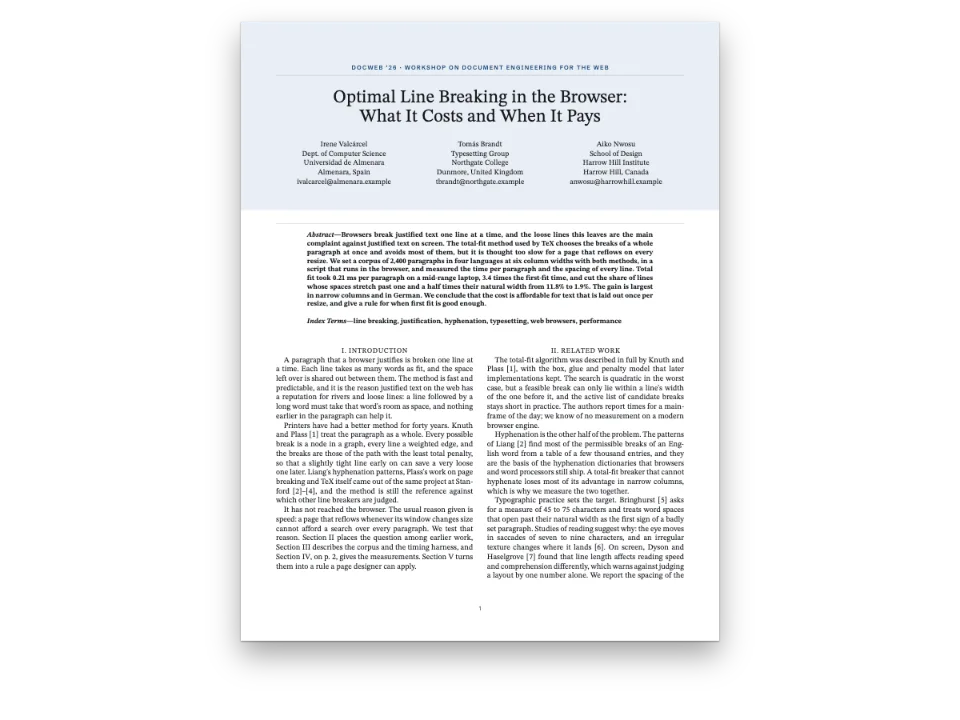
Um artigo curto de pesquisa médica, diagramado como a página de uma revista. Os autores citam com códigos; o Postext imprime números pequenos e elevados no texto e monta no fim a lista numerada de referências, com cada DOI como link.
O que você vai compor
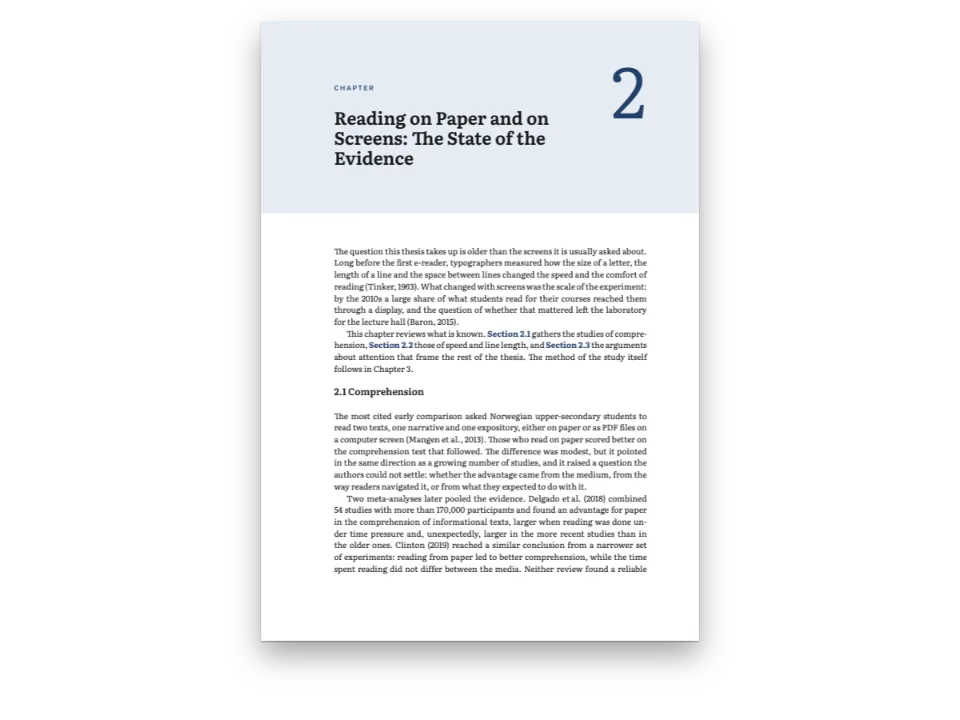
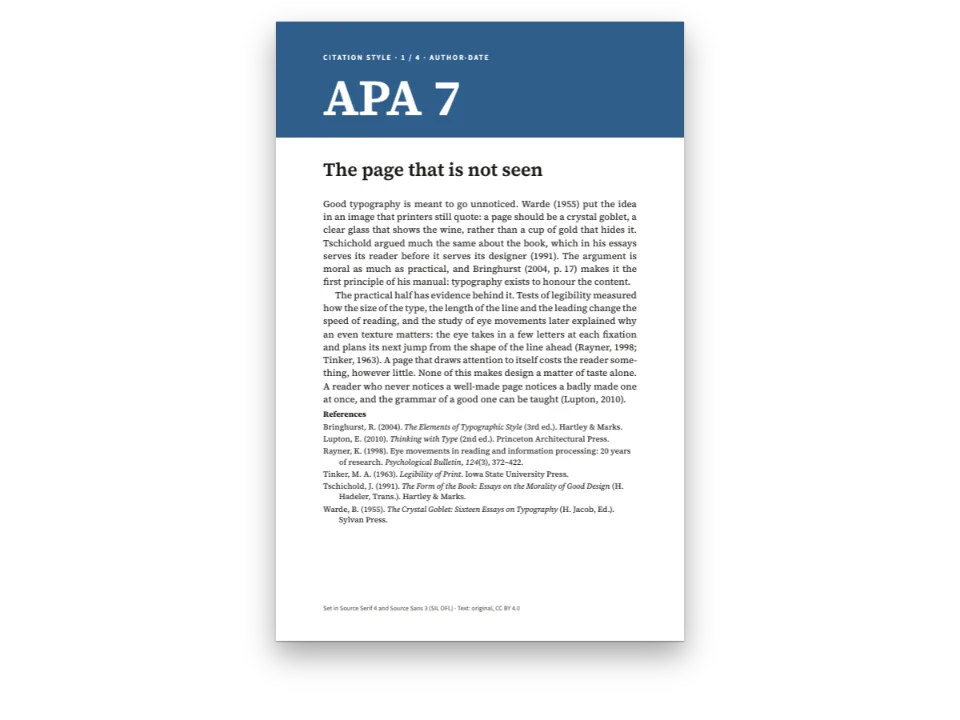
Três páginas de uma revista clínica: um artigo original que relata um ensaio piloto, composto em A4 e duas colunas como o imprimem as revistas que seguem o ICMJE. Uma faixa verde-azulada atravessa o alto da primeira página, sobre o tipo de artigo, um título de três linhas, os autores com números de afiliação elevados e um resumo estruturado sobre um fundo claro. Os autores citam com chaves de BibTeX, e as páginas mostram o que um editor da área médica espera: números pequenos e elevados depois do ponto, obras consecutivas agrupadas como 6–8 e uma lista de referências numerada na forma da NLM, Lancet 2016;387(10022):957–67, que fecha com o DOI de cada obra. No PDF, cada número leva à sua referência e cada DOI abre o artigo. O ensaio é inventado; as onze obras que ele cita são reais.
Esta receita responde a
- Como coloco os números de citação em sobrescrito e transformo os DOIs em links, como fazem as revistas médicas?
- Como cito obras e monto a bibliografia em APA, IEEE ou outro estilo de citação?
A resposta curta
// [@key] prints a raised number in order of first citation. English journals set it after
// the full stop, "control.[@ncdrisc2021]"; Spanish ones before it, "controlada[@ncdrisc2021].".
registerCitationEngine(createCiteprocEngine({ styles: STYLES, locales: LOCALES }));
// elsevier-vancouver is the bundled NLM/Vancouver style (citation-sequence). Two edits bring
// its list to the NLM sample references: "1." instead of "[1]", and the issue after the
// volume, 2015;373(22):2103-16.
const vancouver = STYLES['elsevier-vancouver']
  .replace('<text variable="citation-number" prefix="[" suffix="]"/>',
    '<text variable="citation-number" suffix="."/>')
  .replace('<text variable="volume"/>',
    '<group><text variable="volume"/><text variable="issue" prefix="(" suffix=")"/></group>');
const citations = {
  style: 'custom', customStyle: vancouver,
  marker: 'superscript', collapseRanges: true, // raised 1 and 6–8, not [1] and [6–8]
  link: true, // each number jumps to its reference, in the PDF and on screen
  bibliography: { fontSize: em(0.86), lineHeight: pt(10.4), entrySpacing: pt(1.6),
    labelWidth: mm(2.85), // the width of "1. " at 8 pt: the turnovers line up with the text
    doi: 'link' }, // https://doi.org/… printed whole and clickable
};
Ingredientes
- Funcionalidades
- Citações em um estilo de citaçãoBibliografia a partir das referênciasSobrescritos e subscritosEstilos de títuloAtributos de títuloAberturas desenhadasBoxesCabeços e fóliosEstilo de tabelaEstilo de legendaPosicionamento de figurasPaleta de cores semânticaExportação para PDF
- Também usa
- Citações que posicionam as figurasFigura e Tabela no seu idiomaSair da grade de propósitoCabeços por tipo de páginaFontes incorporadas ao PDFTipos de recurso personalizadosFiguras e tabelas como recursosElementos pré-textuais em romanosTabelas a partir de dadosCapítulos sem número
- Tipografia
- PT Serif, Fira Sans, Fira Sans Condensed (SIL OFL 1.1)
- Materiais
- Nenhum: todas as imagens são desenhadas em código
Preparo
#1 · Vancouver, sobrescrito e com links
O código é a resposta curta acima. Dos estilos que vêm com o Postext, elsevier-vancouver é o que segue o Citing Medicine da NLM (ordem de citação, autores como Ettehad D, Emdin CA, seis nomes e depois et al., títulos de revista abreviados), e por isso é o arquivo de onde partir. Duas substituições de texto aproximam a lista das referências de exemplo da NLM: o número aparece como 1. em vez de [1], e o fascículo vem depois do volume. marker: 'superscript' compõe as citações como números elevados, escreva o estilo o que escrever, e doi: 'link' mantém cada endereço https://doi.org/ como link. O estilo AMA também vem incluído e eleva os números por conta própria, mas a lista dele difere da Vancouver na pontuação e nos intervalos de páginas.
#2 · Um bloco de título sobre as duas colunas
const text = (id, content, family, size, extra) => ({ kind: 'text', id, content, align: 'left',
  fontFamily: family, fontSize: pt(size), color: col('ink'), overflow: 'wrap', ...extra });
const at = (to, edge, x, y, width) => ({ anchor: { to, edge }, offset: { x: mm(x), y: mm(y) },
  ...(width && { size: { width: mm(width), height: 'auto' } }) });
const caps = { fontFamily: COND, fontWeight: 600, letterSpacing: pt(1.3),
  textTransform: 'uppercase' };
const titleBlock = { enabled: true,
  minHeight: mm(62), // the abstract and the text start under the note, on both columns
  slot: { elements: [
    { kind: 'box', id: 'band', style: { backgroundColor: col('accent') },
      placement: { anchor: { to: 'page', edge: 'top-left' },
        size: { width: 'fill', height: mm(15) } } },
    text('journal', t({ en: 'Almenara Medical Journal', es: 'Revista Médica de Almenara' }),
      COND, 9.5, { ...caps, color: col('paper'), placement: at('page', 'top-left', INNER, 6) }),
    text('issue', '2026 · 14(3) · 181–183', COND, 9.5, { ...caps, color: col('paper'),
      align: 'right', placement: at('page', 'top-right', -OUTER, 6, 60) }),
    text('kind', '{attr.kind}', COND, 9, { ...caps, color: col('accent'),
      placement: at('container', 'top-left', 0, 0, MEASURE) }),
    text('title', '{titleText}', SANS, 19.5, { fontWeight: 600, lineHeight: 1.16,
      placement: at('#kind', 'below', 0, 3, MEASURE - 20) }),
    text('authors', '{attr.authors}', SERIF, 10.5, { inlineMarks: true, // ^1^ → ¹
      placement: at('#title', 'below', 0, 4.5, MEASURE) }),
    text('affiliations', '{attr.affiliations}', SANS, 7.4, { inlineMarks: true,
      lineHeight: 1.35, color: col('muted'), placement: at('#authors', 'below', 0, 2, MEASURE) }),
    { kind: 'rule', id: 'rule', thickness: pt(0.5), color: col('rule'),
      placement: at('#affiliations', 'below', 0, 3, MEASURE) },
    text('note', '{attr.note}', SANS, 7.4, { fontStyle: 'italic', color: col('muted'),
      placement: at('#rule', 'below', 0, 1.6, MEASURE) }),
  ] },
};
O título do artigo é o único título de nível 1, com o estilo article, que ocupa a largura da página e o desenha com o seu design. O tipo de artigo, os autores, as afiliações e a nota vêm de atributos do título. inlineMarks transforma o ^1^ do atributo num número de afiliação elevado, e o \n das afiliações abre uma linha para cada instituição. A faixa é ancorada ao refile, e assim chega até a borda superior do papel.
#3 · Um resumo estruturado e um boxe de pontos-chave
const box = (id, bold, more) => ({ id, border: { enabled: false }, snapToGrid: false,
  marginTop: pt(LEAD), marginBottom: pt(LEAD),
  titleStyle: { ...caps, fontSize: pt(8.5), color: col('accent') }, // run-in labels in bold
  body: { fontFamily: SANS, fontSize: pt(8.3), lineHeight: pt(11.2), textAlign: 'left',
    firstLineIndent: pt(0), paragraphSpacing: true, boldColor: col(bold) }, ...more });
const calloutStyles = [
  box('abstract', 'accent', { background: col('tint'), padding: mm(3.5), marginTop: pt(0) }),
  box('keypoints', 'ink', { backgroundEnabled: false, padding: { top: mm(2.5), right: mm(0),
    bottom: mm(1), left: mm(0) }, stripe: { enabled: true, side: 'top', width: pt(2.5),
    color: col('accent') } }),
];
Os dois boxes compartilham um estilo de texto: Fira Sans em 8,3 pt com rótulos em negrito no começo do parágrafo, a voz que o leitor espera no material de síntese. O resumo tem um fundo de cor e os rótulos em verde-azulado; os pontos-chave ficam sob um filete de 2,5 pt, com os rótulos em preto. snapToGrid: false mantém o preenchimento exato, de modo que o boxe do resumo se ajusta ao texto.
#4 · A Tabela 1 e a Figura 1 no alto de uma coluna
const resources = () => [
  { id: 'tbl-baseline', typeId: 'table', kind: 'table', createdAt: 0, updatedAt: 0,
    placement: { position: 'top' },
    caption: t({ en: 'Characteristics of the patients at baseline.',
      es: 'Características de los pacientes al inicio.' }),
    note: t({ en: 'Values are mean (SD) or number (%). BP, blood pressure, in mm Hg.',
      es: 'Valores en media (DE) o número (%). PA, presión arterial, en mm Hg.' }),
    table: { model: { headerRowCount: 1, columnWidths: [2.2, 1.1, 1.1],
      rows: parseTSV(baseline).rows.map((row, r) => row.map(({ content }, c) => ({ content,
        ...(r === 0 && { isHeader: true }), ...(c > 0 && { align: 'center' }) }))) } } },
  { id: 'fig-home', typeId: 'figure', kind: 'svg', createdAt: 0, updatedAt: 0,
    placement: { position: 'top' }, svg: { fileId: 'home.svg', width: 850, height: 520 },
    caption: t({ en: 'Mean home systolic pressure by week in the telemonitoring group, with its '
      + '95% confidence interval. The dashed line is the home target of 135\u00a0mm\u00a0Hg.',
    es: 'Presión sistólica domiciliaria media por semana en el grupo de telemonitorización, con '
      + 'su intervalo de confianza del 95\u00a0%. La línea discontinua es el objetivo de '
      + '135\u00a0mm\u00a0Hg.' }),
    altText: t({ en: 'A line falling from 158 mm Hg in week 1 to 135 mm Hg in week 12.',
      es: 'Una línea que baja de 158 mm Hg en la semana 1 a 135 mm Hg en la semana 12.' }) },
];
A tabela é lida de um texto separado por tabulações, como uma planilha o exporta, e a linha de cabeçalho é preenchida em verde-azulado, com rótulos brancos em negrito. Os dois recursos flutuam até o alto de uma coluna depois do parágrafo que os cita. Com shortLabel igual ao nome completo do tipo, :ref imprime (Table 1), como as revistas escrevem, e o numbered: false do título deixa a contagem em 1 e não em 1.1.
const palette = { ink: '#1a1d21', accent: '#0d5c63', tint: '#e5eff0', rule: '#9fb4b6',
  muted: '#566065', paper: '#ffffff' };
const col = (id) => ({ hex: palette[id], model: 'hex', paletteId: id });
const colorPalette = Object.entries({ ...palette, 'main-color': palette.accent })
  .map(([id, hex]) => ({ id, name: id, value: { hex, model: 'hex' } }));
A receita completa
// ═══ Postext Cookbook · Nº 095 · A medical article in Vancouver style ══════════════ // https://postext.dev/en/cookbook/medical-article-vancouver // Code: MIT · Text: original (CC BY 4.0) · Chart: generated in code (CC BY 4.0) // Fonts: PT Serif, Fira Sans, Fira Sans Condensed (SIL OFL 1.1) · Needs postext ≥ 1.12.1 import { buildDocument, renderPageToCanvas, clearMeasurementCache, registerCitationEngine, registerResourceImage, defaultResourceTypes, parseTSV, } from 'https://esm.sh/postext'; import { renderToPdf, decompressWoff2 } from 'https://esm.sh/postext-pdf'; import { createCiteprocEngine, STYLES, LOCALES } from 'https://esm.sh/postext-citeproc'; const LANG = 'en'; // @lang: the language of the sample document ('en' | 'es') const RECIPE = 'medical-article-vancouver'; // ─── 1 · Design ───────────────────────────────────────────────────────────── // #region palette: black text, one clinical teal for the journal's own marks const palette = { ink: '#1a1d21', accent: '#0d5c63', tint: '#e5eff0', rule: '#9fb4b6', muted: '#566065', paper: '#ffffff' }; const col = (id) => ({ hex: palette[id], model: 'hex', paletteId: id }); const colorPalette = Object.entries({ ...palette, 'main-color': palette.accent }) .map(([id, hex]) => ({ id, name: id, value: { hex, model: 'hex' } })); // #endregion const [SERIF, SANS, COND] = ['PT Serif', 'Fira Sans', 'Fira Sans Condensed']; const [TRIM_W, TRIM_H, TOP, BOTTOM, INNER, OUTER, GUTTER] = [210, 297, 24, 22, 17, 17, 6]; const MEASURE = TRIM_W - INNER - OUTER; const LEAD = 12.8; // pt: 9.3 pt type, as journals set two columns of A4 // #region answer: Vancouver numbers as superscripts, a "1." list and DOIs that are links // [@key] prints a raised number in order of first citation. English journals set it after // the full stop, "control.[@ncdrisc2021]"; Spanish ones before it, "controlada[@ncdrisc2021].". registerCitationEngine(createCiteprocEngine({ styles: STYLES, locales: LOCALES })); // elsevier-vancouver is the bundled NLM/Vancouver style (citation-sequence). Two edits bring // its list to the NLM sample references: "1." instead of "[1]", and the issue after the // volume, 2015;373(22):2103-16. const vancouver = STYLES['elsevier-vancouver'] .replace('<text variable="citation-number" prefix="[" suffix="]"/>', '<text variable="citation-number" suffix="."/>') .replace('<text variable="volume"/>', '<group><text variable="volume"/><text variable="issue" prefix="(" suffix=")"/></group>'); const citations = { style: 'custom', customStyle: vancouver, marker: 'superscript', collapseRanges: true, // raised 1 and 6–8, not [1] and [6–8] link: true, // each number jumps to its reference, in the PDF and on screen bibliography: { fontSize: em(0.86), lineHeight: pt(10.4), entrySpacing: pt(1.6), labelWidth: mm(2.85), // the width of "1. " at 8 pt: the turnovers line up with the text doi: 'link' }, // https://doi.org/… printed whole and clickable }; // #endregion // #region title: the masthead band, article type, title, authors and affiliations const text = (id, content, family, size, extra) => ({ kind: 'text', id, content, align: 'left', fontFamily: family, fontSize: pt(size), color: col('ink'), overflow: 'wrap', ...extra }); const at = (to, edge, x, y, width) => ({ anchor: { to, edge }, offset: { x: mm(x), y: mm(y) }, ...(width && { size: { width: mm(width), height: 'auto' } }) }); const caps = { fontFamily: COND, fontWeight: 600, letterSpacing: pt(1.3), textTransform: 'uppercase' }; const titleBlock = { enabled: true, minHeight: mm(62), // the abstract and the text start under the note, on both columns slot: { elements: [ { kind: 'box', id: 'band', style: { backgroundColor: col('accent') }, placement: { anchor: { to: 'page', edge: 'top-left' }, size: { width: 'fill', height: mm(15) } } }, text('journal', t({ en: 'Almenara Medical Journal', es: 'Revista Médica de Almenara' }), COND, 9.5, { ...caps, color: col('paper'), placement: at('page', 'top-left', INNER, 6) }), text('issue', '2026 · 14(3) · 181–183', COND, 9.5, { ...caps, color: col('paper'), align: 'right', placement: at('page', 'top-right', -OUTER, 6, 60) }), text('kind', '{attr.kind}', COND, 9, { ...caps, color: col('accent'), placement: at('container', 'top-left', 0, 0, MEASURE) }), text('title', '{titleText}', SANS, 19.5, { fontWeight: 600, lineHeight: 1.16, placement: at('#kind', 'below', 0, 3, MEASURE - 20) }), text('authors', '{attr.authors}', SERIF, 10.5, { inlineMarks: true, // ^1^ → ¹ placement: at('#title', 'below', 0, 4.5, MEASURE) }), text('affiliations', '{attr.affiliations}', SANS, 7.4, { inlineMarks: true, lineHeight: 1.35, color: col('muted'), placement: at('#authors', 'below', 0, 2, MEASURE) }), { kind: 'rule', id: 'rule', thickness: pt(0.5), color: col('rule'), placement: at('#affiliations', 'below', 0, 3, MEASURE) }, text('note', '{attr.note}', SANS, 7.4, { fontStyle: 'italic', color: col('muted'), placement: at('#rule', 'below', 0, 1.6, MEASURE) }), ] }, }; // #endregion // #region abstract: the structured abstract in a teal tint, the key points under a teal stripe const box = (id, bold, more) => ({ id, border: { enabled: false }, snapToGrid: false, marginTop: pt(LEAD), marginBottom: pt(LEAD), titleStyle: { ...caps, fontSize: pt(8.5), color: col('accent') }, // run-in labels in bold body: { fontFamily: SANS, fontSize: pt(8.3), lineHeight: pt(11.2), textAlign: 'left', firstLineIndent: pt(0), paragraphSpacing: true, boldColor: col(bold) }, ...more }); const calloutStyles = [ box('abstract', 'accent', { background: col('tint'), padding: mm(3.5), marginTop: pt(0) }), box('keypoints', 'ink', { backgroundEnabled: false, padding: { top: mm(2.5), right: mm(0), bottom: mm(1), left: mm(0) }, stripe: { enabled: true, side: 'top', width: pt(2.5), color: col('accent') } }), ]; // #endregion const head = (id, content, parity, edge, x, extra) => text(id, content, COND, 8, { parity, pages: 'body', fontWeight: 500, letterSpacing: pt(0.4), color: col('muted'), overflow: 'clip', placement: at('page', edge, x, 13, 100), ...extra }); const folio = { fontWeight: 600, color: col('accent') }; const right = { align: 'right' }; // anchored top-right, an element ends at its offset const header = { elements: [ head('v-folio', '{pageNumber}', 'even', 'top-left', OUTER, folio), head('v-title', t({ en: 'Almenara Med J 2026;14(3)', es: 'Rev Med Almenara 2026;14(3)' }), 'even', 'top-left', OUTER + 9), head('r-title', t({ en: 'Ortega Ramos et al. · Telemonitoring after severe hypertension', es: 'Ortega Ramos et al. · Telemonitorización tras una crisis hipertensiva' }), 'odd', 'top-right', -OUTER - 9, right), head('r-folio', '{pageNumber}', 'odd', 'top-right', -OUTER, { ...folio, ...right }), ] }; const footer = { elements: [head('drop-folio', '{pageNumber}', 'all', 'bottom-right', -OUTER, { ...folio, ...right, pages: 'opener', placement: at('page', 'bottom-right', -OUTER, -13, 10) }), ] }; const sans = (size, weight) => ({ fontFamily: SANS, fontSize: pt(size), fontWeight: weight }); const config = () => ({ // a factory: the engine caches resolved configs per object locale: t({ en: 'en-gb', es: 'es' }), // "(Table 1)" in the text, not "Tab. 1"; Table 1, not 1.1, as the title is numbered: false resourceTypes: defaultResourceTypes(LANG).map((type) => ({ ...type, shortLabel: type.name, ...(type.id === 'table' && { captionStyle: { position: 'above' } }) })), colorPalette, citations, calloutStyles, header, footer, headingStyles: [ // No header: [] here, it would hold for the whole section; pages: 'body' spares page 1 { id: 'article', numbered: false, span: 'page', advancedDesign: titleBlock }, { id: 'back', numbered: false, fontSize: pt(9.5), color: col('ink') }, ], page: { sizePreset: 'custom', width: mm(TRIM_W), height: mm(TRIM_H), dpi: 150, pageNumbering: { startAt: 181 }, // the article opens on page 181 of the issue margins: { top: mm(TOP), bottom: mm(BOTTOM), left: mm(INNER), right: mm(OUTER), mirror: true } }, layout: { layoutType: 'double', gutterWidth: mm(GUTTER) }, bodyText: { fontFamily: SERIF, fontSize: pt(9.3), lineHeight: pt(LEAD), color: col('ink'), boldColor: col('ink'), italicColor: col('ink'), referenceColor: col('ink'), referenceBold: false, textAlign: 'justify', firstLineIndent: mm(4), indentAfterHeading: false, hyphenation: { enabled: true }, optimalLineBreaking: true, avoidWidows: true, avoidOrphans: true, avoidRunts: true }, headings: { fontFamily: SANS, color: col('accent'), fontWeight: 600, levels: [ { level: 1, breakBefore: { enabled: true, parity: 'any' } }, // gotcha: headings-drop-h1-break { level: 2, ...sans(11.5, 600), lineHeight: pt(LEAD), marginTop: pt(LEAD), marginBottom: pt(0) }, // a line above, the text straight under it { level: 3, ...sans(9.3, 600), color: col('ink'), lineHeight: pt(LEAD), marginTop: pt(LEAD / 2), marginBottom: pt(0) }, ] }, tableStyle: { rules: 'horizontal', borderColor: col('rule'), borderWidth: pt(0.5), headerBackground: col('accent'), headerColor: col('paper'), headerBold: true, headerFontFamily: SANS, headerFontSize: pt(7.6), bodyFontFamily: SANS, bodyFontSize: pt(7.6), bodyColor: col('ink'), cellPadding: mm(1.2) }, captionStyle: { fontFamily: SANS, fontSize: pt(7.8), color: col('ink'), labelBold: true, labelColor: col('accent'), gap: mm(2), note: { fontSize: pt(6.8), color: col('muted') } }, }); // ─── 2 · Content ──────────────────────────────────────────────────────────── const markdown = String.raw`---Amostra em Markdown · 129 linhas · content.en.md
title: "Pharmacist-led home blood pressure telemonitoring after an emergency visit for severe hypertension" author: "Lucía Ortega Ramos, Daniel Achterberg, Marta Quiroga Gil and Samuel Okafor" --- # Pharmacist-led home blood pressure telemonitoring after an emergency visit for severe hypertension: a pilot randomised trial {style="article" kind="Original article" authors="Lucía Ortega Ramos^1^, Daniel Achterberg^2^, Marta Quiroga Gil^1^, Samuel Okafor^3^" affiliations="^1^ Department of Internal Medicine, Hospital General de Almenara\n^2^ Community Pharmacy Network, Almenara Health Area\n^3^ Primary Care Research Unit, Almenara Health Area" note="Illustrative article written for the Postext Cookbook: the trial, its authors and its data are invented. The works cited are real."} :::callout{type="abstract" title="Abstract"} **Background** Patients discharged from the emergency department after a visit for severe hypertension often wait weeks for a review, and many return with the same readings. **Methods** In this pilot trial, 120 adults seen for a systolic blood pressure of 180 mm Hg or more were randomised to home telemonitoring with medication titration by a community pharmacist, or to usual care. The primary outcome was office systolic pressure at 12 weeks. **Results** At 12 weeks, mean systolic pressure was 136.2 mm Hg with telemonitoring and 145.9 mm Hg with usual care (adjusted difference −9.4 mm Hg; 95% CI −13.8 to −5.0). Control below 140/90 mm Hg was reached by 63% and 37% of patients. **Conclusions** Telemonitoring led by pharmacists lowered blood pressure in the weeks after an emergency visit. A larger trial with cardiovascular outcomes is justified. **Keywords** hypertension; telemonitoring; pharmacists; emergency department; self-monitoring ::: ## Introduction High blood pressure is the leading modifiable cause of cardiovascular death. In 2019 about 1.28 billion adults aged 30 to 79 years had hypertension, and fewer than a quarter of them had it under control.[@ncdrisc2021] Each reduction of 10 mm Hg in systolic pressure lowers the risk of major cardiovascular events by about a fifth,[@ettehad2016] and a target below 120 mm Hg prevented more events than one below 140 mm Hg in patients at high risk.[@sprint2015] European guidelines ask for control within three months of starting treatment,[@williams2018] and American ones for a review every month until it is reached.[@whelton2018] Patients who come to the emergency department with severe hypertension and no acute organ damage are a group the guidelines say little about. Most are sent home with a prescription and a referral to their general practitioner, and the first review may be weeks away. Self-monitoring of blood pressure lowers it when it is combined with a plan for acting on the readings,[@tucker2017; @mcmanus2014; @mcmanus2018] and @margolis2013 showed that pharmacists who adjusted treatment from transmitted home readings improved control for a year in primary care. Whether the same model works in the weeks after an emergency visit has not been tested. We designed a pilot trial to estimate the effect of pharmacist-led telemonitoring on blood pressure at 12 weeks in this group, and to measure recruitment, retention and safety for a larger trial. :::callout{type="keypoints" title="Key points"} **What is already known** Self-monitoring lowers blood pressure when someone acts on the readings, and pharmacists who manage telemonitored readings improve control in primary care. **What this study adds** After an emergency visit for severe hypertension, telemonitoring with titration by a community pharmacist lowered office systolic pressure by 9.4 mm Hg more than usual care at 12 weeks. ::: ## Methods ### Design and participants This was a parallel-group, open-label pilot trial with 1:1 allocation, reported according to the CONSORT statement.[@schulz2010] We enrolled adults aged 18 to 80 years discharged from the emergency department of a district general hospital after a visit with a systolic pressure of 180 mm Hg or more, with no acute organ damage, and living within reach of a participating community pharmacy. Patients with secondary hypertension, an estimated glomerular filtration rate below 30 mL/min/1.73 m², pregnancy or a life expectancy under one year were excluded. ### Interventions Each patient in the telemonitoring group received a validated monitor for the upper arm, which sent every reading to a secure server. They measured twice in the morning and twice in the evening on three days a week. A community pharmacist reviewed the readings weekly and changed treatment by a written protocol agreed with the general practitioners of the area, aiming at a home mean below 135/85 mm Hg. Patients in the usual-care group were referred to their general practitioner, as is routine. ### Outcomes and analysis The primary outcome was the mean of the second and third of three office systolic readings at 12 weeks, taken by a nurse who did not know the allocation. Secondary outcomes were control below 140/90 mm Hg, return visits to the emergency department and adverse events. Data were collected in REDCap.[@harris2009] The difference between groups was estimated by linear regression adjusted for baseline systolic pressure. With 60 patients per group, the trial had 80% power to detect a difference of 8 mm Hg, assuming a standard deviation of 15 mm Hg and 10% loss to follow-up. ## Results Between January and June, 163 patients were screened and 120 were randomised; 57 in the telemonitoring group and 57 in the usual-care group attended the 12-week visit. The groups were similar at baseline (:ref{id="tbl-baseline"}). Patients in the telemonitoring group sent a median of 31 sets of readings, and the pharmacists made a median of two changes to treatment per patient. Home systolic pressure in the telemonitoring group fell most in the first four weeks, and by week 10 it was close to the target (:ref{id="fig-home"}). At 12 weeks, the mean office systolic pressure was 136.2 mm Hg with telemonitoring and 145.9 mm Hg with usual care, an adjusted difference of −9.4 mm Hg (95% CI −13.8 to −5.0). Control below 140/90 mm Hg was reached by 36 of 57 patients (63%) with telemonitoring and by 21 of 57 (37%) with usual care. Three patients in the telemonitoring group and nine in the usual-care group returned to the emergency department with raised blood pressure. Two patients in the telemonitoring group reported dizziness on standing after a dose increase, and both recovered after the dose was reduced. No serious adverse events were related to the intervention. ## Discussion In this pilot trial, telemonitoring with titration by a community pharmacist lowered office systolic pressure by about 9 mm Hg more than usual care in the 12 weeks after an emergency visit for severe hypertension. The size of the effect is close to the 10 mm Hg that meta-analysis associates with a fifth fewer cardiovascular events,[@ettehad2016] and it was reached within the three months that European guidelines allow.[@williams2018] The result agrees with trials of self-monitoring in primary care, where the benefit came from acting on the readings rather than from taking them.[@tucker2017] Pharmacists were well placed to act. They saw the readings every week, they knew the patients from collecting their prescriptions, and the protocol let them change treatment without waiting for an appointment, as the pharmacists did in the trial by @margolis2013 in Minnesota. The trial has limitations. It was small and open-label, it was run in one health area, and 12 weeks is too short to show an effect on events. The office readings were taken by a nurse blind to the allocation, which limits the bias that an open design invites. Fewer return visits to the emergency department in the telemonitoring group are encouraging, but the numbers are too small for a conclusion. A multicentre trial powered for return visits and cardiovascular events is the next step. The rates of recruitment and retention seen here, three in four patients screened and 95% retained, suggest that it is feasible. ## Article information {style="back"} **Funding** None. **Competing interests** None declared. **Note** Set in PT Serif, Fira Sans and Fira Sans Condensed (SIL OFL). Text: original, CC BY 4.0. The study, its authors, institutions and results are invented for this example; the references are to real published works. ## References {style="back"} :::bibliography{title=""} :::references{format=bibtex} @article{ncdrisc2021, author = {{NCD Risk Factor Collaboration (NCD-RisC)}}, title = {Worldwide trends in hypertension prevalence and progress in treatment and control from 1990 to 2019: a pooled analysis of 1201 population-representative studies with 104 million participants}, journal = {Lancet}, year = 2021, volume = 398, number = 10304, pages = {957--980}, doi = {10.1016/S0140-6736(21)01330-1}} @article{ettehad2016, author = {Ettehad, Dena and Emdin, Connor A. and Kiran, Amit and Anderson, Simon G. and Callender, Thomas and Emberson, Jonathan and Chalmers, John and Rodgers, Anthony and Rahimi, Kazem}, title = {Blood pressure lowering for prevention of cardiovascular disease and death: a systematic review and meta-analysis}, journal = {Lancet}, year = 2016, volume = 387, number = 10022, pages = {957--967}, doi = {10.1016/S0140-6736(15)01225-8}} @article{sprint2015, author = {{SPRINT Research Group}}, title = {A randomized trial of intensive versus standard blood-pressure control}, journal = {N Engl J Med}, year = 2015, volume = 373, number = 22, pages = {2103--2116}, doi = {10.1056/NEJMoa1511939}} @article{whelton2018, author = {Whelton, Paul K. and Carey, Robert M. and Aronow, Wilbert S. and Casey, Donald E. and Collins, Karen J. and Dennison Himmelfarb, Cheryl and DePalma, Sondra M.}, title = {2017 {ACC/AHA/AAPA/ABC/ACPM/AGS/APhA/ASH/ASPC/NMA/PCNA} guideline for the prevention, detection, evaluation, and management of high blood pressure in adults}, journal = {Hypertension}, year = 2018, volume = 71, number = 6, pages = {e13--e115}, doi = {10.1161/HYP.0000000000000065}} @article{williams2018, author = {Williams, Bryan and Mancia, Giuseppe and Spiering, Wilko and Agabiti Rosei, Enrico and Azizi, Michel and Burnier, Michel and Clement, Denis L.}, title = {2018 {ESC/ESH} guidelines for the management of arterial hypertension}, journal = {Eur Heart J}, year = 2018, volume = 39, number = 33, pages = {3021--3104}, doi = {10.1093/eurheartj/ehy339}} @article{tucker2017, author = {Tucker, Katherine L. and Sheppard, James P. and Stevens, Richard and Bosworth, Hayden B. and Bove, Alfred and Bray, Emma P. and Earle, Kenneth}, title = {Self-monitoring of blood pressure in hypertension: a systematic review and individual patient data meta-analysis}, journal = {PLoS Med}, year = 2017, volume = 14, number = 9, pages = {e1002389}, doi = {10.1371/journal.pmed.1002389}} @article{mcmanus2014, author = {McManus, Richard J. and Mant, Jonathan and Haque, M. Sayeed and Bray, Emma P. and Bryan, Stirling and Greenfield, Sheila M. and Jones, Miren I.}, title = {Effect of self-monitoring and medication self-titration on systolic blood pressure in hypertensive patients at high risk of cardiovascular disease: the {TASMIN-SR} randomized clinical trial}, journal = {JAMA}, year = 2014, volume = 312, number = 8, pages = {799--808}, doi = {10.1001/jama.2014.10057}} @article{mcmanus2018, author = {McManus, Richard J. and Mant, Jonathan and Franssen, Marloes and Nickless, Alecia and Schwartz, Claire and Hodgkinson, James and Bradburn, Peter}, title = {Efficacy of self-monitored blood pressure, with or without telemonitoring, for titration of antihypertensive medication ({TASMINH4}): an unmasked randomised controlled trial}, journal = {Lancet}, year = 2018, volume = 391, number = 10124, pages = {949--959}, doi = {10.1016/S0140-6736(18)30309-X}} @article{margolis2013, author = {Margolis, Karen L. and Asche, Stephen E. and Bergdall, Anna R. and Dehmer, Steven P. and Groen, Sarah E. and Kadrmas, Holly M. and Kerby, Tessa J.}, title = {Effect of home blood pressure telemonitoring and pharmacist management on blood pressure control: a cluster randomized clinical trial}, journal = {JAMA}, year = 2013, volume = 310, number = 1, pages = {46--56}, doi = {10.1001/jama.2013.6549}} @article{schulz2010, author = {Schulz, Kenneth F. and Altman, Douglas G. and Moher, David and {CONSORT Group}}, title = {{CONSORT} 2010 statement: updated guidelines for reporting parallel group randomised trials}, journal = {BMJ}, year = 2010, volume = 340, pages = {c332}, doi = {10.1136/bmj.c332}} @article{harris2009, author = {Harris, Paul A. and Taylor, Robert and Thielke, Robert and Payne, Jonathon and Gonzalez, Nathaniel and Conde, Jose G.}, title = {Research electronic data capture ({REDCap}): a metadata-driven methodology and workflow process for providing translational research informatics support}, journal = {J Biomed Inform}, year = 2009, volume = 42, number = 2, pages = {377--381}, doi = {10.1016/j.jbi.2008.08.010}} :::`; const baseline = String.raw`Characteristic Telemonitoring \\ (n = 60) Usual care \\ (n = 60)Amostra em Markdown · 10 linhas · content.baseline.en.md
Age, years 58.7 (11.2) 60.1 (10.4) Women 27 (45) 29 (48) Systolic BP at the emergency visit 192.4 (10.8) 190.9 (9.6) Systolic BP at randomisation 161.3 (13.5) 160.2 (12.9) Diastolic BP at randomisation 94.8 (10.1) 93.6 (9.7) Diabetes 14 (23) 12 (20) Chronic kidney disease 6 (10) 8 (13) Antihypertensive drugs, number 1.4 (1.0) 1.5 (1.1) No treatment before the visit 19 (32) 17 (28) Home monitor before the trial 11 (18) 13 (22)`; // TSV: characteristic, telemonitoring, usual care // #region resources: Table 1 from the TSV, Figure 1 drawn from the weekly means const resources = () => [ { id: 'tbl-baseline', typeId: 'table', kind: 'table', createdAt: 0, updatedAt: 0, placement: { position: 'top' }, caption: t({ en: 'Characteristics of the patients at baseline.', es: 'Características de los pacientes al inicio.' }), note: t({ en: 'Values are mean (SD) or number (%). BP, blood pressure, in mm Hg.', es: 'Valores en media (DE) o número (%). PA, presión arterial, en mm Hg.' }), table: { model: { headerRowCount: 1, columnWidths: [2.2, 1.1, 1.1], rows: parseTSV(baseline).rows.map((row, r) => row.map(({ content }, c) => ({ content, ...(r === 0 && { isHeader: true }), ...(c > 0 && { align: 'center' }) }))) } } }, { id: 'fig-home', typeId: 'figure', kind: 'svg', createdAt: 0, updatedAt: 0, placement: { position: 'top' }, svg: { fileId: 'home.svg', width: 850, height: 520 }, caption: t({ en: 'Mean home systolic pressure by week in the telemonitoring group, with its ' + '95% confidence interval. The dashed line is the home target of 135\u00a0mm\u00a0Hg.', es: 'Presión sistólica domiciliaria media por semana en el grupo de telemonitorización, con ' + 'su intervalo de confianza del 95\u00a0%. La línea discontinua es el objetivo de ' + '135\u00a0mm\u00a0Hg.' }), altText: t({ en: 'A line falling from 158 mm Hg in week 1 to 135 mm Hg in week 12.', es: 'Una línea que baja de 158 mm Hg en la semana 1 a 135 mm Hg en la semana 12.' }) }, ]; // #endregion // #region art: the weekly chart, its labels set in Fira Sans carried inside the SVG const HOME = [158.4, 153.1, 149.6, 146.2, 143.8, 141.5, 139.9, 138.6, 137.4, 136.1, 135.3, 134.6]; const n2 = (v) => +v.toFixed(2); // An SVG drawn as an image cannot see the page's web fonts (gotcha: svg-no-webfonts), so the // chart carries its face inline, as a data URL of the Fontsource file. async function inlineFace(family, weight) { const id = family.toLowerCase().replace(/\s+/g, '-'); const url = `https://cdn.jsdelivr.net/npm/@fontsource/${id}@5/files/${id}-latin-${weight}` + '-normal.woff2'; const bytes = new Uint8Array(await (await fetch(url)).arrayBuffer()); let bin = ''; for (const b of bytes) bin += String.fromCharCode(b); return `<style>@font-face{font-family:F;src:url(data:font/woff2;base64,${btoa(bin)}) ` + `format('woff2')}text{font-family:F}</style>`; } function homeChart(face) { // 85 × 52 mm: the width of a column const [W, H, L, R, T, B] = [85, 52, 11, 3, 4, 42]; const x = (week) => L + ((week - 1) / 11) * (W - L - R); const y = (v) => B - ((v - 125) / 40) * (B - T); // 125 to 165 mm Hg const label = (tx, ty, s, anchor = 'middle') => `<text x="${n2(tx)}" y="${n2(ty)}" ` + `font-size="2.7" text-anchor="${anchor}" fill="${palette.muted}">${s}</text>`; let grid = ''; for (const v of [130, 140, 150, 160]) { grid += `<path d="M${L} ${n2(y(v))}H${W - R}" stroke="${palette.rule}" stroke-width="0.2"/>` + label(L - 1.6, y(v) + 0.9, v, 'end'); } for (let w = 1; w <= 12; w++) grid += label(x(w), B + 4, w); const half = (i) => 4.6 - i * 0.18; // the interval narrows as readings accumulate const upper = HOME.map((v, i) => `${n2(x(i + 1))} ${n2(y(v + half(i)))}`); const lower = HOME.map((v, i) => `${n2(x(i + 1))} ${n2(y(v - half(i)))}`).reverse(); const line = HOME.map((v, i) => `${n2(x(i + 1))} ${n2(y(v))}`).join('L'); const dots = HOME.map((v, i) => `<circle cx="${n2(x(i + 1))}" cy="${n2(y(v))}" r="0.75" ` + `fill="${palette.accent}"/>`).join(''); const dash = [0, 1, 2, 3, 4, 5, 6, 7, 8, 9, 10, 11, 12, 13, 14, 15, 16, 17].map((k) => { const x0 = L + k * 4; return x0 + 2 > W - R ? '' : `M${x0} ${n2(y(135))}h2`; }).join(''); return `<svg xmlns="http://www.w3.org/2000/svg" width="850" height="520" ` + `viewBox="0 0 ${W} ${H}">${face}${grid}` + `<path d="M${upper.join('L')}L${lower.join('L')}Z" fill="${palette.tint}"/>` + `<path d="${dash}" stroke="${palette.ink}" stroke-width="0.3"/>` + `<path d="M${L} ${B}H${W - R}" stroke="${palette.ink}" stroke-width="0.35"/>` + `<path d="M${line}" fill="none" stroke="${palette.accent}" stroke-width="0.6"/>${dots}` + label(L - 1.6, T - 1.2, 'mm Hg', 'end') + label((L + W - R) / 2, H - 0.8, t({ en: 'Week', es: 'Semana' })) + '</svg>'; } // #endregion // ─── 3 · Fonts ────────────────────────────────────────────────────────────── const FONTS = { 'PT Serif': ['400', '400i', '700', '700i'], 'Fira Sans': ['400', '400i', '600'], 'Fira Sans Condensed': ['500', '600'] }; // ─── 4 · Build & show ─────────────────────────────────────────────────────── await loadFonts(FONTS, markdown); await loadSvg('home.svg', homeChart(await inlineFace(SANS, 400))); const content = { markdown, resources: resources() }; const doc = await buildWithFonts(() => buildDocument(content, config()), markdown); const title = t({ en: 'A medical article in Vancouver style', es: 'Un artículo médico en estilo Vancouver' }); showPages(doc, { title }); offerPdf(() => renderToPdf(doc, { fontProvider: fontsourceProvider, resourceBytes: imageBytes }), `${RECIPE}.pdf`);Kit · core, fonts, viewer, pdf, images: igual em todas as receitas · 316 linhas
// ─── Kit ── helpers shared by every Cookbook recipe · postext.dev/cookbook ───── // ─── Kit · core v1 ── the same in every recipe · postext.dev/cookbook function mm(value) { return { value, unit: 'mm' }; } function pt(value) { return { value, unit: 'pt' }; } function em(value) { return { value, unit: 'em' }; } /** The sample language's string: t({ en: 'Figure', es: 'Figura' }). */ function t(strings) { return strings[LANG] ?? Object.values(strings)[0]; } /** A file in this recipe's assets folder, served from the Postext repo by jsDelivr. */ function asset(file) { return `https://cdn.jsdelivr.net/gh/drnachio/postext@main/cookbook/${RECIPE}/assets/${file}`; } // ─── Kit · fonts v2 ── the same in every recipe · postext.dev/cookbook // Postext measures with the loaded faces and caches the widths: load every face // before the first build, from Fontsource, the files the PDF embeds too. /** faces = { 'Family Name': ['400', '400i', '700'] }. `text` is the sample: * č ł † α χ also load latin-ext and greek files (kitSubsetsFor). With * `optional`, a face Fontsource does not ship is skipped instead of failing. * Resolves to the number of faces added. */ async function loadFonts(faces, text = '', { optional = false } = {}) { kitStatus('Loading fonts…'); const ranges = { latin: 'U+0000-00FF,U+0131,U+0152-0153,U+02BB-02BC,U+02C6,U+02DA,U+02DC,U+0304,U+0308,U+0329,' + 'U+2000-206F,U+20AC,U+2122,U+2191,U+2193,U+2212,U+2215,U+FEFF,U+FFFD', 'latin-ext': 'U+0100-02BA,U+02BD-02C5,U+02C7-02CC,U+02CE-02D7,U+02DD-02FF,U+0304,U+0308,U+0329,' + 'U+1D00-1DBF,U+1E00-1E9F,U+1EF2-1EFF,U+2020,U+20A0-20AB,U+20AD-20C0,U+2113,U+2C60-2C7F,U+A720-A7FF', greek: 'U+0370-03FF', }; const jobs = []; let added = 0; for (const [family, specs] of Object.entries(faces)) { const id = fontsourceId(family); const todo = [...new Set(specs)].map((spec) => [parseInt(spec, 10), spec.endsWith('i') ? 'italic' : 'normal']) .filter(([weight, style]) => !hasFace(family, weight, style)); // before any await const meta = optional || /[^\0-ÿ]/u.test(text) ? await fontsourceMeta(family) : null; const subsets = ['latin', ...kitSubsetsFor(text, meta)]; for (const [weight, style] of todo) { if (optional && !(meta?.weights.includes(weight) && meta.styles.includes(style))) continue; for (const subset of subsets) { const url = `https://cdn.jsdelivr.net/npm/@fontsource/${id}@5/files/${id}-${subset}-${weight}-${style}.woff2`; const face = new FontFace(family, `url(${url}) format('woff2')`, { weight: String(weight), style, unicodeRange: ranges[subset] }); jobs.push(face.load().then((ready) => { document.fonts.add(ready); added++; }, () => { if (subset === 'latin' && !optional) throw new Error(`Fontsource has no ${family} ${weight} ${style}`); })); } } } await Promise.all(jobs).catch((error) => { kitFail(error); throw error; }); return added; } /** Runs `build` and loads any face the pages use that FONTS missed (a regular * one with a warning), then clears the measurement cache and builds again. */ async function buildWithFonts(build, text = '') { const tried = new Set(); for (let round = 0; round < 3; round++) { kitStatus('Laying out…'); await new Promise(requestAnimationFrame); // let the status paint first const result = await Promise.resolve().then(build).catch((error) => { kitFail(error); throw error; }); const wanted = { base: {}, variants: {} }; for (const { font, base } of [result].flat().flatMap(fontStringsOf)) { const { family, weight, style } = parseFont(font); const key = `${family}|${weight}|${style}`; if (tried.has(key) || hasFace(family, weight, style)) continue; tried.add(key); (wanted[base ? 'base' : 'variants'][family] ??= []).push(`${weight}${style === 'italic' ? 'i' : ''}`); } if (Object.keys(wanted.base).length) { console.warn(`[cookbook] FONTS does not list ${JSON.stringify(wanted.base)}: loading them.`); } const added = await loadFonts(wanted.base, text) + await loadFonts(wanted.variants, text, { optional: true }); if (added === 0) return result; clearMeasurementCache(); } throw new Error('The fonts did not settle after three builds.'); } /** Every font string of the layout; `base` marks a block's own face. */ function fontStringsOf(doc) { const found = new Map(); const walk = (node) => { if (!node || typeof node !== 'object') return; if (Array.isArray(node)) { node.forEach(walk); return; } for (const [key, value] of Object.entries(node)) { if (typeof value === 'string' && /fontString$/i.test(key)) { found.set(value, found.get(value) || key === 'fontString'); } else if (value && typeof value === 'object') walk(value); } }; walk(doc.pages); walk(doc.blocks); return [...found].map(([font, base]) => ({ font, base })); } /** '700 37.5px Open Sans' / 'italic 400 13px "Source Serif 4"' → { family, weight, style }. * A string with no weight ('95.8px Young Serif', from a design text) is 400. */ function parseFont(font) { const m = /^(?:(italic|oblique)\s+)?(?:small-caps\s+)?(?:(\d+|bold|normal)\s+)?[\d.]+px\s+(.+)$/.exec(font.trim()); if (!m) throw new Error(`Unexpected font string: ${font}`); const weight = m[2] === 'bold' ? 700 : !m[2] || m[2] === 'normal' ? 400 : Number(m[2]); return { family: m[3].replace(/^["']|["']$/g, ''), weight, style: m[1] ? 'italic' : 'normal' }; } /** A loaded FontFace covers this family, weight and style (fonts.check() would * also say yes for families nobody declared). */ function hasFace(family, weight, style) { for (const face of document.fonts) { if (face.status !== 'loaded' || face.style !== style) continue; if (face.family.replace(/^["']|["']$/g, '') !== family) continue; const [low, high = low] = face.weight.split(' ').map(Number); if (weight >= low && weight <= high) return true; } return false; } /** The files beyond latin `text` needs that `meta`'s family ships. */ function kitSubsetsFor(text, meta) { return [[/[Ā-˿ᴀ-ᶿḀ-ỿ†ℓⱠ-Ɀ꜠-ꟿ]/u, 'latin-ext'], [/[Ͱ-Ͽ]/u, 'greek']] .filter(([re, x]) => re.test(text) && meta?.subsets?.includes(x)).map(([, x]) => x); } /** Fontsource's id for a family: 'Source Serif 4' → 'source-serif-4'. */ function fontsourceId(family) { return family.toLowerCase().replace(/\s+/g, '-'); } /** The family's Fontsource metadata (weights, styles, subsets), or null. */ function fontsourceMeta(family) { fontsourceMeta.cache ??= new Map(); const id = fontsourceId(family); if (!fontsourceMeta.cache.has(id)) { fontsourceMeta.cache.set(id, fetch(`https://api.fontsource.org/v1/fonts/${id}`) .then((res) => (res.ok ? res.json() : null), () => null)); } return fontsourceMeta.cache.get(id); } // ─── Kit · viewer v1 ── the same in every recipe · postext.dev/cookbook /** The pages as spreads on a dark desk, page 1 alone, then verso | recto, * each painted when it scrolls near. */ function showPages(docs, { title, width = 460 } = {}) { const root = viewer(title); const pages = [docs].flat().flatMap((doc) => doc.pages.map((page) => ({ doc, page, n: (doc.pageIndexOffset ?? 0) + page.index }))); const spreads = []; let verso = null; for (const p of pages) { if (p.n % 2 === 1) { if (verso) spreads.push([verso, null]); verso = p; } else { spreads.push([verso, p]); verso = null; } } if (verso) spreads.push([verso, null]); const density = Math.min(window.devicePixelRatio || 1, 2); showPages.painter?.disconnect(); const painter = new IntersectionObserver((entries) => { for (const { isIntersecting, target } of entries) { if (!isIntersecting) continue; painter.unobserve(target); const { doc, page } = target.postext; renderPageToCanvas(page, doc, target, { scale: (width * density) / page.width }); } }, { rootMargin: '800px' }); showPages.painter = painter; root.replaceChildren(...spreads.map((pair) => { const spread = document.createElement('div'); spread.className = 'pt-spread'; for (const p of pair) { const figure = document.createElement('figure'); if (p) { const label = p.page.pageLabel || String(p.n + 1); const canvas = document.createElement('canvas'); canvas.postext = p; canvas.style.aspectRatio = `${p.page.width} / ${p.page.height}`; canvas.setAttribute('role', 'img'); canvas.setAttribute('aria-label', `Page ${label}`); const folio = document.createElement('figcaption'); folio.textContent = label; figure.append(canvas, folio); painter.observe(canvas); } else figure.className = 'pt-blank'; spread.append(figure); } return spread; })); kitStatus(`${pages.length} ${pages.length === 1 ? 'page' : 'pages'}`); document.documentElement.dataset.postext = 'ready'; return pages.length; } /** The desk, the bar and the error reporting, created once. */ function viewer(title) { if (!document.getElementById('pt-kit')) { document.head.insertAdjacentHTML('beforeend', `<style id="pt-kit"> :root { color-scheme: dark; } body { margin: 0; background: #0e1014; color: #b9bcc4; font: 13px/1.45 system-ui, sans-serif; } #pt-bar { position: sticky; top: 0; z-index: 1; display: flex; flex-wrap: wrap; align-items: center; gap: 6px 16px; padding: 10px 16px; background: rgb(14 16 20 / .92); backdrop-filter: blur(6px); border-bottom: 1px solid #23262d; } #pt-bar strong { color: #f4f1ea; font-weight: 600; } #pt-actions { display: flex; gap: 12px; margin-left: auto; } #pt-actions a, #pt-actions button { color: #d8a21a; font: inherit; background: none; border: 0; padding: 0; cursor: pointer; } #pages { display: grid; justify-items: center; gap: 48px; padding: 32px 16px 72px; } .pt-spread { display: flex; } .pt-spread figure { margin: 0; width: min(460px, 44vw); } .pt-spread canvas { display: block; width: 100%; background: #fff; box-shadow: 0 1px 2px rgb(0 0 0 / .5), 0 22px 44px -16px rgb(0 0 0 / .8); } .pt-spread figure:first-child canvas { box-shadow: inset -14px 0 14px -14px rgb(0 0 0 / .18), 0 1px 2px rgb(0 0 0 / .5), 0 22px 44px -16px rgb(0 0 0 / .8); } .pt-spread figcaption { margin-top: 10px; text-align: center; font: 600 10px/1 system-ui, sans-serif; letter-spacing: .18em; text-transform: uppercase; color: #6c7079; } .pt-blank { visibility: hidden; } @media (max-width: 760px) { .pt-spread { flex-direction: column; gap: 32px; } .pt-spread figure { width: min(460px, 92vw); } .pt-blank { display: none; } } </style>`); document.body.insertAdjacentHTML('afterbegin', '<header id="pt-bar"><strong id="pt-title"></strong><span id="pt-status" role="status"></span><span id="pt-actions"></span></header>'); document.getElementById('pt-title').textContent = document.title || 'Postext'; addEventListener('error', (event) => kitFail(event.error ?? event.message)); addEventListener('unhandledrejection', (event) => kitFail(event.reason)); } if (title) document.getElementById('pt-title').textContent = title; return document.getElementById('pages') ?? document.body.appendChild(Object.assign(document.createElement('main'), { id: 'pages' })); } function kitStatus(text) { viewer(); document.getElementById('pt-status').textContent = text; } function kitFail(error) { document.documentElement.dataset.postext = 'error'; kitStatus(`Error: ${error?.message ?? error}`); } // ─── Kit · pdf v2 ── the same in every recipe that exports a PDF /** The Fontsource files the screen used, as TrueType: the nearest weight the * family ships, upright if it has no italic; latin, then what the face's * letters need (kitSubsetsFor). */ async function fontsourceProvider(family, weight, style, request) { const id = fontsourceId(family); const meta = await fontsourceMeta(family); const weights = meta?.weights?.length ? meta.weights : [400, 700]; const w = weights.reduce((a, b) => (Math.abs(b - weight) < Math.abs(a - weight) ? b : a)); const s = style === 'italic' && meta && !meta.styles.includes('italic') ? 'normal' : style; const text = String.fromCodePoint(...(request?.codePoints ?? [])); const more = kitSubsetsFor(text, meta); const files = await Promise.all(['latin', ...more].map(async (subset) => { const res = await fetch(`https://cdn.jsdelivr.net/npm/@fontsource/${id}@5/files/${id}-${subset}-${w}-${s}.woff2`); if (!res.ok) throw new Error(`Fontsource has no ${family} ${w} ${s} ${subset}`); return decompressWoff2(new Uint8Array(await res.arrayBuffer())); })); return files.length === 1 ? files[0] : files; } /** A "Build the PDF" button; then "Open the PDF" (a new tab: CodePen's frame * shows no PDFs) and a download link. */ function offerPdf(makePdf, filename) { viewer(); const button = Object.assign(document.createElement('button'), { type: 'button', textContent: 'Build the PDF' }); button.dataset.postextPdf = filename; button.addEventListener('click', async () => { button.disabled = true; button.textContent = 'Building the PDF…'; try { const bytes = await makePdf(); const url = URL.createObjectURL(new Blob([bytes], { type: 'application/pdf' })); const size = `${Math.max(1, Math.round(bytes.length / 1024))} KB`; button.replaceWith( Object.assign(document.createElement('a'), { href: url, target: '_blank', rel: 'noopener', textContent: 'Open the PDF ↗' }), Object.assign(document.createElement('a'), { href: url, download: filename, textContent: `Download ${filename} · ${size}` })); } catch (error) { button.disabled = false; button.textContent = 'Build the PDF'; kitFail(error); } }); document.getElementById('pt-actions').append(button); } // ─── Kit · images v1 ── recipes with pictures · postext.dev/cookbook /** Registers a photo or PNG for the canvas and keeps its bytes for the PDF. * fetch → ImageBitmap never taints the canvas (a plain cross-origin <img> would). */ async function loadImage(fileId, url) { const res = await fetch(url); if (!res.ok) throw new Error(`Image not found (${res.status}): ${url}`); const bytes = new Uint8Array(await res.arrayBuffer()); registerResourceImage(fileId, await createImageBitmap(new Blob([bytes]))); (loadImage.bytes ??= new Map()).set(fileId, bytes); } /** Registers SVG markup (drawn in code, or fetched) as a vector image. */ async function loadSvg(fileId, svg) { const img = new Image(); img.src = `data:image/svg+xml;charset=utf-8,${encodeURIComponent(svg)}`; await img.decode(); registerResourceImage(fileId, img); (loadImage.bytes ??= new Map()).set(fileId, new TextEncoder().encode(svg)); } /** renderToPdf({ resourceBytes: imageBytes }) */ function imageBytes(fileId) { return loadImage.bytes?.get(fileId); } /** renderToHtml({ resourceImageUrl: imageUrl }) */ function imageUrl(fileId) { const bytes = imageBytes(fileId); if (!bytes) return undefined; imageUrl.urls ??= new Map(); if (!imageUrl.urls.has(fileId)) { const type = /\.svg$/i.test(fileId) ? 'image/svg+xml' : /\.png$/i.test(fileId) ? 'image/png' : 'image/jpeg'; imageUrl.urls.set(fileId, URL.createObjectURL(new Blob([bytes], { type }))); } return imageUrl.urls.get(fileId); } // ─── /Kit ───────────────────────────────────────────────────────────────────────
O script.js montado funciona como está: cole-o como script de módulo em qualquer página ou abra a receita no CodePen. Pasta da receita no GitHub ↗ (abre em uma nova aba)
Variações
#Usar o estilo AMA
O estilo AMA eleva os números sozinho e lista as obras com doi:10.1056/…; tire as substituições e o marcador.
-  style: 'custom', customStyle: vancouver,
-  marker: 'superscript', collapseRanges: true, // raised 1 and 6–8, not [1] and [6–8]
+ style: 'american-medical-association',#Imprimir os DOIs sem link
Para um PDF que só vai para a gráfica, mantenha os endereços como texto preto simples.
-    doi: 'link' }, // https://doi.org/… printed whole and clickable
+ doi: 'text' },#Números entre colchetes
Algumas revistas que seguem Vancouver escrevem os números na linha, entre colchetes.
-  marker: 'superscript', collapseRanges: true, // raised 1 and 6–8, not [1] and [6–8]
+ marker: 'brackets', collapseRanges: true,Erros comuns
Erro comum
O cabeçalho de um estilo de título vale para toda a sua seção
header: { elements: [] } no estilo de um título remove os cabeços até o próximo título com estilo, não só na abertura. Para tirá-los apenas da primeira página, dê aos elementos do cabeçalho pages: 'body'. Cabeços e fólios →
Erro comum
Qualquer objeto headings desativa a quebra de página do H1
Por padrão, um H1 salta para uma página ímpar (always-odd), mas passar qualquer objeto headings redefine esse padrão, então os capítulos ficam emendados e span: 'page' não faz nada. Declare de novo headings.levels[0].breakBefore: { enabled: true, parity } em toda configuração. Capítulos que abrem em página ímpar →
Erro comum
O texto dentro de um SVG <img> não pode usar fontes web
Um SVG é desenhado como imagem, e uma imagem não tem acesso às fontes web da página, então os rótulos dele caem em uma fonte do sistema. Converta o texto em contornos, incorpore um subconjunto @font-face no SVG ou passe os rótulos para a legenda. Figuras e tabelas como recursos →
Erro comum
Traduza Figura e Tabela com defaultResourceTypes(locale)
O locale da configuração define a hifenização, não as legendas: sem resourceTypes, os tipos embutidos dizem Figure e Table, em inglês. Passe resourceTypes: defaultResourceTypes('es') para o espanhol; para qualquer outro idioma, escreva você mesmo os nomes em resourceTypes. Figura e Tabela no seu idioma →
Erro comum
Carregue todas as fontes antes do layout
O motor de layout mede o texto com as fontes que o navegador carregou e guarda as larguras em cache, então uma fonte que chega depois da primeira composição deixa quebras de linha erradas e um PDF que não corresponde mais à tela. Carregue antes todos os pesos e estilos e chame clearMeasurementCache() antes de recompor quando alguma chegar atrasada. Fontes antes da diagramação →
Erro comum
Coloque entre aspas cada valor do frontmatter
O YAML lê title: 1984 como número e uma data como objeto Date, e valores que não são strings saem vazios nos placeholders e deixam o PDF sem título. Coloque cada valor entre aspas: title: "1984". Metadados do documento →
Erro comum
A configuração fica em cache pela identidade: crie um objeto novo
O motor guarda em cache as configurações resolvidas pela identidade do objeto, então alterar uma configuração no próprio objeto e compor de novo reaproveita o resultado antigo. Crie um objeto novo a cada composição; por isso a configuração de uma receita é uma função, config(). Páginas em um canvas →
- Quando o texto cita duas obras cujos números não são consecutivos, como 4 e 6, o postext 1.12.1 escreve os números elevados como 4, 6, e o espaço depois da vírgula se estica com a linha justificada. Este artigo cita essas obras em lugares diferentes.
labelWidthdefine o recuo das linhas seguintes de cada entrada, não uma coluna para os números: a primeira linha começa depois do número e de um espaço. Com 2,85 mm, o texto das entradas 1 a 9 fica alinhado; as entradas 10 e 11 começam um pouco mais à direita.- O
headerde um estilo de título vale para toda a seção que esse título abre, entãoheader: { elements: [] }no título apagaria os cabeços de todas as páginas até o próximo título com estilo.pages: 'body'nos cabeços basta para tirá-los da primeira página.
Créditos
- Receita
- Ignacio Ferro
- Texto
- Texto original, CC BY 4.0
- Fontes
- PT Serif (SIL OFL 1.1) · Fira Sans (SIL OFL 1.1) · Fira Sans Condensed (SIL OFL 1.1)
- Código
- MIT, como o Postext
Editar este texto ↗ (abre em uma nova aba)Pasta da receita no GitHub ↗ (abre em uma nova aba)