Em poucas palavras
Um artigo curto para um congresso, em duas colunas. O autor escreve um código para cada fonte; o Postext numera as citações entre colchetes, remete às seções por número e página e imprime no fim a lista numerada de referências.
O que você vai compor
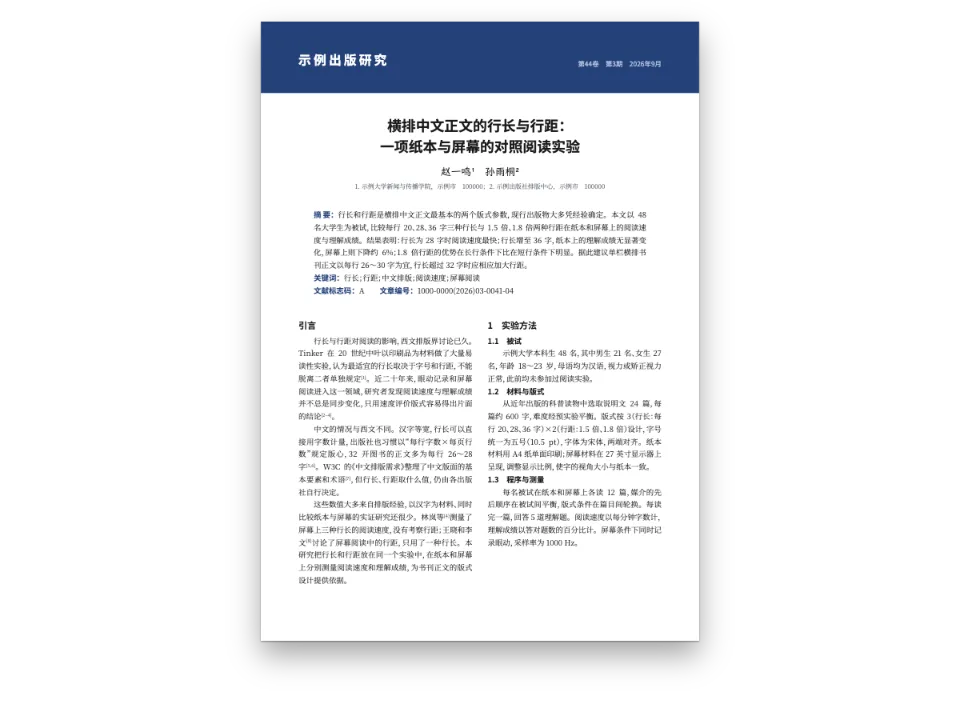
Um artigo de duas páginas para um pequeno workshop de engenharia de documentos, composto como os anais de congressos do IEEE compõem os seus: papel carta US, duas colunas de três polegadas e meia, um tipo no estilo Times em 10 pt e seções numeradas I, II, III em versais centralizadas. O título, os três blocos de autor, o resumo e os termos de indexação ocupam as duas colunas sob uma faixa clara no azul do workshop, a única cor das páginas. Os autores citam com chaves do BibTeX; o Postext imprime [1] na ordem em que cada obra é citada pela primeira vez, agrupa três obras seguidas como [2]–[4], escreve “Knuth and Plass [1]” quando os nomes fazem parte da frase e monta no fim a lista numerada em 8 pt. As remissões a seções imprimem “Section IV, on p. 2” e continuam certas quando o texto se desloca.
Esta receita responde a
- Como cito obras e monto a bibliografia em APA, IEEE ou outro estilo de citação?
- Como remeto a uma seção e à página em que ela está, e mantenho as duas corretas quando o livro muda?
A resposta curta
// [@key] prints [1] in order of first citation, @key in the sentence "Knuth and Plass [1]".
registerCitationEngine(createCiteprocEngine({ styles: STYLES, locales: LOCALES }));
// The bundled IEEE style lists [2], [3], [4]; the IEEE editorial guide writes [2]–[4].
// One attribute on the CSL <citation> element makes citeproc-js join the run.
const ieee = STYLES.ieee.replace('<citation>', '<citation collapse="citation-number">');
const citations = {
  style: 'custom', customStyle: ieee, // or style: 'ieee' for the file as it ships
  link: true,
  bibliography: {
    fontSize: em(0.8), lineHeight: pt(9.4), // 8 pt on 9.4 pt, two sizes under the text
    labelWidth: mm(6), // the [n] column: wide enough for [10], the turnovers align after it
    entrySpacing: pt(1.2),
    doi: 'text', // printed, not linked: the PDF stays black
  },
};
Ingredientes
- Funcionalidades
- Citações em um estilo de citaçãoBibliografia a partir das referênciasReferências cruzadasTítulos numeradosEstilos de títuloCapítulos sem númeroAberturas desenhadasBoxes na largura da páginaPaleta de cores semânticaExportação para PDF
- Também usa
- BoxesCitações que posicionam as figurasAtributos de títuloFontes incorporadas ao PDFQuebras de linha nos títulos
- Tipografia
- STIX Two Text, Schibsted Grotesk (SIL OFL 1.1)
- Materiais
- Nenhum: todas as imagens são desenhadas em código
Preparo
#1 · O estilo IEEE, com seus intervalos
O código é a resposta curta logo acima. Registrado uma vez, o postext-citeproc formata cada [@key] com o citeproc-js e o estilo CSL do IEEE, numerando as obras na ordem em que são citadas pela primeira vez. O arquivo de estilo que acompanha o motor escreve três obras seguidas como [2], [3], [4]; o guia editorial do IEEE as junta como [2]–[4]. Basta acrescentar collapse="citation-number" ao elemento <citation> do estilo e passar o resultado como customStyle para que o citeproc-js faça isso. labelWidth dá aos números da lista uma coluna própria, de modo que a segunda linha de cada entrada começa sob a primeira palavra, e não sob o colchete.
#2 · Um bloco de título sobre as duas colunas
const text = (id, content, size, extra) => ({ kind: 'text', id, content, fontFamily: SERIF,
  fontSize: pt(size), color: col('ink'), align: 'center', overflow: 'wrap', ...extra });
const at = (to, edge, x, y, width) => ({ anchor: { to, edge }, offset: { x: mm(x), y: mm(y) },
  ...(width && { size: { width: mm(width), height: 'auto' } }) });
const AUTHOR_W = MEASURE / 3;
const titleBlock = {
  enabled: true,
  minHeight: mm(64), // venue line, two lines of title and five of author block
  slot: { elements: [
    { kind: 'box', id: 'band', style: { backgroundColor: col('tint') }, // from the trim's top
      placement: { anchor: { to: 'page', edge: 'top-left' },
        size: { width: 'fill', height: mm(TOP + 66) } } },
    text('venue', '{attr.venue}', 7.5, { fontFamily: SANS, fontWeight: 600, color: col('accent'),
      letterSpacing: pt(1.2), textTransform: 'uppercase',
      placement: at('container', 'top-left', 0, 0, MEASURE) }),
    { kind: 'rule', id: 'venue-rule', thickness: pt(0.5), color: col('rule'),
      placement: at('#venue', 'below', 0, 2, MEASURE) },
    text('title', '{titleText}', 23, { lineHeight: 1.1, placement: at('#venue', 'below', 0, 7,
      MEASURE) }),
    ...['a1', 'a2', 'a3'].map((id, i) => text(id, `{attr.${id}}`, 9.5, { lineHeight: 1.25,
      placement: at('#title', 'below', i * AUTHOR_W, 6, AUTHOR_W) })),
  ] },
};
O título é o único título de nível 1 do documento, com o estilo paper. O estilo ocupa a largura da página e desenha o título a partir do seu design: a linha do evento, o título e três blocos de autor com um terço da medida, cada um lido de um atributo do título em que \n quebra as linhas. A faixa é uma caixa ancorada ao refile, por isso chega até a borda superior do papel.
#3 · Resumo e termos de indexação em negrito
const calloutStyles = [{ id: 'abstract', span: 'page', backgroundEnabled: false,
  border: { enabled: false }, stripe: { enabled: true, side: 'top', width: pt(0.5),
    color: col('rule') },
  padding: { top: mm(3), right: mm(14), bottom: mm(1), left: mm(14) },
  marginTop: pt(0), marginBottom: pt(LEAD),
  body: { fontSize: pt(9), lineHeight: pt(11), fontWeight: 700, firstLineIndent: pt(0),
    textAlign: 'justify', paragraphSpacing: true } }];
Um boxe na largura da página leva o resumo e os termos de indexação. O corpo vai em 9 pt negrito, como o IEEE compõe, e ***Abstract*—** no texto dá o rótulo em itálico com seu travessão. O fio fino acima é a tarja do boxe, e o espaçamento interno estreita a medida para cerca de cem caracteres.
#4 · Seções numeradas e remissões a elas
const levels = [
  { level: 1, breakBefore: { enabled: true, parity: 'any' } }, // gotcha: headings-drop-h1-break
  { level: 2, numberingTemplate: '{2:I}.', numberSeparator: ' ', fontSize: pt(9),
    lineHeight: pt(LEAD), fontWeight: 400, letterSpacing: em(0.06), textTransform: 'uppercase',
    marginTop: pt(LEAD), marginBottom: pt(0) }, // a line above, none below: at a column's head
  // the margin above drops and the text still starts on the next grid line
];
const headingStyles = [
  { id: 'paper', numbered: false, span: 'page', advancedDesign: titleBlock },
  { id: 'back', numbered: false }, // Acknowledgment and References: no number
];
const crossRefs = { section: t({ en: 'Section {n}', es: 'sección {n}' }) };
{2:I}. numera as seções I., II., III. Uma remissão imprime o número sem o ponto, então :ref{id="sec:results"} dá “Section IV” pelo modelo de crossRefs, e :ref{id="sec:results" style=page} dá “p. 2”. As duas são calculadas sobre as páginas já compostas, e por isso acompanham o texto se um parágrafo for acrescentado ou uma seção mudar de lugar. Os títulos Acknowledgment e References levam o estilo back e ficam sem número.
const palette = {
  ink: '#16181d', accent: '#1d4a7a', tint: '#e9eef5', rule: '#aeb6c2', muted: '#5a606b',
  paper: '#ffffff',
};
const col = (id) => ({ hex: palette[id], model: 'hex', paletteId: id });
const colorPalette = Object.entries({ ...palette, 'main-color': palette.accent })
  .map(([id, hex]) => ({ id, name: id, value: { hex, model: 'hex' } }));
A receita completa
// ═══ Postext Cookbook · Nº 088 · A two-column conference paper in IEEE style ═══════ // https://postext.dev/en/cookbook/ieee-conference-paper // Code: MIT · Text: original (CC BY 4.0) · Pictures: none // Fonts: STIX Two Text, Schibsted Grotesk (SIL OFL 1.1) · Needs postext ≥ 1.12.0 import { buildDocument, renderPageToCanvas, clearMeasurementCache, registerCitationEngine, } from 'https://esm.sh/postext'; import { renderToPdf, decompressWoff2 } from 'https://esm.sh/postext-pdf'; import { createCiteprocEngine, STYLES, LOCALES } from 'https://esm.sh/postext-citeproc'; const LANG = 'en'; // @lang: the language of the sample document ('en' | 'es') const RECIPE = 'ieee-conference-paper'; // ─── 1 · Design ───────────────────────────────────────────────────────────── // #region palette: black type on white, with one blue for the workshop's own marks const palette = { ink: '#16181d', accent: '#1d4a7a', tint: '#e9eef5', rule: '#aeb6c2', muted: '#5a606b', paper: '#ffffff', }; const col = (id) => ({ hex: palette[id], model: 'hex', paletteId: id }); const colorPalette = Object.entries({ ...palette, 'main-color': palette.accent }) .map(([id, hex]) => ({ id, name: id, value: { hex, model: 'hex' } })); // #endregion const [SERIF, SANS] = ['STIX Two Text', 'Schibsted Grotesk']; // The IEEE conference template in mm: US letter, 0.75 in head, 1 in foot, 0.625 in sides, // two columns of 3.5 in with 0.25 in between. const [TRIM_W, TRIM_H, TOP, BOTTOM, SIDE, GUTTER] = [215.9, 279.4, 19, 25.4, 15.9, 6.35]; const MEASURE = TRIM_W - 2 * SIDE; const LEAD = 12; // pt: 10 pt type on 12 pt, as the template sets it // #region answer: IEEE numbers, collapsed ranges and a references list with a label column // [@key] prints [1] in order of first citation, @key in the sentence "Knuth and Plass [1]". registerCitationEngine(createCiteprocEngine({ styles: STYLES, locales: LOCALES })); // The bundled IEEE style lists [2], [3], [4]; the IEEE editorial guide writes [2]–[4]. // One attribute on the CSL <citation> element makes citeproc-js join the run. const ieee = STYLES.ieee.replace('<citation>', '<citation collapse="citation-number">'); const citations = { style: 'custom', customStyle: ieee, // or style: 'ieee' for the file as it ships link: true, bibliography: { fontSize: em(0.8), lineHeight: pt(9.4), // 8 pt on 9.4 pt, two sizes under the text labelWidth: mm(6), // the [n] column: wide enough for [10], the turnovers align after it entrySpacing: pt(1.2), doi: 'text', // printed, not linked: the PDF stays black }, }; // #endregion // #region title: the title block across both columns, three authors side by side const text = (id, content, size, extra) => ({ kind: 'text', id, content, fontFamily: SERIF, fontSize: pt(size), color: col('ink'), align: 'center', overflow: 'wrap', ...extra }); const at = (to, edge, x, y, width) => ({ anchor: { to, edge }, offset: { x: mm(x), y: mm(y) }, ...(width && { size: { width: mm(width), height: 'auto' } }) }); const AUTHOR_W = MEASURE / 3; const titleBlock = { enabled: true, minHeight: mm(64), // venue line, two lines of title and five of author block slot: { elements: [ { kind: 'box', id: 'band', style: { backgroundColor: col('tint') }, // from the trim's top placement: { anchor: { to: 'page', edge: 'top-left' }, size: { width: 'fill', height: mm(TOP + 66) } } }, text('venue', '{attr.venue}', 7.5, { fontFamily: SANS, fontWeight: 600, color: col('accent'), letterSpacing: pt(1.2), textTransform: 'uppercase', placement: at('container', 'top-left', 0, 0, MEASURE) }), { kind: 'rule', id: 'venue-rule', thickness: pt(0.5), color: col('rule'), placement: at('#venue', 'below', 0, 2, MEASURE) }, text('title', '{titleText}', 23, { lineHeight: 1.1, placement: at('#venue', 'below', 0, 7, MEASURE) }), ...['a1', 'a2', 'a3'].map((id, i) => text(id, `{attr.${id}}`, 9.5, { lineHeight: 1.25, placement: at('#title', 'below', i * AUTHOR_W, 6, AUTHOR_W) })), ] }, }; // #endregion // #region abstract: abstract and index terms in bold 9 pt, between two hairlines const calloutStyles = [{ id: 'abstract', span: 'page', backgroundEnabled: false, border: { enabled: false }, stripe: { enabled: true, side: 'top', width: pt(0.5), color: col('rule') }, padding: { top: mm(3), right: mm(14), bottom: mm(1), left: mm(14) }, marginTop: pt(0), marginBottom: pt(LEAD), body: { fontSize: pt(9), lineHeight: pt(11), fontWeight: 700, firstLineIndent: pt(0), textAlign: 'justify', paragraphSpacing: true } }]; // #endregion // #region sections: I. INTRODUCTION, centred capitals; references print "Section II" const levels = [ { level: 1, breakBefore: { enabled: true, parity: 'any' } }, // gotcha: headings-drop-h1-break { level: 2, numberingTemplate: '{2:I}.', numberSeparator: ' ', fontSize: pt(9), lineHeight: pt(LEAD), fontWeight: 400, letterSpacing: em(0.06), textTransform: 'uppercase', marginTop: pt(LEAD), marginBottom: pt(0) }, // a line above, none below: at a column's head // the margin above drops and the text still starts on the next grid line ]; const headingStyles = [ { id: 'paper', numbered: false, span: 'page', advancedDesign: titleBlock }, { id: 'back', numbered: false }, // Acknowledgment and References: no number ]; const crossRefs = { section: t({ en: 'Section {n}', es: 'sección {n}' }) }; // #endregion const footer = { elements: [ { kind: 'text', id: 'folio', content: '{pageNumber}', fontFamily: SANS, fontSize: pt(7.5), color: col('muted'), align: 'center', placement: { anchor: { to: 'page', edge: 'bottom-left' }, offset: { x: mm(SIDE), y: mm(-13) }, size: { width: mm(MEASURE) } } }, ] }; const config = () => ({ // a factory: the engine caches resolved configs per object locale: t({ en: 'en-us', es: 'es' }), colorPalette, citations, crossRefs, calloutStyles, headingStyles, page: { sizePreset: 'custom', width: mm(TRIM_W), height: mm(TRIM_H), dpi: 150, margins: { top: mm(TOP), bottom: mm(BOTTOM), left: mm(SIDE), right: mm(SIDE) } }, layout: { layoutType: 'double', gutterWidth: mm(GUTTER) }, bodyText: { fontFamily: SERIF, fontSize: pt(10), lineHeight: pt(LEAD), color: col('ink'), boldColor: col('ink'), italicColor: col('ink'), referenceColor: col('ink'), referenceBold: false, // "Section II" sits in the text like the citations textAlign: 'justify', firstLineIndent: mm(3.5), indentAfterHeading: true, hyphenation: { enabled: true }, optimalLineBreaking: true, avoidWidows: true, avoidOrphans: true, avoidRunts: true, }, headings: { fontFamily: SERIF, color: col('ink'), textAlign: 'center', levels }, header: { elements: [] }, footer, }); // ─── 2 · Content ──────────────────────────────────────────────────────────── const markdown = String.raw`---Amostra em Markdown · 91 linhas · content.en.md
title: "Optimal Line Breaking in the Browser" author: "Irene Valcárcel, Tomás Brandt and Aiko Nwosu" --- # Optimal Line Breaking in the Browser: \\ What It Costs and When It Pays {style="paper" venue="DocWeb ’26 · Workshop on Document Engineering for the Web" a1="Irene Valcárcel\nDept. of Computer Science\nUniversidad de Almenara\nAlmenara, Spain\nivalcarcel@almenara.example" a2="Tomás Brandt\nTypesetting Group\nNorthgate College\nDunmore, United Kingdom\ntbrandt@northgate.example" a3="Aiko Nwosu\nSchool of Design\nHarrow Hill Institute\nHarrow Hill, Canada\nanwosu@harrowhill.example"} :::callout{type="abstract"} ***Abstract*—**Browsers break justified text one line at a time, and the loose lines this leaves are the main complaint against justified text on screen. The total-fit method used by TeX chooses the breaks of a whole paragraph at once and avoids most of them, but it is thought too slow for a page that reflows on every resize. We set a corpus of 2,400 paragraphs in four languages at six column widths with both methods, in a script that runs in the browser, and measured the time per paragraph and the spacing of every line. Total fit took 0.21 ms per paragraph on a mid-range laptop, 3.4 times the first-fit time, and cut the share of lines whose spaces stretch past one and a half times their natural width from 11.8% to 1.9%. The gain is largest in narrow columns and in German. We conclude that the cost is affordable for text that is laid out once per resize, and give a rule for when first fit is good enough. ***Index Terms*—**line breaking, justification, hyphenation, typesetting, web browsers, performance ::: ## Introduction {#sec:intro} A paragraph that a browser justifies is broken one line at a time. Each line takes as many words as fit, and the space left over is shared out between them. The method is fast and predictable, and it is the reason justified text on the web has a reputation for rivers and loose lines: a line followed by a long word must take that word's room as space, and nothing earlier in the paragraph can help it. Printers have had a better method for forty years. @knuthplass1981 treat the paragraph as a whole. Every possible break is a node in a graph, every line a weighted edge, and the breaks are those of the path with the least total penalty, so that a slightly tight line early on can save a very loose one later. Liang's hyphenation patterns, Plass's work on page breaking and TeX itself came out of the same project at Stanford [@liang1983; @plass1981; @knuth1984], and the method is still the reference against which other line breakers are judged. It has not reached the browser. The usual reason given is speed: a page that reflows whenever its window changes size cannot afford a search over every paragraph. We test that reason. :ref{id="sec:related"} places the question among earlier work, :ref{id="sec:method"} describes the corpus and the timing harness, and :ref{id="sec:results"}, on :ref{id="sec:results" style=page}, gives the measurements. :ref{id="sec:discussion"} turns them into a rule a page designer can apply. ## Related work {#sec:related} The total-fit algorithm was described in full by @knuthplass1981, with the box, glue and penalty model that later implementations kept. The search is quadratic in the worst case, but a feasible break can only lie within a line's width of the one before it, and the active list of candidate breaks stays short in practice. The authors report times for a mainframe of the day; we know of no measurement on a modern browser engine. Hyphenation is the other half of the problem. The patterns of @liang1983 find most of the permissible breaks of an English word from a table of a few thousand entries, and they are the basis of the hyphenation dictionaries that browsers and word processors still ship. A total-fit breaker that cannot hyphenate loses most of its advantage in narrow columns, which is why we measure the two together. Typographic practice sets the target. @bringhurst2004 asks for a measure of 45 to 75 characters and treats word spaces that open past their natural width as the first sign of a badly set paragraph. Studies of reading suggest why: the eye moves in saccades of seven to nine characters, and an irregular texture changes where it lands [@rayner1998]. On screen, @dyson2001 found that line length affects reading speed and comprehension differently, which warns against judging a layout by one number alone. We report the spacing of the lines rather than a reading measure, and leave the second to future work. ## Method {#sec:method} The corpus has 2,400 paragraphs, 600 in each of English, Spanish, German and French, drawn from public-domain novels and essays. Paragraphs shorter than four lines at the widest measure were left out, since a paragraph that short gives a line breaker little to choose from. Each paragraph was set at six column widths, from 30 to 80 characters of the text face, with two line breakers: first fit, which takes the longest line that fits, and total fit as described in [-@knuthplass1981]. Both used the same Liang patterns for each language, the same glue (a space of a third of an em that may stretch by half and shrink by a third) and the same text face, measured once per word with the canvas text API. The script that does it runs in the browser, with no server. For each setting we recorded the time to break the paragraph, excluding the measurement of words, which both methods share, and the stretch ratio of every line but the last. A line whose ratio passes 1.5 is counted as loose. The timings come from a laptop with a mid-range processor of 2023, in the current stable version of three browsers, each paragraph timed fifty times after a warm-up of ten. ## Results {#sec:results} Total fit took 0.21 ms per paragraph on average, against 0.062 ms for first fit, a ratio of 3.4. The ratio grew with the width of the column, from 2.6 at 30 characters to 4.1 at 80, since a wider line admits more candidate breaks. The slowest paragraph, a German one of 31 lines at 80 characters, took 1.9 ms. A long article of 120 paragraphs is broken in about 25 ms, well inside the time a browser gives itself to answer a resize. The spacing improved in every language and at every width. Over the whole corpus the share of loose lines fell from 11.8% to 1.9%. In columns of 30 to 40 characters, the measure of a two-column page on a phone, it fell from 27% to 4.6%. German gained the most, from 16.3% to 2.2%, because its long compounds leave first fit with the hardest choices; English gained the least, from 8.9% to 1.6%. The number of hyphenated lines rose by a fifth with total fit, which accepts a hyphen where it saves a loose line further down. At 70 characters and more, first fit left fewer than 4% of its lines loose in every language. At that measure the difference between the methods is hard to see on the page, and a reader shown both settings of the same paragraph side by side could rarely tell which was which. ## Discussion {#sec:discussion} The cost of total fit is a few tenths of a millisecond per paragraph, and the text of an ordinary page is broken in less time than the browser spends painting it. For text that is laid out once and then read, as in an article, a book chapter or a paper like this one, the cost is no argument against it. Live editing is a different case: there only the paragraph being edited needs breaking again, and the time for one paragraph is small. The results also give a rule for when first fit is enough. In a single column of 70 characters or more, a reader will rarely meet a loose line with either method, and a designer who cannot choose the line breaker loses little. In narrow columns, and in languages with long words, the difference is large and visible, and total fit with hyphenation is the method to ask for. This matches the advice of the printers [@bringhurst2004, chap. 2], who allow a narrow column to go ragged rather than set it justified without care. ## Conclusion We measured the cost of breaking paragraphs as TeX does in a browser and found it small: 0.21 ms per paragraph, 3.4 times the cost of the browser's own method, for six times fewer loose lines. The case against total fit on screen rests on speed, and on present hardware speed no longer supports it. ## Acknowledgment {style="back"} The authors thank the readers of the DocWeb ’26 committee for their comments on the draft. Set in STIX Two Text and Schibsted Grotesk (SIL OFL). Text: original, CC BY 4.0. The authors, institutions and measurements are invented for this example. ## References {style="back"} :::bibliography{title=""} :::references{format=bibtex} @article{knuthplass1981, author = {Knuth, Donald E. and Plass, Michael F.}, title = {Breaking paragraphs into lines}, journal = {Software: Practice and Experience}, volume = 11, number = 11, pages = {1119--1184}, year = 1981, doi = {10.1002/spe.4380111102}} @phdthesis{liang1983, author = {Liang, Franklin Mark}, title = {Word Hy-phen-a-tion by Com-put-er}, school = {Stanford University}, address = {Stanford, CA}, year = 1983} @phdthesis{plass1981, author = {Plass, Michael Frederick}, title = {Optimal Pagination Techniques for Automatic Typesetting Systems}, school = {Stanford University}, address = {Stanford, CA}, year = 1981} @book{knuth1984, author = {Knuth, Donald E.}, title = {The {TeX}book}, publisher = {Addison-Wesley}, address = {Reading, MA}, year = 1984} @book{bringhurst2004, author = {Bringhurst, Robert}, title = {The Elements of Typographic Style}, edition = {3rd}, publisher = {Hartley \& Marks}, address = {Point Roberts, WA}, year = 2004} @article{rayner1998, author = {Rayner, Keith}, title = {Eye movements in reading and information processing: 20 years of research}, journal = {Psychological Bulletin}, volume = 124, number = 3, pages = {372--422}, year = 1998, doi = {10.1037/0033-2909.124.3.372}} @article{dyson2001, author = {Dyson, Mary C. and Haselgrove, Mark}, title = {The influence of reading speed and line length on the effectiveness of reading from screen}, journal = {International Journal of Human-Computer Studies}, volume = 54, number = 4, pages = {585--612}, year = 2001, doi = {10.1006/ijhc.2001.0458}} :::`; // ─── 3 · Fonts ────────────────────────────────────────────────────────────── const FONTS = { 'STIX Two Text': ['400', '400i', '700', '700i'], 'Schibsted Grotesk': ['400', '600'], }; // ─── 4 · Build & show ─────────────────────────────────────────────────────── await loadFonts(FONTS, markdown); const doc = await buildWithFonts(() => buildDocument({ markdown }, config()), markdown); const title = t({ en: 'An IEEE conference paper', es: 'Una ponencia en estilo IEEE' }); showPages(doc, { title }); offerPdf(() => renderToPdf(doc, { fontProvider: fontsourceProvider }), `${RECIPE}.pdf`);Kit · core, fonts, viewer, pdf: igual em todas as receitas · 281 linhas
// ─── Kit ── helpers shared by every Cookbook recipe · postext.dev/cookbook ───── // ─── Kit · core v1 ── the same in every recipe · postext.dev/cookbook function mm(value) { return { value, unit: 'mm' }; } function pt(value) { return { value, unit: 'pt' }; } function em(value) { return { value, unit: 'em' }; } /** The sample language's string: t({ en: 'Figure', es: 'Figura' }). */ function t(strings) { return strings[LANG] ?? Object.values(strings)[0]; } /** A file in this recipe's assets folder, served from the Postext repo by jsDelivr. */ function asset(file) { return `https://cdn.jsdelivr.net/gh/drnachio/postext@main/cookbook/${RECIPE}/assets/${file}`; } // ─── Kit · fonts v2 ── the same in every recipe · postext.dev/cookbook // Postext measures with the loaded faces and caches the widths: load every face // before the first build, from Fontsource, the files the PDF embeds too. /** faces = { 'Family Name': ['400', '400i', '700'] }. `text` is the sample: * č ł † α χ also load latin-ext and greek files (kitSubsetsFor). With * `optional`, a face Fontsource does not ship is skipped instead of failing. * Resolves to the number of faces added. */ async function loadFonts(faces, text = '', { optional = false } = {}) { kitStatus('Loading fonts…'); const ranges = { latin: 'U+0000-00FF,U+0131,U+0152-0153,U+02BB-02BC,U+02C6,U+02DA,U+02DC,U+0304,U+0308,U+0329,' + 'U+2000-206F,U+20AC,U+2122,U+2191,U+2193,U+2212,U+2215,U+FEFF,U+FFFD', 'latin-ext': 'U+0100-02BA,U+02BD-02C5,U+02C7-02CC,U+02CE-02D7,U+02DD-02FF,U+0304,U+0308,U+0329,' + 'U+1D00-1DBF,U+1E00-1E9F,U+1EF2-1EFF,U+2020,U+20A0-20AB,U+20AD-20C0,U+2113,U+2C60-2C7F,U+A720-A7FF', greek: 'U+0370-03FF', }; const jobs = []; let added = 0; for (const [family, specs] of Object.entries(faces)) { const id = fontsourceId(family); const todo = [...new Set(specs)].map((spec) => [parseInt(spec, 10), spec.endsWith('i') ? 'italic' : 'normal']) .filter(([weight, style]) => !hasFace(family, weight, style)); // before any await const meta = optional || /[^\0-ÿ]/u.test(text) ? await fontsourceMeta(family) : null; const subsets = ['latin', ...kitSubsetsFor(text, meta)]; for (const [weight, style] of todo) { if (optional && !(meta?.weights.includes(weight) && meta.styles.includes(style))) continue; for (const subset of subsets) { const url = `https://cdn.jsdelivr.net/npm/@fontsource/${id}@5/files/${id}-${subset}-${weight}-${style}.woff2`; const face = new FontFace(family, `url(${url}) format('woff2')`, { weight: String(weight), style, unicodeRange: ranges[subset] }); jobs.push(face.load().then((ready) => { document.fonts.add(ready); added++; }, () => { if (subset === 'latin' && !optional) throw new Error(`Fontsource has no ${family} ${weight} ${style}`); })); } } } await Promise.all(jobs).catch((error) => { kitFail(error); throw error; }); return added; } /** Runs `build` and loads any face the pages use that FONTS missed (a regular * one with a warning), then clears the measurement cache and builds again. */ async function buildWithFonts(build, text = '') { const tried = new Set(); for (let round = 0; round < 3; round++) { kitStatus('Laying out…'); await new Promise(requestAnimationFrame); // let the status paint first const result = await Promise.resolve().then(build).catch((error) => { kitFail(error); throw error; }); const wanted = { base: {}, variants: {} }; for (const { font, base } of [result].flat().flatMap(fontStringsOf)) { const { family, weight, style } = parseFont(font); const key = `${family}|${weight}|${style}`; if (tried.has(key) || hasFace(family, weight, style)) continue; tried.add(key); (wanted[base ? 'base' : 'variants'][family] ??= []).push(`${weight}${style === 'italic' ? 'i' : ''}`); } if (Object.keys(wanted.base).length) { console.warn(`[cookbook] FONTS does not list ${JSON.stringify(wanted.base)}: loading them.`); } const added = await loadFonts(wanted.base, text) + await loadFonts(wanted.variants, text, { optional: true }); if (added === 0) return result; clearMeasurementCache(); } throw new Error('The fonts did not settle after three builds.'); } /** Every font string of the layout; `base` marks a block's own face. */ function fontStringsOf(doc) { const found = new Map(); const walk = (node) => { if (!node || typeof node !== 'object') return; if (Array.isArray(node)) { node.forEach(walk); return; } for (const [key, value] of Object.entries(node)) { if (typeof value === 'string' && /fontString$/i.test(key)) { found.set(value, found.get(value) || key === 'fontString'); } else if (value && typeof value === 'object') walk(value); } }; walk(doc.pages); walk(doc.blocks); return [...found].map(([font, base]) => ({ font, base })); } /** '700 37.5px Open Sans' / 'italic 400 13px "Source Serif 4"' → { family, weight, style }. * A string with no weight ('95.8px Young Serif', from a design text) is 400. */ function parseFont(font) { const m = /^(?:(italic|oblique)\s+)?(?:small-caps\s+)?(?:(\d+|bold|normal)\s+)?[\d.]+px\s+(.+)$/.exec(font.trim()); if (!m) throw new Error(`Unexpected font string: ${font}`); const weight = m[2] === 'bold' ? 700 : !m[2] || m[2] === 'normal' ? 400 : Number(m[2]); return { family: m[3].replace(/^["']|["']$/g, ''), weight, style: m[1] ? 'italic' : 'normal' }; } /** A loaded FontFace covers this family, weight and style (fonts.check() would * also say yes for families nobody declared). */ function hasFace(family, weight, style) { for (const face of document.fonts) { if (face.status !== 'loaded' || face.style !== style) continue; if (face.family.replace(/^["']|["']$/g, '') !== family) continue; const [low, high = low] = face.weight.split(' ').map(Number); if (weight >= low && weight <= high) return true; } return false; } /** The files beyond latin `text` needs that `meta`'s family ships. */ function kitSubsetsFor(text, meta) { return [[/[Ā-˿ᴀ-ᶿḀ-ỿ†ℓⱠ-Ɀ꜠-ꟿ]/u, 'latin-ext'], [/[Ͱ-Ͽ]/u, 'greek']] .filter(([re, x]) => re.test(text) && meta?.subsets?.includes(x)).map(([, x]) => x); } /** Fontsource's id for a family: 'Source Serif 4' → 'source-serif-4'. */ function fontsourceId(family) { return family.toLowerCase().replace(/\s+/g, '-'); } /** The family's Fontsource metadata (weights, styles, subsets), or null. */ function fontsourceMeta(family) { fontsourceMeta.cache ??= new Map(); const id = fontsourceId(family); if (!fontsourceMeta.cache.has(id)) { fontsourceMeta.cache.set(id, fetch(`https://api.fontsource.org/v1/fonts/${id}`) .then((res) => (res.ok ? res.json() : null), () => null)); } return fontsourceMeta.cache.get(id); } // ─── Kit · viewer v1 ── the same in every recipe · postext.dev/cookbook /** The pages as spreads on a dark desk, page 1 alone, then verso | recto, * each painted when it scrolls near. */ function showPages(docs, { title, width = 460 } = {}) { const root = viewer(title); const pages = [docs].flat().flatMap((doc) => doc.pages.map((page) => ({ doc, page, n: (doc.pageIndexOffset ?? 0) + page.index }))); const spreads = []; let verso = null; for (const p of pages) { if (p.n % 2 === 1) { if (verso) spreads.push([verso, null]); verso = p; } else { spreads.push([verso, p]); verso = null; } } if (verso) spreads.push([verso, null]); const density = Math.min(window.devicePixelRatio || 1, 2); showPages.painter?.disconnect(); const painter = new IntersectionObserver((entries) => { for (const { isIntersecting, target } of entries) { if (!isIntersecting) continue; painter.unobserve(target); const { doc, page } = target.postext; renderPageToCanvas(page, doc, target, { scale: (width * density) / page.width }); } }, { rootMargin: '800px' }); showPages.painter = painter; root.replaceChildren(...spreads.map((pair) => { const spread = document.createElement('div'); spread.className = 'pt-spread'; for (const p of pair) { const figure = document.createElement('figure'); if (p) { const label = p.page.pageLabel || String(p.n + 1); const canvas = document.createElement('canvas'); canvas.postext = p; canvas.style.aspectRatio = `${p.page.width} / ${p.page.height}`; canvas.setAttribute('role', 'img'); canvas.setAttribute('aria-label', `Page ${label}`); const folio = document.createElement('figcaption'); folio.textContent = label; figure.append(canvas, folio); painter.observe(canvas); } else figure.className = 'pt-blank'; spread.append(figure); } return spread; })); kitStatus(`${pages.length} ${pages.length === 1 ? 'page' : 'pages'}`); document.documentElement.dataset.postext = 'ready'; return pages.length; } /** The desk, the bar and the error reporting, created once. */ function viewer(title) { if (!document.getElementById('pt-kit')) { document.head.insertAdjacentHTML('beforeend', `<style id="pt-kit"> :root { color-scheme: dark; } body { margin: 0; background: #0e1014; color: #b9bcc4; font: 13px/1.45 system-ui, sans-serif; } #pt-bar { position: sticky; top: 0; z-index: 1; display: flex; flex-wrap: wrap; align-items: center; gap: 6px 16px; padding: 10px 16px; background: rgb(14 16 20 / .92); backdrop-filter: blur(6px); border-bottom: 1px solid #23262d; } #pt-bar strong { color: #f4f1ea; font-weight: 600; } #pt-actions { display: flex; gap: 12px; margin-left: auto; } #pt-actions a, #pt-actions button { color: #d8a21a; font: inherit; background: none; border: 0; padding: 0; cursor: pointer; } #pages { display: grid; justify-items: center; gap: 48px; padding: 32px 16px 72px; } .pt-spread { display: flex; } .pt-spread figure { margin: 0; width: min(460px, 44vw); } .pt-spread canvas { display: block; width: 100%; background: #fff; box-shadow: 0 1px 2px rgb(0 0 0 / .5), 0 22px 44px -16px rgb(0 0 0 / .8); } .pt-spread figure:first-child canvas { box-shadow: inset -14px 0 14px -14px rgb(0 0 0 / .18), 0 1px 2px rgb(0 0 0 / .5), 0 22px 44px -16px rgb(0 0 0 / .8); } .pt-spread figcaption { margin-top: 10px; text-align: center; font: 600 10px/1 system-ui, sans-serif; letter-spacing: .18em; text-transform: uppercase; color: #6c7079; } .pt-blank { visibility: hidden; } @media (max-width: 760px) { .pt-spread { flex-direction: column; gap: 32px; } .pt-spread figure { width: min(460px, 92vw); } .pt-blank { display: none; } } </style>`); document.body.insertAdjacentHTML('afterbegin', '<header id="pt-bar"><strong id="pt-title"></strong><span id="pt-status" role="status"></span><span id="pt-actions"></span></header>'); document.getElementById('pt-title').textContent = document.title || 'Postext'; addEventListener('error', (event) => kitFail(event.error ?? event.message)); addEventListener('unhandledrejection', (event) => kitFail(event.reason)); } if (title) document.getElementById('pt-title').textContent = title; return document.getElementById('pages') ?? document.body.appendChild(Object.assign(document.createElement('main'), { id: 'pages' })); } function kitStatus(text) { viewer(); document.getElementById('pt-status').textContent = text; } function kitFail(error) { document.documentElement.dataset.postext = 'error'; kitStatus(`Error: ${error?.message ?? error}`); } // ─── Kit · pdf v2 ── the same in every recipe that exports a PDF /** The Fontsource files the screen used, as TrueType: the nearest weight the * family ships, upright if it has no italic; latin, then what the face's * letters need (kitSubsetsFor). */ async function fontsourceProvider(family, weight, style, request) { const id = fontsourceId(family); const meta = await fontsourceMeta(family); const weights = meta?.weights?.length ? meta.weights : [400, 700]; const w = weights.reduce((a, b) => (Math.abs(b - weight) < Math.abs(a - weight) ? b : a)); const s = style === 'italic' && meta && !meta.styles.includes('italic') ? 'normal' : style; const text = String.fromCodePoint(...(request?.codePoints ?? [])); const more = kitSubsetsFor(text, meta); const files = await Promise.all(['latin', ...more].map(async (subset) => { const res = await fetch(`https://cdn.jsdelivr.net/npm/@fontsource/${id}@5/files/${id}-${subset}-${w}-${s}.woff2`); if (!res.ok) throw new Error(`Fontsource has no ${family} ${w} ${s} ${subset}`); return decompressWoff2(new Uint8Array(await res.arrayBuffer())); })); return files.length === 1 ? files[0] : files; } /** A "Build the PDF" button; then "Open the PDF" (a new tab: CodePen's frame * shows no PDFs) and a download link. */ function offerPdf(makePdf, filename) { viewer(); const button = Object.assign(document.createElement('button'), { type: 'button', textContent: 'Build the PDF' }); button.dataset.postextPdf = filename; button.addEventListener('click', async () => { button.disabled = true; button.textContent = 'Building the PDF…'; try { const bytes = await makePdf(); const url = URL.createObjectURL(new Blob([bytes], { type: 'application/pdf' })); const size = `${Math.max(1, Math.round(bytes.length / 1024))} KB`; button.replaceWith( Object.assign(document.createElement('a'), { href: url, target: '_blank', rel: 'noopener', textContent: 'Open the PDF ↗' }), Object.assign(document.createElement('a'), { href: url, download: filename, textContent: `Download ${filename} · ${size}` })); } catch (error) { button.disabled = false; button.textContent = 'Build the PDF'; kitFail(error); } }); document.getElementById('pt-actions').append(button); } // ─── /Kit ───────────────────────────────────────────────────────────────────────
O script.js montado funciona como está: cole-o como script de módulo em qualquer página ou abra a receita no CodePen. Pasta da receita no GitHub ↗ (abre em uma nova aba)
Variações
#Mantenha o estilo como ele vem
Sem a alteração, três obras seguidas saem uma a uma, como algumas revistas preferem.
-  style: 'custom', customStyle: ieee, // or style: 'ieee' for the file as it ships
+ style: 'ieee',#Escreva os intervalos dentro de um só par de colchetes
Alguns estilos numéricos imprimem [2–4]. O marcador brackets escreve os números por conta própria e junta os consecutivos.
-  style: 'custom', customStyle: ieee, // or style: 'ieee' for the file as it ships
+ style: 'ieee', marker: 'brackets', collapseRanges: true,Erros comuns
Erro comum
Qualquer objeto headings desativa a quebra de página do H1
Por padrão, um H1 salta para uma página ímpar (always-odd), mas passar qualquer objeto headings redefine esse padrão, então os capítulos ficam emendados e span: 'page' não faz nada. Declare de novo headings.levels[0].breakBefore: { enabled: true, parity } em toda configuração. Capítulos que abrem em página ímpar →
Erro comum
Carregue todas as fontes antes do layout
O motor de layout mede o texto com as fontes que o navegador carregou e guarda as larguras em cache, então uma fonte que chega depois da primeira composição deixa quebras de linha erradas e um PDF que não corresponde mais à tela. Carregue antes todos os pesos e estilos e chame clearMeasurementCache() antes de recompor quando alguma chegar atrasada. Fontes antes da diagramação →
Erro comum
Coloque entre aspas cada valor do frontmatter
O YAML lê title: 1984 como número e uma data como objeto Date, e valores que não são strings saem vazios nos placeholders e deixam o PDF sem título. Coloque cada valor entre aspas: title: "1984". Metadados do documento →
Erro comum
A configuração fica em cache pela identidade: crie um objeto novo
O motor guarda em cache as configurações resolvidas pela identidade do objeto, então alterar uma configuração no próprio objeto e compor de novo reaproveita o resultado antigo. Crie um objeto novo a cada composição; por isso a configuração de uma receita é uma função, config(). Páginas em um canvas →
- Quando as duas colunas da última página não terminam na mesma altura, veja o que fica no ponto onde seriam cortadas: o motor não deixa um título de seção no pé de uma coluna, longe do seu texto, e desiste do corte. Uma frase a mais ou a menos nas últimas seções leva o corte para depois do título.
- Comandos do BibTeX como
{\TeX}não são expandidos. EscrevaThe {TeX}book; as chaves mantêm as maiúsculas como estão.
Créditos
- Receita
- Ignacio Ferro
- Texto
- Texto original, CC BY 4.0
- Fontes
- STIX Two Text (SIL OFL 1.1) · Schibsted Grotesk (SIL OFL 1.1)
- Código
- MIT, como o Postext
Editar este texto ↗ (abre em uma nova aba)Pasta da receita no GitHub ↗ (abre em uma nova aba)