Em poucas palavras
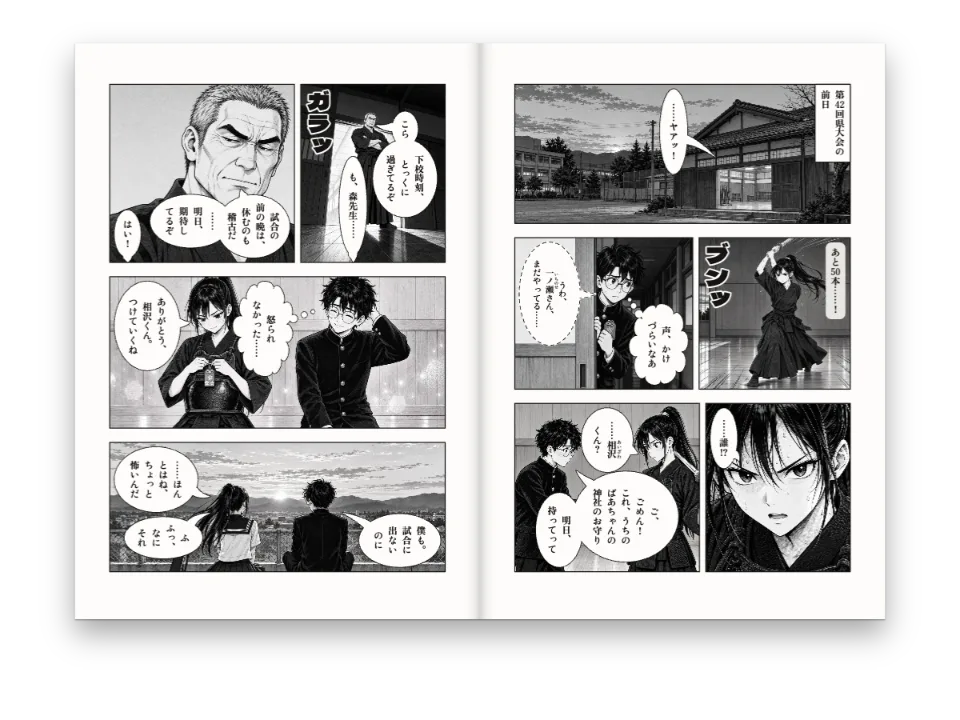
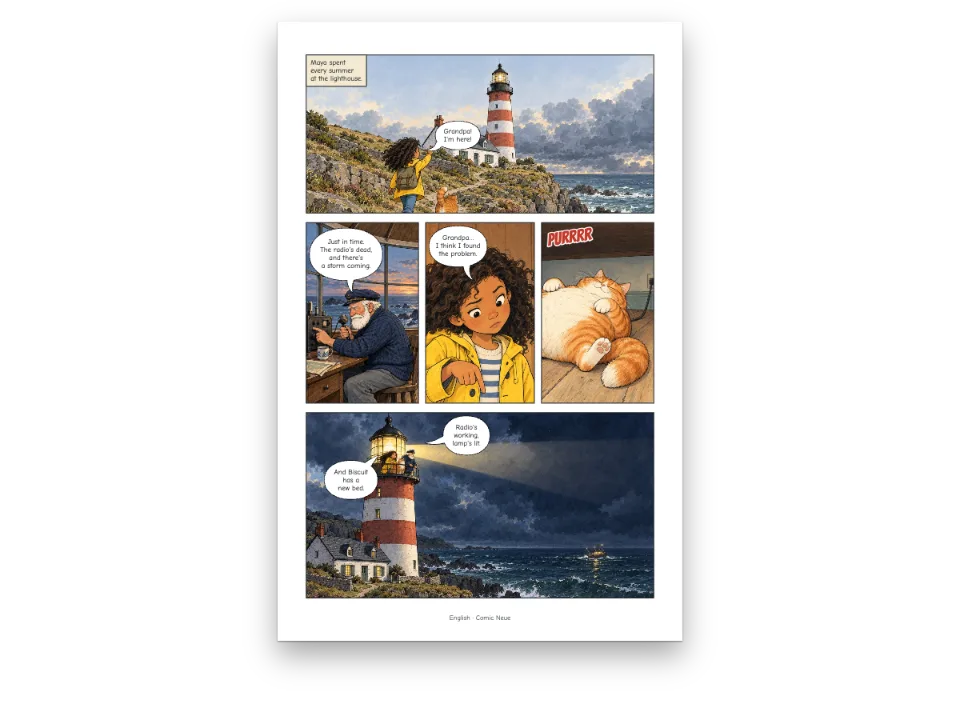
Uma página de tirinhas japonesas de quatro quadros, lado a lado como numa revista de mangá: você lê a tira da direita de cima para baixo e depois a da esquerda.
O que você vai compor
Uma página de uma antologia de yonkoma, ねこ喫茶まどろみ (Café Soneca), escrita para a receita e desenhada num estilo chibi suave: Mugi cuida de um café de gatos com uma gata branca, um gato preto e uma gata tricolor. O yonkoma, a tirinha de quatro quadros, é a tira de humor do jornal posta em pé: quatro quadros iguais empilhados de cima para baixo, com apresentação, desenvolvimento, virada e piada final. Uma página de revista traz duas lado a lado, e como a página abre pela direita, a tira da direita vem primeiro. A página é A5, 148 × 210 mm, com o original japonês de um lado da página dupla e a edição na língua desta página do outro (a inglesa na página japonesa).
Esta receita responde a
- Como faço para compor uma tira yonkoma de quatro quadros?
A resposta curta
// content.<lang>.md splits the page `* [* / * / * / *] | * [* / * / * / *]`: two equal
// columns, each cut into four equal panels. The reading direction lays the first column
// out on the right, so the strip that opens the page is the right-hand one, as in a
// yonkoma magazine, and each strip still reads top to bottom. The gutter between the
// strips is wider than the gutters between their panels, so the eye drops down a strip
// before it crosses to the next.
const comics = (lang) => ({
  artDirection: 'rtl', // the right strip first, in every edition
  mirrorArt: false,
  gutter: { horizontal: mm(3), vertical: mm(9) }, // 3 mm between panels, 9 mm between strips
  panel: { borderWidth: pt(0.9), borderColor: col('ink'), background: col('paper') },
  lettering: {
    fontFamily: EDITIONS[lang].faces[0], color: col('ink'),
    fontSize: pt(['ja', 'zh'].includes(lang) ? 8 : 7), // a yonkoma letters smaller than a story
    writingMode: lang === 'zh' ? 'vertical' : 'auto',
    maxColumnChars: 6, // short columns: a yonkoma panel is wider than it is tall
  },
  balloonStyles: balloons(),
});
Ingredientes
- Funcionalidades
- Divisão em quadrosSentido de leitura e ordem do mangáTexto verticalFontes chinesas, japonesas e coreanasBordas e sarjetas dos quadrosArte e enquadramento do quadroLetreiramento em outros idiomasPersonagens e âncorasPáginas de quadrinhosLetreiramento de quadrinhosEstilos de balãoOnomatopeiasLivros encadernados pela direitaPaleta de cores semânticaPáginas em um canvasExportação para PDF
- Também usa
- Quebra de linha em chinêsCor do papelFontes incorporadas ao PDFFiguras e tabelas como recursos
- Tipografia
- Zen Antique, Dela Gothic One, Comic Neue, Bangers, Noto Sans SC, ZCOOL KuaiLe, Playpen Sans Arabic, Lalezar (SIL OFL 1.1)
- Materiais
neko-bowls.jpgneko-door.jpgneko-guest.jpgneko-keyboard.jpgneko-laptop.jpgneko-nap.jpgneko-onebowl.jpgneko-toast.jpg- Mugi unlocking the cat café's door, three cats waiting inside (Generated With Diffusion Models, original)
- Mugi setting out food bowls for the cats (Generated With Diffusion Models, original)
- Three cats eating from one bowl (Generated With Diffusion Models, original)
- The cats staring at Mugi's toast (Generated With Diffusion Models, original)
- A tired office worker arriving at the café (Generated With Diffusion Models, original)
- The three cats asleep on one cushion (Generated With Diffusion Models, original)
- The office worker opening his laptop (Generated With Diffusion Models, original)
- The cats sitting on the keyboard, the worker in happy tears (Generated With Diffusion Models, original)
Preparo
#1 · Dividir a página em duas colunas de quatro
O código é a resposta curta acima. A página inteira é um :::page com split="* [* / * / * / *] | * [* / * / * / *]": duas colunas iguais, cada uma cortada em quatro faixas iguais. As oito linhas ::panel preenchem as células na ordem de leitura, então as quatro primeiras pertencem à primeira tira, e com a leitura da direita para a esquerda a primeira coluna fica à direita (divisão da página). A sarjeta entre as tiras tem 9 mm, e a sarjeta entre os quadros, 3 mm, para que o olho desça por uma tira antes de passar para a outra.
#2 · Pôr o título de cada tira no primeiro quadro
const balloons = () => [
  { id: 'speech', fill: col('paper'), stroke: col('ink'), strokeWidth: pt(0.6), roundness: 2.4 },
  { id: 'shout', fill: col('paper'), stroke: col('ink'), burstPoints: 16 },
  // caption{title}: the strip's title, white on black in the first panel's corner
  { id: 'title', shape: 'rectangle', fill: col('ink'), stroke: col('ink'), color: col('paper'),
    bold: true, tail: 'none', position: 'top-start', butt: true, align: 'center' },
  { id: 'sfx', color: col('ink'), haloColor: col('paper'), fontScale: 1.8 }, // chibi: small effects
];
Um yonkoma tem título, e as antologias o imprimem num boxe na cabeça da tira. Aqui o título é uma linha do roteiro, caption{title}: 朝ごはん, e title é um estilo de balão próprio: branco sobre preto, encostado na borda do quadro, no canto superior do lado inicial, que neste livro é o direito. Ele é letreirado em cada edição como qualquer outra fala, então a página brasileira traz Café da manhã e Terapia nos mesmos boxes.
#3 · Marcar os gatos também como personagens que falam
const cat = (id, x, y, fx, fy, w = 0.12, h = 0.15) => ({ id, x, y,
  face: { x: fx, y: fy, width: w, height: h } });
const nose = (id, x, y) => ({ id, x, y, head: { x, y: y - 0.04 } }); // cats asleep or eating
const ART = { // fractions of the picture: the same in every language
  door: {
    alt: t({ en: "Mugi unlocks the café's glass door; the white, black and calico cats wait.",
      es: 'Mugi abre la puerta de cristal del café; dentro esperan los tres gatos.',
      ca: 'La Mugi obre la porta de vidre del cafè; a dins esperen els tres gats.',
      zh: '麦打开猫咖的玻璃门,三只猫在里面等着。',
      ar: 'موغي تفتح باب المقهى الزجاجي، والقطط الثلاث تنتظر في الداخل.',
      ja: '猫カフェのガラス戸を開けるむぎ。中で3匹の猫が待っている。',
      pt: 'Mugi abre a porta de vidro do café; lá dentro, os três gatos esperam.' }),
  safeArea: { x: 0.09, y: 0.19, width: 0.81, height: 0.52 },
  anchors: [{ id: 'mugi', x: 0.205, y: 0.385, head: { x: 0.17, y: 0.25 },
    face: { x: 0.1, y: 0.2, width: 0.2, height: 0.23 } },
  cat('shiro', 0.5, 0.66, 0.44, 0.55, 0.13), cat('kuro', 0.66, 0.62, 0.61, 0.52, 0.12, 0.14),
  cat('mike', 0.83, 0.645, 0.77, 0.53, 0.12, 0.16)] },
  bowls: {
    alt: t({ en: 'Mugi sets out full food bowls in front of the three cats.',
      es: 'Mugi pone cuencos llenos delante de los tres gatos.',
      ca: 'La Mugi posa bols plens de menjar davant dels tres gats.',
      zh: '麦把装满猫粮的碗摆在三只猫面前。',
      ar: 'موغي تضع صحون طعام ممتلئة أمام القطط الثلاث.',
      ja: '3匹の猫の前に、ご飯を盛った器を並べるむぎ。',
      pt: 'Mugi põe tigelas cheias de comida na frente dos três gatos.' }),
  safeArea: { x: 0.16, y: 0.26, width: 0.74, height: 0.65 },
  anchors: [{ id: 'mugi', x: 0.27, y: 0.465, head: { x: 0.25, y: 0.3 },
    face: { x: 0.17, y: 0.26, width: 0.16, height: 0.24 } },
  cat('shiro', 0.37, 0.63, 0.31, 0.52, 0.13, 0.16), cat('kuro', 0.6, 0.64, 0.55, 0.52, 0.11, 0.16),
  cat('mike', 0.82, 0.62, 0.76, 0.52, 0.12, 0.14)] },
  onebowl: {
    alt: t({ en: 'All three cats push their heads into the same bowl; the others stay full.',
      es: 'Los tres gatos meten la cabeza en el mismo cuenco; los otros siguen llenos.',
      ca: 'Els tres gats fiquen el cap al mateix bol; els altres continuen plens.',
      zh: '三只猫把头挤进同一个碗里,另外两个碗还满着。',
      ar: 'القطط الثلاث تدسّ رؤوسها في الصحن نفسه، والصحنان الآخران ممتلئان.',
      ja: '3匹そろって同じ器に頭を突っこみ、ほかの器は手つかず。',
      pt: 'Os três gatos enfiam a cabeça na mesma tigela; as outras continuam cheias.' }),
  safeArea: { x: 0.05, y: 0.27, width: 0.88, height: 0.66 },
  anchors: [nose('shiro', 0.33, 0.66), nose('kuro', 0.5, 0.6), nose('mike', 0.66, 0.68),
    { id: 'sfx', x: 0.5, y: 0.3 }] },
  toast: {
    alt: t({ en: 'Mugi bites her toast while the three cats stare at it with shining eyes.',
      es: 'Mugi muerde su tostada mientras los tres gatos la miran con ojos brillantes.',
      ca: 'La Mugi mossega la torrada mentre els tres gats la miren amb ulls brillants.',
      zh: '麦咬着吐司,三只猫眼睛发亮地盯着。',
      ar: 'موغي تقضم خبزها المحمّص والقطط الثلاث تحدّق فيه بعيون لامعة.',
      ja: 'トーストをかじるむぎを、3匹がきらきらした目で見つめる。',
      pt: 'Mugi morde a torrada enquanto os três gatos olham para ela com olhos brilhando.' }),
  safeArea: { x: 0.09, y: 0.22, width: 0.85, height: 0.56 },
  avoid: [{ x: 0.6, y: 0.52, width: 0.15, height: 0.1 }],
  anchors: [{ id: 'mugi', x: 0.8, y: 0.5, head: { x: 0.85, y: 0.32 },
    face: { x: 0.75, y: 0.25, width: 0.2, height: 0.33 } },
  cat('shiro', 0.17, 0.71, 0.1, 0.6, 0.14, 0.16), cat('kuro', 0.32, 0.73, 0.26, 0.62, 0.12, 0.14),
  cat('mike', 0.46, 0.66, 0.4, 0.56, 0.12, 0.14)] },
  guest: {
    alt: t({ en: 'A tired office worker walks in, arms out; Mugi greets him from the counter.',
      es: 'Un oficinista cansado entra con los brazos abiertos; Mugi lo saluda desde la barra.',
      ca: 'Un oficinista cansat entra amb els braços oberts; la Mugi el saluda des de la barra.',
      zh: '一个疲惫的上班族张着双臂走进来,麦在柜台后招呼他。',
      ar: 'موظف متعب يدخل فاتحًا ذراعيه، وموغي ترحّب به من خلف المنضدة.',
      ja: '両手を広げて入ってくる疲れた会社員と、カウンターから迎えるむぎ。',
      pt: 'Um funcionário de escritório cansado entra de braços abertos; Mugi o recebe do '
        + 'balcão.' }),
  safeArea: { x: 0.13, y: 0.14, width: 0.74, height: 0.51 },
  anchors: [{ id: 'kyaku', x: 0.31, y: 0.42, head: { x: 0.28, y: 0.3 },
    face: { x: 0.19, y: 0.22, width: 0.21, height: 0.26 } },
  { id: 'mugi', x: 0.76, y: 0.39, head: { x: 0.76, y: 0.28 },
    face: { x: 0.68, y: 0.2, width: 0.18, height: 0.25 } }] },
  nap: {
    alt: t({ en: 'The three cats asleep in one pile on a round cushion.',
      es: 'Los tres gatos dormidos en un montón sobre un cojín redondo.',
      ca: 'Els tres gats adormits en un munt sobre un coixí rodó.',
      zh: '三只猫挤成一团睡在圆垫子上。',
      ar: 'القطط الثلاث نائمة كومةً واحدة على وسادة مستديرة.',
      ja: '丸いクッションの上で、ひとかたまりになって眠る3匹。',
      pt: 'Os três gatos dormem amontoados numa almofada redonda.' }),
  safeArea: { x: 0.27, y: 0.21, width: 0.52, height: 0.55 },
  anchors: [nose('shiro', 0.4, 0.42), nose('kuro', 0.41, 0.7), nose('mike', 0.72, 0.58),
    { id: 'sfx', x: 0.3, y: 0.25 }] },
  laptop: {
    alt: t({ en: 'The office worker sighs at a café table and opens his laptop.',
      es: 'El oficinista suspira en una mesa del café y abre el portátil.',
      ca: 'L’oficinista sospira en una taula del cafè i obre el portàtil.',
      zh: '上班族在咖啡桌前叹了口气,打开笔记本电脑。',
      ar: 'الموظف يتنهّد إلى طاولة في المقهى ويفتح حاسوبه.',
      ja: 'カフェのテーブルでため息をつき、ノートパソコンを開く会社員。',
      pt: 'O funcionário suspira numa mesa do café e abre o notebook.' }),
  safeArea: { x: 0.22, y: 0.25, width: 0.56, height: 0.55 },
  anchors: [{ id: 'kyaku', x: 0.45, y: 0.62, head: { x: 0.39, y: 0.4 },
    face: { x: 0.3, y: 0.3, width: 0.22, height: 0.38 } }] },
  keyboard: {
    alt: t({ en: 'The three cats sit on the keyboard; the worker cries tears of joy.',
      es: 'Los tres gatos se sientan en el teclado; el oficinista llora de alegría.',
      ca: 'Els tres gats seuen damunt del teclat; l’oficinista plora d’alegria.',
      zh: '三只猫坐在键盘上,上班族喜极而泣。',
      ar: 'القطط الثلاث تجلس على لوحة المفاتيح، والموظف يبكي من الفرح.',
      ja: 'キーボードの上に座る3匹と、うれし泣きする会社員。',
      pt: 'Os três gatos sentam no teclado; o funcionário chora de alegria.' }),
  safeArea: { x: 0.07, y: 0.1, width: 0.81, height: 0.78 },
  anchors: [{ id: 'kyaku', x: 0.29, y: 0.42, head: { x: 0.25, y: 0.2 },
    face: { x: 0.15, y: 0.1, width: 0.27, height: 0.4 } },
  cat('shiro', 0.42, 0.57, 0.36, 0.48, 0.13, 0.14), cat('kuro', 0.59, 0.6, 0.53, 0.5, 0.12, 0.14),
  cat('mike', 0.74, 0.62, 0.68, 0.52, 0.12, 0.14)] },
};
const panels = () => Promise.all([
  comicPanel('door', asset('neko-door.jpg'), ART.door),
  comicPanel('bowls', asset('neko-bowls.jpg'), ART.bowls),
  comicPanel('onebowl', asset('neko-onebowl.jpg'), ART.onebowl),
  comicPanel('toast', asset('neko-toast.jpg'), ART.toast),
  comicPanel('guest', asset('neko-guest.jpg'), ART.guest),
  comicPanel('nap', asset('neko-nap.jpg'), ART.nap),
  comicPanel('laptop', asset('neko-laptop.jpg'), ART.laptop),
  comicPanel('keyboard', asset('neko-keyboard.jpg'), ART.keyboard),
]);
Os gatos falam, kuro: にゃ, então cada imagem marca a boca e a cara deles como marca as de Mugi. Duas pequenas funções auxiliares encurtam a lista: cat() para um gato virado para o leitor e nose() para um com a cara enfiada na tigela ou na almofada. No terceiro quadro, Mugi está fora da imagem, e a fala dela, mugi{tail=top}, ganha um rabicho até a borda de cima.
#4 · Carregar as fontes de cada edição com as suas palavras
const SFX = /^sfx[^::\n]*[::](.*)$/gm; // sound-effect lines: the second face sets them
async function loadEdition(lang) {
  const text = TEXT[lang];
  const [face, sfx] = EDITIONS[lang].faces;
  const faces = { [face]: FONTS[face], [sfx]: FONTS[sfx] };
  if (['ja', 'zh'].includes(lang)) { // CJK: only the files that hold these characters
    const effects = [...text.matchAll(SFX)].map((m) => m[1]).join('');
    await loadCjkFonts({ [face]: FONTS[face] }, text.replace(SFX, ''), { vertical: true });
    await loadCjkFonts({ [sfx]: FONTS[sfx] }, effects, { vertical: true });
  }
  if (lang === 'ar') await loadArabicFonts(faces, text);
  await loadComicFonts(faces, text); // the bold and italic the faces do not ship
}
Cada fonte recebe as palavras que compõe: a Zen Antique, os balões; a Dela Gothic One, as onomatopeias (ガツガツ, じーっ, すやぁ, ずしっ). Um quadro de yonkoma é mais largo que alto, então as colunas japonesas param em seis caracteres (maxColumnChars: 6), e o letreiramento é meio ponto menor que numa página de história.
#5 · Pôr o original ao lado de cada edição
const FACING = LANG === 'ja' ? 'en' : LANG; // Japanese readers see the English edition
const TEXT = { ja: original, [FACING]: LANG === 'ja' ? english : markdown };
await loadFonts(FONTS, Object.values(TEXT).join('\n'));
const resources = await panels();
const build = async (lang) => { // the same pictures and page; this language's lettering
  await loadEdition(lang);
  return buildWithFonts(() => buildDocument({ markdown: TEXT[lang], resources,
    continuation: { pageIndexOffset: lang === 'ja' ? 1 : 2 } }, edition(lang)), TEXT[lang]);
};
const docs = [await build('ja'), await build(FACING)];
Cada idioma do site letreira as tiras num arquivo próprio, de frente para o original japonês na página dupla; a página japonesa fica de frente para a edição em inglês. Em todos os idiomas, a tira da direita continua sendo lida primeiro.
A receita completa
// ═══ Postext Cookbook · Nº 151 · Two yonkoma strips on a page ═════════════════════════ // https://postext.dev/en/cookbook/yonkoma // Code: MIT · Story: written for the recipe (CC BY 4.0) · Pictures: generated with diffusion models // Fonts: Zen Antique, Comic Neue and six more (SIL OFL 1.1) · Needs postext ≥ 1.21.0 // A page of a cat-café yonkoma: two four-panel strips side by side, the right one first. import { buildDocument, renderPageToCanvas, clearMeasurementCache, registerResourceImage, loadVerticalAlternates, } from 'https://esm.sh/postext'; import { renderToPdf, decompressWoff2 } from 'https://esm.sh/postext-pdf'; const LANG = 'pt'; // @lang: this edition's language; the Japanese original faces it const RECIPE = 'yonkoma'; // ─── 1 · Design ───────────────────────────────────────────────────────────── // #region palette: black ink on a warm white, one screen-tone grey const palette = { ink: '#151413', // panel borders, balloon outlines, the lettering paper: '#fdfcf9', // the page and the balloons tone: '#e8e6e1', // the inner-voice box, a light screen tone muted: '#6f6b64', accent: '#a8322b', // the cover red (the Folio case in recipe.json) }; const col = (id) => ({ hex: palette[id], model: 'hex', paletteId: id }); const colorPalette = [ ...Object.entries(palette).map(([id, hex]) => ({ id, name: id, value: { hex, model: 'hex' } })), { id: 'main-color', name: 'ink (defaults)', value: { hex: palette.ink, model: 'hex' } }, ]; // #endregion // The engine's lettering and sound-effect faces per language (defaultComicFont and // defaultComicSfxFont), written out so FONTS and the PDF know them. const EDITIONS = { ja: { locale: 'ja', faces: ['Zen Antique', 'Dela Gothic One'] }, en: { locale: 'en-us', faces: ['Comic Neue', 'Bangers'] }, es: { locale: 'es', faces: ['Comic Neue', 'Bangers'] }, ca: { locale: 'ca', faces: ['Comic Neue', 'Bangers'] }, zh: { locale: 'zh-Hans', faces: ['Noto Sans SC', 'ZCOOL KuaiLe'] }, ar: { locale: 'ar', faces: ['Playpen Sans Arabic', 'Lalezar'] }, pt: { locale: 'pt-BR', faces: ['Comic Neue', 'Bangers'] }, }; // #region answer: two columns of four, read from the right // content.<lang>.md splits the page `* [* / * / * / *] | * [* / * / * / *]`: two equal // columns, each cut into four equal panels. The reading direction lays the first column // out on the right, so the strip that opens the page is the right-hand one, as in a // yonkoma magazine, and each strip still reads top to bottom. The gutter between the // strips is wider than the gutters between their panels, so the eye drops down a strip // before it crosses to the next. const comics = (lang) => ({ artDirection: 'rtl', // the right strip first, in every edition mirrorArt: false, gutter: { horizontal: mm(3), vertical: mm(9) }, // 3 mm between panels, 9 mm between strips panel: { borderWidth: pt(0.9), borderColor: col('ink'), background: col('paper') }, lettering: { fontFamily: EDITIONS[lang].faces[0], color: col('ink'), fontSize: pt(['ja', 'zh'].includes(lang) ? 8 : 7), // a yonkoma letters smaller than a story writingMode: lang === 'zh' ? 'vertical' : 'auto', maxColumnChars: 6, // short columns: a yonkoma panel is wider than it is tall }, balloonStyles: balloons(), }); // #endregion // #region balloons: round speech, and a black box for each strip's title const balloons = () => [ { id: 'speech', fill: col('paper'), stroke: col('ink'), strokeWidth: pt(0.6), roundness: 2.4 }, { id: 'shout', fill: col('paper'), stroke: col('ink'), burstPoints: 16 }, // caption{title}: the strip's title, white on black in the first panel's corner { id: 'title', shape: 'rectangle', fill: col('ink'), stroke: col('ink'), color: col('paper'), bold: true, tail: 'none', position: 'top-start', butt: true, align: 'center' }, { id: 'sfx', color: col('ink'), haloColor: col('paper'), fontScale: 1.8 }, // chibi: small effects ]; // #endregion const config = () => ({ // a factory: the engine caches resolved configs per object // Each edition's language, written out (gotcha: ja-locale-tag); the original is built // with 'ja' in every edition (edition('ja') below). locale: t({ ja: 'ja', en: 'en-us', es: 'es', ca: 'ca', zh: 'zh-Hans', ar: 'ar', pt: 'pt-BR' }), colorPalette, page: { sizePreset: 'custom', width: mm(148), height: mm(210), dpi: 150, // A5, a yonkoma anthology binding: 'right', backgroundColor: col('paper'), // manga open from the right, in any language margins: { top: mm(15), bottom: mm(15), left: mm(14), right: mm(14), mirror: true }, }, bodyText: { fontFamily: 'Zen Antique', fontSize: pt(9), lineHeight: pt(15), color: col('ink'), boldColor: col('ink'), italicColor: col('ink'), referenceColor: col('ink'), }, headings: { fontFamily: 'Zen Antique', color: col('ink'), levels: [{ level: 1, breakBefore: { enabled: true, parity: 'any' } }] }, // the H1 break header: { elements: [] }, // comic pages are all panels: no running heads, no folios footer: { elements: [] }, comics: comics(LANG), }); // Another edition changes the language and the faces; the strips and their order stay. const edition = (lang) => ({ ...config(), locale: EDITIONS[lang].locale, comics: comics(lang) }); // ─── 2 · Content ──────────────────────────────────────────────────────────── const markdown = String.raw`---Amostra em Markdown · 30 linhas · content.pt.md
title: "Café Soneca" author: "Postext Cookbook" --- :::page{split="* [* / * / * / *] | * [* / * / * / *]"} ::panel{art=door} caption{title}: Café da manhã mugi: Bom dia, pessoal! kuro: Miau. ::panel{art=bowls} mugi: Uma tigela pra cada um, tá? ::panel{art=onebowl} sfx: NHAC NHAC mugi{tail=top}: …Por que todos na mesma? ::panel{art=toast} sfx: OLHAR FIXO mugi: Vocês acabaram de comer! ::panel{art=guest} caption{title}: Terapia kyaku: Vim ser curado pelos gatos… mugi: Bem-vindo! ::panel{art=nap} sfx: zzz kyaku{tail=top}: …Estão todos dormindo. ::panel{art=laptop} kyaku: Tá bom. Vou trabalhar um pouco… ::panel{art=keyboard} sfx{at="70% 80%" rotate=-10}: POF! kyaku{shout}: Não dá pra trabalhar. Que alegria!! :::`; // content.<lang>.md: this edition's lettering const original = String.raw`---Amostra em Markdown · 30 linhas · content.ja.md
title: "ねこ喫茶まどろみ" author: "Postext Cookbook" --- :::page{split="* [* / * / * / *] | * [* / * / * / *]"} ::panel{art=door} caption{title}: 朝ごはん mugi: おはよー、みんな! kuro: にゃ ::panel{art=bowls} mugi: ひとり一個ずつね ::panel{art=onebowl} sfx: ガツガツ mugi{tail=top}: ……なんで一個に集まるの ::panel{art=toast} sfx: じーっ mugi: さっき食べたでしょ! ::panel{art=guest} caption{title}: いやし kyaku: 猫ちゃんに癒されに来ました…… mugi: いらっしゃいませー ::panel{art=nap} sfx: すやぁ kyaku{tail=top}: ……全員寝てる ::panel{art=laptop} kyaku: しかたない、仕事するか…… ::panel{art=keyboard} sfx{at="86% 84%" rotate=-10}: ずしっ kyaku{shout break}: 仕事できないけど幸せーっ!! :::`; // content.ja.md, the original, in every edition const english = String.raw`---Amostra em Markdown · 30 linhas · content.en.md
title: "Café Doze" author: "Postext Cookbook" --- :::page{split="* [* / * / * / *] | * [* / * / * / *]"} ::panel{art=door} caption{title}: Breakfast mugi: Morning, everyone! kuro: Mrrp. ::panel{art=bowls} mugi: One bowl each, okay? ::panel{art=onebowl} sfx: NOM NOM mugi{tail=top}: …Why all in the same one? ::panel{art=toast} sfx: STARE mugi: You just ate! ::panel{art=guest} caption{title}: Therapy kyaku: I'm here to be healed by cats… mugi: Welcome! ::panel{art=nap} sfx: zzz kyaku{tail=top}: …They're all asleep. ::panel{art=laptop} kyaku: Fine. I'll get some work done… ::panel{art=keyboard} sfx{at="70% 80%" rotate=-10}: THUMP kyaku{shout}: Can't work. So happy!! :::`; // the Japanese edition faces the original with it // The same panels and speaker ids in every file; only the words change. // ─── 3 · Fonts ────────────────────────────────────────────────────────────── const FONTS = { 'Zen Antique': ['400'], 'Dela Gothic One': ['400'], 'Comic Neue': ['400', '700', '400i', '700i'], Bangers: ['400'], 'Noto Sans SC': ['400', '700'], 'ZCOOL KuaiLe': ['400'], 'Playpen Sans Arabic': ['400', '700'], Lalezar: ['400'], }; // #region art: eight chibi panels drawn for the recipe, speakers and faces marked once const cat = (id, x, y, fx, fy, w = 0.12, h = 0.15) => ({ id, x, y, face: { x: fx, y: fy, width: w, height: h } }); const nose = (id, x, y) => ({ id, x, y, head: { x, y: y - 0.04 } }); // cats asleep or eating const ART = { // fractions of the picture: the same in every language door: { alt: t({ en: "Mugi unlocks the café's glass door; the white, black and calico cats wait.", es: 'Mugi abre la puerta de cristal del café; dentro esperan los tres gatos.', ca: 'La Mugi obre la porta de vidre del cafè; a dins esperen els tres gats.', zh: '麦打开猫咖的玻璃门,三只猫在里面等着。', ar: 'موغي تفتح باب المقهى الزجاجي، والقطط الثلاث تنتظر في الداخل.', ja: '猫カフェのガラス戸を開けるむぎ。中で3匹の猫が待っている。', pt: 'Mugi abre a porta de vidro do café; lá dentro, os três gatos esperam.' }), safeArea: { x: 0.09, y: 0.19, width: 0.81, height: 0.52 }, anchors: [{ id: 'mugi', x: 0.205, y: 0.385, head: { x: 0.17, y: 0.25 }, face: { x: 0.1, y: 0.2, width: 0.2, height: 0.23 } }, cat('shiro', 0.5, 0.66, 0.44, 0.55, 0.13), cat('kuro', 0.66, 0.62, 0.61, 0.52, 0.12, 0.14), cat('mike', 0.83, 0.645, 0.77, 0.53, 0.12, 0.16)] }, bowls: { alt: t({ en: 'Mugi sets out full food bowls in front of the three cats.', es: 'Mugi pone cuencos llenos delante de los tres gatos.', ca: 'La Mugi posa bols plens de menjar davant dels tres gats.', zh: '麦把装满猫粮的碗摆在三只猫面前。', ar: 'موغي تضع صحون طعام ممتلئة أمام القطط الثلاث.', ja: '3匹の猫の前に、ご飯を盛った器を並べるむぎ。', pt: 'Mugi põe tigelas cheias de comida na frente dos três gatos.' }), safeArea: { x: 0.16, y: 0.26, width: 0.74, height: 0.65 }, anchors: [{ id: 'mugi', x: 0.27, y: 0.465, head: { x: 0.25, y: 0.3 }, face: { x: 0.17, y: 0.26, width: 0.16, height: 0.24 } }, cat('shiro', 0.37, 0.63, 0.31, 0.52, 0.13, 0.16), cat('kuro', 0.6, 0.64, 0.55, 0.52, 0.11, 0.16), cat('mike', 0.82, 0.62, 0.76, 0.52, 0.12, 0.14)] }, onebowl: { alt: t({ en: 'All three cats push their heads into the same bowl; the others stay full.', es: 'Los tres gatos meten la cabeza en el mismo cuenco; los otros siguen llenos.', ca: 'Els tres gats fiquen el cap al mateix bol; els altres continuen plens.', zh: '三只猫把头挤进同一个碗里,另外两个碗还满着。', ar: 'القطط الثلاث تدسّ رؤوسها في الصحن نفسه، والصحنان الآخران ممتلئان.', ja: '3匹そろって同じ器に頭を突っこみ、ほかの器は手つかず。', pt: 'Os três gatos enfiam a cabeça na mesma tigela; as outras continuam cheias.' }), safeArea: { x: 0.05, y: 0.27, width: 0.88, height: 0.66 }, anchors: [nose('shiro', 0.33, 0.66), nose('kuro', 0.5, 0.6), nose('mike', 0.66, 0.68), { id: 'sfx', x: 0.5, y: 0.3 }] }, toast: { alt: t({ en: 'Mugi bites her toast while the three cats stare at it with shining eyes.', es: 'Mugi muerde su tostada mientras los tres gatos la miran con ojos brillantes.', ca: 'La Mugi mossega la torrada mentre els tres gats la miren amb ulls brillants.', zh: '麦咬着吐司,三只猫眼睛发亮地盯着。', ar: 'موغي تقضم خبزها المحمّص والقطط الثلاث تحدّق فيه بعيون لامعة.', ja: 'トーストをかじるむぎを、3匹がきらきらした目で見つめる。', pt: 'Mugi morde a torrada enquanto os três gatos olham para ela com olhos brilhando.' }), safeArea: { x: 0.09, y: 0.22, width: 0.85, height: 0.56 }, avoid: [{ x: 0.6, y: 0.52, width: 0.15, height: 0.1 }], anchors: [{ id: 'mugi', x: 0.8, y: 0.5, head: { x: 0.85, y: 0.32 }, face: { x: 0.75, y: 0.25, width: 0.2, height: 0.33 } }, cat('shiro', 0.17, 0.71, 0.1, 0.6, 0.14, 0.16), cat('kuro', 0.32, 0.73, 0.26, 0.62, 0.12, 0.14), cat('mike', 0.46, 0.66, 0.4, 0.56, 0.12, 0.14)] }, guest: { alt: t({ en: 'A tired office worker walks in, arms out; Mugi greets him from the counter.', es: 'Un oficinista cansado entra con los brazos abiertos; Mugi lo saluda desde la barra.', ca: 'Un oficinista cansat entra amb els braços oberts; la Mugi el saluda des de la barra.', zh: '一个疲惫的上班族张着双臂走进来,麦在柜台后招呼他。', ar: 'موظف متعب يدخل فاتحًا ذراعيه، وموغي ترحّب به من خلف المنضدة.', ja: '両手を広げて入ってくる疲れた会社員と、カウンターから迎えるむぎ。', pt: 'Um funcionário de escritório cansado entra de braços abertos; Mugi o recebe do ' + 'balcão.' }), safeArea: { x: 0.13, y: 0.14, width: 0.74, height: 0.51 }, anchors: [{ id: 'kyaku', x: 0.31, y: 0.42, head: { x: 0.28, y: 0.3 }, face: { x: 0.19, y: 0.22, width: 0.21, height: 0.26 } }, { id: 'mugi', x: 0.76, y: 0.39, head: { x: 0.76, y: 0.28 }, face: { x: 0.68, y: 0.2, width: 0.18, height: 0.25 } }] }, nap: { alt: t({ en: 'The three cats asleep in one pile on a round cushion.', es: 'Los tres gatos dormidos en un montón sobre un cojín redondo.', ca: 'Els tres gats adormits en un munt sobre un coixí rodó.', zh: '三只猫挤成一团睡在圆垫子上。', ar: 'القطط الثلاث نائمة كومةً واحدة على وسادة مستديرة.', ja: '丸いクッションの上で、ひとかたまりになって眠る3匹。', pt: 'Os três gatos dormem amontoados numa almofada redonda.' }), safeArea: { x: 0.27, y: 0.21, width: 0.52, height: 0.55 }, anchors: [nose('shiro', 0.4, 0.42), nose('kuro', 0.41, 0.7), nose('mike', 0.72, 0.58), { id: 'sfx', x: 0.3, y: 0.25 }] }, laptop: { alt: t({ en: 'The office worker sighs at a café table and opens his laptop.', es: 'El oficinista suspira en una mesa del café y abre el portátil.', ca: 'L’oficinista sospira en una taula del cafè i obre el portàtil.', zh: '上班族在咖啡桌前叹了口气,打开笔记本电脑。', ar: 'الموظف يتنهّد إلى طاولة في المقهى ويفتح حاسوبه.', ja: 'カフェのテーブルでため息をつき、ノートパソコンを開く会社員。', pt: 'O funcionário suspira numa mesa do café e abre o notebook.' }), safeArea: { x: 0.22, y: 0.25, width: 0.56, height: 0.55 }, anchors: [{ id: 'kyaku', x: 0.45, y: 0.62, head: { x: 0.39, y: 0.4 }, face: { x: 0.3, y: 0.3, width: 0.22, height: 0.38 } }] }, keyboard: { alt: t({ en: 'The three cats sit on the keyboard; the worker cries tears of joy.', es: 'Los tres gatos se sientan en el teclado; el oficinista llora de alegría.', ca: 'Els tres gats seuen damunt del teclat; l’oficinista plora d’alegria.', zh: '三只猫坐在键盘上,上班族喜极而泣。', ar: 'القطط الثلاث تجلس على لوحة المفاتيح، والموظف يبكي من الفرح.', ja: 'キーボードの上に座る3匹と、うれし泣きする会社員。', pt: 'Os três gatos sentam no teclado; o funcionário chora de alegria.' }), safeArea: { x: 0.07, y: 0.1, width: 0.81, height: 0.78 }, anchors: [{ id: 'kyaku', x: 0.29, y: 0.42, head: { x: 0.25, y: 0.2 }, face: { x: 0.15, y: 0.1, width: 0.27, height: 0.4 } }, cat('shiro', 0.42, 0.57, 0.36, 0.48, 0.13, 0.14), cat('kuro', 0.59, 0.6, 0.53, 0.5, 0.12, 0.14), cat('mike', 0.74, 0.62, 0.68, 0.52, 0.12, 0.14)] }, }; const panels = () => Promise.all([ comicPanel('door', asset('neko-door.jpg'), ART.door), comicPanel('bowls', asset('neko-bowls.jpg'), ART.bowls), comicPanel('onebowl', asset('neko-onebowl.jpg'), ART.onebowl), comicPanel('toast', asset('neko-toast.jpg'), ART.toast), comicPanel('guest', asset('neko-guest.jpg'), ART.guest), comicPanel('nap', asset('neko-nap.jpg'), ART.nap), comicPanel('laptop', asset('neko-laptop.jpg'), ART.laptop), comicPanel('keyboard', asset('neko-keyboard.jpg'), ART.keyboard), ]); // #endregion // #region fonts: each edition loads its two faces with the words they set const SFX = /^sfx[^::\n]*[::](.*)$/gm; // sound-effect lines: the second face sets them async function loadEdition(lang) { const text = TEXT[lang]; const [face, sfx] = EDITIONS[lang].faces; const faces = { [face]: FONTS[face], [sfx]: FONTS[sfx] }; if (['ja', 'zh'].includes(lang)) { // CJK: only the files that hold these characters const effects = [...text.matchAll(SFX)].map((m) => m[1]).join(''); await loadCjkFonts({ [face]: FONTS[face] }, text.replace(SFX, ''), { vertical: true }); await loadCjkFonts({ [sfx]: FONTS[sfx] }, effects, { vertical: true }); } if (lang === 'ar') await loadArabicFonts(faces, text); await loadComicFonts(faces, text); // the bold and italic the faces do not ship } // #endregion // ─── 4 · Build & show ─────────────────────────────────────────────────────── // #region editions: the original on the right-hand page, this edition's lettering facing it const FACING = LANG === 'ja' ? 'en' : LANG; // Japanese readers see the English edition const TEXT = { ja: original, [FACING]: LANG === 'ja' ? english : markdown }; await loadFonts(FONTS, Object.values(TEXT).join('\n')); const resources = await panels(); const build = async (lang) => { // the same pictures and page; this language's lettering await loadEdition(lang); return buildWithFonts(() => buildDocument({ markdown: TEXT[lang], resources, continuation: { pageIndexOffset: lang === 'ja' ? 1 : 2 } }, edition(lang)), TEXT[lang]); }; const docs = [await build('ja'), await build(FACING)]; // #endregion const TITLE = t({ en: 'Two yonkoma strips on a page', es: 'Dos tiras yonkoma en una página', ca: 'Dues tires yonkoma en una pàgina', zh: '一页并排两篇四格漫画', ar: 'شريطا يونكوما في صفحة واحدة', ja: '1ページに四コマを2本並べる', pt: 'Duas tiras yonkoma numa página' }); showBook(docs, { title: TITLE }); offerPdf(() => renderToPdf(docs, { fontProvider: comicPdfProvider, resourceBytes: imageBytes }), `${RECIPE}.pdf`);Kit · core, fonts, viewer, pdf, images, cjk, arabic, comics: igual em todas as receitas · 722 linhas
// ─── Kit ── helpers shared by every Cookbook recipe · postext.dev/cookbook ───── // ─── Kit · core v1 ── the same in every recipe · postext.dev/cookbook function mm(value) { return { value, unit: 'mm' }; } function pt(value) { return { value, unit: 'pt' }; } function em(value) { return { value, unit: 'em' }; } /** The sample language's string: t({ en: 'Figure', es: 'Figura' }). */ function t(strings) { return strings[LANG] ?? Object.values(strings)[0]; } /** A file in this recipe's assets folder, served from the Postext repo by jsDelivr. */ function asset(file) { return `https://cdn.jsdelivr.net/gh/drnachio/postext@main/cookbook/${RECIPE}/assets/${file}`; } // ─── Kit · fonts v2 ── the same in every recipe · postext.dev/cookbook // Postext measures with the loaded faces and caches the widths: load every face // before the first build, from Fontsource, the files the PDF embeds too. /** faces = { 'Family Name': ['400', '400i', '700'] }. `text` is the sample: * č ł † α χ also load latin-ext and greek files (kitSubsetsFor). With * `optional`, a face Fontsource does not ship is skipped instead of failing. * Resolves to the number of faces added. */ async function loadFonts(faces, text = '', { optional = false } = {}) { kitStatus('Loading fonts…'); const ranges = { latin: 'U+0000-00FF,U+0131,U+0152-0153,U+02BB-02BC,U+02C6,U+02DA,U+02DC,U+0304,U+0308,U+0329,' + 'U+2000-206F,U+20AC,U+2122,U+2191,U+2193,U+2212,U+2215,U+FEFF,U+FFFD', 'latin-ext': 'U+0100-02BA,U+02BD-02C5,U+02C7-02CC,U+02CE-02D7,U+02DD-02FF,U+0304,U+0308,U+0329,' + 'U+1D00-1DBF,U+1E00-1E9F,U+1EF2-1EFF,U+2020,U+20A0-20AB,U+20AD-20C0,U+2113,U+2C60-2C7F,U+A720-A7FF', greek: 'U+0370-03FF', }; const jobs = []; let added = 0; for (const [family, specs] of Object.entries(faces)) { const id = fontsourceId(family); const todo = [...new Set(specs)].map((spec) => [parseInt(spec, 10), spec.endsWith('i') ? 'italic' : 'normal']) .filter(([weight, style]) => !hasFace(family, weight, style)); // before any await const meta = optional || /[^\0-ÿ]/u.test(text) ? await fontsourceMeta(family) : null; const subsets = ['latin', ...kitSubsetsFor(text, meta)]; for (const [weight, style] of todo) { if (optional && !(meta?.weights.includes(weight) && meta.styles.includes(style))) continue; for (const subset of subsets) { const url = `https://cdn.jsdelivr.net/npm/@fontsource/${id}@5/files/${id}-${subset}-${weight}-${style}.woff2`; const face = new FontFace(family, `url(${url}) format('woff2')`, { weight: String(weight), style, unicodeRange: ranges[subset] }); jobs.push(face.load().then((ready) => { document.fonts.add(ready); added++; }, () => { if (subset === 'latin' && !optional) throw new Error(`Fontsource has no ${family} ${weight} ${style}`); })); } } } await Promise.all(jobs).catch((error) => { kitFail(error); throw error; }); return added; } /** Runs `build` and loads any face the pages use that FONTS missed (a regular * one with a warning), then clears the measurement cache and builds again. */ async function buildWithFonts(build, text = '') { const tried = new Set(); for (let round = 0; round < 3; round++) { kitStatus('Laying out…'); await new Promise(requestAnimationFrame); // let the status paint first const result = await Promise.resolve().then(build).catch((error) => { kitFail(error); throw error; }); const wanted = { base: {}, variants: {} }; for (const { font, base } of [result].flat().flatMap(fontStringsOf)) { const { family, weight, style } = parseFont(font); const key = `${family}|${weight}|${style}`; if (tried.has(key) || hasFace(family, weight, style)) continue; tried.add(key); (wanted[base ? 'base' : 'variants'][family] ??= []).push(`${weight}${style === 'italic' ? 'i' : ''}`); } if (Object.keys(wanted.base).length) { console.warn(`[cookbook] FONTS does not list ${JSON.stringify(wanted.base)}: loading them.`); } const added = await loadFonts(wanted.base, text) + await loadFonts(wanted.variants, text, { optional: true }); if (added === 0) return result; clearMeasurementCache(); } throw new Error('The fonts did not settle after three builds.'); } /** Every font string of the layout; `base` marks a block's own face. */ function fontStringsOf(doc) { const found = new Map(); const walk = (node) => { if (!node || typeof node !== 'object') return; if (Array.isArray(node)) { node.forEach(walk); return; } for (const [key, value] of Object.entries(node)) { if (typeof value === 'string' && /fontString$/i.test(key)) { found.set(value, found.get(value) || key === 'fontString'); } else if (value && typeof value === 'object') walk(value); } }; walk(doc.pages); walk(doc.blocks); return [...found].map(([font, base]) => ({ font, base })); } /** '700 37.5px Open Sans' / 'italic 400 13px "Source Serif 4"' → { family, weight, style }. * A string with no weight ('95.8px Young Serif', from a design text) is 400. */ function parseFont(font) { const m = /^(?:(italic|oblique)\s+)?(?:small-caps\s+)?(?:(\d+|bold|normal)\s+)?[\d.]+px\s+(.+)$/.exec(font.trim()); if (!m) throw new Error(`Unexpected font string: ${font}`); const weight = m[2] === 'bold' ? 700 : !m[2] || m[2] === 'normal' ? 400 : Number(m[2]); return { family: m[3].replace(/^["']|["']$/g, ''), weight, style: m[1] ? 'italic' : 'normal' }; } /** A loaded FontFace covers this family, weight and style (fonts.check() would * also say yes for families nobody declared). */ function hasFace(family, weight, style) { for (const face of document.fonts) { if (face.status !== 'loaded' || face.style !== style) continue; if (face.family.replace(/^["']|["']$/g, '') !== family) continue; const [low, high = low] = face.weight.split(' ').map(Number); if (weight >= low && weight <= high) return true; } return false; } /** The files beyond latin `text` needs that `meta`'s family ships. */ function kitSubsetsFor(text, meta) { return [[/[Ā-˿ᴀ-ᶿḀ-ỿ†ℓⱠ-Ɀ꜠-ꟿ]/u, 'latin-ext'], [/[Ͱ-Ͽ]/u, 'greek']] .filter(([re, x]) => re.test(text) && meta?.subsets?.includes(x)).map(([, x]) => x); } /** Fontsource's id for a family: 'Source Serif 4' → 'source-serif-4'. */ function fontsourceId(family) { return family.toLowerCase().replace(/\s+/g, '-'); } /** The family's Fontsource metadata (weights, styles, subsets), or null. */ function fontsourceMeta(family) { fontsourceMeta.cache ??= new Map(); const id = fontsourceId(family); if (!fontsourceMeta.cache.has(id)) { fontsourceMeta.cache.set(id, fetch(`https://api.fontsource.org/v1/fonts/${id}`) .then((res) => (res.ok ? res.json() : null), () => null)); } return fontsourceMeta.cache.get(id); } // ─── Kit · viewer v1 ── the same in every recipe · postext.dev/cookbook /** The pages as spreads on a dark desk, page 1 alone, then verso | recto, * each painted when it scrolls near. */ function showPages(docs, { title, width = 460 } = {}) { const root = viewer(title); const pages = [docs].flat().flatMap((doc) => doc.pages.map((page) => ({ doc, page, n: (doc.pageIndexOffset ?? 0) + page.index }))); const spreads = []; let verso = null; for (const p of pages) { if (p.n % 2 === 1) { if (verso) spreads.push([verso, null]); verso = p; } else { spreads.push([verso, p]); verso = null; } } if (verso) spreads.push([verso, null]); const density = Math.min(window.devicePixelRatio || 1, 2); showPages.painter?.disconnect(); const painter = new IntersectionObserver((entries) => { for (const { isIntersecting, target } of entries) { if (!isIntersecting) continue; painter.unobserve(target); const { doc, page } = target.postext; renderPageToCanvas(page, doc, target, { scale: (width * density) / page.width }); } }, { rootMargin: '800px' }); showPages.painter = painter; root.replaceChildren(...spreads.map((pair) => { const spread = document.createElement('div'); spread.className = 'pt-spread'; for (const p of pair) { const figure = document.createElement('figure'); if (p) { const label = p.page.pageLabel || String(p.n + 1); const canvas = document.createElement('canvas'); canvas.postext = p; canvas.style.aspectRatio = `${p.page.width} / ${p.page.height}`; canvas.setAttribute('role', 'img'); canvas.setAttribute('aria-label', `Page ${label}`); const folio = document.createElement('figcaption'); folio.textContent = label; figure.append(canvas, folio); painter.observe(canvas); } else figure.className = 'pt-blank'; spread.append(figure); } return spread; })); kitStatus(`${pages.length} ${pages.length === 1 ? 'page' : 'pages'}`); document.documentElement.dataset.postext = 'ready'; return pages.length; } /** The desk, the bar and the error reporting, created once. */ function viewer(title) { if (!document.getElementById('pt-kit')) { document.head.insertAdjacentHTML('beforeend', `<style id="pt-kit"> :root { color-scheme: dark; } body { margin: 0; background: #0e1014; color: #b9bcc4; font: 13px/1.45 system-ui, sans-serif; } #pt-bar { position: sticky; top: 0; z-index: 1; display: flex; flex-wrap: wrap; align-items: center; gap: 6px 16px; padding: 10px 16px; background: rgb(14 16 20 / .92); backdrop-filter: blur(6px); border-bottom: 1px solid #23262d; } #pt-bar strong { color: #f4f1ea; font-weight: 600; } #pt-actions { display: flex; gap: 12px; margin-left: auto; } #pt-actions a, #pt-actions button { color: #d8a21a; font: inherit; background: none; border: 0; padding: 0; cursor: pointer; } #pages { display: grid; justify-items: center; gap: 48px; padding: 32px 16px 72px; } .pt-spread { display: flex; } .pt-spread figure { margin: 0; width: min(460px, 44vw); } .pt-spread canvas { display: block; width: 100%; background: #fff; box-shadow: 0 1px 2px rgb(0 0 0 / .5), 0 22px 44px -16px rgb(0 0 0 / .8); } .pt-spread figure:first-child canvas { box-shadow: inset -14px 0 14px -14px rgb(0 0 0 / .18), 0 1px 2px rgb(0 0 0 / .5), 0 22px 44px -16px rgb(0 0 0 / .8); } .pt-spread figcaption { margin-top: 10px; text-align: center; font: 600 10px/1 system-ui, sans-serif; letter-spacing: .18em; text-transform: uppercase; color: #6c7079; } .pt-blank { visibility: hidden; } @media (max-width: 760px) { .pt-spread { flex-direction: column; gap: 32px; } .pt-spread figure { width: min(460px, 92vw); } .pt-blank { display: none; } } </style>`); document.body.insertAdjacentHTML('afterbegin', '<header id="pt-bar"><strong id="pt-title"></strong><span id="pt-status" role="status"></span><span id="pt-actions"></span></header>'); document.getElementById('pt-title').textContent = document.title || 'Postext'; addEventListener('error', (event) => kitFail(event.error ?? event.message)); addEventListener('unhandledrejection', (event) => kitFail(event.reason)); } if (title) document.getElementById('pt-title').textContent = title; return document.getElementById('pages') ?? document.body.appendChild(Object.assign(document.createElement('main'), { id: 'pages' })); } function kitStatus(text) { viewer(); document.getElementById('pt-status').textContent = text; } function kitFail(error) { document.documentElement.dataset.postext = 'error'; kitStatus(`Error: ${error?.message ?? error}`); } // ─── Kit · pdf v2 ── the same in every recipe that exports a PDF /** The Fontsource files the screen used, as TrueType: the nearest weight the * family ships, upright if it has no italic; latin, then what the face's * letters need (kitSubsetsFor). */ async function fontsourceProvider(family, weight, style, request) { const id = fontsourceId(family); const meta = await fontsourceMeta(family); const weights = meta?.weights?.length ? meta.weights : [400, 700]; const w = weights.reduce((a, b) => (Math.abs(b - weight) < Math.abs(a - weight) ? b : a)); const s = style === 'italic' && meta && !meta.styles.includes('italic') ? 'normal' : style; const text = String.fromCodePoint(...(request?.codePoints ?? [])); const more = kitSubsetsFor(text, meta); const files = await Promise.all(['latin', ...more].map(async (subset) => { const res = await fetch(`https://cdn.jsdelivr.net/npm/@fontsource/${id}@5/files/${id}-${subset}-${w}-${s}.woff2`); if (!res.ok) throw new Error(`Fontsource has no ${family} ${w} ${s} ${subset}`); return decompressWoff2(new Uint8Array(await res.arrayBuffer())); })); return files.length === 1 ? files[0] : files; } /** A "Build the PDF" button; then "Open the PDF" (a new tab: CodePen's frame * shows no PDFs) and a download link. */ function offerPdf(makePdf, filename) { viewer(); const button = Object.assign(document.createElement('button'), { type: 'button', textContent: 'Build the PDF' }); button.dataset.postextPdf = filename; button.addEventListener('click', async () => { button.disabled = true; button.textContent = 'Building the PDF…'; try { const bytes = await makePdf(); const url = URL.createObjectURL(new Blob([bytes], { type: 'application/pdf' })); const size = `${Math.max(1, Math.round(bytes.length / 1024))} KB`; button.replaceWith( Object.assign(document.createElement('a'), { href: url, target: '_blank', rel: 'noopener', textContent: 'Open the PDF ↗' }), Object.assign(document.createElement('a'), { href: url, download: filename, textContent: `Download ${filename} · ${size}` })); } catch (error) { button.disabled = false; button.textContent = 'Build the PDF'; kitFail(error); } }); document.getElementById('pt-actions').append(button); } // ─── Kit · images v1 ── recipes with pictures · postext.dev/cookbook /** Registers a photo or PNG for the canvas and keeps its bytes for the PDF. * fetch → ImageBitmap never taints the canvas (a plain cross-origin <img> would). */ async function loadImage(fileId, url) { const res = await fetch(url); if (!res.ok) throw new Error(`Image not found (${res.status}): ${url}`); const bytes = new Uint8Array(await res.arrayBuffer()); registerResourceImage(fileId, await createImageBitmap(new Blob([bytes]))); (loadImage.bytes ??= new Map()).set(fileId, bytes); } /** Registers SVG markup (drawn in code, or fetched) as a vector image. */ async function loadSvg(fileId, svg) { const img = new Image(); img.src = `data:image/svg+xml;charset=utf-8,${encodeURIComponent(svg)}`; await img.decode(); registerResourceImage(fileId, img); (loadImage.bytes ??= new Map()).set(fileId, new TextEncoder().encode(svg)); } /** renderToPdf({ resourceBytes: imageBytes }) */ function imageBytes(fileId) { return loadImage.bytes?.get(fileId); } /** renderToHtml({ resourceImageUrl: imageUrl }) */ function imageUrl(fileId) { const bytes = imageBytes(fileId); if (!bytes) return undefined; imageUrl.urls ??= new Map(); if (!imageUrl.urls.has(fileId)) { const type = /\.svg$/i.test(fileId) ? 'image/svg+xml' : /\.png$/i.test(fileId) ? 'image/png' : 'image/jpeg'; imageUrl.urls.set(fileId, URL.createObjectURL(new Blob([bytes], { type }))); } return imageUrl.urls.get(fileId); } // ─── Kit · cjk v1 ── Chinese, Japanese and Korean books · postext.dev/cookbook // Fontsource ships a CJK family as about a hundred files per weight, each // declared in its stylesheet with the unicode-range it covers. The screen // loads the files the sample touches; the PDF gets the same files for the // characters its pages set in each face, and embeds each as a subset. // A book bound on the right (vertical text) is shown with its spreads // mirrored: page 1 alone on the left of the spine, then [3 | 2]. /** The files of a Fontsource face, read from its stylesheet: { url, range, * ranges }, the last declared first (the order the browser tries them in). */ function cjkSlices(family, weight, style) { cjkSlices.cache ??= new Map(); const id = fontsourceId(family); const css = `https://cdn.jsdelivr.net/npm/@fontsource/${id}@5/${weight}${style === 'italic' ? '-italic' : ''}.css`; if (!cjkSlices.cache.has(css)) { cjkSlices.cache.set(css, fetch(css) .then((res) => { if (!res.ok) throw new Error(`Fontsource has no ${family} ${weight} ${style} (${res.status})`); return res.text(); }) .then((text) => [...text.matchAll(/@font-face\s*{([^}]*)}/g)].map(([, rule]) => { const range = /unicode-range:\s*([^;]+);/.exec(rule)?.[1].trim() ?? 'U+0-10FFFF'; const ranges = range.split(',').map((part) => { const [lo, hi = lo] = part.trim().slice(2).split('-'); return [parseInt(lo, 16), parseInt(hi, 16)]; }); return { url: new URL(/url\(([^)]+?\.woff2)\)/.exec(rule)[1], css).href, range, ranges }; }).reverse())); } return cjkSlices.cache.get(css); } /** The file of `slices` that holds code point `cp`, if any. */ function cjkSliceFor(slices, cp) { return slices.find((slice) => slice.ranges.some(([lo, hi]) => cp >= lo && cp <= hi)); } /** Whether Fontsource serves `family` as a Chinese, Japanese or Korean * family (its subsets name the script). Fails when the API does not * answer: a CJK face taken for a Latin one would paint in a system face. */ async function isCjkFamily(family) { const meta = await fontsourceMeta(family); if (!meta) throw new Error(`api.fontsource.org did not describe ${family}: reload to try again`); return !!meta.subsets?.some((subset) => /^(chinese|japanese|korean)/.test(subset)); } /** faces = { 'Noto Serif TC': ['400', '700'] }, as for loadFonts: the * whole FONTS object may be passed, its other families are left to * loadFonts. Adds one FontFace per file of each CJK face with its * unicodeRange, then loads the files `text` touches. `text` is what the * faces set: the sample for the text face; a book in several voices calls * it once per voice (loadCjkFonts({ 'LXGW WenKai TC': ['400'] }, quotes)), * so the heading and quotation faces fetch and check only their own * characters. Fails when a character of `text` is in no file of a face. * List every weight the pages use: a weight left to buildWithFonts gets * the latin file only. With { vertical: true } it also loads each * family's vertical forms (brackets, quotes, pause marks) for the canvas, * which needs loadVerticalAlternates imported from postext. Resolves to * the number of files loaded. */ async function loadCjkFonts(faces, text, { vertical = false } = {}) { kitStatus('Loading fonts…'); let loaded = 0; try { if (vertical && typeof loadVerticalAlternates !== 'function') { throw new Error('loadCjkFonts(…, { vertical: true }) needs loadVerticalAlternates imported from postext'); } for (const [family, specs] of Object.entries(faces)) { if (!(await isCjkFamily(family))) continue; const twin = []; for (const spec of new Set(specs)) { const weight = parseInt(spec, 10); const style = spec.endsWith('i') ? 'italic' : 'normal'; const slices = await cjkSlices(family, weight, style); const missing = [...new Set(text)].filter((ch) => /\S/.test(ch) && !cjkSliceFor(slices, ch.codePointAt(0))); if (missing.length) { throw new Error(`${family} ${spec} has no file for ${missing.slice(0, 12).join(' ')}: ` + `give each face the text it sets (loadCjkFonts({ '${family}': ['${spec}'] }, text))`); } for (const slice of slices) { document.fonts.add(new FontFace(family, `url(${slice.url}) format('woff2')`, { weight: String(weight), style, unicodeRange: slice.range })); twin.push({ source: slice.url, weight: String(weight), style, unicodeRange: slice.range }); } const font = `${style === 'italic' ? 'italic ' : ''}${weight} 16px "${family}"`; loaded += (await document.fonts.load(font, text)).length; if (!document.fonts.check(font, text)) throw new Error(`${family} ${spec} did not load for the sample`); } // The same files under a twin name with the `vert` feature on: the // canvas paints the punctuation of vertical lines with it. if (vertical && twin.length) await loadVerticalAlternates(family, twin); } } catch (error) { kitFail(error); throw error; } return loaded; } /** The PDF font provider for recipes with CJK faces: a family whose * Fontsource subsets are Chinese, Japanese or Korean gets the files that * hold the characters its pages set (`request.codePoints`); any other * family gets the latin file fontsourceProvider fetches (the "pdf" block) * and, when the face sets letters only latin-ext has, that file too. */ async function cjkPdfProvider(family, weight, style, request) { if (!(await isCjkFamily(family))) return cjkLatinPdfFiles(family, weight, style, request); const meta = await fontsourceMeta(family); const weights = meta.weights?.length ? meta.weights : [400, 700]; const w = weights.reduce((a, b) => (Math.abs(b - weight) < Math.abs(a - weight) ? b : a)); const s = style === 'italic' && !meta.styles.includes('italic') ? 'normal' : style; const slices = await cjkSlices(family, w, s); const picked = new Set(); for (const cp of request?.codePoints ?? []) { const slice = cjkSliceFor(slices, cp); if (slice) picked.add(slice); } if (!picked.size) picked.add(slices[0]); return Promise.all(slices.filter((slice) => picked.has(slice)).map(async (slice) => { const res = await fetch(slice.url); if (!res.ok) throw new Error(`Fontsource file ${slice.url} (${res.status})`); return decompressWoff2(new Uint8Array(await res.arrayBuffer())); })); } /** A Latin family set next to the CJK faces: its latin file, then its * latin-ext file when the face sets letters only latin-ext has (ō ū in * Hepburn rōmaji, ǎ in pinyin), the file loadFonts adds on screen for * them. Latin comes first: postext-pdf draws a character from the first * file that has it, as the browser takes a character both files hold from * latin. A face Fontsource ships without latin-ext, or whose file does * not come, gets latin alone, and the PDF names the letters it lacks. */ async function cjkLatinPdfFiles(family, weight, style, request) { const meta = await fontsourceMeta(family); const beyond = [...(request?.codePoints ?? [])].some(cjkLatinExtOnly); if (!beyond || !meta?.subsets?.includes('latin-ext')) return fontsourceProvider(family, weight, style); const weights = meta.weights?.length ? meta.weights : [400, 700]; const w = weights.reduce((a, b) => (Math.abs(b - weight) < Math.abs(a - weight) ? b : a)); const s = style === 'italic' && !meta.styles.includes('italic') ? 'normal' : style; const id = fontsourceId(family); const url = `https://cdn.jsdelivr.net/npm/@fontsource/${id}@5/files/${id}-latin-ext-${w}-${s}.woff2`; const [latin, ext] = await Promise.all([fontsourceProvider(family, weight, style), fetch(url) .then(async (res) => (res.ok ? decompressWoff2(new Uint8Array(await res.arrayBuffer())) : null), () => null)]); return ext ? [latin, ext] : latin; } /** Whether code point `cp` is in Fontsource's latin-ext file and not in * its latin file: Latin Extended-A and -B, IPA, the spacing modifiers and * Latin Extended Additional (loadFonts's test for latin-ext), less the * few latin holds too (ı Œ œ ʻ ʼ ˆ ˚ ˜). */ function cjkLatinExtOnly(cp) { if (!((cp >= 0x100 && cp <= 0x2ff) || (cp >= 0x1e00 && cp <= 0x1eff))) return false; return ![0x131, 0x152, 0x153, 0x2bb, 0x2bc, 0x2c6, 0x2da, 0x2dc].includes(cp); } /** showPages for a book bound on either edge. A right-bound book (the * document says so: doc.binding is 'right' for page.binding 'right' and * for vertical text) lies on the desk as it opens: page 1 alone on the * left of the spine, then [3 | 2], the spine shade on each page's inner * edge. `binding` ('left' | 'right') overrides the document's. */ function showBook(docs, { binding, ...options } = {}) { const count = showPages(docs, options); const right = (binding ?? [docs].flat()[0]?.binding) === 'right'; if (!document.getElementById('pt-kit-cjk')) { // The pages keep direction ltr: a canvas draws text in the direction its // element inherits, and under rtl each run would end where the engine // starts it, its brackets mirrored. document.head.insertAdjacentHTML('beforeend', `<style id="pt-kit-cjk"> .pt-spread[dir="rtl"] canvas { direction: ltr; } .pt-spread[dir="rtl"] figure:first-child canvas { box-shadow: inset 14px 0 14px -14px rgb(0 0 0 / .18), 0 1px 2px rgb(0 0 0 / .5), 0 22px 44px -16px rgb(0 0 0 / .8); } </style>`); } // Each pair stays [verso, recto] in the page; right to left, the verso // sits on the right. Phones stack the pages in reading order either way. for (const spread of document.querySelectorAll('#pages > .pt-spread')) spread.dir = right ? 'rtl' : 'ltr'; document.getElementById('pages').dataset.binding = right ? 'right' : 'left'; return count; } // ─── Kit · arabic v1 ── Arabic-script faces · postext.dev/cookbook // Fontsource ships an Arabic family as one file per subset and weight: the // `arabic` file holds the letters, the harakat, the Arabic-Indic digits, the // Arabic punctuation and the presentation forms; `latin` and `latin-ext` // hold the rest. loadFonts loads the latin files; this block adds the arabic // file of every Arabic family, for the canvas and for the PDF, which shapes // the letters with HarfBuzz from the same bytes. /** The code points of Fontsource's `arabic` subset, as its stylesheets * declare them (the same unicode-range the browser picks the file by). A * function, not a const: the kit is inlined after the recipe's top-level * awaits, and a const read before its line throws, where a function * declaration is hoisted. */ function arabicRange() { return 'U+0600-06FF,U+0750-077F,U+0870-088E,U+0890-0891,U+0897-08E1,U+08E3-08FF,' + 'U+200C-200E,U+2010-2011,U+204F,U+2E41,U+FB50-FDFF,U+FE70-FE74,U+FE76-FEFC,U+102E0-102FB,' + 'U+10E60-10E7E,U+10EC2-10EC4,U+10EFC-10EFF,U+1EE00-1EEFF'; } /** Whether code point `cp` is in the arabic file. */ function inArabicRange(cp) { inArabicRange.ranges ??= arabicRange().split(',').map((part) => { const [lo, hi = lo] = part.slice(2).split('-'); return [parseInt(lo, 16), parseInt(hi, 16)]; }); return inArabicRange.ranges.some(([lo, hi]) => cp >= lo && cp <= hi); } /** Whether Fontsource serves `family` with an `arabic` subset. Fails when * the API does not answer: an Arabic face taken for a Latin one would set * its letters in a system face. */ async function isArabicFamily(family) { const meta = await fontsourceMeta(family); if (!meta) throw new Error(`api.fontsource.org did not describe ${family}: reload to try again`); return !!meta.subsets?.includes('arabic'); } /** The arabic file of a face. */ function arabicFileUrl(family, weight, style) { const id = fontsourceId(family); return `https://cdn.jsdelivr.net/npm/@fontsource/${id}@5/files/${id}-arabic-${weight}-${style}.woff2`; } /** faces = { Amiri: ['400', '700'] }, as for loadFonts, after it: the whole * FONTS object may be passed, its families without an arabic subset are * left alone. Adds the arabic file of every listed weight of each Arabic * family (the latin files come from loadFonts) and loads it. `text` is * the sample: fails when it holds an Arabic-script character the arabic * file does not cover. List every weight the pages set in Arabic: a weight * left to buildWithFonts gets the latin file only, and its Arabic letters * fall back to a system face. Resolves to the number of files loaded. */ async function loadArabicFonts(faces, text = '') { kitStatus('Loading fonts…'); let loaded = 0; try { const outside = [...new Set(text)].filter((ch) => /\p{Script=Arabic}/u.test(ch) && !inArabicRange(ch.codePointAt(0))); if (outside.length) throw new Error(`Fontsource's arabic files have no ${outside.slice(0, 12).join(' ')}`); for (const [family, specs] of Object.entries(faces)) { if (!(await isArabicFamily(family))) continue; for (const spec of new Set(specs)) { const weight = parseInt(spec, 10); const style = spec.endsWith('i') ? 'italic' : 'normal'; const face = new FontFace(family, `url(${arabicFileUrl(family, weight, style)}) format('woff2')`, { weight: String(weight), style, unicodeRange: arabicRange() }); document.fonts.add(await face.load().catch(() => { throw new Error(`Fontsource has no arabic file for ${family} ${weight} ${style}`); })); loaded++; } } } catch (error) { kitFail(error); throw error; } return loaded; } /** The PDF font provider for recipes with Arabic faces: a family with an * arabic subset gets its arabic file when its pages set Arabic letters * (`request.codePoints`), then its latin file, and its latin-ext file for * the letters beyond latin (transliteration: ā ḥ ʿ). The arabic file comes * first: it also holds the space and the brackets, so a line of Arabic is * shaped as one run and not cut at every space. Any other family goes to * fontsourceProvider (the "pdf" block). */ async function arabicPdfProvider(family, weight, style, request) { if (!(await isArabicFamily(family))) return fontsourceProvider(family, weight, style, request); const meta = await fontsourceMeta(family); const weights = meta.weights?.length ? meta.weights : [400, 700]; const w = weights.reduce((a, b) => (Math.abs(b - weight) < Math.abs(a - weight) ? b : a)); const s = style === 'italic' && !meta.styles.includes('italic') ? 'normal' : style; const wanted = [...(request?.codePoints ?? [])]; const id = fontsourceId(family); const urls = []; if (!wanted.length || wanted.some(inArabicRange)) urls.push(arabicFileUrl(family, w, s)); urls.push(`https://cdn.jsdelivr.net/npm/@fontsource/${id}@5/files/${id}-latin-${w}-${s}.woff2`); if (meta.subsets.includes('latin-ext') && wanted.some((cp) => /[Ā-˿Ḁ-ỿ]/u.test(String.fromCodePoint(cp)))) { urls.push(`https://cdn.jsdelivr.net/npm/@fontsource/${id}@5/files/${id}-latin-ext-${w}-${s}.woff2`); } return Promise.all(urls.map(async (url) => { const res = await fetch(url); if (!res.ok) throw new Error(`Fontsource file ${url} (${res.status})`); return decompressWoff2(new Uint8Array(await res.arrayBuffer())); })); } // ─── Kit · comics v1 ── comic pages · postext.dev/cookbook // The engine letters a comic in a face per language (defaultComicFont: // Comic Neue, Zen Antique for Japanese, Noto Sans SC, LXGW WenKai TC, // Playpen Sans Arabic; defaultComicSfxFont: Bangers, Dela Gothic One, // ZCOOL KuaiLe, Lalezar) and asks for the bold of a shout or a sound effect // and the italic of an inner voice. Most of these faces ship one weight and // no italic: this block declares the file Fontsource does ship for those // variants, so the canvas measures and paints the letters the PDF embeds // (the providers snap to the shipped file) and not a bold or a slant the // browser makes up. It also turns the art manifest into panel resources. /** faces = { 'Comic Neue': ['400', '700'], Bangers: ['400'] }, as for * loadFonts, after it (and after loadCjkFonts or loadArabicFonts for the * faces of those scripts); the whole FONTS object may be passed. List in * FONTS only what Fontsource ships (Bangers: ['400']): loadFonts fails on * the rest. For each family, the regular, bold, italic and bold italic it * lacks are declared with its nearest file (the regular for the bold, the * upright for the italic) and loaded for `text`. A CJK face needs the cjk * block; an Arabic face setting Arabic, the arabic block. Resolves to the * number of variants added. */ async function loadComicFonts(faces, text = '') { kitStatus('Loading fonts…'); let added = 0; try { for (const family of Object.keys(faces)) { const meta = await fontsourceMeta(family); if (!meta) throw new Error(`api.fontsource.org did not describe ${family}: reload to try again`); const weights = meta.weights?.length ? meta.weights : [400, 700]; const styles = meta.styles?.length ? meta.styles : ['normal']; for (const [weight, style] of [[400, 'normal'], [700, 'normal'], [400, 'italic'], [700, 'italic']]) { if ((weights.includes(weight) && styles.includes(style)) || hasFace(family, weight, style)) continue; const w = weights.reduce((a, b) => (Math.abs(b - weight) < Math.abs(a - weight) ? b : a)); const s = style === 'italic' && styles.includes('italic') ? 'italic' : 'normal'; for (const { url, range } of await comicFaceFiles(family, w, s, meta, text)) { document.fonts.add(new FontFace(family, `url(${url}) format('woff2')`, { weight: String(weight), style, unicodeRange: range })); } await document.fonts.load(`${style === 'italic' ? 'italic ' : ''}${weight} 16px "${family}"`, text || 'A'); added++; } } } catch (error) { kitFail(error); throw error; } return added; } /** The files of a shipped face ({ url, range }): a CJK face's slices (the * cjk block reads them from its stylesheet), else latin, the latin-ext * and greek files `text` needs, and the arabic file when `text` holds * Arabic. */ async function comicFaceFiles(family, weight, style, meta, text) { if (meta.subsets?.some((subset) => /^(chinese|japanese|korean)/.test(subset))) { if (typeof cjkSlices !== 'function') throw new Error(`${family} is a CJK face: list the cjk kit block`); return (await cjkSlices(family, weight, style)).map(({ url, range }) => ({ url, range })); } const id = fontsourceId(family); const file = (subset) => `https://cdn.jsdelivr.net/npm/@fontsource/${id}@5/files/${id}-${subset}-${weight}-${style}.woff2`; const files = ['latin', ...kitSubsetsFor(text, meta)].map((subset) => ({ url: file(subset), range: comicRange(subset) })); if (meta.subsets?.includes('arabic') && /\p{Script=Arabic}/u.test(text)) { if (typeof arabicRange !== 'function') throw new Error(`${family} sets Arabic: list the arabic kit block`); files.unshift({ url: file('arabic'), range: arabicRange() }); } return files; } /** The unicode-range loadFonts gives a Fontsource file. A function, not a * const: the kit is inlined after the recipe's top-level awaits. */ function comicRange(subset) { return { latin: 'U+0000-00FF,U+0131,U+0152-0153,U+02BB-02BC,U+02C6,U+02DA,U+02DC,U+0304,U+0308,U+0329,' + 'U+2000-206F,U+20AC,U+2122,U+2191,U+2193,U+2212,U+2215,U+FEFF,U+FFFD', 'latin-ext': 'U+0100-02BA,U+02BD-02C5,U+02C7-02CC,U+02CE-02D7,U+02DD-02FF,U+0304,U+0308,U+0329,' + 'U+1D00-1DBF,U+1E00-1E9F,U+1EF2-1EFF,U+2020,U+20A0-20AB,U+20AD-20C0,U+2113,U+2C60-2C7F,U+A720-A7FF', greek: 'U+0370-03FF', }[subset]; } /** The PDF font provider of a comic in any script: a CJK face goes to * cjkPdfProvider, an Arabic face to arabicPdfProvider, any other to * fontsourceProvider (the "pdf" block). Each embeds the shipped weight * and style nearest to the one asked for, the file loadComicFonts * declared for the canvas. */ async function comicPdfProvider(family, weight, style, request) { const subsets = (await fontsourceMeta(family))?.subsets ?? []; if (subsets.some((subset) => /^(chinese|japanese|korean)/.test(subset))) { if (typeof cjkPdfProvider !== 'function') throw new Error(`${family} is a CJK face: list the cjk kit block`); return cjkPdfProvider(family, weight, style, request); } if (subsets.includes('arabic') && typeof arabicPdfProvider === 'function') { return arabicPdfProvider(family, weight, style, request); } return fontsourceProvider(family, weight, style, request); } /** A panel picture as a resource for art= (and pop=): loads `url` * (write asset('lh-arrive.jpg') in the call, so the lint checks the file) * and declares it with `meta`, its entry in the art manifest: * { width, height, alt, safeArea, anchors, avoid }. The safe area is what * every crop keeps, the anchors the speakers' mouths, heads and faces, * the avoid zones what no balloon covers; all in fractions of the picture, * the same in every language. Without width and height, the picture's own * size. Needs the images block. Resolves to the resource. */ async function comicPanel(id, url, meta = {}) { const fileId = decodeURIComponent(url.split('/').pop()); await loadImage(fileId, url); let { width, height } = meta; if (!width || !height) { const bitmap = await createImageBitmap(new Blob([imageBytes(fileId)])); ({ width, height } = bitmap); bitmap.close(); } return { id, typeId: meta.typeId ?? 'figure', kind: 'bitmap', createdAt: 0, updatedAt: 0, bitmap: { fileId, format: /\.png$/i.test(fileId) ? 'png' : 'jpeg', width, height }, ...(meta.alt && { altText: meta.alt }), ...(meta.safeArea && { safeArea: meta.safeArea }), ...(meta.anchors?.length && { anchors: meta.anchors }), ...(meta.avoid?.length && { avoid: meta.avoid }), }; } // ─── /Kit ───────────────────────────────────────────────────────────────────────
O script.js montado funciona como está: cole-o como script de módulo em qualquer página ou abra a receita no CodePen. Pasta da receita no GitHub ↗ (abre em uma nova aba)
Erros comuns
Erro comum
Marque um texto japonês como 'ja', nunca com zh-Hans nem LANG
As edições de uma receita são en e es, mas uma amostra japonesa é japonesa nas duas: `locale: LANG` a marcaria como inglês ou espanhol, e uma marcação chinesa a comporia pelas regras chinesas (pontuação Kaiming, kana pequeno livre para começar linha, 图 no lugar de 図, formas chinesas dos glifos no PDF). Escreva 'ja': isso escolhe a região do Japão (quebra de linha e pontuação da JLReq, pontos de ênfase em gergelim, espaçamento dos furigana, rótulos 図 e 表) e desativa a hifenização. O lint reprova um texto com kana sob uma marcação zh ou ko. Quebra de linha em japonês (kinsoku) →
Erro comum
Fontes chinesas são carregadas em fatias, pelo bloco cjk
O Fontsource serve uma família chinesa, japonesa ou coreana em cerca de cem arquivos por peso, cada um com um intervalo de caracteres. loadFonts baixa só o arquivo latin, então na tela os caracteres chineses vêm de uma fonte do sistema e são medidos errado, e o fontsourceProvider entrega ao PDF esse arquivo latin, que os imprime como caixas vazias. Inclua o bloco cjk do kit, chame loadCjkFonts(FONTS, markdown) depois de loadFonts (uma vez por voz, com o texto que ela compõe, quando o livro usa várias fontes CJK) e passe a renderToPdf fontProvider: cjkPdfProvider: os dois pegam os arquivos que contêm os caracteres do texto. Fontes chinesas, japonesas e coreanas →
Erro comum
A configuração fica em cache pela identidade: crie um objeto novo
O motor guarda em cache as configurações resolvidas pela identidade do objeto, então alterar uma configuração no próprio objeto e compor de novo reaproveita o resultado antigo. Crie um objeto novo a cada composição; por isso a configuração de uma receita é uma função, config(). Páginas em um canvas →
Erro comum
Carregue todas as fontes antes do layout
O motor de layout mede o texto com as fontes que o navegador carregou e guarda as larguras em cache, então uma fonte que chega depois da primeira composição deixa quebras de linha erradas e um PDF que não corresponde mais à tela. Carregue antes todos os pesos e estilos e chame clearMeasurementCache() antes de recompor quando alguma chegar atrasada. Fontes antes da diagramação →
- Num quadro pequeno, um balão vertical fica sem altura antes de ficar sem largura: o motor o compõe em mais colunas, mais curtas, quebrando entre palavras. O último grito do funcionário continua alto demais para o quadro de baixo em japonês, então ele é marcado com
break(kyaku{shout break}): estoura a moldura para o quadro de cima em vez de cobrir os gatos, sem sair para a margem da página. - Uma onomatopeia grande fica longe dos rostos, como um balão, e o seu ponto fixo fica dentro da área segura do quadro, para que todo recorte o mantenha: POF! fica em
70% 80%, sobre as patas dos gatos. O japonês ずしっ é composto na vertical e é mais alto; nesse ponto cobria a cara da gata tricolor e a composição avisavacomicBalloonOverflow, então ali ele fica em86% 84%, ao lado dela.
Créditos
- Receita
- Ignacio Ferro
- Texto
- ねこ喫茶まどろみ (Café Doze), two yonkoma strips written for this recipe, with their English, Spanish, Catalan, Chinese and Arabic letterings · Postext Cookbook · CC BY 4.0
- Imagens
- Mugi unlocking the cat café's door, three cats waiting inside · Generated With Diffusion Models · original
- Mugi setting out food bowls for the cats · Generated With Diffusion Models · original
- Three cats eating from one bowl · Generated With Diffusion Models · original
- The cats staring at Mugi's toast · Generated With Diffusion Models · original
- A tired office worker arriving at the café · Generated With Diffusion Models · original
- The three cats asleep on one cushion · Generated With Diffusion Models · original
- The office worker opening his laptop · Generated With Diffusion Models · original
- The cats sitting on the keyboard, the worker in happy tears · Generated With Diffusion Models · original
- Fontes
- Zen Antique (SIL OFL 1.1) · Dela Gothic One (SIL OFL 1.1) · Comic Neue (SIL OFL 1.1) · Bangers (SIL OFL 1.1) · Noto Sans SC (SIL OFL 1.1) · ZCOOL KuaiLe (SIL OFL 1.1) · Playpen Sans Arabic (SIL OFL 1.1) · Lalezar (SIL OFL 1.1)
- Código
- MIT, como o Postext
Editar este texto ↗ (abre em uma nova aba)Pasta da receita no GitHub ↗ (abre em uma nova aba)