简单来说
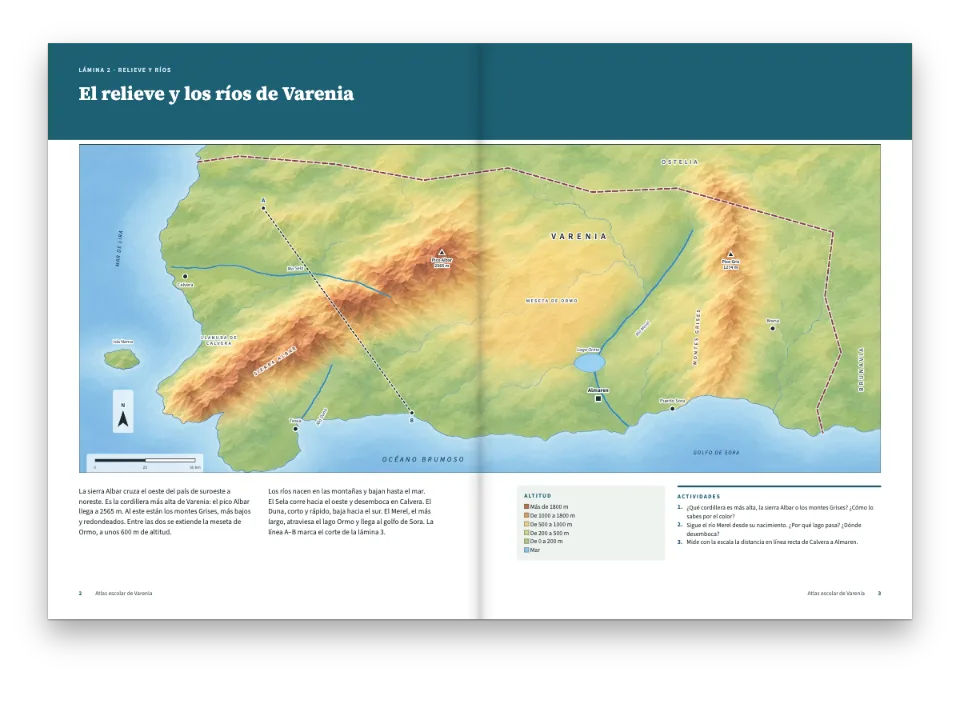
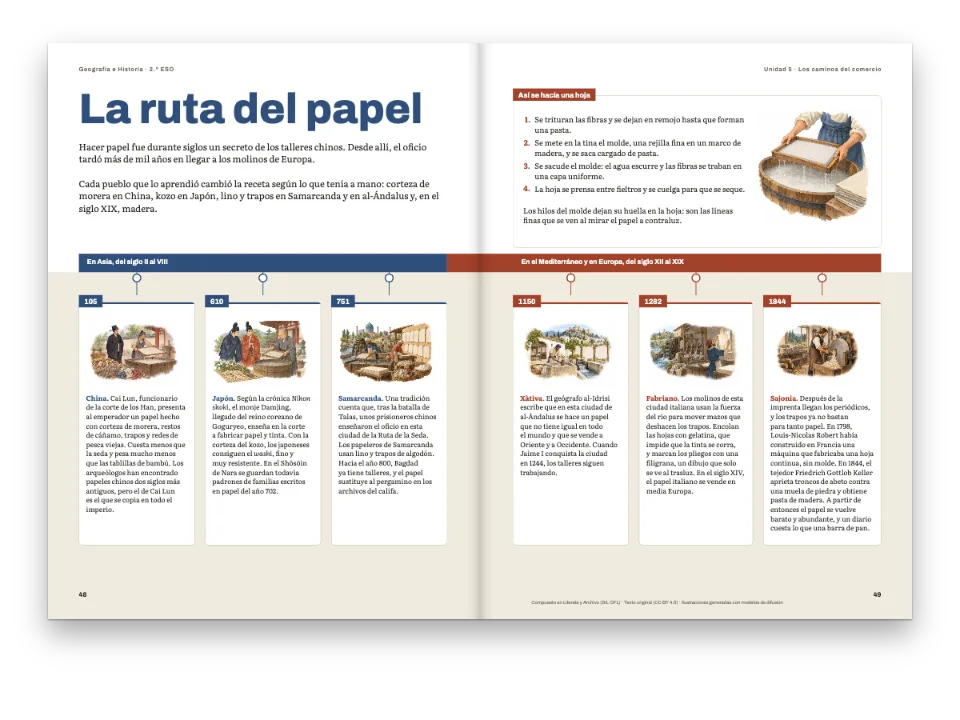
一个讲河流的教科书单元,共九页。每个主题是一个彩色底的跨页,有标题标签、文字、插图和各种框。地图上没有画任何文字,地名全都来自正文。三种语言篇幅不同,却用同一套模板。
成品一览
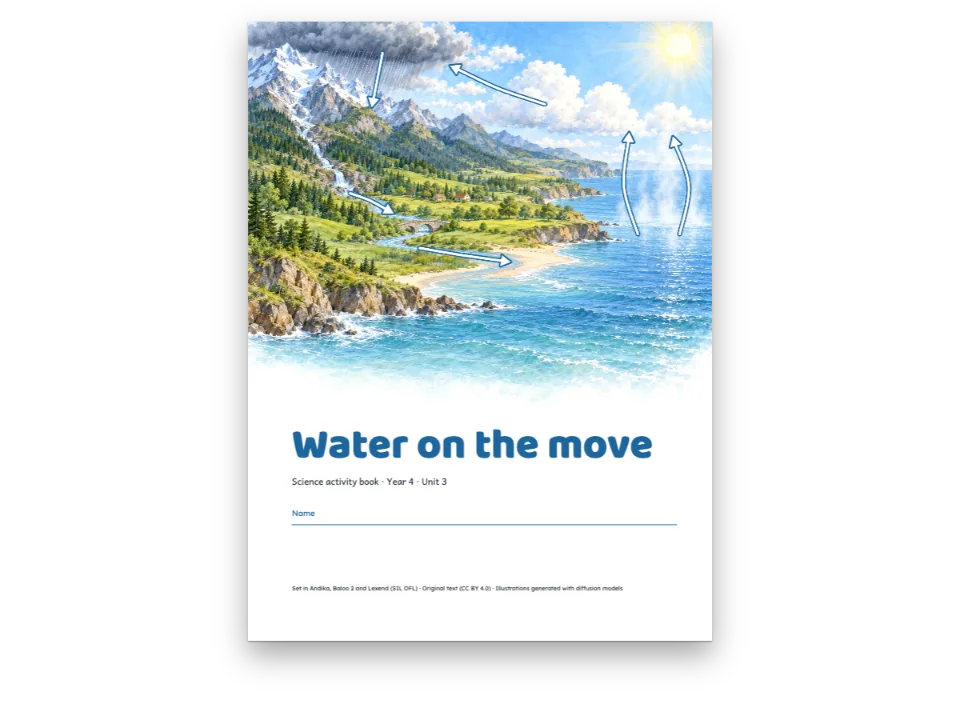
《Our river》是一本虚构的三年级社会课本的第 4 单元,这里排了九页,开本 210 × 280 mm,有西班牙语、加泰罗尼亚语和英语三版。单元开篇是一幅画出来的河谷,接着是列出两个篇目的目录页,然后是三个跨页主题,每个主题各有底色:水的蓝、田野的绿、阳光的沙色。每个主题都有写着编号和标题的标签、两栏文字,以及带标签、随文字变高的框。第二个主题是一幅横跨两页的手绘地图,河流、村镇和三个河段的名字都由 Markdown 标在图上。三种语言的篇幅相差五分之一以上,却排进同一套模板:框按文字需要变高,把下一个框往下推,而地图会比任何文字先缩小一点。
这道食谱解答
- 同一套页面模板要排三种语言的教科书单元,而各语言的文字长短不一,该怎么做?
- 怎样让页面上的框随文字变高,并把下面的框往下推?
- 怎样从正文里给地图写上地名,让译本只换文字、不动地图本身?
简短回答
// Ground, title tab and number are decoration anchored to the title frame, so the tab is as
// tall as the title needs. A topic extends the base and changes its colours and adds frames.
const ground = (f) => ({ kind: 'box', id: 'ground', decorative: true,
  placement: { ...at('bleed', 'top-left'), size: { width: 'fill', height: 'fill' } },
  style: { backgroundColor: col(`${f}-ground`) } });
const titleTab = (f, x = TAB) => ({ kind: 'box', id: 'tab', decorative: true,
  placement: { ...at('#titulo', 'top-left', -x), // the tab reaches out to the margin
    size: { width: mm(HALF), height: { to: '#titulo', edge: 'bottom' } } },
  style: { backgroundColor: col(f), borderRadius: mm(4) } });
const badge = (f) => ({ kind: 'text', id: 'number', content: '{attr.numero}', fontFamily: DISPLAY,
  fontSize: pt(22), fontWeight: 700, color: col(f), align: 'center',
  box: { backgroundColor: col('paper'), borderRadius: mm(6) },
  placement: { ...at('#titulo', 'top-left', 5 - TAB, 2.4),
    size: { width: mm(12), height: mm(12) } } });
const TAB = 22; // mm of the tab left of the title: the badge stands there, outside the frame
const title = { name: 'titulo', takes: 'h1', style: 'titulo', width: mm(HALF - TAB),
  placement: at('container', 'top-left', TAB) };

const base = {
  id: 'tema', spread: true, gutter: mm(12),
  decoration: { elements: [ground('agua'), titleTab('agua'), badge('agua')] },
  frames: [title, { name: 'texto', flow: true, columns: 2, columnGap: mm(7), width: mm(HALF),
    fit: { minScale: 0.9 } }],
  groups: [{ name: 'izquierda', kind: 'stack', gap: mm(6), frames: ['titulo', 'texto'] }],
};
const topic = (id, f, more) => ({ id, extends: 'tema',
  decoration: { elements: [{ id: 'ground', style: { backgroundColor: col(`${f}-ground`) } },
    { id: 'tab', style: { backgroundColor: col(f), borderRadius: mm(4) } },
    { id: 'number', color: col(f) }] },
  ...more });
const box = (name, style, minHeight, more) => ({ name, style, width: mm(HALF),
  minHeight: mm(minHeight), ...more });
const answer = (name, lines) => ({ name, optional: true, style: 'respuesta', width: mm(HALF),
  height: mm(LINE * lines), minHeight: mm(LINE * lines),
  rules: { every: mm(LINE), color: col('rule'), width: pt(0.75) } });
// A picture that sits at the corner of a box and pushes its text aside.
const corner = (name) => ({ name: `${name}-foto`, layer: 2, width: mm(56), exclude: 'push',
  placement: at(`#${name}`, 'top-right', -5, 8) });
用料
- 功能
- 模板页组内随文字变高的框带编号的框标签图上的标注目录跨页模板标注框页面设计中的文字、线条和框页面设计中的图片锚定设计元素锚定在框上的装饰对称页边距书眉与页码标题样式语义调色板作为资源的图和表在Canvas上绘制页面导出PDF
- 类型
- Nunito, Fredoka(SIL OFL 1.1)
- 素材
arroyo-720.jpgcascada-720.jpglimpieza-720.jpgmapa-1900.jpgmolino-720.jpgnacimiento-720.jpgpiraguas-720.jpgportada-1400.jpgriego-720.jpg- The valley of the River Aldara, painted from the mountains to the sea, with two children watching the water. (Generated With Diffusion Models, 原创)
- The painted map of the valley, from the spring to the port, with no lettering: the names are labels set from the Markdown. (Generated With Diffusion Models, 原创)
- A spring between mossy rocks. (Generated With Diffusion Models, 原创)
- A mountain stream over round stones. (Generated With Diffusion Models, 原创)
- A small waterfall into a green pool. (Generated With Diffusion Models, 原创)
- A farmer opening the gate of an irrigation canal. (Generated With Diffusion Models, 原创)
- An old stone watermill with its wheel. (Generated With Diffusion Models, 原创)
- Children paddling canoes on a calm river. (Generated With Diffusion Models, 原创)
- Children and a teacher picking up litter on a river bank. (Generated With Diffusion Models, 原创)
做法
#1 · 用 extends 搭出各种框
// Three steps of `extends`: the box (shape, type, tab), a family's colours on it, then the kind.
const tab = (f) => ({ position: 'top-left', background: col(f), color: col('paper'),
  fontFamily: DISPLAY, fontSize: pt(12), fontWeight: 600, height: mm(7), paddingX: mm(3.2),
  offset: mm(7), inset: mm(5), rule: { enabled: false, color: col(f) } });
const boxText = { fontFamily: TEXT, fontSize: pt(12), lineHeight: pt(17.5), color: col('ink'),
  boldColor: col('ink'), italicColor: col('ink'), firstLineIndent: pt(0), textAlign: 'left',
  paragraphSpacing: true };
const none = { top: mm(0), right: mm(0), bottom: mm(0), left: mm(0) }; // no padding
const calloutStyles = [
  { id: 'caja', backgroundEnabled: true, background: col('paper'), borderRadius: mm(3),
    border: { enabled: false }, padding: { top: mm(3.4), right: mm(5), bottom: mm(4), left: mm(5) },
    body: boxText, lists: { color: col('ink'), gap: mm(2), itemSpacing: mm(1.6) } },
  ...Object.keys(FAMILIES).flatMap((f) => [
    { id: `caja-${f}`, extends: 'caja', label: tab(f), lists: { color: col(f) } },
    { id: `dato-${f}`, extends: `caja-${f}`, background: col(`${f}-tint`) },
    { id: `palabras-${f}`, extends: `caja-${f}`,
      border: { enabled: true, color: col(f), width: pt(1.4) } },
    { id: `actividad-${f}`, extends: `caja-${f}`,
      stripe: { enabled: true, side: 'left', width: pt(4), color: col(f) } },
  ]),
  // Plain frames: the title (its tab is decoration), a picture's card and an answer space.
  { id: 'titulo', extends: 'caja', backgroundEnabled: false,
    padding: { top: mm(2.6), right: mm(6), bottom: mm(3.2), left: mm(0) } },
  { id: 'titulo-plano', extends: 'titulo', padding: { left: mm(8) } },
  { id: 'portada', extends: 'caja-agua', background: col('agua'), borderRadius: mm(4),
    padding: { top: mm(2.6), right: mm(8), bottom: mm(3.6), left: mm(8) } },
  { id: 'foto', extends: 'caja', borderRadius: mm(2),
    padding: { top: mm(1.8), right: mm(1.8), bottom: mm(2.2), left: mm(1.8) } },
  { id: 'respuesta', extends: 'caja', padding: none },
  { id: 'colofon', extends: 'caja', backgroundEnabled: false, padding: none,
    body: { ...boxText, fontSize: pt(8), lineHeight: pt(11), color: col('muted') } },
];
框样式分三步做成。caja 保存形状、字体和标签的几何;caja-agua、caja-campo、caja-sol 把一个色系的颜色加到标签和项目符号上;dato-、palabras-、actividad- 决定种类:带底色的框、带描边的框、带色条的框。新增一个色系只要在 FAMILIES 里加三个颜色,任何样式都不用写两遍。
#2 · 让每个主题继承同一个底板模板
// Ground, title tab and number are decoration anchored to the title frame, so the tab is as
// tall as the title needs. A topic extends the base and changes its colours and adds frames.
const ground = (f) => ({ kind: 'box', id: 'ground', decorative: true,
  placement: { ...at('bleed', 'top-left'), size: { width: 'fill', height: 'fill' } },
  style: { backgroundColor: col(`${f}-ground`) } });
const titleTab = (f, x = TAB) => ({ kind: 'box', id: 'tab', decorative: true,
  placement: { ...at('#titulo', 'top-left', -x), // the tab reaches out to the margin
    size: { width: mm(HALF), height: { to: '#titulo', edge: 'bottom' } } },
  style: { backgroundColor: col(f), borderRadius: mm(4) } });
const badge = (f) => ({ kind: 'text', id: 'number', content: '{attr.numero}', fontFamily: DISPLAY,
  fontSize: pt(22), fontWeight: 700, color: col(f), align: 'center',
  box: { backgroundColor: col('paper'), borderRadius: mm(6) },
  placement: { ...at('#titulo', 'top-left', 5 - TAB, 2.4),
    size: { width: mm(12), height: mm(12) } } });
const TAB = 22; // mm of the tab left of the title: the badge stands there, outside the frame
const title = { name: 'titulo', takes: 'h1', style: 'titulo', width: mm(HALF - TAB),
  placement: at('container', 'top-left', TAB) };

const base = {
  id: 'tema', spread: true, gutter: mm(12),
  decoration: { elements: [ground('agua'), titleTab('agua'), badge('agua')] },
  frames: [title, { name: 'texto', flow: true, columns: 2, columnGap: mm(7), width: mm(HALF),
    fit: { minScale: 0.9 } }],
  groups: [{ name: 'izquierda', kind: 'stack', gap: mm(6), frames: ['titulo', 'texto'] }],
};
const topic = (id, f, more) => ({ id, extends: 'tema',
  decoration: { elements: [{ id: 'ground', style: { backgroundColor: col(`${f}-ground`) } },
    { id: 'tab', style: { backgroundColor: col(f), borderRadius: mm(4) } },
    { id: 'number', color: col(f) }] },
  ...more });
const box = (name, style, minHeight, more) => ({ name, style, width: mm(HALF),
  minHeight: mm(minHeight), ...more });
const answer = (name, lines) => ({ name, optional: true, style: 'respuesta', width: mm(HALF),
  height: mm(LINE * lines), minHeight: mm(LINE * lines),
  rules: { every: mm(LINE), color: col('rule'), width: pt(0.75) } });
// A picture that sits at the corner of a box and pushes its text aside.
const corner = (name) => ({ name: `${name}-foto`, layer: 2, width: mm(56), exclude: 'push',
  placement: at(`#${name}`, 'top-right', -5, 8) });
底板是一个跨页模板:铺到出血位的底色、带编号的标题标签,以及两栏文字。每个主题用 extends: 'tema' 继承它,按 id 改三个装饰元素的颜色,再加上自己的框。标签和编号是锚定在标题框上的装饰,所以标签的高度正好是这种语言的标题所需,编号则放在框的左边,不会被任何框盖住。
#3 · 让各组自己分配空间
每个主题有两个组。左页是一个堆叠组:标题、文字,然后是配图条或地图。右页是另一个由框组成的堆叠组,或者是三个框平分宽度的一行。框和自己的文字一样高,但不低于 minHeight,所以西班牙语的文字会把下面的一切往下推,模板里没有任何位置需要改。页面不够用时,重排阶梯先收回空间,再缩小地图和图片,文字放在最后,最多缩到 90 %。pnpm cookbook bench 会把三个版本的文字加长 30 % 再排一遍。
#4 · 按正文给地图标上名字
// An anchor is a point of the painting (fractions of its width and height) and a label style;
// every language's ::label lines use the same anchors.
const halo = { color: col('paper'), width: pt(1.8) };
const labelStyles = [
  { id: 'sierra', fontFamily: DISPLAY, fontSize: pt(13), fontWeight: 600, color: col('ink'),
    textTransform: 'uppercase', letterSpacing: 0.14, halo },
  { id: 'agua', fontFamily: TEXT, fontSize: pt(11), fontWeight: 700, fontStyle: 'italic',
    color: { hex: '#0b3a5c', model: 'hex' }, halo },
  { id: 'mar', fontFamily: TEXT, fontSize: pt(12), fontWeight: 700, fontStyle: 'italic',
    color: col('paper'), halo: { color: { hex: '#0b3a5c', model: 'hex' }, width: pt(1.8) } },
  { id: 'pueblo', fontFamily: DISPLAY, fontSize: pt(12), fontWeight: 600, color: col('ink'), halo },
  { id: 'curso', fontFamily: DISPLAY, fontSize: pt(10.5), fontWeight: 600, color: col('paper'),
    textTransform: 'uppercase', letterSpacing: 0.08, background: col('campo'),
    padding: mm(1.6) },
];
const ANCHORS = [
  { id: 'sierra', x: 0.21, y: 0.055, style: 'sierra' },
  { id: 'nacimiento', x: 0.065, y: 0.115, style: 'agua', align: 'start' },
  { id: 'fontalba', x: 0.135, y: 0.255, style: 'pueblo', verticalAlign: 'top' },
  { id: 'embalse', x: 0.31, y: 0.155, style: 'agua', width: 0.12 },
  { id: 'molinar', x: 0.505, y: 0.35, style: 'pueblo', verticalAlign: 'bottom' },
  { id: 'aldamar', x: 0.845, y: 0.505, style: 'pueblo', verticalAlign: 'bottom' },
  { id: 'mar', x: 0.965, y: 0.28, style: 'mar' },
  { id: 'rio', x: 0.61, y: 0.715, style: 'agua', rotate: -3 },
  { id: 'alto', x: 0.17, y: 0.45, style: 'curso' },
  { id: 'medio', x: 0.4, y: 0.77, style: 'curso' },
  { id: 'bajo', x: 0.74, y: 0.865, style: 'curso' },
];
地图是一幅没有一个字母的绘画。每个地点是图上的一个锚点,用占图宽和图高的比例表示,并带一种标注样式;各版本在这些锚点上写自己的 ::label 行。Penalta Reservoir、Pantà de Penyalta 和 Embalse de Peñalta 站在同一个位置上,更长的名字会在锚点的 width 里换行。
#5 · 让目录的每一篇不被拆开
// The heading style paints the title tab; the entries come from the headings and the parts.
const indiceOpener = { enabled: true, minHeight: mm(26), slot: { elements: [
  { kind: 'box', id: 'tab', decorative: true,
    placement: { ...at('container', 'top-left'), size: { width: mm(HALF), height: mm(18) } },
    style: { backgroundColor: col('agua'), borderRadius: mm(4) } },
  { kind: 'text', id: 'title', content: '{titleText}', fontFamily: DISPLAY, fontSize: pt(28),
    fontWeight: 600, color: col('paper'), align: 'left',
    placement: { ...at('container', 'top-left', 8, 3.2), size: { width: mm(HALF - 12) } } },
] } };
const toc = {
  levels: [
    { level: 1, fontFamily: DISPLAY, fontSize: pt(15), lineHeight: pt(22), fontWeight: 500,
      color: col('ink'), numberFontWeight: 600, numberColor: col('agua'), numberWidth: mm(9),
      marginTop: pt(4) },
    { level: 2, fontFamily: TEXT, fontSize: pt(11.5), lineHeight: pt(18), indent: mm(9),
      color: col('ink') },
  ],
  pageNumber: { fontFamily: DISPLAY, fontWeight: 500, width: mm(9), color: col('agua') },
  leader: { char: '.', gap: mm(1.5) },
  parts: { height: pt(34), marginTop: pt(12), marginBottom: pt(4), design: { elements: [
    { kind: 'box', id: 'band', decorative: true,
      placement: { ...at('container', 'top-left'), size: { width: 'fill', height: 'fill' } },
      style: { backgroundColor: col('paper'), borderRadius: mm(3) } },
    { kind: 'text', id: 'letter', content: '{number}', fontFamily: DISPLAY, fontSize: pt(16),
      fontWeight: 700, color: col('paper'), align: 'center',
      box: { backgroundColor: col('agua'), borderRadius: mm(4) },
      placement: { ...at('container', 'left', 2, 0), size: { width: mm(8), height: mm(8) } } },
    { kind: 'text', id: 'name', content: '{titleText}', fontFamily: DISPLAY, fontSize: pt(13),
      fontWeight: 600, color: col('agua'), placement: at('container', 'left', 14, 0) },
  ] } },
};
:::toc{keep="part" levels="1-2"} 列出各个主题和小节,并让每个篇名行和它的条目待在一起。带 parts.page: false 的 :::part 围栏只是目录里的一行,也是running head的一个分节,不会多出一页扉页。目录排成正文页而不是放进框里,因为框里的 :::toc 会丢掉篇名行。
完整食谱
// ═══ Postext Cookbook · Nº 156 · A children's textbook unit in three languages ═══ // https://postext.dev/en/cookbook/children-textbook-pages // Code: MIT · Text: original (CC BY 4.0) · Pictures: generated with diffusion models // Fonts: Nunito, Fredoka (SIL OFL 1.1) · Needs postext ≥ 1.40.0 import { buildDocumentWithFonts, renderPageToCanvas, registerResourceImage, } from 'https://esm.sh/postext'; import { renderToPdf, decompressWoff2 } from 'https://esm.sh/postext-pdf'; const LANG = 'es'; // @lang: the language of the sample document ('es' | 'en' | 'ca') const RECIPE = 'children-textbook-pages'; // ─── 1 · Design ───────────────────────────────────────────────────────────── // #region palette: one ink and three families (water, field, sun), each with an accent, a tint // for its boxes and a ground for its pages const FAMILIES = { agua: { main: '#1b6aa0', tint: '#e1f0fa', ground: '#d3e8f6' }, campo: { main: '#336f27', tint: '#e5f1dc', ground: '#d9ebcb' }, sol: { main: '#9a5209', tint: '#fcefd2', ground: '#f8e6b8' }, }; const palette = { ink: '#1d2f3f', muted: '#4f6272', rule: '#7e98ab', paper: '#ffffff' }; for (const [f, c] of Object.entries(FAMILIES)) { Object.assign(palette, { [f]: c.main, [`${f}-tint`]: c.tint, [`${f}-ground`]: c.ground }); } const col = (id) => ({ hex: palette[id], model: 'hex', paletteId: id }); const colorPalette = [ ...Object.entries(palette).map(([id, hex]) => ({ id, name: id, value: { hex, model: 'hex' } })), { id: 'main-color', name: 'water (defaults)', value: { hex: palette.agua, model: 'hex' } }, ]; // #endregion const [TEXT, DISPLAY] = ['Nunito', 'Fredoka']; const PAGE = { w: 210, h: 280, top: 18, bottom: 18, inner: 14, outer: 12 }; // mm, mirrored const HALF = PAGE.w - PAGE.inner - PAGE.outer; // one page's type area: 184 mm const SHEET = 2 * HALF + 2 * PAGE.inner; // a spread's content area: 396 mm const RIGHT = HALF + 2 * PAGE.inner; // where the right page's type area starts on the sheet const LINE = 8; // mm between two answer lines const at = (to, edge, x = 0, y = 0) => ({ anchor: { to, edge }, offset: { x: mm(x), y: mm(y) } }); const onRight = at('container', 'top-left', RIGHT); // every frame of the right page's stack // #region boxes: callout styles that extend each other // Three steps of `extends`: the box (shape, type, tab), a family's colours on it, then the kind. const tab = (f) => ({ position: 'top-left', background: col(f), color: col('paper'), fontFamily: DISPLAY, fontSize: pt(12), fontWeight: 600, height: mm(7), paddingX: mm(3.2), offset: mm(7), inset: mm(5), rule: { enabled: false, color: col(f) } }); const boxText = { fontFamily: TEXT, fontSize: pt(12), lineHeight: pt(17.5), color: col('ink'), boldColor: col('ink'), italicColor: col('ink'), firstLineIndent: pt(0), textAlign: 'left', paragraphSpacing: true }; const none = { top: mm(0), right: mm(0), bottom: mm(0), left: mm(0) }; // no padding const calloutStyles = [ { id: 'caja', backgroundEnabled: true, background: col('paper'), borderRadius: mm(3), border: { enabled: false }, padding: { top: mm(3.4), right: mm(5), bottom: mm(4), left: mm(5) }, body: boxText, lists: { color: col('ink'), gap: mm(2), itemSpacing: mm(1.6) } }, ...Object.keys(FAMILIES).flatMap((f) => [ { id: `caja-${f}`, extends: 'caja', label: tab(f), lists: { color: col(f) } }, { id: `dato-${f}`, extends: `caja-${f}`, background: col(`${f}-tint`) }, { id: `palabras-${f}`, extends: `caja-${f}`, border: { enabled: true, color: col(f), width: pt(1.4) } }, { id: `actividad-${f}`, extends: `caja-${f}`, stripe: { enabled: true, side: 'left', width: pt(4), color: col(f) } }, ]), // Plain frames: the title (its tab is decoration), a picture's card and an answer space. { id: 'titulo', extends: 'caja', backgroundEnabled: false, padding: { top: mm(2.6), right: mm(6), bottom: mm(3.2), left: mm(0) } }, { id: 'titulo-plano', extends: 'titulo', padding: { left: mm(8) } }, { id: 'portada', extends: 'caja-agua', background: col('agua'), borderRadius: mm(4), padding: { top: mm(2.6), right: mm(8), bottom: mm(3.6), left: mm(8) } }, { id: 'foto', extends: 'caja', borderRadius: mm(2), padding: { top: mm(1.8), right: mm(1.8), bottom: mm(2.2), left: mm(1.8) } }, { id: 'respuesta', extends: 'caja', padding: none }, { id: 'colofon', extends: 'caja', backgroundEnabled: false, padding: none, body: { ...boxText, fontSize: pt(8), lineHeight: pt(11), color: col('muted') } }, ]; // #endregion // #region answer: one base template and a family of topics that extend it // Ground, title tab and number are decoration anchored to the title frame, so the tab is as // tall as the title needs. A topic extends the base and changes its colours and adds frames. const ground = (f) => ({ kind: 'box', id: 'ground', decorative: true, placement: { ...at('bleed', 'top-left'), size: { width: 'fill', height: 'fill' } }, style: { backgroundColor: col(`${f}-ground`) } }); const titleTab = (f, x = TAB) => ({ kind: 'box', id: 'tab', decorative: true, placement: { ...at('#titulo', 'top-left', -x), // the tab reaches out to the margin size: { width: mm(HALF), height: { to: '#titulo', edge: 'bottom' } } }, style: { backgroundColor: col(f), borderRadius: mm(4) } }); const badge = (f) => ({ kind: 'text', id: 'number', content: '{attr.numero}', fontFamily: DISPLAY, fontSize: pt(22), fontWeight: 700, color: col(f), align: 'center', box: { backgroundColor: col('paper'), borderRadius: mm(6) }, placement: { ...at('#titulo', 'top-left', 5 - TAB, 2.4), size: { width: mm(12), height: mm(12) } } }); const TAB = 22; // mm of the tab left of the title: the badge stands there, outside the frame const title = { name: 'titulo', takes: 'h1', style: 'titulo', width: mm(HALF - TAB), placement: at('container', 'top-left', TAB) }; const base = { id: 'tema', spread: true, gutter: mm(12), decoration: { elements: [ground('agua'), titleTab('agua'), badge('agua')] }, frames: [title, { name: 'texto', flow: true, columns: 2, columnGap: mm(7), width: mm(HALF), fit: { minScale: 0.9 } }], groups: [{ name: 'izquierda', kind: 'stack', gap: mm(6), frames: ['titulo', 'texto'] }], }; const topic = (id, f, more) => ({ id, extends: 'tema', decoration: { elements: [{ id: 'ground', style: { backgroundColor: col(`${f}-ground`) } }, { id: 'tab', style: { backgroundColor: col(f), borderRadius: mm(4) } }, { id: 'number', color: col(f) }] }, ...more }); const box = (name, style, minHeight, more) => ({ name, style, width: mm(HALF), minHeight: mm(minHeight), ...more }); const answer = (name, lines) => ({ name, optional: true, style: 'respuesta', width: mm(HALF), height: mm(LINE * lines), minHeight: mm(LINE * lines), rules: { every: mm(LINE), color: col('rule'), width: pt(0.75) } }); // A picture that sits at the corner of a box and pushes its text aside. const corner = (name) => ({ name: `${name}-foto`, layer: 2, width: mm(56), exclude: 'push', placement: at(`#${name}`, 'top-right', -5, 8) }); // #endregion const questions = [1, 2, 3].flatMap((n) => [box(`pregunta-${n}`, 'dato-agua', 14), answer(`respuesta-${n}`, 3)]); const pageTemplates = [ base, // Water: text, a strip of three pictures and a box; three boxes grow down the right page. topic('tema-agua', 'agua', { frames: [ ...[1, 2, 3].map((n) => ({ name: `foto-${n}`, style: 'foto', width: mm((HALF - 10) / 3), ...(n === 1 && { placement: at('#texto', 'below', 0, 8) }) })), box('probar', 'palabras-agua', 46, { placement: at('#foto-1', 'below', 0, 10) }), { ...box('sabias', 'dato-agua', 40), placement: onRight }, { ...box('palabras', 'palabras-agua', 62), placement: onRight }, { ...box('actividades', 'actividad-agua', 58), placement: onRight }, ], groups: [ { name: 'fotos', kind: 'row', gap: mm(5), frames: ['foto-1', 'foto-2', 'foto-3'] }, { name: 'derecha', kind: 'stack', gap: mm(12), frames: ['sabias', 'palabras', 'actividades'] }, ], }), // Field: one map across the spread; under it a text, and three boxes that share a width. topic('tema-campo', 'campo', { frames: [ { name: 'mapa', crossGutter: true, width: mm(SHEET) }, box('actividad', 'actividad-campo', 24), ...[1, 2, 3].map((n) => ({ name: `curso-${n}`, style: 'dato-campo', width: mm(56), minHeight: mm(46), shrink: 1, ...(n === 1 && { placement: at('#mapa', 'below', RIGHT, 6) }) })), ], groups: [ { name: 'izquierda', kind: 'stack', gap: mm(6), frames: ['titulo', 'mapa', 'texto', 'actividad'] }, { name: 'cursos', kind: 'row', gap: mm(6), frames: ['curso-1', 'curso-2', 'curso-3'] }, ], }), // Sun: boxes with a picture at their corner that pushes the text aside. topic('tema-sol', 'sol', { frames: [ box('cuidar', 'palabras-sol', 64, { padding: { right: mm(64) } }), corner('cuidar'), box('turno', 'actividad-sol', 40), ...[1, 2, 3].flatMap((n) => [ box(`uso-${n}`, 'dato-sol', 66, { padding: { right: mm(64) }, placement: onRight }), corner(`uso-${n}`), ]), ], groups: [ { name: 'izquierda', kind: 'stack', gap: mm(12), frames: ['titulo', 'texto', 'cuidar', 'turno'] }, { name: 'derecha', kind: 'stack', gap: mm(12), frames: ['uso-1', 'uso-2', 'uso-3'] }, ], }), // Before the unit: questions, each with room to write. { id: 'saberes', header: false, decoration: { elements: [titleTab('agua', 0)] }, frames: [{ ...title, style: 'titulo-plano', width: mm(HALF), placement: at('container', 'top-left') }, { name: 'texto', flow: true, width: mm(HALF) }, ...questions], groups: [{ name: 'pagina', kind: 'stack', gap: mm(7), frames: ['titulo', 'texto', ...questions.map((q) => q.name)] }] }, // The opener: a painting to the bleed, the title over its foot. { id: 'unidad', header: false, footer: false, decoration: { elements: [ { kind: 'image', id: 'portada', resourceId: 'portada', decorative: true, placement: { ...at('bleed', 'top-left'), size: { width: 'fill', height: mm(157.5) } } }, { kind: 'text', id: 'kicker', content: '{attr.unidad}', fontFamily: DISPLAY, fontSize: pt(11), fontWeight: 600, letterSpacing: pt(1), textTransform: 'uppercase', color: col('agua'), box: { backgroundColor: col('paper'), borderRadius: mm(2) }, placement: { ...at('#titulo', 'top-left', 0, -9), size: { height: mm(7) } } }, ] }, frames: [ { name: 'titulo', takes: 'h1', style: 'portada', width: mm(120), placement: at('container', 'top-left', 0, 104) }, { name: 'texto', flow: true, width: mm(160) }, box('aprenderas', 'dato-agua', 36), { name: 'colofon', style: 'colofon', width: mm(HALF), placement: at('container', 'bottom-left') }, ], groups: [{ name: 'pagina', kind: 'stack', gap: mm(7), frames: ['titulo', 'texto', 'aprenderas'] }] }, ]; const head = (id, content, parity, edge, x) => ({ kind: 'text', id, content, parity, fontFamily: TEXT, fontSize: pt(8), fontWeight: 700, letterSpacing: pt(1), color: col('muted'), textTransform: 'uppercase', placement: at('page', edge, x, 9) }); const folio = (id, parity, edge, x) => ({ kind: 'text', id, content: '{pageNumber}', parity, fontFamily: DISPLAY, fontSize: pt(11), fontWeight: 600, color: col('paper'), align: 'center', box: { backgroundColor: col('agua'), borderRadius: mm(4) }, placement: { ...at('page', edge, x, -8), size: { width: mm(8), height: mm(8) } } }); // #region contents: a flow page, because a :::toc cannot be laid out inside a frame yet // The heading style paints the title tab; the entries come from the headings and the parts. const indiceOpener = { enabled: true, minHeight: mm(26), slot: { elements: [ { kind: 'box', id: 'tab', decorative: true, placement: { ...at('container', 'top-left'), size: { width: mm(HALF), height: mm(18) } }, style: { backgroundColor: col('agua'), borderRadius: mm(4) } }, { kind: 'text', id: 'title', content: '{titleText}', fontFamily: DISPLAY, fontSize: pt(28), fontWeight: 600, color: col('paper'), align: 'left', placement: { ...at('container', 'top-left', 8, 3.2), size: { width: mm(HALF - 12) } } }, ] } }; const toc = { levels: [ { level: 1, fontFamily: DISPLAY, fontSize: pt(15), lineHeight: pt(22), fontWeight: 500, color: col('ink'), numberFontWeight: 600, numberColor: col('agua'), numberWidth: mm(9), marginTop: pt(4) }, { level: 2, fontFamily: TEXT, fontSize: pt(11.5), lineHeight: pt(18), indent: mm(9), color: col('ink') }, ], pageNumber: { fontFamily: DISPLAY, fontWeight: 500, width: mm(9), color: col('agua') }, leader: { char: '.', gap: mm(1.5) }, parts: { height: pt(34), marginTop: pt(12), marginBottom: pt(4), design: { elements: [ { kind: 'box', id: 'band', decorative: true, placement: { ...at('container', 'top-left'), size: { width: 'fill', height: 'fill' } }, style: { backgroundColor: col('paper'), borderRadius: mm(3) } }, { kind: 'text', id: 'letter', content: '{number}', fontFamily: DISPLAY, fontSize: pt(16), fontWeight: 700, color: col('paper'), align: 'center', box: { backgroundColor: col('agua'), borderRadius: mm(4) }, placement: { ...at('container', 'left', 2, 0), size: { width: mm(8), height: mm(8) } } }, { kind: 'text', id: 'name', content: '{titleText}', fontFamily: DISPLAY, fontSize: pt(13), fontWeight: 600, color: col('agua'), placement: at('container', 'left', 14, 0) }, ] } }, }; // #endregion // #region art-labels: the map's label styles and anchors; the words are in the Markdown // An anchor is a point of the painting (fractions of its width and height) and a label style; // every language's ::label lines use the same anchors. const halo = { color: col('paper'), width: pt(1.8) }; const labelStyles = [ { id: 'sierra', fontFamily: DISPLAY, fontSize: pt(13), fontWeight: 600, color: col('ink'), textTransform: 'uppercase', letterSpacing: 0.14, halo }, { id: 'agua', fontFamily: TEXT, fontSize: pt(11), fontWeight: 700, fontStyle: 'italic', color: { hex: '#0b3a5c', model: 'hex' }, halo }, { id: 'mar', fontFamily: TEXT, fontSize: pt(12), fontWeight: 700, fontStyle: 'italic', color: col('paper'), halo: { color: { hex: '#0b3a5c', model: 'hex' }, width: pt(1.8) } }, { id: 'pueblo', fontFamily: DISPLAY, fontSize: pt(12), fontWeight: 600, color: col('ink'), halo }, { id: 'curso', fontFamily: DISPLAY, fontSize: pt(10.5), fontWeight: 600, color: col('paper'), textTransform: 'uppercase', letterSpacing: 0.08, background: col('campo'), padding: mm(1.6) }, ]; const ANCHORS = [ { id: 'sierra', x: 0.21, y: 0.055, style: 'sierra' }, { id: 'nacimiento', x: 0.065, y: 0.115, style: 'agua', align: 'start' }, { id: 'fontalba', x: 0.135, y: 0.255, style: 'pueblo', verticalAlign: 'top' }, { id: 'embalse', x: 0.31, y: 0.155, style: 'agua', width: 0.12 }, { id: 'molinar', x: 0.505, y: 0.35, style: 'pueblo', verticalAlign: 'bottom' }, { id: 'aldamar', x: 0.845, y: 0.505, style: 'pueblo', verticalAlign: 'bottom' }, { id: 'mar', x: 0.965, y: 0.28, style: 'mar' }, { id: 'rio', x: 0.61, y: 0.715, style: 'agua', rotate: -3 }, { id: 'alto', x: 0.17, y: 0.45, style: 'curso' }, { id: 'medio', x: 0.4, y: 0.77, style: 'curso' }, { id: 'bajo', x: 0.74, y: 0.865, style: 'curso' }, ]; // #endregion const config = { locale: t({ es: 'es', en: 'en-gb', ca: 'ca' }), resourceTypes: [{ id: 'dibujo', name: t({ es: 'Dibujo', en: 'Picture', ca: 'Dibuix' }), shortLabel: '', numberingTemplate: '', resetOn: 'never', counterFormat: 'decimal', captionPrefix: '', defaultPlacement: { position: 'here' } }], colorPalette, page: { sizePreset: 'custom', width: mm(PAGE.w), height: mm(PAGE.h), dpi: 150, margins: { top: mm(PAGE.top), bottom: mm(PAGE.bottom), left: mm(PAGE.inner), right: mm(PAGE.outer), mirror: true } }, layout: { layoutType: 'single' }, bodyText: { fontFamily: TEXT, fontSize: pt(12), lineHeight: pt(17.5), color: col('ink'), boldColor: col('ink'), italicColor: col('ink'), referenceColor: col('ink'), textAlign: 'left', firstLineIndent: pt(0), paragraphSpacing: true, hyphenation: { enabled: true }, optimalLineBreaking: true, avoidWidows: true, avoidOrphans: true, avoidRunts: true }, headings: { fontFamily: DISPLAY, fontWeight: 600, color: col('ink'), levels: [ { level: 1, fontSize: pt(28), lineHeight: pt(32), color: col('paper'), marginTop: pt(0), marginBottom: pt(0), breakBefore: { enabled: false } }, { level: 2, fontSize: pt(15), lineHeight: pt(19), marginTop: pt(9), marginBottom: pt(3) }, ] }, // Headings that are not entries of the unit: no number, no row in the contents. headingStyles: [ { id: 'portada', numbered: false, toc: false, fontSize: pt(46), lineHeight: pt(48) }, { id: 'previo', numbered: false, toc: false }, { id: 'indice', numbered: false, toc: false, fontSize: pt(28), advancedDesign: indiceOpener }, ], toc, parts: { page: false }, // a part is a row of the contents, with no divider page unorderedLists: { bulletChar: '•', color: col('agua'), fontWeight: 700, itemSpacing: pt(3) }, orderedLists: { numberFormat: 'arabic', fontFamily: DISPLAY, fontWeight: 600, color: col('agua'), itemSpacing: pt(4) }, labelStyles, captionStyle: { fontFamily: TEXT, fontSize: pt(9), color: col('ink'), descriptionItalic: true, gap: pt(4) }, calloutStyles, header: { elements: [ head('materia', '{subtitle}', 'even', 'top-left', PAGE.outer), head('unidad', '{title}', 'odd', 'top-right', -PAGE.outer), ] }, footer: { elements: [folio('folio-par', 'even', 'bottom-left', PAGE.outer), folio('folio-impar', 'odd', 'bottom-right', -PAGE.outer)] }, pageTemplates, }; // ─── 2 · Content ──────────────────────────────────────────────────────────── const markdown = String.raw`---Markdown样例 · 188行 · content.es.md
title: "Nuestro río" subtitle: "Ciencias sociales · 3.º de Primaria" --- ::::page{template="unidad" unidad="Unidad 4 · Ciencias sociales"} # Nuestro río {style="portada"} Todos los pueblos que conoces están cerca del agua. Esta unidad sigue a un río, el Aldara, desde la nieve donde nace hasta el mar donde termina. Vas a descubrir dónde nace un río, cómo cambia en su camino hacia abajo y cómo viven junto a él las personas de Fontalba, Molinar y Aldamar. :::frame{slot="aprenderas" label="Vas a aprender"} - Cómo un manantial se convierte en arroyo, y un arroyo en río. - Qué son el curso alto, el curso medio y el curso bajo de un río. - Cómo usan las personas el agua del río y cómo se cuida. ::: :::frame{slot="colofon"} Compuesto en Nunito y Fredoka (SIL OFL) · Texto original (CC BY 4.0) · Ilustraciones generadas con modelos de difusión ::: :::: # En esta unidad {style="indice"} :::toc{keep="part" levels="1-2"} :::figure{resource="rio"} ::alt[Mapa pintado del valle del río Aldara, desde las montañas nevadas hasta el mar.] ::caption[El río Aldara, desde su nacimiento hasta el mar. El mapa está en las páginas 6 y 7.] ::: ::::page{template="saberes"} # ¿Qué sabes de los ríos? {style="previo"} Antes de empezar, piensa en los ríos que has visto. Escribe tus ideas en las líneas. Al final de la unidad vuelve a leerlas y mira qué ha cambiado. :::frame{slot="pregunta-1" label="Piensa 1"} ¿Dónde crees que empieza un río? ::: :::frame{slot="pregunta-2" label="Piensa 2"} ¿Para qué usan las personas un río? ::: :::frame{slot="pregunta-3" label="Piensa 3"} ¿Qué animales y plantas viven en un río o junto a él? ::: :::: :::part{number="A" title="Un río de la montaña al mar"} ::: ::::page{template="tema-agua" spread numero="1"} # Dónde nace un río Llueve y nieva en las montañas. Parte del agua baja por las laderas y parte se cuela en la tierra. Bajo tierra avanza despacio, hasta que choca con una roca que no puede atravesar. Entonces sale al aire libre. El lugar donde el agua brota de la tierra se llama **manantial**. ## Del manantial al arroyo Un manantial da solo un hilo de agua. El hilo baja por la ladera, se encuentra con otros hilos y entre todos forman un **arroyo**. En una pendiente fuerte, el arroyo corre deprisa. Arrastra guijarros y los deja lisos de tanto rodarlos. Cuando se juntan varios arroyos, forman uno mayor. El río Aldara empieza así, entre la nieve de la sierra Blanca, a 1850 metros sobre el nivel del mar. :::figure{resource="nacimiento" slot="foto-1"} ::alt[Agua clara que brota entre rocas cubiertas de musgo.] ::caption[Un manantial. El agua ha pasado meses bajo tierra.] ::: :::figure{resource="arroyo" slot="foto-2"} ::alt[Un arroyo que salta sobre piedras redondas.] ::caption[Un arroyo, empinado y rápido, con guijarros pulidos.] ::: :::figure{resource="cascada" slot="foto-3"} ::alt[Una pequeña cascada que cae en una poza verde.] ::caption[Una cascada, donde el arroyo cae por un escalón de roca.] ::: :::frame{slot="probar" label="Pruébalo"} Sostén una esponja mojada sobre una bandeja y apriétala con suavidad. ¿Por dónde sale el agua? Mira cómo gotea y luego corre. Así alimenta un manantial a un arroyo. ::: :::frame{slot="sabias" label="¿Sabías que…?"} En su nacimiento, el Aldara es un hilo de agua que se puede saltar. Después de 94 kilómetros es tan ancho como largo es un campo de fútbol. ::: :::frame{slot="palabras" label="Palabras para aprender"} **Manantial:** lugar donde el agua brota de la tierra. **Arroyo:** río pequeño que baja rápido por una pendiente. **Afluente:** arroyo o río que desemboca en otro mayor. **Orilla:** la tierra que hay a los lados de un río. ::: :::frame{slot="actividades" label="Actividades"} 1. Mira las tres imágenes. ¿Cuál muestra un manantial? ¿Cómo lo sabes? 2. ¿Por qué un arroyo corre más rápido en la montaña que en el valle? 3. ¿Cuál de las cuatro palabras del recuadro puedes ver en las imágenes? ::: :::: ::::page{template="tema-campo" spread numero="2"} # De la montaña al mar El río Aldara mide 94 kilómetros. Nace en la sierra Blanca, cruza un valle y una llanura y llega al mar en Aldamar. Los geógrafos dividen un río en tres partes. Cada parte se llama **curso** y cada una tiene un aspecto distinto. :::figure{resource="mapa" slot="mapa"} ::alt[Un mapa pintado del valle: montañas nevadas y un nacimiento a la izquierda, el pueblo de Fontalba, un embalse con su presa, la ciudad de Molinar con su puente y su molino, campos de cultivo, el río que se curva por una llanura y el puerto de Aldamar junto al mar, a la derecha.] ::label[Sierra Blanca]{at="sierra"} ::label[Nacimiento]{at="nacimiento"} ::label[Fontalba]{at="fontalba"} ::label[Embalse de Peñalta]{at="embalse"} ::label[Molinar]{at="molinar"} ::label[Aldamar]{at="aldamar"} ::label[Mar]{at="mar"} ::label[Río Aldara]{at="rio"} ::label[Curso alto]{at="alto"} ::label[Curso medio]{at="medio"} ::label[Curso bajo]{at="bajo"} ::: :::frame{slot="actividad" label="Mira el mapa"} Sigue el río con el dedo desde el nacimiento hasta el mar. ¿Qué población está más cerca del mar? ::: :::frame{slot="curso-1" label="Curso alto"} La pendiente es fuerte. El agua es fría, clara y rápida, y excava la roca. Aquí está Fontalba. ::: :::frame{slot="curso-2" label="Curso medio"} El valle es más ancho y el río va más despacio. Los agricultores riegan sus campos, y Molinar creció junto a un puente y un molino. ::: :::frame{slot="curso-3" label="Curso bajo"} La tierra es casi llana. El río es ancho y lento, y dibuja grandes curvas. En Aldamar desemboca en el mar. ::: :::: :::part{number="B" title="Las personas y el río"} ::: ::::page{template="tema-sol" spread numero="3"} # Las personas y el río Las personas siempre se han instalado cerca de los ríos. Necesitan agua para beber, para lavarse y para cultivar alimentos. Un río también da peces, un camino para las barcas y la fuerza que hace girar una rueda. ## Cuidamos el río Un río solo se mantiene limpio si lo cuidamos. La basura, el aceite y el agua sucia lo enferman, y los peces y las plantas que viven en él lo sufren. Todo lo que cae por un desagüe o por la calle acaba en un río o en el mar. :::frame{slot="cuidar" label="Cuidamos nuestro río"} - Tiramos la basura a la papelera, nunca al agua. - Gastamos el agua con cuidado y cerramos el grifo. - Vamos por los caminos y no molestamos a plantas ni animales. - Ayudamos a limpiar la orilla cuando lo organiza el colegio. ::: :::frame{slot="turno" label="Te toca a ti"} 1. Dibuja un cartel con tres normas para mantener limpio nuestro río. 2. Pregunta en casa: ¿de dónde viene el agua de tu grifo? ::: :::figure{resource="limpieza" slot="cuidar-foto"} ::alt[Niños con guantes y bolsas de papel recogiendo basura en la orilla de un río.] ::: :::frame{slot="uso-1" label="1 · Agua para los campos"} En el curso medio, los agricultores abren pequeñas acequias para que el agua del río corra entre los surcos. Sin ella, los tomates y las lechugas no crecerían en verano. Una sola acequia puede llevar agua a muchos kilómetros de distancia. ::: :::figure{resource="riego" slot="uso-1-foto"} ::alt[Un agricultor levanta una compuerta de una acequia en un campo de hortalizas.] ::: :::frame{slot="uso-2" label="2 · Molinos"} Hace mucho tiempo, el agua al caer movía la rueda del molino de Molinar. La rueda hacía girar las piedras que molían el trigo para hacer harina para todo el valle. Hoy el viejo molino es un pequeño museo. ::: :::figure{resource="molino" slot="uso-2-foto"} ::alt[Un viejo molino de piedra con una gran rueda de madera junto a un río.] ::: :::frame{slot="uso-3" label="3 · Deporte y juegos"} Ahora el curso bajo, tranquilo, es un lugar para las piraguas. En las mañanas de verano, los niños de Aldamar aprenden a remar con un monitor, y todos llevan chaleco salvavidas. ::: :::figure{resource="piraguas" slot="uso-3-foto"} ::alt[Niños con chalecos salvavidas reman en dos piraguas por un río tranquilo.] ::: ::::`; // content.<lang>.md, inlined by the Cookbook // #region art: nine paintings (JPEGs in assets/), the pictures of the unit // Painted with a diffusion model in a coloured-pencil and watercolour manner, cut to the shape // of the frames that show them and declared with their pixels. Nothing is written on them: the // names on the map are ::label lines of the Markdown, standing at the anchors below. const ART = { portada: ['portada-1400.jpg', 1400, 1021, 165], mapa: ['mapa-1900.jpg', 1900, 730, 122], ...Object.fromEntries(['nacimiento', 'arroyo', 'cascada', 'riego', 'molino', 'piraguas', 'limpieza'].map((id) => [id, [`${id}-720.jpg`, 720, 540, 330]])) }; const resources = await Promise.all(Object.entries(ART).map(async ([id, [fileId, w, h, ppi]]) => { await loadImage(fileId, asset(fileId)); return { id, typeId: 'dibujo', kind: 'bitmap', caption: '', altText: '', createdAt: 0, updatedAt: 0, bitmap: { fileId, format: 'jpeg', width: w, height: h, resolution: ppi }, ...(id === 'mapa' && { anchors: ANCHORS }) }; })); // The map again with no anchors, small, under the contents. resources.push({ ...resources.find((r) => r.id === 'mapa'), id: 'rio', anchors: [] }); // #endregion // ─── 3 · Fonts ────────────────────────────────────────────────────────────── const FONTS = { Nunito: ['400', '400i', '700'], Fredoka: ['500', '600', '700'] }; // ─── 4 · Build & show ─────────────────────────────────────────────────────── const doc = await buildDocumentWithFonts({ markdown, resources }, config, kitFonts(FONTS)); showPages(doc, { title: t({ es: 'Nuestro río', en: 'Our river', ca: 'El nostre riu' }) }); offerPdf(() => renderToPdf(doc, { fontProvider: fontsourceProvider, resourceBytes: imageBytes }), `${RECIPE}.pdf`);工具包 · core, fonts, viewer, pdf, images:每道食谱都相同 · 315行
// ─── Kit ── helpers shared by every Cookbook recipe · postext.dev/cookbook ───── // ─── Kit · core v1 ── the same in every recipe · postext.dev/cookbook function mm(value) { return { value, unit: 'mm' }; } function pt(value) { return { value, unit: 'pt' }; } function em(value) { return { value, unit: 'em' }; } /** The sample language's string: t({ en: 'Figure', es: 'Figura' }). */ function t(strings) { return strings[LANG] ?? Object.values(strings)[0]; } /** A file in this recipe's assets folder, served from the Postext repo by jsDelivr. */ function asset(file) { return `https://cdn.jsdelivr.net/gh/drnachio/postext@main/cookbook/${RECIPE}/assets/${file}`; } // ─── Kit · fonts v3 ── the same in every recipe · postext.dev/cookbook // Postext loads the faces a config asks for before layout (prepareFonts, // buildDocumentWithFonts) and asks the kit for the files: Fontsource's, the // files the PDF embeds too. /** The options of buildDocumentWithFonts / prepareFonts / withLoadedFonts: * the Fontsource resolver, and the faces of FONTS loaded with the ones the * config names. FONTS = { 'Family Name': ['400', '400i', '700'] }. */ function kitFonts(FONTS = {}) { const faces = Object.entries(FONTS).flatMap(([family, specs]) => specs.map((spec) => ({ family, weight: parseInt(spec, 10), style: spec.endsWith('i') ? 'italic' : 'normal' }))); return { resolve: fontsourceResolver, faces }; } /** A face's Fontsource files, in a fixed order: latin, then latin-ext and greek * when `text` needs them and the family ships them (kitSubsetsFor), each with * its unicode-range. Null for a weight or slant Fontsource does not ship. */ async function fontsourceResolver(family, weight, style, { text = '' } = {}) { const id = fontsourceId(family); const meta = await fontsourceMeta(family); if (meta && !(meta.weights.includes(weight) && meta.styles.includes(style))) return null; kitStatus('Loading fonts…'); const at = await fontsourceAt(id); return ['latin', ...kitSubsetsFor(text, meta)].map((subset) => ({ source: `${at}files/${id}-${subset}-${weight}-${style}.woff2`, unicodeRange: kitRanges()[subset], })); } /** The unicode-range of each Fontsource file the kit loads (a function: the * kit is inlined after the pen's code, which runs before a const would be set). */ function kitRanges() { return { latin: 'U+0000-00FF,U+0131,U+0152-0153,U+02BB-02BC,U+02C6,U+02DA,U+02DC,U+0304,U+0308,U+0329,' + 'U+2000-206F,U+20AC,U+2122,U+2191,U+2193,U+2212,U+2215,U+FEFF,U+FFFD', 'latin-ext': 'U+0100-02BA,U+02BD-02C5,U+02C7-02CC,U+02CE-02D7,U+02DD-02FF,U+0304,U+0308,U+0329,' + 'U+1D00-1DBF,U+1E00-1E9F,U+1EF2-1EFF,U+2020,U+20A0-20AB,U+20AD-20C0,U+2113,U+2C60-2C7F,U+A720-A7FF', greek: 'U+0370-03FF', }; } /** For the cjk, arabic and comics blocks, which add their own files: the * faces of `faces` = { 'Family Name': ['400', '400i', '700'] }. `text` is the sample: * č ł † α χ also load latin-ext and greek files (kitSubsetsFor). With * `optional`, a face Fontsource does not ship is skipped instead of failing. * The files are added once all have loaded, in the order asked (latin, then * latin-ext, then greek), whatever order they arrive in: the last one added * wins a character two files hold. Resolves to the number of faces added. */ async function loadFonts(faces, text = '', { optional = false } = {}) { kitStatus('Loading fonts…'); const ranges = kitRanges(); const jobs = []; for (const [family, specs] of Object.entries(faces)) { const id = fontsourceId(family); const todo = [...new Set(specs)].map((spec) => [parseInt(spec, 10), spec.endsWith('i') ? 'italic' : 'normal']) .filter(([weight, style]) => !hasFace(family, weight, style)); // before any await const at = fontsourceAt(id); const meta = optional || /[^\0-ÿ]/u.test(text) ? await fontsourceMeta(family) : null; const subsets = ['latin', ...kitSubsetsFor(text, meta)]; for (const [weight, style] of todo) { if (optional && !(meta?.weights.includes(weight) && meta.styles.includes(style))) continue; for (const subset of subsets) { const url = `${await at}files/${id}-${subset}-${weight}-${style}.woff2`; const face = new FontFace(family, `url(${url}) format('woff2')`, { weight: String(weight), style, unicodeRange: ranges[subset] }); jobs.push(face.load().catch(() => { if (subset === 'latin' && !optional) throw new Error(`Fontsource has no ${family} ${weight} ${style}`); })); } } } const ready = await Promise.all(jobs).catch((error) => { kitFail(error); throw error; }); return ready.filter((face) => face && document.fonts.add(face)).length; } /** A loaded FontFace covers this family, weight and style (fonts.check() would * also say yes for families nobody declared). */ function hasFace(family, weight, style) { for (const face of document.fonts) { if (face.status !== 'loaded' || face.style !== style) continue; if (face.family.replace(/^["']|["']$/g, '') !== family) continue; const [low, high = low] = face.weight.split(' ').map(Number); if (weight >= low && weight <= high) return true; } return false; } /** The files beyond latin `text` needs that `meta`'s family ships. */ function kitSubsetsFor(text, meta) { return [[/[Ā-˿ᴀ-ᶿḀ-ỿ†ℓⱠ-Ɀ꜠-ꟿ]/u, 'latin-ext'], [/[Ͱ-Ͽ]/u, 'greek']] .filter(([re, x]) => re.test(text) && meta?.subsets?.includes(x)).map(([, x]) => x); } /** Fontsource's id for a family: 'Source Serif 4' → 'source-serif-4'. */ function fontsourceId(family) { return family.toLowerCase().replace(/\s+/g, '-'); } /** A package's folder at the one version @5 names now (#766). */ function fontsourceAt(id, u = `https://cdn.jsdelivr.net/npm/@fontsource/${id}@`) { return (fontsourceAt.c ??= {})[id] ??= fetch(u + '5/package.json').then((r) => r.json()) .then((p) => p.version || 5, () => 5).then((v) => `${u}${v}/`); } /** The family's Fontsource metadata (weights, styles, subsets), or null. */ function fontsourceMeta(family) { fontsourceMeta.cache ??= new Map(); const id = fontsourceId(family); if (!fontsourceMeta.cache.has(id)) { fontsourceMeta.cache.set(id, fetch(`https://api.fontsource.org/v1/fonts/${id}`) .then((res) => (res.ok ? res.json() : null), () => null)); } return fontsourceMeta.cache.get(id); } // ─── Kit · viewer v2 ── the same in every recipe · postext.dev/cookbook /** The pages as spreads on a dark desk, page 1 alone, then verso | recto, * each painted when it scrolls near. Other options go to renderPageToCanvas. */ function showPages(docs, { title, width = 460, ...render } = {}) { const root = viewer(title); const pages = [docs].flat().flatMap((doc) => doc.pages.map((page) => ({ doc, page, n: (doc.pageIndexOffset ?? 0) + page.index }))); const spreads = []; let verso = null; for (const p of pages) { if (p.n % 2 === 1) { if (verso) spreads.push([verso, null]); verso = p; } else { spreads.push([verso, p]); verso = null; } } if (verso) spreads.push([verso, null]); const density = Math.min(window.devicePixelRatio || 1, 2); showPages.painter?.disconnect(); const painter = new IntersectionObserver((entries) => { for (const { isIntersecting, target } of entries) { if (!isIntersecting) continue; painter.unobserve(target); const { doc, page } = target.postext; renderPageToCanvas(page, doc, target, { ...render, scale: (width * density) / page.width }); } }, { rootMargin: '800px' }); showPages.painter = painter; root.replaceChildren(...spreads.map((pair) => { const spread = document.createElement('div'); spread.className = 'pt-spread'; for (const p of pair) { const figure = document.createElement('figure'); if (p) { const label = p.page.pageLabel || String(p.n + 1); const canvas = document.createElement('canvas'); canvas.postext = p; canvas.style.aspectRatio = `${p.page.width} / ${p.page.height}`; canvas.setAttribute('role', 'img'); canvas.setAttribute('aria-label', `Page ${label}`); const folio = document.createElement('figcaption'); folio.textContent = label; figure.append(canvas, folio); painter.observe(canvas); } else figure.className = 'pt-blank'; spread.append(figure); } return spread; })); kitStatus(`${pages.length} ${pages.length === 1 ? 'page' : 'pages'}`); document.documentElement.dataset.postext = 'ready'; return pages.length; } /** The desk, the bar and the error reporting, created once. */ function viewer(title) { if (!document.getElementById('pt-kit')) { document.head.insertAdjacentHTML('beforeend', `<style id="pt-kit"> :root { color-scheme: dark; } body { margin: 0; background: #0e1014; color: #b9bcc4; font: 13px/1.45 system-ui, sans-serif; } #pt-bar { position: sticky; top: 0; z-index: 1; display: flex; flex-wrap: wrap; align-items: center; gap: 6px 16px; padding: 10px 16px; background: rgb(14 16 20 / .92); backdrop-filter: blur(6px); border-bottom: 1px solid #23262d; } #pt-bar strong { color: #f4f1ea; font-weight: 600; } #pt-actions { display: flex; gap: 12px; margin-left: auto; } #pt-actions a, #pt-actions button { color: #d8a21a; font: inherit; background: none; border: 0; padding: 0; cursor: pointer; } #pages { display: grid; justify-items: center; gap: 48px; padding: 32px 16px 72px; } .pt-spread { display: flex; } .pt-spread figure { margin: 0; width: min(460px, 44vw); } .pt-spread canvas { display: block; width: 100%; background: #fff; box-shadow: 0 1px 2px rgb(0 0 0 / .5), 0 22px 44px -16px rgb(0 0 0 / .8); } .pt-spread figure:first-child canvas { box-shadow: inset -14px 0 14px -14px rgb(0 0 0 / .18), 0 1px 2px rgb(0 0 0 / .5), 0 22px 44px -16px rgb(0 0 0 / .8); } .pt-spread figcaption { margin-top: 10px; text-align: center; font: 600 10px/1 system-ui, sans-serif; letter-spacing: .18em; text-transform: uppercase; color: #6c7079; } .pt-blank { visibility: hidden; } @media (max-width: 760px) { .pt-spread { flex-direction: column; gap: 32px; } .pt-spread figure { width: min(460px, 92vw); } .pt-blank { display: none; } } </style>`); document.body.insertAdjacentHTML('afterbegin', '<header id="pt-bar"><strong id="pt-title"></strong><span id="pt-status" role="status"></span><span id="pt-actions"></span></header>'); document.getElementById('pt-title').textContent = document.title || 'Postext'; addEventListener('error', (event) => kitFail(event.error ?? event.message)); addEventListener('unhandledrejection', (event) => kitFail(event.reason)); } if (title) document.getElementById('pt-title').textContent = title; return document.getElementById('pages') ?? document.body.appendChild(Object.assign(document.createElement('main'), { id: 'pages' })); } function kitStatus(text) { viewer(); document.getElementById('pt-status').textContent = text; } function kitFail(error) { document.documentElement.dataset.postext = 'error'; kitStatus(`Error: ${error?.message ?? error}`); } // ─── Kit · pdf v3 ── the same in every recipe that exports a PDF /** The Fontsource files the screen used, as TrueType, with their range and * place: the nearest weight the family ships, upright with no italic; * latin, then what its letters need (kitSubsetsFor). */ async function fontsourceProvider(family, weight, style, request) { const id = fontsourceId(family); const meta = await fontsourceMeta(family); const weights = meta?.weights?.length ? meta.weights : [400, 700]; const w = weights.reduce((a, b) => (Math.abs(b - weight) < Math.abs(a - weight) ? b : a)); const s = style === 'italic' && meta && !meta.styles.includes('italic') ? 'normal' : style; const text = String.fromCodePoint(...(request?.codePoints ?? [])); const files = await Promise.all(['latin', ...kitSubsetsFor(text, meta)].map(async (subset, order) => { const res = await fetch(`${await fontsourceAt(id)}files/${id}-${subset}-${w}-${s}.woff2`); if (!res.ok) throw new Error(`Fontsource has no ${family} ${w} ${s} ${subset}`); return Object.assign(await decompressWoff2(new Uint8Array(await res.arrayBuffer())), { unicodeRange: kitRanges()[subset], order }); })); return files.length === 1 ? files[0] : files; } /** A "Build the PDF" button; then "Open the PDF" (a new tab: CodePen's frame * shows no PDFs) and a download link. */ function offerPdf(makePdf, filename) { viewer(); const button = Object.assign(document.createElement('button'), { type: 'button', textContent: 'Build the PDF' }); button.dataset.postextPdf = filename; button.addEventListener('click', async () => { button.disabled = true; button.textContent = 'Building the PDF…'; try { const bytes = await makePdf(); const url = URL.createObjectURL(new Blob([bytes], { type: 'application/pdf' })); const size = `${Math.max(1, Math.round(bytes.length / 1024))} KB`; button.replaceWith( Object.assign(document.createElement('a'), { href: url, target: '_blank', rel: 'noopener', textContent: 'Open the PDF ↗' }), Object.assign(document.createElement('a'), { href: url, download: filename, textContent: `Download ${filename} · ${size}` })); } catch (error) { button.disabled = false; button.textContent = 'Build the PDF'; kitFail(error); } }); document.getElementById('pt-actions').append(button); } // ─── Kit · images v3 ── recipes with pictures · postext.dev/cookbook /** Registers a photo or PNG for the canvas and keeps its bytes for the PDF. * fetch → ImageBitmap never taints the canvas (a plain cross-origin <img> would). */ async function loadImage(fileId, url) { const res = await fetch(url); if (!res.ok) throw new Error(`Image not found (${res.status}): ${url}`); const bytes = new Uint8Array(await res.arrayBuffer()); registerResourceImage(fileId, await createImageBitmap(new Blob([bytes]))); (loadImage.bytes ??= new Map()).set(fileId, bytes); } /** Registers SVG markup as a vector image, its fonts inside (inlineSvgFonts, ≥ 1.25). * `options` go to registerResourceImage: { singleInk: true } tints it on the canvas. */ async function loadSvg(fileId, svg, options) { if (typeof inlineSvgFonts === 'function') svg = await inlineSvgFonts(svg, svgFaces); const img = new Image(); img.src = `data:image/svg+xml;charset=utf-8,${encodeURIComponent(svg)}`; await img.decode(); registerResourceImage(fileId, img, options); (loadImage.bytes ??= new Map()).set(fileId, new TextEncoder().encode(svg)); } /** A face's Fontsource files: nearest weight; latin + what the SVG sets. */ async function svgFaces(family, weight, style, { codePoints = [] } = {}) { const [id, m] = [fontsourceId(family), await fontsourceMeta(family)]; const w = m?.weights.reduce((a, b) => (Math.abs(b - weight) < Math.abs(a - weight) ? b : a)) ?? weight; const s = m?.styles.includes(style) === false ? 'normal' : style; return Promise.all(['latin', ...kitSubsetsFor(String.fromCodePoint(...codePoints), m)].map(async (x) => new Uint8Array( await (await fetch(`${await fontsourceAt(id)}files/${id}-${x}-${w}-${s}.woff2`)).arrayBuffer()))); } /** renderToPdf({ resourceBytes: imageBytes }) */ function imageBytes(fileId) { return loadImage.bytes?.get(fileId); } /** renderToHtml({ resourceImageUrl: imageUrl }) */ function imageUrl(fileId) { const bytes = imageBytes(fileId); if (!bytes) return undefined; imageUrl.urls ??= new Map(); if (!imageUrl.urls.has(fileId)) { const type = /\.svg$/i.test(fileId) ? 'image/svg+xml' : /\.png$/i.test(fileId) ? 'image/png' : 'image/jpeg'; imageUrl.urls.set(fileId, URL.createObjectURL(new Blob([bytes], { type }))); } return imageUrl.urls.get(fileId); } // ─── /Kit ───────────────────────────────────────────────────────────────────────
组合好的script.js可以直接运行:把它粘贴到任何页面的模块脚本中,或在CodePen上打开这道食谱。 GitHub上的食谱文件夹 ↗ (在新标签页中打开)
变化
#再加一个色系
一个讲海的主题,就是 FAMILIES 里的第四项,再加一个用 topic('tema-mar', 'mar', { frames }) 做的模板。FAMILIES 上的循环会替它写出 caja-mar、dato-mar 等样式。
-  sol: { main: '#9a5209', tint: '#fcefd2', ground: '#f8e6b8' },
+  sol: { main: '#9a5209', tint: '#fcefd2', ground: '#f8e6b8' },
+ mar: { main: '#0f5a6b', tint: '#dcf0f2', ground: '#cbe6ea' },#让文字保持原来的字号
不能缩小文字的框写 fit: { shrinkText: false }。这样较长的文字会更用力地推周围的框,阶梯也会更早轮到图片。
-  frames: [title, { name: 'texto', flow: true, columns: 2, columnGap: mm(7), width: mm(HALF),
-    fit: { minScale: 0.9 } }],
+  frames: [title, { name: 'texto', flow: true, columns: 2, columnGap: mm(7), width: mm(HALF),
+ fit: { shrinkText: false } }],常见问题
易错点
目录不能排在模板页的框里
:::frame 里放 :::toc 时,目录会按框内的段落来排:toc.parts.design 的篇名行不会画出来,只留下一个空行,每个条目后面还带着文档的段间距,目录自己的标题也会被列进去。请把目录排成正文页:用一个 numbered: false、toc: false 的标题样式,由它的 advancedDesign 画出标题,再在正文里写 :::toc{keep="part"},篇名行、点状前导符和 keep 规则在这里都有效。它的设计画到栏的页边为止,所以这一页的底色要等引擎能把目录排成模板页时才能用上。 目录 →
- 画进图里的名字无法随语言改变:地图上没有任何文字,每个地名都是一个标注。
- 压在框下面的装饰元素在 Sandbox 里点不到,所以每个主题的编号放在标题框的左边,而不是框里面。
- 两处图框使用同一个资源时,两处都取第一处写的文字:目录页上的小地图是同一个文件,用另一个资源
rio,不带锚点。
致谢
- 文本
- Our river, a children's textbook unit written for this recipe in Spanish, Catalan and English · Postext Cookbook · CC BY 4.0
- 图片
- The valley of the River Aldara, painted from the mountains to the sea, with two children watching the water. · Generated With Diffusion Models · 原创
- The painted map of the valley, from the spring to the port, with no lettering: the names are labels set from the Markdown. · Generated With Diffusion Models · 原创
- A spring between mossy rocks. · Generated With Diffusion Models · 原创
- A mountain stream over round stones. · Generated With Diffusion Models · 原创
- A small waterfall into a green pool. · Generated With Diffusion Models · 原创
- A farmer opening the gate of an irrigation canal. · Generated With Diffusion Models · 原创
- An old stone watermill with its wheel. · Generated With Diffusion Models · 原创
- Children paddling canoes on a calm river. · Generated With Diffusion Models · 原创
- Children and a teacher picking up litter on a river bank. · Generated With Diffusion Models · 原创
- 字体
- Nunito (SIL OFL 1.1) · Fredoka (SIL OFL 1.1)