简单来说
栏很窄时,[2, 3] 这样的引文编号可能单独落到行首,p < 0.05 也可能在符号后断开。这篇论文排了两遍:一遍标出哪里出现这种断行,一遍改变断行,让它几乎不再出现。
成品一览
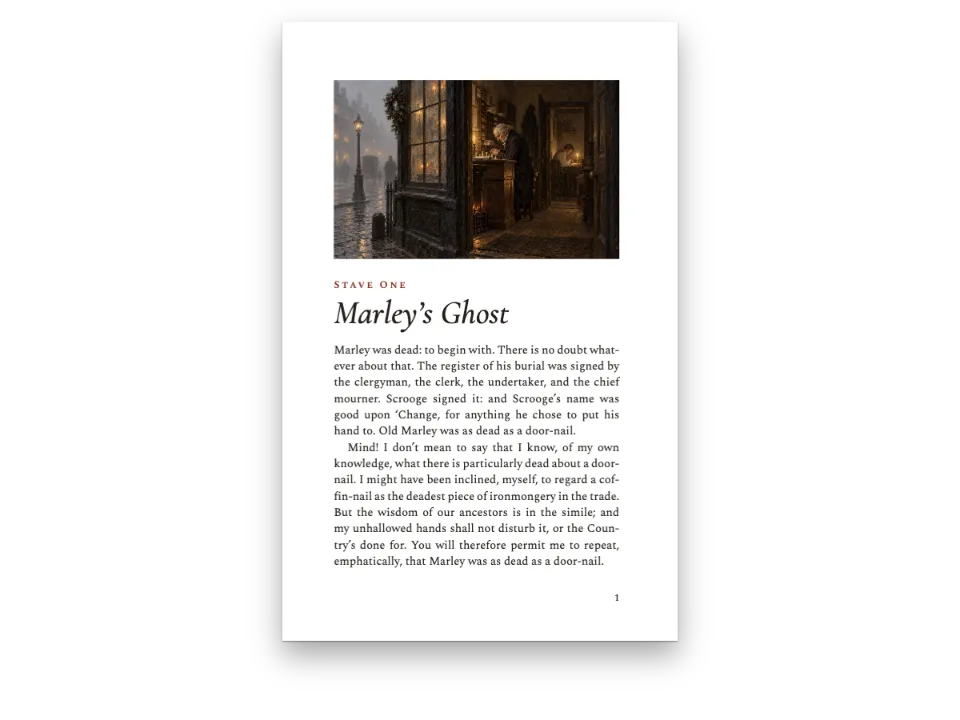
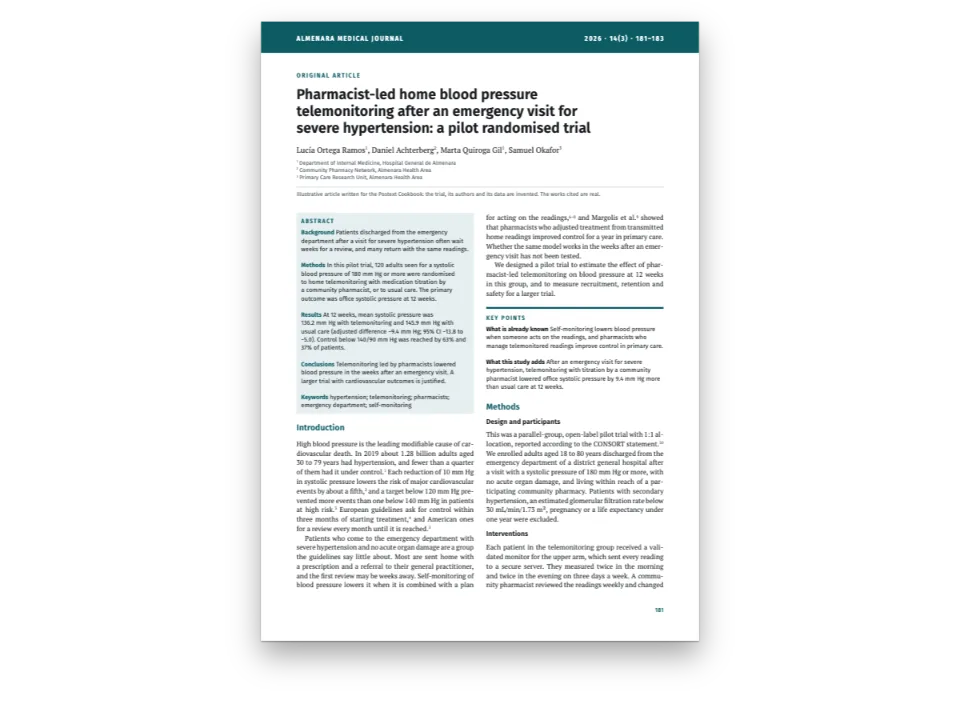
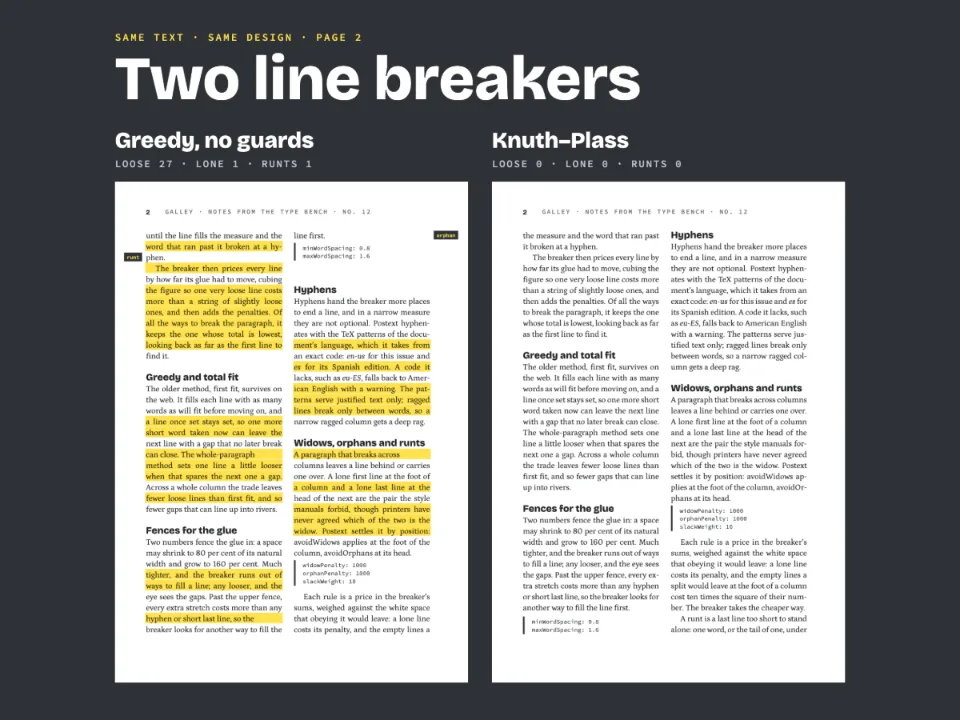
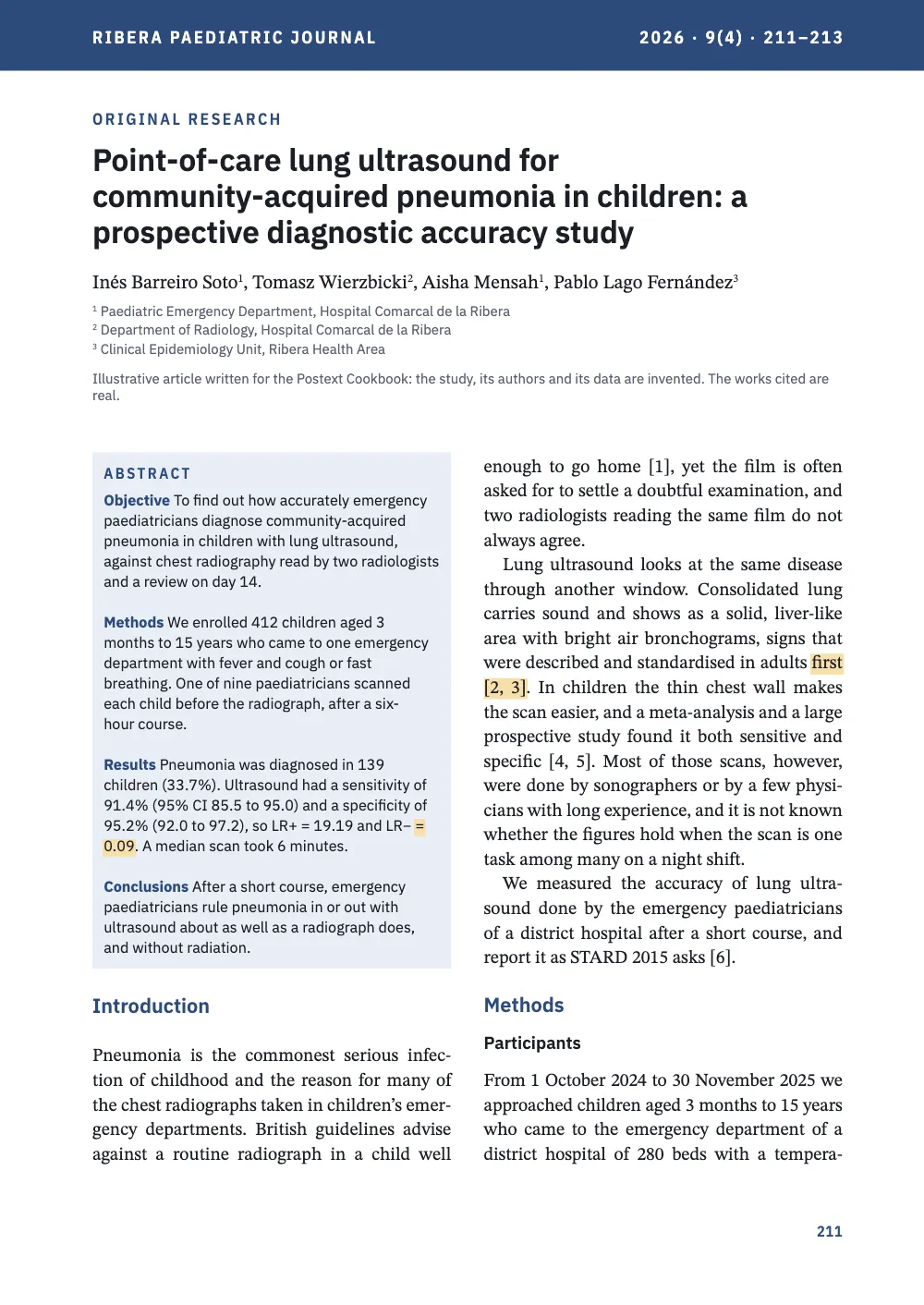
一份 170 × 240 mm 儿科期刊中的三页,双栏两端对齐,栏宽 66 mm,字体 STIX Two Text,内容是一篇用肺部超声诊断肺炎的原创研究,参考文献按 Vancouver 格式编号。栏这么窄,断行算法可选的余地很少,英文文本有三处断得不好。引文编号 [2, 3] 单独落到行首,离开了它所支撑的词;阴性似然比 LR− = 0.09 两次在等号后断开。初校把 citationBreaks 和 operatorBreaks 设为 'warn' 来排:断行一处不改,每处断点加一道浅琥珀色底纹,并在参考文献后的校样条上逐条列出。二校用 'avoid' 排,三处留下一处。西班牙语版排的是同一篇研究,小数点用逗号。
这道食谱解答
- 怎样避免引用编号或 p < 0.05 这样的统计量在行尾被拆开?
- 怎样像医学期刊那样把引用序号排成上标,并让DOI成为可点击的链接?
简短回答
const bodyText = {
  fontFamily: SERIF, fontSize: pt(9.5), lineHeight: pt(LEAD), color: col('ink'),
  boldColor: col('ink'), italicColor: col('ink'), referenceColor: col('ink'),
  referenceBold: false, textAlign: 'justify', firstLineIndent: mm(3.5),
  indentAfterHeading: false, hyphenation: { enabled: true },
  optimalLineBreaking: true, // the rules price breaks in the Knuth–Plass breaker
  avoidWidows: true, avoidOrphans: true, avoidRunts: true,
  // A line that opens on a citation, "[8, 9]" (citationBreak), or ends or opens on a sign
  // set between spaces, "p <" / "0.05" (operatorBreak). 'warn' reports each one and changes
  // nothing; 'avoid' adds the penalty to the demerits of those breaks and reports the ones
  // it keeps. The first proof sets 'warn' (see proofs).
  citationBreaks: 'avoid', operatorBreaks: 'avoid',
  // 10000 by default, what a line spaced to the limit costs. A 66 mm column offers few other
  // breaks; at 30000 the breaker takes looser lines, never past maxWordSpacing.
  citationBreakPenalty: 30000, operatorBreakPenalty: 30000,
};
用料
- 功能
- 行首的引用编号与行边的运算符号最优断行(Knuth–Plass)按引用样式排的引用由参考文献数据生成的文献表高亮标记断词与文档语言单栏或双栏设计过的章首页标题属性标题样式书眉与页码按页面角色显示书眉对称页边距标注框语义调色板
- 类型
- STIX Two Text, IBM Plex Sans, IBM Plex Sans Condensed(SIL OFL 1.1)
- 素材
- 无:所有图片都用代码绘制
做法
#1 · 给两类断点定价
代码见上文简短回答。一行以带编号的引文开头,或以引文的后半截开头,比如 [4, 之后的 5],就是引文断行。一行以前后带空格的符号结尾或开头,就是运算符断行,符号包括 =、<、±、× 和减号。'warn' 两种都报告,行保持原样。'avoid' 给这些断点的代价加上罚分,Knuth–Plass 断行算法于是另找一种断法。它需要开启 optimalLineBreaking:逐行断行没有可以累加的代价。
默认罚分 10000,等于把一行拉到词距上限的代价,所以算法绝不会为了让引文挨着它的词而把一行拉过这个上限。在这个栏宽下,10000 让两个版本各留两处断点。设为 30000 后,算法接受更松的行,但仍在 maxWordSpacing 之内,两个版本各剩一处。再提高也没有变化:最后一处在上限之内没有别的断法。
#2 · 在文字上标出断点
// The word before the citation and the citation, or the sign and the number on its other
// side, wrapped in :mark[…]: a band under ordinary text, so the breaks stay where they were.
const wordEnd = (s, i) => i + s.slice(i).search(/[\s;)]|[,.](?!\d)|$/); // 0.09, not 0
function sides(source, w, a, b) { // a warning names line a, before the break, by its source
  if (w.kind === 'citationBreak') { // "colleagues [@simel1991]"
    const cite = source.lastIndexOf('[@', b.sourceStart + 2);
    return [source.lastIndexOf(' ', cite - 2) + 1, source.indexOf(']', cite) + 1];
  }
  if (w.edge === 'end') { // "LR− = 0.09": the sign ends line a, the number opens line b
    const from = source.lastIndexOf(` ${w.text} `, a.sourceEnd) + 1;
    return [from, wordEnd(source, from + w.text.length + 1)];
  }
  const sign = source.indexOf(` ${w.text} `, b.sourceStart - 1); // the sign opens line b
  return [source.lastIndexOf(' ', sign - 1) + 1, sign + 1 + w.text.length];
}
function markBreaks(source, doc, found) {
  const pairs = doc.blocks.flatMap((b) => b.lines.map((line, i) => [line, b.lines[i + 1]]));
  const spans = new Map();
  for (const w of found) {
    const [a, b] = pairs.find(([line]) => line.sourceStart === w.sourceStart) ?? [];
    const [from, to] = b ? sides(source, w, a, b) : [];
    if (from > a?.sourceStart && to > from && to <= b.sourceEnd) spans.set(from, to);
  }
  return [...spans].sort(([x], [y]) => y - x).reduce((md, [from, to]) => `${md.slice(0, from)}`
    + `:mark[${md.slice(from, to)}]{style="edge"}${md.slice(to)}`, source);
}
每条警告都带着类型、引文或符号、两行的文字、第一行在源文本中的位置以及页码。脚本在排好的文档里找到这两行,用 :mark[…] 包住断点:引文和它前面的词,或者符号和另一侧的数字。标记只在文字下面画底纹,断点留在原处。底纹够不到引文样式生成的编号,所以页面上只有前面那个词带标记。
#3 · 两份校样和一张疑问条
const KIND = { citationBreak: t({ en: 'citation', es: 'cita' }),
  operatorBreak: t({ en: 'sign', es: 'signo' }) };
const edge = (s, end) => (end ? s.trim().split(/\s+/).slice(-2) : s.trim().split(/\s+/)
  .slice(0, 2)).join('\u00a0').replace(/[.,;]$/, ''); // no-break spaces: no breaks of its own
const query = (doc, w) => `${t({ en: 'p.', es: 'pág.' })}\u00a0${doc.pages[w.pageIndex]
  .pageLabel}, ${KIND[w.kind]}: …${edge(w.lines[0], true)}\u00a0/ ${edge(w.lines[1])}…`;
const slip = (mode, doc, found) => ['', `:::callout{type="slip" title="${mode === 'warn'
  ? t({ en: 'First proof: queries', es: 'Primeras pruebas: consultas' })
  : t({ en: 'Second proof: queries', es: 'Segundas pruebas: consultas' })}"}`,
`citationBreaks / operatorBreaks: '${mode}' · ${found.length} ${found.length === 1
  ? t({ en: 'break', es: 'corte' }) : t({ en: 'breaks', es: 'cortes' })}.`,
...found.flatMap((w) => ['', query(doc, w)]), ':::', ''].join('\n');
const build = (md, mode) => buildDocumentWithFonts({ markdown: md }, { ...config,
  bodyText: { ...bodyText, citationBreaks: mode, operatorBreaks: mode } }, kitFonts(FONTS));
async function proof(mode) {
  const plain = await build(markdown, mode); // pass 1: where the breaks are
  const found = (plain.contentWarnings ?? []).filter((w) => /^(citation|operator)Break$/
    .test(w.kind));
  return build(markBreaks(markdown, plain, found) + slip(mode, plain, found), mode); // pass 2
}
const docs = { warn: await proof('warn'), avoid: await proof('avoid') };
每份校样排两次。第一次找出断点;第二次排带标记的文章,并在参考文献后附一张校样条,所以校样条落在最后一页。排字工退回校样时附上疑问,也是这个做法。校样条各行的词之间用不换行空格连接,自身不会再产生断点。capture.doc 发布两次带标记的排版,[1, 3]。
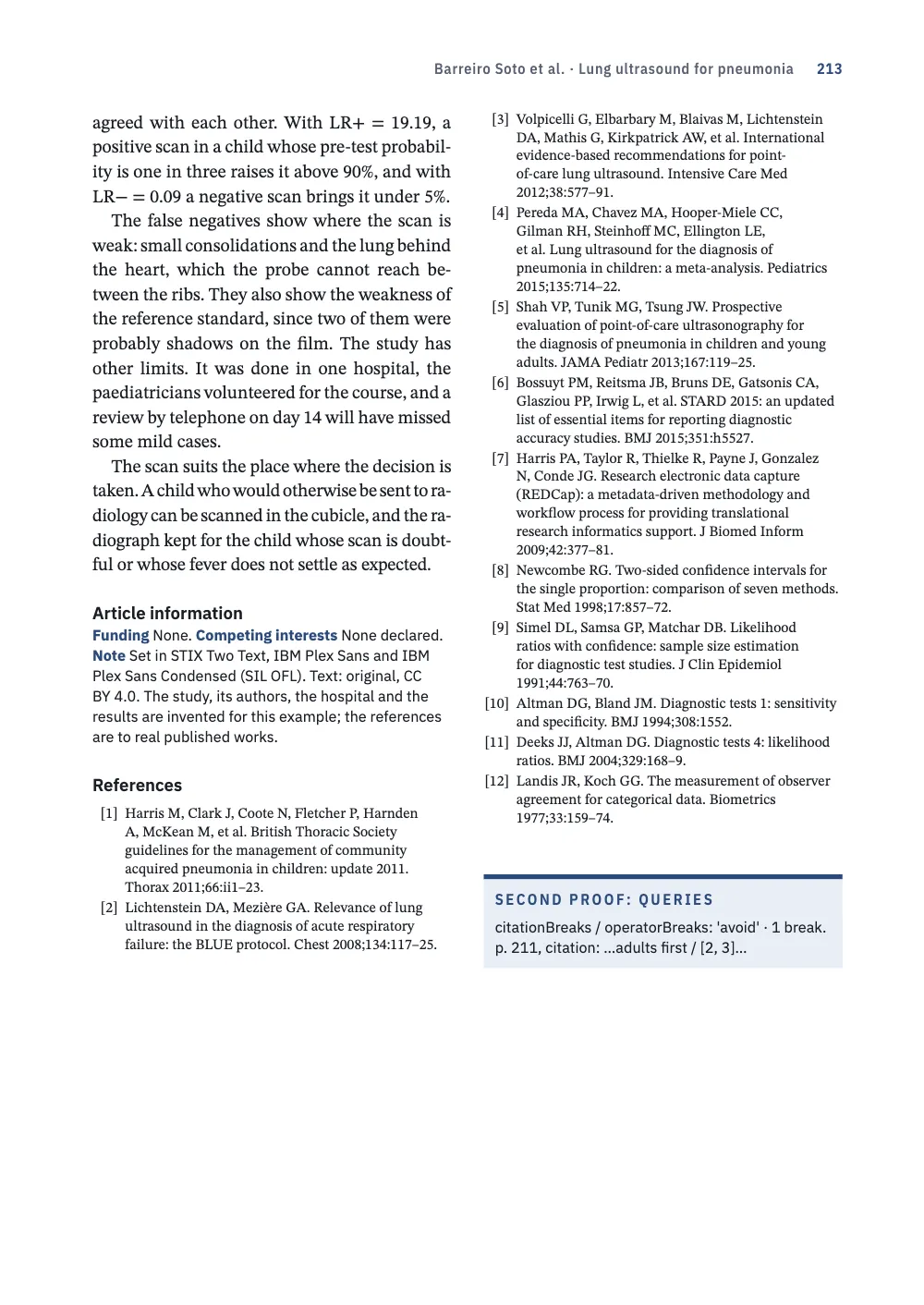
英文版剩下的一处是第211页的 first 叠 [2, 3]。西班牙语版初校找到四处,其中有 CP+ 叠 = 19,19,还有引文本身被拆开的 [4, 叠 5];二校留下一处,anteriores [4, 叠 5]。
#4 · 方括号里的编号引文
registerCitationEngine(createCiteprocEngine({ styles: STYLES, locales: LOCALES }));
const citations = { style: 'elsevier-vancouver', locale: t({ en: 'en-GB', es: 'es-ES' }),
  marker: 'brackets', collapseRanges: true, // [8, 9] and [4–6], set after a word space
  bibliography: { fontSize: em(0.8), lineHeight: pt(9.6), entrySpacing: pt(1),
    labelWidth: mm(6), labelAlign: 'right', doi: 'hide' } };
引文处理器把每个 [@key] 排成词距之后方括号里的编号,并把连续编号合并成 [4–6] 这样的形式。方括号前的空格和括号内逗号后的空格都是可以断行的地方,所以引文多的窄栏需要这条规则。
#5 · 刊头与文章信息块
const text = (id, content, family, size, extra) => ({ kind: 'text', id, content, align: 'left',
  fontFamily: family, fontSize: pt(size), color: col('ink'), overflow: 'wrap', ...extra });
const at = (to, edge, x, y, width) => ({ anchor: { to, edge }, offset: { x: mm(x), y: mm(y) },
  ...(width && { size: { width: mm(width), height: 'auto' } }) });
const caps = { fontFamily: COND, fontWeight: 600, letterSpacing: pt(1.2),
  textTransform: 'uppercase' };
const JOURNAL = t({ en: 'Ribera Paediatric Journal', es: 'Revista Pediátrica de la Ribera' });
const white = { ...caps, color: col('paper') };
const titleBlock = { enabled: true, minHeight: mm(58), slot: { elements: [
  { kind: 'box', id: 'band', style: { backgroundColor: col('accent') }, placement: {
    anchor: { to: 'page', edge: 'top-left' }, size: { width: 'fill', height: mm(13) } } },
  text('journal', JOURNAL, COND, 9, { ...white, placement: at('page', 'top-left', INNER, 5) }),
  text('issue', '{attr.issue}', COND, 9, { ...white, align: 'right',
    placement: at('page', 'top-right', -OUTER, 5, 60) }),
  text('kind', '{attr.kind}', COND, 8.5, { ...caps, color: col('accent'),
    placement: at('container', 'top-left', 0, 0, MEASURE) }),
  text('title', '{titleText}', SANS, 16, { fontWeight: 600, lineHeight: 1.18,
    placement: at('#kind', 'below', 0, 2.5, MEASURE - 6) }),
  text('authors', '{attr.authors}', SERIF, 10, { inlineMarks: true, // ^1^ → ¹
    placement: at('#title', 'below', 0, 3.5, MEASURE) }),
  text('affiliations', '{attr.affiliations}', SANS, 7.2, { inlineMarks: true, lineHeight: 1.35,
    color: col('muted'), placement: at('#authors', 'below', 0, 1.6, MEASURE) }),
  text('note', '{attr.note}', SANS, 7.2, { color: col('muted'),
    placement: at('#affiliations', 'below', 0, 2.4, MEASURE) }),
] } };
标题样式画出期刊色带、文章类型、标题、带单位编号的作者和一条注释,全都来自 H1 上的属性。两个版本共用这个样式,文字留在 Markdown 里。
完整食谱
// ═══ Postext Cookbook · Nº 186 · Citations and statistics off the line edges ═══════════
// https://postext.dev/en/cookbook/clinical-paper-line-edges
// Code: MIT · Text: original (CC BY 4.0) · Pictures: none
// Fonts: STIX Two Text, IBM Plex Sans and Sans Condensed (SIL OFL 1.1) · Needs postext ≥ 1.79.0
import {
  buildDocumentWithFonts, renderPageToCanvas, registerCitationEngine,
} from 'https://esm.sh/postext';
import { createCiteprocEngine, STYLES, LOCALES } from 'https://esm.sh/postext-citeproc';

const LANG = 'en'; // @lang: the language of the sample document ('en' | 'es')
const RECIPE = 'clinical-paper-line-edges';

// ─── 1 · Design ─────────────────────────────────────────────────────────────
// #region palette: an indigo journal, a pale amber band for the proof marks
const palette = { ink: '#1b1e26', accent: '#2c4a7c', tint: '#e9eef6', mark: '#f7dfa9',
  muted: '#596173', paper: '#ffffff' };
const col = (id) => ({ hex: palette[id], model: 'hex', paletteId: id });
const colorPalette = Object.entries({ ...palette, 'main-color': palette.accent })
  .map(([id, hex]) => ({ id, name: id, value: { hex, model: 'hex' } }));
// #endregion
const [SERIF, SANS, COND] = ['STIX Two Text', 'IBM Plex Sans', 'IBM Plex Sans Condensed'];
const [TRIM_W, TRIM_H, TOP, BOTTOM, INNER, OUTER, GUTTER] = [170, 240, 20, 22, 17, 15, 6];
const MEASURE = TRIM_W - INNER - OUTER; // 138 mm: two columns of 66 mm, about 45 characters
const LEAD = 12.8; // pt, for 9.5 pt type

// #region answer: no line opens on a citation, no line ends or opens on a lone sign
const bodyText = {
  fontFamily: SERIF, fontSize: pt(9.5), lineHeight: pt(LEAD), color: col('ink'),
  boldColor: col('ink'), italicColor: col('ink'), referenceColor: col('ink'),
  referenceBold: false, textAlign: 'justify', firstLineIndent: mm(3.5),
  indentAfterHeading: false, hyphenation: { enabled: true },
  optimalLineBreaking: true, // the rules price breaks in the Knuth–Plass breaker
  avoidWidows: true, avoidOrphans: true, avoidRunts: true,
  // A line that opens on a citation, "[8, 9]" (citationBreak), or ends or opens on a sign
  // set between spaces, "p <" / "0.05" (operatorBreak). 'warn' reports each one and changes
  // nothing; 'avoid' adds the penalty to the demerits of those breaks and reports the ones
  // it keeps. The first proof sets 'warn' (see proofs).
  citationBreaks: 'avoid', operatorBreaks: 'avoid',
  // 10000 by default, what a line spaced to the limit costs. A 66 mm column offers few other
  // breaks; at 30000 the breaker takes looser lines, never past maxWordSpacing.
  citationBreakPenalty: 30000, operatorBreakPenalty: 30000,
};
// #endregion

// #region citations: numbered references in brackets, the list in the Vancouver order
registerCitationEngine(createCiteprocEngine({ styles: STYLES, locales: LOCALES }));
const citations = { style: 'elsevier-vancouver', locale: t({ en: 'en-GB', es: 'es-ES' }),
  marker: 'brackets', collapseRanges: true, // [8, 9] and [4–6], set after a word space
组合好的script.js可以直接运行:把它粘贴到任何页面的模块脚本中,或在CodePen上打开这道食谱。 GitHub上的食谱文件夹 ↗ (在新标签页中打开)
变化
常见问题
版面警告 · citationBreak
行首的引用编号
原因. 段落中某一行以紧跟在词后的编号引用或其一部分开头:一行末尾是“authors”,下一行开头是“[12]”,或者“[14,”下面是“16]”。数字后面括号里的数字不算引用(“2016 (3)”),括号里的词也不算。从右到左的文字以及中文、日文、韩文保持原样。bodyText.citationBreaks设为'warn'时报告每一处这样的断行;设为'avoid'时,只报告断行保留下来的那些:在词距范围内没有代价低于bodyText.citationBreakPenalty的排法能避开它们。引擎把每一处记入doc.contentWarnings,附上引用、两行文字和页码。
解决. 把bodyText.citationBreaks设为'avoid':断行会给引用之前或引用内部的断行定价,并在词距允许的范围内重排段落;这个空格仍和其他空格一起伸缩。仍然保留的断行,避开它的代价高于bodyText.citationBreakPenalty,往往是因为引用相对行宽太宽:调高惩罚值以换取更松的行,或在词和引用之间写一个不换行空格(U+00A0),无论规则如何都把这一对连在一起。移植现有书籍时保持'warn':移植要重现原书的断行。 文档 →
版面警告 · operatorBreak
行首行尾的符号
原因. 段落中某一行以前后有空格的单独符号结尾或开头,即 = < > ≤ ≥ ± × ≈ ≠ ÷ − + · → 之一:一行末尾是“LR+ =”而“18.29”在下一行,或者一行以“± 0.03”开头。词之间的连字符不算符号。从右到左的文字以及中文、日文、韩文保持原样。bodyText.operatorBreaks设为'warn'时报告每一处这样的断行,每处断行一条(一行同时以符号开头和结尾会得到两条);设为'avoid'时,只报告断行保留下来的那些:在词距范围内没有代价低于bodyText.operatorBreakPenalty的排法能避开它们。引擎把每一处记入doc.contentWarnings,附上符号、所在边(行尾或行首)、两行文字和页码。
解决. 把bodyText.operatorBreaks设为'avoid':断行会给符号两侧空格处的断行定价,并在词距允许的范围内重排段落。仍然保留的断行,避开它的代价高于bodyText.operatorBreakPenalty,常见于窄栏中符号和两侧的项都较宽的情况:调高惩罚值以换取更松的行,或在符号两侧写不换行空格(U+00A0,窄的用U+202F),无论规则如何都把它连在一起。移植现有书籍时保持'warn':移植要重现原书的断行。 文档 →
- 断点是在断好的行里查找的。改了开本、字号或文字,断点就会移动;请读每次排版的警告,不要照抄上一次的位置。
- 要让某一处引文在任何栏宽下都挨着它的词,就在 Markdown 里它前面打一个不换行空格。文章其余部分交给这条规则。
致谢
- 文本
- 原创文字, CC BY 4.0
- 字体
- STIX Two Text (SIL OFL 1.1) · IBM Plex Sans (SIL OFL 1.1) · IBM Plex Sans Condensed (SIL OFL 1.1)