简单来说
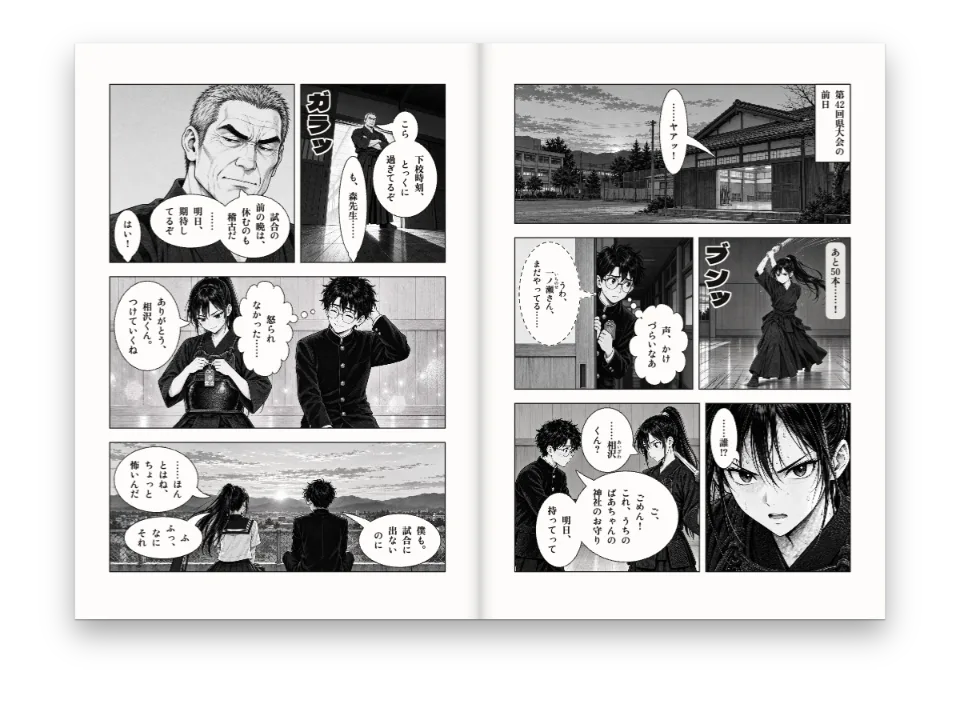
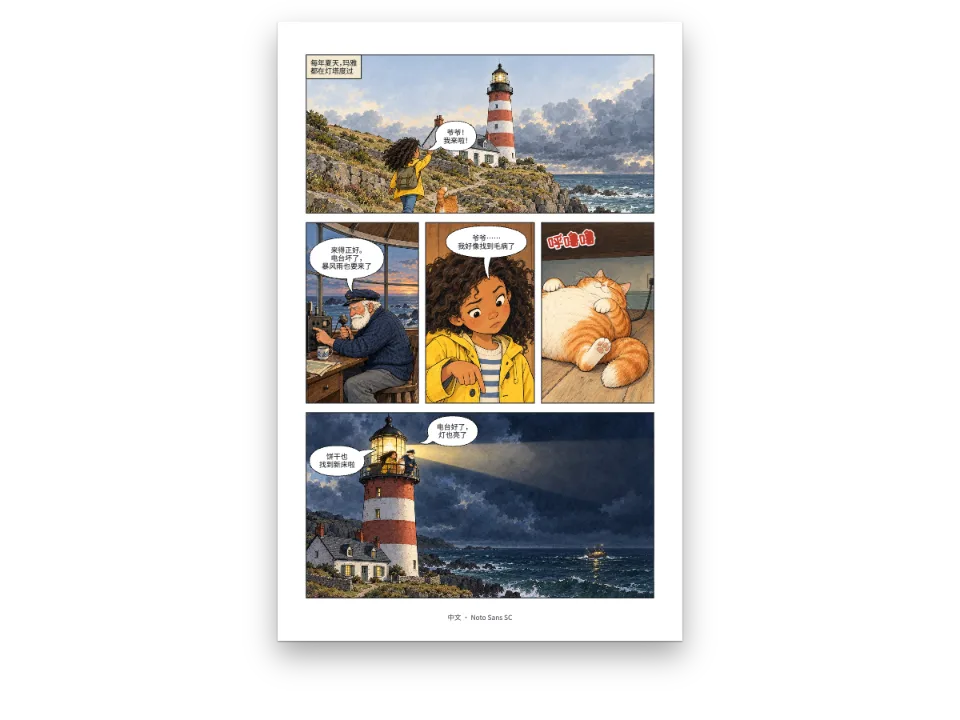
像漫画杂志那样,把两篇由四个格子组成的小漫画并排放在一页上:先从上到下读右边那篇,再读左边那篇。
成品一览
这是为本示例编写、用柔和的Q版画风绘制的四格漫画集《ねこ喫茶まどろみ》(打盹猫咖)中的一页:麦经营一家猫咖,店里有一只白猫、一只黑猫和一只三花猫。四格漫画就像把报纸上的连环漫画竖起来:四个一样大的格子从上往下叠,起、承、转、合。杂志一页并排放两篇,因为书从右边翻开,所以先读右边那篇。页面是A5,148 × 210 mm,跨页一边是日文原版,另一边是本页语言的版本(日文页上是英文版)。
这道食谱解答
- 怎样排一组四格漫画?
简短回答
// content.<lang>.md splits the page `* [* / * / * / *] | * [* / * / * / *]`: two equal
// columns, each cut into four equal panels. The reading direction lays the first column
// out on the right, so the strip that opens the page is the right-hand one, as in a
// yonkoma magazine, and each strip still reads top to bottom. The gutter between the
// strips is wider than the gutters between their panels, so the eye drops down a strip
// before it crosses to the next.
const comics = (lang) => ({
  artDirection: 'rtl', // the right strip first, in every edition
  mirrorArt: false,
  gutter: { horizontal: mm(3), vertical: mm(9) }, // 3 mm between panels, 9 mm between strips
  panel: { borderWidth: pt(0.9), borderColor: col('ink'), background: col('paper') },
  lettering: {
    fontFamily: EDITIONS[lang].faces[0], color: col('ink'),
    fontSize: pt(['ja', 'zh'].includes(lang) ? 8 : 7), // a yonkoma letters smaller than a story
    writingMode: lang === 'zh' ? 'vertical' : 'auto',
    maxColumnChars: 6, // short columns: a yonkoma panel is wider than it is tall
  },
  balloonStyles: balloons(),
});
用料
- 类型
- Zen Antique, Dela Gothic One, Comic Neue, Bangers, Noto Sans SC, ZCOOL KuaiLe, Playpen Sans Arabic, Lalezar(SIL OFL 1.1)
- 素材
neko-bowls.jpgneko-door.jpgneko-guest.jpgneko-keyboard.jpgneko-laptop.jpgneko-nap.jpgneko-onebowl.jpgneko-toast.jpg- Mugi unlocking the cat café's door, three cats waiting inside (Generated With Diffusion Models, 原创)
- Mugi setting out food bowls for the cats (Generated With Diffusion Models, 原创)
- Three cats eating from one bowl (Generated With Diffusion Models, 原创)
- The cats staring at Mugi's toast (Generated With Diffusion Models, 原创)
- A tired office worker arriving at the café (Generated With Diffusion Models, 原创)
- The three cats asleep on one cushion (Generated With Diffusion Models, 原创)
- The office worker opening his laptop (Generated With Diffusion Models, 原创)
- The cats sitting on the keyboard, the worker in happy tears (Generated With Diffusion Models, 原创)
做法
#1 · 把页面分成两列,每列四格
代码见上方的简短回答。整页是一个:::page,分格写作split="* [* / * / * / *] | * [* / * / * / *]":两列等宽,每列切成四层等高。八行::panel按阅读顺序填入格子,所以前四格属于第一篇;从右往左读时,第一列排在右边(分格)。两篇之间的格间是9 mm,格子之间是3 mm,视线会先把一篇读到底再转到下一篇。
#2 · 每篇的标题放在第一格
const balloons = () => [
  { id: 'speech', fill: col('paper'), stroke: col('ink'), strokeWidth: pt(0.6), roundness: 2.4 },
  { id: 'shout', fill: col('paper'), stroke: col('ink'), burstPoints: 16 },
  // caption{title}: the strip's title, white on black in the first panel's corner
  { id: 'title', shape: 'rectangle', fill: col('ink'), stroke: col('ink'), color: col('paper'),
    bold: true, tail: 'none', position: 'top-start', butt: true, align: 'center' },
  { id: 'sfx', color: col('ink'), haloColor: col('paper'), fontScale: 1.8 }, // chibi: small effects
];
四格漫画有标题,漫画集会把它印在每篇开头的方框里。这里标题也是脚本中的一行(caption{title}: 朝ごはん),title是一个单独的对话框样式:黑底白字,紧贴格子起始一侧的上角,在这本书里就是右上角。它和其他行一样按版本嵌字,所以英文页的同一个方框里写着Breakfast和Therapy。
#3 · 猫也标成说话人
const cat = (id, x, y, fx, fy, w = 0.12, h = 0.15) => ({ id, x, y,
  face: { x: fx, y: fy, width: w, height: h } });
const nose = (id, x, y) => ({ id, x, y, head: { x, y: y - 0.04 } }); // cats asleep or eating
const ART = { // fractions of the picture: the same in every language
  door: {
    alt: t({ en: "Mugi unlocks the café's glass door; the white, black and calico cats wait.",
      es: 'Mugi abre la puerta de cristal del café; dentro esperan los tres gatos.',
      ca: 'La Mugi obre la porta de vidre del cafè; a dins esperen els tres gats.',
      zh: '麦打开猫咖的玻璃门,三只猫在里面等着。',
      ar: 'موغي تفتح باب المقهى الزجاجي، والقطط الثلاث تنتظر في الداخل.',
      ja: '猫カフェのガラス戸を開けるむぎ。中で3匹の猫が待っている。',
      fr: 'Mugi ouvre la porte vitrée du café ; à l’intérieur, les trois chats attendent.',
      de: 'Mugi schließt die Glastür des Cafés auf; drinnen warten die drei Katzen.',
      it: 'Mugi apre la porta a vetri del caffè; dentro aspettano i tre gatti.',
      pt: 'Mugi abre a porta de vidro do café; lá dentro, os três gatos esperam.' }),
  safeArea: { x: 0.09, y: 0.19, width: 0.81, height: 0.52 },
  anchors: [{ id: 'mugi', x: 0.205, y: 0.385, head: { x: 0.17, y: 0.25 },
    face: { x: 0.1, y: 0.2, width: 0.2, height: 0.23 } },
  cat('shiro', 0.5, 0.66, 0.44, 0.55, 0.13), cat('kuro', 0.66, 0.62, 0.61, 0.52, 0.12, 0.14),
  cat('mike', 0.83, 0.645, 0.77, 0.53, 0.12, 0.16)] },
  bowls: {
    alt: t({ en: 'Mugi sets out full food bowls in front of the three cats.',
      es: 'Mugi pone cuencos llenos delante de los tres gatos.',
      ca: 'La Mugi posa bols plens de menjar davant dels tres gats.',
      zh: '麦把装满猫粮的碗摆在三只猫面前。',
      ar: 'موغي تضع صحون طعام ممتلئة أمام القطط الثلاث.',
      ja: '3匹の猫の前に、ご飯を盛った器を並べるむぎ。',
      fr: 'Mugi pose des bols pleins de nourriture devant les trois chats.',
      de: 'Mugi stellt den drei Katzen volle Futternäpfe hin.',
      it: 'Mugi mette le ciotole piene di cibo davanti ai tre gatti.',
      pt: 'Mugi põe tigelas cheias de comida na frente dos três gatos.' }),
  safeArea: { x: 0.16, y: 0.26, width: 0.74, height: 0.65 },
  anchors: [{ id: 'mugi', x: 0.27, y: 0.465, head: { x: 0.25, y: 0.3 },
    face: { x: 0.17, y: 0.26, width: 0.16, height: 0.24 } },
  cat('shiro', 0.37, 0.63, 0.31, 0.52, 0.13, 0.16), cat('kuro', 0.6, 0.64, 0.55, 0.52, 0.11, 0.16),
  cat('mike', 0.82, 0.62, 0.76, 0.52, 0.12, 0.14)] },
  onebowl: {
    alt: t({ en: 'All three cats push their heads into the same bowl; the others stay full.',
      es: 'Los tres gatos meten la cabeza en el mismo cuenco; los otros siguen llenos.',
      ca: 'Els tres gats fiquen el cap al mateix bol; els altres continuen plens.',
      zh: '三只猫把头挤进同一个碗里,另外两个碗还满着。',
      ar: 'القطط الثلاث تدسّ رؤوسها في الصحن نفسه، والصحنان الآخران ممتلئان.',
      ja: '3匹そろって同じ器に頭を突っこみ、ほかの器は手つかず。',
      fr: 'Les trois chats plongent la tête dans le même bol ; les autres restent pleins.',
      de: 'Alle drei Katzen stecken den Kopf in denselben Napf; die anderen bleiben voll.',
      it: 'I tre gatti infilano la testa nella stessa ciotola; le altre restano piene.',
      pt: 'Os três gatos enfiam a cabeça na mesma tigela; as outras continuam cheias.' }),
  safeArea: { x: 0.05, y: 0.27, width: 0.88, height: 0.66 },
  anchors: [nose('shiro', 0.33, 0.66), nose('kuro', 0.5, 0.6), nose('mike', 0.66, 0.68),
    { id: 'sfx', x: 0.5, y: 0.3 }] },
  toast: {
    alt: t({ en: 'Mugi bites her toast while the three cats stare at it with shining eyes.',
      es: 'Mugi muerde su tostada mientras los tres gatos la miran con ojos brillantes.',
      ca: 'La Mugi mossega la torrada mentre els tres gats la miren amb ulls brillants.',
      zh: '麦咬着吐司,三只猫眼睛发亮地盯着。',
      ar: 'موغي تقضم خبزها المحمّص والقطط الثلاث تحدّق فيه بعيون لامعة.',
      ja: 'トーストをかじるむぎを、3匹がきらきらした目で見つめる。',
      fr: 'Mugi croque sa tartine tandis que les trois chats la fixent, les yeux brillants.',
      de: 'Mugi beißt in ihren Toast, während die drei Katzen ihn mit leuchtenden Augen '
        + 'anstarren.',
      it: 'Mugi addenta il suo toast e i tre gatti lo fissano con gli occhi che brillano.',
      pt: 'Mugi morde a torrada enquanto os três gatos olham para ela com olhos brilhando.' }),
  safeArea: { x: 0.09, y: 0.22, width: 0.85, height: 0.56 },
  avoid: [{ x: 0.6, y: 0.52, width: 0.15, height: 0.1 }],
  anchors: [{ id: 'mugi', x: 0.8, y: 0.5, head: { x: 0.85, y: 0.32 },
    face: { x: 0.75, y: 0.25, width: 0.2, height: 0.33 } },
  cat('shiro', 0.17, 0.71, 0.1, 0.6, 0.14, 0.16), cat('kuro', 0.32, 0.73, 0.26, 0.62, 0.12, 0.14),
  cat('mike', 0.46, 0.66, 0.4, 0.56, 0.12, 0.14)] },
  guest: {
    alt: t({ en: 'A tired office worker walks in, arms out; Mugi greets him from the counter.',
      es: 'Un oficinista cansado entra con los brazos abiertos; Mugi lo saluda desde la barra.',
      ca: 'Un oficinista cansat entra amb els braços oberts; la Mugi el saluda des de la barra.',
      zh: '一个疲惫的上班族张着双臂走进来,麦在柜台后招呼他。',
      ar: 'موظف متعب يدخل فاتحًا ذراعيه، وموغي ترحّب به من خلف المنضدة.',
      ja: '両手を広げて入ってくる疲れた会社員と、カウンターから迎えるむぎ。',
      fr: 'Un employé de bureau fatigué entre les bras ouverts ; Mugi l’accueille depuis le '
        + 'comptoir.',
      de: 'Ein müder Büroangestellter kommt mit offenen Armen herein; Mugi begrüßt ihn '
        + 'von der Theke aus.',
      it: 'Un impiegato stanco entra a braccia aperte; Mugi lo accoglie dal bancone.',
      pt: 'Um funcionário de escritório cansado entra de braços abertos; Mugi o recebe do '
        + 'balcão.' }),
  safeArea: { x: 0.13, y: 0.14, width: 0.74, height: 0.51 },
  anchors: [{ id: 'kyaku', x: 0.31, y: 0.42, head: { x: 0.28, y: 0.3 },
    face: { x: 0.19, y: 0.22, width: 0.21, height: 0.26 } },
  { id: 'mugi', x: 0.76, y: 0.39, head: { x: 0.76, y: 0.28 },
    face: { x: 0.68, y: 0.2, width: 0.18, height: 0.25 } }] },
  nap: {
    alt: t({ en: 'The three cats asleep in one pile on a round cushion.',
      es: 'Los tres gatos dormidos en un montón sobre un cojín redondo.',
      ca: 'Els tres gats adormits en un munt sobre un coixí rodó.',
      zh: '三只猫挤成一团睡在圆垫子上。',
      ar: 'القطط الثلاث نائمة كومةً واحدة على وسادة مستديرة.',
      ja: '丸いクッションの上で、ひとかたまりになって眠る3匹。',
      fr: 'Les trois chats dorment en tas sur un coussin rond.',
      de: 'Die drei Katzen schlafen auf einem Haufen auf einem runden Kissen.',
      it: 'I tre gatti dormono ammucchiati su un cuscino rotondo.',
      pt: 'Os três gatos dormem amontoados numa almofada redonda.' }),
  safeArea: { x: 0.27, y: 0.21, width: 0.52, height: 0.55 },
  anchors: [nose('shiro', 0.4, 0.42), nose('kuro', 0.41, 0.7), nose('mike', 0.72, 0.58),
    { id: 'sfx', x: 0.3, y: 0.25 }] },
  laptop: {
    alt: t({ en: 'The office worker sighs at a café table and opens his laptop.',
      es: 'El oficinista suspira en una mesa del café y abre el portátil.',
      ca: 'L’oficinista sospira en una taula del cafè i obre el portàtil.',
      zh: '上班族在咖啡桌前叹了口气,打开笔记本电脑。',
      ar: 'الموظف يتنهّد إلى طاولة في المقهى ويفتح حاسوبه.',
      ja: 'カフェのテーブルでため息をつき、ノートパソコンを開く会社員。',
      fr: 'L’employé soupire à une table du café et ouvre son ordinateur portable.',
      de: 'Der Büroangestellte seufzt an einem Cafétisch und klappt seinen Laptop auf.',
      it: 'L’impiegato sospira a un tavolino del caffè e apre il portatile.',
      pt: 'O funcionário suspira numa mesa do café e abre o notebook.' }),
  safeArea: { x: 0.22, y: 0.25, width: 0.56, height: 0.55 },
  anchors: [{ id: 'kyaku', x: 0.45, y: 0.62, head: { x: 0.39, y: 0.4 },
    face: { x: 0.3, y: 0.3, width: 0.22, height: 0.38 } }] },
  keyboard: {
    alt: t({ en: 'The three cats sit on the keyboard; the worker cries tears of joy.',
      es: 'Los tres gatos se sientan en el teclado; el oficinista llora de alegría.',
      ca: 'Els tres gats seuen damunt del teclat; l’oficinista plora d’alegria.',
      zh: '三只猫坐在键盘上,上班族喜极而泣。',
      ar: 'القطط الثلاث تجلس على لوحة المفاتيح، والموظف يبكي من الفرح.',
      ja: 'キーボードの上に座る3匹と、うれし泣きする会社員。',
      fr: 'Les trois chats s’assoient sur le clavier ; l’employé pleure de joie.',
      de: 'Die drei Katzen setzen sich auf die Tastatur; der Angestellte weint vor Freude.',
      it: 'I tre gatti si siedono sulla tastiera; l’impiegato piange di gioia.',
      pt: 'Os três gatos sentam no teclado; o funcionário chora de alegria.' }),
  safeArea: { x: 0.07, y: 0.1, width: 0.81, height: 0.78 },
  anchors: [{ id: 'kyaku', x: 0.29, y: 0.42, head: { x: 0.25, y: 0.2 },
    face: { x: 0.15, y: 0.1, width: 0.27, height: 0.4 } },
  cat('shiro', 0.42, 0.57, 0.36, 0.48, 0.13, 0.14), cat('kuro', 0.59, 0.6, 0.53, 0.5, 0.12, 0.14),
  cat('mike', 0.74, 0.62, 0.68, 0.52, 0.12, 0.14)] },
};
const panels = () => Promise.all([
  comicPanel('door', asset('neko-door.jpg'), ART.door),
  comicPanel('bowls', asset('neko-bowls.jpg'), ART.bowls),
  comicPanel('onebowl', asset('neko-onebowl.jpg'), ART.onebowl),
  comicPanel('toast', asset('neko-toast.jpg'), ART.toast),
  comicPanel('guest', asset('neko-guest.jpg'), ART.guest),
  comicPanel('nap', asset('neko-nap.jpg'), ART.nap),
  comicPanel('laptop', asset('neko-laptop.jpg'), ART.laptop),
  comicPanel('keyboard', asset('neko-keyboard.jpg'), ART.keyboard),
]);
猫也会说话(kuro: にゃ),所以每幅画像标出麦的嘴和脸那样标出猫的。两个小函数让列表更短:面向读者的猫用cat(),脸埋在碗里或垫子里的猫用nose()。第三格里麦不在画面中,她那一行mugi{tail=top}的尾巴指向格子的上边。
#4 · 用各版本自己的文字载入字体
const SFX = /^sfx[^::\n]*[::](.*)$/gm; // sound-effect lines: the second face sets them
async function loadEdition(lang) {
  const text = TEXT[lang];
  const [face, sfx] = EDITIONS[lang].faces;
  const faces = { [face]: FONTS[face], [sfx]: FONTS[sfx] };
  if (['ja', 'zh'].includes(lang)) { // CJK: only the files that hold these characters
    const effects = [...text.matchAll(SFX)].map((m) => m[1]).join('');
    await loadCjkFonts({ [face]: FONTS[face] }, text.replace(SFX, ''), { vertical: true });
    await loadCjkFonts({ [sfx]: FONTS[sfx] }, effects, { vertical: true });
  }
  if (lang === 'ar') await loadArabicFonts(faces, text);
  await loadComicFonts(faces, text); // the bold and italic the faces do not ship
}
每种字体只拿到它要排的文字:Zen Antique排对话框,Dela Gothic One排拟声字(ガツガツ、じーっ、すやぁ、ずしっ)。四格漫画的格子宽大于高,所以日文竖列六个字就换列(maxColumnChars: 6),嵌字也比故事漫画的页面小半磅。
#5 · 把原版放在每个版本旁边
const FACING = LANG === 'ja' ? 'en' : LANG; // Japanese readers see the English edition
const TEXT = { ja: original, [FACING]: LANG === 'ja' ? english : markdown };
await loadFonts(FONTS, Object.values(TEXT).join('\n'));
const resources = await panels();
const build = async (lang) => { // the same pictures and page; this language's lettering
  await loadEdition(lang);
  return withLoadedFonts(() => buildDocument({ markdown: TEXT[lang], resources,
    continuation: { pageIndexOffset: lang === 'ja' ? 1 : 2 } }, edition(lang)),
    { ...kitFonts(FONTS), text: TEXT[lang] });
};
const docs = [await build('ja'), await build(FACING)];
本站的每种语言都在自己的文件里为这两篇嵌字,与跨页另一边的日文原版相对;日文页对着英文版。无论哪种语言,都先读右边那篇。
完整食谱
// ═══ Postext Cookbook · Nº 151 · Two yonkoma strips on a page ═════════════════════════
// https://postext.dev/en/cookbook/yonkoma
// Code: MIT · Story: written for the recipe (CC BY 4.0) · Pictures: generated with diffusion models
// Fonts: Zen Antique, Comic Neue and six more (SIL OFL 1.1) · Needs postext ≥ 1.65.0
// A page of a cat-café yonkoma: two four-panel strips side by side, the right one first.
import {
  buildDocument, withLoadedFonts, renderPageToCanvas, registerResourceImage, loadVerticalAlternates,
} from 'https://esm.sh/postext';
import { renderToPdf, decompressWoff2 } from 'https://esm.sh/postext-pdf';

const LANG = 'zh'; // @lang: this edition's language; the Japanese original faces it
const RECIPE = 'yonkoma';

// ─── 1 · Design ─────────────────────────────────────────────────────────────
// #region palette: black ink on a warm white, one screen-tone grey
const palette = {
  ink: '#151413', // panel borders, balloon outlines, the lettering
  paper: '#fdfcf9', // the page and the balloons
  tone: '#e8e6e1', // the inner-voice box, a light screen tone
  muted: '#6f6b64',
  accent: '#a8322b', // the cover red (the Folio case in recipe.json)
};
const col = (id) => ({ hex: palette[id], model: 'hex', paletteId: id });
const colorPalette = [
  ...Object.entries(palette).map(([id, hex]) => ({ id, name: id, value: { hex, model: 'hex' } })),
  { id: 'main-color', name: 'ink (defaults)', value: { hex: palette.ink, model: 'hex' } },
];
// #endregion

// The engine's lettering and sound-effect faces per language (defaultComicFont and
// defaultComicSfxFont), written out so FONTS and the PDF know them.
const EDITIONS = {
  ja: { locale: 'ja', faces: ['Zen Antique', 'Dela Gothic One'] },
  en: { locale: 'en-us', faces: ['Comic Neue', 'Bangers'] },
  es: { locale: 'es', faces: ['Comic Neue', 'Bangers'] },
  ca: { locale: 'ca', faces: ['Comic Neue', 'Bangers'] },
  zh: { locale: 'zh-Hans', faces: ['Noto Sans SC', 'ZCOOL KuaiLe'] },
  ar: { locale: 'ar', faces: ['Playpen Sans Arabic', 'Lalezar'] },
  pt: { locale: 'pt-BR', faces: ['Comic Neue', 'Bangers'] },
  fr: { locale: 'fr', faces: ['Comic Neue', 'Bangers'] },
  de: { locale: 'de', faces: ['Comic Neue', 'Bangers'] },
  it: { locale: 'it', faces: ['Comic Neue', 'Bangers'] },
};

// #region answer: two columns of four, read from the right
// content.<lang>.md splits the page `* [* / * / * / *] | * [* / * / * / *]`: two equal
// columns, each cut into four equal panels. The reading direction lays the first column
// out on the right, so the strip that opens the page is the right-hand one, as in a
组合好的script.js可以直接运行:把它粘贴到任何页面的模块脚本中,或在CodePen上打开这道食谱。 GitHub上的食谱文件夹 ↗ (在新标签页中打开)
常见问题
易错点
日文文本标记为'ja',不要用zh-Hans或LANG
食谱的版本是en和es,但日文示例在两个版本里都是日文:`locale: LANG`会把它标记为英文或西班牙文,中文标记则会按中文规则排它(开明式标点、小假名可以出现在行首、图代替図、PDF中用中文字形)。postext 1.30起,这个标记也是文字成形所用的语言(测量、绘制和嵌入都按它进行),所以'ja'以外的标记给出的不是日文字形(中文标记给出中文字形),断行的位置也不同。写'ja':它选用日本地区(JLReq断行和标点、芝麻着重号、振假名的分布、図和表标签),并关闭断词。lint会让带假名却标记为zh或ko的文本失败。 日文禁则处理 →
易错点
中文字体通过cjk块分片加载
Fontsource把一个中文、日文或韩文字体家族按每个字重约一百个文件提供,每个文件覆盖一段字符范围。loadFonts只获取latin文件,所以屏幕上的汉字来自系统字体,测量不准;fontsourceProvider交给PDF的也是这个latin文件,汉字印出来是空框。列出kit中的cjk块,在loadFonts之后调用loadCjkFonts(FONTS, markdown)(书中用到几种CJK字体时,每种字体调用一次,并传入它所排的文字),并给renderToPdf传fontProvider: cjkPdfProvider:两者都会取用包含文中字符的那些文件。 中日韩字体 →
- 在小格子里,竖排对话框先不够高,然后才不够宽:引擎会把它排成更多、更短的竖行,并在词与词之间断开。上班族最后那声喊叫在日文版里对下面那格来说还是太高,所以给它加上
break(kyaku{shout break}):它向上冲进上面那一格,而不是盖住猫,也不会冲进页边。 - 大号拟声字也像对话框一样要避开脸,它的固定点放在这一格的安全区里,怎么裁都留得住:咚放在
70% 80%,猫爪上。日文版的ずしっ竖排,个子更高,放在那里会盖住三花猫的脸,构建时警告comicBalloonOverflow,所以那里改放在她旁边的86% 84%。
致谢
- 文本
- ねこ喫茶まどろみ (Café Doze), two yonkoma strips written for this recipe, with their English, Spanish, Catalan, Chinese and Arabic letterings · Postext Cookbook · CC BY 4.0
- 图片
- Mugi unlocking the cat café's door, three cats waiting inside · Generated With Diffusion Models · 原创
- Mugi setting out food bowls for the cats · Generated With Diffusion Models · 原创
- Three cats eating from one bowl · Generated With Diffusion Models · 原创
- The cats staring at Mugi's toast · Generated With Diffusion Models · 原创
- A tired office worker arriving at the café · Generated With Diffusion Models · 原创
- The three cats asleep on one cushion · Generated With Diffusion Models · 原创
- The office worker opening his laptop · Generated With Diffusion Models · 原创
- The cats sitting on the keyboard, the worker in happy tears · Generated With Diffusion Models · 原创
- 字体
- Zen Antique (SIL OFL 1.1) · Dela Gothic One (SIL OFL 1.1) · Comic Neue (SIL OFL 1.1) · Bangers (SIL OFL 1.1) · Noto Sans SC (SIL OFL 1.1) · ZCOOL KuaiLe (SIL OFL 1.1) · Playpen Sans Arabic (SIL OFL 1.1) · Lalezar (SIL OFL 1.1)