En poques paraules
Un quadern de cal·ligrafia per a infants fet deu vegades, una per llengua. Cada lliçó mostra una paraula escrita, després de punts per repassar-la i després ratlles buides, amb la lletra i el paper de les escoles de cada país.
Què compondràs
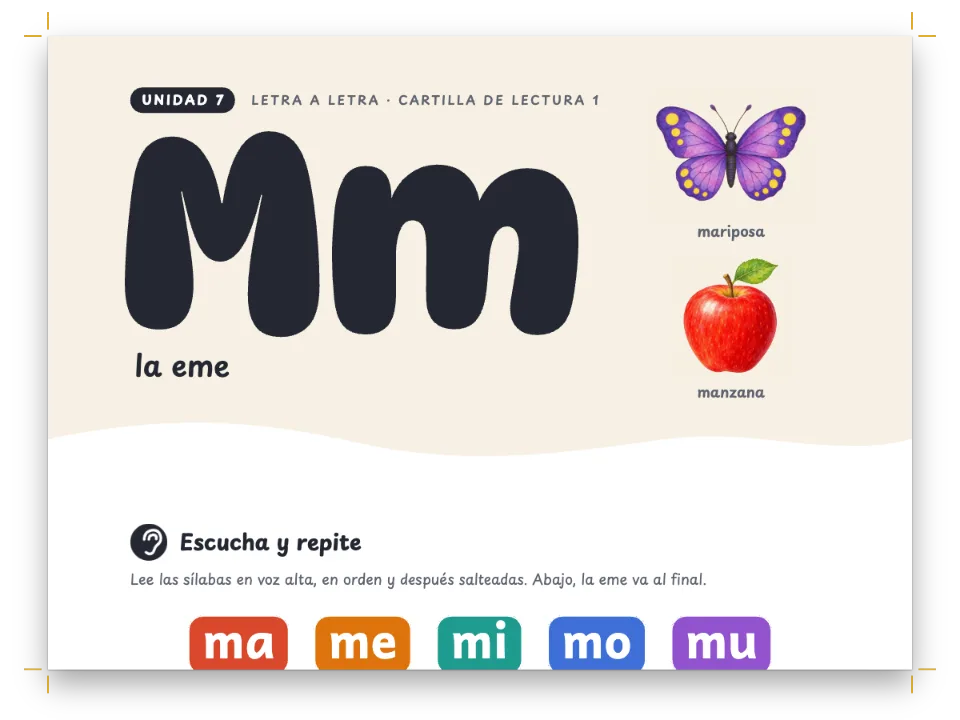
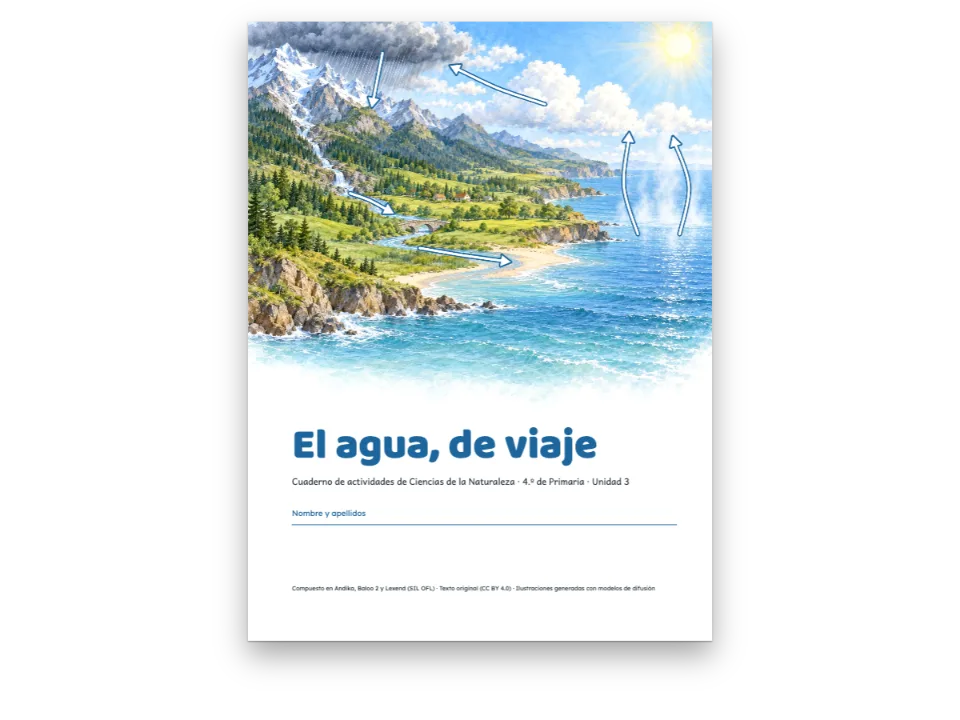
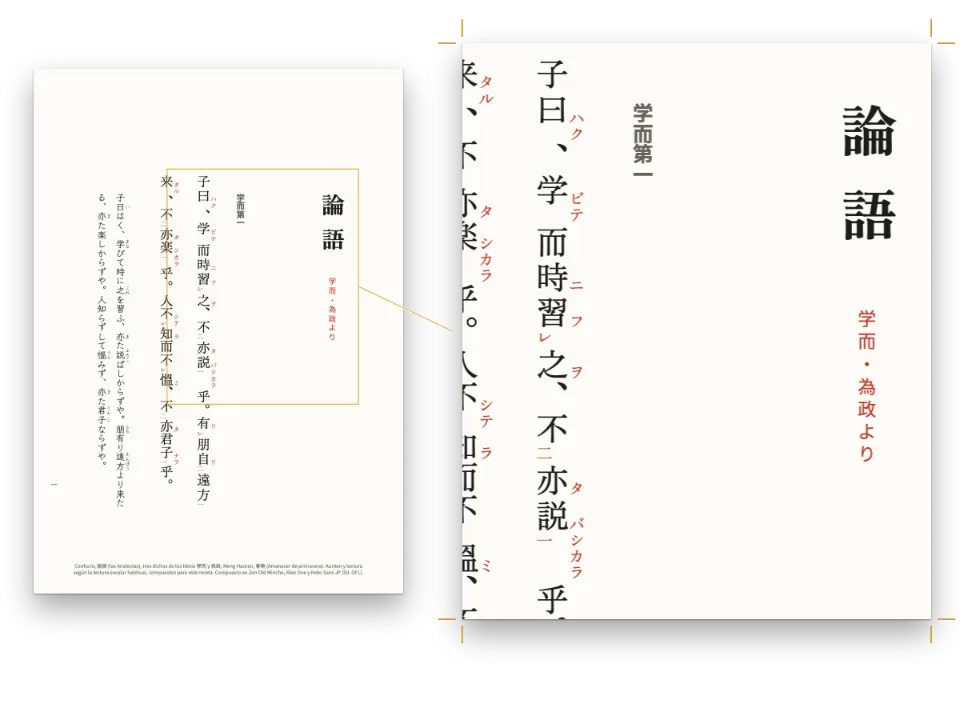
Dotze pàgines d’un quadern de cal·ligrafia de primer en A4, en deu edicions que són deu quaderns diferents. Cada llengua té la lletra lligada que ensenyen les seves escoles, de les famílies Playwrite de Google (GB J, ES, FR Trad, DE VA, IT Trad, BR) o de Playpen Sans Arabic, sobre el paper on escriuen els seus infants: la pauta de les escoles d’aquí, els quadres Seyès francesos amb el marge vermell, la Lineatur alemanya amb la banda central groga, les línies de cal·ligrafia brasileres. L’edició xinesa escriu en quadrícules 田字格, on els infants repassen caràcters en vermell pàl·lid (描红), amb el pinyin en quatre línies; la japonesa, en quadres マス amb una creu de punts i el repàs en gris (なぞり書き). Les lliçons segueixen l’ortografia de cada llengua: la ñ i la h muda en castellà, la l·l en català, la ß i els substantius amb majúscula en alemany, les partícules は, を i へ en japonès, les quatre formes d’una lletra i les lletres que no s’uneixen en àrab. Cada ratlla va del model als punts i dels punts a res. Les vint-i-nou pintures, generades amb un model de difusió, són comunes a totes les edicions.
Aquesta recepta respon a
- Com faig un quadern de cal·ligrafia: un model, lletres puntejades per repassar i línies buides, sobre la pauta escolar de cada país?
- Com faig una fitxa d'exercicis: línies per omplir, caixes de resposta, bancs de paraules, llistes de comprovació?
La resposta curta
// ### Repasa y escribe {w="nina" model="niña"} draws four rows on the edition's ruling: the
// model and dotted copies, a row of dots, the model and one copy, and an empty row. The
// ruling and the dots are one picture per block ('trazo-' + w, drawn under #region art); the
// models are live text set on its baselines. A design text's baseline falls 0.8 of its line
// below the box top, so a box of line L set at baseline − 0.8 L puts the letters on the line.
const G = CJK ? null : geometry(ED.ruling, ED.u); // rows, baselines and the face's size
const LABEL_H = 7; // mm: the block's label above its ruling
const model = (id, row, extra = {}) => text(id, '{attr.model}', HAND, G.size / 0.3528,
  at('container', 'top-left', 0, LABEL_H + G.base[row] - 0.8 * G.line,
    { width: mm(W) }), { lineHeight: mm(G.line), overflow: 'clip', ...extra });
const wordBlock = (rows, again = true) => ({ enabled: true,
  minHeight: mm(LABEL_H + G.height(rows)), slot: { elements: [label('label'),
    image('trazo', 'trazo-{attr.w}', at('container', 'top-left', 0, LABEL_H,
      box(W, G.height(rows)))),
    model('model-1', 0),
    ...(again ? [model('model-3', 2)] : []), // a sentence is written out once
  ] } });
Ingredients
- Funcions
- Obertures dissenyadesAtributs de títolImatges als dissenys de pàginaEstils de títolCobertes, portades i colofonsTextos, filets i caixes als dissenys de pàginaChips en líniaRequadresPaleta de color semànticaPartició de mots i llengua del documentCapçaleres segons el tipus de pàginaMarges simètricsFonts àrabsFonts xineses, japoneses i coreanesLlibres enquadernats per la dretaText de dreta a esquerraKana, kanji i rōmajiPàgines en un canvasExportació a PDF
- També fa servir
- Fonts incrustades al PDFTipus de recurs propisFigures i taules com a recursosCapçaleres per secció
- Tipografia
- Andika, Lexend, Playwrite GB J, Playwrite ES, Playwrite FR Trad, Playwrite DE VA, Playwrite IT Trad, Playwrite BR, LXGW WenKai TC, Noto Serif SC, Noto Sans SC, Klee One, Zen Maru Gothic, Playpen Sans Arabic, Noto Naskh Arabic, Baloo Bhaijaan 2 (SIL OFL 1.1)
- Recursos
apple-480.jpgbee-480.jpgbird-480.jpgboat-480.jpgbutterfly-480.jpgcake-480.jpgcat-480.jpgcover-1600.jpgdog-480.jpgduck-480.jpgfire-480.jpgfish-480.jpgflower-480.jpggrip-480.jpghouse-480.jpgicecream-480.jpgkey-480.jpgkite-480.jpgmedal-480.jpgmoon-480.jpgmountain-480.jpgowl-480.jpgpenguin-480.jpgshoe-480.jpgspider-480.jpgsun-480.jpgtraces-ar.jsontraces-ca.jsontraces-de.jsontraces-en.jsontraces-es.jsontraces-fr.jsontraces-it.jsontraces-pt.jsontree-480.jpgumbrella-480.jpgwater-480.jpg- Two children writing in notebooks at a school table, a cat asleep on a chair beside them. (Generated With Diffusion Models, original)
- A smiling sun. (Generated With Diffusion Models, original)
- A crescent moon with three stars. (Generated With Diffusion Models, original)
- A ginger cat sitting. (Generated With Diffusion Models, original)
- A brown and white puppy. (Generated With Diffusion Models, original)
- An orange fish with blue stripes. (Generated With Diffusion Models, original)
- A honey bee flying. (Generated With Diffusion Models, original)
- A little black spider on a thread. (Generated With Diffusion Models, original)
- A red apple. (Generated With Diffusion Models, original)
- A golden key. (Generated With Diffusion Models, original)
- A red child's shoe. (Generated With Diffusion Models, original)
- A small house with a red roof. (Generated With Diffusion Models, original)
- A small sailing boat. (Generated With Diffusion Models, original)
- A yellow duckling. (Generated With Diffusion Models, original)
- A colourful kite. (Generated With Diffusion Models, original)
- A birthday cake with three candles. (Generated With Diffusion Models, original)
- A penguin. (Generated With Diffusion Models, original)
- An owl on a branch. (Generated With Diffusion Models, original)
- A red umbrella in the rain. (Generated With Diffusion Models, original)
- An ice-cream cone with two scoops. (Generated With Diffusion Models, original)
- A blue and orange butterfly. (Generated With Diffusion Models, original)
- A leafy tree. (Generated With Diffusion Models, original)
- A snowy mountain. (Generated With Diffusion Models, original)
- A daisy. (Generated With Diffusion Models, original)
- A small blue bird on a twig. (Generated With Diffusion Models, original)
- Splashing water. (Generated With Diffusion Models, original)
- A small campfire. (Generated With Diffusion Models, original)
- A child's hand holding a pencil with the tripod grip. (Generated With Diffusion Models, original)
- A golden star medal with coloured pencils. (Generated With Diffusion Models, original)
- The dotted letters of the en edition, traced along the outlines of Playwrite GB J Thin. (Ignacio Ferro, original)
- The dotted letters of the es edition, traced along the outlines of Playwrite ES Thin. (Ignacio Ferro, original)
- The dotted letters of the ca edition, traced along the outlines of Playwrite ES Thin. (Ignacio Ferro, original)
- The dotted letters of the fr edition, traced along the outlines of Playwrite FR Trad Thin. (Ignacio Ferro, original)
- The dotted letters of the de edition, traced along the outlines of Playwrite DE VA Thin. (Ignacio Ferro, original)
- The dotted letters of the it edition, traced along the outlines of Playwrite IT Trad Thin. (Ignacio Ferro, original)
- The dotted letters of the pt edition, traced along the outlines of Playwrite BR Thin. (Ignacio Ferro, original)
- The dotted letters of the ar edition, traced along the outlines of Playpen Sans Arabic Thin. (Ignacio Ferro, original)
Elaboració
#1 · Dona a cada edició la seva lletra escolar i el seu paper
// hand: the school model the children copy; ruling: the paper they copy it on; u: its
// x-height in mm (the height of an a), the unit every ruling is drawn in; rise: the room its
// capitals need above a title. The Chinese text is in Song: the Kai face, cut for Hong Kong
// and Taiwan, centres its commas, so it sets only the titles and the squares.
const EDITIONS = {
  en: { hand: 'Playwrite GB J', ruling: 'gb', u: 3.6 },
  es: { hand: 'Playwrite ES', ruling: 'pauta', u: 3.6 },
  ca: { hand: 'Playwrite ES', ruling: 'pauta', u: 3.6 },
  fr: { hand: 'Playwrite FR Trad', ruling: 'seyes', u: 3, rise: 5 },
  de: { hand: 'Playwrite DE VA', ruling: 'lineatur', u: 3.6 },
  it: { hand: 'Playwrite IT Trad', ruling: 'righe', u: 3.6 },
  pt: { hand: 'Playwrite BR', ruling: 'caligrafia', u: 3.2 },
  zh: { hand: 'LXGW WenKai TC', ruling: 'tian', text: 'Noto Serif SC',
    label: 'Noto Sans SC', pinyin: 'Andika', cell: 16 },
  ja: { hand: 'Klee One', ruling: 'masu', text: 'Klee One', label: 'Zen Maru Gothic', cell: 16 },
  ar: { hand: 'Playpen Sans Arabic', ruling: 'satr', u: 3.6,
    text: 'Noto Naskh Arabic', label: 'Baloo Bhaijaan 2' },
};
const ED = { text: 'Andika', label: 'Lexend', rise: 0, ...EDITIONS[LANG] };
const [HAND, TEXT, LABEL] = [ED.hand, ED.text, ED.label];
const CJK = ED.cell !== undefined; // a grid of squares, one character to each
const RTL = LANG === 'ar';
const LW = CJK ? 700 : 600; // the labels' weight: the CJK label faces ship no 600
// Labels in tracked capitals, where the script has capitals.
const caps = (n) => (!CJK && !RTL ? { textTransform: 'uppercase', letterSpacing: pt(n) } : {});
u és l’alçada de la x en mil·límetres, la unitat amb què es dibuixa cada pauta: 3,6 mm a gairebé totes les edicions, 3,2 mm a la brasilera i 3 mm a la francesa, on les línies Seyès són a una alçada de x les unes de les altres. Totes les Playwrite dibuixen l’alçada de la x a la meitat del cos, així que el model fa u / 0,5 i les línies cauen on les proporcions de la mateixa lletra posen els traços ascendents i descendents. El text xinès va en Song (Noto Serif SC): LXGW WenKai TC centra les comes com s’imprimeixen a Hong Kong i Taiwan, així que la Kai només compon els títols i les quadrícules.
#2 · Posa el model sobre la pauta, en text viu
// ### Repasa y escribe {w="nina" model="niña"} draws four rows on the edition's ruling: the
// model and dotted copies, a row of dots, the model and one copy, and an empty row. The
// ruling and the dots are one picture per block ('trazo-' + w, drawn under #region art); the
// models are live text set on its baselines. A design text's baseline falls 0.8 of its line
// below the box top, so a box of line L set at baseline − 0.8 L puts the letters on the line.
const G = CJK ? null : geometry(ED.ruling, ED.u); // rows, baselines and the face's size
const LABEL_H = 7; // mm: the block's label above its ruling
const model = (id, row, extra = {}) => text(id, '{attr.model}', HAND, G.size / 0.3528,
  at('container', 'top-left', 0, LABEL_H + G.base[row] - 0.8 * G.line,
    { width: mm(W) }), { lineHeight: mm(G.line), overflow: 'clip', ...extra });
const wordBlock = (rows, again = true) => ({ enabled: true,
  minHeight: mm(LABEL_H + G.height(rows)), slot: { elements: [label('label'),
    image('trazo', 'trazo-{attr.w}', at('container', 'top-left', 0, LABEL_H,
      box(W, G.height(rows)))),
    model('model-1', 0),
    ...(again ? [model('model-3', 2)] : []), // a sentence is written out once
  ] } });
Un bloc de pràctica és un títol de nivell 3 amb un disseny que dibuixa una imatge, la pauta amb les còpies puntejades, i hi compon a sobre el model com a text en la lletra escolar. La línia de base d’un text de disseny cau a 0,8 del seu interlineat sota la vora superior de la caixa, així que la caixa del model comença 0,8 del seu interlineat per sobre de la línia de base de la ratlla, i les lletres s’aguanten sobre la línia que dibuixa la pauta. L’interlineat fa deu alçades de x perquè el retall de la caixa caigui 2 u sota la línia de base, amb lloc per a la cua de la g. El text del títol, Repassa i escriu, és l’etiqueta del bloc; w anomena la imatge i model, la paraula.
#3 · Dibuixa els punts amb els contorns de la mateixa lletra
Postext compon una lletra en color, perfilada o pàl·lida, però no la dibuixa com una filera de punts al llarg del traç. Els punts es dibuixen abans de compondre el quadern, amb els contorns del tall Thin de cada Playwrite: un punt cada 0,2 alçades de x al llarg de cada contorn, i només es conserva si no n’hi ha cap altre a menys de 0,8 d’aquest pas, de manera que els dos costats d’un traç prim donen una sola filera. El punt de la i i els accents queden com a petites formes plenes. Els punts de cada edició, amb l’avanç de la còpia i el del model, són a traces-<lang>.json, i el pen reparteix les còpies per les ratlles: a la primera, després del model; a la segona, de punta a punta; a la tercera, una sola després del model; la quarta queda buida.
#4 · Repassa els caràcters a la seva quadrícula
// ### 写一写 {c1="日" c2="月"}: each character in the first square of its row, three copies to
// trace in the pale red (描红) or grey (なぞり書き) of the next squares, then empty ones. A
// Han or kana character is one em wide, so tracking of (square − em) sets one per square.
const [CELL, EM] = [ED.cell ?? 16, (ED.cell ?? 16) * 0.72]; // mm: the square, its character
const SQUARES = Math.floor(W / CELL);
const row = (n, y, content, x, color) => text(`r${n}-${x}`, content, HAND, EM / 0.3528,
  at('container', 'top-left', x * CELL + (CELL - EM) / 2, y + (CELL - EM) / 2 + EM * 0.06,
    box(W - x * CELL, EM)),
  { lineHeight: mm(EM), letterSpacing: mm(CELL - EM), overflow: 'clip', color: col(color) });
// A sentence (####) takes three rows: written out, traced, and a row to write it alone.
const squareBlock = (rows, sentence) => ({ enabled: true, minHeight: mm(LABEL_H + rows * CELL),
  slot: { elements: [label('label'), image('grid', `squares-${rows}`,
    at('container', 'top-left', 0, LABEL_H, box(SQUARES * CELL, rows * CELL))),
  ...(sentence ? [row(0, LABEL_H, '{attr.model}', 0, 'ink'),
    row(1, LABEL_H + CELL, '{attr.model}', 0, 'trace')] : Array.from({ length: rows }, (_, n) => [
    row(n, LABEL_H + n * CELL, `{attr.c${n + 1}}`, 0, 'ink'),
    row(n, LABEL_H + n * CELL, `{attr.c${n + 1}}{attr.c${n + 1}}{attr.c${n + 1}}`, 1, 'trace'),
  ]).flat()),
  ] } });
// Pinyin on four lines and three spaces (四线三格), ##### {model="bā"}: the syllable, copies
// to trace in the pale red, the syllable again and room after it.
const P = ED.pinyin ? geometry('sixian', 3.6) : null;
const pinyin = (id, n, x, content, color) => text(id, content, ED.pinyin, P.size / 0.3528,
  at('container', 'top-left', x, LABEL_H + P.base[n] - 0.8 * P.line, { width: mm(W - x) }),
  { lineHeight: mm(P.line), overflow: 'clip', color: col(color) });
const copies = Array(5).fill('{attr.model}').join('\u00a0\u00a0\u00a0\u00a0');
const pinyinBlock = P && { enabled: true, minHeight: mm(LABEL_H + P.height(3)),
  slot: { elements: [label('label'),
    image('lines', 'sixian', at('container', 'top-left', 0, LABEL_H,
      box(W, P.height(3)))),
    pinyin('p1', 0, 0, '{attr.model}', 'ink'), pinyin('p1-copies', 0, 36, copies, 'trace'),
    pinyin('p2', 1, 0, copies, 'trace'), pinyin('p3', 2, 0, '{attr.model}', 'ink'),
  ] } };
Un caràcter xinès o un kana fa un quadratí d’amplada, així que un espaiat de quadre menys quadratí posa un caràcter a cada quadre, com en un 字帖. El primer quadre de la ratlla porta el caràcter en tinta, els tres següents el mateix caràcter en el vermell pàl·lid del 描红 (gris a l’edició japonesa) i la resta queda buida. Una frase (####) ocupa tres ratlles: escrita, repassada i buida, amb la puntuació en un quadre propi. Les ratlles de pinyin fan servir la pauta de quatre línies de les edicions llatines amb Andika, que té la a i la g d’un sol ull que aprenen els infants.
#5 · No reflecteixis res per a l’àrab
L’edició àrab comparteix tots els dissenys amb les altres. El motor reflecteix un disseny de títol que es compon en el flux d’una pàgina de dreta a esquerra, així que el disc de lletres, el model i la primera imatge del diccionari passen sols a la dreta. Només les còpies puntejades, dibuixades dins d’una imatge, es col·loquen des de la vora dreta al codi, i les ones de l’escalfament corren de dreta a esquerra. locale: 'ar' enquaderna el llibre per la dreta.
La recepta completa
// ═══ Postext Cookbook · Nº 161 · Handwriting workbook in ten scripts ═══════════════ // https://postext.dev/en/cookbook/handwriting-workbook // Code: MIT · Text: original (CC BY 4.0) · Pictures: generated with diffusion models // Fonts: Playwrite, Playpen Sans Arabic, Klee One and others (SIL OFL) · Needs postext ≥ 1.42.1 import { buildDocument, withLoadedFonts, renderPageToCanvas, registerResourceImage, } from 'https://esm.sh/postext'; import { renderToPdf, decompressWoff2 } from 'https://esm.sh/postext-pdf'; const LANG = 'ca'; // @lang: the language of the workbook (en es ca fr de it pt zh ja ar) const RECIPE = 'handwriting-workbook'; // ─── 1 · Design ───────────────────────────────────────────────────────────── // #region palette: a navy ink, one coral accent, the sun and the pale fields of the bands const palette = { ink: '#22304a', // text and the models accent: '#bf4630', // kickers, labels, folios sun: '#f4b73f', // the boxes' stripe tint: '#fdf0da', // opener bands, boxes rule: '#7f9ccc', // the ruling dots: '#4d5b76', // the dotted letters trace: LANG === 'ja' ? '#b4bccb' : '#e7a9a0', // traced over: 描红 in red, なぞり書き in grey paper: '#ffffff', }; const col = (id) => ({ hex: palette[id], model: 'hex', paletteId: id }); const colorPalette = [ ...Object.entries(palette).map(([id, hex]) => ({ id, name: id, value: { hex, model: 'hex' } })), { id: 'main-color', name: 'accent (defaults)', value: { hex: palette.accent, model: 'hex' } }, ]; // #endregion // #region editions: each language its school's script, its ruling and its faces // hand: the school model the children copy; ruling: the paper they copy it on; u: its // x-height in mm (the height of an a), the unit every ruling is drawn in; rise: the room its // capitals need above a title. The Chinese text is in Song: the Kai face, cut for Hong Kong // and Taiwan, centres its commas, so it sets only the titles and the squares. const EDITIONS = { en: { hand: 'Playwrite GB J', ruling: 'gb', u: 3.6 }, es: { hand: 'Playwrite ES', ruling: 'pauta', u: 3.6 }, ca: { hand: 'Playwrite ES', ruling: 'pauta', u: 3.6 }, fr: { hand: 'Playwrite FR Trad', ruling: 'seyes', u: 3, rise: 5 }, de: { hand: 'Playwrite DE VA', ruling: 'lineatur', u: 3.6 }, it: { hand: 'Playwrite IT Trad', ruling: 'righe', u: 3.6 }, pt: { hand: 'Playwrite BR', ruling: 'caligrafia', u: 3.2 }, zh: { hand: 'LXGW WenKai TC', ruling: 'tian', text: 'Noto Serif SC', label: 'Noto Sans SC', pinyin: 'Andika', cell: 16 }, ja: { hand: 'Klee One', ruling: 'masu', text: 'Klee One', label: 'Zen Maru Gothic', cell: 16 }, ar: { hand: 'Playpen Sans Arabic', ruling: 'satr', u: 3.6, text: 'Noto Naskh Arabic', label: 'Baloo Bhaijaan 2' }, }; const ED = { text: 'Andika', label: 'Lexend', rise: 0, ...EDITIONS[LANG] }; const [HAND, TEXT, LABEL] = [ED.hand, ED.text, ED.label]; const CJK = ED.cell !== undefined; // a grid of squares, one character to each const RTL = LANG === 'ar'; const LW = CJK ? 700 : 600; // the labels' weight: the CJK label faces ship no 600 // Labels in tracked capitals, where the script has capitals. const caps = (n) => (!CJK && !RTL ? { textTransform: 'uppercase', letterSpacing: pt(n) } : {}); // #endregion const W = 176; // mm: the type area's width, and every practice block's // A design laid in the flow of a right-to-left page is mirrored by the engine, so 'left' is // the start side in every edition: the Arabic book needs no coordinates of its own. const box = (width, height) => ({ width: mm(width), height: mm(height) }); const at = (to, edge, x = 0, y = 0, size) => ({ anchor: { to, edge }, offset: { x: mm(x), y: mm(y) }, ...(size && { size }) }); const text = (id, content, fontFamily, size, placement, extra = {}) => ({ kind: 'text', id, content, fontFamily, fontSize: pt(size), color: col('ink'), align: 'left', placement, ...extra }); const image = (id, resourceId, placement) => ({ kind: 'image', id, resourceId, placement, decorative: true }); const label = (id) => text(id, '{titleText}', LABEL, 9, at('container', 'top-left'), { fontWeight: LW, color: col('accent'), ...caps(1.2) }); // #region answer: a practice block: the model in the school face, then dots, then nothing // ### Repasa y escribe {w="nina" model="niña"} draws four rows on the edition's ruling: the // model and dotted copies, a row of dots, the model and one copy, and an empty row. The // ruling and the dots are one picture per block ('trazo-' + w, drawn under #region art); the // models are live text set on its baselines. A design text's baseline falls 0.8 of its line // below the box top, so a box of line L set at baseline − 0.8 L puts the letters on the line. const G = CJK ? null : geometry(ED.ruling, ED.u); // rows, baselines and the face's size const LABEL_H = 7; // mm: the block's label above its ruling const model = (id, row, extra = {}) => text(id, '{attr.model}', HAND, G.size / 0.3528, at('container', 'top-left', 0, LABEL_H + G.base[row] - 0.8 * G.line, { width: mm(W) }), { lineHeight: mm(G.line), overflow: 'clip', ...extra }); const wordBlock = (rows, again = true) => ({ enabled: true, minHeight: mm(LABEL_H + G.height(rows)), slot: { elements: [label('label'), image('trazo', 'trazo-{attr.w}', at('container', 'top-left', 0, LABEL_H, box(W, G.height(rows)))), model('model-1', 0), ...(again ? [model('model-3', 2)] : []), // a sentence is written out once ] } }); // #endregion // #region squares: the Chinese and Japanese blocks, a character to a square // ### 写一写 {c1="日" c2="月"}: each character in the first square of its row, three copies to // trace in the pale red (描红) or grey (なぞり書き) of the next squares, then empty ones. A // Han or kana character is one em wide, so tracking of (square − em) sets one per square. const [CELL, EM] = [ED.cell ?? 16, (ED.cell ?? 16) * 0.72]; // mm: the square, its character const SQUARES = Math.floor(W / CELL); const row = (n, y, content, x, color) => text(`r${n}-${x}`, content, HAND, EM / 0.3528, at('container', 'top-left', x * CELL + (CELL - EM) / 2, y + (CELL - EM) / 2 + EM * 0.06, box(W - x * CELL, EM)), { lineHeight: mm(EM), letterSpacing: mm(CELL - EM), overflow: 'clip', color: col(color) }); // A sentence (####) takes three rows: written out, traced, and a row to write it alone. const squareBlock = (rows, sentence) => ({ enabled: true, minHeight: mm(LABEL_H + rows * CELL), slot: { elements: [label('label'), image('grid', `squares-${rows}`, at('container', 'top-left', 0, LABEL_H, box(SQUARES * CELL, rows * CELL))), ...(sentence ? [row(0, LABEL_H, '{attr.model}', 0, 'ink'), row(1, LABEL_H + CELL, '{attr.model}', 0, 'trace')] : Array.from({ length: rows }, (_, n) => [ row(n, LABEL_H + n * CELL, `{attr.c${n + 1}}`, 0, 'ink'), row(n, LABEL_H + n * CELL, `{attr.c${n + 1}}{attr.c${n + 1}}{attr.c${n + 1}}`, 1, 'trace'), ]).flat()), ] } }); // Pinyin on four lines and three spaces (四线三格), ##### {model="bā"}: the syllable, copies // to trace in the pale red, the syllable again and room after it. const P = ED.pinyin ? geometry('sixian', 3.6) : null; const pinyin = (id, n, x, content, color) => text(id, content, ED.pinyin, P.size / 0.3528, at('container', 'top-left', x, LABEL_H + P.base[n] - 0.8 * P.line, { width: mm(W - x) }), { lineHeight: mm(P.line), overflow: 'clip', color: col(color) }); const copies = Array(5).fill('{attr.model}').join('\u00a0\u00a0\u00a0\u00a0'); const pinyinBlock = P && { enabled: true, minHeight: mm(LABEL_H + P.height(3)), slot: { elements: [label('label'), image('lines', 'sixian', at('container', 'top-left', 0, LABEL_H, box(W, P.height(3)))), pinyin('p1', 0, 0, '{attr.model}', 'ink'), pinyin('p1-copies', 0, 36, copies, 'trace'), pinyin('p2', 1, 0, copies, 'trace'), pinyin('p3', 2, 0, '{attr.model}', 'ink'), ] } }; // #endregion // #region opener: a tinted band with the lesson's letters in a disc and its picture const BAND = 40; // mm const opener = { enabled: true, minHeight: mm(BAND + 7), slot: { elements: [ { kind: 'box', id: 'band', decorative: true, style: { backgroundColor: col('tint'), borderRadius: mm(5) }, placement: at('container', 'top-left', 0, 0, box(W, BAND)) }, text('letters', '{attr.letras}', HAND, CJK ? 30 : 26, at('container', 'top-left', 5, 5, box(40, 30)), { align: 'center', verticalAlign: 'middle', color: col('accent'), overflow: 'clip', box: { backgroundColor: col('paper'), borderRadius: mm(15) } }), text('kicker', '{attr.kicker}', LABEL, 9, at('container', 'top-left', 52, 8), { fontWeight: LW, color: col('accent'), ...caps(1.2) }), text('title', '{titleText}', HAND, CJK ? 26 : 24, at('container', 'top-left', 52, 15 + ED.rise, { width: mm(80) }), { lineHeight: 1.25 }), { kind: 'box', id: 'card', decorative: true, style: { backgroundColor: col('paper'), borderRadius: mm(4) }, placement: at('container', 'top-right', -4, 3, box(34, 34)) }, image('picture', '{attr.pic}', at('container', 'top-right', -5, 4, box(32, 32))), ] } }; // #endregion // #region pages: the cover, the certificate and the picture dictionary // The cover: a painted scene to the bleed, the title in the school face, a line for a name. const COVER = 178; // mm from the top edge: the foot of the painting const cover = { id: 'portada', header: { elements: [] }, footer: { elements: [] }, advancedDesign: { enabled: true, slot: { elements: [ image('scene', 'cover', at('page', 'top-left', 0, 0, { width: 'fill', height: mm(COVER) })), text('kicker', '{attr.kicker}', LABEL, 11, at('page', 'top', 0, COVER + 10), { align: 'center', fontWeight: LW, color: col('accent'), ...caps(1.6) }), text('title', '{titleText}', HAND, CJK ? 48 : 46, at('page', 'top', 0, COVER + 18 + ED.rise), { align: 'center', lineHeight: 1.2 }), text('name', '{attr.nombre}', LABEL, 12, at('page', 'top', -W / 2 + 24, COVER + 58), { color: col('ink') }), { kind: 'rule', id: 'name-line', direction: 'horizontal', thickness: pt(1), color: col('rule'), placement: at('page', 'top', 14, COVER + 64, { width: mm(110) }) }, text('colophon', '{attr.colofon}', LABEL, 7, at('page', 'top', 0, 262, { width: mm(W) }), { align: 'center', color: col('dots'), lineHeight: 1.4 }), ] } } }; // The last page: the same frame as a certificate, the child's name and the date to fill in. const diploma = { id: 'diploma', header: { elements: [] }, footer: { elements: [] }, advancedDesign: { enabled: true, minHeight: mm(250), slot: { elements: [ { kind: 'box', id: 'frame', decorative: true, style: { borderColor: col('sun'), borderWidth: pt(5), borderRadius: mm(8), backgroundColor: col('paper') }, placement: at('container', 'top-left', 0, 4, box(W, 244)) }, image('picture', 'medal', at('container', 'top', 0, 22, box(70, 70))), text('title', '{titleText}', HAND, CJK ? 40 : 38, at('container', 'top', 0, 104, { width: mm(W - 20) }), { align: 'center', color: col('accent'), lineHeight: 1.2 }), text('body', '{attr.texto}', TEXT, 15, at('container', 'top', 0, 136, { width: mm(130) }), { align: 'center', lineHeight: 1.45 }), ...[0, 1].map((n) => text(`field-${n}`, `{attr.${['nombre', 'fecha'][n]}}`, LABEL, 11, at('container', 'top-left', 28, 186 + n * 22), { color: col('dots') })), ...[0, 1].map((n) => ({ kind: 'rule', id: `line-${n}`, direction: 'horizontal', thickness: pt(1), color: col('rule'), placement: at('container', 'top-left', 28, 192 + n * 22, { width: mm(W - 56) }) })), ] } } }; // The picture dictionary, ## {p1="cat" w1="gato" …}: four pictures to a row, each word under // its picture in the school face, and a line to copy it on. const SLOT = W / 4; const dictionary = { enabled: true, minHeight: mm(58), slot: { elements: [0, 1, 2, 3].flatMap((n) => [ image(`p${n}`, `{attr.p${n + 1}}`, at('container', 'top-left', n * SLOT + (SLOT - 34) / 2, 0, box(34, 34))), text(`w${n}`, `{attr.w${n + 1}}`, HAND, CJK ? 20 : 17, at('container', 'top-left', n * SLOT, 36, box(SLOT, 10)), { align: 'center', overflow: 'clip' }), { kind: 'rule', id: `l${n}`, direction: 'horizontal', thickness: pt(0.75), color: col('rule'), placement: at('container', 'top-left', n * SLOT + 4, 54, { width: mm(SLOT - 8) }) }, ]) } }; // #endregion // The folio in an accent disc at the outer foot, the book's title beside it. const foot = (parity, edge, side) => [ text(`folio-${parity}`, '{pageNumber}', LABEL, 10, { anchor: { to: 'page', edge }, offset: { x: mm(18 * side), y: mm(-9) }, size: box(8, 8) }, { parity, align: 'center', verticalAlign: 'middle', fontWeight: 700, color: col('paper'), lineHeight: 1.17, box: { backgroundColor: col('accent'), borderRadius: mm(4) } }), text(`title-${parity}`, '{title} · {subtitle}', LABEL, 7.5, { anchor: { to: 'page', edge }, offset: { x: mm(29 * side), y: mm(-11) } }, { parity, color: col('dots'), align: side > 0 ? 'left' : 'right', ...caps(1) }), ]; const config = { // Hyphenation, punctuation, direction and binding follow the edition's language. locale: t({ en: 'en-gb', es: 'es', ca: 'ca', fr: 'fr', de: 'de', it: 'it', pt: 'pt-BR', zh: 'zh-Hans', ja: 'ja', ar: 'ar' }), resourceTypes: [{ id: 'dibujo', name: 'Dibujo', shortLabel: '', captionPrefix: '', numberingTemplate: '', resetOn: 'never', counterFormat: 'decimal', defaultPlacement: { position: 'here' } }], colorPalette, page: { sizePreset: 'custom', width: mm(210), height: mm(297), dpi: 150, margins: { top: mm(16), bottom: mm(22), left: mm(18), right: mm(16), mirror: true } }, layout: { layoutType: 'single' }, bodyText: { fontFamily: TEXT, fontSize: pt(CJK ? 13.5 : 14), lineHeight: pt(RTL ? 25 : 20), color: col('ink'), boldColor: col('ink'), italicColor: col('ink'), referenceColor: col('ink'), textAlign: RTL || CJK ? 'justify' : 'left', firstLineIndent: pt(0), paragraphSpacing: true, hyphenation: { enabled: !CJK && !RTL }, optimalLineBreaking: true, avoidWidows: true, avoidOrphans: true, avoidRunts: true, }, headings: { fontFamily: HAND, color: col('ink'), fontWeight: 400, levels: [ { level: 1, breakBefore: { enabled: true, parity: 'any' }, marginTop: pt(0), marginBottom: mm(3), advancedDesign: opener }, { level: 2, marginTop: mm(3), marginBottom: mm(3), advancedDesign: dictionary }, { level: 3, marginTop: mm(4), marginBottom: mm(2), advancedDesign: CJK ? squareBlock(4) : wordBlock(4) }, { level: 4, marginTop: mm(4), marginBottom: mm(2), advancedDesign: CJK ? squareBlock(3, true) : wordBlock(3, false) }, ...(P ? [{ level: 5, marginTop: mm(4), marginBottom: mm(2), advancedDesign: pinyinBlock }] : []), ], }, headingStyles: [cover, diploma], chipStyles: [ // a blank to write a letter in, and a letter tile { id: 'hueco', fontFamily: LABEL, background: col('paper'), borderColor: col('rule'), borderWidth: pt(1), borderRadius: mm(1.2), paddingX: mm(4), paddingY: em(0.12) }, { id: 'letra', fontFamily: HAND, background: col('tint'), borderColor: col('sun'), borderWidth: pt(1), borderRadius: mm(1.6), paddingX: mm(2), paddingY: em(0.08) }], calloutStyles: [{ id: 'recuerda', background: col('tint'), borderRadius: mm(3), stripe: { enabled: true, side: 'left', width: pt(4), color: col('sun') }, padding: { top: mm(3), right: mm(5), bottom: mm(3.5), left: mm(5) }, titleStyle: { fontFamily: LABEL, fontSize: pt(9), fontWeight: LW, color: col('accent'), ...caps(1.2) }, body: { fontFamily: TEXT, fontSize: pt(12), lineHeight: pt(RTL ? 21 : 17), color: col('ink'), boldColor: col('ink'), italicColor: col('ink'), firstLineIndent: pt(0) } }], header: { elements: [] }, footer: { elements: [...foot('even', 'bottom-left', 1), ...foot('odd', 'bottom-right', -1)] }, }; // ─── 2 · Content ──────────────────────────────────────────────────────────── const markdown = String.raw`---Mostra en Markdown · 134 línies · content.ca.md
title: "Aprenc a escriure" subtitle: "Quadern de cal·ligrafia 1" --- # Aprenc a escriure {style="portada" kicker="Quadern de cal·ligrafia · Lletra lligada" nombre="Em dic" colofon="Compost en Playwrite ES, Andika i Lexend (SIL OFL) · Text original (CC BY 4.0) · Il·lustracions generades amb models de difusió"} # Abans de començar {kicker="Escalfem la mà" letras="a b c" pic="grip"} Seu amb l’esquena dreta i els dos peus a terra. Agafa el llapis amb tres dits, com una pinça, sense estrènyer. Repassa els punts d’esquerra a dreta sense aixecar el llapis. ### Ones del mar {w="waves"} ### Bucles de cargol {w="loops"} # Les vocals i els accents {kicker="Lliçó 1" letras="à è é ò" pic="owl"} En català hi ha cinc vocals: **a, e, i, o, u**. La **e** i la **o** poden sonar obertes o tancades. L’accent obert s’inclina cap a l’esquerra: **à, è, ò**. L’accent tancat s’inclina cap a la dreta: **é, í, ó, ú**. ### Repassa i escriu {w="avia" model="àvia"} ### Repassa i escriu {w="camio" model="camió"} Escriu la vocal amb accent: sof:chip[ ]{style="hueco"} · caf:chip[ ]{style="hueco"} · cami:chip[ ]{style="hueco"} · pap:chip[ ]{style="hueco"} :::callout{type="recuerda" title="Recorda"} La **a** porta sempre l’accent obert: **à**. La **i** i la **u** el porten sempre tancat: **í**, **ú**. ::: # La m i la p {kicker="Lliçó 2" letras="m p" pic="apple"} La **m** té tres ponts i la **p** baixa per sota de la línia. Si ajuntes cada consonant amb una vocal, surt una síl·laba: ma, me, mi, mo, mu; pa, pe, pi, po, pu. ### Repassa i escriu {w="poma" model="poma"} ### Repassa i escriu {w="mapa" model="mapa"} m o p? :chip[ ]{style="hueco"}oma · ma:chip[ ]{style="hueco"}a · :chip[ ]{style="hueco"}oto · lla:chip[ ]{style="hueco"}is :::callout{type="recuerda" title="Recorda"} Davant de **p** i de **b** s’escriu sempre **m**: campana, bomba, embut. ::: # La ny i la ll {kicker="Lliçó 3" letras="ny ll" pic="spider"} La **ny** són dues lletres que fan un sol so, com a **aranya**, **pinya** o **any**. La **ll** també són dues lletres i un sol so: **lluna**, **cavall**, **llapis**. Escriu les dues lletres juntes, sense aixecar el llapis. ### Repassa i escriu {w="aranya" model="aranya"} ### Repassa i escriu {w="lluna" model="lluna"} ny o ll? :chip[ ]{style="hueco"}una · pi:chip[ ]{style="hueco"}a · cava:chip[ ]{style="hueco"} · munta:chip[ ]{style="hueco"}a :::callout{type="recuerda" title="Recorda"} Sense la **y** canvia la paraula: **pena** no és el mateix que **penya**. ::: # La ela geminada {kicker="Lliçó 4" letras="l·l" pic="butterfly"} La **l·l** són dues eles separades per un punt volat, i se sent una ela més llarga: **col·legi**, **il·lusió**, **pel·lícula**. Escriu la primera l, posa el punt a mitja altura i després escriu la segona l. ### Repassa i escriu {w="collegi" model="col·legi"} ### Repassa i escriu {w="illusio" model="il·lusió"} ll o l·l? co:chip[ ]{style="hueco"}egi · ga:chip[ ]{style="hueco"}ina · pe:chip[ ]{style="hueco"}ícula · papa:chip[ ]{style="hueco"}ona :::callout{type="recuerda" title="Recorda"} El punt de la **l·l** va a mitja altura, entre les dues eles. No és el punt del final de la frase. ::: # La ç i la qu {kicker="Lliçó 5" letras="ç qu" pic="key"} El so de **casa** s’escriu amb **c** davant de a, o, u, i amb **qu** davant de e, i: **quatre**, **quilo**. El so de **cel** s’escriu amb **c** davant de e, i, i amb **ç** davant de a, o, u: **plaça**, **cançó**. ### Repassa i escriu {w="placa" model="plaça"} ### Repassa i escriu {w="quatre" model="quatre"} c, qu o ç? :chip[ ]{style="hueco"}asa · can:chip[ ]{style="hueco"}ó · :chip[ ]{style="hueco"}ilo · bra:chip[ ]{style="hueco"} :::callout{type="recuerda" title="Recorda"} La **ç** porta una cueta a sota. No va mai davant de **e** ni de **i**. ::: # La g, la gu i la gü {kicker="Lliçó 6" letras="g gu gü" pic="penguin"} La **g** sona suau a **gat**, **goma** i **gust**. Davant de e, i, per fer aquest so escrivim **gu**: **formigues**, **guitarra**. Si la u ha de sonar, porta dos puntets a sobre, la dièresi: **pingüí**. ### Repassa i escriu {w="pingui" model="pingüí"} ### Repassa i escriu {w="formigues" model="formigues"} gu o gü? :chip[ ]{style="hueco"}itarra · pin:chip[ ]{style="hueco"}í · formi:chip[ ]{style="hueco"}es · ai:chip[ ]{style="hueco"}es :::callout{type="recuerda" title="Recorda"} Davant de e, i, la **g** sona com la **j**: **gel**, **girafa**. Davant de a, o, u, sempre **j**: **joc**, **jardí**. ::: # L’apòstrof i la dièresi {kicker="Lliçó 7" letras="l’ ï" pic="bee"} Davant d’una paraula que comença per vocal, **el** i **la** es tornen **l’**: **l’abella**, **l’arbre**. La **dièresi** sobre la **i** o la **u** vol dir que aquella vocal es llegeix a part: **raïm**, **veïna**. ### Repassa i escriu {w="labella" model="l’abella"} ### Repassa i escriu {w="raim" model="raïm"} Escriu amb apòstrof: el ocell · la oca · el arbre · la àvia :::callout{type="recuerda" title="Recorda"} L’apòstrof és una coma petita a dalt. Entre la **l’** i la paraula no hi ha espai. ::: # Les meves paraules {kicker="Diccionari" letras="abc" pic="house"} Llegeix cada paraula i copia-la a la línia de sota amb la teva millor lletra. ## sol, lluna, gat, peix {p1="sun" w1="sol" p2="moon" w2="lluna" p3="cat" w3="gat" p4="fish" w4="peix"} ## casa, vaixell, ànec, clau {p1="house" w1="casa" p2="boat" w2="vaixell" p3="duck" w3="ànec" p4="key" w4="clau"} ## sabata, poma, abella, arbre {p1="shoe" w1="sabata" p2="apple" w2="poma" p3="bee" w3="abella" p4="tree" w4="arbre"} # Copio frases {kicker="Lliçó 8" letras="Aa" pic="kite"} Una frase comença amb majúscula i acaba amb un punt. Entre paraula i paraula deixa l’espai d’una o. #### Copia la frase {w="frase-1" model="El meu gat dorm al sol."} #### Copia la frase {w="frase-2" model="La lluna surt de nit."} #### Copia la frase {w="frase-3" model="M’agrada molt escriure."} # Ja sé escriure! {style="diploma" texto="Has repassat les vocals i els accents, la ny i la ll, la l·l, la ç i la qu, la gu i la gü i l’apòstrof. Ara ja pots escriure les teves paraules." nombre="Nom" fecha="Data"}`; // content.<lang>.md, inlined by the Cookbook // #region art: the edition's ruling drawn in code, the dots from the face's own outlines // Each country's paper, in x-heights (u) above and below the baseline. lines: [height, // weight] pairs; band: a filled band; seyes: the French grid of 1 u squares, a heavy line // every 4 u, verticals every 4 u; Seyès and the Italian page rule a red margin where the // writing starts. function geometry(style, u) { const R = { pauta: { above: 2, below: 1, gap: 1, lines: [[-1, 0.4], [0, 0.9], [1, 0.9], [2, 0.4]] }, gb: { above: 2, below: 1, gap: 0.8, lines: [[-0.8, 0.5], [0, 0.9], [1, 0.5, 'dash'], [1.8, 0.5]] }, lineatur: { above: 2, below: 1, gap: 1, lines: [[-1, 0.6], [0, 0.6], [1, 0.6], [2, 0.6]], band: [0, 1, '#fdf3c7'] }, righe: { above: 2, below: 1, gap: 1, lines: [[-1, 0.4], [0, 0.8], [1, 0.8], [2, 0.4]], margin: true }, caligrafia: { above: 2.4, below: 1.4, gap: 0.8, lines: [[-1.3, 0.4], [0, 0.9], [1, 0.9], [2.3, 0.4]], band: [0, 1, '#e8f0fb'] }, satr: { above: 2, below: 1, gap: 1, lines: [[-1, 0.4], [0, 0.9], [1, 0.5, 'dash'], [2, 0.4]] }, seyes: { above: 4, below: 2, gap: -2, seyes: true }, // a row on every heavy line sixian: { above: 2, below: 1, gap: 1, lines: [[-1, 0.6], [0, 0.9], [1, 0.6], [2, 0.6]] }, }[style]; const pitch = (R.above + R.below + R.gap) * u; const base = [0, 1, 2, 3].map((n) => n * pitch + R.above * u); // The faces set their x-height at half the em, Playpen Sans Arabic its tooth at 0.4. const xh = { satr: 0.4, sixian: 0.508 }[style] ?? 0.5; // Andika's x-height for pinyin // line: a tall box for the models, whose clip falls 2 u under the baseline. return { ...R, u, pitch, base, size: u / xh, line: u * 10, height: (rows) => (rows - 1) * pitch + (R.above + R.below) * u }; } const n2 = (v) => +v.toFixed(2); function ruling(g, rows) { const out = []; const h = g.height(rows); const hline = (y, w, dash) => out.push(`<path d="M0 ${n2(y)}H${W}" stroke="${palette.rule}" ` + `stroke-width="${n2(w * 0.3528)}" stroke-opacity="${w < 0.6 ? 0.55 : 1}"` + `${dash ? ' stroke-dasharray="1.2 1"' : ''}/>`); if (g.seyes) { for (let k = 0; k <= h / g.u + 1e-6; k++) hline(k * g.u, k % 4 === 0 ? 0.9 : 0.35); for (let x = 4 * g.u; x <= W; x += 4 * g.u) out.push(`<path d="M${n2(x)} 0V${n2(h)}" ` + `stroke="${palette.rule}" stroke-width=".12"/>`); out.push(`<path d="M.2 0V${n2(h)}" stroke="#d9534f" stroke-width=".3"/>`); return out.join(''); } for (const b of g.base.slice(0, rows)) { if (g.band) out.push(`<rect x="0" y="${n2(b - g.band[1] * g.u)}" width="${W}" ` + `height="${n2((g.band[1] - g.band[0]) * g.u)}" fill="${g.band[2]}"/>`); for (const [k, w, dash] of g.lines) hline(b - k * g.u, w, dash); } if (g.margin) out.push(`<path d="M.2 0V${n2(h)}" stroke="#d9534f" stroke-width=".3"/>`); return out.join(''); } // The dots of a word: TRACES holds, for each model, the dots along the outlines of the face's // thin cut (one row of dots, the two sides of a stroke merged) as a path of zero-length, // round-capped segments, its advance, and the model's advance in the regular cut, all in mm. function dotted(word, x, y) { const t = TRACES.words[word]; return `<g transform="translate(${n2(x)} ${n2(y)})"><path d="${t.d}" stroke="${palette.dots}" ` + `stroke-width="${TRACES.dot}" stroke-linecap="round" fill="none"/>` + (t.f ? `<path d="${t.f}" fill="${palette.dots}"/>` : '') + '</g>'; } // Warm-up strokes: curves drawn by code, dotted at the same pitch as the letters. const PATTERNS = { // s runs along the stroke; x and y in 2 u, from the baseline up lines: (s) => [Math.floor(s) * 0.5, s % 1], // sticks, each drawn from the foot up waves: (s) => [s * 0.5, (1 - Math.cos(s * Math.PI)) / 4], // waves in the x-height band loops: (s) => [s * 0.5 - 0.2 * Math.sin(2 * Math.PI * s), (1 - Math.cos(2 * Math.PI * s)) / 2], }; function pattern(name, x0, x1, base, u) { const f = PATTERNS[name]; const pts = []; let prev = null; let acc = 0; for (let s = 0; s < 400; s += 0.002) { const [px, py] = f(s); const p = [x0 + px * u * 2, base - py * u * 2]; if (p[0] > x1) break; acc += prev ? Math.hypot(p[0] - prev[0], p[1] - prev[1]) : TRACES.pitch; prev = p; if (acc < TRACES.pitch) continue; pts.push(`M${n2(RTL ? W - p[0] : p[0])} ${n2(p[1])}h.01`); acc = 0; } return `<path d="${pts.join('')}" stroke="${palette.dots}" stroke-width="${TRACES.dot}" ` + 'stroke-linecap="round" fill="none"/>'; } // One block's picture: the ruling, then the dotted copies laid out from the start side. A word // (###): copies after the model, a row of copies, one copy after the model, an empty row. A // sentence (####): one copy under the model, then an empty row. A warm-up pattern: two rows // of it and the start of a third. function traceSvg(g, w, word, sentence) { const rows = sentence ? 3 : 4; const gap = 3 * g.u; const parts = [ruling(g, rows)]; const copies = (row, from, count = 99) => { const t = TRACES.words[word]; for (let x = from, k = 0; x + t.a <= W && k < count; x += t.a + gap, k++) { parts.push(dotted(word, RTL ? W - x - t.a : x, g.base[row])); } }; if (PATTERNS[w]) { [W, W, W * 0.4].forEach((end, row) => parts.push(pattern(w, 2, end - 2, g.base[row], g.u))); } else if (sentence) copies(1, 0, 1); else { const lead = TRACES.words[word].m + gap; copies(0, lead); copies(1, 0); copies(2, lead, 1); } const h = g.height(rows); return `<svg xmlns="http://www.w3.org/2000/svg" width="${W * 10}" height="${n2(h * 10)}" ` + `viewBox="0 0 ${W} ${n2(h)}">${parts.join('')}</svg>`; } // The pictures the practice blocks name: one per block, read off the headings that ask for one, // or the edition's squares and its pinyin lines. async function practicePictures(add) { const svg = (w, h, body) => `<svg xmlns="http://www.w3.org/2000/svg" width="${W * 10}" ` + `height="${n2(h * 10)}" viewBox="0 0 ${w} ${n2(h)}">${body}</svg>`; const blocks = CJK ? [] : markdown.matchAll(/^(#{3,4}) .*?w="([^"]+)"(?: model="([^"]+)")?/gm); for (const [, level, w, word] of blocks) { await loadSvg(`trazo-${w}.svg`, traceSvg(G, w, word ?? '', level === '####')); add(`trazo-${w}`, `trazo-${w}.svg`, 'svg', W * 10, G.height(level === '####' ? 3 : 4) * 10); } if (P) { await loadSvg('sixian.svg', svg(W, P.height(3), ruling(P, 3))); add('sixian', 'sixian.svg', 'svg', W * 10, P.height(3) * 10); } if (CJK) for (const rows of [3, 4]) { await loadSvg(`squares-${rows}.svg`, squaresSvg(rows)); add(`squares-${rows}`, `squares-${rows}.svg`, 'svg', SQUARES * CELL * 10, rows * CELL * 10); } } // The squares: 田字格 in red with a dashed cross, or マス with a dotted cross in grey-blue. function squaresSvg(rows) { const c = CELL; const n = SQUARES; const red = ED.ruling === 'tian'; const ink = red ? '#d0574b' : palette.rule; const cross = Array.from({ length: rows }, (_, r) => Array.from({ length: n }, (_, k) => `M${k * c + c / 2} ${r * c + 0.6}V${r * c + c - 0.6}M${k * c + 0.6} ${r * c + c / 2}` + `H${k * c + c - 0.6}`).join('')).join(''); const grid = Array.from({ length: n + 1 }, (_, k) => `M${k * c} 0V${rows * c}`).join('') + Array.from({ length: rows + 1 }, (_, r) => `M0 ${r * c}H${n * c}`).join(''); return `<svg xmlns="http://www.w3.org/2000/svg" width="${n * c * 10}" height="${rows * c * 10}" ` + `viewBox="0 0 ${n * c} ${rows * c}"><path d="${cross}" fill="none" stroke="${ink}" ` + `stroke-opacity=".55" stroke-width=".2" stroke-dasharray="${red ? '.9 .6' : '.25 .55'}"/>` + `<path d="${grid}" fill="none" stroke="${ink}" stroke-width=".35"/></svg>`; } // #endregion // ─── 3 · Fonts ────────────────────────────────────────────────────────────── const FONTS = { Andika: ['400', '700'], // the text: drawn for children learning to read Lexend: ['400', '600', '700'], // labels, kickers, folios // The school models, one per country: Google's Playwrite families follow each one. 'Playwrite GB J': ['400'], 'Playwrite ES': ['400'], 'Playwrite FR Trad': ['400'], 'Playwrite DE VA': ['400'], 'Playwrite IT Trad': ['400'], 'Playwrite BR': ['400'], 'LXGW WenKai TC': ['400'], // 楷: the Chinese titles and squares 'Noto Serif SC': ['400', '700'], // 宋: the Chinese text 'Noto Sans SC': ['400', '700'], // 黑: Chinese labels 'Klee One': ['400'], // 教科書体: the Japanese text and its squares 'Zen Maru Gothic': ['400', '700'], // Japanese labels 'Playpen Sans Arabic': ['400'], // the Arabic model 'Noto Naskh Arabic': ['400', '700'], // the Arabic text, vocalised 'Baloo Bhaijaan 2': ['400', '600', '700'], // Arabic labels }; // ─── 4 · Build & show ─────────────────────────────────────────────────────── // The edition loads its own faces only: its school face, its text and its labels. const used = [HAND, TEXT, LABEL, ED.pinyin]; for (const family of Object.keys(FONTS)) if (!used.includes(family)) delete FONTS[family]; await loadFonts(FONTS, markdown); await loadCjkFonts(FONTS, markdown); await loadArabicFonts(FONTS, markdown); const TRACES = CJK ? null : await (await fetch({ en: asset('traces-en.json'), es: asset('traces-es.json'), ca: asset('traces-ca.json'), fr: asset('traces-fr.json'), de: asset('traces-de.json'), it: asset('traces-it.json'), pt: asset('traces-pt.json'), ar: asset('traces-ar.json') }[LANG])).json(); const resources = []; // every picture, painted or drawn const add = (id, fileId, kind, width, height, more = {}) => resources.push({ id, kind, typeId: 'dibujo', createdAt: 0, updatedAt: 0, [kind]: { fileId, width, height, ...more } }); // The paintings the edition names (pic="…", p1="…"), from one shared set, at their pixels. const named = new Set(['medal', ...[...markdown.matchAll(/\b(?:pic|p\d)="(\w+)"/g)].map((m) => m[1])]); await Promise.all([['cover', 'cover-1600.jpg', 1600, 1356], ...[...named].map((id) => [id, `${id}-480.jpg`, 480, 480])].map(async ([id, file, w, h]) => { await loadImage(file, asset(file)); add(id, file, 'bitmap', w, h, { format: 'jpeg' }); })); await practicePictures(add); // the rulings, the dots and the squares (#region art) const doc = await withLoadedFonts(() => buildDocument({ markdown, resources }, config), { ...kitFonts(FONTS), text: markdown }); showBook(doc, { title: t({ en: 'Handwriting workbook', es: 'Cuaderno de caligrafía', ca: 'Quadern de cal·ligrafia', fr: 'Cahier d’écriture', de: 'Schreibheft', it: 'Quaderno di scrittura', pt: 'Caderno de caligrafia', zh: '写字练习册', ja: 'かきかたれんしゅうちょう', ar: 'كراسة الخط' }) }); offerPdf(() => renderToPdf(doc, { resourceBytes: imageBytes, fontProvider: { zh: cjkPdfProvider, ja: cjkPdfProvider, ar: arabicPdfProvider }[LANG] ?? fontsourceProvider }), `${RECIPE}-${LANG}.pdf`);Kit · core, fonts, viewer, pdf, images, cjk, arabic: igual a totes les receptes · 613 línies
// ─── Kit ── helpers shared by every Cookbook recipe · postext.dev/cookbook ───── // ─── Kit · core v1 ── the same in every recipe · postext.dev/cookbook function mm(value) { return { value, unit: 'mm' }; } function pt(value) { return { value, unit: 'pt' }; } function em(value) { return { value, unit: 'em' }; } /** The sample language's string: t({ en: 'Figure', es: 'Figura' }). */ function t(strings) { return strings[LANG] ?? Object.values(strings)[0]; } /** A file in this recipe's assets folder, served from the Postext repo by jsDelivr. */ function asset(file) { return `https://cdn.jsdelivr.net/gh/drnachio/postext@main/cookbook/${RECIPE}/assets/${file}`; } // ─── Kit · fonts v3 ── the same in every recipe · postext.dev/cookbook // Postext loads the faces a config asks for before layout (prepareFonts, // buildDocumentWithFonts) and asks the kit for the files: Fontsource's, the // files the PDF embeds too. /** The options of buildDocumentWithFonts / prepareFonts / withLoadedFonts: * the Fontsource resolver, and the faces of FONTS loaded with the ones the * config names. FONTS = { 'Family Name': ['400', '400i', '700'] }. */ function kitFonts(FONTS = {}) { const faces = Object.entries(FONTS).flatMap(([family, specs]) => specs.map((spec) => ({ family, weight: parseInt(spec, 10), style: spec.endsWith('i') ? 'italic' : 'normal' }))); return { resolve: fontsourceResolver, faces }; } /** A face's Fontsource files, in a fixed order: latin, then latin-ext and greek * when `text` needs them and the family ships them (kitSubsetsFor), each with * its unicode-range. Null for a weight or slant Fontsource does not ship. */ async function fontsourceResolver(family, weight, style, { text = '' } = {}) { const id = fontsourceId(family); const meta = await fontsourceMeta(family); if (meta && !(meta.weights.includes(weight) && meta.styles.includes(style))) return null; kitStatus('Loading fonts…'); const at = await fontsourceAt(id); return ['latin', ...kitSubsetsFor(text, meta)].map((subset) => ({ source: `${at}files/${id}-${subset}-${weight}-${style}.woff2`, unicodeRange: kitRanges()[subset], })); } /** The unicode-range of each Fontsource file the kit loads (a function: the * kit is inlined after the pen's code, which runs before a const would be set). */ function kitRanges() { return { latin: 'U+0000-00FF,U+0131,U+0152-0153,U+02BB-02BC,U+02C6,U+02DA,U+02DC,U+0304,U+0308,U+0329,' + 'U+2000-206F,U+20AC,U+2122,U+2191,U+2193,U+2212,U+2215,U+FEFF,U+FFFD', 'latin-ext': 'U+0100-02BA,U+02BD-02C5,U+02C7-02CC,U+02CE-02D7,U+02DD-02FF,U+0304,U+0308,U+0329,' + 'U+1D00-1DBF,U+1E00-1E9F,U+1EF2-1EFF,U+2020,U+20A0-20AB,U+20AD-20C0,U+2113,U+2C60-2C7F,U+A720-A7FF', greek: 'U+0370-03FF', }; } /** For the cjk, arabic and comics blocks, which add their own files: the * faces of `faces` = { 'Family Name': ['400', '400i', '700'] }. `text` is the sample: * č ł † α χ also load latin-ext and greek files (kitSubsetsFor). With * `optional`, a face Fontsource does not ship is skipped instead of failing. * The files are added once all have loaded, in the order asked (latin, then * latin-ext, then greek), whatever order they arrive in: the last one added * wins a character two files hold. Resolves to the number of faces added. */ async function loadFonts(faces, text = '', { optional = false } = {}) { kitStatus('Loading fonts…'); const ranges = kitRanges(); const jobs = []; for (const [family, specs] of Object.entries(faces)) { const id = fontsourceId(family); const todo = [...new Set(specs)].map((spec) => [parseInt(spec, 10), spec.endsWith('i') ? 'italic' : 'normal']) .filter(([weight, style]) => !hasFace(family, weight, style)); // before any await const at = fontsourceAt(id); const meta = optional || /[^\0-ÿ]/u.test(text) ? await fontsourceMeta(family) : null; const subsets = ['latin', ...kitSubsetsFor(text, meta)]; for (const [weight, style] of todo) { if (optional && !(meta?.weights.includes(weight) && meta.styles.includes(style))) continue; for (const subset of subsets) { const url = `${await at}files/${id}-${subset}-${weight}-${style}.woff2`; const face = new FontFace(family, `url(${url}) format('woff2')`, { weight: String(weight), style, unicodeRange: ranges[subset] }); jobs.push(face.load().catch(() => { if (subset === 'latin' && !optional) throw new Error(`Fontsource has no ${family} ${weight} ${style}`); })); } } } const ready = await Promise.all(jobs).catch((error) => { kitFail(error); throw error; }); return ready.filter((face) => face && document.fonts.add(face)).length; } /** A loaded FontFace covers this family, weight and style (fonts.check() would * also say yes for families nobody declared). */ function hasFace(family, weight, style) { for (const face of document.fonts) { if (face.status !== 'loaded' || face.style !== style) continue; if (face.family.replace(/^["']|["']$/g, '') !== family) continue; const [low, high = low] = face.weight.split(' ').map(Number); if (weight >= low && weight <= high) return true; } return false; } /** The files beyond latin `text` needs that `meta`'s family ships. */ function kitSubsetsFor(text, meta) { return [[/[Ā-˿ᴀ-ᶿḀ-ỿ†ℓⱠ-Ɀ꜠-ꟿ]/u, 'latin-ext'], [/[Ͱ-Ͽ]/u, 'greek']] .filter(([re, x]) => re.test(text) && meta?.subsets?.includes(x)).map(([, x]) => x); } /** Fontsource's id for a family: 'Source Serif 4' → 'source-serif-4'. */ function fontsourceId(family) { return family.toLowerCase().replace(/\s+/g, '-'); } /** A package's folder at the one version @5 names now (#766). */ function fontsourceAt(id, u = `https://cdn.jsdelivr.net/npm/@fontsource/${id}@`) { return (fontsourceAt.c ??= {})[id] ??= fetch(u + '5/package.json').then((r) => r.json()) .then((p) => p.version || 5, () => 5).then((v) => `${u}${v}/`); } /** The family's Fontsource metadata (weights, styles, subsets), or null. */ function fontsourceMeta(family) { fontsourceMeta.cache ??= new Map(); const id = fontsourceId(family); if (!fontsourceMeta.cache.has(id)) { fontsourceMeta.cache.set(id, fetch(`https://api.fontsource.org/v1/fonts/${id}`) .then((res) => (res.ok ? res.json() : null), () => null)); } return fontsourceMeta.cache.get(id); } // ─── Kit · viewer v2 ── the same in every recipe · postext.dev/cookbook /** The pages as spreads on a dark desk, page 1 alone, then verso | recto, * each painted when it scrolls near. Other options go to renderPageToCanvas. */ function showPages(docs, { title, width = 460, ...render } = {}) { const root = viewer(title); const pages = [docs].flat().flatMap((doc) => doc.pages.map((page) => ({ doc, page, n: (doc.pageIndexOffset ?? 0) + page.index }))); const spreads = []; let verso = null; for (const p of pages) { if (p.n % 2 === 1) { if (verso) spreads.push([verso, null]); verso = p; } else { spreads.push([verso, p]); verso = null; } } if (verso) spreads.push([verso, null]); const density = Math.min(window.devicePixelRatio || 1, 2); showPages.painter?.disconnect(); const painter = new IntersectionObserver((entries) => { for (const { isIntersecting, target } of entries) { if (!isIntersecting) continue; painter.unobserve(target); const { doc, page } = target.postext; renderPageToCanvas(page, doc, target, { ...render, scale: (width * density) / page.width }); } }, { rootMargin: '800px' }); showPages.painter = painter; root.replaceChildren(...spreads.map((pair) => { const spread = document.createElement('div'); spread.className = 'pt-spread'; for (const p of pair) { const figure = document.createElement('figure'); if (p) { const label = p.page.pageLabel || String(p.n + 1); const canvas = document.createElement('canvas'); canvas.postext = p; canvas.style.aspectRatio = `${p.page.width} / ${p.page.height}`; canvas.setAttribute('role', 'img'); canvas.setAttribute('aria-label', `Page ${label}`); const folio = document.createElement('figcaption'); folio.textContent = label; figure.append(canvas, folio); painter.observe(canvas); } else figure.className = 'pt-blank'; spread.append(figure); } return spread; })); kitStatus(`${pages.length} ${pages.length === 1 ? 'page' : 'pages'}`); document.documentElement.dataset.postext = 'ready'; return pages.length; } /** The desk, the bar and the error reporting, created once. */ function viewer(title) { if (!document.getElementById('pt-kit')) { document.head.insertAdjacentHTML('beforeend', `<style id="pt-kit"> :root { color-scheme: dark; } body { margin: 0; background: #0e1014; color: #b9bcc4; font: 13px/1.45 system-ui, sans-serif; } #pt-bar { position: sticky; top: 0; z-index: 1; display: flex; flex-wrap: wrap; align-items: center; gap: 6px 16px; padding: 10px 16px; background: rgb(14 16 20 / .92); backdrop-filter: blur(6px); border-bottom: 1px solid #23262d; } #pt-bar strong { color: #f4f1ea; font-weight: 600; } #pt-actions { display: flex; gap: 12px; margin-left: auto; } #pt-actions a, #pt-actions button { color: #d8a21a; font: inherit; background: none; border: 0; padding: 0; cursor: pointer; } #pages { display: grid; justify-items: center; gap: 48px; padding: 32px 16px 72px; } .pt-spread { display: flex; } .pt-spread figure { margin: 0; width: min(460px, 44vw); } .pt-spread canvas { display: block; width: 100%; background: #fff; box-shadow: 0 1px 2px rgb(0 0 0 / .5), 0 22px 44px -16px rgb(0 0 0 / .8); } .pt-spread figure:first-child canvas { box-shadow: inset -14px 0 14px -14px rgb(0 0 0 / .18), 0 1px 2px rgb(0 0 0 / .5), 0 22px 44px -16px rgb(0 0 0 / .8); } .pt-spread figcaption { margin-top: 10px; text-align: center; font: 600 10px/1 system-ui, sans-serif; letter-spacing: .18em; text-transform: uppercase; color: #6c7079; } .pt-blank { visibility: hidden; } @media (max-width: 760px) { .pt-spread { flex-direction: column; gap: 32px; } .pt-spread figure { width: min(460px, 92vw); } .pt-blank { display: none; } } </style>`); document.body.insertAdjacentHTML('afterbegin', '<header id="pt-bar"><strong id="pt-title"></strong><span id="pt-status" role="status"></span><span id="pt-actions"></span></header>'); document.getElementById('pt-title').textContent = document.title || 'Postext'; addEventListener('error', (event) => kitFail(event.error ?? event.message)); addEventListener('unhandledrejection', (event) => kitFail(event.reason)); } if (title) document.getElementById('pt-title').textContent = title; return document.getElementById('pages') ?? document.body.appendChild(Object.assign(document.createElement('main'), { id: 'pages' })); } function kitStatus(text) { viewer(); document.getElementById('pt-status').textContent = text; } function kitFail(error) { document.documentElement.dataset.postext = 'error'; kitStatus(`Error: ${error?.message ?? error}`); } // ─── Kit · pdf v3 ── the same in every recipe that exports a PDF /** The Fontsource files the screen used, as TrueType, with their range and * place: the nearest weight the family ships, upright with no italic; * latin, then what its letters need (kitSubsetsFor). */ async function fontsourceProvider(family, weight, style, request) { const id = fontsourceId(family); const meta = await fontsourceMeta(family); const weights = meta?.weights?.length ? meta.weights : [400, 700]; const w = weights.reduce((a, b) => (Math.abs(b - weight) < Math.abs(a - weight) ? b : a)); const s = style === 'italic' && meta && !meta.styles.includes('italic') ? 'normal' : style; const text = String.fromCodePoint(...(request?.codePoints ?? [])); const files = await Promise.all(['latin', ...kitSubsetsFor(text, meta)].map(async (subset, order) => { const res = await fetch(`${await fontsourceAt(id)}files/${id}-${subset}-${w}-${s}.woff2`); if (!res.ok) throw new Error(`Fontsource has no ${family} ${w} ${s} ${subset}`); return Object.assign(await decompressWoff2(new Uint8Array(await res.arrayBuffer())), { unicodeRange: kitRanges()[subset], order }); })); return files.length === 1 ? files[0] : files; } /** A "Build the PDF" button; then "Open the PDF" (a new tab: CodePen's frame * shows no PDFs) and a download link. */ function offerPdf(makePdf, filename) { viewer(); const button = Object.assign(document.createElement('button'), { type: 'button', textContent: 'Build the PDF' }); button.dataset.postextPdf = filename; button.addEventListener('click', async () => { button.disabled = true; button.textContent = 'Building the PDF…'; try { const bytes = await makePdf(); const url = URL.createObjectURL(new Blob([bytes], { type: 'application/pdf' })); const size = `${Math.max(1, Math.round(bytes.length / 1024))} KB`; button.replaceWith( Object.assign(document.createElement('a'), { href: url, target: '_blank', rel: 'noopener', textContent: 'Open the PDF ↗' }), Object.assign(document.createElement('a'), { href: url, download: filename, textContent: `Download ${filename} · ${size}` })); } catch (error) { button.disabled = false; button.textContent = 'Build the PDF'; kitFail(error); } }); document.getElementById('pt-actions').append(button); } // ─── Kit · images v3 ── recipes with pictures · postext.dev/cookbook /** Registers a photo or PNG for the canvas and keeps its bytes for the PDF. * fetch → ImageBitmap never taints the canvas (a plain cross-origin <img> would). */ async function loadImage(fileId, url) { const res = await fetch(url); if (!res.ok) throw new Error(`Image not found (${res.status}): ${url}`); const bytes = new Uint8Array(await res.arrayBuffer()); registerResourceImage(fileId, await createImageBitmap(new Blob([bytes]))); (loadImage.bytes ??= new Map()).set(fileId, bytes); } /** Registers SVG markup as a vector image, its fonts inside (inlineSvgFonts, ≥ 1.25). * `options` go to registerResourceImage: { singleInk: true } tints it on the canvas. */ async function loadSvg(fileId, svg, options) { if (typeof inlineSvgFonts === 'function') svg = await inlineSvgFonts(svg, svgFaces); const img = new Image(); img.src = `data:image/svg+xml;charset=utf-8,${encodeURIComponent(svg)}`; await img.decode(); registerResourceImage(fileId, img, options); (loadImage.bytes ??= new Map()).set(fileId, new TextEncoder().encode(svg)); } /** A face's Fontsource files: nearest weight; latin + what the SVG sets. */ async function svgFaces(family, weight, style, { codePoints = [] } = {}) { const [id, m] = [fontsourceId(family), await fontsourceMeta(family)]; const w = m?.weights.reduce((a, b) => (Math.abs(b - weight) < Math.abs(a - weight) ? b : a)) ?? weight; const s = m?.styles.includes(style) === false ? 'normal' : style; return Promise.all(['latin', ...kitSubsetsFor(String.fromCodePoint(...codePoints), m)].map(async (x) => new Uint8Array( await (await fetch(`${await fontsourceAt(id)}files/${id}-${x}-${w}-${s}.woff2`)).arrayBuffer()))); } /** renderToPdf({ resourceBytes: imageBytes }) */ function imageBytes(fileId) { return loadImage.bytes?.get(fileId); } /** renderToHtml({ resourceImageUrl: imageUrl }) */ function imageUrl(fileId) { const bytes = imageBytes(fileId); if (!bytes) return undefined; imageUrl.urls ??= new Map(); if (!imageUrl.urls.has(fileId)) { const type = /\.svg$/i.test(fileId) ? 'image/svg+xml' : /\.png$/i.test(fileId) ? 'image/png' : 'image/jpeg'; imageUrl.urls.set(fileId, URL.createObjectURL(new Blob([bytes], { type }))); } return imageUrl.urls.get(fileId); } // ─── Kit · cjk v2 ── Chinese, Japanese and Korean books · postext.dev/cookbook // Fontsource ships a CJK family as about a hundred files per weight, each // declared in its stylesheet with the unicode-range it covers. The screen // loads the files the sample touches; the PDF gets the same files for the // characters its pages set in each face, and embeds each as a subset. // A book bound on the right (vertical text) is shown with its spreads // mirrored: page 1 alone on the left of the spine, then [3 | 2]. /** The files of a Fontsource face, read from its stylesheet: { url, range, * ranges }, the last declared first (the order the browser tries them in). */ function cjkSlices(family, weight, style) { cjkSlices.cache ??= new Map(); const id = fontsourceId(family); const css = `${id}/${weight}${style === 'italic' ? '-italic' : ''}.css`; if (!cjkSlices.cache.has(css)) { let at; cjkSlices.cache.set(css, fontsourceAt(id).then((a) => fetch(at = a + css.slice(id.length + 1))) .then((res) => { if (!res.ok) throw new Error(`Fontsource has no ${family} ${weight} ${style} (${res.status})`); return res.text(); }) .then((text) => [...text.matchAll(/@font-face\s*{([^}]*)}/g)].map(([, rule]) => { const range = /unicode-range:\s*([^;]+);/.exec(rule)?.[1].trim() ?? 'U+0-10FFFF'; const ranges = range.split(',').map((part) => { const [lo, hi = lo] = part.trim().slice(2).split('-'); return [parseInt(lo, 16), parseInt(hi, 16)]; }); return { url: new URL(/url\(([^)]+?\.woff2)\)/.exec(rule)[1], at).href, range, ranges }; }).reverse())); } return cjkSlices.cache.get(css); } /** The file of `slices` the screen sets code point `cp` in, if any: the * last one loadCjkFonts adds whose range holds it. A numbered file that * repeats a letter of latin is added after latin, and wins it. */ function cjkSliceFor(slices, cp) { const holds = (slice) => slice.ranges.some(([lo, hi]) => cp >= lo && cp <= hi); return slices.reduce((last, slice) => (holds(slice) ? slice : last), undefined); } /** Whether Fontsource serves `family` as a Chinese, Japanese or Korean * family (its subsets name the script). Fails when the API does not * answer: a CJK face taken for a Latin one would paint in a system face. */ async function isCjkFamily(family) { const meta = await fontsourceMeta(family); if (!meta) throw new Error(`api.fontsource.org did not describe ${family}: reload to try again`); return !!meta.subsets?.some((subset) => /^(chinese|japanese|korean)/.test(subset)); } /** faces = { 'Noto Serif TC': ['400', '700'] }, as for loadFonts: the * whole FONTS object may be passed, its other families are left to * loadFonts. Adds one FontFace per file of each CJK face with its * unicodeRange, then loads the files `text` touches. `text` is what the * faces set: the sample for the text face; a book in several voices calls * it once per voice (loadCjkFonts({ 'LXGW WenKai TC': ['400'] }, quotes)), * so the heading and quotation faces fetch and check only their own * characters. Fails when a character of `text` is in no file of a face. * List every weight the pages use: a weight left to the engine's later round * gets the latin file only. With { vertical: true } it also loads each * family's vertical forms (brackets, quotes, pause marks) for the canvas, * which needs loadVerticalAlternates imported from postext. Resolves to * the number of files loaded. */ async function loadCjkFonts(faces, text, { vertical = false } = {}) { kitStatus('Loading fonts…'); let loaded = 0; try { if (vertical && typeof loadVerticalAlternates !== 'function') { throw new Error('loadCjkFonts(…, { vertical: true }) needs loadVerticalAlternates imported from postext'); } for (const [family, specs] of Object.entries(faces)) { if (!(await isCjkFamily(family))) continue; const twin = []; for (const spec of new Set(specs)) { const weight = parseInt(spec, 10); const style = spec.endsWith('i') ? 'italic' : 'normal'; const slices = await cjkSlices(family, weight, style); const missing = [...new Set(text)].filter((ch) => /\S/.test(ch) && !cjkSliceFor(slices, ch.codePointAt(0))); if (missing.length) { throw new Error(`${family} ${spec} has no file for ${missing.slice(0, 12).join(' ')}: ` + `give each face the text it sets (loadCjkFonts({ '${family}': ['${spec}'] }, text))`); } for (const slice of slices) { document.fonts.add(new FontFace(family, `url(${slice.url}) format('woff2')`, { weight: String(weight), style, unicodeRange: slice.range })); twin.push({ source: slice.url, weight: String(weight), style, unicodeRange: slice.range }); } const font = `${style === 'italic' ? 'italic ' : ''}${weight} 16px "${family}"`; loaded += (await document.fonts.load(font, text)).length; if (!document.fonts.check(font, text)) throw new Error(`${family} ${spec} did not load for the sample`); } // The same files under a twin name with the `vert` feature on: the // canvas paints the punctuation of vertical lines with it. if (vertical && twin.length) await loadVerticalAlternates(family, twin); } } catch (error) { kitFail(error); throw error; } return loaded; } /** The PDF font provider for recipes with CJK faces: a family whose * Fontsource subsets are Chinese, Japanese or Korean gets the files the * screen set its pages' characters in (`request.codePoints`), each marked * with its unicode-range and its place in the order loadCjkFonts added * them: postext-pdf sets a character two files hold in the one added * last, as the browser does. Any other family gets the latin file * fontsourceProvider fetches (the "pdf" block) and, when the face sets * letters only latin-ext has, that file too. */ async function cjkPdfProvider(family, weight, style, request) { if (!(await isCjkFamily(family))) return cjkLatinPdfFiles(family, weight, style, request); const meta = await fontsourceMeta(family); const weights = meta.weights?.length ? meta.weights : [400, 700]; const w = weights.reduce((a, b) => (Math.abs(b - weight) < Math.abs(a - weight) ? b : a)); const s = style === 'italic' && !meta.styles.includes('italic') ? 'normal' : style; const slices = await cjkSlices(family, w, s); const picked = new Set(); for (const cp of request?.codePoints ?? []) { const slice = cjkSliceFor(slices, cp); if (slice) picked.add(slice); } if (!picked.size) picked.add(slices[0]); return Promise.all(slices.map(async (slice, order) => { if (!picked.has(slice)) return null; const res = await fetch(slice.url); if (!res.ok) throw new Error(`Fontsource file ${slice.url} (${res.status})`); const bytes = await decompressWoff2(new Uint8Array(await res.arrayBuffer())); return Object.assign(bytes, { unicodeRange: slice.range, order }); })).then((files) => files.filter(Boolean)); } /** A Latin family set next to the CJK faces: its latin file, then its * latin-ext file when the face sets letters only latin-ext has (ō ū in * Hepburn rōmaji, ǎ in pinyin), the file loadFonts adds on screen for * them, each marked with its unicode-range and its place in that order: * the PDF sets a character in the file the browser took it from. A face * Fontsource ships without latin-ext, or whose file does not come, gets * latin alone, and the PDF names the letters it lacks. */ async function cjkLatinPdfFiles(family, weight, style, request) { const meta = await fontsourceMeta(family); const beyond = [...(request?.codePoints ?? [])].some(cjkLatinExtOnly); if (!beyond || !meta?.subsets?.includes('latin-ext')) return fontsourceProvider(family, weight, style); const weights = meta.weights?.length ? meta.weights : [400, 700]; const w = weights.reduce((a, b) => (Math.abs(b - weight) < Math.abs(a - weight) ? b : a)); const s = style === 'italic' && !meta.styles.includes('italic') ? 'normal' : style; const id = fontsourceId(family); const url = `${await fontsourceAt(id)}files/${id}-latin-ext-${w}-${s}.woff2`; const [latin, ext] = await Promise.all([fontsourceProvider(family, weight, style), fetch(url) .then(async (res) => (res.ok ? decompressWoff2(new Uint8Array(await res.arrayBuffer())) : null), () => null)]); const ranges = kitRanges(); return ext ? [Object.assign(latin, { unicodeRange: ranges.latin, order: 0 }), Object.assign(ext, { unicodeRange: ranges['latin-ext'], order: 1 })] : latin; } /** Whether code point `cp` is in Fontsource's latin-ext file and not in * its latin file: Latin Extended-A and -B, IPA, the spacing modifiers and * Latin Extended Additional (loadFonts's test for latin-ext), less the * few latin holds too (ı Œ œ ʻ ʼ ˆ ˚ ˜). */ function cjkLatinExtOnly(cp) { if (!((cp >= 0x100 && cp <= 0x2ff) || (cp >= 0x1e00 && cp <= 0x1eff))) return false; return ![0x131, 0x152, 0x153, 0x2bb, 0x2bc, 0x2c6, 0x2da, 0x2dc].includes(cp); } /** showPages for a book bound on either edge. A right-bound book (the * document says so: doc.binding is 'right' for page.binding 'right' and * for vertical text) lies on the desk as it opens: page 1 alone on the * left of the spine, then [3 | 2], the spine shade on each page's inner * edge. `binding` ('left' | 'right') overrides the document's. */ function showBook(docs, { binding, ...options } = {}) { const count = showPages(docs, options); const right = (binding ?? [docs].flat()[0]?.binding) === 'right'; if (!document.getElementById('pt-kit-cjk')) { // The pages keep direction ltr: a canvas draws text in the direction its // element inherits, and under rtl each run would end where the engine // starts it, its brackets mirrored. document.head.insertAdjacentHTML('beforeend', `<style id="pt-kit-cjk"> .pt-spread[dir="rtl"] canvas { direction: ltr; } .pt-spread[dir="rtl"] figure:first-child canvas { box-shadow: inset 14px 0 14px -14px rgb(0 0 0 / .18), 0 1px 2px rgb(0 0 0 / .5), 0 22px 44px -16px rgb(0 0 0 / .8); } </style>`); } // Each pair stays [verso, recto] in the page; right to left, the verso // sits on the right. Phones stack the pages in reading order either way. for (const spread of document.querySelectorAll('#pages > .pt-spread')) spread.dir = right ? 'rtl' : 'ltr'; document.getElementById('pages').dataset.binding = right ? 'right' : 'left'; return count; } // ─── Kit · arabic v2 ── Arabic-script faces · postext.dev/cookbook // Fontsource ships an Arabic family as one file per subset and weight: the // `arabic` file holds the letters, the harakat, the Arabic-Indic digits, the // Arabic punctuation and the presentation forms; `latin` and `latin-ext` // hold the rest. loadFonts loads the latin files; this block adds the arabic // file of every Arabic family, for the canvas and for the PDF, which shapes // the letters with HarfBuzz from the same bytes. /** The code points of Fontsource's `arabic` subset, as its stylesheets * declare them (the same unicode-range the browser picks the file by). A * function, not a const: the kit is inlined after the recipe's top-level * awaits, and a const read before its line throws, where a function * declaration is hoisted. */ function arabicRange() { return 'U+0600-06FF,U+0750-077F,U+0870-088E,U+0890-0891,U+0897-08E1,U+08E3-08FF,' + 'U+200C-200E,U+2010-2011,U+204F,U+2E41,U+FB50-FDFF,U+FE70-FE74,U+FE76-FEFC,U+102E0-102FB,' + 'U+10E60-10E7E,U+10EC2-10EC4,U+10EFC-10EFF,U+1EE00-1EEFF'; } /** Whether code point `cp` is in the arabic file. */ function inArabicRange(cp) { inArabicRange.ranges ??= arabicRange().split(',').map((part) => { const [lo, hi = lo] = part.slice(2).split('-'); return [parseInt(lo, 16), parseInt(hi, 16)]; }); return inArabicRange.ranges.some(([lo, hi]) => cp >= lo && cp <= hi); } /** Whether Fontsource serves `family` with an `arabic` subset. Fails when * the API does not answer: an Arabic face taken for a Latin one would set * its letters in a system face. */ async function isArabicFamily(family) { const meta = await fontsourceMeta(family); if (!meta) throw new Error(`api.fontsource.org did not describe ${family}: reload to try again`); return !!meta.subsets?.includes('arabic'); } /** The arabic file of a face. */ async function arabicFileUrl(family, weight, style) { const id = fontsourceId(family); return `${await fontsourceAt(id)}files/${id}-arabic-${weight}-${style}.woff2`; } /** faces = { Amiri: ['400', '700'] }, as for loadFonts, after it: the whole * FONTS object may be passed, its families without an arabic subset are * left alone. Adds the arabic file of every listed weight of each Arabic * family (the latin files come from loadFonts) and loads it. `text` is * the sample: fails when it holds an Arabic-script character the arabic * file does not cover. List every weight the pages set in Arabic: a weight * left to the engine's later round gets the latin file only, and its Arabic letters * fall back to a system face. Resolves to the number of files loaded. */ async function loadArabicFonts(faces, text = '') { kitStatus('Loading fonts…'); let loaded = 0; try { const outside = [...new Set(text)].filter((ch) => /\p{Script=Arabic}/u.test(ch) && !inArabicRange(ch.codePointAt(0))); if (outside.length) throw new Error(`Fontsource's arabic files have no ${outside.slice(0, 12).join(' ')}`); for (const [family, specs] of Object.entries(faces)) { if (!(await isArabicFamily(family))) continue; for (const spec of new Set(specs)) { const weight = parseInt(spec, 10); const style = spec.endsWith('i') ? 'italic' : 'normal'; const face = new FontFace(family, `url(${await arabicFileUrl(family, weight, style)}) format('woff2')`, { weight: String(weight), style, unicodeRange: arabicRange() }); document.fonts.add(await face.load().catch(() => { throw new Error(`Fontsource has no arabic file for ${family} ${weight} ${style}`); })); loaded++; } } } catch (error) { kitFail(error); throw error; } return loaded; } /** The PDF font provider for recipes with Arabic faces: a family with an * arabic subset gets its arabic file when its pages set Arabic letters * (`request.codePoints`), then its latin file, and its latin-ext file for * the letters beyond latin (transliteration: ā ḥ ʿ), each marked with its * unicode-range and its place in the order the screen added them (latin * and latin-ext by loadFonts, then arabic): the arabic file also has a * space and brackets, which the browser takes from latin, the file whose * range holds them, and postext-pdf follows it. Any other family goes to * fontsourceProvider (the "pdf" block). */ async function arabicPdfProvider(family, weight, style, request) { if (!(await isArabicFamily(family))) return fontsourceProvider(family, weight, style, request); const meta = await fontsourceMeta(family); const weights = meta.weights?.length ? meta.weights : [400, 700]; const w = weights.reduce((a, b) => (Math.abs(b - weight) < Math.abs(a - weight) ? b : a)); const s = style === 'italic' && !meta.styles.includes('italic') ? 'normal' : style; const wanted = [...(request?.codePoints ?? [])]; const id = fontsourceId(family); const subsets = !wanted.length || wanted.some(inArabicRange) ? ['arabic', 'latin'] : ['latin']; if (meta.subsets.includes('latin-ext') && wanted.some((cp) => /[Ā-˿Ḁ-ỿ]/u.test(String.fromCodePoint(cp)))) { subsets.push('latin-ext'); } const at = await fontsourceAt(id); return Promise.all(subsets.map(async (subset) => { const url = `${at}files/${id}-${subset}-${w}-${s}.woff2`; const res = await fetch(url); if (!res.ok) throw new Error(`Fontsource file ${url} (${res.status})`); const bytes = await decompressWoff2(new Uint8Array(await res.arrayBuffer())); return Object.assign(bytes, { unicodeRange: subset === 'arabic' ? arabicRange() : kitRanges()[subset], order: ['latin', 'latin-ext', 'greek', 'arabic'].indexOf(subset) }); })); } // ─── /Kit ───────────────────────────────────────────────────────────────────────
L'script.js compost funciona tal com és: enganxa'l com a script de mòdul en qualsevol pàgina o obre la recepta a CodePen. Carpeta de la recepta a GitHub ↗ (s'obre en una pestanya nova)
Variants
#Fes servir la cursiva dels Estats Units
Playwrite té una família per a molts models escolars. Per a la cursiva nord-americana, canvia la lletra anglesa i torna a generar-ne els punts.
-  en: { hand: 'Playwrite GB J', ruling: 'gb', u: 3.6 },
+ en: { hand: 'Playwrite US Trad', ruling: 'gb', u: 3.6 },#Escriu en una de cada dues línies Seyès
Quan comencen l’escola, els infants solen escriure en una de cada dues línies gruixudes. Dona a les ratlles franceses un pas de vuit línies.
-    seyes: { above: 4, below: 2, gap: -2, seyes: true }, // a row on every heavy line
+ seyes: { above: 4, below: 2, gap: 2, seyes: true },Errors freqüents
- Un text de disseny es retalla a la seva caixa. Una caixa d’una sola línia talla les cues de la g i la p del model: dona-li un interlineat alt i col·loca-la des de la línia de base.
loadCjkFontscarrega cada font per a tota la mostra: si a una font xinesa li falta un caràcter que el text fa servir en qualsevol lloc, la càrrega falla. Escriu els noms de les fonts en caràcters llatins al colofó.
Crèdits
- Recepta
- Ignacio Ferro
- Text
- Text original, CC BY 4.0
- Imatges
- Two children writing in notebooks at a school table, a cat asleep on a chair beside them. · Generated With Diffusion Models · original
- A smiling sun. · Generated With Diffusion Models · original
- A crescent moon with three stars. · Generated With Diffusion Models · original
- A ginger cat sitting. · Generated With Diffusion Models · original
- A brown and white puppy. · Generated With Diffusion Models · original
- An orange fish with blue stripes. · Generated With Diffusion Models · original
- A honey bee flying. · Generated With Diffusion Models · original
- A little black spider on a thread. · Generated With Diffusion Models · original
- A red apple. · Generated With Diffusion Models · original
- A golden key. · Generated With Diffusion Models · original
- A red child's shoe. · Generated With Diffusion Models · original
- A small house with a red roof. · Generated With Diffusion Models · original
- A small sailing boat. · Generated With Diffusion Models · original
- A yellow duckling. · Generated With Diffusion Models · original
- A colourful kite. · Generated With Diffusion Models · original
- A birthday cake with three candles. · Generated With Diffusion Models · original
- A penguin. · Generated With Diffusion Models · original
- An owl on a branch. · Generated With Diffusion Models · original
- A red umbrella in the rain. · Generated With Diffusion Models · original
- An ice-cream cone with two scoops. · Generated With Diffusion Models · original
- A blue and orange butterfly. · Generated With Diffusion Models · original
- A leafy tree. · Generated With Diffusion Models · original
- A snowy mountain. · Generated With Diffusion Models · original
- A daisy. · Generated With Diffusion Models · original
- A small blue bird on a twig. · Generated With Diffusion Models · original
- Splashing water. · Generated With Diffusion Models · original
- A small campfire. · Generated With Diffusion Models · original
- A child's hand holding a pencil with the tripod grip. · Generated With Diffusion Models · original
- A golden star medal with coloured pencils. · Generated With Diffusion Models · original
- The dotted letters of the en edition, traced along the outlines of Playwrite GB J Thin. · Ignacio Ferro · original
- The dotted letters of the es edition, traced along the outlines of Playwrite ES Thin. · Ignacio Ferro · original
- The dotted letters of the ca edition, traced along the outlines of Playwrite ES Thin. · Ignacio Ferro · original
- The dotted letters of the fr edition, traced along the outlines of Playwrite FR Trad Thin. · Ignacio Ferro · original
- The dotted letters of the de edition, traced along the outlines of Playwrite DE VA Thin. · Ignacio Ferro · original
- The dotted letters of the it edition, traced along the outlines of Playwrite IT Trad Thin. · Ignacio Ferro · original
- The dotted letters of the pt edition, traced along the outlines of Playwrite BR Thin. · Ignacio Ferro · original
- The dotted letters of the ar edition, traced along the outlines of Playpen Sans Arabic Thin. · Ignacio Ferro · original
- Fonts
- Andika (SIL OFL 1.1) · Lexend (SIL OFL 1.1) · Playwrite GB J (SIL OFL 1.1) · Playwrite ES (SIL OFL 1.1) · Playwrite FR Trad (SIL OFL 1.1) · Playwrite DE VA (SIL OFL 1.1) · Playwrite IT Trad (SIL OFL 1.1) · Playwrite BR (SIL OFL 1.1) · LXGW WenKai TC (SIL OFL 1.1) · Noto Serif SC (SIL OFL 1.1) · Noto Sans SC (SIL OFL 1.1) · Klee One (SIL OFL 1.1) · Zen Maru Gothic (SIL OFL 1.1) · Playpen Sans Arabic (SIL OFL 1.1) · Noto Naskh Arabic (SIL OFL 1.1) · Baloo Bhaijaan 2 (SIL OFL 1.1)
- Codi
- MIT, com Postext
Editar aquest text ↗ (s'obre en una pestanya nova)Carpeta de la recepta a GitHub ↗ (s'obre en una pestanya nova)