En poques paraules
El començament de la Muqaddima d'Ibn Khaldun com a edició crítica àrab moderna: la introducció numerada amb lletres, el text amb xifres i notes a peu de pàgina que tornen a començar per u a cada pàgina.
Què compondràs
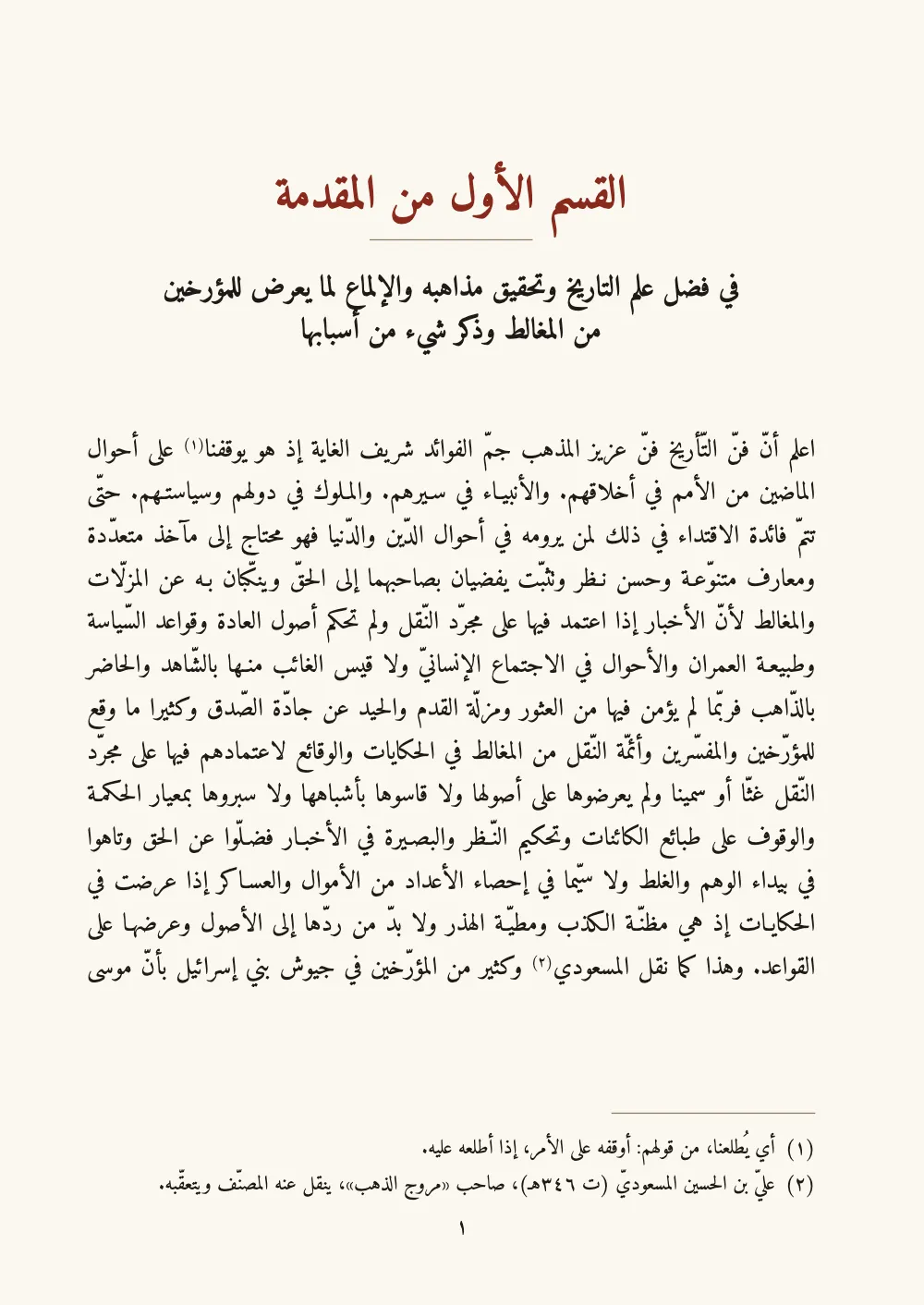
Onze pàgines d'una edició crítica àrab moderna, un taḥqīq, de la primera secció de la Muqaddima d'Ibn Khaldun, sobre l'excel·lència de la història. Els preliminars es folien amb lletres abjad, com fan les edicions del Caire i de Beirut: una portada أ, la seva pàgina de crèdits ب i la introducció de l'editor ج i د. El text torna a començar a ١ a la pàgina senar següent. Les notes de l'editor van al peu de cada pàgina, numerades (١), (٢), (٣) i reiniciades a cada pàgina, sota un filet curt a la dreta; glossen paraules rares, identifiquen les persones i els llocs que anomena Ibn Khaldun i donen la sura i el verset de cada cita de l'Alcorà. Un índex de noms tanca el llibre, ordenat com s'ordenen els índexs àrabs, sense l'article ال. Les notes i la introducció s'han escrit per a aquesta recepta.
Aquesta recepta respon a
- Com numero els preliminars d'un llibre àrab amb lletres abjad (أ، ب، ج)?
- Com numero les notes a peu de pàgina àrabs per pàgina, entre parèntesis: (١)?
La resposta curta
// The page counter starts in abjad letters: the title page is أ, its back ب, the editor's
// introduction ج and د. Before the text, two directives in the Markdown count again from 1,
// in the document's digits (١ ٢ ٣ in an `ar` document), on the next odd page:
//   :::pagebreak{parity="odd"}
//   :::numbering{format="arabic-indic" startAt=1}
// {pageNumber} prints each page's own label, so one footer and one header serve both runs.
const pageNumbering = { format: 'abjad', startAt: 1 }; // أ ب ج د هـ و ز ح…
// The editor's notes: numbered again on every page, written «(١)», raised after the word in
// the text and on the line at the head of the note. The rule over the notes and each note's
// number stand on the start side, the right, because the page runs right to left.
const footnotes = {
  numbering: 'page', markerTemplate: '({n})', noteNumberPosition: 'inline',
  fontSize: pt(10.5), lineHeight: pt(18.5), color: col('ink'), textAlign: 'justify',
  spaceAbove: pt(14), spaceBelowRule: pt(6),
  separator: { width: 0.28, lineWidth: pt(0.6), color: col('rule') },
};
Ingredients
- Funcions
- Notes a peu de pàginaEstils de numeració àrabsPreliminars en romansXifres dels números generatsText de dreta a esquerraLlibres enquadernats per la dretaFonts àrabsL'àrab com a llengua del documentEstils de títolAtributs de títolObertures dissenyadesCapçaleres i folisCapçaleres segons el tipus de pàginaÍndex analíticÍndex ordenat sense l'articleEstils de paràgrafPaleta de color semànticaExportació a PDFFonts incrustades al PDF
- També fa servir
- Color del paperSalts de pàgina i de columnaGeometria per seccióCapçaleres per seccióCapítols sense número
- Tipografia
- Amiri, Aref Ruqaa (SIL OFL 1.1)
- Recursos
- Cap: totes les imatges es dibuixen en codi
Elaboració
#1 · Dues sèries de folis i notes per pàgina
El codi és la resposta curta de dalt. page.pageNumbering comença el llibre en 'abjad', les lletres en l'ordre abjad, amb هـ per al cinc. Abans del text, dues directives reinicien el compte a la pàgina senar següent amb les xifres del document (:::numbering, Xifres i estils de numeració). Les notes porten numbering: 'page', un markerTemplate de '({n})' i noteNumberPosition: 'inline', de manera que la crida va volada al text i la nota comença amb el seu número a la línia (Notes a peu de pàgina).
#2 · Un índex que se salta l'article
// Marks in the text, `:index[المسعودي]`, `:index[الطّبريّ]{term="الطبري"}`. With
// ignoreArticle, المسعودي files under م and الطبري under ط; ابن الكلبي stays under ا.
// It is the default when the index sorts in Arabic: written out here to say so.
const index = { ignoreArticle: true, fontFamily: NASKH, fontSize: pt(11), lineHeight: pt(17),
  color: col('ink'), groups: { fontFamily: NASKH, fontWeight: 700, fontSize: pt(13),
    color: col('accent'), marginTop: pt(8) } };
const indexStyle = { id: 'index', numbered: false, toc: false, span: 'page',
  breakBefore: { enabled: true, parity: 'any' },
  layout: { layoutType: 'double', gutterWidth: mm(10) } }; // two columns under the title
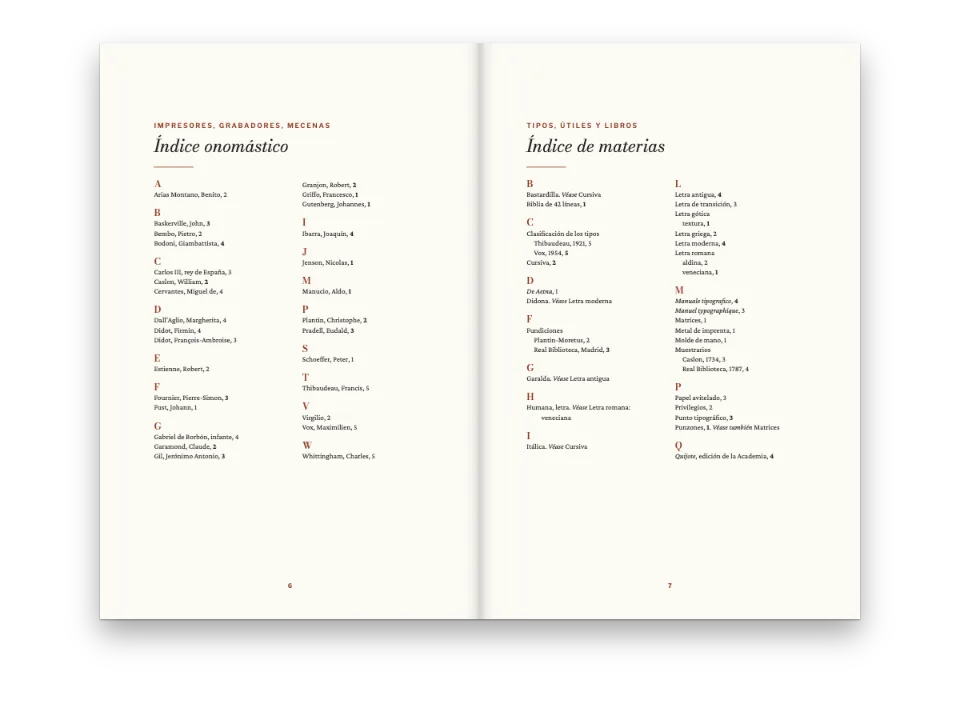
Els noms es marquen al text, :index[المسعودي], i :::index els imprimeix al final. Amb ignoreArticle, المسعودي va sota م i الطبري sota ط, mentre que ابن إسحاق es queda sota ا; una remissió porta d'إسرائيل a يعقوب (Índex general i índex analític). Els números de pàgina de l'índex són les etiquetes de les pàgines, així que un nom de la introducció remet a ج.
#3 · Capçaleres sobre un filet
// Running heads are physical. In a book bound on the right the verso (even) is the right
// page: its outer edge, the folio's, is the right one, and its text block starts INNER mm
// from the left edge; the recto (odd) mirrors it.
const HEAD_Y = 14; // mm from the trim
const blockX = (parity) => (parity === 'even' ? INNER : OUTER); // the text block's left edge
const heads = (parity, content) => [
  text(`${parity}-head`, content, NASKH, 10.5,
    { ...at('top-left', blockX(parity), HEAD_Y, 'page'), size: { width: mm(MEASURE) } },
    { color: col('muted'), parity, pages: 'body' }),
  text(`${parity}-folio`, '{pageNumber}', NASKH, 11.5, parity === 'even'
    ? at('top-right', -OUTER, HEAD_Y, 'page') : at('top-left', OUTER, HEAD_Y, 'page'),
  { parity, pages: 'body', align: parity === 'even' ? 'right' : 'left' }),
  { ...rule(`${parity}-rule`, HEAD_Y + 7, MEASURE, 'top-left', 'page', blockX(parity)),
    parity, pages: 'body' },
];
const header = { elements: [...heads('even', '{title}'), ...heads('odd', '{chapterTitle}')] };
const dropFolio = (pages) => text(`folio-${pages}`, '{pageNumber}', NASKH, 11.5,
  at('bottom', 0, -12, 'page'), { pages });
const footer = { elements: [dropFolio('opener')] }; // on the openers, under the text
// Front matter: no running heads, the abjad folio centred at the foot of every page.
const front = { id: 'front', numbered: false, toc: false,
  breakBefore: { enabled: true, parity: 'any' }, header: { elements: [] },
  footer: { elements: [dropFolio('all')] }, advancedDesign: titleOnly(22) };
La pàgina parella porta el títol del llibre i la senar la secció, sobre un filet fi de l'amplada de la caixa, amb el foli a l'extrem exterior. En un llibre enquadernat per la dreta la pàgina parella queda a la dreta, així que el seu foli va a dalt a la dreta (Ordre de les pàgines i enquadernació per la dreta). Les obertures i els preliminars porten en canvi el foli centrat al peu.
#4 · Una portada i la seva pàgina de crèdits
const onPage = (y) => at('top', 0, y, 'page');
const blind = { numbered: false, toc: false, span: 'page', runningChapter: false,
  breakBefore: { enabled: true, parity: 'any' }, header: { elements: [] },
  footer: { elements: [] } }; // blind folios: أ and ب count, but do not print
const titlePage = { id: 'title', ...blind, advancedDesign: design([
  text('book', '{attr.book}', NASKH, 14, onPage(44), { color: col('muted') }),
  rule('rule-top', 58, 40, 'top', 'page'),
  text('title', '{titleText}', RUQAA, 44, onPage(64), { fontWeight: 700,
    color: col('accent'), lineHeight: 1.3 }),
  rule('rule-foot', 92, 40, 'top', 'page'),
  text('author', 'تأليف {author}', NASKH, 15, onPage(100), { fontWeight: 700 }),
  text('years', '{attr.years}', NASKH, 12, onPage(110)),
  text('part', '{attr.part}: {subtitle}', NASKH, 13, onPage(132)),
  text('editor', '{attr.editor}', NASKH, 12, onPage(178), { color: col('accent') }),
  text('latin', '{attr.latin}', NASKH, 9.5, { ...onPage(196), size: { width: mm(110) } },
    { color: col('muted'), direction: 'ltr' }), // a Latin line: its own direction
], 0) };
const imprintPage = { id: 'imprint', ...blind, advancedDesign: design([
  text('edition', '{attr.edition}', NASKH, 11, onPage(170)),
  text('imprint', '{attr.imprint}', NASKH, 9, { ...onPage(180), size: { width: mm(100) } },
    { color: col('muted'), lineHeight: 1.45, direction: 'ltr' }),
], 0) };
La portada i la pàgina de crèdits del seu dors són estils d'encapçalament sense res al flux: les seves línies surten d'atributs del títol, així que les línies llatines dels crèdits, que canvien amb l'edició, són un atribut al Markdown.
La recepta completa
// ═══ Postext Cookbook · Nº 113 · A critical edition (taḥqīq) with notes per page ═══════
// https://postext.dev/en/cookbook/tahqiq-critical-edition
// Code: MIT · Text: Ibn Khaldūn, al-Muqaddima, ar.wikisource (PD) · Pictures: none
// Fonts: Amiri, Aref Ruqaa (SIL OFL 1.1) · Needs postext ≥ 1.25.0
import { buildDocument, withLoadedFonts, renderPageToCanvas } from 'https://esm.sh/postext';
import { renderToPdf, decompressWoff2 } from 'https://esm.sh/postext-pdf';

const LANG = 'es'; // @lang: the language of the sample document ('en' | 'es')
const RECIPE = 'tahqiq-critical-edition';

// ─── 1 · Design ─────────────────────────────────────────────────────────────
// A modern Cairo taḥqīq: black Naskh on a cream paper, headings and rules in one dark red.
const palette = {
  ink: '#1e1a16', // text and notes: a warm near-black
  accent: '#8a2a1d', // headings, the title, the index letters
  rule: '#8c7a62', // hairlines: the rule under the running heads, the rule over the notes
  muted: '#5e564c', // running heads, the imprint
  paper: '#fbf8f0', // a cream paper
};
const col = (id) => ({ hex: palette[id], model: 'hex', paletteId: id });
const colorPalette = [
  ...Object.entries(palette).map(([id, hex]) => ({ id, name: id, value: { hex, model: 'hex' } })),
  { id: 'main-color', name: 'accent (defaults)', value: { hex: palette.accent, model: 'hex' } },
];
const NASKH = 'Amiri'; // text, notes, headings in bold, running heads, index
const RUQAA = 'Aref Ruqaa'; // display: the title on the title page
const [W, H] = [170, 240]; // mm: 17 × 24 cm, the size of most Cairo and Beirut editions
const [TOP, INNER, OUTER] = [22, 20, 16]; // mm; `left` is the inner margin on both pages
const MEASURE = W - INNER - OUTER; // 134 mm
const [SIZE, LEAD] = [13, 22.5]; // pt: 1.73 ×, so the few vowels marked clear the line above

// #region answer: abjad folios for the front matter, Arabic-Indic from the text, notes (١)
// The page counter starts in abjad letters: the title page is أ, its back ب, the editor's
// introduction ج and د. Before the text, two directives in the Markdown count again from 1,
// in the document's digits (١ ٢ ٣ in an `ar` document), on the next odd page:
//   :::pagebreak{parity="odd"}
//   :::numbering{format="arabic-indic" startAt=1}
// {pageNumber} prints each page's own label, so one footer and one header serve both runs.
const pageNumbering = { format: 'abjad', startAt: 1 }; // أ ب ج د هـ و ز ح…
// The editor's notes: numbered again on every page, written «(١)», raised after the word in
// the text and on the line at the head of the note. The rule over the notes and each note's
// number stand on the start side, the right, because the page runs right to left.
const footnotes = {
  numbering: 'page', markerTemplate: '({n})', noteNumberPosition: 'inline',
  fontSize: pt(10.5), lineHeight: pt(18.5), color: col('ink'), textAlign: 'justify',
  spaceAbove: pt(14), spaceBelowRule: pt(6),
  separator: { width: 0.28, lineWidth: pt(0.6), color: col('rule') },
};
L'script.js compost funciona tal com és: enganxa'l com a script de mòdul en qualsevol pàgina o obre la recepta a CodePen. Carpeta de la recepta a GitHub ↗ (s'obre en una pestanya nova)
Variants
#Fes servir els numerals abjad
'arabic-abjad' escriu els numerals abjad additius en lloc de la sèrie simple de lletres: la pàgina onze és يا, no ك.
-const pageNumbering = { format: 'abjad', startAt: 1 }; // أ ب ج د هـ و ز ح…
+const pageNumbering = { format: 'arabic-abjad', startAt: 1 }; // … ط ي يا يب#Numera les notes al llarg de la secció
numbering: 'chapter' continua comptant les notes d'una pàgina a l'altra, com fan algunes edicions antigues.
-  numbering: 'page', markerTemplate: '({n})', noteNumberPosition: 'inline',
+ numbering: 'chapter', markerTemplate: '({n})', noteNumberPosition: 'inline',Errors freqüents
Error freqüent
Etiqueta un llibre àrab 'ar', no amb LANG
Les edicions d'una recepta són en i es, però una mostra àrab és àrab en totes dues: `locale: LANG` la compondria d'esquerra a dreta, l'enquadernaria per l'esquerra, numeraria les seves pàgines 1 2 3 i anomenaria Figure o Figura les seves figures. Des de postext 1.30 l'etiqueta és a més la llengua en què es compon el text (en què es mesura, es pinta i s'incrusta), de manera que sota una etiqueta anglesa o castellana una font com Markazi Text no dibuixa les formes àrabs de les cometes angulars i dels punts, i les línies es parteixen per un altre lloc. Escriu tu l'etiqueta: 'ar' (xifres aràbigo-índiques, la convenció del Màixriq), una regió com 'ar-EG' o 'ar-SA', o 'ar-MA', 'ar-DZ' o 'ar-TN' per a una edició magribina amb xifres europees. Una pàgina llatina que només cita àrab conserva el seu propi locale. Text de dreta a esquerra →
Error freqüent
Les fonts àrabs necessiten el seu fitxer arabic, amb el bloc arabic
Fontsource serveix Amiri, Noto Naskh Arabic o Scheherazade New en un fitxer per subconjunt, i les lletres àrabs són al fitxer arabic. loadFonts només baixa latin (i latin-ext), de manera que a la pantalla l'àrab surt d'una font del sistema i es mesura malament, i fontsourceProvider lliura al PDF aquell fitxer latin, que imprimeix caixes buides. Afegeix el bloc arabic del kit, crida loadArabicFonts(FONTS, markdown) després de loadFonts, amb tots els pesos que les pàgines fan servir en àrab llistats a FONTS, i passa a renderToPdf fontProvider: arabicPdfProvider. Fonts àrabs →
Error freqüent
:::numbering s'aplica a la pàgina següent
:::numbering canvia el compte a partir de la pàgina següent que comença, no de l'actual. Col·loca'l just després d'un :::pagebreak (amb paritat odd abans del primer capítol) perquè la numeració nova comenci on vols. Preliminars en romans →
Crèdits
- Recepta
- Ignacio Ferro
- Text
- The opening section of the Muqaddima, “On the excellence of history”, as ar.wikisource gives it (revision 610595), without its notes · Ibn Khaldūn · domini públic
- The editor’s introduction in Arabic, the notes, the index and the imprint · Postext Cookbook · original
- Fonts
- Amiri (SIL OFL 1.1) · Aref Ruqaa (SIL OFL 1.1)
- Codi
- MIT, com Postext
Editar aquest text ↗ (s'obre en una pestanya nova)Carpeta de la recepta a GitHub ↗ (s'obre en una pestanya nova)