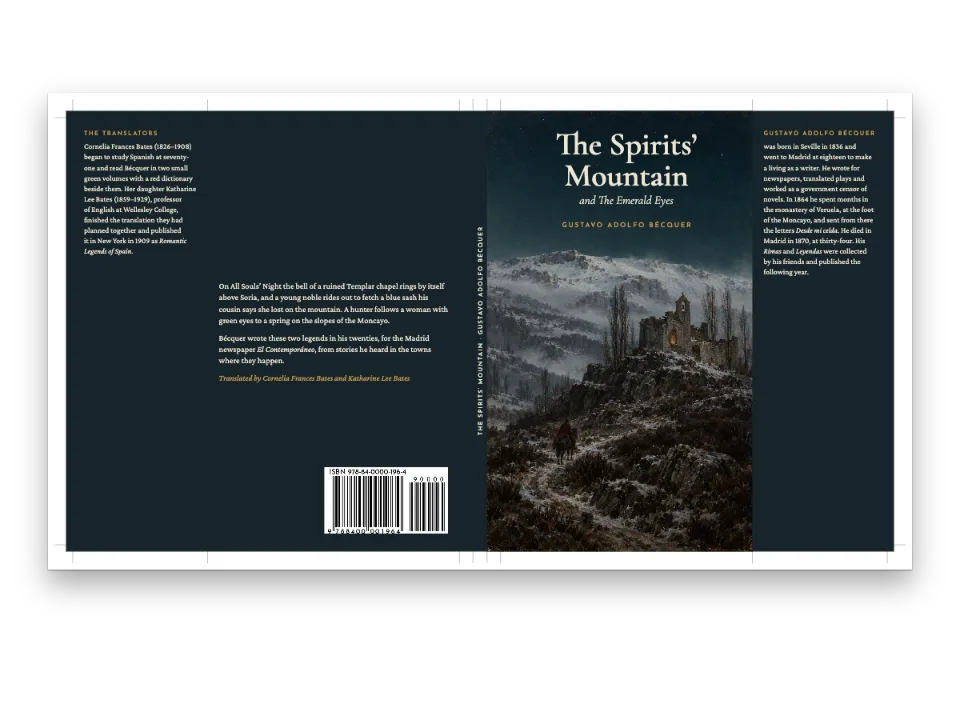
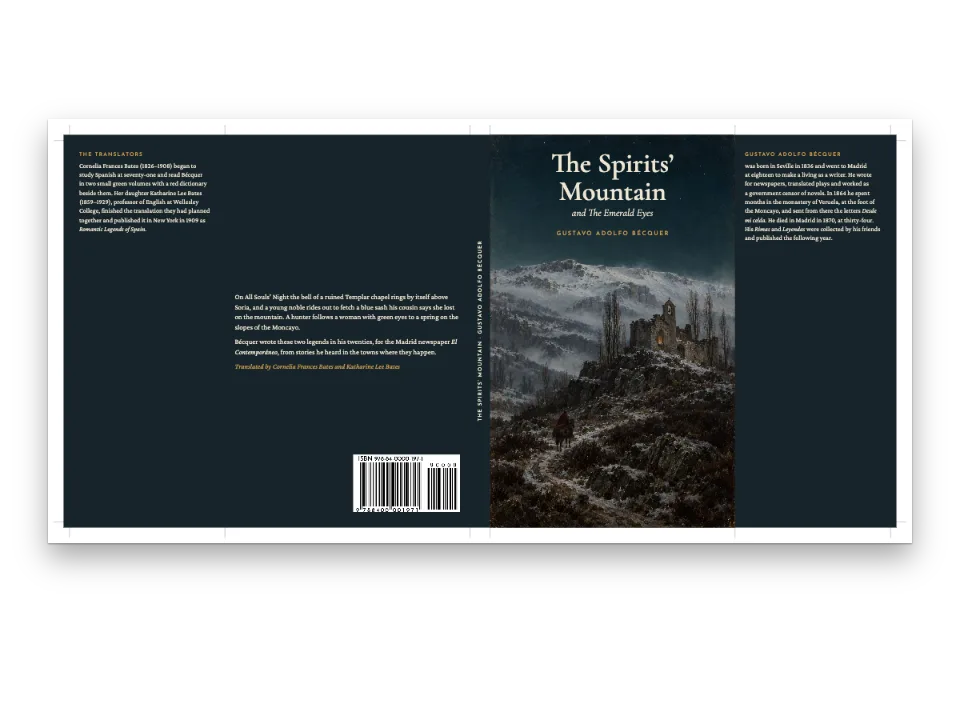
Kurz gesagt
Ein schmales Buch mit einem klassischen Gedicht und der Bogen für seinen Umschlag. Teile davon werden nach dem Druck veredelt: Glanz auf dem Bild, ein Rahmen in Goldfolie und Formen, die aus dem Karton gehoben sind.
Was Sie setzen
Jorge Manriques Coplas auf den Tod seines Vaters in Longfellows Übersetzung (die spanische Ausgabe setzt das Original) als Broschur von 125 × 200 mm, dazu der Umschlagbogen, der nach dem Vierfarbdruck in die Veredelung geht. Er bekommt drei Veredelungen. Ein partieller Glanzlack liegt über dem Bild, oberhalb und unterhalb der Kartusche. Der doppelte Rahmen der Kartusche wird in Goldfolie geprägt, das Feld darin hochgeprägt, sodass der Titel auf einer erhabenen Fläche steht. Auf der Rückseite eine Raute als Blindprägung: keine Farbe, nur der Karton angehoben. Unter dem Buch zeichnet das Rezept den Bogen viermal: wie er gedruckt wird, mit den Platten für Lack und Folie in Falschfarben, im Streiflicht und als Prägeplatte, nach der der Graveur das Werkzeug schneidet. Das PDF ist ein PDF/X-4 mit einer Platte für jede Veredelung.
Dieses Rezept beantwortet
- Wie bringe ich partiellen Lack, Folie und einen geprägten Titel auf einen Umschlag, für Druckerei und Buchbinder?
Die kurze Antwort
// A slim paperback: PUR perfect binding, the spine from the pages on 120 g/m² wove. The
// spine is under the 6 mm a spine is lettered from by default, so this version letters it
// from 4.5 mm.
const production = {
  bindings: [{ id: 'pur', name: 'PUR perfect binding', style: 'perfect', signature: 16,
    measures: { bleed: 3, spineAllowance: 0.5 } }],
  versions: [{ id: 'paperback', name: t({ en: 'Paperback', es: 'Rústica' }), binding: 'pur',
    isbn: '978-84-0000-199-5', spineText: { minSpine: 4.5 } }],
};
const folio = { paper: { type: 'bookWove', grammage: 120, bulk: 2.2, shade: '#f7f1e3' } };
const cover = {
  background: col('ground'),
  elements: [
    { id: 'art', kind: 'image', zone: 'front', x: 0, y: -3, width: 128, height: 206,
      resourceId: 'river', fit: 'cover' },
    // The title's panel, a shade darker than the ground, and the frame round it. The frame
    // prints nothing in four colours (it has the panel's colour): the foil plate carries it.
    { id: 'panel', kind: 'shape', zone: 'front', x: 14, y: 77, width: CW, height: CH,
      color: col('panel'), path: [{ closed: true, nodes: contour(0, 6) }] },
    { id: 'cartouche', kind: 'shape', zone: 'front', x: 14, y: 77, width: CW, height: CH,
      color: col('panel'), path: cartouche },
  ],
  finishes: [
    // A spot gloss over the painting above and below the panel, 4 mm clear of it, so the
    // varnish never lies on the foil. The back and the spine stay matt.
    ...[[-3, 76], [127, 76]].map(([y, height], i) => ({ id: `gloss-${i + 1}`, process: 'varnish',
      ink: col('varnish'), shape: { box: { zone: 'front', x: 0, y, width: 128, height } } })),
    // Gold foil on the frame, and the whole panel embossed: the title prints on a raised
    // field, the foil stamped round its edge.
    { id: 'gold', process: 'foil', ink: col('foil'), shape: { element: 'cartouche' } },
    { id: 'relief', process: 'emboss', shape: { element: 'panel' } },
    // A blind emboss: no ink and no foil, only the paper raised.
    { id: 'emblem', process: 'emboss', shape: { outline: emblem,
      box: { zone: 'back', x: 52.5, y: 30, width: 20, height: 20 } } },
  ],
  verticalAlign: { front: 'middle', back: 'middle' },
};
// The press file: PDF/X-4. The varnish and the foil are spot inks with a finish, each on
// its plate; the emboss goes on a plate named Emboss, beside the die line.
const print = { standard: 'pdfx4', outputProfile: 'fogra51', convertImages: false };
Zutaten
- Funktionen
- Umschlagveredelung und technische PlattenUmschlagbogenSpezialfarbenDruckausgaben, ISBN und BuchrückenUmschläge, Titelseiten und ImpressumÜberschriftenformateGestaltete AuftakteText, Linien und Kästen in SeitengestaltungenDokument-MetadatenAbsatzformateVerse Zeile für ZeileKolumnentitel und SeitenzahlenAbbildungen und Tabellen als RessourcenSemantische FarbpalettePDF-ExportPDFs in CMYK und GraustufenSeiten auf einem Canvas
- Nutzt außerdem
- Papier, Bindung, Tisch und Licht (Folio)ÜberschriftenattributePapierfarbeKopfzeilen nach SeitenrolleIm PDF eingebettete SchriftenKolumnentitel je AbschnittSonderfarben und DruckfarbentabelleKapitel ohne Nummer
- Schrift
- Alegreya, Alegreya SC, Alegreya Sans SC (SIL OFL 1.1)
- Dateien
river-1100.jpg- The cover painting: a river at sunset running to the sea below a ruined castle, in oils (Generated With Diffusion Models, eigener Text)
Zubereitung
#1 · Jede Veredelung folgt einer Form des Entwurfs
Der Code steht oben in der kurzen Antwort. Eine Veredelung nennt ein Verfahren, eine Farbe, wenn das Verfahren eine druckt, und eine Form: ein Element des Umschlags ({ element: 'cartouche' }), einen Kasten in einer seiner Zonen oder einen Umriss in einem Kasten. Lack und Folie sind Sonderfarben mit finish in der Palette; jede bekommt ihre Platte im PDF, und der Preflight führt sie auf. Die Prägung druckt nichts. Sie liegt auf einer technischen Platte, die die Druckdatei Emboss nennt, der Vorlage des Graveurs, und auf der Seite wird nichts davon gemalt.
Der Lack besteht aus zwei Kästen, einer über der Kartusche und einer darunter, die 4 mm vor ihr enden, damit der Lack nie auf der Folie liegt. Rückseite und Rücken bleiben matt. Das Buch hat 27 Seiten auf Werkdruckpapier von 120 g/m² mit Volumen 2,2, gebunden in Lagen zu 16 also 32, und das ergibt einen Rücken von 4,7 mm. Ein Rücken unter 6 mm bleibt standardmäßig unbeschriftet; die Ausgabe setzt spineText.minSpine deshalb auf 4,5. Die ISBN ist eine Beispielnummer, die keinem Buch gehört.
#2 · Die Kartusche ist ein Pfad des Entwurfs, kein Bild
// Fractions of its box, so the frame stretches with it. Two rings, each an outer contour and
// an inner one run the other way round: the hole between them stays empty, and the foil and
// the emboss take exactly this outline.
const [CW, CH] = [97, 46]; // the cartouche's box, mm
const K = 0.5523; // a quarter circle as a cubic
function contour(inset, notch) {
  const [tx, ty, rx, ry] = [inset / CW, inset / CH, (notch + inset) / CW, (notch + inset) / CH];
  // Each corner: the point on the edge before it and on the edge after it, a hollow arc
  // between them whose handles leave each edge square.
  const corners = [
    [[1 - rx, ty], [1 - tx, ry], 'h'], [[1 - tx, 1 - ry], [1 - rx, 1 - ty], 'v'],
    [[rx, 1 - ty], [tx, 1 - ry], 'h'], [[tx, ry], [rx, ty], 'v']];
  return corners.flatMap(([[ax, ay], [bx, by], edge]) => [
    { x: ax, y: ay, out: edge === 'h' ? { x: ax, y: ay + K * (by - ay) }
      : { x: ax + K * (bx - ax), y: ay } },
    { x: bx, y: by, in: edge === 'h' ? { x: bx - K * (bx - ax), y: by }
      : { x: bx, y: by - K * (by - ay) } }]);
}
const reversed = (nodes) => nodes.slice().reverse()
  .map(({ x, y, in: i, out: o }) => ({ x, y, ...(o && { in: o }), ...(i && { out: i }) }));
const ring = (outer, inner, notch) => [{ closed: true, nodes: contour(outer, notch) },
  { closed: true, nodes: reversed(contour(inner, notch)) }];
const cartouche = [...ring(0, 1.3, 6), ...ring(2.3, 2.75, 6)];
// The emblem on the back: a lozenge with a lozenge cut out of it, as a saved outline.
const lozenge = (d) => [[0.5, d], [1 - d, 0.5], [0.5, 1 - d], [d, 0.5]].map(([x, y]) => ({ x, y }));
const emblem = [lozenge(0), lozenge(0.24).reverse()];
Folie und Prägung übernehmen genau den Umriss des Elements, das sie nennen; der Rahmen muss also eine Form sein, deren Pfad die Engine kennt. Ein Umschlagpfad ist eine Liste geschlossener Konturen, deren Knoten Bruchteile des Elementkastens sind, mit Ein- und Ausgangsgriffen für Kurven. Jede Ecke ist ein nach innen gekehrter Viertelkreis, als kubische Kurve gezeichnet. Ein Ring ist eine äußere Kontur und eine innere, die andersherum läuft: Mit der Regel nonzero bleibt der Raum dazwischen leer. Zwei Ringe ergeben den doppelten Rahmen. Der Rahmen hat die Farbe des Feldes und druckt im Vierfarbsatz nichts; ihn trägt die Folienplatte. Das Emblem der Rückseite ist ein gespeicherter Umriss aus zwei Rauten, die kleinere umgekehrt.
#3 · Die Schriften des Umschlags
const style = (id, fontFamily, size, lead, color, extra) => ({ id, fontFamily, fontSize: pt(size),
  lineHeight: pt(lead), color, italicColor: color, firstLineIndent: mm(0), textAlign: 'left',
  hyphenation: false, ...extra });
const caps = (tracking) => ({ fontWeight: 700, letterSpacing: pt(tracking) });
const mid = { textAlign: 'center' };
const coverStyles = [
  style('cover-title', 'Alegreya SC', 40, 40, col('cream'), { ...mid, fontWeight: 500 }),
  style('cover-subtitle', 'Alegreya', 13, 17, col('cream'), { ...mid, italic: true }),
  style('cover-author', 'Alegreya Sans SC', 9, 12, col('ochre'), { ...mid, ...caps(1.6),
    marginTop: pt(9) }),
  style('cover-spine', 'Alegreya Sans SC', 7, 8, col('cream'), { ...mid, ...caps(1.1) }),
  style('cover-quote', 'Alegreya', 13, 17, col('ochre'), { ...mid, italic: true,
    marginBottom: pt(16) }),
  style('cover-blurb', 'Alegreya', 10.5, 14.5, col('cream'), { marginBottom: pt(7) }),
  style('cover-note', 'Alegreya Sans SC', 8, 11, col('ochre'), { ...caps(1.2),
    marginTop: pt(4) }),
];
cover-title, cover-subtitle, cover-author und cover-spine sind die Namen, die buildCover den platzierten Metadaten gibt; cover-quote, cover-blurb und cover-note werden im Markdown des Umschlags genannt. Die Vorderseite ist in der Höhe zentriert (verticalAlign), so landet der Titel in der Kartusche, wie groß seine Schrift auch ist.
#4 · Der Buchblock
const [W, H, TOP, FOOT, INNER, OUTER, LEAD] = [125, 200, 22, 24, 19, 17, 15]; // mm, pt
const at = (to, edge, x, y, size) => ({ anchor: { to, edge }, offset: { x: mm(x), y: mm(y) },
  ...(size && { size }) });
const text = (id, content, look, place) => ({ kind: 'text', id, content, align: 'center',
  overflow: 'wrap', placement: place, ...look });
const face = (fontFamily, size, color, x) => ({ fontFamily, fontSize: pt(size), color, ...x });
const label = (size, color = col('muted')) => face('Alegreya Sans SC', size, color, caps(size / 6));
const sc = (size, extra) => face('Alegreya SC', size, col('ink'), { fontWeight: 500, ...extra });
const none = { header: { elements: [] }, footer: { elements: [] }, numbered: false, toc: false };
const design = (minHeight, elements) => ({ enabled: true, minHeight: mm(minHeight),
  slot: { elements } });
const page = (parity) => ({ breakBefore: { enabled: true, parity } });
const rule = (id, y, to = 'page') => ({ kind: 'rule', id, direction: 'horizontal',
  thickness: pt(0.6), color: col('accent'), placement: at(to, 'top', 0, y, { width: mm(12) }) });
const headingStyles = [
  { ...none, id: 'half-title', advancedDesign: design(60, [
    text('t', '{title}', sc(18), at('page', 'top', 0, 64))]) },
  { ...none, ...page('odd'), id: 'title-page', advancedDesign: design(H - TOP - FOOT, [
    text('t', '{title}', sc(34), at('page', 'top', 0, 50)),
    text('s', '{subtitle}', face('Alegreya', 13, col('ink'), { italic: true }),
      at('page', 'top', 0, 66)),
    rule('r', 76),
    text('a', '{author}', label(8.5, col('accent')), at('page', 'top', 0, 81)),
    text('c', '{attr.credit}', face('Alegreya', 9.5, col('muted'), { italic: true }),
      at('page', 'top', 0, 120, { width: mm(76) })),
    text('i', '{attr.imprint}', label(7.5), at('page', 'bottom', 0, -28)),
  ]) },
  { ...none, ...page('even'), id: 'rights',
    advancedDesign: design(92, [rule('r', 86, 'container')]) },
  // The poem opens on a recto, sunk 46 mm, its title in small capitals over a short rule.
  { ...page('odd'), id: 'poem', toc: false, header: { elements: [] }, advancedDesign: design(46, [
    text('t', '{titleText}', sc(19), at('container', 'top', 0, 18)),
    text('n', '{attr.note}', face('Alegreya', 10.5, col('muted'), { italic: true }),
      at('container', 'top', 0, 28, { width: mm(80) })),
    rule('r', 38, 'container')]) },
  { ...none, ...page('odd'), id: 'colophon', advancedDesign: design(64, [
    rule('r', 56, 'container')]) },
];
const head = (id, content, parity) => text(id, content, { ...label(6.8), parity, pages: 'body' },
  at('page', 'top', 0, 11));
Schmutztitel, Titelseite, Impressum, dann das Gedicht ab einer rechten Seite, 46 mm tiefer, als Vers gesetzt, der keine Strophe auf zwei Seiten verteilt. Die lebenden Kolumnentitel tragen links den Autor und rechts den Titel. Das Kolophon schließt das Buch auf der letzten rechten Seite.
#5 · Der Bogen entsteht aus den gesetzten Seiten
const built = buildCover({ config, version: 'paperback', pages: book.pages, markdown: coverText,
  metadata: book.metadata, resources });
if (!('config' in built)) throw new Error(built.issues.map((i) => i.kind).join(', '));
// The barcode's digits name OCR-B, which no font server has: the label face sets them.
for (const [id, bytes] of Object.entries(built.files)) {
  await loadSvg(id, new TextDecoder().decode(bytes)
    .replace(/font-family="[^"]*"/g, 'font-family="Alegreya Sans SC"'));
}
const sheet = await buildDocumentWithFonts(built.content, built.config, kitFonts(FONTS));
buildCover erhält die Seiten, die Metadaten und das Markdown des Umschlags und liefert ein Dokument für buildDocumentWithFonts, dazu den Strichcode als SVG. Seine Ziffern verlangen OCR-B, das kein Schriftserver anbietet; das Rezept setzt sie daher in der schon geladenen Alegreya Sans SC.
#6 · Was jede Platte bedeckt
// 'flat' paints the inks: the foil in its colour, the varnish and the emboss not at all.
// 'map' marks the special plates in false colour over a faded sheet, 'sheen' rakes a light
// across it. The emboss plate is drawn from the page's technical plates, the outlines the
// PDF fills on its Emboss separation.
const leaf = sheet.pages[0];
const scale = 1100 / leaf.width;
const outline = (ctx, paths) => {
  ctx.beginPath();
  for (const c of paths.flat()) {
    if (c.op === 'M') ctx.moveTo(c.x, c.y);
    else if (c.op === 'L') ctx.lineTo(c.x, c.y);
    else if (c.op === 'C') ctx.bezierCurveTo(c.x1, c.y1, c.x2, c.y2, c.x, c.y);
    else if (c.op === 'Q') ctx.quadraticCurveTo(c.x1, c.y1, c.x, c.y);
    else ctx.closePath();
  }
  ctx.fill('nonzero');
};
const VIEWS = [
  ['flat', t({ en: 'As it prints', es: 'Como se imprime' })],
  ['map', t({ en: 'The varnish and foil plates', es: 'Las planchas de barniz y oro' })],
  ['sheen', t({ en: 'Under a raking light', es: 'Con luz rasante' })],
  ['emboss', t({ en: 'The Emboss plate', es: 'La plancha de gofrado' })],
];
const views = document.createElement('section');
views.id = 'finish-views';
views.style.cssText = 'display: grid; grid-template-columns: repeat(2, minmax(0, 560px)); '
  + 'gap: 18px; justify-content: center; padding: 24px max(16px, calc(50% - 520px)); color: #ddd; '
  + 'font: 14px sans-serif';
for (const [mode, name] of VIEWS) {
  const [figure, canvas, caption] = ['figure', 'canvas', 'figcaption']
    .map((tag) => document.createElement(tag));
  figure.style.margin = '0';
  canvas.style.cssText = 'display: block; width: 100%';
  canvas.setAttribute('role', 'img');
  canvas.setAttribute('aria-label', `${t({ en: 'The cover sheet', es: 'El pliego' })}: ${name}`);
  renderPageToCanvas(leaf, sheet, canvas, { scale, finishes: mode === 'emboss' ? 'flat' : mode });
  if (mode === 'emboss') {
    // The die-maker's film: the plate in black on white, the sheet faded under it.
    const ctx = canvas.getContext('2d');
    ctx.setTransform(1, 0, 0, 1, 0, 0);
    ctx.fillStyle = 'rgba(255, 255, 255, 0.86)';
    ctx.fillRect(0, 0, canvas.width, canvas.height);
    ctx.setTransform(scale, 0, 0, scale, 0, 0);
    ctx.fillStyle = '#111';
    outline(ctx, (leaf.plates ?? []).flatMap((p) => p.paths));
  }
  caption.textContent = name;
  figure.append(canvas, caption);
  views.append(figure);
}
// What the preflight reads from the sheet: its spot plates and the reliefs it checks.
const spots = preflightDocument(sheet).find((i) => i.kind === 'spotInks');
const list = document.createElement('p');
list.style.cssText = 'grid-column: 1 / -1; margin: 0; text-align: center';
list.textContent = `${t({ en: 'Plates beside CMYK', es: 'Planchas además de CMYK' })}: `
  + [...(spots?.inks ?? []), ...new Set((leaf.plates ?? [])
    .map((p) => `${p.process[0].toUpperCase()}${p.process.slice(1)}`))].join(' · ');
views.append(list);
document.getElementById('pages').before(views);
renderPageToCanvas malt Veredelungen auf drei Arten. flat malt die Farben, wie die Maschine sie legt: die Folie in ihrer Farbe, den Lack gar nicht. map blasst den Bogen ab und markiert jede Sonderplatte in Falschfarbe. sheen führt ein Streiflicht über den Bogen, in dem Lack und Folie glänzen. Die Prägung erscheint in keiner der drei, da sie nichts druckt; die vierte Ansicht zeichnet die technischen Platten der Seite (page.plates) schwarz auf den abgeblassten Bogen, die Umrisse, die das PDF auf seinem Auszug Emboss füllt. Die Zeile darunter liest die Sonderfarben aus preflightDocument und die Verfahren aus den Platten.
Das ganze Rezept
// ═══ Postext Cookbook · Nº 199 · A cover in foil, spot varnish and emboss ═══════════════
// https://postext.dev/en/cookbook/cover-foil-varnish-emboss
// Code: MIT · Text: Manrique, tr. H. W. Longfellow (public domain) · Art: diffusion models
// Fonts: Alegreya, Alegreya SC, Alegreya Sans SC (SIL OFL 1.1) · Needs postext ≥ 1.92.0
//
// Manrique's Coplas as a slim paperback whose cover goes to the finisher after the press: a
// spot gloss over the painting, a gold-foil cartouche stamped over an emboss of the same
// shape, and a blind emboss on the back. Each finish is a shape of the cover's design; the
// varnish and the foil get spot plates of their own, the emboss a plate that prints nothing.
import { buildDocumentWithFonts, renderPageToCanvas, registerResourceImage, inlineSvgFonts,
  preflightDocument } from 'https://esm.sh/postext';
import { buildCover } from 'https://esm.sh/postext/production';
import { renderToPdf, decompressWoff2 } from 'https://esm.sh/postext-pdf';

const LANG = 'en'; // @lang: the language of the sample document ('en' | 'es')
const RECIPE = 'cover-foil-varnish-emboss';

// ─── 1 · Design ─────────────────────────────────────────────────────────────
// The pages' four colours, then the cover's: a bottle-green ground and its darker panel.
const palette = { ink: '#262320', accent: '#8a3b2a', muted: '#6d655b', paper: '#fbf7ef',
  ground: '#1d2b27', panel: '#15201d', cream: '#efe5cf', ochre: '#c8a15a' };
// The two inks the finisher is asked for: spot colours that each make a plate of their own.
const spot = (hex, name, cmyk, kind) => ({ hex, model: 'spot',
  spot: { name, cmyk, finish: { kind, sheen: 'gloss' } } });
const inks = { foil: spot('#b8963e', 'Gold foil', { c: 0, m: 20, y: 60, k: 25 }, 'foil'),
  varnish: spot('#eef0e6', 'Gloss varnish', { c: 0, m: 0, y: 0, k: 0 }, 'varnish') };
const col = (id) => (inks[id] ? { ...inks[id], paletteId: id }
  : { hex: palette[id], model: 'hex', paletteId: id });
const colorPalette = [
  ...Object.entries(palette).map(([id, hex]) => ({ id, name: id, value: { hex, model: 'hex' } })),
  ...Object.entries(inks).map(([id, value]) => ({ id, name: value.spot.name, value })),
  { id: 'main-color', name: 'accent (defaults)', value: { hex: palette.accent, model: 'hex' } },
];

// #region art: the cartouche, a frame with hollow corners, drawn as a shape of the design
// Fractions of its box, so the frame stretches with it. Two rings, each an outer contour and
// an inner one run the other way round: the hole between them stays empty, and the foil and
// the emboss take exactly this outline.
const [CW, CH] = [97, 46]; // the cartouche's box, mm
const K = 0.5523; // a quarter circle as a cubic
function contour(inset, notch) {
  const [tx, ty, rx, ry] = [inset / CW, inset / CH, (notch + inset) / CW, (notch + inset) / CH];
  // Each corner: the point on the edge before it and on the edge after it, a hollow arc
  // between them whose handles leave each edge square.
  const corners = [
    [[1 - rx, ty], [1 - tx, ry], 'h'], [[1 - tx, 1 - ry], [1 - rx, 1 - ty], 'v'],
    [[rx, 1 - ty], [tx, 1 - ry], 'h'], [[tx, ry], [rx, ty], 'v']];
  return corners.flatMap(([[ax, ay], [bx, by], edge]) => [
Das zusammengesetzte script.js läuft unverändert: Fügen Sie es in das Modulskript einer beliebigen Seite ein, oder öffnen Sie das Rezept auf CodePen. Ordner des Rezepts auf GitHub ↗ (öffnet sich in einem neuen Tab)
Varianten
#Das Emblem tiefprägen
Eine Tiefprägung drückt die Form in den Karton, statt sie anzuheben, und liegt auf einer eigenen Platte Deboss.
-    { id: 'emblem', process: 'emboss', shape: { outline: emblem,
+ { id: 'emblem', process: 'deboss', shape: { outline: emblem,#Das ganze Bild lackieren
Eine einzige Veredelung auf dem Element des Bildes ersetzt die zwei Kästen. Der Lack liegt dann auch über der Kartusche und dem Titel.
-    ...[[-3, 76], [127, 76]].map(([y, height], i) => ({ id: `gloss-${i + 1}`, process: 'varnish',
-      ink: col('varnish'), shape: { box: { zone: 'front', x: 0, y, width: 128, height } } })),
+ { id: 'gloss', process: 'varnish', ink: col('varnish'), shape: { element: 'art' } },Häufige Fehler
- Eine Hoch- oder Tiefprägung näher als 3 mm am Beschnitt oder an einem Falz meldet der Preflight (
reliefTrim,reliefFold): Dort bricht der Karton. Halten Sie Prägungen von den Rückenfalzen fern. - Die Prägung wird am Bildschirm nie gemalt. Prüfen Sie sie im Auszug Emboss des PDF oder zeichnen Sie
page.plates, wie es das Rezept tut. - Eine Veredelung über einem Textrahmen verdeckt dessen Zeilen, in den Ansichten wie in der Druckdatei. Lassen Sie einen Teil des Textes frei von der Folie, wie hier den Titel in der Öffnung der Kartusche.
Nachweise
- Rezept
- Ignacio Ferro
- Text
- Coplas de Manrique, translated by Henry Wadsworth Longfellow (1833), from The Complete Poetical Works of Henry Wadsworth Longfellow (Household Edition, 1902), Project Gutenberg eBook #1365 · Jorge Manrique · gemeinfrei
- Coplas por la muerte de su padre, from the first critical edition by R. Foulché-Delbosc (1902), Project Gutenberg eBook #49333, spelling and punctuation modernised · Jorge Manrique · gemeinfrei
- Bilder
- The cover painting: a river at sunset running to the sea below a ruined castle, in oils · Generated With Diffusion Models · eigener Text
- Schriften
- Alegreya (SIL OFL 1.1) · Alegreya SC (SIL OFL 1.1) · Alegreya Sans SC (SIL OFL 1.1)
- Code
- MIT, wie Postext
Diesen Text bearbeiten ↗ (öffnet sich in einem neuen Tab)Ordner des Rezepts auf GitHub ↗ (öffnet sich in einem neuen Tab)