Kurz gesagt
Ein Pappbilderbuch für die Kleinsten. Jedes Loch in einer Seite zeigt ein Stückchen des nächsten Bilds, der Text rät mit, und beim Umblättern sieht man, was es wirklich ist.
Was Sie setzen
Kuckuck! Wer ist im Garten?, ein Pappbilderbuch mit vierzehn Seiten auf 160 mm im Quadrat, alle vier Ecken abgerundet. Jedes Bild hat ein Loch, und das Loch sitzt genau dort, wo das nächste Bild den Teil hat, der das Auge täuscht: die gestreifte Flanke einer schlafenden Katze, die ein Tiger sein könnte, die Wolle eines Schafs, die eine Wolke sein könnte, eine Laterne, die der Mond sein könnte. Das Fenster im Umschlag ist breiter als das Loch dahinter, so reicht der erste Blick zwei Seiten tief. Links fragt der Text; das Umblättern gibt die Antwort. Die Druckdatei führt die Stanzlinie auf einer eigenen Platte.
Dieses Rezept beantwortet
- Wie stanze ich Löcher in die Seiten eines Buchs, durch die man jeweils einen Teil des nächsten Bilds sieht?
- Wie gebe ich dem Stanzformenbauer die Stanzlinie auf einer eigenen Platte im PDF?
Die kurze Antwort
// Each painting is cut where the next one's telling part lies: the cat's striped flank, the
// sheep's wool, the lantern's glow. The cover's window is wider than the hedge's hole and
// holds it, so from the cover you see the hedge, and through the hedge the cat. A hole cuts
// both sides of its leaf, mirrored on the verso, and the words there run round it.
const circle = (id, name, cx, cy, d) => ({ id, name, shape: 'circle', x: mm(cx - d / 2),
  y: mm(cy - d / 2), width: mm(d), height: mm(d), wrap: { gap: mm(4) } });
const dieCuts = {
  shapes: [
    circle('window', t({ en: 'Cover window', es: 'Ventana de la cubierta' }), 112, 68, 60),
    circle('hedge', t({ en: 'Gap in the hedge', es: 'Hueco del seto' }), 112, 60, 36),
    { id: 'knot', name: t({ en: 'Knothole', es: 'Nudo de la valla' }), shape: 'ellipse',
      x: mm(102), y: mm(48), width: mm(32), height: mm(40), wrap: { gap: mm(4) } },
    circle('peephole', t({ en: 'Barn-door peephole', es: 'Mirilla del granero' }), 91, 29, 20),
  ],
  // By position in the book: page 1 is the cover, 3 the hedge, 7 the fence, 11 the door.
  pages: [{ pages: '1', die: 'window' }, { pages: '3', die: 'hedge' },
    { pages: '7', die: 'knot' }, { pages: '11', die: 'peephole' }],
  corners: { radius: mm(9), edges: 'all' }, // board books are rounded on all four corners
};
Zutaten
- Funktionen
- Gestanzte LöcherAbgerundete Ecken und Bücher in FormStanzlinie im PDFLöcher durch mehrere Blätter3D-Buchbetrachter (Folio)ÜberschriftenformateBilder in SeitengestaltungenÜberschriftenattributeAbsatzformateAnschnitt und SchnittmarkenPDFs in CMYK und GraustufenPDF-ExportAbbildungen und Tabellen als RessourcenSemantische FarbpaletteSeiten auf einem Canvas
- Nutzt außerdem
- Papier, Bindung, Tisch und Licht (Folio)Gestaltete AuftaktePapierfarbeFarben je TeilIm PDF eingebettete SchriftenAbschnittsgeometrieKapitel ohne Nummer
- Schrift
- Andika, Fredoka, Nunito (SIL OFL 1.1)
- Dateien
cat.jpgcover.jpgdoor.jpgfence.jpghedge.jpglantern.jpgsheep.jpg- Cover painting: a cottage garden, a hedge, hollyhocks and a robin (Generated With Diffusion Models, eigener Text)
- Page 3: the hedge (Generated With Diffusion Models, eigener Text)
- Page 5: the ginger cat asleep (Generated With Diffusion Models, eigener Text)
- Page 7: the wooden fence (Generated With Diffusion Models, eigener Text)
- Page 9: the sheep (Generated With Diffusion Models, eigener Text)
- Page 11: the barn door (Generated With Diffusion Models, eigener Text)
- Page 13: Grandpa and his lantern at dusk (Generated With Diffusion Models, eigener Text)
Zubereitung
#1 · Löcher dort, wo das nächste Bild sich verrät
Der Code steht in der kurzen Antwort oben. Jede Form wird von der oberen linken Ecke des Beschnitts aus gesetzt, und dieCuts.pages nennt die Seite, die sie stanzt, gezählt ab der ersten Seite des Buchs. Messen Sie das Loch an dem Bild, das es zeigt, nicht an der Seite, in die es gestanzt wird: Hecke, Zaun und Tor sind Texturen, die überall ein Loch vertragen, Katze und Laterne nicht.
#2 · Bilder im Passer mit den Löchern
// Each painting hangs from the trim and runs BLEED past it on every side, so the holes hit it
// in the same place on screen and in print. A picture's section drops the foot margin, so its
// design reaches the foot of the page; the words on the verso behind it, in the same section,
// start TOP down.
const SHEET = { width: mm(TRIM + 2 * BLEED), height: mm(TRIM + 2 * BLEED) }; // trim + bleed
const painting = { kind: 'image', id: 'painting', resourceId: '{attr.picture}', fit: 'cover',
  placement: at('page', 'top-left', -BLEED, -BLEED, SHEET) };
const full = (elements) => ({ enabled: true, minHeight: mm(TRIM - TOP), slot: { elements } });
const flush = { margins: { top: mm(TOP), bottom: mm(0), left: mm(INNER), right: mm(OUTER) } };
const title = { kind: 'text', id: 'title', content: '{titleText}', fontFamily: DISPLAY,
  fontWeight: 600, fontSize: pt(40), lineHeight: 1, color: col('accent'), align: 'left',
  placement: at('page', 'top-left', 62, 8, { width: mm(88) }) };
const headingStyles = [
  { id: 'cover', numbered: false, toc: false, ...flush, advancedDesign: full([painting, title]) },
  { id: 'picture', numbered: false, ...flush, breakBefore: { enabled: true, parity: 'odd' },
    advancedDesign: full([painting]) },
  // The back cover: the board printed dusk blue (the section's palette), the type in cream.
  { id: 'back', numbered: false, toc: false, breakBefore: { enabled: true, parity: 'even' },
    color: col('cream'), palette: { paper: palette.dusk } },
];
Die Löcher stehen in Millimetern ab dem Beschnitt, also hängt jedes Bild am Beschnitt und läuft auf allen Seiten um den Anschnitt darüber hinaus, am Bildschirm wie im Druck. Der Bildstil nimmt nur den unteren Rand weg: der Entwurf reicht bis zum Fuß der Seite, und der Text auf der Rückseite behält seinen oberen Rand von 44 mm, der ihn unter die Oberkante der kleinen Löcher setzt.
#3 · Die Stanzlinie auf ihrer Platte
  // The die line is stroked on a Separation plate of its own ('Die'), overprinting, that the
  // press never inks. PDF/X-4 on coated stock: the board is printed on coated paper.
  print: { standard: 'pdfx4', outputProfile: 'fogra51', convertImages: false,
    dieLine: { output: 'page', ink: 'Die', width: pt(0.5) } },
Das PDF druckt jede Seite ganz und zieht den Umriss jedes Lochs und jedes abgerundeten Blatts auf einer Separation Die nach, die überdruckt und nie eingefärbt wird. convertImages: false lässt die Bilder als RGB-JPEGs mit sRGB-Profil, was PDF/X-4 erlaubt, und die Datei bleibt klein.
#4 · Das Buch in der Hand
  folio: {
    tilt: 50, yaw: -32,
    paper: { type: 'board', shade: '#fbf5e8' },
    binding: { type: 'hardcover', cover: 'pages', coverMaterial: 'paper' },
    surface: { type: 'oak' },
    lighting: { environment: 'daylight', intensity: 1.05 },
  },
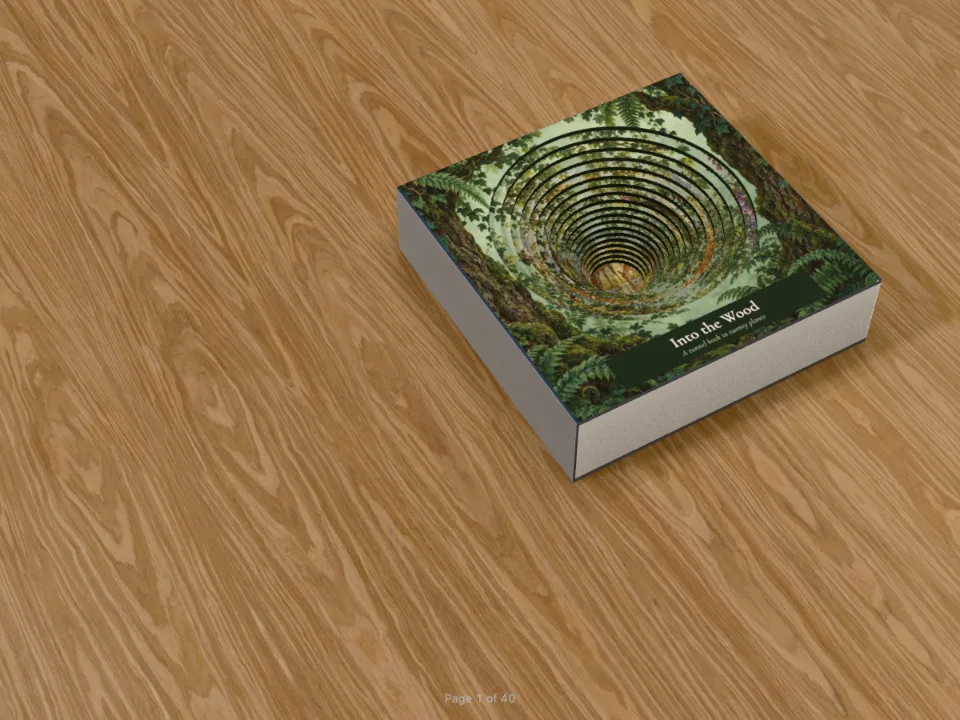
Folio stanzt die Löcher durch jedes Blatt und zeigt die Seiten darunter mit den Wänden des Schnitts, so liest sich das gestufte Fenster als Tiefe. Die Pappe blättert steif, und die runden Ecken sind an jedem Blatt geschnitten.
#5 · Flache Seiten mit Durchblick
// renderPageToCanvas cuts the holes; `beneath` hands it the pages under them, painted here
// at a lower scale (the composite stretches them to the page), each with its own holes.
const under = new Map();
const beneath = (i) => {
  if (!under.has(i) && doc.pages[i]) {
    const canvas = document.createElement('canvas');
    under.set(i, canvas);
    renderPageToCanvas(doc.pages[i], doc, canvas, { scale: 1, beneath });
  }
  return under.get(i);
};
Auf dem Canvas zeigt ein Loch, was hinter dem Canvas liegt, solange der Renderer die Seiten darunter nicht bekommt. beneath gibt sie nach Index zurück, jede mit ihren eigenen Löchern gemalt: so zeigt der Umschlag die Hecke und durch die Hecke die Katze.
Das ganze Rezept
// ═══ Postext Cookbook · Nº 193 · A peek-a-boo board book with holes in register ════════
// https://postext.dev/en/cookbook/peek-a-boo-board-book
// Code: MIT · Text: original (CC BY 4.0) · Paintings: generated with diffusion models
// Fonts: Andika, Fredoka, Nunito (SIL OFL 1.1) · Needs postext ≥ 1.84.0
//
// A fourteen-page board book for toddlers: on every other recto a hole is cut through the
// painting, and what shows through it is a scrap of the next picture. The words on the left
// make a guess from the scrap; the turned page shows what it really is. The leaves have
// rounded corners, the holes step down from the cover, and the PDF carries the die line.
import {
  buildDocumentWithFonts, renderPageToCanvas, registerResourceImage,
} from 'https://esm.sh/postext';
import { renderToPdf, decompressWoff2 } from 'https://esm.sh/postext-pdf';
import { createFolioFromDocument } from 'https://esm.sh/postext-folio';

const LANG = 'en'; // @lang: the language of the sample document ('en' | 'es')
const RECIPE = 'peek-a-boo-board-book';

// ─── 1 · Design ─────────────────────────────────────────────────────────────
// #region palette: a cream board, a robin red for the title and the guesses, a dusk blue
const palette = {
  ink: '#2a2420', // text: a warm near-black
  accent: '#b8432c', // the cover title and the guesses: the robin's breast
  paper: '#fbf5e8', // the board the words are printed on
  dusk: '#253a63', // the back cover, the blue of the last painting's sky
  cream: '#fff9ec', // type on the cover and the back
  muted: '#7a6f64', // the colophon
};
const col = (id) => ({ hex: palette[id], model: 'hex', paletteId: id });
const colorPalette = [
  ...Object.entries(palette).map(([id, hex]) => ({ id, name: id, value: { hex, model: 'hex' } })),
  { id: 'main-color', name: 'accent (defaults)', value: { hex: palette.accent, model: 'hex' } },
];
// #endregion
const [TRIM, BLEED] = [160, 3]; // mm: a square board book, and its bleed
const [TOP, FOOT, INNER, OUTER] = [44, 16, 18, 16]; // the words sit low, under the holes' tops
const [TEXT, DISPLAY, LABEL] = ['Andika', 'Fredoka', 'Nunito'];
const LEAD = 31; // pt: 24 pt type on a generous leading, for reading aloud
const at = (to, edge, x = 0, y = 0, size) => ({ anchor: { to, edge },
  offset: { x: mm(x), y: mm(y) }, ...(size && { size }) });

// #region answer: the dies, and the pages they cut
// Each painting is cut where the next one's telling part lies: the cat's striped flank, the
// sheep's wool, the lantern's glow. The cover's window is wider than the hedge's hole and
// holds it, so from the cover you see the hedge, and through the hedge the cat. A hole cuts
// both sides of its leaf, mirrored on the verso, and the words there run round it.
const circle = (id, name, cx, cy, d) => ({ id, name, shape: 'circle', x: mm(cx - d / 2),
  y: mm(cy - d / 2), width: mm(d), height: mm(d), wrap: { gap: mm(4) } });
Das zusammengesetzte script.js läuft unverändert: Fügen Sie es in das Modulskript einer beliebigen Seite ein, oder öffnen Sie das Rezept auf CodePen. Ordner des Rezepts auf GitHub ↗ (öffnet sich in einem neuen Tab)
Varianten
#Nur die Ecken am Vorderschnitt runden
Ein Bilderbuch rundet die beiden Ecken fern vom Rücken und lässt den Rücken rechtwinklig.
-  corners: { radius: mm(9), edges: 'all' }, // board books are rounded on all four corners
+ corners: { radius: mm(6), edges: 'fore' },#Jedes Blatt in eine Form schneiden
Ein Umriss in viewBox-Einheiten schneidet jedes Blatt, auf den Rückseiten gespiegelt; er geht den Ecken vor.
   corners: { radius: mm(9), edges: 'all' }, // board books are rounded on all four corners
+ outline: { d: 'M0 0.35 L0.5 0 L1 0.35 L1 1 L0 1 Z', viewBox: [1, 1] }, // a houseNachweise
- Rezept
- Ignacio Ferro
- Text
- The words of the board book · Postext Cookbook · CC BY 4.0
- Bilder
- Cover painting: a cottage garden, a hedge, hollyhocks and a robin · Generated With Diffusion Models · eigener Text
- Page 3: the hedge · Generated With Diffusion Models · eigener Text
- Page 5: the ginger cat asleep · Generated With Diffusion Models · eigener Text
- Page 7: the wooden fence · Generated With Diffusion Models · eigener Text
- Page 9: the sheep · Generated With Diffusion Models · eigener Text
- Page 11: the barn door · Generated With Diffusion Models · eigener Text
- Page 13: Grandpa and his lantern at dusk · Generated With Diffusion Models · eigener Text
- Schriften
- Andika (SIL OFL 1.1) · Fredoka (SIL OFL 1.1) · Nunito (SIL OFL 1.1)
- Code
- MIT, wie Postext
Diesen Text bearbeiten ↗ (öffnet sich in einem neuen Tab)Ordner des Rezepts auf GitHub ↗ (öffnet sich in einem neuen Tab)