Lo que vas a componer
Cuatro páginas del centro de una edición de lectura del Diccionario de Kangxi (康熙字典, 1716), reordenado por pinyin, de 天 tiān a 庭 tíng. Cada lema va en rojo, en la song supernegra, con su pinyin encima; las lecturas de los diccionarios de rimas (反切) y las acepciones lo siguen en un solo párrafo, con las acepciones numeradas ① ② en el mismo rojo. La página es un 大32开 de 140 × 203 mm, a dos columnas de 17 caracteres de 小五 (9 pt), sobre una retícula de 31 líneas, y cada columna llega a su última línea. En la esquina exterior de cada página, la cabecera nombra el primer y el último lema que hay en ella, así que quien busca 蜩 va a la página que lleva 腆—髫. Para compararlo con un diccionario en alfabeto latino, mira el vocabulario marinero de Smyth.
Esta receta responde a
- ¿Cómo imprimo en la cabecera de un diccionario el primer y el último lema de cada página?
- ¿Cómo pongo pinyin sobre los caracteres chinos?
- ¿Cómo llevo los caracteres chinos al PDF sin cajas vacías?
La respuesta corta
// Each headword is a level-2 heading, '## {天|tiān}'. {firstMark.h2} prints the text of the
// first one that starts on the page, without its reading, and {lastMark.h2} the last; a
// page on which none starts repeats the one in force. They stand at the outer corner, the
// folio outside them, over a hairline as wide as the type area.
const HEAD_Y = 11; // mm from the top edge to the top of the guide words
const [GUIDE, FOLIO] = [10.5, 8]; // pt
const head = (id, content, parity, x, size, extra) => ({ kind: 'text', id, content, parity,
  fontFamily: HEI, fontWeight: 700, fontSize: pt(size), lineHeight: 1, color: col('ink'),
  // A design line puts its baseline 0.8 of its height down: the folio drops to share it.
  placement: { anchor: { to: 'page', edge: parity === 'even' ? 'top-left' : 'top-right' },
    offset: { x: mm(parity === 'even' ? x : -x), y: mm(HEAD_Y + 0.8 * (GUIDE - size) * PT) } },
  ...extra });
const folio = { color: col('muted') };
const guideWords = [
  head('verso-folio', '{pageNumber}', 'even', SIDE, FOLIO, folio),
  head('verso-guide', '{firstMark.h2}—{lastMark.h2}', 'even', SIDE + 8, GUIDE),
  head('recto-guide', '{firstMark.h2}—{lastMark.h2}', 'odd', SIDE + 8, GUIDE),
  head('recto-folio', '{pageNumber}', 'odd', SIDE, FOLIO, folio),
  { kind: 'rule', id: 'hairline', direction: 'horizontal', thickness: pt(0.5), color: col('ink'),
    placement: { anchor: { to: 'page', edge: 'top-left' },
      offset: { x: mm(SIDE), y: mm(HEAD_Y + 5.5) }, size: { width: mm(AREA.width) } } },
];
Ingredientes
- Funciones
- Palabras guía en la cabeceraRuby: lecturas en pinyin y zhuyinRetícula de caracteresUna o dos columnasFilete de columnaEquilibrado de columnasFuentes chinas, japonesas y coreanasCorte de líneas en chinoAnchura de la puntuación chinaJustificación entre caracteresCabeceras y foliosBandas a sangre y pestañasAnclaje de elementos de diseñoNegrita, cursiva y sus coloresEstilos de párrafoMárgenes simétricosPaleta de color semánticaExportación a PDF
- También usa
- Color del papelFuentes incrustadas en el PDF
- Tipografía
- Noto Serif TC, Noto Sans TC, LXGW WenKai TC (SIL OFL 1.1)
- Recursos
- Ninguno: todas las imágenes se dibujan en código
Elaboración
#1 · Las palabras guía salen de los lemas
El código es la respuesta corta de arriba. Cada lema es un título de segundo nivel, y {firstMark.h2} y {lastMark.h2} imprimen el texto del primer y del último título de ese nivel que empiezan en la página (elementos de texto). La marca son los caracteres del título: ## {天|tiān} marca 天, y la lectura se queda sobre el lema. Una entrada que pasa de una página a la siguiente solo cuenta donde está su lema: la página 635 empieza con el final de 殄 y lleva 腆—髫. El primer nivel queda para las letras; en estas cuatro páginas no empieza ninguna, pero la cabecera de una letra no contaría como palabra guía.
#2 · El pinyin sobre el lema
// A heading with no design of its own keeps its reading: '## {天|tiān}' sets tiān over 天.
// Two grid lines hold the headword and a 7.5 pt reading, so every entry stays on the grid.
// A Latin reading stands clear of its base by its descenders: the g of tīng stays off 汀.
const cjk = {
  grid: { enabled: true, charsPerLine: CHARS, linesPerPage: LINES },
  // The regular Song, not the heading's Black: a reading takes the face of its base.
  ruby: { fontFamily: SONG, fontSize: em(0.5), color: col('cinnabar') },
};
const headword = { level: 2, fontSize: pt(15), lineHeight: pt(2 * LEAD), marginTop: pt(0),
  marginBottom: pt(0) };
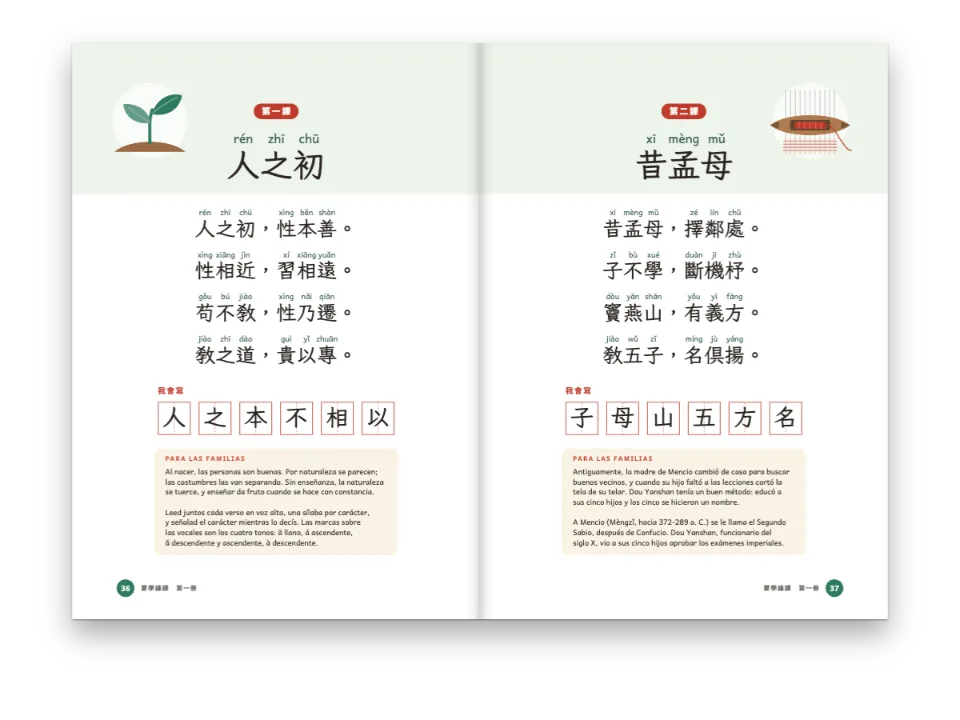
{天|tiān} es la forma corta de :ruby[天]{rt="tiān"}, una lectura sobre un carácter (marcas chinas, ruby y warichu). Un título sin diseño propio compone su lectura; con un diseño, el título imprimiría 天 solo. La lectura toma la fuente del título, la supernegra, salvo que cjk.ruby.fontFamily nombre otra, y por eso se nombra la song regular. La mitad de 15 pt son 7,5 pt, y la línea de 30 pt del título deja sitio para la lectura sobre el lema: el título ocupa dos líneas de la retícula y el texto que va debajo sigue en las líneas de 15 pt de las dos columnas. El pinyin sube lo que bajan los rasgos descendentes de su fuente y 0,04 em más, así que la g de tīng acaba 0,6 pt por encima de la caja de 汀.
#3 · Un párrafo para cada entrada
// As the Kangxi Dictionary sets an entry: the rhyme-book readings (反切), then the senses
// run in, each after its number. '**②**' marks a number, and the text prints its bold in
// cinnabar: the only bold on these pages. A word joiner (U+2060, invisible) follows each
// number in the Markdown: no line ends on a number, away from the sense it opens.
const bodyText = { fontFamily: SONG, fontSize: pt(BODY), lineHeight: pt(LEAD), color: col('ink'),
  boldColor: col('cinnabar'), italicColor: col('ink'), referenceColor: col('ink'),
  textAlign: 'justify', firstLineIndent: pt(0) }; // no indent: the headword opens the entry
El Diccionario de Kangxi compone cada entrada seguida: primero las lecturas de los diccionarios de rimas y después cada acepción, introducida por 又. Aquí el 又 se ha cambiado por números en círculo, escritos como **②**, y boldColor los imprime en el rojo de los lemas; no hay otra negrita en el texto. Una acepción que el Kangxi lee de otro modo conserva su lectura, como 跳 ② con 徒刀切. El compositor trata ① a ⑳ como letras latinas, así que una línea podría acabar en un número cuya acepción empieza en la línea siguiente: el unidor de palabras (U+2060) escrita después de cada número lo impide, y de paso quita el espacio entre chino y latín. El equilibrado de columnas está desactivado (headings.balancing.enabled: false): ninguna columna abre espacio sobre sus lemas y cada entrada sigue a la anterior a la misma distancia.
#4 · La pestaña de la T
const INITIALS = 'ABCDEFGHJKLMNOPQRSTWXYZ'; // no pinyin syllable starts with I, U or V
const STEP = AREA.height / INITIALS.length; // mm: 7.13, the 23 tabs fill the type area's height
const tab = (parity) => {
  const edge = parity === 'odd' ? 'top-right' : 'top-left'; // the fore-edge
  const at = (x, width) => ({ anchor: { to: 'page', edge },
    offset: { x: mm(parity === 'odd' ? x : -x), y: mm(TOP + INITIALS.indexOf('T') * STEP + 0.3) },
    size: { width: mm(width), height: mm(STEP - 0.6) } });
  // 6 mm inside the trim and 3 mm past it: the page cuts the tab square at the fore-edge
  // (a print file with cutLines prints the 3 mm in its bleed); the letter on the 6 mm.
  return [
    { kind: 'box', id: `tab-${parity}`, parity, placement: at(3, 9),
      style: { backgroundColor: col('cinnabar'), borderRadius: mm(1.2) } },
    { kind: 'text', id: `tab-letter-${parity}`, parity, content: 'T', fontFamily: HEI,
      fontWeight: 700, fontSize: pt(9), lineHeight: 1, color: col('paper'), align: 'center',
      verticalAlign: 'middle', placement: at(0, 6) },
  ];
};
Las sílabas del pinyin empiezan por 23 de las 26 letras (ninguna por I, U o V), así que la altura de la caja se divide en 23 pasos de 7,13 mm, y a la T le toca el decimonoveno. La pestaña mide 9 mm y empieza 3 mm fuera del corte, de modo que la página la corta en recto por el borde exterior y solo se ven redondeadas sus esquinas interiores; un archivo para imprenta con page.cutLines llevaría esos 3 mm a la sangre. La letra se centra en los 6 mm que quedan dentro. Las cuatro páginas son de la T, de modo que la pestaña no cambia de altura; en el vocabulario de Smyth baja por el corte de una letra a la siguiente.
#5 · Cada fuente carga sus propios caracteres
// Fontsource cuts a Chinese face into about a hundred files (gotcha: cjk-fonts-slices).
// The regular Song sets the whole sample; each other voice gets only its own text.
const all = (re) => [...markdown.matchAll(re)].map((m) => m[1]).join('');
const heads = all(/^## \{(.+?)\|/gm);
await loadFonts(FONTS, markdown);
await loadCjkFonts({ [SONG]: ['400'] }, markdown);
await loadCjkFonts({ [SONG]: ['700'] }, all(/\*\*(.+?)\*\*/g));
await loadCjkFonts({ [SONG]: ['900'] }, heads);
await loadCjkFonts({ [HEI]: ['700'] }, `${heads}—0123456789T`);
await loadCjkFonts({ [KAI]: ['400'] }, all(/style="colophon-zh"\}\n(.+)\n/g));
Fontsource corta cada fuente china en un centenar de archivos por intervalos de caracteres, y loadCjkFonts carga los que contienen el texto que recibe. La song regular recibe toda la muestra, también el texto en español del colofón. La supernegra, los treinta lemas; la negrita, los números de acepción; la hei, los lemas y las cifras de las cabeceras, y la kai, la frase en chino del colofón. cjkPdfProvider incrusta esos mismos archivos en el PDF, cada uno reducido a los caracteres que usan sus páginas.
La receta completa
// ═══ Postext Cookbook · Nº 086 · A Chinese dictionary page with guide words ═════════ // https://postext.dev/en/cookbook/chinese-dictionary-page // Code: MIT · Text: 康熙字典 (1716), Wikisource transcription, CC BY-SA 4.0 · Pinyin: CC BY 4.0 // Fonts: Noto Serif TC, Noto Sans TC, LXGW WenKai TC (SIL OFL 1.1) · Needs postext ≥ 1.9.0 import { buildDocument, renderPageToCanvas, clearMeasurementCache } from 'https://esm.sh/postext'; import { renderToPdf, decompressWoff2 } from 'https://esm.sh/postext-pdf'; const LANG = 'es'; // @lang: the language of the sample document ('en' | 'es') const RECIPE = 'chinese-dictionary-page'; // ─── 1 · Design ───────────────────────────────────────────────────────────── // #region palette: black and one cinnabar, the second ink of a two-colour dictionary const palette = { ink: '#1f1b17', // text, guide words cinnabar: '#a52f28', // headwords, their readings, sense numbers, the thumb tab rule: '#bab2a4', // the column rule muted: '#5c554d', // folios, colophon paper: '#fbf8f2', // the page, and the letter reversed out of the tab }; const col = (id) => ({ hex: palette[id], model: 'hex', paletteId: id }); // The engine's defaults link to 'main-color': point it at the cinnabar. const colorPalette = Object.entries({ ...palette, 'main-color': palette.cinnabar }) .map(([id, hex]) => ({ id, name: id, value: { hex, model: 'hex' } })); // #endregion const [SONG, HEI, KAI] = ['Noto Serif TC', 'Noto Sans TC', 'LXGW WenKai TC']; const PT = 25.4 / 72; // mm in a point const [BODY, LEAD] = [9, 15]; // pt: 小五 on a 15 pt line, the grid both columns share const [CHARS, LINES] = [17, 31]; // characters to a column's line, lines to a column const TRIM = { width: 140, height: 203 }; // mm: 大32开 const MIN = { top: 20, bottom: 16, side: 12 }; // mm: minimums the grid grows to centre the area // The type area the grid sets (two columns and a 2-em gutter) and the margins it leaves. const AREA = { width: (2 * CHARS + 2) * BODY * PT, height: LINES * LEAD * PT }; // 114.3 × 164 const SIDE = (TRIM.width - AREA.width) / 2; // 12.85 mm const TOP = MIN.top + (TRIM.height - MIN.top - MIN.bottom - AREA.height) / 2; // 21.5 mm // #region answer: the first and the last headword of each page in its running head // Each headword is a level-2 heading, '## {天|tiān}'. {firstMark.h2} prints the text of the // first one that starts on the page, without its reading, and {lastMark.h2} the last; a // page on which none starts repeats the one in force. They stand at the outer corner, the // folio outside them, over a hairline as wide as the type area. const HEAD_Y = 11; // mm from the top edge to the top of the guide words const [GUIDE, FOLIO] = [10.5, 8]; // pt const head = (id, content, parity, x, size, extra) => ({ kind: 'text', id, content, parity, fontFamily: HEI, fontWeight: 700, fontSize: pt(size), lineHeight: 1, color: col('ink'), // A design line puts its baseline 0.8 of its height down: the folio drops to share it. placement: { anchor: { to: 'page', edge: parity === 'even' ? 'top-left' : 'top-right' }, offset: { x: mm(parity === 'even' ? x : -x), y: mm(HEAD_Y + 0.8 * (GUIDE - size) * PT) } }, ...extra }); const folio = { color: col('muted') }; const guideWords = [ head('verso-folio', '{pageNumber}', 'even', SIDE, FOLIO, folio), head('verso-guide', '{firstMark.h2}—{lastMark.h2}', 'even', SIDE + 8, GUIDE), head('recto-guide', '{firstMark.h2}—{lastMark.h2}', 'odd', SIDE + 8, GUIDE), head('recto-folio', '{pageNumber}', 'odd', SIDE, FOLIO, folio), { kind: 'rule', id: 'hairline', direction: 'horizontal', thickness: pt(0.5), color: col('ink'), placement: { anchor: { to: 'page', edge: 'top-left' }, offset: { x: mm(SIDE), y: mm(HEAD_Y + 5.5) }, size: { width: mm(AREA.width) } } }, ]; // #endregion // #region tab: the initial T on the fore-edge, 19th of the 23 that start a pinyin syllable const INITIALS = 'ABCDEFGHJKLMNOPQRSTWXYZ'; // no pinyin syllable starts with I, U or V const STEP = AREA.height / INITIALS.length; // mm: 7.13, the 23 tabs fill the type area's height const tab = (parity) => { const edge = parity === 'odd' ? 'top-right' : 'top-left'; // the fore-edge const at = (x, width) => ({ anchor: { to: 'page', edge }, offset: { x: mm(parity === 'odd' ? x : -x), y: mm(TOP + INITIALS.indexOf('T') * STEP + 0.3) }, size: { width: mm(width), height: mm(STEP - 0.6) } }); // 6 mm inside the trim and 3 mm past it: the page cuts the tab square at the fore-edge // (a print file with cutLines prints the 3 mm in its bleed); the letter on the 6 mm. return [ { kind: 'box', id: `tab-${parity}`, parity, placement: at(3, 9), style: { backgroundColor: col('cinnabar'), borderRadius: mm(1.2) } }, { kind: 'text', id: `tab-letter-${parity}`, parity, content: 'T', fontFamily: HEI, fontWeight: 700, fontSize: pt(9), lineHeight: 1, color: col('paper'), align: 'center', verticalAlign: 'middle', placement: at(0, 6) }, ]; }; // #endregion // #region headwords: 15 pt Song Black in cinnabar, the pinyin over it in the line gap // A heading with no design of its own keeps its reading: '## {天|tiān}' sets tiān over 天. // Two grid lines hold the headword and a 7.5 pt reading, so every entry stays on the grid. // A Latin reading stands clear of its base by its descenders: the g of tīng stays off 汀. const cjk = { grid: { enabled: true, charsPerLine: CHARS, linesPerPage: LINES }, // The regular Song, not the heading's Black: a reading takes the face of its base. ruby: { fontFamily: SONG, fontSize: em(0.5), color: col('cinnabar') }, }; const headword = { level: 2, fontSize: pt(15), lineHeight: pt(2 * LEAD), marginTop: pt(0), marginBottom: pt(0) }; // #endregion // #region senses: one paragraph to an entry, the sense numbers ① ② in cinnabar // As the Kangxi Dictionary sets an entry: the rhyme-book readings (反切), then the senses // run in, each after its number. '**②**' marks a number, and the text prints its bold in // cinnabar: the only bold on these pages. A word joiner (U+2060, invisible) follows each // number in the Markdown: no line ends on a number, away from the sense it opens. const bodyText = { fontFamily: SONG, fontSize: pt(BODY), lineHeight: pt(LEAD), color: col('ink'), boldColor: col('cinnabar'), italicColor: col('ink'), referenceColor: col('ink'), textAlign: 'justify', firstLineIndent: pt(0) }; // no indent: the headword opens the entry // #endregion // The colophon: a sentence of Chinese in the Kai, then the credits in the Song's Latin letters. const colophon = { fontSize: pt(7.5), lineHeight: pt(11), color: col('muted'), firstLineIndent: pt(0), textAlign: 'left' }; const paragraphStyles = [ { id: 'colophon-zh', ...colophon, fontFamily: KAI, marginTop: pt(LEAD) }, { id: 'colophon', ...colophon, fontFamily: SONG, marginTop: pt(3) }, ]; const config = () => ({ // a factory: the engine caches resolved configs per object // Taiwan's rules: full-width punctuation, centred in Noto Serif TC, and the basic // line breaking. Written out, never LANG (gotcha: cjk-locale-tag). locale: 'zh-Hant', colorPalette, page: { width: mm(TRIM.width), height: mm(TRIM.height), dpi: 150, backgroundColor: col('paper'), margins: { top: mm(MIN.top), bottom: mm(MIN.bottom), left: mm(MIN.side), right: mm(MIN.side), mirror: true } }, layout: { layoutType: 'double', gutterWidth: pt(2 * BODY), columnRule: { enabled: true, color: col('rule'), lineWidth: pt(0.4) } }, cjk, bodyText, headings: { fontFamily: SONG, fontWeight: 900, color: col('cinnabar'), textAlign: 'left', // Every entry follows the one before with no line between them. Column balancing would // open lines above some headwords to bring a short column down to the foot; off, a column // that cannot take the next headword and two lines of its text ends short instead. balancing: { enabled: false }, levels: [ // No letter opens in these pages; restated all the same, since any headings object // drops the H1 break (gotcha: headings-drop-h1-break). { level: 1, breakBefore: { enabled: true, parity: 'any' } }, headword, ] }, paragraphStyles, header: { elements: [...guideWords, ...tab('even'), ...tab('odd')] }, footer: { elements: [] }, }); // ─── 2 · Content ──────────────────────────────────────────────────────────── const markdown = String.raw`---Muestra en Markdown · 130 líneas · content.es.md
title: "康熙字典選讀" --- ## {天|tiān} 《唐韻》《正韻》他前切,《集韻》《韻會》他年切。**①**《說文》顛也。至高在上,从一大也。《易·說卦》乾為天。**②**星名。《爾雅·釋天》天根,氐也。**③**地名。《蜀地志》蜀邛僰山後四野,無晴日,曰漏天。《杜甫詩》地近漏天終歲雨。**④**姓。漢長社令天高,見《姓苑》。 ## {添|tiān} 《唐韻》《集韻》《韻會》《正韻》並他兼切,音沾。**①**《玉篇》益也。**②**《集韻》他念切,味益也。**③**《李翊俗名小錄》呼下酒具為添。 ## {田|tián} 《唐韻》待年切,《集韻》《韻會》《正韻》亭年切,並音闐。**①**《說文》陳也。樹穀曰田,象四口。十,阡陌之制也。《正韻》土已耕曰田。《易·乾卦》見龍在田。**②**獵也,與畋、佃通。《易·恆卦》田无禽。《詩·鄭風》叔于田。**③**姓。《五音集韻》出北平,敬仲自陳適齊,後改田氏。《史記·田敬仲完世家註》敬仲奔齊,以陳田二字聲相近,遂為田氏。**④**鼓名。《詩·周頌》應田縣鼓。《傳》田,大鼓也。**⑤**蓮葉貌。《江南曲》江南可採蓮,蓮葉何田田。 ## {恬|tián} 《唐韻》《集韻》《韻會》《正韻》並徒兼切,音甜。**①**《說文》安也。从心,甜省聲。《書·梓材》引養引恬。**②**靜也。《莊子·繕性篇》以恬養志。 ## {填|tián} 《廣韻》徒年切,《集韻》《韻會》《正韻》亭年切,並音田。**①**《說文》塞也。《博物志》炎帝女溺死東海中,化為鳥,曰精衛,常取西山之木石,以填東海。**②**鼓聲。《孟子》填然鼓之。 ## {闐|tián} 《唐韻》待年切,《集韻》《韻會》《正韻》亭年切,並音田。**①**《說文》盛也。**②**《博雅》闐闐,聲也。《詩·小雅》振旅闐闐。《左思·蜀都賦》車馬雷駭,轟轟闐闐。**③**《增韻》滿也。《史記·汲鄭傳》始翟公為廷尉,賓客闐門。 ## {忝|tiǎn} 《唐韻》《集韻》《韻會》《正韻》並他點切。**①**《說文》辱也。《詩·小雅》無忝爾所生。 ## {殄|tiǎn} 《唐韻》《集韻》《韻會》《正韻》並徒典切,填上聲。**①**《說文》盡也。一曰絕也。《書·畢命》商俗靡靡,餘風未殄。**②**與腆同。《儀禮·燕禮》寡君有不腆之酒。《鄭註》古文腆皆作殄。 ## {腆|tiǎn} 《唐韻》《集韻》《韻會》《正韻》並他典切。**①**《說文》設膳腆腆多也。《玉篇》厚也。《書·酒誥》自洗腆致用酒。《註》洗以致其潔,腆以致其厚。**②**《廣韻》善也。《禮·郊特牲》幣必誠,辭無不腆。 ## {佻|tiāo} 《廣韻》徒聊切,《集韻》《韻會》《正韻》田聊切,並音條。**①**《爾雅·釋言》佻,偷也。《屈原·離騷》余猶惡其佻巧。**②**行不耐勞苦貌。《詩·小雅》佻佻公子,行彼周行。**③**竊取名。《周語》佻天以為己力。 ## {挑|tiāo} 《唐韻》吐彫切,《集韻》《韻會》《正韻》他彫切,並音祧。**①**《說文》撓也。**②**《增韻》杖荷也。俗謂肩荷曰挑。**③**取也。今揀選人物亦謂之挑。 ## {迢|tiáo} 《唐韻》徒聊切,《集韻》《韻會》《正韻》田聊切,並音條。**①**《說文》迢遰也。《正字通》遠不相通也。**②**《集韻》迢迢,高貌。 ## {條|tiáo} 《廣韻》徒聊切,《集韻》《韻會》田聊切,並音迢。**①**《說文》小枝也。《詩·周南》伐其條枚。《傳》枝曰條,榦曰枚。**②**條理也。《書·盤庚》若網在綱,有條而不紊。**③**條例。顏師古曰:凡言條者,一一而疏舉之,若木條焉。**④**八風之一。《易緯通卦驗》東北曰條風。 ## {蜩|tiáo} 《唐韻》徒聊切,《集韻》《韻會》《正韻》田聊切,並音迢。**①**《玉篇》蟬也。《詩·豳風》五月鳴蜩。《傳》蜩,蟬也。螗,蝘也。**②**蜩甲,蟬蛻也。《莊子·寓言篇》予蜩甲也。 ## {調|tiáo} 《唐韻》徒遼切,《集韻》《韻會》《正韻》田聊切,並音迢。**①**《說文》和也。《詩·小雅》弓矢既調。《禮·月令》仲夏調竽笙竾簧。**②**《韻會》揉伏也。《史記·秦本紀》大費佐舜調馴鳥獸。**③**《正字通》嘲笑也。《世說》王丞相每調之。 ## {髫|tiáo} 《唐韻》徒聊切,《集韻》《韻會》《正韻》田聊切,並音迢。**①**《說文》小兒垂結也。《後漢·伏湛傳》髫髮厲志。《註》髫髮謂童子垂髮也。《干祿字書》俗作齠。 ## {挑|tiǎo} 《唐韻》《集韻》《韻會》並徒了切,音窕。**①**引也,撥也。《史記·項羽紀》願與漢王挑戰,決雌雄。《前漢·司馬相如傳》相如以琴心挑之。《註》寄心於琴聲,以挑動之也。**②**亦與誂通。誘也,戲也。 ## {窕|tiǎo} 《唐韻》《韻會》《正韻》並徒了切,掉上聲。**①**深極也,閒也。《詩·周南》窈窕淑女。《傳》窈窕,幽閒也。**②**山水深亦曰窈窕。《杜甫詩》煙生窈窕溪。**③**細也。《左傳·昭二十一年》小者不窕。 ## {眺|tiào} 《唐韻》《集韻》《韻會》《正韻》並他弔切,音糶。**①**《說文》目不正也。《潘岳·射雉賦》邪眺旁剔。《註》視瞻不正,常驚惕也。**②**《玉篇》眺望也。《類篇》遠視也。《禮·月令》可以遠眺望。 ## {跳|tiào} 《廣韻》徒聊切,《集韻》《韻會》《正韻》田聊切,並音迢。**①**《說文》蹶也。一曰躍也。《莊子·逍遙遊》東西跳梁。《史記·司馬相如傳》馳波跳沫。**②**《集韻》徒刀切,音陶。與逃通。《前漢·高帝紀》漢王跳。《註》謂走也。 ## {糶|tiào} 《廣韻》《集韻》《韻會》《正韻》並他弔切,音眺。**①**《說文》出穀也。《史記·貨殖傳》糶二十病農,九十病末。**②**《集韻》徒弔切,音調。姓也。晉有糶裁。 ## {帖|tiē} 《唐韻》他叶切,《集韻》《韻會》託協切,《正韻》他協切,並音貼。**①**《廣雅》服也。**②**《增韻》妥帖,定也。《王逸·楚辭序》義多乖異,事不妥帖。《陸機·文賦》或妥帖而易施。 ## {貼|tiē} 《廣韻》《正韻》他協切,《集韻》《韻會》托協切,並音帖。**①**《說文》以物為質也。**②**《增韻》裨也,依附也,黏置也。 ## {鐵|tiě} 〔古文〕銕《唐韻》天結切,《集韻》《韻會》《正韻》他結切,並天入聲。**①**《說文》黑金也。《書·禹貢》厥貢璆鐵銀鏤砮磬。《史記·貨殖傳》邯鄲郭縱以冶鐵成業。**②**《禮·月令》孟冬駕鐵驪。《註》鐵驪,色如鐵。**③**姓。《正字通》宋鐵南仲,明鐵鉉。 ## {餮|tiè} 《廣韻》《集韻》《韻會》《正韻》並他結切,音鐵。**①**《玉篇》貪食也。《左傳·文十八年》縉雲氏有不才子,貪於飲食,冒於貨賄,天下謂之饕餮。《註》貪財為饕,貪食為餮。 ## {汀|tīng} 《唐韻》他丁切,《集韻》《韻會》湯丁切,《正韻》他經切。**①**《說文》平也。謂水際平地。《謝靈運詩》汀曲舟已隱。**②**洲渚。《楚辭·九歌》搴汀洲兮杜若。 ## {聽|tīng} 《廣韻》《集韻》《韻會》《正韻》並他定切,音侹。**①**《說文》聆也。《書·太甲》聽德惟聰。**②**《廣韻》待也。**③**從也。《左傳·昭二十六年》姑慈婦聽。**④**斷也。《禮·王制》司寇正刑明辟,以聽獄訟。 ## {廳|tīng} 《廣韻》他丁切,《集韻》湯丁切,《正韻》他經切,並音汀。**①**《廣韻》屋也。**②**《集韻》古者治官處,謂之聽事。《增韻》漢晉皆作聽,六朝以來,乃始加广。 ## {亭|tíng} 《唐韻》特丁切,《集韻》《韻會》《正韻》唐丁切,並音庭。**①**《說文》民所安定也。《釋名》停也。道路所舍,人停集也。**②**亭長。《後漢·百官志》十里一亭,十亭一鄉。**③**平也,均也。《前漢·酷吏傳》張湯平亭疑法。**④**亭亭,聳立貌。《黃庭經》九原之山何亭亭。 ## {庭|tíng} 《唐韻》特丁切,《集韻》《韻會》《正韻》唐丁切,並音亭。**①**《說文》宮中也。《玉篇》堂階前也。《易·節卦》不出戶庭,无咎。**②**《爾雅·釋詁》直也。《詩·小雅》播厥百穀,既庭且碩。**③**洞庭,湖名。《楚辭·九歌》洞庭波兮木葉下。 :::paragraphs{style="colophon-zh"} 據維基文庫本《康熙字典》選錄三十條,依漢語拼音排序,拼音與義項編號為編者所加。 ::: :::paragraphs{style="colophon"} Entradas del Diccionario de Kangxi (1716) según la transcripción de Wikisource (CC BY-SA 4.0); el pinyin y los números de acepción son de los editores. Compuesto en Noto Serif TC, Noto Sans TC y LXGW WenKai TC (SIL OFL). :::`; // content.<lang>.md, inlined by the Cookbook // ─── 3 · Fonts ────────────────────────────────────────────────────────────── const FONTS = { // every face the pages use, loaded before the build (gotcha: fonts-first) 'Noto Serif TC': ['400', '700', '900'], // SONG: the entries, readings, credits; the headwords 'Noto Sans TC': ['700'], // HEI: guide words, folios, the tab 'LXGW WenKai TC': ['400'], // KAI: the colophon's sentence of Chinese }; // ─── 4 · Build & show ─────────────────────────────────────────────────────── // #region voices: each face loads the files of the characters it sets // Fontsource cuts a Chinese face into about a hundred files (gotcha: cjk-fonts-slices). // The regular Song sets the whole sample; each other voice gets only its own text. const all = (re) => [...markdown.matchAll(re)].map((m) => m[1]).join(''); const heads = all(/^## \{(.+?)\|/gm); await loadFonts(FONTS, markdown); await loadCjkFonts({ [SONG]: ['400'] }, markdown); await loadCjkFonts({ [SONG]: ['700'] }, all(/\*\*(.+?)\*\*/g)); await loadCjkFonts({ [SONG]: ['900'] }, heads); await loadCjkFonts({ [HEI]: ['700'] }, `${heads}—0123456789T`); await loadCjkFonts({ [KAI]: ['400'] }, all(/style="colophon-zh"\}\n(.+)\n/g)); // #endregion // Pages 634 to 637 of the dictionary: page 1 is a verso, so the four lie as two spreads. const continuation = { pageIndexOffset: 633, pageNumbering: { startAt: 634 } }; const doc = await buildWithFonts( () => buildDocument({ markdown, continuation }, config()), markdown); showPages(doc, { title: t({ en: 'A Chinese dictionary page', es: 'Una página de diccionario chino' }) }); offerPdf(() => renderToPdf(doc, { fontProvider: cjkPdfProvider }), `${RECIPE}.pdf`);Kit · core, fonts, viewer, pdf, cjk: igual en todas las recetas · 422 líneas
// ─── Kit ── helpers shared by every Cookbook recipe · postext.dev/cookbook ───── // ─── Kit · core v1 ── the same in every recipe · postext.dev/cookbook ───────── function mm(value) { return { value, unit: 'mm' }; } function pt(value) { return { value, unit: 'pt' }; } function em(value) { return { value, unit: 'em' }; } /** The sample language's string: t({ en: 'Figure', es: 'Figura' }). */ function t(strings) { return strings[LANG] ?? Object.values(strings)[0]; } /** A file in this recipe's assets folder, served from the Postext repo by jsDelivr. */ function asset(file) { return `https://cdn.jsdelivr.net/gh/drnachio/postext@main/cookbook/${RECIPE}/assets/${file}`; } // ─── Kit · fonts v1 ── the same in every recipe · postext.dev/cookbook ──────── // Postext measures text with the faces the browser has loaded, and caches the // widths, so every face must be ready before the first build. Faces come from // Fontsource: the same static files the PDF embeds, so screen and PDF agree. /** faces = { 'Family Name': ['400', '400i', '700'] }. `text` is the sample: * letters beyond Latin-1 (č, ł, ő…) also load the latin-ext files. With * `optional`, a face Fontsource does not ship is skipped instead of failing. * Resolves to the number of faces added. */ async function loadFonts(faces, text = '', { optional = false } = {}) { kitStatus('Loading fonts…'); const ranges = { latin: 'U+0000-00FF,U+0131,U+0152-0153,U+02BB-02BC,U+02C6,U+02DA,U+02DC,U+0304,U+0308,U+0329,' + 'U+2000-206F,U+20AC,U+2122,U+2191,U+2193,U+2212,U+2215,U+FEFF,U+FFFD', 'latin-ext': 'U+0100-02BA,U+02BD-02C5,U+02C7-02CC,U+02CE-02D7,U+02DD-02FF,U+0304,U+0308,U+0329,' + 'U+1D00-1DBF,U+1E00-1E9F,U+1EF2-1EFF,U+2020,U+20A0-20AB,U+20AD-20C0,U+2113,U+2C60-2C7F,U+A720-A7FF', }; const subsets = /[Ā-˿Ḁ-ỿ]/.test(text) ? ['latin', 'latin-ext'] : ['latin']; const jobs = []; let added = 0; for (const [family, specs] of Object.entries(faces)) { const id = fontsourceId(family); const meta = optional ? await fontsourceMeta(family) : null; for (const spec of new Set(specs)) { const weight = parseInt(spec, 10); const style = spec.endsWith('i') ? 'italic' : 'normal'; if (hasFace(family, weight, style)) continue; if (optional && !(meta?.weights.includes(weight) && meta.styles.includes(style))) continue; for (const subset of subsets) { const url = `https://cdn.jsdelivr.net/npm/@fontsource/${id}@5/files/${id}-${subset}-${weight}-${style}.woff2`; const face = new FontFace(family, `url(${url}) format('woff2')`, { weight: String(weight), style, unicodeRange: ranges[subset] }); jobs.push(face.load().then((ready) => { document.fonts.add(ready); added++; }, () => { if (subset === 'latin' && !optional) throw new Error(`Fontsource has no ${family} ${weight} ${style}`); })); } } } await Promise.all(jobs).catch((error) => { kitFail(error); throw error; }); return added; } /** Runs `build` (a buildDocument or buildBundle call) and checks the faces * the pages use. A regular face missing from FONTS is loaded with a warning; * bold and italic variants are loaded when the family ships them. Then the * measurement caches are cleared and the build runs again. */ async function buildWithFonts(build, text = '') { const tried = new Set(); for (let round = 0; round < 3; round++) { kitStatus('Laying out…'); await new Promise(requestAnimationFrame); // let the status paint first const result = await Promise.resolve().then(build).catch((error) => { kitFail(error); throw error; }); const wanted = { base: {}, variants: {} }; for (const { font, base } of [result].flat().flatMap(fontStringsOf)) { const { family, weight, style } = parseFont(font); const key = `${family}|${weight}|${style}`; if (tried.has(key) || hasFace(family, weight, style)) continue; tried.add(key); (wanted[base ? 'base' : 'variants'][family] ??= []).push(`${weight}${style === 'italic' ? 'i' : ''}`); } if (Object.keys(wanted.base).length) { console.warn(`[cookbook] FONTS does not list ${JSON.stringify(wanted.base)}: loading them.`); } const added = await loadFonts(wanted.base, text) + await loadFonts(wanted.variants, text, { optional: true }); if (added === 0) return result; clearMeasurementCache(); } throw new Error('The fonts did not settle after three builds.'); } /** Every font string of the layout. `base` marks a block's own face; its * bold, italic and bold-italic variants are listed whether or not used. */ function fontStringsOf(doc) { const found = new Map(); const walk = (node) => { if (!node || typeof node !== 'object') return; if (Array.isArray(node)) { node.forEach(walk); return; } for (const [key, value] of Object.entries(node)) { if (typeof value === 'string' && /fontString$/i.test(key)) { found.set(value, found.get(value) || key === 'fontString'); } else if (value && typeof value === 'object') walk(value); } }; walk(doc.pages); walk(doc.blocks); return [...found].map(([font, base]) => ({ font, base })); } /** '700 37.5px Open Sans' / 'italic 400 13px "Source Serif 4"' → { family, weight, style }. * A string with no weight ('95.8px Young Serif', from a design text) is 400. */ function parseFont(font) { const m = /^(?:(italic|oblique)\s+)?(?:small-caps\s+)?(?:(\d+|bold|normal)\s+)?[\d.]+px\s+(.+)$/.exec(font.trim()); if (!m) throw new Error(`Unexpected font string: ${font}`); const weight = m[2] === 'bold' ? 700 : !m[2] || m[2] === 'normal' ? 400 : Number(m[2]); return { family: m[3].replace(/^["']|["']$/g, ''), weight, style: m[1] ? 'italic' : 'normal' }; } /** True when a loaded FontFace covers exactly this family, weight and style * (document.fonts.check() is also true for families nobody declared). */ function hasFace(family, weight, style) { for (const face of document.fonts) { if (face.status !== 'loaded' || face.style !== style) continue; if (face.family.replace(/^["']|["']$/g, '') !== family) continue; const [low, high = low] = face.weight.split(' ').map(Number); if (weight >= low && weight <= high) return true; } return false; } /** Fontsource's id for a family: 'Source Serif 4' → 'source-serif-4'. */ function fontsourceId(family) { return family.toLowerCase().replace(/\s+/g, '-'); } /** The weights and styles a family ships ({ weights: [400, 700], styles: ['normal', 'italic'] }), or null. */ function fontsourceMeta(family) { fontsourceMeta.cache ??= new Map(); const id = fontsourceId(family); if (!fontsourceMeta.cache.has(id)) { fontsourceMeta.cache.set(id, fetch(`https://api.fontsource.org/v1/fonts/${id}`) .then((res) => (res.ok ? res.json() : null), () => null)); } return fontsourceMeta.cache.get(id); } // ─── Kit · viewer v1 ── the same in every recipe · postext.dev/cookbook ─────── /** Shows the pages as facing spreads on a dark desk: the first page is a * recto on its own, then verso | recto pairs, as in a bound book. Pages * are painted when they scroll near the screen. */ function showPages(docs, { title, width = 460 } = {}) { const root = viewer(title); const pages = [docs].flat().flatMap((doc) => doc.pages.map((page) => ({ doc, page, n: (doc.pageIndexOffset ?? 0) + page.index }))); const spreads = []; let verso = null; for (const p of pages) { if (p.n % 2 === 1) { if (verso) spreads.push([verso, null]); verso = p; } else { spreads.push([verso, p]); verso = null; } } if (verso) spreads.push([verso, null]); const density = Math.min(window.devicePixelRatio || 1, 2); showPages.painter?.disconnect(); const painter = new IntersectionObserver((entries) => { for (const { isIntersecting, target } of entries) { if (!isIntersecting) continue; painter.unobserve(target); const { doc, page } = target.postext; renderPageToCanvas(page, doc, target, { scale: (width * density) / page.width }); } }, { rootMargin: '800px' }); showPages.painter = painter; root.replaceChildren(...spreads.map((pair) => { const spread = document.createElement('div'); spread.className = 'pt-spread'; for (const p of pair) { const figure = document.createElement('figure'); if (p) { const label = p.page.pageLabel || String(p.n + 1); const canvas = document.createElement('canvas'); canvas.postext = p; canvas.style.aspectRatio = `${p.page.width} / ${p.page.height}`; canvas.setAttribute('role', 'img'); canvas.setAttribute('aria-label', `Page ${label}`); const folio = document.createElement('figcaption'); folio.textContent = label; figure.append(canvas, folio); painter.observe(canvas); } else figure.className = 'pt-blank'; spread.append(figure); } return spread; })); kitStatus(`${pages.length} ${pages.length === 1 ? 'page' : 'pages'}`); document.documentElement.dataset.postext = 'ready'; return pages.length; } /** The desk, the bar and the error reporting, created once. */ function viewer(title) { if (!document.getElementById('pt-kit')) { document.head.insertAdjacentHTML('beforeend', `<style id="pt-kit"> :root { color-scheme: dark; } body { margin: 0; background: #0e1014; color: #b9bcc4; font: 13px/1.45 system-ui, sans-serif; } #pt-bar { position: sticky; top: 0; z-index: 1; display: flex; flex-wrap: wrap; align-items: center; gap: 6px 16px; padding: 10px 16px; background: rgb(14 16 20 / .92); backdrop-filter: blur(6px); border-bottom: 1px solid #23262d; } #pt-bar strong { color: #f4f1ea; font-weight: 600; } #pt-actions { display: flex; gap: 12px; margin-left: auto; } #pt-actions a, #pt-actions button { color: #d8a21a; font: inherit; background: none; border: 0; padding: 0; cursor: pointer; } #pages { display: grid; justify-items: center; gap: 48px; padding: 32px 16px 72px; } .pt-spread { display: flex; } .pt-spread figure { margin: 0; width: min(460px, 44vw); } .pt-spread canvas { display: block; width: 100%; background: #fff; box-shadow: 0 1px 2px rgb(0 0 0 / .5), 0 22px 44px -16px rgb(0 0 0 / .8); } .pt-spread figure:first-child canvas { box-shadow: inset -14px 0 14px -14px rgb(0 0 0 / .18), 0 1px 2px rgb(0 0 0 / .5), 0 22px 44px -16px rgb(0 0 0 / .8); } .pt-spread figcaption { margin-top: 10px; text-align: center; font: 600 10px/1 system-ui, sans-serif; letter-spacing: .18em; text-transform: uppercase; color: #6c7079; } .pt-blank { visibility: hidden; } @media (max-width: 760px) { .pt-spread { flex-direction: column; gap: 32px; } .pt-spread figure { width: min(460px, 92vw); } .pt-blank { display: none; } } </style>`); document.body.insertAdjacentHTML('afterbegin', '<header id="pt-bar"><strong id="pt-title"></strong><span id="pt-status" role="status"></span><span id="pt-actions"></span></header>'); document.getElementById('pt-title').textContent = document.title || 'Postext'; addEventListener('error', (event) => kitFail(event.error ?? event.message)); addEventListener('unhandledrejection', (event) => kitFail(event.reason)); } if (title) document.getElementById('pt-title').textContent = title; return document.getElementById('pages') ?? document.body.appendChild(Object.assign(document.createElement('main'), { id: 'pages' })); } function kitStatus(text) { viewer(); document.getElementById('pt-status').textContent = text; } function kitFail(error) { document.documentElement.dataset.postext = 'error'; kitStatus(`Error: ${error?.message ?? error}`); } // ─── Kit · pdf v1 ── the same in every recipe that exports a PDF ────────────── /** postext-pdf embeds TrueType bytes. Fetch the Fontsource file the screen * used, snapping to a weight the family ships and falling back to upright * when it has no italic: the PDF asks for every face a block could use. */ async function fontsourceProvider(family, weight, style) { const id = fontsourceId(family); const meta = await fontsourceMeta(family); const weights = meta?.weights?.length ? meta.weights : [400, 700]; const w = weights.reduce((a, b) => (Math.abs(b - weight) < Math.abs(a - weight) ? b : a)); const s = style === 'italic' && meta && !meta.styles.includes('italic') ? 'normal' : style; const res = await fetch(`https://cdn.jsdelivr.net/npm/@fontsource/${id}@5/files/${id}-latin-${w}-${s}.woff2`); if (!res.ok) throw new Error(`Fontsource has no ${family} ${w} ${s} (${res.status})`); return decompressWoff2(new Uint8Array(await res.arrayBuffer())); } /** A "Build the PDF" button in the bar. Once built: "Open the PDF" (a new * tab, since CodePen's preview frame cannot show PDFs) and a download link. */ function offerPdf(makePdf, filename) { viewer(); const button = Object.assign(document.createElement('button'), { type: 'button', textContent: 'Build the PDF' }); button.dataset.postextPdf = filename; button.addEventListener('click', async () => { button.disabled = true; button.textContent = 'Building the PDF…'; try { const bytes = await makePdf(); const url = URL.createObjectURL(new Blob([bytes], { type: 'application/pdf' })); const size = `${Math.max(1, Math.round(bytes.length / 1024))} KB`; button.replaceWith( Object.assign(document.createElement('a'), { href: url, target: '_blank', rel: 'noopener', textContent: 'Open the PDF ↗' }), Object.assign(document.createElement('a'), { href: url, download: filename, textContent: `Download ${filename} · ${size}` })); } catch (error) { button.disabled = false; button.textContent = 'Build the PDF'; kitFail(error); } }); document.getElementById('pt-actions').append(button); } // ─── Kit · cjk v1 ── Chinese, Japanese and Korean books · postext.dev/cookbook ─ // Fontsource ships a CJK family as about a hundred files per weight, each // declared in its stylesheet with the unicode-range it covers. The screen // loads the files the sample touches; the PDF gets the same files for the // characters its pages set in each face, and embeds each as a subset. // A book bound on the right (vertical text) is shown with its spreads // mirrored: page 1 alone on the left of the spine, then [3 | 2]. /** The files of a Fontsource face, read from its stylesheet: { url, range, * ranges }, the last declared first (the order the browser tries them in). */ function cjkSlices(family, weight, style) { cjkSlices.cache ??= new Map(); const id = fontsourceId(family); const css = `https://cdn.jsdelivr.net/npm/@fontsource/${id}@5/${weight}${style === 'italic' ? '-italic' : ''}.css`; if (!cjkSlices.cache.has(css)) { cjkSlices.cache.set(css, fetch(css) .then((res) => { if (!res.ok) throw new Error(`Fontsource has no ${family} ${weight} ${style} (${res.status})`); return res.text(); }) .then((text) => [...text.matchAll(/@font-face\s*{([^}]*)}/g)].map(([, rule]) => { const range = /unicode-range:\s*([^;]+);/.exec(rule)?.[1].trim() ?? 'U+0-10FFFF'; const ranges = range.split(',').map((part) => { const [lo, hi = lo] = part.trim().slice(2).split('-'); return [parseInt(lo, 16), parseInt(hi, 16)]; }); return { url: new URL(/url\(([^)]+?\.woff2)\)/.exec(rule)[1], css).href, range, ranges }; }).reverse())); } return cjkSlices.cache.get(css); } /** The file of `slices` that holds code point `cp`, if any. */ function cjkSliceFor(slices, cp) { return slices.find((slice) => slice.ranges.some(([lo, hi]) => cp >= lo && cp <= hi)); } /** Whether Fontsource serves `family` as a Chinese, Japanese or Korean * family (its subsets name the script). Fails when the API does not * answer: a CJK face taken for a Latin one would paint in a system face. */ async function isCjkFamily(family) { const meta = await fontsourceMeta(family); if (!meta) throw new Error(`api.fontsource.org did not describe ${family}: reload to try again`); return !!meta.subsets?.some((subset) => /^(chinese|japanese|korean)/.test(subset)); } /** faces = { 'Noto Serif TC': ['400', '700'] }, as for loadFonts: the * whole FONTS object may be passed, its other families are left to * loadFonts. Adds one FontFace per file of each CJK face with its * unicodeRange, then loads the files `text` touches. `text` is what the * faces set: the sample for the text face; a book in several voices calls * it once per voice (loadCjkFonts({ 'LXGW WenKai TC': ['400'] }, quotes)), * so the heading and quotation faces fetch and check only their own * characters. Fails when a character of `text` is in no file of a face. * List every weight the pages use: a weight left to buildWithFonts gets * the latin file only. With { vertical: true } it also loads each * family's vertical forms (brackets, quotes, pause marks) for the canvas, * which needs loadVerticalAlternates imported from postext. Resolves to * the number of files loaded. */ async function loadCjkFonts(faces, text, { vertical = false } = {}) { kitStatus('Loading fonts…'); let loaded = 0; try { if (vertical && typeof loadVerticalAlternates !== 'function') { throw new Error('loadCjkFonts(…, { vertical: true }) needs loadVerticalAlternates imported from postext'); } for (const [family, specs] of Object.entries(faces)) { if (!(await isCjkFamily(family))) continue; const twin = []; for (const spec of new Set(specs)) { const weight = parseInt(spec, 10); const style = spec.endsWith('i') ? 'italic' : 'normal'; const slices = await cjkSlices(family, weight, style); const missing = [...new Set(text)].filter((ch) => /\S/.test(ch) && !cjkSliceFor(slices, ch.codePointAt(0))); if (missing.length) { throw new Error(`${family} ${spec} has no file for ${missing.slice(0, 12).join(' ')}: ` + `give each face the text it sets (loadCjkFonts({ '${family}': ['${spec}'] }, text))`); } for (const slice of slices) { document.fonts.add(new FontFace(family, `url(${slice.url}) format('woff2')`, { weight: String(weight), style, unicodeRange: slice.range })); twin.push({ source: slice.url, weight: String(weight), style, unicodeRange: slice.range }); } const font = `${style === 'italic' ? 'italic ' : ''}${weight} 16px "${family}"`; loaded += (await document.fonts.load(font, text)).length; if (!document.fonts.check(font, text)) throw new Error(`${family} ${spec} did not load for the sample`); } // The same files under a twin name with the `vert` feature on: the // canvas paints the punctuation of vertical lines with it. if (vertical && twin.length) await loadVerticalAlternates(family, twin); } } catch (error) { kitFail(error); throw error; } return loaded; } /** The PDF font provider for recipes with CJK faces: a family whose * Fontsource subsets are Chinese, Japanese or Korean gets the files that * hold the characters its pages set (`request.codePoints`); any other * family goes to fontsourceProvider (the "pdf" block). */ async function cjkPdfProvider(family, weight, style, request) { if (!(await isCjkFamily(family))) return fontsourceProvider(family, weight, style); const meta = await fontsourceMeta(family); const weights = meta.weights?.length ? meta.weights : [400, 700]; const w = weights.reduce((a, b) => (Math.abs(b - weight) < Math.abs(a - weight) ? b : a)); const s = style === 'italic' && !meta.styles.includes('italic') ? 'normal' : style; const slices = await cjkSlices(family, w, s); const picked = new Set(); for (const cp of request?.codePoints ?? []) { const slice = cjkSliceFor(slices, cp); if (slice) picked.add(slice); } if (!picked.size) picked.add(slices[0]); return Promise.all(slices.filter((slice) => picked.has(slice)).map(async (slice) => { const res = await fetch(slice.url); if (!res.ok) throw new Error(`Fontsource file ${slice.url} (${res.status})`); return decompressWoff2(new Uint8Array(await res.arrayBuffer())); })); } /** showPages for a book bound on either edge. A right-bound book (the * document says so: doc.binding is 'right' for page.binding 'right' and * for vertical text) lies on the desk as it opens: page 1 alone on the * left of the spine, then [3 | 2], the spine shade on each page's inner * edge. `binding` ('left' | 'right') overrides the document's. */ function showBook(docs, { binding, ...options } = {}) { const count = showPages(docs, options); const right = (binding ?? [docs].flat()[0]?.binding) === 'right'; if (!document.getElementById('pt-kit-cjk')) { // The pages keep direction ltr: a canvas draws text in the direction its // element inherits, and under rtl each run would end where the engine // starts it, its brackets mirrored. document.head.insertAdjacentHTML('beforeend', `<style id="pt-kit-cjk"> .pt-spread[dir="rtl"] canvas { direction: ltr; } .pt-spread[dir="rtl"] figure:first-child canvas { box-shadow: inset 14px 0 14px -14px rgb(0 0 0 / .18), 0 1px 2px rgb(0 0 0 / .5), 0 22px 44px -16px rgb(0 0 0 / .8); } </style>`); } // Each pair stays [verso, recto] in the page; right to left, the verso // sits on the right. Phones stack the pages in reading order either way. for (const spread of document.querySelectorAll('#pages > .pt-spread')) spread.dir = right ? 'rtl' : 'ltr'; document.getElementById('pages').dataset.binding = right ? 'right' : 'left'; return count; } // ─── /Kit ───────────────────────────────────────────────────────────────────────
El script.js compuesto funciona tal cual: pégalo como script de módulo en cualquier página o abre la receta en CodePen. Carpeta de la receta en GitHub ↗
Variantes
#El primer lema en la par y el último en la impar
Hay diccionarios que imprimen una sola palabra guía por página: la primera arriba en la par y la última arriba en la impar, de modo que el pliego dice 天 … 髫.
-  head('verso-guide', '{firstMark.h2}—{lastMark.h2}', 'even', SIDE + 8, GUIDE),
-  head('recto-guide', '{firstMark.h2}—{lastMark.h2}', 'odd', SIDE + 8, GUIDE),
+  head('verso-guide', '{firstMark.h2}', 'even', SIDE + 8, GUIDE),
+ head('recto-guide', '{lastMark.h2}', 'odd', SIDE + 8, GUIDE),#Pinyin con ɑ y ɡ de un solo ojo
Los diccionarios chinos componen el pinyin en una fuente con la a y la g de un solo ojo. Nombra Andika para las lecturas y añádela a FONTS ('Andika': ['400'], con su crédito OFL).
-  ruby: { fontFamily: SONG, fontSize: em(0.5), color: col('cinnabar') },
+ ruby: { fontFamily: 'Andika', fontSize: em(0.5), color: col('cinnabar') },#Lemas del tamaño del texto
Un diccionario compacto pone el lema en negrita al principio de su párrafo. Mete las entradas en :::paragraphs{style="entry"}, empieza cada una con **{天|tiān}** e imprime {firstMark.entry}: un párrafo que empieza con un tramo en negrita marca la página con él.
Errores frecuentes
Error frecuente
Los números en círculo ① ② se componen como texto latino
En un párrafo chino, el compositor trata ① a ⑳ como letras latinas: una línea puede acabar en un número cuya acepción empieza en la línea siguiente, y cjk.latinSpacing pone su cuarto de cuadratín entre el número y el carácter siguiente. Escribe una unión de palabras (U+2060) después de cada número: el número se queda en la línea de su acepción y el espacio desaparece. Espacio entre chino y latín →
Error frecuente
Las lecturas se imprimen en el texto, no en diseños, pies ni celdas
Las lecturas ruby se dibujan en párrafos, títulos, elementos de lista, citas y recuadros. Un elemento de texto de un diseño (una apertura, una cabecera, una etiqueta), un pie, una nota al pie y una celda de tabla imprimen los caracteres base sin sus lecturas. Un título que necesita su pinyin es un título sin diseño propio: dibuja lo que lo rodea (una banda, el número de la lección) con el diseño del título anterior, cuyos elementos con reserve: false se pintan bajo el texto de una apertura span: 'page'. Ruby: lecturas en pinyin y zhuyin →
Error frecuente
Las fuentes chinas se cargan por fragmentos, con el bloque cjk
Fontsource sirve una familia china, japonesa o coreana en un centenar de archivos por peso, cada uno con un intervalo de caracteres. loadFonts solo descarga el archivo latin, así que en pantalla los caracteres chinos salen de una fuente del sistema y se miden mal, y fontsourceProvider entrega al PDF ese archivo latin, que los imprime como cajas vacías. Añade el bloque cjk del kit, llama a loadCjkFonts(FONTS, markdown) después de loadFonts (una vez por voz, con el texto que compone, si el libro usa varias fuentes chinas) y pasa a renderToPdf fontProvider: cjkPdfProvider: ambos toman los archivos que contienen los caracteres del texto. Fuentes chinas, japonesas y coreanas →
Error frecuente
Etiqueta el documento zh-Hans o zh-Hant, no con LANG
Las ediciones de una receta son en y es, pero una muestra china es china en las dos: `locale: LANG` la etiquetaría como inglés o español, separaría sus palabras latinas, llamaría Figure o Figura a sus figuras y daría al PDF un idioma equivocado. Escribe tú la etiqueta: 'zh-Hans' (convenciones de la China continental: corte GB, puntuación Kaiming) o 'zh-Hant' (Taiwán: puntuación de ancho completo centrada); 'zh-HK' para Hong Kong. Un 'zh' a secas se lee como chino simplificado continental. Corte de líneas en chino →
Error frecuente
Cualquier objeto headings desactiva el salto de página del H1
Por defecto un H1 salta a una página impar (always-odd), pero cualquier objeto headings anula ese valor, así que los capítulos van seguidos y span: 'page' no hace nada. Vuelve a declarar headings.levels[0].breakBefore: { enabled: true, parity } en cada configuración. Capítulos que abren en página impar →
Error frecuente
Carga todas las fuentes antes de componer
La composición mide el texto con las fuentes que el navegador ha cargado y guarda los anchos, así que una fuente que llega después de la primera composición deja cortes de línea erróneos y un PDF que ya no coincide con la pantalla. Carga antes todos los pesos y estilos, y llama a clearMeasurementCache() antes de recomponer si alguna llega tarde. Fuentes antes de componer →
- El compositor puede cortar el título de una obra después de su primer carácter (《說|文》). Las treinta entradas son recortes de artículos del Kangxi mucho más largos, y los recortes se eligieron para que ningún título se corte por ahí. Un unidor de palabras dentro del título (
《說文》) lo mantiene entero, a cambio de una línea con un carácter menos. - Con el equilibrado de columnas activado, una columna en la que ya no cabe el siguiente lema con dos líneas de su texto debajo (
bodyText.widowMinLines) termina antes, y las líneas que sobran van encima de los lemas, una como mucho para cada uno: una entrada queda a una línea de la anterior y la siguiente no. Desactivado, esa columna se queda corta; los recortes de arriba llenan además todas las columnas menos la última.
Créditos
- Receta
- Ignacio Ferro
- Texto
- Treinta entradas del Diccionario de Kangxi (康熙字典, 1716), de 天 a 庭, reducidas a unas pocas acepciones: lo que se conserva sigue el orden y las atribuciones del original, una acepción con lectura propia la mantiene y, de las formas antiguas (古文), solo se compone 銕, porque las demás no están en las fuentes. Las variantes van en los caracteres tradicionales normalizados de hoy y la puntuación se ha revisado en algunos puntos. Según la transcripción de zh.wikisource, que da como fuente la copia del Siku Quanshu Huiyao (四庫全書薈要本) y anota algunas correcciones de Wang Yinzhi de 1831 (字典考證); 29 páginas por radical y número de trazos, revisiones consultadas el 29 de septiembre de 2026: 大部 2535754, 水部/八畫 2542298, 田部 2543683, 心部/六畫 2537571, 土部/十畫 2535684, 門部/十畫 2553837, 心部/四畫 2537569, 歹部/五畫 2541608, 肉部/八畫 2549900, 人部/六畫 416510, 手部/六畫 2538445, 辵部/五畫 2553283, 木部/七畫 2540094, 虫部/八畫 2551174, 言部/八畫 2551690, 髟部/五畫 2556393, 穴部/六畫 2546633, 目部/六畫 2544863, 足部/六畫 2552906, 米部/十九畫 2548884, 巾部/五畫 2536199, 貝部/五畫 2552278, 金部/十三畫 2553630, 食部/九畫 2556072, 水部/二畫 2541898, 耳部/十六畫 2549782, 广部/二十二畫 2536291, 亠部/七畫 409671, 广部/七畫 2536277 · Zhang Yushu, Chen Tingjing and others (1716); transcription by Wikisource editors · CC BY-SA 4.0
- Las lecturas en pinyin, los números de acepción, el orden de las entradas y el colofón · Postext Cookbook · CC BY 4.0
- Fuentes
- Noto Serif TC (SIL OFL 1.1) · Noto Sans TC (SIL OFL 1.1) · LXGW WenKai TC (SIL OFL 1.1)
- Código
- MIT, como Postext