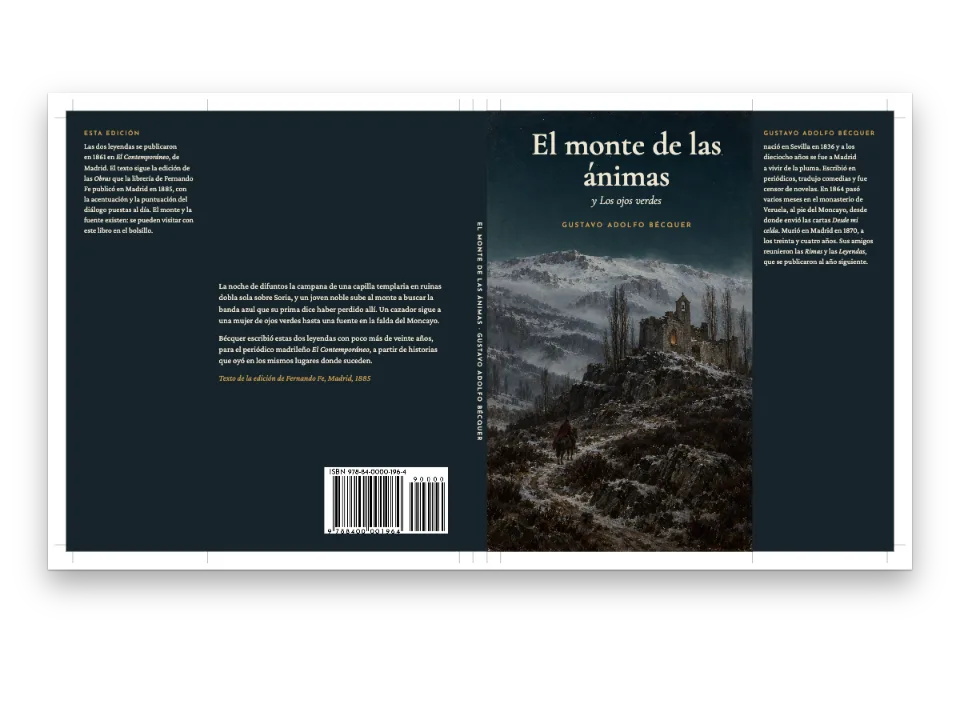
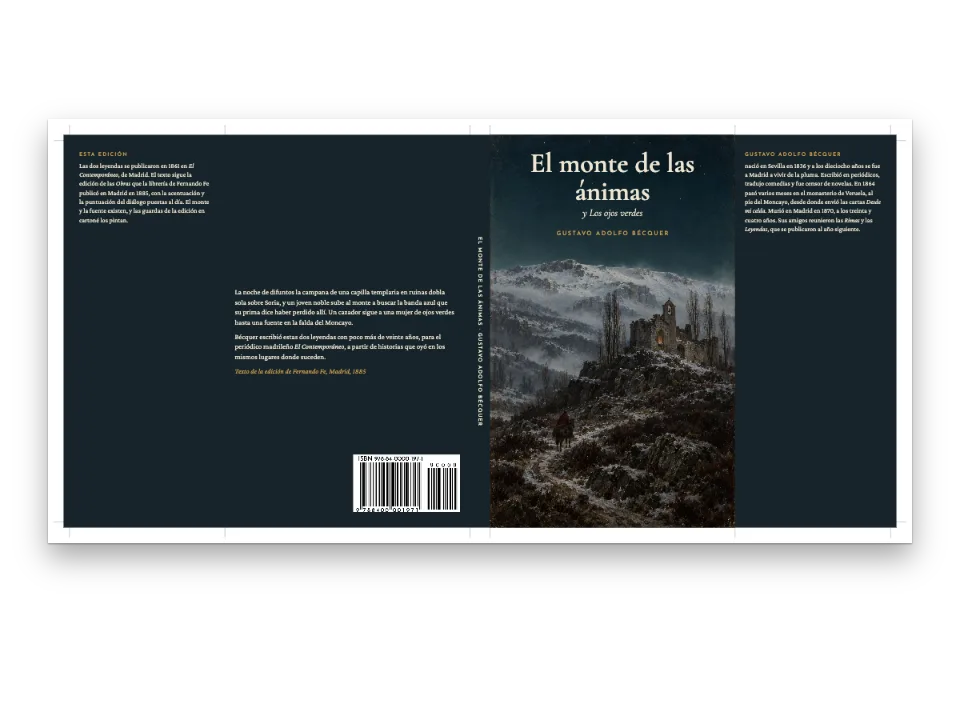
En pocas palabras
Un librito con un poema clásico y el pliego de su cubierta. Algunas partes se tratan después de imprimir: una capa brillante sobre la pintura, un marco de oro estampado y formas en relieve sobre la cartulina.
Lo que vas a componer
Las Coplas por la muerte de su padre de Jorge Manrique (la edición inglesa lleva la traducción de Longfellow) en una rústica de 125 × 200 mm, y el pliego de cubierta que pasa al taller de acabados cuando ya están impresas las cuatro tintas. Lleva tres acabados. Un barniz brillante a registro cubre la pintura por encima y por debajo de la cartela. El doble marco de la cartela se estampa en oro, y el panel que encierra va gofrado, de modo que el título queda sobre un campo en relieve. En la contracubierta, un rombo en gofrado en seco: sin tinta, solo la cartulina levantada. Debajo del libro, la receta dibuja el pliego cuatro veces: como se imprime, con las planchas de barniz y oro en falso color, con luz rasante y como la plancha de gofrado de la que parte el grabador del troquel. El PDF es PDF/X-4 y trae una plancha para cada acabado.
Esta receta responde a
- ¿Cómo pongo barniz selectivo, estampación y un título en relieve en una cubierta, para la imprenta y el encuadernador?
La respuesta corta
// A slim paperback: PUR perfect binding, the spine from the pages on 120 g/m² wove. The
// spine is under the 6 mm a spine is lettered from by default, so this version letters it
// from 4.5 mm.
const production = {
  bindings: [{ id: 'pur', name: 'PUR perfect binding', style: 'perfect', signature: 16,
    measures: { bleed: 3, spineAllowance: 0.5 } }],
  versions: [{ id: 'paperback', name: t({ en: 'Paperback', es: 'Rústica' }), binding: 'pur',
    isbn: '978-84-0000-199-5', spineText: { minSpine: 4.5 } }],
};
const folio = { paper: { type: 'bookWove', grammage: 120, bulk: 2.2, shade: '#f7f1e3' } };
const cover = {
  background: col('ground'),
  elements: [
    { id: 'art', kind: 'image', zone: 'front', x: 0, y: -3, width: 128, height: 206,
      resourceId: 'river', fit: 'cover' },
    // The title's panel, a shade darker than the ground, and the frame round it. The frame
    // prints nothing in four colours (it has the panel's colour): the foil plate carries it.
    { id: 'panel', kind: 'shape', zone: 'front', x: 14, y: 77, width: CW, height: CH,
      color: col('panel'), path: [{ closed: true, nodes: contour(0, 6) }] },
    { id: 'cartouche', kind: 'shape', zone: 'front', x: 14, y: 77, width: CW, height: CH,
      color: col('panel'), path: cartouche },
  ],
  finishes: [
    // A spot gloss over the painting above and below the panel, 4 mm clear of it, so the
    // varnish never lies on the foil. The back and the spine stay matt.
    ...[[-3, 76], [127, 76]].map(([y, height], i) => ({ id: `gloss-${i + 1}`, process: 'varnish',
      ink: col('varnish'), shape: { box: { zone: 'front', x: 0, y, width: 128, height } } })),
    // Gold foil on the frame, and the whole panel embossed: the title prints on a raised
    // field, the foil stamped round its edge.
    { id: 'gold', process: 'foil', ink: col('foil'), shape: { element: 'cartouche' } },
    { id: 'relief', process: 'emboss', shape: { element: 'panel' } },
    // A blind emboss: no ink and no foil, only the paper raised.
    { id: 'emblem', process: 'emboss', shape: { outline: emblem,
      box: { zone: 'back', x: 52.5, y: 30, width: 20, height: 20 } } },
  ],
  verticalAlign: { front: 'middle', back: 'middle' },
};
// The press file: PDF/X-4. The varnish and the foil are spot inks with a finish, each on
// its plate; the emboss goes on a plate named Emboss, beside the die line.
const print = { standard: 'pdfx4', outputProfile: 'fogra51', convertImages: false };
Ingredientes
- Funciones
- Acabados de cubierta y planchas técnicasPliego de cubiertaTintas especialesVersiones impresas, ISBN y lomoCubiertas, portadas y colofonesEstilos de títuloAperturas diseñadasTextos, filetes y cajas en los diseños de páginaMetadatos del documentoEstilos de párrafoVerso línea a líneaCabeceras y foliosFiguras y tablas como recursosPaleta de color semánticaExportación a PDFPDF en CMYK y en escala de grisesPáginas en un canvas
- También usa
- Papel, encuadernación, mesa y luz (Folio)Atributos de títuloColor del papelCabeceras según el tipo de páginaFuentes incrustadas en el PDFCabeceras por secciónTintas planas y tabla de tintasCapítulos sin número
- Tipografía
- Alegreya, Alegreya SC, Alegreya Sans SC (SIL OFL 1.1)
- Recursos
river-1100.jpg- La pintura de cubierta: un río al atardecer que va a dar en la mar bajo un castillo en ruinas, al óleo (Generated With Diffusion Models, original)
Elaboración
#1 · Cada acabado sigue una forma del diseño
El código es la respuesta corta de arriba. Un acabado indica un proceso, una tinta si el proceso la imprime y una forma: un elemento de la cubierta ({ element: 'cartouche' }), una caja en una de sus zonas o un contorno dentro de una caja. El barniz y el oro son tintas planas con finish en la paleta, así que cada una tiene su plancha en el PDF y el control previo las enumera. El gofrado no imprime nada. Va en una plancha técnica que el archivo de imprenta llama Emboss, la que usa el grabador, y en la página no se pinta.
El barniz son dos cajas, una por encima de la cartela y otra por debajo, que se quedan a 4 mm de ella para que el barniz nunca pise el oro. La contracubierta y el lomo quedan mates. El libro tiene 27 páginas de papel ahuesado de 120 g/m² con 2,2 de mano, 32 una vez encuadernado en cuadernillos de 16, y eso da un lomo de 4,7 mm. Por omisión un lomo de menos de 6 mm no se rotula, así que la versión pone spineText.minSpine en 4,5. El ISBN es un número de muestra que no corresponde a ningún libro.
#2 · La cartela es un trazado del diseño, no una imagen
// Fractions of its box, so the frame stretches with it. Two rings, each an outer contour and
// an inner one run the other way round: the hole between them stays empty, and the foil and
// the emboss take exactly this outline.
const [CW, CH] = [97, 46]; // the cartouche's box, mm
const K = 0.5523; // a quarter circle as a cubic
function contour(inset, notch) {
  const [tx, ty, rx, ry] = [inset / CW, inset / CH, (notch + inset) / CW, (notch + inset) / CH];
  // Each corner: the point on the edge before it and on the edge after it, a hollow arc
  // between them whose handles leave each edge square.
  const corners = [
    [[1 - rx, ty], [1 - tx, ry], 'h'], [[1 - tx, 1 - ry], [1 - rx, 1 - ty], 'v'],
    [[rx, 1 - ty], [tx, 1 - ry], 'h'], [[tx, ry], [rx, ty], 'v']];
  return corners.flatMap(([[ax, ay], [bx, by], edge]) => [
    { x: ax, y: ay, out: edge === 'h' ? { x: ax, y: ay + K * (by - ay) }
      : { x: ax + K * (bx - ax), y: ay } },
    { x: bx, y: by, in: edge === 'h' ? { x: bx - K * (bx - ax), y: by }
      : { x: bx, y: by - K * (by - ay) } }]);
}
const reversed = (nodes) => nodes.slice().reverse()
  .map(({ x, y, in: i, out: o }) => ({ x, y, ...(o && { in: o }), ...(i && { out: i }) }));
const ring = (outer, inner, notch) => [{ closed: true, nodes: contour(outer, notch) },
  { closed: true, nodes: reversed(contour(inner, notch)) }];
const cartouche = [...ring(0, 1.3, 6), ...ring(2.3, 2.75, 6)];
// The emblem on the back: a lozenge with a lozenge cut out of it, as a saved outline.
const lozenge = (d) => [[0.5, d], [1 - d, 0.5], [0.5, 1 - d], [d, 0.5]].map(([x, y]) => ({ x, y }));
const emblem = [lozenge(0), lozenge(0.24).reverse()];
El oro y el gofrado toman el contorno exacto del elemento al que apuntan, así que el marco tiene que ser una forma cuyo trazado conozca el motor. Un trazado de cubierta es una lista de contornos cerrados con nodos expresados en fracciones de la caja del elemento y tiradores de entrada y salida para las curvas. Cada esquina es un cuarto de círculo vuelto hacia dentro, dibujado como una cúbica. Un anillo es un contorno exterior y otro interior recorrido en sentido contrario: con la regla nonzero, el hueco entre ambos queda vacío. Dos anillos forman el doble marco. El marco tiene el color del panel, de modo que en cuatricromía no imprime nada y lo lleva la plancha del oro. El emblema de la contracubierta es un contorno guardado, dos rombos, el menor invertido.
#3 · Los estilos de la cubierta
const style = (id, fontFamily, size, lead, color, extra) => ({ id, fontFamily, fontSize: pt(size),
  lineHeight: pt(lead), color, italicColor: color, firstLineIndent: mm(0), textAlign: 'left',
  hyphenation: false, ...extra });
const caps = (tracking) => ({ fontWeight: 700, letterSpacing: pt(tracking) });
const mid = { textAlign: 'center' };
const coverStyles = [
  style('cover-title', 'Alegreya SC', 40, 40, col('cream'), { ...mid, fontWeight: 500 }),
  style('cover-subtitle', 'Alegreya', 13, 17, col('cream'), { ...mid, italic: true }),
  style('cover-author', 'Alegreya Sans SC', 9, 12, col('ochre'), { ...mid, ...caps(1.6),
    marginTop: pt(9) }),
  style('cover-spine', 'Alegreya Sans SC', 7, 8, col('cream'), { ...mid, ...caps(1.1) }),
  style('cover-quote', 'Alegreya', 13, 17, col('ochre'), { ...mid, italic: true,
    marginBottom: pt(16) }),
  style('cover-blurb', 'Alegreya', 10.5, 14.5, col('cream'), { marginBottom: pt(7) }),
  style('cover-note', 'Alegreya Sans SC', 8, 11, col('ochre'), { ...caps(1.2),
    marginTop: pt(4) }),
];
cover-title, cover-subtitle, cover-author y cover-spine son los nombres que buildCover da a los metadatos que coloca; cover-quote, cover-blurb y cover-note se nombran en el Markdown de la cubierta. La cubierta se centra en altura (verticalAlign), y así el título cae dentro de la cartela sea cual sea su cuerpo.
#4 · La tripa
const [W, H, TOP, FOOT, INNER, OUTER, LEAD] = [125, 200, 22, 24, 19, 17, 15]; // mm, pt
const at = (to, edge, x, y, size) => ({ anchor: { to, edge }, offset: { x: mm(x), y: mm(y) },
  ...(size && { size }) });
const text = (id, content, look, place) => ({ kind: 'text', id, content, align: 'center',
  overflow: 'wrap', placement: place, ...look });
const face = (fontFamily, size, color, x) => ({ fontFamily, fontSize: pt(size), color, ...x });
const label = (size, color = col('muted')) => face('Alegreya Sans SC', size, color, caps(size / 6));
const sc = (size, extra) => face('Alegreya SC', size, col('ink'), { fontWeight: 500, ...extra });
const none = { header: { elements: [] }, footer: { elements: [] }, numbered: false, toc: false };
const design = (minHeight, elements) => ({ enabled: true, minHeight: mm(minHeight),
  slot: { elements } });
const page = (parity) => ({ breakBefore: { enabled: true, parity } });
const rule = (id, y, to = 'page') => ({ kind: 'rule', id, direction: 'horizontal',
  thickness: pt(0.6), color: col('accent'), placement: at(to, 'top', 0, y, { width: mm(12) }) });
const headingStyles = [
  { ...none, id: 'half-title', advancedDesign: design(60, [
    text('t', '{title}', sc(18), at('page', 'top', 0, 64))]) },
  { ...none, ...page('odd'), id: 'title-page', advancedDesign: design(H - TOP - FOOT, [
    text('t', '{title}', sc(34), at('page', 'top', 0, 50)),
    text('s', '{subtitle}', face('Alegreya', 13, col('ink'), { italic: true }),
      at('page', 'top', 0, 66)),
    rule('r', 76),
    text('a', '{author}', label(8.5, col('accent')), at('page', 'top', 0, 81)),
    text('c', '{attr.credit}', face('Alegreya', 9.5, col('muted'), { italic: true }),
      at('page', 'top', 0, 120, { width: mm(76) })),
    text('i', '{attr.imprint}', label(7.5), at('page', 'bottom', 0, -28)),
  ]) },
  { ...none, ...page('even'), id: 'rights',
    advancedDesign: design(92, [rule('r', 86, 'container')]) },
  // The poem opens on a recto, sunk 46 mm, its title in small capitals over a short rule.
  { ...page('odd'), id: 'poem', toc: false, header: { elements: [] }, advancedDesign: design(46, [
    text('t', '{titleText}', sc(19), at('container', 'top', 0, 18)),
    text('n', '{attr.note}', face('Alegreya', 10.5, col('muted'), { italic: true }),
      at('container', 'top', 0, 28, { width: mm(80) })),
    rule('r', 38, 'container')]) },
  { ...none, ...page('odd'), id: 'colophon', advancedDesign: design(64, [
    rule('r', 56, 'container')]) },
];
const head = (id, content, parity) => text(id, content, { ...label(6.8), parity, pages: 'body' },
  at('page', 'top', 0, 11));
Anteportada, portada, créditos y el poema desde una impar, 46 mm más abajo, compuesto en verso que no parte ninguna copla entre dos páginas. Los titulillos llevan el autor en la par y el título en la impar. El colofón cierra el libro en la última impar.
#5 · El pliego sale de las páginas compuestas
const built = buildCover({ config, version: 'paperback', pages: book.pages, markdown: coverText,
  metadata: book.metadata, resources });
if (!('config' in built)) throw new Error(built.issues.map((i) => i.kind).join(', '));
// The barcode's digits name OCR-B, which no font server has: the label face sets them.
for (const [id, bytes] of Object.entries(built.files)) {
  await loadSvg(id, new TextDecoder().decode(bytes)
    .replace(/font-family="[^"]*"/g, 'font-family="Alegreya Sans SC"'));
}
const sheet = await buildDocumentWithFonts(built.content, built.config, kitFonts(FONTS));
buildCover recibe las páginas, los metadatos y el Markdown de la cubierta y devuelve un documento para buildDocumentWithFonts, además del código de barras en SVG. Las cifras del código piden OCR-B, que no tiene ningún servidor de fuentes, así que la receta las compone en Alegreya Sans SC, que ya está cargada.
#6 · Lo que cubre cada plancha
// 'flat' paints the inks: the foil in its colour, the varnish and the emboss not at all.
// 'map' marks the special plates in false colour over a faded sheet, 'sheen' rakes a light
// across it. The emboss plate is drawn from the page's technical plates, the outlines the
// PDF fills on its Emboss separation.
const leaf = sheet.pages[0];
const scale = 1100 / leaf.width;
const outline = (ctx, paths) => {
  ctx.beginPath();
  for (const c of paths.flat()) {
    if (c.op === 'M') ctx.moveTo(c.x, c.y);
    else if (c.op === 'L') ctx.lineTo(c.x, c.y);
    else if (c.op === 'C') ctx.bezierCurveTo(c.x1, c.y1, c.x2, c.y2, c.x, c.y);
    else if (c.op === 'Q') ctx.quadraticCurveTo(c.x1, c.y1, c.x, c.y);
    else ctx.closePath();
  }
  ctx.fill('nonzero');
};
const VIEWS = [
  ['flat', t({ en: 'As it prints', es: 'Como se imprime' })],
  ['map', t({ en: 'The varnish and foil plates', es: 'Las planchas de barniz y oro' })],
  ['sheen', t({ en: 'Under a raking light', es: 'Con luz rasante' })],
  ['emboss', t({ en: 'The Emboss plate', es: 'La plancha de gofrado' })],
];
const views = document.createElement('section');
views.id = 'finish-views';
views.style.cssText = 'display: grid; grid-template-columns: repeat(2, minmax(0, 560px)); '
  + 'gap: 18px; justify-content: center; padding: 24px max(16px, calc(50% - 520px)); color: #ddd; '
  + 'font: 14px sans-serif';
for (const [mode, name] of VIEWS) {
  const [figure, canvas, caption] = ['figure', 'canvas', 'figcaption']
    .map((tag) => document.createElement(tag));
  figure.style.margin = '0';
  canvas.style.cssText = 'display: block; width: 100%';
  canvas.setAttribute('role', 'img');
  canvas.setAttribute('aria-label', `${t({ en: 'The cover sheet', es: 'El pliego' })}: ${name}`);
  renderPageToCanvas(leaf, sheet, canvas, { scale, finishes: mode === 'emboss' ? 'flat' : mode });
  if (mode === 'emboss') {
    // The die-maker's film: the plate in black on white, the sheet faded under it.
    const ctx = canvas.getContext('2d');
    ctx.setTransform(1, 0, 0, 1, 0, 0);
    ctx.fillStyle = 'rgba(255, 255, 255, 0.86)';
    ctx.fillRect(0, 0, canvas.width, canvas.height);
    ctx.setTransform(scale, 0, 0, scale, 0, 0);
    ctx.fillStyle = '#111';
    outline(ctx, (leaf.plates ?? []).flatMap((p) => p.paths));
  }
  caption.textContent = name;
  figure.append(canvas, caption);
  views.append(figure);
}
// What the preflight reads from the sheet: its spot plates and the reliefs it checks.
const spots = preflightDocument(sheet).find((i) => i.kind === 'spotInks');
const list = document.createElement('p');
list.style.cssText = 'grid-column: 1 / -1; margin: 0; text-align: center';
list.textContent = `${t({ en: 'Plates beside CMYK', es: 'Planchas además de CMYK' })}: `
  + [...(spots?.inks ?? []), ...new Set((leaf.plates ?? [])
    .map((p) => `${p.process[0].toUpperCase()}${p.process.slice(1)}`))].join(' · ');
views.append(list);
document.getElementById('pages').before(views);
renderPageToCanvas pinta los acabados de tres maneras. flat pinta las tintas como las pone la máquina: el oro en su color y el barniz nada. map apaga el pliego y marca cada plancha especial en falso color. sheen pasa una luz rasante por el pliego, y el barniz y el oro la recogen. El gofrado no sale en ninguna de las tres, porque no imprime; la cuarta vista dibuja en negro sobre el pliego apagado las planchas técnicas de la página (page.plates), los contornos que el PDF rellena en su separación Emboss. La línea de debajo lee las tintas planas de preflightDocument y los procesos de las planchas.
La receta completa
// ═══ Postext Cookbook · Nº 199 · A cover in foil, spot varnish and emboss ═══════════════
// https://postext.dev/en/cookbook/cover-foil-varnish-emboss
// Code: MIT · Text: Manrique, tr. H. W. Longfellow (public domain) · Art: diffusion models
// Fonts: Alegreya, Alegreya SC, Alegreya Sans SC (SIL OFL 1.1) · Needs postext ≥ 1.92.0
//
// Manrique's Coplas as a slim paperback whose cover goes to the finisher after the press: a
// spot gloss over the painting, a gold-foil cartouche stamped over an emboss of the same
// shape, and a blind emboss on the back. Each finish is a shape of the cover's design; the
// varnish and the foil get spot plates of their own, the emboss a plate that prints nothing.
import { buildDocumentWithFonts, renderPageToCanvas, registerResourceImage, inlineSvgFonts,
  preflightDocument } from 'https://esm.sh/postext';
import { buildCover } from 'https://esm.sh/postext/production';
import { renderToPdf, decompressWoff2 } from 'https://esm.sh/postext-pdf';

const LANG = 'es'; // @lang: the language of the sample document ('en' | 'es')
const RECIPE = 'cover-foil-varnish-emboss';

// ─── 1 · Design ─────────────────────────────────────────────────────────────
// The pages' four colours, then the cover's: a bottle-green ground and its darker panel.
const palette = { ink: '#262320', accent: '#8a3b2a', muted: '#6d655b', paper: '#fbf7ef',
  ground: '#1d2b27', panel: '#15201d', cream: '#efe5cf', ochre: '#c8a15a' };
// The two inks the finisher is asked for: spot colours that each make a plate of their own.
const spot = (hex, name, cmyk, kind) => ({ hex, model: 'spot',
  spot: { name, cmyk, finish: { kind, sheen: 'gloss' } } });
const inks = { foil: spot('#b8963e', 'Gold foil', { c: 0, m: 20, y: 60, k: 25 }, 'foil'),
  varnish: spot('#eef0e6', 'Gloss varnish', { c: 0, m: 0, y: 0, k: 0 }, 'varnish') };
const col = (id) => (inks[id] ? { ...inks[id], paletteId: id }
  : { hex: palette[id], model: 'hex', paletteId: id });
const colorPalette = [
  ...Object.entries(palette).map(([id, hex]) => ({ id, name: id, value: { hex, model: 'hex' } })),
  ...Object.entries(inks).map(([id, value]) => ({ id, name: value.spot.name, value })),
  { id: 'main-color', name: 'accent (defaults)', value: { hex: palette.accent, model: 'hex' } },
];

// #region art: the cartouche, a frame with hollow corners, drawn as a shape of the design
// Fractions of its box, so the frame stretches with it. Two rings, each an outer contour and
// an inner one run the other way round: the hole between them stays empty, and the foil and
// the emboss take exactly this outline.
const [CW, CH] = [97, 46]; // the cartouche's box, mm
const K = 0.5523; // a quarter circle as a cubic
function contour(inset, notch) {
  const [tx, ty, rx, ry] = [inset / CW, inset / CH, (notch + inset) / CW, (notch + inset) / CH];
  // Each corner: the point on the edge before it and on the edge after it, a hollow arc
  // between them whose handles leave each edge square.
  const corners = [
    [[1 - rx, ty], [1 - tx, ry], 'h'], [[1 - tx, 1 - ry], [1 - rx, 1 - ty], 'v'],
    [[rx, 1 - ty], [tx, 1 - ry], 'h'], [[tx, ry], [rx, ty], 'v']];
  return corners.flatMap(([[ax, ay], [bx, by], edge]) => [
El script.js compuesto funciona tal cual: pégalo como script de módulo en cualquier página o abre la receta en CodePen. Carpeta de la receta en GitHub ↗ (se abre en una nueva pestaña)
Variantes
#Gofrado hundido en el emblema
El bajorrelieve hunde la forma en la cartulina en vez de levantarla, y va en una plancha Deboss propia.
-    { id: 'emblem', process: 'emboss', shape: { outline: emblem,
+ { id: 'emblem', process: 'deboss', shape: { outline: emblem,#Barniz sobre toda la pintura
Un solo acabado sobre el elemento de la pintura sustituye a las dos cajas. El barniz pasa entonces también por la cartela y el título.
-    ...[[-3, 76], [127, 76]].map(([y, height], i) => ({ id: `gloss-${i + 1}`, process: 'varnish',
-      ink: col('varnish'), shape: { box: { zone: 'front', x: 0, y, width: 128, height } } })),
+ { id: 'gloss', process: 'varnish', ink: col('varnish'), shape: { element: 'art' } },Errores frecuentes
- Un gofrado o un bajorrelieve a menos de 3 mm del corte o de un pliegue lo señala el control previo (
reliefTrim,reliefFold): ahí la cartulina se agrieta. Deja los relieves lejos de los pliegues del lomo. - El gofrado nunca se pinta en pantalla. Compruébalo en la separación Emboss del PDF o dibuja
page.plates, como hace la receta. - Un acabado puesto sobre un marco de texto tapa sus líneas en las vistas y en el archivo de imprenta. Deja parte del texto fuera del oro, como aquí el título, que va en el hueco de la cartela.
Créditos
- Receta
- Ignacio Ferro
- Texto
- Coplas de Manrique, en la traducción de Henry Wadsworth Longfellow (1833), de The Complete Poetical Works of Henry Wadsworth Longfellow (Household Edition, 1902), libro electrónico n.º 1365 del Proyecto Gutenberg · Jorge Manrique · dominio público
- Coplas por la muerte de su padre, de la primera edición crítica de R. Foulché-Delbosc (1902), libro electrónico n.º 49333 del Proyecto Gutenberg, con la ortografía y la puntuación modernizadas · Jorge Manrique · dominio público
- Imágenes
- La pintura de cubierta: un río al atardecer que va a dar en la mar bajo un castillo en ruinas, al óleo · Generated With Diffusion Models · original
- Fuentes
- Alegreya (SIL OFL 1.1) · Alegreya SC (SIL OFL 1.1) · Alegreya Sans SC (SIL OFL 1.1)
- Código
- MIT, como Postext
Editar este texto ↗ (se abre en una nueva pestaña)Carpeta de la receta en GitHub ↗ (se abre en una nueva pestaña)