En pocas palabras
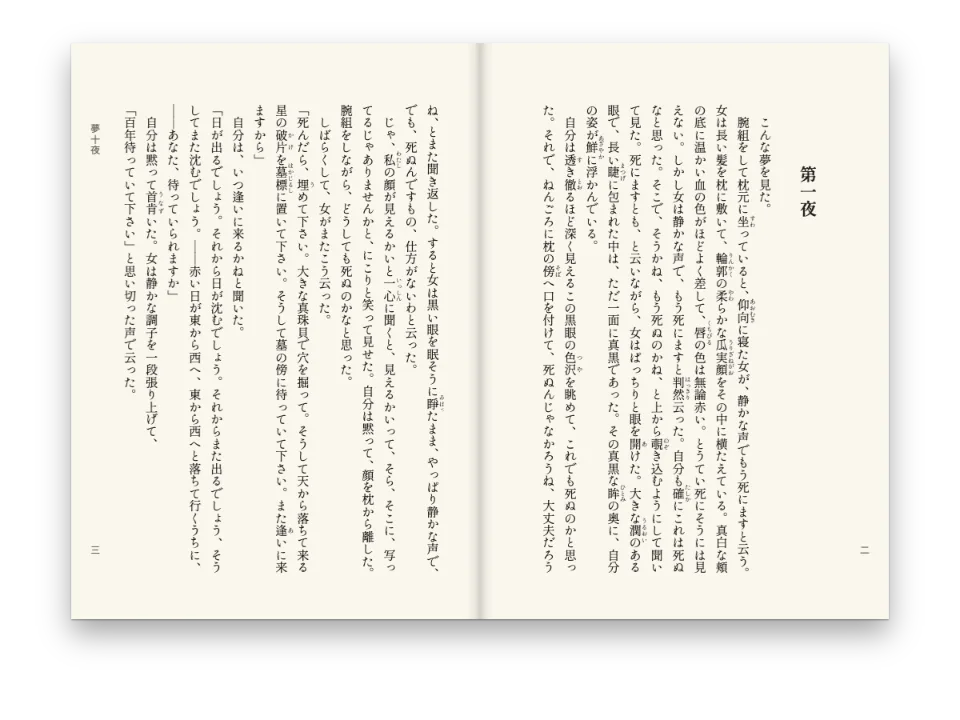
Un librito de poemas japoneses: el diario de viaje de Bashō con sus haikus en líneas propias, y los poemas breves de Takuboku en tres versos cada uno, que nunca corta un cambio de página.
Lo que vas a componer
Ocho páginas de un librito de poesía en una página 四六判 de 127 × 188 mm, encuadernada por la derecha. La primera parte son siete etapas de Sendas de Oku de Bashō, su prosa con sus haikus; la segunda, doce tankas de Un puñado de arena de Ishikawa Takuboku, cada uno en los tres versos en que lo escribió. La prosa corre de arriba abajo, 36 caracteres por línea, en Shippori Mincho de 10 pt con un paso holgado de 1,9 em. Cada haiku ocupa una línea propia tres caracteres más abajo, cada tanka dos, y el haiku de Sora va firmado 曾良 cerca del pie de la línea. Ningún tanka se parte entre dos páginas, y un * anaranjado separa los grupos. El libro de poesía europeo es la Nº 015; los poemas Tang en chino vertical, la Nº 083.
Esta receta responde a
- ¿Cómo compongo poesía: un verso por línea, espacio entre estrofas, sangría francesa en los versos que no caben y sin separación silábica?
- ¿Qué fuentes componen el japonés, con los kanji en sus formas japonesas, en pantalla y en el PDF?
La respuesta corta
// Each line of verse is a paragraph of its own, so a style sets where it starts. A haiku
// stands three characters down from the head of the line; Takuboku's tanka keep his three
// lines, two down; 曾良 signs his haiku raised five characters from the foot (地から五字上げ).
const paragraphStyles = [
  { id: 'haiku', indent: em(3), firstLineIndent: em(0), marginTop: pt(0), marginBottom: pt(0) },
  { id: 'tanka', indent: em(2), firstLineIndent: em(0), marginTop: pt(0), marginBottom: pt(0) },
  { id: 'by', textAlign: 'end', endIndent: em(5), firstLineIndent: em(0) },
  // The ornament between groups of poems, in the middle of its line.
  { id: 'ornament', textAlign: 'center', firstLineIndent: em(0), color: col('persimmon') },
];
//   :::paragraphs{style="haiku"}       :::paragraphs{style="by"}
//   夏草や兵どもが夢の跡                   曾良
//   :::                                :::
Ingredientes
- Funciones
- Estilos de párrafoTítulos que ocupan líneas del texto (gyōdori)Texto verticalLibros encuadernados por la derechaSangrías, alineación y separación de párrafosFurigana: lecturas en kana sobre los kanjiCorte de líneas japonés (kinsoku)Numerales japoneses y contadores en kanaKana, kanji y rōmajiRetícula de caracteresFuentes chinas, japonesas y coreanasImportar textos de Aozora BunkoEstilos de títuloAperturas diseñadasTextos, filetes y cajas en los diseños de páginaCabeceras y foliosCabeceras según el tipo de páginaMárgenes simétricosPaleta de color semánticaExportación a PDF
- También usa
- Recuadros que se parten o noRecuadrosCorte de líneas en chinoAtributos de títuloColor del papelFuentes incrustadas en el PDFPreliminares en romanosRuby: lecturas en pinyin y zhuyinCabeceras por sección
- Tipografía
- Shippori Mincho, Noto Sans JP (SIL OFL 1.1)
- Recursos
- Ninguno: todas las imágenes se dibujan en código
Elaboración
#1 · Un verso es un párrafo, y su estilo dice dónde empieza
El código es la respuesta corta de arriba. Postext no tiene salto de línea manual, así que cada verso de un poema es un párrafo propio dentro de un contenedor :::paragraphs, y el estilo del contenedor fija la sangría: indent: em(3) baja un haiku tres caracteres desde la cabeza de la línea (el texto de Aozora los pone a dos; tres les dan más aire), y firstLineIndent: em(0) evita que se le sume la sangría de un carácter del texto. Los 17 sonidos más o menos de un haiku caben en cualquier línea de 36, así que nunca saltan. La firma es otro párrafo: textAlign: 'end' la apoya en el pie de la línea (地付き, jitsuki) y endIndent: em(5) la levanta cinco caracteres desde ahí (地から五字上げ), como hace la edición de la que procede el texto (Estilos de párrafo).
#2 · Mantén cada tanka en una sola página
// Postext has no hard line break and never keeps one paragraph with the next, so each tanka
// sits in a box with nothing drawn round it: a box moves on whole (keepTogether, its
// default), and a tanka is never cut at the foot of a page. One blank line follows each.
//   :::callout{type="tanka"}  :::paragraphs{style="tanka"} … three lines …  :::  :::
const calloutStyles = [{ id: 'tanka', backgroundEnabled: false, keepTogether: true,
  padding: { top: pt(0), right: pt(0), bottom: pt(0), left: pt(0) },
  marginTop: pt(0), marginBottom: pt(LEAD),
  body: { fontFamily: MINCHO, fontSize: pt(BODY), lineHeight: pt(LEAD), color: col('ink'),
    firstLineIndent: em(0) } }];
Los tres versos de un tanka son tres párrafos, y el motor mantiene juntas las líneas de un párrafo, pero nunca un párrafo con el siguiente. Un recuadro sí mantiene junto su contenido, así que cada tanka va en un :::callout cuyo estilo no dibuja nada: sin fondo, sin relleno y con un margen de una línea detrás, la línea en blanco entre poemas. En la página 5 el tercer tanka no cabe bajo el título de la parte y los dos primeros, así que abre entero la página 6 en lugar de dejar atrás su primer verso (Estilos de aviso).
#3 · Espacia los nombres de lugar a un mismo ancho
// The place names over the prose take two lines (2行取り), four characters down, and a
// two-character name is spaced out to three (字取り: 平泉 → 平 泉), so they all end level.
const place = {
  level: 2, fontFamily: MINCHO, fontWeight: 700, fontSize: pt(11),
  lineSpan: 2, indent: em(4), jidori: 3,
};
Las etapas del viaje son títulos de segundo nivel de dos líneas del texto (2行取り), para que la prosa y los haikus que siguen queden en la retícula. jidori: 3 espacia un nombre más corto hasta ocupar tres de sus propios caracteres (字取り): 平泉 se imprime 平 泉, con un carácter entero entre ambos, y todos los nombres acaban a la misma altura que 立石寺 y 最上川. Un nombre que ya tiene tres caracteres se queda como está (Configuración por nivel).
#4 · Abre cada parte en su propia página
// A design on a vertical page is laid out in the flow frame: x runs down the column from
// the head of the type area, y across the page leftwards from its right edge.
const at = (down, across) => ({ anchor: { to: 'container', edge: 'top-left' },
  offset: { x: pt(down), y: pt(across) } });
const TITLE = 18; // pt
const part = {
  level: 1, breakBefore: { enabled: true, parity: 'any' }, // gotcha: headings-drop-h1-break
  advancedDesign: { enabled: true, minHeight: lines(5), slot: { elements: [
    { kind: 'text', id: 'title', content: '{titleText}', fontFamily: MINCHO, fontWeight: 700,
      fontSize: pt(TITLE), lineHeight: 1, letterSpacing: pt(4), color: col('ink'),
      placement: at(3 * BODY, 1.5 * LEAD - TITLE / 2) },
    { kind: 'text', id: 'abridged', content: '(抄)', fontFamily: MINCHO, fontSize: pt(9),
      color: col('ink'), placement: { anchor: { to: '#title', edge: 'right-of' },
        offset: { x: pt(6), y: pt((TITLE - 9) / 2) } } },
    { kind: 'rule', id: 'rule', direction: 'horizontal', thickness: pt(0.6),
      color: col('persimmon'), placement: { ...at(3 * BODY, 2.5 * LEAD),
        size: { width: pt(4 * TITLE) } } },
    { kind: 'text', id: 'poet', content: '{attr.author}', fontFamily: MINCHO, fontSize: pt(11),
      letterSpacing: pt(3), color: col('ink'),
      placement: at(CHARS * BODY - 4 * 11 - 3 * 3 - 2 * BODY, 3.5 * LEAD - 11 / 2) },
  ] } },
};
Cada parte es un título de primer nivel cuyo diseño pone el título, un (抄) pequeño, «selección», justo detrás con anchor.to: '#title', un filete anaranjado corto junto al título y el poeta cerca del pie de la línea. El diseño reserva cinco líneas, y el texto empieza tras ellas en la misma retícula.
#5 · Elige una fuente que tenga las marcas antiguas
const title = markdown.match(/^title: "(.*)"$/m)[1];
const heads = markdown.match(/^#+ [^{\n]*/gm).join('');
await loadFonts(FONTS, markdown); // the Latin files: the colophon
await loadCjkFonts({ [MINCHO]: ['400'] }, markdown, { vertical: true });
await loadCjkFonts({ [MINCHO]: ['700'] }, heads);
await loadCjkFonts({ [GOTHIC]: ['400'] },
  `${title}${heads}${markdown.match(/colophon="([^"]*)"/)[1]}一二三四五六七八九十`, { vertical: true });
La prosa de Bashō escribe las palabras repetidas con la vieja marca de iteración 〻 (日〻, 人〻), y los textos antiguos usan también el largo くの字点 〳〵. Zen Old Mincho no tiene ninguna de las dos: el lienzo las tomaría de una fuente del sistema y el PDF dibujaría cajas vacías. Shippori Mincho, Noto Serif JP y Shippori Mincho B1 tienen ambas, así que los poemas van en Shippori Mincho (Fuentes chinas, japonesas y coreanas). El texto de Aozora conserva además las notas del editor sobre grafías antiguas, とら{え|(へ)}て, que imprimen el kana esperado junto al que escribió Bashō.
La receta completa
// ═══ Postext Cookbook · Nº 119 · Haiku and tanka set vertically ═══════════════════ // https://postext.dev/en/cookbook/haiku-and-tanka // Code: MIT · Text: 芭蕉『おくのほそ道』, 啄木『一握の砂』, Aozora Bunko (PD) · Pictures: none // Fonts: Shippori Mincho, Noto Sans JP (SIL OFL 1.1) · Needs postext ≥ 1.16.1 import { buildDocument, renderPageToCanvas, clearMeasurementCache, loadVerticalAlternates, } from 'https://esm.sh/postext'; import { renderToPdf, decompressWoff2 } from 'https://esm.sh/postext-pdf'; const LANG = 'es'; // @lang: the language of the colophon; the poems are Japanese in both const RECIPE = 'haiku-and-tanka'; // ─── 1 · Design ───────────────────────────────────────────────────────────── // #region palette: ink, one persimmon, a soft poetry stock const palette = { ink: '#22201d', // the poems persimmon: '#b5512c', // 柿: the part titles' rule and the ornaments muted: '#6a645c', // the hashira, the folios, the colophon paper: '#fbf8f1', }; const col = (id) => ({ hex: palette[id], model: 'hex', paletteId: id }); const colorPalette = [ ...Object.entries(palette).map(([id, hex]) => ({ id, name: id, value: { hex, model: 'hex' } })), { id: 'main-color', name: 'defaults', value: { hex: palette.persimmon, model: 'hex' } }, ]; // #endregion // Shippori Mincho: it has the 〻 of 日〻 and 人〻, which Zen Old Mincho lacks. const [MINCHO, GOTHIC] = ['Shippori Mincho', 'Noto Sans JP']; const [BODY, LEAD, CHARS, LINES] = [10, 19, 36, 14]; // pt, pt: 36字 × 14行, a 1.9 em pitch const lines = (n) => pt(n * LEAD); // #region answer: a haiku on one line three characters down, a tanka in three, 地付き names // Each line of verse is a paragraph of its own, so a style sets where it starts. A haiku // stands three characters down from the head of the line; Takuboku's tanka keep his three // lines, two down; 曾良 signs his haiku raised five characters from the foot (地から五字上げ). const paragraphStyles = [ { id: 'haiku', indent: em(3), firstLineIndent: em(0), marginTop: pt(0), marginBottom: pt(0) }, { id: 'tanka', indent: em(2), firstLineIndent: em(0), marginTop: pt(0), marginBottom: pt(0) }, { id: 'by', textAlign: 'end', endIndent: em(5), firstLineIndent: em(0) }, // The ornament between groups of poems, in the middle of its line. { id: 'ornament', textAlign: 'center', firstLineIndent: em(0), color: col('persimmon') }, ]; // :::paragraphs{style="haiku"} :::paragraphs{style="by"} // 夏草や兵どもが夢の跡 曾良 // ::: ::: // #endregion // #region tanka: a box with nothing drawn round it keeps each tanka on one page // Postext has no hard line break and never keeps one paragraph with the next, so each tanka // sits in a box with nothing drawn round it: a box moves on whole (keepTogether, its // default), and a tanka is never cut at the foot of a page. One blank line follows each. // :::callout{type="tanka"} :::paragraphs{style="tanka"} … three lines … ::: ::: const calloutStyles = [{ id: 'tanka', backgroundEnabled: false, keepTogether: true, padding: { top: pt(0), right: pt(0), bottom: pt(0), left: pt(0) }, marginTop: pt(0), marginBottom: pt(LEAD), body: { fontFamily: MINCHO, fontSize: pt(BODY), lineHeight: pt(LEAD), color: col('ink'), firstLineIndent: em(0) } }]; // #endregion // #region places: the place names take two lines, spaced to three characters // The place names over the prose take two lines (2行取り), four characters down, and a // two-character name is spaced out to three (字取り: 平泉 → 平 泉), so they all end level. const place = { level: 2, fontFamily: MINCHO, fontWeight: 700, fontSize: pt(11), lineSpan: 2, indent: em(4), jidori: 3, }; // #endregion // #region part: each part opens a page with its title, (抄) and the poet at the foot // A design on a vertical page is laid out in the flow frame: x runs down the column from // the head of the type area, y across the page leftwards from its right edge. const at = (down, across) => ({ anchor: { to: 'container', edge: 'top-left' }, offset: { x: pt(down), y: pt(across) } }); const TITLE = 18; // pt const part = { level: 1, breakBefore: { enabled: true, parity: 'any' }, // gotcha: headings-drop-h1-break advancedDesign: { enabled: true, minHeight: lines(5), slot: { elements: [ { kind: 'text', id: 'title', content: '{titleText}', fontFamily: MINCHO, fontWeight: 700, fontSize: pt(TITLE), lineHeight: 1, letterSpacing: pt(4), color: col('ink'), placement: at(3 * BODY, 1.5 * LEAD - TITLE / 2) }, { kind: 'text', id: 'abridged', content: '(抄)', fontFamily: MINCHO, fontSize: pt(9), color: col('ink'), placement: { anchor: { to: '#title', edge: 'right-of' }, offset: { x: pt(6), y: pt((TITLE - 9) / 2) } } }, { kind: 'rule', id: 'rule', direction: 'horizontal', thickness: pt(0.6), color: col('persimmon'), placement: { ...at(3 * BODY, 2.5 * LEAD), size: { width: pt(4 * TITLE) } } }, { kind: 'text', id: 'poet', content: '{attr.author}', fontFamily: MINCHO, fontSize: pt(11), letterSpacing: pt(3), color: col('ink'), placement: at(CHARS * BODY - 4 * 11 - 3 * 3 - 2 * BODY, 3.5 * LEAD - 11 / 2) }, ] } }, }; // #endregion // #region furniture: the book's title down the fore-edge, the folio below it const foreEdge = (id, content, parity, edge, y, extra = {}) => ({ kind: 'text', id, content, parity, pages: 'body', writingMode: 'vertical-rl', fontFamily: GOTHIC, fontSize: pt(7), letterSpacing: pt(1), color: col('muted'), overflow: 'clip', placement: { anchor: { to: 'outer', edge }, offset: { y: em(y) } }, ...extra, }); const header = { elements: [ foreEdge('book', '{title}', 'even', 'top', 3), foreEdge('part', '{chapterTitle}', 'odd', 'top', 3), foreEdge('folio', '{pageNumber}', 'all', 'bottom', -3, { pages: 'all' }), ] }; const none = { elements: [] }; // The first part's opening page carries the colophon across the foot. const first = { id: 'first', footer: { elements: [{ kind: 'text', id: 'colophon', content: '{attr.colophon}', pages: 'opener', fontFamily: GOTHIC, fontSize: pt(5.5), lineHeight: 1.45, color: col('muted'), overflow: 'wrap', align: 'center', placement: { anchor: { to: 'page', edge: 'bottom' }, offset: { y: mm(-7) }, size: { width: mm(100) } } }] } }; // #endregion const config = () => ({ // a factory: the engine caches resolved configs per object locale: 'ja', // written out, never LANG (gotcha: ja-locale-tag) colorPalette, page: { sizePreset: 'custom', width: mm(127), height: mm(188), dpi: 150, // 四六判 backgroundColor: col('paper'), margins: { top: mm(32), bottom: mm(24), left: mm(15), right: mm(17), mirror: true }, pageNumbering: { format: 'japanese-informal' }, }, layout: { layoutType: 'single', writingMode: 'vertical-rl' }, cjk: { grid: { enabled: true, charsPerLine: CHARS, linesPerPage: LINES } }, bodyText: { fontFamily: MINCHO, fontSize: pt(BODY), lineHeight: pt(LEAD), color: col('ink'), boldColor: col('ink'), italicColor: col('ink'), referenceColor: col('ink'), textAlign: 'justify', firstLineIndent: em(1), indentAfterHeading: true, }, headings: { fontFamily: MINCHO, color: col('ink'), levels: [part, place] }, headingStyles: [first], paragraphStyles, calloutStyles, header, footer: none, }); // ─── 2 · Content ──────────────────────────────────────────────────────────── const markdown = String.raw`---Muestra en Markdown · 183 líneas · content.es.md
title: "芭蕉と啄木" subtitle: "俳句と短歌" --- # おくのほそ道 {style="first" author="松尾芭蕉" colophon="Matsuo Bashō, おくのほそ道 (Sendas de Oku, 1702), selección, según la edición de Sugiura Shōichirō (1957); Ishikawa Takuboku, 一握の砂 (Un puñado de arena, 1910), doce tankas. Texto: Aozora Bunko 61619 y 816, dominio público. Compuesto en Shippori Mincho y Noto Sans JP (SIL OFL)."} ## 冒頭 {月日|つきひ}は{百代|はくだい}の{過客|くわかく}にして、{行|ゆき}かふ{年|とし}も{又|また}{旅人|たびびと}{也|なり}。{舟|ふね}の{上|うへ}に生涯をうかべ馬の口とら{え|(へ)}て{老|おい}をむかふる{物|もの}は、{日〻|ひび}{旅|たび}にして{旅|たび}を{栖|すみか}とす。古人も多く旅に死せるあり。予もいづれの年よりか、{片雲|へんうん}の風にさそはれて、漂泊の思ひやまず海濱にさすらへ、{去年|こぞ}の秋{江上|かうじやう}の{破屋|はをく}に{蜘|くも}の古巣をはらひて、やゝ年も{暮|くれ}春{立|たて}る霞の空に白川の關こえんと、そゞろ{神|がみ}の物につきて心をくるはせ、{道祖神|だうそじん}のまねきにあひて{取|とる}もの手につかず、もゝ{引|ひき}の{破|やぶれ}をつゞり{笠|かさ}の{緒|を}{付|つけ}か{え|(へ)}て、三里に灸す{ゆ|(う)}るより松嶋の月{先|まづ}心にかゝりて、{住|すめ}る{方|かた}は人に讓り{杉風|さんぷう}が{別墅|べつしよ}に移るに、 :::paragraphs{style="haiku"} 草の戸も{住替|すみかは}る{代|よ}ぞひなの家 ::: {面八句|おもてはちく}を{庵|いほり}の柱に{懸置|かけおく}。 ## 旅立 :::paragraphs{style="haiku"} {行|ゆく}春や鳥{啼|なき}{魚|うを}の目は{泪|なみだ} ::: ## 平泉 三代の{榮耀|えいえう}{一睡|いつすゐ}の{中|うち}にして、{大門|だいもん}の跡は一里こなたに{有|あり}。{秀衡|ひでひら}が跡は田野に{成|なり}て、金鷄山のみ形を殘す。{先|まづ}{高舘|たかだち}にのぼれば、北上川南部より流るゝ{大河|たいが}也。衣川は和泉が{城|じやう}をめぐりて、高舘の下にて大河に{落入|おちいる}。{康衡|やすひら}等が旧跡は、衣が關を{隔|へだて}て南部口をさし堅め、{夷|えぞ}をふせぐとみえたり。{偖|さて}も義臣すぐつて{此城|このしろ}にこもり、功名一時の{叢|くさむら}となる。「國破れて山河あり、{城|じやう}春にして草青みたり」と笠{打敷|うちしき}て時のうつるまで泪を落し侍りぬ。 :::paragraphs{style="haiku"} {夏草|なつくさ}や{兵|つはもの}どもが夢の跡 {卯|う}の{花|はな}に{兼房|かねふさ}みゆる{白毛|しらが}かな ::: :::paragraphs{style="by"} 曾良 ::: ## 立石寺 山形領に{立石寺|りふしやくじ}と{云|いふ}山寺あり。{慈覺大師|じかくだいし}の開基にして、{殊|ことに}清閑の地也。一見すべきよし、人〻のすゝむるに{依|よつ}て、尾花澤よりとつて返し、{其|その}間七里ばかり也。日いまだ{暮|くれ}ず。{麓|ふもと}の坊に宿かり{置|おき}て、山上の堂にのぼる。岩に{巖|いはほ}を{重|かさね}て山とし、{松柏|しようはく}{年旧|としふり}、{土石|どせき}{老|おい}て苔{滑|なめらか}に、岩上の院〻{扉|とびら}を{閉|とぢ}て物の音きこえず。{岸|きし}をめぐり岩を{這|はひ}て{佛閣|ぶつかく}を拜し、{佳景|かけい}{寂莫|じやくまく}として心すみ{行|ゆく}のみおぼゆ。 :::paragraphs{style="haiku"} {閑|しづか}さや岩にしみ{入|いる}蝉の聲 ::: ## 最上川 :::paragraphs{style="haiku"} 五月雨をあつめて早し最上川 ::: ## 越後路 :::paragraphs{style="haiku"} 文月や六日も常の夜には似ず 荒海や佐渡によこたふ{天河|あまのがは} ::: ## 大垣 :::paragraphs{style="haiku"} 蛤のふたみにわかれ{行|ゆく}秋ぞ ::: # 一握の砂 {author="石川啄木"} :::callout{type="tanka"} :::paragraphs{style="tanka"} {東海|とうかい}の{小島|こじま}の{磯|いそ}の{白砂|しらすな}に われ{泣|な}きぬれて {蟹|かに}とたはむる ::: ::: :::callout{type="tanka"} :::paragraphs{style="tanka"} {頬|ほ}につたふ なみだのごはず {一握|いちあく}の砂を{示|しめ}しし人を忘れず ::: ::: :::callout{type="tanka"} :::paragraphs{style="tanka"} いのちなき砂のかなしさよ さらさらと {握|にぎ}れば指のあひだより落つ ::: ::: :::callout{type="tanka"} :::paragraphs{style="tanka"} たはむれに母を{背負|せお}ひて そのあまり{軽|かろ}きに泣きて 三歩あゆまず ::: ::: :::callout{type="tanka"} :::paragraphs{style="tanka"} はたらけど はたらけど{猶|なほ}わが{生活|くらし}楽にならざり ぢっと手を見る ::: ::: :::paragraphs{style="ornament"} * ::: :::callout{type="tanka"} :::paragraphs{style="tanka"} {不来方|こずかた}のお城の草に寝ころびて 空に吸はれし {十五|じふご}の心 ::: ::: :::callout{type="tanka"} :::paragraphs{style="tanka"} ふるさとの{訛|なまり}なつかし {停車場|ていしやば}の人ごみの中に そを{聴|き}きにゆく ::: ::: :::callout{type="tanka"} :::paragraphs{style="tanka"} 石をもて追はるるごとく ふるさとを{出|い}でしかなしみ 消ゆる時なし ::: ::: :::callout{type="tanka"} :::paragraphs{style="tanka"} やはらかに柳あをめる {北上|きたかみ}の{岸辺|きしべ}目に見ゆ 泣けとごとくに ::: ::: :::callout{type="tanka"} :::paragraphs{style="tanka"} ふるさとの山に向ひて 言ふことなし ふるさとの山はありがたきかな ::: ::: :::paragraphs{style="ornament"} * ::: :::callout{type="tanka"} :::paragraphs{style="tanka"} {函館|はこだて}の{青柳町|あをやぎちやう}こそかなしけれ 友の{恋歌|こひうた} 矢ぐるまの花 ::: :::`; // content.<lang>.md: the same Japanese text in both // ─── 3 · Fonts ────────────────────────────────────────────────────────────── const FONTS = { 'Shippori Mincho': ['400', '700'], // the poems and the prose; the titles 'Noto Sans JP': ['400'], // the hashira, the folios and the colophon }; // ─── 4 · Build & show ─────────────────────────────────────────────────────── // #region voices: each face loads the files that hold the characters it sets const title = markdown.match(/^title: "(.*)"$/m)[1]; const heads = markdown.match(/^#+ [^{\n]*/gm).join(''); await loadFonts(FONTS, markdown); // the Latin files: the colophon await loadCjkFonts({ [MINCHO]: ['400'] }, markdown, { vertical: true }); await loadCjkFonts({ [MINCHO]: ['700'] }, heads); await loadCjkFonts({ [GOTHIC]: ['400'] }, `${title}${heads}${markdown.match(/colophon="([^"]*)"/)[1]}一二三四五六七八九十`, { vertical: true }); // #endregion const doc = await buildWithFonts(() => buildDocument({ markdown }, config()), markdown); showBook(doc, { title: t({ en: 'Haiku and tanka set vertically', es: 'Haikus y tankas compuestos en vertical' }) }); offerPdf(() => renderToPdf(doc, { fontProvider: cjkPdfProvider }), `${RECIPE}.pdf`);Kit · core, fonts, viewer, pdf, cjk: igual en todas las recetas · 453 líneas
// ─── Kit ── helpers shared by every Cookbook recipe · postext.dev/cookbook ───── // ─── Kit · core v1 ── the same in every recipe · postext.dev/cookbook ───────── function mm(value) { return { value, unit: 'mm' }; } function pt(value) { return { value, unit: 'pt' }; } function em(value) { return { value, unit: 'em' }; } /** The sample language's string: t({ en: 'Figure', es: 'Figura' }). */ function t(strings) { return strings[LANG] ?? Object.values(strings)[0]; } /** A file in this recipe's assets folder, served from the Postext repo by jsDelivr. */ function asset(file) { return `https://cdn.jsdelivr.net/gh/drnachio/postext@main/cookbook/${RECIPE}/assets/${file}`; } // ─── Kit · fonts v1 ── the same in every recipe · postext.dev/cookbook ──────── // Postext measures text with the faces the browser has loaded, and caches the // widths, so every face must be ready before the first build. Faces come from // Fontsource: the same static files the PDF embeds, so screen and PDF agree. /** faces = { 'Family Name': ['400', '400i', '700'] }. `text` is the sample: * letters beyond Latin-1 (č, ł, ő…) also load the latin-ext files. With * `optional`, a face Fontsource does not ship is skipped instead of failing. * Resolves to the number of faces added. */ async function loadFonts(faces, text = '', { optional = false } = {}) { kitStatus('Loading fonts…'); const ranges = { latin: 'U+0000-00FF,U+0131,U+0152-0153,U+02BB-02BC,U+02C6,U+02DA,U+02DC,U+0304,U+0308,U+0329,' + 'U+2000-206F,U+20AC,U+2122,U+2191,U+2193,U+2212,U+2215,U+FEFF,U+FFFD', 'latin-ext': 'U+0100-02BA,U+02BD-02C5,U+02C7-02CC,U+02CE-02D7,U+02DD-02FF,U+0304,U+0308,U+0329,' + 'U+1D00-1DBF,U+1E00-1E9F,U+1EF2-1EFF,U+2020,U+20A0-20AB,U+20AD-20C0,U+2113,U+2C60-2C7F,U+A720-A7FF', }; const subsets = /[Ā-˿Ḁ-ỿ]/.test(text) ? ['latin', 'latin-ext'] : ['latin']; const jobs = []; let added = 0; for (const [family, specs] of Object.entries(faces)) { const id = fontsourceId(family); const meta = optional ? await fontsourceMeta(family) : null; for (const spec of new Set(specs)) { const weight = parseInt(spec, 10); const style = spec.endsWith('i') ? 'italic' : 'normal'; if (hasFace(family, weight, style)) continue; if (optional && !(meta?.weights.includes(weight) && meta.styles.includes(style))) continue; for (const subset of subsets) { const url = `https://cdn.jsdelivr.net/npm/@fontsource/${id}@5/files/${id}-${subset}-${weight}-${style}.woff2`; const face = new FontFace(family, `url(${url}) format('woff2')`, { weight: String(weight), style, unicodeRange: ranges[subset] }); jobs.push(face.load().then((ready) => { document.fonts.add(ready); added++; }, () => { if (subset === 'latin' && !optional) throw new Error(`Fontsource has no ${family} ${weight} ${style}`); })); } } } await Promise.all(jobs).catch((error) => { kitFail(error); throw error; }); return added; } /** Runs `build` (a buildDocument or buildBundle call) and checks the faces * the pages use. A regular face missing from FONTS is loaded with a warning; * bold and italic variants are loaded when the family ships them. Then the * measurement caches are cleared and the build runs again. */ async function buildWithFonts(build, text = '') { const tried = new Set(); for (let round = 0; round < 3; round++) { kitStatus('Laying out…'); await new Promise(requestAnimationFrame); // let the status paint first const result = await Promise.resolve().then(build).catch((error) => { kitFail(error); throw error; }); const wanted = { base: {}, variants: {} }; for (const { font, base } of [result].flat().flatMap(fontStringsOf)) { const { family, weight, style } = parseFont(font); const key = `${family}|${weight}|${style}`; if (tried.has(key) || hasFace(family, weight, style)) continue; tried.add(key); (wanted[base ? 'base' : 'variants'][family] ??= []).push(`${weight}${style === 'italic' ? 'i' : ''}`); } if (Object.keys(wanted.base).length) { console.warn(`[cookbook] FONTS does not list ${JSON.stringify(wanted.base)}: loading them.`); } const added = await loadFonts(wanted.base, text) + await loadFonts(wanted.variants, text, { optional: true }); if (added === 0) return result; clearMeasurementCache(); } throw new Error('The fonts did not settle after three builds.'); } /** Every font string of the layout. `base` marks a block's own face; its * bold, italic and bold-italic variants are listed whether or not used. */ function fontStringsOf(doc) { const found = new Map(); const walk = (node) => { if (!node || typeof node !== 'object') return; if (Array.isArray(node)) { node.forEach(walk); return; } for (const [key, value] of Object.entries(node)) { if (typeof value === 'string' && /fontString$/i.test(key)) { found.set(value, found.get(value) || key === 'fontString'); } else if (value && typeof value === 'object') walk(value); } }; walk(doc.pages); walk(doc.blocks); return [...found].map(([font, base]) => ({ font, base })); } /** '700 37.5px Open Sans' / 'italic 400 13px "Source Serif 4"' → { family, weight, style }. * A string with no weight ('95.8px Young Serif', from a design text) is 400. */ function parseFont(font) { const m = /^(?:(italic|oblique)\s+)?(?:small-caps\s+)?(?:(\d+|bold|normal)\s+)?[\d.]+px\s+(.+)$/.exec(font.trim()); if (!m) throw new Error(`Unexpected font string: ${font}`); const weight = m[2] === 'bold' ? 700 : !m[2] || m[2] === 'normal' ? 400 : Number(m[2]); return { family: m[3].replace(/^["']|["']$/g, ''), weight, style: m[1] ? 'italic' : 'normal' }; } /** True when a loaded FontFace covers exactly this family, weight and style * (document.fonts.check() is also true for families nobody declared). */ function hasFace(family, weight, style) { for (const face of document.fonts) { if (face.status !== 'loaded' || face.style !== style) continue; if (face.family.replace(/^["']|["']$/g, '') !== family) continue; const [low, high = low] = face.weight.split(' ').map(Number); if (weight >= low && weight <= high) return true; } return false; } /** Fontsource's id for a family: 'Source Serif 4' → 'source-serif-4'. */ function fontsourceId(family) { return family.toLowerCase().replace(/\s+/g, '-'); } /** The weights and styles a family ships ({ weights: [400, 700], styles: ['normal', 'italic'] }), or null. */ function fontsourceMeta(family) { fontsourceMeta.cache ??= new Map(); const id = fontsourceId(family); if (!fontsourceMeta.cache.has(id)) { fontsourceMeta.cache.set(id, fetch(`https://api.fontsource.org/v1/fonts/${id}`) .then((res) => (res.ok ? res.json() : null), () => null)); } return fontsourceMeta.cache.get(id); } // ─── Kit · viewer v1 ── the same in every recipe · postext.dev/cookbook ─────── /** Shows the pages as facing spreads on a dark desk: the first page is a * recto on its own, then verso | recto pairs, as in a bound book. Pages * are painted when they scroll near the screen. */ function showPages(docs, { title, width = 460 } = {}) { const root = viewer(title); const pages = [docs].flat().flatMap((doc) => doc.pages.map((page) => ({ doc, page, n: (doc.pageIndexOffset ?? 0) + page.index }))); const spreads = []; let verso = null; for (const p of pages) { if (p.n % 2 === 1) { if (verso) spreads.push([verso, null]); verso = p; } else { spreads.push([verso, p]); verso = null; } } if (verso) spreads.push([verso, null]); const density = Math.min(window.devicePixelRatio || 1, 2); showPages.painter?.disconnect(); const painter = new IntersectionObserver((entries) => { for (const { isIntersecting, target } of entries) { if (!isIntersecting) continue; painter.unobserve(target); const { doc, page } = target.postext; renderPageToCanvas(page, doc, target, { scale: (width * density) / page.width }); } }, { rootMargin: '800px' }); showPages.painter = painter; root.replaceChildren(...spreads.map((pair) => { const spread = document.createElement('div'); spread.className = 'pt-spread'; for (const p of pair) { const figure = document.createElement('figure'); if (p) { const label = p.page.pageLabel || String(p.n + 1); const canvas = document.createElement('canvas'); canvas.postext = p; canvas.style.aspectRatio = `${p.page.width} / ${p.page.height}`; canvas.setAttribute('role', 'img'); canvas.setAttribute('aria-label', `Page ${label}`); const folio = document.createElement('figcaption'); folio.textContent = label; figure.append(canvas, folio); painter.observe(canvas); } else figure.className = 'pt-blank'; spread.append(figure); } return spread; })); kitStatus(`${pages.length} ${pages.length === 1 ? 'page' : 'pages'}`); document.documentElement.dataset.postext = 'ready'; return pages.length; } /** The desk, the bar and the error reporting, created once. */ function viewer(title) { if (!document.getElementById('pt-kit')) { document.head.insertAdjacentHTML('beforeend', `<style id="pt-kit"> :root { color-scheme: dark; } body { margin: 0; background: #0e1014; color: #b9bcc4; font: 13px/1.45 system-ui, sans-serif; } #pt-bar { position: sticky; top: 0; z-index: 1; display: flex; flex-wrap: wrap; align-items: center; gap: 6px 16px; padding: 10px 16px; background: rgb(14 16 20 / .92); backdrop-filter: blur(6px); border-bottom: 1px solid #23262d; } #pt-bar strong { color: #f4f1ea; font-weight: 600; } #pt-actions { display: flex; gap: 12px; margin-left: auto; } #pt-actions a, #pt-actions button { color: #d8a21a; font: inherit; background: none; border: 0; padding: 0; cursor: pointer; } #pages { display: grid; justify-items: center; gap: 48px; padding: 32px 16px 72px; } .pt-spread { display: flex; } .pt-spread figure { margin: 0; width: min(460px, 44vw); } .pt-spread canvas { display: block; width: 100%; background: #fff; box-shadow: 0 1px 2px rgb(0 0 0 / .5), 0 22px 44px -16px rgb(0 0 0 / .8); } .pt-spread figure:first-child canvas { box-shadow: inset -14px 0 14px -14px rgb(0 0 0 / .18), 0 1px 2px rgb(0 0 0 / .5), 0 22px 44px -16px rgb(0 0 0 / .8); } .pt-spread figcaption { margin-top: 10px; text-align: center; font: 600 10px/1 system-ui, sans-serif; letter-spacing: .18em; text-transform: uppercase; color: #6c7079; } .pt-blank { visibility: hidden; } @media (max-width: 760px) { .pt-spread { flex-direction: column; gap: 32px; } .pt-spread figure { width: min(460px, 92vw); } .pt-blank { display: none; } } </style>`); document.body.insertAdjacentHTML('afterbegin', '<header id="pt-bar"><strong id="pt-title"></strong><span id="pt-status" role="status"></span><span id="pt-actions"></span></header>'); document.getElementById('pt-title').textContent = document.title || 'Postext'; addEventListener('error', (event) => kitFail(event.error ?? event.message)); addEventListener('unhandledrejection', (event) => kitFail(event.reason)); } if (title) document.getElementById('pt-title').textContent = title; return document.getElementById('pages') ?? document.body.appendChild(Object.assign(document.createElement('main'), { id: 'pages' })); } function kitStatus(text) { viewer(); document.getElementById('pt-status').textContent = text; } function kitFail(error) { document.documentElement.dataset.postext = 'error'; kitStatus(`Error: ${error?.message ?? error}`); } // ─── Kit · pdf v1 ── the same in every recipe that exports a PDF ────────────── /** postext-pdf embeds TrueType bytes. Fetch the Fontsource file the screen * used, snapping to a weight the family ships and falling back to upright * when it has no italic: the PDF asks for every face a block could use. */ async function fontsourceProvider(family, weight, style) { const id = fontsourceId(family); const meta = await fontsourceMeta(family); const weights = meta?.weights?.length ? meta.weights : [400, 700]; const w = weights.reduce((a, b) => (Math.abs(b - weight) < Math.abs(a - weight) ? b : a)); const s = style === 'italic' && meta && !meta.styles.includes('italic') ? 'normal' : style; const res = await fetch(`https://cdn.jsdelivr.net/npm/@fontsource/${id}@5/files/${id}-latin-${w}-${s}.woff2`); if (!res.ok) throw new Error(`Fontsource has no ${family} ${w} ${s} (${res.status})`); return decompressWoff2(new Uint8Array(await res.arrayBuffer())); } /** A "Build the PDF" button in the bar. Once built: "Open the PDF" (a new * tab, since CodePen's preview frame cannot show PDFs) and a download link. */ function offerPdf(makePdf, filename) { viewer(); const button = Object.assign(document.createElement('button'), { type: 'button', textContent: 'Build the PDF' }); button.dataset.postextPdf = filename; button.addEventListener('click', async () => { button.disabled = true; button.textContent = 'Building the PDF…'; try { const bytes = await makePdf(); const url = URL.createObjectURL(new Blob([bytes], { type: 'application/pdf' })); const size = `${Math.max(1, Math.round(bytes.length / 1024))} KB`; button.replaceWith( Object.assign(document.createElement('a'), { href: url, target: '_blank', rel: 'noopener', textContent: 'Open the PDF ↗' }), Object.assign(document.createElement('a'), { href: url, download: filename, textContent: `Download ${filename} · ${size}` })); } catch (error) { button.disabled = false; button.textContent = 'Build the PDF'; kitFail(error); } }); document.getElementById('pt-actions').append(button); } // ─── Kit · cjk v1 ── Chinese, Japanese and Korean books · postext.dev/cookbook ─ // Fontsource ships a CJK family as about a hundred files per weight, each // declared in its stylesheet with the unicode-range it covers. The screen // loads the files the sample touches; the PDF gets the same files for the // characters its pages set in each face, and embeds each as a subset. // A book bound on the right (vertical text) is shown with its spreads // mirrored: page 1 alone on the left of the spine, then [3 | 2]. /** The files of a Fontsource face, read from its stylesheet: { url, range, * ranges }, the last declared first (the order the browser tries them in). */ function cjkSlices(family, weight, style) { cjkSlices.cache ??= new Map(); const id = fontsourceId(family); const css = `https://cdn.jsdelivr.net/npm/@fontsource/${id}@5/${weight}${style === 'italic' ? '-italic' : ''}.css`; if (!cjkSlices.cache.has(css)) { cjkSlices.cache.set(css, fetch(css) .then((res) => { if (!res.ok) throw new Error(`Fontsource has no ${family} ${weight} ${style} (${res.status})`); return res.text(); }) .then((text) => [...text.matchAll(/@font-face\s*{([^}]*)}/g)].map(([, rule]) => { const range = /unicode-range:\s*([^;]+);/.exec(rule)?.[1].trim() ?? 'U+0-10FFFF'; const ranges = range.split(',').map((part) => { const [lo, hi = lo] = part.trim().slice(2).split('-'); return [parseInt(lo, 16), parseInt(hi, 16)]; }); return { url: new URL(/url\(([^)]+?\.woff2)\)/.exec(rule)[1], css).href, range, ranges }; }).reverse())); } return cjkSlices.cache.get(css); } /** The file of `slices` that holds code point `cp`, if any. */ function cjkSliceFor(slices, cp) { return slices.find((slice) => slice.ranges.some(([lo, hi]) => cp >= lo && cp <= hi)); } /** Whether Fontsource serves `family` as a Chinese, Japanese or Korean * family (its subsets name the script). Fails when the API does not * answer: a CJK face taken for a Latin one would paint in a system face. */ async function isCjkFamily(family) { const meta = await fontsourceMeta(family); if (!meta) throw new Error(`api.fontsource.org did not describe ${family}: reload to try again`); return !!meta.subsets?.some((subset) => /^(chinese|japanese|korean)/.test(subset)); } /** faces = { 'Noto Serif TC': ['400', '700'] }, as for loadFonts: the * whole FONTS object may be passed, its other families are left to * loadFonts. Adds one FontFace per file of each CJK face with its * unicodeRange, then loads the files `text` touches. `text` is what the * faces set: the sample for the text face; a book in several voices calls * it once per voice (loadCjkFonts({ 'LXGW WenKai TC': ['400'] }, quotes)), * so the heading and quotation faces fetch and check only their own * characters. Fails when a character of `text` is in no file of a face. * List every weight the pages use: a weight left to buildWithFonts gets * the latin file only. With { vertical: true } it also loads each * family's vertical forms (brackets, quotes, pause marks) for the canvas, * which needs loadVerticalAlternates imported from postext. Resolves to * the number of files loaded. */ async function loadCjkFonts(faces, text, { vertical = false } = {}) { kitStatus('Loading fonts…'); let loaded = 0; try { if (vertical && typeof loadVerticalAlternates !== 'function') { throw new Error('loadCjkFonts(…, { vertical: true }) needs loadVerticalAlternates imported from postext'); } for (const [family, specs] of Object.entries(faces)) { if (!(await isCjkFamily(family))) continue; const twin = []; for (const spec of new Set(specs)) { const weight = parseInt(spec, 10); const style = spec.endsWith('i') ? 'italic' : 'normal'; const slices = await cjkSlices(family, weight, style); const missing = [...new Set(text)].filter((ch) => /\S/.test(ch) && !cjkSliceFor(slices, ch.codePointAt(0))); if (missing.length) { throw new Error(`${family} ${spec} has no file for ${missing.slice(0, 12).join(' ')}: ` + `give each face the text it sets (loadCjkFonts({ '${family}': ['${spec}'] }, text))`); } for (const slice of slices) { document.fonts.add(new FontFace(family, `url(${slice.url}) format('woff2')`, { weight: String(weight), style, unicodeRange: slice.range })); twin.push({ source: slice.url, weight: String(weight), style, unicodeRange: slice.range }); } const font = `${style === 'italic' ? 'italic ' : ''}${weight} 16px "${family}"`; loaded += (await document.fonts.load(font, text)).length; if (!document.fonts.check(font, text)) throw new Error(`${family} ${spec} did not load for the sample`); } // The same files under a twin name with the `vert` feature on: the // canvas paints the punctuation of vertical lines with it. if (vertical && twin.length) await loadVerticalAlternates(family, twin); } } catch (error) { kitFail(error); throw error; } return loaded; } /** The PDF font provider for recipes with CJK faces: a family whose * Fontsource subsets are Chinese, Japanese or Korean gets the files that * hold the characters its pages set (`request.codePoints`); any other * family gets the latin file fontsourceProvider fetches (the "pdf" block) * and, when the face sets letters only latin-ext has, that file too. */ async function cjkPdfProvider(family, weight, style, request) { if (!(await isCjkFamily(family))) return cjkLatinPdfFiles(family, weight, style, request); const meta = await fontsourceMeta(family); const weights = meta.weights?.length ? meta.weights : [400, 700]; const w = weights.reduce((a, b) => (Math.abs(b - weight) < Math.abs(a - weight) ? b : a)); const s = style === 'italic' && !meta.styles.includes('italic') ? 'normal' : style; const slices = await cjkSlices(family, w, s); const picked = new Set(); for (const cp of request?.codePoints ?? []) { const slice = cjkSliceFor(slices, cp); if (slice) picked.add(slice); } if (!picked.size) picked.add(slices[0]); return Promise.all(slices.filter((slice) => picked.has(slice)).map(async (slice) => { const res = await fetch(slice.url); if (!res.ok) throw new Error(`Fontsource file ${slice.url} (${res.status})`); return decompressWoff2(new Uint8Array(await res.arrayBuffer())); })); } /** A Latin family set next to the CJK faces: its latin file, then its * latin-ext file when the face sets letters only latin-ext has (ō ū in * Hepburn rōmaji, ǎ in pinyin), the file loadFonts adds on screen for * them. Latin comes first: postext-pdf draws a character from the first * file that has it, as the browser takes a character both files hold from * latin. A face Fontsource ships without latin-ext, or whose file does * not come, gets latin alone, and the PDF names the letters it lacks. */ async function cjkLatinPdfFiles(family, weight, style, request) { const meta = await fontsourceMeta(family); const beyond = [...(request?.codePoints ?? [])].some(cjkLatinExtOnly); if (!beyond || !meta?.subsets?.includes('latin-ext')) return fontsourceProvider(family, weight, style); const weights = meta.weights?.length ? meta.weights : [400, 700]; const w = weights.reduce((a, b) => (Math.abs(b - weight) < Math.abs(a - weight) ? b : a)); const s = style === 'italic' && !meta.styles.includes('italic') ? 'normal' : style; const id = fontsourceId(family); const url = `https://cdn.jsdelivr.net/npm/@fontsource/${id}@5/files/${id}-latin-ext-${w}-${s}.woff2`; const [latin, ext] = await Promise.all([fontsourceProvider(family, weight, style), fetch(url) .then(async (res) => (res.ok ? decompressWoff2(new Uint8Array(await res.arrayBuffer())) : null), () => null)]); return ext ? [latin, ext] : latin; } /** Whether code point `cp` is in Fontsource's latin-ext file and not in * its latin file: Latin Extended-A and -B, IPA, the spacing modifiers and * Latin Extended Additional (loadFonts's test for latin-ext), less the * few latin holds too (ı Œ œ ʻ ʼ ˆ ˚ ˜). */ function cjkLatinExtOnly(cp) { if (!((cp >= 0x100 && cp <= 0x2ff) || (cp >= 0x1e00 && cp <= 0x1eff))) return false; return ![0x131, 0x152, 0x153, 0x2bb, 0x2bc, 0x2c6, 0x2da, 0x2dc].includes(cp); } /** showPages for a book bound on either edge. A right-bound book (the * document says so: doc.binding is 'right' for page.binding 'right' and * for vertical text) lies on the desk as it opens: page 1 alone on the * left of the spine, then [3 | 2], the spine shade on each page's inner * edge. `binding` ('left' | 'right') overrides the document's. */ function showBook(docs, { binding, ...options } = {}) { const count = showPages(docs, options); const right = (binding ?? [docs].flat()[0]?.binding) === 'right'; if (!document.getElementById('pt-kit-cjk')) { // The pages keep direction ltr: a canvas draws text in the direction its // element inherits, and under rtl each run would end where the engine // starts it, its brackets mirrored. document.head.insertAdjacentHTML('beforeend', `<style id="pt-kit-cjk"> .pt-spread[dir="rtl"] canvas { direction: ltr; } .pt-spread[dir="rtl"] figure:first-child canvas { box-shadow: inset 14px 0 14px -14px rgb(0 0 0 / .18), 0 1px 2px rgb(0 0 0 / .5), 0 22px 44px -16px rgb(0 0 0 / .8); } </style>`); } // Each pair stays [verso, recto] in the page; right to left, the verso // sits on the right. Phones stack the pages in reading order either way. for (const spread of document.querySelectorAll('#pages > .pt-spread')) spread.dir = right ? 'rtl' : 'ltr'; document.getElementById('pages').dataset.binding = right ? 'right' : 'left'; return count; } // ─── /Kit ───────────────────────────────────────────────────────────────────────
El script.js compuesto funciona tal cual: pégalo como script de módulo en cualquier página o abre la receta en CodePen. Carpeta de la receta en GitHub ↗ (se abre en una nueva pestaña)
Variantes
#Separa las tres frases del haiku
Algunas antologías escolares ponen un espacio ideográfico entre los 5, 7 y 5 sonidos, para quien aprende la forma; el espacio es un carácter del texto.
-{夏草|なつくさ}や{兵|つはもの}どもが夢の跡
+{夏草|なつくさ}や {兵|つはもの}どもが 夢の跡#Deja que un tanka largo se parta
Un estilo de recuadro con keepTogether: false deja que un tanka empiece al pie de una página y siga en la siguiente, como haría una antología apretada de mil poemas.
-const calloutStyles = [{ id: 'tanka', backgroundEnabled: false, keepTogether: true,
+const calloutStyles = [{ id: 'tanka', backgroundEnabled: false, keepTogether: false,Errores frecuentes
Error frecuente
Etiqueta un texto japonés 'ja', nunca zh-Hans ni LANG
Las ediciones de una receta son en y es, pero una muestra japonesa es japonesa en las dos: `locale: LANG` la etiquetaría como inglés o español, y una etiqueta china la compondría con las reglas chinas (puntuación Kaiming, kana pequeño libre de empezar línea, 图 en lugar de 図, formas chinas de los caracteres en el PDF). Escribe 'ja': elige la región de Japón (corte y puntuación de la JLReq, puntos de sésamo, reparto de los furigana, etiquetas 図 y 表) y desactiva la separación silábica. El lint falla un texto con kana bajo una etiqueta zh o ko. Corte de líneas japonés (kinsoku) →
Error frecuente
Cualquier objeto headings desactiva el salto de página del H1
Por defecto un H1 salta a una página impar (always-odd), pero cualquier objeto headings anula ese valor, así que los capítulos van seguidos y span: 'page' no hace nada. Vuelve a declarar headings.levels[0].breakBefore: { enabled: true, parity } en cada configuración. Capítulos que abren en página impar →
Error frecuente
Las fuentes chinas se cargan por fragmentos, con el bloque cjk
Fontsource sirve una familia china, japonesa o coreana en un centenar de archivos por peso, cada uno con un intervalo de caracteres. loadFonts solo descarga el archivo latin, así que en pantalla los caracteres chinos salen de una fuente del sistema y se miden mal, y fontsourceProvider entrega al PDF ese archivo latin, que los imprime como cajas vacías. Añade el bloque cjk del kit, llama a loadCjkFonts(FONTS, markdown) después de loadFonts (una vez por voz, con el texto que compone, si el libro usa varias fuentes chinas) y pasa a renderToPdf fontProvider: cjkPdfProvider: ambos toman los archivos que contienen los caracteres del texto. Fuentes chinas, japonesas y coreanas →
Error frecuente
Un libro encuadernado por la derecha muestra sus pliegos con showBook
En un libro encuadernado por la derecha (texto árabe, hebreo o persa, chino vertical, o page.binding 'right') la página 1 sigue siendo impar, pero queda a la izquierda del lomo, y los pliegos se leen [3 | 2]. showPages compone todos los libros como si se encuadernaran por la izquierda; showBook, del bloque book (el bloque cjk trae la misma función), lee doc.binding y refleja los pliegos. capture.hero sigue nombrando un pliego en orden de lectura, [par, impar]: [2, 3]. Libros encuadernados por la derecha →
Error frecuente
Entrecomilla cada valor del frontmatter
YAML lee title: 1984 como un número y una fecha como un objeto Date, y los valores que no son cadenas se imprimen vacíos en los marcadores y dejan el PDF sin título. Entrecomilla cada valor: title: "1984". Metadatos del documento →
Error frecuente
Un intervalo de Fontsource puede nombrar caracteres que su archivo no tiene
Fontsource da a cada archivo un unicode-range, y loadCjkFonts carga los archivos cuyos intervalos cubren la muestra, pero un intervalo puede prometer más de lo que su archivo tiene. El fragmento de Zen Old Mincho para U+3028–303F no tiene 〻 ni las marcas de repetición largas 〳〴〵, y la fuente tampoco tiene las vocales con macrón ō ū ā; el archivo latin-ext de Shippori Mincho B1 trae unos pocos caracteres y ninguno es ō, ū ni ā. Nada falla mientras corre la receta: en pantalla esos caracteres salen de una fuente del sistema y se miden con ella, y el PDF imprime la caja .notdef de la fuente, que solo la comprobación C25 señala después. Busca en la fuente una marca rara o una palabra en rōmaji antes de elegirla (fontTools sobre el archivo de Fontsource) y compón ese texto con una que la tenga: Shippori Mincho B1 y Noto Serif JP tienen 〻 y 〳〴〵; Noto Serif JP y Noto Sans JP, las vocales con macrón. Fuentes chinas, japonesas y coreanas →
Créditos
- Receta
- Ignacio Ferro
- Texto
- 松尾芭蕉『おくのほそ道』 (Sendas de Oku, 1702), siete secciones, sin las notas del editor; ficha 61619 de Aozora Bunko, según 「芭蕉 おくのほそ道」 (Iwanami, 1975), sobre la edición de 杉浦正一郎 en Iwanami Bunko (1957), transcripción de 砂場清隆, corrección de 木下聡, convertida con aozora.py · Matsuo Bashō; Sugiura Shōichirō (editor, 1911–1957); Aozora Bunko volunteers · dominio público
- 石川啄木『一握の砂』 (Un puñado de arena, 1910), doce tankas; ficha 816 de Aozora Bunko, convertida con aozora.py · Ishikawa Takuboku; Aozora Bunko volunteers · dominio público
- Fuentes
- Shippori Mincho (SIL OFL 1.1) · Noto Sans JP (SIL OFL 1.1)
- Código
- MIT, como Postext
Editar este texto ↗ (se abre en una nueva pestaña)Carpeta de la receta en GitHub ↗ (se abre en una nueva pestaña)