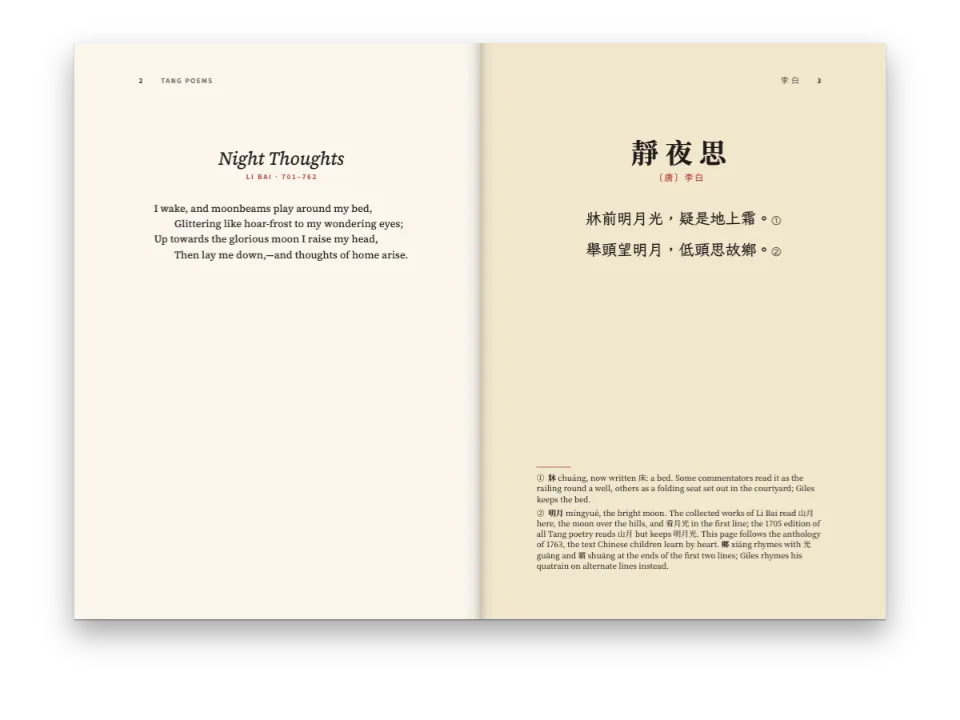
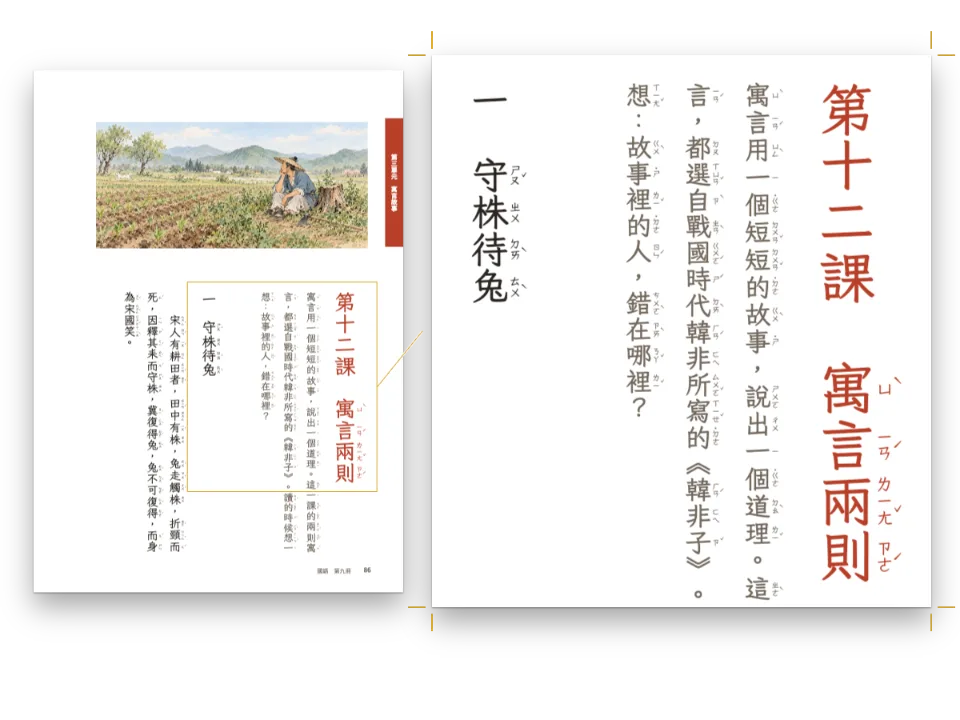
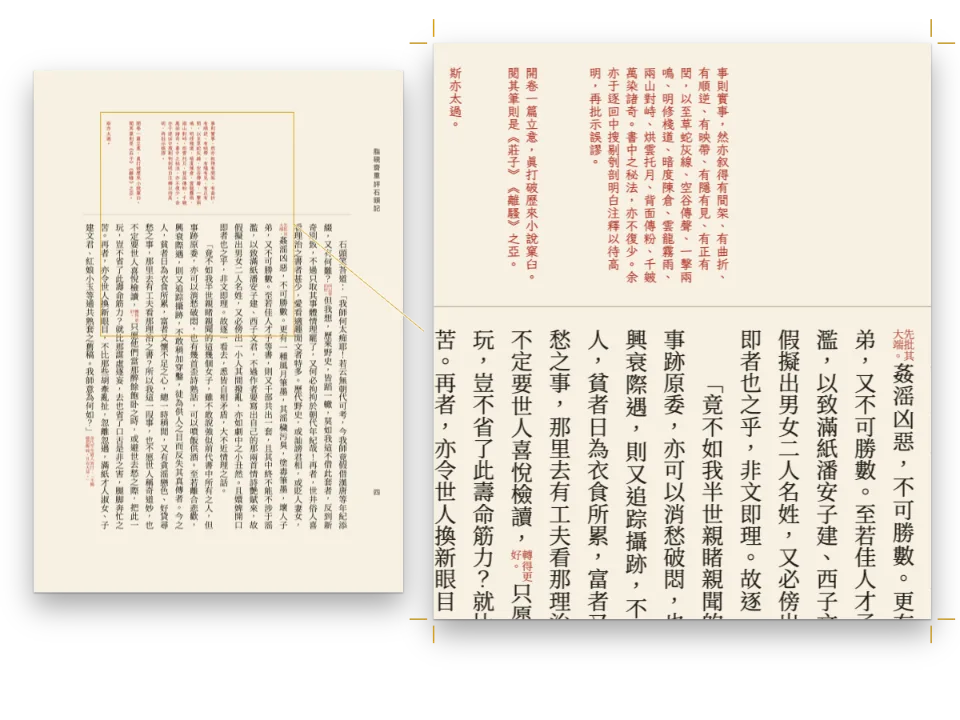
In breve
Il cinese classico come lo imparano i lettori giapponesi: piccoli segni rossi accanto ai caratteri dicono in che ordine leggerli e quali desinenze giapponesi aggiungere, e la lettura giapponese completa segue ogni passo.
Che cosa comporrai
Tre pagine di un’antologia scolastica giapponese di 漢文 (kanbun), il cinese classico letto come giapponese, su una pagina A5 rilegata a destra: tre detti dei Dialoghi di Confucio e la quartina Spring Dawn di Meng Haoran. Ogni passo è composto in Zen Old Mincho a 15 pt nell’ordine cinese, con i suoi 訓点 (kunten) accanto ai caratteri in vermiglione, a metà del loro corpo: i segni di ritorno (返り点) in basso a sinistra di un carattere dicono al lettore di proseguire e tornarci dopo, e gli okurigana (送り仮名) alla sua destra aggiungono le desinenze giapponesi. Sotto ogni passo il suo 書き下し文 (yomikudashi), lo stesso testo riscritto in giapponese, scorre in Klee One, una grafia da libro di scuola, con i furigana dove una lettura è difficile. I classici cinesi con i loro ausili di lettura sono nella Nº 080.
Questa ricetta risponde a
- Come stampo il kanbun con i suoi segni di ritorno e gli okurigana?
- Come aggiungo i furigana sopra i kanji, una lettura per carattere o una per l’intera parola?
La risposta breve
// :kunten[習]{kaeri="レ" okuri="フ"} sets the return mark small at the character's lower
// left and the okurigana at its lower right, down the line; the text keeps its Chinese
// order, which the reader follows by the marks. cjk.kunten sizes and colours them: half
// the character, in vermilion. The Japanese reading under each passage is plain kana and
// kanji with furigana: {君子|くん|し} gives each character its reading (jukugo ruby).
const cjk = {
  grid: { enabled: true, charsPerLine: CHARS, linesPerPage: LINES },
  kunten: { fontSize: em(0.5), color: col('vermilion'), placement: 'inline' },
};
const paragraphStyles = [
  // The text: 15 pt on a pitch of two grid lines, room for the okurigana beside it. A
  // quatrain takes two lines, a couplet to the line with a space between its verses.
  { id: 'kanbun', fontFamily: MINCHO, fontSize: pt(KANBUN), lineHeight: pt(2 * LEAD),
    firstLineIndent: em(0), textAlign: 'justify' },
  { id: 'shi', fontFamily: MINCHO, fontSize: pt(KANBUN), lineHeight: pt(2 * LEAD),
    indent: em(2), firstLineIndent: em(0), marginTop: pt(0), marginBottom: pt(0) },
  // The reading (書き下し文), two characters down in a school-book hand.
  { id: 'kudashi', indent: em(2), firstLineIndent: em(0), marginTop: pt(LEAD) },
  { id: 'kudashi-shi', indent: em(4), firstLineIndent: em(0), marginTop: pt(0),
    marginBottom: pt(0) },
];
Ingredienti
- Funzionalità
- Segni di lettura del kanbun (kunten)Furigana: letture in kana sopra i kanjiTesto verticaleLibri rilegati a destraRuby: letture in pinyin e zhuyinStili di paragrafoTitoli su più righe di testo (gyōdori)Kana, kanji e rōmajiDivisione in righe del giapponese (kinsoku)Numeri giapponesi e contatori in kanaGriglia dei caratteriFont cinesi, giapponesi e coreaniStili di titoloAperture progettateTestatine e folioTestatine secondo il ruolo della paginaMargini speculariTavolozza di colori semanticaEsportazione in PDF
- Usa anche
- Divisione in righe del cineseAttributi dei titoliColore della cartaFont incorporati nel PDFPagine preliminari in numeri romaniTestatine per sezione
- Tipo
- Zen Old Mincho, Klee One, Noto Sans JP (SIL OFL 1.1)
- Risorse
- Nessuna: ogni immagine è disegnata nel codice
Preparazione
#1 · Segna ogni carattere con :kunten
Il codice è nella risposta breve qui sopra. :kunten[習]{kaeri="レ" okuri="フ"} dà a 習 il segno di ritorno レ e l’okurigana フ; il testo conserva il carattere, quindi la ricerca, la copia e il PDF leggono il passo come è scritto, e i segni non prendono nessun carattere del testo (Segni, ruby e warichu). Leggi 学ビテ而時ニ習フレ之ヲ: レ su 習 manda il lettore prima a 之 e poi indietro, 之を習ふ; 而 non ha segni e non si legge. Nel testo verticale il segno di ritorno sta in basso a sinistra del suo carattere e occupa mezzo carattere della riga, e gli okurigana stanno a destra, a partire da metà altezza del carattere, come li compone JIS X 4051. cjk.kunten ne fissa il corpo, la metà di quello del testo, e il colore, il vermiglione con cui li scrive un lettore; un passo è a 15 pt su due righe della griglia, il che lascia 27 pt accanto a ogni riga per gli okurigana.
#2 · Salta con 一 二 e con 一レ
I numeri portano il lettore più indietro. In 不二亦タ説バシカラ一乎 il lettore salta 不, che ha 二, legge 亦た説ばしから, e a 一 risale a 不: 亦た説ばしからずや. In 為政 il segno combinato 一レ su 為 fa entrambe le cose: 可二以テ為一レ師ト矣 si legge 以て, 師と (レ), 為る, poi di nuovo a 可 (da 一 a 二), 以て師と為るべし. I code point kanbun ㆑ ㆒ ㆓ si leggono come i caratteri che rappresentano, quindi un testo copiato da altrove conserva i suoi segni.
#3 · Lascia che gli okurigana lunghi spingano avanti il carattere successivo
Un okurigana più lungo del suo carattere non scorre accanto al successivo: in 花落ツルコト知ル多少 i quattro kana di ツルコト occupano la lunghezza di due caratteri, e 知 scende per cominciare dopo di loro, come li compone JIS X 4051 (§5.6.4). La riga cresce; il suo a capo successivo si sposta con lei.
#4 · Dai a ogni passo un’etichetta alta due righe
const at = (down, across) => ({ anchor: { to: 'container', edge: 'top-left' },
  offset: { x: pt(down), y: pt(across) } });
const TITLE = 26; // pt
const part = { level: 1, breakBefore: { enabled: true, parity: 'any' },
  advancedDesign: { enabled: true, minHeight: pt(5 * LEAD), slot: { elements: [
    { kind: 'text', id: 'title', content: '{titleText}', fontFamily: MINCHO, fontWeight: 700,
      fontSize: pt(TITLE), lineHeight: 1, letterSpacing: pt(TITLE / 2), color: col('ink'),
      placement: at(2 * BODY, 2 * LEAD - TITLE / 2) },
    { kind: 'text', id: 'kicker', content: '{attr.kicker}', fontFamily: GOTHIC, fontSize: pt(8.5),
      letterSpacing: pt(2), color: col('vermilion'), placement: at(2 * BODY + 3 * TITLE + 18,
        2 * LEAD - 8.5 / 2) },
  ] } } };
// 2行取り, the passage's book and number in gothic, two characters down.
const passage = { level: 2, fontFamily: GOTHIC, fontWeight: 700, fontSize: pt(9.5),
  color: col('muted'), lineSpan: 2, indent: em(2) };
Ogni libro dell’antologia apre una pagina con il suo titolo, 論語 o 唐詩, il primo con una piccola nota vermiglione su ciò che contiene; ogni passo riceve un’etichetta in gotico larga due righe di testo (2行取り), 学而第一 o 春暁 孟浩然, così i passi sotto di essa restano sulla griglia. La lettura è un blocco :::paragraphs{style="kudashi"} abbassato di due caratteri, nel carattere e nel corpo del testo, con furigana jukugo: {君子|くん|し} dà a ogni carattere la sua lettura, così una riga potrebbe andare a capo tra di loro.
#5 · Carica ogni voce con i suoi caratteri
const FENCE = /:::paragraphs\{style="([\w-]+)"\}\n([\s\S]*?)\n:::/g;
const fence = (style) => [...markdown.matchAll(FENCE)].filter((m) => m[1] === style)
  .map((m) => m[2]).join('');
const kanbun = `${fence('kanbun')}${fence('shi')}`; // the text and its marks' kana
const reading = `${fence('kudashi')}${fence('kudashi-shi')}`;
const heads = markdown.match(/^#+ [^{\n]*/gm).join('');
const colophon = markdown.match(/colophon="([^"]*)"/)[1];
await loadFonts(FONTS, markdown); // the Latin files: the colophon
await loadCjkFonts({ [MINCHO]: ['400'] }, kanbun, { vertical: true });
await loadCjkFonts({ [MINCHO]: ['700'] }, heads);
await loadCjkFonts({ [KYOKASHO]: ['400'] }, reading, { vertical: true });
await loadCjkFonts({ [GOTHIC]: ['400', '700'] },
  `${heads}${colophon}${markdown.match(/kicker="([^"]*)"/)[1]}漢文訓読一二三四五六七八九十`,
  { vertical: true });
Il testo classico e la lettura sono composti in caratteri diversi, quindi ognuno carica i file per i propri glifi: Zen Old Mincho per i passi e i loro segni, i cui kana stanno dentro gli attributi di :kunten, Klee One per le letture e i loro furigana, Noto Sans JP per le etichette. La quartina è composta con due versi per riga e uno spazio ideografico tra loro, un modo comune di stamparla, così la poesia e la sua lettura stanno nella pagina sotto il titolo.
La ricetta completa
// ═══ Postext Cookbook · Nº 122 · Kanbun with its reading marks, and the Japanese reading ═══ // https://postext.dev/en/cookbook/kanbun-kundoku // Code: MIT · Text: 論語, 孟浩然「春暁」 (public domain); kunten and readings CC BY 4.0 // Fonts: Zen Old Mincho, Klee One, Noto Sans JP (SIL OFL 1.1) · Needs postext ≥ 1.25.0 import { buildDocument, withLoadedFonts, renderPageToCanvas, loadVerticalAlternates, } from 'https://esm.sh/postext'; import { renderToPdf, decompressWoff2 } from 'https://esm.sh/postext-pdf'; const LANG = 'en'; // @lang: the language of the colophon; the page is Japanese in both const RECIPE = 'kanbun-kundoku'; // ─── 1 · Design ───────────────────────────────────────────────────────────── // #region palette: ink, the vermilion of hand-written kunten, a school-book paper const palette = { ink: '#1e1c1a', // the text vermilion: '#c0392b', // 朱: the reading marks, as a reader adds them by hand muted: '#6a635c', // the headings' labels, the folios paper: '#fcfbf7', }; const col = (id) => ({ hex: palette[id], model: 'hex', paletteId: id }); const colorPalette = [ ...Object.entries(palette).map(([id, hex]) => ({ id, name: id, value: { hex, model: 'hex' } })), { id: 'main-color', name: 'defaults', value: { hex: palette.vermilion, model: 'hex' } }, ]; // #endregion const [MINCHO, KYOKASHO, GOTHIC] = ['Zen Old Mincho', 'Klee One', 'Noto Sans JP']; const [BODY, LEAD, CHARS, LINES] = [10.5, 21, 36, 16]; // pt, pt: 36字 × 16行, a 2 em pitch const KANBUN = 15; // pt: the classical text, set larger on two lines of the grid // #region answer: kanbun with 返り点 and 送り仮名, its yomikudashi beside it in furigana // :kunten[習]{kaeri="レ" okuri="フ"} sets the return mark small at the character's lower // left and the okurigana at its lower right, down the line; the text keeps its Chinese // order, which the reader follows by the marks. cjk.kunten sizes and colours them: half // the character, in vermilion. The Japanese reading under each passage is plain kana and // kanji with furigana: {君子|くん|し} gives each character its reading (jukugo ruby). const cjk = { grid: { enabled: true, charsPerLine: CHARS, linesPerPage: LINES }, kunten: { fontSize: em(0.5), color: col('vermilion'), placement: 'inline' }, }; const paragraphStyles = [ // The text: 15 pt on a pitch of two grid lines, room for the okurigana beside it. A // quatrain takes two lines, a couplet to the line with a space between its verses. { id: 'kanbun', fontFamily: MINCHO, fontSize: pt(KANBUN), lineHeight: pt(2 * LEAD), firstLineIndent: em(0), textAlign: 'justify' }, { id: 'shi', fontFamily: MINCHO, fontSize: pt(KANBUN), lineHeight: pt(2 * LEAD), indent: em(2), firstLineIndent: em(0), marginTop: pt(0), marginBottom: pt(0) }, // The reading (書き下し文), two characters down in a school-book hand. { id: 'kudashi', indent: em(2), firstLineIndent: em(0), marginTop: pt(LEAD) }, { id: 'kudashi-shi', indent: em(4), firstLineIndent: em(0), marginTop: pt(0), marginBottom: pt(0) }, ]; // #endregion // #region headings: each part opens a page; each passage under a two-line label const at = (down, across) => ({ anchor: { to: 'container', edge: 'top-left' }, offset: { x: pt(down), y: pt(across) } }); const TITLE = 26; // pt const part = { level: 1, breakBefore: { enabled: true, parity: 'any' }, advancedDesign: { enabled: true, minHeight: pt(5 * LEAD), slot: { elements: [ { kind: 'text', id: 'title', content: '{titleText}', fontFamily: MINCHO, fontWeight: 700, fontSize: pt(TITLE), lineHeight: 1, letterSpacing: pt(TITLE / 2), color: col('ink'), placement: at(2 * BODY, 2 * LEAD - TITLE / 2) }, { kind: 'text', id: 'kicker', content: '{attr.kicker}', fontFamily: GOTHIC, fontSize: pt(8.5), letterSpacing: pt(2), color: col('vermilion'), placement: at(2 * BODY + 3 * TITLE + 18, 2 * LEAD - 8.5 / 2) }, ] } } }; // 2行取り, the passage's book and number in gothic, two characters down. const passage = { level: 2, fontFamily: GOTHIC, fontWeight: 700, fontSize: pt(9.5), color: col('muted'), lineSpan: 2, indent: em(2) }; // #endregion const foreEdge = (id, content, edge, y, pages) => ({ kind: 'text', id, content, pages, writingMode: 'vertical-rl', fontFamily: GOTHIC, fontSize: pt(7.5), letterSpacing: pt(1), color: col('muted'), placement: { anchor: { to: 'outer', edge }, offset: { y: em(y) } } }); const header = { elements: [ foreEdge('hashira', '{title} {chapterTitle}', 'top', 3, 'body'), foreEdge('folio', '{pageNumber}', 'bottom', -3, 'all'), ] }; // The first part's opening page carries the colophon across the foot. const first = { id: 'first', footer: { elements: [{ kind: 'text', id: 'colophon', content: '{attr.colophon}', pages: 'opener', fontFamily: GOTHIC, fontSize: pt(5.5), lineHeight: 1.45, color: col('muted'), overflow: 'wrap', align: 'center', placement: { anchor: { to: 'page', edge: 'bottom' }, offset: { y: mm(-7) }, size: { width: mm(118) } } }] } }; const config = () => ({ locale: 'ja', // written out, never LANG (gotcha: ja-locale-tag) colorPalette, page: { sizePreset: 'custom', width: mm(148), height: mm(210), dpi: 150, // A5 backgroundColor: col('paper'), margins: { top: mm(40), bottom: mm(32), left: mm(13), right: mm(16), mirror: true }, pageNumbering: { format: 'japanese-informal' }, }, layout: { layoutType: 'single', writingMode: 'vertical-rl' }, cjk, bodyText: { fontFamily: KYOKASHO, fontSize: pt(BODY), lineHeight: pt(LEAD), color: col('ink'), boldColor: col('ink'), italicColor: col('ink'), referenceColor: col('ink'), textAlign: 'justify', firstLineIndent: em(1), indentAfterHeading: true, }, headings: { fontFamily: MINCHO, color: col('ink'), levels: [part, passage] }, headingStyles: [first], paragraphStyles, header, footer: { elements: [] }, }); // ─── 2 · Content ──────────────────────────────────────────────────────────── const markdown = String.raw`---Esempio Markdown · 50 righe · content.en.md
title: "漢文訓読" --- # 論語 {style="first" kicker="学而・為政より" colophon="Confucius, 論語 (the Analects), three sayings from the books 學而 and 爲政; Meng Haoran, 春曉 (Spring Dawn). Kunten and reading after the usual school reading, set for this recipe. Set in Zen Old Mincho, Klee One and Noto Sans JP (SIL OFL)."} ## 学而第一 :::paragraphs{style="kanbun"} 子:kunten[曰]{okuri="ハク"}、:kunten[学]{okuri="ビテ"}而:kunten[時]{okuri="ニ"}:kunten[習]{kaeri="レ" okuri="フ"}:kunten[之]{okuri="ヲ"}、:kunten[不]{kaeri="二"}:kunten[亦]{okuri="タ"}:kunten[説]{kaeri="一" okuri="バシカラ"}乎。:kunten[有]{kaeri="レ" okuri="リ"}朋:kunten[自]{kaeri="二" okuri="リ"}遠:kunten[方]{kaeri="一"}:kunten[来]{okuri="タル"}、:kunten[不]{kaeri="二"}:kunten[亦]{okuri="タ"}:kunten[楽]{kaeri="一" okuri="シカラ"}乎。人:kunten[不]{kaeri="レ" okuri="シテ"}:kunten[知]{okuri="ラ"}而:kunten[不]{kaeri="レ"}:kunten[慍]{okuri="ミ"}、:kunten[不]{kaeri="二"}:kunten[亦]{okuri="タ"}君:kunten[子]{kaeri="一" okuri="ナラ"}乎。 ::: :::paragraphs{style="kudashi"} 子{曰|い}はく、{学|まな}びて時に{之|これ}を習ふ、{亦|ま}た{説|よろこ}ばしからずや。{朋|とも}有り{遠方|えん|ぽう}より来たる、{亦|ま}た楽しからずや。人知らずして{慍|うら}みず、{亦|ま}た{君子|くん|し}ならずや。 ::: ## 学而第三 :::paragraphs{style="kanbun"} 子:kunten[曰]{okuri="ハク"}、巧言令色、:kunten[鮮]{okuri="ナシ"}矣仁。 ::: :::paragraphs{style="kudashi"} 子{曰|い}はく、{巧言令色|こう|げん|れい|しょく}、{鮮|すく}なし{仁|じん}。 ::: ## 為政第十一 :::paragraphs{style="kanbun"} 子:kunten[曰]{okuri="ハク"}、:kunten[温]{kaeri="レ" okuri="メテ"}:kunten[故]{okuri="キヲ"}而:kunten[知]{kaeri="レ" okuri="レバ"}:kunten[新]{okuri="シキヲ"}、:kunten[可]{kaeri="二" okuri="シ"}:kunten[以]{okuri="テ"}:kunten[為]{kaeri="一レ" okuri="ル"}:kunten[師]{okuri="ト"}矣。 ::: :::paragraphs{style="kudashi"} 子{曰|い}はく、{故|ふる}きを{温|あたた}めて新しきを知れば、{以|もっ}て師と{為|な}るべし。 ::: # 唐詩 ## 春暁 孟浩然 :::paragraphs{style="shi"} 春眠:kunten[不]{kaeri="レ"}:kunten[覚]{kaeri="レ" okuri="エ"}:kunten[暁]{okuri="ヲ"} 処処:kunten[聞]{kaeri="二" okuri="ク"}啼:kunten[鳥]{kaeri="一" okuri="ヲ"} 夜来風:kunten[雨]{okuri="ノ"}声 花:kunten[落]{okuri="ツルコト"}:kunten[知]{okuri="ル"}多少 ::: :::paragraphs{style="kudashi-shi"} {春眠|しゅん|みん}{暁|あかつき}を{覚|おぼ}えず {処処|しょ|しょ}{啼鳥|てい|ちょう}を聞く {夜来|や|らい}{風雨|ふう|う}の声 花落つること知る{多少|た|しょう} :::`; // content.<lang>.md: the same Japanese text in both // ─── 3 · Fonts ────────────────────────────────────────────────────────────── const FONTS = { 'Zen Old Mincho': ['400', '700'], // the classical text and its marks; the part titles 'Klee One': ['400'], // the reading, in a school-book hand 'Noto Sans JP': ['400', '700'], // labels, the hashira and folios, the colophon }; // ─── 4 · Build & show ─────────────────────────────────────────────────────── // #region voices: each face loads the files that hold the characters it sets const FENCE = /:::paragraphs\{style="([\w-]+)"\}\n([\s\S]*?)\n:::/g; const fence = (style) => [...markdown.matchAll(FENCE)].filter((m) => m[1] === style) .map((m) => m[2]).join(''); const kanbun = `${fence('kanbun')}${fence('shi')}`; // the text and its marks' kana const reading = `${fence('kudashi')}${fence('kudashi-shi')}`; const heads = markdown.match(/^#+ [^{\n]*/gm).join(''); const colophon = markdown.match(/colophon="([^"]*)"/)[1]; await loadFonts(FONTS, markdown); // the Latin files: the colophon await loadCjkFonts({ [MINCHO]: ['400'] }, kanbun, { vertical: true }); await loadCjkFonts({ [MINCHO]: ['700'] }, heads); await loadCjkFonts({ [KYOKASHO]: ['400'] }, reading, { vertical: true }); await loadCjkFonts({ [GOTHIC]: ['400', '700'] }, `${heads}${colophon}${markdown.match(/kicker="([^"]*)"/)[1]}漢文訓読一二三四五六七八九十`, { vertical: true }); // #endregion const doc = await withLoadedFonts(() => buildDocument({ markdown }, config()), { ...kitFonts(FONTS), text: markdown }); showBook(doc, { title: t({ en: 'Kanbun with its reading marks, and the Japanese reading', es: 'Kanbun con sus marcas de lectura y la lectura japonesa' }) }); offerPdf(() => renderToPdf(doc, { fontProvider: cjkPdfProvider }), `${RECIPE}.pdf`);Kit · core, fonts, viewer, pdf, cjk: uguale in ogni ricetta · 458 righe
// ─── Kit ── helpers shared by every Cookbook recipe · postext.dev/cookbook ───── // ─── Kit · core v1 ── the same in every recipe · postext.dev/cookbook function mm(value) { return { value, unit: 'mm' }; } function pt(value) { return { value, unit: 'pt' }; } function em(value) { return { value, unit: 'em' }; } /** The sample language's string: t({ en: 'Figure', es: 'Figura' }). */ function t(strings) { return strings[LANG] ?? Object.values(strings)[0]; } /** A file in this recipe's assets folder, served from the Postext repo by jsDelivr. */ function asset(file) { return `https://cdn.jsdelivr.net/gh/drnachio/postext@main/cookbook/${RECIPE}/assets/${file}`; } // ─── Kit · fonts v3 ── the same in every recipe · postext.dev/cookbook // Postext loads the faces a config asks for before layout (prepareFonts, // buildDocumentWithFonts) and asks the kit for the files: Fontsource's, the // files the PDF embeds too. /** The options of buildDocumentWithFonts / prepareFonts / withLoadedFonts: * the Fontsource resolver, and the faces of FONTS loaded with the ones the * config names. FONTS = { 'Family Name': ['400', '400i', '700'] }. */ function kitFonts(FONTS = {}) { const faces = Object.entries(FONTS).flatMap(([family, specs]) => specs.map((spec) => ({ family, weight: parseInt(spec, 10), style: spec.endsWith('i') ? 'italic' : 'normal' }))); return { resolve: fontsourceResolver, faces }; } /** A face's Fontsource files, in a fixed order: latin, then latin-ext and greek * when `text` needs them and the family ships them (kitSubsetsFor), each with * its unicode-range. Null for a weight or slant Fontsource does not ship. */ async function fontsourceResolver(family, weight, style, { text = '' } = {}) { const id = fontsourceId(family); const meta = await fontsourceMeta(family); if (meta && !(meta.weights.includes(weight) && meta.styles.includes(style))) return null; kitStatus('Loading fonts…'); const at = await fontsourceAt(id); return ['latin', ...kitSubsetsFor(text, meta)].map((subset) => ({ source: `${at}files/${id}-${subset}-${weight}-${style}.woff2`, unicodeRange: kitRanges()[subset], })); } /** The unicode-range of each Fontsource file the kit loads (a function: the * kit is inlined after the pen's code, which runs before a const would be set). */ function kitRanges() { return { latin: 'U+0000-00FF,U+0131,U+0152-0153,U+02BB-02BC,U+02C6,U+02DA,U+02DC,U+0304,U+0308,U+0329,' + 'U+2000-206F,U+20AC,U+2122,U+2191,U+2193,U+2212,U+2215,U+FEFF,U+FFFD', 'latin-ext': 'U+0100-02BA,U+02BD-02C5,U+02C7-02CC,U+02CE-02D7,U+02DD-02FF,U+0304,U+0308,U+0329,' + 'U+1D00-1DBF,U+1E00-1E9F,U+1EF2-1EFF,U+2020,U+20A0-20AB,U+20AD-20C0,U+2113,U+2C60-2C7F,U+A720-A7FF', greek: 'U+0370-03FF', }; } /** For the cjk, arabic and comics blocks, which add their own files: the * faces of `faces` = { 'Family Name': ['400', '400i', '700'] }. `text` is the sample: * č ł † α χ also load latin-ext and greek files (kitSubsetsFor). With * `optional`, a face Fontsource does not ship is skipped instead of failing. * The files are added once all have loaded, in the order asked (latin, then * latin-ext, then greek), whatever order they arrive in: the last one added * wins a character two files hold. Resolves to the number of faces added. */ async function loadFonts(faces, text = '', { optional = false } = {}) { kitStatus('Loading fonts…'); const ranges = kitRanges(); const jobs = []; for (const [family, specs] of Object.entries(faces)) { const id = fontsourceId(family); const todo = [...new Set(specs)].map((spec) => [parseInt(spec, 10), spec.endsWith('i') ? 'italic' : 'normal']) .filter(([weight, style]) => !hasFace(family, weight, style)); // before any await const at = fontsourceAt(id); const meta = optional || /[^\0-ÿ]/u.test(text) ? await fontsourceMeta(family) : null; const subsets = ['latin', ...kitSubsetsFor(text, meta)]; for (const [weight, style] of todo) { if (optional && !(meta?.weights.includes(weight) && meta.styles.includes(style))) continue; for (const subset of subsets) { const url = `${await at}files/${id}-${subset}-${weight}-${style}.woff2`; const face = new FontFace(family, `url(${url}) format('woff2')`, { weight: String(weight), style, unicodeRange: ranges[subset] }); jobs.push(face.load().catch(() => { if (subset === 'latin' && !optional) throw new Error(`Fontsource has no ${family} ${weight} ${style}`); })); } } } const ready = await Promise.all(jobs).catch((error) => { kitFail(error); throw error; }); return ready.filter((face) => face && document.fonts.add(face)).length; } /** A loaded FontFace covers this family, weight and style (fonts.check() would * also say yes for families nobody declared). */ function hasFace(family, weight, style) { for (const face of document.fonts) { if (face.status !== 'loaded' || face.style !== style) continue; if (face.family.replace(/^["']|["']$/g, '') !== family) continue; const [low, high = low] = face.weight.split(' ').map(Number); if (weight >= low && weight <= high) return true; } return false; } /** The files beyond latin `text` needs that `meta`'s family ships. */ function kitSubsetsFor(text, meta) { return [[/[Ā-˿ᴀ-ᶿḀ-ỿ†ℓⱠ-Ɀ꜠-ꟿ]/u, 'latin-ext'], [/[Ͱ-Ͽ]/u, 'greek']] .filter(([re, x]) => re.test(text) && meta?.subsets?.includes(x)).map(([, x]) => x); } /** Fontsource's id for a family: 'Source Serif 4' → 'source-serif-4'. */ function fontsourceId(family) { return family.toLowerCase().replace(/\s+/g, '-'); } /** A package's folder at the one version @5 names now (#766). */ function fontsourceAt(id, u = `https://cdn.jsdelivr.net/npm/@fontsource/${id}@`) { return (fontsourceAt.c ??= {})[id] ??= fetch(u + '5/package.json').then((r) => r.json()) .then((p) => p.version || 5, () => 5).then((v) => `${u}${v}/`); } /** The family's Fontsource metadata (weights, styles, subsets), or null. */ function fontsourceMeta(family) { fontsourceMeta.cache ??= new Map(); const id = fontsourceId(family); if (!fontsourceMeta.cache.has(id)) { fontsourceMeta.cache.set(id, fetch(`https://api.fontsource.org/v1/fonts/${id}`) .then((res) => (res.ok ? res.json() : null), () => null)); } return fontsourceMeta.cache.get(id); } // ─── Kit · viewer v2 ── the same in every recipe · postext.dev/cookbook /** The pages as spreads on a dark desk, page 1 alone, then verso | recto, * each painted when it scrolls near. Other options go to renderPageToCanvas. */ function showPages(docs, { title, width = 460, ...render } = {}) { const root = viewer(title); const pages = [docs].flat().flatMap((doc) => doc.pages.map((page) => ({ doc, page, n: (doc.pageIndexOffset ?? 0) + page.index }))); const spreads = []; let verso = null; for (const p of pages) { if (p.n % 2 === 1) { if (verso) spreads.push([verso, null]); verso = p; } else { spreads.push([verso, p]); verso = null; } } if (verso) spreads.push([verso, null]); const density = Math.min(window.devicePixelRatio || 1, 2); showPages.painter?.disconnect(); const painter = new IntersectionObserver((entries) => { for (const { isIntersecting, target } of entries) { if (!isIntersecting) continue; painter.unobserve(target); const { doc, page } = target.postext; renderPageToCanvas(page, doc, target, { ...render, scale: (width * density) / page.width }); } }, { rootMargin: '800px' }); showPages.painter = painter; root.replaceChildren(...spreads.map((pair) => { const spread = document.createElement('div'); spread.className = 'pt-spread'; for (const p of pair) { const figure = document.createElement('figure'); if (p) { const label = p.page.pageLabel || String(p.n + 1); const canvas = document.createElement('canvas'); canvas.postext = p; canvas.style.aspectRatio = `${p.page.width} / ${p.page.height}`; canvas.setAttribute('role', 'img'); canvas.setAttribute('aria-label', `Page ${label}`); const folio = document.createElement('figcaption'); folio.textContent = label; figure.append(canvas, folio); painter.observe(canvas); } else figure.className = 'pt-blank'; spread.append(figure); } return spread; })); kitStatus(`${pages.length} ${pages.length === 1 ? 'page' : 'pages'}`); document.documentElement.dataset.postext = 'ready'; return pages.length; } /** The desk, the bar and the error reporting, created once. */ function viewer(title) { if (!document.getElementById('pt-kit')) { document.head.insertAdjacentHTML('beforeend', `<style id="pt-kit"> :root { color-scheme: dark; } body { margin: 0; background: #0e1014; color: #b9bcc4; font: 13px/1.45 system-ui, sans-serif; } #pt-bar { position: sticky; top: 0; z-index: 1; display: flex; flex-wrap: wrap; align-items: center; gap: 6px 16px; padding: 10px 16px; background: rgb(14 16 20 / .92); backdrop-filter: blur(6px); border-bottom: 1px solid #23262d; } #pt-bar strong { color: #f4f1ea; font-weight: 600; } #pt-actions { display: flex; gap: 12px; margin-left: auto; } #pt-actions a, #pt-actions button { color: #d8a21a; font: inherit; background: none; border: 0; padding: 0; cursor: pointer; } #pages { display: grid; justify-items: center; gap: 48px; padding: 32px 16px 72px; } .pt-spread { display: flex; } .pt-spread figure { margin: 0; width: min(460px, 44vw); } .pt-spread canvas { display: block; width: 100%; background: #fff; box-shadow: 0 1px 2px rgb(0 0 0 / .5), 0 22px 44px -16px rgb(0 0 0 / .8); } .pt-spread figure:first-child canvas { box-shadow: inset -14px 0 14px -14px rgb(0 0 0 / .18), 0 1px 2px rgb(0 0 0 / .5), 0 22px 44px -16px rgb(0 0 0 / .8); } .pt-spread figcaption { margin-top: 10px; text-align: center; font: 600 10px/1 system-ui, sans-serif; letter-spacing: .18em; text-transform: uppercase; color: #6c7079; } .pt-blank { visibility: hidden; } @media (max-width: 760px) { .pt-spread { flex-direction: column; gap: 32px; } .pt-spread figure { width: min(460px, 92vw); } .pt-blank { display: none; } } </style>`); document.body.insertAdjacentHTML('afterbegin', '<header id="pt-bar"><strong id="pt-title"></strong><span id="pt-status" role="status"></span><span id="pt-actions"></span></header>'); document.getElementById('pt-title').textContent = document.title || 'Postext'; addEventListener('error', (event) => kitFail(event.error ?? event.message)); addEventListener('unhandledrejection', (event) => kitFail(event.reason)); } if (title) document.getElementById('pt-title').textContent = title; return document.getElementById('pages') ?? document.body.appendChild(Object.assign(document.createElement('main'), { id: 'pages' })); } function kitStatus(text) { viewer(); document.getElementById('pt-status').textContent = text; } function kitFail(error) { document.documentElement.dataset.postext = 'error'; kitStatus(`Error: ${error?.message ?? error}`); } // ─── Kit · pdf v3 ── the same in every recipe that exports a PDF /** The Fontsource files the screen used, as TrueType, with their range and * place: the nearest weight the family ships, upright with no italic; * latin, then what its letters need (kitSubsetsFor). */ async function fontsourceProvider(family, weight, style, request) { const id = fontsourceId(family); const meta = await fontsourceMeta(family); const weights = meta?.weights?.length ? meta.weights : [400, 700]; const w = weights.reduce((a, b) => (Math.abs(b - weight) < Math.abs(a - weight) ? b : a)); const s = style === 'italic' && meta && !meta.styles.includes('italic') ? 'normal' : style; const text = String.fromCodePoint(...(request?.codePoints ?? [])); const files = await Promise.all(['latin', ...kitSubsetsFor(text, meta)].map(async (subset, order) => { const res = await fetch(`${await fontsourceAt(id)}files/${id}-${subset}-${w}-${s}.woff2`); if (!res.ok) throw new Error(`Fontsource has no ${family} ${w} ${s} ${subset}`); return Object.assign(await decompressWoff2(new Uint8Array(await res.arrayBuffer())), { unicodeRange: kitRanges()[subset], order }); })); return files.length === 1 ? files[0] : files; } /** A "Build the PDF" button; then "Open the PDF" (a new tab: CodePen's frame * shows no PDFs) and a download link. */ function offerPdf(makePdf, filename) { viewer(); const button = Object.assign(document.createElement('button'), { type: 'button', textContent: 'Build the PDF' }); button.dataset.postextPdf = filename; button.addEventListener('click', async () => { button.disabled = true; button.textContent = 'Building the PDF…'; try { const bytes = await makePdf(); const url = URL.createObjectURL(new Blob([bytes], { type: 'application/pdf' })); const size = `${Math.max(1, Math.round(bytes.length / 1024))} KB`; button.replaceWith( Object.assign(document.createElement('a'), { href: url, target: '_blank', rel: 'noopener', textContent: 'Open the PDF ↗' }), Object.assign(document.createElement('a'), { href: url, download: filename, textContent: `Download ${filename} · ${size}` })); } catch (error) { button.disabled = false; button.textContent = 'Build the PDF'; kitFail(error); } }); document.getElementById('pt-actions').append(button); } // ─── Kit · cjk v2 ── Chinese, Japanese and Korean books · postext.dev/cookbook // Fontsource ships a CJK family as about a hundred files per weight, each // declared in its stylesheet with the unicode-range it covers. The screen // loads the files the sample touches; the PDF gets the same files for the // characters its pages set in each face, and embeds each as a subset. // A book bound on the right (vertical text) is shown with its spreads // mirrored: page 1 alone on the left of the spine, then [3 | 2]. /** The files of a Fontsource face, read from its stylesheet: { url, range, * ranges }, the last declared first (the order the browser tries them in). */ function cjkSlices(family, weight, style) { cjkSlices.cache ??= new Map(); const id = fontsourceId(family); const css = `${id}/${weight}${style === 'italic' ? '-italic' : ''}.css`; if (!cjkSlices.cache.has(css)) { let at; cjkSlices.cache.set(css, fontsourceAt(id).then((a) => fetch(at = a + css.slice(id.length + 1))) .then((res) => { if (!res.ok) throw new Error(`Fontsource has no ${family} ${weight} ${style} (${res.status})`); return res.text(); }) .then((text) => [...text.matchAll(/@font-face\s*{([^}]*)}/g)].map(([, rule]) => { const range = /unicode-range:\s*([^;]+);/.exec(rule)?.[1].trim() ?? 'U+0-10FFFF'; const ranges = range.split(',').map((part) => { const [lo, hi = lo] = part.trim().slice(2).split('-'); return [parseInt(lo, 16), parseInt(hi, 16)]; }); return { url: new URL(/url\(([^)]+?\.woff2)\)/.exec(rule)[1], at).href, range, ranges }; }).reverse())); } return cjkSlices.cache.get(css); } /** The file of `slices` the screen sets code point `cp` in, if any: the * last one loadCjkFonts adds whose range holds it. A numbered file that * repeats a letter of latin is added after latin, and wins it. */ function cjkSliceFor(slices, cp) { const holds = (slice) => slice.ranges.some(([lo, hi]) => cp >= lo && cp <= hi); return slices.reduce((last, slice) => (holds(slice) ? slice : last), undefined); } /** Whether Fontsource serves `family` as a Chinese, Japanese or Korean * family (its subsets name the script). Fails when the API does not * answer: a CJK face taken for a Latin one would paint in a system face. */ async function isCjkFamily(family) { const meta = await fontsourceMeta(family); if (!meta) throw new Error(`api.fontsource.org did not describe ${family}: reload to try again`); return !!meta.subsets?.some((subset) => /^(chinese|japanese|korean)/.test(subset)); } /** faces = { 'Noto Serif TC': ['400', '700'] }, as for loadFonts: the * whole FONTS object may be passed, its other families are left to * loadFonts. Adds one FontFace per file of each CJK face with its * unicodeRange, then loads the files `text` touches. `text` is what the * faces set: the sample for the text face; a book in several voices calls * it once per voice (loadCjkFonts({ 'LXGW WenKai TC': ['400'] }, quotes)), * so the heading and quotation faces fetch and check only their own * characters. Fails when a character of `text` is in no file of a face. * List every weight the pages use: a weight left to the engine's later round * gets the latin file only. With { vertical: true } it also loads each * family's vertical forms (brackets, quotes, pause marks) for the canvas, * which needs loadVerticalAlternates imported from postext. Resolves to * the number of files loaded. */ async function loadCjkFonts(faces, text, { vertical = false } = {}) { kitStatus('Loading fonts…'); let loaded = 0; try { if (vertical && typeof loadVerticalAlternates !== 'function') { throw new Error('loadCjkFonts(…, { vertical: true }) needs loadVerticalAlternates imported from postext'); } for (const [family, specs] of Object.entries(faces)) { if (!(await isCjkFamily(family))) continue; const twin = []; for (const spec of new Set(specs)) { const weight = parseInt(spec, 10); const style = spec.endsWith('i') ? 'italic' : 'normal'; const slices = await cjkSlices(family, weight, style); const missing = [...new Set(text)].filter((ch) => /\S/.test(ch) && !cjkSliceFor(slices, ch.codePointAt(0))); if (missing.length) { throw new Error(`${family} ${spec} has no file for ${missing.slice(0, 12).join(' ')}: ` + `give each face the text it sets (loadCjkFonts({ '${family}': ['${spec}'] }, text))`); } for (const slice of slices) { document.fonts.add(new FontFace(family, `url(${slice.url}) format('woff2')`, { weight: String(weight), style, unicodeRange: slice.range })); twin.push({ source: slice.url, weight: String(weight), style, unicodeRange: slice.range }); } const font = `${style === 'italic' ? 'italic ' : ''}${weight} 16px "${family}"`; loaded += (await document.fonts.load(font, text)).length; if (!document.fonts.check(font, text)) throw new Error(`${family} ${spec} did not load for the sample`); } // The same files under a twin name with the `vert` feature on: the // canvas paints the punctuation of vertical lines with it. if (vertical && twin.length) await loadVerticalAlternates(family, twin); } } catch (error) { kitFail(error); throw error; } return loaded; } /** The PDF font provider for recipes with CJK faces: a family whose * Fontsource subsets are Chinese, Japanese or Korean gets the files the * screen set its pages' characters in (`request.codePoints`), each marked * with its unicode-range and its place in the order loadCjkFonts added * them: postext-pdf sets a character two files hold in the one added * last, as the browser does. Any other family gets the latin file * fontsourceProvider fetches (the "pdf" block) and, when the face sets * letters only latin-ext has, that file too. */ async function cjkPdfProvider(family, weight, style, request) { if (!(await isCjkFamily(family))) return cjkLatinPdfFiles(family, weight, style, request); const meta = await fontsourceMeta(family); const weights = meta.weights?.length ? meta.weights : [400, 700]; const w = weights.reduce((a, b) => (Math.abs(b - weight) < Math.abs(a - weight) ? b : a)); const s = style === 'italic' && !meta.styles.includes('italic') ? 'normal' : style; const slices = await cjkSlices(family, w, s); const picked = new Set(); for (const cp of request?.codePoints ?? []) { const slice = cjkSliceFor(slices, cp); if (slice) picked.add(slice); } if (!picked.size) picked.add(slices[0]); return Promise.all(slices.map(async (slice, order) => { if (!picked.has(slice)) return null; const res = await fetch(slice.url); if (!res.ok) throw new Error(`Fontsource file ${slice.url} (${res.status})`); const bytes = await decompressWoff2(new Uint8Array(await res.arrayBuffer())); return Object.assign(bytes, { unicodeRange: slice.range, order }); })).then((files) => files.filter(Boolean)); } /** A Latin family set next to the CJK faces: its latin file, then its * latin-ext file when the face sets letters only latin-ext has (ō ū in * Hepburn rōmaji, ǎ in pinyin), the file loadFonts adds on screen for * them, each marked with its unicode-range and its place in that order: * the PDF sets a character in the file the browser took it from. A face * Fontsource ships without latin-ext, or whose file does not come, gets * latin alone, and the PDF names the letters it lacks. */ async function cjkLatinPdfFiles(family, weight, style, request) { const meta = await fontsourceMeta(family); const beyond = [...(request?.codePoints ?? [])].some(cjkLatinExtOnly); if (!beyond || !meta?.subsets?.includes('latin-ext')) return fontsourceProvider(family, weight, style); const weights = meta.weights?.length ? meta.weights : [400, 700]; const w = weights.reduce((a, b) => (Math.abs(b - weight) < Math.abs(a - weight) ? b : a)); const s = style === 'italic' && !meta.styles.includes('italic') ? 'normal' : style; const id = fontsourceId(family); const url = `${await fontsourceAt(id)}files/${id}-latin-ext-${w}-${s}.woff2`; const [latin, ext] = await Promise.all([fontsourceProvider(family, weight, style), fetch(url) .then(async (res) => (res.ok ? decompressWoff2(new Uint8Array(await res.arrayBuffer())) : null), () => null)]); const ranges = kitRanges(); return ext ? [Object.assign(latin, { unicodeRange: ranges.latin, order: 0 }), Object.assign(ext, { unicodeRange: ranges['latin-ext'], order: 1 })] : latin; } /** Whether code point `cp` is in Fontsource's latin-ext file and not in * its latin file: Latin Extended-A and -B, IPA, the spacing modifiers and * Latin Extended Additional (loadFonts's test for latin-ext), less the * few latin holds too (ı Œ œ ʻ ʼ ˆ ˚ ˜). */ function cjkLatinExtOnly(cp) { if (!((cp >= 0x100 && cp <= 0x2ff) || (cp >= 0x1e00 && cp <= 0x1eff))) return false; return ![0x131, 0x152, 0x153, 0x2bb, 0x2bc, 0x2c6, 0x2da, 0x2dc].includes(cp); } /** showPages for a book bound on either edge. A right-bound book (the * document says so: doc.binding is 'right' for page.binding 'right' and * for vertical text) lies on the desk as it opens: page 1 alone on the * left of the spine, then [3 | 2], the spine shade on each page's inner * edge. `binding` ('left' | 'right') overrides the document's. */ function showBook(docs, { binding, ...options } = {}) { const count = showPages(docs, options); const right = (binding ?? [docs].flat()[0]?.binding) === 'right'; if (!document.getElementById('pt-kit-cjk')) { // The pages keep direction ltr: a canvas draws text in the direction its // element inherits, and under rtl each run would end where the engine // starts it, its brackets mirrored. document.head.insertAdjacentHTML('beforeend', `<style id="pt-kit-cjk"> .pt-spread[dir="rtl"] canvas { direction: ltr; } .pt-spread[dir="rtl"] figure:first-child canvas { box-shadow: inset 14px 0 14px -14px rgb(0 0 0 / .18), 0 1px 2px rgb(0 0 0 / .5), 0 22px 44px -16px rgb(0 0 0 / .8); } </style>`); } // Each pair stays [verso, recto] in the page; right to left, the verso // sits on the right. Phones stack the pages in reading order either way. for (const spread of document.querySelectorAll('#pages > .pt-spread')) spread.dir = right ? 'rtl' : 'ltr'; document.getElementById('pages').dataset.binding = right ? 'right' : 'left'; return count; } // ─── /Kit ───────────────────────────────────────────────────────────────────────
Lo script.js composto funziona così com’è: incollalo nello script modulo di qualsiasi pagina, oppure apri la ricetta su CodePen. Cartella della ricetta su GitHub ↗ (si apre in una nuova scheda)
Varianti
#Stampa i segni in nero
Un’antologia stampata compone i kunten con l’inchiostro del testo; togli il colore.
-  kunten: { fontSize: em(0.5), color: col('vermilion'), placement: 'inline' },
+ kunten: { fontSize: em(0.5), placement: 'inline' },#Componi i segni tra le righe
placement: 'interlinear' toglie i segni di ritorno dalla riga e li mette nello spazio accanto alla metà inferiore del carattere, così il passo mantiene la spaziatura del testo nudo (白文). JIS li compone in linea, l’impostazione predefinita.
-  kunten: { fontSize: em(0.5), color: col('vermilion'), placement: 'inline' },
+ kunten: { fontSize: em(0.5), color: col('vermilion'), placement: 'interlinear' },Errori frequenti
Errore frequente
Assegna a un testo giapponese il tag 'ja', mai zh-Hans o LANG
Le edizioni di una ricetta sono en ed es, ma un esempio giapponese è giapponese in entrambe: `locale: LANG` gli darebbe il tag inglese o spagnolo, e un tag cinese lo comporrebbe con le regole cinesi (punteggiatura Kaiming, kana piccoli liberi di aprire una riga, 图 per 図, forme cinesi dei glifi nel PDF). Da postext 1.30 il tag è anche la lingua usata per lo shaping del testo (misura, disegno e incorporamento), quindi qualunque tag diverso da 'ja' dà forme dei glifi diverse da quelle giapponesi (quelle cinesi con un tag cinese) e altri a capo. Scrivi 'ja': sceglie la regione Giappone (divisione in righe e punteggiatura JLReq, segni d’enfasi a sesamo, spaziatura dei furigana, etichette 図 e 表) e disattiva la sillabazione. Il lint fa fallire un testo con kana sotto un tag zh o ko. Divisione in righe del giapponese (kinsoku) →
Errore frequente
I caratteri cinesi si caricano a fette, tramite il blocco cjk
Fontsource serve una famiglia cinese, giapponese o coreana come un centinaio di file per peso, ognuno dei quali copre un intervallo di caratteri. loadFonts scarica solo il file latin, così a schermo i caratteri Han vengono da un font di sistema e sono misurati male, e fontsourceProvider passa al PDF quel file latin, che li stampa come riquadri vuoti. Elenca il blocco cjk del kit, chiama loadCjkFonts(FONTS, markdown) dopo loadFonts (una volta per voce tipografica, con il testo che compone, quando il libro usa più caratteri CJK) e passa a renderToPdf fontProvider: cjkPdfProvider: entrambi prendono i file che contengono i caratteri del testo. Font cinesi, giapponesi e coreani →
Errore frequente
Un libro rilegato a destra mostra le doppie pagine con showBook
In un libro rilegato a destra (testo arabo, ebraico o persiano, cinese verticale, o page.binding 'right') la pagina 1 resta il recto, ma sta a sinistra del dorso, e le coppie si leggono [3 | 2]. showPages dispone ogni libro come rilegato a sinistra; showBook del blocco book (il blocco cjk porta la stessa funzione) legge doc.binding e rispecchia le coppie. capture.hero indica comunque una doppia pagina in ordine di lettura, [verso, recto]: [2, 3]. Libri rilegati a destra →
Crediti
- Ricetta
- Ignacio Ferro
- Testo
- 論語 (the Analects of Confucius), 學而 1 and 3, 爲政 11, and 孟浩然「春曉」 (Spring Dawn), in shinjitai; the kunten (返り点, 送り仮名) and the yomikudashi follow the usual Japanese school reading and were set for this recipe (CC BY 4.0) · Confucius and his disciples; Meng Haoran; Ignacio Ferro (kunten and reading) · pubblico dominio
- Font
- Zen Old Mincho (SIL OFL 1.1) · Klee One (SIL OFL 1.1) · Noto Sans JP (SIL OFL 1.1)
- Codice
- MIT, come Postext
Modifica questo testo ↗ (si apre in una nuova scheda)Cartella della ricetta su GitHub ↗ (si apre in una nuova scheda)