In breve
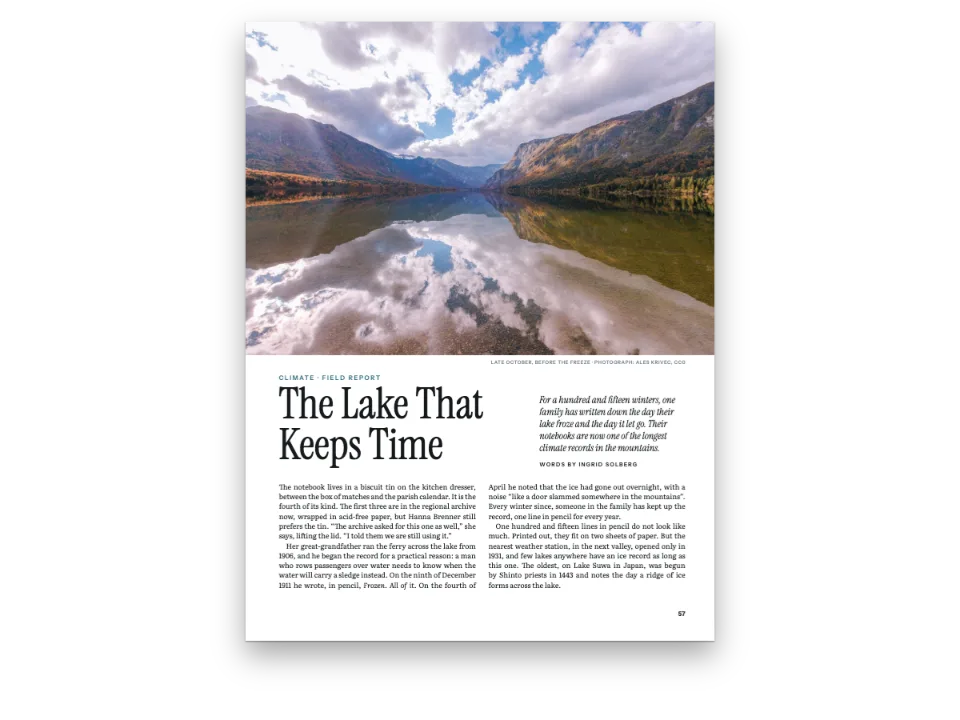
Un servizio di viaggio di sei pagine di un mensile, composto in tre colonne strette. Mostra come collocare foto e una grande citazione su due colonne o su tutta la pagina, e un riquadro di consigli pratici in una.
Che cosa comporrai
Sei pagine del numero di novembre di Meridian, un mensile di viaggi, su una pagina di 225 × 297 mm. Il servizio si apre su una doppia pagina: una sola fotografia di saline all’alba attraversa le due pagine, con il titolo in negativo sull’acqua a sinistra e, a destra sotto l’immagine, il paragrafo d’attacco con il suo capolettera, il sommario e la firma. L’articolo prosegue poi in tre colonne giustificate di 61,7 mm ciascuna. Le fotografie occupano due colonne, l’intera larghezza o una colonna; un estratto sta su due colonne tra i paragrafi; un box colorato con una mappa dell’isola apre la pagina di chiusura. Un quadratino blu chiude il testo.
Questa ricetta risponde a
- Postext può comporre tre o più colonne di testo, o far scorrere il testo intorno a un’immagine?
- Come decido dove va una figura: in testa alla pagina, su entrambe le colonne, esattamente qui o nel margine?
- Come faccio flottare un riquadro in testa o al piede della pagina mentre il testo continua a scorrere?
- Come aggiungo a un’apertura una riga d’autore, un sommario o un attacco con capolettera?
La risposta breve
const GUTTER = 5; // mm between the columns
const WIDTH = TRIM.width - MARGIN.inner - MARGIN.outer; // the text block, 195 mm
const COLUMN = (WIDTH - 2 * GUTTER) / 3; // 61.7 mm: about 40 characters of 9.6 pt text
const layout = { layoutType: 'multiple', columnCount: 3, gutterWidth: mm(GUTTER) };
// A float takes `columns` adjacent columns and the gutters between them: the head (or foot)
// of the first run of columns that are still empty, on its page or the next. As many columns
// as the page has is a page-wide float, like span: 'page'.
const across = {
  raker: { position: 'top', columns: 2 }, // 128.3 mm wide, at the head of two columns
  pans: { position: 'top', span: 'page' }, // 195 mm, the whole text block
  flor: { position: 'bottom' }, // 61.7 mm: one column, the default
  sieve: { position: 'top', columns: 2 }, // cited in the first column: heads the other two
  quay: { position: 'top', columns: 2 }, // two columns again, on the closing page
};
// A floated box takes `columns` the same way: the style sets it, a fence may override it
// with :::callout{type="pull" columns="3"}. A box set in the flow ('here') keeps to its column.
const pull = { id: 'pull', placement: 'top', columns: 2, backgroundEnabled: false,
  stripe: { enabled: true, side: 'top', width: pt(2.5), color: col('sea') }, // one device
  padding: { top: mm(3), right: pt(0), bottom: mm(1), left: pt(0) },
  body: { fontFamily: 'Fraunces', fontSize: pt(19), lineHeight: pt(2 * LEAD - 3),
    italic: true, textAlign: 'left', hyphenation: false, color: col('sea'),
    firstLineIndent: pt(0) } };
const visit = { id: 'visit', placement: 'top', // one column, at the head of the next free one
  background: col('tint'), padding: { top: mm(4), right: mm(4), bottom: mm(4), left: mm(4) },
  titleStyle: { ...label, fontWeight: 700, fontSize: pt(8.5), letterSpacing: pt(1.4),
    color: col('sea'), gap: mm(2) },
  body: { fontFamily: 'Barlow Condensed', fontWeight: 500, fontSize: pt(9.6),
    lineHeight: pt(12.4), textAlign: 'left', hyphenation: false, boldColor: col('sea'),
    paragraphSpacing: true, firstLineIndent: pt(0) } };
Ingredienti
- Funzionalità
- Tre o più colonneElementi flottanti su più colonneRiquadri flottantiRiquadriCollocazione delle figureAperture progettateImmagini nei progetti di paginaCapilettera nelle apertureAttributi dei titoliStili di titoloTestatine e folioTestatine secondo il ruolo della paginaStile delle didascalieRighe di fonte e creditiChip in lineaTipi di risorsa personalizzatiFigure e tabelle come risorseTavolozza di colori semanticaMargini speculari
- Tipo
- Source Serif 4, Fraunces, Barlow Condensed (SIL OFL 1.1)
- Risorse
flor-1200.jpgpans-1840.jpgquay-960.jpgraker-1500.jpgsieve-1500.jpgspread-left-1200.jpgspread-right-1200.jpg- Sunrise on the salt pans (the opening spread, in two halves) (Generated With Diffusion Models, CC BY 4.0)
- Sunrise on the salt pans, the recto's half (Generated With Diffusion Models, CC BY 4.0)
- A rake drawing up wet salt (Generated With Diffusion Models, CC BY 4.0)
- The salt flats from above (Generated With Diffusion Models, CC BY 4.0)
- A salt maker with a basket of flor de sal (Generated With Diffusion Models, CC BY 4.0)
- Skimming flor de sal with a sieve (Generated With Diffusion Models, CC BY 4.0)
- Salt sacks on a harbour quay at dusk (Generated With Diffusion Models, CC BY 4.0)
- The sidebar's map of Marisal, drawn in code (Ignacio Ferro, MIT)
Preparazione
#1 · Dividi la pagina in tre colonne, e lascia che gli elementi flottanti ne occupino una, due o tre
Il codice è la risposta breve qui sopra. layoutType: 'multiple' con columnCount: 3 divide la gabbia del testo di 195 mm in tre colonne uguali, quindi con un’intercolonna di 5 mm ciascuna è larga 61,7 mm, circa 40 caratteri di Source Serif a 9,6 pt. Il placement.columns di un’immagine occupa altrettante colonne adiacenti e le intercolonne tra di esse: la fotografia del rastrello è larga 128,3 mm, e le saline, con span: 'page', gli interi 195 mm. Lo stile dell’estratto fa lo stesso per un riquadro, con columns: 2 su uno stile placement: 'top', così flotta in testa a due colonne libere e il testo vi scorre attorno. Una griglia a tre colonne si adatta a un servizio di rivista con molte immagini, perché ogni immagine può occupare una, due o tre colonne. Un testo lungo con poche immagini si legge meglio in due colonne più larghe.
#2 · Apri su una doppia pagina, una fotografia su due pagine
const PHOTO = 165; // mm: how far down the recto the right half of the photograph bleeds
// The verso is its own heading style: the left half of the picture fills the page, and the
// kicker and headline are reversed out of the dark water at its foot. The picture reserves
// nothing, so nothing is pushed off the page; the recto's heading opens the next page.
const spread = { id: 'spread', span: 'page', advancedDesign: { enabled: true, slot: { elements: [
  { kind: 'image', id: 'photo', resourceId: 'spread-left', reserve: false,
    placement: { ...at('bleed', 'top-left'), size: { width: 'fill', height: 'fill' } } },
  { kind: 'text', id: 'kicker', content: '{attr.kicker}', ...label, fontSize: pt(10),
    letterSpacing: pt(2), color: col('paper'), // on a sea-blue tab: the water is too bright
    box: { backgroundColor: col('sea'), padding: { top: mm(1.2), right: mm(2.4),
      bottom: mm(1.2), left: mm(2.4) } },
    placement: at('page', 'top-left', 20, 188) },
  { kind: 'text', id: 'headline', content: '{titleText}', fontFamily: 'Fraunces',
    fontWeight: 600, fontSize: pt(66), lineHeight: 0.96, // a multiple of the size
    color: col('paper'), align: 'left', overflow: 'wrap',
    placement: at('#kicker', 'below', 0, 3, 150) },
] } } };
// The recto: the right half of the picture, cut to PHOTO mm, then the lead with its drop cap
// in the first column and the standfirst (the heading's own text) across the other two.
const air = { padding: { bottom: mm(6) } }; // empty padding counts: the columns start lower
const deck = { id: 'deck', span: 'page', advancedDesign: { enabled: true, slot: { elements: [
  { kind: 'image', id: 'photo', resourceId: 'spread-right', // cropped to 225 × 165 mm
    placement: { ...at('bleed', 'top-left'), size: { width: 'fill', height: mm(PHOTO) } } },
  { kind: 'text', id: 'credit', content: '{attr.credit}', ...label, fontWeight: 500,
    fontSize: pt(6.8), letterSpacing: pt(0.5), color: col('muted'), align: 'right',
    placement: at('container', 'top-right', 0, PHOTO - MARGIN.top + 2) },
  { kind: 'text', id: 'lead', content: '{attr.lead}', fontFamily: 'Source Serif 4',
    fontSize: pt(9.6), lineHeight: LEAD / 9.6, color: col('ink'), align: 'justify',
    hyphenate: true, box: air, placement: at('container', 'top-left', 0, PHOTO - 10, COLUMN),
    dropCap: { lines: 4, fontFamily: 'Fraunces', fontWeight: 600, color: col('sea'),
      gap: mm(1.6) } },
  { kind: 'text', id: 'standfirst', content: '{titleText}', fontFamily: 'Fraunces', italic: true,
    fontSize: pt(16.5), lineHeight: 1.24, color: col('ink'), align: 'left', overflow: 'wrap',
    placement: at('container', 'top-left', COLUMN + GUTTER, PHOTO - 11, 2 * COLUMN + GUTTER) },
  { kind: 'text', id: 'byline', content: '{attr.byline}', ...label, fontSize: pt(8.5),
    letterSpacing: pt(1.5), color: col('sea'), box: air,
    placement: at('#standfirst', 'below', 0, 4) },
] } } };
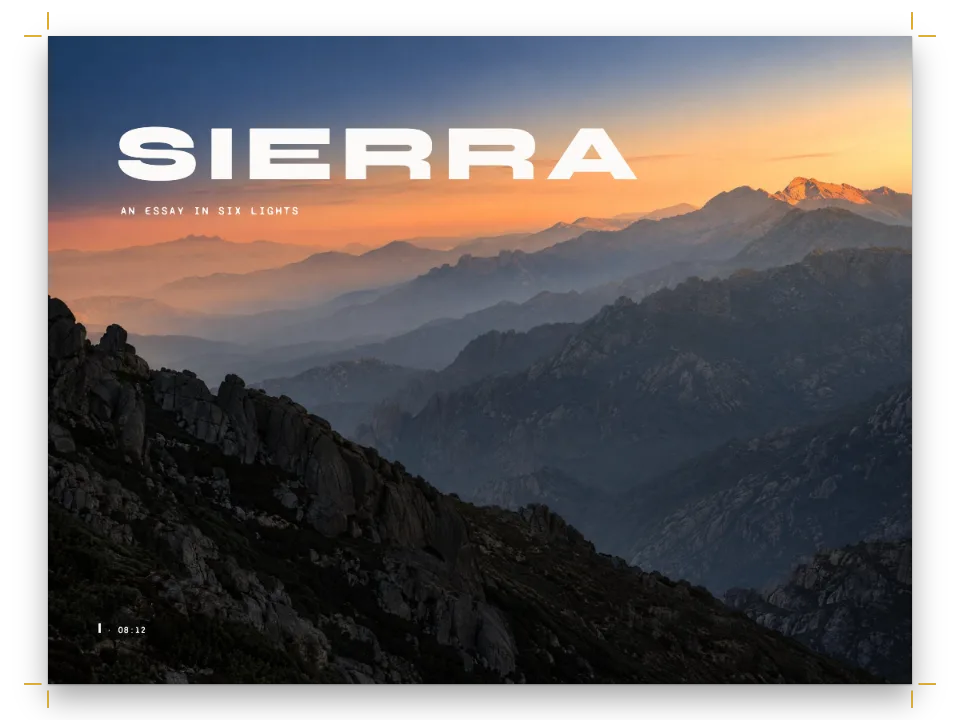
Ogni metà della fotografia appartiene a uno stile di titolo con span: 'page', e un titolo a tutta larghezza apre sempre una nuova pagina, quindi la pagina del titolo e quella del sommario si susseguono. La metà sinistra riempie il verso e non riserva nulla (reserve: false), così il titolo può stare sull’acqua al piede. La metà destra è tagliata a 165 mm, e il paragrafo d’attacco, il sommario e la firma pendono dal contenitore sotto di essa. Il paragrafo d’attacco è un testo di disegno con un dropCap di quattro righe, largo una colonna; il suo padding inferiore vuoto conta nell’altezza dell’apertura, così le colonne cominciano 6 mm sotto di esso. continuation.pageIndexOffset: 83 fa della pagina 84 un verso, così le due metà si fronteggiano.
#3 · Dichiara le fotografie, e cita ciascuna dove deve finire
// No figure numbers: the pictures get a type with an empty caption prefix and template.
const photoType = { id: 'photo', name: 'Photograph', shortLabel: 'photo', captionPrefix: '',
  numberingTemplate: '', resetOn: 'never', counterFormat: 'decimal' };
const CREDIT = 'Photograph generated with diffusion models';
// Pixels at the page's 150 dpi (gotcha: bitmap-print-size): each shrinks to its frame.
const photo = (id, [w, h], altText, caption) => ({ id, typeId: 'photo',
  kind: 'bitmap', createdAt: 0, updatedAt: 0, altText,
  bitmap: { fileId: `${id}-${w}.jpg`, format: 'jpeg', width: w, height: h },
  note: CREDIT, ...(caption && { caption, placement: across[id] }) });
const resources = [ // the two halves of the spread are drawn by the headings, never cited
  photo('spread-left', [1200, 1584], 'Salt pans at sunrise, the sky mirrored in still brine.'),
  photo('spread-right', [1200, 880], 'A salt raker at work below a row of white salt heaps.'),
  photo('raker', [1500, 1125], 'A wooden rake pushing a ridge of wet salt crystals.',
    'Raking the crystallisers at dawn. The salt rolls up in a ridge; a rake that digs in '
    + 'tears the clay floor and greys the harvest.'),
  photo('pans', [1840, 1150], 'Rectangular salt pans in pink, ochre and grey by the sea.',
    'The Alvarra flats from the lighthouse hill. The pink basins are nearly ready: an alga '
    + 'colours the brine once it holds more than 200 grams of salt a litre.'),
  photo('flor', [1200, 1488], 'An older woman in a straw hat holding a basket of salt.',
    'Amélia Sousa with an afternoon’s flor de sal, about four kilos from two pans.'),
  photo('sieve', [1500, 1125], 'Hands skimming a crust of salt crystals with a round sieve.',
    'Skimming the flower: the sieve works the downwind edge of the pan, where the breeze has '
    + 'drifted the crust.'),
  photo('quay', [960, 1200], 'Sacks of salt on a harbour quay beside a blue boat at dusk.',
    'Porto Velho, the last week of September: fifty-kilo sacks wait for the mainland boat.'),
  { id: 'map', typeId: 'photo', kind: 'svg', createdAt: 0, updatedAt: 0, // drawn below
    svg: { fileId: 'map.svg', width: MAP.width * 10, height: MAP.height * 10 },
    placement: { position: 'here' }, // in the sidebar, under its title
    caption: 'The Alvarra pans (pink) lie on the eastern flats, 6 km from Porto Velho (the '
      + 'squares) by the coast road. The lighthouse hill is the triangle; the ferry, dashed.',
    altText: 'A map of a long, low island with salt pans at its eastern end and a harbour '
      + 'town at the west.' },
];
Un elemento flottante va alla prima testa (o al primo piede) libera delle sue colonne dopo la riga che lo cita, quindi sono le righe ::resource a decidere le pagine. La fotografia del setaccio è citata in cima alla prima colonna della quinta pagina, dove la seconda e la terza colonna sono ancora vuote, quindi le intesta nella stessa pagina. La fotografia del porto è citata in fondo a quella pagina e intesta due colonne della successiva. Le fotografie di uno stesso tipo non si sorpassano mai, quindi le loro citazioni seguono l’ordine dell’articolo. Le bitmap sono misurate ai 150 dpi della pagina: 1500 px fanno 254 mm e si riducono ai 128,3 mm di due colonne.
#4 · Testatine e folio fuori dalla doppia pagina d’apertura
const head = { ...label, fontSize: pt(7.5), letterSpacing: pt(1.3), color: col('muted') };
const folio = { fontFamily: 'Barlow Condensed', fontWeight: 700, fontSize: pt(9.5),
  color: col('ink') };
const pin = (edge, x, y) => ({ anchor: { to: 'page', edge }, offset: { x: mm(x), y: mm(y) } });
const sides = [['even', 'left', 1], ['odd', 'right', -1]]; // 1: the outer edge is on the left
// The label is 2 pt smaller, so it sits 0.68 mm lower in its box: one shared baseline.
const DROP = (0.8 * 1.2 * 2 * 25.4) / 72;
const header = { elements: sides.flatMap(([parity, edge, s]) => [
  { kind: 'text', id: `folio-${parity}`, content: '{pageNumber}', ...folio, align: edge,
    placement: pin(`top-${edge}`, s * MARGIN.outer, 12) },
  { kind: 'text', id: `head-${parity}`, ...head, align: edge,
    content: s > 0 ? '{title} · {subtitle}' : '{chapterTitle}',
    placement: pin(`top-${edge}`, s * (MARGIN.outer + 9), 12 + DROP) },
].map((element) => ({ ...element, parity, pages: 'body' }))) }; // none on the spread
const footer = { elements: [{ kind: 'text', id: 'drop-folio', content: '{pageNumber}', ...folio,
  align: 'right', parity: 'odd', pages: 'opener', // the recto of the spread: a folio at the foot
  placement: pin('bottom-right', -MARGIN.outer, -12) }] };
Gli elementi d’intestazione si dipingono sopra la pagina e non riservano spazio, quindi il folio e l’etichetta sono ancorati alla pagina nel margine superiore. pages: 'body' li tiene lontani da entrambe le pagine della doppia pagina, che sono pagine d’apertura perché ciascuna comincia con un titolo a tutta larghezza. Il recto della doppia pagina ha invece il suo folio al piede, grazie a pages: 'opener' e parity: 'odd'; il verso, tutto fotografia, non ne porta.
#5 · Disegna nel codice la mappa del box
function mulberry32(seed) {
  return () => {
    seed = (seed + 0x6d2b79f5) | 0;
    let r = Math.imul(seed ^ (seed >>> 15), 1 | seed);
    r = (r + Math.imul(r ^ (r >>> 7), 61 | r)) ^ r;
    return ((r ^ (r >>> 14)) >>> 0) / 4294967296;
  };
}
function islandMap() { // in mm: a long, low island lying south-west to north-east
  const rand = mulberry32(135);
  const f = (id, a = 1) => `fill="${palette[id]}"${a < 1 ? ` fill-opacity="${a}"` : ''}`;
  const [cx, cy, rx, ry, turn] = [28, 27, 23, 9.5, -0.5]; // centre, half-axes, radians
  const place = (u, v) => [cx + u * Math.cos(turn) - v * Math.sin(turn),
    cy + u * Math.sin(turn) + v * Math.cos(turn)]; // island frame to map
  const coast = Array.from({ length: 48 }, (_, i) => {
    const a = (i / 48) * 2 * Math.PI;
    const k = 0.9 + rand() * 0.16; // a ragged shore
    return place(rx * k * Math.cos(a), ry * k * Math.sin(a)).map((n) => n.toFixed(2)).join(' ');
  });
  const pans = []; // a grid of basins on the eastern flats, inside the shore
  for (let u = 6; u < 19; u += 2.4) {
    for (let v = -5; v < 5; v += 1.9) {
      if ((u / rx) ** 2 + (v / ry) ** 2 > 0.62) continue;
      const [x, y] = place(u, v);
      pans.push(`<rect x="${(x - 1).toFixed(2)}" y="${(y - 0.7).toFixed(2)}" width="2" `
        + `height="1.4" transform="rotate(${(turn * 180) / Math.PI} ${x.toFixed(2)} `
        + `${y.toFixed(2)})" ${f(rand() < 0.7 ? 'salt' : 'rule')}/>`);
    }
  }
  const [tx, ty] = place(-18, 3); // Porto Velho, on the south-west shore
  const town = [[0, 0], [1.3, 0.2], [0.4, 1.2], [1.7, 1.3], [-0.9, 0.9]].map(([dx, dy]) =>
    `<rect x="${(tx + dx).toFixed(2)}" y="${(ty + dy).toFixed(2)}" width="0.9" height="0.9" `
    + `${f('ink')}/>`).join('');
  const [lx, ly] = place(2, -6.5); // the lighthouse hill, on the north shore
  const ferry = `M${tx} ${ty + 1.5}C${tx - 6} ${ty + 6} 6 46 1.5 48`; // to the mainland, south-west
  return `<svg xmlns="http://www.w3.org/2000/svg" width="${MAP.width * 10}" `
    + `height="${MAP.height * 10}" viewBox="0 0 ${MAP.width} ${MAP.height}">`
    + `<rect width="${MAP.width}" height="${MAP.height}" ${f('sea', 0.16)}/>`
    + `<path d="M${coast.join('L')}Z" ${f('paper')} stroke="${palette.muted}" `
    + 'stroke-width="0.25"/>' + pans.join('') + town
    + `<path d="M${lx - 1.4} ${ly + 1.1}L${lx} ${ly - 1.3}L${lx + 1.4} ${ly + 1.1}Z" ${f('ink')}/>`
    + `<path d="${ferry}" fill="none" stroke="${palette.ink}" stroke-width="0.3" `
    + 'stroke-dasharray="1 0.8"/>'
    + `<path d="M0.4 46.4L1.5 48L2.9 47Z" ${f('ink')}/>` // the arrowhead, a path (no marker)
    + '</svg>';
}
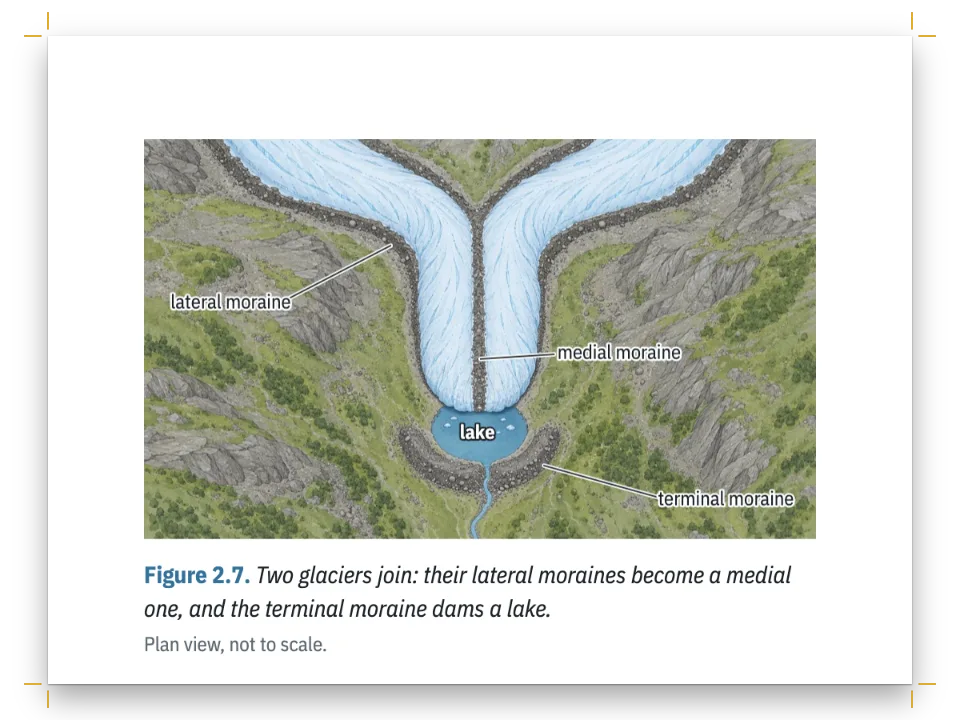
La mappa è una risorsa SVG con placement: 'here', citata dentro il blocco del box, così sta sotto il titolo del riquadro alla sua giustezza. Non ha scritte: il testo dentro un SVG non può usare i web font della pagina, quindi è la didascalia a nominare le forme. La punta di freccia sulla rotta del traghetto è un tracciato, perché un <marker> non sopravviverebbe a un’esportazione in PDF.
La ricetta completa
// ═══ Postext Cookbook · Nº 135 · Magazine feature on a three-column grid ═════════ // https://postext.dev/en/cookbook/magazine-three-column-feature // Code: MIT · Text: original (CC BY 4.0) · Photographs: generated with diffusion models // Fonts: Source Serif 4, Fraunces, Barlow Condensed (SIL OFL 1.1) · Needs postext ≥ 1.28.0 // A travel feature from a monthly magazine, pages 84–89 of the issue. The story opens on a // spread, a photograph bled across both pages, then runs on in three columns: pictures across // two of them, one across the page and one in a single column, a pull quote floated across // two columns, a sidebar in one, running heads, folios and an end mark. import { buildDocumentWithFonts, renderPageToCanvas, registerResourceImage, } from 'https://esm.sh/postext'; const LANG = 'en'; // @lang: the language of the sample document ('en' | 'es') const RECIPE = 'magazine-three-column-feature'; // ─── 1 · Design ───────────────────────────────────────────────────────────── // #region palette: an Atlantic blue for the one accent, a salt tint for the sidebar const palette = { ink: '#1c2024', // text: a blue-black sea: '#1d5470', // the accent: kickers, crossheads, the quote, the drop cap tint: '#edf1f2', // the sidebar's ground rule: '#c5ced3', // the map's resting pans muted: '#5c656d', // running heads, credits, the colophon paper: '#ffffff', // the page, and the headline reversed out of the photograph salt: '#dfa79c', // the pans on the sidebar's map, the pink of ripe brine }; const col = (id) => ({ hex: palette[id], model: 'hex', paletteId: id }); const colorPalette = [ ...Object.entries(palette).map(([id, hex]) => ({ id, name: id, value: { hex, model: 'hex' } })), // The engine's defaults link to 'main-color': point it at the accent, so nothing prints blue. { id: 'main-color', name: 'sea (defaults)', value: { hex: palette.sea, model: 'hex' } }, ]; // #endregion const TRIM = { width: 225, height: 297 }; // a magazine trim, in mm const MARGIN = { top: 22, bottom: 20, inner: 16, outer: 14 }; // mirrored const LEAD = 14; // body leading in pt: the baseline grid const MAP = { width: 54, height: 50 }; // mm: the sidebar's map, as wide as its measure const label = { fontFamily: 'Barlow Condensed', fontWeight: 600, textTransform: 'uppercase', align: 'left' }; // design text is centred by default const at = (to, edge, x = 0, y = 0, width) => ({ anchor: { to, edge }, offset: { x: mm(x), y: mm(y) }, ...(width && { size: { width: mm(width) } }) }); // #region answer: three equal columns, and floats that take one, two or all three of them const GUTTER = 5; // mm between the columns const WIDTH = TRIM.width - MARGIN.inner - MARGIN.outer; // the text block, 195 mm const COLUMN = (WIDTH - 2 * GUTTER) / 3; // 61.7 mm: about 40 characters of 9.6 pt text const layout = { layoutType: 'multiple', columnCount: 3, gutterWidth: mm(GUTTER) }; // A float takes `columns` adjacent columns and the gutters between them: the head (or foot) // of the first run of columns that are still empty, on its page or the next. As many columns // as the page has is a page-wide float, like span: 'page'. const across = { raker: { position: 'top', columns: 2 }, // 128.3 mm wide, at the head of two columns pans: { position: 'top', span: 'page' }, // 195 mm, the whole text block flor: { position: 'bottom' }, // 61.7 mm: one column, the default sieve: { position: 'top', columns: 2 }, // cited in the first column: heads the other two quay: { position: 'top', columns: 2 }, // two columns again, on the closing page }; // A floated box takes `columns` the same way: the style sets it, a fence may override it // with :::callout{type="pull" columns="3"}. A box set in the flow ('here') keeps to its column. const pull = { id: 'pull', placement: 'top', columns: 2, backgroundEnabled: false, stripe: { enabled: true, side: 'top', width: pt(2.5), color: col('sea') }, // one device padding: { top: mm(3), right: pt(0), bottom: mm(1), left: pt(0) }, body: { fontFamily: 'Fraunces', fontSize: pt(19), lineHeight: pt(2 * LEAD - 3), italic: true, textAlign: 'left', hyphenation: false, color: col('sea'), firstLineIndent: pt(0) } }; const visit = { id: 'visit', placement: 'top', // one column, at the head of the next free one background: col('tint'), padding: { top: mm(4), right: mm(4), bottom: mm(4), left: mm(4) }, titleStyle: { ...label, fontWeight: 700, fontSize: pt(8.5), letterSpacing: pt(1.4), color: col('sea'), gap: mm(2) }, body: { fontFamily: 'Barlow Condensed', fontWeight: 500, fontSize: pt(9.6), lineHeight: pt(12.4), textAlign: 'left', hyphenation: false, boldColor: col('sea'), paragraphSpacing: true, firstLineIndent: pt(0) } }; // #endregion // #region spread: one photograph across the opening spread, the headline on the verso const PHOTO = 165; // mm: how far down the recto the right half of the photograph bleeds // The verso is its own heading style: the left half of the picture fills the page, and the // kicker and headline are reversed out of the dark water at its foot. The picture reserves // nothing, so nothing is pushed off the page; the recto's heading opens the next page. const spread = { id: 'spread', span: 'page', advancedDesign: { enabled: true, slot: { elements: [ { kind: 'image', id: 'photo', resourceId: 'spread-left', reserve: false, placement: { ...at('bleed', 'top-left'), size: { width: 'fill', height: 'fill' } } }, { kind: 'text', id: 'kicker', content: '{attr.kicker}', ...label, fontSize: pt(10), letterSpacing: pt(2), color: col('paper'), // on a sea-blue tab: the water is too bright box: { backgroundColor: col('sea'), padding: { top: mm(1.2), right: mm(2.4), bottom: mm(1.2), left: mm(2.4) } }, placement: at('page', 'top-left', 20, 188) }, { kind: 'text', id: 'headline', content: '{titleText}', fontFamily: 'Fraunces', fontWeight: 600, fontSize: pt(66), lineHeight: 0.96, // a multiple of the size color: col('paper'), align: 'left', overflow: 'wrap', placement: at('#kicker', 'below', 0, 3, 150) }, ] } } }; // The recto: the right half of the picture, cut to PHOTO mm, then the lead with its drop cap // in the first column and the standfirst (the heading's own text) across the other two. const air = { padding: { bottom: mm(6) } }; // empty padding counts: the columns start lower const deck = { id: 'deck', span: 'page', advancedDesign: { enabled: true, slot: { elements: [ { kind: 'image', id: 'photo', resourceId: 'spread-right', // cropped to 225 × 165 mm placement: { ...at('bleed', 'top-left'), size: { width: 'fill', height: mm(PHOTO) } } }, { kind: 'text', id: 'credit', content: '{attr.credit}', ...label, fontWeight: 500, fontSize: pt(6.8), letterSpacing: pt(0.5), color: col('muted'), align: 'right', placement: at('container', 'top-right', 0, PHOTO - MARGIN.top + 2) }, { kind: 'text', id: 'lead', content: '{attr.lead}', fontFamily: 'Source Serif 4', fontSize: pt(9.6), lineHeight: LEAD / 9.6, color: col('ink'), align: 'justify', hyphenate: true, box: air, placement: at('container', 'top-left', 0, PHOTO - 10, COLUMN), dropCap: { lines: 4, fontFamily: 'Fraunces', fontWeight: 600, color: col('sea'), gap: mm(1.6) } }, { kind: 'text', id: 'standfirst', content: '{titleText}', fontFamily: 'Fraunces', italic: true, fontSize: pt(16.5), lineHeight: 1.24, color: col('ink'), align: 'left', overflow: 'wrap', placement: at('container', 'top-left', COLUMN + GUTTER, PHOTO - 11, 2 * COLUMN + GUTTER) }, { kind: 'text', id: 'byline', content: '{attr.byline}', ...label, fontSize: pt(8.5), letterSpacing: pt(1.5), color: col('sea'), box: air, placement: at('#standfirst', 'below', 0, 4) }, ] } } }; // #endregion // #region heads: the magazine and the issue on the verso, the story on the recto const head = { ...label, fontSize: pt(7.5), letterSpacing: pt(1.3), color: col('muted') }; const folio = { fontFamily: 'Barlow Condensed', fontWeight: 700, fontSize: pt(9.5), color: col('ink') }; const pin = (edge, x, y) => ({ anchor: { to: 'page', edge }, offset: { x: mm(x), y: mm(y) } }); const sides = [['even', 'left', 1], ['odd', 'right', -1]]; // 1: the outer edge is on the left // The label is 2 pt smaller, so it sits 0.68 mm lower in its box: one shared baseline. const DROP = (0.8 * 1.2 * 2 * 25.4) / 72; const header = { elements: sides.flatMap(([parity, edge, s]) => [ { kind: 'text', id: `folio-${parity}`, content: '{pageNumber}', ...folio, align: edge, placement: pin(`top-${edge}`, s * MARGIN.outer, 12) }, { kind: 'text', id: `head-${parity}`, ...head, align: edge, content: s > 0 ? '{title} · {subtitle}' : '{chapterTitle}', placement: pin(`top-${edge}`, s * (MARGIN.outer + 9), 12 + DROP) }, ].map((element) => ({ ...element, parity, pages: 'body' }))) }; // none on the spread const footer = { elements: [{ kind: 'text', id: 'drop-folio', content: '{pageNumber}', ...folio, align: 'right', parity: 'odd', pages: 'opener', // the recto of the spread: a folio at the foot placement: pin('bottom-right', -MARGIN.outer, -12) }] }; // #endregion const config = () => ({ locale: 'en-us', // American English hyphenation colorPalette, resourceTypes: [photoType], page: { width: mm(TRIM.width), height: mm(TRIM.height), dpi: 150, margins: { top: mm(MARGIN.top), bottom: mm(MARGIN.bottom), left: mm(MARGIN.inner), right: mm(MARGIN.outer), mirror: true } }, // left is the inner side layout, bodyText: { fontFamily: 'Source Serif 4', fontSize: pt(9.6), lineHeight: pt(LEAD), color: col('ink'), boldColor: col('ink'), italicColor: col('ink'), referenceColor: col('ink'), textAlign: 'justify', firstLineIndent: mm(3), indentAfterHeading: false, // A 40-character measure: a line no break can set within twice the normal space takes up // to 0.015 em of tracking for the rest instead of spreading its spaces wider still. minWordSpacing: 0.7, maxJustifyTracking: 15, hyphenateAcrossColumns: 'withinPage' }, // no word is divided over a page headings: { fontFamily: 'Fraunces', fontWeight: 600, color: col('sea'), levels: [ // parity 'any': the spread opens on the next page (the default waits for a recto). { level: 1, span: 'page', breakBefore: { enabled: true, parity: 'any' } }, { level: 2, fontSize: pt(12.5), lineHeight: pt(LEAD), marginTop: pt(LEAD), marginBottom: pt(0) }, // crossheads, one grid line above ] }, headingStyles: [spread, deck], calloutStyles: [pull, visit], chipStyles: [{ id: 'end', background: col('sea'), borderWidth: pt(0), borderRadius: pt(0), fontSize: em(0.6), paddingX: em(0.5), paddingY: em(0), gap: em(0.6) }], // a square captionStyle: { fontFamily: 'Barlow Condensed', fontWeight: 500, fontSize: pt(8.6), lineHeight: pt(10.6), color: col('ink'), gap: mm(2), note: { fontSize: pt(7), color: col('muted'), gap: mm(0.5) } }, paragraphStyles: [{ id: 'colophon', fontFamily: 'Barlow Condensed', fontWeight: 500, fontSize: pt(7.4), lineHeight: pt(9.6), color: col('muted'), textAlign: 'left', firstLineIndent: pt(0), marginTop: pt(LEAD) }], header, footer, }); // ─── 2 · Content ──────────────────────────────────────────────────────────── // #region resources: the photographs, declared once by their real pixels // No figure numbers: the pictures get a type with an empty caption prefix and template. const photoType = { id: 'photo', name: 'Photograph', shortLabel: 'photo', captionPrefix: '', numberingTemplate: '', resetOn: 'never', counterFormat: 'decimal' }; const CREDIT = 'Photograph generated with diffusion models'; // Pixels at the page's 150 dpi (gotcha: bitmap-print-size): each shrinks to its frame. const photo = (id, [w, h], altText, caption) => ({ id, typeId: 'photo', kind: 'bitmap', createdAt: 0, updatedAt: 0, altText, bitmap: { fileId: `${id}-${w}.jpg`, format: 'jpeg', width: w, height: h }, note: CREDIT, ...(caption && { caption, placement: across[id] }) }); const resources = [ // the two halves of the spread are drawn by the headings, never cited photo('spread-left', [1200, 1584], 'Salt pans at sunrise, the sky mirrored in still brine.'), photo('spread-right', [1200, 880], 'A salt raker at work below a row of white salt heaps.'), photo('raker', [1500, 1125], 'A wooden rake pushing a ridge of wet salt crystals.', 'Raking the crystallisers at dawn. The salt rolls up in a ridge; a rake that digs in ' + 'tears the clay floor and greys the harvest.'), photo('pans', [1840, 1150], 'Rectangular salt pans in pink, ochre and grey by the sea.', 'The Alvarra flats from the lighthouse hill. The pink basins are nearly ready: an alga ' + 'colours the brine once it holds more than 200 grams of salt a litre.'), photo('flor', [1200, 1488], 'An older woman in a straw hat holding a basket of salt.', 'Amélia Sousa with an afternoon’s flor de sal, about four kilos from two pans.'), photo('sieve', [1500, 1125], 'Hands skimming a crust of salt crystals with a round sieve.', 'Skimming the flower: the sieve works the downwind edge of the pan, where the breeze has ' + 'drifted the crust.'), photo('quay', [960, 1200], 'Sacks of salt on a harbour quay beside a blue boat at dusk.', 'Porto Velho, the last week of September: fifty-kilo sacks wait for the mainland boat.'), { id: 'map', typeId: 'photo', kind: 'svg', createdAt: 0, updatedAt: 0, // drawn below svg: { fileId: 'map.svg', width: MAP.width * 10, height: MAP.height * 10 }, placement: { position: 'here' }, // in the sidebar, under its title caption: 'The Alvarra pans (pink) lie on the eastern flats, 6 km from Porto Velho (the ' + 'squares) by the coast road. The lighthouse hill is the triangle; the ferry, dashed.', altText: 'A map of a long, low island with salt pans at its eastern end and a harbour ' + 'town at the west.' }, ]; // #endregion const markdown = String.raw`---Esempio Markdown · 97 righe · content.en.md
title: "Meridian" subtitle: "November 2026" --- # The Salt Rakers of Marisal {style="spread" kicker="Islands · The Atlantic"} ## On a flat island at the edge of the Atlantic, nine families still make salt by hand, with sun, wind and a wooden rake. Their season lasts eleven weeks, and every year it starts a little later {style="deck" byline="Words by Marta Quintal" credit="Sunrise on the Alvarra pans · Photographs generated with diffusion models" lead="At five in the morning the brine in the Alvarra pans has the colour of pewter, and João Brás is already standing in it up to his ankles. He works the way his father taught him, walking backwards down the pan and drawing the rake towards him in long, even strokes, so that the salt rolls up into a ridge without tearing the clay floor beneath it."} Brás is fifty-eight. He has been raking these pans every summer since he was eleven, except for two years of military service and one summer, in 1994, when he broke his wrist falling from the roof of the salt store. The pan he is working this morning measures nine metres by twenty-two, and by half past seven he will have drawn about four hundred kilos of salt into a white ridge along its edge. Then the sun will be too high, and the salt too bright to look at. Marisal is fourteen kilometres long and nowhere higher than a two-storey house. It has no river and almost no trees, and the wind from the north-east blows on two days out of three between June and September. For most of its history the island had nothing to sell except what the sea and that wind could make together. The first salt works were dug on the eastern flats in the 1680s. At their peak, in the years before the Second World War, more than six hundred pans were worked on the island, by some 140 families. The decline came quickly. In the 1960s a plant on the mainland began to make salt by boiling brine under vacuum, cheaply and all year round, and the canneries that had bought Marisal’s salt for two centuries switched to it within a decade. Young men left for the merchant fleet and the building sites of the north. The pans they left behind silted up in a few winters, and their clay walls slumped into the brine like sandcastles after a tide. ## Water, sun and wind The method has not changed in three centuries. At high tide, sea water flows through a sluice into a large reservoir, the *viveiro*, where it settles for a few days and drops its sand. From there it is let down, a few centimetres at a time, through a chain of ever shallower basins. In each one the sun and the wind take a little more of the water, and the brine grows heavier. The basins are laid out so that the water never has to be lifted: the whole works falls about forty centimetres from the sluice to the last pan, and gravity does the rest. Sea water holds about 35 grams of salt in every litre. By the time it reaches the last basins, the crystallisers, it holds more than 250, and salt begins to form on the surface like frost on a window. The whole passage takes about three weeks. The salt makers measure it with a glass hydrometer that floats higher as the brine thickens, but most of them can judge it without one. “You can see it in the colour,” says Brás. “It goes pink first, then a sort of grey. When it shines like oil, the salt is coming.” The pink comes from a single-celled alga that thrives in water too salty for anything else. It is harmless, and it gives the pans their colours when you see them from the lighthouse hill. ::resource{id="raker"} The skill lies in the water level. Too deep, and the salt forms slowly, in small grains; too shallow, and it crusts over with the clay. A salt maker opens and closes the little wooden gates between his basins several times a day, by hand or with the side of his foot. Brás has 46 gates on his eleven pans, and he can tell you the height of the water behind each one without looking. At noon the rakers go home to sleep, and the flats belong to the wind. Brás eats with his wife under the vine at the back of the house: grilled mackerel, bread, a tomato cut in half and rubbed with the coarse grey salt from the bottom of the heap, the salt nobody buys. In the evening he walks back down to the pans to check the gates, and on still nights he sometimes stays until dark, sitting on the wall of the reservoir and listening to the brine tick as the crystals form. ## Eleven weeks The harvest runs from early July to the middle of September, when the first autumn rain usually arrives. It used to begin in June. Over the past twenty years the records of the salt makers’ cooperative show the first raking moving back by about nine days, because late spring storms now fill the basins with rainwater just when they should be concentrating. A single heavy shower in August can dissolve a week’s salt in an hour. The rakers watch the forecast on their phones, and on uncertain evenings they draw the salt into heaps and cover them with plastic sheets held down by stones. ::resource{id="pans"} The work is heavy and short. Raking starts before dawn, while the salt is cool and the light is low enough to show the ridges. By nine the crystallisers glare white and the air above them shimmers. Each pan is raked every three or four days. The wet salt is shovelled into wooden wheelbarrows and pushed along the clay walkways to the heaps at the end of each row, where it drains and dries for two weeks before it goes into the store. The store at the end of the flats was built in 1911, a long whitewashed shed with no windows and a floor of beaten earth. Inside it smells of seaweed and tar, and by the end of September the heaps rise to the roof beams. Nothing made of metal is kept there: in a year the salt eats a nail down to a rust stain in the wood. :::callout{type="pull"} The sea gives you the water. The sun and the wind do the work. All we do is stop it running away. ::: A good pan gives about 60 tonnes of coarse salt in a season. Sold in bulk to the canning factory on the mainland, it brings the salt maker around 90 euros a tonne, less than the diesel it takes to ship it. By the late 1990s fewer than twenty families were still working pans, and most of the eastern flats had been left to the herons. ## The flower of the salt What saved the pans was not the coarse salt. On hot, still afternoons a thin crust forms on the surface of the crystallisers, made of flat, brittle crystals that float on the brine like ice on a pond. This is the *flor de sal*, the flower of the salt. It is skimmed off by hand with a wide, fine-meshed sieve on a long handle, a few millimetres at a time, before the evening wind breaks it up and sinks it. The skimmer works along the downwind edge of the pan, where the breeze has pushed the crust into a drift, and lifts it in shallow passes that barely touch the water. Lift too deep and the sieve brings up brine and clay with the crystals; too slowly, and the crust folds and sinks before it reaches the mesh. A pan gives only one or two per cent of its harvest as flower, and it has to be gathered on every day that it appears. On Marisal it was always women’s work, and for generations it was not sold at all. Families kept it for the table and gave it as a present at weddings. Amélia Sousa, who is seventy-four, has skimmed the pans behind her house every summer since 1962. “My mother called it the salt for visitors,” she says. “The coarse salt was for the fish. The flower was kept for the days when the priest came to eat with us.” Chefs on the mainland describe the flower in the language of wine. The crystals are hollow pyramids a few millimetres across, and they snap between the teeth instead of dissolving on the tongue. It tastes less sharply of salt than the coarse grain, because it holds a little more of the sea’s magnesium and calcium, and it is never cooked with: a pinch goes on at the table, over a fried egg or a slice of tomato. ::resource{id="sieve"} ::resource{id="flor"} In 2011 nine families formed a cooperative, the Salineiros de Alvarra, and began to sell the flower in small tins under their own name. A 250-gram tin sells for six euros on the island and for three times that in city delicatessens. The flower now brings in more than the rest of the harvest put together. It has paid for a new sluice, a shared drying shed and the repair of 38 abandoned pans, and this year, for the first time since 1971, the cooperative turned buyers away in August. ## The herons’ share Not everyone welcomed the restoration. By 2010 the abandoned pans on the eastern flats had become one of the largest resting places for wading birds on the island’s side of the ocean: black-winged stilts, avocets, little egrets and, every autumn, a few hundred flamingos on their way south. The birdwatchers who came to count them were the first visitors Marisal had had in years, and they were not pleased to see the walls rebuilt. The answer was a map. The cooperative and the island’s naturalists’ society agreed to leave twenty-two of the old pans flooded all year as a refuge, to keep the working pans free of plastic and lime, and to stop raking near the nesting walls between April and June. The birds seem content with the arrangement. Stilts now nest on the working walls as well, and the rakers step round their eggs. Each September the society’s volunteers count the birds from the lighthouse hill, as they have since 1998. Last year they recorded 41 species on the flats in a single morning, among them a spoonbill ringed as a chick on the far side of the ocean. ## Nine families The cooperative has eleven members under forty. One of them is Rita Brás, João’s niece, who studied marine biology on the mainland and came back in 2019 to work four pans her grandfather had abandoned in 1987. It took her two winters to rebuild their clay walls and floors, treading the wet clay flat with her bare feet as the old salt makers did. She logs the salinity of every basin three times a day and shares the figures with a university group that studies salt marshes. “My uncle thinks I am measuring what he already knows,” she says. “He is right. But when he stops, someone will have to know it from the numbers instead.” Rita’s pans are the smallest on the flats, and the most watched. She has fitted one of them with a floating thermometer and a camera on a pole, and every evening she posts its picture for the cooperative’s customers, who can watch the crust form on brine they will eat a year later. Orders from the mainland doubled in the first summer she did it. The older members were doubtful at first. Now they come round after supper to look at the screen with her and argue about the colour of the water. ::resource{id="quay"} :::callout{type="visit" title="Visiting Marisal"} ::resource{id="map"} **Getting there** The ferry from the mainland takes 2 hours 40 minutes and sails daily from June to September, three times a week in winter. **Getting round** Bicycles for hire at the ferry quay, €12 a day. The pans are six kilometres from Porto Velho by the coast road, which is flat all the way. **When to go** The harvest runs from July to mid-September. The cooperative shows visitors round the pans on weekday mornings at eight; book a day ahead. **Where to stay** Three guesthouses in Porto Velho, from €65 a night. Bring a hat: there is no shade on the flats. **Where to eat** Casa do Moinho, on the harbour, grills the morning’s mackerel and serves it with the coarse grey salt. Lunch for two, about €38. **What to bring home** Flor de sal in 250 g tins, €6 at the cooperative’s shed by the sluice. ::: The old salt makers are not sentimental about their trade. Brás will tell you that his back hurts from June to October and that he would not wish the work on his sons, who drive taxis in the island’s one town. He also says that he has never had a better morning than the first raking of a good year, when the salt comes up under the rake in a single unbroken roll and the whole pan smells of the sea. On the last Saturday of the season the cooperative weighs the year’s harvest on the old platform scale in the salt store, sack by sack, with a notebook and a pencil. Last year it came to 1,860 tonnes of coarse salt and a little under eleven tonnes of flower, the best year since the cooperative began. The figure is chalked on the door of the store, where it stays until the rain washes it off, some time in October. At the end of September the salt goes down to the quay at Porto Velho in linen sacks of fifty kilos each, and the last boat of the season carries it to the mainland. The pans are flooded with sea water for the winter, to protect the clay from the rain and the frost. By November, when the rakers start mending their gates, the flats look like a lake again, and the herons are back on the walls, waiting. :chip[ ]{style="end"} :::paragraphs{style="colophon"} Marisal, the Alvarra pans and everyone in this feature are fictional · Set in Source Serif 4, Fraunces and Barlow Condensed (SIL Open Font License) · Text: CC BY 4.0 · Photographs generated with diffusion models :::`; // content.<lang>.md, inlined by the Cookbook // #region art: the sidebar's map of Marisal, drawn in code with a seeded PRNG function mulberry32(seed) { return () => { seed = (seed + 0x6d2b79f5) | 0; let r = Math.imul(seed ^ (seed >>> 15), 1 | seed); r = (r + Math.imul(r ^ (r >>> 7), 61 | r)) ^ r; return ((r ^ (r >>> 14)) >>> 0) / 4294967296; }; } function islandMap() { // in mm: a long, low island lying south-west to north-east const rand = mulberry32(135); const f = (id, a = 1) => `fill="${palette[id]}"${a < 1 ? ` fill-opacity="${a}"` : ''}`; const [cx, cy, rx, ry, turn] = [28, 27, 23, 9.5, -0.5]; // centre, half-axes, radians const place = (u, v) => [cx + u * Math.cos(turn) - v * Math.sin(turn), cy + u * Math.sin(turn) + v * Math.cos(turn)]; // island frame to map const coast = Array.from({ length: 48 }, (_, i) => { const a = (i / 48) * 2 * Math.PI; const k = 0.9 + rand() * 0.16; // a ragged shore return place(rx * k * Math.cos(a), ry * k * Math.sin(a)).map((n) => n.toFixed(2)).join(' '); }); const pans = []; // a grid of basins on the eastern flats, inside the shore for (let u = 6; u < 19; u += 2.4) { for (let v = -5; v < 5; v += 1.9) { if ((u / rx) ** 2 + (v / ry) ** 2 > 0.62) continue; const [x, y] = place(u, v); pans.push(`<rect x="${(x - 1).toFixed(2)}" y="${(y - 0.7).toFixed(2)}" width="2" ` + `height="1.4" transform="rotate(${(turn * 180) / Math.PI} ${x.toFixed(2)} ` + `${y.toFixed(2)})" ${f(rand() < 0.7 ? 'salt' : 'rule')}/>`); } } const [tx, ty] = place(-18, 3); // Porto Velho, on the south-west shore const town = [[0, 0], [1.3, 0.2], [0.4, 1.2], [1.7, 1.3], [-0.9, 0.9]].map(([dx, dy]) => `<rect x="${(tx + dx).toFixed(2)}" y="${(ty + dy).toFixed(2)}" width="0.9" height="0.9" ` + `${f('ink')}/>`).join(''); const [lx, ly] = place(2, -6.5); // the lighthouse hill, on the north shore const ferry = `M${tx} ${ty + 1.5}C${tx - 6} ${ty + 6} 6 46 1.5 48`; // to the mainland, south-west return `<svg xmlns="http://www.w3.org/2000/svg" width="${MAP.width * 10}" ` + `height="${MAP.height * 10}" viewBox="0 0 ${MAP.width} ${MAP.height}">` + `<rect width="${MAP.width}" height="${MAP.height}" ${f('sea', 0.16)}/>` + `<path d="M${coast.join('L')}Z" ${f('paper')} stroke="${palette.muted}" ` + 'stroke-width="0.25"/>' + pans.join('') + town + `<path d="M${lx - 1.4} ${ly + 1.1}L${lx} ${ly - 1.3}L${lx + 1.4} ${ly + 1.1}Z" ${f('ink')}/>` + `<path d="${ferry}" fill="none" stroke="${palette.ink}" stroke-width="0.3" ` + 'stroke-dasharray="1 0.8"/>' + `<path d="M0.4 46.4L1.5 48L2.9 47Z" ${f('ink')}/>` // the arrowhead, a path (no marker) + '</svg>'; } // #endregion // ─── 3 · Fonts ────────────────────────────────────────────────────────────── const FONTS = { // text, display and label faces, loaded before the build 'Source Serif 4': ['400', '400i', '600'], Fraunces: ['400i', '600'], 'Barlow Condensed': ['400', '500', '600', '700'] }; // ─── 4 · Build & show ─────────────────────────────────────────────────────── await Promise.all([...resources.filter((r) => r.bitmap).map(({ bitmap }) => loadImage(bitmap.fileId, asset(bitmap.fileId))), loadSvg('map.svg', islandMap())]); // Pages 84–89 of the issue: page 84 is a verso, so the opener lies open as a spread. const continuation = { pageIndexOffset: 83, pageNumbering: { startAt: 84 } }; const doc = await buildDocumentWithFonts({ markdown, resources, continuation }, config(), kitFonts(FONTS)); showPages(doc, { title: 'Magazine feature on a three-column grid' });Kit · core, fonts, viewer, images: uguale in ogni ricetta · 270 righe
// ─── Kit ── helpers shared by every Cookbook recipe · postext.dev/cookbook ───── // ─── Kit · core v1 ── the same in every recipe · postext.dev/cookbook function mm(value) { return { value, unit: 'mm' }; } function pt(value) { return { value, unit: 'pt' }; } function em(value) { return { value, unit: 'em' }; } /** The sample language's string: t({ en: 'Figure', es: 'Figura' }). */ function t(strings) { return strings[LANG] ?? Object.values(strings)[0]; } /** A file in this recipe's assets folder, served from the Postext repo by jsDelivr. */ function asset(file) { return `https://cdn.jsdelivr.net/gh/drnachio/postext@main/cookbook/${RECIPE}/assets/${file}`; } // ─── Kit · fonts v3 ── the same in every recipe · postext.dev/cookbook // Postext loads the faces a config asks for before layout (prepareFonts, // buildDocumentWithFonts) and asks the kit for the files: Fontsource's, the // files the PDF embeds too. /** The options of buildDocumentWithFonts / prepareFonts / withLoadedFonts: * the Fontsource resolver, and the faces of FONTS loaded with the ones the * config names. FONTS = { 'Family Name': ['400', '400i', '700'] }. */ function kitFonts(FONTS = {}) { const faces = Object.entries(FONTS).flatMap(([family, specs]) => specs.map((spec) => ({ family, weight: parseInt(spec, 10), style: spec.endsWith('i') ? 'italic' : 'normal' }))); return { resolve: fontsourceResolver, faces }; } /** A face's Fontsource files, in a fixed order: latin, then latin-ext and greek * when `text` needs them and the family ships them (kitSubsetsFor), each with * its unicode-range. Null for a weight or slant Fontsource does not ship. */ async function fontsourceResolver(family, weight, style, { text = '' } = {}) { const id = fontsourceId(family); const meta = await fontsourceMeta(family); if (meta && !(meta.weights.includes(weight) && meta.styles.includes(style))) return null; kitStatus('Loading fonts…'); const at = await fontsourceAt(id); return ['latin', ...kitSubsetsFor(text, meta)].map((subset) => ({ source: `${at}files/${id}-${subset}-${weight}-${style}.woff2`, unicodeRange: kitRanges()[subset], })); } /** The unicode-range of each Fontsource file the kit loads (a function: the * kit is inlined after the pen's code, which runs before a const would be set). */ function kitRanges() { return { latin: 'U+0000-00FF,U+0131,U+0152-0153,U+02BB-02BC,U+02C6,U+02DA,U+02DC,U+0304,U+0308,U+0329,' + 'U+2000-206F,U+20AC,U+2122,U+2191,U+2193,U+2212,U+2215,U+FEFF,U+FFFD', 'latin-ext': 'U+0100-02BA,U+02BD-02C5,U+02C7-02CC,U+02CE-02D7,U+02DD-02FF,U+0304,U+0308,U+0329,' + 'U+1D00-1DBF,U+1E00-1E9F,U+1EF2-1EFF,U+2020,U+20A0-20AB,U+20AD-20C0,U+2113,U+2C60-2C7F,U+A720-A7FF', greek: 'U+0370-03FF', }; } /** For the cjk, arabic and comics blocks, which add their own files: the * faces of `faces` = { 'Family Name': ['400', '400i', '700'] }. `text` is the sample: * č ł † α χ also load latin-ext and greek files (kitSubsetsFor). With * `optional`, a face Fontsource does not ship is skipped instead of failing. * The files are added once all have loaded, in the order asked (latin, then * latin-ext, then greek), whatever order they arrive in: the last one added * wins a character two files hold. Resolves to the number of faces added. */ async function loadFonts(faces, text = '', { optional = false } = {}) { kitStatus('Loading fonts…'); const ranges = kitRanges(); const jobs = []; for (const [family, specs] of Object.entries(faces)) { const id = fontsourceId(family); const todo = [...new Set(specs)].map((spec) => [parseInt(spec, 10), spec.endsWith('i') ? 'italic' : 'normal']) .filter(([weight, style]) => !hasFace(family, weight, style)); // before any await const at = fontsourceAt(id); const meta = optional || /[^\0-ÿ]/u.test(text) ? await fontsourceMeta(family) : null; const subsets = ['latin', ...kitSubsetsFor(text, meta)]; for (const [weight, style] of todo) { if (optional && !(meta?.weights.includes(weight) && meta.styles.includes(style))) continue; for (const subset of subsets) { const url = `${await at}files/${id}-${subset}-${weight}-${style}.woff2`; const face = new FontFace(family, `url(${url}) format('woff2')`, { weight: String(weight), style, unicodeRange: ranges[subset] }); jobs.push(face.load().catch(() => { if (subset === 'latin' && !optional) throw new Error(`Fontsource has no ${family} ${weight} ${style}`); })); } } } const ready = await Promise.all(jobs).catch((error) => { kitFail(error); throw error; }); return ready.filter((face) => face && document.fonts.add(face)).length; } /** A loaded FontFace covers this family, weight and style (fonts.check() would * also say yes for families nobody declared). */ function hasFace(family, weight, style) { for (const face of document.fonts) { if (face.status !== 'loaded' || face.style !== style) continue; if (face.family.replace(/^["']|["']$/g, '') !== family) continue; const [low, high = low] = face.weight.split(' ').map(Number); if (weight >= low && weight <= high) return true; } return false; } /** The files beyond latin `text` needs that `meta`'s family ships. */ function kitSubsetsFor(text, meta) { return [[/[Ā-˿ᴀ-ᶿḀ-ỿ†ℓⱠ-Ɀ꜠-ꟿ]/u, 'latin-ext'], [/[Ͱ-Ͽ]/u, 'greek']] .filter(([re, x]) => re.test(text) && meta?.subsets?.includes(x)).map(([, x]) => x); } /** Fontsource's id for a family: 'Source Serif 4' → 'source-serif-4'. */ function fontsourceId(family) { return family.toLowerCase().replace(/\s+/g, '-'); } /** A package's folder at the one version @5 names now (#766). */ function fontsourceAt(id, u = `https://cdn.jsdelivr.net/npm/@fontsource/${id}@`) { return (fontsourceAt.c ??= {})[id] ??= fetch(u + '5/package.json').then((r) => r.json()) .then((p) => p.version || 5, () => 5).then((v) => `${u}${v}/`); } /** The family's Fontsource metadata (weights, styles, subsets), or null. */ function fontsourceMeta(family) { fontsourceMeta.cache ??= new Map(); const id = fontsourceId(family); if (!fontsourceMeta.cache.has(id)) { fontsourceMeta.cache.set(id, fetch(`https://api.fontsource.org/v1/fonts/${id}`) .then((res) => (res.ok ? res.json() : null), () => null)); } return fontsourceMeta.cache.get(id); } // ─── Kit · viewer v2 ── the same in every recipe · postext.dev/cookbook /** The pages as spreads on a dark desk, page 1 alone, then verso | recto, * each painted when it scrolls near. Other options go to renderPageToCanvas. */ function showPages(docs, { title, width = 460, ...render } = {}) { const root = viewer(title); const pages = [docs].flat().flatMap((doc) => doc.pages.map((page) => ({ doc, page, n: (doc.pageIndexOffset ?? 0) + page.index }))); const spreads = []; let verso = null; for (const p of pages) { if (p.n % 2 === 1) { if (verso) spreads.push([verso, null]); verso = p; } else { spreads.push([verso, p]); verso = null; } } if (verso) spreads.push([verso, null]); const density = Math.min(window.devicePixelRatio || 1, 2); showPages.painter?.disconnect(); const painter = new IntersectionObserver((entries) => { for (const { isIntersecting, target } of entries) { if (!isIntersecting) continue; painter.unobserve(target); const { doc, page } = target.postext; renderPageToCanvas(page, doc, target, { ...render, scale: (width * density) / page.width }); } }, { rootMargin: '800px' }); showPages.painter = painter; root.replaceChildren(...spreads.map((pair) => { const spread = document.createElement('div'); spread.className = 'pt-spread'; for (const p of pair) { const figure = document.createElement('figure'); if (p) { const label = p.page.pageLabel || String(p.n + 1); const canvas = document.createElement('canvas'); canvas.postext = p; canvas.style.aspectRatio = `${p.page.width} / ${p.page.height}`; canvas.setAttribute('role', 'img'); canvas.setAttribute('aria-label', `Page ${label}`); const folio = document.createElement('figcaption'); folio.textContent = label; figure.append(canvas, folio); painter.observe(canvas); } else figure.className = 'pt-blank'; spread.append(figure); } return spread; })); kitStatus(`${pages.length} ${pages.length === 1 ? 'page' : 'pages'}`); document.documentElement.dataset.postext = 'ready'; return pages.length; } /** The desk, the bar and the error reporting, created once. */ function viewer(title) { if (!document.getElementById('pt-kit')) { document.head.insertAdjacentHTML('beforeend', `<style id="pt-kit"> :root { color-scheme: dark; } body { margin: 0; background: #0e1014; color: #b9bcc4; font: 13px/1.45 system-ui, sans-serif; } #pt-bar { position: sticky; top: 0; z-index: 1; display: flex; flex-wrap: wrap; align-items: center; gap: 6px 16px; padding: 10px 16px; background: rgb(14 16 20 / .92); backdrop-filter: blur(6px); border-bottom: 1px solid #23262d; } #pt-bar strong { color: #f4f1ea; font-weight: 600; } #pt-actions { display: flex; gap: 12px; margin-left: auto; } #pt-actions a, #pt-actions button { color: #d8a21a; font: inherit; background: none; border: 0; padding: 0; cursor: pointer; } #pages { display: grid; justify-items: center; gap: 48px; padding: 32px 16px 72px; } .pt-spread { display: flex; } .pt-spread figure { margin: 0; width: min(460px, 44vw); } .pt-spread canvas { display: block; width: 100%; background: #fff; box-shadow: 0 1px 2px rgb(0 0 0 / .5), 0 22px 44px -16px rgb(0 0 0 / .8); } .pt-spread figure:first-child canvas { box-shadow: inset -14px 0 14px -14px rgb(0 0 0 / .18), 0 1px 2px rgb(0 0 0 / .5), 0 22px 44px -16px rgb(0 0 0 / .8); } .pt-spread figcaption { margin-top: 10px; text-align: center; font: 600 10px/1 system-ui, sans-serif; letter-spacing: .18em; text-transform: uppercase; color: #6c7079; } .pt-blank { visibility: hidden; } @media (max-width: 760px) { .pt-spread { flex-direction: column; gap: 32px; } .pt-spread figure { width: min(460px, 92vw); } .pt-blank { display: none; } } </style>`); document.body.insertAdjacentHTML('afterbegin', '<header id="pt-bar"><strong id="pt-title"></strong><span id="pt-status" role="status"></span><span id="pt-actions"></span></header>'); document.getElementById('pt-title').textContent = document.title || 'Postext'; addEventListener('error', (event) => kitFail(event.error ?? event.message)); addEventListener('unhandledrejection', (event) => kitFail(event.reason)); } if (title) document.getElementById('pt-title').textContent = title; return document.getElementById('pages') ?? document.body.appendChild(Object.assign(document.createElement('main'), { id: 'pages' })); } function kitStatus(text) { viewer(); document.getElementById('pt-status').textContent = text; } function kitFail(error) { document.documentElement.dataset.postext = 'error'; kitStatus(`Error: ${error?.message ?? error}`); } // ─── Kit · images v3 ── recipes with pictures · postext.dev/cookbook /** Registers a photo or PNG for the canvas and keeps its bytes for the PDF. * fetch → ImageBitmap never taints the canvas (a plain cross-origin <img> would). */ async function loadImage(fileId, url) { const res = await fetch(url); if (!res.ok) throw new Error(`Image not found (${res.status}): ${url}`); const bytes = new Uint8Array(await res.arrayBuffer()); registerResourceImage(fileId, await createImageBitmap(new Blob([bytes]))); (loadImage.bytes ??= new Map()).set(fileId, bytes); } /** Registers SVG markup as a vector image, its fonts inside (inlineSvgFonts, ≥ 1.25). * `options` go to registerResourceImage: { singleInk: true } tints it on the canvas. */ async function loadSvg(fileId, svg, options) { if (typeof inlineSvgFonts === 'function') svg = await inlineSvgFonts(svg, svgFaces); const img = new Image(); img.src = `data:image/svg+xml;charset=utf-8,${encodeURIComponent(svg)}`; await img.decode(); registerResourceImage(fileId, img, options); (loadImage.bytes ??= new Map()).set(fileId, new TextEncoder().encode(svg)); } /** A face's Fontsource files: nearest weight; latin + what the SVG sets. */ async function svgFaces(family, weight, style, { codePoints = [] } = {}) { const [id, m] = [fontsourceId(family), await fontsourceMeta(family)]; const w = m?.weights.reduce((a, b) => (Math.abs(b - weight) < Math.abs(a - weight) ? b : a)) ?? weight; const s = m?.styles.includes(style) === false ? 'normal' : style; return Promise.all(['latin', ...kitSubsetsFor(String.fromCodePoint(...codePoints), m)].map(async (x) => new Uint8Array( await (await fetch(`${await fontsourceAt(id)}files/${id}-${x}-${w}-${s}.woff2`)).arrayBuffer()))); } /** renderToPdf({ resourceBytes: imageBytes }) */ function imageBytes(fileId) { return loadImage.bytes?.get(fileId); } /** renderToHtml({ resourceImageUrl: imageUrl }) */ function imageUrl(fileId) { const bytes = imageBytes(fileId); if (!bytes) return undefined; imageUrl.urls ??= new Map(); if (!imageUrl.urls.has(fileId)) { const type = /\.svg$/i.test(fileId) ? 'image/svg+xml' : /\.png$/i.test(fileId) ? 'image/png' : 'image/jpeg'; imageUrl.urls.set(fileId, URL.createObjectURL(new Blob([bytes], { type }))); } return imageUrl.urls.get(fileId); } // ─── /Kit ───────────────────────────────────────────────────────────────────────
Lo script.js composto funziona così com’è: incollalo nello script modulo di qualsiasi pagina, oppure apri la ricetta su CodePen. Cartella della ricetta su GitHub ↗ (si apre in una nuova scheda)
Varianti
#Metti l’estratto su tutte e tre le colonne
Un riquadro flottante preferisce l’attributo columns del blocco a quello del suo stile, così un estratto può occupare l’intera larghezza.
- :::callout{type="pull"}
+ :::callout{type="pull" columns="3"}#Componi l’articolo in due colonne
Per un servizio con meno immagini e paragrafi più lunghi, vedi Servizio di rivista: dalla foto d’apertura al segno di fine, su un layout double.
Errori frequenti
Errore frequente
Un elemento flottante 'top' va alla pagina dopo la sua citazione, a meno che non possa aprire la pagina che lo cita
Per impostazione predefinita un elemento flottante non va mai sopra il proprio riferimento, quindi un flottante 'top' a tutta larghezza citato a pagina N apre la pagina N+1. Imposta placement.citingPage: true sulla risorsa o sul defaultPlacement del suo tipo (o layout.floatsAtCitingPage per tutto il libro, da postext 1.25) e aprirà invece la pagina N, con il testo sopra il riferimento che scende sotto di esso, quando entra entro layout.maxTopFraction e la riga che lo cita resta su quella pagina. Non apre mai la prima pagina di un capitolo né una pagina dopo un’interruzione forzata: lì apre ancora la pagina successiva, e 'auto' o 'bottom' possono prendere il piede della pagina che lo cita. Collocazione delle figure →
Errore frequente
Un titolo a tutta larghezza apre sempre una nuova pagina
Un titolo il cui livello o stile imposta span: 'page' viene impaginato come apertura in testa a una pagina, che abbia o no un breakBefore. Messo dopo altro testo, o dopo un’altra apertura nella stessa pagina, passa alla pagina successiva e lascia vuoto il resto di quella corrente. Un titolone su entrambe le colonne (o su entrambi i registri di una pagina verticale) sotto una testata va nella grafica dell’apertura stessa, accanto alla testata, oppure in un riquadro :::callout{span="page"} come titolo senza span, come fa newspaper-front-page con i suoi titoloni. Aperture progettate →
Errore frequente
La pagina 1 è un recto: pianifica le pagine con i numeri fisici
La pagina 1 è una pagina destra e la pagina 2 il primo verso, quindi pianifica le doppie pagine con i numeri di pagina fisici: un’apertura su una pagina pari sta di fronte alla pagina dispari che la segue. Interruzioni di pagina e di colonna →
Errore frequente
Le bitmap prendono la dimensione di stampa da una risoluzione: dichiarala, non pixel alla dimensione di stampa
Una bitmap senza risoluzione viene impaginata a un pixel per pixel di impaginazione ai dpi del documento, quindi una foto di 2400 px è larga 406 mm su una pagina a 150 dpi. Dichiara i pixel reali del file e dai all’immagine la sua risoluzione (bitmap.resolution: 300), o imposta layout.bitmapResolution per ogni bitmap: un valore in ppi, o 'file' per leggere quello indicato dal file. La colonna limita comunque l’immagine. Figure e tabelle come risorse →
- Una fotografia su due colonne intesta due colonne ancora vuote. Citata nella seconda colonna, non trova una coppia simile nella sua pagina, perché resta solo la terza colonna, e aspetta la pagina successiva.
- L’articolo è adattato per finire alla stessa altezza nella sesta pagina sotto la fotografia del porto. Dopo una modifica, controlla che l’ultima pagina sia ancora piena: qualche riga in meno e la fotografia passa a una pagina tutta sua.
- Con righe di 40 caratteri, un paragrafo giustificato ha pochi punti di divisione.
maxJustifyTracking: 15permette a una riga che non si riesce a comporre entro il doppio dello spazio normale di prendere invece fino a 0,015 em di spaziatura tra lettere. Correggi un’ultima riga di una sola parola ritoccando il testo, come è stato fatto per queste pagine.
Crediti
- Ricetta
- Ignacio Ferro
- Testo
- Testo originale, CC BY 4.0
- Immagini
- Sunrise on the salt pans (the opening spread, in two halves) · Generated With Diffusion Models · CC BY 4.0
- Sunrise on the salt pans, the recto's half · Generated With Diffusion Models · CC BY 4.0
- A rake drawing up wet salt · Generated With Diffusion Models · CC BY 4.0
- The salt flats from above · Generated With Diffusion Models · CC BY 4.0
- A salt maker with a basket of flor de sal · Generated With Diffusion Models · CC BY 4.0
- Skimming flor de sal with a sieve · Generated With Diffusion Models · CC BY 4.0
- Salt sacks on a harbour quay at dusk · Generated With Diffusion Models · CC BY 4.0
- The sidebar's map of Marisal, drawn in code · Ignacio Ferro · MIT
- Font
- Source Serif 4 (SIL OFL 1.1) · Fraunces (SIL OFL 1.1) · Barlow Condensed (SIL OFL 1.1)
- Codice
- MIT, come Postext
Modifica questo testo ↗ (si apre in una nuova scheda)Cartella della ricetta su GitHub ↗ (si apre in una nuova scheda)