かんたんな説明
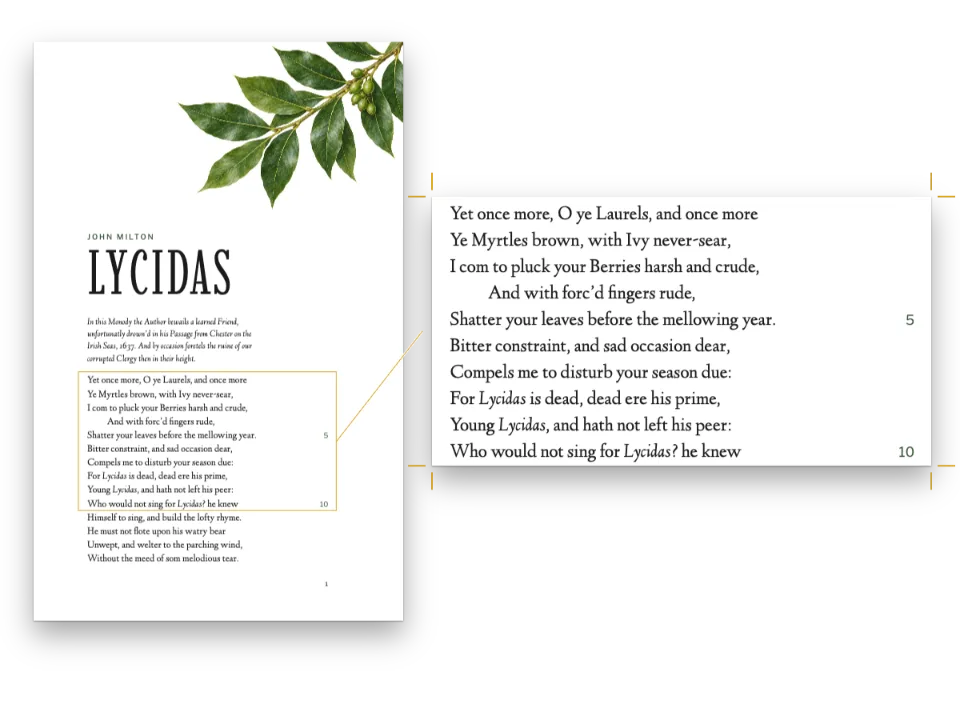
『不思議の国のアリス』の数ページに、編者の注を横の余白に添えたものです。どの注も説明する行のすぐ横にあり、本文には色つきの文字で印が付いています。
できあがり
『不思議の国のアリス』第7章、狂ったお茶会の冒頭を、156 × 234 mmの一般書の判型で注釈版の3ページに組みます。キャロルの本文はUnnaの両端そろえ1段で、1行およそ66字です。小口側の33 mmの帯に編者の傍注8件を収め、それぞれを注の文字を含む段落の横に置きます。そのため傍注は奇数ページでは右、偶数ページでは左に並びます。語句や言葉遊びについての傍注は緑、歴史についての傍注は赤で、本文中の文字も対応する傍注の色になります。章は真上から見たお茶会のテーブルの水彩画の下で始まり、続いて数字、Rozha Oneの表題、緑のドロップキャップを置いたイタリックのヘッドノートが並びます。この版についての注記は、ヘッドノートの横の余白に置きます。
このレシピが答える質問
- 説明する段落の横に、傍注や注釈を置くには?
- 脚注を付けるには?
- 幅の広い本文の段と幅の狭いサイド段からなる1段半のレイアウトにするには?
- 章扉に著者名の行、リード文、ドロップキャップ付きの導入文を加えるには?
手短な答え
const layout = {
  layoutType: 'oneAndHalf', // one text column and a narrower side column
  sideColumnPercent: 26, // of the 127 mm between the margins: a 33 mm channel
  sideColumnRole: 'floats', // no text runs in it: it holds side boxes and figures
  sideColumnSide: 'outer', // at the fore-edge, which mirrored margins move page by page
  gutterWidth: mm(4.5), // the text column keeps 127 − 33 − 4.5 = 89.5 mm
};
// A gloss is :::callout{type="note" span="side" title="a · …"} in the Markdown.
// span="side" moves it out of the flow into the channel, level with the block after
// the fence, so the fence goes just before the paragraph that carries its letter.
// Glosses never float. One that meets the gloss above stacks under it. One that would
// run past the column's foot slides up, as far as the gloss above allows, until its
// foot sits on the foot; if it still does not fit, it waits for the next page
// (gotcha: side-box-starts-at-fence).
const gloss = (id, hue) => ({ id,
  backgroundEnabled: false, // one device: a hairline over the gloss, in its colour
  stripe: { enabled: true, side: 'top', width: pt(0.5), color: col(hue) },
  padding: { top: mm(1.5), right: pt(0), bottom: pt(0), left: pt(0) },
  // Cormorant SC draws lower case as small capitals: the title needs no textTransform.
  titleStyle: { fontFamily: LABEL, fontWeight: 600, fontSize: pt(8.5),
    letterSpacing: pt(0.3), color: col(hue), gap: mm(0.8) },
  // Face and colours come from bodyText. A box body also inherits its 4 mm first-line
  // indent, which a gloss sets back to 0.
  body: { fontSize: pt(7.8), lineHeight: pt(10), textAlign: 'left',
    firstLineIndent: pt(0) } });
const calloutStyles = [gloss('note', 'lawn'), gloss('context', 'jam')]; // words, history
材料
- 機能
- 欄外の注フロート用の余白段1段半組み見開きの余白囲み上付きと下付き段落スタイルデザインした章扉段抜きの章見出し帯ページデザインのテキスト・罫・ボックスページデザインの画像デザイン要素の基準位置章扉のドロップキャップ見出しの属性柱とノンブルページの役割ごとの柱リソースとしての図と表セマンティックカラーパレット最適な改行(Knuth–Plass)インラインのチップ
- 種類
- Unna, Rozha One, Cormorant SC (SIL OFL 1.1)
- 素材
tea-table-1560.jpg- The tea-table seen from above, a watercolour (Generated With Diffusion Models, オリジナル)
作り方
#1 · 小口側を傍注に充てる
コードは前出の手短な答えにあります。1段半組みでは、sideColumnPercent: 26で左右の余白のあいだの127 mmのうち33 mmをサイド段に割り当て、4.5 mmの段間を引いた89.5 mmが本文に残ります。sideColumnRole: 'floats'はキャロルの本文をサイド段に流さないための設定で、サイド段にはspan: 'side'で置いたものだけが入ります。脚注は段の地で罫の下に待っていますが、余白の傍注は説明する行と同じ高さに立ち、本文の段から行を奪いません。2つの傍注スタイルは細罫と見出しの色だけが違うので、読者は読む前に語句の注か歴史の注かを見分けられます。
#2 · ページを見開きにして、帯を小口に追従させる
const PT = 25.4 / 72; // mm in a point
const [TRIM_W, TRIM_H] = [156, 234]; // mm
const [TOP, BOTTOM, INNER, OUTER] = [22, 22, 15, 14]; // mm: 38 lines of text
const page = { width: mm(TRIM_W), height: mm(TRIM_H), dpi: 150,
  backgroundColor: col('paper'),
  // left is a recto's inner margin; mirror swaps the sides on a verso, and 'outer' moves
  // the channel with them: right on a recto, left on a verso.
  margins: { top: mm(TOP), bottom: mm(BOTTOM), left: mm(INNER), right: mm(OUTER),
    mirror: true } };
const CONTENT_W = TRIM_W - INNER - OUTER; // 127 mm
const SIDE_W = CONTENT_W * layout.sideColumnPercent / 100; // 33 mm: the glosses' measure
const TEXT_W = CONTENT_W - SIDE_W - layout.gutterWidth.value;
mirror: trueで偶数ページごとに左右の余白が入れ替わり、sideColumnSide: 'outer'で帯もそれに合わせて動きます。こうして傍注は81ページと83ページでは右に、82ページでは左に並びます。天と地の余白を22 mmにすると190 mmが残り、14 ptの行が38行入ります。傍注もそれぞれこのグリッドの行から始まります。
#3 · 説明する段落の前で傍注を囲む
const bodyText = { // justified and hyphenated (en-us) by default
  // Copy-fitted to the 89.5 mm column: at 9.5 pt '“Have some wine,” the March Hare said in
  // an encouraging tone.' fits one line. At 10.4 pt every measure from 77 to 93 mm left
  // it a short last line: 'couraging tone.', 'aging tone.', 'ing tone.' or 'tone.'.
  fontFamily: TEXT, fontSize: pt(9.5), lineHeight: pt(LEAD), color: col('ink'),
  boldColor: col('ink'), italicColor: col('ink'), firstLineIndent: mm(4),
  // Unna's space is narrow, 0.22 em. At the default 0.6 the line breaker set 'Alice felt
  // dreadfully puzzled. The Hatter’s remark seemed to have' with its spaces at 0.69.
  minWordSpacing: 0.75 };
const paragraphStyles = [
  // The chapter's first paragraph, set flush. indentAfterHeading: false would do it
  // without glosses, but the gloss fences between the heading and this paragraph
  // count as the block after the heading, so the default stays and the paragraph takes
  // this style (gotcha: side-box-after-heading).
  { id: 'opening', firstLineIndent: pt(0) },
];
:::calloutの囲みにspan="side"を付けた囲みは本文の流れから外れ、囲みのあとに続くブロックと同じ高さで帯の中に立ちます。そこで、下の例のように、各傍注は注の文字を含む段落の直前に書きます。傍注aとbは第1段落の横に置くので、その囲みは見出しと第1段落のあいだに入ります。1.4.1ではこの2つの囲みが見出しの次のブロックとして数えられ、indentAfterHeading: falseが段落まで届きません。そこで設定ではこのオプションを既定値のままにし、openingスタイルで段落を字下げなしにしています。本文は段に合わせて文字量を調整しています。9.5 ptでは“Have some wine,”で始まる段落が89.5 mmの1行に収まりますが、10.4 ptでは77 mmから93 mmまでどの行長でも“ing tone.”や“tone.”のような短い最終行が残りました。Unnaの語間は0.22 emと狭く、minWordSpacingが既定の0.6のままでは、83ページの1行で語間がその幅の0.69まで詰められていました。minWordSpacing: 0.75にするとその行は出なくなります。
:::callout{type="context" span="side" title="c · Hair"}
Tenniel drew Alice with long, loose hair. …
:::

“Your hair wants cutting,”:chip[^c^]{style="context"} said the Hatter. …#4 · 各文字を傍注の色で印刷する
// A letter in the text is a chip named after its gloss's type, :chip[^a^]{style="note"}:
// the Markdown has no mark for coloured text, and a chip style sets a colour. With no
// fill, outline, padding or gap the chip adds no width, so the lines break as they would
// with a plain ^a^.
const letter = (id, hue) => ({ id, backgroundEnabled: false, borderWidth: pt(0),
  paddingX: pt(0), gap: pt(0), color: col(hue), bold: true });
const chipStyles = [letter('note', 'lawn'), letter('context', 'jam')];
Markdownには文字に色を付ける記法がありませんが、チップのスタイルは文字色を指定できます。そこで各文字を、傍注の種類と同じ名前のスタイルを持つチップにします。:chip[^c^]{style="context"}は赤いcを印刷し、その赤は傍注cの細罫と見出しの赤と同じです。塗り、輪郭、パディング、間隔のないチップは幅を増やさないので、どの行も素の^c^のときと同じ位置で改行されます。
#5 · お茶会のテーブルの下で章を始める
const HEADPIECE = 72; // mm: the depth of the painting at the head of the page
const HEADNOTE = { size: 9.8, lead: LEAD }; // pt: the headnote keeps the body's leading
const CAPS = { text: 0.597, initial: 0.56 }; // cap heights, em: Unna and Rozha One
// The initial's size: its capital runs from the first line's cap height down to the
// last baseline it spans. The default size is as tall as both line boxes, so its top
// rises above the first line's capitals.
const dropSize = (lines) => pt(((lines - 1) * HEADNOTE.lead + CAPS.text * HEADNOTE.size)
  / CAPS.initial);
const below = (id, y, width) => ({ anchor: { to: `#${id}`, edge: 'below' },
  offset: { y: mm(y) }, size: { width } });
// The opener reserves the height of its lowest text, rounded up to the grid, and the
// heading's default bottom margin adds one blank line: with a four-line headnote the
// text starts on line 23. The painting reserves nothing
// (gotcha: opener-image-no-reserve), so the kicker, the title and the headnote hang
// below it and carry the reserve past it.
const opener = { enabled: true, slot: { elements: [
  // An image element draws a resource without number or caption. It hangs from the
  // trim's corner over the margin, which 1.4.1 paints only when level 1 spans the page.
  { kind: 'image', id: 'headpiece', resourceId: 'tea-table',
    placement: { anchor: { to: 'page', edge: 'top-left' },
      size: { width: mm(TRIM_W) } } },
  // The numeral comes from the heading line,
  // # A Mad Tea-Party {num="VII" headnote="…" …}: the excerpt stands alone, so
  // {chapterNumber} would print 1 (gotcha: heading-number-placeholders).
  { kind: 'text', id: 'kicker', content: 'Chapter {attr.num}', fontFamily: LABEL,
    fontWeight: 600, fontSize: pt(9), letterSpacing: pt(2), textTransform: 'uppercase',
    color: col('jam'), align: 'left',
    placement: { anchor: { to: 'container', edge: 'top-left' },
      offset: { y: mm(HEADPIECE - TOP + 8) } } }, // 8 mm under the painting's foot
  { kind: 'text', id: 'title', content: '{titleText}', fontFamily: DISPLAY,
    fontSize: pt(40), lineHeight: 1.05, color: col('ink'), align: 'left',
    // A longer title wraps instead of ending in '…' (gotcha: overflow-ellipsis-default).
    overflow: 'wrap',
    placement: below('kicker', 2, 'fill') },
  // Drop caps exist only in design text, which is set ragged
  // (gotcha: design-text-ragged): the headnote is the editor's voice, italic and ragged;
  // Carroll's text opens in the flow.
  { kind: 'text', id: 'headnote', content: '{attr.headnote}', fontFamily: TEXT,
    italic: true, fontSize: pt(HEADNOTE.size),
    // A design text's lineHeight multiplies its size
    // (gotcha: design-lineheight-multiple).
    lineHeight: HEADNOTE.lead / HEADNOTE.size, color: col('ink'),
    align: 'left', overflow: 'wrap', // a drop cap needs wrapping text
    dropCap: { lines: 2, fontFamily: DISPLAY, fontSize: dropSize(2), color: col('lawn'),
      gap: mm(1.5) },
    placement: below('title', 5, mm(TEXT_W)) },
  // The note on this edition stands in the channel, level with the headnote's top.
  { kind: 'text', id: 'edition-label', content: 'This edition', fontFamily: LABEL,
    fontWeight: 600, fontSize: pt(8.5), letterSpacing: pt(0.3), color: col('muted'),
    align: 'left', placement: { anchor: { to: '#headnote', edge: 'right-of' },
      offset: { x: layout.gutterWidth }, size: { width: mm(SIDE_W) } } },
  { kind: 'text', id: 'edition', content: '{attr.source}', fontFamily: TEXT,
    fontSize: pt(7.5), lineHeight: 10 / 7.5, color: col('muted'), align: 'left',
    overflow: 'wrap',
    placement: { anchor: { to: '#edition-label', edge: 'below' }, offset: { y: mm(0.8) },
      size: { width: mm(SIDE_W) } } },
] } };
見出しのデザイン枠はページ全体に広げ、絵が仕上がり線まで届くようにします。画像要素は高さを確保しないため、肩見出し、表題、ヘッドノートを絵の下に吊るし、それらが確保する領域を決めます。領域はそのうちいちばん下の要素で終わり、グリッドの行に切り上げられます。見出しの既定の下余白で空き行が1行加わります。ヘッドノートが4行なら本文は23行目から始まり、5行目があれば24行目に下がります。数字、ヘッドノート、この版についての注記は見出しの属性{num="VII" headnote="…" source="…"}から取ります。数字をここから取るのは、抜粋がそれだけで1つの文書になるため、{chapterNumber}では1が印刷されてしまうからです。デザインのテキストは両端そろえにならないので、ドロップキャップは左そろえのイタリックで組んだ編者のヘッドノートの頭に置き、キャロルの本文はその下の流れで両端そろえで始まります。dropSize()は頭文字の大きさを決め、その上端をヘッドノート1行目の大文字にそろえます。
#6 · 説明する内容で傍注の色を分ける
const palette = {
  ink: '#1f1b1a', // text: a warm near-black
  lawn: '#1e6f6b', // glosses on words and jokes, the drop cap
  jam: '#b23a48', // glosses on history, the kicker
  muted: '#6e645b', // running heads, the note on this edition
  paper: '#f8f3e6', // the page, and the tablecloth
};
// col(id): a colour linked to its entry. It carries the hex too, because 1.4.1 paints
// design elements from the hex alone (gotcha: palette-skips-designs).
const col = (id) => ({ hex: palette[id], model: 'hex', paletteId: id });
const entry = (id, hex, name = id) => ({ id, name, value: { hex, model: 'hex' } });
const colorPalette = [
  ...Object.entries(palette).map(([id, hex]) => entry(id, hex)),
  // The engine's defaults link to 'main-color': aimed at the green, nothing prints blue.
  entry('main-color', palette.lawn, 'lawn (defaults)'),
];
芝生の緑は語句、言い回し、言葉遊びについての傍注を、ジャムの赤は人物、日付、本文の来歴についての傍注を示します。同じpaletteオブジェクトでjamに新しい値を与えると、歴史についての傍注、その文字、肩見出しの色が一度に変わります。上の水彩画も、同じ芝生の緑とジャムの赤を基準に選んでいます。1.4.1は章扉と柱を16進値から描くため、リンクした色にはそれぞれ16進値も書いておきます(「よくあるつまずき」を参照)。
レシピの全体
// ═══ Postext Cookbook · Nº 032 · Annotated classic with margin glosses ════════════ // https://postext.dev/en/cookbook/annotated-classic-glosses // Code: MIT · Text: Lewis Carroll (PD), glosses (CC BY 4.0) · Headpiece: diffusion models // Fonts: Unna, Rozha One, Cormorant SC (SIL OFL 1.1) · Needs postext ≥ 1.4.1 // The mad tea-party as an annotated edition: the text keeps to one column, and its glosses stand // in the outer margin beside the lines they explain, changing sides with the spread. import { buildDocument, renderPageToCanvas, clearMeasurementCache, registerResourceImage, } from 'https://esm.sh/postext'; const LANG = 'en'; // @lang: the language of the sample document ('en') const RECIPE = 'annotated-classic-glosses'; // ─── 1 · Design ───────────────────────────────────────────────────────────── // #region palette: a lawn green and a jam red on cream paper const palette = { ink: '#1f1b1a', // text: a warm near-black lawn: '#1e6f6b', // glosses on words and jokes, the drop cap jam: '#b23a48', // glosses on history, the kicker muted: '#6e645b', // running heads, the note on this edition paper: '#f8f3e6', // the page, and the tablecloth }; // col(id): a colour linked to its entry. It carries the hex too, because 1.4.1 paints // design elements from the hex alone (gotcha: palette-skips-designs). const col = (id) => ({ hex: palette[id], model: 'hex', paletteId: id }); const entry = (id, hex, name = id) => ({ id, name, value: { hex, model: 'hex' } }); const colorPalette = [ ...Object.entries(palette).map(([id, hex]) => entry(id, hex)), // The engine's defaults link to 'main-color': aimed at the green, nothing prints blue. entry('main-color', palette.lawn, 'lawn (defaults)'), ]; // #endregion const [TEXT, DISPLAY, LABEL] = ['Unna', 'Rozha One', 'Cormorant SC']; const LEAD = 14; // body leading in pt: the grid of every page // #region answer: a float-only channel at the fore-edge, and two gloss styles for it const layout = { layoutType: 'oneAndHalf', // one text column and a narrower side column sideColumnPercent: 26, // of the 127 mm between the margins: a 33 mm channel sideColumnRole: 'floats', // no text runs in it: it holds side boxes and figures sideColumnSide: 'outer', // at the fore-edge, which mirrored margins move page by page gutterWidth: mm(4.5), // the text column keeps 127 − 33 − 4.5 = 89.5 mm }; // A gloss is :::callout{type="note" span="side" title="a · …"} in the Markdown. // span="side" moves it out of the flow into the channel, level with the block after // the fence, so the fence goes just before the paragraph that carries its letter. // Glosses never float. One that meets the gloss above stacks under it. One that would // run past the column's foot slides up, as far as the gloss above allows, until its // foot sits on the foot; if it still does not fit, it waits for the next page // (gotcha: side-box-starts-at-fence). const gloss = (id, hue) => ({ id, backgroundEnabled: false, // one device: a hairline over the gloss, in its colour stripe: { enabled: true, side: 'top', width: pt(0.5), color: col(hue) }, padding: { top: mm(1.5), right: pt(0), bottom: pt(0), left: pt(0) }, // Cormorant SC draws lower case as small capitals: the title needs no textTransform. titleStyle: { fontFamily: LABEL, fontWeight: 600, fontSize: pt(8.5), letterSpacing: pt(0.3), color: col(hue), gap: mm(0.8) }, // Face and colours come from bodyText. A box body also inherits its 4 mm first-line // indent, which a gloss sets back to 0. body: { fontSize: pt(7.8), lineHeight: pt(10), textAlign: 'left', firstLineIndent: pt(0) } }); const calloutStyles = [gloss('note', 'lawn'), gloss('context', 'jam')]; // words, history // #endregion // #region letters: the letter that calls each gloss, in the gloss's colour // A letter in the text is a chip named after its gloss's type, :chip[^a^]{style="note"}: // the Markdown has no mark for coloured text, and a chip style sets a colour. With no // fill, outline, padding or gap the chip adds no width, so the lines break as they would // with a plain ^a^. const letter = (id, hue) => ({ id, backgroundEnabled: false, borderWidth: pt(0), paddingX: pt(0), gap: pt(0), color: col(hue), bold: true }); const chipStyles = [letter('note', 'lawn'), letter('context', 'jam')]; // #endregion // #region page: a trade page with mirrored margins, so the channel is always at the fore-edge const PT = 25.4 / 72; // mm in a point const [TRIM_W, TRIM_H] = [156, 234]; // mm const [TOP, BOTTOM, INNER, OUTER] = [22, 22, 15, 14]; // mm: 38 lines of text const page = { width: mm(TRIM_W), height: mm(TRIM_H), dpi: 150, backgroundColor: col('paper'), // left is a recto's inner margin; mirror swaps the sides on a verso, and 'outer' moves // the channel with them: right on a recto, left on a verso. margins: { top: mm(TOP), bottom: mm(BOTTOM), left: mm(INNER), right: mm(OUTER), mirror: true } }; const CONTENT_W = TRIM_W - INNER - OUTER; // 127 mm const SIDE_W = CONTENT_W * layout.sideColumnPercent / 100; // 33 mm: the glosses' measure const TEXT_W = CONTENT_W - SIDE_W - layout.gutterWidth.value; // #endregion // #region text: book texture and a flush opening paragraph const bodyText = { // justified and hyphenated (en-us) by default // Copy-fitted to the 89.5 mm column: at 9.5 pt '“Have some wine,” the March Hare said in // an encouraging tone.' fits one line. At 10.4 pt every measure from 77 to 93 mm left // it a short last line: 'couraging tone.', 'aging tone.', 'ing tone.' or 'tone.'. fontFamily: TEXT, fontSize: pt(9.5), lineHeight: pt(LEAD), color: col('ink'), boldColor: col('ink'), italicColor: col('ink'), firstLineIndent: mm(4), // Unna's space is narrow, 0.22 em. At the default 0.6 the line breaker set 'Alice felt // dreadfully puzzled. The Hatter’s remark seemed to have' with its spaces at 0.69. minWordSpacing: 0.75 }; const paragraphStyles = [ // The chapter's first paragraph, set flush. indentAfterHeading: false would do it // without glosses, but the gloss fences between the heading and this paragraph // count as the block after the heading, so the default stays and the paragraph takes // this style (gotcha: side-box-after-heading). { id: 'opening', firstLineIndent: pt(0) }, ]; // #endregion // #region opener: a headpiece, the chapter's numeral and title, a headnote with a drop cap const HEADPIECE = 72; // mm: the depth of the painting at the head of the page const HEADNOTE = { size: 9.8, lead: LEAD }; // pt: the headnote keeps the body's leading const CAPS = { text: 0.597, initial: 0.56 }; // cap heights, em: Unna and Rozha One // The initial's size: its capital runs from the first line's cap height down to the // last baseline it spans. The default size is as tall as both line boxes, so its top // rises above the first line's capitals. const dropSize = (lines) => pt(((lines - 1) * HEADNOTE.lead + CAPS.text * HEADNOTE.size) / CAPS.initial); const below = (id, y, width) => ({ anchor: { to: `#${id}`, edge: 'below' }, offset: { y: mm(y) }, size: { width } }); // The opener reserves the height of its lowest text, rounded up to the grid, and the // heading's default bottom margin adds one blank line: with a four-line headnote the // text starts on line 23. The painting reserves nothing // (gotcha: opener-image-no-reserve), so the kicker, the title and the headnote hang // below it and carry the reserve past it. const opener = { enabled: true, slot: { elements: [ // An image element draws a resource without number or caption. It hangs from the // trim's corner over the margin, which 1.4.1 paints only when level 1 spans the page. { kind: 'image', id: 'headpiece', resourceId: 'tea-table', placement: { anchor: { to: 'page', edge: 'top-left' }, size: { width: mm(TRIM_W) } } }, // The numeral comes from the heading line, // # A Mad Tea-Party {num="VII" headnote="…" …}: the excerpt stands alone, so // {chapterNumber} would print 1 (gotcha: heading-number-placeholders). { kind: 'text', id: 'kicker', content: 'Chapter {attr.num}', fontFamily: LABEL, fontWeight: 600, fontSize: pt(9), letterSpacing: pt(2), textTransform: 'uppercase', color: col('jam'), align: 'left', placement: { anchor: { to: 'container', edge: 'top-left' }, offset: { y: mm(HEADPIECE - TOP + 8) } } }, // 8 mm under the painting's foot { kind: 'text', id: 'title', content: '{titleText}', fontFamily: DISPLAY, fontSize: pt(40), lineHeight: 1.05, color: col('ink'), align: 'left', // A longer title wraps instead of ending in '…' (gotcha: overflow-ellipsis-default). overflow: 'wrap', placement: below('kicker', 2, 'fill') }, // Drop caps exist only in design text, which is set ragged // (gotcha: design-text-ragged): the headnote is the editor's voice, italic and ragged; // Carroll's text opens in the flow. { kind: 'text', id: 'headnote', content: '{attr.headnote}', fontFamily: TEXT, italic: true, fontSize: pt(HEADNOTE.size), // A design text's lineHeight multiplies its size // (gotcha: design-lineheight-multiple). lineHeight: HEADNOTE.lead / HEADNOTE.size, color: col('ink'), align: 'left', overflow: 'wrap', // a drop cap needs wrapping text dropCap: { lines: 2, fontFamily: DISPLAY, fontSize: dropSize(2), color: col('lawn'), gap: mm(1.5) }, placement: below('title', 5, mm(TEXT_W)) }, // The note on this edition stands in the channel, level with the headnote's top. { kind: 'text', id: 'edition-label', content: 'This edition', fontFamily: LABEL, fontWeight: 600, fontSize: pt(8.5), letterSpacing: pt(0.3), color: col('muted'), align: 'left', placement: { anchor: { to: '#headnote', edge: 'right-of' }, offset: { x: layout.gutterWidth }, size: { width: mm(SIDE_W) } } }, { kind: 'text', id: 'edition', content: '{attr.source}', fontFamily: TEXT, fontSize: pt(7.5), lineHeight: 10 / 7.5, color: col('muted'), align: 'left', overflow: 'wrap', placement: { anchor: { to: '#edition-label', edge: 'below' }, offset: { y: mm(0.8) }, size: { width: mm(SIDE_W) } } }, ] } }; // #endregion // The running heads: the book on the verso, the chapter on the recto, folios at the fore-edge. const HEAD = 14; // mm from the top trim to the heads' baseline const INSET = 8; // mm from the folio's outer edge to the running head's const DROP = 13; // mm from the bottom trim up to the foot of the drop folio's box // In 1.4.1 a design text's first baseline sits 0.96 em below the top of its box: the default // lineHeight, 1.2, times 0.8, where the baseline falls in the line box. const BASELINE = 1.2 * 0.8; const baseline = (size) => mm(HEAD - BASELINE * size * PT); const head = (id, parity, content, x, extra = {}) => ({ kind: 'text', id, parity, content, pages: 'body', fontFamily: LABEL, fontWeight: 600, fontSize: pt(8.5), letterSpacing: pt(1.2), textTransform: 'uppercase', color: col('muted'), ...extra, placement: { anchor: { to: 'page', edge: parity === 'even' ? 'top-left' : 'top-right' }, offset: { x: mm(x), y: baseline(extra.fontSize?.value ?? 8.5) } } }); const folio = { fontFamily: TEXT, fontWeight: 700, fontSize: pt(9), letterSpacing: pt(0), color: col('ink') }; const header = { elements: [ head('verso-folio', 'even', '{pageNumber}', OUTER, folio), head('verso-title', 'even', '{title}', OUTER + INSET), head('recto-title', 'odd', '{chapterTitle}', -(OUTER + INSET)), head('recto-folio', 'odd', '{pageNumber}', -OUTER, folio), ] }; // The opener, a recto, carries a drop folio at the foot of its channel instead. const footer = { elements: [{ ...head('drop-folio', 'odd', '{pageNumber}', -OUTER, folio), pages: 'opener', placement: { anchor: { to: 'page', edge: 'bottom-right' }, offset: { x: mm(-OUTER), y: mm(-DROP) } } }] }; const config = () => ({ // a factory: configs are cached by identity (gotcha: config-cache-identity) colorPalette, page, layout, bodyText, paragraphStyles, calloutStyles, chipStyles, header, footer, headings: { fontFamily: DISPLAY, fontWeight: 400, color: col('ink'), // Rozha One has one weight levels: [ // Restated: any headings object drops the H1 break (gotcha: headings-drop-h1-break). // 'odd' puts the opener on a recto; span 'page' lets its design cross the channel. { level: 1, span: 'page', breakBefore: { enabled: true, parity: 'odd' }, advancedDesign: opener }, ], }, }); // ─── 2 · Content ──────────────────────────────────────────────────────────── const markdown = String.raw`---Markdownの見本 · 121行 · content.en.md
title: "Alice’s Adventures in Wonderland" author: "Lewis Carroll" --- # A Mad Tea-Party {num="VII" headnote="The tea-party is not in the book Carroll wrote out by hand for Alice Liddell in 1864; he added it, with the Cheshire Cat, for the book of 1865. Letters in the text point to the glosses beside it: green for words and jokes, red for history." source="Text after Project Gutenberg eBook 11; notes CC BY 4.0. Set in Unna, Rozha One and Cormorant SC (SIL OFL)."} :::callout{type="note" span="side" title="a · The March Hare"} ‘Mad as a March hare’ is an old saying. Hares are shy, but in early spring they race about the fields and rear up on their hind legs to box. ::: :::callout{type="context" span="side" title="b · The Hatter"} ‘Mad as a hatter’ was a saying before Carroll used it. Hatters made felt from fur treated with mercury, and the fumes gave many of them tremors and fits of shyness and temper. Carroll never calls him the Mad Hatter. ::: :::paragraphs{style="opening"} There was a table set out under a tree in front of the house, and the March Hare:chip[^a^]{style="note"} and the Hatter:chip[^b^]{style="context"} were having tea at it: a Dormouse was sitting between them, fast asleep, and the other two were using it as a cushion, resting their elbows on it, and talking over its head. “Very uncomfortable for the Dormouse,” thought Alice; “only, as it’s asleep, I suppose it doesn’t mind.” ::: The table was a large one, but the three were all crowded together at one corner of it: “No room! No room!” they cried out when they saw Alice coming. “There’s *plenty* of room!” said Alice indignantly, and she sat down in a large arm-chair at one end of the table. “Have some wine,” the March Hare said in an encouraging tone. Alice looked all round the table, but there was nothing on it but tea. “I don’t see any wine,” she remarked. “There isn’t any,” said the March Hare. “Then it wasn’t very civil of you to offer it,” said Alice angrily. “It wasn’t very civil of you to sit down without being invited,” said the March Hare. “I didn’t know it was *your* table,” said Alice; “it’s laid for a great many more than three.” :::callout{type="context" span="side" title="c · Hair"} Tenniel drew Alice with long, loose hair. Alice Liddell, in Carroll’s photographs of her, wears hers short and dark, with a fringe. ::: “Your hair wants cutting,”:chip[^c^]{style="context"} said the Hatter. He had been looking at Alice for some time with great curiosity, and this was his first speech. “You should learn not to make personal remarks,” Alice said with some severity; “it’s very rude.” :::callout{type="context" span="side" title="d · The riddle"} Carroll made up the riddle without an answer. So many readers asked for one that in a preface of 1896 he offered this: ‘Because it can produce a few notes, tho they are very flat; and it is nevar put with the wrong end in front!’ Later printings changed *nevar*, raven spelt backwards, to *never*, and the joke was lost. ::: The Hatter opened his eyes very wide on hearing this; but all he *said* was, “Why is a raven like a writing-desk?”:chip[^d^]{style="context"} “Come, we shall have some fun now!” thought Alice. “I’m glad they’ve begun asking riddles.—I believe I can guess that,” she added aloud. “Do you mean that you think you can find out the answer to it?” said the March Hare. “Exactly so,” said Alice. “Then you should say what you mean,” the March Hare went on. “I do,” Alice hastily replied; “at least—at least I mean what I say—that’s the same thing, you know.” :::callout{type="note" span="side" title="e · I see what I eat"} The Hatter has the logic right. Turn a statement round and you get its converse, which can be false when the statement is true. Carroll, as Charles Dodgson, taught mathematics at Christ Church, Oxford, and wrote two books on logic. ::: “Not the same thing a bit!” said the Hatter. “You might just as well say that ‘I see what I eat’ is the same thing as ‘I eat what I see’!”:chip[^e^]{style="note"} “You might just as well say,” added the March Hare, “that ‘I like what I get’ is the same thing as ‘I get what I like’!” “You might just as well say,” added the Dormouse, who seemed to be talking in his sleep, “that ‘I breathe when I sleep’ is the same thing as ‘I sleep when I breathe’!” “It *is* the same thing with you,” said the Hatter, and here the conversation dropped, and the party sat silent for a minute, while Alice thought over all she could remember about ravens and writing-desks, which wasn’t much. The Hatter was the first to break the silence. “What day of the month is it?” he said, turning to Alice: he had taken his watch out of his pocket, and was looking at it uneasily, shaking it every now and then, and holding it to his ear. :::callout{type="context" span="side" title="f · The fourth"} Of May: Alice Liddell was born on 4 May 1852. ::: Alice considered a little, and then said “The fourth.”:chip[^f^]{style="context"} “Two days wrong!” sighed the Hatter. “I told you butter wouldn’t suit the works!” he added looking angrily at the March Hare. :::callout{type="note" span="side" title="g · The best butter"} Grocers sold butter by grade, and ‘best’ fetched the highest price. The March Hare defends its quality, which was never the trouble. ::: “It was the *best* butter,”:chip[^g^]{style="note"} the March Hare meekly replied. “Yes, but some crumbs must have got in as well,” the Hatter grumbled: “you shouldn’t have put it in with the bread-knife.” The March Hare took the watch and looked at it gloomily: then he dipped it into his cup of tea, and looked at it again: but he could think of nothing better to say than his first remark, “It was the *best* butter, you know.” Alice had been looking over his shoulder with some curiosity. “What a funny watch!” she remarked. “It tells the day of the month, and doesn’t tell what o’clock it is!” “Why should it?” muttered the Hatter. “Does *your* watch tell you what year it is?” “Of course not,” Alice replied very readily: “but that’s because it stays the same year for such a long time together.” “Which is just the case with *mine*,” said the Hatter. Alice felt dreadfully puzzled. The Hatter’s remark seemed to have no sort of meaning in it, and yet it was certainly English. “I don’t quite understand you,” she said, as politely as she could. “The Dormouse is asleep again,” said the Hatter, and he poured a little hot tea upon its nose. :::callout{type="note" span="side" title="h · The Dormouse"} Hazel dormice sleep through the day and hibernate for half the year, from autumn to spring. The name is often traced to the French *dormir*, to sleep. ::: The Dormouse:chip[^h^]{style="note"} shook its head impatiently, and said, without opening its eyes, “Of course, of course; just what I was going to remark myself.” “Have you guessed the riddle yet?” the Hatter said, turning to Alice again. “No, I give it up,” Alice replied: “what’s the answer?” “I haven’t the slightest idea,” said the Hatter. “Nor I,” said the March Hare. Alice sighed wearily. “I think you might do something better with the time,” she said, “than waste it in asking riddles that have no answers.” “If you knew Time as well as I do,” said the Hatter, “you wouldn’t talk about wasting *it*. It’s *him*.” “I don’t know what you mean,” said Alice. “Of course you don’t!” the Hatter said, tossing his head contemptuously. “I dare say you never even spoke to Time!”`; // content.<lang>.md, inlined by the Cookbook // The headpiece is a resource that only the opener's design draws: never cited, never placed. // It is a watercolour, a JPEG in assets/ cut to the trim's 156 × 72 mm, declared at its pixels. const resources = [{ id: 'tea-table', typeId: 'figure', kind: 'bitmap', createdAt: 0, updatedAt: 0, bitmap: { fileId: 'tea-table-1560.jpg', format: 'jpeg', width: 1560, height: 720 }, altText: 'The tea-table under a tree, seen from above: a long white cloth laid with cups, a red ' + 'teapot, bread and butter and a watch on its chain; the Dormouse asleep in a teapot at one ' + 'end and a red arm-chair at the other.' }]; // ─── 3 · Fonts ────────────────────────────────────────────────────────────── const FONTS = { // text, display and label faces, loaded before the build (gotcha: fonts-first) Unna: ['400', '400i', '700'], // 700: the folios and the gloss letters 'Rozha One': ['400'], 'Cormorant SC': ['600'], }; // ─── 4 · Build & show ─────────────────────────────────────────────────────── await loadFonts(FONTS, markdown); await loadImage('tea-table-1560.jpg', asset('tea-table-1560.jpg')); const continuation = { pageNumbering: { startAt: 81 } }; // chapter VII of a book: an odd folio const doc = await buildWithFonts( () => buildDocument({ markdown, resources, continuation }, config()), markdown); showPages(doc, { title: 'Annotated classic with margin glosses' });キット · core, fonts, viewer, images:全レシピ共通 · 270行
// ─── Kit ── helpers shared by every Cookbook recipe · postext.dev/cookbook ───── // ─── Kit · core v1 ── the same in every recipe · postext.dev/cookbook ───────── function mm(value) { return { value, unit: 'mm' }; } function pt(value) { return { value, unit: 'pt' }; } function em(value) { return { value, unit: 'em' }; } /** The sample language's string: t({ en: 'Figure', es: 'Figura' }). */ function t(strings) { return strings[LANG] ?? Object.values(strings)[0]; } /** A file in this recipe's assets folder, served from the Postext repo by jsDelivr. */ function asset(file) { return `https://cdn.jsdelivr.net/gh/drnachio/postext@main/cookbook/${RECIPE}/assets/${file}`; } // ─── Kit · fonts v1 ── the same in every recipe · postext.dev/cookbook ──────── // Postext measures text with the faces the browser has loaded, and caches the // widths, so every face must be ready before the first build. Faces come from // Fontsource: the same static files the PDF embeds, so screen and PDF agree. /** faces = { 'Family Name': ['400', '400i', '700'] }. `text` is the sample: * letters beyond Latin-1 (č, ł, ő…) also load the latin-ext files. With * `optional`, a face Fontsource does not ship is skipped instead of failing. * Resolves to the number of faces added. */ async function loadFonts(faces, text = '', { optional = false } = {}) { kitStatus('Loading fonts…'); const ranges = { latin: 'U+0000-00FF,U+0131,U+0152-0153,U+02BB-02BC,U+02C6,U+02DA,U+02DC,U+0304,U+0308,U+0329,' + 'U+2000-206F,U+20AC,U+2122,U+2191,U+2193,U+2212,U+2215,U+FEFF,U+FFFD', 'latin-ext': 'U+0100-02BA,U+02BD-02C5,U+02C7-02CC,U+02CE-02D7,U+02DD-02FF,U+0304,U+0308,U+0329,' + 'U+1D00-1DBF,U+1E00-1E9F,U+1EF2-1EFF,U+2020,U+20A0-20AB,U+20AD-20C0,U+2113,U+2C60-2C7F,U+A720-A7FF', }; const subsets = /[Ā-˿Ḁ-ỿ]/.test(text) ? ['latin', 'latin-ext'] : ['latin']; const jobs = []; let added = 0; for (const [family, specs] of Object.entries(faces)) { const id = fontsourceId(family); const meta = optional ? await fontsourceMeta(family) : null; for (const spec of new Set(specs)) { const weight = parseInt(spec, 10); const style = spec.endsWith('i') ? 'italic' : 'normal'; if (hasFace(family, weight, style)) continue; if (optional && !(meta?.weights.includes(weight) && meta.styles.includes(style))) continue; for (const subset of subsets) { const url = `https://cdn.jsdelivr.net/npm/@fontsource/${id}@5/files/${id}-${subset}-${weight}-${style}.woff2`; const face = new FontFace(family, `url(${url}) format('woff2')`, { weight: String(weight), style, unicodeRange: ranges[subset] }); jobs.push(face.load().then((ready) => { document.fonts.add(ready); added++; }, () => { if (subset === 'latin' && !optional) throw new Error(`Fontsource has no ${family} ${weight} ${style}`); })); } } } await Promise.all(jobs).catch((error) => { kitFail(error); throw error; }); return added; } /** Runs `build` (a buildDocument or buildBundle call) and checks the faces * the pages use. A regular face missing from FONTS is loaded with a warning; * bold and italic variants are loaded when the family ships them. Then the * measurement caches are cleared and the build runs again. */ async function buildWithFonts(build, text = '') { const tried = new Set(); for (let round = 0; round < 3; round++) { kitStatus('Laying out…'); await new Promise(requestAnimationFrame); // let the status paint first const result = await Promise.resolve().then(build).catch((error) => { kitFail(error); throw error; }); const wanted = { base: {}, variants: {} }; for (const { font, base } of [result].flat().flatMap(fontStringsOf)) { const { family, weight, style } = parseFont(font); const key = `${family}|${weight}|${style}`; if (tried.has(key) || hasFace(family, weight, style)) continue; tried.add(key); (wanted[base ? 'base' : 'variants'][family] ??= []).push(`${weight}${style === 'italic' ? 'i' : ''}`); } if (Object.keys(wanted.base).length) { console.warn(`[cookbook] FONTS does not list ${JSON.stringify(wanted.base)}: loading them.`); } const added = await loadFonts(wanted.base, text) + await loadFonts(wanted.variants, text, { optional: true }); if (added === 0) return result; clearMeasurementCache(); } throw new Error('The fonts did not settle after three builds.'); } /** Every font string of the layout. `base` marks a block's own face; its * bold, italic and bold-italic variants are listed whether or not used. */ function fontStringsOf(doc) { const found = new Map(); const walk = (node) => { if (!node || typeof node !== 'object') return; if (Array.isArray(node)) { node.forEach(walk); return; } for (const [key, value] of Object.entries(node)) { if (typeof value === 'string' && /fontString$/i.test(key)) { found.set(value, found.get(value) || key === 'fontString'); } else if (value && typeof value === 'object') walk(value); } }; walk(doc.pages); walk(doc.blocks); return [...found].map(([font, base]) => ({ font, base })); } /** '700 37.5px Open Sans' / 'italic 400 13px "Source Serif 4"' → { family, weight, style }. * A string with no weight ('95.8px Young Serif', from a design text) is 400. */ function parseFont(font) { const m = /^(?:(italic|oblique)\s+)?(?:small-caps\s+)?(?:(\d+|bold|normal)\s+)?[\d.]+px\s+(.+)$/.exec(font.trim()); if (!m) throw new Error(`Unexpected font string: ${font}`); const weight = m[2] === 'bold' ? 700 : !m[2] || m[2] === 'normal' ? 400 : Number(m[2]); return { family: m[3].replace(/^["']|["']$/g, ''), weight, style: m[1] ? 'italic' : 'normal' }; } /** True when a loaded FontFace covers exactly this family, weight and style * (document.fonts.check() is also true for families nobody declared). */ function hasFace(family, weight, style) { for (const face of document.fonts) { if (face.status !== 'loaded' || face.style !== style) continue; if (face.family.replace(/^["']|["']$/g, '') !== family) continue; const [low, high = low] = face.weight.split(' ').map(Number); if (weight >= low && weight <= high) return true; } return false; } /** Fontsource's id for a family: 'Source Serif 4' → 'source-serif-4'. */ function fontsourceId(family) { return family.toLowerCase().replace(/\s+/g, '-'); } /** The weights and styles a family ships ({ weights: [400, 700], styles: ['normal', 'italic'] }), or null. */ function fontsourceMeta(family) { fontsourceMeta.cache ??= new Map(); const id = fontsourceId(family); if (!fontsourceMeta.cache.has(id)) { fontsourceMeta.cache.set(id, fetch(`https://api.fontsource.org/v1/fonts/${id}`) .then((res) => (res.ok ? res.json() : null), () => null)); } return fontsourceMeta.cache.get(id); } // ─── Kit · viewer v1 ── the same in every recipe · postext.dev/cookbook ─────── /** Shows the pages as facing spreads on a dark desk: the first page is a * recto on its own, then verso | recto pairs, as in a bound book. Pages * are painted when they scroll near the screen. */ function showPages(docs, { title, width = 460 } = {}) { const root = viewer(title); const pages = [docs].flat().flatMap((doc) => doc.pages.map((page) => ({ doc, page, n: (doc.pageIndexOffset ?? 0) + page.index }))); const spreads = []; let verso = null; for (const p of pages) { if (p.n % 2 === 1) { if (verso) spreads.push([verso, null]); verso = p; } else { spreads.push([verso, p]); verso = null; } } if (verso) spreads.push([verso, null]); const density = Math.min(window.devicePixelRatio || 1, 2); showPages.painter?.disconnect(); const painter = new IntersectionObserver((entries) => { for (const { isIntersecting, target } of entries) { if (!isIntersecting) continue; painter.unobserve(target); const { doc, page } = target.postext; renderPageToCanvas(page, doc, target, { scale: (width * density) / page.width }); } }, { rootMargin: '800px' }); showPages.painter = painter; root.replaceChildren(...spreads.map((pair) => { const spread = document.createElement('div'); spread.className = 'pt-spread'; for (const p of pair) { const figure = document.createElement('figure'); if (p) { const label = p.page.pageLabel || String(p.n + 1); const canvas = document.createElement('canvas'); canvas.postext = p; canvas.style.aspectRatio = `${p.page.width} / ${p.page.height}`; canvas.setAttribute('role', 'img'); canvas.setAttribute('aria-label', `Page ${label}`); const folio = document.createElement('figcaption'); folio.textContent = label; figure.append(canvas, folio); painter.observe(canvas); } else figure.className = 'pt-blank'; spread.append(figure); } return spread; })); kitStatus(`${pages.length} ${pages.length === 1 ? 'page' : 'pages'}`); document.documentElement.dataset.postext = 'ready'; return pages.length; } /** The desk, the bar and the error reporting, created once. */ function viewer(title) { if (!document.getElementById('pt-kit')) { document.head.insertAdjacentHTML('beforeend', `<style id="pt-kit"> :root { color-scheme: dark; } body { margin: 0; background: #0e1014; color: #b9bcc4; font: 13px/1.45 system-ui, sans-serif; } #pt-bar { position: sticky; top: 0; z-index: 1; display: flex; flex-wrap: wrap; align-items: center; gap: 6px 16px; padding: 10px 16px; background: rgb(14 16 20 / .92); backdrop-filter: blur(6px); border-bottom: 1px solid #23262d; } #pt-bar strong { color: #f4f1ea; font-weight: 600; } #pt-actions { display: flex; gap: 12px; margin-left: auto; } #pt-actions a, #pt-actions button { color: #d8a21a; font: inherit; background: none; border: 0; padding: 0; cursor: pointer; } #pages { display: grid; justify-items: center; gap: 48px; padding: 32px 16px 72px; } .pt-spread { display: flex; } .pt-spread figure { margin: 0; width: min(460px, 44vw); } .pt-spread canvas { display: block; width: 100%; background: #fff; box-shadow: 0 1px 2px rgb(0 0 0 / .5), 0 22px 44px -16px rgb(0 0 0 / .8); } .pt-spread figure:first-child canvas { box-shadow: inset -14px 0 14px -14px rgb(0 0 0 / .18), 0 1px 2px rgb(0 0 0 / .5), 0 22px 44px -16px rgb(0 0 0 / .8); } .pt-spread figcaption { margin-top: 10px; text-align: center; font: 600 10px/1 system-ui, sans-serif; letter-spacing: .18em; text-transform: uppercase; color: #6c7079; } .pt-blank { visibility: hidden; } @media (max-width: 760px) { .pt-spread { flex-direction: column; gap: 32px; } .pt-spread figure { width: min(460px, 92vw); } .pt-blank { display: none; } } </style>`); document.body.insertAdjacentHTML('afterbegin', '<header id="pt-bar"><strong id="pt-title"></strong><span id="pt-status" role="status"></span><span id="pt-actions"></span></header>'); document.getElementById('pt-title').textContent = document.title || 'Postext'; addEventListener('error', (event) => kitFail(event.error ?? event.message)); addEventListener('unhandledrejection', (event) => kitFail(event.reason)); } if (title) document.getElementById('pt-title').textContent = title; return document.getElementById('pages') ?? document.body.appendChild(Object.assign(document.createElement('main'), { id: 'pages' })); } function kitStatus(text) { viewer(); document.getElementById('pt-status').textContent = text; } function kitFail(error) { document.documentElement.dataset.postext = 'error'; kitStatus(`Error: ${error?.message ?? error}`); } // ─── Kit · images v1 ── recipes with pictures · postext.dev/cookbook ────────── /** Registers a photo or PNG for the canvas and keeps its bytes for the PDF. * fetch → ImageBitmap never taints the canvas (a plain cross-origin <img> would). */ async function loadImage(fileId, url) { const res = await fetch(url); if (!res.ok) throw new Error(`Image not found (${res.status}): ${url}`); const bytes = new Uint8Array(await res.arrayBuffer()); registerResourceImage(fileId, await createImageBitmap(new Blob([bytes]))); (loadImage.bytes ??= new Map()).set(fileId, bytes); } /** Registers SVG markup (drawn in code, or fetched) as a vector image. */ async function loadSvg(fileId, svg) { const img = new Image(); img.src = `data:image/svg+xml;charset=utf-8,${encodeURIComponent(svg)}`; await img.decode(); registerResourceImage(fileId, img); (loadImage.bytes ??= new Map()).set(fileId, new TextEncoder().encode(svg)); } /** renderToPdf({ resourceBytes: imageBytes }) */ function imageBytes(fileId) { return loadImage.bytes?.get(fileId); } /** renderToHtml({ resourceImageUrl: imageUrl }) */ function imageUrl(fileId) { const bytes = imageBytes(fileId); if (!bytes) return undefined; imageUrl.urls ??= new Map(); if (!imageUrl.urls.has(fileId)) { const type = /\.svg$/i.test(fileId) ? 'image/svg+xml' : /\.png$/i.test(fileId) ? 'image/png' : 'image/jpeg'; imageUrl.urls.set(fileId, URL.createObjectURL(new Blob([bytes], { type }))); } return imageUrl.urls.get(fileId); } // ─── /Kit ───────────────────────────────────────────────────────────────────────
組み立てたscript.jsはそのまま動きます。任意のページのモジュールスクリプトに貼り付けるか、レシピをCodePenで開いてください。 GitHub上のレシピのフォルダー ↗ (新しいタブで開きます)
アレンジ
#傍注をどのページでも右に置く
画面で1ページずつ読む版なら、見開きの設定を切ります。すると'outer'はどのページでも右端を指し、柱は仕上がり線に固定されているので位置が変わりません。
-    mirror: true } };
+ mirror: false } };#長い注はページの地に送る
余白に収まらない長い注は脚注にします。本文に[^1]を書き、段落の下にその定義[^1]:を書くと、Postextは本文の段の地に、短い罫の下の89.5 mm幅で組みます。傍注は帯に残ります。それらの注のスタイルは引用した段の地に置く脚注で扱います。
よくあるつまずき
つまずき
サイド段の囲みは、囲みを開く位置の次のブロックと同じ高さから始まる
postext 1.4.1では、span: 'side'の囲みは、囲みを開く位置で本文が達した高さの次のグリッド行から、すでにある囲みがあればその下に、サイド段に置かれます。注釈は説明する段落の直前で開いてください。段落のあとで開くと、注釈は次の段落の横から始まります。段の末尾を越える囲みは、上の囲みが許す範囲で、下端が段の末尾にそろうまで上にずれます。それでも収まらない囲みは、次のページのサイド段まで待ちます。 欄外の注 →
つまずき
見出しのあとのサイド段の囲みは、次の段落を字下げさせる
postext 1.4.1では、見出しと最初の段落の間に置いたspan: 'side'の囲みがあると、indentAfterHeading: falseでもその段落の1行目が字下げされます。囲みは流れから外れますが、そのブロックは見出しの次のブロックとして数えられるためです。囲みは最初の段落のあとに置いてください。 欄外の注 →
つまずき
{number}/{chapterNumber}はH1の番号を出す。{numberRoman}は部だけ
{number}と{chapterNumber}は見出しの書式付きの番号を出力しますが、{numberRoman}、{numberDecimal}などの数値のバリエーションが埋まるのは部扉だけです。章番号の書式はnumberingTemplate({1:I})で指定するか、属性として渡してください。 番号付き見出し →
つまずき
章扉の画像は確保する高さに数えられない
postext 1.4.1では、詳細デザインの見出しは、確保する高さを画像抜きで計測します。テキスト、罫、箱はページに固定していても数えられますが、ページの頭に裁ち落としで置いた写真のような画像は何も確保しないため、本文がその上から始まることがあります。minHeightを本文が始まるべき位置に設定してください。 デザインした章扉 →
つまずき
デザインのテキストは両端そろえにならず、ドロップキャップのリードは行末がそろわない
postext 1.4.1のデザインのテキスト要素は左そろえ、中央、右そろえのいずれかで、語単位で折り返します。両端そろえはなく、hyphenate: trueは1行に収まらない長い語を分割するだけです。そのため、dropCapの横に組むリードの行は、両端そろえの本文の横で行末がそろいません。リードは頭文字の横の行だけにして、手で収めてください。lines: 1(上がり頭文字)ならリードは1行で、dropCapの間隔で行末をぴったり合わせられます。段落の続きはMarkdownに書きます。 章扉のドロップキャップ →
つまずき
デザインのテキストのlineHeightは倍率で、寸法ではない
デザインのスロットでは、テキスト要素のlineHeightはフォントサイズに掛ける倍率です(lineHeight: 1.05)。postext 1.4.1ではpt(15)のような寸法を指定しても拒否されず、章扉の高さがNaNと計測されて、minHeightを含め確保する高さが警告なしに失われ、本文がタイトルに重なって組まれます。 ページデザインのテキスト・罫・ボックス →
つまずき
パレットを差し替えても、デザイン要素と参照色は変わらない
postext 1.4.1はcolorPaletteをテキストのスタイル(本文、見出し、リスト、キャプション、表、囲み)には反映しますが、ヘッダー、フッター、章扉、部扉の要素と、bodyText.referenceColorには反映しません。これらはpaletteIdの横に書いた16進の色のままです。画面用のダーク版や色替えのためにパレットを差し替えるときは、ビルドの前に、リンクしたすべての色をcolorPaletteから書き直してください。 セマンティックカラーパレット →
つまずき
headingsオブジェクトを渡すとH1の改ページが消える
既定ではH1は奇数ページへ改ページします(always-odd)。ところがheadingsオブジェクトを渡すと中身にかかわらずこの既定がリセットされ、章は改ページせずに続けて組まれ、span: 'page'も効かなくなります。どの設定でもheadings.levels[0].breakBefore: { enabled: true, parity }を書き直してください。 奇数ページから始まる章 →
- 傍注はMarkdownに書いた順に上から積み重なるので、長い傍注は次の傍注を押し下げます。81ページでは2つの文字がどちらも第1段落の2行目にあり、傍注aは段落と同じ高さから、傍注bはその下、文字から5行下から始まります。文字が近くに集まる箇所では傍注を短くしてください。
- 前出のつまずき「見出しのあとのサイド段の囲みは、次の段落を字下げさせる」は、囲みを第1段落のあとに書くよう勧めています。そこに書いた傍注は第2段落の横から始まる(「サイド段の囲みは、囲みを開く位置の次のブロックと同じ高さから始まる」を参照)ため、この版では2つの囲みとも第1段落の前に置き、その段落を
openingスタイルで字下げなしにしています。
クレジット
- 本文
- Alice’s Adventures in Wonderland (1865), the opening of chapter VII, “A Mad Tea-Party” · Lewis Carroll · パブリックドメイン
- The headnote, the eight glosses and the note on this edition · Ignacio Ferro · CC BY 4.0
- 画像
- The tea-table seen from above, a watercolour · Generated With Diffusion Models · オリジナル
- フォント
- Unna (SIL OFL 1.1) · Rozha One (SIL OFL 1.1) · Cormorant SC (SIL OFL 1.1)