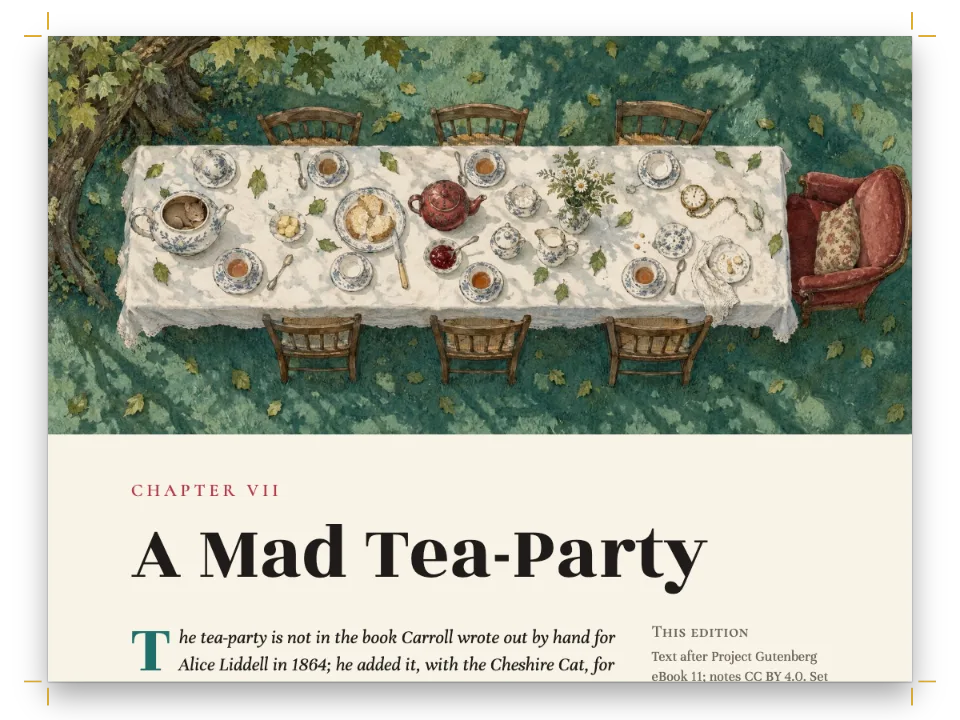
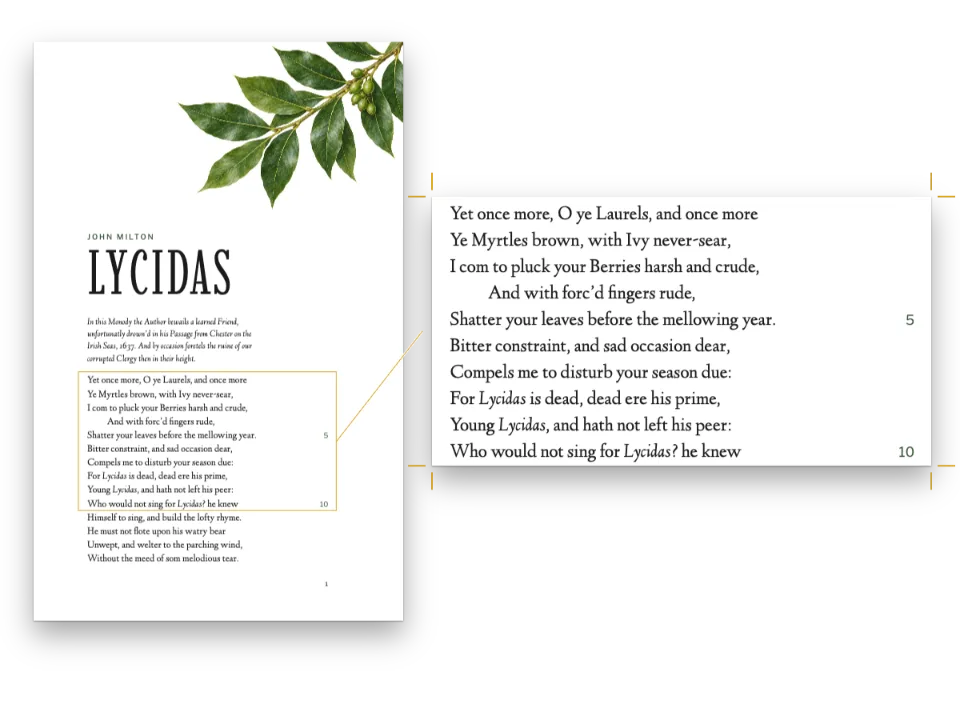
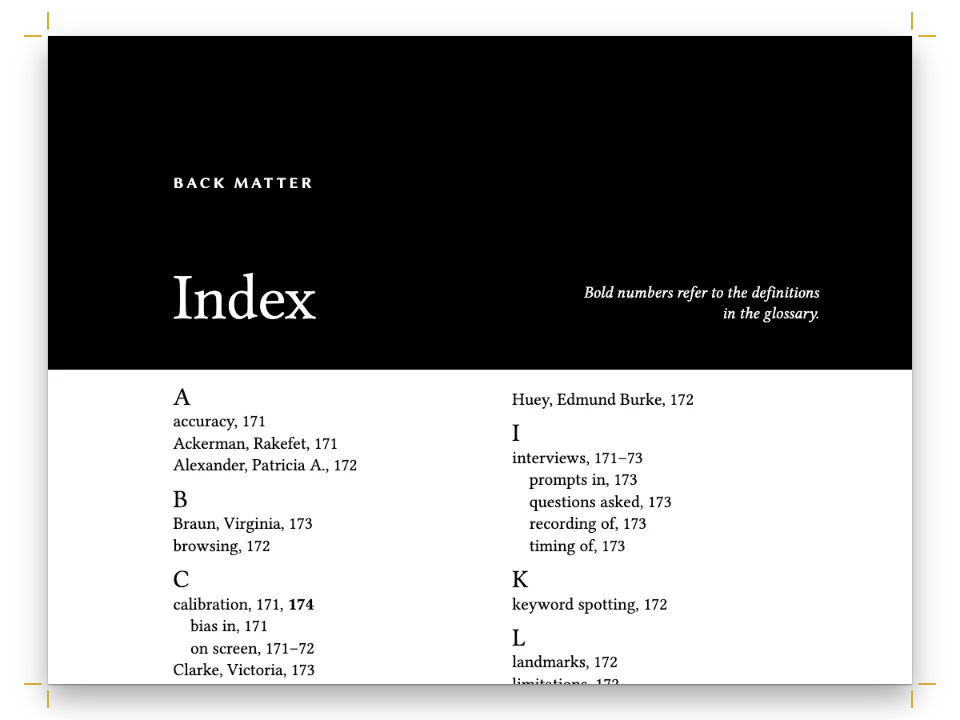
かんたんな説明
ろうそくを題材にした有名な科学講演を、小さな本に組みます。注を各ページの下ではなく最後にまとめ、独立したページに2段で並べる方法を示します。
できあがり
マイケル・ファラデーの『ロウソクの科学』(The Chemical History of a Candle)の第1講を、156 × 234 mmのページに小さな読者向けの版として組みます。講演は煤の色の地で始まり、その下端に火の灯ったろうそくが立っています。拡散モデルで生成した写真で、黒が煤の色とそろっています。本文はLibre Bodoniの両端そろえの1段です。本なら脚注を置くところに、濃いオレンジの小さな上付き数字があり、読者を講演の最後へ導きます。注は独立したページに続きます。ろうそくが吹き消された煤の色の帯の下に、8.2 ptの行末不ぞろいの2段で組まれ、ボールドの番号が字下げの中にぶら下がります。6つの注のうち3つは、ウィリアム・クルックスによる1861年の版の1908年の刷りからとったものです。残りの3つは新しく書いたもので、「Ed.」の署名があります。2つの段は同じ行で終わり、2段目は奥付で閉じます。
このレシピが答える質問
- 脚注を付けるには?
- 参考文献や用語集を組むには(ぶら下げインデント、小さめの文字)?
- 数式を使わずに、上付き文字、下付き文字、化学式を書くには?
手短な答え
// Use: buildDocument({ markdown: endnotes(markdown) }, config()), with a 'note' paragraph style.
// [^label] in the text → **^n^**, numbered by first citation; bold, so it takes bodyText.boldColor.
// The [^label]: definitions (one line each) print where the first stood, a 'note' paragraph each:
// '**n** text', never '1. text', which would open a numbered list (gotcha: digit-period-list).
function endnotes(markdown, style = 'note') {
const notes = new Map(); // label → text
const HOLE = '\u0000'; // marks where a definition stood: the first becomes the notes
const text = markdown.replace(/^\[\^([^\]\s]+)\]:[ \t]*(.+)\n?/gm,
(_, label, note) => { notes.set(label, note.trim()); return HOLE; });
const cited = []; // labels in order of first citation
const number = (label) => {
if (!notes.has(label)) throw new Error(`The note [^${label}] has no definition`);
if (!cited.includes(label)) cited.push(label);
return cited.indexOf(label) + 1;
};
// Markers side by side share one superscript, [^a][^b] → **^1,2^**, never 12 raised (note 12).
// A word joiner (U+2060, no width) opens each one: after an italic, '*Royal George*' and the
// bold's ** would make '***', which the parser reads as a bold run, and print the asterisks.
const marked = text.replace(/(?:\[\^[^\]\s]+\])+/g, (run) => {
const numbers = [...run.matchAll(/\[\^([^\]\s]+)\]/g)].map(([, label]) => number(label));
return `**^${numbers.join(',')}^**`;
});
const unused = [...notes.keys()].filter((label) => !cited.includes(label));
if (unused.length) console.warn(`Notes never cited: ${unused.join(', ')}`);
const entries = cited.map((label, i) => `**${i + 1}** ${notes.get(label)}`);
const section = `:::paragraphs{style="${style}"}\n${entries.join('\n\n')}\n:::\n`;
return marked.replace(HOLE, () => section).replaceAll(HOLE, ''); // () =>: '$&' stays text
}
材料
- 機能
- 上付きと下付き参考文献と用語集節ごとのページ構成見出しスタイル段末そろえ段間罫段落スタイルエスケープとそのままの文字太字・イタリックとその色図を配置する参照番号付きキャプション独自のリソースの種類キャプションのスタイルデザインした章扉ページデザインの画像見出しの属性柱とノンブル見開きの余白セマンティックカラーパレット
- 種類
- Libre Bodoni, Besley, Archivo Narrow (SIL OFL 1.1)
- 素材
candle-640.jpgsnuffed-600.jpg- The lit candle on the lecture’s opener, a photograph (Generated With Diffusion Models, オリジナル)
- The snuffed candle on the notes’ band, a photograph (Generated With Diffusion Models, オリジナル)
- Figure 1, the flame as seen and in section, drawn in code in the page’s palette (Ignacio Ferro, CC BY 4.0)
作り方
#1 · ビルドの前に脚注を後注に変える
プリプロセッサーは上の手短な答えにあります。Postextは[^1]の注を自分で組みます(脚注)。置き場所は引用した段の下、またはplacement: 'chapterEnd'なら章の最後のブロックのあとです。どちらの場合も注は章の段の中にとどまり、本文の書体で、短い罫の下に組まれます。この版では注に見出し、帯、2段組みのページを与えますが、見出しスタイルがそれを行えるのはMarkdownに書かれた見出しだけです。そこでCodePenのサンプルはbuildDocumentを呼ぶ前にMarkdownを書き換え、エンジンが[^1]を目にすることはありません。プリプロセッサーは本文で最初に引用された順に合印へ番号を振り、すべての定義をその順で、最初の定義があった位置の## Notesの下にまとめます。1. と書くと番号付きリストが始まってしまうので、各注は**1**で始めます。各合印の先頭には単語結合子(U+2060)を置きます。これがないと、*Royal George*のあとの合印の**がイタリックの閉じのアスタリスクとつながって***になり、アスタリスクが印字されてしまいます。
#2 · ボールドを合印専用にする
const markers = { boldColor: col('ember'), // **^n^**: a superscript at 58 % of the text size
  referenceBold: false }; // [Fig. 1] follows the bold colour, set roman
プリプロセッサーは各合印を**^n^**と書きます。キャレットは数字を本文サイズの58 %にし、その3分の1だけ上げます(インライン書式)。ボールドにするとbodyText.boldColorの色が付きます。ファラデーはボールドを使わないので、この色を合印に回せます。5.8 ptの数字には用紙に対して4.5:1のコントラストが必要ですが、炎の色は2.6:1しかないので、合印にはもっと暗い熾火の色を使います。17ページの参照[Fig. 1]も同じ色のローマン体で印字されます。referenceColorの既定値はボールドの色で、referenceBold: falseでボールドを外しているためです。
#3 · 注は小さく、番号はぶら下げに
const NOTE = 8.2; // pt: the notes' size, about four fifths of the text
// The hang is a bold number and an en space, measured in the notes' face once the fonts are in:
// a bold 5 matches 2, 3 and 6 within 0.02 em (the 4 is 0.05 em wider, the 1 0.14 em narrower).
function hang(label = '5') { // from ten notes on, pass the widest label: hang('10')
  const ctx = new OffscreenCanvas(1, 1).getContext('2d');
  const width = (w, s) => { ctx.font = `${w} 100px "${TEXT}"`; return ctx.measureText(s).width; };
  return em((width(700, label) + width(400, ' ')) / 100);
}
// Ragged, as justifying would stretch the en space (gotcha: ragged-no-hyphenation).
const noteStyles = () => [{ id: 'note', fontSize: pt(NOTE), lineHeight: pt(NOTE * 1.3),
  textAlign: 'left', hangingIndent: hang() },
  // 22 pt above the colophon is copy-fitted: its last line and the first column's share a line.
  { id: 'colophon', fontFamily: LABEL, fontSize: pt(7), lineHeight: pt(9.2), color: col('muted'),
    textAlign: 'left', firstLineIndent: pt(0), marginTop: pt(22) },
];
注は8.2 pt、行送り10.7 ptで、本文サイズのおよそ5分の4です。CodePenのサンプルは、フォントの読み込みが済んでから、スタイルのhangingIndentをLibre Bodoniで測ります。ボールドの5とエンスペースで1.12 emになり、各注の最初の語が折り返し行の頭とそろいます(段落スタイル)。番号をぶら下げに出しておけば、注と注のあいだにあきは要りません。行末不ぞろいで組むのは、両端そろえにするとそのエンスペースが伸び、8.2 ptで幅55 mmの段を両端そろえにすると行がゆるくなるからです。キャレットが上付きを作るように、チルダは下付きを作ります。注4のC~25~H~52~や注5のH~2~Oがその例です。
#4 · 注に2段組みのページを与える
const BAND = 82; // mm from the trim's top: level with the foot of Figure 1 across the spread
// The band sets the reserve too, but the first grid line clear of it lies 3 mm under the soot:
const BAND_GAP = 5; // mm more of minHeight moves the notes down a line
const notesSection = { id: 'notes', // an opener page: the drop folio, no running heads
  breakBefore: { enabled: true, parity: 'any' }, span: 'page', // the next page, either side
  layout: { layoutType: 'double', gutterWidth: mm(6) }, // two columns of about 40 characters
  advancedDesign: { enabled: true, minHeight: mm(BAND - TOP + BAND_GAP), slot: { elements: [
    soot(BAND), art('snuffed', 32, 64, BAND, 12), series,
    text('kicker', '{attr.kicker}', LABEL, 9.5, 'flame', at('container', 'top-left', 0, 16),
      caps(9.5)),
    text('title', '{titleText}', DISPLAY, 52, 'wax', below('kicker', 0.5, 80), display),
    text('intro', '{attr.intro}', LABEL, 8.4, 'rule', below('title', 2.5, 92),
      { lineHeight: 1.3 }),
  ] } } };
見出し## Notes {style="notes" …}が始める節のページには、そのスタイルのレイアウトとデザインが適用されます。parity: 'any'で節は奇偶を問わず次のページから始まり、span: 'page'で帯が両方の段にまたがるので、帯は仕上がりの端まで届き、2段目はその下から始まります(見出しスタイル)。見出しが確保する高さは帯で決まりますが、帯にかからない最初のグリッド線は煤の色の地のわずか3 mm下にあるので、BAND_GAPでminHeightに5 mmを足し、注を1行下から始めています。段間の細罫は文書のlayoutに宣言します。1.4.1は見出しスタイルのcolumnRuleを描かないためです。段末そろえは初期設定で有効で、最後のページを切り分けて2つの段を同じ行で終わらせます(段末そろえ)。
#5 · 講演を煤の色の地で始める
const FIELD = 112; // mm from the trim's top
// The field reaches below the heading, so it sets the reserve (gotcha: opener-reserves-anchored);
// the H1's default bottom margin (0.5 em of 18 pt) rides on it: the text starts a grid line lower.
const opener = { enabled: true,
  slot: { elements: [soot(FIELD), art('candle', 40, 100, FIELD, 10), series,
    text('kicker', '{attr.kicker}', LABEL, 9.5, 'flame', below('series', 17, 60), caps(9.5)),
    text('title', '{titleText}', DISPLAY, 48, 'wax', below('kicker', 1.5, 96), display),
    // 86 mm breaks the subtitle after a dash: no-break spaces do not hold (gotcha: nbsp-breaks)
    text('subtitle', '{attr.subtitle}', DISPLAY, 11.5, 'rule', below('title', 3.5, 86),
      { fontWeight: 500, italic: true, lineHeight: 1.3 }),
    text('byline', '{attr.byline}', LABEL, 7.6, 'rule', below('subtitle', 7, 84), caps(7.6)),
  ] } };
地はページに固定したボックスで、その下端に、JPEGを収めた画像要素のろうそくが立っています。講演は1段組みですが、第1レベルの見出しにはspan: 'page'を指定します。これがないと、1.4.1はデザインを仕上がりの端から描かず、段の上端で切り取ってしまいます。キッカー、副題、署名は見出しの行# A Candle {kicker="Lecture I" subtitle="…" byline="…"}から取るので、第2講を組むときに新しいコードは要りません。地は見出しより下まで届くので、見出しが確保する高さは地で決まります。そこに見出しの既定の下余白0.5 emが加わり、本文は煤の色にかからない最初の行の1グリッド行下から始まります。デザイン要素の文字ではノーブレークスペースが効かないので、副題の幅を86 mmにしてダッシュのあとで改行させています。
#6 · 煤の上には炎の色、紙の上には熾火の色
const palette = {
  ink: '#1f1c19', paper: '#fffdf8', // text and the soot of the fields; a warm white page
  flame: '#e08a1e', ember: '#a9560c', // kickers on soot (6:1); markers and numbers (5.1:1)
  wax: '#f6efe1', rule: '#d4c6ad', // type on soot; hairlines and small type on soot (10:1)
  muted: '#6d6356', blue: '#4f7cae', // running heads, colophon (5.8:1); a flame's blue foot
};
const col = (id) => ({ hex: palette[id], model: 'hex', paletteId: id });
// The engine's defaults link to 'main-color': point it at the ember, so nothing prints blue.
// col() writes the hex too: design slots do not read the palette (gotcha: palette-skips-designs).
const colorPalette = Object.entries({ ...palette, 'main-color': palette.ember })
  .map(([id, hex]) => ({ id, name: id, value: { hex, model: 'hex' } }));
炎のオレンジは、煤の色の上では6:1のコントラストがありますが、用紙の上では2.6:1しかありません。そこで炎の色は暗い帯の上のキッカーと図1に使います。用紙の上にオレンジで印字する小さなもの(合印、注の番号、図のラベル)には、5.1:1のもっと暗い熾火の色を使います。main-colorが熾火の色を指しているので、設定で指定し直していない既定値も青で印字されず、デザインに従います。
レシピの全体
// ═══ Postext Cookbook · Nº 020 · Endnotes on a page of their own, in two columns ═════ // https://postext.dev/en/cookbook/endnotes-instead-of-footnotes // Code: MIT · Text: Faraday, ed. Crookes (PD) · Notes, figure: CC BY 4.0 · Photos: diffusion models // Fonts: Libre Bodoni, Besley, Archivo Narrow (SIL OFL 1.1) · Needs postext ≥ 1.4.1 import { buildDocument, renderPageToCanvas, clearMeasurementCache, registerResourceImage } from 'https://esm.sh/postext'; const LANG = 'en'; // @lang: the language of the sample document ('en' | 'es') const RECIPE = 'endnotes-instead-of-footnotes'; // ─── 1 · Design ───────────────────────────────────────────────────────────── // #region palette: soot, wax and a flame; the ember is the flame dark enough for small type const palette = { ink: '#1f1c19', paper: '#fffdf8', // text and the soot of the fields; a warm white page flame: '#e08a1e', ember: '#a9560c', // kickers on soot (6:1); markers and numbers (5.1:1) wax: '#f6efe1', rule: '#d4c6ad', // type on soot; hairlines and small type on soot (10:1) muted: '#6d6356', blue: '#4f7cae', // running heads, colophon (5.8:1); a flame's blue foot }; const col = (id) => ({ hex: palette[id], model: 'hex', paletteId: id }); // The engine's defaults link to 'main-color': point it at the ember, so nothing prints blue. // col() writes the hex too: design slots do not read the palette (gotcha: palette-skips-designs). const colorPalette = Object.entries({ ...palette, 'main-color': palette.ember }) .map(([id, hex]) => ({ id, name: id, value: { hex, model: 'hex' } })); // #endregion const TEXT = 'Libre Bodoni', DISPLAY = 'Besley', LABEL = 'Archivo Narrow'; // text; titles; labels const TOP = 22, INNER = 18, OUTER = 22; // mm: margins, and a 116 mm measure of 74 characters // #region answer: Markdown footnotes become raised markers and a Notes section // Use: buildDocument({ markdown: endnotes(markdown) }, config()), with a 'note' paragraph style. // [^label] in the text → **^n^**, numbered by first citation; bold, so it takes bodyText.boldColor. // The [^label]: definitions (one line each) print where the first stood, a 'note' paragraph each: // '**n** text', never '1. text', which would open a numbered list (gotcha: digit-period-list). function endnotes(markdown, style = 'note') { const notes = new Map(); // label → text const HOLE = '\u0000'; // marks where a definition stood: the first becomes the notes const text = markdown.replace(/^\[\^([^\]\s]+)\]:[ \t]*(.+)\n?/gm, (_, label, note) => { notes.set(label, note.trim()); return HOLE; }); const cited = []; // labels in order of first citation const number = (label) => { if (!notes.has(label)) throw new Error(`The note [^${label}] has no definition`); if (!cited.includes(label)) cited.push(label); return cited.indexOf(label) + 1; }; // Markers side by side share one superscript, [^a][^b] → **^1,2^**, never 12 raised (note 12). // A word joiner (U+2060, no width) opens each one: after an italic, '*Royal George*' and the // bold's ** would make '***', which the parser reads as a bold run, and print the asterisks. const marked = text.replace(/(?:\[\^[^\]\s]+\])+/g, (run) => { const numbers = [...run.matchAll(/\[\^([^\]\s]+)\]/g)].map(([, label]) => number(label)); return `**^${numbers.join(',')}^**`; }); const unused = [...notes.keys()].filter((label) => !cited.includes(label)); if (unused.length) console.warn(`Notes never cited: ${unused.join(', ')}`); const entries = cited.map((label, i) => `**${i + 1}** ${notes.get(label)}`); const section = `:::paragraphs{style="${style}"}\n${entries.join('\n\n')}\n:::\n`; return marked.replace(HOLE, () => section).replaceAll(HOLE, ''); // () =>: '$&' stays text } // #endregion // #region markers: the lecture has no bold of its own, so the bold colour is free for the markers const markers = { boldColor: col('ember'), // **^n^**: a superscript at 58 % of the text size referenceBold: false }; // [Fig. 1] follows the bold colour, set roman // #endregion // #region notes: 8.2 pt, set ragged, each number hanging in the indent const NOTE = 8.2; // pt: the notes' size, about four fifths of the text // The hang is a bold number and an en space, measured in the notes' face once the fonts are in: // a bold 5 matches 2, 3 and 6 within 0.02 em (the 4 is 0.05 em wider, the 1 0.14 em narrower). function hang(label = '5') { // from ten notes on, pass the widest label: hang('10') const ctx = new OffscreenCanvas(1, 1).getContext('2d'); const width = (w, s) => { ctx.font = `${w} 100px "${TEXT}"`; return ctx.measureText(s).width; }; return em((width(700, label) + width(400, ' ')) / 100); } // Ragged, as justifying would stretch the en space (gotcha: ragged-no-hyphenation). const noteStyles = () => [{ id: 'note', fontSize: pt(NOTE), lineHeight: pt(NOTE * 1.3), textAlign: 'left', hangingIndent: hang() }, // 22 pt above the colophon is copy-fitted: its last line and the first column's share a line. { id: 'colophon', fontFamily: LABEL, fontSize: pt(7), lineHeight: pt(9.2), color: col('muted'), textAlign: 'left', firstLineIndent: pt(0), marginTop: pt(22) }, ]; // #endregion // Design text wraps (it ends in an ellipsis by default: gotcha overflow-ellipsis-default). const text = (id, content, family, size, color, placement, extra) => ({ kind: 'text', id, content, fontFamily: family, fontSize: pt(size), color: col(color), placement, overflow: 'wrap', align: 'left', ...extra }); const caps = (s) => ({ fontWeight: 600, textTransform: 'uppercase', letterSpacing: pt(s * 0.18) }); const display = { fontWeight: 800, lineHeight: 1 }; // the titles, set solid const at = (to, edge, x, y, width) => ({ anchor: { to, edge }, offset: { x: mm(x), y: mm(y) }, ...(width && { size: { width: mm(width) } }) }); const below = (id, y, width) => at(`#${id}`, 'below', 0, y, width); // A field of soot from the trim's top, edge to edge, and a candle standing on its lower edge. const soot = (height) => ({ kind: 'box', id: 'soot', style: { backgroundColor: col('ink') }, placement: { ...at('page', 'top-left', 0, 0), size: { width: 'fill', height: mm(height) } } }); const art = (id, width, height, foot, x) => ({ kind: 'image', id, resourceId: id, placement: at('page', 'top-right', -x, foot - height, width) }); const series = text('series', '{title}', LABEL, 7.6, 'rule', at('container', 'top-left', 0, 4), caps(7.6)); // the book's title, from the frontmatter, heads both bands // #region opener: the lecture opens on a field of soot with a photo of a lit candle const FIELD = 112; // mm from the trim's top // The field reaches below the heading, so it sets the reserve (gotcha: opener-reserves-anchored); // the H1's default bottom margin (0.5 em of 18 pt) rides on it: the text starts a grid line lower. const opener = { enabled: true, slot: { elements: [soot(FIELD), art('candle', 40, 100, FIELD, 10), series, text('kicker', '{attr.kicker}', LABEL, 9.5, 'flame', below('series', 17, 60), caps(9.5)), text('title', '{titleText}', DISPLAY, 48, 'wax', below('kicker', 1.5, 96), display), // 86 mm breaks the subtitle after a dash: no-break spaces do not hold (gotcha: nbsp-breaks) text('subtitle', '{attr.subtitle}', DISPLAY, 11.5, 'rule', below('title', 3.5, 86), { fontWeight: 500, italic: true, lineHeight: 1.3 }), text('byline', '{attr.byline}', LABEL, 7.6, 'rule', below('subtitle', 7, 84), caps(7.6)), ] } }; // #endregion // #region section: the notes open a page of their own, in two columns under a band of soot const BAND = 82; // mm from the trim's top: level with the foot of Figure 1 across the spread // The band sets the reserve too, but the first grid line clear of it lies 3 mm under the soot: const BAND_GAP = 5; // mm more of minHeight moves the notes down a line const notesSection = { id: 'notes', // an opener page: the drop folio, no running heads breakBefore: { enabled: true, parity: 'any' }, span: 'page', // the next page, either side layout: { layoutType: 'double', gutterWidth: mm(6) }, // two columns of about 40 characters advancedDesign: { enabled: true, minHeight: mm(BAND - TOP + BAND_GAP), slot: { elements: [ soot(BAND), art('snuffed', 32, 64, BAND, 12), series, text('kicker', '{attr.kicker}', LABEL, 9.5, 'flame', at('container', 'top-left', 0, 16), caps(9.5)), text('title', '{titleText}', DISPLAY, 52, 'wax', below('kicker', 0.5, 80), display), text('intro', '{attr.intro}', LABEL, 8.4, 'rule', below('title', 2.5, 92), { lineHeight: 1.3 }), ] } } }; // #endregion const head = (id, content, parity, edge, x, extra) => ({ kind: 'text', id, content, parity, pages: 'body', fontFamily: LABEL, fontSize: pt(7.6), color: col('muted'), ...caps(7.6), placement: at('page', edge, x, 13), ...extra }); const folio = { fontFamily: DISPLAY, fontSize: pt(8.6), fontWeight: 700, color: col('ink'), letterSpacing: pt(0) }; // untracked figures const header = { elements: [ // the book on the verso, the lecture on the recto, folios outside head('verso-folio', '{pageNumber}', 'even', 'top-left', OUTER, folio), head('verso-title', '{title}', 'even', 'top-left', OUTER + 9), head('recto-title', '{attr.kicker} · {chapterTitle}', 'odd', 'top-right', -(OUTER + 9)), head('recto-folio', '{pageNumber}', 'odd', 'top-right', -OUTER, folio), ] }; const dropFolio = text('drop', '{pageNumber}', DISPLAY, 8.6, 'ink', at('page', 'bottom', 0, -12), { fontWeight: 700, align: 'center', pages: 'opener' }); // the lecture's and the notes' openers const config = () => ({ // a factory, never a shared object (gotcha: config-cache-identity) colorPalette, header, footer: { elements: [dropFolio] }, page: { width: mm(156), height: mm(234), dpi: 150, // a trade octavo backgroundColor: col('paper'), margins: { top: mm(TOP), bottom: mm(23), left: mm(INNER), right: mm(OUTER), mirror: true } }, // left is the inner margin // Drawn only where a page has two columns: the notes' (gotcha: section-column-rule). layout: { layoutType: 'single', columnRule: { enabled: true, color: col('rule') } }, bodyText: { fontFamily: TEXT, fontSize: pt(10), lineHeight: pt(13.8), color: col('ink'), italicColor: col('ink'), ...markers, firstLineIndent: mm(4.5), indentAfterHeading: false, minWordSpacing: 0.85, maxWordSpacing: 1.8 }, // the loosest lines reach 1.78 under any cap headings: { fontFamily: DISPLAY, color: col('ink'), levels: [ // Break restated (gotcha: headings-drop-h1-break); the span lets the design reach the trim. { level: 1, span: 'page', breakBefore: { enabled: true, parity: 'odd' }, advancedDesign: opener }, ] }, headingStyles: [notesSection], paragraphStyles: noteStyles(), // One figure, numbered through the book: "Figure 1", not the chapter-scoped "Figure 1.1". resourceTypes: [{ id: 'figure', name: 'Figure', shortLabel: 'Fig.', captionPrefix: 'Figure', numberingTemplate: '{n}', resetOn: 'never', counterFormat: 'decimal' }], captionStyle: { fontFamily: LABEL, fontSize: pt(8.2), labelColor: col('ember') }, }); // ─── 2 · Content ──────────────────────────────────────────────────────────── const markdown = String.raw`---Markdownの見本 · 36行 · content.en.md
title: "The Chemical History of a Candle" author: "Michael Faraday" --- # A Candle {kicker="Lecture I" subtitle="The Flame – Its Sources – Structure – Mobility – Brightness" byline="Michael Faraday · Christmas 1860"} I purpose, in return for the honour you do us by coming to see what are our proceedings here, to bring before you, in the course of these lectures, the Chemical History of a Candle. I have taken this subject on a former occasion;[^christmas] and were it left to my own will, I should prefer to repeat it almost every year—so abundant is the interest that attaches itself to the subject, so wonderful are the varieties of outlet which it offers into the various departments of philosophy. There is not a law under which any part of this universe is governed which does not come into play, and is touched upon in these phenomena. There is no better, there is no more open door by which you can enter into the study of natural philosophy, than by considering the physical phenomena of a candle. I trust, therefore, I shall not disappoint you in choosing this for my subject rather than any newer topic, which could not be better, were it even so good. But we must speak of candles as they are in commerce. Here are a couple of candles commonly called dips. They are made of lengths of cotton cut off, hung up by a loop, dipped into melted tallow, taken out again and cooled, then re-dipped until there is an accumulation of tallow round the cotton. In order that you may have an idea of the various characters of these candles, you see these which I hold in my hand—they are very small, and very curious. They are, or were, the candles used by the miners in coal mines. In olden times the miner had to find his own candles; and it was supposed that a small candle would not so soon set fire to the fire-damp in the coal mines as a large one; and for that reason, as well as for economy’s sake, he had candles made of this sort—20, 30, 40, or 60 to the pound. They have been replaced since then by the steel-mill, and then by the Davy-lamp, and other safety-lamps of various kinds. I have here a candle that was taken out of the *Royal George*[^george], it is said, by Colonel Pasley. It has been sunk in the sea for many years, subject to the action of salt water. It shews you how well candles may be preserved; for though it is cracked about and broken a good deal, yet, when lighted, it goes on burning regularly, and the tallow resumes its natural condition as soon as it is fused. Mr. Field, of Lambeth, has supplied me abundantly with beautiful illustrations of the candle and its materials. I shall therefore now refer to them. And, first, there is the suet—the fat of the ox—Russian tallow, I believe, employed in the manufacture of these dips, which Gay Lussac, or some one who entrusted him with his knowledge, converted into that beautiful substance, stearin, which you see lying beside it. A candle, you know, is not now a greasy thing like an ordinary tallow candle, but a clean thing, and you may almost scrape off and pulverise the drops which fall from it without soiling anything. This is the process he adopted:[^stearin]—The fat or tallow is first boiled with quick-lime, and made into a soap, and then the soap is decomposed by sulphuric acid, which takes away the lime, and leaves the fat re-arranged as stearic acid, whilst a quantity of glycerin is produced at the same time. Glycerin—absolutely a sugar, or a substance similar to sugar—comes out of the tallow in this chemical change. The oil is then pressed out of it; and you see here this series of pressed cakes, shewing how beautifully the impurities are carried out by the oily part as the pressure goes on increasing, and at last you have left that substance which is melted, and cast into candles as here represented. The candle I have in my hand is a stearin candle, made of stearin from tallow in the way I have told you. Then here is a sperm candle, which comes from the purified oil of the spermaceti whale. Here also are yellow bees-wax and refined bees-wax, from which candles are made. Here, too, is that curious substance called paraffin, and some paraffin candles made of paraffin obtained from the bogs of Ireland.[^paraffin] I have here also a substance brought from Japan, since we have forced an entrance into that out-of-the-way place—a sort of wax which a kind friend has sent me, and which forms a new material for the manufacture of candles. There is another condition which you must learn as regards the candle, without which you would not be able fully to understand the philosophy of it, and that is the vaporous condition of the fuel. In order that you may understand that, let me shew you a very pretty, but very common-place experiment. If you blow a candle out cleverly, you will see the vapour rise from it. You have, I know, often smelt the vapour of a blown-out candle—and a very bad smell it is; but if you blow it out cleverly, you will be able to see the vapour into which this solid matter is transformed. I will blow out one of these candles in such a way as not to disturb the air around it, by the continuing action of my breath; and now, if I hold a lighted taper two or three inches from the wick, you will observe a train of fire going through the air till it reaches the candle. I am obliged to be quick and ready, because, if I allow the vapour time to cool, it becomes condensed into a liquid or solid, or the stream of combustible matter gets disturbed. Now, as to the shape or form of the flame. It concerns us much to know about the condition which the matter of the candle finally assumes at the top of the wick—where you have such beauty and brightness as nothing but combustion or flame can produce.[^combustion] You have the glittering beauty of gold and silver, and the still higher lustre of jewels, like the ruby and diamond; but none of these rival the brilliancy and beauty of flame. What diamond can shine like flame? It owes its lustre at night-time to the very flame shining upon it. The flame shines in darkness, but the light which the diamond has is as nothing until the flame shine upon it, when it is brilliant again. The candle alone shines by itself, and for itself, or for those who have arranged the materials. Now, let us look a little at the form of the flame as you see it under the glass shade. It is steady and equal; and its general form is that which is represented in the diagram [:ref{id="flame"}], varying with atmospheric disturbances, and also varying according to the size of the candle. It is a bright oblong—brighter at the top than towards the bottom—with the wick in the middle, and besides the wick in the middle, certain darker parts towards the bottom, where the ignition is not so perfect as in the part above. I can give you here a little further illustration, for the purpose of shewing you how flame goes up or down; according to the current. I have here a flame—it is not a candle-flame—but you can, no doubt, by this time, generalise enough to be able to compare one thing with another. What I am about to do is to change the ascending current that takes the flame upwards into a descending current. This I can easily do by the little apparatus you see before me. The flame, as I have said, is not a candle flame, but it is produced by alcohol, so that it shall not smoke too much. I will also colour the flame with another substance,[^copper] so that you may trace its course; for with the spirit alone you could hardly see well enough to have the opportunity of tracing its direction. By lighting this spirit-of-wine, we have then a flame produced; and you observe that when held in the air, it naturally goes upwards. You understand now easily enough why flames go up under ordinary circumstances—it is because of the draught of air by which the combustion is formed. But now, by blowing the flame down, you see I am enabled to make it go downwards into this little chimney—the direction of the current being changed. Before we have concluded this course of lectures, we shall shew you a lamp in which the flame goes up and the smoke goes down, or the flame goes down and the smoke goes up. You see, then, that we have the power in this way of varying the flame in different directions. It is too bad that we have not got further; but we must not, under any circumstances, keep you beyond your time. It will be a lesson to me in future to hold you more strictly to the philosophy of the thing, than to take up your time so much with these illustrations. ## Notes {style="notes" kicker="Lecture I" intro="The raised numbers in the lecture point here. Notes signed by the editor are new to this edition; the rest are William Crookes’s, from the impression of 1908."} [^christmas]: Faraday first gave this course of six lectures at Christmas 1848. The text printed here is that of his second course, given at the Royal Institution in 1860–61 and published in 1861, edited by William Crookes. *Ed.* [^george]: The *Royal George* sunk at Spithead on the 29th of August, 1782. Colonel Pasley commenced operations for the removal of the wreck by the explosion of gunpowder, in August, 1839. The candle which Professor Faraday exhibited must therefore have been exposed to the action of salt water for upwards of fifty-seven years. [^stearin]: The fat or tallow consists of a chemical combination of fatty acids with glycerine. The lime unites with the palmitic, oleic, and stearic acids, and separates the glycerine. After washing, the insoluble lime soap is decomposed with hot dilute sulphuric acid. The melted fatty acids thus rise as an oil to the surface, when they are decanted. They are again washed and cast into thin plates, which, when cold, are placed between layers of cocoa-nut matting, and submitted to intense hydraulic pressure. In this way the soft oleic acid is squeezed out, whilst the hard palmitic and stearic acids remain. These are further purified by pressure at a higher temperature, and washing in warm dilute sulphuric acid, when they are ready to be made into candles. These acids are harder and whiter than the fats from which they were obtained, whilst at the same time they are cleaner and more combustible. [^paraffin]: Paraffin wax is a mixture of hydrocarbons with 20 to 40 carbon atoms, such as C~25~H~52~. Karl von Reichenbach first isolated it from wood tar in 1830; by 1860 it was distilled for candles from shale, peat and coal. *Ed.* [^combustion]: As it burns, the vapour of the wax combines with oxygen from the air and leaves the flame as water, H~2~O, and carbon dioxide, CO~2~, which Faraday calls “carbonic acid”. He finds the water in Lecture II and the carbonic acid in Lecture V. *Ed.* [^copper]: The alcohol had chloride of copper dissolved in it: this produces a beautiful green flame. :::paragraphs{style="colophon"} Set in Libre Bodoni, Besley and Archivo Narrow, all three under the SIL Open Font License. The text is Michael Faraday’s, as edited by William Crookes in 1861, from the impression of 1908 (Project Gutenberg eBook 14474), abridged; the figure and the editor’s notes are CC BY 4.0. :::`; // content.<lang>.md, inlined by the Cookbook const svgResource = (id, width, height, extra) => ({ id, typeId: 'figure', kind: 'svg', svg: { fileId: `${id}.svg`, width, height }, createdAt: 0, updatedAt: 0, ...extra }); // The candles on the bands are photographs, JPEGs in assets/ cut to their 40 × 100 and 32 × 64 // mm and declared at their pixels; their black was lifted to the soot's ink. Uncited: design only. const photo = (id, bitmap) => ({ id, typeId: 'figure', kind: 'bitmap', bitmap, createdAt: 0, updatedAt: 0 }); const resources = [ photo('candle', { fileId: 'candle-640.jpg', format: 'jpeg', width: 640, height: 1600 }), photo('snuffed', { fileId: 'snuffed-600.jpg', format: 'jpeg', width: 600, height: 1200 }), // Cited on page 17, the 'top' figure heads page 18 (gotcha: top-float-next-page). svgResource('flame', 2320, 1200, { placement: { position: 'top' }, caption: 'A candle flame as ' + 'it looks under a glass shade (left) and in section (right): the dark core of wax vapour ' + 'round the wick, the blue foot where the air first meets it, the bright zone where soot ' + 'glows, and the faint mantle, the hottest part. Heated air rises round it and draws it up.', altText: 'A candle flame, whole and in section, with arrows of rising air' }), ]; // #region art: Figure 1, the flame as seen and in section, in the palette // No words in the drawings: an SVG drawn as an image cannot use web fonts // (gotcha: svg-no-webfonts). Arrowheads are paths (gotcha: svg-no-marker-filters). const n = (v) => +v.toFixed(2); const svg = (w, h, body) => `<svg xmlns="http://www.w3.org/2000/svg" width="${w * 10}" ` + `height="${h * 10}" viewBox="0 0 ${w} ${h}">${body}</svg>`; const shape = (d, fill, extra = '') => `<path d="${d}" fill="${fill}"${extra}/>`; const line = (d, stroke, width, extra = '') => `<path d="${d}" fill="none" stroke="${stroke}" ` + `stroke-width="${width}" stroke-linecap="round" stroke-linejoin="round"${extra}/>`; const dot = (x, y, r, fill, extra = '') => `<circle cx="${n(x)}" cy="${n(y)}" r="${n(r)}" ` + `fill="${fill}"${extra}/>`; const op = (v) => ` fill-opacity="${v}"`; // Light round a flame: a radial gradient from the flame's colour to nothing. const halo = (x, y, r, strength) => `<radialGradient id="h${x}" cx="0.5" cy="0.5" r="0.5">` + `<stop offset="0" stop-color="${palette.flame}" stop-opacity="${strength}"/>` + `<stop offset="0.45" stop-color="${palette.flame}" stop-opacity="${strength * 0.35}"/>` + `<stop offset="1" stop-color="${palette.flame}" stop-opacity="0"/></radialGradient>` + dot(x, y, r, `url(#h${x})`); // A flame from its foot (x, base) up to its tip: round below, drawn out above. function tongue(x, base, top, half) { const h = base - top; return `M${n(x)} ${n(top)}C${n(x + half * 0.3)} ${n(top + h * 0.28)} ${n(x + half)} ` + `${n(top + h * 0.5)} ${n(x + half)} ${n(top + h * 0.74)}` + `C${n(x + half)} ${n(base - h * 0.04)} ` + `${n(x + half * 0.5)} ${n(base)} ${n(x)} ${n(base)}C${n(x - half * 0.5)} ${n(base)} ` + `${n(x - half)} ${n(base - h * 0.04)} ${n(x - half)} ${n(top + h * 0.74)}C${n(x - half)} ` + `${n(top + h * 0.5)} ${n(x - half * 0.3)} ${n(top + h * 0.28)} ${n(x)} ${n(top)}Z`; } // The flame's zones: mantle, bright body, dark core round the wick, blue foot. function flameAt(x, base, top, half, { lit = true, section = false } = {}) { const h = base - top; const P = palette; let out = shape(tongue(x, base + 2, top - h * 0.08, half * 1.22), P.flame, section ? `${op(0.16)} stroke="${P.flame}" stroke-width="0.8"` : op(0.22)); out += shape(tongue(x, base, top, half), P.flame); if (!section) { // as seen: brighter above, darker below out += shape(tongue(x, base - h * 0.22, top + h * 0.1, half * 0.72), P.wax, op(0.55)) + shape(tongue(x, base - h * 0.38, top + h * 0.2, half * 0.42), P.wax, op(0.75)); } out += shape(tongue(x, base, base - h * (section ? 0.5 : 0.36), half * (section ? 0.5 : 0.36)), section ? P.ink : P.ember, op(section ? 0.72 : 0.7)); out += shape(`M${n(x - half * 0.95)} ${n(base - h * 0.1)}Q${n(x)} ${n(base + h * 0.06)} ` + `${n(x + half * 0.95)} ${n(base - h * 0.1)}Q${n(x + half * 0.7)} ${n(base + h * 0.03)} ` + `${n(x)} ${n(base + h * 0.03)}Q${n(x - half * 0.7)} ${n(base + h * 0.03)} ` + `${n(x - half * 0.95)} ${n(base - h * 0.1)}Z`, P.blue, op(lit ? 0.9 : 0)); return out; } // A pillar of wax from y down past the art's foot, with the cup of melted wax on top. function pillar(x, y, half, foot, drip = 0) { const P = palette; const shade = `<linearGradient id="w${x}" x1="0" x2="1" y1="0" y2="0">` // rounded by light + `<stop offset="0" stop-color="${P.rule}"/><stop offset="0.3" stop-color="${P.wax}"/>` + `<stop offset="0.62" stop-color="${P.wax}"/><stop offset="1" stop-color="${P.rule}"/>` + '</linearGradient>'; return shade + `<rect x="${n(x - half)}" y="${n(y)}" width="${n(half * 2)}" ` + `height="${n(foot - y)}" fill="url(#w${x})"/>` + (drip ? shape(`M${n(x - half * 0.78)} ${n(y)}h${n(half * 0.34)}v${n(drip)}a${n(half * 0.17)} ` + `${n(half * 0.17)} 0 0 1-${n(half * 0.34)} 0Z`, P.wax) : '') + `<ellipse cx="${n(x)}" cy="${n(y)}" rx="${n(half)}" ry="${n(half * 0.2)}" ` + `fill="${P.wax}"/>` + `<ellipse cx="${n(x)}" cy="${n(y + half * 0.02)}" rx="${n(half * 0.76)}" ` + `ry="${n(half * 0.13)}" fill="${P.rule}"${op(0.8)}/>`; // the cup of melted wax } const wick = (x, y, len, lean = 2) => line(`M${n(x)} ${n(y)}q${n(lean * 0.3)} ${n(-len * 0.5)} ` + `${n(lean)} ${n(-len)}`, palette.ink, 1.6); // Rising air: a curve from beside the foot to above the tip, and a path arrowhead. function draught(x0, y0, x1, y1, color, width, opacity) { const head = shape(`M${n(x1 - 2.2)} ${n(y1 + 3.2)}L${n(x1)} ${n(y1 - 0.6)}L${n(x1 + 2.2)} ` + `${n(y1 + 3.2)}Z`, color, op(opacity)); return line(`M${n(x0)} ${n(y0)}C${n(x0)} ${n((y0 + y1) / 2)} ${n(x1)} ${n(y0 - (y0 - y1) * 0.6)} ` + `${n(x1)} ${n(y1 + 2)}`, color, width, ` stroke-opacity="${opacity}"`) + head; } function flame() { // Figure 1: 116 × 60 mm, as seen and in section, on soot const P = palette; let out = `<rect width="232" height="120" rx="2" fill="${P.ink}"/>`; out += halo(70, 60, 46, 0.3) + flameAt(70, 92, 24, 11) + pillar(70, 100, 17, 120, 12) + wick(69.5, 101, 12) // then the glass shade, open below, drawn over the candle it stands round + `<path d="M47 112V17a5 5 0 0 1 5-5h36a5 5 0 0 1 5 5v95" fill="${P.wax}"${op(0.05)} ` + `stroke="${P.rule}" stroke-opacity="0.4" stroke-width="0.8"/>` + line('M52 18v88', P.wax, 1.4, ' stroke-opacity="0.18"'); for (const side of [-1, 1]) { // the air the flame heats, rising round it out += draught(160 + side * 32, 108, 160 + side * 10, 14, P.rule, 1, 0.75) + draught(160 + side * 44, 104, 160 + side * 22, 30, P.rule, 1, 0.5); } return svg(232, 120, out + flameAt(160, 92, 24, 11, { section: true }) + pillar(160, 100, 17, 120) + wick(159.5, 101, 12)); } const drawings = { flame }; // #endregion // ─── 3 · Fonts ────────────────────────────────────────────────────────────── // Every face the design uses, loaded before the first build (gotcha: fonts-first). const FONTS = { 'Libre Bodoni': ['400', '400i', '700'], // text and notes (700: the numbers) Besley: ['500i', '700', '800'], 'Archivo Narrow': ['400', '400i', '600', '700'] }; // labels // ─── 4 · Build & show ─────────────────────────────────────────────────────── const source = endnotes(markdown); // the answer, run before the engine sees the text await Promise.all([loadFonts(FONTS, source), ...resources.filter((r) => r.bitmap).map(({ bitmap: b }) => loadImage(b.fileId, asset(b.fileId))), ...Object.entries(drawings).map(([id, draw]) => loadSvg(`${id}.svg`, draw()))]); // The lecture starts on folio 15, a recto, 14 pages into the book (gotcha: parity-page1-recto). const continuation = { pageIndexOffset: 14, pageNumbering: { startAt: 15 } }; const doc = await buildWithFonts( () => buildDocument({ markdown: source, resources, continuation }, config()), source); showPages(doc, { title: 'The Chemical History of a Candle, Lecture I' });キット · core, fonts, viewer, images:全レシピ共通 · 270行
// ─── Kit ── helpers shared by every Cookbook recipe · postext.dev/cookbook ───── // ─── Kit · core v1 ── the same in every recipe · postext.dev/cookbook ───────── function mm(value) { return { value, unit: 'mm' }; } function pt(value) { return { value, unit: 'pt' }; } function em(value) { return { value, unit: 'em' }; } /** The sample language's string: t({ en: 'Figure', es: 'Figura' }). */ function t(strings) { return strings[LANG] ?? Object.values(strings)[0]; } /** A file in this recipe's assets folder, served from the Postext repo by jsDelivr. */ function asset(file) { return `https://cdn.jsdelivr.net/gh/drnachio/postext@main/cookbook/${RECIPE}/assets/${file}`; } // ─── Kit · fonts v1 ── the same in every recipe · postext.dev/cookbook ──────── // Postext measures text with the faces the browser has loaded, and caches the // widths, so every face must be ready before the first build. Faces come from // Fontsource: the same static files the PDF embeds, so screen and PDF agree. /** faces = { 'Family Name': ['400', '400i', '700'] }. `text` is the sample: * letters beyond Latin-1 (č, ł, ő…) also load the latin-ext files. With * `optional`, a face Fontsource does not ship is skipped instead of failing. * Resolves to the number of faces added. */ async function loadFonts(faces, text = '', { optional = false } = {}) { kitStatus('Loading fonts…'); const ranges = { latin: 'U+0000-00FF,U+0131,U+0152-0153,U+02BB-02BC,U+02C6,U+02DA,U+02DC,U+0304,U+0308,U+0329,' + 'U+2000-206F,U+20AC,U+2122,U+2191,U+2193,U+2212,U+2215,U+FEFF,U+FFFD', 'latin-ext': 'U+0100-02BA,U+02BD-02C5,U+02C7-02CC,U+02CE-02D7,U+02DD-02FF,U+0304,U+0308,U+0329,' + 'U+1D00-1DBF,U+1E00-1E9F,U+1EF2-1EFF,U+2020,U+20A0-20AB,U+20AD-20C0,U+2113,U+2C60-2C7F,U+A720-A7FF', }; const subsets = /[Ā-˿Ḁ-ỿ]/.test(text) ? ['latin', 'latin-ext'] : ['latin']; const jobs = []; let added = 0; for (const [family, specs] of Object.entries(faces)) { const id = fontsourceId(family); const meta = optional ? await fontsourceMeta(family) : null; for (const spec of new Set(specs)) { const weight = parseInt(spec, 10); const style = spec.endsWith('i') ? 'italic' : 'normal'; if (hasFace(family, weight, style)) continue; if (optional && !(meta?.weights.includes(weight) && meta.styles.includes(style))) continue; for (const subset of subsets) { const url = `https://cdn.jsdelivr.net/npm/@fontsource/${id}@5/files/${id}-${subset}-${weight}-${style}.woff2`; const face = new FontFace(family, `url(${url}) format('woff2')`, { weight: String(weight), style, unicodeRange: ranges[subset] }); jobs.push(face.load().then((ready) => { document.fonts.add(ready); added++; }, () => { if (subset === 'latin' && !optional) throw new Error(`Fontsource has no ${family} ${weight} ${style}`); })); } } } await Promise.all(jobs).catch((error) => { kitFail(error); throw error; }); return added; } /** Runs `build` (a buildDocument or buildBundle call) and checks the faces * the pages use. A regular face missing from FONTS is loaded with a warning; * bold and italic variants are loaded when the family ships them. Then the * measurement caches are cleared and the build runs again. */ async function buildWithFonts(build, text = '') { const tried = new Set(); for (let round = 0; round < 3; round++) { kitStatus('Laying out…'); await new Promise(requestAnimationFrame); // let the status paint first const result = await Promise.resolve().then(build).catch((error) => { kitFail(error); throw error; }); const wanted = { base: {}, variants: {} }; for (const { font, base } of [result].flat().flatMap(fontStringsOf)) { const { family, weight, style } = parseFont(font); const key = `${family}|${weight}|${style}`; if (tried.has(key) || hasFace(family, weight, style)) continue; tried.add(key); (wanted[base ? 'base' : 'variants'][family] ??= []).push(`${weight}${style === 'italic' ? 'i' : ''}`); } if (Object.keys(wanted.base).length) { console.warn(`[cookbook] FONTS does not list ${JSON.stringify(wanted.base)}: loading them.`); } const added = await loadFonts(wanted.base, text) + await loadFonts(wanted.variants, text, { optional: true }); if (added === 0) return result; clearMeasurementCache(); } throw new Error('The fonts did not settle after three builds.'); } /** Every font string of the layout. `base` marks a block's own face; its * bold, italic and bold-italic variants are listed whether or not used. */ function fontStringsOf(doc) { const found = new Map(); const walk = (node) => { if (!node || typeof node !== 'object') return; if (Array.isArray(node)) { node.forEach(walk); return; } for (const [key, value] of Object.entries(node)) { if (typeof value === 'string' && /fontString$/i.test(key)) { found.set(value, found.get(value) || key === 'fontString'); } else if (value && typeof value === 'object') walk(value); } }; walk(doc.pages); walk(doc.blocks); return [...found].map(([font, base]) => ({ font, base })); } /** '700 37.5px Open Sans' / 'italic 400 13px "Source Serif 4"' → { family, weight, style }. * A string with no weight ('95.8px Young Serif', from a design text) is 400. */ function parseFont(font) { const m = /^(?:(italic|oblique)\s+)?(?:small-caps\s+)?(?:(\d+|bold|normal)\s+)?[\d.]+px\s+(.+)$/.exec(font.trim()); if (!m) throw new Error(`Unexpected font string: ${font}`); const weight = m[2] === 'bold' ? 700 : !m[2] || m[2] === 'normal' ? 400 : Number(m[2]); return { family: m[3].replace(/^["']|["']$/g, ''), weight, style: m[1] ? 'italic' : 'normal' }; } /** True when a loaded FontFace covers exactly this family, weight and style * (document.fonts.check() is also true for families nobody declared). */ function hasFace(family, weight, style) { for (const face of document.fonts) { if (face.status !== 'loaded' || face.style !== style) continue; if (face.family.replace(/^["']|["']$/g, '') !== family) continue; const [low, high = low] = face.weight.split(' ').map(Number); if (weight >= low && weight <= high) return true; } return false; } /** Fontsource's id for a family: 'Source Serif 4' → 'source-serif-4'. */ function fontsourceId(family) { return family.toLowerCase().replace(/\s+/g, '-'); } /** The weights and styles a family ships ({ weights: [400, 700], styles: ['normal', 'italic'] }), or null. */ function fontsourceMeta(family) { fontsourceMeta.cache ??= new Map(); const id = fontsourceId(family); if (!fontsourceMeta.cache.has(id)) { fontsourceMeta.cache.set(id, fetch(`https://api.fontsource.org/v1/fonts/${id}`) .then((res) => (res.ok ? res.json() : null), () => null)); } return fontsourceMeta.cache.get(id); } // ─── Kit · viewer v1 ── the same in every recipe · postext.dev/cookbook ─────── /** Shows the pages as facing spreads on a dark desk: the first page is a * recto on its own, then verso | recto pairs, as in a bound book. Pages * are painted when they scroll near the screen. */ function showPages(docs, { title, width = 460 } = {}) { const root = viewer(title); const pages = [docs].flat().flatMap((doc) => doc.pages.map((page) => ({ doc, page, n: (doc.pageIndexOffset ?? 0) + page.index }))); const spreads = []; let verso = null; for (const p of pages) { if (p.n % 2 === 1) { if (verso) spreads.push([verso, null]); verso = p; } else { spreads.push([verso, p]); verso = null; } } if (verso) spreads.push([verso, null]); const density = Math.min(window.devicePixelRatio || 1, 2); showPages.painter?.disconnect(); const painter = new IntersectionObserver((entries) => { for (const { isIntersecting, target } of entries) { if (!isIntersecting) continue; painter.unobserve(target); const { doc, page } = target.postext; renderPageToCanvas(page, doc, target, { scale: (width * density) / page.width }); } }, { rootMargin: '800px' }); showPages.painter = painter; root.replaceChildren(...spreads.map((pair) => { const spread = document.createElement('div'); spread.className = 'pt-spread'; for (const p of pair) { const figure = document.createElement('figure'); if (p) { const label = p.page.pageLabel || String(p.n + 1); const canvas = document.createElement('canvas'); canvas.postext = p; canvas.style.aspectRatio = `${p.page.width} / ${p.page.height}`; canvas.setAttribute('role', 'img'); canvas.setAttribute('aria-label', `Page ${label}`); const folio = document.createElement('figcaption'); folio.textContent = label; figure.append(canvas, folio); painter.observe(canvas); } else figure.className = 'pt-blank'; spread.append(figure); } return spread; })); kitStatus(`${pages.length} ${pages.length === 1 ? 'page' : 'pages'}`); document.documentElement.dataset.postext = 'ready'; return pages.length; } /** The desk, the bar and the error reporting, created once. */ function viewer(title) { if (!document.getElementById('pt-kit')) { document.head.insertAdjacentHTML('beforeend', `<style id="pt-kit"> :root { color-scheme: dark; } body { margin: 0; background: #0e1014; color: #b9bcc4; font: 13px/1.45 system-ui, sans-serif; } #pt-bar { position: sticky; top: 0; z-index: 1; display: flex; flex-wrap: wrap; align-items: center; gap: 6px 16px; padding: 10px 16px; background: rgb(14 16 20 / .92); backdrop-filter: blur(6px); border-bottom: 1px solid #23262d; } #pt-bar strong { color: #f4f1ea; font-weight: 600; } #pt-actions { display: flex; gap: 12px; margin-left: auto; } #pt-actions a, #pt-actions button { color: #d8a21a; font: inherit; background: none; border: 0; padding: 0; cursor: pointer; } #pages { display: grid; justify-items: center; gap: 48px; padding: 32px 16px 72px; } .pt-spread { display: flex; } .pt-spread figure { margin: 0; width: min(460px, 44vw); } .pt-spread canvas { display: block; width: 100%; background: #fff; box-shadow: 0 1px 2px rgb(0 0 0 / .5), 0 22px 44px -16px rgb(0 0 0 / .8); } .pt-spread figure:first-child canvas { box-shadow: inset -14px 0 14px -14px rgb(0 0 0 / .18), 0 1px 2px rgb(0 0 0 / .5), 0 22px 44px -16px rgb(0 0 0 / .8); } .pt-spread figcaption { margin-top: 10px; text-align: center; font: 600 10px/1 system-ui, sans-serif; letter-spacing: .18em; text-transform: uppercase; color: #6c7079; } .pt-blank { visibility: hidden; } @media (max-width: 760px) { .pt-spread { flex-direction: column; gap: 32px; } .pt-spread figure { width: min(460px, 92vw); } .pt-blank { display: none; } } </style>`); document.body.insertAdjacentHTML('afterbegin', '<header id="pt-bar"><strong id="pt-title"></strong><span id="pt-status" role="status"></span><span id="pt-actions"></span></header>'); document.getElementById('pt-title').textContent = document.title || 'Postext'; addEventListener('error', (event) => kitFail(event.error ?? event.message)); addEventListener('unhandledrejection', (event) => kitFail(event.reason)); } if (title) document.getElementById('pt-title').textContent = title; return document.getElementById('pages') ?? document.body.appendChild(Object.assign(document.createElement('main'), { id: 'pages' })); } function kitStatus(text) { viewer(); document.getElementById('pt-status').textContent = text; } function kitFail(error) { document.documentElement.dataset.postext = 'error'; kitStatus(`Error: ${error?.message ?? error}`); } // ─── Kit · images v1 ── recipes with pictures · postext.dev/cookbook ────────── /** Registers a photo or PNG for the canvas and keeps its bytes for the PDF. * fetch → ImageBitmap never taints the canvas (a plain cross-origin <img> would). */ async function loadImage(fileId, url) { const res = await fetch(url); if (!res.ok) throw new Error(`Image not found (${res.status}): ${url}`); const bytes = new Uint8Array(await res.arrayBuffer()); registerResourceImage(fileId, await createImageBitmap(new Blob([bytes]))); (loadImage.bytes ??= new Map()).set(fileId, bytes); } /** Registers SVG markup (drawn in code, or fetched) as a vector image. */ async function loadSvg(fileId, svg) { const img = new Image(); img.src = `data:image/svg+xml;charset=utf-8,${encodeURIComponent(svg)}`; await img.decode(); registerResourceImage(fileId, img); (loadImage.bytes ??= new Map()).set(fileId, new TextEncoder().encode(svg)); } /** renderToPdf({ resourceBytes: imageBytes }) */ function imageBytes(fileId) { return loadImage.bytes?.get(fileId); } /** renderToHtml({ resourceImageUrl: imageUrl }) */ function imageUrl(fileId) { const bytes = imageBytes(fileId); if (!bytes) return undefined; imageUrl.urls ??= new Map(); if (!imageUrl.urls.has(fileId)) { const type = /\.svg$/i.test(fileId) ? 'image/svg+xml' : /\.png$/i.test(fileId) ? 'image/png' : 'image/jpeg'; imageUrl.urls.set(fileId, URL.createObjectURL(new Blob([bytes], { type }))); } return imageUrl.urls.get(fileId); } // ─── /Kit ───────────────────────────────────────────────────────────────────────
組み立てたscript.jsはそのまま動きます。任意のページのモジュールスクリプトに貼り付けるか、レシピをCodePenで開いてください。 GitHub上のレシピのフォルダー ↗ (新しいタブで開きます)
アレンジ
#注をPostextに組ませる
endnotes()と## Notesの見出しを外し、定義のあいだに空行を入れ(エンジンは次の空行までを1つの定義として読みます)、設定にfootnotes: { placement: 'chapterEnd' }を加えます。エンジンが合印に番号を振り、注を講演の最後、奥付のあとに、1段のまま組みます。エンジンが組む注のスタイルは、引用した段の地に置く脚注で扱っています。
#合印を墨で印字する
本文が自分の強調にボールドを使うなら、合印は墨で印字します。boldColorは合印にもボールドのすべての語にも同じ色を付けるからです。
-const markers = { boldColor: col('ember'), // **^n^**: a superscript at 58 % of the text size
+const markers = { boldColor: col('ink'), // **^n^**: a superscript at 58 % of the text size#注の段をそろえずに流す
最後のページの段末そろえを切ると、1段目が下端まで埋まってから2段目が始まります。
-  headings: { fontFamily: DISPLAY, color: col('ink'), levels: [
+ headings: { fontFamily: DISPLAY, color: col('ink'), balancing: { trailing: false }, levels: [よくあるつまずき
つまずき
段落の頭の'1998. 'や'- 'はリストになる
数字、ピリオド、スペースで始まる段落や、ハイフンとスペースで始まる段落はリスト項目になります。数字の前にワードジョイナー(U+2060)を入れ、会話文はemダッシュで書いてください。 エスケープとそのままの文字 →
つまずき
行末不ぞろいのテキストはハイフネーションされない
ハイフネーションが効くのは両端そろえのテキストだけです。左そろえのテキストは語と語の間で改行するため、幅の狭い左そろえの段では行末の凹凸が大きくなります。その箇所を両端そろえにするか、行長を広げてください。 ハイフネーションと文書の言語 →
つまずき
見出しスタイルの段間罫は描かれない
postext 1.4.1では、見出しスタイルのlayoutはその節を2段組みに切り替えますが、レンダラーが読むのは文書のlayout.columnRuleだけなので、headingStyles[].layoutの中のcolumnRuleは無視されます。罫は文書のlayoutで宣言してください。罫が描かれるのは2段以上あるページだけなので、1段組みの本では2段組みの節にだけ罫が入ります。 段間罫 →
つまずき
ノーブレークスペースでも改行される
postext 1.4.1の改行処理はU+00A0を通常のスペースとして扱うため、0.08 %、2.006 s、Section 2などが2行に分かれることがあります。間を詰める(0.08%)か、文を書き換えてください。 エスケープとそのままの文字 →
つまずき
'top'のフロートは参照したページには入らない
フロートが自分の参照より上に置かれることはありません。そのため、Nページで参照したページ幅の'top'フロートはN+1ページの頭に置かれます。もっと前で参照するか、参照したページの下端に入れる位置'auto'または'bottom'を使ってください。 図の配置 →
つまずき
パレットを差し替えても、デザイン要素と参照色は変わらない
postext 1.4.1はcolorPaletteをテキストのスタイル(本文、見出し、リスト、キャプション、表、囲み)には反映しますが、ヘッダー、フッター、章扉、部扉の要素と、bodyText.referenceColorには反映しません。これらはpaletteIdの横に書いた16進の色のままです。画面用のダーク版や色替えのためにパレットを差し替えるときは、ビルドの前に、リンクしたすべての色をcolorPaletteから書き直してください。 セマンティックカラーパレット →
つまずき
章扉はページに固定した要素のうち最も下のものまで高さを確保する
詳細デザインの章扉は、最も下にある要素までの高さを確保します。見出しより下にあるページや裁ち落としに固定した要素もこれに含まれるため、ページの下端に置いた装飾があると本文が次のページへ押し出されます。こうした装飾は見出しより上に置くか、ヘッダーやフッターのスロットに移すか、minHeightで確保する高さを指定してください。 デザインした章扉 →
つまずき
headingsオブジェクトを渡すとH1の改ページが消える
既定ではH1は奇数ページへ改ページします(always-odd)。ところがheadingsオブジェクトを渡すと中身にかかわらずこの既定がリセットされ、章は改ページせずに続けて組まれ、span: 'page'も効かなくなります。どの設定でもheadings.levels[0].breakBefore: { enabled: true, parity }を書き直してください。 奇数ページから始まる章 →
つまずき
デザインのテキストのoverflowの既定値は'ellipsis-end'
幅に収まらないデザインのテキスト要素は、既定では省略記号で終わります。複数行に折り返したいタイトルにはoverflow: 'wrap'を設定してください。 ページデザインのテキスト・罫・ボックス →
つまずき
SVGの<img>内のテキストはWebフォントを使えない
SVGは画像として描かれ、画像はページのWebフォントにアクセスできないため、ラベルはシステムの書体にフォールバックします。テキストをアウトライン化するか、SVGに@font-faceのサブセットを埋め込むか、ラベルをキャプションに移してください。 リソースとしての図と表 →
つまずき
SVGの図に<marker>やフィルターを使わない(ラスターにフォールバックする)
SVGの図がPDFでベクターのまま残るのは、<marker>、フィルター、マスクを使っていない場合だけです。使っているとラスターにフォールバックし、深く入れ子にしたフィルターはChromeで図を真っ白にすることがあります。矢じりはパスで描いてください。 リソースとしての図と表 →
つまずき
1ページは奇数ページ。ページは物理的な番号で計画する
1ページは右ページで、2ページが最初の偶数ページです。見開きは物理的なページ番号で計画してください。偶数ページの章扉は、その次の奇数ページと向かい合います。 改ページと改段 →
つまずき
フロントマターの値はすべて引用符で囲む
YAMLはtitle: 1984を数値として、日付をDateオブジェクトとして読みます。文字列でない値はプレースホルダーに空で出力され、PDFにもタイトルが付きません。値はすべて引用符で囲んでください(title: "1984")。 文書のメタデータ →
つまずき
設定はオブジェクトの同一性でキャッシュされる。毎回新しいオブジェクトを作る
エンジンは解決済みの設定をオブジェクトの同一性でキャッシュします。そのため、設定をその場で書き換えて再ビルドすると前の結果が再利用されます。ビルドのたびに新しいオブジェクトを作ってください。レシピの設定がファクトリー関数config()になっているのはこのためです。 キャンバス上のページ →
つまずき
レイアウトの前にすべてのフォントを読み込む
レイアウトはブラウザーが読み込んだフォントで文字を計測し、その幅をキャッシュします。最初のビルドのあとに届いたフォントがあると改行位置が狂い、PDFも画面と一致しなくなります。すべてのウェイトとスタイルを先に読み込み、遅れて届いたときは再ビルドの前にclearMeasurementCache()を呼んでください。 レイアウト前のフォント読み込み →
クレジット
- 本文
- The Chemical History of a Candle, Lecture I (abridged), and William Crookes’s notes to it, from the Chatto & Windus impression of 1908 · Michael Faraday; William Crookes · パブリックドメイン
- The notes signed Ed., the colophon and the drawings · Ignacio Ferro · CC BY 4.0
- 画像
- The lit candle on the lecture’s opener, a photograph · Generated With Diffusion Models · オリジナル
- The snuffed candle on the notes’ band, a photograph · Generated With Diffusion Models · オリジナル
- Figure 1, the flame as seen and in section, drawn in code in the page’s palette · Ignacio Ferro · CC BY 4.0
- フォント
- Libre Bodoni (SIL OFL 1.1) · Besley (SIL OFL 1.1) · Archivo Narrow (SIL OFL 1.1)