かんたんな説明
博士論文の一章です。著者は出典ごとに短いコードを書き、Postextが本文中の引用と章末の文献一覧をAPAの書式で組みます。
できあがり
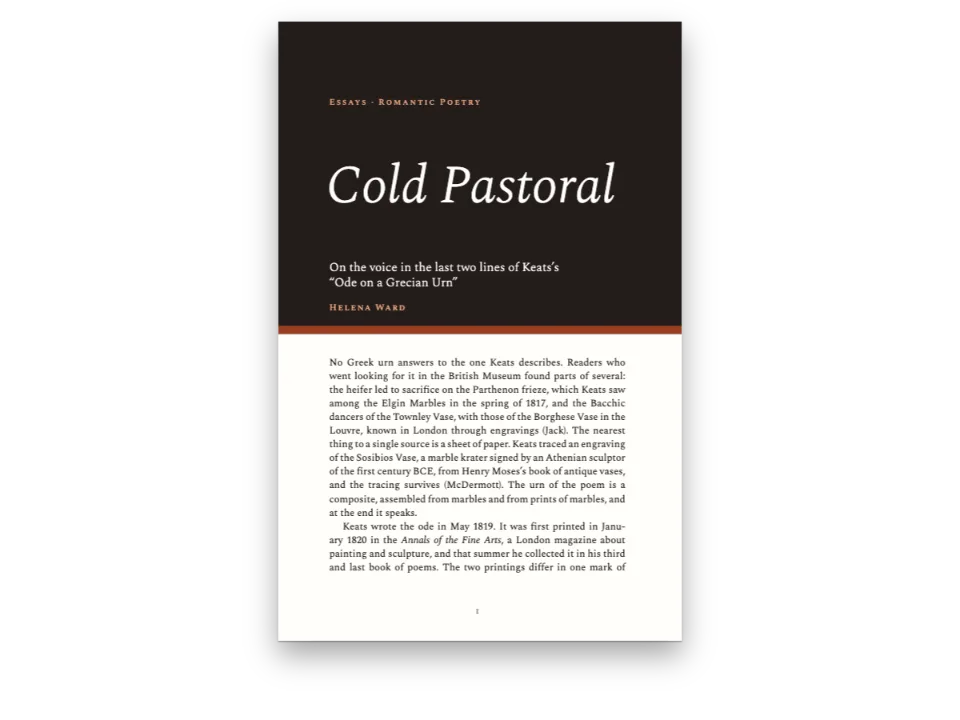
教育学の博士論文の第2章、先行研究のレビューです。紙で読むことと画面で読むことについて、20年分の研究が何を示してきたかをまとめています。左綴じのA4判に、Literataを行送り16ptで組み、大学の青を淡くした帯を章頭に敷きます。著者は文献をZoteroで管理し、書き出したBibTeXをそのまま貼り込みます。本文では、出典ひとつがひとつのキーです。Postextはすべての引用をAPA 7の形に整え、著者名と年、指定があればページを入れます。著者名が文の一部になるときは「Delgado et al. (2018)」と書き、文献一覧もこのスタイルが求める順序と形で組みます。指導教員にChicagoで、と言われたら、書き換えるのはスタイルを指定する1行です。
このレシピが答える質問
- APA、IEEEなどの引用スタイルで、文献を引用し参考文献を作るには?
手短な答え
// Citations are written [@key, p. 33] and formatted by citeproc-js in the chosen CSL
// style; the references come from the BibTeX block at the end of the chapter. Register
// the engine once, before the first build, then the style is one setting.
registerCitationEngine(createCiteprocEngine({ styles: STYLES, locales: LOCALES }));
const citations = {
  style: 'apa', // 'chicago-author-date', 'ieee', 'vancouver'… change nothing else
  link: true, // each citation jumps to its entry in the PDF and on screen
  bibliography: {
    // APA asks for a half-inch hanging indent and keeps the list in the text size.
    fontSize: em(1), hangingIndent: mm(12.7), entrySpacing: pt(4),
    doi: 'link', // printed whole, as APA wants, and clickable
  },
};
材料
- 種類
- Literata, Public Sans (SIL OFL 1.1)
- 素材
- なし:図はすべてコードで描画
作り方
#1 · 引用エンジンとスタイルをひとつずつ
コードは上の手短な答えにあります。Postextは引用を読み取り、その文言は引用エンジンに任せます。エンジンは最初のビルドの前に一度だけ登録します。postext-citeprocはZoteroやMendeleyが使うエンジンciteproc-jsを包んだもので、CSLスタイル16種とそのロケールファイルを備えています。[@mangen2013]は「(Mangen et al., 2013)」になり、角かっこのない@delgado2018は著者名を文中に置きます。[@ibanez2023, pp. 12–15]ではページ範囲がかっこの中に入ります。エンジンは文書のロケールに従うので、文書がスペイン語なら、同じキーでも接続語や略語はスペイン語のロケールファイルから取られます。
#2 · 文献一覧はBibTeXのブロックから
章の最後のブロックは:::references{format=bibtex}で、中にZoteroの書き出しを貼り込みます。アクセントは{\'a}のように書きます。その上の:::bibliographyが、References見出しの下に一覧を置きます。これがなければ、一覧は文書の末尾に追加されます。載るのは引用した文献だけで、APAの順序で並び、本文中の引用はどれも一覧の該当項目にリンクします。
#3 · 番号のない見出しと、言葉で書く参照
  headingStyles: [{ id: 'references', numbered: false }],
  crossRefs: { section: t({ en: 'Section {n}', es: 'Sección {n}' }) },
文献一覧の見出しにはreferencesスタイルを使います。このスタイルは見出しを目次に残したまま番号づけから外すので、一覧が2.4節になることはありません。:ref{id="sec-speed"}はcrossRefsのラベルから「Section 2.2」と印字し、見出しにリンクします。番号は章題のstartAt=2から来ており、見出しと同じカウンターを使っています。
#4 · 章頭を帯の中に置く
const BAND = 92; // mm from the trim's top
const opener = {
  enabled: true,
  minHeight: mm(BAND - 28 + 10), // the body starts 10 mm under the band
  slot: { elements: [
    { kind: 'box', id: 'band', style: { backgroundColor: col('tint') },
      placement: { anchor: { to: 'page', edge: 'top-left' },
        size: { width: 'fill', height: mm(BAND) } } },
    { kind: 'text', id: 'label', content: t({ en: 'Chapter', es: 'Capítulo' }),
      fontFamily: LABEL, fontSize: pt(9), fontWeight: 600, letterSpacing: pt(1.8),
      textTransform: 'uppercase',
      color: col('accent'), align: 'left',
      placement: { anchor: { to: 'container', edge: 'top-left' },
        offset: { x: mm(0), y: mm(2) } } },
    { kind: 'text', id: 'number', content: '{number}', fontFamily: TEXT, fontSize: pt(96),
      fontWeight: 300, lineHeight: 0.9, color: col('accent'), align: 'right',
      placement: { anchor: { to: 'container', edge: 'top-right' },
        offset: { x: mm(0), y: mm(-6) },
        size: { width: mm(40), height: 'auto' } } },
    { kind: 'text', id: 'title', content: '{titleText}', fontFamily: TEXT, fontSize: pt(24),
      lineHeight: 1.12, fontWeight: 600, color: col('ink'), align: 'left', overflow: 'wrap',
      placement: { anchor: { to: 'container', edge: 'top-left' },
        offset: { x: mm(0), y: mm(14) },
        size: { width: mm(108), height: 'auto' } } },
  ] },
};
帯は仕上がりに固定した囲みで、本文はその10 mm下から始まります。数字はLiterata Lightの96ptで右に置きます。この大きさでは文字というより形として見え、表題は行長をすべて使えます。
const palette = {
  ink: '#1b1b1f', accent: '#22406a', tint: '#e6ecf4', rule: '#b9bec8', muted: '#5d6370',
};
const col = (id) => ({ hex: palette[id], model: 'hex', paletteId: id });
const colorPalette = Object.entries({ ...palette, 'main-color': palette.accent })
  .map(([id, hex]) => ({ id, name: id, value: { hex, model: 'hex' } }));
レシピの全体
// ═══ Postext Cookbook · Nº 087 · A thesis chapter cited in APA 7 ═══════════════════ // https://postext.dev/en/cookbook/apa-thesis-with-bibtex // Code: MIT · Text: original (CC BY 4.0) · Pictures: none // Fonts: Literata, Public Sans (SIL OFL 1.1) · Needs postext ≥ 1.12.0 import { buildDocument, renderPageToCanvas, clearMeasurementCache, registerCitationEngine, } from 'https://esm.sh/postext'; import { renderToPdf, decompressWoff2 } from 'https://esm.sh/postext-pdf'; import { createCiteprocEngine, STYLES, LOCALES } from 'https://esm.sh/postext-citeproc'; const LANG = 'en'; // @lang: the language of the sample document ('en' | 'es') const RECIPE = 'apa-thesis-with-bibtex'; // ─── 1 · Design ───────────────────────────────────────────────────────────── // #region palette: a thesis prints in black; the one colour is the university's const palette = { ink: '#1b1b1f', accent: '#22406a', tint: '#e6ecf4', rule: '#b9bec8', muted: '#5d6370', }; const col = (id) => ({ hex: palette[id], model: 'hex', paletteId: id }); const colorPalette = Object.entries({ ...palette, 'main-color': palette.accent }) .map(([id, hex]) => ({ id, name: id, value: { hex, model: 'hex' } })); // #endregion const TEXT = 'Literata', LABEL = 'Public Sans'; const LEAD = 16; // pt: double spacing is a typewriter habit; 1.45 reads as well and fits more // #region answer: the citation engine, APA 7 and how its references look // Citations are written [@key, p. 33] and formatted by citeproc-js in the chosen CSL // style; the references come from the BibTeX block at the end of the chapter. Register // the engine once, before the first build, then the style is one setting. registerCitationEngine(createCiteprocEngine({ styles: STYLES, locales: LOCALES })); const citations = { style: 'apa', // 'chicago-author-date', 'ieee', 'vancouver'… change nothing else link: true, // each citation jumps to its entry in the PDF and on screen bibliography: { // APA asks for a half-inch hanging indent and keeps the list in the text size. fontSize: em(1), hangingIndent: mm(12.7), entrySpacing: pt(4), doi: 'link', // printed whole, as APA wants, and clickable }, }; // #endregion // #region opener: a pale band at the head of the page, the number large and light in it const BAND = 92; // mm from the trim's top const opener = { enabled: true, minHeight: mm(BAND - 28 + 10), // the body starts 10 mm under the band slot: { elements: [ { kind: 'box', id: 'band', style: { backgroundColor: col('tint') }, placement: { anchor: { to: 'page', edge: 'top-left' }, size: { width: 'fill', height: mm(BAND) } } }, { kind: 'text', id: 'label', content: t({ en: 'Chapter', es: 'Capítulo' }), fontFamily: LABEL, fontSize: pt(9), fontWeight: 600, letterSpacing: pt(1.8), textTransform: 'uppercase', color: col('accent'), align: 'left', placement: { anchor: { to: 'container', edge: 'top-left' }, offset: { x: mm(0), y: mm(2) } } }, { kind: 'text', id: 'number', content: '{number}', fontFamily: TEXT, fontSize: pt(96), fontWeight: 300, lineHeight: 0.9, color: col('accent'), align: 'right', placement: { anchor: { to: 'container', edge: 'top-right' }, offset: { x: mm(0), y: mm(-6) }, size: { width: mm(40), height: 'auto' } } }, { kind: 'text', id: 'title', content: '{titleText}', fontFamily: TEXT, fontSize: pt(24), lineHeight: 1.12, fontWeight: 600, color: col('ink'), align: 'left', overflow: 'wrap', placement: { anchor: { to: 'container', edge: 'top-left' }, offset: { x: mm(0), y: mm(14) }, size: { width: mm(108), height: 'auto' } } }, ] }, }; // #endregion const head = (id, content, edge, x) => ({ kind: 'text', id, content, pages: 'body', fontFamily: LABEL, fontSize: pt(7.5), letterSpacing: pt(0.8), color: col('muted'), placement: { anchor: { to: 'page', edge }, offset: { x: mm(x), y: mm(14) } }, }); const config = () => ({ // a factory: the engine caches resolved configs per object locale: t({ en: 'en-us', es: 'es' }), colorPalette, citations, page: { sizePreset: 'custom', width: mm(210), height: mm(297), dpi: 150, // one-sided, bound at the left margins: { top: mm(28), bottom: mm(28), left: mm(35), right: mm(25) }, }, layout: { layoutType: 'single' }, bodyText: { fontFamily: TEXT, fontSize: pt(11), lineHeight: pt(LEAD), color: col('ink'), boldColor: col('ink'), italicColor: col('ink'), referenceColor: col('accent'), textAlign: 'justify', firstLineIndent: mm(6), indentAfterHeading: false, hyphenation: { enabled: true }, optimalLineBreaking: true, avoidWidows: true, avoidOrphans: true, avoidRunts: true, }, headings: { fontFamily: TEXT, color: col('ink'), fontWeight: 600, levels: [ // Restated: any headings object drops the H1 break (gotcha: headings-drop-h1-break). { level: 1, numberingTemplate: '{1}', fontSize: pt(22), breakBefore: { enabled: true, parity: 'any' }, advancedDesign: opener }, { level: 2, numberingTemplate: '{1}.{2}', numberSeparator: ' ', fontSize: pt(13), lineHeight: pt(LEAD), marginTop: pt(LEAD), marginBottom: pt(LEAD / 2) }, ], }, // #region refs: the references heading goes unnumbered; section references read in words headingStyles: [{ id: 'references', numbered: false }], crossRefs: { section: t({ en: 'Section {n}', es: 'Sección {n}' }) }, // #endregion header: { elements: [ head('title', '{title}', 'top-left', 35), head('folio', '{pageNumber}', 'top-right', -25), ] }, footer: { elements: [] }, }); // ─── 2 · Content ──────────────────────────────────────────────────────────── const markdown = String.raw`---Markdownの見本 · 69行 · content.en.md
title: "Reading on Paper and on Screens" author: "Marta Ibáñez Roca" --- # Reading on Paper and on Screens: The State of the Evidence {#ch-review startAt=2} The question this thesis takes up is older than the screens it is usually asked about. Long before the first e-reader, typographers measured how the size of a letter, the length of a line and the space between lines changed the speed and the comfort of reading [@tinker1963]. What changed with screens was the scale of the experiment: by the 2010s a large share of what students read for their courses reached them through a display, and the question of whether that mattered left the laboratory for the lecture hall [@baron2015]. This chapter reviews what is known. :ref{id="sec-comprehension"} gathers the studies of comprehension, :ref{id="sec-speed"} those of speed and line length, and :ref{id="sec-attention"} the arguments about attention that frame the rest of the thesis. The method of the study itself follows in Chapter 3. ## Comprehension {#sec-comprehension} The most cited early comparison asked Norwegian upper-secondary students to read two texts, one narrative and one expository, either on paper or as PDF files on a computer screen [@mangen2013]. Those who read on paper scored better on the comprehension test that followed. The difference was modest, but it pointed in the same direction as a growing number of studies, and it raised a question the authors could not settle: whether the advantage came from the medium, from the way readers navigated it, or from what they expected to do with it. Two meta-analyses later pooled the evidence. @delgado2018 combined 54 studies with more than 170,000 participants and found an advantage for paper in the comprehension of informational texts, larger when reading was done under time pressure and, unexpectedly, larger in the more recent studies than in the older ones. @clinton2019 reached a similar conclusion from a narrower set of experiments: reading from paper led to better comprehension, while the time spent reading did not differ between the media. Neither review found a reliable difference for narrative texts. A pilot study run for this thesis with forty first-year students found the same pattern [@ibanez2023, pp. 12–15], although its sample was too small to settle it. ## Speed and line length {#sec-speed} Speed is the measure readers notice first and researchers trust least. A reader can go faster by understanding less, and a gain in words per minute says nothing of what was retained [@rayner2016]. Studies that control for comprehension tell a more modest story than the claims of speed-reading courses: the eyes move in short jumps, take in a few letters on either side of the fixation, and cannot be trained to take in a whole line at once [@rayner2016]. Line length is the variable typographers have argued about longest. On screen, @dyson2001 measured speed and comprehension at several line lengths and found that the two do not always improve together, which warns against judging a layout by speed alone. Older work on print had already shown that the best length depends on the size of the type and the leading, not on a fixed count of characters [@tinker1963; see also @ibanez2023, sec. 2]. ## Attention and the reading brain {#sec-attention} The empirical studies leave room for a wider argument. @wolf2018 holds that the habits formed by reading on screens, quick and skimming, carry over to the reading of long texts and weaken the slower processes that comprehension of a demanding argument needs. @baron2015 reaches a similar view from surveys of students, many of whom reported that they concentrated better on paper even when they preferred screens for convenience. These are arguments rather than measurements, and this thesis treats them as hypotheses: Chapter 3 tests whether the advantage for paper reported in :ref{id="sec-comprehension"} holds when the screen layout is set with the care a printed page receives. ## References {style="references"} :::bibliography{title=""} :::references{format=bibtex} @book{tinker1963, author = {Tinker, Miles A.}, title = {Legibility of print}, publisher = {Iowa State University Press}, address = {Ames, IA}, year = 1963} @book{baron2015, author = {Baron, Naomi S.}, title = {Words onscreen: The fate of reading in a digital world}, publisher = {Oxford University Press}, address = {New York}, year = 2015} @article{mangen2013, author = {Mangen, Anne and Walgermo, Bente R. and Br{\o}nnick, Kolbj{\o}rn}, title = {Reading linear texts on paper versus computer screen: Effects on reading comprehension}, journal = {International Journal of Educational Research}, volume = 58, pages = {61--68}, year = 2013, doi = {10.1016/j.ijer.2012.12.002}} @article{delgado2018, author = {Delgado, Pablo and Vargas, Crist{\'o}bal and Ackerman, Rakefet and Salmer{\'o}n, Ladislao}, title = {Don't throw away your printed books: A meta-analysis on the effects of reading media on reading comprehension}, journal = {Educational Research Review}, volume = 25, pages = {23--38}, year = 2018, doi = {10.1016/j.edurev.2018.09.003}} @article{clinton2019, author = {Clinton, Virginia}, title = {Reading from paper compared to screens: A systematic review and meta-analysis}, journal = {Journal of Research in Reading}, volume = 42, number = 2, pages = {288--325}, year = 2019, doi = {10.1111/1467-9817.12269}} @article{dyson2001, author = {Dyson, Mary C. and Haselgrove, Mark}, title = {The influence of reading speed and line length on the effectiveness of reading from screen}, journal = {International Journal of Human-Computer Studies}, volume = 54, number = 4, pages = {585--612}, year = 2001, doi = {10.1006/ijhc.2001.0458}} @article{rayner2016, author = {Rayner, Keith and Schotter, Elizabeth R. and Masson, Michael E. J. and Potter, Mary C. and Treiman, Rebecca}, title = {So much to read, so little time: How do we read, and can speed reading help?}, journal = {Psychological Science in the Public Interest}, volume = 17, number = 1, pages = {4--34}, year = 2016, doi = {10.1177/1529100615623267}} @techreport{ibanez2023, author = {Ib{\'a}{\~n}ez Roca, Marta}, title = {Screen layouts and comprehension: A pilot study}, institution = {Reading Lab}, type = {Working paper}, number = 3, year = 2023} @book{wolf2018, author = {Wolf, Maryanne}, title = {Reader, come home: The reading brain in a digital world}, publisher = {Harper}, address = {New York}, year = 2018} :::`; // ─── 3 · Fonts ────────────────────────────────────────────────────────────── const FONTS = { Literata: ['300', '400', '400i', '600', '600i'], 'Public Sans': ['400', '600'], }; // ─── 4 · Build & show ─────────────────────────────────────────────────────── await loadFonts(FONTS, markdown); const doc = await buildWithFonts(() => buildDocument({ markdown }, config()), markdown); const title = t({ en: 'A thesis chapter in APA 7', es: 'Un capítulo de tesis en APA 7' }); showPages(doc, { title }); offerPdf(() => renderToPdf(doc, { fontProvider: fontsourceProvider }), `${RECIPE}.pdf`);キット · core, fonts, viewer, pdf:全レシピ共通 · 275行
// ─── Kit ── helpers shared by every Cookbook recipe · postext.dev/cookbook ───── // ─── Kit · core v1 ── the same in every recipe · postext.dev/cookbook ───────── function mm(value) { return { value, unit: 'mm' }; } function pt(value) { return { value, unit: 'pt' }; } function em(value) { return { value, unit: 'em' }; } /** The sample language's string: t({ en: 'Figure', es: 'Figura' }). */ function t(strings) { return strings[LANG] ?? Object.values(strings)[0]; } /** A file in this recipe's assets folder, served from the Postext repo by jsDelivr. */ function asset(file) { return `https://cdn.jsdelivr.net/gh/drnachio/postext@main/cookbook/${RECIPE}/assets/${file}`; } // ─── Kit · fonts v1 ── the same in every recipe · postext.dev/cookbook ──────── // Postext measures text with the faces the browser has loaded, and caches the // widths, so every face must be ready before the first build. Faces come from // Fontsource: the same static files the PDF embeds, so screen and PDF agree. /** faces = { 'Family Name': ['400', '400i', '700'] }. `text` is the sample: * letters beyond Latin-1 (č, ł, ő…) also load the latin-ext files. With * `optional`, a face Fontsource does not ship is skipped instead of failing. * Resolves to the number of faces added. */ async function loadFonts(faces, text = '', { optional = false } = {}) { kitStatus('Loading fonts…'); const ranges = { latin: 'U+0000-00FF,U+0131,U+0152-0153,U+02BB-02BC,U+02C6,U+02DA,U+02DC,U+0304,U+0308,U+0329,' + 'U+2000-206F,U+20AC,U+2122,U+2191,U+2193,U+2212,U+2215,U+FEFF,U+FFFD', 'latin-ext': 'U+0100-02BA,U+02BD-02C5,U+02C7-02CC,U+02CE-02D7,U+02DD-02FF,U+0304,U+0308,U+0329,' + 'U+1D00-1DBF,U+1E00-1E9F,U+1EF2-1EFF,U+2020,U+20A0-20AB,U+20AD-20C0,U+2113,U+2C60-2C7F,U+A720-A7FF', }; const subsets = /[Ā-˿Ḁ-ỿ]/.test(text) ? ['latin', 'latin-ext'] : ['latin']; const jobs = []; let added = 0; for (const [family, specs] of Object.entries(faces)) { const id = fontsourceId(family); const meta = optional ? await fontsourceMeta(family) : null; for (const spec of new Set(specs)) { const weight = parseInt(spec, 10); const style = spec.endsWith('i') ? 'italic' : 'normal'; if (hasFace(family, weight, style)) continue; if (optional && !(meta?.weights.includes(weight) && meta.styles.includes(style))) continue; for (const subset of subsets) { const url = `https://cdn.jsdelivr.net/npm/@fontsource/${id}@5/files/${id}-${subset}-${weight}-${style}.woff2`; const face = new FontFace(family, `url(${url}) format('woff2')`, { weight: String(weight), style, unicodeRange: ranges[subset] }); jobs.push(face.load().then((ready) => { document.fonts.add(ready); added++; }, () => { if (subset === 'latin' && !optional) throw new Error(`Fontsource has no ${family} ${weight} ${style}`); })); } } } await Promise.all(jobs).catch((error) => { kitFail(error); throw error; }); return added; } /** Runs `build` (a buildDocument or buildBundle call) and checks the faces * the pages use. A regular face missing from FONTS is loaded with a warning; * bold and italic variants are loaded when the family ships them. Then the * measurement caches are cleared and the build runs again. */ async function buildWithFonts(build, text = '') { const tried = new Set(); for (let round = 0; round < 3; round++) { kitStatus('Laying out…'); await new Promise(requestAnimationFrame); // let the status paint first const result = await Promise.resolve().then(build).catch((error) => { kitFail(error); throw error; }); const wanted = { base: {}, variants: {} }; for (const { font, base } of [result].flat().flatMap(fontStringsOf)) { const { family, weight, style } = parseFont(font); const key = `${family}|${weight}|${style}`; if (tried.has(key) || hasFace(family, weight, style)) continue; tried.add(key); (wanted[base ? 'base' : 'variants'][family] ??= []).push(`${weight}${style === 'italic' ? 'i' : ''}`); } if (Object.keys(wanted.base).length) { console.warn(`[cookbook] FONTS does not list ${JSON.stringify(wanted.base)}: loading them.`); } const added = await loadFonts(wanted.base, text) + await loadFonts(wanted.variants, text, { optional: true }); if (added === 0) return result; clearMeasurementCache(); } throw new Error('The fonts did not settle after three builds.'); } /** Every font string of the layout. `base` marks a block's own face; its * bold, italic and bold-italic variants are listed whether or not used. */ function fontStringsOf(doc) { const found = new Map(); const walk = (node) => { if (!node || typeof node !== 'object') return; if (Array.isArray(node)) { node.forEach(walk); return; } for (const [key, value] of Object.entries(node)) { if (typeof value === 'string' && /fontString$/i.test(key)) { found.set(value, found.get(value) || key === 'fontString'); } else if (value && typeof value === 'object') walk(value); } }; walk(doc.pages); walk(doc.blocks); return [...found].map(([font, base]) => ({ font, base })); } /** '700 37.5px Open Sans' / 'italic 400 13px "Source Serif 4"' → { family, weight, style }. * A string with no weight ('95.8px Young Serif', from a design text) is 400. */ function parseFont(font) { const m = /^(?:(italic|oblique)\s+)?(?:small-caps\s+)?(?:(\d+|bold|normal)\s+)?[\d.]+px\s+(.+)$/.exec(font.trim()); if (!m) throw new Error(`Unexpected font string: ${font}`); const weight = m[2] === 'bold' ? 700 : !m[2] || m[2] === 'normal' ? 400 : Number(m[2]); return { family: m[3].replace(/^["']|["']$/g, ''), weight, style: m[1] ? 'italic' : 'normal' }; } /** True when a loaded FontFace covers exactly this family, weight and style * (document.fonts.check() is also true for families nobody declared). */ function hasFace(family, weight, style) { for (const face of document.fonts) { if (face.status !== 'loaded' || face.style !== style) continue; if (face.family.replace(/^["']|["']$/g, '') !== family) continue; const [low, high = low] = face.weight.split(' ').map(Number); if (weight >= low && weight <= high) return true; } return false; } /** Fontsource's id for a family: 'Source Serif 4' → 'source-serif-4'. */ function fontsourceId(family) { return family.toLowerCase().replace(/\s+/g, '-'); } /** The weights and styles a family ships ({ weights: [400, 700], styles: ['normal', 'italic'] }), or null. */ function fontsourceMeta(family) { fontsourceMeta.cache ??= new Map(); const id = fontsourceId(family); if (!fontsourceMeta.cache.has(id)) { fontsourceMeta.cache.set(id, fetch(`https://api.fontsource.org/v1/fonts/${id}`) .then((res) => (res.ok ? res.json() : null), () => null)); } return fontsourceMeta.cache.get(id); } // ─── Kit · viewer v1 ── the same in every recipe · postext.dev/cookbook ─────── /** Shows the pages as facing spreads on a dark desk: the first page is a * recto on its own, then verso | recto pairs, as in a bound book. Pages * are painted when they scroll near the screen. */ function showPages(docs, { title, width = 460 } = {}) { const root = viewer(title); const pages = [docs].flat().flatMap((doc) => doc.pages.map((page) => ({ doc, page, n: (doc.pageIndexOffset ?? 0) + page.index }))); const spreads = []; let verso = null; for (const p of pages) { if (p.n % 2 === 1) { if (verso) spreads.push([verso, null]); verso = p; } else { spreads.push([verso, p]); verso = null; } } if (verso) spreads.push([verso, null]); const density = Math.min(window.devicePixelRatio || 1, 2); showPages.painter?.disconnect(); const painter = new IntersectionObserver((entries) => { for (const { isIntersecting, target } of entries) { if (!isIntersecting) continue; painter.unobserve(target); const { doc, page } = target.postext; renderPageToCanvas(page, doc, target, { scale: (width * density) / page.width }); } }, { rootMargin: '800px' }); showPages.painter = painter; root.replaceChildren(...spreads.map((pair) => { const spread = document.createElement('div'); spread.className = 'pt-spread'; for (const p of pair) { const figure = document.createElement('figure'); if (p) { const label = p.page.pageLabel || String(p.n + 1); const canvas = document.createElement('canvas'); canvas.postext = p; canvas.style.aspectRatio = `${p.page.width} / ${p.page.height}`; canvas.setAttribute('role', 'img'); canvas.setAttribute('aria-label', `Page ${label}`); const folio = document.createElement('figcaption'); folio.textContent = label; figure.append(canvas, folio); painter.observe(canvas); } else figure.className = 'pt-blank'; spread.append(figure); } return spread; })); kitStatus(`${pages.length} ${pages.length === 1 ? 'page' : 'pages'}`); document.documentElement.dataset.postext = 'ready'; return pages.length; } /** The desk, the bar and the error reporting, created once. */ function viewer(title) { if (!document.getElementById('pt-kit')) { document.head.insertAdjacentHTML('beforeend', `<style id="pt-kit"> :root { color-scheme: dark; } body { margin: 0; background: #0e1014; color: #b9bcc4; font: 13px/1.45 system-ui, sans-serif; } #pt-bar { position: sticky; top: 0; z-index: 1; display: flex; flex-wrap: wrap; align-items: center; gap: 6px 16px; padding: 10px 16px; background: rgb(14 16 20 / .92); backdrop-filter: blur(6px); border-bottom: 1px solid #23262d; } #pt-bar strong { color: #f4f1ea; font-weight: 600; } #pt-actions { display: flex; gap: 12px; margin-left: auto; } #pt-actions a, #pt-actions button { color: #d8a21a; font: inherit; background: none; border: 0; padding: 0; cursor: pointer; } #pages { display: grid; justify-items: center; gap: 48px; padding: 32px 16px 72px; } .pt-spread { display: flex; } .pt-spread figure { margin: 0; width: min(460px, 44vw); } .pt-spread canvas { display: block; width: 100%; background: #fff; box-shadow: 0 1px 2px rgb(0 0 0 / .5), 0 22px 44px -16px rgb(0 0 0 / .8); } .pt-spread figure:first-child canvas { box-shadow: inset -14px 0 14px -14px rgb(0 0 0 / .18), 0 1px 2px rgb(0 0 0 / .5), 0 22px 44px -16px rgb(0 0 0 / .8); } .pt-spread figcaption { margin-top: 10px; text-align: center; font: 600 10px/1 system-ui, sans-serif; letter-spacing: .18em; text-transform: uppercase; color: #6c7079; } .pt-blank { visibility: hidden; } @media (max-width: 760px) { .pt-spread { flex-direction: column; gap: 32px; } .pt-spread figure { width: min(460px, 92vw); } .pt-blank { display: none; } } </style>`); document.body.insertAdjacentHTML('afterbegin', '<header id="pt-bar"><strong id="pt-title"></strong><span id="pt-status" role="status"></span><span id="pt-actions"></span></header>'); document.getElementById('pt-title').textContent = document.title || 'Postext'; addEventListener('error', (event) => kitFail(event.error ?? event.message)); addEventListener('unhandledrejection', (event) => kitFail(event.reason)); } if (title) document.getElementById('pt-title').textContent = title; return document.getElementById('pages') ?? document.body.appendChild(Object.assign(document.createElement('main'), { id: 'pages' })); } function kitStatus(text) { viewer(); document.getElementById('pt-status').textContent = text; } function kitFail(error) { document.documentElement.dataset.postext = 'error'; kitStatus(`Error: ${error?.message ?? error}`); } // ─── Kit · pdf v1 ── the same in every recipe that exports a PDF ────────────── /** postext-pdf embeds TrueType bytes. Fetch the Fontsource file the screen * used, snapping to a weight the family ships and falling back to upright * when it has no italic: the PDF asks for every face a block could use. */ async function fontsourceProvider(family, weight, style) { const id = fontsourceId(family); const meta = await fontsourceMeta(family); const weights = meta?.weights?.length ? meta.weights : [400, 700]; const w = weights.reduce((a, b) => (Math.abs(b - weight) < Math.abs(a - weight) ? b : a)); const s = style === 'italic' && meta && !meta.styles.includes('italic') ? 'normal' : style; const res = await fetch(`https://cdn.jsdelivr.net/npm/@fontsource/${id}@5/files/${id}-latin-${w}-${s}.woff2`); if (!res.ok) throw new Error(`Fontsource has no ${family} ${w} ${s} (${res.status})`); return decompressWoff2(new Uint8Array(await res.arrayBuffer())); } /** A "Build the PDF" button in the bar. Once built: "Open the PDF" (a new * tab, since CodePen's preview frame cannot show PDFs) and a download link. */ function offerPdf(makePdf, filename) { viewer(); const button = Object.assign(document.createElement('button'), { type: 'button', textContent: 'Build the PDF' }); button.dataset.postextPdf = filename; button.addEventListener('click', async () => { button.disabled = true; button.textContent = 'Building the PDF…'; try { const bytes = await makePdf(); const url = URL.createObjectURL(new Blob([bytes], { type: 'application/pdf' })); const size = `${Math.max(1, Math.round(bytes.length / 1024))} KB`; button.replaceWith( Object.assign(document.createElement('a'), { href: url, target: '_blank', rel: 'noopener', textContent: 'Open the PDF ↗' }), Object.assign(document.createElement('a'), { href: url, download: filename, textContent: `Download ${filename} · ${size}` })); } catch (error) { button.disabled = false; button.textContent = 'Build the PDF'; kitFail(error); } }); document.getElementById('pt-actions').append(button); } // ─── /Kit ───────────────────────────────────────────────────────────────────────
組み立てたscript.jsはそのまま動きます。任意のページのモジュールスクリプトに貼り付けるか、レシピをCodePenで開いてください。 GitHub上のレシピのフォルダー ↗ (新しいタブで開きます)
アレンジ
#スタイルを変える
同じ章をChicagoの著者年方式にすると、著者名の後のカンマが消え、年は著者の後に並びます。
-  style: 'apa', // 'chicago-author-date', 'ieee', 'vancouver'… change nothing else
+ style: 'chicago-author-date',#一覧を本文より小さく組む
多くの大学では、文献一覧を本文より一段小さく、行間を詰めて組むことを認めています。
-    fontSize: em(1), hangingIndent: mm(12.7), entrySpacing: pt(4),
+ fontSize: em(0.9), lineHeight: pt(13), hangingIndent: mm(12.7), entrySpacing: pt(3),よくあるつまずき
つまずき
headingsオブジェクトを渡すとH1の改ページが消える
既定ではH1は奇数ページへ改ページします(always-odd)。ところがheadingsオブジェクトを渡すと中身にかかわらずこの既定がリセットされ、章は改ページせずに続けて組まれ、span: 'page'も効かなくなります。どの設定でもheadings.levels[0].breakBefore: { enabled: true, parity }を書き直してください。 奇数ページから始まる章 →
つまずき
レイアウトの前にすべてのフォントを読み込む
レイアウトはブラウザーが読み込んだフォントで文字を計測し、その幅をキャッシュします。最初のビルドのあとに届いたフォントがあると改行位置が狂い、PDFも画面と一致しなくなります。すべてのウェイトとスタイルを先に読み込み、遅れて届いたときは再ビルドの前にclearMeasurementCache()を呼んでください。 レイアウト前のフォント読み込み →
つまずき
フロントマターの値はすべて引用符で囲む
YAMLはtitle: 1984を数値として、日付をDateオブジェクトとして読みます。文字列でない値はプレースホルダーに空で出力され、PDFにもタイトルが付きません。値はすべて引用符で囲んでください(title: "1984")。 文書のメタデータ →
つまずき
設定はオブジェクトの同一性でキャッシュされる。毎回新しいオブジェクトを作る
エンジンは解決済みの設定をオブジェクトの同一性でキャッシュします。そのため、設定をその場で書き換えて再ビルドすると前の結果が再利用されます。ビルドのたびに新しいオブジェクトを作ってください。レシピの設定がファクトリー関数config()になっているのはこのためです。 キャンバス上のページ →
- APAでは論文や書籍の題名をセンテンスケース(文頭と固有名詞だけ大文字)で書きますが、citeproc-jsは題名をデータのとおりに印字します。Zoteroは題名の多くをタイトルケースで保存しているので、ページに出る前にZoteroかBibTeXの側で直してください。
クレジット
- 本文
- 書き下ろしの文章, CC BY 4.0
- フォント
- Literata (SIL OFL 1.1) · Public Sans (SIL OFL 1.1)