かんたんな説明
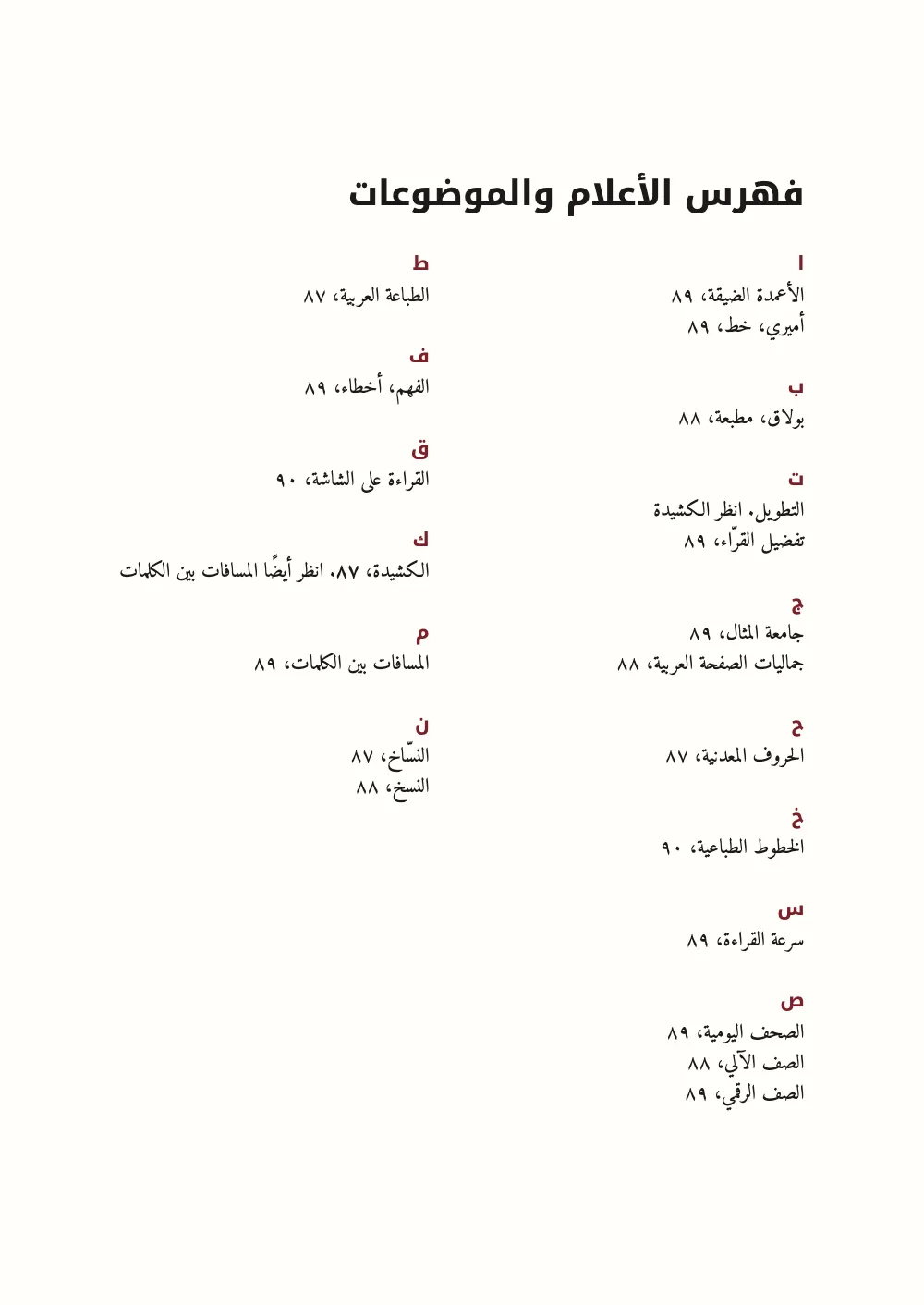
アラビア語の学術誌の5ページです。論文、脚注、文献一覧、索引が入ります。索引ではアラビア語の索引の習慣どおり、الكشيدةを冠詞الではなくكの項に並べます。
できあがり
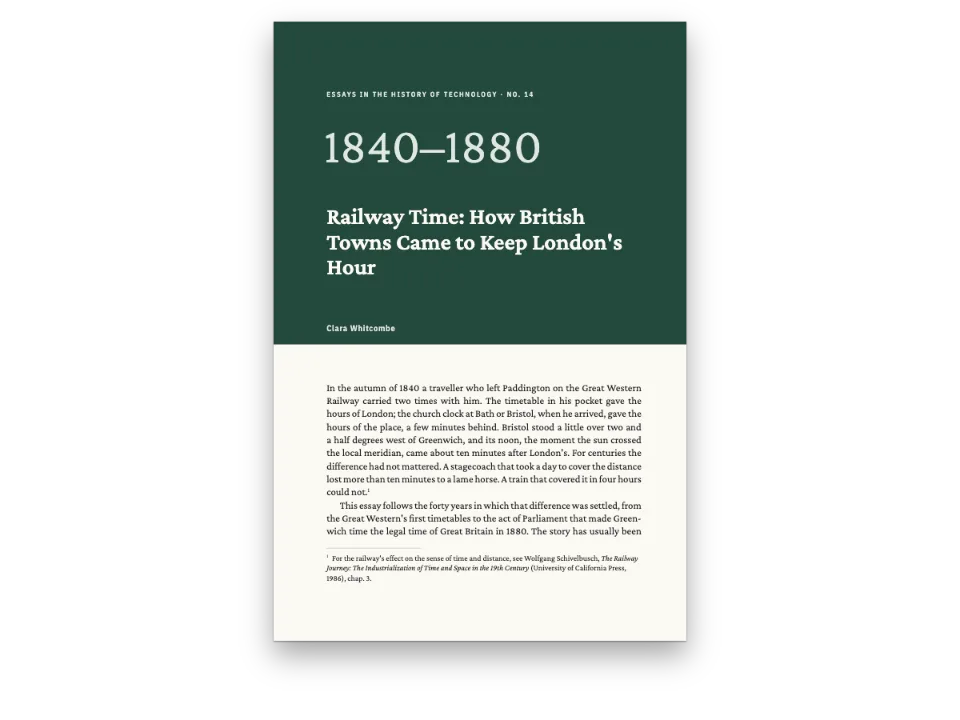
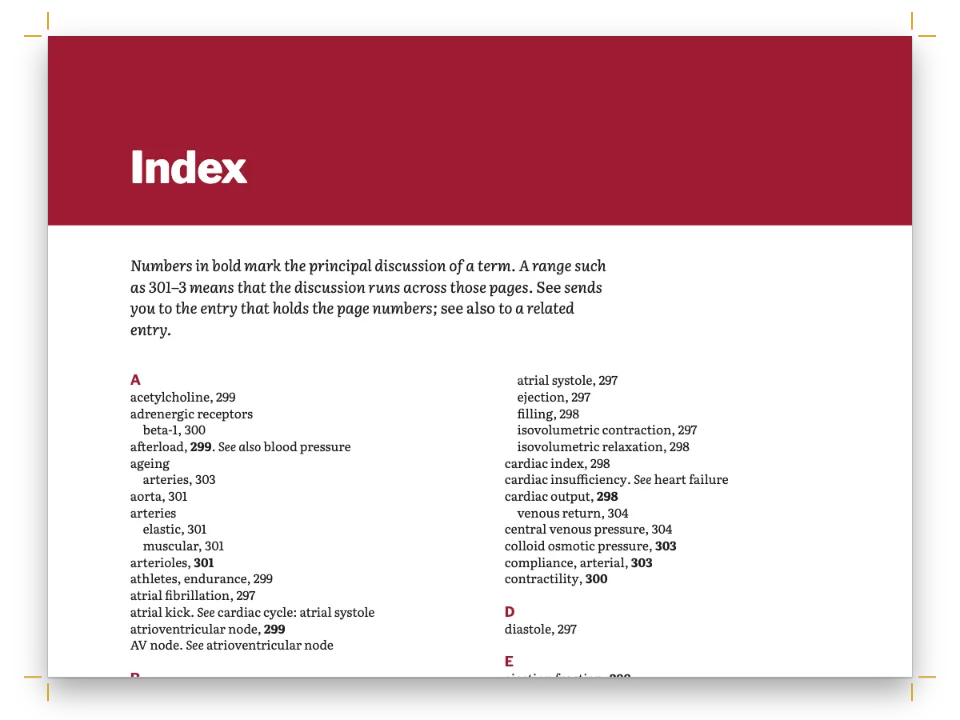
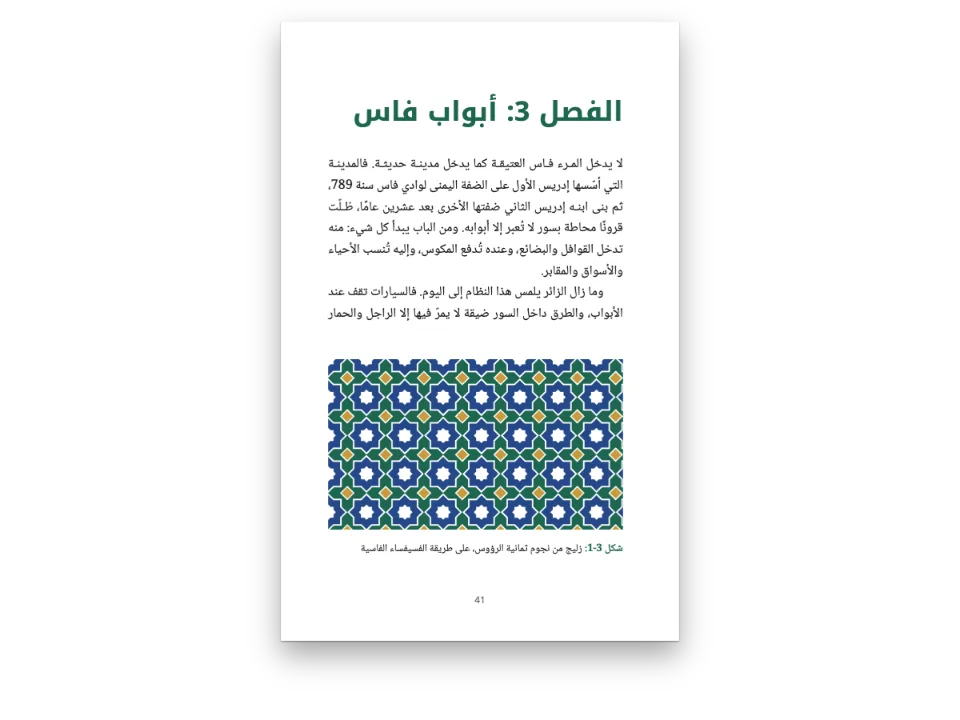
架空のアラビア語学術誌のある号から、87ページで始まる5ページを17 × 24 cmで組みます。カシーダによる両端そろえが読む速さを落とすかどうかを論じた論文で、本文は12 ptのAmiri、節見出しはNoto Kufi Arabicです。注は各ページの地に置き、アラビア語の学術誌の慣例どおり、ページごとに«(١)»、«(٢)»と1から番号を振ります。Markdownに[@ayalon2016]と書いた引用も注になり、アラビア語のCSLロケールを使ったシカゴ方式(注)のスタイルで整形されます。続いてアラビア語の文献を先に並べた文献一覧があり、2段組みの索引で論文が終わります。索引ではالكشيدةをكの項に、الصحف اليوميةをصの項に並べ、冠詞الは数えません。シカゴ式の注を付けた歴史論文は同じことを英語で行います。
このレシピが答える質問
- アラビア語の索引を、冠詞الを除いて並べるには?
- アラビア語の記事で、脚注と参考文献を使って出典を引用するには?
手短な答え
// Citations are written [@ayalon2016, 45] in the text; a note style puts each one in a
// footnote, numbered with the author's own [^notes]. The CSL locale is Arabic: ص for a page.
registerCitationEngine(createCiteprocEngine({ styles: STYLES, locales: LOCALES }));
const citations = {
  style: 'chicago-notes-bibliography', notes: 'footnote', locale: 'ar',
  bibliography: { fontSize: em(0.9), lineHeight: pt(17), hangingIndent: em(2),
    entrySpacing: pt(2) },
};
const footnotes = {
  markerTemplate: '({n})', // «(١)», in the document's digits
  numbering: 'page', // from (١) again on every page, as Arabic journals number them
  noteNumberPosition: 'inline', // the note opens with (١) on the line, not raised
  fontSize: pt(10), lineHeight: pt(18), spaceBetween: pt(2), // 1.8 ×: tanwīn clears the line
  textAlign: 'start', // ragged from the right: a Latin title would open wide gaps
  separator: { width: 0.3, lineWidth: pt(0.5), color: col('red') }, // on the start side
};
// The index sorts by the word after the article: الكشيدة files under ك, not under ا.
// ignoreArticle is already true for an Arabic index; it is written out to be seen.
const index = {
  ignoreArticle: true,
  fontFamily: TEXT, fontSize: pt(10.5), lineHeight: pt(16), indent: em(1.2),
  main: { bold: true }, // the page that defines the term
  groups: { fontFamily: LABEL, fontSize: pt(10), fontWeight: 700, color: col('red') },
};
材料
- 機能
- 文書の言語としてのアラビア語冠詞を無視して並べる索引注による引用脚注引用スタイルによる引用参考文献から作る文献一覧索引右から左のテキストアラビア語のフォント生成される番号の数字番号付き見出し見出しスタイルデザインした章扉柱とノンブル囲みPDFの書き出し
- 種類
- Amiri, Noto Kufi Arabic (SIL OFL 1.1)
- 素材
- なし:図はすべてコードで描画
作り方
#1 · 注、引用、索引を1か所で設定する
コードは前出の手短な答えにあります。脚注の設定は、アラビア語の本が求める3つです。かっこを付けるmarkerTemplate: '({n})'、ページごとに番号を振り直すnumbering: 'page'、注の行頭に«(١)»を置くnoteNumberPosition: 'inline'です。数字は文書の数字を使い、罫は右に立ちます(脚注)。引用は注と番号を共有します。citations.locale: 'ar'でCSLの用語がアラビア語になり、たとえば号数にはعددが付きます。index.ignoreArticleは各項目をالのあとの語で並べ、ハムザの諸形を同一視するので、أميريもالأعمدةもاの項に入ります(目次と索引)。アラビア語の索引では既定でオンですが、ここでは見えるように書いておきます。
#2 · 帯のない誌名欄
const centred = (y, extra = {}) => ({ anchor: { to: 'container', edge: 'top' },
  offset: { y: mm(y) }, size: { width: 'fill' }, ...extra });
const line = (id, content, family, size, colour, y, extra = {}) => ({ kind: 'text', id,
  content, fontFamily: family, fontSize: pt(size), color: col(colour), align: 'center',
  overflow: 'wrap', placement: centred(y), ...extra });
const masthead = { enabled: true, minHeight: mm(70), slot: { elements: [
  line('journal', JOURNAL, LABEL, 9, 'red', 0, { fontWeight: 700 }),
  line('issue', '{attr.issue}', LABEL, 8, 'muted', 6),
  { kind: 'rule', id: 'rule', thickness: pt(0.5), color: col('rule'),
    placement: centred(13) },
  line('title', '{titleText}', TEXT, 22, 'ink', 18, { fontWeight: 700, lineHeight: 1.45 }),
  line('author', '{attr.author}', TEXT, 13, 'ink', 45),
  line('affiliation', '{attr.affiliation}', TEXT, 10, 'muted', 52),
] } };
論文の表題は1レベル見出しで、デザインで描きます。誌名と号数、細罫、2行に中央そろえした表題、著者が並びます。号数の行はアラビア・インド数字で入力しています。デザインの属性は著者が書いたテキストで、エンジンは書き換えないからです。ノンブルは87から始まる(page.pageNumbering.startAt)ので、論文が号のどこに載っているかがノンブルからわかります。
#3 · 小口の角から柱を置く
const head = (id, content, parity, edge, x) => ({ kind: 'text', id, content, parity,
  pages: 'body', fontFamily: LABEL, fontSize: pt(7.5), color: col('muted'), align: edge,
  placement: { anchor: { to: 'page', edge: `top-${edge}` }, offset: { x: mm(x), y: mm(13) } } });
const folio = (id, parity, edge, x) => ({ ...head(id, '{pageNumber}', parity, edge, x),
  fontWeight: 700, color: col('red') });
const header = { elements: [
  folio('r-folio', 'even', 'right', -SIDE.outer),
  head('r-head', JOURNAL, 'even', 'right', -(SIDE.outer + 9)),
  head('l-head', 'سلمى الخطيب: أثر الكشيدة في سرعة القراءة', 'odd', 'left', SIDE.outer + 9),
  folio('l-folio', 'odd', 'left', SIDE.outer),
] };
右ページには誌名を、左ページには著者と短い表題を入れ、それぞれ小口の角にノンブルを添えます。ヘッダーの要素は物理的な左右を保つので、この綴じ方で右側に来る偶数ページはtop-rightを基準にします。
レシピの全体
// ═══ Postext Cookbook · Nº 107 · An Arabic research article with notes, citations and an index ═══ // https://postext.dev/en/cookbook/arabic-research-article // Code: MIT · Text: original Arabic prose (CC BY 4.0) · Pictures: none // Fonts: Amiri, Noto Kufi Arabic (SIL OFL 1.1) · Needs postext ≥ 1.15.0 import { buildDocument, renderPageToCanvas, clearMeasurementCache, registerCitationEngine, } from 'https://esm.sh/postext'; import { renderToPdf, decompressWoff2 } from 'https://esm.sh/postext-pdf'; import { createCiteprocEngine, STYLES, LOCALES } from 'https://esm.sh/postext-citeproc'; const LANG = 'en'; // @lang: the language of the frame; the article is Arabic in both editions const RECIPE = 'arabic-research-article'; // ─── 1 · Design ───────────────────────────────────────────────────────────── // #region palette: a journal's dark red on a warm white const palette = { ink: '#1d1a19', // text red: '#7d2028', // the accent: the journal's name, section numbers, the notes' rule rose: '#f1e4e1', // the abstract's ground rule: '#c8bcb5', // hairlines muted: '#655d58', // running heads, the colophon paper: '#fffdfa', }; const col = (id) => ({ hex: palette[id], model: 'hex', paletteId: id }); const colorPalette = Object.entries({ ...palette, 'main-color': palette.red }) .map(([id, hex]) => ({ id, name: id, value: { hex, model: 'hex' } })); // #endregion const [TEXT, LABEL] = ['Amiri', 'Noto Kufi Arabic']; const [BODY, LEAD] = [12, 20]; // pt: Amiri, partly vocalised, at 1.67 × the size const TRIM = { width: 170, height: 240 }; // mm: 17 × 24 cm, the Arab journal const SIDE = { inner: 22, outer: 18 }; // mm const JOURNAL = 'مجلة دراسات الكتاب والنشر'; // #region answer: notes «(١)» per page, the citations among them, an index without ال // Citations are written [@ayalon2016, 45] in the text; a note style puts each one in a // footnote, numbered with the author's own [^notes]. The CSL locale is Arabic: ص for a page. registerCitationEngine(createCiteprocEngine({ styles: STYLES, locales: LOCALES })); const citations = { style: 'chicago-notes-bibliography', notes: 'footnote', locale: 'ar', bibliography: { fontSize: em(0.9), lineHeight: pt(17), hangingIndent: em(2), entrySpacing: pt(2) }, }; const footnotes = { markerTemplate: '({n})', // «(١)», in the document's digits numbering: 'page', // from (١) again on every page, as Arabic journals number them noteNumberPosition: 'inline', // the note opens with (١) on the line, not raised fontSize: pt(10), lineHeight: pt(18), spaceBetween: pt(2), // 1.8 ×: tanwīn clears the line textAlign: 'start', // ragged from the right: a Latin title would open wide gaps separator: { width: 0.3, lineWidth: pt(0.5), color: col('red') }, // on the start side }; // The index sorts by the word after the article: الكشيدة files under ك, not under ا. // ignoreArticle is already true for an Arabic index; it is written out to be seen. const index = { ignoreArticle: true, fontFamily: TEXT, fontSize: pt(10.5), lineHeight: pt(16), indent: em(1.2), main: { bold: true }, // the page that defines the term groups: { fontFamily: LABEL, fontSize: pt(10), fontWeight: 700, color: col('red') }, }; // #endregion // #region masthead: the journal's name, the article's title and its author, centred const centred = (y, extra = {}) => ({ anchor: { to: 'container', edge: 'top' }, offset: { y: mm(y) }, size: { width: 'fill' }, ...extra }); const line = (id, content, family, size, colour, y, extra = {}) => ({ kind: 'text', id, content, fontFamily: family, fontSize: pt(size), color: col(colour), align: 'center', overflow: 'wrap', placement: centred(y), ...extra }); const masthead = { enabled: true, minHeight: mm(70), slot: { elements: [ line('journal', JOURNAL, LABEL, 9, 'red', 0, { fontWeight: 700 }), line('issue', '{attr.issue}', LABEL, 8, 'muted', 6), { kind: 'rule', id: 'rule', thickness: pt(0.5), color: col('rule'), placement: centred(13) }, line('title', '{titleText}', TEXT, 22, 'ink', 18, { fontWeight: 700, lineHeight: 1.45 }), line('author', '{attr.author}', TEXT, 13, 'ink', 45), line('affiliation', '{attr.affiliation}', TEXT, 10, 'muted', 52), ] } }; // #endregion // #region heads: the journal on the right-hand page, the author and title on the left const head = (id, content, parity, edge, x) => ({ kind: 'text', id, content, parity, pages: 'body', fontFamily: LABEL, fontSize: pt(7.5), color: col('muted'), align: edge, placement: { anchor: { to: 'page', edge: `top-${edge}` }, offset: { x: mm(x), y: mm(13) } } }); const folio = (id, parity, edge, x) => ({ ...head(id, '{pageNumber}', parity, edge, x), fontWeight: 700, color: col('red') }); const header = { elements: [ folio('r-folio', 'even', 'right', -SIDE.outer), head('r-head', JOURNAL, 'even', 'right', -(SIDE.outer + 9)), head('l-head', 'سلمى الخطيب: أثر الكشيدة في سرعة القراءة', 'odd', 'left', SIDE.outer + 9), folio('l-folio', 'odd', 'left', SIDE.outer), ] }; // #endregion const config = () => ({ // a factory: the engine caches resolved configs per object locale: 'ar', // written out, never LANG (gotcha: arabic-locale-tag) colorPalette, citations, footnotes, index, page: { width: mm(TRIM.width), height: mm(TRIM.height), dpi: 150, backgroundColor: col('paper'), pageNumbering: { startAt: 87 }, margins: { top: mm(24), bottom: mm(22), left: mm(SIDE.inner), right: mm(SIDE.outer), mirror: true } }, layout: { layoutType: 'single' }, bodyText: { fontFamily: TEXT, fontSize: pt(BODY), lineHeight: pt(LEAD), color: col('ink'), boldColor: col('ink'), italicColor: col('ink'), referenceColor: col('ink'), textAlign: 'justify', firstLineIndent: em(1.5), indentAfterHeading: false, optimalLineBreaking: true, avoidWidows: true, avoidOrphans: true }, headings: { fontFamily: LABEL, fontWeight: 700, color: col('ink'), balancing: { enabled: false }, // no space added over the heads to fill a page levels: [ // Restated: any headings object drops the H1 break (gotcha: headings-drop-h1-break). { level: 1, breakBefore: { enabled: true, parity: 'any' }, marginTop: pt(0), marginBottom: pt(0), advancedDesign: masthead }, // ١- المقدمة: the section number in the document digits, a hyphen after it. { level: 2, fontSize: pt(12), lineHeight: pt(LEAD), numberingTemplate: '{2}-', numberSeparator: ' ', color: col('red'), marginTop: pt(LEAD), marginBottom: pt(4) }, ] }, headingStyles: [ { id: 'unnumbered', numbered: false }, // the abstract, the references, the index // The index: a title across the page and two columns, the first on the right. { id: 'index', numbered: false, span: 'page', breakBefore: { enabled: true, parity: 'any' }, advancedDesign: { enabled: false }, fontSize: pt(18), lineHeight: pt(30), marginBottom: pt(LEAD), layout: { layoutType: 'double', gutterWidth: mm(8) } }, ], calloutStyles: [{ id: 'abstract', background: col('rose'), padding: { top: mm(3.5), right: mm(5), bottom: mm(3.5), left: mm(5) }, marginTop: pt(0), marginBottom: pt(0), titleStyle: { fontFamily: LABEL, fontSize: pt(9), fontWeight: 700, color: col('red') }, body: { fontSize: pt(10.5), lineHeight: pt(17), firstLineIndent: pt(0) } }], paragraphStyles: [{ id: 'colophon', fontFamily: TEXT, fontSize: pt(9), lineHeight: pt(13), color: col('muted'), textAlign: 'left', firstLineIndent: pt(0), marginTop: pt(LEAD) }], header, footer: { elements: [] }, }); // ─── 2 · Content ──────────────────────────────────────────────────────────── const markdown = String.raw`---Markdownの見本 · 93行 · content.en.md
title: "أثر الكشيدة في سرعة قراءة النص العربي المطبوع" --- # أثر الكشيدة في سرعة قراءة النص العربي المطبوع: تجربة على قرّاء جامعيين {issue="المجلد ١٤ · العدد ٣ · خريف ٢٠٢٦" author="سلمى الخطيب" affiliation="قسم علوم المعلومات والنشر، جامعة المثال"} :::callout{type="abstract" title="ملخص"} تبحث هذه الدراسة في أثر ضبط السطور بالكشيدة في سرعة قراءة النص العربي المطبوع وفي فهمه. قرأ ستون طالبًا جامعيًا نصوصًا مضبوطة بثلاث طرق: بالمسافات وحدها، وبالكشيدة وحدها، وبمزيج منهما. ولم تختلف سرعة القراءة اختلافًا ذا دلالة بين الطرق الثلاث، غير أن القرّاء فضّلوا الطريقة المختلطة، وكانت أخطاء الفهم في الكشيدة الكثيفة أعلى قليلًا. ::: ## المقدمة يملأ :index[الطابع]{term="الطباعة العربية"} العربي السطر حتى نهايته بإحدى وسيلتين: أن يوسّع المسافات بين الكلمات، أو أن يمدّ بعض الحروف المتصلة بما يسمّى :index[الكشيدة]{main}:index{term="الكشيدة" seealso="المسافات بين الكلمات"} أو :index[التطويل]{see="الكشيدة"}. والوسيلة الثانية قديمة قِدم الخط نفسه، عرفها :index[النسّاخ] قبل المطبعة، ثم نقلها صانعو :index[الحروف المعدنية] إلى صناديقهم في صورة قطع خاصة تُدسّ بين أجزاء الكلمة.[@nemeth2017] وحين انتقلت الطباعة العربية إلى الحاسوب، صار المدّ عملية آلية يقوم بها البرنامج، وصار السؤال عن مقداره ومواضعه سؤالًا تقنيًا قبل أن يكون جماليًا.[^raqim] [^raqim]: تُبنى قواعد المواضع الجائزة للمدّ في البرامج الحديثة على ما وصفه الخطاطون في خط :index[النسخ]، ولا سيما المنع بعد الكاف واللام، وقبل الحروف المستديرة في آخر الكلمة. ولا يكاد يُختلف في أن الكشيدة جزء من :index[جماليات الصفحة العربية]، لكن أثرها في القراءة لم يُدرس إلا قليلًا. فالدراسات القليلة المتاحة اعتمدت على تقدير القرّاء للنص، لا على قياس قراءتهم له،[@hashimi2019, ٧٧; @attar2021] والمعايير الدولية تكتفي بوصف المواضع التي يجوز فيها المدّ دون أن تحدد مقداره.[@alreq] ويحاول هذا البحث أن يقيس الأثر قياسًا مباشرًا. ## الكشيدة في الطباعة العربية حين أُنشئت :index[مطبعة بولاق]{term="بولاق، مطبعة"} في عشرينيات القرن التاسع عشر، سُبكت حروفها على نماذج من الخط الذي يكتبه النسّاخ، وصار الكتاب المطبوع بعد ذلك بعقود سلعة يقرؤها جمهور واسع.[@ayalon2016] وكان صفّاف الحروف يضبط السطر بقطع من المدّ يدسّها بين أجزاء الكلمة، إلى أن ظهرت آلات :index[الصف الآلي] في القرن العشرين فقلّصت عدد أشكال الحروف تقليصًا كبيرًا.[@nemeth2017] وقد عادت الكشيدة في :index[الصحف اليومية] بعد انتشار :index[الصف الرقمي]، لأنها تسمح بضبط :index[الأعمدة الضيقة] دون أن تتسع المسافات اتساعًا ظاهرًا. غير أن بعض المصممين يرون أن الإكثار منها يجعل الصفحة مضطربة، وأن العين تتعثر بالكلمات الممدودة كما تتعثر بالفجوات الواسعة.[@attar2021, ٥٢] ## منهج التجربة شارك في التجربة ستون طالبًا وطالبة من :index[جامعة المثال]، تتراوح أعمارهم بين ١٩ و٢٦ سنة، وكلهم يقرأ العربية لغةً أولى. وقرأ كل منهم تسعة نصوص قصيرة من المقالات الصحفية، طول كل منها نحو ٣٠٠ كلمة، على صفحات مطبوعة بخط :index[أميري]{term="أميري، خط"} بحجم ١٣ نقطة.[^font] [^font]: اختير خط أميري لأنه يرسم الكشيدة منحنية، كما في الطباعة البولاقية، فيكون الفرق بين الطرق الثلاث أوضح مما هو في الخطوط التي ترسمها خطًا مستقيمًا. وضُبطت النصوص بثلاث طرق: بالمسافات وحدها، وبالكشيدة وحدها مع مسافات ثابتة، وبمزيج يوسّع :index[المسافات بين الكلمات] بمقدار الربع أولًا ثم يمدّ الحروف. وقيس زمن القراءة بالثواني، ثم أجاب القارئ عن خمسة أسئلة في الفهم، وأخيرًا رتّب الطرق الثلاث بحسب تفضيله.:index{term="تفضيل القرّاء"} ## النتائج والمناقشة لم تختلف :index[سرعة القراءة] اختلافًا ذا دلالة بين الطرق الثلاث: كان المتوسط ٢١٤ كلمة في الدقيقة للمسافات، و٢٠٩ للكشيدة، و٢١٧ للطريقة المختلطة. أما :index[أخطاء الفهم]{term="الفهم، أخطاء"} فكانت أعلى قليلًا في الكشيدة وحدها، ولا سيما في السطور التي مُدّت فيها ثلاث كلمات أو أكثر. وفضّل ٣٨ مشاركًا الطريقة المختلطة، و١٤ المسافات وحدها، و٨ الكشيدة وحدها. وهذا يتفق مع ما يذهب إليه الطابعون من أن الكشيدة تحسن قليلًا ولا تحسن كثيرًا،[@hashimi2019, ٨١] ومع ما تقترحه الإرشادات الحديثة من توزيع الفراغ على المسافات والمدّ معًا.[@alreq] ولهذه النتائج حدود واضحة: فالنصوص قصيرة، والقرّاء من فئة عمرية واحدة، والخط واحد. ويحتاج الأمر إلى تجارب على :index[خطوط أخرى]{term="الخطوط الطباعية"}، وعلى :index[القراءة على الشاشة]، حيث يتغير عرض السطر بتغير الجهاز. ## المراجع {style="unnumbered"} :::bibliography{title=""} :::paragraphs{style="colophon" dir=ltr} A specimen article written in Arabic for the Postext Cookbook. The journal, its author, her experiment and the Arabic works by al-Hashimi and al-Attar are invented; the books by Ayalon and Nemeth and the W3C document are real. ::: # فهرس الأعلام والموضوعات {style="index"} :::index :::references{format=csl-yaml} - id: nemeth2017 type: book language: en author: [{family: Nemeth, given: Titus}] title: "Arabic type-making in the machine age: the influence of technology on the form of Arabic type, 1908–1993" publisher: Brill publisher-place: Leiden issued: 2017 - id: ayalon2016 type: book language: en author: [{family: Ayalon, given: Ami}] title: "The Arabic print revolution: cultural production and mass readership" publisher: Cambridge University Press publisher-place: Cambridge issued: 2016 - id: alreq type: webpage language: en author: [{literal: W3C}] title: "Arabic & Persian layout requirements" URL: https://www.w3.org/TR/alreq/ - id: hashimi2019 type: book language: ar author: [{literal: منى الهاشمي}] title: "الحرف العربي على الشاشة: دراسة في المقروئية" publisher: دار المثال publisher-place: بيروت issued: {literal: "٢٠١٩"} - id: attar2021 type: article-journal language: ar author: [{literal: كريم العطار}] title: "التطويل في الصحف اليومية العربية" container-title: مجلة دراسات الكتاب والنشر volume: "٩" issue: "٢" page: "٤٥-٦٨" issued: {literal: "٢٠٢١"} :::`; // content.<lang>.md: the same Arabic article in both // ─── 3 · Fonts ────────────────────────────────────────────────────────────── const FONTS = { // every face the pages use, loaded before the build (gotcha: fonts-first) Amiri: ['400', '700'], // TEXT: the article, notes, references, index; bold emphasis 'Noto Kufi Arabic': ['400', '700'], // LABEL: masthead, section heads, running heads }; // ─── 4 · Build & show ─────────────────────────────────────────────────────── await loadFonts(FONTS, markdown); // Each Arabic face's letters live in a file of their own (gotcha: arabic-fonts-subset). await loadArabicFonts(FONTS, markdown); const doc = await buildWithFonts(() => buildDocument({ markdown }, config()), markdown); showBook(doc, { title: t({ en: 'An Arabic research article', es: 'Un artículo académico árabe' }) }); offerPdf(() => renderToPdf(doc, { fontProvider: arabicPdfProvider }), `${RECIPE}.pdf`);キット · core, fonts, viewer, pdf, arabic, book:全レシピ共通 · 411行
// ─── Kit ── helpers shared by every Cookbook recipe · postext.dev/cookbook ───── // ─── Kit · core v1 ── the same in every recipe · postext.dev/cookbook ───────── function mm(value) { return { value, unit: 'mm' }; } function pt(value) { return { value, unit: 'pt' }; } function em(value) { return { value, unit: 'em' }; } /** The sample language's string: t({ en: 'Figure', es: 'Figura' }). */ function t(strings) { return strings[LANG] ?? Object.values(strings)[0]; } /** A file in this recipe's assets folder, served from the Postext repo by jsDelivr. */ function asset(file) { return `https://cdn.jsdelivr.net/gh/drnachio/postext@main/cookbook/${RECIPE}/assets/${file}`; } // ─── Kit · fonts v1 ── the same in every recipe · postext.dev/cookbook ──────── // Postext measures text with the faces the browser has loaded, and caches the // widths, so every face must be ready before the first build. Faces come from // Fontsource: the same static files the PDF embeds, so screen and PDF agree. /** faces = { 'Family Name': ['400', '400i', '700'] }. `text` is the sample: * letters beyond Latin-1 (č, ł, ő…) also load the latin-ext files. With * `optional`, a face Fontsource does not ship is skipped instead of failing. * Resolves to the number of faces added. */ async function loadFonts(faces, text = '', { optional = false } = {}) { kitStatus('Loading fonts…'); const ranges = { latin: 'U+0000-00FF,U+0131,U+0152-0153,U+02BB-02BC,U+02C6,U+02DA,U+02DC,U+0304,U+0308,U+0329,' + 'U+2000-206F,U+20AC,U+2122,U+2191,U+2193,U+2212,U+2215,U+FEFF,U+FFFD', 'latin-ext': 'U+0100-02BA,U+02BD-02C5,U+02C7-02CC,U+02CE-02D7,U+02DD-02FF,U+0304,U+0308,U+0329,' + 'U+1D00-1DBF,U+1E00-1E9F,U+1EF2-1EFF,U+2020,U+20A0-20AB,U+20AD-20C0,U+2113,U+2C60-2C7F,U+A720-A7FF', }; const subsets = /[Ā-˿Ḁ-ỿ]/.test(text) ? ['latin', 'latin-ext'] : ['latin']; const jobs = []; let added = 0; for (const [family, specs] of Object.entries(faces)) { const id = fontsourceId(family); const meta = optional ? await fontsourceMeta(family) : null; for (const spec of new Set(specs)) { const weight = parseInt(spec, 10); const style = spec.endsWith('i') ? 'italic' : 'normal'; if (hasFace(family, weight, style)) continue; if (optional && !(meta?.weights.includes(weight) && meta.styles.includes(style))) continue; for (const subset of subsets) { const url = `https://cdn.jsdelivr.net/npm/@fontsource/${id}@5/files/${id}-${subset}-${weight}-${style}.woff2`; const face = new FontFace(family, `url(${url}) format('woff2')`, { weight: String(weight), style, unicodeRange: ranges[subset] }); jobs.push(face.load().then((ready) => { document.fonts.add(ready); added++; }, () => { if (subset === 'latin' && !optional) throw new Error(`Fontsource has no ${family} ${weight} ${style}`); })); } } } await Promise.all(jobs).catch((error) => { kitFail(error); throw error; }); return added; } /** Runs `build` (a buildDocument or buildBundle call) and checks the faces * the pages use. A regular face missing from FONTS is loaded with a warning; * bold and italic variants are loaded when the family ships them. Then the * measurement caches are cleared and the build runs again. */ async function buildWithFonts(build, text = '') { const tried = new Set(); for (let round = 0; round < 3; round++) { kitStatus('Laying out…'); await new Promise(requestAnimationFrame); // let the status paint first const result = await Promise.resolve().then(build).catch((error) => { kitFail(error); throw error; }); const wanted = { base: {}, variants: {} }; for (const { font, base } of [result].flat().flatMap(fontStringsOf)) { const { family, weight, style } = parseFont(font); const key = `${family}|${weight}|${style}`; if (tried.has(key) || hasFace(family, weight, style)) continue; tried.add(key); (wanted[base ? 'base' : 'variants'][family] ??= []).push(`${weight}${style === 'italic' ? 'i' : ''}`); } if (Object.keys(wanted.base).length) { console.warn(`[cookbook] FONTS does not list ${JSON.stringify(wanted.base)}: loading them.`); } const added = await loadFonts(wanted.base, text) + await loadFonts(wanted.variants, text, { optional: true }); if (added === 0) return result; clearMeasurementCache(); } throw new Error('The fonts did not settle after three builds.'); } /** Every font string of the layout. `base` marks a block's own face; its * bold, italic and bold-italic variants are listed whether or not used. */ function fontStringsOf(doc) { const found = new Map(); const walk = (node) => { if (!node || typeof node !== 'object') return; if (Array.isArray(node)) { node.forEach(walk); return; } for (const [key, value] of Object.entries(node)) { if (typeof value === 'string' && /fontString$/i.test(key)) { found.set(value, found.get(value) || key === 'fontString'); } else if (value && typeof value === 'object') walk(value); } }; walk(doc.pages); walk(doc.blocks); return [...found].map(([font, base]) => ({ font, base })); } /** '700 37.5px Open Sans' / 'italic 400 13px "Source Serif 4"' → { family, weight, style }. * A string with no weight ('95.8px Young Serif', from a design text) is 400. */ function parseFont(font) { const m = /^(?:(italic|oblique)\s+)?(?:small-caps\s+)?(?:(\d+|bold|normal)\s+)?[\d.]+px\s+(.+)$/.exec(font.trim()); if (!m) throw new Error(`Unexpected font string: ${font}`); const weight = m[2] === 'bold' ? 700 : !m[2] || m[2] === 'normal' ? 400 : Number(m[2]); return { family: m[3].replace(/^["']|["']$/g, ''), weight, style: m[1] ? 'italic' : 'normal' }; } /** True when a loaded FontFace covers exactly this family, weight and style * (document.fonts.check() is also true for families nobody declared). */ function hasFace(family, weight, style) { for (const face of document.fonts) { if (face.status !== 'loaded' || face.style !== style) continue; if (face.family.replace(/^["']|["']$/g, '') !== family) continue; const [low, high = low] = face.weight.split(' ').map(Number); if (weight >= low && weight <= high) return true; } return false; } /** Fontsource's id for a family: 'Source Serif 4' → 'source-serif-4'. */ function fontsourceId(family) { return family.toLowerCase().replace(/\s+/g, '-'); } /** The weights and styles a family ships ({ weights: [400, 700], styles: ['normal', 'italic'] }), or null. */ function fontsourceMeta(family) { fontsourceMeta.cache ??= new Map(); const id = fontsourceId(family); if (!fontsourceMeta.cache.has(id)) { fontsourceMeta.cache.set(id, fetch(`https://api.fontsource.org/v1/fonts/${id}`) .then((res) => (res.ok ? res.json() : null), () => null)); } return fontsourceMeta.cache.get(id); } // ─── Kit · viewer v1 ── the same in every recipe · postext.dev/cookbook ─────── /** Shows the pages as facing spreads on a dark desk: the first page is a * recto on its own, then verso | recto pairs, as in a bound book. Pages * are painted when they scroll near the screen. */ function showPages(docs, { title, width = 460 } = {}) { const root = viewer(title); const pages = [docs].flat().flatMap((doc) => doc.pages.map((page) => ({ doc, page, n: (doc.pageIndexOffset ?? 0) + page.index }))); const spreads = []; let verso = null; for (const p of pages) { if (p.n % 2 === 1) { if (verso) spreads.push([verso, null]); verso = p; } else { spreads.push([verso, p]); verso = null; } } if (verso) spreads.push([verso, null]); const density = Math.min(window.devicePixelRatio || 1, 2); showPages.painter?.disconnect(); const painter = new IntersectionObserver((entries) => { for (const { isIntersecting, target } of entries) { if (!isIntersecting) continue; painter.unobserve(target); const { doc, page } = target.postext; renderPageToCanvas(page, doc, target, { scale: (width * density) / page.width }); } }, { rootMargin: '800px' }); showPages.painter = painter; root.replaceChildren(...spreads.map((pair) => { const spread = document.createElement('div'); spread.className = 'pt-spread'; for (const p of pair) { const figure = document.createElement('figure'); if (p) { const label = p.page.pageLabel || String(p.n + 1); const canvas = document.createElement('canvas'); canvas.postext = p; canvas.style.aspectRatio = `${p.page.width} / ${p.page.height}`; canvas.setAttribute('role', 'img'); canvas.setAttribute('aria-label', `Page ${label}`); const folio = document.createElement('figcaption'); folio.textContent = label; figure.append(canvas, folio); painter.observe(canvas); } else figure.className = 'pt-blank'; spread.append(figure); } return spread; })); kitStatus(`${pages.length} ${pages.length === 1 ? 'page' : 'pages'}`); document.documentElement.dataset.postext = 'ready'; return pages.length; } /** The desk, the bar and the error reporting, created once. */ function viewer(title) { if (!document.getElementById('pt-kit')) { document.head.insertAdjacentHTML('beforeend', `<style id="pt-kit"> :root { color-scheme: dark; } body { margin: 0; background: #0e1014; color: #b9bcc4; font: 13px/1.45 system-ui, sans-serif; } #pt-bar { position: sticky; top: 0; z-index: 1; display: flex; flex-wrap: wrap; align-items: center; gap: 6px 16px; padding: 10px 16px; background: rgb(14 16 20 / .92); backdrop-filter: blur(6px); border-bottom: 1px solid #23262d; } #pt-bar strong { color: #f4f1ea; font-weight: 600; } #pt-actions { display: flex; gap: 12px; margin-left: auto; } #pt-actions a, #pt-actions button { color: #d8a21a; font: inherit; background: none; border: 0; padding: 0; cursor: pointer; } #pages { display: grid; justify-items: center; gap: 48px; padding: 32px 16px 72px; } .pt-spread { display: flex; } .pt-spread figure { margin: 0; width: min(460px, 44vw); } .pt-spread canvas { display: block; width: 100%; background: #fff; box-shadow: 0 1px 2px rgb(0 0 0 / .5), 0 22px 44px -16px rgb(0 0 0 / .8); } .pt-spread figure:first-child canvas { box-shadow: inset -14px 0 14px -14px rgb(0 0 0 / .18), 0 1px 2px rgb(0 0 0 / .5), 0 22px 44px -16px rgb(0 0 0 / .8); } .pt-spread figcaption { margin-top: 10px; text-align: center; font: 600 10px/1 system-ui, sans-serif; letter-spacing: .18em; text-transform: uppercase; color: #6c7079; } .pt-blank { visibility: hidden; } @media (max-width: 760px) { .pt-spread { flex-direction: column; gap: 32px; } .pt-spread figure { width: min(460px, 92vw); } .pt-blank { display: none; } } </style>`); document.body.insertAdjacentHTML('afterbegin', '<header id="pt-bar"><strong id="pt-title"></strong><span id="pt-status" role="status"></span><span id="pt-actions"></span></header>'); document.getElementById('pt-title').textContent = document.title || 'Postext'; addEventListener('error', (event) => kitFail(event.error ?? event.message)); addEventListener('unhandledrejection', (event) => kitFail(event.reason)); } if (title) document.getElementById('pt-title').textContent = title; return document.getElementById('pages') ?? document.body.appendChild(Object.assign(document.createElement('main'), { id: 'pages' })); } function kitStatus(text) { viewer(); document.getElementById('pt-status').textContent = text; } function kitFail(error) { document.documentElement.dataset.postext = 'error'; kitStatus(`Error: ${error?.message ?? error}`); } // ─── Kit · pdf v1 ── the same in every recipe that exports a PDF ────────────── /** postext-pdf embeds TrueType bytes. Fetch the Fontsource file the screen * used, snapping to a weight the family ships and falling back to upright * when it has no italic: the PDF asks for every face a block could use. */ async function fontsourceProvider(family, weight, style) { const id = fontsourceId(family); const meta = await fontsourceMeta(family); const weights = meta?.weights?.length ? meta.weights : [400, 700]; const w = weights.reduce((a, b) => (Math.abs(b - weight) < Math.abs(a - weight) ? b : a)); const s = style === 'italic' && meta && !meta.styles.includes('italic') ? 'normal' : style; const res = await fetch(`https://cdn.jsdelivr.net/npm/@fontsource/${id}@5/files/${id}-latin-${w}-${s}.woff2`); if (!res.ok) throw new Error(`Fontsource has no ${family} ${w} ${s} (${res.status})`); return decompressWoff2(new Uint8Array(await res.arrayBuffer())); } /** A "Build the PDF" button in the bar. Once built: "Open the PDF" (a new * tab, since CodePen's preview frame cannot show PDFs) and a download link. */ function offerPdf(makePdf, filename) { viewer(); const button = Object.assign(document.createElement('button'), { type: 'button', textContent: 'Build the PDF' }); button.dataset.postextPdf = filename; button.addEventListener('click', async () => { button.disabled = true; button.textContent = 'Building the PDF…'; try { const bytes = await makePdf(); const url = URL.createObjectURL(new Blob([bytes], { type: 'application/pdf' })); const size = `${Math.max(1, Math.round(bytes.length / 1024))} KB`; button.replaceWith( Object.assign(document.createElement('a'), { href: url, target: '_blank', rel: 'noopener', textContent: 'Open the PDF ↗' }), Object.assign(document.createElement('a'), { href: url, download: filename, textContent: `Download ${filename} · ${size}` })); } catch (error) { button.disabled = false; button.textContent = 'Build the PDF'; kitFail(error); } }); document.getElementById('pt-actions').append(button); } // ─── Kit · arabic v1 ── Arabic-script faces · postext.dev/cookbook ─────────── // Fontsource ships an Arabic family as one file per subset and weight: the // `arabic` file holds the letters, the harakat, the Arabic-Indic digits, the // Arabic punctuation and the presentation forms; `latin` and `latin-ext` // hold the rest. loadFonts loads the latin files; this block adds the arabic // file of every Arabic family, for the canvas and for the PDF, which shapes // the letters with HarfBuzz from the same bytes. /** The code points of Fontsource's `arabic` subset, as its stylesheets * declare them (the same unicode-range the browser picks the file by). A * function, not a const: the kit is inlined after the recipe's top-level * awaits, and a const read before its line throws, where a function * declaration is hoisted. */ function arabicRange() { return 'U+0600-06FF,U+0750-077F,U+0870-088E,U+0890-0891,U+0897-08E1,U+08E3-08FF,' + 'U+200C-200E,U+2010-2011,U+204F,U+2E41,U+FB50-FDFF,U+FE70-FE74,U+FE76-FEFC,U+102E0-102FB,' + 'U+10E60-10E7E,U+10EC2-10EC4,U+10EFC-10EFF,U+1EE00-1EEFF'; } /** Whether code point `cp` is in the arabic file. */ function inArabicRange(cp) { inArabicRange.ranges ??= arabicRange().split(',').map((part) => { const [lo, hi = lo] = part.slice(2).split('-'); return [parseInt(lo, 16), parseInt(hi, 16)]; }); return inArabicRange.ranges.some(([lo, hi]) => cp >= lo && cp <= hi); } /** Whether Fontsource serves `family` with an `arabic` subset. Fails when * the API does not answer: an Arabic face taken for a Latin one would set * its letters in a system face. */ async function isArabicFamily(family) { const meta = await fontsourceMeta(family); if (!meta) throw new Error(`api.fontsource.org did not describe ${family}: reload to try again`); return !!meta.subsets?.includes('arabic'); } /** The arabic file of a face. */ function arabicFileUrl(family, weight, style) { const id = fontsourceId(family); return `https://cdn.jsdelivr.net/npm/@fontsource/${id}@5/files/${id}-arabic-${weight}-${style}.woff2`; } /** faces = { Amiri: ['400', '700'] }, as for loadFonts, after it: the whole * FONTS object may be passed, its families without an arabic subset are * left alone. Adds the arabic file of every listed weight of each Arabic * family (the latin files come from loadFonts) and loads it. `text` is * the sample: fails when it holds an Arabic-script character the arabic * file does not cover. List every weight the pages set in Arabic: a weight * left to buildWithFonts gets the latin file only, and its Arabic letters * fall back to a system face. Resolves to the number of files loaded. */ async function loadArabicFonts(faces, text = '') { kitStatus('Loading fonts…'); let loaded = 0; try { const outside = [...new Set(text)].filter((ch) => /\p{Script=Arabic}/u.test(ch) && !inArabicRange(ch.codePointAt(0))); if (outside.length) throw new Error(`Fontsource's arabic files have no ${outside.slice(0, 12).join(' ')}`); for (const [family, specs] of Object.entries(faces)) { if (!(await isArabicFamily(family))) continue; for (const spec of new Set(specs)) { const weight = parseInt(spec, 10); const style = spec.endsWith('i') ? 'italic' : 'normal'; const face = new FontFace(family, `url(${arabicFileUrl(family, weight, style)}) format('woff2')`, { weight: String(weight), style, unicodeRange: arabicRange() }); document.fonts.add(await face.load().catch(() => { throw new Error(`Fontsource has no arabic file for ${family} ${weight} ${style}`); })); loaded++; } } } catch (error) { kitFail(error); throw error; } return loaded; } /** The PDF font provider for recipes with Arabic faces: a family with an * arabic subset gets its arabic file when its pages set Arabic letters * (`request.codePoints`), then its latin file, and its latin-ext file for * the letters beyond latin (transliteration: ā ḥ ʿ). The arabic file comes * first: it also holds the space and the brackets, so a line of Arabic is * shaped as one run and not cut at every space. Any other family goes to * fontsourceProvider (the "pdf" block). */ async function arabicPdfProvider(family, weight, style, request) { if (!(await isArabicFamily(family))) return fontsourceProvider(family, weight, style); const meta = await fontsourceMeta(family); const weights = meta.weights?.length ? meta.weights : [400, 700]; const w = weights.reduce((a, b) => (Math.abs(b - weight) < Math.abs(a - weight) ? b : a)); const s = style === 'italic' && !meta.styles.includes('italic') ? 'normal' : style; const wanted = [...(request?.codePoints ?? [])]; const id = fontsourceId(family); const urls = []; if (!wanted.length || wanted.some(inArabicRange)) urls.push(arabicFileUrl(family, w, s)); urls.push(`https://cdn.jsdelivr.net/npm/@fontsource/${id}@5/files/${id}-latin-${w}-${s}.woff2`); if (meta.subsets.includes('latin-ext') && wanted.some((cp) => /[Ā-˿Ḁ-ỿ]/u.test(String.fromCodePoint(cp)))) { urls.push(`https://cdn.jsdelivr.net/npm/@fontsource/${id}@5/files/${id}-latin-ext-${w}-${s}.woff2`); } return Promise.all(urls.map(async (url) => { const res = await fetch(url); if (!res.ok) throw new Error(`Fontsource file ${url} (${res.status})`); return decompressWoff2(new Uint8Array(await res.arrayBuffer())); })); } // ─── Kit · book v1 ── books bound on either edge · postext.dev/cookbook ────── // A book bound on the right (Arabic, Hebrew or Persian text, vertical // Chinese, or page.binding 'right') opens from what a Latin reader calls // the back: page 1 lies alone on the left of the spine, then [3 | 2]. /** showPages for a book bound on either edge. A right-bound book (the * document says so: doc.binding is 'right' for page.binding 'right', for * text that runs right to left and for vertical text, when the binding is * left to 'auto') lies on the desk as it opens: page 1 alone on the left * of the spine, then [3 | 2], the spine shade on each page's inner edge. * `binding` ('left' | 'right') overrides the document's. */ function showBook(docs, { binding, ...options } = {}) { const count = showPages(docs, options); const right = (binding ?? [docs].flat()[0]?.binding) === 'right'; if (!document.getElementById('pt-kit-book')) { // The pages keep direction ltr, as in a left-bound book: a canvas takes // the direction its element inherits, and under the spread's rtl a run // painted for an ltr canvas would end where the engine starts it. document.head.insertAdjacentHTML('beforeend', `<style id="pt-kit-book"> .pt-spread[dir="rtl"] canvas { direction: ltr; } .pt-spread[dir="rtl"] figure:first-child canvas { box-shadow: inset 14px 0 14px -14px rgb(0 0 0 / .18), 0 1px 2px rgb(0 0 0 / .5), 0 22px 44px -16px rgb(0 0 0 / .8); } </style>`); } // Each pair stays [verso, recto] in the page; right to left, the verso // sits on the right. Phones stack the pages in reading order either way. for (const spread of document.querySelectorAll('#pages > .pt-spread')) spread.dir = right ? 'rtl' : 'ltr'; document.getElementById('pages').dataset.binding = right ? 'right' : 'left'; return count; } // ─── /Kit ───────────────────────────────────────────────────────────────────────
組み立てたscript.jsはそのまま動きます。任意のページのモジュールスクリプトに貼り付けるか、レシピをCodePenで開いてください。 GitHub上のレシピのフォルダー ↗ (新しいタブで開きます)
アレンジ
よくあるつまずき
つまずき
アラビア語の本のタグはLANGではなく'ar'にする
レシピの版はenとesですが、アラビア語のサンプルはどちらの版でもアラビア語です。`locale: LANG`では左から右に組まれ、左綴じになり、ページ番号は1 2 3となり、図のキャプションにはFigureやFiguraが付きます。タグは自分で書いてください。'ar'(アラビア・インド数字、マシュリク地域の慣習)、'ar-EG'や'ar-SA'のような地域付きのタグ、ヨーロッパ式数字を使うマグレブ版なら'ar-MA'、'ar-DZ'、'ar-TN'です。アラビア語を引用するだけのラテン文字のページは、自分のロケールのままにします。 右から左のテキスト →
つまずき
アラビア語の書体にはarabicブロックを通じてarabicファイルが必要
FontsourceはAmiri、Noto Naskh Arabic、Scheherazade Newをサブセットごとに1ファイルとして配信し、アラビア文字はarabicファイルに入っています。loadFontsが取得するのはlatin(とlatin-ext)だけなので、画面ではアラビア文字がシステムの書体で出て計測が狂い、fontsourceProviderはPDFにそのlatinファイルを渡すため、空の四角が印字されます。キットのarabicブロックを挙げ、loadFontsのあとにloadArabicFonts(FONTS, markdown)を呼び(ページでアラビア文字に使うすべてのウェイトをFONTSに挙げておきます)、renderToPdfにfontProvider: arabicPdfProviderを渡してください。 アラビア語のフォント →
つまずき
headingsオブジェクトを渡すとH1の改ページが消える
既定ではH1は奇数ページへ改ページします(always-odd)。ところがheadingsオブジェクトを渡すと中身にかかわらずこの既定がリセットされ、章は改ページせずに続けて組まれ、span: 'page'も効かなくなります。どの設定でもheadings.levels[0].breakBefore: { enabled: true, parity }を書き直してください。 奇数ページから始まる章 →
つまずき
見出しスタイルはその階層の改ページを受け継ぐ
headingStylesの項目は、指定しなかったフィールドをすべて見出しの階層から受け継ぎ、breakBeforeも例外ではありません。:::pagebreakのあとのH1に付けた目次や奥付のスタイルはparity 'odd'を受け継ぎ、白ページの後ろに置かれます。こうしたスタイルにはbreakBefore: { enabled: false }を指定してください。 見出しスタイル →
つまずき
レイアウトの前にすべてのフォントを読み込む
レイアウトはブラウザーが読み込んだフォントで文字を計測し、その幅をキャッシュします。最初のビルドのあとに届いたフォントがあると改行位置が狂い、PDFも画面と一致しなくなります。すべてのウェイトとスタイルを先に読み込み、遅れて届いたときは再ビルドの前にclearMeasurementCache()を呼んでください。 レイアウト前のフォント読み込み →
- CSLスタイルが書く約物はスタイルのものです。注の各部分のあいだのコンマ、セミコロン、引用符はラテン文字のもので、الهاشمي, الحرف العربيのようになります。日付と数値はデータから取るので、アラビア語の文献には
issued: {literal: "٢٠١٩"}や[@hashimi2019, ٧٧]のようなロケーターを書いています。ラテン文字の文献は0–9のままです。 - ラテン文字の文献を挙げた注や文献はアラビア語のページの方向で流れるので、最後のピリオドは行の左端に立ちます。
クレジット
- 本文
- A research article written in Arabic for the recipe; its journal, author, experiment and Arabic sources are invented · Postext Cookbook · オリジナル
- フォント
- Amiri (SIL OFL 1.1) · Noto Kufi Arabic (SIL OFL 1.1)