かんたんな説明
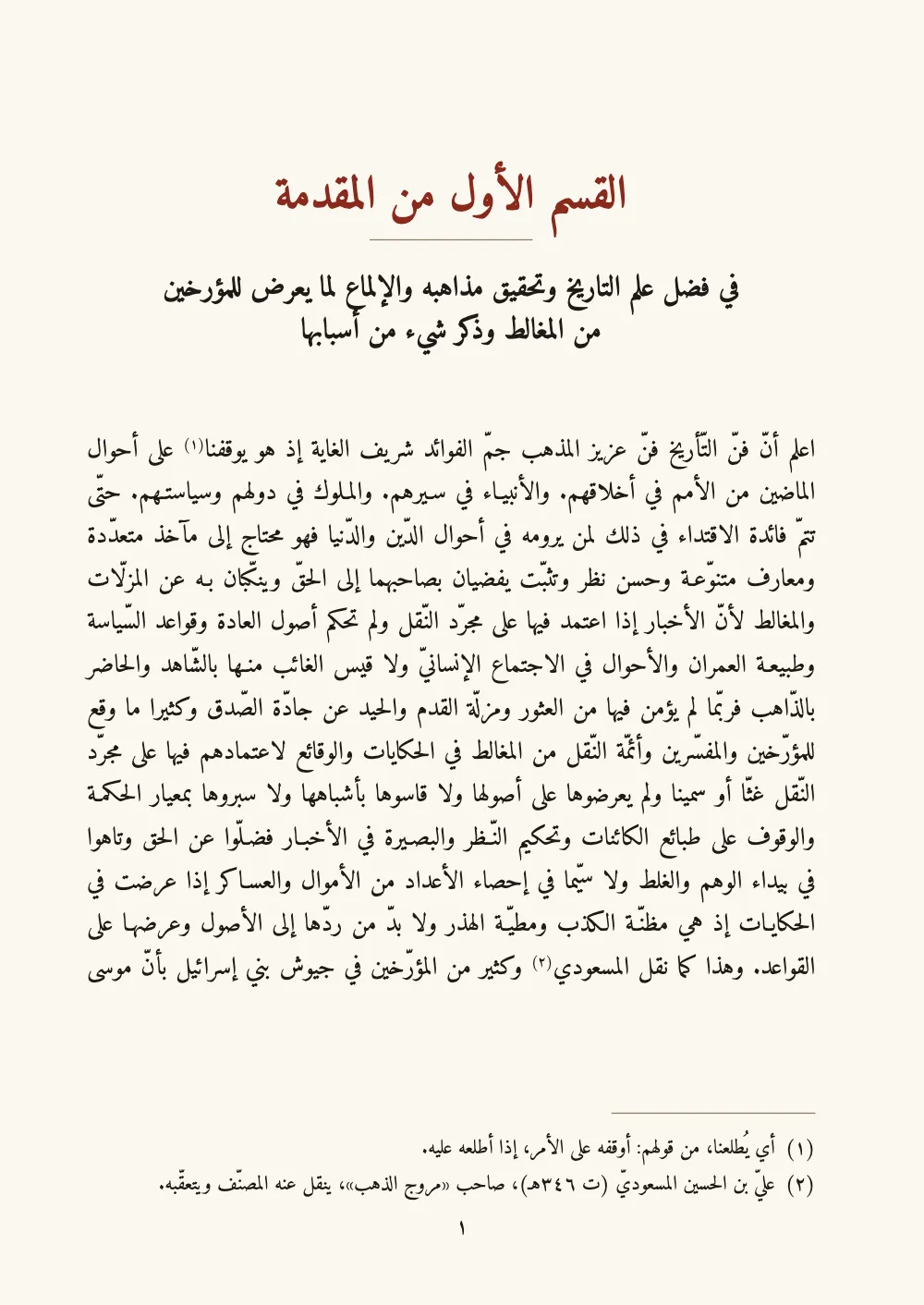
Ibn Khaldūnの『歴史序説』の冒頭を、現代のアラビア語の学術校訂版として組みます。序文のページは文字で、本文は数字で番号を振り、脚注はページごとに1から数え直します。
できあがり
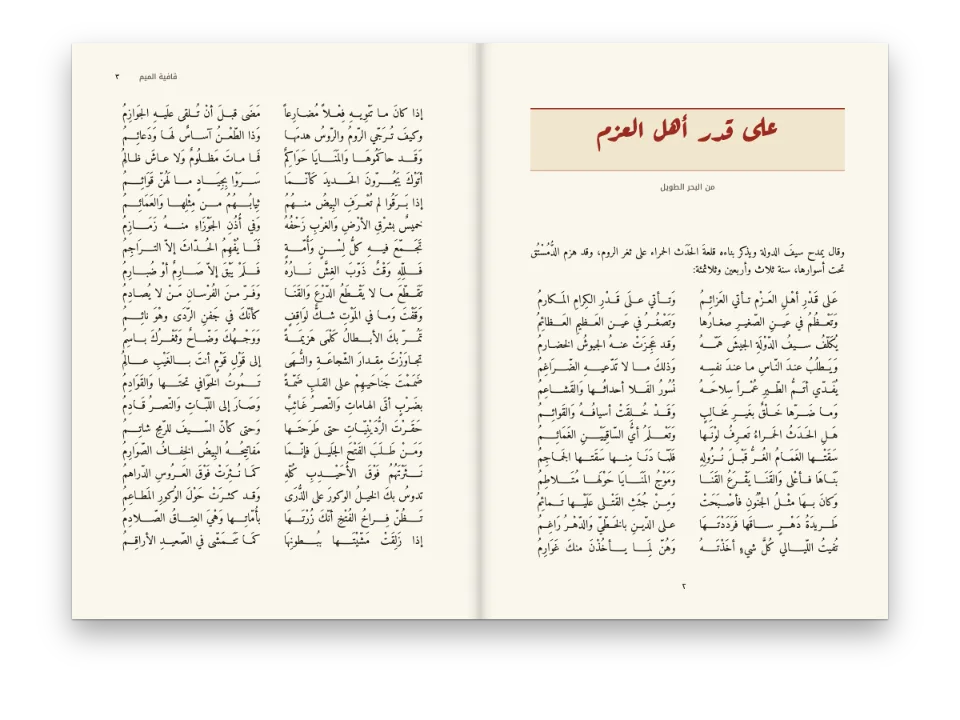
Ibn Khaldūnの『歴史序説』(Muqaddima)のうち、歴史学の優れた点を論じる最初の節を、現代のアラビア語の校訂版、つまりタフキーク(taḥqīq)として11ページ組みます。前付けには、カイロやベイルートの版と同じようにアブジャドの文字でノンブルを振ります。扉がأ、その裏の刊記がب、続く校訂者の序文がجとدです。本文は次の奇数ページで١から数え直します。校訂者の注は各ページの地に、右寄りの短い罫の下に置き、(١)、(٢)、(٣)と番号を振って、ページごとに振り直します。注は珍しい語を説明し、Ibn Khaldūnが挙げる人物と土地を特定し、クルアーンの引用ごとに章(スーラ)と節を示します。巻末には人名索引を置き、アラビア語の索引の流儀どおり、冠詞الを除いて並べます。注と序文はこのレシピのために書いたものです。
このレシピが答える質問
- アラビア語の本の前付けに、アブジャド文字(أ، ب، ج)でノンブルを振るには?
- アラビア語の脚注に、ページごとにかっこ付きの番号((١))を振るには?
手短な答え
// The page counter starts in abjad letters: the title page is أ, its back ب, the editor's
// introduction ج and د. Before the text, two directives in the Markdown count again from 1,
// in the document's digits (١ ٢ ٣ in an `ar` document), on the next odd page:
//   :::pagebreak{parity="odd"}
//   :::numbering{format="arabic-indic" startAt=1}
// {pageNumber} prints each page's own label, so one footer and one header serve both runs.
const pageNumbering = { format: 'abjad', startAt: 1 }; // أ ب ج د هـ و ز ح…
// The editor's notes: numbered again on every page, written «(١)», raised after the word in
// the text and on the line at the head of the note. The rule over the notes and each note's
// number stand on the start side, the right, because the page runs right to left.
const footnotes = {
  numbering: 'page', markerTemplate: '({n})', noteNumberPosition: 'inline',
  fontSize: pt(10.5), lineHeight: pt(18.5), color: col('ink'), textAlign: 'justify',
  spaceAbove: pt(14), spaceBelowRule: pt(6),
  separator: { width: 0.28, lineWidth: pt(0.6), color: col('rule') },
};
材料
- 機能
- 脚注アラビア語の番号スタイルローマ数字の前付け生成される番号の数字右から左のテキスト右綴じの本アラビア語のフォント文書の言語としてのアラビア語見出しスタイル見出しの属性デザインした章扉柱とノンブルページの役割ごとの柱索引冠詞を無視して並べる索引段落スタイルセマンティックカラーパレットPDFの書き出しPDFに埋め込むフォント
- 種類
- Amiri, Aref Ruqaa (SIL OFL 1.1)
- 素材
- なし:図はすべてコードで描画
作り方
#1 · 2系統のノンブルと、ページごとの注
コードは上の手短な答えにあります。page.pageNumberingは本を'abjad'、つまりアブジャド順の文字で始めます。5はهـです。本文の前に置いた2つのディレクティブが、次の奇数ページから文書の数字で数え直させます(:::numbering、数字と番号の書式)。注にはnumbering: 'page'、markerTemplateの'({n})'、noteNumberPosition: 'inline'を設定します。こうすると合印は本文の中で上がり、注は行の中でその番号から始まります(脚注)。
#2 · 冠詞を飛ばす索引
// Marks in the text, `:index[المسعودي]`, `:index[الطّبريّ]{term="الطبري"}`. With
// ignoreArticle, المسعودي files under م and الطبري under ط; ابن الكلبي stays under ا.
// It is the default when the index sorts in Arabic: written out here to say so.
const index = { ignoreArticle: true, fontFamily: NASKH, fontSize: pt(11), lineHeight: pt(17),
  color: col('ink'), groups: { fontFamily: NASKH, fontWeight: 700, fontSize: pt(13),
    color: col('accent'), marginTop: pt(8) } };
const indexStyle = { id: 'index', numbered: false, toc: false, span: 'page',
  breakBefore: { enabled: true, parity: 'any' },
  layout: { layoutType: 'double', gutterWidth: mm(10) } }; // two columns under the title
名前は本文の中で:index[المسعودي]のように印をつけ、:::indexが巻末に印字します。ignoreArticleを使うと、المسعوديはمに、الطبريはطに入り、ابن إسحاقはاのままです。参照項目でإسرائيلをيعقوبへ導きます(目次と索引)。索引のページ番号はページのラベルなので、序文に出てくる名前はجとなります。
#3 · 罫の上の柱
// Running heads are physical. In a book bound on the right the verso (even) is the right
// page: its outer edge, the folio's, is the right one, and its text block starts INNER mm
// from the left edge; the recto (odd) mirrors it.
const HEAD_Y = 14; // mm from the trim
const blockX = (parity) => (parity === 'even' ? INNER : OUTER); // the text block's left edge
const heads = (parity, content) => [
  text(`${parity}-head`, content, NASKH, 10.5,
    { ...at('top-left', blockX(parity), HEAD_Y, 'page'), size: { width: mm(MEASURE) } },
    { color: col('muted'), parity, pages: 'body' }),
  text(`${parity}-folio`, '{pageNumber}', NASKH, 11.5, parity === 'even'
    ? at('top-right', -OUTER, HEAD_Y, 'page') : at('top-left', OUTER, HEAD_Y, 'page'),
  { parity, pages: 'body', align: parity === 'even' ? 'right' : 'left' }),
  { ...rule(`${parity}-rule`, HEAD_Y + 7, MEASURE, 'top-left', 'page', blockX(parity)),
    parity, pages: 'body' },
];
const header = { elements: [...heads('even', '{title}'), ...heads('odd', '{chapterTitle}')] };
const dropFolio = (pages) => text(`folio-${pages}`, '{pageNumber}', NASKH, 11.5,
  at('bottom', 0, -12, 'page'), { pages });
const footer = { elements: [dropFolio('opener')] }; // on the openers, under the text
// Front matter: no running heads, the abjad folio centred at the foot of every page.
const front = { id: 'front', numbered: false, toc: false,
  breakBefore: { enabled: true, parity: 'any' }, header: { elements: [] },
  footer: { elements: [dropFolio('all')] }, advancedDesign: titleOnly(22) };
偶数ページには書名、奇数ページには節の名前を、版面と同じ幅の細罫の上に置き、ノンブルは小口側の端に入れます。右綴じの本では偶数ページが右ページになるので、そのノンブルは右上に来ます(ページの順序と右綴じ)。扉と前付けでは、代わりに地の中央にノンブルを置きます。
#4 · 扉とその刊記
const onPage = (y) => at('top', 0, y, 'page');
const blind = { numbered: false, toc: false, span: 'page', runningChapter: false,
  breakBefore: { enabled: true, parity: 'any' }, header: { elements: [] },
  footer: { elements: [] } }; // blind folios: أ and ب count, but do not print
const titlePage = { id: 'title', ...blind, advancedDesign: design([
  text('book', '{attr.book}', NASKH, 14, onPage(44), { color: col('muted') }),
  rule('rule-top', 58, 40, 'top', 'page'),
  text('title', '{titleText}', RUQAA, 44, onPage(64), { fontWeight: 700,
    color: col('accent'), lineHeight: 1.3 }),
  rule('rule-foot', 92, 40, 'top', 'page'),
  text('author', 'تأليف {author}', NASKH, 15, onPage(100), { fontWeight: 700 }),
  text('years', '{attr.years}', NASKH, 12, onPage(110)),
  text('part', '{attr.part}: {subtitle}', NASKH, 13, onPage(132)),
  text('editor', '{attr.editor}', NASKH, 12, onPage(178), { color: col('accent') }),
  text('latin', '{attr.latin}', NASKH, 9.5, { ...onPage(196), size: { width: mm(110) } },
    { color: col('muted'), direction: 'ltr' }), // a Latin line: its own direction
], 0) };
const imprintPage = { id: 'imprint', ...blind, advancedDesign: design([
  text('edition', '{attr.edition}', NASKH, 11, onPage(170)),
  text('imprint', '{attr.imprint}', NASKH, 9, { ...onPage(180), size: { width: mm(100) } },
    { color: col('muted'), lineHeight: 1.45, direction: 'ltr' }),
], 0) };
扉とその裏の刊記は、本文の流れに何も持たない見出しスタイルです。行は見出しの属性から取るので、版によって変わる刊記の欧文の行は、Markdownの中の属性ひとつで済みます。
レシピの全体
// ═══ Postext Cookbook · Nº 113 · A critical edition (taḥqīq) with notes per page ═══════ // https://postext.dev/en/cookbook/tahqiq-critical-edition // Code: MIT · Text: Ibn Khaldūn, al-Muqaddima, ar.wikisource (PD) · Pictures: none // Fonts: Amiri, Aref Ruqaa (SIL OFL 1.1) · Needs postext ≥ 1.15.0 import { buildDocument, renderPageToCanvas, clearMeasurementCache } from 'https://esm.sh/postext'; import { renderToPdf, decompressWoff2 } from 'https://esm.sh/postext-pdf'; const LANG = 'en'; // @lang: the language of the sample document ('en' | 'es') const RECIPE = 'tahqiq-critical-edition'; // ─── 1 · Design ───────────────────────────────────────────────────────────── // A modern Cairo taḥqīq: black Naskh on a cream paper, headings and rules in one dark red. const palette = { ink: '#1e1a16', // text and notes: a warm near-black accent: '#8a2a1d', // headings, the title, the index letters rule: '#8c7a62', // hairlines: the rule under the running heads, the rule over the notes muted: '#5e564c', // running heads, the imprint paper: '#fbf8f0', // a cream paper }; const col = (id) => ({ hex: palette[id], model: 'hex', paletteId: id }); const colorPalette = [ ...Object.entries(palette).map(([id, hex]) => ({ id, name: id, value: { hex, model: 'hex' } })), { id: 'main-color', name: 'accent (defaults)', value: { hex: palette.accent, model: 'hex' } }, ]; const NASKH = 'Amiri'; // text, notes, headings in bold, running heads, index const RUQAA = 'Aref Ruqaa'; // display: the title on the title page const [W, H] = [170, 240]; // mm: 17 × 24 cm, the size of most Cairo and Beirut editions const [TOP, INNER, OUTER] = [22, 20, 16]; // mm; `left` is the inner margin on both pages const MEASURE = W - INNER - OUTER; // 134 mm const [SIZE, LEAD] = [13, 22.5]; // pt: 1.73 ×, so the few vowels marked clear the line above // #region answer: abjad folios for the front matter, Arabic-Indic from the text, notes (١) // The page counter starts in abjad letters: the title page is أ, its back ب, the editor's // introduction ج and د. Before the text, two directives in the Markdown count again from 1, // in the document's digits (١ ٢ ٣ in an `ar` document), on the next odd page: // :::pagebreak{parity="odd"} // :::numbering{format="arabic-indic" startAt=1} // {pageNumber} prints each page's own label, so one footer and one header serve both runs. const pageNumbering = { format: 'abjad', startAt: 1 }; // أ ب ج د هـ و ز ح… // The editor's notes: numbered again on every page, written «(١)», raised after the word in // the text and on the line at the head of the note. The rule over the notes and each note's // number stand on the start side, the right, because the page runs right to left. const footnotes = { numbering: 'page', markerTemplate: '({n})', noteNumberPosition: 'inline', fontSize: pt(10.5), lineHeight: pt(18.5), color: col('ink'), textAlign: 'justify', spaceAbove: pt(14), spaceBelowRule: pt(6), separator: { width: 0.28, lineWidth: pt(0.6), color: col('rule') }, }; // #endregion // #region index: فهرس الأعلام, sorted as if the article ال were not there // Marks in the text, `:index[المسعودي]`, `:index[الطّبريّ]{term="الطبري"}`. With // ignoreArticle, المسعودي files under م and الطبري under ط; ابن الكلبي stays under ا. // It is the default when the index sorts in Arabic: written out here to say so. const index = { ignoreArticle: true, fontFamily: NASKH, fontSize: pt(11), lineHeight: pt(17), color: col('ink'), groups: { fontFamily: NASKH, fontWeight: 700, fontSize: pt(13), color: col('accent'), marginTop: pt(8) } }; const indexStyle = { id: 'index', numbered: false, toc: false, span: 'page', breakBefore: { enabled: true, parity: 'any' }, layout: { layoutType: 'double', gutterWidth: mm(10) } }; // two columns under the title // #endregion // #region opener: a bold Naskh title and the section's long heading under a short rule const at = (edge, x, y, to = 'container') => ({ anchor: { to, edge }, offset: { x: mm(x), y: mm(y) } }); const text = (id, content, font, size, placement, extra = {}) => ({ kind: 'text', id, content, fontFamily: font, fontSize: pt(size), color: col('ink'), align: 'center', overflow: 'wrap', lineHeight: 1.5, placement, ...extra }); const rule = (id, y, width, edge = 'top', to = 'container', x = 0) => ({ kind: 'rule', id, direction: 'horizontal', thickness: pt(0.6), color: col('rule'), placement: { ...at(edge, x, y, to), size: { width: width === 'fill' ? 'fill' : mm(width) } } }); const design = (elements, minHeight) => ({ enabled: true, minHeight: mm(minHeight), slot: { elements } }); const opener = design([ text('title', '{titleText}', NASKH, 24, at('top', 0, 6), { fontWeight: 700, color: col('accent') }), rule('rule', 22, 30), text('sub', '{attr.sub}', NASKH, 15, { ...at('top', 0, 26), size: { width: mm(110) } }, { fontWeight: 700 }), ], 44); // The index and the introduction take the title alone. const titleOnly = (minHeight) => design([text('title', '{titleText}', NASKH, 20, at('top', 0, 4), { fontWeight: 700, color: col('accent') }), rule('rule', 17, 22)], minHeight); // #endregion // #region furniture: running heads over a rule on the body pages, folios on the outer edge // Running heads are physical. In a book bound on the right the verso (even) is the right // page: its outer edge, the folio's, is the right one, and its text block starts INNER mm // from the left edge; the recto (odd) mirrors it. const HEAD_Y = 14; // mm from the trim const blockX = (parity) => (parity === 'even' ? INNER : OUTER); // the text block's left edge const heads = (parity, content) => [ text(`${parity}-head`, content, NASKH, 10.5, { ...at('top-left', blockX(parity), HEAD_Y, 'page'), size: { width: mm(MEASURE) } }, { color: col('muted'), parity, pages: 'body' }), text(`${parity}-folio`, '{pageNumber}', NASKH, 11.5, parity === 'even' ? at('top-right', -OUTER, HEAD_Y, 'page') : at('top-left', OUTER, HEAD_Y, 'page'), { parity, pages: 'body', align: parity === 'even' ? 'right' : 'left' }), { ...rule(`${parity}-rule`, HEAD_Y + 7, MEASURE, 'top-left', 'page', blockX(parity)), parity, pages: 'body' }, ]; const header = { elements: [...heads('even', '{title}'), ...heads('odd', '{chapterTitle}')] }; const dropFolio = (pages) => text(`folio-${pages}`, '{pageNumber}', NASKH, 11.5, at('bottom', 0, -12, 'page'), { pages }); const footer = { elements: [dropFolio('opener')] }; // on the openers, under the text // Front matter: no running heads, the abjad folio centred at the foot of every page. const front = { id: 'front', numbered: false, toc: false, breakBefore: { enabled: true, parity: 'any' }, header: { elements: [] }, footer: { elements: [dropFolio('all')] }, advancedDesign: titleOnly(22) }; // #endregion // #region title: the title page and its back, with nothing in the flow const onPage = (y) => at('top', 0, y, 'page'); const blind = { numbered: false, toc: false, span: 'page', runningChapter: false, breakBefore: { enabled: true, parity: 'any' }, header: { elements: [] }, footer: { elements: [] } }; // blind folios: أ and ب count, but do not print const titlePage = { id: 'title', ...blind, advancedDesign: design([ text('book', '{attr.book}', NASKH, 14, onPage(44), { color: col('muted') }), rule('rule-top', 58, 40, 'top', 'page'), text('title', '{titleText}', RUQAA, 44, onPage(64), { fontWeight: 700, color: col('accent'), lineHeight: 1.3 }), rule('rule-foot', 92, 40, 'top', 'page'), text('author', 'تأليف {author}', NASKH, 15, onPage(100), { fontWeight: 700 }), text('years', '{attr.years}', NASKH, 12, onPage(110)), text('part', '{attr.part}: {subtitle}', NASKH, 13, onPage(132)), text('editor', '{attr.editor}', NASKH, 12, onPage(178), { color: col('accent') }), text('latin', '{attr.latin}', NASKH, 9.5, { ...onPage(196), size: { width: mm(110) } }, { color: col('muted'), direction: 'ltr' }), // a Latin line: its own direction ], 0) }; const imprintPage = { id: 'imprint', ...blind, advancedDesign: design([ text('edition', '{attr.edition}', NASKH, 11, onPage(170)), text('imprint', '{attr.imprint}', NASKH, 9, { ...onPage(180), size: { width: mm(100) } }, { color: col('muted'), lineHeight: 1.45, direction: 'ltr' }), ], 0) }; // #endregion const config = () => ({ // a factory: the engine caches resolved configs per object locale: 'ar', // right to left, bound on the right, digits ٠–٩ (gotcha: arabic-locale-tag) colorPalette, page: { width: mm(W), height: mm(H), dpi: 150, backgroundColor: col('paper'), pageNumbering, margins: { top: mm(TOP), bottom: mm(20), left: mm(INNER), right: mm(OUTER), mirror: true } }, layout: { layoutType: 'single' }, bodyText: { fontFamily: NASKH, fontSize: pt(SIZE), lineHeight: pt(LEAD), color: col('ink'), boldColor: col('ink'), italicColor: col('ink'), referenceColor: col('ink'), textAlign: 'justify', firstLineIndent: em(1.5), indentAfterHeading: false, optimalLineBreaking: true, avoidWidows: true, avoidOrphans: true }, // Restated: any headings object drops the H1 break (gotcha: headings-drop-h1-break). headings: { fontFamily: NASKH, fontWeight: 700, color: col('accent'), levels: [{ level: 1, fontSize: pt(24), breakBefore: { enabled: true, parity: 'any' }, advancedDesign: opener }] }, headingStyles: [titlePage, imprintPage, front, { ...indexStyle, advancedDesign: titleOnly(26) }], paragraphStyles: [{ id: 'signature', textAlign: 'right', firstLineIndent: pt(0), fontWeight: 700, marginTop: pt(LEAD / 2) }], // 'right' is the end of an Arabic line unorderedLists: { bulletChar: '•', color: col('accent') }, // the bullets footnotes, index, header, footer, }); // ─── 2 · Content ──────────────────────────────────────────────────────────── const markdown = String.raw`---Markdownの見本 · 108行 · content.en.md
title: "مقدمة ابن خلدون" subtitle: "في فضل علم التاريخ" author: "عبد الرحمن بن خلدون" --- # مقدمة ابن خلدون {style="title" book="كتاب العبر وديوان المبتدأ والخبر" years="(٧٣٢–٨٠٨هـ)" part="القسم الأول من المقدمة" editor="تحقيق وتعليق: Postext Cookbook" latin="Ibn Khaldūn, The Muqaddima · the opening section, on the excellence of history · a critical edition"} # الطبعة {style="imprint" edition="الطبعة الأولى، ١٤٤٨هـ / ٢٠٢٦م" imprint="Text: Ibn Khaldūn (1332–1406), al-Muqaddima, the first section, from ar.wikisource (revision 610595), public domain; its paragraphs and the ornate brackets around the Qurʾān are this edition’s. Introduction, notes and index: Postext Cookbook, MIT. Set in Amiri and Aref Ruqaa (SIL OFL)."} # مقدمة المحقق {style="front"} الحمد لله، والصلاة والسلام على رسول الله، وبعد: فهذه نشرة لأوّل فصول «المقدّمة» التي صدّر بها :index[عبد الرحمن بن خلدون]{term="ابن خلدون"} (٧٣٢–٨٠٨هـ) كتابه «العِبَر وديوان المبتدأ والخبر». يبيّن فيه فضل علم التاريخ، وينبّه على أسباب الغلط في الأخبار، ويضرب لذلك مثلين: عدد جيوش بني إسرائيل، وغزوات التبابعة ملوك اليمن إلى المغرب والمشرق. ثمّ يعرض الخبر على ما تقتضيه طبيعة العمران وعوائد الأمم، فما خالفها ردّه. وُلد ابن خلدون بتونس سنة ٧٣٢هـ، وتقلّب في خدمة الدول بالمغرب والأندلس، ثمّ انتقل إلى مصر فولي فيها قضاء المالكيّة، وتوفّي بالقاهرة سنة ٨٠٨هـ. وعماد هذا الفصل قانون يقدّمه لنقد الأخبار: أن يُقاس الغائب بالشاهد، وأن يُنظر في إمكان الخبر قبل النظر في رواته. وقد أتمّ المصنّف كتابة المقدّمة في قلعة ابن سلامة من بلاد المغرب الأوسط سنة ٧٧٩هـ، في نحو خمسة أشهر، ثمّ عاد إليها بالزيادة والتنقيح في سنوات إقامته بتونس والقاهرة. وطُبعت أوّل مرّة في بولاق سنة ١٢٧٤هـ (١٨٥٧م) بتصحيح الشيخ نصر الهورينيّ، وفي باريس سنة ١٨٥٨م بعناية المستشرق كاترمير. وهذا منهجنا في النشرة: - أثبتنا النصّ كما تنشره «ويكي مصدر» (المراجعة ٦١٠٥٩٥)، ولم ننقل حواشيه، فالحواشي هنا كلّها من وضعنا. - قسّمنا الكلام فقرات، ولم نغيّر من ألفاظه شيئًا، إلّا همزةً سقطت من «الإلماع» في العنوان. - جعلنا ما اقتبسه المصنّف من القرآن الكريم بين القوسين المزهّرين ﴿ ﴾، وذكرنا في الحاشية السورة ورقم الآية. - عرّفنا بالأعلام والأماكن، وشرحنا الغريب من الألفاظ. - رقّمنا الحواشي في كلّ صفحة على حدة، بين قوسين، ورقّمنا صفحات هذه المقدّمة بحروف أبجد، وصفحات النصّ بالأرقام. - ألحقنا بالنصّ فهرسًا للأعلام، رتّبناه على حروف المعجم دون اعتبار «ال» التعريف. ونرجو أن تعين هذه النشرة قارئ المقدّمة على تتبّع منهج صاحبها في نقد الأخبار: فهو يسمّي مصادره، ويعرض ما نقلوه على الجغرافيا والأنساب وحاجات الجيوش من الزاد والعلف، ثمّ يحكم. والله وليّ التوفيق. :::paragraphs{style="signature"} المحقّق ::: :::pagebreak{parity="odd"} :::numbering{format="arabic-indic" startAt=1} # القسم الأول من المقدمة {sub="في فضل علم التاريخ وتحقيق مذاهبه والإلماع لما يعرض للمؤرخين من المغالط وذكر شيء من أسبابها"} اعلم أنّ فنّ التّأريخ فنّ عزيز المذهب جمّ الفوائد شريف الغاية إذ هو يوقفنا[^n1] على أحوال الماضين من الأمم في أخلاقهم. والأنبياء في سيرهم. والملوك في دولهم وسياستهم. حتّى تتمّ فائدة الاقتداء في ذلك لمن يرومه في أحوال الدّين والدّنيا فهو محتاج إلى مآخذ متعدّدة ومعارف متنوّعة وحسن نظر وتثبّت يفضيان بصاحبهما إلى الحقّ وينكّبان به عن المزلّات والمغالط لأنّ الأخبار إذا اعتمد فيها على مجرّد النّقل ولم تحكم أصول العادة وقواعد السّياسة وطبيعة العمران والأحوال في الاجتماع الإنسانيّ ولا قيس الغائب منها بالشّاهد والحاضر بالذّاهب فربّما لم يؤمن فيها من العثور ومزلّة القدم والحيد عن جادّة الصّدق وكثيرا ما وقع للمؤرّخين والمفسّرين وأئمّة النّقل من المغالط في الحكايات والوقائع لاعتمادهم فيها على مجرّد النّقل غثّا أو سمينا ولم يعرضوها على أصولها ولا قاسوها بأشباهها ولا سبروها بمعيار الحكمة والوقوف على طبائع الكائنات وتحكيم النّظر والبصيرة في الأخبار فضلّوا عن الحق وتاهوا في بيداء الوهم والغلط ولا سيّما في إحصاء الأعداد من الأموال والعساكر إذا عرضت في الحكايات إذ هي مظنّة الكذب ومطيّة الهذر ولا بدّ من ردّها إلى الأصول وعرضها على القواعد. وهذا كما نقل :index[المسعودي][^n2] وكثير من المؤرّخين في جيوش بني إسرائيل بأنّ :index[موسى] عليه السّلام أحصاهم في التّيه[^n3] بعد أن أجاز من يطيق حمل السّلاح خاصّة من ابن عشرين فما فوقها فكانوا ستّمائة ألف أو يزيدون[^n4] ويذهل في ذلك عن تقدير مصر والشّام واتّساعهما لمثل هذا العدد من الجيوش لكلّ مملكة من الممالك حصّة من الحامية تتّسع لها وتقوم بوظائفها وتضيق عمّا فوقها تشهد بذلك العوائد المعروفة والأحوال المألوفة ثمّ إنّ مثل هذه الجيوش البالغة إلى مثل هذا العدد يبعد أن يقع بينها زحف أو قتال لضيق ساحة الأرض عنها وبعدها إذا اصطفّت عن مدى البصر مرّتين أو ثلاثا أو أزيد فكيف يقتتل هذان الفريقان أو تكون غلبة أحد الصّفّين وشيء من جوانبه لا يشعر بالجانب الآخر والحاضر يشهد لذلك فالماضي أشبه بالآتي من الماء بالماء. [^n1]: أي يُطلعنا، من قولهم: أوقفه على الأمر، إذا أطلعه عليه. [^n2]: عليّ بن الحسين المسعوديّ (ت ٣٤٦هـ)، صاحب «مروج الذهب»، ينقل عنه المصنّف ويتعقّبه. [^n3]: التيه: البرّيّة التي تاه فيها بنو إسرائيل بعد خروجهم من مصر، وإليها الإشارة بقوله تعالى: ﴿فَإِنَّهَا مُحَرَّمَةٌ عَلَيْهِمْ أَرْبَعِينَ سَنَةً يَتِيهُونَ فِي الْأَرْضِ﴾ [المائدة: ٢٦]. [^n4]: في سفر العدد من التوراة أنّ عدّتهم ستّمائة ألف وثلاثة آلاف وخمسمائة وخمسون رجلًا (العدد ١: ٤٦). ولقد كان ملك الفرس ودولتهم أعظم من ملك بني إسرائيل بكثير يشهد لذلك ما كان من غلب :index[بخت نصّر]{term="بخت نصر"}[^n5] لهم والتهامه بلادهم واستيلائه على أمرهم وتخريب بيت المقدس قاعدة ملّتهم وسلطانهم وهو من بعض عمّال مملكة فارس يقال إنّه كان مرزبان[^n6] المغرب من تخومها وكانت ممالكهم بالعراقين وخراسان وما وراء النّهر والأبواب أوسع من ممالك بني إسرائيل بكثير ومع ذلك لم تبلغ جيوش الفرس قطّ مثل هذا العدد ولا قريبا منه وأعظم ما كانت جموعهم بالقادسيّة[^n7] مائة وعشرين ألفا كلّهم متبوع على ما نقله :index[سيف]{term="سيف بن عمر"}[^n8] قال وكانوا في أتباعهم أكثر من مائتي ألف وعن :index[عائشة] و:index[الزّهريّ]{term="الزهري"}[^n9] فإنّ جموع :index[رستم] الّذين زحف بهم :index[سعد]{term="سعد بن أبي وقاص"} بالقادسيّة إنّما كانوا ستّين ألفا كلّهم متبوع وأيضا فلو بلغ بنو إسرائيل مثل هذا العدد لاتّسع نطاق ملكهم وانفسح مدى دولتهم فإنّ العمالات والممالك في الدّول على نسبة الحامية والقبيل القائمين بها في قلّتها وكثرتها حسبما نبين في فصل الممالك من الكتاب الأوّل والقوم لم تتّسع ممالكهم إلى غير الأردنّ وفلسطين من الشّام وبلاد يثرب وخيبر من الحجاز على ما هو المعروف. [^n5]: هو نبوخذ نصّر الثاني، ملك بابل (ت ٥٦٢ ق.م)، خرّب بيت المقدس سنة ٥٨٦ ق.م وسبى أهله إلى بابل. وكان ملكًا لبابل، لا عاملًا للفرس. [^n6]: المرزبان: لفظ فارسيّ معناه حاكم الثغر أو الإقليم، والجمع مرازبة. [^n7]: موضع قرب الكوفة، كانت فيه الوقعة بين المسلمين بقيادة سعد بن أبي وقّاص والفرس بقيادة رستم، سنة ١٥هـ (٦٣٦م) على الأشهر. [^n8]: سيف بن عمر التميميّ (ت نحو ١٨٠هـ)، صاحب كتاب «الفتوح والردّة»، وعنه روى الطبريّ أكثر أخبار القادسيّة. [^n9]: أبو بكر محمّد بن مسلم بن شهاب الزهريّ (ت ١٢٤هـ)، من أوائل من دوّنوا الحديث والمغازي. وأيضا فالّذين بين موسى وإسرائيل إنّما هو أربعة آباء على ما ذكره المحقّقون فإنّه موسى بن عمران بن يصهر بن قاهت بفتح الهاء وكسرها ابن لاوي بكسر الواو وفتحها ابن :index[يعقوب] وهو إسرائيل:index{term="إسرائيل" see="يعقوب"} الله هكذا نسبه في التّوراة والمدّة بينهما على ما نقله المسعوديّ قال دخل إسرائيل مصر مع ولده الأسباط وأولادهم حين أتوا إلى :index[يوسف] سبعين نفسا وكان مقامهم بمصر إلى أن خرجوا مع موسى عليه السّلام إلى التّيه مائتين وعشرين سنة تتداولهم ملوك القبط من الفراعنة ويبعد أن يتشعّب النّسل في أربعة أجيال إلى مثل هذا العدد وإن زعموا أنّ عدد تلك الجيوش إنّما كان في زمن سليمان ومن بعده فبعيد أيضا إذ ليس بين :index[سليمان] وإسرائيل إلّا أحد عشر أبا فإنّه سليمان بن :index[داود] بن يشّا بن عوفيذ (ويقال ابن عوفذ) ابن باعز (ويقال بوعز) بن سلمون بن نحشون بن عمّينوذب (ويقال حمّيناذاب) بن رمّ بن حصرون (ويقال حسرون) بن بارس (ويقال ببرس) بن يهوذا بن يعقوب ولا يتشعّب النّسل في أحد عشر من الولد إلى مثل هذا العدد الّذي زعموه اللَّهمّ إلى المائتين والآلاف فربّما يكون وأمّا أن يتجاوز إلى ما بعدهما من عقود الأعداد فبعيد واعتبر ذلك في الحاضر المشاهد والقريب المعروف تجد زعمهم باطلا ونقلهم كاذبا. والّذي ثبت في الإسرائيليّات أنّ جنود سليمان كانت اثني عشر ألفا خاصّة وأنّ مقرّباته[^n10] كانت ألفا وأربعمائة فرس مرتبطة على أبوابه هذا هو الصّحيح من أخبارهم ولا يلتفت إلى خرافات العامّة منهم وفي أيّام سليمان (عليه السّلام) وملكه كان عنفوان دولتهم واتّساع ملكهم هذا وقد نجد الكافّة من أهل العصر إذا أفاضوا في الحديث عن عساكر الدّول الّتي لعهدهم أو قريبا منه وتفاوضوا في الأخبار عن جيوش المسلمين أو النّصارى أو أخذوا في إحصاء أموال الجبايات وخراج السّلطان ونفقات المترفين وبضائع الأغنياء الموسرين توغّلوا في العدد وتجاوزوا حدود العوائد وطاوعوا وساوس الإعراب فإذا استكشف أصحاب الدّواوين عن عساكرهم واستنبطت أحوال أهل الثّروة في بضائعهم وفوائدهم واستجليت عوائد المترفين في نفقاتهم لم تجد معشار ما يعدّونه وما ذلك إلّا لولوع النّفس بالغرائب وسهولة التّجاوز على اللسان والغفلة على المتعقّب والمنتقد حتّى لا يحاسب نفسه على خطإ ولا عمد ولا يطالبها في الخبر بتوسط ولا عدالة ولا يرجعها إلى بحث وتفتيش فيرسل عنانه ويسيم في مراتع الكذب لسانه ويتّخذ آيات الله هزءا[^n11] و﴿يشتري لهو الحديث ليضلّ عن سبيل الله﴾[^n12] وحسبك بها صفقة خاسرة. [^n10]: المقرّبات: الخيل الكريمة تُربط قريبًا من بيوت أصحابها ولا تُترك في المرعى، واحدتها مُقْرَبة. [^n11]: اقتباس من قوله تعالى: ﴿وَلَا تَتَّخِذُوا آيَاتِ اللَّهِ هُزُوًا﴾ [البقرة: ٢٣١]. [^n12]: من قوله تعالى: ﴿وَمِنَ النَّاسِ مَنْ يَشْتَرِي لَهْوَ الْحَدِيثِ لِيُضِلَّ عَنْ سَبِيلِ اللَّهِ بِغَيْرِ عِلْمٍ﴾ [لقمان: ٦]. ومن الأخبار الواهية للمؤرّخين ما ينقلونه كافّة في أخبار التّبابعة[^n13] ملوك اليمن وجزيرة العرب أنّهم كانوا يغزون من قراهم باليمن إلى إفريقية[^n14] والبربر من بلاد المغرب وأنّ :index[أفريقش بن قيس بن صيفيّ]{term="أفريقش بن قيس"} من أعاظم ملوكهم الأول وكان لعهد موسى عليه السّلام أو قبله بقليل غزا إفريقية وأثخن في البربر وأنّه الّذي سمّاهم بهذا الاسم حين سمع رطانتهم وقال ما هذه البربرة فأخذ هذا الاسم عنه ودعوا به من حينئذ وأنّه لمّا انصرف من المغرب حجز هنالك قبائل من حمير فأقاموا بها واختلطوا بأهلها ومنهم صنهاجة[^n15] وكتامة ومن هذا ذهب :index[الطّبريّ]{term="الطبري"}[^n16] و:index[الجرجانيّ]{term="الجرجاني"} و:index[المسعوديّ]{term="المسعودي"} و:index[ابن الكلبيّ]{term="ابن الكلبي"}[^n17] و:index[البيليّ]{term="البيلي"} إلى أنّ صنهاجة وكتامة من حمير وتأباه نسابة البربر وهو الصّحيح وذكر المسعوديّ أيضا أنّ :index[ذا الأذعار]{term="ذو الأذعار"} من ملوكهم قبل أفريقش وكان على عهد سليمان (عليه السّلام) غزا المغرب ودوّخه وكذلك ذكر مثله عن :index[ياسر] ابنه من بعده وأنّه بلغ وادي الرّمل في بلاد المغرب ولم يجد فيه مسلكا لكثرة الرّمل فرجع وكذلك يقولون في تبّع الآخر وهو :index[أسعد أبو كرب] وكان على عهد :index[يستأسف] من ملوك الفرس الكيانيّة[^n18] أنّه ملك الموصل وأذربيجان ولقي التّرك فهزمهم وأثخن ثمّ غزاهم ثانية وثالثة كذلك وأنّه بعد ذلك أغزى ثلاثة من بنيه بلاد فارس وإلى بلاد الصّغد[^n19] من بلاد أمم التّرك وراء النّهر وإلى بلاد الرّوم فملك الأوّل البلاد إلى سمرقند وقطع المفازة إلى الصين فوجد أخاه الثّاني الّذي غزا إلى سمرقند قد سبقه إليها فأثخنا في بلاد الصّين ورجعا جميعا بالغنائم وتركوا ببلاد الصّين قبائل من حمير فهم بها إلى هذا العهد وبلغ الثّالث إلى قسطنطنيّة فدرسها[^n20] ودوّخ بلاد الرّوم ورجع. [^n13]: التبابعة: ملوك حِمْيَر باليمن، واحدهم تُبَّع، وهو لقب من ملك منهم. [^n14]: إفريقية: الاسم القديم لما يُعرف اليوم بتونس وشرق الجزائر، وكانت قاعدتها القيروان. [^n15]: صنهاجة وكتامة: قبيلتان عظيمتان من البربر، قامت على كتامة دعوة الفاطميّين، ومن صنهاجة بنو زيري والمرابطون. [^n16]: محمّد بن جرير الطبريّ (ت ٣١٠هـ)، صاحب «تاريخ الرسل والملوك». [^n17]: هشام بن محمّد بن السائب الكلبيّ (ت ٢٠٤هـ)، النسّابة الأخباريّ. [^n18]: الكيانيّة: الطبقة الثانية من ملوك الفرس في أخبارهم القديمة، ومنهم كيكاوس وكيخسرو. [^n19]: الصُّغْد: بلاد ما وراء النهر بين بخارى وسمرقند. [^n20]: أي محا أثرها وأخربها. وهذه الأخبار كلّها بعيدة عن الصّحّة عريقة في الوهم والغلط وأشبه بأحاديث القصص الموضوعة. وذلك أنّ ملك التّبابعة إنّما كان بجزيرة العرب وقرارهم وكرسيّهم بصنعاء اليمن. وجزيرة العرب يحيط بها البحر من ثلاث جهاتها فبحر الهند من الجنوب وبحر فارس الهابط منه إلى البصرة من المشرق وبحر السّويس[^n21] الهابط منه إلى السّويس من أعمال مصر من جهة المغرب كما تراه في مصوّر الجغرافيا فلا يجد السّالكون من اليمن إلى المغرب طريقا من غير السّويس والمسلك هناك ما بين بحر السّويس والبحر الشّاميّ قدر مرحلتين[^n22] فما دونهما ويبعد أن يمرّ بهذا المسلك ملك عظيم في عساكر موفورة من غير أن يصير من أعماله هذه ممتنع في العادة. وقد كان بتلك الأعمال العمالقة وكنعان بالشّام والقبط بمصر ثمّ ملك العمالقة مصر وملك بنو إسرائيل الشّام ولم ينقل قطّ أنّ التّبابعة حاربوا أحدا من هؤلاء الأمم ولا ملكوا شيئا من تلك الأعمال وأيضا فالشّقّة من البحر إلى المغرب بعيدة والأزودة والعلوفة للعساكر كثيرة فإذا ساروا في غير أعمالهم احتاجوا إلى انتهاب الزّرع والنّعم وانتهاب البلاد فيما يمرّون عليه ولا يكفي ذلك للأزودة وللعلوفة عادة وإن نقلوا كفايتهم من ذلك من أعمالهم فلا تفي لهم الرّواحل بنقله فلا بدّ وأن يمرّوا في طريقهم كلّها بأعمال قد ملكوها ودوّخوها لتكون الميرة منها وإن قلنا إنّ تلك العساكر تمرّ بهؤلاء الأمم من غير أن تهيجهم فتحصل لهم الميرة بالمسالمة فذلك أبعد وأشدّ امتناعا فدلّ على أنّ هذه الأخبار واهية أو موضوعة. [^n21]: يريد البحر الأحمر، ويسمّى بحر القُلزُم، والبحر الشاميّ هو البحر المتوسّط. [^n22]: المرحلة: المسافة التي يقطعها المسافر في يوم. وأمّا وادي الرّمل الّذي يعجز السّالك فلم يسمع قطّ ذكره في المغرب على كثرة سالكه ومن يقصّ طرقه من الرّكّاب والقرى في كلّ عصر وكلّ جهة وهو على ما ذكروه من الغرابة تتوفّر الدّواعي على نقله. وأمّا غزوهم بلاد الشّرق وأرض التّرك وإن كان طريقه أوسع من مسالك السّويس إلّا أنّ الشّقّة هنا أبعد وأمم فارس والرّوم معترضون فيها دون التّرك ولم ينقل قطّ أنّ التّبابعة ملكوا بلاد فارس ولا بلاد الرّوم وإنّما كانوا يحاربون أهل فارس على حدود بلاد العراق وما بين البحرين والحيرة والجزيرة بين دجلة والفرات وما بينهما في الأعمال وقد وقع ذلك بين ذي الأذعار منهم و:index[كيكاوس] من ملوك الكيانيّة وبين تبّع الأصغر أبي كرب ويستأسف منهم أيضا ومع ملوك الطّوائف بعد الكيانيّة والسّاسانيّة من بعدهم بمجاوزة أرض فارس بالغزو إلى بلاد الترك والتّبت وهو ممتنع عادة من أجل الأمم المعترضة منهم والحاجة إلى الأزودة والعلوفات مع بعد الشّقّة كما مرّ فالأخبار بذلك واهية مدخولة وهي لو كانت صحيحة النّقل لكان ذلك قادحا فيها فكيف وهي لم تنقل من وجه صحيح وقول :index[ابن إسحاق][^n23] في خبر يثرب والأوس والخزرج[^n24] أنّ تبّعا الآخر سار إلى المشرق محمولا على العراق وبلاد فارس وأمّا بلاد التّرك والتّبت فلا يصحّ غزوهم إليها بوجه لما تقرّر فلا تثقنّ بما يلقى إليك من ذلك وتأمّل الأخبار واعرضها على القوانين الصّحيحة يقع لك تمحيصها بأحسن وجه والله الهادي إلى الصّواب. [^n23]: محمّد بن إسحاق بن يسار (ت ١٥١هـ)، صاحب «السيرة». [^n24]: الأوس والخزرج: قبيلتا الأنصار من أهل يثرب، وهي المدينة. # فهرس الأعلام {style="index"} :::index`; // content.<lang>.md, inlined by the Cookbook // ─── 3 · Fonts ────────────────────────────────────────────────────────────── const FONTS = { // every face the pages use, loaded before the build (gotcha: fonts-first) Amiri: ['400', '700'], // NASKH: text, notes, headings, heads, the Latin lines 'Aref Ruqaa': ['700'], // RUQAA: the title }; // ─── 4 · Build & show ─────────────────────────────────────────────────────── await loadFonts(FONTS, markdown); // The arabic file of each face, which loadFonts leaves out (gotcha: arabic-fonts-subset). await loadArabicFonts(FONTS, markdown); const doc = await buildWithFonts(() => buildDocument({ markdown }, config()), markdown); showBook(doc, { title: t({ en: 'A critical edition with notes per page', es: 'Una edición crítica con notas por página' }) }); offerPdf(() => renderToPdf(doc, { fontProvider: arabicPdfProvider }), `${RECIPE}.pdf`);キット · core, fonts, viewer, pdf, arabic, book:全レシピ共通 · 411行
// ─── Kit ── helpers shared by every Cookbook recipe · postext.dev/cookbook ───── // ─── Kit · core v1 ── the same in every recipe · postext.dev/cookbook ───────── function mm(value) { return { value, unit: 'mm' }; } function pt(value) { return { value, unit: 'pt' }; } function em(value) { return { value, unit: 'em' }; } /** The sample language's string: t({ en: 'Figure', es: 'Figura' }). */ function t(strings) { return strings[LANG] ?? Object.values(strings)[0]; } /** A file in this recipe's assets folder, served from the Postext repo by jsDelivr. */ function asset(file) { return `https://cdn.jsdelivr.net/gh/drnachio/postext@main/cookbook/${RECIPE}/assets/${file}`; } // ─── Kit · fonts v1 ── the same in every recipe · postext.dev/cookbook ──────── // Postext measures text with the faces the browser has loaded, and caches the // widths, so every face must be ready before the first build. Faces come from // Fontsource: the same static files the PDF embeds, so screen and PDF agree. /** faces = { 'Family Name': ['400', '400i', '700'] }. `text` is the sample: * letters beyond Latin-1 (č, ł, ő…) also load the latin-ext files. With * `optional`, a face Fontsource does not ship is skipped instead of failing. * Resolves to the number of faces added. */ async function loadFonts(faces, text = '', { optional = false } = {}) { kitStatus('Loading fonts…'); const ranges = { latin: 'U+0000-00FF,U+0131,U+0152-0153,U+02BB-02BC,U+02C6,U+02DA,U+02DC,U+0304,U+0308,U+0329,' + 'U+2000-206F,U+20AC,U+2122,U+2191,U+2193,U+2212,U+2215,U+FEFF,U+FFFD', 'latin-ext': 'U+0100-02BA,U+02BD-02C5,U+02C7-02CC,U+02CE-02D7,U+02DD-02FF,U+0304,U+0308,U+0329,' + 'U+1D00-1DBF,U+1E00-1E9F,U+1EF2-1EFF,U+2020,U+20A0-20AB,U+20AD-20C0,U+2113,U+2C60-2C7F,U+A720-A7FF', }; const subsets = /[Ā-˿Ḁ-ỿ]/.test(text) ? ['latin', 'latin-ext'] : ['latin']; const jobs = []; let added = 0; for (const [family, specs] of Object.entries(faces)) { const id = fontsourceId(family); const meta = optional ? await fontsourceMeta(family) : null; for (const spec of new Set(specs)) { const weight = parseInt(spec, 10); const style = spec.endsWith('i') ? 'italic' : 'normal'; if (hasFace(family, weight, style)) continue; if (optional && !(meta?.weights.includes(weight) && meta.styles.includes(style))) continue; for (const subset of subsets) { const url = `https://cdn.jsdelivr.net/npm/@fontsource/${id}@5/files/${id}-${subset}-${weight}-${style}.woff2`; const face = new FontFace(family, `url(${url}) format('woff2')`, { weight: String(weight), style, unicodeRange: ranges[subset] }); jobs.push(face.load().then((ready) => { document.fonts.add(ready); added++; }, () => { if (subset === 'latin' && !optional) throw new Error(`Fontsource has no ${family} ${weight} ${style}`); })); } } } await Promise.all(jobs).catch((error) => { kitFail(error); throw error; }); return added; } /** Runs `build` (a buildDocument or buildBundle call) and checks the faces * the pages use. A regular face missing from FONTS is loaded with a warning; * bold and italic variants are loaded when the family ships them. Then the * measurement caches are cleared and the build runs again. */ async function buildWithFonts(build, text = '') { const tried = new Set(); for (let round = 0; round < 3; round++) { kitStatus('Laying out…'); await new Promise(requestAnimationFrame); // let the status paint first const result = await Promise.resolve().then(build).catch((error) => { kitFail(error); throw error; }); const wanted = { base: {}, variants: {} }; for (const { font, base } of [result].flat().flatMap(fontStringsOf)) { const { family, weight, style } = parseFont(font); const key = `${family}|${weight}|${style}`; if (tried.has(key) || hasFace(family, weight, style)) continue; tried.add(key); (wanted[base ? 'base' : 'variants'][family] ??= []).push(`${weight}${style === 'italic' ? 'i' : ''}`); } if (Object.keys(wanted.base).length) { console.warn(`[cookbook] FONTS does not list ${JSON.stringify(wanted.base)}: loading them.`); } const added = await loadFonts(wanted.base, text) + await loadFonts(wanted.variants, text, { optional: true }); if (added === 0) return result; clearMeasurementCache(); } throw new Error('The fonts did not settle after three builds.'); } /** Every font string of the layout. `base` marks a block's own face; its * bold, italic and bold-italic variants are listed whether or not used. */ function fontStringsOf(doc) { const found = new Map(); const walk = (node) => { if (!node || typeof node !== 'object') return; if (Array.isArray(node)) { node.forEach(walk); return; } for (const [key, value] of Object.entries(node)) { if (typeof value === 'string' && /fontString$/i.test(key)) { found.set(value, found.get(value) || key === 'fontString'); } else if (value && typeof value === 'object') walk(value); } }; walk(doc.pages); walk(doc.blocks); return [...found].map(([font, base]) => ({ font, base })); } /** '700 37.5px Open Sans' / 'italic 400 13px "Source Serif 4"' → { family, weight, style }. * A string with no weight ('95.8px Young Serif', from a design text) is 400. */ function parseFont(font) { const m = /^(?:(italic|oblique)\s+)?(?:small-caps\s+)?(?:(\d+|bold|normal)\s+)?[\d.]+px\s+(.+)$/.exec(font.trim()); if (!m) throw new Error(`Unexpected font string: ${font}`); const weight = m[2] === 'bold' ? 700 : !m[2] || m[2] === 'normal' ? 400 : Number(m[2]); return { family: m[3].replace(/^["']|["']$/g, ''), weight, style: m[1] ? 'italic' : 'normal' }; } /** True when a loaded FontFace covers exactly this family, weight and style * (document.fonts.check() is also true for families nobody declared). */ function hasFace(family, weight, style) { for (const face of document.fonts) { if (face.status !== 'loaded' || face.style !== style) continue; if (face.family.replace(/^["']|["']$/g, '') !== family) continue; const [low, high = low] = face.weight.split(' ').map(Number); if (weight >= low && weight <= high) return true; } return false; } /** Fontsource's id for a family: 'Source Serif 4' → 'source-serif-4'. */ function fontsourceId(family) { return family.toLowerCase().replace(/\s+/g, '-'); } /** The weights and styles a family ships ({ weights: [400, 700], styles: ['normal', 'italic'] }), or null. */ function fontsourceMeta(family) { fontsourceMeta.cache ??= new Map(); const id = fontsourceId(family); if (!fontsourceMeta.cache.has(id)) { fontsourceMeta.cache.set(id, fetch(`https://api.fontsource.org/v1/fonts/${id}`) .then((res) => (res.ok ? res.json() : null), () => null)); } return fontsourceMeta.cache.get(id); } // ─── Kit · viewer v1 ── the same in every recipe · postext.dev/cookbook ─────── /** Shows the pages as facing spreads on a dark desk: the first page is a * recto on its own, then verso | recto pairs, as in a bound book. Pages * are painted when they scroll near the screen. */ function showPages(docs, { title, width = 460 } = {}) { const root = viewer(title); const pages = [docs].flat().flatMap((doc) => doc.pages.map((page) => ({ doc, page, n: (doc.pageIndexOffset ?? 0) + page.index }))); const spreads = []; let verso = null; for (const p of pages) { if (p.n % 2 === 1) { if (verso) spreads.push([verso, null]); verso = p; } else { spreads.push([verso, p]); verso = null; } } if (verso) spreads.push([verso, null]); const density = Math.min(window.devicePixelRatio || 1, 2); showPages.painter?.disconnect(); const painter = new IntersectionObserver((entries) => { for (const { isIntersecting, target } of entries) { if (!isIntersecting) continue; painter.unobserve(target); const { doc, page } = target.postext; renderPageToCanvas(page, doc, target, { scale: (width * density) / page.width }); } }, { rootMargin: '800px' }); showPages.painter = painter; root.replaceChildren(...spreads.map((pair) => { const spread = document.createElement('div'); spread.className = 'pt-spread'; for (const p of pair) { const figure = document.createElement('figure'); if (p) { const label = p.page.pageLabel || String(p.n + 1); const canvas = document.createElement('canvas'); canvas.postext = p; canvas.style.aspectRatio = `${p.page.width} / ${p.page.height}`; canvas.setAttribute('role', 'img'); canvas.setAttribute('aria-label', `Page ${label}`); const folio = document.createElement('figcaption'); folio.textContent = label; figure.append(canvas, folio); painter.observe(canvas); } else figure.className = 'pt-blank'; spread.append(figure); } return spread; })); kitStatus(`${pages.length} ${pages.length === 1 ? 'page' : 'pages'}`); document.documentElement.dataset.postext = 'ready'; return pages.length; } /** The desk, the bar and the error reporting, created once. */ function viewer(title) { if (!document.getElementById('pt-kit')) { document.head.insertAdjacentHTML('beforeend', `<style id="pt-kit"> :root { color-scheme: dark; } body { margin: 0; background: #0e1014; color: #b9bcc4; font: 13px/1.45 system-ui, sans-serif; } #pt-bar { position: sticky; top: 0; z-index: 1; display: flex; flex-wrap: wrap; align-items: center; gap: 6px 16px; padding: 10px 16px; background: rgb(14 16 20 / .92); backdrop-filter: blur(6px); border-bottom: 1px solid #23262d; } #pt-bar strong { color: #f4f1ea; font-weight: 600; } #pt-actions { display: flex; gap: 12px; margin-left: auto; } #pt-actions a, #pt-actions button { color: #d8a21a; font: inherit; background: none; border: 0; padding: 0; cursor: pointer; } #pages { display: grid; justify-items: center; gap: 48px; padding: 32px 16px 72px; } .pt-spread { display: flex; } .pt-spread figure { margin: 0; width: min(460px, 44vw); } .pt-spread canvas { display: block; width: 100%; background: #fff; box-shadow: 0 1px 2px rgb(0 0 0 / .5), 0 22px 44px -16px rgb(0 0 0 / .8); } .pt-spread figure:first-child canvas { box-shadow: inset -14px 0 14px -14px rgb(0 0 0 / .18), 0 1px 2px rgb(0 0 0 / .5), 0 22px 44px -16px rgb(0 0 0 / .8); } .pt-spread figcaption { margin-top: 10px; text-align: center; font: 600 10px/1 system-ui, sans-serif; letter-spacing: .18em; text-transform: uppercase; color: #6c7079; } .pt-blank { visibility: hidden; } @media (max-width: 760px) { .pt-spread { flex-direction: column; gap: 32px; } .pt-spread figure { width: min(460px, 92vw); } .pt-blank { display: none; } } </style>`); document.body.insertAdjacentHTML('afterbegin', '<header id="pt-bar"><strong id="pt-title"></strong><span id="pt-status" role="status"></span><span id="pt-actions"></span></header>'); document.getElementById('pt-title').textContent = document.title || 'Postext'; addEventListener('error', (event) => kitFail(event.error ?? event.message)); addEventListener('unhandledrejection', (event) => kitFail(event.reason)); } if (title) document.getElementById('pt-title').textContent = title; return document.getElementById('pages') ?? document.body.appendChild(Object.assign(document.createElement('main'), { id: 'pages' })); } function kitStatus(text) { viewer(); document.getElementById('pt-status').textContent = text; } function kitFail(error) { document.documentElement.dataset.postext = 'error'; kitStatus(`Error: ${error?.message ?? error}`); } // ─── Kit · pdf v1 ── the same in every recipe that exports a PDF ────────────── /** postext-pdf embeds TrueType bytes. Fetch the Fontsource file the screen * used, snapping to a weight the family ships and falling back to upright * when it has no italic: the PDF asks for every face a block could use. */ async function fontsourceProvider(family, weight, style) { const id = fontsourceId(family); const meta = await fontsourceMeta(family); const weights = meta?.weights?.length ? meta.weights : [400, 700]; const w = weights.reduce((a, b) => (Math.abs(b - weight) < Math.abs(a - weight) ? b : a)); const s = style === 'italic' && meta && !meta.styles.includes('italic') ? 'normal' : style; const res = await fetch(`https://cdn.jsdelivr.net/npm/@fontsource/${id}@5/files/${id}-latin-${w}-${s}.woff2`); if (!res.ok) throw new Error(`Fontsource has no ${family} ${w} ${s} (${res.status})`); return decompressWoff2(new Uint8Array(await res.arrayBuffer())); } /** A "Build the PDF" button in the bar. Once built: "Open the PDF" (a new * tab, since CodePen's preview frame cannot show PDFs) and a download link. */ function offerPdf(makePdf, filename) { viewer(); const button = Object.assign(document.createElement('button'), { type: 'button', textContent: 'Build the PDF' }); button.dataset.postextPdf = filename; button.addEventListener('click', async () => { button.disabled = true; button.textContent = 'Building the PDF…'; try { const bytes = await makePdf(); const url = URL.createObjectURL(new Blob([bytes], { type: 'application/pdf' })); const size = `${Math.max(1, Math.round(bytes.length / 1024))} KB`; button.replaceWith( Object.assign(document.createElement('a'), { href: url, target: '_blank', rel: 'noopener', textContent: 'Open the PDF ↗' }), Object.assign(document.createElement('a'), { href: url, download: filename, textContent: `Download ${filename} · ${size}` })); } catch (error) { button.disabled = false; button.textContent = 'Build the PDF'; kitFail(error); } }); document.getElementById('pt-actions').append(button); } // ─── Kit · arabic v1 ── Arabic-script faces · postext.dev/cookbook ─────────── // Fontsource ships an Arabic family as one file per subset and weight: the // `arabic` file holds the letters, the harakat, the Arabic-Indic digits, the // Arabic punctuation and the presentation forms; `latin` and `latin-ext` // hold the rest. loadFonts loads the latin files; this block adds the arabic // file of every Arabic family, for the canvas and for the PDF, which shapes // the letters with HarfBuzz from the same bytes. /** The code points of Fontsource's `arabic` subset, as its stylesheets * declare them (the same unicode-range the browser picks the file by). A * function, not a const: the kit is inlined after the recipe's top-level * awaits, and a const read before its line throws, where a function * declaration is hoisted. */ function arabicRange() { return 'U+0600-06FF,U+0750-077F,U+0870-088E,U+0890-0891,U+0897-08E1,U+08E3-08FF,' + 'U+200C-200E,U+2010-2011,U+204F,U+2E41,U+FB50-FDFF,U+FE70-FE74,U+FE76-FEFC,U+102E0-102FB,' + 'U+10E60-10E7E,U+10EC2-10EC4,U+10EFC-10EFF,U+1EE00-1EEFF'; } /** Whether code point `cp` is in the arabic file. */ function inArabicRange(cp) { inArabicRange.ranges ??= arabicRange().split(',').map((part) => { const [lo, hi = lo] = part.slice(2).split('-'); return [parseInt(lo, 16), parseInt(hi, 16)]; }); return inArabicRange.ranges.some(([lo, hi]) => cp >= lo && cp <= hi); } /** Whether Fontsource serves `family` with an `arabic` subset. Fails when * the API does not answer: an Arabic face taken for a Latin one would set * its letters in a system face. */ async function isArabicFamily(family) { const meta = await fontsourceMeta(family); if (!meta) throw new Error(`api.fontsource.org did not describe ${family}: reload to try again`); return !!meta.subsets?.includes('arabic'); } /** The arabic file of a face. */ function arabicFileUrl(family, weight, style) { const id = fontsourceId(family); return `https://cdn.jsdelivr.net/npm/@fontsource/${id}@5/files/${id}-arabic-${weight}-${style}.woff2`; } /** faces = { Amiri: ['400', '700'] }, as for loadFonts, after it: the whole * FONTS object may be passed, its families without an arabic subset are * left alone. Adds the arabic file of every listed weight of each Arabic * family (the latin files come from loadFonts) and loads it. `text` is * the sample: fails when it holds an Arabic-script character the arabic * file does not cover. List every weight the pages set in Arabic: a weight * left to buildWithFonts gets the latin file only, and its Arabic letters * fall back to a system face. Resolves to the number of files loaded. */ async function loadArabicFonts(faces, text = '') { kitStatus('Loading fonts…'); let loaded = 0; try { const outside = [...new Set(text)].filter((ch) => /\p{Script=Arabic}/u.test(ch) && !inArabicRange(ch.codePointAt(0))); if (outside.length) throw new Error(`Fontsource's arabic files have no ${outside.slice(0, 12).join(' ')}`); for (const [family, specs] of Object.entries(faces)) { if (!(await isArabicFamily(family))) continue; for (const spec of new Set(specs)) { const weight = parseInt(spec, 10); const style = spec.endsWith('i') ? 'italic' : 'normal'; const face = new FontFace(family, `url(${arabicFileUrl(family, weight, style)}) format('woff2')`, { weight: String(weight), style, unicodeRange: arabicRange() }); document.fonts.add(await face.load().catch(() => { throw new Error(`Fontsource has no arabic file for ${family} ${weight} ${style}`); })); loaded++; } } } catch (error) { kitFail(error); throw error; } return loaded; } /** The PDF font provider for recipes with Arabic faces: a family with an * arabic subset gets its arabic file when its pages set Arabic letters * (`request.codePoints`), then its latin file, and its latin-ext file for * the letters beyond latin (transliteration: ā ḥ ʿ). The arabic file comes * first: it also holds the space and the brackets, so a line of Arabic is * shaped as one run and not cut at every space. Any other family goes to * fontsourceProvider (the "pdf" block). */ async function arabicPdfProvider(family, weight, style, request) { if (!(await isArabicFamily(family))) return fontsourceProvider(family, weight, style); const meta = await fontsourceMeta(family); const weights = meta.weights?.length ? meta.weights : [400, 700]; const w = weights.reduce((a, b) => (Math.abs(b - weight) < Math.abs(a - weight) ? b : a)); const s = style === 'italic' && !meta.styles.includes('italic') ? 'normal' : style; const wanted = [...(request?.codePoints ?? [])]; const id = fontsourceId(family); const urls = []; if (!wanted.length || wanted.some(inArabicRange)) urls.push(arabicFileUrl(family, w, s)); urls.push(`https://cdn.jsdelivr.net/npm/@fontsource/${id}@5/files/${id}-latin-${w}-${s}.woff2`); if (meta.subsets.includes('latin-ext') && wanted.some((cp) => /[Ā-˿Ḁ-ỿ]/u.test(String.fromCodePoint(cp)))) { urls.push(`https://cdn.jsdelivr.net/npm/@fontsource/${id}@5/files/${id}-latin-ext-${w}-${s}.woff2`); } return Promise.all(urls.map(async (url) => { const res = await fetch(url); if (!res.ok) throw new Error(`Fontsource file ${url} (${res.status})`); return decompressWoff2(new Uint8Array(await res.arrayBuffer())); })); } // ─── Kit · book v1 ── books bound on either edge · postext.dev/cookbook ────── // A book bound on the right (Arabic, Hebrew or Persian text, vertical // Chinese, or page.binding 'right') opens from what a Latin reader calls // the back: page 1 lies alone on the left of the spine, then [3 | 2]. /** showPages for a book bound on either edge. A right-bound book (the * document says so: doc.binding is 'right' for page.binding 'right', for * text that runs right to left and for vertical text, when the binding is * left to 'auto') lies on the desk as it opens: page 1 alone on the left * of the spine, then [3 | 2], the spine shade on each page's inner edge. * `binding` ('left' | 'right') overrides the document's. */ function showBook(docs, { binding, ...options } = {}) { const count = showPages(docs, options); const right = (binding ?? [docs].flat()[0]?.binding) === 'right'; if (!document.getElementById('pt-kit-book')) { // The pages keep direction ltr, as in a left-bound book: a canvas takes // the direction its element inherits, and under the spread's rtl a run // painted for an ltr canvas would end where the engine starts it. document.head.insertAdjacentHTML('beforeend', `<style id="pt-kit-book"> .pt-spread[dir="rtl"] canvas { direction: ltr; } .pt-spread[dir="rtl"] figure:first-child canvas { box-shadow: inset 14px 0 14px -14px rgb(0 0 0 / .18), 0 1px 2px rgb(0 0 0 / .5), 0 22px 44px -16px rgb(0 0 0 / .8); } </style>`); } // Each pair stays [verso, recto] in the page; right to left, the verso // sits on the right. Phones stack the pages in reading order either way. for (const spread of document.querySelectorAll('#pages > .pt-spread')) spread.dir = right ? 'rtl' : 'ltr'; document.getElementById('pages').dataset.binding = right ? 'right' : 'left'; return count; } // ─── /Kit ───────────────────────────────────────────────────────────────────────
組み立てたscript.jsはそのまま動きます。任意のページのモジュールスクリプトに貼り付けるか、レシピをCodePenで開いてください。 GitHub上のレシピのフォルダー ↗ (新しいタブで開きます)
アレンジ
#アブジャド数字を使う
'arabic-abjad'は、単純な文字の並びではなく、加算式のアブジャド数字を書きます。11ページ目はكではなくياになります。
-const pageNumbering = { format: 'abjad', startAt: 1 }; // أ ب ج د هـ و ز ح…
+const pageNumbering = { format: 'arabic-abjad', startAt: 1 }; // … ط ي يا يب#注の番号を節を通して振る
numbering: 'chapter'にすると、古い版のいくつかと同じように、注の番号はページをまたいで続きます。
-  numbering: 'page', markerTemplate: '({n})', noteNumberPosition: 'inline',
+ numbering: 'chapter', markerTemplate: '({n})', noteNumberPosition: 'inline',よくあるつまずき
つまずき
アラビア語の本のタグはLANGではなく'ar'にする
レシピの版はenとesですが、アラビア語のサンプルはどちらの版でもアラビア語です。`locale: LANG`では左から右に組まれ、左綴じになり、ページ番号は1 2 3となり、図のキャプションにはFigureやFiguraが付きます。タグは自分で書いてください。'ar'(アラビア・インド数字、マシュリク地域の慣習)、'ar-EG'や'ar-SA'のような地域付きのタグ、ヨーロッパ式数字を使うマグレブ版なら'ar-MA'、'ar-DZ'、'ar-TN'です。アラビア語を引用するだけのラテン文字のページは、自分のロケールのままにします。 右から左のテキスト →
つまずき
アラビア語の書体にはarabicブロックを通じてarabicファイルが必要
FontsourceはAmiri、Noto Naskh Arabic、Scheherazade Newをサブセットごとに1ファイルとして配信し、アラビア文字はarabicファイルに入っています。loadFontsが取得するのはlatin(とlatin-ext)だけなので、画面ではアラビア文字がシステムの書体で出て計測が狂い、fontsourceProviderはPDFにそのlatinファイルを渡すため、空の四角が印字されます。キットのarabicブロックを挙げ、loadFontsのあとにloadArabicFonts(FONTS, markdown)を呼び(ページでアラビア文字に使うすべてのウェイトをFONTSに挙げておきます)、renderToPdfにfontProvider: arabicPdfProviderを渡してください。 アラビア語のフォント →
つまずき
:::numberingは次のページから効く
:::numberingは、現在のページではなく、次に始まるページから番号を変えます。:::pagebreak(第1章の前ならparity odd)の直後に置けば、新しい番号付けが意図した位置から始まります。 ローマ数字の前付け →
つまずき
headingsオブジェクトを渡すとH1の改ページが消える
既定ではH1は奇数ページへ改ページします(always-odd)。ところがheadingsオブジェクトを渡すと中身にかかわらずこの既定がリセットされ、章は改ページせずに続けて組まれ、span: 'page'も効かなくなります。どの設定でもheadings.levels[0].breakBefore: { enabled: true, parity }を書き直してください。 奇数ページから始まる章 →
つまずき
レイアウトの前にすべてのフォントを読み込む
レイアウトはブラウザーが読み込んだフォントで文字を計測し、その幅をキャッシュします。最初のビルドのあとに届いたフォントがあると改行位置が狂い、PDFも画面と一致しなくなります。すべてのウェイトとスタイルを先に読み込み、遅れて届いたときは再ビルドの前にclearMeasurementCache()を呼んでください。 レイアウト前のフォント読み込み →
クレジット
- 本文
- The opening section of the Muqaddima, “On the excellence of history”, as ar.wikisource gives it (revision 610595), without its notes · Ibn Khaldūn · パブリックドメイン
- The editor’s introduction in Arabic, the notes, the index and the imprint · Postext Cookbook · オリジナル
- フォント
- Amiri (SIL OFL 1.1) · Aref Ruqaa (SIL OFL 1.1)