かんたんな説明
日本の学会誌に載る短い研究論文です。著者は文献ごとにコードを書き、Postextは引用された順に番号を振り、日本の科学技術系の学会誌が求める形で参考文献一覧を印刷します。
できあがり
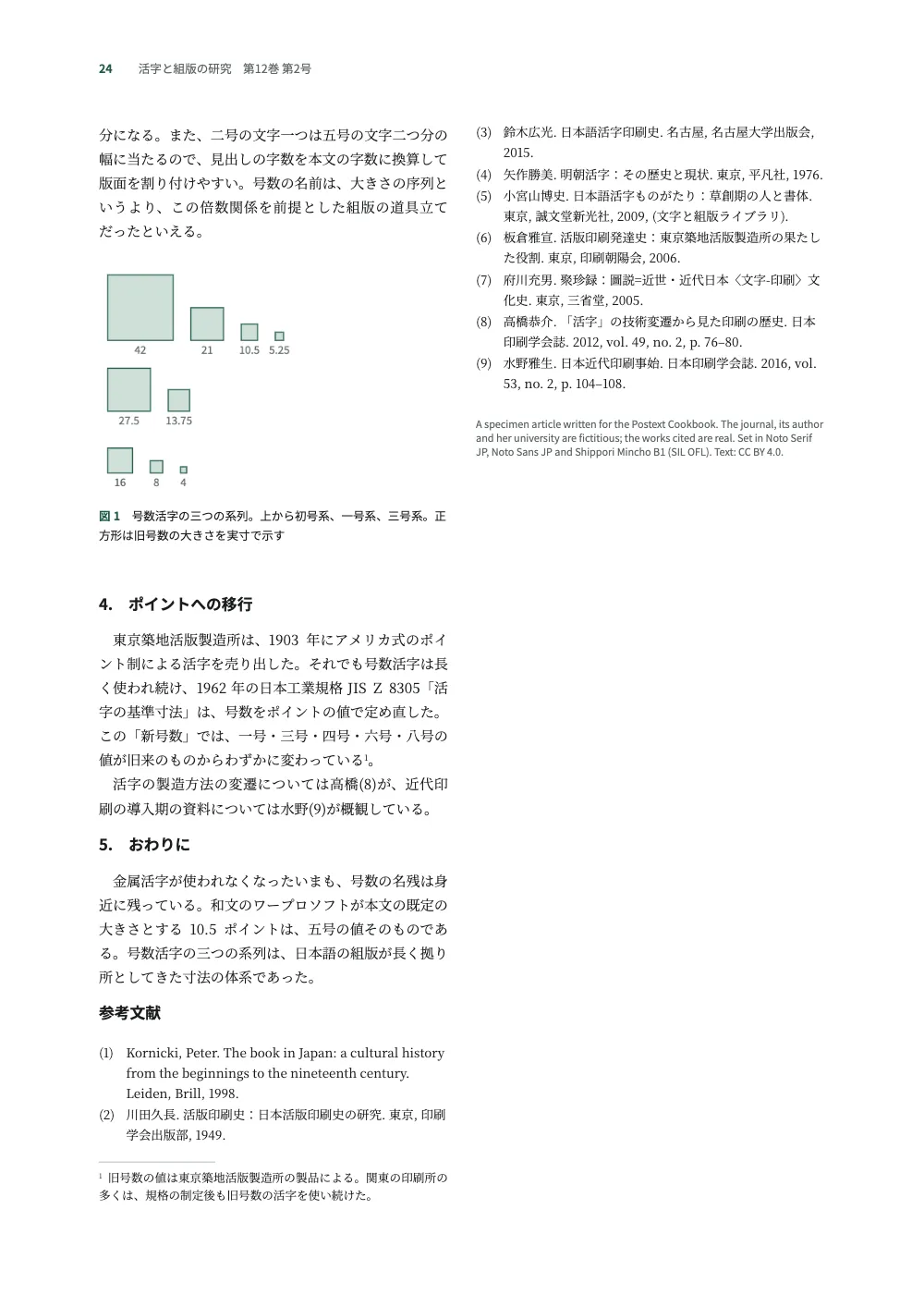
架空の活字・組版研究の学会誌に載る研究ノート「号数活字の三つの系列」の2ページを、日本の学会が学会誌を組むのと同じ形で組みます。A4判、9ptのNoto Serif JPで25字×45行の2段組み、題は学会誌の緑の帯の上にShippori Mincho B1で組みます。引用は、日本の科学技術系の学会誌が使う参照文献の書き方の指針SIST 02に従います。各文献に最初に引用された順で(1)、(2, 3)と番号を振り、参考文献の下の一覧では日本人の名前を姓から書き、出版地を出版者の前に、出版年を最後に置きます。9つの号数の表、それを原寸の比率で描いた図、2つの脚注には日本語のラベルが付きます。GB/T 7714で引用する中国語論文が、この中国語版にあたります。
このレシピが答える質問
- APA、IEEEなどの引用スタイルで、文献を引用し参考文献を作るには?
- 日本語の本で、(1)の注を章末、ページの下、または見開きにわたって本文の横に置くには?
手短な答え
// Register the engine once, before the first build. SIST 02, the standard Japanese science
// and technology journals cite to, numbers works in the order they are first cited; the
// ja-JP locale writes the list's words and joins authors with と and ほか. The document's
// own locale 'ja' gives the notes their Japanese defaults: at the foot of the column,
// numbered per page, a superscript marker and a rule a third of the column.
registerCitationEngine(createCiteprocEngine({ styles: STYLES, locales: LOCALES }));
const citations = {
  style: 'sist02',
  locale: 'ja-JP',
  bibliography: { fontSize: em(8 / BODY), lineHeight: pt(13), entrySpacing: pt(1),
    labelWidth: em(2.2) }, // turnovers under the text of the entry, past the (n)
};
const footnotes = { fontSize: pt(7.5), lineHeight: pt(11.5), color: col('ink'),
  separator: { color: col('rule') } }; // placement, numbering and marker: the 'ja' defaults
材料
- 機能
- 引用スタイルによる引用参考文献から作る文献一覧日本の本の注脚注番号付きキャプション「図」と「表」を文書の言語で表スタイルキャプションのスタイルリソースとしての図と表その場に置く図番号付き見出し行取りの見出し1段組みと2段組み文字グリッドデザインした章扉見出しスタイル中国語・日本語・韓国語のフォントインラインのチップ柱とノンブルPDFの書き出し
- 種類
- Noto Serif JP, Noto Sans JP, Shippori Mincho B1 (SIL OFL 1.1)
- 素材
- Figure 1, the three series of type sizes, drawn in code to scale (Postext Cookbook, CC BY 4.0)
作り方
#1 · スタイル、ロケール、注
コードは前に掲げた手短な答えです。postext-citeprocはSIST 02を'sist02'として同梱し、CSLロケールja-JPも同梱しています。このロケールは一覧の用語を日本語で書き、本文に組み込む引用では日本人の著者2人を「と」で、3人以上を「ほか」でつなぎます(引用)。本文では[@kawada1949; @suzuki2015]が(2, 3)を印刷し、高橋[@takahashi2012]がは名前の後に番号を置いて「高橋(8)が」となります。中国のGB/T 7714とは合印が異なります。SIST 02は番号を行の高さでかっこに入れ、GB/T 7714は角かっこに入れて上付きにします。注には何も要りません。locale: 'ja'の横組みの文書では、注は段の下端に置かれ、ページごとに1から番号が振られ、上付きの合印と段の3分の1の長さの罫が付きます。
#2 · CSL-YAMLブロックに書く文献
文献はMarkdownの末尾の:::references{format=csl-yaml}に並べます。ZoteroがCSL YAMLとして書き出す形式です(引用の書き方)。日本人の名前はfamilyとgivenに分けて{family: 鈴木, given: 広光}と入れ、SIST 02はそれを鈴木広光と続けて印刷します。Kornickiはカンマを保ち、Kornicki, Peterとなります。叢書はcollection-titleに入れ、出版年の後にかっこ付きで印刷されます。日本印刷学会誌の2本の論文は、巻、号、ページをvol. 49, no. 2, p. 76–80と示します。どの文献も実在し、CiNiiで書誌を確かめられます。
#3 · 学会誌の帯に載せる題
const BAND = 78; // mm from the trim's top: the title sits on the journal's green
const at = (id, y) => ({ anchor: { to: `#${id}`, edge: 'below' }, offset: { y: mm(y) },
  size: { width: mm(AREA) } });
const line = (id, content, family, size, color, placement, extra) => ({ kind: 'text', id,
  content, fontFamily: family, fontSize: pt(size), color: col(color), align: 'center',
  overflow: 'wrap', placement, ...extra });
const top = (y) => ({ anchor: { to: 'container', edge: 'top-left' }, offset: { y: mm(y) },
  size: { width: mm(AREA) } });
const masthead = { enabled: true, minHeight: pt(10 * PITCH), slot: { elements: [
  { kind: 'box', id: 'band', style: { backgroundColor: col('green') },
    placement: { anchor: { to: 'page', edge: 'top-left' },
      size: { width: 'fill', height: mm(BAND) } } },
  line('journal', '活字と組版の研究', GOTHIC, 13, 'paper', top(-13), { fontWeight: 700,
    align: 'left', letterSpacing: pt(2) }),
  line('issue', '第12巻 第2号(2026)', GOTHIC, 8, 'mist', top(-12), { align: 'right' }),
  line('kind', '{attr.kind}', GOTHIC, 8, 'mist', top(2), { fontWeight: 700,
    letterSpacing: pt(2) }),
  line('title', '{titleText}', TITLE, 20, 'paper', at('kind', 3), { fontWeight: 700,
    lineHeight: 1.45 }),
  line('english', '{attr.english}', MINCHO, 8.5, 'mist', at('title', 3)),
  line('author', '{attr.authors}', MINCHO, 11, 'ink', top(BAND - 16)),
  line('affiliation', '{attr.affiliation}', MINCHO, 8, 'muted', at('author', 1.5)),
] } };
表題ブロックはH1のデザインで、2段にまたがる見出しスタイルです。帯は仕上がりにアンカーした箱で、ラベル、題、その英訳がその上に載ります。それぞれ前の要素の下に置くので、題が3行になると英訳の行が押し下げられます。著者と所属は見出しの属性から取り、帯の下に置きます。
#4 · 要旨とそのラベル
const calloutStyles = [{ id: 'abstract', span: 'page', backgroundEnabled: false,
  stripe: { enabled: true, side: 'top', width: pt(1.5), color: col('green') },
  padding: { top: mm(2.5), bottom: mm(2.5), left: em(2), right: em(2) },
  marginTop: pt(0), marginBottom: pt(PITCH),
  body: { fontFamily: MINCHO, fontSize: pt(8.5), lineHeight: pt(14), firstLineIndent: pt(0),
    textAlign: 'justify' } }];
const chipStyles = [{ id: 'label', fontFamily: GOTHIC, bold: true, color: col('green'),
  backgroundEnabled: false, borderWidth: pt(0), paddingX: em(0), gap: em(1) }];
要旨は緑の上ストライプの下に置いたページ幅の囲みで、ラベルは学会誌の色の太字ゴシックのチップです。各ラベルの後にMarkdownで入力した全角スペースが、要 旨と本文の間をあけます。
#5 · 引用した位置に置く表1と図1
const SIZES = `号数\t旧号数(pt)\t新号数(pt)\t系列
初号\t42\t42\t初号系
一号\t27.5\t26.25\t一号系
二号\t21\t21\t初号系
三号\t16\t15.75\t三号系
四号\t13.75\t13.125\t一号系
五号\t10.5\t10.5\t初号系
六号\t8\t7.875\t三号系
七号\t5.25\t5.25\t初号系
八号\t4\t3.9375\t三号系`;
const SERIES = [[42, 21, 10.5, 5.25], [27.5, 13.75], [16, 8, 4]]; // old values, pt
const resources = [
  { id: 'tbl:sizes', typeId: 'table', kind: 'table', createdAt: 0, updatedAt: 0,
    placement: { position: 'here' },
    caption: '号数活字の大きさ。新号数はJIS Z 8305(1962)による',
    table: { model: { ...parseTSV(SIZES), headerRowCount: 1, columnWidths: [16, 28, 28, 28] } } },
  { id: 'fig:series', typeId: 'figure', kind: 'svg', createdAt: 0, updatedAt: 0,
    placement: { position: 'here' },
    caption: '号数活字の三つの系列。上から初号系、一号系、三号系。正方形は旧号数の大きさを実寸で示す',
    altText: 'Three rows of squares drawn to scale: 42, 21, 10.5 and 5.25 pt; 27.5 and 13.75 pt; '
      + '16, 8 and 4 pt. Each square is half the one before it.',
    svg: { fileId: 'series.svg', width: 790, height: 520 } },
];
defaultResourceTypes('ja')は図と表を与えます。この論文では章ごとではなく通しで表1、図1と番号を振るので、テンプレートは'{n}'です。どちらも'here'で、引用する段落の下、段の中に置きます。図の正方形は、それが表す活字の大きさで描いています。初号の42ptから八号の4ptまでで、半分ずつ小さくなっていく系列がページ上で見て取れます。
レシピの全体
// ═══ Postext Cookbook · Nº 125 · A Japanese research paper cited to SIST 02 ═══════════ // https://postext.dev/en/cookbook/sist02-research-paper // Code: MIT · Text: original (CC BY 4.0) · Pictures: drawn in code // Fonts: Noto Serif JP, Noto Sans JP, Shippori Mincho B1 (SIL OFL 1.1) · Needs postext ≥ 1.16.1 import { buildDocument, renderPageToCanvas, clearMeasurementCache, registerCitationEngine, defaultResourceTypes, parseTSV, registerResourceImage, } from 'https://esm.sh/postext'; import { renderToPdf, decompressWoff2 } from 'https://esm.sh/postext-pdf'; import { createCiteprocEngine, STYLES, LOCALES } from 'https://esm.sh/postext-citeproc'; const LANG = 'en'; // @lang: the language of the frame; the paper is Japanese in both const RECIPE = 'sist02-research-paper'; // ─── 1 · Design ───────────────────────────────────────────────────────────── // #region palette: black text, one deep green for the journal, its rules and its labels const palette = { ink: '#1b1d1c', green: '#1f5a46', mist: '#cfe0d8', rule: '#a7b3ad', muted: '#5d6662', paper: '#ffffff', }; const col = (id) => ({ hex: palette[id], model: 'hex', paletteId: id }); const colorPalette = Object.entries({ ...palette, 'main-color': palette.green }) .map(([id, hex]) => ({ id, name: id, value: { hex, model: 'hex' } })); // #endregion const [MINCHO, GOTHIC, TITLE] = ['Noto Serif JP', 'Noto Sans JP', 'Shippori Mincho B1']; const [BODY, PITCH] = [9, 15.5]; // pt: 9 pt text on a 15.5 pt line const [CHARS, LINES] = [25, 45]; // characters to a column's line, lines to a column const PT = 25.4 / 72; // mm in a point const AREA = (2 * CHARS + 2) * BODY * PT; // mm: two columns and a 2-em gutter, 165 // #region answer: SIST 02 in Japanese: numbered citations, the list under 参考文献 // Register the engine once, before the first build. SIST 02, the standard Japanese science // and technology journals cite to, numbers works in the order they are first cited; the // ja-JP locale writes the list's words and joins authors with と and ほか. The document's // own locale 'ja' gives the notes their Japanese defaults: at the foot of the column, // numbered per page, a superscript marker and a rule a third of the column. registerCitationEngine(createCiteprocEngine({ styles: STYLES, locales: LOCALES })); const citations = { style: 'sist02', locale: 'ja-JP', bibliography: { fontSize: em(8 / BODY), lineHeight: pt(13), entrySpacing: pt(1), labelWidth: em(2.2) }, // turnovers under the text of the entry, past the (n) }; const footnotes = { fontSize: pt(7.5), lineHeight: pt(11.5), color: col('ink'), separator: { color: col('rule') } }; // placement, numbering and marker: the 'ja' defaults // #endregion // #region masthead: the journal, the paper's kind, its title and English title on a band const BAND = 78; // mm from the trim's top: the title sits on the journal's green const at = (id, y) => ({ anchor: { to: `#${id}`, edge: 'below' }, offset: { y: mm(y) }, size: { width: mm(AREA) } }); const line = (id, content, family, size, color, placement, extra) => ({ kind: 'text', id, content, fontFamily: family, fontSize: pt(size), color: col(color), align: 'center', overflow: 'wrap', placement, ...extra }); const top = (y) => ({ anchor: { to: 'container', edge: 'top-left' }, offset: { y: mm(y) }, size: { width: mm(AREA) } }); const masthead = { enabled: true, minHeight: pt(10 * PITCH), slot: { elements: [ { kind: 'box', id: 'band', style: { backgroundColor: col('green') }, placement: { anchor: { to: 'page', edge: 'top-left' }, size: { width: 'fill', height: mm(BAND) } } }, line('journal', '活字と組版の研究', GOTHIC, 13, 'paper', top(-13), { fontWeight: 700, align: 'left', letterSpacing: pt(2) }), line('issue', '第12巻 第2号(2026)', GOTHIC, 8, 'mist', top(-12), { align: 'right' }), line('kind', '{attr.kind}', GOTHIC, 8, 'mist', top(2), { fontWeight: 700, letterSpacing: pt(2) }), line('title', '{titleText}', TITLE, 20, 'paper', at('kind', 3), { fontWeight: 700, lineHeight: 1.45 }), line('english', '{attr.english}', MINCHO, 8.5, 'mist', at('title', 3)), line('author', '{attr.authors}', MINCHO, 11, 'ink', top(BAND - 16)), line('affiliation', '{attr.affiliation}', MINCHO, 8, 'muted', at('author', 1.5)), ] } }; // #endregion // #region abstract: across both columns, its labels in gothic the colour of the journal const calloutStyles = [{ id: 'abstract', span: 'page', backgroundEnabled: false, stripe: { enabled: true, side: 'top', width: pt(1.5), color: col('green') }, padding: { top: mm(2.5), bottom: mm(2.5), left: em(2), right: em(2) }, marginTop: pt(0), marginBottom: pt(PITCH), body: { fontFamily: MINCHO, fontSize: pt(8.5), lineHeight: pt(14), firstLineIndent: pt(0), textAlign: 'justify' } }]; const chipStyles = [{ id: 'label', fontFamily: GOTHIC, bold: true, color: col('green'), backgroundEnabled: false, borderWidth: pt(0), paddingX: em(0), gap: em(1) }]; // #endregion // Running heads on the body pages: the journal on the verso, the author on the recto. const head = (id, content, parity, edge, x, extra) => ({ kind: 'text', id, content, parity, pages: 'body', fontFamily: GOTHIC, fontSize: pt(7.5), color: col('muted'), align: edge.endsWith('left') ? 'left' : 'right', placement: { anchor: { to: 'container', edge }, offset: { x: mm(x), y: mm(14) } }, ...extra }); const folio = { fontWeight: 700, color: col('green') }; const header = { elements: [ head('v-folio', '{pageNumber}', 'even', 'top-left', 0, folio), head('v-head', '活字と組版の研究 第12巻 第2号', 'even', 'top-left', 9), head('r-head', '森川:号数活字の三つの系列', 'odd', 'top-right', -9), head('r-folio', '{pageNumber}', 'odd', 'top-right', 0, folio), ] }; const config = () => ({ // a factory: the engine caches resolved configs per object locale: 'ja', // written out, never LANG (gotcha: ja-locale-tag) resourceTypes: defaultResourceTypes('ja').map((type) => ({ ...type, numberingTemplate: '{n}' })), // 図1, 表1: a paper numbers through, not by chapter colorPalette, citations, footnotes, page: { sizePreset: 'custom', width: mm(210), height: mm(297), dpi: 150, // A4 pageNumbering: { startAt: 23 }, margins: { top: mm(24), bottom: mm(20), left: mm(18), right: mm(18), mirror: true } }, layout: { layoutType: 'double', gutterWidth: pt(2 * BODY) }, cjk: { grid: { enabled: true, charsPerLine: CHARS, linesPerPage: LINES } }, bodyText: { fontFamily: MINCHO, fontSize: pt(BODY), lineHeight: pt(PITCH), color: col('ink'), boldColor: col('ink'), italicColor: col('ink'), referenceColor: col('ink'), referenceBold: false, textAlign: 'justify', firstLineIndent: em(1), indentAfterHeading: true }, headings: { fontFamily: GOTHIC, fontWeight: 700, color: col('ink'), balancing: { enabled: false }, // heads stay on the grid levels: [ { level: 1, breakBefore: { enabled: true, parity: 'any' } }, // headings-drop-h1-break { level: 2, numberingTemplate: '{2}.', numberSeparator: ' ', fontSize: pt(10), lineSpan: 2 }, // 2行取り: 1. はじめに on two lines of the grid ] }, headingStyles: [ { id: 'article', numbered: false, span: 'page', advancedDesign: masthead }, { id: 'references', numbered: false }, ], calloutStyles, chipStyles, tableStyle: { rules: 'horizontal', borderColor: col('rule'), borderWidth: pt(0.5), headerBackground: col('green'), headerColor: col('paper'), headerFontFamily: GOTHIC, bodyFontFamily: MINCHO, bodyFontSize: pt(8), bodyColor: col('ink'), cellPadding: mm(1) }, captionStyle: { fontFamily: GOTHIC, fontSize: pt(7.5), color: col('ink'), labelBold: true, labelColor: col('green') }, // 表1 …, the ja default paragraphStyles: [{ id: 'colophon', fontFamily: GOTHIC, fontSize: pt(6.5), lineHeight: pt(9), color: col('muted'), firstLineIndent: pt(0), textAlign: 'left', marginTop: pt(PITCH) }], header, footer: { elements: [] }, }); // ─── 2 · Content ──────────────────────────────────────────────────────────── const markdown = String.raw`---Markdownの見本 · 134行 · content.en.md
title: "号数活字の三つの系列" --- # 号数活字の三つの系列:\\近代日本の活字の大きさはどう決められたか {style="article" kind="研究ノート" authors="森川 啓" affiliation="架空大学 文学部" english="Three Series of Gōsū Type Sizes: How the Sizes of Modern Japanese Type Were Set"} :::callout{type="abstract"} :chip[要 旨]{style="label"} 明治初期に日本で鋳造が始まった金属活字は、初号から八号までの九つの大きさを「号数」で呼び分けた。本稿では、号数活字の大きさが倍と半分の関係で結ばれた三つの系列からなることを示し、その構造が組版の実務に何をもたらしたかを整理する。また、1962年に日本工業規格が号数をポイントの値で定め直した経緯と、いまも五号に当たる10.5ポイントが和文の標準の大きさとして残っている理由を考察する。 :chip[キーワード]{style="label"} 号数活字、ポイント、明朝体、東京築地活版製造所、JIS Z 8305 ::: ## はじめに 日本語の活字印刷は、近世初期の古活字版のように早くから試みられてきたが[@kornicki1998]、出版の主流となったのは明治に入って金属活字が鋳造されてからである[@kawada1949; @suzuki2015]。その活字の大きさは、いまのようなポイントではなく、「号数」という独自の単位で呼ばれていた。 号数活字の名前は、組版や印刷の歴史を扱う文献にたびたび現れる[@yahagi1976; @komiyama2009]。しかし、九つの大きさがどのような関係で並んでいるのかは、個々の数値ほどには知られていない。本稿では、号数の大きさを系列ごとに整理し、その構造が組版に与えた影響を考える[^term]。 ## 号数活字の成立 号数の体系は、1869年に長崎で本木昌造らが上海の美華書館の技術者から活字鋳造を学んだことに始まるとされる。その後、平野富二が東京築地活版製造所を設け、号数活字は同所の製品として全国に広まった[@itakura2006]。同所の活字見本は、近代日本の書体と字形を知るための基本資料となっている[@fukawa2005]。 ## 三つの系列 号数活字の大きさを[@tbl:sizes]に示す。九つの大きさは、互いに倍と半分の関係で結ばれた三つの系列に分けられる。初号・二号・五号・七号の系列、一号・四号の系列、三号・六号・八号の系列である([@fig:series])。 ::resource{id="tbl:sizes"} この構造には実務上の利点があった。五号の本文に七号のルビを付けると、ルビの大きさはちょうど本文の半分になる。また、二号の文字一つは五号の文字二つ分の幅に当たるので、見出しの字数を本文の字数に換算して版面を割り付けやすい。号数の名前は、大きさの序列というより、この倍数関係を前提とした組版の道具立てだったといえる。 ::resource{id="fig:series"} ## ポイントへの移行 東京築地活版製造所は、1903年にアメリカ式のポイント制による活字を売り出した。それでも号数活字は長く使われ続け、1962年の日本工業規格JIS Z 8305「活字の基準寸法」は、号数をポイントの値で定め直した。この「新号数」では、一号・三号・四号・六号・八号の値が旧来のものからわずかに変わっている[^jis]。 活字の製造方法の変遷については高橋[@takahashi2012]が、近代印刷の導入期の資料については水野[@mizuno2016]が概観している。 ## おわりに 金属活字が使われなくなったいまも、号数の名残は身近に残っている。和文のワープロソフトが本文の既定の大きさとする10.5ポイントは、五号の値そのものである。号数活字の三つの系列は、日本語の組版が長く拠り所としてきた寸法の体系であった。 ## 参考文献 {style="references"} :::bibliography{title=""} [^term]: 本稿でいう「活字」は、鉛合金で鋳造した金属活字を指す。 [^jis]: 旧号数の値は東京築地活版製造所の製品による。関東の印刷所の多くは、規格の制定後も旧号数の活字を使い続けた。 :::paragraphs{style="colophon"} A specimen article written for the Postext Cookbook. The journal, its author and her university are fictitious; the works cited are real. Set in Noto Serif JP, Noto Sans JP and Shippori Mincho B1 (SIL OFL). Text: CC BY 4.0. ::: :::references{format=csl-yaml} - id: suzuki2015 type: book language: ja author: [{family: 鈴木, given: 広光}] title: 日本語活字印刷史 publisher: 名古屋大学出版会 publisher-place: 名古屋 issued: 2015 - id: yahagi1976 type: book language: ja author: [{family: 矢作, given: 勝美}] title: 明朝活字:その歴史と現状 publisher: 平凡社 publisher-place: 東京 issued: 1976 - id: komiyama2009 type: book language: ja author: [{family: 小宮山, given: 博史}] title: 日本語活字ものがたり:草創期の人と書体 publisher: 誠文堂新光社 publisher-place: 東京 collection-title: 文字と組版ライブラリ issued: 2009 - id: itakura2006 type: book language: ja author: [{family: 板倉, given: 雅宣}] title: 活版印刷発達史:東京築地活版製造所の果たした役割 publisher: 印刷朝陽会 publisher-place: 東京 issued: 2006 - id: fukawa2005 type: book language: ja author: [{family: 府川, given: 充男}] title: 聚珍録:圖説=近世・近代日本〈文字-印刷〉文化史 publisher: 三省堂 publisher-place: 東京 issued: 2005 - id: kawada1949 type: book language: ja author: [{family: 川田, given: 久長}] title: 活版印刷史:日本活版印刷史の研究 publisher: 印刷学会出版部 publisher-place: 東京 issued: 1949 - id: kornicki1998 type: book language: en author: [{family: Kornicki, given: Peter}] title: "The book in Japan: a cultural history from the beginnings to the nineteenth century" publisher: Brill publisher-place: Leiden issued: 1998 - id: takahashi2012 type: article-journal language: ja author: [{family: 高橋, given: 恭介}] title: 「活字」の技術変遷から見た印刷の歴史 container-title: 日本印刷学会誌 volume: 49 issue: 2 page: 76-80 issued: 2012 DOI: 10.11413/nig.49.076 - id: mizuno2016 type: article-journal language: ja author: [{family: 水野, given: 雅生}] title: 日本近代印刷事始 container-title: 日本印刷学会誌 volume: 53 issue: 2 page: 104-108 issued: 2016 DOI: 10.11413/nig.53.104 :::`; // content.<lang>.md: the same Japanese paper in both // #region resources: the table of sizes, and the three series drawn to scale const SIZES = `号数\t旧号数(pt)\t新号数(pt)\t系列 初号\t42\t42\t初号系 一号\t27.5\t26.25\t一号系 二号\t21\t21\t初号系 三号\t16\t15.75\t三号系 四号\t13.75\t13.125\t一号系 五号\t10.5\t10.5\t初号系 六号\t8\t7.875\t三号系 七号\t5.25\t5.25\t初号系 八号\t4\t3.9375\t三号系`; const SERIES = [[42, 21, 10.5, 5.25], [27.5, 13.75], [16, 8, 4]]; // old values, pt const resources = [ { id: 'tbl:sizes', typeId: 'table', kind: 'table', createdAt: 0, updatedAt: 0, placement: { position: 'here' }, caption: '号数活字の大きさ。新号数はJIS Z 8305(1962)による', table: { model: { ...parseTSV(SIZES), headerRowCount: 1, columnWidths: [16, 28, 28, 28] } } }, { id: 'fig:series', typeId: 'figure', kind: 'svg', createdAt: 0, updatedAt: 0, placement: { position: 'here' }, caption: '号数活字の三つの系列。上から初号系、一号系、三号系。正方形は旧号数の大きさを実寸で示す', altText: 'Three rows of squares drawn to scale: 42, 21, 10.5 and 5.25 pt; 27.5 and 13.75 pt; ' + '16, 8 and 4 pt. Each square is half the one before it.', svg: { fileId: 'series.svg', width: 790, height: 520 } }, ]; // #endregion // #region art: squares at their size in points, labelled in the gothic's latin file async function labelFace() { const url = 'https://cdn.jsdelivr.net/npm/@fontsource/noto-sans-jp@5/files/' + 'noto-sans-jp-latin-400-normal.woff2'; const bytes = new Uint8Array(await (await fetch(url)).arrayBuffer()); let bin = ''; for (let i = 0; i < bytes.length; i += 8192) { bin += String.fromCharCode(...bytes.subarray(i, i + 8192)); } return `@font-face{font-family:L;src:url(data:font/woff2;base64,${btoa(bin)}) format('woff2')}` + `text{font-family:L;font-size:2.4px;text-anchor:middle;fill:${palette.muted}}`; } function seriesArt(style) { let out = ''; SERIES.forEach((row, r) => { let x = 2; const base = [17, 33, 47][r]; // mm: the squares of a row stand on one line for (const size of row) { const s = size * PT; // a square as wide as the type body out += `<rect x="${x}" y="${base - s}" width="${s}" height="${s}" fill="${palette.mist}" ` + `stroke="${palette.green}" stroke-width=".25"/><text x="${x + s / 2}" y="${base + 3}">` + `${size}</text>`; x += s + 4; } }); return `<svg xmlns="http://www.w3.org/2000/svg" width="790" height="520" viewBox="0 0 79 52">` + `<style>${style}</style>${out}</svg>`; } // #endregion // ─── 3 · Fonts ────────────────────────────────────────────────────────────── const FONTS = { // every face the pages use, loaded before the build (gotcha: fonts-first) 'Noto Serif JP': ['400'], // 明朝: text, abstract, notes, references, author 'Noto Sans JP': ['400', '700'], // ゴシック: journal, heads, labels, captions, table head 'Shippori Mincho B1': ['700'], // the title, a display mincho }; // ─── 4 · Build & show ─────────────────────────────────────────────────────── // Each voice loads the files of what it sets (gotcha: cjk-fonts-slices); the text face also // gets the words SIST 02 adds to the list. const all = (re) => (markdown.match(re) ?? []).join(''); const gothic = `${all(/^#+ .*$/gm)}${all(/:chip\[[^\]]*\]/g)}${SIZES}` + `${resources.map((r) => r.caption).join('')}活字と組版の研究第巻号森川:三つの系列0123456789`; await loadFonts(FONTS, markdown); await loadCjkFonts({ [MINCHO]: FONTS[MINCHO] }, `${markdown}${SIZES}ほかと編巻号頁`); await loadCjkFonts({ [GOTHIC]: FONTS[GOTHIC] }, gothic); await loadCjkFonts({ [TITLE]: FONTS[TITLE] }, all(/^# .*$/gm)); await loadSvg('series.svg', seriesArt(await labelFace())); const doc = await buildWithFonts(() => buildDocument({ markdown, resources }, config()), markdown); showPages(doc, { title: t({ en: 'A Japanese paper cited to SIST 02', es: 'Un artículo japonés citado según SIST 02' }) }); offerPdf(() => renderToPdf(doc, { fontProvider: cjkPdfProvider, resourceBytes: imageBytes }), `${RECIPE}.pdf`);キット · core, fonts, viewer, pdf, images, cjk:全レシピ共通 · 488行
// ─── Kit ── helpers shared by every Cookbook recipe · postext.dev/cookbook ───── // ─── Kit · core v1 ── the same in every recipe · postext.dev/cookbook ───────── function mm(value) { return { value, unit: 'mm' }; } function pt(value) { return { value, unit: 'pt' }; } function em(value) { return { value, unit: 'em' }; } /** The sample language's string: t({ en: 'Figure', es: 'Figura' }). */ function t(strings) { return strings[LANG] ?? Object.values(strings)[0]; } /** A file in this recipe's assets folder, served from the Postext repo by jsDelivr. */ function asset(file) { return `https://cdn.jsdelivr.net/gh/drnachio/postext@main/cookbook/${RECIPE}/assets/${file}`; } // ─── Kit · fonts v1 ── the same in every recipe · postext.dev/cookbook ──────── // Postext measures text with the faces the browser has loaded, and caches the // widths, so every face must be ready before the first build. Faces come from // Fontsource: the same static files the PDF embeds, so screen and PDF agree. /** faces = { 'Family Name': ['400', '400i', '700'] }. `text` is the sample: * letters beyond Latin-1 (č, ł, ő…) also load the latin-ext files. With * `optional`, a face Fontsource does not ship is skipped instead of failing. * Resolves to the number of faces added. */ async function loadFonts(faces, text = '', { optional = false } = {}) { kitStatus('Loading fonts…'); const ranges = { latin: 'U+0000-00FF,U+0131,U+0152-0153,U+02BB-02BC,U+02C6,U+02DA,U+02DC,U+0304,U+0308,U+0329,' + 'U+2000-206F,U+20AC,U+2122,U+2191,U+2193,U+2212,U+2215,U+FEFF,U+FFFD', 'latin-ext': 'U+0100-02BA,U+02BD-02C5,U+02C7-02CC,U+02CE-02D7,U+02DD-02FF,U+0304,U+0308,U+0329,' + 'U+1D00-1DBF,U+1E00-1E9F,U+1EF2-1EFF,U+2020,U+20A0-20AB,U+20AD-20C0,U+2113,U+2C60-2C7F,U+A720-A7FF', }; const subsets = /[Ā-˿Ḁ-ỿ]/.test(text) ? ['latin', 'latin-ext'] : ['latin']; const jobs = []; let added = 0; for (const [family, specs] of Object.entries(faces)) { const id = fontsourceId(family); const meta = optional ? await fontsourceMeta(family) : null; for (const spec of new Set(specs)) { const weight = parseInt(spec, 10); const style = spec.endsWith('i') ? 'italic' : 'normal'; if (hasFace(family, weight, style)) continue; if (optional && !(meta?.weights.includes(weight) && meta.styles.includes(style))) continue; for (const subset of subsets) { const url = `https://cdn.jsdelivr.net/npm/@fontsource/${id}@5/files/${id}-${subset}-${weight}-${style}.woff2`; const face = new FontFace(family, `url(${url}) format('woff2')`, { weight: String(weight), style, unicodeRange: ranges[subset] }); jobs.push(face.load().then((ready) => { document.fonts.add(ready); added++; }, () => { if (subset === 'latin' && !optional) throw new Error(`Fontsource has no ${family} ${weight} ${style}`); })); } } } await Promise.all(jobs).catch((error) => { kitFail(error); throw error; }); return added; } /** Runs `build` (a buildDocument or buildBundle call) and checks the faces * the pages use. A regular face missing from FONTS is loaded with a warning; * bold and italic variants are loaded when the family ships them. Then the * measurement caches are cleared and the build runs again. */ async function buildWithFonts(build, text = '') { const tried = new Set(); for (let round = 0; round < 3; round++) { kitStatus('Laying out…'); await new Promise(requestAnimationFrame); // let the status paint first const result = await Promise.resolve().then(build).catch((error) => { kitFail(error); throw error; }); const wanted = { base: {}, variants: {} }; for (const { font, base } of [result].flat().flatMap(fontStringsOf)) { const { family, weight, style } = parseFont(font); const key = `${family}|${weight}|${style}`; if (tried.has(key) || hasFace(family, weight, style)) continue; tried.add(key); (wanted[base ? 'base' : 'variants'][family] ??= []).push(`${weight}${style === 'italic' ? 'i' : ''}`); } if (Object.keys(wanted.base).length) { console.warn(`[cookbook] FONTS does not list ${JSON.stringify(wanted.base)}: loading them.`); } const added = await loadFonts(wanted.base, text) + await loadFonts(wanted.variants, text, { optional: true }); if (added === 0) return result; clearMeasurementCache(); } throw new Error('The fonts did not settle after three builds.'); } /** Every font string of the layout. `base` marks a block's own face; its * bold, italic and bold-italic variants are listed whether or not used. */ function fontStringsOf(doc) { const found = new Map(); const walk = (node) => { if (!node || typeof node !== 'object') return; if (Array.isArray(node)) { node.forEach(walk); return; } for (const [key, value] of Object.entries(node)) { if (typeof value === 'string' && /fontString$/i.test(key)) { found.set(value, found.get(value) || key === 'fontString'); } else if (value && typeof value === 'object') walk(value); } }; walk(doc.pages); walk(doc.blocks); return [...found].map(([font, base]) => ({ font, base })); } /** '700 37.5px Open Sans' / 'italic 400 13px "Source Serif 4"' → { family, weight, style }. * A string with no weight ('95.8px Young Serif', from a design text) is 400. */ function parseFont(font) { const m = /^(?:(italic|oblique)\s+)?(?:small-caps\s+)?(?:(\d+|bold|normal)\s+)?[\d.]+px\s+(.+)$/.exec(font.trim()); if (!m) throw new Error(`Unexpected font string: ${font}`); const weight = m[2] === 'bold' ? 700 : !m[2] || m[2] === 'normal' ? 400 : Number(m[2]); return { family: m[3].replace(/^["']|["']$/g, ''), weight, style: m[1] ? 'italic' : 'normal' }; } /** True when a loaded FontFace covers exactly this family, weight and style * (document.fonts.check() is also true for families nobody declared). */ function hasFace(family, weight, style) { for (const face of document.fonts) { if (face.status !== 'loaded' || face.style !== style) continue; if (face.family.replace(/^["']|["']$/g, '') !== family) continue; const [low, high = low] = face.weight.split(' ').map(Number); if (weight >= low && weight <= high) return true; } return false; } /** Fontsource's id for a family: 'Source Serif 4' → 'source-serif-4'. */ function fontsourceId(family) { return family.toLowerCase().replace(/\s+/g, '-'); } /** The weights and styles a family ships ({ weights: [400, 700], styles: ['normal', 'italic'] }), or null. */ function fontsourceMeta(family) { fontsourceMeta.cache ??= new Map(); const id = fontsourceId(family); if (!fontsourceMeta.cache.has(id)) { fontsourceMeta.cache.set(id, fetch(`https://api.fontsource.org/v1/fonts/${id}`) .then((res) => (res.ok ? res.json() : null), () => null)); } return fontsourceMeta.cache.get(id); } // ─── Kit · viewer v1 ── the same in every recipe · postext.dev/cookbook ─────── /** Shows the pages as facing spreads on a dark desk: the first page is a * recto on its own, then verso | recto pairs, as in a bound book. Pages * are painted when they scroll near the screen. */ function showPages(docs, { title, width = 460 } = {}) { const root = viewer(title); const pages = [docs].flat().flatMap((doc) => doc.pages.map((page) => ({ doc, page, n: (doc.pageIndexOffset ?? 0) + page.index }))); const spreads = []; let verso = null; for (const p of pages) { if (p.n % 2 === 1) { if (verso) spreads.push([verso, null]); verso = p; } else { spreads.push([verso, p]); verso = null; } } if (verso) spreads.push([verso, null]); const density = Math.min(window.devicePixelRatio || 1, 2); showPages.painter?.disconnect(); const painter = new IntersectionObserver((entries) => { for (const { isIntersecting, target } of entries) { if (!isIntersecting) continue; painter.unobserve(target); const { doc, page } = target.postext; renderPageToCanvas(page, doc, target, { scale: (width * density) / page.width }); } }, { rootMargin: '800px' }); showPages.painter = painter; root.replaceChildren(...spreads.map((pair) => { const spread = document.createElement('div'); spread.className = 'pt-spread'; for (const p of pair) { const figure = document.createElement('figure'); if (p) { const label = p.page.pageLabel || String(p.n + 1); const canvas = document.createElement('canvas'); canvas.postext = p; canvas.style.aspectRatio = `${p.page.width} / ${p.page.height}`; canvas.setAttribute('role', 'img'); canvas.setAttribute('aria-label', `Page ${label}`); const folio = document.createElement('figcaption'); folio.textContent = label; figure.append(canvas, folio); painter.observe(canvas); } else figure.className = 'pt-blank'; spread.append(figure); } return spread; })); kitStatus(`${pages.length} ${pages.length === 1 ? 'page' : 'pages'}`); document.documentElement.dataset.postext = 'ready'; return pages.length; } /** The desk, the bar and the error reporting, created once. */ function viewer(title) { if (!document.getElementById('pt-kit')) { document.head.insertAdjacentHTML('beforeend', `<style id="pt-kit"> :root { color-scheme: dark; } body { margin: 0; background: #0e1014; color: #b9bcc4; font: 13px/1.45 system-ui, sans-serif; } #pt-bar { position: sticky; top: 0; z-index: 1; display: flex; flex-wrap: wrap; align-items: center; gap: 6px 16px; padding: 10px 16px; background: rgb(14 16 20 / .92); backdrop-filter: blur(6px); border-bottom: 1px solid #23262d; } #pt-bar strong { color: #f4f1ea; font-weight: 600; } #pt-actions { display: flex; gap: 12px; margin-left: auto; } #pt-actions a, #pt-actions button { color: #d8a21a; font: inherit; background: none; border: 0; padding: 0; cursor: pointer; } #pages { display: grid; justify-items: center; gap: 48px; padding: 32px 16px 72px; } .pt-spread { display: flex; } .pt-spread figure { margin: 0; width: min(460px, 44vw); } .pt-spread canvas { display: block; width: 100%; background: #fff; box-shadow: 0 1px 2px rgb(0 0 0 / .5), 0 22px 44px -16px rgb(0 0 0 / .8); } .pt-spread figure:first-child canvas { box-shadow: inset -14px 0 14px -14px rgb(0 0 0 / .18), 0 1px 2px rgb(0 0 0 / .5), 0 22px 44px -16px rgb(0 0 0 / .8); } .pt-spread figcaption { margin-top: 10px; text-align: center; font: 600 10px/1 system-ui, sans-serif; letter-spacing: .18em; text-transform: uppercase; color: #6c7079; } .pt-blank { visibility: hidden; } @media (max-width: 760px) { .pt-spread { flex-direction: column; gap: 32px; } .pt-spread figure { width: min(460px, 92vw); } .pt-blank { display: none; } } </style>`); document.body.insertAdjacentHTML('afterbegin', '<header id="pt-bar"><strong id="pt-title"></strong><span id="pt-status" role="status"></span><span id="pt-actions"></span></header>'); document.getElementById('pt-title').textContent = document.title || 'Postext'; addEventListener('error', (event) => kitFail(event.error ?? event.message)); addEventListener('unhandledrejection', (event) => kitFail(event.reason)); } if (title) document.getElementById('pt-title').textContent = title; return document.getElementById('pages') ?? document.body.appendChild(Object.assign(document.createElement('main'), { id: 'pages' })); } function kitStatus(text) { viewer(); document.getElementById('pt-status').textContent = text; } function kitFail(error) { document.documentElement.dataset.postext = 'error'; kitStatus(`Error: ${error?.message ?? error}`); } // ─── Kit · pdf v1 ── the same in every recipe that exports a PDF ────────────── /** postext-pdf embeds TrueType bytes. Fetch the Fontsource file the screen * used, snapping to a weight the family ships and falling back to upright * when it has no italic: the PDF asks for every face a block could use. */ async function fontsourceProvider(family, weight, style) { const id = fontsourceId(family); const meta = await fontsourceMeta(family); const weights = meta?.weights?.length ? meta.weights : [400, 700]; const w = weights.reduce((a, b) => (Math.abs(b - weight) < Math.abs(a - weight) ? b : a)); const s = style === 'italic' && meta && !meta.styles.includes('italic') ? 'normal' : style; const res = await fetch(`https://cdn.jsdelivr.net/npm/@fontsource/${id}@5/files/${id}-latin-${w}-${s}.woff2`); if (!res.ok) throw new Error(`Fontsource has no ${family} ${w} ${s} (${res.status})`); return decompressWoff2(new Uint8Array(await res.arrayBuffer())); } /** A "Build the PDF" button in the bar. Once built: "Open the PDF" (a new * tab, since CodePen's preview frame cannot show PDFs) and a download link. */ function offerPdf(makePdf, filename) { viewer(); const button = Object.assign(document.createElement('button'), { type: 'button', textContent: 'Build the PDF' }); button.dataset.postextPdf = filename; button.addEventListener('click', async () => { button.disabled = true; button.textContent = 'Building the PDF…'; try { const bytes = await makePdf(); const url = URL.createObjectURL(new Blob([bytes], { type: 'application/pdf' })); const size = `${Math.max(1, Math.round(bytes.length / 1024))} KB`; button.replaceWith( Object.assign(document.createElement('a'), { href: url, target: '_blank', rel: 'noopener', textContent: 'Open the PDF ↗' }), Object.assign(document.createElement('a'), { href: url, download: filename, textContent: `Download ${filename} · ${size}` })); } catch (error) { button.disabled = false; button.textContent = 'Build the PDF'; kitFail(error); } }); document.getElementById('pt-actions').append(button); } // ─── Kit · images v1 ── recipes with pictures · postext.dev/cookbook ────────── /** Registers a photo or PNG for the canvas and keeps its bytes for the PDF. * fetch → ImageBitmap never taints the canvas (a plain cross-origin <img> would). */ async function loadImage(fileId, url) { const res = await fetch(url); if (!res.ok) throw new Error(`Image not found (${res.status}): ${url}`); const bytes = new Uint8Array(await res.arrayBuffer()); registerResourceImage(fileId, await createImageBitmap(new Blob([bytes]))); (loadImage.bytes ??= new Map()).set(fileId, bytes); } /** Registers SVG markup (drawn in code, or fetched) as a vector image. */ async function loadSvg(fileId, svg) { const img = new Image(); img.src = `data:image/svg+xml;charset=utf-8,${encodeURIComponent(svg)}`; await img.decode(); registerResourceImage(fileId, img); (loadImage.bytes ??= new Map()).set(fileId, new TextEncoder().encode(svg)); } /** renderToPdf({ resourceBytes: imageBytes }) */ function imageBytes(fileId) { return loadImage.bytes?.get(fileId); } /** renderToHtml({ resourceImageUrl: imageUrl }) */ function imageUrl(fileId) { const bytes = imageBytes(fileId); if (!bytes) return undefined; imageUrl.urls ??= new Map(); if (!imageUrl.urls.has(fileId)) { const type = /\.svg$/i.test(fileId) ? 'image/svg+xml' : /\.png$/i.test(fileId) ? 'image/png' : 'image/jpeg'; imageUrl.urls.set(fileId, URL.createObjectURL(new Blob([bytes], { type }))); } return imageUrl.urls.get(fileId); } // ─── Kit · cjk v1 ── Chinese, Japanese and Korean books · postext.dev/cookbook ─ // Fontsource ships a CJK family as about a hundred files per weight, each // declared in its stylesheet with the unicode-range it covers. The screen // loads the files the sample touches; the PDF gets the same files for the // characters its pages set in each face, and embeds each as a subset. // A book bound on the right (vertical text) is shown with its spreads // mirrored: page 1 alone on the left of the spine, then [3 | 2]. /** The files of a Fontsource face, read from its stylesheet: { url, range, * ranges }, the last declared first (the order the browser tries them in). */ function cjkSlices(family, weight, style) { cjkSlices.cache ??= new Map(); const id = fontsourceId(family); const css = `https://cdn.jsdelivr.net/npm/@fontsource/${id}@5/${weight}${style === 'italic' ? '-italic' : ''}.css`; if (!cjkSlices.cache.has(css)) { cjkSlices.cache.set(css, fetch(css) .then((res) => { if (!res.ok) throw new Error(`Fontsource has no ${family} ${weight} ${style} (${res.status})`); return res.text(); }) .then((text) => [...text.matchAll(/@font-face\s*{([^}]*)}/g)].map(([, rule]) => { const range = /unicode-range:\s*([^;]+);/.exec(rule)?.[1].trim() ?? 'U+0-10FFFF'; const ranges = range.split(',').map((part) => { const [lo, hi = lo] = part.trim().slice(2).split('-'); return [parseInt(lo, 16), parseInt(hi, 16)]; }); return { url: new URL(/url\(([^)]+?\.woff2)\)/.exec(rule)[1], css).href, range, ranges }; }).reverse())); } return cjkSlices.cache.get(css); } /** The file of `slices` that holds code point `cp`, if any. */ function cjkSliceFor(slices, cp) { return slices.find((slice) => slice.ranges.some(([lo, hi]) => cp >= lo && cp <= hi)); } /** Whether Fontsource serves `family` as a Chinese, Japanese or Korean * family (its subsets name the script). Fails when the API does not * answer: a CJK face taken for a Latin one would paint in a system face. */ async function isCjkFamily(family) { const meta = await fontsourceMeta(family); if (!meta) throw new Error(`api.fontsource.org did not describe ${family}: reload to try again`); return !!meta.subsets?.some((subset) => /^(chinese|japanese|korean)/.test(subset)); } /** faces = { 'Noto Serif TC': ['400', '700'] }, as for loadFonts: the * whole FONTS object may be passed, its other families are left to * loadFonts. Adds one FontFace per file of each CJK face with its * unicodeRange, then loads the files `text` touches. `text` is what the * faces set: the sample for the text face; a book in several voices calls * it once per voice (loadCjkFonts({ 'LXGW WenKai TC': ['400'] }, quotes)), * so the heading and quotation faces fetch and check only their own * characters. Fails when a character of `text` is in no file of a face. * List every weight the pages use: a weight left to buildWithFonts gets * the latin file only. With { vertical: true } it also loads each * family's vertical forms (brackets, quotes, pause marks) for the canvas, * which needs loadVerticalAlternates imported from postext. Resolves to * the number of files loaded. */ async function loadCjkFonts(faces, text, { vertical = false } = {}) { kitStatus('Loading fonts…'); let loaded = 0; try { if (vertical && typeof loadVerticalAlternates !== 'function') { throw new Error('loadCjkFonts(…, { vertical: true }) needs loadVerticalAlternates imported from postext'); } for (const [family, specs] of Object.entries(faces)) { if (!(await isCjkFamily(family))) continue; const twin = []; for (const spec of new Set(specs)) { const weight = parseInt(spec, 10); const style = spec.endsWith('i') ? 'italic' : 'normal'; const slices = await cjkSlices(family, weight, style); const missing = [...new Set(text)].filter((ch) => /\S/.test(ch) && !cjkSliceFor(slices, ch.codePointAt(0))); if (missing.length) { throw new Error(`${family} ${spec} has no file for ${missing.slice(0, 12).join(' ')}: ` + `give each face the text it sets (loadCjkFonts({ '${family}': ['${spec}'] }, text))`); } for (const slice of slices) { document.fonts.add(new FontFace(family, `url(${slice.url}) format('woff2')`, { weight: String(weight), style, unicodeRange: slice.range })); twin.push({ source: slice.url, weight: String(weight), style, unicodeRange: slice.range }); } const font = `${style === 'italic' ? 'italic ' : ''}${weight} 16px "${family}"`; loaded += (await document.fonts.load(font, text)).length; if (!document.fonts.check(font, text)) throw new Error(`${family} ${spec} did not load for the sample`); } // The same files under a twin name with the `vert` feature on: the // canvas paints the punctuation of vertical lines with it. if (vertical && twin.length) await loadVerticalAlternates(family, twin); } } catch (error) { kitFail(error); throw error; } return loaded; } /** The PDF font provider for recipes with CJK faces: a family whose * Fontsource subsets are Chinese, Japanese or Korean gets the files that * hold the characters its pages set (`request.codePoints`); any other * family gets the latin file fontsourceProvider fetches (the "pdf" block) * and, when the face sets letters only latin-ext has, that file too. */ async function cjkPdfProvider(family, weight, style, request) { if (!(await isCjkFamily(family))) return cjkLatinPdfFiles(family, weight, style, request); const meta = await fontsourceMeta(family); const weights = meta.weights?.length ? meta.weights : [400, 700]; const w = weights.reduce((a, b) => (Math.abs(b - weight) < Math.abs(a - weight) ? b : a)); const s = style === 'italic' && !meta.styles.includes('italic') ? 'normal' : style; const slices = await cjkSlices(family, w, s); const picked = new Set(); for (const cp of request?.codePoints ?? []) { const slice = cjkSliceFor(slices, cp); if (slice) picked.add(slice); } if (!picked.size) picked.add(slices[0]); return Promise.all(slices.filter((slice) => picked.has(slice)).map(async (slice) => { const res = await fetch(slice.url); if (!res.ok) throw new Error(`Fontsource file ${slice.url} (${res.status})`); return decompressWoff2(new Uint8Array(await res.arrayBuffer())); })); } /** A Latin family set next to the CJK faces: its latin file, then its * latin-ext file when the face sets letters only latin-ext has (ō ū in * Hepburn rōmaji, ǎ in pinyin), the file loadFonts adds on screen for * them. Latin comes first: postext-pdf draws a character from the first * file that has it, as the browser takes a character both files hold from * latin. A face Fontsource ships without latin-ext, or whose file does * not come, gets latin alone, and the PDF names the letters it lacks. */ async function cjkLatinPdfFiles(family, weight, style, request) { const meta = await fontsourceMeta(family); const beyond = [...(request?.codePoints ?? [])].some(cjkLatinExtOnly); if (!beyond || !meta?.subsets?.includes('latin-ext')) return fontsourceProvider(family, weight, style); const weights = meta.weights?.length ? meta.weights : [400, 700]; const w = weights.reduce((a, b) => (Math.abs(b - weight) < Math.abs(a - weight) ? b : a)); const s = style === 'italic' && !meta.styles.includes('italic') ? 'normal' : style; const id = fontsourceId(family); const url = `https://cdn.jsdelivr.net/npm/@fontsource/${id}@5/files/${id}-latin-ext-${w}-${s}.woff2`; const [latin, ext] = await Promise.all([fontsourceProvider(family, weight, style), fetch(url) .then(async (res) => (res.ok ? decompressWoff2(new Uint8Array(await res.arrayBuffer())) : null), () => null)]); return ext ? [latin, ext] : latin; } /** Whether code point `cp` is in Fontsource's latin-ext file and not in * its latin file: Latin Extended-A and -B, IPA, the spacing modifiers and * Latin Extended Additional (loadFonts's test for latin-ext), less the * few latin holds too (ı Œ œ ʻ ʼ ˆ ˚ ˜). */ function cjkLatinExtOnly(cp) { if (!((cp >= 0x100 && cp <= 0x2ff) || (cp >= 0x1e00 && cp <= 0x1eff))) return false; return ![0x131, 0x152, 0x153, 0x2bb, 0x2bc, 0x2c6, 0x2da, 0x2dc].includes(cp); } /** showPages for a book bound on either edge. A right-bound book (the * document says so: doc.binding is 'right' for page.binding 'right' and * for vertical text) lies on the desk as it opens: page 1 alone on the * left of the spine, then [3 | 2], the spine shade on each page's inner * edge. `binding` ('left' | 'right') overrides the document's. */ function showBook(docs, { binding, ...options } = {}) { const count = showPages(docs, options); const right = (binding ?? [docs].flat()[0]?.binding) === 'right'; if (!document.getElementById('pt-kit-cjk')) { // The pages keep direction ltr: a canvas draws text in the direction its // element inherits, and under rtl each run would end where the engine // starts it, its brackets mirrored. document.head.insertAdjacentHTML('beforeend', `<style id="pt-kit-cjk"> .pt-spread[dir="rtl"] canvas { direction: ltr; } .pt-spread[dir="rtl"] figure:first-child canvas { box-shadow: inset 14px 0 14px -14px rgb(0 0 0 / .18), 0 1px 2px rgb(0 0 0 / .5), 0 22px 44px -16px rgb(0 0 0 / .8); } </style>`); } // Each pair stays [verso, recto] in the page; right to left, the verso // sits on the right. Phones stack the pages in reading order either way. for (const spread of document.querySelectorAll('#pages > .pt-spread')) spread.dir = right ? 'rtl' : 'ltr'; document.getElementById('pages').dataset.binding = right ? 'right' : 'left'; return count; } // ─── /Kit ───────────────────────────────────────────────────────────────────────
組み立てたscript.jsはそのまま動きます。任意のページのモジュールスクリプトに貼り付けるか、レシピをCodePenで開いてください。 GitHub上のレシピのフォルダー ↗ (新しいタブで開きます)
アレンジ
#上付きの引用番号
番号を行の上に上げる日本の学会誌も多くあります。marker: 'superscript'は番号をかっこなしで上付きに印刷し、一覧には手を加えません。
   locale: 'ja-JP',
+ marker: 'superscript',#論文全体で通し番号の注
数ページの論文なら、注をページごとではなく1から最後まで通しで数えることもできます。
-const footnotes = { fontSize: pt(7.5), lineHeight: pt(11.5), color: col('ink'),
+const footnotes = { numbering: 'document', fontSize: pt(7.5), lineHeight: pt(11.5),
+ color: col('ink'),よくあるつまずき
つまずき
日本語のテキストのタグは'ja'。zh-HansやLANGにしない
レシピの版はenとesですが、日本語のサンプルはどちらの版でも日本語です。`locale: LANG`では英語やスペイン語とタグ付けされ、中国語のタグでは中国語の規則で組まれます(開明式の約物、小書きの仮名が行頭に来てもよい、図の代わりに图、PDFでは中国の字形)。'ja'と書いてください。日本の地域(JLReqの改行と約物、ゴマの圏点、ルビの間隔、図と表の表示名)が選ばれ、ハイフネーションが切られます。リントは、zhやkoのタグで仮名を含むテキストをエラーにします。 日本語の改行(禁則処理) →
つまずき
日本語は日本語の書体で組む
Noto Serif SCとTCは仮名を持っていますが、漢字は中国の字形(直、骨、角が異なります)で、仮名も中国のデザインで描きます。本文はNoto Serif JPかShippori Mincho B1、見出しはNoto Sans JPで組み、loadCjkFontsで読み込んでください。Fontsourceの日本語ファイルには変体仮名などの古い仮名(U+1B000–1B16F)がないため、loadCjkFontsはそこで失敗し、PDFには四角が印字されます。現代の仮名で書くか、それを持つ書体をレシピのassetsに同梱してください。Shippori Minchoにはマクロン付きの母音ōとūもないので、ローマ字はラテン文字の書体で組んでください。 仮名、漢字、ローマ字 →
つまずき
中国語の書体はcjkブロックを通じてスライス単位で読み込む
Fontsourceは中国語、日本語、韓国語のファミリーを、ウェイトごとに約100個のファイルとして配信し、各ファイルが文字の範囲を受け持ちます。loadFontsが取得するのはlatinファイルだけなので、画面では漢字がシステムの書体で出て計測が狂い、fontsourceProviderはPDFにそのlatinファイルを渡すため、漢字が空の四角で印字されます。キットのcjkブロックを挙げ、loadFontsのあとにloadCjkFonts(FONTS, markdown)を呼び(本で複数のCJK書体を使うときは、それぞれの書体で組むテキストを渡して書体ごとに1回)、renderToPdfにfontProvider: cjkPdfProviderを渡してください。どちらもテキストの文字を含むファイルを取得します。 中国語・日本語・韓国語のフォント →
つまずき
文字グリッドでは段末そろえを切る
段末そろえは、本文と一緒に送った見出しが末尾に空行を残したときのように短く終わるページを、見出しの上にグリッドの行を加えたり、段落を1行ゆるく組んだりして埋めます。中国語の行をゆるく組むと文字の間が広がる(GB/T 9704のページで0.13 em、balancing.maxTrackingをはるかに超えます)ため、文字はグリッドの列から外れ、見出しは自分の行から外れます。升目で数えるページは、短く終わらせてください。headings.balancing: { enabled: false }を設定します。 文字グリッド →
つまずき
SVGの<img>内のテキストはWebフォントを使えない
SVGは画像として描かれ、画像はページのWebフォントにアクセスできないため、ラベルはシステムの書体にフォールバックします。テキストをアウトライン化するか、SVGに@font-faceのサブセットを埋め込むか、ラベルをキャプションに移してください。 リソースとしての図と表 →
つまずき
headingsオブジェクトを渡すとH1の改ページが消える
既定ではH1は奇数ページへ改ページします(always-odd)。ところがheadingsオブジェクトを渡すと中身にかかわらずこの既定がリセットされ、章は改ページせずに続けて組まれ、span: 'page'も効かなくなります。どの設定でもheadings.levels[0].breakBefore: { enabled: true, parity }を書き直してください。 奇数ページから始まる章 →
つまずき
フロントマターの値はすべて引用符で囲む
YAMLはtitle: 1984を数値として、日付をDateオブジェクトとして読みます。文字列でない値はプレースホルダーに空で出力され、PDFにもタイトルが付きません。値はすべて引用符で囲んでください(title: "1984")。 文書のメタデータ →
つまずき
レイアウトの前にすべてのフォントを読み込む
レイアウトはブラウザーが読み込んだフォントで文字を計測し、その幅をキャッシュします。最初のビルドのあとに届いたフォントがあると改行位置が狂い、PDFも画面と一致しなくなります。すべてのウェイトとスタイルを先に読み込み、遅れて届いたときは再ビルドの前にclearMeasurementCache()を呼んでください。 レイアウト前のフォント読み込み →
- 日本人の名前は
familyとgivenに分けるか、スペースのない1つのliteralとして書いてください。BibTeXによくあるように、姓と名の間にスペースを入れた1つの文字列(author = {夏目 漱石})は姓から先として読まれますが、ローマ字表記のNatsume Sosekiは英語の名前と同じく名、姓の順に読まれます。 - 同梱のSIST 02はDOIを印刷しません。DOIが重要な論文では、本文か注にDOIを書いてください。
クレジット
- 本文
- 書き下ろしの文章, CC BY 4.0
- 画像
- Figure 1, the three series of type sizes, drawn in code to scale · Postext Cookbook · CC BY 4.0
- フォント
- Noto Serif JP (SIL OFL 1.1) · Noto Sans JP (SIL OFL 1.1) · Shippori Mincho B1 (SIL OFL 1.1)