かんたんな説明
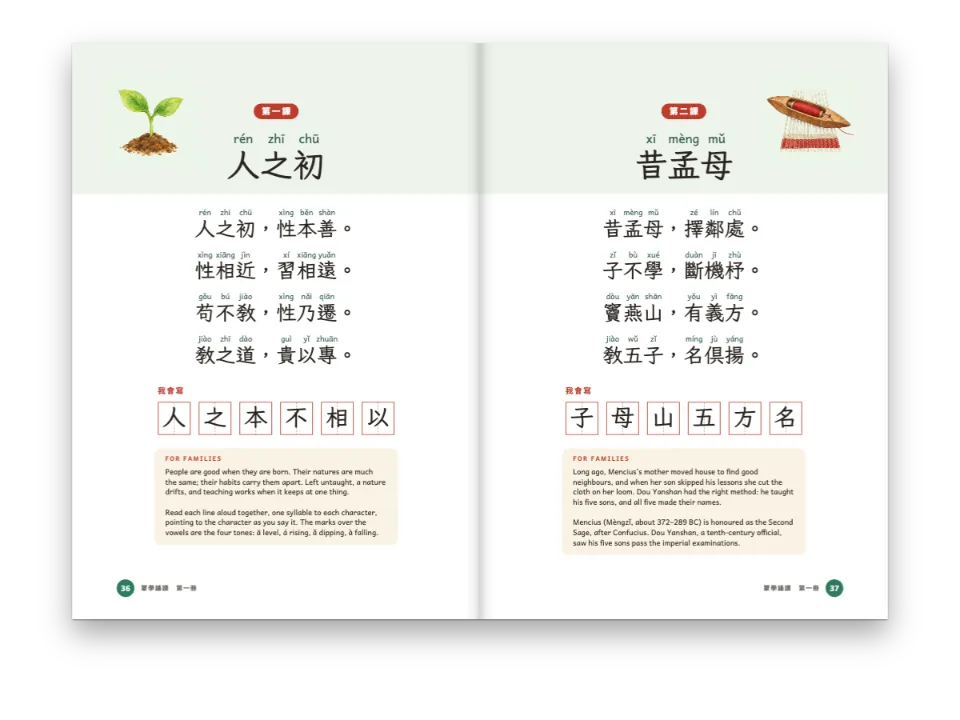
子どもが声に出して読めるよう、すべての漢字の上に小さなかなを刷った国語の教科書の1ページです。Postextは読みを親文字の上に置き、長い読みは隣のかなに掛けますが、別の漢字には掛けません。
できあがり
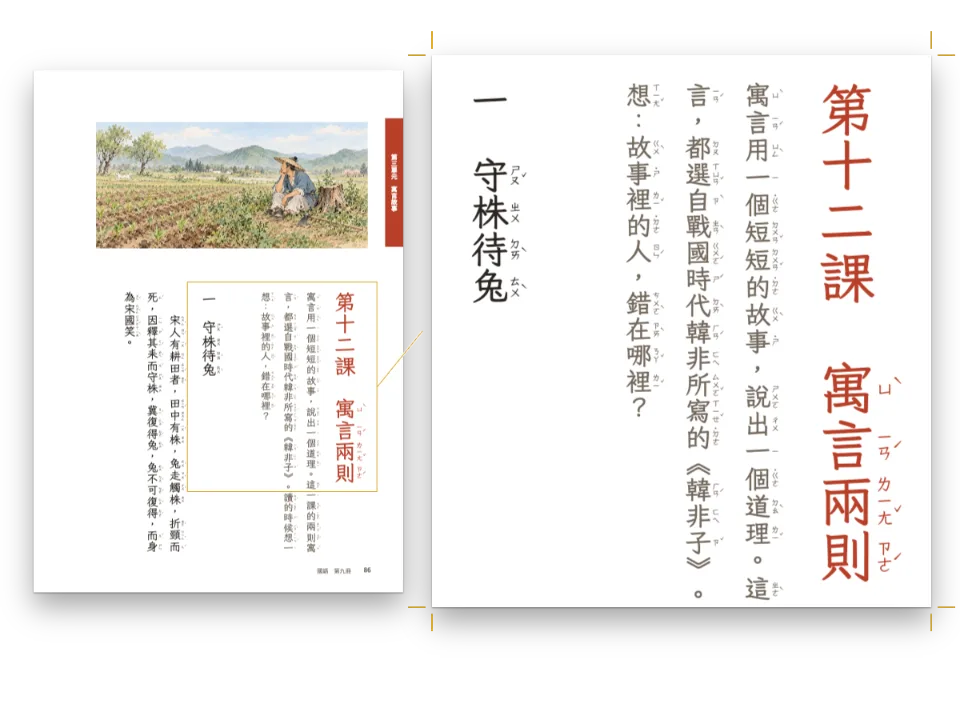
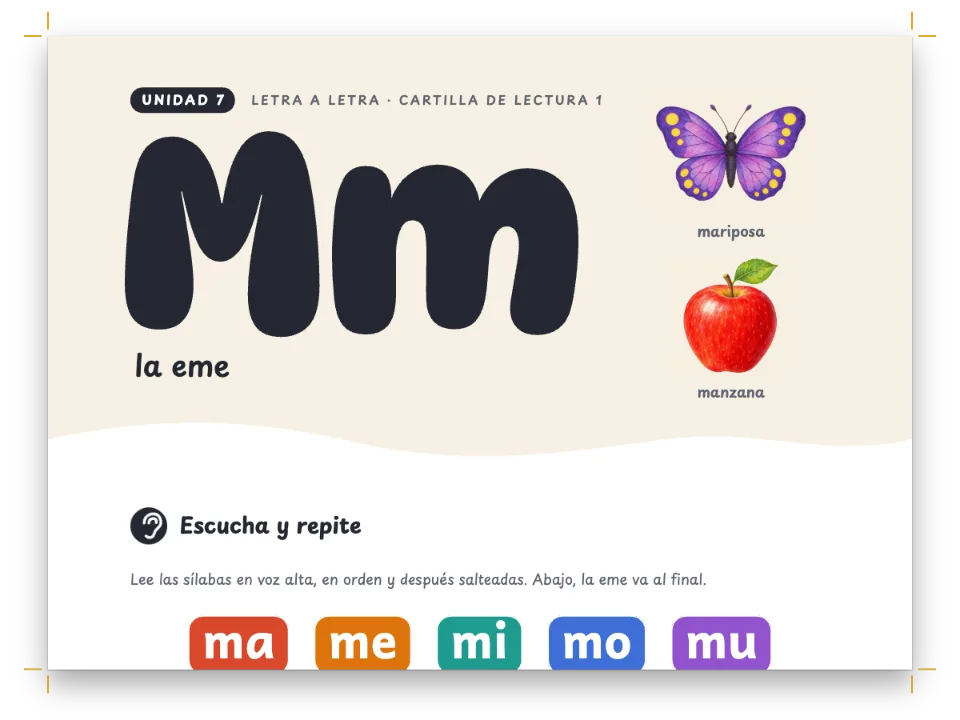
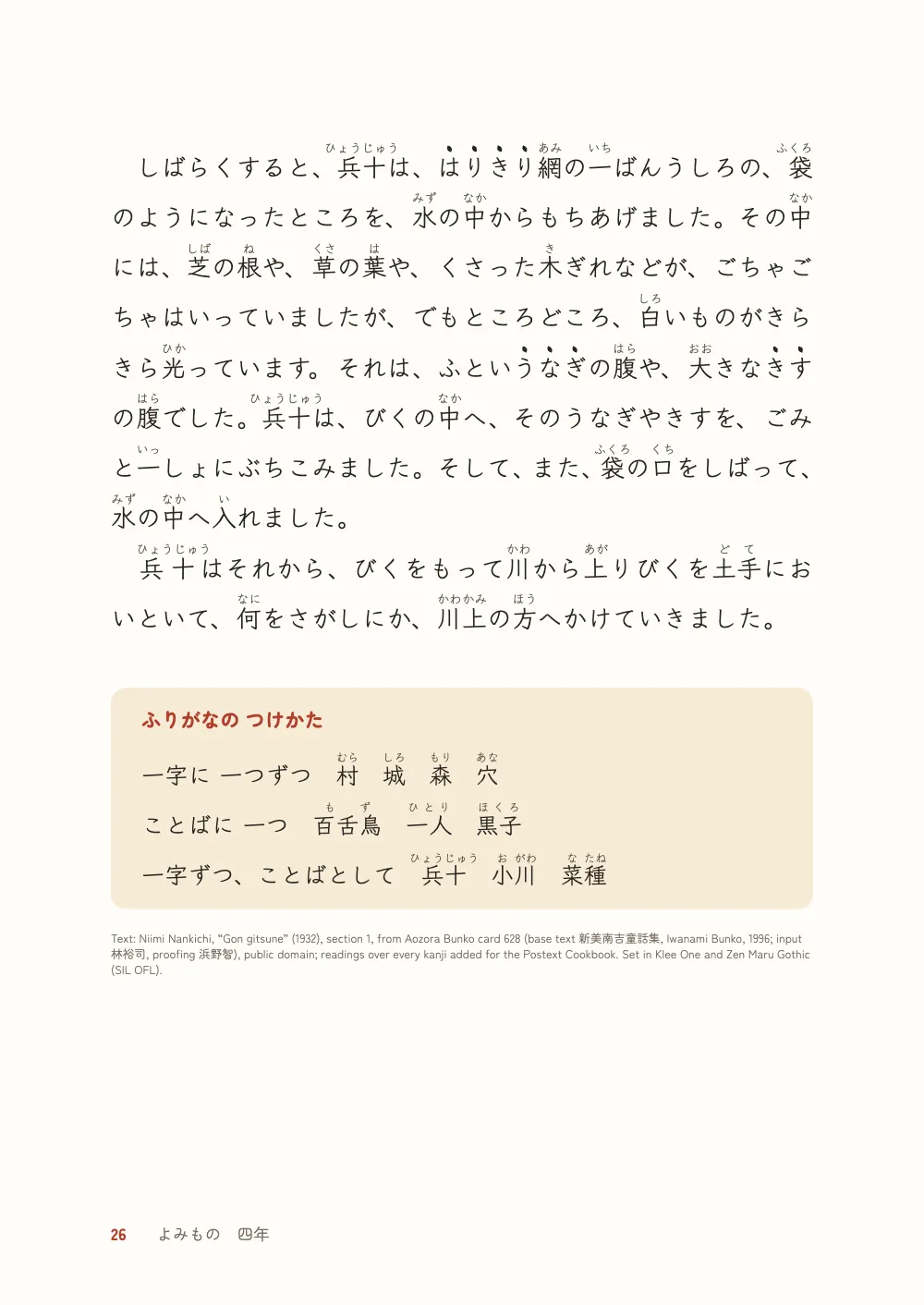
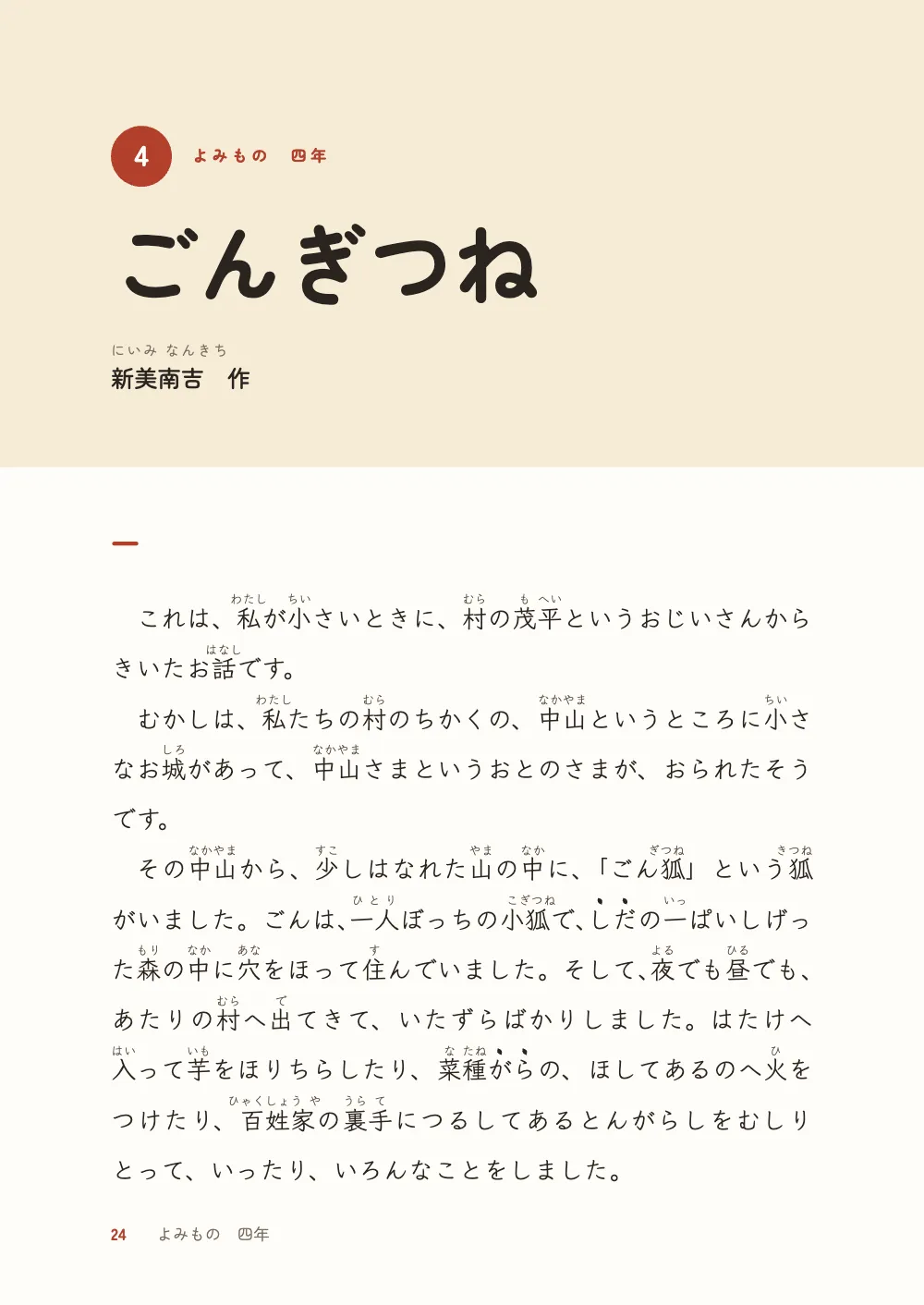
新美南吉の『ごんぎつね』(1932年)の冒頭のページを、小学4年生の国語の教科書の体裁で組みます。日本の子どもなら誰もが9歳か10歳で出会う物語です。B5判の1ページに、教科書の手書き文字をもとにした書体Klee Oneで28字×21行を組みます。文字サイズは14 pt、行送りは28 ptで、すべての漢字の上に小さなかなの読みが付きます。主役はこの読みです。村と森には1字ごとの読みを、1字ずつの読みを持たない百舌鳥(もず)には語全体でひとつの読みを付けます。兵十(ひょうじゅう)には熟語ルビを付け、読みは長すぎる場合を除いてそれぞれの漢字の上に収まります。最後の囲みでは、指導者向けにこの3つの場合を示します。ピンインの入門読本では、同じ方法で中国語のすべての字の上に読みを付けています。
このレシピが答える質問
- 漢字に、1字ごとまたは語全体に1つの読みでふりがなを付けるには?
手短な答え
// In a document tagged 'ja' the compact {漢字|かん|じ} (one reading per character) is jukugo
// ruby: each reading stays over its own kanji when it fits, and when one is longer it may run
// onto the next kanji of the same word; a break may fall between the two. {百舌鳥|もず} (one
// reading for the word) is group ruby, spread over the word 1:2:1. :ruby[菜種]{rt="な たね"
// mode=jukugo} says the same as the compact form; mode=mono keeps each reading to its kanji.
const cjk = {
  grid: { enabled: true, charsPerLine: CHARS, linesPerPage: LINES },
  ruby: {
    fontSize: em(0.5), // 7 pt: half the text, the size JLReq gives furigana
    color: col('reading'),
    align: 'jis', // a reading shorter than its base: ½ unit at each end, 1 between (1:2:1)
    overhang: 'kana', // a longer reading may run one ruby character onto a kana, never a kanji
    smallKana: 'keep', // ひょう with its small ょ, as today's books print it
  },
};
// The line gap (28 − 14 = 14 pt) holds a 7 pt reading with room to spare: no line moves for one.
const bodyText = {
  fontFamily: TEXT, fontSize: pt(SIZE), lineHeight: pt(PITCH), color: col('ink'),
  boldColor: col('ink'), italicColor: col('ink'), referenceColor: col('ink'),
  textAlign: 'justify', firstLineIndent: em(1), indentAfterHeading: true,
  avoidRunts: true, // no paragraph ends on one character
};
材料
- 機能
- ふりがな:漢字に付ける仮名の読みルビ:ピンインと注音仮名、漢字、ローマ字日本語の圏点(傍点)中国語・日本語・韓国語のフォント文字グリッド日本語の約物のアキ日本語の改行(禁則処理)行取りの見出しデザインした章扉見出しの属性囲み柱とノンブル見開きの余白用紙の色段落スタイルセマンティックカラーパレット青空文庫の取り込みPDFの書き出し
- 種類
- Klee One, Zen Maru Gothic (SIL OFL 1.1)
- 素材
- なし:図はすべてコードで描画
作り方
#1 · 読みの3つの書き方
コードは前出の手短な答えにあります。Markdownでは、{村|むら}で村の上に「むら」を置きます。{兵十|ひょう|じゅう}は漢字ごとに読みを与え、'ja'のタグを付けた文書ではこれが熟語ルビになります。読みは収まる限りそれぞれの漢字の上にとどまり、長い読みは同じ語の次の漢字には掛かっても、別の語の漢字には掛かりません。3つの漢字にひとつの読みを付ける{百舌鳥|もず}はグループルビで、語全体にひとまとまりとして配置されます。:ruby[菜種]{rt="な たね" mode=jukugo}は、囲みの最後の例をディレクティブの形で書いたものです。この形ではmode=monoとalignも指定できます(圏点と傍線、ルビ、割注)。
#2 · 1:2:1と、かなにだけ掛ける読み
cjk.rubyの下の2つの設定は、'ja'が自動で選ぶ値です。align: 'jis'は、親文字より短い読みをJIS X 4051の方式で配置します。両端に半単位、かなの間に1単位のスペースを入れるので、25ページの百舌鳥では「も」と「ず」が中央に固まらず、字と字の継ぎ目の上に来ます。overhang: 'kana'は、親文字より長い読みを、隣のかなや約物の空きにルビ1字分まで掛けることを許し、漢字には掛けません。「ごん狐」の狐に付く「ぎつね」は「ん」と後ろのかぎ括弧に掛かり、「兵十だな」の「じゅう」は「だ」に掛かります。掛けられるかながない場合は、漢字のほうを読みの幅まで広げます。行頭や行末では、読みは行長の内側にとどまります。
#3 · 読みが収まる行間
読みは本文14 ptの半分の7 pt、行送りは28 ptです。2行の間の14 ptに読みが余裕をもって収まるので、グリッドのどの行も位置を変えません。行送りを本文と読みの合計より詰めると、ビルドがrubyExceedsLeadingの警告を出します。
#4 · 冒頭のページには読みを刷らない
// Design text sets no furigana (gotcha: ruby-not-in-designs): the author's reading is a
// line of its own.
const BAND = 92; // mm from the trim's top
const opener = { enabled: true, minHeight: pt(PITCH * 6), slot: { elements: [
  { kind: 'box', id: 'band', reserve: false, style: { backgroundColor: col('straw') },
    placement: { anchor: { to: 'page', edge: 'top-left' },
      size: { width: 'fill', height: mm(BAND) } } },
  { kind: 'text', id: 'unit', content: '{attr.unit}', fontFamily: ROUND, fontSize: pt(16),
    fontWeight: 700, color: col('paper'), align: 'center', verticalAlign: 'middle',
    overflow: 'clip', box: { backgroundColor: col('red'), borderRadius: mm(6) },
    placement: { anchor: { to: 'container', edge: 'top-left' }, offset: { y: mm(-2) },
      size: { width: mm(12), height: mm(12) } } },
  { kind: 'text', id: 'series', content: '{title}', fontFamily: ROUND, fontSize: pt(9),
    fontWeight: 700, letterSpacing: pt(2), color: col('red'), align: 'left',
    verticalAlign: 'middle', placement: { anchor: { to: 'container', edge: 'top-left' },
      offset: { x: mm(16), y: mm(-2) }, size: { width: mm(80), height: mm(12) } } },
  { kind: 'text', id: 'title', content: '{titleText}', fontFamily: ROUND, fontSize: pt(48),
    lineHeight: 1.1, fontWeight: 700, color: col('ink'), align: 'left',
    placement: { anchor: { to: '#unit', edge: 'below' }, offset: { y: mm(7) } } },
  { kind: 'text', id: 'kana', content: '{attr.kana}', fontFamily: ROUND, fontSize: pt(8),
    letterSpacing: pt(1), color: col('muted'), align: 'left',
    placement: { anchor: { to: '#title', edge: 'below' }, offset: { y: mm(5) } } },
  { kind: 'text', id: 'author', content: '{attr.author} 作', fontFamily: ROUND,
    fontSize: pt(13), fontWeight: 500, color: col('ink'), align: 'left',
    placement: { anchor: { to: '#kana', edge: 'below' }, offset: { y: mm(1) } } },
] } };
タイトルと作者名はデザイン要素のテキストで、ルビは組めません。そこで新美南吉の読みは、教科書の刷り方にならって、名前の上にかなで独立した1行として置きます。タイトル自体も教科書の表記どおり、かなで「ごんぎつね」と書きます。青空文庫のテキストでは題が「ごん狐」です。
#5 · ひとつのアクセント色と、少し淡い読み
const palette = {
  ink: '#2a2420', // text: a warm near-black
  red: '#b2402c', // the one accent: the unit badge, the section numbers, the box title
  reading: '#5a4e45', // the furigana, a shade off the ink so the two layers part
  straw: '#f6ecd6', // the opener band and the box
  muted: '#7a6d62', // folios, the series line, the colophon
  paper: '#fffdf8',
};
const col = (id) => ({ hex: palette[id], model: 'hex', paletteId: id });
const colorPalette = Object.entries({ ...palette, 'main-color': palette.red })
  .map(([id, hex]) => ({ id, name: id, value: { hex, model: 'hex' } }));
読みには、墨より一段明るい茶色のreadingを使います。かなが薄くなりすぎることなく、本文と読みの2つの層を目で区別できます。物語に咲く彼岸花の赤を、バッジ、節番号、囲みのタイトルに使います。
レシピの全体
// ═══ Postext Cookbook · Nº 124 · A school reader with furigana: per character, per word ═══ // https://postext.dev/en/cookbook/jukugo-furigana-textbook // Code: MIT · Text: 新美南吉「ごん狐」(1932), Aozora Bunko 628 (PD); readings: CC BY 4.0 // Fonts: Klee One, Zen Maru Gothic (SIL OFL 1.1) · Needs postext ≥ 1.16.1 import { buildDocument, renderPageToCanvas, clearMeasurementCache } from 'https://esm.sh/postext'; import { renderToPdf, decompressWoff2 } from 'https://esm.sh/postext-pdf'; const LANG = 'en'; // @lang: the language of the frame; the story is Japanese in both const RECIPE = 'jukugo-furigana-textbook'; // ─── 1 · Design ───────────────────────────────────────────────────────────── // #region palette: an autumn reader: ink, the red of the higanbana, a pale straw ground const palette = { ink: '#2a2420', // text: a warm near-black red: '#b2402c', // the one accent: the unit badge, the section numbers, the box title reading: '#5a4e45', // the furigana, a shade off the ink so the two layers part straw: '#f6ecd6', // the opener band and the box muted: '#7a6d62', // folios, the series line, the colophon paper: '#fffdf8', }; const col = (id) => ({ hex: palette[id], model: 'hex', paletteId: id }); const colorPalette = Object.entries({ ...palette, 'main-color': palette.red }) .map(([id, hex]) => ({ id, name: id, value: { hex, model: 'hex' } })); // #endregion const [TEXT, ROUND] = ['Klee One', 'Zen Maru Gothic']; // 教科書体-like text, rounded gothic const [SIZE, PITCH] = [14, 28]; // pt: a fourth-year reader's size, on a line twice as tall const [CHARS, LINES] = [28, 21]; // the type area in characters // #region answer: readings over every kanji: by character, by word, jukugo, JIS 1:2:1 // In a document tagged 'ja' the compact {漢字|かん|じ} (one reading per character) is jukugo // ruby: each reading stays over its own kanji when it fits, and when one is longer it may run // onto the next kanji of the same word; a break may fall between the two. {百舌鳥|もず} (one // reading for the word) is group ruby, spread over the word 1:2:1. :ruby[菜種]{rt="な たね" // mode=jukugo} says the same as the compact form; mode=mono keeps each reading to its kanji. const cjk = { grid: { enabled: true, charsPerLine: CHARS, linesPerPage: LINES }, ruby: { fontSize: em(0.5), // 7 pt: half the text, the size JLReq gives furigana color: col('reading'), align: 'jis', // a reading shorter than its base: ½ unit at each end, 1 between (1:2:1) overhang: 'kana', // a longer reading may run one ruby character onto a kana, never a kanji smallKana: 'keep', // ひょう with its small ょ, as today's books print it }, }; // The line gap (28 − 14 = 14 pt) holds a 7 pt reading with room to spare: no line moves for one. const bodyText = { fontFamily: TEXT, fontSize: pt(SIZE), lineHeight: pt(PITCH), color: col('ink'), boldColor: col('ink'), italicColor: col('ink'), referenceColor: col('ink'), textAlign: 'justify', firstLineIndent: em(1), indentAfterHeading: true, avoidRunts: true, // no paragraph ends on one character }; // #endregion // #region opener: a straw band with the unit badge, the title and the author's name in kana // Design text sets no furigana (gotcha: ruby-not-in-designs): the author's reading is a // line of its own. const BAND = 92; // mm from the trim's top const opener = { enabled: true, minHeight: pt(PITCH * 6), slot: { elements: [ { kind: 'box', id: 'band', reserve: false, style: { backgroundColor: col('straw') }, placement: { anchor: { to: 'page', edge: 'top-left' }, size: { width: 'fill', height: mm(BAND) } } }, { kind: 'text', id: 'unit', content: '{attr.unit}', fontFamily: ROUND, fontSize: pt(16), fontWeight: 700, color: col('paper'), align: 'center', verticalAlign: 'middle', overflow: 'clip', box: { backgroundColor: col('red'), borderRadius: mm(6) }, placement: { anchor: { to: 'container', edge: 'top-left' }, offset: { y: mm(-2) }, size: { width: mm(12), height: mm(12) } } }, { kind: 'text', id: 'series', content: '{title}', fontFamily: ROUND, fontSize: pt(9), fontWeight: 700, letterSpacing: pt(2), color: col('red'), align: 'left', verticalAlign: 'middle', placement: { anchor: { to: 'container', edge: 'top-left' }, offset: { x: mm(16), y: mm(-2) }, size: { width: mm(80), height: mm(12) } } }, { kind: 'text', id: 'title', content: '{titleText}', fontFamily: ROUND, fontSize: pt(48), lineHeight: 1.1, fontWeight: 700, color: col('ink'), align: 'left', placement: { anchor: { to: '#unit', edge: 'below' }, offset: { y: mm(7) } } }, { kind: 'text', id: 'kana', content: '{attr.kana}', fontFamily: ROUND, fontSize: pt(8), letterSpacing: pt(1), color: col('muted'), align: 'left', placement: { anchor: { to: '#title', edge: 'below' }, offset: { y: mm(5) } } }, { kind: 'text', id: 'author', content: '{attr.author} 作', fontFamily: ROUND, fontSize: pt(13), fontWeight: 500, color: col('ink'), align: 'left', placement: { anchor: { to: '#kana', edge: 'below' }, offset: { y: mm(1) } } }, ] } }; // #endregion // Folios at the outer foot, the series beside them. const foot = (id, content, parity, edge, x, extra) => ({ kind: 'text', id, content, parity, fontFamily: ROUND, fontSize: pt(9), color: col('muted'), align: edge.endsWith('left') ? 'left' : 'right', placement: { anchor: { to: 'container', edge }, offset: { x: mm(x), y: mm(-12) } }, ...extra }); const folio = { fontWeight: 700, color: col('red') }; const config = () => ({ // a factory: the engine caches resolved configs per object locale: 'ja', // written out, never LANG (gotcha: ja-locale-tag) colorPalette, page: { sizePreset: 'custom', width: mm(182), height: mm(257), dpi: 150, // B5 backgroundColor: col('paper'), // Minimums: the grid centres its 28 × 21 area (138 × 207 mm) in what they leave. margins: { top: mm(26), bottom: mm(22), left: mm(20), right: mm(20), mirror: true } }, layout: { layoutType: 'single' }, cjk, bodyText, headings: { fontFamily: ROUND, fontWeight: 700, color: col('red'), balancing: { enabled: false }, // nothing added above heads: the grid holds levels: [ // Restated: any headings object drops the H1 break (gotcha: headings-drop-h1-break). { level: 1, breakBefore: { enabled: true, parity: 'any' }, advancedDesign: opener }, { level: 2, fontSize: pt(16), lineSpan: 2 }, // 一, 二…: two lines of the grid ] }, calloutStyles: [{ id: 'words', background: col('straw'), borderRadius: mm(3), snapToGrid: false, marginTop: pt(PITCH), marginBottom: pt(0), padding: { top: mm(4), right: mm(6), bottom: mm(3), left: mm(6) }, titleStyle: { fontFamily: ROUND, fontSize: pt(11), fontWeight: 700, color: col('red') }, body: { fontFamily: TEXT, fontSize: pt(13), lineHeight: pt(28), color: col('ink'), firstLineIndent: pt(0), textAlign: 'left' } }], paragraphStyles: [{ id: 'colophon', fontFamily: ROUND, fontSize: pt(6.5), lineHeight: pt(9), color: col('muted'), firstLineIndent: pt(0), textAlign: 'left', marginTop: mm(4) }], header: { elements: [] }, footer: { elements: [ foot('v-folio', '{pageNumber}', 'even', 'bottom-left', 0, folio), foot('v-series', '{title}', 'even', 'bottom-left', 9), foot('r-series', '{chapterTitle}', 'odd', 'bottom-right', -9), foot('r-folio', '{pageNumber}', 'odd', 'bottom-right', 0, folio), ] }, }); // ─── 2 · Content ──────────────────────────────────────────────────────────── const markdown = String.raw`---Markdownの見本 · 38行 · content.en.md
title: "よみもの 四年" --- # ごんぎつね {author="新美南吉" kana="にいみ なんきち" unit="4"} ## 一 これは、{私|わたし}が{小|ちい}さいときに、{村|むら}の{茂平|も|へい}というおじいさんからきいたお{話|はなし}です。 むかしは、{私|わたし}たちの{村|むら}のちかくの、{中山|なか|やま}というところに{小|ちい}さなお{城|しろ}があって、{中山|なか|やま}さまというおとのさまが、おられたそうです。 その{中山|なか|やま}から、{少|すこ}しはなれた{山|やま}の{中|なか}に、「ごん{狐|ぎつね}」という{狐|きつね}がいました。ごんは、{一人|ひとり}ぼっちの{小狐|こ|ぎつね}で、:dots[しだ]{style=sesame}の{一|いっ}ぱいしげった{森|もり}の{中|なか}に{穴|あな}をほって{住|す}んでいました。そして、{夜|よる}でも{昼|ひる}でも、あたりの{村|むら}へ{出|で}てきて、いたずらばかりしました。はたけへ{入|はい}って{芋|いも}をほりちらしたり、{菜種|な|たね}:dots[がら]{style=sesame}の、ほしてあるのへ{火|ひ}をつけたり、{百姓家|ひゃく|しょう|や}の{裏手|うら|て}につるしてあるとんがらしをむしりとって、いったり、いろんなことをしました。 {或|ある}{秋|あき}のことでした。{二|に}、{三日|さん|にち}{雨|あめ}がふりつづいたその{間|あいだ}、ごんは、{外|そと}へも{出|で}られなくて{穴|あな}の{中|なか}にしゃがんでいました。 {雨|あめ}があがると、ごんは、ほっとして{穴|あな}からはい{出|で}ました。{空|そら}はからっと{晴|は}れていて、{百舌鳥|もず}の{声|こえ}がきんきん、ひびいていました。 ごんは、{村|むら}の{小川|お|がわ}の{堤|つつみ}まで{出|で}て{来|き}ました。あたりの、すすきの{穂|ほ}には、まだ{雨|あめ}のしずくが{光|ひか}っていました。{川|かわ}は、いつもは{水|みず}が{少|すくな}いのですが、{三日|みっ|か}もの{雨|あめ}で、{水|みず}が、どっとましていました。ただのときは{水|みず}につかることのない、{川|かわ}べりのすすきや、{萩|はぎ}の{株|かぶ}が、{黄|き}いろくにごった{水|みず}に{横|よこ}だおしになって、もまれています。ごんは{川下|かわ|しも}の{方|ほう}へと、ぬかるみみちを{歩|ある}いていきました。 ふと{見|み}ると、{川|かわ}の{中|なか}に{人|ひと}がいて、{何|なに}かやっています。ごんは、{見|み}つからないように、そうっと{草|くさ}の{深|ふか}いところへ{歩|ある}きよって、そこからじっとのぞいてみました。 「{兵十|ひょう|じゅう}だな」と、ごんは{思|おも}いました。{兵十|ひょう|じゅう}はぼろぼろの{黒|くろ}いきものをまくし{上|あ}げて、{腰|こし}のところまで{水|みず}にひたりながら、{魚|さかな}をとる、:dots[はりきり]{style=sesame}という、{網|あみ}をゆすぶっていました。はちまきをした{顔|かお}の{横|よこ}っちょうに、まるい{萩|はぎ}の{葉|は}が{一|いち}まい、{大|おお}きな{黒子|ほくろ}みたいにへばりついていました。 しばらくすると、{兵十|ひょう|じゅう}は、:dots[はりきり]{style=sesame}{網|あみ}の{一|いち}ばんうしろの、{袋|ふくろ}のようになったところを、{水|みず}の{中|なか}からもちあげました。その{中|なか}には、{芝|しば}の{根|ね}や、{草|くさ}の{葉|は}や、くさった{木|き}ぎれなどが、ごちゃごちゃはいっていましたが、でもところどころ、{白|しろ}いものがきらきら{光|ひか}っています。それは、ふとい:dots[うなぎ]{style=sesame}の{腹|はら}や、{大|おお}きな:dots[きす]{style=sesame}の{腹|はら}でした。{兵十|ひょう|じゅう}は、びくの{中|なか}へ、そのうなぎやきすを、ごみと{一|いっ}しょにぶちこみました。そして、また、{袋|ふくろ}の{口|くち}をしばって、{水|みず}の{中|なか}へ{入|い}れました。 {兵十|ひょう|じゅう}はそれから、びくをもって{川|かわ}から{上|あが}りびくを{土手|ど|て}においといて、{何|なに}をさがしにか、{川上|かわ|かみ}の{方|ほう}へかけていきました。 :::callout{type="words" title="ふりがなの つけかた"} 一字に 一つずつ {村|むら} {城|しろ} {森|もり} {穴|あな} ことばに 一つ {百舌鳥|もず} {一人|ひとり} {黒子|ほくろ} 一字ずつ、ことばとして {兵十|ひょう|じゅう} {小川|お|がわ} :ruby[菜種]{rt="な たね" mode=jukugo} ::: :::paragraphs{style="colophon"} Text: Niimi Nankichi, “Gon gitsune” (1932), section 1, from Aozora Bunko card 628 (base text 新美南吉童話集, Iwanami Bunko, 1996; input 林裕司, proofing 浜野智), public domain; readings over every kanji added for the Postext Cookbook. Set in Klee One and Zen Maru Gothic (SIL OFL). :::`; // content.<lang>.md: the same Japanese page in both // ─── 3 · Fonts ────────────────────────────────────────────────────────────── const FONTS = { // every face the pages use, loaded before the build (gotcha: fonts-first) 'Klee One': ['400'], // the text and its readings: the hand of a school textbook 'Zen Maru Gothic': ['400', '500', '700'], // the title, heads, badge, box title, folios }; // ─── 4 · Build & show ─────────────────────────────────────────────────────── // Each face loads the files of what it sets (gotcha: cjk-fonts-slices). const all = (re) => (markdown.match(re) ?? []).join(''); await loadFonts(FONTS, markdown); await loadCjkFonts({ [TEXT]: FONTS[TEXT] }, markdown); await loadCjkFonts({ [ROUND]: FONTS[ROUND] }, `${all(/^#.*$/gm)}${all(/title="[^"]*"/g)}${all(/colophon"\}\n[^\n]*/g)}よみもの四年作0123456789`); // Page 1 is page 24 of the reader, a verso: the lesson opens on a spread. const continuation = { pageIndexOffset: 23, pageNumbering: { startAt: 24 } }; const doc = await buildWithFonts(() => buildDocument({ markdown, continuation }, config()), markdown); showPages(doc, { title: t({ en: 'A school reader with furigana', es: 'Un libro de lectura con furigana' }) }); offerPdf(() => renderToPdf(doc, { fontProvider: cjkPdfProvider }), `${RECIPE}.pdf`);キット · core, fonts, viewer, pdf, cjk:全レシピ共通 · 453行
// ─── Kit ── helpers shared by every Cookbook recipe · postext.dev/cookbook ───── // ─── Kit · core v1 ── the same in every recipe · postext.dev/cookbook ───────── function mm(value) { return { value, unit: 'mm' }; } function pt(value) { return { value, unit: 'pt' }; } function em(value) { return { value, unit: 'em' }; } /** The sample language's string: t({ en: 'Figure', es: 'Figura' }). */ function t(strings) { return strings[LANG] ?? Object.values(strings)[0]; } /** A file in this recipe's assets folder, served from the Postext repo by jsDelivr. */ function asset(file) { return `https://cdn.jsdelivr.net/gh/drnachio/postext@main/cookbook/${RECIPE}/assets/${file}`; } // ─── Kit · fonts v1 ── the same in every recipe · postext.dev/cookbook ──────── // Postext measures text with the faces the browser has loaded, and caches the // widths, so every face must be ready before the first build. Faces come from // Fontsource: the same static files the PDF embeds, so screen and PDF agree. /** faces = { 'Family Name': ['400', '400i', '700'] }. `text` is the sample: * letters beyond Latin-1 (č, ł, ő…) also load the latin-ext files. With * `optional`, a face Fontsource does not ship is skipped instead of failing. * Resolves to the number of faces added. */ async function loadFonts(faces, text = '', { optional = false } = {}) { kitStatus('Loading fonts…'); const ranges = { latin: 'U+0000-00FF,U+0131,U+0152-0153,U+02BB-02BC,U+02C6,U+02DA,U+02DC,U+0304,U+0308,U+0329,' + 'U+2000-206F,U+20AC,U+2122,U+2191,U+2193,U+2212,U+2215,U+FEFF,U+FFFD', 'latin-ext': 'U+0100-02BA,U+02BD-02C5,U+02C7-02CC,U+02CE-02D7,U+02DD-02FF,U+0304,U+0308,U+0329,' + 'U+1D00-1DBF,U+1E00-1E9F,U+1EF2-1EFF,U+2020,U+20A0-20AB,U+20AD-20C0,U+2113,U+2C60-2C7F,U+A720-A7FF', }; const subsets = /[Ā-˿Ḁ-ỿ]/.test(text) ? ['latin', 'latin-ext'] : ['latin']; const jobs = []; let added = 0; for (const [family, specs] of Object.entries(faces)) { const id = fontsourceId(family); const meta = optional ? await fontsourceMeta(family) : null; for (const spec of new Set(specs)) { const weight = parseInt(spec, 10); const style = spec.endsWith('i') ? 'italic' : 'normal'; if (hasFace(family, weight, style)) continue; if (optional && !(meta?.weights.includes(weight) && meta.styles.includes(style))) continue; for (const subset of subsets) { const url = `https://cdn.jsdelivr.net/npm/@fontsource/${id}@5/files/${id}-${subset}-${weight}-${style}.woff2`; const face = new FontFace(family, `url(${url}) format('woff2')`, { weight: String(weight), style, unicodeRange: ranges[subset] }); jobs.push(face.load().then((ready) => { document.fonts.add(ready); added++; }, () => { if (subset === 'latin' && !optional) throw new Error(`Fontsource has no ${family} ${weight} ${style}`); })); } } } await Promise.all(jobs).catch((error) => { kitFail(error); throw error; }); return added; } /** Runs `build` (a buildDocument or buildBundle call) and checks the faces * the pages use. A regular face missing from FONTS is loaded with a warning; * bold and italic variants are loaded when the family ships them. Then the * measurement caches are cleared and the build runs again. */ async function buildWithFonts(build, text = '') { const tried = new Set(); for (let round = 0; round < 3; round++) { kitStatus('Laying out…'); await new Promise(requestAnimationFrame); // let the status paint first const result = await Promise.resolve().then(build).catch((error) => { kitFail(error); throw error; }); const wanted = { base: {}, variants: {} }; for (const { font, base } of [result].flat().flatMap(fontStringsOf)) { const { family, weight, style } = parseFont(font); const key = `${family}|${weight}|${style}`; if (tried.has(key) || hasFace(family, weight, style)) continue; tried.add(key); (wanted[base ? 'base' : 'variants'][family] ??= []).push(`${weight}${style === 'italic' ? 'i' : ''}`); } if (Object.keys(wanted.base).length) { console.warn(`[cookbook] FONTS does not list ${JSON.stringify(wanted.base)}: loading them.`); } const added = await loadFonts(wanted.base, text) + await loadFonts(wanted.variants, text, { optional: true }); if (added === 0) return result; clearMeasurementCache(); } throw new Error('The fonts did not settle after three builds.'); } /** Every font string of the layout. `base` marks a block's own face; its * bold, italic and bold-italic variants are listed whether or not used. */ function fontStringsOf(doc) { const found = new Map(); const walk = (node) => { if (!node || typeof node !== 'object') return; if (Array.isArray(node)) { node.forEach(walk); return; } for (const [key, value] of Object.entries(node)) { if (typeof value === 'string' && /fontString$/i.test(key)) { found.set(value, found.get(value) || key === 'fontString'); } else if (value && typeof value === 'object') walk(value); } }; walk(doc.pages); walk(doc.blocks); return [...found].map(([font, base]) => ({ font, base })); } /** '700 37.5px Open Sans' / 'italic 400 13px "Source Serif 4"' → { family, weight, style }. * A string with no weight ('95.8px Young Serif', from a design text) is 400. */ function parseFont(font) { const m = /^(?:(italic|oblique)\s+)?(?:small-caps\s+)?(?:(\d+|bold|normal)\s+)?[\d.]+px\s+(.+)$/.exec(font.trim()); if (!m) throw new Error(`Unexpected font string: ${font}`); const weight = m[2] === 'bold' ? 700 : !m[2] || m[2] === 'normal' ? 400 : Number(m[2]); return { family: m[3].replace(/^["']|["']$/g, ''), weight, style: m[1] ? 'italic' : 'normal' }; } /** True when a loaded FontFace covers exactly this family, weight and style * (document.fonts.check() is also true for families nobody declared). */ function hasFace(family, weight, style) { for (const face of document.fonts) { if (face.status !== 'loaded' || face.style !== style) continue; if (face.family.replace(/^["']|["']$/g, '') !== family) continue; const [low, high = low] = face.weight.split(' ').map(Number); if (weight >= low && weight <= high) return true; } return false; } /** Fontsource's id for a family: 'Source Serif 4' → 'source-serif-4'. */ function fontsourceId(family) { return family.toLowerCase().replace(/\s+/g, '-'); } /** The weights and styles a family ships ({ weights: [400, 700], styles: ['normal', 'italic'] }), or null. */ function fontsourceMeta(family) { fontsourceMeta.cache ??= new Map(); const id = fontsourceId(family); if (!fontsourceMeta.cache.has(id)) { fontsourceMeta.cache.set(id, fetch(`https://api.fontsource.org/v1/fonts/${id}`) .then((res) => (res.ok ? res.json() : null), () => null)); } return fontsourceMeta.cache.get(id); } // ─── Kit · viewer v1 ── the same in every recipe · postext.dev/cookbook ─────── /** Shows the pages as facing spreads on a dark desk: the first page is a * recto on its own, then verso | recto pairs, as in a bound book. Pages * are painted when they scroll near the screen. */ function showPages(docs, { title, width = 460 } = {}) { const root = viewer(title); const pages = [docs].flat().flatMap((doc) => doc.pages.map((page) => ({ doc, page, n: (doc.pageIndexOffset ?? 0) + page.index }))); const spreads = []; let verso = null; for (const p of pages) { if (p.n % 2 === 1) { if (verso) spreads.push([verso, null]); verso = p; } else { spreads.push([verso, p]); verso = null; } } if (verso) spreads.push([verso, null]); const density = Math.min(window.devicePixelRatio || 1, 2); showPages.painter?.disconnect(); const painter = new IntersectionObserver((entries) => { for (const { isIntersecting, target } of entries) { if (!isIntersecting) continue; painter.unobserve(target); const { doc, page } = target.postext; renderPageToCanvas(page, doc, target, { scale: (width * density) / page.width }); } }, { rootMargin: '800px' }); showPages.painter = painter; root.replaceChildren(...spreads.map((pair) => { const spread = document.createElement('div'); spread.className = 'pt-spread'; for (const p of pair) { const figure = document.createElement('figure'); if (p) { const label = p.page.pageLabel || String(p.n + 1); const canvas = document.createElement('canvas'); canvas.postext = p; canvas.style.aspectRatio = `${p.page.width} / ${p.page.height}`; canvas.setAttribute('role', 'img'); canvas.setAttribute('aria-label', `Page ${label}`); const folio = document.createElement('figcaption'); folio.textContent = label; figure.append(canvas, folio); painter.observe(canvas); } else figure.className = 'pt-blank'; spread.append(figure); } return spread; })); kitStatus(`${pages.length} ${pages.length === 1 ? 'page' : 'pages'}`); document.documentElement.dataset.postext = 'ready'; return pages.length; } /** The desk, the bar and the error reporting, created once. */ function viewer(title) { if (!document.getElementById('pt-kit')) { document.head.insertAdjacentHTML('beforeend', `<style id="pt-kit"> :root { color-scheme: dark; } body { margin: 0; background: #0e1014; color: #b9bcc4; font: 13px/1.45 system-ui, sans-serif; } #pt-bar { position: sticky; top: 0; z-index: 1; display: flex; flex-wrap: wrap; align-items: center; gap: 6px 16px; padding: 10px 16px; background: rgb(14 16 20 / .92); backdrop-filter: blur(6px); border-bottom: 1px solid #23262d; } #pt-bar strong { color: #f4f1ea; font-weight: 600; } #pt-actions { display: flex; gap: 12px; margin-left: auto; } #pt-actions a, #pt-actions button { color: #d8a21a; font: inherit; background: none; border: 0; padding: 0; cursor: pointer; } #pages { display: grid; justify-items: center; gap: 48px; padding: 32px 16px 72px; } .pt-spread { display: flex; } .pt-spread figure { margin: 0; width: min(460px, 44vw); } .pt-spread canvas { display: block; width: 100%; background: #fff; box-shadow: 0 1px 2px rgb(0 0 0 / .5), 0 22px 44px -16px rgb(0 0 0 / .8); } .pt-spread figure:first-child canvas { box-shadow: inset -14px 0 14px -14px rgb(0 0 0 / .18), 0 1px 2px rgb(0 0 0 / .5), 0 22px 44px -16px rgb(0 0 0 / .8); } .pt-spread figcaption { margin-top: 10px; text-align: center; font: 600 10px/1 system-ui, sans-serif; letter-spacing: .18em; text-transform: uppercase; color: #6c7079; } .pt-blank { visibility: hidden; } @media (max-width: 760px) { .pt-spread { flex-direction: column; gap: 32px; } .pt-spread figure { width: min(460px, 92vw); } .pt-blank { display: none; } } </style>`); document.body.insertAdjacentHTML('afterbegin', '<header id="pt-bar"><strong id="pt-title"></strong><span id="pt-status" role="status"></span><span id="pt-actions"></span></header>'); document.getElementById('pt-title').textContent = document.title || 'Postext'; addEventListener('error', (event) => kitFail(event.error ?? event.message)); addEventListener('unhandledrejection', (event) => kitFail(event.reason)); } if (title) document.getElementById('pt-title').textContent = title; return document.getElementById('pages') ?? document.body.appendChild(Object.assign(document.createElement('main'), { id: 'pages' })); } function kitStatus(text) { viewer(); document.getElementById('pt-status').textContent = text; } function kitFail(error) { document.documentElement.dataset.postext = 'error'; kitStatus(`Error: ${error?.message ?? error}`); } // ─── Kit · pdf v1 ── the same in every recipe that exports a PDF ────────────── /** postext-pdf embeds TrueType bytes. Fetch the Fontsource file the screen * used, snapping to a weight the family ships and falling back to upright * when it has no italic: the PDF asks for every face a block could use. */ async function fontsourceProvider(family, weight, style) { const id = fontsourceId(family); const meta = await fontsourceMeta(family); const weights = meta?.weights?.length ? meta.weights : [400, 700]; const w = weights.reduce((a, b) => (Math.abs(b - weight) < Math.abs(a - weight) ? b : a)); const s = style === 'italic' && meta && !meta.styles.includes('italic') ? 'normal' : style; const res = await fetch(`https://cdn.jsdelivr.net/npm/@fontsource/${id}@5/files/${id}-latin-${w}-${s}.woff2`); if (!res.ok) throw new Error(`Fontsource has no ${family} ${w} ${s} (${res.status})`); return decompressWoff2(new Uint8Array(await res.arrayBuffer())); } /** A "Build the PDF" button in the bar. Once built: "Open the PDF" (a new * tab, since CodePen's preview frame cannot show PDFs) and a download link. */ function offerPdf(makePdf, filename) { viewer(); const button = Object.assign(document.createElement('button'), { type: 'button', textContent: 'Build the PDF' }); button.dataset.postextPdf = filename; button.addEventListener('click', async () => { button.disabled = true; button.textContent = 'Building the PDF…'; try { const bytes = await makePdf(); const url = URL.createObjectURL(new Blob([bytes], { type: 'application/pdf' })); const size = `${Math.max(1, Math.round(bytes.length / 1024))} KB`; button.replaceWith( Object.assign(document.createElement('a'), { href: url, target: '_blank', rel: 'noopener', textContent: 'Open the PDF ↗' }), Object.assign(document.createElement('a'), { href: url, download: filename, textContent: `Download ${filename} · ${size}` })); } catch (error) { button.disabled = false; button.textContent = 'Build the PDF'; kitFail(error); } }); document.getElementById('pt-actions').append(button); } // ─── Kit · cjk v1 ── Chinese, Japanese and Korean books · postext.dev/cookbook ─ // Fontsource ships a CJK family as about a hundred files per weight, each // declared in its stylesheet with the unicode-range it covers. The screen // loads the files the sample touches; the PDF gets the same files for the // characters its pages set in each face, and embeds each as a subset. // A book bound on the right (vertical text) is shown with its spreads // mirrored: page 1 alone on the left of the spine, then [3 | 2]. /** The files of a Fontsource face, read from its stylesheet: { url, range, * ranges }, the last declared first (the order the browser tries them in). */ function cjkSlices(family, weight, style) { cjkSlices.cache ??= new Map(); const id = fontsourceId(family); const css = `https://cdn.jsdelivr.net/npm/@fontsource/${id}@5/${weight}${style === 'italic' ? '-italic' : ''}.css`; if (!cjkSlices.cache.has(css)) { cjkSlices.cache.set(css, fetch(css) .then((res) => { if (!res.ok) throw new Error(`Fontsource has no ${family} ${weight} ${style} (${res.status})`); return res.text(); }) .then((text) => [...text.matchAll(/@font-face\s*{([^}]*)}/g)].map(([, rule]) => { const range = /unicode-range:\s*([^;]+);/.exec(rule)?.[1].trim() ?? 'U+0-10FFFF'; const ranges = range.split(',').map((part) => { const [lo, hi = lo] = part.trim().slice(2).split('-'); return [parseInt(lo, 16), parseInt(hi, 16)]; }); return { url: new URL(/url\(([^)]+?\.woff2)\)/.exec(rule)[1], css).href, range, ranges }; }).reverse())); } return cjkSlices.cache.get(css); } /** The file of `slices` that holds code point `cp`, if any. */ function cjkSliceFor(slices, cp) { return slices.find((slice) => slice.ranges.some(([lo, hi]) => cp >= lo && cp <= hi)); } /** Whether Fontsource serves `family` as a Chinese, Japanese or Korean * family (its subsets name the script). Fails when the API does not * answer: a CJK face taken for a Latin one would paint in a system face. */ async function isCjkFamily(family) { const meta = await fontsourceMeta(family); if (!meta) throw new Error(`api.fontsource.org did not describe ${family}: reload to try again`); return !!meta.subsets?.some((subset) => /^(chinese|japanese|korean)/.test(subset)); } /** faces = { 'Noto Serif TC': ['400', '700'] }, as for loadFonts: the * whole FONTS object may be passed, its other families are left to * loadFonts. Adds one FontFace per file of each CJK face with its * unicodeRange, then loads the files `text` touches. `text` is what the * faces set: the sample for the text face; a book in several voices calls * it once per voice (loadCjkFonts({ 'LXGW WenKai TC': ['400'] }, quotes)), * so the heading and quotation faces fetch and check only their own * characters. Fails when a character of `text` is in no file of a face. * List every weight the pages use: a weight left to buildWithFonts gets * the latin file only. With { vertical: true } it also loads each * family's vertical forms (brackets, quotes, pause marks) for the canvas, * which needs loadVerticalAlternates imported from postext. Resolves to * the number of files loaded. */ async function loadCjkFonts(faces, text, { vertical = false } = {}) { kitStatus('Loading fonts…'); let loaded = 0; try { if (vertical && typeof loadVerticalAlternates !== 'function') { throw new Error('loadCjkFonts(…, { vertical: true }) needs loadVerticalAlternates imported from postext'); } for (const [family, specs] of Object.entries(faces)) { if (!(await isCjkFamily(family))) continue; const twin = []; for (const spec of new Set(specs)) { const weight = parseInt(spec, 10); const style = spec.endsWith('i') ? 'italic' : 'normal'; const slices = await cjkSlices(family, weight, style); const missing = [...new Set(text)].filter((ch) => /\S/.test(ch) && !cjkSliceFor(slices, ch.codePointAt(0))); if (missing.length) { throw new Error(`${family} ${spec} has no file for ${missing.slice(0, 12).join(' ')}: ` + `give each face the text it sets (loadCjkFonts({ '${family}': ['${spec}'] }, text))`); } for (const slice of slices) { document.fonts.add(new FontFace(family, `url(${slice.url}) format('woff2')`, { weight: String(weight), style, unicodeRange: slice.range })); twin.push({ source: slice.url, weight: String(weight), style, unicodeRange: slice.range }); } const font = `${style === 'italic' ? 'italic ' : ''}${weight} 16px "${family}"`; loaded += (await document.fonts.load(font, text)).length; if (!document.fonts.check(font, text)) throw new Error(`${family} ${spec} did not load for the sample`); } // The same files under a twin name with the `vert` feature on: the // canvas paints the punctuation of vertical lines with it. if (vertical && twin.length) await loadVerticalAlternates(family, twin); } } catch (error) { kitFail(error); throw error; } return loaded; } /** The PDF font provider for recipes with CJK faces: a family whose * Fontsource subsets are Chinese, Japanese or Korean gets the files that * hold the characters its pages set (`request.codePoints`); any other * family gets the latin file fontsourceProvider fetches (the "pdf" block) * and, when the face sets letters only latin-ext has, that file too. */ async function cjkPdfProvider(family, weight, style, request) { if (!(await isCjkFamily(family))) return cjkLatinPdfFiles(family, weight, style, request); const meta = await fontsourceMeta(family); const weights = meta.weights?.length ? meta.weights : [400, 700]; const w = weights.reduce((a, b) => (Math.abs(b - weight) < Math.abs(a - weight) ? b : a)); const s = style === 'italic' && !meta.styles.includes('italic') ? 'normal' : style; const slices = await cjkSlices(family, w, s); const picked = new Set(); for (const cp of request?.codePoints ?? []) { const slice = cjkSliceFor(slices, cp); if (slice) picked.add(slice); } if (!picked.size) picked.add(slices[0]); return Promise.all(slices.filter((slice) => picked.has(slice)).map(async (slice) => { const res = await fetch(slice.url); if (!res.ok) throw new Error(`Fontsource file ${slice.url} (${res.status})`); return decompressWoff2(new Uint8Array(await res.arrayBuffer())); })); } /** A Latin family set next to the CJK faces: its latin file, then its * latin-ext file when the face sets letters only latin-ext has (ō ū in * Hepburn rōmaji, ǎ in pinyin), the file loadFonts adds on screen for * them. Latin comes first: postext-pdf draws a character from the first * file that has it, as the browser takes a character both files hold from * latin. A face Fontsource ships without latin-ext, or whose file does * not come, gets latin alone, and the PDF names the letters it lacks. */ async function cjkLatinPdfFiles(family, weight, style, request) { const meta = await fontsourceMeta(family); const beyond = [...(request?.codePoints ?? [])].some(cjkLatinExtOnly); if (!beyond || !meta?.subsets?.includes('latin-ext')) return fontsourceProvider(family, weight, style); const weights = meta.weights?.length ? meta.weights : [400, 700]; const w = weights.reduce((a, b) => (Math.abs(b - weight) < Math.abs(a - weight) ? b : a)); const s = style === 'italic' && !meta.styles.includes('italic') ? 'normal' : style; const id = fontsourceId(family); const url = `https://cdn.jsdelivr.net/npm/@fontsource/${id}@5/files/${id}-latin-ext-${w}-${s}.woff2`; const [latin, ext] = await Promise.all([fontsourceProvider(family, weight, style), fetch(url) .then(async (res) => (res.ok ? decompressWoff2(new Uint8Array(await res.arrayBuffer())) : null), () => null)]); return ext ? [latin, ext] : latin; } /** Whether code point `cp` is in Fontsource's latin-ext file and not in * its latin file: Latin Extended-A and -B, IPA, the spacing modifiers and * Latin Extended Additional (loadFonts's test for latin-ext), less the * few latin holds too (ı Œ œ ʻ ʼ ˆ ˚ ˜). */ function cjkLatinExtOnly(cp) { if (!((cp >= 0x100 && cp <= 0x2ff) || (cp >= 0x1e00 && cp <= 0x1eff))) return false; return ![0x131, 0x152, 0x153, 0x2bb, 0x2bc, 0x2c6, 0x2da, 0x2dc].includes(cp); } /** showPages for a book bound on either edge. A right-bound book (the * document says so: doc.binding is 'right' for page.binding 'right' and * for vertical text) lies on the desk as it opens: page 1 alone on the * left of the spine, then [3 | 2], the spine shade on each page's inner * edge. `binding` ('left' | 'right') overrides the document's. */ function showBook(docs, { binding, ...options } = {}) { const count = showPages(docs, options); const right = (binding ?? [docs].flat()[0]?.binding) === 'right'; if (!document.getElementById('pt-kit-cjk')) { // The pages keep direction ltr: a canvas draws text in the direction its // element inherits, and under rtl each run would end where the engine // starts it, its brackets mirrored. document.head.insertAdjacentHTML('beforeend', `<style id="pt-kit-cjk"> .pt-spread[dir="rtl"] canvas { direction: ltr; } .pt-spread[dir="rtl"] figure:first-child canvas { box-shadow: inset 14px 0 14px -14px rgb(0 0 0 / .18), 0 1px 2px rgb(0 0 0 / .5), 0 22px 44px -16px rgb(0 0 0 / .8); } </style>`); } // Each pair stays [verso, recto] in the page; right to left, the verso // sits on the right. Phones stack the pages in reading order either way. for (const spread of document.querySelectorAll('#pages > .pt-spread')) spread.dir = right ? 'rtl' : 'ltr'; document.getElementById('pages').dataset.binding = right ? 'right' : 'left'; return count; } // ─── /Kit ───────────────────────────────────────────────────────────────────────
組み立てたscript.jsはそのまま動きます。任意のページのモジュールスクリプトに貼り付けるか、レシピをCodePenで開いてください。 GitHub上のレシピのフォルダー ↗ (新しいタブで開きます)
アレンジ
#読みのかなを並字にする
古い本では、ルビの「っ」や「ょ」を並字で刷り、「がっこう」を「がつこう」と書きました。smallKana: 'full'は同じ表示にし、読み上げやコピーで得られるテキストは変えません。
-    smallKana: 'keep', // ひょう with its small ょ, as today's books print it
+ smallKana: 'full', // ひよう: the small kana at full size, as letterpress books printed them#すべての読みを中央に置く
align: 'center'は、短い読みを親文字の中央に置きます。中国の本の多くはこの配置です。日本語の既定は1:2:1です。
-    align: 'jis', // a reading shorter than its base: ½ unit at each end, 1 between (1:2:1)
+ align: 'center', // も ず together in the middle of 百舌鳥よくあるつまずき
つまずき
日本語のテキストのタグは'ja'。zh-HansやLANGにしない
レシピの版はenとesですが、日本語のサンプルはどちらの版でも日本語です。`locale: LANG`では英語やスペイン語とタグ付けされ、中国語のタグでは中国語の規則で組まれます(開明式の約物、小書きの仮名が行頭に来てもよい、図の代わりに图、PDFでは中国の字形)。'ja'と書いてください。日本の地域(JLReqの改行と約物、ゴマの圏点、ルビの間隔、図と表の表示名)が選ばれ、ハイフネーションが切られます。リントは、zhやkoのタグで仮名を含むテキストをエラーにします。 日本語の改行(禁則処理) →
つまずき
日本語は日本語の書体で組む
Noto Serif SCとTCは仮名を持っていますが、漢字は中国の字形(直、骨、角が異なります)で、仮名も中国のデザインで描きます。本文はNoto Serif JPかShippori Mincho B1、見出しはNoto Sans JPで組み、loadCjkFontsで読み込んでください。Fontsourceの日本語ファイルには変体仮名などの古い仮名(U+1B000–1B16F)がないため、loadCjkFontsはそこで失敗し、PDFには四角が印字されます。現代の仮名で書くか、それを持つ書体をレシピのassetsに同梱してください。Shippori Minchoにはマクロン付きの母音ōとūもないので、ローマ字はラテン文字の書体で組んでください。 仮名、漢字、ローマ字 →
つまずき
中国語の書体はcjkブロックを通じてスライス単位で読み込む
Fontsourceは中国語、日本語、韓国語のファミリーを、ウェイトごとに約100個のファイルとして配信し、各ファイルが文字の範囲を受け持ちます。loadFontsが取得するのはlatinファイルだけなので、画面では漢字がシステムの書体で出て計測が狂い、fontsourceProviderはPDFにそのlatinファイルを渡すため、漢字が空の四角で印字されます。キットのcjkブロックを挙げ、loadFontsのあとにloadCjkFonts(FONTS, markdown)を呼び(本で複数のCJK書体を使うときは、それぞれの書体で組むテキストを渡して書体ごとに1回)、renderToPdfにfontProvider: cjkPdfProviderを渡してください。どちらもテキストの文字を含むファイルを取得します。 中国語・日本語・韓国語のフォント →
つまずき
ルビは本文に出て、デザイン、キャプション、セルには出ない
ルビは段落、見出し、リスト項目、引用、囲みで描かれます。デザインのテキスト要素(章扉、柱、バッジ)、キャプション、脚注、表のセルでは、ルビなしで親文字だけが印字されます。ピンインが必要なタイトルは、独自のデザインを持たない見出しにしてください。その周り(帯や課の番号)は直前の見出しのデザインで描きます。reserve: falseの要素は、span: 'page'の章扉の本文の下に描かれます。 ルビ:ピンインと注音 →
つまずき
青空文庫のファイルはShift_JISではなくCP932として読む
青空文庫のテキストファイルはWindows-31J(CP932)です。ただのShift_JISとしてデコードすると、ダッシュ――はemダッシュ(U+2014)に、~は波ダッシュ〜になり、NECやIBMの文字のいくつかは失敗します。cp932として読み、そのあとで記法を変換してください。《》のルビ、[#…]の注記、※[#…]の外字はMarkdownではないので、残すとそのまま印字されます。スキルのaozora.pyは両方を行います。 青空文庫の取り込み →
つまずき
headingsオブジェクトを渡すとH1の改ページが消える
既定ではH1は奇数ページへ改ページします(always-odd)。ところがheadingsオブジェクトを渡すと中身にかかわらずこの既定がリセットされ、章は改ページせずに続けて組まれ、span: 'page'も効かなくなります。どの設定でもheadings.levels[0].breakBefore: { enabled: true, parity }を書き直してください。 奇数ページから始まる章 →
つまずき
レイアウトの前にすべてのフォントを読み込む
レイアウトはブラウザーが読み込んだフォントで文字を計測し、その幅をキャッシュします。最初のビルドのあとに届いたフォントがあると改行位置が狂い、PDFも画面と一致しなくなります。すべてのウェイトとスタイルを先に読み込み、遅れて届いたときは再ビルドの前にclearMeasurementCache()を呼んでください。 レイアウト前のフォント読み込み →
レイアウト警告 · rubyExceedsLeading
ルビが次の行に接触
原因. 本文の上または下にルビを付けた段落で、行間がルビより狭くなっています。ルビは行間に置かれるため、隣の行に接してしまいます。
対処. 段落の行送りを大きくする(少なくとも文字サイズに`cjk.ruby.fontSize`を加えた値)か、ルビを小さくしてください。 ドキュメント →
- 青空文庫は語全体にひとつの読みを書き(兵十《ひょうじゅう》)、変換ツールはこれをグループルビ
{兵十|ひょうじゅう}として保ちます。熟語ルビにするには、読みを漢字ごとに手で分けてください:{兵十|ひょう|じゅう}。 - 縦棒で区切った読みが1字ごとの部分に分けられるのは、部分の数が親文字と一致する場合だけです。
{一人|ひ|と|り}は2つの漢字に3つの部分があるので、語全体でひとつの読みとして組まれます。一人にはもともとそれが必要です。
クレジット
- 本文
- “Gon gitsune” (ごん狐), section 1, by Niimi Nankichi (1932): Aozora Bunko card 628, base text 新美南吉童話集 (Iwanami Bunko, 1996, second printing 1997), input by 林裕司, proofing by 浜野智 · Niimi Nankichi (1913–1943) · パブリックドメイン
- The readings over every kanji, the box on furigana and the opener’s labels · Postext Cookbook · CC BY 4.0
- フォント
- Klee One (SIL OFL 1.1) · Zen Maru Gothic (SIL OFL 1.1)