かんたんな説明
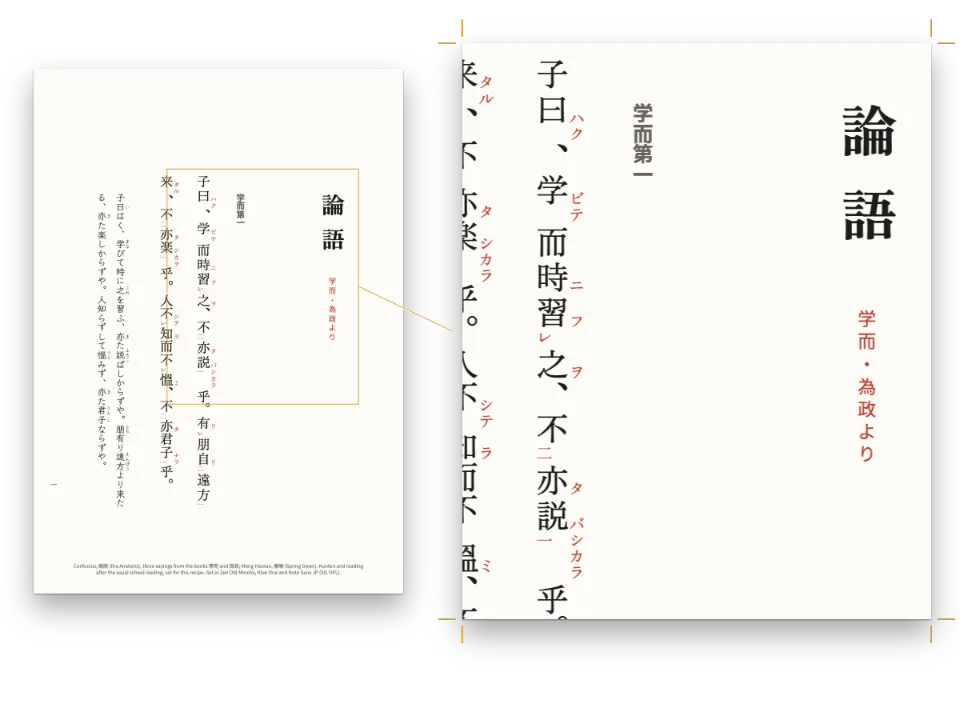
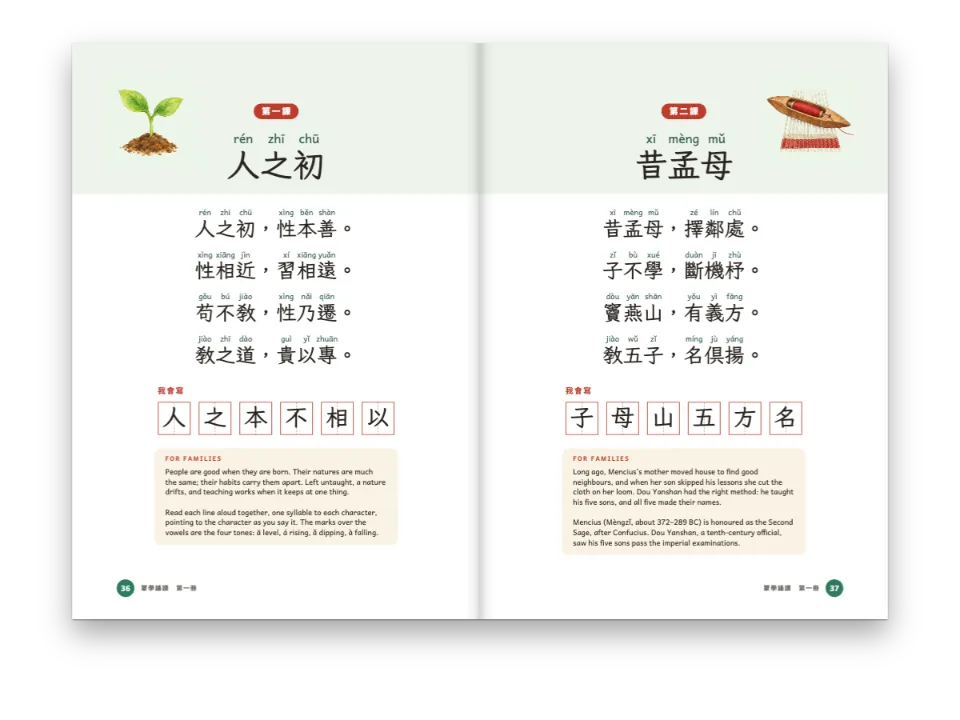
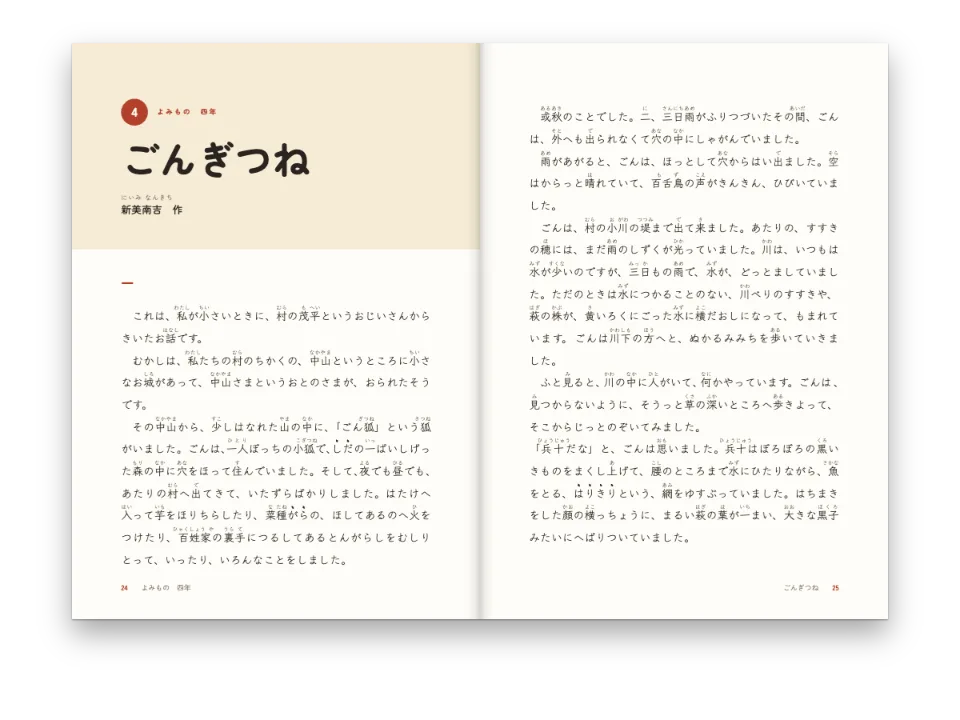
台湾の学校で使う国語の読本を、上から下へ読む縦の行で印刷します。漢字の一つひとつに小さな読み仮名のような発音記号が付き、子どもはまだ習っていない字も読めます。
できあがり
架空の台湾の小学5年生用読本『國語』第9冊の第12課です。『韓非子』から2つの寓話を採っています。切り株のそばでもう1匹のウサギを待つ宋の農夫と、自分の足より寸法書きを信じる鄭の男の話です。台湾の読本は楷書体の縦組みで、各字の右に注音を1列に添えるので、子どもは字を習う前にその字を読めます。課は右綴じの見開きで始まります。上段には絵、注、作者、新出字を入れ、下段には16ptのIansuiで1行23字の本文が続きます。ラテン文字での対応例は余白に段を設けた教科書で、そのフロート専用のサイド段を90°回したものが、ここでの上段にあたります。
このレシピが答える質問
- 縦組みの中国語のすべての文字の横に注音を付けるには?
- 中国語の本を縦組み・右綴じで組むには?
手短な答え
const layout = {
  writingMode: 'vertical-rl', // lines run down the page, read from the right; bound on the right
  layoutType: 'oneAndHalf', // two tiers: the text below, pictures and notes above
  sideColumnRole: 'floats', sideColumnSide: 'left', // 'left' is the top tier in vertical text
  sideColumnPercent: 34,
  gutterWidth: pt(2 * SIZE),
};
const cjk = {
  // The lower tier: 23 characters down, 13 lines across the page.
  grid: { enabled: true, charsPerLine: 23, linesPerPage: 13 },
  // Readings at half the text size; zhuyin sets its symbols at 60 % of that, 0.3 em,
  // so three symbols fit beside one character, and beside each of two in a row.
  ruby: { fontFamily: ZHUYIN, fontSize: em(0.5) },
};
// The line pitch is twice the size: a gap of one em, which the zhuyin and its tone
// marks half fill. clreq asks for 1.5 em; one em keeps 13 lines of 23 on the page.
const LINE = 2 * SIZE;
const bodyText = {
  fontFamily: KAI, fontSize: pt(SIZE), lineHeight: pt(LINE), color: col('ink'),
  boldColor: col('ink'), italicColor: col('ink'), referenceColor: col('ink'),
  textAlign: 'justify', firstLineIndent: em(2), indentAfterHeading: true,
};
材料
- 機能
- ルビ:ピンインと注音縦組み右綴じの本中国語・日本語・韓国語のフォント中国語の約物の幅文字グリッド1段半組みフロート用の余白段欄外の注中国語の漢数字番号付きリスト独自のリソースの種類囲み段落スタイル見出しスタイルページデザインのテキスト・罫・ボックス柱とノンブルPDFの書き出し
- 種類
- Iansui, LXGW WenKai TC, Noto Serif TC, Noto Sans TC (SIL OFL 1.1)
- 素材
plate-1-1500.jpgplate-2-1500.jpg- The farmer waiting by the stump, a brush painting (Generated With Diffusion Models, オリジナル)
- The man of Zheng hurrying home from the shoe stall, a brush painting (Generated With Diffusion Models, オリジナル)
作り方
#1 · 各字の横に注音の列
コードは前に掲げた手短な答えです。{宋人|ㄙㄨㄥˋ|ㄖㄣˊ}は、|で区切った読みを1字ずつ与えます。約物は波かっこの外に置くので、。や,には読みが付きません。縦組みでは、注音符号による読みは行の右に置かれ、記号は縦に積まれます。声調記号は最後の記号の右に、軽声の点は最初の記号の上に付きます。cjk.ruby.fontSizeを本文の半分にすると記号は0.3emで組まれ、3つの記号が1字の横に収まります。就像のように読みが2つ続いても、どちらの字も広げずに記号の4分の1以上の間隔を保ちます。0.6emにすると、ㄇㄧㄥˊは明より背が高くなり、明明の字間が広がります。32ptの行送りでは行間が1em残り、注音とその声調記号がその半分ほどを埋めます。clreqは縦組みの行の間に注音を置くとき1.5emの行間を求めますが、それは行送り40ptで1ページ10行になります。そこでこのページは行間を1emにして23字×13行とし、各読みは隣の行から約8ptの間隔を保っています。
#2 · 上段の絵と注
const resourceTypes = [{ id: 'plate', name: '插圖', shortLabel: '圖', numberingTemplate: '{n}',
  resetOn: 'never', counterFormat: 'decimal', captionPrefix: '' }]; // no prefix, no caption
const box = (id, title, body) => ({ id, title, background: col('tint'),
  padding: { top: mm(3), right: mm(3), bottom: mm(3), left: mm(3) },
  titleStyle: { fontFamily: HEI, fontSize: pt(11), fontWeight: 700, color: col('accent') },
  body: { color: col('ink'), firstLineIndent: pt(0), textAlign: 'left', boldColor: col('ink'),
    italicColor: col('ink'), ...body } });
// Zhuyin is 0.3 em of the text it reads: at 13 pt the notes' readings are 3.9 pt.
const calloutStyles = [ // fenced :::callout{type="notes" span="side"} in the text
  box('notes', '注釋', { fontFamily: MING, fontSize: pt(13), lineHeight: pt(24) }),
  box('author', '作者', { fontFamily: MING, fontSize: pt(13), lineHeight: pt(24),
    textAlign: 'justify', firstLineIndent: em(2) }),
  box('chars', '生字', { fontFamily: KAI, fontSize: pt(22), lineHeight: pt(40),
    textAlign: 'center' }),
];
縦組みでは、oneAndHalfレイアウトの段は上下の段になり、sideColumnSide: 'left'でフロート専用の段を上に置きます。本文中の::resource{id="plate-1"}が最初の絵をそこへ送ります。plateタイプにはキャプションの接頭辞がなく、絵にもキャプションがないので、絵の下には何も印刷されません。span="side"で記述した囲みは、記述した行から上段に入り、その文章は上段の中を下へ流れます。2つの寓話の注は1つの囲みにまとめ、課を通して番号を振り、86ページで終わる1つ目の原文の後に記述しています。注は87ページの上段を埋め、どちらの寓話の注も原文と同じ見開きに収まります。注音は読みを付ける文字の0.3emで、cjk.rubyは本全体で1つの設定です。そのため注と作者の囲みは13ptで組み、読みを3.9ptに保ちます。
#3 · 4つの書体、それぞれが自分のテキストだけを読み込む
// {株|ㄓㄨ}: the characters are the text, the readings go to the zhuyin face.
const BOXES = /^:::callout\{type="(?:notes|author)"[^}]*\}\n([\s\S]*?)^:::$/gm;
const bases = (md) => md.replace(/\{([^|{}]+)((?:\|[^|{}]+)+)\}/g, '$1');
const readings = [...markdown.matchAll(/\{[^|{}]+((?:\|[^|{}]+)+)\}/g)].map((m) => m[1]).join('');
await loadFonts(FONTS, markdown);
await loadCjkFonts({ [KAI]: ['400'] }, bases(markdown.replace(BOXES, '')), { vertical: true });
const notesText = [...markdown.matchAll(BOXES)].map((m) => m[1]).join('\n');
await loadCjkFonts({ [MING]: ['400'] }, bases(notesText), { vertical: true });
await loadCjkFonts({ [ZHUYIN]: ['400'] }, readings.replaceAll('|', ''), { vertical: true });
await loadCjkFonts({ [HEI]: ['400', '700'] }, LABELS, { vertical: true });
await Promise.all(Object.values(plates).map((fileId) => loadImage(fileId, asset(fileId))));
// Lesson 12 of a reader: page 86 is a verso, so the lesson opens on a spread.
const continuation = { pageIndexOffset: 1, pageNumbering: { startAt: 86 } };
const doc = await buildWithFonts(
  () => buildDocument({ markdown, resources, continuation }, config()), markdown);
showBook(doc, { title: t({ en: 'A vertical reader with zhuyin',
  es: 'Un libro de lectura vertical con zhuyin' }) });
offerPdf(() => renderToPdf(doc, { fontProvider: cjkPdfProvider, resourceBytes: imageBytes }),
  `${RECIPE}.pdf`);
課の本文はIansuiで組みます。Klee Oneをもとに、子どもが書き方を習う台湾の標準字体で描かれた楷書体です。読みはLXGW WenKai TCで組み、この書体の軽声の点は4.8ptでも丸いまま保たれます。注はNoto Serif TC、ラベルはNoto Sans TCです。各書体は、自分が組む字を含むファイルだけを読み込みます。読みはその字とは別に分けられ、注の囲みは明朝体だけに回されます。vertical: trueは縦組み用の字形を加えるので、「」や、が行の中で正しい向きに立ちます。pageIndexOffset: 1で86ページを偶数ページにし、課が見開きで始まるようにします。
#4 · 小口側のつめとノンブル
// The verso lies on the right of the spread, so even pages carry both at the right edge.
const tab = (parity, edge) => [
  { kind: 'box', id: `tab-${parity}`, parity, pages: 'all',
    placement: { anchor: { to: 'page', edge }, offset: { y: mm(24) },
      size: { width: mm(9), height: mm(64) } }, style: { backgroundColor: col('accent') } },
  { kind: 'text', id: `unit-${parity}`, content: '第三單元 寓言故事', parity, pages: 'all',
    writingMode: 'vertical-rl', fontFamily: HEI, fontSize: pt(9), fontWeight: 700,
    color: col('paper'), align: 'center', verticalAlign: 'middle',
    placement: { anchor: { to: `#tab-${parity}`, edge: 'align-top' },
      size: { width: mm(9), height: mm(64) } } },
];
const foot = (id, parity, edge, x, content, extra = {}) => ({
  kind: 'text', id, content, parity, pages: 'all', fontFamily: HEI, fontSize: pt(8),
  color: col('muted'), placement: { anchor: { to: 'page', edge }, offset: { x: mm(x), y: mm(-9) } },
  ...extra,
});
const folio = { fontSize: pt(9), fontWeight: 700 };
const header = { elements: [...tab('even', 'top-right'), ...tab('odd', 'top-left')] };
const footer = {
  elements: [
    foot('folio-even', 'even', 'bottom-right', -16, '{pageNumber}', folio),
    foot('book', 'even', 'bottom-right', -26, '國語 第九冊'),
    foot('folio-odd', 'odd', 'bottom-left', 16, '{pageNumber}', folio),
    foot('lesson', 'odd', 'bottom-left', 26, '{chapterTitle}'),
  ],
};
右綴じの本では偶数ページが見開きの右側に来るので、偶数ページは右端に、奇数ページは左端に単元のつめとノンブルを置きます。つめは箱の上にテキスト要素を重ねたものです。要素にwritingMode: 'vertical-rl'を指定して第三單元 寓言故事をつめの中で縦に組み、ノンブルと地の行は横組みのままにします。
レシピの全体
// ═══ Postext Cookbook · Nº 080 · A vertical reader with zhuyin to the right ═════════ // https://postext.dev/en/cookbook/zhuyin-vertical-reader // Code: MIT · Text: Han Feizi, zh.wikisource (CC BY-SA 4.0) · Pictures: diffusion models // Fonts: Iansui, LXGW WenKai TC, Noto Serif TC, Noto Sans TC (SIL OFL 1.1) · Needs postext ≥ 1.9.0 import { buildDocument, renderPageToCanvas, clearMeasurementCache, registerResourceImage, loadVerticalAlternates, } from 'https://esm.sh/postext'; import { renderToPdf, decompressWoff2 } from 'https://esm.sh/postext-pdf'; const LANG = 'en'; // @lang: the language of the sample document ('en' | 'es') const RECIPE = 'zhuyin-vertical-reader'; // ─── 1 · Design ───────────────────────────────────────────────────────────── // #region palette: semantic colours, every one linked by id const palette = { ink: '#2b2520', // text and zhuyin accent: '#b83f28', // lesson title, labels, the unit's tab (4.9:1 on the tint) tint: '#f7efdf', // the boxes of the upper tier muted: '#72675b', // lead, folios, colophon paper: '#ffffff', // the lettering on the tab }; const col = (id) => ({ hex: palette[id], model: 'hex', paletteId: id }); const colorPalette = [ ...Object.entries(palette).map(([id, hex]) => ({ id, name: id, value: { hex, model: 'hex' } })), { id: 'main-color', name: 'accent (defaults)', value: { hex: palette.accent, model: 'hex' } }, ]; // #endregion const KAI = 'Iansui'; // 楷: the lesson, drawn to Taiwan's standard forms (為, not 爲) const ZHUYIN = 'LXGW WenKai TC'; // the readings: a round dot for the neutral tone const MING = 'Noto Serif TC'; // 明: notes and the author box const HEI = 'Noto Sans TC'; // 黑: labels, folios, the tab const SIZE = 16; // the text size (三號) // #region answer: vertical text with a zhuyin column right of every character const layout = { writingMode: 'vertical-rl', // lines run down the page, read from the right; bound on the right layoutType: 'oneAndHalf', // two tiers: the text below, pictures and notes above sideColumnRole: 'floats', sideColumnSide: 'left', // 'left' is the top tier in vertical text sideColumnPercent: 34, gutterWidth: pt(2 * SIZE), }; const cjk = { // The lower tier: 23 characters down, 13 lines across the page. grid: { enabled: true, charsPerLine: 23, linesPerPage: 13 }, // Readings at half the text size; zhuyin sets its symbols at 60 % of that, 0.3 em, // so three symbols fit beside one character, and beside each of two in a row. ruby: { fontFamily: ZHUYIN, fontSize: em(0.5) }, }; // The line pitch is twice the size: a gap of one em, which the zhuyin and its tone // marks half fill. clreq asks for 1.5 em; one em keeps 13 lines of 23 on the page. const LINE = 2 * SIZE; const bodyText = { fontFamily: KAI, fontSize: pt(SIZE), lineHeight: pt(LINE), color: col('ink'), boldColor: col('ink'), italicColor: col('ink'), referenceColor: col('ink'), textAlign: 'justify', firstLineIndent: em(2), indentAfterHeading: true, }; // #endregion // #region upper-tier: pictures without a caption line, boxes of notes set down the tier const resourceTypes = [{ id: 'plate', name: '插圖', shortLabel: '圖', numberingTemplate: '{n}', resetOn: 'never', counterFormat: 'decimal', captionPrefix: '' }]; // no prefix, no caption const box = (id, title, body) => ({ id, title, background: col('tint'), padding: { top: mm(3), right: mm(3), bottom: mm(3), left: mm(3) }, titleStyle: { fontFamily: HEI, fontSize: pt(11), fontWeight: 700, color: col('accent') }, body: { color: col('ink'), firstLineIndent: pt(0), textAlign: 'left', boldColor: col('ink'), italicColor: col('ink'), ...body } }); // Zhuyin is 0.3 em of the text it reads: at 13 pt the notes' readings are 3.9 pt. const calloutStyles = [ // fenced :::callout{type="notes" span="side"} in the text box('notes', '注釋', { fontFamily: MING, fontSize: pt(13), lineHeight: pt(24) }), box('author', '作者', { fontFamily: MING, fontSize: pt(13), lineHeight: pt(24), textAlign: 'justify', firstLineIndent: em(2) }), box('chars', '生字', { fontFamily: KAI, fontSize: pt(22), lineHeight: pt(40), textAlign: 'center' }), ]; // #endregion // #region furniture: the unit's tab and the folios, on the outer edge of a right-bound book // The verso lies on the right of the spread, so even pages carry both at the right edge. const tab = (parity, edge) => [ { kind: 'box', id: `tab-${parity}`, parity, pages: 'all', placement: { anchor: { to: 'page', edge }, offset: { y: mm(24) }, size: { width: mm(9), height: mm(64) } }, style: { backgroundColor: col('accent') } }, { kind: 'text', id: `unit-${parity}`, content: '第三單元 寓言故事', parity, pages: 'all', writingMode: 'vertical-rl', fontFamily: HEI, fontSize: pt(9), fontWeight: 700, color: col('paper'), align: 'center', verticalAlign: 'middle', placement: { anchor: { to: `#tab-${parity}`, edge: 'align-top' }, size: { width: mm(9), height: mm(64) } } }, ]; const foot = (id, parity, edge, x, content, extra = {}) => ({ kind: 'text', id, content, parity, pages: 'all', fontFamily: HEI, fontSize: pt(8), color: col('muted'), placement: { anchor: { to: 'page', edge }, offset: { x: mm(x), y: mm(-9) } }, ...extra, }); const folio = { fontSize: pt(9), fontWeight: 700 }; const header = { elements: [...tab('even', 'top-right'), ...tab('odd', 'top-left')] }; const footer = { elements: [ foot('folio-even', 'even', 'bottom-right', -16, '{pageNumber}', folio), foot('book', 'even', 'bottom-right', -26, '國語 第九冊'), foot('folio-odd', 'odd', 'bottom-left', 16, '{pageNumber}', folio), foot('lesson', 'odd', 'bottom-left', 26, '{chapterTitle}'), ], }; // #endregion const config = () => ({ // a factory: the engine caches resolved configs per object locale: 'zh-Hant', // Taiwan: full-width punctuation, centred in its cell (gotcha: cjk-locale-tag) colorPalette, resourceTypes, page: { sizePreset: 'custom', width: mm(184), height: mm(260), dpi: 150, // 16開 margins: { top: mm(24), bottom: mm(18), left: mm(18), right: mm(16), mirror: true }, }, layout, cjk, bodyText, headings: { fontFamily: KAI, color: col('ink'), fontWeight: 400, // Iansui has one weight levels: [ // The lesson and fable numbers are typed in the headings: a numberingTemplate would // join the number to the title's first reading (see the recipe's workarounds). { level: 1, fontSize: pt(30), lineHeight: pt(2 * LINE), color: col('accent'), breakBefore: { enabled: true, parity: 'any' }, marginBottom: pt(0) }, { level: 2, fontSize: pt(20), lineHeight: pt(2 * LINE), marginTop: pt(LINE), marginBottom: pt(0) }, { level: 3, fontFamily: HEI, fontWeight: 700, fontSize: pt(13), lineHeight: pt(LINE), color: col('accent'), marginTop: pt(LINE / 2), marginBottom: pt(0) }, ], }, // 想一想 and 語文天地: exercise heads in the label face, one line tall. headingStyles: [{ id: 'drill', fontFamily: HEI, fontWeight: 700, fontSize: pt(13), lineHeight: pt(LINE), color: col('accent'), marginTop: pt(LINE / 2), marginBottom: pt(0) }], orderedLists: { numberFormat: 'trad-chinese-informal', separator: '、', color: col('accent'), fontFamily: HEI, fontWeight: 700, marginTop: pt(0), marginBottom: pt(0) }, paragraphStyles: [ { id: 'lead', fontFamily: KAI, fontSize: pt(14), lineHeight: pt(LINE), color: col('muted'), textAlign: 'justify', firstLineIndent: em(0) }, { id: 'plain', fontFamily: KAI, fontSize: pt(14), lineHeight: pt(LINE), color: col('ink'), textAlign: 'justify', firstLineIndent: em(2) }, { id: 'idiom', fontFamily: KAI, fontSize: pt(SIZE), lineHeight: pt(LINE), color: col('ink'), boldColor: col('accent'), boldFontWeight: 400, textAlign: 'justify', // bold in colour only firstLineIndent: em(0) }, { id: 'colophon', fontFamily: HEI, fontSize: pt(7), lineHeight: pt(11), color: col('muted'), textAlign: 'left', firstLineIndent: pt(0), marginTop: pt(LINE) }, ], calloutStyles, header, footer, }); // ─── 2 · Content ──────────────────────────────────────────────────────────── const markdown = String.raw`# 第十二課 {寓言兩則|ㄩˋ|ㄧㄢˊ|ㄌㄧㄤˇ|ㄗㄜˊ}Markdownの見本 · 91行 · content.en.md
:::paragraphs{style="lead"} {寓言用一個短短的故事|ㄩˋ|ㄧㄢˊ|ㄩㄥˋ|ㄧ|˙ㄍㄜ|ㄉㄨㄢˇ|ㄉㄨㄢˇ|˙ㄉㄜ|ㄍㄨˋ|˙ㄕ},{說出一個道理|ㄕㄨㄛ|ㄔㄨ|ㄧ|˙ㄍㄜ|ㄉㄠˋ|ㄌㄧˇ}。{這一課的兩則寓言|ㄓㄜˋ|ㄧ|ㄎㄜˋ|˙ㄉㄜ|ㄌㄧㄤˇ|ㄗㄜˊ|ㄩˋ|ㄧㄢˊ},{都選自戰國時代韓非所寫的|ㄉㄡ|ㄒㄩㄢˇ|ㄗˋ|ㄓㄢˋ|ㄍㄨㄛˊ|ㄕˊ|ㄉㄞˋ|ㄏㄢˊ|ㄈㄟ|ㄙㄨㄛˇ|ㄒㄧㄝˇ|˙ㄉㄜ}《{韓非子|ㄏㄢˊ|ㄈㄟ|ㄗˇ}》。{讀的時候想一想|ㄉㄨˊ|˙ㄉㄜ|ㄕˊ|ㄏㄡˋ|ㄒㄧㄤˇ|ㄧ|ㄒㄧㄤˇ}:{故事裡的人|ㄍㄨˋ|˙ㄕ|ㄌㄧˇ|˙ㄉㄜ|ㄖㄣˊ},{錯在哪裡|ㄘㄨㄛˋ|ㄗㄞˋ|ㄋㄚˇ|ㄌㄧˇ}? ::: ::resource{id="plate-1"} ## 一 {守株待兔|ㄕㄡˇ|ㄓㄨ|ㄉㄞˋ|ㄊㄨˋ} {宋人有耕田者|ㄙㄨㄥˋ|ㄖㄣˊ|ㄧㄡˇ|ㄍㄥ|ㄊㄧㄢˊ|ㄓㄜˇ},{田中有株|ㄊㄧㄢˊ|ㄓㄨㄥ|ㄧㄡˇ|ㄓㄨ},{兔走觸株|ㄊㄨˋ|ㄗㄡˇ|ㄔㄨˋ|ㄓㄨ},{折頸而死|ㄓㄜˊ|ㄐㄧㄥˇ|ㄦˊ|ㄙˇ},{因釋其耒而守株|ㄧㄣ|ㄕˋ|ㄑㄧˊ|ㄌㄟˇ|ㄦˊ|ㄕㄡˇ|ㄓㄨ},{冀復得兔|ㄐㄧˋ|ㄈㄨˋ|ㄉㄜˊ|ㄊㄨˋ},{兔不可復得|ㄊㄨˋ|ㄅㄨˋ|ㄎㄜˇ|ㄈㄨˋ|ㄉㄜˊ},{而身為宋國笑|ㄦˊ|ㄕㄣ|ㄨㄟˊ|ㄙㄨㄥˋ|ㄍㄨㄛˊ|ㄒㄧㄠˋ}。 :::callout{type="notes" span="side"} ①{株|ㄓㄨ}:露出地面的樹根。 ②{走|ㄗㄡˇ}:跑。 ③{觸|ㄔㄨˋ}:碰,撞。 ④{釋|ㄕˋ}:放下。 ⑤{耒|ㄌㄟˇ}:古代翻土用的農具。 ⑥{冀|ㄐㄧˋ}:希望。 ⑦{為宋國笑|ㄨㄟˊ|ㄙㄨㄥˋ|ㄍㄨㄛˊ|ㄒㄧㄠˋ}:被宋國人譏笑。 ⑧{且置履|ㄑㄧㄝˇ|ㄓˋ|ㄌㄩˇ}:將要買鞋。 ⑨{度|ㄉㄨㄛˋ}:量長短。 ⑩{坐|ㄗㄨㄛˋ}:同「座」,座位。 ⑪{操|ㄘㄠ}:拿,帶著。 ⑫{度|ㄉㄨˋ}:量好的尺碼。 ⑬{反|ㄈㄢˇ}:同「返」,回去。 ⑭{罷|ㄅㄚˋ}:結束,散了。 ⑮{寧|ㄋㄧㄥˊ}:寧可。 ::: ### {語譯|ㄩˇ|ㄧˋ} :::paragraphs{style="plain"} {宋國有一個種田的人|ㄙㄨㄥˋ|ㄍㄨㄛˊ|ㄧㄡˇ|ㄧ|˙ㄍㄜ|ㄓㄨㄥˋ|ㄊㄧㄢˊ|˙ㄉㄜ|ㄖㄣˊ},{田裡有一截樹樁|ㄊㄧㄢˊ|ㄌㄧˇ|ㄧㄡˇ|ㄧ|ㄐㄧㄝˊ|ㄕㄨˋ|ㄓㄨㄤ}。{有一天|ㄧㄡˇ|ㄧ|ㄊㄧㄢ},{一隻兔子跑過來|ㄧ|ㄓ|ㄊㄨˋ|˙ㄗ|ㄆㄠˇ|ㄍㄨㄛˋ|˙ㄌㄞ},{一頭撞在樹樁上|ㄧ|ㄊㄡˊ|ㄓㄨㄤˋ|ㄗㄞˋ|ㄕㄨˋ|ㄓㄨㄤ|ㄕㄤˋ},{折斷脖子死了|ㄓㄜˊ|ㄉㄨㄢˋ|ㄅㄛˊ|˙ㄗ|ㄙˇ|˙ㄌㄜ}。{這個人就放下手裡的農具|ㄓㄜˋ|˙ㄍㄜ|ㄖㄣˊ|ㄐㄧㄡˋ|ㄈㄤˋ|ㄒㄧㄚˋ|ㄕㄡˇ|ㄌㄧˇ|˙ㄉㄜ|ㄋㄨㄥˊ|ㄐㄩˋ},{天天守在樹樁旁邊|ㄊㄧㄢ|ㄊㄧㄢ|ㄕㄡˇ|ㄗㄞˋ|ㄕㄨˋ|ㄓㄨㄤ|ㄆㄤˊ|ㄅㄧㄢ},{希望再撿到兔子|ㄒㄧ|ㄨㄤˋ|ㄗㄞˋ|ㄐㄧㄢˇ|ㄉㄠˋ|ㄊㄨˋ|˙ㄗ}。{兔子再也沒有來過|ㄊㄨˋ|˙ㄗ|ㄗㄞˋ|ㄧㄝˇ|ㄇㄟˊ|ㄧㄡˇ|ㄌㄞˊ|ㄍㄨㄛˋ},{他自己倒成了宋國人的笑話|ㄊㄚ|ㄗˋ|ㄐㄧˇ|ㄉㄠˋ|ㄔㄥˊ|˙ㄌㄜ|ㄙㄨㄥˋ|ㄍㄨㄛˊ|ㄖㄣˊ|˙ㄉㄜ|ㄒㄧㄠˋ|ㄏㄨㄚˋ}。 ::: ::resource{id="plate-2"} ## 二 {鄭人買履|ㄓㄥˋ|ㄖㄣˊ|ㄇㄞˇ|ㄌㄩˇ} {鄭人有且置履者|ㄓㄥˋ|ㄖㄣˊ|ㄧㄡˇ|ㄑㄧㄝˇ|ㄓˋ|ㄌㄩˇ|ㄓㄜˇ},{先自度其足而置之其坐|ㄒㄧㄢ|ㄗˋ|ㄉㄨㄛˋ|ㄑㄧˊ|ㄗㄨˊ|ㄦˊ|ㄓˋ|ㄓ|ㄑㄧˊ|ㄗㄨㄛˋ},{至之市而忘操之|ㄓˋ|ㄓ|ㄕˋ|ㄦˊ|ㄨㄤˋ|ㄘㄠ|ㄓ}。{已得履|ㄧˇ|ㄉㄜˊ|ㄌㄩˇ},{乃曰|ㄋㄞˇ|ㄩㄝ}:「{吾忘持度|ㄨˊ|ㄨㄤˋ|ㄔˊ|ㄉㄨˋ}。」{反歸取之|ㄈㄢˇ|ㄍㄨㄟ|ㄑㄩˇ|ㄓ}。{及反|ㄐㄧˊ|ㄈㄢˇ},{市罷|ㄕˋ|ㄅㄚˋ},{遂不得履|ㄙㄨㄟˋ|ㄅㄨˋ|ㄉㄜˊ|ㄌㄩˇ}。{人曰|ㄖㄣˊ|ㄩㄝ}:「{何不試之以足|ㄏㄜˊ|ㄅㄨˋ|ㄕˋ|ㄓ|ㄧˇ|ㄗㄨˊ}?」{曰|ㄩㄝ}:「{寧信度|ㄋㄧㄥˊ|ㄒㄧㄣˋ|ㄉㄨˋ},{無自信也|ㄨˊ|ㄗˋ|ㄒㄧㄣˋ|ㄧㄝˇ}。」 ### {語譯|ㄩˇ|ㄧˋ} :::paragraphs{style="plain"} {鄭國有個人要買鞋子|ㄓㄥˋ|ㄍㄨㄛˊ|ㄧㄡˇ|˙ㄍㄜ|ㄖㄣˊ|ㄧㄠˋ|ㄇㄞˇ|ㄒㄧㄝˊ|˙ㄗ}。{他先在家裡量好自己腳的大小|ㄊㄚ|ㄒㄧㄢ|ㄗㄞˋ|ㄐㄧㄚ|˙ㄌㄧ|ㄌㄧㄤˊ|ㄏㄠˇ|ㄗˋ|ㄐㄧˇ|ㄐㄧㄠˇ|˙ㄉㄜ|ㄉㄚˋ|ㄒㄧㄠˇ},{把量好的尺碼放在座位上|ㄅㄚˇ|ㄌㄧㄤˊ|ㄏㄠˇ|˙ㄉㄜ|ㄔˇ|ㄇㄚˇ|ㄈㄤˋ|ㄗㄞˋ|ㄗㄨㄛˋ|ㄨㄟˋ|ㄕㄤˋ}。{到了市場|ㄉㄠˋ|˙ㄌㄜ|ㄕˋ|ㄔㄤˊ},{卻忘了把尺碼帶在身上|ㄑㄩㄝˋ|ㄨㄤˋ|˙ㄌㄜ|ㄅㄚˇ|ㄔˇ|ㄇㄚˇ|ㄉㄞˋ|ㄗㄞˋ|ㄕㄣ|ㄕㄤˋ}。{他已經挑好了鞋子|ㄊㄚ|ㄧˇ|ㄐㄧㄥ|ㄊㄧㄠ|ㄏㄠˇ|˙ㄌㄜ|ㄒㄧㄝˊ|˙ㄗ},{才說|ㄘㄞˊ|ㄕㄨㄛ}:「{我忘了帶尺碼|ㄨㄛˇ|ㄨㄤˋ|˙ㄌㄜ|ㄉㄞˋ|ㄔˇ|ㄇㄚˇ}。」{就轉身回家去拿|ㄐㄧㄡˋ|ㄓㄨㄢˇ|ㄕㄣ|ㄏㄨㄟˊ|ㄐㄧㄚ|ㄑㄩˋ|ㄋㄚˊ}。{等他再回到市場|ㄉㄥˇ|ㄊㄚ|ㄗㄞˋ|ㄏㄨㄟˊ|ㄉㄠˋ|ㄕˋ|ㄔㄤˊ},{市場已經散了|ㄕˋ|ㄔㄤˊ|ㄧˇ|ㄐㄧㄥ|ㄙㄢˋ|˙ㄌㄜ},{終於沒買到鞋子|ㄓㄨㄥ|ㄩˊ|ㄇㄟˊ|ㄇㄞˇ|ㄉㄠˋ|ㄒㄧㄝˊ|˙ㄗ}。{有人問他|ㄧㄡˇ|ㄖㄣˊ|ㄨㄣˋ|ㄊㄚ}:「{為什麼不用腳試穿呢|ㄨㄟˋ|ㄕㄣˊ|˙ㄇㄜ|ㄅㄨˋ|ㄩㄥˋ|ㄐㄧㄠˇ|ㄕˋ|ㄔㄨㄢ|˙ㄋㄜ}?」{他說|ㄊㄚ|ㄕㄨㄛ}:「{我寧可相信尺碼|ㄨㄛˇ|ㄋㄧㄥˊ|ㄎㄜˇ|ㄒㄧㄤ|ㄒㄧㄣˋ|ㄔˇ|ㄇㄚˇ},{也不相信自己的腳|ㄧㄝˇ|ㄅㄨˋ|ㄒㄧㄤ|ㄒㄧㄣˋ|ㄗˋ|ㄐㄧˇ|˙ㄉㄜ|ㄐㄧㄠˇ}。」 ::: ## {想一想|ㄒㄧㄤˇ|ㄧ|ㄒㄧㄤˇ} {style="drill"} 1. {宋國的農夫為什麼成了別人的笑話|ㄙㄨㄥˋ|ㄍㄨㄛˊ|˙ㄉㄜ|ㄋㄨㄥˊ|ㄈㄨ|ㄨㄟˋ|ㄕㄣˊ|˙ㄇㄜ|ㄔㄥˊ|˙ㄌㄜ|ㄅㄧㄝˊ|ㄖㄣˊ|˙ㄉㄜ|ㄒㄧㄠˋ|ㄏㄨㄚˋ}? 2. {鄭國人明明到了市場|ㄓㄥˋ|ㄍㄨㄛˊ|ㄖㄣˊ|ㄇㄧㄥˊ|ㄇㄧㄥˊ|ㄉㄠˋ|˙ㄌㄜ|ㄕˋ|ㄔㄤˊ},{為什麼沒買到鞋子|ㄨㄟˋ|ㄕㄣˊ|˙ㄇㄜ|ㄇㄟˊ|ㄇㄞˇ|ㄉㄠˋ|ㄒㄧㄝˊ|˙ㄗ}? 3. {這兩個人做錯的地方|ㄓㄜˋ|ㄌㄧㄤˇ|˙ㄍㄜ|ㄖㄣˊ|ㄗㄨㄛˋ|ㄘㄨㄛˋ|˙ㄉㄜ|ㄉㄧˋ|ㄈㄤ},{有什麼相同|ㄧㄡˇ|ㄕㄣˊ|˙ㄇㄜ|ㄒㄧㄤ|ㄊㄨㄥˊ}? :::callout{type="author" span="side"} {韓非|ㄏㄢˊ|ㄈㄟ},戰國時代韓國的貴族,大約生於西元前二八〇年,死於西元前二三三年。他和{李斯|ㄌㄧˇ|ㄙ}都是{荀子|ㄒㄩㄣˊ|ㄗˇ}的學生,說話口吃,卻很會寫文章。後人把他的文章編成《韓非子》,書中有許多有趣的寓言故事。 ::: ## {語文天地|ㄩˇ|ㄨㄣˊ|ㄊㄧㄢ|ㄉㄧˋ} {style="drill"} 「{守株待兔|ㄕㄡˇ|ㄓㄨ|ㄉㄞˋ|ㄊㄨˋ}」{與|ㄩˇ}「{鄭人買履|ㄓㄥˋ|ㄖㄣˊ|ㄇㄞˇ|ㄌㄩˇ}」{後來都成了成語|ㄏㄡˋ|ㄌㄞˊ|ㄉㄡ|ㄔㄥˊ|˙ㄌㄜ|ㄔㄥˊ|ㄩˇ}。 :::paragraphs{style="idiom"} **{守株待兔|ㄕㄡˇ|ㄓㄨ|ㄉㄞˋ|ㄊㄨˋ}**:{比喻不肯努力|ㄅㄧˇ|ㄩˋ|ㄅㄨˋ|ㄎㄣˇ|ㄋㄨˇ|ㄌㄧˋ},{只想白白得到好處|ㄓˇ|ㄒㄧㄤˇ|ㄅㄞˊ|ㄅㄞˊ|ㄉㄜˊ|ㄉㄠˋ|ㄏㄠˇ|ㄔㄨˋ}。{例|ㄌㄧˋ}:{考試前不讀書|ㄎㄠˇ|ㄕˋ|ㄑㄧㄢˊ|ㄅㄨˋ|ㄉㄨˊ|ㄕㄨ},{只希望考的題目剛好都會|ㄓˇ|ㄒㄧ|ㄨㄤˋ|ㄎㄠˇ|˙ㄉㄜ|ㄊㄧˊ|ㄇㄨˋ|ㄍㄤ|ㄏㄠˇ|ㄉㄡ|ㄏㄨㄟˋ},{這就是守株待兔|ㄓㄜˋ|ㄐㄧㄡˋ|ㄕˋ|ㄕㄡˇ|ㄓㄨ|ㄉㄞˋ|ㄊㄨˋ}。 **{鄭人買履|ㄓㄥˋ|ㄖㄣˊ|ㄇㄞˇ|ㄌㄩˇ}**:{比喻只相信死板的規定|ㄅㄧˇ|ㄩˋ|ㄓˇ|ㄒㄧㄤ|ㄒㄧㄣˋ|ㄙˇ|ㄅㄢˇ|˙ㄉㄜ|ㄍㄨㄟ|ㄉㄧㄥˋ},{不看實際的情形|ㄅㄨˋ|ㄎㄢˋ|ㄕˊ|ㄐㄧˋ|˙ㄉㄜ|ㄑㄧㄥˊ|ㄒㄧㄥˊ}。{例|ㄌㄧˋ}:{買衣服不試穿|ㄇㄞˇ|ㄧ|˙ㄈㄨ|ㄅㄨˋ|ㄕˋ|ㄔㄨㄢ},{只看尺寸|ㄓˇ|ㄎㄢˋ|ㄔˊ|˙ㄘㄨㄣ},{就像鄭人買履|ㄐㄧㄡˋ|ㄒㄧㄤˋ|ㄓㄥˋ|ㄖㄣˊ|ㄇㄞˇ|ㄌㄩˇ}。 ::: :::callout{type="chars" span="side"} {株|ㄓㄨ} {耒|ㄌㄟˇ} {冀|ㄐㄧˋ} {履|ㄌㄩˇ} {罷|ㄅㄚˋ} {遂|ㄙㄨㄟˋ} ::: :::paragraphs{style="colophon"} Set in Iansui, LXGW WenKai TC, Noto Serif TC and Noto Sans TC (SIL OFL). Text: Han Feizi, chapters :sideways[49] and :sideways[32], Chinese Wikisource, revisions 2642850 and 2327662 (CC BY-SA 4.0). Zhuyin checked against the Revised Mandarin Chinese Dictionary (Ministry of Education, Taiwan); modern versions, notes and exercises written for this recipe (CC BY 4.0). :::`; // content.<lang>.md, inlined by the Cookbook // ─── 3 · Fonts ────────────────────────────────────────────────────────────── const FONTS = { Iansui: ['400'], 'LXGW WenKai TC': ['400'], 'Noto Serif TC': ['400'], 'Noto Sans TC': ['400', '700'], }; // What the label face sets: the tab, the foot of the page, box titles and exercise heads. const LABELS = '第三單元寓言故事國語第九冊十二課兩則注釋作者生字語譯想一文天地、0123456789'; // #region art: two brush paintings for the upper tier, JPEGs in assets/ cut to 15 : 7 const plates = { 'plate-1': 'plate-1-1500.jpg', 'plate-2': 'plate-2-1500.jpg' }; // #endregion const altText = { 'plate-1': '守株待兔:農夫坐在樹樁旁,農具丟在田裡,一隻兔子跑遠了。', 'plate-2': '鄭人買履:鄭國人從鞋攤走回家,量好的尺碼還放在家門口的凳子上。', }; const resources = Object.entries(plates).map(([id, fileId]) => ({ id, typeId: 'plate', kind: 'bitmap', createdAt: 0, updatedAt: 0, altText: altText[id], placement: { span: 'side' }, bitmap: { fileId, format: 'jpeg', width: 1500, height: 700 } })); // declared at their pixels // ─── 4 · Build & show ─────────────────────────────────────────────────────── // #region build: each voice loads with the text it sets; vertical forms for the canvas // {株|ㄓㄨ}: the characters are the text, the readings go to the zhuyin face. const BOXES = /^:::callout\{type="(?:notes|author)"[^}]*\}\n([\s\S]*?)^:::$/gm; const bases = (md) => md.replace(/\{([^|{}]+)((?:\|[^|{}]+)+)\}/g, '$1'); const readings = [...markdown.matchAll(/\{[^|{}]+((?:\|[^|{}]+)+)\}/g)].map((m) => m[1]).join(''); await loadFonts(FONTS, markdown); await loadCjkFonts({ [KAI]: ['400'] }, bases(markdown.replace(BOXES, '')), { vertical: true }); const notesText = [...markdown.matchAll(BOXES)].map((m) => m[1]).join('\n'); await loadCjkFonts({ [MING]: ['400'] }, bases(notesText), { vertical: true }); await loadCjkFonts({ [ZHUYIN]: ['400'] }, readings.replaceAll('|', ''), { vertical: true }); await loadCjkFonts({ [HEI]: ['400', '700'] }, LABELS, { vertical: true }); await Promise.all(Object.values(plates).map((fileId) => loadImage(fileId, asset(fileId)))); // Lesson 12 of a reader: page 86 is a verso, so the lesson opens on a spread. const continuation = { pageIndexOffset: 1, pageNumbering: { startAt: 86 } }; const doc = await buildWithFonts( () => buildDocument({ markdown, resources, continuation }, config()), markdown); showBook(doc, { title: t({ en: 'A vertical reader with zhuyin', es: 'Un libro de lectura vertical con zhuyin' }) }); offerPdf(() => renderToPdf(doc, { fontProvider: cjkPdfProvider, resourceBytes: imageBytes }), `${RECIPE}.pdf`); // #endregionキット · core, fonts, viewer, pdf, images, cjk:全レシピ共通 · 488行
// ─── Kit ── helpers shared by every Cookbook recipe · postext.dev/cookbook ───── // ─── Kit · core v1 ── the same in every recipe · postext.dev/cookbook ───────── function mm(value) { return { value, unit: 'mm' }; } function pt(value) { return { value, unit: 'pt' }; } function em(value) { return { value, unit: 'em' }; } /** The sample language's string: t({ en: 'Figure', es: 'Figura' }). */ function t(strings) { return strings[LANG] ?? Object.values(strings)[0]; } /** A file in this recipe's assets folder, served from the Postext repo by jsDelivr. */ function asset(file) { return `https://cdn.jsdelivr.net/gh/drnachio/postext@main/cookbook/${RECIPE}/assets/${file}`; } // ─── Kit · fonts v1 ── the same in every recipe · postext.dev/cookbook ──────── // Postext measures text with the faces the browser has loaded, and caches the // widths, so every face must be ready before the first build. Faces come from // Fontsource: the same static files the PDF embeds, so screen and PDF agree. /** faces = { 'Family Name': ['400', '400i', '700'] }. `text` is the sample: * letters beyond Latin-1 (č, ł, ő…) also load the latin-ext files. With * `optional`, a face Fontsource does not ship is skipped instead of failing. * Resolves to the number of faces added. */ async function loadFonts(faces, text = '', { optional = false } = {}) { kitStatus('Loading fonts…'); const ranges = { latin: 'U+0000-00FF,U+0131,U+0152-0153,U+02BB-02BC,U+02C6,U+02DA,U+02DC,U+0304,U+0308,U+0329,' + 'U+2000-206F,U+20AC,U+2122,U+2191,U+2193,U+2212,U+2215,U+FEFF,U+FFFD', 'latin-ext': 'U+0100-02BA,U+02BD-02C5,U+02C7-02CC,U+02CE-02D7,U+02DD-02FF,U+0304,U+0308,U+0329,' + 'U+1D00-1DBF,U+1E00-1E9F,U+1EF2-1EFF,U+2020,U+20A0-20AB,U+20AD-20C0,U+2113,U+2C60-2C7F,U+A720-A7FF', }; const subsets = /[Ā-˿Ḁ-ỿ]/.test(text) ? ['latin', 'latin-ext'] : ['latin']; const jobs = []; let added = 0; for (const [family, specs] of Object.entries(faces)) { const id = fontsourceId(family); const meta = optional ? await fontsourceMeta(family) : null; for (const spec of new Set(specs)) { const weight = parseInt(spec, 10); const style = spec.endsWith('i') ? 'italic' : 'normal'; if (hasFace(family, weight, style)) continue; if (optional && !(meta?.weights.includes(weight) && meta.styles.includes(style))) continue; for (const subset of subsets) { const url = `https://cdn.jsdelivr.net/npm/@fontsource/${id}@5/files/${id}-${subset}-${weight}-${style}.woff2`; const face = new FontFace(family, `url(${url}) format('woff2')`, { weight: String(weight), style, unicodeRange: ranges[subset] }); jobs.push(face.load().then((ready) => { document.fonts.add(ready); added++; }, () => { if (subset === 'latin' && !optional) throw new Error(`Fontsource has no ${family} ${weight} ${style}`); })); } } } await Promise.all(jobs).catch((error) => { kitFail(error); throw error; }); return added; } /** Runs `build` (a buildDocument or buildBundle call) and checks the faces * the pages use. A regular face missing from FONTS is loaded with a warning; * bold and italic variants are loaded when the family ships them. Then the * measurement caches are cleared and the build runs again. */ async function buildWithFonts(build, text = '') { const tried = new Set(); for (let round = 0; round < 3; round++) { kitStatus('Laying out…'); await new Promise(requestAnimationFrame); // let the status paint first const result = await Promise.resolve().then(build).catch((error) => { kitFail(error); throw error; }); const wanted = { base: {}, variants: {} }; for (const { font, base } of [result].flat().flatMap(fontStringsOf)) { const { family, weight, style } = parseFont(font); const key = `${family}|${weight}|${style}`; if (tried.has(key) || hasFace(family, weight, style)) continue; tried.add(key); (wanted[base ? 'base' : 'variants'][family] ??= []).push(`${weight}${style === 'italic' ? 'i' : ''}`); } if (Object.keys(wanted.base).length) { console.warn(`[cookbook] FONTS does not list ${JSON.stringify(wanted.base)}: loading them.`); } const added = await loadFonts(wanted.base, text) + await loadFonts(wanted.variants, text, { optional: true }); if (added === 0) return result; clearMeasurementCache(); } throw new Error('The fonts did not settle after three builds.'); } /** Every font string of the layout. `base` marks a block's own face; its * bold, italic and bold-italic variants are listed whether or not used. */ function fontStringsOf(doc) { const found = new Map(); const walk = (node) => { if (!node || typeof node !== 'object') return; if (Array.isArray(node)) { node.forEach(walk); return; } for (const [key, value] of Object.entries(node)) { if (typeof value === 'string' && /fontString$/i.test(key)) { found.set(value, found.get(value) || key === 'fontString'); } else if (value && typeof value === 'object') walk(value); } }; walk(doc.pages); walk(doc.blocks); return [...found].map(([font, base]) => ({ font, base })); } /** '700 37.5px Open Sans' / 'italic 400 13px "Source Serif 4"' → { family, weight, style }. * A string with no weight ('95.8px Young Serif', from a design text) is 400. */ function parseFont(font) { const m = /^(?:(italic|oblique)\s+)?(?:small-caps\s+)?(?:(\d+|bold|normal)\s+)?[\d.]+px\s+(.+)$/.exec(font.trim()); if (!m) throw new Error(`Unexpected font string: ${font}`); const weight = m[2] === 'bold' ? 700 : !m[2] || m[2] === 'normal' ? 400 : Number(m[2]); return { family: m[3].replace(/^["']|["']$/g, ''), weight, style: m[1] ? 'italic' : 'normal' }; } /** True when a loaded FontFace covers exactly this family, weight and style * (document.fonts.check() is also true for families nobody declared). */ function hasFace(family, weight, style) { for (const face of document.fonts) { if (face.status !== 'loaded' || face.style !== style) continue; if (face.family.replace(/^["']|["']$/g, '') !== family) continue; const [low, high = low] = face.weight.split(' ').map(Number); if (weight >= low && weight <= high) return true; } return false; } /** Fontsource's id for a family: 'Source Serif 4' → 'source-serif-4'. */ function fontsourceId(family) { return family.toLowerCase().replace(/\s+/g, '-'); } /** The weights and styles a family ships ({ weights: [400, 700], styles: ['normal', 'italic'] }), or null. */ function fontsourceMeta(family) { fontsourceMeta.cache ??= new Map(); const id = fontsourceId(family); if (!fontsourceMeta.cache.has(id)) { fontsourceMeta.cache.set(id, fetch(`https://api.fontsource.org/v1/fonts/${id}`) .then((res) => (res.ok ? res.json() : null), () => null)); } return fontsourceMeta.cache.get(id); } // ─── Kit · viewer v1 ── the same in every recipe · postext.dev/cookbook ─────── /** Shows the pages as facing spreads on a dark desk: the first page is a * recto on its own, then verso | recto pairs, as in a bound book. Pages * are painted when they scroll near the screen. */ function showPages(docs, { title, width = 460 } = {}) { const root = viewer(title); const pages = [docs].flat().flatMap((doc) => doc.pages.map((page) => ({ doc, page, n: (doc.pageIndexOffset ?? 0) + page.index }))); const spreads = []; let verso = null; for (const p of pages) { if (p.n % 2 === 1) { if (verso) spreads.push([verso, null]); verso = p; } else { spreads.push([verso, p]); verso = null; } } if (verso) spreads.push([verso, null]); const density = Math.min(window.devicePixelRatio || 1, 2); showPages.painter?.disconnect(); const painter = new IntersectionObserver((entries) => { for (const { isIntersecting, target } of entries) { if (!isIntersecting) continue; painter.unobserve(target); const { doc, page } = target.postext; renderPageToCanvas(page, doc, target, { scale: (width * density) / page.width }); } }, { rootMargin: '800px' }); showPages.painter = painter; root.replaceChildren(...spreads.map((pair) => { const spread = document.createElement('div'); spread.className = 'pt-spread'; for (const p of pair) { const figure = document.createElement('figure'); if (p) { const label = p.page.pageLabel || String(p.n + 1); const canvas = document.createElement('canvas'); canvas.postext = p; canvas.style.aspectRatio = `${p.page.width} / ${p.page.height}`; canvas.setAttribute('role', 'img'); canvas.setAttribute('aria-label', `Page ${label}`); const folio = document.createElement('figcaption'); folio.textContent = label; figure.append(canvas, folio); painter.observe(canvas); } else figure.className = 'pt-blank'; spread.append(figure); } return spread; })); kitStatus(`${pages.length} ${pages.length === 1 ? 'page' : 'pages'}`); document.documentElement.dataset.postext = 'ready'; return pages.length; } /** The desk, the bar and the error reporting, created once. */ function viewer(title) { if (!document.getElementById('pt-kit')) { document.head.insertAdjacentHTML('beforeend', `<style id="pt-kit"> :root { color-scheme: dark; } body { margin: 0; background: #0e1014; color: #b9bcc4; font: 13px/1.45 system-ui, sans-serif; } #pt-bar { position: sticky; top: 0; z-index: 1; display: flex; flex-wrap: wrap; align-items: center; gap: 6px 16px; padding: 10px 16px; background: rgb(14 16 20 / .92); backdrop-filter: blur(6px); border-bottom: 1px solid #23262d; } #pt-bar strong { color: #f4f1ea; font-weight: 600; } #pt-actions { display: flex; gap: 12px; margin-left: auto; } #pt-actions a, #pt-actions button { color: #d8a21a; font: inherit; background: none; border: 0; padding: 0; cursor: pointer; } #pages { display: grid; justify-items: center; gap: 48px; padding: 32px 16px 72px; } .pt-spread { display: flex; } .pt-spread figure { margin: 0; width: min(460px, 44vw); } .pt-spread canvas { display: block; width: 100%; background: #fff; box-shadow: 0 1px 2px rgb(0 0 0 / .5), 0 22px 44px -16px rgb(0 0 0 / .8); } .pt-spread figure:first-child canvas { box-shadow: inset -14px 0 14px -14px rgb(0 0 0 / .18), 0 1px 2px rgb(0 0 0 / .5), 0 22px 44px -16px rgb(0 0 0 / .8); } .pt-spread figcaption { margin-top: 10px; text-align: center; font: 600 10px/1 system-ui, sans-serif; letter-spacing: .18em; text-transform: uppercase; color: #6c7079; } .pt-blank { visibility: hidden; } @media (max-width: 760px) { .pt-spread { flex-direction: column; gap: 32px; } .pt-spread figure { width: min(460px, 92vw); } .pt-blank { display: none; } } </style>`); document.body.insertAdjacentHTML('afterbegin', '<header id="pt-bar"><strong id="pt-title"></strong><span id="pt-status" role="status"></span><span id="pt-actions"></span></header>'); document.getElementById('pt-title').textContent = document.title || 'Postext'; addEventListener('error', (event) => kitFail(event.error ?? event.message)); addEventListener('unhandledrejection', (event) => kitFail(event.reason)); } if (title) document.getElementById('pt-title').textContent = title; return document.getElementById('pages') ?? document.body.appendChild(Object.assign(document.createElement('main'), { id: 'pages' })); } function kitStatus(text) { viewer(); document.getElementById('pt-status').textContent = text; } function kitFail(error) { document.documentElement.dataset.postext = 'error'; kitStatus(`Error: ${error?.message ?? error}`); } // ─── Kit · pdf v1 ── the same in every recipe that exports a PDF ────────────── /** postext-pdf embeds TrueType bytes. Fetch the Fontsource file the screen * used, snapping to a weight the family ships and falling back to upright * when it has no italic: the PDF asks for every face a block could use. */ async function fontsourceProvider(family, weight, style) { const id = fontsourceId(family); const meta = await fontsourceMeta(family); const weights = meta?.weights?.length ? meta.weights : [400, 700]; const w = weights.reduce((a, b) => (Math.abs(b - weight) < Math.abs(a - weight) ? b : a)); const s = style === 'italic' && meta && !meta.styles.includes('italic') ? 'normal' : style; const res = await fetch(`https://cdn.jsdelivr.net/npm/@fontsource/${id}@5/files/${id}-latin-${w}-${s}.woff2`); if (!res.ok) throw new Error(`Fontsource has no ${family} ${w} ${s} (${res.status})`); return decompressWoff2(new Uint8Array(await res.arrayBuffer())); } /** A "Build the PDF" button in the bar. Once built: "Open the PDF" (a new * tab, since CodePen's preview frame cannot show PDFs) and a download link. */ function offerPdf(makePdf, filename) { viewer(); const button = Object.assign(document.createElement('button'), { type: 'button', textContent: 'Build the PDF' }); button.dataset.postextPdf = filename; button.addEventListener('click', async () => { button.disabled = true; button.textContent = 'Building the PDF…'; try { const bytes = await makePdf(); const url = URL.createObjectURL(new Blob([bytes], { type: 'application/pdf' })); const size = `${Math.max(1, Math.round(bytes.length / 1024))} KB`; button.replaceWith( Object.assign(document.createElement('a'), { href: url, target: '_blank', rel: 'noopener', textContent: 'Open the PDF ↗' }), Object.assign(document.createElement('a'), { href: url, download: filename, textContent: `Download ${filename} · ${size}` })); } catch (error) { button.disabled = false; button.textContent = 'Build the PDF'; kitFail(error); } }); document.getElementById('pt-actions').append(button); } // ─── Kit · images v1 ── recipes with pictures · postext.dev/cookbook ────────── /** Registers a photo or PNG for the canvas and keeps its bytes for the PDF. * fetch → ImageBitmap never taints the canvas (a plain cross-origin <img> would). */ async function loadImage(fileId, url) { const res = await fetch(url); if (!res.ok) throw new Error(`Image not found (${res.status}): ${url}`); const bytes = new Uint8Array(await res.arrayBuffer()); registerResourceImage(fileId, await createImageBitmap(new Blob([bytes]))); (loadImage.bytes ??= new Map()).set(fileId, bytes); } /** Registers SVG markup (drawn in code, or fetched) as a vector image. */ async function loadSvg(fileId, svg) { const img = new Image(); img.src = `data:image/svg+xml;charset=utf-8,${encodeURIComponent(svg)}`; await img.decode(); registerResourceImage(fileId, img); (loadImage.bytes ??= new Map()).set(fileId, new TextEncoder().encode(svg)); } /** renderToPdf({ resourceBytes: imageBytes }) */ function imageBytes(fileId) { return loadImage.bytes?.get(fileId); } /** renderToHtml({ resourceImageUrl: imageUrl }) */ function imageUrl(fileId) { const bytes = imageBytes(fileId); if (!bytes) return undefined; imageUrl.urls ??= new Map(); if (!imageUrl.urls.has(fileId)) { const type = /\.svg$/i.test(fileId) ? 'image/svg+xml' : /\.png$/i.test(fileId) ? 'image/png' : 'image/jpeg'; imageUrl.urls.set(fileId, URL.createObjectURL(new Blob([bytes], { type }))); } return imageUrl.urls.get(fileId); } // ─── Kit · cjk v1 ── Chinese, Japanese and Korean books · postext.dev/cookbook ─ // Fontsource ships a CJK family as about a hundred files per weight, each // declared in its stylesheet with the unicode-range it covers. The screen // loads the files the sample touches; the PDF gets the same files for the // characters its pages set in each face, and embeds each as a subset. // A book bound on the right (vertical text) is shown with its spreads // mirrored: page 1 alone on the left of the spine, then [3 | 2]. /** The files of a Fontsource face, read from its stylesheet: { url, range, * ranges }, the last declared first (the order the browser tries them in). */ function cjkSlices(family, weight, style) { cjkSlices.cache ??= new Map(); const id = fontsourceId(family); const css = `https://cdn.jsdelivr.net/npm/@fontsource/${id}@5/${weight}${style === 'italic' ? '-italic' : ''}.css`; if (!cjkSlices.cache.has(css)) { cjkSlices.cache.set(css, fetch(css) .then((res) => { if (!res.ok) throw new Error(`Fontsource has no ${family} ${weight} ${style} (${res.status})`); return res.text(); }) .then((text) => [...text.matchAll(/@font-face\s*{([^}]*)}/g)].map(([, rule]) => { const range = /unicode-range:\s*([^;]+);/.exec(rule)?.[1].trim() ?? 'U+0-10FFFF'; const ranges = range.split(',').map((part) => { const [lo, hi = lo] = part.trim().slice(2).split('-'); return [parseInt(lo, 16), parseInt(hi, 16)]; }); return { url: new URL(/url\(([^)]+?\.woff2)\)/.exec(rule)[1], css).href, range, ranges }; }).reverse())); } return cjkSlices.cache.get(css); } /** The file of `slices` that holds code point `cp`, if any. */ function cjkSliceFor(slices, cp) { return slices.find((slice) => slice.ranges.some(([lo, hi]) => cp >= lo && cp <= hi)); } /** Whether Fontsource serves `family` as a Chinese, Japanese or Korean * family (its subsets name the script). Fails when the API does not * answer: a CJK face taken for a Latin one would paint in a system face. */ async function isCjkFamily(family) { const meta = await fontsourceMeta(family); if (!meta) throw new Error(`api.fontsource.org did not describe ${family}: reload to try again`); return !!meta.subsets?.some((subset) => /^(chinese|japanese|korean)/.test(subset)); } /** faces = { 'Noto Serif TC': ['400', '700'] }, as for loadFonts: the * whole FONTS object may be passed, its other families are left to * loadFonts. Adds one FontFace per file of each CJK face with its * unicodeRange, then loads the files `text` touches. `text` is what the * faces set: the sample for the text face; a book in several voices calls * it once per voice (loadCjkFonts({ 'LXGW WenKai TC': ['400'] }, quotes)), * so the heading and quotation faces fetch and check only their own * characters. Fails when a character of `text` is in no file of a face. * List every weight the pages use: a weight left to buildWithFonts gets * the latin file only. With { vertical: true } it also loads each * family's vertical forms (brackets, quotes, pause marks) for the canvas, * which needs loadVerticalAlternates imported from postext. Resolves to * the number of files loaded. */ async function loadCjkFonts(faces, text, { vertical = false } = {}) { kitStatus('Loading fonts…'); let loaded = 0; try { if (vertical && typeof loadVerticalAlternates !== 'function') { throw new Error('loadCjkFonts(…, { vertical: true }) needs loadVerticalAlternates imported from postext'); } for (const [family, specs] of Object.entries(faces)) { if (!(await isCjkFamily(family))) continue; const twin = []; for (const spec of new Set(specs)) { const weight = parseInt(spec, 10); const style = spec.endsWith('i') ? 'italic' : 'normal'; const slices = await cjkSlices(family, weight, style); const missing = [...new Set(text)].filter((ch) => /\S/.test(ch) && !cjkSliceFor(slices, ch.codePointAt(0))); if (missing.length) { throw new Error(`${family} ${spec} has no file for ${missing.slice(0, 12).join(' ')}: ` + `give each face the text it sets (loadCjkFonts({ '${family}': ['${spec}'] }, text))`); } for (const slice of slices) { document.fonts.add(new FontFace(family, `url(${slice.url}) format('woff2')`, { weight: String(weight), style, unicodeRange: slice.range })); twin.push({ source: slice.url, weight: String(weight), style, unicodeRange: slice.range }); } const font = `${style === 'italic' ? 'italic ' : ''}${weight} 16px "${family}"`; loaded += (await document.fonts.load(font, text)).length; if (!document.fonts.check(font, text)) throw new Error(`${family} ${spec} did not load for the sample`); } // The same files under a twin name with the `vert` feature on: the // canvas paints the punctuation of vertical lines with it. if (vertical && twin.length) await loadVerticalAlternates(family, twin); } } catch (error) { kitFail(error); throw error; } return loaded; } /** The PDF font provider for recipes with CJK faces: a family whose * Fontsource subsets are Chinese, Japanese or Korean gets the files that * hold the characters its pages set (`request.codePoints`); any other * family gets the latin file fontsourceProvider fetches (the "pdf" block) * and, when the face sets letters only latin-ext has, that file too. */ async function cjkPdfProvider(family, weight, style, request) { if (!(await isCjkFamily(family))) return cjkLatinPdfFiles(family, weight, style, request); const meta = await fontsourceMeta(family); const weights = meta.weights?.length ? meta.weights : [400, 700]; const w = weights.reduce((a, b) => (Math.abs(b - weight) < Math.abs(a - weight) ? b : a)); const s = style === 'italic' && !meta.styles.includes('italic') ? 'normal' : style; const slices = await cjkSlices(family, w, s); const picked = new Set(); for (const cp of request?.codePoints ?? []) { const slice = cjkSliceFor(slices, cp); if (slice) picked.add(slice); } if (!picked.size) picked.add(slices[0]); return Promise.all(slices.filter((slice) => picked.has(slice)).map(async (slice) => { const res = await fetch(slice.url); if (!res.ok) throw new Error(`Fontsource file ${slice.url} (${res.status})`); return decompressWoff2(new Uint8Array(await res.arrayBuffer())); })); } /** A Latin family set next to the CJK faces: its latin file, then its * latin-ext file when the face sets letters only latin-ext has (ō ū in * Hepburn rōmaji, ǎ in pinyin), the file loadFonts adds on screen for * them. Latin comes first: postext-pdf draws a character from the first * file that has it, as the browser takes a character both files hold from * latin. A face Fontsource ships without latin-ext, or whose file does * not come, gets latin alone, and the PDF names the letters it lacks. */ async function cjkLatinPdfFiles(family, weight, style, request) { const meta = await fontsourceMeta(family); const beyond = [...(request?.codePoints ?? [])].some(cjkLatinExtOnly); if (!beyond || !meta?.subsets?.includes('latin-ext')) return fontsourceProvider(family, weight, style); const weights = meta.weights?.length ? meta.weights : [400, 700]; const w = weights.reduce((a, b) => (Math.abs(b - weight) < Math.abs(a - weight) ? b : a)); const s = style === 'italic' && !meta.styles.includes('italic') ? 'normal' : style; const id = fontsourceId(family); const url = `https://cdn.jsdelivr.net/npm/@fontsource/${id}@5/files/${id}-latin-ext-${w}-${s}.woff2`; const [latin, ext] = await Promise.all([fontsourceProvider(family, weight, style), fetch(url) .then(async (res) => (res.ok ? decompressWoff2(new Uint8Array(await res.arrayBuffer())) : null), () => null)]); return ext ? [latin, ext] : latin; } /** Whether code point `cp` is in Fontsource's latin-ext file and not in * its latin file: Latin Extended-A and -B, IPA, the spacing modifiers and * Latin Extended Additional (loadFonts's test for latin-ext), less the * few latin holds too (ı Œ œ ʻ ʼ ˆ ˚ ˜). */ function cjkLatinExtOnly(cp) { if (!((cp >= 0x100 && cp <= 0x2ff) || (cp >= 0x1e00 && cp <= 0x1eff))) return false; return ![0x131, 0x152, 0x153, 0x2bb, 0x2bc, 0x2c6, 0x2da, 0x2dc].includes(cp); } /** showPages for a book bound on either edge. A right-bound book (the * document says so: doc.binding is 'right' for page.binding 'right' and * for vertical text) lies on the desk as it opens: page 1 alone on the * left of the spine, then [3 | 2], the spine shade on each page's inner * edge. `binding` ('left' | 'right') overrides the document's. */ function showBook(docs, { binding, ...options } = {}) { const count = showPages(docs, options); const right = (binding ?? [docs].flat()[0]?.binding) === 'right'; if (!document.getElementById('pt-kit-cjk')) { // The pages keep direction ltr: a canvas draws text in the direction its // element inherits, and under rtl each run would end where the engine // starts it, its brackets mirrored. document.head.insertAdjacentHTML('beforeend', `<style id="pt-kit-cjk"> .pt-spread[dir="rtl"] canvas { direction: ltr; } .pt-spread[dir="rtl"] figure:first-child canvas { box-shadow: inset 14px 0 14px -14px rgb(0 0 0 / .18), 0 1px 2px rgb(0 0 0 / .5), 0 22px 44px -16px rgb(0 0 0 / .8); } </style>`); } // Each pair stays [verso, recto] in the page; right to left, the verso // sits on the right. Phones stack the pages in reading order either way. for (const spread of document.querySelectorAll('#pages > .pt-spread')) spread.dir = right ? 'rtl' : 'ltr'; document.getElementById('pages').dataset.binding = right ? 'right' : 'left'; return count; } // ─── /Kit ───────────────────────────────────────────────────────────────────────
組み立てたscript.jsはそのまま動きます。任意のページのモジュールスクリプトに貼り付けるか、レシピをCodePenで開いてください。 GitHub上のレシピのフォルダー ↗ (新しいタブで開きます)
アレンジ
よくあるつまずき
つまずき
ルビは本文に出て、デザイン、キャプション、セルには出ない
ルビは段落、見出し、リスト項目、引用、囲みで描かれます。デザインのテキスト要素(章扉、柱、バッジ)、キャプション、脚注、表のセルでは、ルビなしで親文字だけが印字されます。ピンインが必要なタイトルは、独自のデザインを持たない見出しにしてください。その周り(帯や課の番号)は直前の見出しのデザインで描きます。reserve: falseの要素は、span: 'page'の章扉の本文の下に描かれます。 ルビ:ピンインと注音 →
つまずき
縦組みのサイド段はページを横切る段になり、'left'は天側
layout.writingModeが'vertical-rl'のとき、ページは横組みのページを90度回したものになるため、oneAndHalfレイアウトのサイド段はページを横切る段になります。sideColumnSide 'left'はそれを天側、頭注(眉批)の位置に置き、'right'は地側に置きます。'outer'と'inner'は'right'と'left'として読まれる(横切る段には小口側の端がない)ため、教科書の余白の段に使う'outer'では注が地側に行きます。sideColumnPercentはページの高さに対する割合です。 フロート用の余白段 →
つまずき
中国語の書体はcjkブロックを通じてスライス単位で読み込む
Fontsourceは中国語、日本語、韓国語のファミリーを、ウェイトごとに約100個のファイルとして配信し、各ファイルが文字の範囲を受け持ちます。loadFontsが取得するのはlatinファイルだけなので、画面では漢字がシステムの書体で出て計測が狂い、fontsourceProviderはPDFにそのlatinファイルを渡すため、漢字が空の四角で印字されます。キットのcjkブロックを挙げ、loadFontsのあとにloadCjkFonts(FONTS, markdown)を呼び(本で複数のCJK書体を使うときは、それぞれの書体で組むテキストを渡して書体ごとに1回)、renderToPdfにfontProvider: cjkPdfProviderを渡してください。どちらもテキストの文字を含むファイルを取得します。 中国語・日本語・韓国語のフォント →
つまずき
右綴じの本の見開きはshowBookで表示する
右綴じの本(アラビア語、ヘブライ語、ペルシア語のテキスト、縦組みの中国語、またはpage.binding 'right')でも1ページは奇数ページですが、背の左側に来て、見開きは[3 | 2]と並びます。showPagesはどの本も左綴じとして並べます。bookブロックのshowBook(cjkブロックにも同じ関数があります)はdoc.bindingを読み、見開きを左右反転します。capture.heroでは、見開きは引き続き読む順の[偶数ページ, 奇数ページ]、つまり[2, 3]と指定します。 右綴じの本 →
つまずき
文書のタグはLANGではなくzh-Hansかzh-Hantにする
レシピの版はenとesですが、中国語のサンプルはどちらの版でも中国語です。`locale: LANG`では英語やスペイン語とタグ付けされ、ラテン文字の語がハイフネーションされ、図にFigureやFiguraの表示名が付き、PDFの言語も誤ります。タグは自分で書いてください。'zh-Hans'(中国本土の慣習:GBの改行規則、開明式の約物)または'zh-Hant'(台湾:全角で中央に置く約物)、香港なら'zh-HK'です。単なる'zh'は簡体字、本土として読まれます。日本語のサンプルには'ja'を使います(つまずき「ja-locale-tag」)。 中国語の改行 →
-
読みは台湾の辞書から取ってください。pypinyinをはじめ、中国本土の辞書をもとにしたツールは、度をduó、寧をnìng、時候をshíhou、市場をshìchǎngとします。台湾の読本が従う教育部の『重編國語辭典修訂本』(Revised Mandarin Chinese Dictionary)は、ㄉㄨㄛˋ、ㄋㄧㄥˊ、ㄕˊ ㄏㄡˋ、ㄕˋ ㄔㄤˊと読み、故事、家裡、過來の2音節目を軽声にします。moedict.twで1語ずつ引けます。この辞書は一と不を本来の声調のまま示しており、この課もそれに従っています。
-
書体を混ぜる前に、それぞれの書体で何字か組んでみてください。LXGW WenKai TCは伝統的な字形に従い、為(U+70BA)を爲の形で描きます。そのため、この書体で組んだ課では同じ見開きの本文に爲宋國笑、明朝体の注に為宋國笑と印刷されてしまいました。Iansuiは標準字体の為を描きます。
-
課と寓話の番号は見出しに直接入力しています(
# 第十二課 {寓言兩則|…})。numberingTemplateを使うと番号が題の最初の字とつながり、その字に読みがあると、読みが番号と字を合わせた幅の中央に置かれてしまいます。 -
各ページの上段に何が入るかを数え、そのページに余裕がある位置で各囲みを記述してください。作者の囲みは語文天地の前に記述して89ページの上段の先頭に来るようにし、成語の後に記述した新出字の囲みがそれに続きます。本文が終わるまでに場所が見つからない囲みや絵は、下に何もないページに組まれ、その次のものは警告なしに省かれます。すべてがページに載っているか確かめてください。
-
Iansuiのウェイトは1つだけです。見出しは大きさで、成語の見出し語は色で目立たせます。
idiomスタイルはboldFontWeight: 400とし、アクセント色をboldColorにしているので、**…**は書体ではなく色を変えます。
クレジット
- 本文
- Han Feizi, chapter 49, “Wu du” (The five vermin): the man of Song who waited by the stump · Han Fei; transcription and punctuation by Wikisource editors (爲 set as 為, the Taiwan standard form) · CC BY-SA 4.0
- Han Feizi, chapter 32, “Wai chu shuo zuo shang”: the man of Zheng who went to buy shoes · Han Fei; transcription and punctuation by Wikisource editors · CC BY-SA 4.0
- The zhuyin (checked against the Ministry of Education's Revised Mandarin Chinese Dictionary), the modern Chinese versions, the notes, the author box, the lead and the exercises, written for this recipe · Postext Cookbook · CC BY 4.0
- 画像
- The farmer waiting by the stump, a brush painting · Generated With Diffusion Models · オリジナル
- The man of Zheng hurrying home from the shoe stall, a brush painting · Generated With Diffusion Models · オリジナル
- フォント
- Iansui (SIL OFL 1.1) · LXGW WenKai TC (SIL OFL 1.1) · Noto Serif TC (SIL OFL 1.1) · Noto Sans TC (SIL OFL 1.1)