かんたんな説明
1912年の中国語の文書2編を、上から下へ読む縦の行で印刷した例です。日付や数字、ラテン文字を縦書きの文章の中で読みやすく組む方法を示します。
できあがり
中華民国の建国期の文書2編を収めた7ページの読本です。1912年1月1日の就任にあたって孫文が発した宣言書と、3月11日の臨時約法の第1章・第2章を、右綴じの184 × 260 mmのページに縦組みで組みます。文書そのものは漢数字のまま、民國元年三月十一日と書きます。楷書体の解題と注は、西暦の日付、数量、号数をアラビア数字で示しており、このレシピが組むのはその数字です。10月10日は1字分に数字1つずつ正立し、1912とSun Yat-senは横倒しになり、民國115年は3桁を1字分に収め、ROCは文字を縦に積みます。二重罫に囲まれた朱色の表紙、各文書の冒頭の朱色の帯、漢数字のノンブルを伴う小口側の柱が本文を囲みます。
このレシピが答える質問
- 縦組みの中で、日付や数字を正立させるには?
- 中国語の本を縦組み・右綴じで組むには?
- 版面を字数で設定し、1行の字数と1ページの行数を決めるには?
手短な答え
const layout = { layoutType: 'single', writingMode: 'vertical-rl' }; // binding 'auto': right
const cjk = {
  // 10月10日: each number of up to two digits stands upright in one cell (tate-chu-yoko);
  // 1912 and Sun Yat-sen stay on their side, as clreq sets long numbers and Latin words.
  uprightDigits: 2,
  // The type area in characters: 44 down each line, 19 lines to the page.
  grid: { enabled: true, charsPerLine: CHARS, linesPerPage: 19 },
};
// By hand, in the Markdown: 民國:tcy[115]年 puts three digits in one cell, :upright[ROC]
// stands each letter of an acronym upright, :sideways[…] turns any run with the line.
材料
- 機能
- 縦組みの中の正立した数字縦組み右綴じの本文字グリッド中国語の漢数字中国語・日本語・韓国語のフォント中国語の約物の幅中国語の改行デザインした章扉見出しスタイル見出しの属性段落スタイル柱とノンブルページデザインのテキスト・罫・ボックス用紙の色セマンティックカラーパレットPDFの書き出しPDFに埋め込むフォント
- 種類
- Noto Serif TC, Noto Sans TC, LXGW WenKai TC (SIL OFL 1.1)
- 素材
- なし:図はすべてコードで描画
作り方
#1 · 短い数字は設定に任せる
コードは上の手短な答えにあります。cjk.uprightDigits: 2にすると、縦組みの中の1桁か2桁の数字の並びはすべて1字(1 em)分の枠に正立し、2桁なら横に並びます。10月10日、第35號、7章56條にマークアップは要りません。それより長い数字はラテン文字の語と同じく全体が横倒しになります。clreqも4桁の数字をそう組むので、1912や1644は90°回って行に沿って読まれます。正立させたい3桁の数字には印を付けます。民國:tcy[115]年は115を1字分に詰めます。:upright[ROC]は文字を1字ずつそれぞれの枠に縦に立て、その中では行を分割しません(縦組みの数字)。
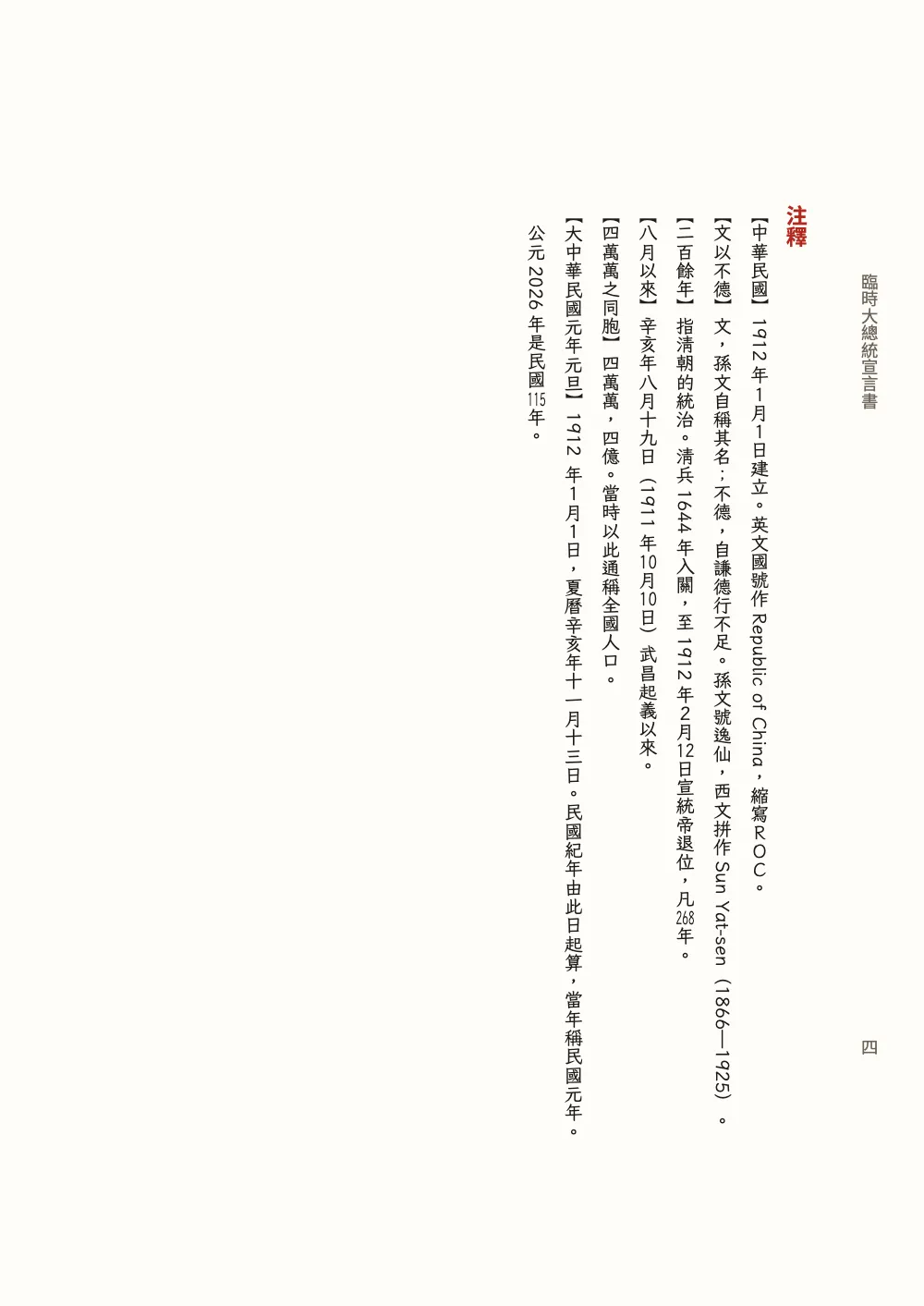
1912年の本文は刊行当時のままです。編者の注は台湾の数字表記の規則、2004年の行政院による公文書橫式書寫數字使用原則に従います。日付、番号、数量はアラビア数字(1912年3月8日、第35號、7章56條)、固有名詞、成句、概数は漢数字(東三省、四萬萬、四億)で、旧暦の日付、辛亥年八月十九日も漢数字です。注が文書の見出しや用語を引くときは、第一章や二十二行省のように元の形を保ちます。これらの規則は横書きの文書のために書かれたものです。縦に組むと、その数字こそがレシピで正立させなければならないものになります。
#2 · 各文書を右側の帯で始める
// The margins are minimums: the grid centres the 44 characters (186.3 mm) between them,
// so the type area starts HEAD mm down the sheet. The band's title starts there too.
const HEAD = MARGIN.top + (TRIM.h - MARGIN.top - MARGIN.bottom - LINE) / 2;
const BAND = 42; // mm from the right trim edge: where a reader of vertical text starts
const onBand = { color: col('paper'), overflow: 'wrap' };
// In the flow of a vertical page x runs down the sheet and y leftward from its right edge.
const at = (x, y, extra = {}) => ({ anchor: { to: 'page', edge: 'top-left' },
  offset: { x: mm(x), y: mm(y) }, ...extra });
const opener = {
  enabled: true,
  minHeight: mm(BAND - 15), // past the side margin (21.6 mm), 6 mm of paper before the text
  slot: { elements: [
    { kind: 'box', id: 'band', style: { backgroundColor: col('seal') },
      placement: { anchor: { to: 'bleed', edge: 'top-left' }, size: { height: mm(BAND) } } },
    { kind: 'text', id: 'title', content: '{titleText}', ...onBand, fontFamily: HEI,
      fontWeight: 700, fontSize: pt(34), lineHeight: 1.2, letterSpacing: pt(4), align: 'left',
      placement: at(HEAD, 8) },
    { kind: 'text', id: 'latin', content: '{attr.latin}', ...onBand, fontFamily: HEI,
      fontSize: pt(9), lineHeight: 1.6, align: 'left', placement: at(HEAD, 25) },
    // The date ends where the lines of text end: align 'right' is the foot of a vertical line.
    { kind: 'text', id: 'date', content: '{attr.date}', ...onBand, fontFamily: HEI,
      fontWeight: 500, fontSize: pt(13), lineHeight: 1.2, align: 'right',
      placement: at(HEAD, 24, { size: { width: mm(LINE) } }) },
  ] },
};
縦の流れでは、ページの上は紙面の右端、つまり読み始めの位置です。そのため裁ち落としの上端に固定した見出しデザインは右端を縦に走る帯になり、size.heightが紙面上での帯の幅になります。オフセットも流れとともに回り、xは紙面の下方向へ、yは左方向へ測ります。グリッドは版面を余白の間の中央に置き、HEADがその和を繰り返すので、題はすべての行の1字目と同じ高さから始まります。align: 'right'は日付を行の地側、本文の行が終わる位置に置きます。cjk.uprightDigitsはデザインの文字にも効くので、3月11日の11は本文と同じく1字分に正立します。帯は裁ち落としの帯を敷いた章扉のものを90°回したものです。
見出しデザインには奇数・偶数の区別がないので、帯はつねに紙面の右端を走ります。右ページである2ページ目ではその端は小口ですが、右綴じの本の左ページである5ページ目では背になり、題は折り目から8 mm、21.6 mmののどの余白の内側から始まります。ホチキス留めの読本ならそれでも十分に開きます。糸綴じや無線綴じの本では、breakBefore.parity: 'even'で各文書を右ページから始めてください。その場合5ページ目は白ページになります。
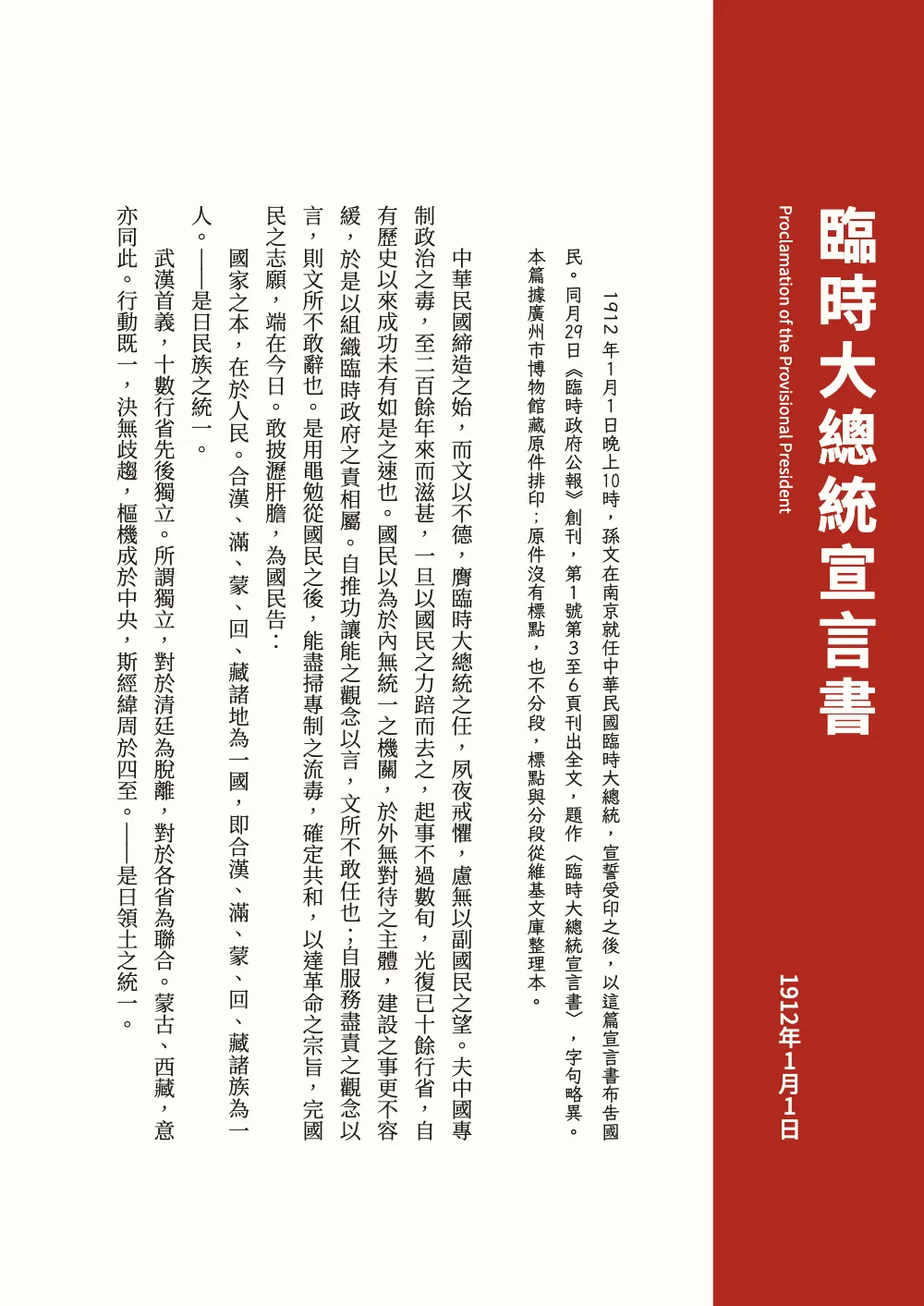
#3 · 柱を小口側に置く
const foreEdge = (id, content, edge, y) => ({
  kind: 'text', id, content, writingMode: 'vertical-rl', pages: 'body', align: 'left',
  fontFamily: HEI, fontSize: pt(9.6), color: col('muted'), overflow: 'clip',
  placement: { anchor: { to: 'outer', edge }, offset: { y: em(y) } },
});
const header = { elements: [
  foreEdge('head', '{chapterTitle}', 'top', 4), // four characters below the type area
  foreEdge('folio', '{pageNumber}', 'bottom', -5), // ends five characters above its foot
] };
anchor.to: 'outer'は背から遠い側の余白を指します。右綴じの本では、柱は奇数ページの左端と偶数ページの右端を縦に走ります。書名は版面の頭から4字下がって始まり、ノンブルは版面の地から5字上で終わります。どちらも本文サイズの80 %で縦に組みます(縦組みのテキスト要素)。pageNumbering.format: 'trad-chinese-informal'でノンブルは三、四、六、七と刷られ、pages: 'body'で2つの章扉には入りません。
#4 · ページ幅のデザインで表紙を裁ち落としまで塗る
const frame = (id, inset, width) => ({ kind: 'box', id,
  style: { borderColor: col('tint'), borderWidth: pt(width) },
  placement: at(inset, inset, { size: { width: mm(TRIM.h - 2 * inset),
    height: mm(TRIM.w - 2 * inset) } }) });
const coverLine = (id, content, y, align) => ({ kind: 'text', id, content, ...onBand,
  fontFamily: HEI, fontWeight: 500, fontSize: pt(18), lineHeight: 1.2, align,
  placement: at(HEAD, y, { size: { width: mm(LINE) } }) });
const cover = {
  id: 'cover', numbered: false, toc: false, runningChapter: false,
  span: 'page', // a page-wide design is not cut at the foot of the column: the field bleeds
  header: { elements: [] }, footer: { elements: [] },
  advancedDesign: { enabled: true, slot: { elements: [
    { kind: 'box', id: 'field', style: { backgroundColor: col('seal') },
      placement: { anchor: { to: 'bleed', edge: 'top-left' }, size: { height: mm(TRIM.w) } } },
    frame('rule-outer', 11, 1.6), frame('rule-inner', 13, 0.5), // 文武線: thick, then thin
    { kind: 'text', id: 'title', content: '{titleText}', ...onBand, fontFamily: HEI,
      fontWeight: 700, fontSize: pt(56), lineHeight: 1.1, letterSpacing: pt(5.6), align: 'left',
      placement: at(HEAD, 26) },
    { kind: 'text', id: 'latin', content: '{attr.latin}', ...onBand, fontFamily: HEI,
      fontSize: pt(11), lineHeight: 1.4, align: 'left', placement: at(HEAD, 51) },
    coverLine('first', '臨時大總統宣言書', 104, 'left'),
    coverLine('first-date', '1912年1月1日', 104, 'right'),
    coverLine('second', '中華民國臨時約法', 118, 'left'),
    coverLine('second-date', '1912年3月11日', 118, 'right'),
  ] } },
};
段の中の見出しデザインは段の地で切られます。縦組みのページではその地は左の余白なので、裁ち落としに固定した地色は左の仕上がり線の21.6 mm手前で止まっていました。span: 'page'にすると見出しはページ幅の帯として組まれ、切られないので、地色は両端に届きます。2つの枠は中国の刊本の太細の二重罫を描き、太さは1.6 ptと0.5 pt、間隔は2 mmです。
#5 · 声ごとに、その声が組む文字でフォントを読み込む
const voice = (styles) => (markdown.match(
  new RegExp(`:::paragraphs\\{style="(?:${styles})"\\}[\\s\\S]*?:::`, 'g')) ?? []).join('');
const kaiText = voice('headnote|note');
// Hei: headings and their attributes, seals, colophon, the cover's lines, folios 一 to 十.
const heiText = (markdown.match(/^#.*$/gm) ?? []).join('') + voice('seal|colophon')
  + '臨時大總統宣言書1912年1月1日中華民國臨時約法1912年3月11日一二三四五六七八九十';
Fontsourceはこれらの書体のウェイトごとに、文字の範囲を分担する約100個のファイルを配信しており、loadCjkFontsはテキストが触れるファイルを読み込みます。見出し、印記、奥付、表紙の行、ノンブルだけを渡すと、Noto Sans TCは各ウェイトで10ファイルを読み込みます。見本全体を渡すと35ファイルになり、それがウェイト3つ分です。LXGW WenKai TCには解題と注を渡し、16ファイルを読み込みます。渡したテキストが足りない書体があると、キャプチャーは失敗し(C12)、フォールバックの書体から借りなければならなかった文字を挙げます。
レシピの全体
// ═══ Postext Cookbook · Nº 081 · Dates and acronyms upright in vertical text ═══════ // https://postext.dev/en/cookbook/chinese-dates-upright // Code: MIT · Text: 1912 documents, zh.wikisource (CC BY-SA 4.0); notes (CC BY 4.0) // Fonts: Noto Serif TC, Noto Sans TC, LXGW WenKai TC (SIL OFL 1.1) · Needs postext ≥ 1.9.0 // Two founding documents of the Republic of China, 1912, set vertically as a reader. import { buildDocument, renderPageToCanvas, clearMeasurementCache, loadVerticalAlternates, } from 'https://esm.sh/postext'; import { renderToPdf, decompressWoff2 } from 'https://esm.sh/postext-pdf'; const LANG = 'en'; // @lang: the language of the sample document ('en' | 'es') const RECIPE = 'chinese-dates-upright'; // ─── 1 · Design ───────────────────────────────────────────────────────────── // #region palette: ink, the vermilion of a seal, and the paper of a gazette const palette = { ink: '#1e1a17', // text: a warm near-black seal: '#b1291f', // the one accent: the bands, the seal notes, the chapter heads tint: '#f6dccf', // the cover's double rule, a pale vermilion muted: '#6d645b', // fore-edge heads, the colophon paper: '#fffdf8', }; const col = (id) => ({ hex: palette[id], model: 'hex', paletteId: id }); const colorPalette = [ ...Object.entries(palette).map(([id, hex]) => ({ id, name: id, value: { hex, model: 'hex' } })), { id: 'main-color', name: 'seal (defaults)', value: { hex: palette.seal, model: 'hex' } }, ]; // #endregion const SONG = 'Noto Serif TC'; // 宋/明: the documents const HEI = 'Noto Sans TC'; // 黑: titles, heads, labels const KAI = 'LXGW WenKai TC'; // 楷: the editor's headnotes and notes const BODY = 12; // pt, 小四 const LEAD = 21; // pt: a line gap of 0.75 em const CHARS = 44; // characters to a line const LINE = (CHARS * BODY * 25.4) / 72; // mm: the length of a line, 186.3 const TRIM = { w: 184, h: 260 }; // mm, 16开 const MARGIN = { top: 30, bottom: 22, side: 20 }; // mm, minimums: 天头 deeper than 地脚 // #region answer: vertical text where numbers of one or two digits stand upright const layout = { layoutType: 'single', writingMode: 'vertical-rl' }; // binding 'auto': right const cjk = { // 10月10日: each number of up to two digits stands upright in one cell (tate-chu-yoko); // 1912 and Sun Yat-sen stay on their side, as clreq sets long numbers and Latin words. uprightDigits: 2, // The type area in characters: 44 down each line, 19 lines to the page. grid: { enabled: true, charsPerLine: CHARS, linesPerPage: 19 }, }; // By hand, in the Markdown: 民國:tcy[115]年 puts three digits in one cell, :upright[ROC] // stands each letter of an acronym upright, :sideways[…] turns any run with the line. // #endregion // #region opener: a vermilion band down the right edge, where each document begins // The margins are minimums: the grid centres the 44 characters (186.3 mm) between them, // so the type area starts HEAD mm down the sheet. The band's title starts there too. const HEAD = MARGIN.top + (TRIM.h - MARGIN.top - MARGIN.bottom - LINE) / 2; const BAND = 42; // mm from the right trim edge: where a reader of vertical text starts const onBand = { color: col('paper'), overflow: 'wrap' }; // In the flow of a vertical page x runs down the sheet and y leftward from its right edge. const at = (x, y, extra = {}) => ({ anchor: { to: 'page', edge: 'top-left' }, offset: { x: mm(x), y: mm(y) }, ...extra }); const opener = { enabled: true, minHeight: mm(BAND - 15), // past the side margin (21.6 mm), 6 mm of paper before the text slot: { elements: [ { kind: 'box', id: 'band', style: { backgroundColor: col('seal') }, placement: { anchor: { to: 'bleed', edge: 'top-left' }, size: { height: mm(BAND) } } }, { kind: 'text', id: 'title', content: '{titleText}', ...onBand, fontFamily: HEI, fontWeight: 700, fontSize: pt(34), lineHeight: 1.2, letterSpacing: pt(4), align: 'left', placement: at(HEAD, 8) }, { kind: 'text', id: 'latin', content: '{attr.latin}', ...onBand, fontFamily: HEI, fontSize: pt(9), lineHeight: 1.6, align: 'left', placement: at(HEAD, 25) }, // The date ends where the lines of text end: align 'right' is the foot of a vertical line. { kind: 'text', id: 'date', content: '{attr.date}', ...onBand, fontFamily: HEI, fontWeight: 500, fontSize: pt(13), lineHeight: 1.2, align: 'right', placement: at(HEAD, 24, { size: { width: mm(LINE) } }) }, ] }, }; // #endregion // #region heads: fore-edge heads, the folio in Chinese numerals const foreEdge = (id, content, edge, y) => ({ kind: 'text', id, content, writingMode: 'vertical-rl', pages: 'body', align: 'left', fontFamily: HEI, fontSize: pt(9.6), color: col('muted'), overflow: 'clip', placement: { anchor: { to: 'outer', edge }, offset: { y: em(y) } }, }); const header = { elements: [ foreEdge('head', '{chapterTitle}', 'top', 4), // four characters below the type area foreEdge('folio', '{pageNumber}', 'bottom', -5), // ends five characters above its foot ] }; // #endregion // #region cover: the title page, a vermilion field inside a double rule const frame = (id, inset, width) => ({ kind: 'box', id, style: { borderColor: col('tint'), borderWidth: pt(width) }, placement: at(inset, inset, { size: { width: mm(TRIM.h - 2 * inset), height: mm(TRIM.w - 2 * inset) } }) }); const coverLine = (id, content, y, align) => ({ kind: 'text', id, content, ...onBand, fontFamily: HEI, fontWeight: 500, fontSize: pt(18), lineHeight: 1.2, align, placement: at(HEAD, y, { size: { width: mm(LINE) } }) }); const cover = { id: 'cover', numbered: false, toc: false, runningChapter: false, span: 'page', // a page-wide design is not cut at the foot of the column: the field bleeds header: { elements: [] }, footer: { elements: [] }, advancedDesign: { enabled: true, slot: { elements: [ { kind: 'box', id: 'field', style: { backgroundColor: col('seal') }, placement: { anchor: { to: 'bleed', edge: 'top-left' }, size: { height: mm(TRIM.w) } } }, frame('rule-outer', 11, 1.6), frame('rule-inner', 13, 0.5), // 文武線: thick, then thin { kind: 'text', id: 'title', content: '{titleText}', ...onBand, fontFamily: HEI, fontWeight: 700, fontSize: pt(56), lineHeight: 1.1, letterSpacing: pt(5.6), align: 'left', placement: at(HEAD, 26) }, { kind: 'text', id: 'latin', content: '{attr.latin}', ...onBand, fontFamily: HEI, fontSize: pt(11), lineHeight: 1.4, align: 'left', placement: at(HEAD, 51) }, coverLine('first', '臨時大總統宣言書', 104, 'left'), coverLine('first-date', '1912年1月1日', 104, 'right'), coverLine('second', '中華民國臨時約法', 118, 'left'), coverLine('second-date', '1912年3月11日', 118, 'right'), ] } }, }; // #endregion const config = () => ({ // a factory: the engine caches resolved configs per object locale: 'zh-Hant', // Taiwan conventions: centred punctuation (gotcha: cjk-locale-tag) colorPalette, page: { sizePreset: 'custom', width: mm(TRIM.w), height: mm(TRIM.h), dpi: 150, backgroundColor: col('paper'), margins: { top: mm(MARGIN.top), bottom: mm(MARGIN.bottom), left: mm(MARGIN.side), right: mm(MARGIN.side), mirror: true }, pageNumbering: { format: 'trad-chinese-informal' }, // 一, 二, 三… }, layout, cjk, bodyText: { fontFamily: SONG, fontSize: pt(BODY), lineHeight: pt(LEAD), color: col('ink'), boldColor: col('ink'), italicColor: col('ink'), referenceColor: col('ink'), textAlign: 'justify', firstLineIndent: em(2), indentAfterHeading: true, }, headings: { fontFamily: HEI, color: col('seal'), fontWeight: 700, levels: [ // Restated: any headings object drops the H1 break (gotcha: headings-drop-h1-break). { level: 1, breakBefore: { enabled: true, parity: 'any' }, advancedDesign: opener }, { level: 2, fontSize: pt(BODY), lineHeight: pt(LEAD), marginTop: pt(LEAD), marginBottom: pt(0) }, ], }, headingStyles: [cover], paragraphStyles: [ // 低二格: the editor's Kai, two body cells lower (pt: the Kai's own em is off the grid). { id: 'headnote', fontFamily: KAI, fontSize: pt(10.5), lineHeight: pt(LEAD), color: col('ink'), indent: pt(2 * BODY), firstLineIndent: pt(2 * BODY), marginBottom: pt(LEAD) }, { id: 'note', fontFamily: KAI, fontSize: pt(10.5), lineHeight: pt(LEAD), color: col('ink'), firstLineIndent: pt(0), hangingIndent: em(1) }, { id: 'order', firstLineIndent: em(2), marginTop: pt(0) }, { id: 'dateline', textAlign: 'left', indent: em(12), firstLineIndent: pt(0) }, // The seal notice starts 22 cells down, a cell past the end of 大中華民國元年元旦. { id: 'seal', fontFamily: HEI, fontSize: pt(10.5), color: col('seal'), textAlign: 'left', indent: pt(22 * BODY), firstLineIndent: pt(0) }, { id: 'article', firstLineIndent: pt(0), hangingIndent: em(2) }, { id: 'item', indent: em(2), firstLineIndent: pt(0), hangingIndent: em(2) }, { id: 'colophon', fontFamily: HEI, fontSize: pt(7.5), lineHeight: pt(LEAD), color: col('muted'), textAlign: 'left', firstLineIndent: pt(0), marginTop: pt(LEAD) }, ], header, footer: { elements: [] }, }); // ─── 2 · Content ──────────────────────────────────────────────────────────── const markdown = String.raw`---Markdownの見本 · 139行 · content.en.md
title: "民國元年文告二種" author: "孫文 臨時參議院" --- # 民國元年文告二種 {style="cover" latin="Two founding documents of 1912"} # 臨時大總統宣言書 {date="1912年1月1日" latin="Proclamation of the Provisional President"} :::paragraphs{style="headnote"} 1912年1月1日晚上10時,孫文在南京就任中華民國臨時大總統,宣誓受印之後,以這篇宣言書布告國民。同月29日《臨時政府公報》創刊,第1號第3至6頁刊出全文,題作〈臨時大總統宣言書〉,字句略異。本篇據廣州市博物館藏原件排印;原件沒有標點,也不分段,標點與分段從維基文庫整理本。 ::: 中華民國締造之始,而文以不德,膺臨時大總統之任,夙夜戒懼,慮無以副國民之望。夫中國專制政治之毒,至二百餘年來而滋甚,一旦以國民之力踣而去之,起事不過數旬,光復已十餘行省,自有歷史以來成功未有如是之速也。國民以為於內無統一之機關,於外無對待之主體,建設之事更不容緩,於是以組織臨時政府之責相屬。自推功讓能之觀念以言,文所不敢任也;自服務盡責之觀念以言,則文所不敢辭也。是用黽勉從國民之後,能盡掃專制之流毒,確定共和,以達革命之宗旨,完國民之志願,端在今日。敢披瀝肝膽,為國民告: 國家之本,在於人民。合漢、滿、蒙、回、藏諸地為一國,即合漢、滿、蒙、回、藏諸族為一人。——是曰民族之統一。 武漢首義,十數行省先後獨立。所謂獨立,對於清廷為脫離,對於各省為聯合。蒙古、西藏,意亦同此。行動既一,決無歧趨,樞機成於中央,斯經緯周於四至。——是曰領土之統一。 血鐘一鳴,義旗四起,擁甲帶戈之士遍於十餘行省。雖編製或不一,號令或不齊,而目的所在則無不同。由共同之目的,以為共同之行動,整齊劃一,夫豈其難?——是曰軍政之統一。 國家幅員遼闊,各省自有其風氣所宜。前此清廷強以中央集權之法行之,遂其偽立憲之術;今者各省聯合,互謀自治,此後行政,期於中央政府與各省之關係調劑得宜。大綱既挈,條目自舉。——是曰內治之統一。 滿清時代,借立憲之名,行斂財之實,雜捐苛細,民不聊生。此後國家經費,取給於民,必期合於理財學理,而尤在改良社會經濟組織,使人民知有生之樂。——是曰財政之統一。 以上數者,為政務之方針,持此進行,庶無大過。 若夫革命主義,為吾儕所昌言,萬國所同喻,前此雖屢起屢躓,外人無不鑒其用心。八月以來,義旗飆發,諸友邦對之抱和平之望、持中立之態,而報紙及輿論尤每表其同情。鄰誼之篤,良足深謝。臨時政府成立以後,當盡文明國應盡之義務,以期享文明國應享之權利。滿清時代辱國之舉措與排外之心理,務一洗而去之。與我友邦益增睦誼,持和平主義,將使中國見重於國際社會,且將使世界漸趨於大同。循序以進,不為幸獲。對外方針,實在於是。 夫民國新建,外交內政百緒繁生,文自顧何人,而克勝此?然而臨時之政府,革命時代之政府也。十餘年來從事於革命者,皆以誠摯純潔之精神戰勝所遇之艱難。即使後此之艱難遠逾於前日,而吾人惟保此革命之精神,一往而莫之能阻,必使中華民國之基礎確定於大地,然後臨時政府之職務始盡,而吾人始可告無罪於國民也。今以與我國民初相見之日,披布腹心,惟我四萬萬之同胞共鑒之。 :::paragraphs{style="dateline"} 大中華民國元年元旦 ::: :::paragraphs{style="seal"} (中華民國臨時大總統印) ::: ## 注釋 :::paragraphs{style="note"} 【中華民國】1912年1月1日建立。英文國號作 Republic of China,縮寫:upright[ROC]。 【文以不德】文,孫文自稱其名;不德,自謙德行不足。孫文號逸仙,西文拼作 Sun Yat-sen(1866—1925)。 【二百餘年】指清朝的統治。清兵1644年入關,至1912年2月12日宣統帝退位,凡:tcy[268]年。 【八月以來】辛亥年八月十九日(1911年10月10日)武昌起義以來。 【四萬萬之同胞】四萬萬,四億。當時以此通稱全國人口。 【大中華民國元年元旦】1912年1月1日,夏曆辛亥年十一月十三日。民國紀年由此日起算,當年稱民國元年。公元2026年是民國:tcy[115]年。 ::: # 中華民國臨時約法 {date="1912年3月11日" latin="Provisional Constitution of the Republic of China"} :::paragraphs{style="headnote"} 1912年3月8日,南京臨時參議院議決《中華民國臨時約法》;3月11日,臨時大總統孫文公布施行,全文刊於《臨時政府公報》第35號。約法凡7章56條,本篇錄第一章〈總綱〉與第二章〈人民〉,共15條,前冠公布令。原文的「爲」「靑」「敎」「决」,本篇改用通行字形。 ::: :::paragraphs{style="order"} 玆准參議院咨送議決臨時約法前來,合行公布。 ::: :::paragraphs{style="seal"} 孫文印 ::: :::paragraphs{style="dateline"} 中華民國元年三月十一日 ::: ## 第一章 總綱 :::paragraphs{style="article"} 第一條 中華民國由中華人民組織之。 第二條 中華民國之主權屬於國民全體。 第三條 中華民國領土,為二十二行省、內外蒙古、西藏、青海。 第四條 中華民國以參議院、臨時大總統、國務院、法院行使其統治權。 ::: ## 第二章 人民 :::paragraphs{style="article"} 第五條 中華民國人民一律平等,無種族、階級、宗教之區別。 第六條 人民得享有左列各項之自由權: ::: :::paragraphs{style="item"} 一、人民之身體,非依法律不得逮捕、拘禁、審問、處罰。 二、人民之家宅,非依法律不得侵入或搜索。 三、人民有保有財產及營業之自由。 四、人民有言論、著作、刊行及集會結社之自由。 五、人民有書信秘密之自由。 六、人民有居住遷徙之自由。 七、人民有信教之自由。 ::: :::paragraphs{style="article"} 第七條 人民有請願於議會之權。 第八條 人民有陳訴於行政官署之權。 第九條 人民有訴訟於法院受其審判之權。 第十條 人民對於官吏違法損害權利之行為,有陳訴於平政院之權。 第十一條 人民有應任官考試之權。 第十二條 人民有選舉及被選舉之權。 第十三條 人民依法律有納稅之義務。 第十四條 人民依法律有服兵之義務。 第十五條 本章所載人民之權利,有認為增進公益、維持治安或非常緊急必要時,得依法律限制之。 ::: ## 注釋 :::paragraphs{style="note"} 【參議院】臨時參議院,1912年1月28日在南京開院,參議員由各省都督府選派,每省至多3人。 【二十二行省】清末本部十八省,加上東三省與新疆,合稱二十二行省。 ::: :::paragraphs{style="colophon"} Set in Noto Serif TC, Noto Sans TC and LXGW WenKai TC (SIL OFL) · Texts: zh.wikisource, CC BY-SA 4.0 · Headnotes and notes: CC BY 4.0 :::`; // content.<lang>.md, inlined by the Cookbook // ─── 3 · Fonts ────────────────────────────────────────────────────────────── // Every face the pages paint; the Chinese ones by files (gotcha: cjk-fonts-slices). const FONTS = { 'Noto Serif TC': ['400'], 'Noto Sans TC': ['400', '500', '700'], 'LXGW WenKai TC': ['400'] }; // #region voices: each Chinese face loads the files for the text it sets const voice = (styles) => (markdown.match( new RegExp(`:::paragraphs\\{style="(?:${styles})"\\}[\\s\\S]*?:::`, 'g')) ?? []).join(''); const kaiText = voice('headnote|note'); // Hei: headings and their attributes, seals, colophon, the cover's lines, folios 一 to 十. const heiText = (markdown.match(/^#.*$/gm) ?? []).join('') + voice('seal|colophon') + '臨時大總統宣言書1912年1月1日中華民國臨時約法1912年3月11日一二三四五六七八九十'; // #endregion // ─── 4 · Build & show ─────────────────────────────────────────────────────── await loadFonts(FONTS, markdown); await loadCjkFonts({ [SONG]: FONTS[SONG] }, markdown, { vertical: true }); await loadCjkFonts({ [HEI]: FONTS[HEI] }, heiText, { vertical: true }); await loadCjkFonts({ [KAI]: FONTS[KAI] }, kaiText, { vertical: true }); const doc = await buildWithFonts(() => buildDocument({ markdown }, config()), markdown); showBook(doc, { title: t({ en: 'Two documents of 1912', es: 'Dos documentos de 1912' }) }); offerPdf(() => renderToPdf(doc, { fontProvider: cjkPdfProvider }), `${RECIPE}.pdf`);キット · core, fonts, viewer, pdf, cjk:全レシピ共通 · 453行
// ─── Kit ── helpers shared by every Cookbook recipe · postext.dev/cookbook ───── // ─── Kit · core v1 ── the same in every recipe · postext.dev/cookbook ───────── function mm(value) { return { value, unit: 'mm' }; } function pt(value) { return { value, unit: 'pt' }; } function em(value) { return { value, unit: 'em' }; } /** The sample language's string: t({ en: 'Figure', es: 'Figura' }). */ function t(strings) { return strings[LANG] ?? Object.values(strings)[0]; } /** A file in this recipe's assets folder, served from the Postext repo by jsDelivr. */ function asset(file) { return `https://cdn.jsdelivr.net/gh/drnachio/postext@main/cookbook/${RECIPE}/assets/${file}`; } // ─── Kit · fonts v1 ── the same in every recipe · postext.dev/cookbook ──────── // Postext measures text with the faces the browser has loaded, and caches the // widths, so every face must be ready before the first build. Faces come from // Fontsource: the same static files the PDF embeds, so screen and PDF agree. /** faces = { 'Family Name': ['400', '400i', '700'] }. `text` is the sample: * letters beyond Latin-1 (č, ł, ő…) also load the latin-ext files. With * `optional`, a face Fontsource does not ship is skipped instead of failing. * Resolves to the number of faces added. */ async function loadFonts(faces, text = '', { optional = false } = {}) { kitStatus('Loading fonts…'); const ranges = { latin: 'U+0000-00FF,U+0131,U+0152-0153,U+02BB-02BC,U+02C6,U+02DA,U+02DC,U+0304,U+0308,U+0329,' + 'U+2000-206F,U+20AC,U+2122,U+2191,U+2193,U+2212,U+2215,U+FEFF,U+FFFD', 'latin-ext': 'U+0100-02BA,U+02BD-02C5,U+02C7-02CC,U+02CE-02D7,U+02DD-02FF,U+0304,U+0308,U+0329,' + 'U+1D00-1DBF,U+1E00-1E9F,U+1EF2-1EFF,U+2020,U+20A0-20AB,U+20AD-20C0,U+2113,U+2C60-2C7F,U+A720-A7FF', }; const subsets = /[Ā-˿Ḁ-ỿ]/.test(text) ? ['latin', 'latin-ext'] : ['latin']; const jobs = []; let added = 0; for (const [family, specs] of Object.entries(faces)) { const id = fontsourceId(family); const meta = optional ? await fontsourceMeta(family) : null; for (const spec of new Set(specs)) { const weight = parseInt(spec, 10); const style = spec.endsWith('i') ? 'italic' : 'normal'; if (hasFace(family, weight, style)) continue; if (optional && !(meta?.weights.includes(weight) && meta.styles.includes(style))) continue; for (const subset of subsets) { const url = `https://cdn.jsdelivr.net/npm/@fontsource/${id}@5/files/${id}-${subset}-${weight}-${style}.woff2`; const face = new FontFace(family, `url(${url}) format('woff2')`, { weight: String(weight), style, unicodeRange: ranges[subset] }); jobs.push(face.load().then((ready) => { document.fonts.add(ready); added++; }, () => { if (subset === 'latin' && !optional) throw new Error(`Fontsource has no ${family} ${weight} ${style}`); })); } } } await Promise.all(jobs).catch((error) => { kitFail(error); throw error; }); return added; } /** Runs `build` (a buildDocument or buildBundle call) and checks the faces * the pages use. A regular face missing from FONTS is loaded with a warning; * bold and italic variants are loaded when the family ships them. Then the * measurement caches are cleared and the build runs again. */ async function buildWithFonts(build, text = '') { const tried = new Set(); for (let round = 0; round < 3; round++) { kitStatus('Laying out…'); await new Promise(requestAnimationFrame); // let the status paint first const result = await Promise.resolve().then(build).catch((error) => { kitFail(error); throw error; }); const wanted = { base: {}, variants: {} }; for (const { font, base } of [result].flat().flatMap(fontStringsOf)) { const { family, weight, style } = parseFont(font); const key = `${family}|${weight}|${style}`; if (tried.has(key) || hasFace(family, weight, style)) continue; tried.add(key); (wanted[base ? 'base' : 'variants'][family] ??= []).push(`${weight}${style === 'italic' ? 'i' : ''}`); } if (Object.keys(wanted.base).length) { console.warn(`[cookbook] FONTS does not list ${JSON.stringify(wanted.base)}: loading them.`); } const added = await loadFonts(wanted.base, text) + await loadFonts(wanted.variants, text, { optional: true }); if (added === 0) return result; clearMeasurementCache(); } throw new Error('The fonts did not settle after three builds.'); } /** Every font string of the layout. `base` marks a block's own face; its * bold, italic and bold-italic variants are listed whether or not used. */ function fontStringsOf(doc) { const found = new Map(); const walk = (node) => { if (!node || typeof node !== 'object') return; if (Array.isArray(node)) { node.forEach(walk); return; } for (const [key, value] of Object.entries(node)) { if (typeof value === 'string' && /fontString$/i.test(key)) { found.set(value, found.get(value) || key === 'fontString'); } else if (value && typeof value === 'object') walk(value); } }; walk(doc.pages); walk(doc.blocks); return [...found].map(([font, base]) => ({ font, base })); } /** '700 37.5px Open Sans' / 'italic 400 13px "Source Serif 4"' → { family, weight, style }. * A string with no weight ('95.8px Young Serif', from a design text) is 400. */ function parseFont(font) { const m = /^(?:(italic|oblique)\s+)?(?:small-caps\s+)?(?:(\d+|bold|normal)\s+)?[\d.]+px\s+(.+)$/.exec(font.trim()); if (!m) throw new Error(`Unexpected font string: ${font}`); const weight = m[2] === 'bold' ? 700 : !m[2] || m[2] === 'normal' ? 400 : Number(m[2]); return { family: m[3].replace(/^["']|["']$/g, ''), weight, style: m[1] ? 'italic' : 'normal' }; } /** True when a loaded FontFace covers exactly this family, weight and style * (document.fonts.check() is also true for families nobody declared). */ function hasFace(family, weight, style) { for (const face of document.fonts) { if (face.status !== 'loaded' || face.style !== style) continue; if (face.family.replace(/^["']|["']$/g, '') !== family) continue; const [low, high = low] = face.weight.split(' ').map(Number); if (weight >= low && weight <= high) return true; } return false; } /** Fontsource's id for a family: 'Source Serif 4' → 'source-serif-4'. */ function fontsourceId(family) { return family.toLowerCase().replace(/\s+/g, '-'); } /** The weights and styles a family ships ({ weights: [400, 700], styles: ['normal', 'italic'] }), or null. */ function fontsourceMeta(family) { fontsourceMeta.cache ??= new Map(); const id = fontsourceId(family); if (!fontsourceMeta.cache.has(id)) { fontsourceMeta.cache.set(id, fetch(`https://api.fontsource.org/v1/fonts/${id}`) .then((res) => (res.ok ? res.json() : null), () => null)); } return fontsourceMeta.cache.get(id); } // ─── Kit · viewer v1 ── the same in every recipe · postext.dev/cookbook ─────── /** Shows the pages as facing spreads on a dark desk: the first page is a * recto on its own, then verso | recto pairs, as in a bound book. Pages * are painted when they scroll near the screen. */ function showPages(docs, { title, width = 460 } = {}) { const root = viewer(title); const pages = [docs].flat().flatMap((doc) => doc.pages.map((page) => ({ doc, page, n: (doc.pageIndexOffset ?? 0) + page.index }))); const spreads = []; let verso = null; for (const p of pages) { if (p.n % 2 === 1) { if (verso) spreads.push([verso, null]); verso = p; } else { spreads.push([verso, p]); verso = null; } } if (verso) spreads.push([verso, null]); const density = Math.min(window.devicePixelRatio || 1, 2); showPages.painter?.disconnect(); const painter = new IntersectionObserver((entries) => { for (const { isIntersecting, target } of entries) { if (!isIntersecting) continue; painter.unobserve(target); const { doc, page } = target.postext; renderPageToCanvas(page, doc, target, { scale: (width * density) / page.width }); } }, { rootMargin: '800px' }); showPages.painter = painter; root.replaceChildren(...spreads.map((pair) => { const spread = document.createElement('div'); spread.className = 'pt-spread'; for (const p of pair) { const figure = document.createElement('figure'); if (p) { const label = p.page.pageLabel || String(p.n + 1); const canvas = document.createElement('canvas'); canvas.postext = p; canvas.style.aspectRatio = `${p.page.width} / ${p.page.height}`; canvas.setAttribute('role', 'img'); canvas.setAttribute('aria-label', `Page ${label}`); const folio = document.createElement('figcaption'); folio.textContent = label; figure.append(canvas, folio); painter.observe(canvas); } else figure.className = 'pt-blank'; spread.append(figure); } return spread; })); kitStatus(`${pages.length} ${pages.length === 1 ? 'page' : 'pages'}`); document.documentElement.dataset.postext = 'ready'; return pages.length; } /** The desk, the bar and the error reporting, created once. */ function viewer(title) { if (!document.getElementById('pt-kit')) { document.head.insertAdjacentHTML('beforeend', `<style id="pt-kit"> :root { color-scheme: dark; } body { margin: 0; background: #0e1014; color: #b9bcc4; font: 13px/1.45 system-ui, sans-serif; } #pt-bar { position: sticky; top: 0; z-index: 1; display: flex; flex-wrap: wrap; align-items: center; gap: 6px 16px; padding: 10px 16px; background: rgb(14 16 20 / .92); backdrop-filter: blur(6px); border-bottom: 1px solid #23262d; } #pt-bar strong { color: #f4f1ea; font-weight: 600; } #pt-actions { display: flex; gap: 12px; margin-left: auto; } #pt-actions a, #pt-actions button { color: #d8a21a; font: inherit; background: none; border: 0; padding: 0; cursor: pointer; } #pages { display: grid; justify-items: center; gap: 48px; padding: 32px 16px 72px; } .pt-spread { display: flex; } .pt-spread figure { margin: 0; width: min(460px, 44vw); } .pt-spread canvas { display: block; width: 100%; background: #fff; box-shadow: 0 1px 2px rgb(0 0 0 / .5), 0 22px 44px -16px rgb(0 0 0 / .8); } .pt-spread figure:first-child canvas { box-shadow: inset -14px 0 14px -14px rgb(0 0 0 / .18), 0 1px 2px rgb(0 0 0 / .5), 0 22px 44px -16px rgb(0 0 0 / .8); } .pt-spread figcaption { margin-top: 10px; text-align: center; font: 600 10px/1 system-ui, sans-serif; letter-spacing: .18em; text-transform: uppercase; color: #6c7079; } .pt-blank { visibility: hidden; } @media (max-width: 760px) { .pt-spread { flex-direction: column; gap: 32px; } .pt-spread figure { width: min(460px, 92vw); } .pt-blank { display: none; } } </style>`); document.body.insertAdjacentHTML('afterbegin', '<header id="pt-bar"><strong id="pt-title"></strong><span id="pt-status" role="status"></span><span id="pt-actions"></span></header>'); document.getElementById('pt-title').textContent = document.title || 'Postext'; addEventListener('error', (event) => kitFail(event.error ?? event.message)); addEventListener('unhandledrejection', (event) => kitFail(event.reason)); } if (title) document.getElementById('pt-title').textContent = title; return document.getElementById('pages') ?? document.body.appendChild(Object.assign(document.createElement('main'), { id: 'pages' })); } function kitStatus(text) { viewer(); document.getElementById('pt-status').textContent = text; } function kitFail(error) { document.documentElement.dataset.postext = 'error'; kitStatus(`Error: ${error?.message ?? error}`); } // ─── Kit · pdf v1 ── the same in every recipe that exports a PDF ────────────── /** postext-pdf embeds TrueType bytes. Fetch the Fontsource file the screen * used, snapping to a weight the family ships and falling back to upright * when it has no italic: the PDF asks for every face a block could use. */ async function fontsourceProvider(family, weight, style) { const id = fontsourceId(family); const meta = await fontsourceMeta(family); const weights = meta?.weights?.length ? meta.weights : [400, 700]; const w = weights.reduce((a, b) => (Math.abs(b - weight) < Math.abs(a - weight) ? b : a)); const s = style === 'italic' && meta && !meta.styles.includes('italic') ? 'normal' : style; const res = await fetch(`https://cdn.jsdelivr.net/npm/@fontsource/${id}@5/files/${id}-latin-${w}-${s}.woff2`); if (!res.ok) throw new Error(`Fontsource has no ${family} ${w} ${s} (${res.status})`); return decompressWoff2(new Uint8Array(await res.arrayBuffer())); } /** A "Build the PDF" button in the bar. Once built: "Open the PDF" (a new * tab, since CodePen's preview frame cannot show PDFs) and a download link. */ function offerPdf(makePdf, filename) { viewer(); const button = Object.assign(document.createElement('button'), { type: 'button', textContent: 'Build the PDF' }); button.dataset.postextPdf = filename; button.addEventListener('click', async () => { button.disabled = true; button.textContent = 'Building the PDF…'; try { const bytes = await makePdf(); const url = URL.createObjectURL(new Blob([bytes], { type: 'application/pdf' })); const size = `${Math.max(1, Math.round(bytes.length / 1024))} KB`; button.replaceWith( Object.assign(document.createElement('a'), { href: url, target: '_blank', rel: 'noopener', textContent: 'Open the PDF ↗' }), Object.assign(document.createElement('a'), { href: url, download: filename, textContent: `Download ${filename} · ${size}` })); } catch (error) { button.disabled = false; button.textContent = 'Build the PDF'; kitFail(error); } }); document.getElementById('pt-actions').append(button); } // ─── Kit · cjk v1 ── Chinese, Japanese and Korean books · postext.dev/cookbook ─ // Fontsource ships a CJK family as about a hundred files per weight, each // declared in its stylesheet with the unicode-range it covers. The screen // loads the files the sample touches; the PDF gets the same files for the // characters its pages set in each face, and embeds each as a subset. // A book bound on the right (vertical text) is shown with its spreads // mirrored: page 1 alone on the left of the spine, then [3 | 2]. /** The files of a Fontsource face, read from its stylesheet: { url, range, * ranges }, the last declared first (the order the browser tries them in). */ function cjkSlices(family, weight, style) { cjkSlices.cache ??= new Map(); const id = fontsourceId(family); const css = `https://cdn.jsdelivr.net/npm/@fontsource/${id}@5/${weight}${style === 'italic' ? '-italic' : ''}.css`; if (!cjkSlices.cache.has(css)) { cjkSlices.cache.set(css, fetch(css) .then((res) => { if (!res.ok) throw new Error(`Fontsource has no ${family} ${weight} ${style} (${res.status})`); return res.text(); }) .then((text) => [...text.matchAll(/@font-face\s*{([^}]*)}/g)].map(([, rule]) => { const range = /unicode-range:\s*([^;]+);/.exec(rule)?.[1].trim() ?? 'U+0-10FFFF'; const ranges = range.split(',').map((part) => { const [lo, hi = lo] = part.trim().slice(2).split('-'); return [parseInt(lo, 16), parseInt(hi, 16)]; }); return { url: new URL(/url\(([^)]+?\.woff2)\)/.exec(rule)[1], css).href, range, ranges }; }).reverse())); } return cjkSlices.cache.get(css); } /** The file of `slices` that holds code point `cp`, if any. */ function cjkSliceFor(slices, cp) { return slices.find((slice) => slice.ranges.some(([lo, hi]) => cp >= lo && cp <= hi)); } /** Whether Fontsource serves `family` as a Chinese, Japanese or Korean * family (its subsets name the script). Fails when the API does not * answer: a CJK face taken for a Latin one would paint in a system face. */ async function isCjkFamily(family) { const meta = await fontsourceMeta(family); if (!meta) throw new Error(`api.fontsource.org did not describe ${family}: reload to try again`); return !!meta.subsets?.some((subset) => /^(chinese|japanese|korean)/.test(subset)); } /** faces = { 'Noto Serif TC': ['400', '700'] }, as for loadFonts: the * whole FONTS object may be passed, its other families are left to * loadFonts. Adds one FontFace per file of each CJK face with its * unicodeRange, then loads the files `text` touches. `text` is what the * faces set: the sample for the text face; a book in several voices calls * it once per voice (loadCjkFonts({ 'LXGW WenKai TC': ['400'] }, quotes)), * so the heading and quotation faces fetch and check only their own * characters. Fails when a character of `text` is in no file of a face. * List every weight the pages use: a weight left to buildWithFonts gets * the latin file only. With { vertical: true } it also loads each * family's vertical forms (brackets, quotes, pause marks) for the canvas, * which needs loadVerticalAlternates imported from postext. Resolves to * the number of files loaded. */ async function loadCjkFonts(faces, text, { vertical = false } = {}) { kitStatus('Loading fonts…'); let loaded = 0; try { if (vertical && typeof loadVerticalAlternates !== 'function') { throw new Error('loadCjkFonts(…, { vertical: true }) needs loadVerticalAlternates imported from postext'); } for (const [family, specs] of Object.entries(faces)) { if (!(await isCjkFamily(family))) continue; const twin = []; for (const spec of new Set(specs)) { const weight = parseInt(spec, 10); const style = spec.endsWith('i') ? 'italic' : 'normal'; const slices = await cjkSlices(family, weight, style); const missing = [...new Set(text)].filter((ch) => /\S/.test(ch) && !cjkSliceFor(slices, ch.codePointAt(0))); if (missing.length) { throw new Error(`${family} ${spec} has no file for ${missing.slice(0, 12).join(' ')}: ` + `give each face the text it sets (loadCjkFonts({ '${family}': ['${spec}'] }, text))`); } for (const slice of slices) { document.fonts.add(new FontFace(family, `url(${slice.url}) format('woff2')`, { weight: String(weight), style, unicodeRange: slice.range })); twin.push({ source: slice.url, weight: String(weight), style, unicodeRange: slice.range }); } const font = `${style === 'italic' ? 'italic ' : ''}${weight} 16px "${family}"`; loaded += (await document.fonts.load(font, text)).length; if (!document.fonts.check(font, text)) throw new Error(`${family} ${spec} did not load for the sample`); } // The same files under a twin name with the `vert` feature on: the // canvas paints the punctuation of vertical lines with it. if (vertical && twin.length) await loadVerticalAlternates(family, twin); } } catch (error) { kitFail(error); throw error; } return loaded; } /** The PDF font provider for recipes with CJK faces: a family whose * Fontsource subsets are Chinese, Japanese or Korean gets the files that * hold the characters its pages set (`request.codePoints`); any other * family gets the latin file fontsourceProvider fetches (the "pdf" block) * and, when the face sets letters only latin-ext has, that file too. */ async function cjkPdfProvider(family, weight, style, request) { if (!(await isCjkFamily(family))) return cjkLatinPdfFiles(family, weight, style, request); const meta = await fontsourceMeta(family); const weights = meta.weights?.length ? meta.weights : [400, 700]; const w = weights.reduce((a, b) => (Math.abs(b - weight) < Math.abs(a - weight) ? b : a)); const s = style === 'italic' && !meta.styles.includes('italic') ? 'normal' : style; const slices = await cjkSlices(family, w, s); const picked = new Set(); for (const cp of request?.codePoints ?? []) { const slice = cjkSliceFor(slices, cp); if (slice) picked.add(slice); } if (!picked.size) picked.add(slices[0]); return Promise.all(slices.filter((slice) => picked.has(slice)).map(async (slice) => { const res = await fetch(slice.url); if (!res.ok) throw new Error(`Fontsource file ${slice.url} (${res.status})`); return decompressWoff2(new Uint8Array(await res.arrayBuffer())); })); } /** A Latin family set next to the CJK faces: its latin file, then its * latin-ext file when the face sets letters only latin-ext has (ō ū in * Hepburn rōmaji, ǎ in pinyin), the file loadFonts adds on screen for * them. Latin comes first: postext-pdf draws a character from the first * file that has it, as the browser takes a character both files hold from * latin. A face Fontsource ships without latin-ext, or whose file does * not come, gets latin alone, and the PDF names the letters it lacks. */ async function cjkLatinPdfFiles(family, weight, style, request) { const meta = await fontsourceMeta(family); const beyond = [...(request?.codePoints ?? [])].some(cjkLatinExtOnly); if (!beyond || !meta?.subsets?.includes('latin-ext')) return fontsourceProvider(family, weight, style); const weights = meta.weights?.length ? meta.weights : [400, 700]; const w = weights.reduce((a, b) => (Math.abs(b - weight) < Math.abs(a - weight) ? b : a)); const s = style === 'italic' && !meta.styles.includes('italic') ? 'normal' : style; const id = fontsourceId(family); const url = `https://cdn.jsdelivr.net/npm/@fontsource/${id}@5/files/${id}-latin-ext-${w}-${s}.woff2`; const [latin, ext] = await Promise.all([fontsourceProvider(family, weight, style), fetch(url) .then(async (res) => (res.ok ? decompressWoff2(new Uint8Array(await res.arrayBuffer())) : null), () => null)]); return ext ? [latin, ext] : latin; } /** Whether code point `cp` is in Fontsource's latin-ext file and not in * its latin file: Latin Extended-A and -B, IPA, the spacing modifiers and * Latin Extended Additional (loadFonts's test for latin-ext), less the * few latin holds too (ı Œ œ ʻ ʼ ˆ ˚ ˜). */ function cjkLatinExtOnly(cp) { if (!((cp >= 0x100 && cp <= 0x2ff) || (cp >= 0x1e00 && cp <= 0x1eff))) return false; return ![0x131, 0x152, 0x153, 0x2bb, 0x2bc, 0x2c6, 0x2da, 0x2dc].includes(cp); } /** showPages for a book bound on either edge. A right-bound book (the * document says so: doc.binding is 'right' for page.binding 'right' and * for vertical text) lies on the desk as it opens: page 1 alone on the * left of the spine, then [3 | 2], the spine shade on each page's inner * edge. `binding` ('left' | 'right') overrides the document's. */ function showBook(docs, { binding, ...options } = {}) { const count = showPages(docs, options); const right = (binding ?? [docs].flat()[0]?.binding) === 'right'; if (!document.getElementById('pt-kit-cjk')) { // The pages keep direction ltr: a canvas draws text in the direction its // element inherits, and under rtl each run would end where the engine // starts it, its brackets mirrored. document.head.insertAdjacentHTML('beforeend', `<style id="pt-kit-cjk"> .pt-spread[dir="rtl"] canvas { direction: ltr; } .pt-spread[dir="rtl"] figure:first-child canvas { box-shadow: inset 14px 0 14px -14px rgb(0 0 0 / .18), 0 1px 2px rgb(0 0 0 / .5), 0 22px 44px -16px rgb(0 0 0 / .8); } </style>`); } // Each pair stays [verso, recto] in the page; right to left, the verso // sits on the right. Phones stack the pages in reading order either way. for (const spread of document.querySelectorAll('#pages > .pt-spread')) spread.dir = right ? 'rtl' : 'ltr'; document.getElementById('pages').dataset.binding = right ? 'right' : 'left'; return count; } // ─── /Kit ───────────────────────────────────────────────────────────────────────
組み立てたscript.jsはそのまま動きます。任意のページのモジュールスクリプトに貼り付けるか、レシピをCodePenで開いてください。 GitHub上のレシピのフォルダー ↗ (新しいタブで開きます)
アレンジ
よくあるつまずき
つまずき
中国語の書体はcjkブロックを通じてスライス単位で読み込む
Fontsourceは中国語、日本語、韓国語のファミリーを、ウェイトごとに約100個のファイルとして配信し、各ファイルが文字の範囲を受け持ちます。loadFontsが取得するのはlatinファイルだけなので、画面では漢字がシステムの書体で出て計測が狂い、fontsourceProviderはPDFにそのlatinファイルを渡すため、漢字が空の四角で印字されます。キットのcjkブロックを挙げ、loadFontsのあとにloadCjkFonts(FONTS, markdown)を呼び(本で複数のCJK書体を使うときは、それぞれの書体で組むテキストを渡して書体ごとに1回)、renderToPdfにfontProvider: cjkPdfProviderを渡してください。どちらもテキストの文字を含むファイルを取得します。 中国語・日本語・韓国語のフォント →
つまずき
文書のタグはLANGではなくzh-Hansかzh-Hantにする
レシピの版はenとesですが、中国語のサンプルはどちらの版でも中国語です。`locale: LANG`では英語やスペイン語とタグ付けされ、ラテン文字の語がハイフネーションされ、図にFigureやFiguraの表示名が付き、PDFの言語も誤ります。タグは自分で書いてください。'zh-Hans'(中国本土の慣習:GBの改行規則、開明式の約物)または'zh-Hant'(台湾:全角で中央に置く約物)、香港なら'zh-HK'です。単なる'zh'は簡体字、本土として読まれます。日本語のサンプルには'ja'を使います(つまずき「ja-locale-tag」)。 中国語の改行 →
つまずき
右綴じの本の見開きはshowBookで表示する
右綴じの本(アラビア語、ヘブライ語、ペルシア語のテキスト、縦組みの中国語、またはpage.binding 'right')でも1ページは奇数ページですが、背の左側に来て、見開きは[3 | 2]と並びます。showPagesはどの本も左綴じとして並べます。bookブロックのshowBook(cjkブロックにも同じ関数があります)はdoc.bindingを読み、見開きを左右反転します。capture.heroでは、見開きは引き続き読む順の[偶数ページ, 奇数ページ]、つまり[2, 3]と指定します。 右綴じの本 →
つまずき
headingsオブジェクトを渡すとH1の改ページが消える
既定ではH1は奇数ページへ改ページします(always-odd)。ところがheadingsオブジェクトを渡すと中身にかかわらずこの既定がリセットされ、章は改ページせずに続けて組まれ、span: 'page'も効かなくなります。どの設定でもheadings.levels[0].breakBefore: { enabled: true, parity }を書き直してください。 奇数ページから始まる章 →
つまずき
設定はオブジェクトの同一性でキャッシュされる。毎回新しいオブジェクトを作る
エンジンは解決済みの設定をオブジェクトの同一性でキャッシュします。そのため、設定をその場で書き換えて再ビルドすると前の結果が再利用されます。ビルドのたびに新しいオブジェクトを作ってください。レシピの設定がファクトリー関数config()になっているのはこのためです。 キャンバス上のページ →
つまずき
レイアウトの前にすべてのフォントを読み込む
レイアウトはブラウザーが読み込んだフォントで文字を計測し、その幅をキャッシュします。最初のビルドのあとに届いたフォントがあると改行位置が狂い、PDFも画面と一致しなくなります。すべてのウェイトとスタイルを先に読み込み、遅れて届いたときは再ビルドの前にclearMeasurementCache()を呼んでください。 レイアウト前のフォント読み込み →
- Fontsourceが配信するNoto Serif TCには爲と敎がありません。スタイルシートには両方が載っていますが、そのグリフを持つファイルがありません。1912年刊の約法は、為と教をこの爲と敎の形で書いています。Canvasは敎をシステムの書体で描き、PDFにはそのグリフがなく、キャプチャーがそれを報告しました(C25)。この読本は為と教で組み、それに合わせて靑と决も青と決にそろえ、そのことを解題に記しています。
- Fontsourceが配信するLXGW WenKai TCは、即、為、青、教を古い字形の卽、爲、靑、敎で描くため、宋体の本文にある同じ字と並ぶと違和感があります。注はこの4字を使わない文言にしてあり、約法の旧字形を列挙する解題だけがそれを必要とします。自分の注の楷書体のテキストは原寸で読んで確かめてください。
- 横倒しにした数字は、ラテン文字の語と同じく隣の中国語との間に左右4分の1 emずつのアキを取ります(
cjk.latinSpacing)。そのため解題は1912 年のように見えます。1字分に収めた数字は漢字と同じくアキを取りません。
クレジット
- 本文
- Sun Wen (Sun Yat-sen), proclamation on taking office as Provisional President, 1 January 1912, from the original in the Guangzhou Museum · Sun Wen; transcription and punctuation by Wikisource editors · CC BY-SA 4.0
- Provisional Constitution of the Republic of China, 11 March 1912 (Linshi zhengfu gongbao no. 35), chapters 1 and 2, with its promulgation order; four old character forms set in their current forms · Provisional Senate, Nanjing; transcription by Wikisource editors · CC BY-SA 4.0
- The headnotes and notes in Chinese, written for this recipe · Postext Cookbook · CC BY 4.0
- フォント
- Noto Serif TC (SIL OFL 1.1) · Noto Sans TC (SIL OFL 1.1) · LXGW WenKai TC (SIL OFL 1.1)