かんたんな説明
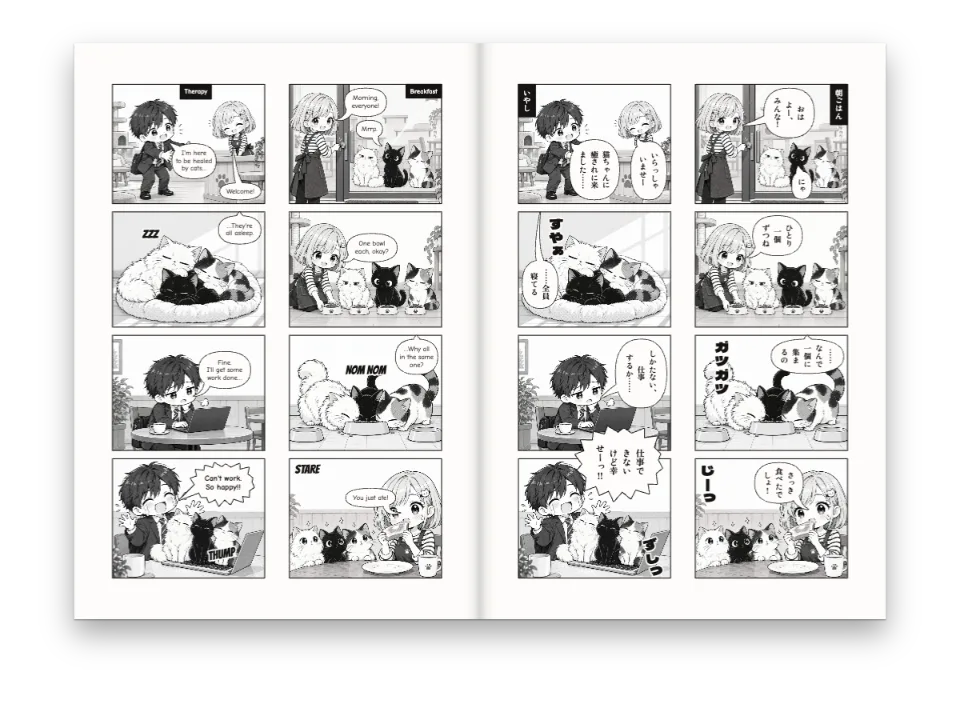
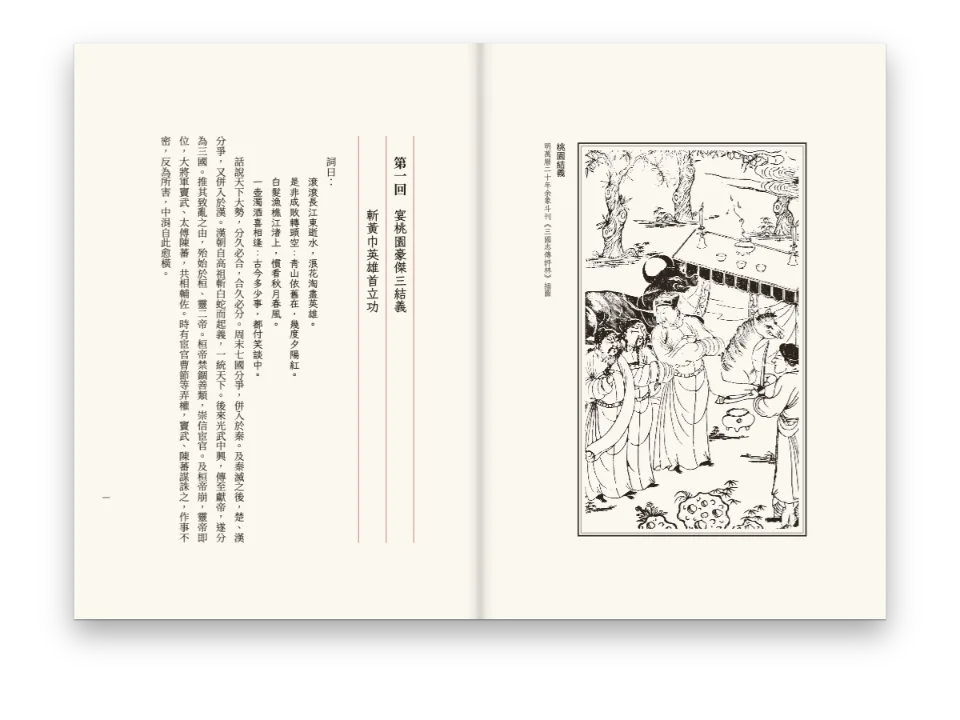
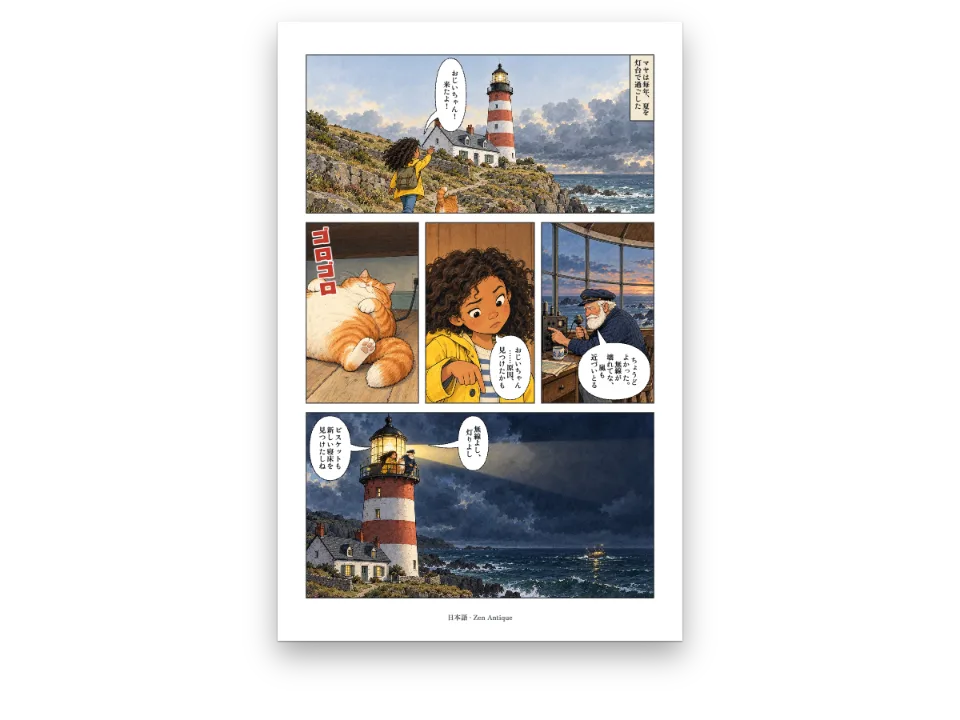
日本の漫画2ページです。日本語版は細い列に上から下へ文字を入れ、ほかの言語の版も右上のコマから読む日本語版の順番をそのまま保ちます。
できあがり
このレシピのために書き、白黒で描いた剣道漫画『前の晩』の冒頭2ページです。県大会の前日、花はひとりで素振りを続け、空が神社のお守りを届けに来て、森先生がふたりを帰らせます。先に日本語の原版を置き、週刊誌と同じように写植します。かなは明朝、漢字はゴシックのアンチック体で、フキダシは横に広げず縦に長く、末尾の句点は落とします。見開きの向かいには、同じ2ページを英語で組みます。文字は横組みですが、2000年代の初めからの翻訳版と同じく、右上のコマから読みます。判型はB6判(128 × 182 mm)、単行本の大きさです。
このレシピが答える質問
- 右から左へ読む漫画を組むには?
- 吹き出しに日本語を縦書きで写植するには?
手短な答え
const comics = (lang) => ({
  // The pages were drawn for right-to-left reading: panel 1 sits top right. The
  // reading direction stays 'auto', which follows the art in a left-to-right
  // language too: the English page keeps the Japanese panel order.
  artDirection: 'rtl',
  mirrorArt: false, // never flop the art: Hana's grip on the sword, the kimono's fold
  gutter: { horizontal: mm(4.5), vertical: mm(2) }, // a tier gap twice the panel gap
  panel: { borderWidth: pt(0.9), borderColor: col('ink'), background: col('paper') },
  lettering: {
    fontFamily: EDITIONS[lang].faces[0], color: col('ink'),
    fontSize: pt(['ja', 'zh'].includes(lang) ? 8.5 : 7.5), // one size per edition
    // 'auto' sets Japanese in columns of 8 characters at most and drops the final 。.
    // Chinese goes in columns too: a book bound on the right never mixes the two.
    writingMode: lang === 'zh' ? 'vertical' : 'auto',
  },
  balloonStyles: balloons(),
});
材料
- 機能
- 読む方向と漫画の順序漫画の写植他言語への写植し直し縦組み中国語・日本語・韓国語のフォント右綴じの本コマ割りコマの絵とトリミング話者とアンカー漫画のページ吹き出しのスタイル描き文字の擬音セマンティックカラーパレットキャンバス上のページPDFの書き出し
- 種類
- Zen Antique, Dela Gothic One, Comic Neue, Bangers, Noto Sans SC, ZCOOL KuaiLe, Playpen Sans Arabic, Lalezar (SIL OFL 1.1)
- 素材
kendo-charm.jpgkendo-closeup.jpgkendo-coach.jpgkendo-dojo.jpgkendo-doorway.jpgkendo-kneel.jpgkendo-roof.jpgkendo-smile.jpgkendo-swing.jpg- The school's old wooden kendo dojo at dusk, its doors open and lit (Generated With Diffusion Models, オリジナル)
- Hana alone in the dojo, swinging her bamboo sword overhead (Generated With Diffusion Models, オリジナル)
- Sora peeking round the sliding door with a shrine charm (Generated With Diffusion Models, オリジナル)
- Close-up of Hana's sweating face (Generated With Diffusion Models, オリジナル)
- Sora holding out the charm to Hana (Generated With Diffusion Models, オリジナル)
- Coach Mori in the doorway, backlit, arms crossed (Generated With Diffusion Models, オリジナル)
- Close-up of Coach Mori's small smile (Generated With Diffusion Models, オリジナル)
- Hana tying the charm to her armour while Sora scratches his head (Generated With Diffusion Models, オリジナル)
- Hana and Sora on the school roof at sunset, seen from behind (Generated With Diffusion Models, オリジナル)
作り方
#1 · 描かれた向きに読む
コードは前の手短な答えにあります。漫画家はどのページも右上から組み立てます。最初のコマ、最初に話す人物、段をたどる視線は、どれもそこから始まります。artDirection: 'rtl'でそれをエンジンに伝え、読む方向を'auto'のままにしておけば、どの版も絵に従います。アラビア語版はもともと右から左へ読みます。絵を反転させることはありません。欧米の出版社は2002年ごろまで漫画を左右反転して出しており、剣士はみな左利きになり、着物の合わせは逆になりました。描いたままのページは読者に慣れをひとつ求めるだけですが、反転は絵そのものを損ないます。各:::pageはコマ割り30 / 34 [46 | *] / * [44 | *]を持ち、どの段も最初のコマが右に来ます(読む方向)。
#2 · 人物の位置は絵の上に一度だけ記す
const ART = { // fractions of the picture: the same in every language
  dojo: {
    alt: t({ en: 'The old wooden kendo dojo at dusk, its doors open and lit.',
      es: 'El viejo dojo de madera al anochecer, con las puertas abiertas e iluminadas.',
      ca: 'L’antic dojo de fusta al capvespre, amb les portes obertes i il·luminades.',
      pt: 'O velho dojô de madeira ao anoitecer, com as portas abertas e iluminadas.',
      zh: '黄昏时分的老木造剑道场,门敞开着,里面亮着灯。',
      ar: 'قاعة الكندو الخشبية القديمة عند الغسق، أبوابها مفتوحة ومضاءة.',
      ja: '夕暮れの古い木造の剣道場。戸が開いて、中に明かりがともっている。' }),
  safeArea: { x: 0.45, y: 0.32, width: 0.5, height: 0.51 },
  anchors: [{ id: 'dojo', x: 0.66, y: 0.63 }] },
  swing: {
    alt: t({ en: 'Hana, alone in the dojo, swings her bamboo sword overhead.',
      es: 'Hana, sola en el dojo, alza la espada de bambú sobre la cabeza.',
      ca: 'La Hana, sola al dojo, aixeca l’espasa de bambú per sobre del cap.',
      pt: 'Hana, sozinha no dojô, ergue a espada de bambu acima da cabeça.',
      zh: '花独自在道场里,把竹剑高举过头。',
      ar: 'هانا وحدها في القاعة ترفع سيف الخيزران فوق رأسها.',
      ja: 'ひとり道場で、竹刀を頭上に振りかぶる花。' }),
  safeArea: { x: 0.36, y: 0, width: 0.31, height: 0.5 },
  avoid: [{ x: 0.43, y: 0, width: 0.17, height: 0.12 }],
  anchors: [{ id: 'hana', x: 0.535, y: 0.28, head: { x: 0.53, y: 0.22 },
    face: { x: 0.49, y: 0.14, width: 0.11, height: 0.17 } }] },
  doorway: {
    alt: t({ en: 'Sora peeks round the sliding door, holding a shrine charm.',
      es: 'Sora se asoma por la puerta corredera con un amuleto en la mano.',
      ca: 'En Sora treu el cap per la porta corredissa amb un amulet a la mà.',
      pt: 'Sora espia pela porta de correr com um amuleto na mão.',
      zh: '空从拉门后探出头,手里攥着护身符。',
      ar: 'سورا يطلّ من وراء الباب المنزلق وفي يده تميمة.',
      ja: 'お守りを手に、引き戸の陰からのぞく空。' }),
  safeArea: { x: 0.37, y: 0.09, width: 0.34, height: 0.5 },
  avoid: [{ x: 0.49, y: 0.41, width: 0.08, height: 0.1 }],
  anchors: [{ id: 'sora', x: 0.545, y: 0.31, head: { x: 0.55, y: 0.22 },
    face: { x: 0.47, y: 0.16, width: 0.2, height: 0.18 } }] },
  closeup: {
    alt: t({ en: "Close-up of Hana's sweating, startled face.",
      es: 'Primer plano del rostro sudoroso y sobresaltado de Hana.',
      ca: 'Primer pla de la cara suada i sobresaltada de la Hana.',
      pt: 'Primeiro plano do rosto suado e assustado de Hana.',
      zh: '花满脸是汗、吃了一惊的特写。',
      ar: 'لقطة قريبة لوجه هانا المتعرّق المذعور.',
      ja: '汗をかき、はっとした花の顔のアップ。' }),
  safeArea: { x: 0.27, y: 0.28, width: 0.43, height: 0.51 },
  anchors: [{ id: 'hana', x: 0.475, y: 0.665, head: { x: 0.45, y: 0.35 },
    face: { x: 0.3, y: 0.3, width: 0.4, height: 0.45 } }] },
  charm: {
    alt: t({ en: 'Sora holds out the charm; Hana looks at it, sword on her shoulder.',
      es: 'Sora le tiende el amuleto; Hana lo mira con la espada al hombro.',
      ca: 'En Sora li allarga l’amulet; la Hana el mira amb l’espasa a l’espatlla.',
      pt: 'Sora estende o amuleto; Hana olha para ele com a espada no ombro.',
      zh: '空递出护身符,花扛着竹剑看着它。',
      ar: 'سورا يمدّ التميمة، وهانا تنظر إليها والسيف على كتفها.',
      ja: '空がお守りを差し出し、竹刀を肩にかついだ花がそれを見る。' }),
  safeArea: { x: 0.21, y: 0.09, width: 0.56, height: 0.53 },
  avoid: [{ x: 0.43, y: 0.47, width: 0.06, height: 0.09 }],
  anchors: [{ id: 'sora', x: 0.325, y: 0.335, head: { x: 0.29, y: 0.22 },
    face: { x: 0.26, y: 0.17, width: 0.11, height: 0.2 } },
  { id: 'hana', x: 0.675, y: 0.335, head: { x: 0.665, y: 0.22 },
    face: { x: 0.62, y: 0.17, width: 0.11, height: 0.2 } }] },
  coach: {
    alt: t({ en: 'Coach Mori in the doorway, backlit, arms crossed.',
      es: 'El entrenador Mori en la puerta, a contraluz, de brazos cruzados.',
      ca: 'L’entrenador Mori a la porta, a contrallum, de braços plegats.',
      pt: 'O treinador Mori na porta, contra a luz, de braços cruzados.',
      zh: '森老师站在门口,背着光,双臂抱在胸前。',
      ar: 'المدرّب موري عند الباب، والضوء خلفه، عاقدًا ذراعيه.',
      ja: '逆光の戸口で腕を組んで立つ森先生。' }),
  safeArea: { x: 0.33, y: 0.13, width: 0.3, height: 0.32 },
  anchors: [{ id: 'mori', x: 0.425, y: 0.215, head: { x: 0.42, y: 0.17 },
    face: { x: 0.37, y: 0.13, width: 0.1, height: 0.11 } }] },
  smile: {
    alt: t({ en: "Close-up of Mori's stern face breaking into a small smile.",
      es: 'Primer plano del rostro severo de Mori, que esboza una sonrisa.',
      ca: 'Primer pla de la cara severa d’en Mori, que esbossa un somriure.',
      pt: 'Primeiro plano do rosto severo de Mori, que esboça um sorriso.',
      zh: '森老师严肃的脸上露出一丝笑意的特写。',
      ar: 'لقطة قريبة لوجه موري الصارم وقد ارتسمت عليه ابتسامة.',
      ja: '厳しい顔がふっとゆるむ森先生のアップ。' }),
  safeArea: { x: 0.43, y: 0.21, width: 0.51, height: 0.53 },
  anchors: [{ id: 'mori', x: 0.69, y: 0.52, head: { x: 0.6, y: 0.25 },
    face: { x: 0.45, y: 0.28, width: 0.45, height: 0.32 } }] },
  kneel: {
    alt: t({ en: 'Kneeling, Hana ties the charm to her armour; Sora scratches his head.',
      es: 'De rodillas, Hana se ata el amuleto a la armadura; Sora se rasca la cabeza.',
      ca: 'De genolls, la Hana es lliga l’amulet a l’armadura; en Sora es grata el cap.',
      pt: 'De joelhos, Hana amarra o amuleto na armadura; Sora coça a cabeça.',
      zh: '花跪坐着把护身符系在护具上,空挠着头。',
      ar: 'هانا جاثية تربط التميمة بدرعها، وسورا يحكّ رأسه.',
      ja: '正座してお守りを防具に結ぶ花と、頭をかく空。' }),
  safeArea: { x: 0.21, y: 0.08, width: 0.61, height: 0.48 },
  avoid: [{ x: 0.27, y: 0.43, width: 0.06, height: 0.12 }],
  anchors: [{ id: 'hana', x: 0.305, y: 0.245, head: { x: 0.3, y: 0.17 },
    face: { x: 0.25, y: 0.1, width: 0.11, height: 0.17 } },
  { id: 'sora', x: 0.7, y: 0.25, head: { x: 0.71, y: 0.15 },
    face: { x: 0.64, y: 0.1, width: 0.13, height: 0.18 } }] },
  roof: {
    alt: t({ en: 'Seen from behind, Hana and Sora sit on the school roof at sunset.',
      es: 'De espaldas, Hana y Sora sentados en la azotea del instituto al atardecer.',
      ca: 'D’esquena, la Hana i en Sora asseguts al terrat de l’institut a la posta.',
      pt: 'De costas, Hana e Sora sentados no terraço da escola ao pôr do sol.',
      zh: '夕阳下,花和空坐在学校楼顶的背影。',
      ar: 'هانا وسورا جالسان على سطح المدرسة عند الغروب، من الخلف.',
      ja: '夕焼けの屋上に並んで座る花と空の後ろ姿。' }),
  safeArea: { x: 0.24, y: 0.41, width: 0.47, height: 0.31 },
  anchors: [{ id: 'hana', x: 0.36, y: 0.52, head: { x: 0.36, y: 0.48 },
    face: { x: 0.31, y: 0.43, width: 0.11, height: 0.14 } },
  { id: 'sora', x: 0.63, y: 0.52, head: { x: 0.625, y: 0.47 },
    face: { x: 0.58, y: 0.41, width: 0.1, height: 0.15 } }] },
};
const panels = () => Promise.all([
  comicPanel('dojo', asset('kendo-dojo.jpg'), ART.dojo),
  comicPanel('swing', asset('kendo-swing.jpg'), ART.swing),
  comicPanel('doorway', asset('kendo-doorway.jpg'), ART.doorway),
  comicPanel('closeup', asset('kendo-closeup.jpg'), ART.closeup),
  comicPanel('charm', asset('kendo-charm.jpg'), ART.charm),
  comicPanel('coach', asset('kendo-coach.jpg'), ART.coach),
  comicPanel('smile', asset('kendo-smile.jpg'), ART.smile),
  comicPanel('kneel', asset('kendo-kneel.jpg'), ART.kneel),
  comicPanel('roof', asset('kendo-roof.jpg'), ART.roof),
]);
言葉は言語ごとに変わりますが、絵は変わりません。どの絵にも、どう切り抜いても残すセーフエリアがあり、人物ごとに口(しっぽの向かう先)、頭(思考のフキダシ用)、フキダシで隠してはいけない顔を、絵に対する割合で記します。台本の各行は話し手を名指しし(sora: …)、エンジンはどの言語でもその人物の近くにフキダシを置きます。森先生が戸口に現れるコマの空のように、絵に写っていない話し手にはコマの縁へ向かうしっぽを付けます(sora{tail=bottom})。
#3 · フキダシの中身は言語ごとに
const balloons = () => [
  { id: 'speech', fill: col('paper'), stroke: col('ink'), strokeWidth: pt(0.6), roundness: 2 },
  { id: 'whisper', fill: col('paper'), stroke: col('ink'), roundness: 2 },
  { id: 'thought', fill: col('paper'), stroke: col('ink') },
  { id: 'inner', fill: col('tone'), stroke: col('tone'), strokeWidth: pt(0), italic: false },
  { id: 'caption', fill: col('paper'), stroke: col('ink'), strokeWidth: pt(0.5) },
  { id: 'sfx', color: col('ink'), haloColor: col('paper') },
];
スタイルが決めるのは声の種類です。ふつうの台詞は楕円、ささやきは破線、心の声は雲形、花の内心は灰色の囲みです。中の文字の並べ方は版ごとに決まります。日本語では、エンジンが1列8字までの縦の列で組み、フキダシ末の「。」を落として「、」は残し、第42回の2桁を縦中横で1字分に収め(:tcy[42])、!?を1字の中に横に並べます。台本では名前が初めて出るところに読みを付けます({一ノ瀬|いちのせ})。漫画が人名にルビを振るのと同じです。英語では同じフキダシが横組みの楕円になり、読む順は右から始まったままです。
#4 · 各版の書体はその版の言葉で読み込む
const SFX = /^sfx[^::\n]*[::](.*)$/gm; // sound-effect lines: the second face sets them
async function loadEdition(lang) {
  const text = TEXT[lang];
  const [face, sfx] = EDITIONS[lang].faces;
  const faces = { [face]: FONTS[face], [sfx]: FONTS[sfx] };
  if (['ja', 'zh'].includes(lang)) { // CJK: only the files that hold these characters
    const effects = [...text.matchAll(SFX)].map((m) => m[1]).join('');
    await loadCjkFonts({ [face]: FONTS[face] }, text.replace(SFX, ''), { vertical: true });
    await loadCjkFonts({ [sfx]: FONTS[sfx] }, effects, { vertical: true });
  }
  if (lang === 'ar') await loadArabicFonts(faces, text);
  await loadComicFonts(faces, text); // the bold and italic the faces do not ship
}
Zen AntiqueとDela Gothic Oneは、文字の範囲ごとにそれぞれ100ほどのファイルに分かれています。書体ごとに組む言葉を渡して読み込むので(前者はフキダシ、後者は描き文字)、ページは必要なファイルだけを取りに行きます。loadComicFontsは、叫びの太字や内心の斜体を、これらの書体が実際に持っているファイルから宣言します。画面とPDFで同じ字形になります。
#5 · 各版の向かいに原版を置く
const FACING = LANG === 'ja' ? 'en' : LANG; // Japanese readers see the English edition
const TEXT = { ja: original, [FACING]: LANG === 'ja' ? english : markdown };
await loadFonts(FONTS, Object.values(TEXT).join('\n'));
const resources = await panels();
const build = async (lang) => { // the same pictures and page; this language's lettering
  await loadEdition(lang);
  return buildWithFonts(() => buildDocument({ markdown: TEXT[lang], resources,
    continuation: { pageIndexOffset: 1 } }, edition(lang)), TEXT[lang]);
};
const docs = [await build('ja'), await build(FACING)];
このサイトの言語ごとに2ページの版があり、それぞれのcontent.<lang>.mdに書きます。どの版も日本語の原版と向かい合わせです。/* @content@ja */がすべての版にcontent.ja.mdを取り込み、日本語のページでは原版の向かいに英語版を置きます。右開きの本では縦と横のフキダシを混ぜないので、中国語版も縦の列で組みます。アラビア語版は、その言語の向きのまま右から左へ読みます。
レシピの全体
// ═══ Postext Cookbook · Nº 149 · Manga read right to left, lettered vertically ══════ // https://postext.dev/en/cookbook/manga-right-to-left // Code: MIT · Story: written for the recipe (CC BY 4.0) · Pictures: generated with diffusion models // Fonts: Zen Antique, Comic Neue and six more (SIL OFL 1.1) · Needs postext ≥ 1.21.0 // Two pages of a kendo manga: the Japanese original, then the same pages lettered again. import { buildDocument, renderPageToCanvas, clearMeasurementCache, registerResourceImage, loadVerticalAlternates, } from 'https://esm.sh/postext'; import { renderToPdf, decompressWoff2 } from 'https://esm.sh/postext-pdf'; const LANG = 'ja'; // @lang: this edition's language; the Japanese original faces it const RECIPE = 'manga-right-to-left'; // ─── 1 · Design ───────────────────────────────────────────────────────────── // #region palette: black ink on a warm white, one screen-tone grey const palette = { ink: '#151413', // panel borders, balloon outlines, the lettering paper: '#fdfcf9', // the page and the balloons tone: '#e8e6e1', // the inner-voice box, a light screen tone muted: '#6f6b64', accent: '#a8322b', // the cover red (the Folio case in recipe.json) }; const col = (id) => ({ hex: palette[id], model: 'hex', paletteId: id }); const colorPalette = [ ...Object.entries(palette).map(([id, hex]) => ({ id, name: id, value: { hex, model: 'hex' } })), { id: 'main-color', name: 'ink (defaults)', value: { hex: palette.ink, model: 'hex' } }, ]; // #endregion // The engine's lettering and sound-effect faces per language (defaultComicFont and // defaultComicSfxFont), written out so FONTS and the PDF know them. const EDITIONS = { ja: { locale: 'ja', faces: ['Zen Antique', 'Dela Gothic One'] }, en: { locale: 'en-us', faces: ['Comic Neue', 'Bangers'] }, es: { locale: 'es', faces: ['Comic Neue', 'Bangers'] }, ca: { locale: 'ca', faces: ['Comic Neue', 'Bangers'] }, pt: { locale: 'pt-BR', faces: ['Comic Neue', 'Bangers'] }, zh: { locale: 'zh-Hans', faces: ['Noto Sans SC', 'ZCOOL KuaiLe'] }, ar: { locale: 'ar', faces: ['Playpen Sans Arabic', 'Lalezar'] }, }; // #region answer: the art reads right to left, so every edition does const comics = (lang) => ({ // The pages were drawn for right-to-left reading: panel 1 sits top right. The // reading direction stays 'auto', which follows the art in a left-to-right // language too: the English page keeps the Japanese panel order. artDirection: 'rtl', mirrorArt: false, // never flop the art: Hana's grip on the sword, the kimono's fold gutter: { horizontal: mm(4.5), vertical: mm(2) }, // a tier gap twice the panel gap panel: { borderWidth: pt(0.9), borderColor: col('ink'), background: col('paper') }, lettering: { fontFamily: EDITIONS[lang].faces[0], color: col('ink'), fontSize: pt(['ja', 'zh'].includes(lang) ? 8.5 : 7.5), // one size per edition // 'auto' sets Japanese in columns of 8 characters at most and drops the final 。. // Chinese goes in columns too: a book bound on the right never mixes the two. writingMode: lang === 'zh' ? 'vertical' : 'auto', }, balloonStyles: balloons(), }); // #endregion // #region balloons: oval speech, a dashed whisper, a grey box for the inner voice const balloons = () => [ { id: 'speech', fill: col('paper'), stroke: col('ink'), strokeWidth: pt(0.6), roundness: 2 }, { id: 'whisper', fill: col('paper'), stroke: col('ink'), roundness: 2 }, { id: 'thought', fill: col('paper'), stroke: col('ink') }, { id: 'inner', fill: col('tone'), stroke: col('tone'), strokeWidth: pt(0), italic: false }, { id: 'caption', fill: col('paper'), stroke: col('ink'), strokeWidth: pt(0.5) }, { id: 'sfx', color: col('ink'), haloColor: col('paper') }, ]; // #endregion const config = () => ({ // a factory: the engine caches resolved configs per object // Each edition's language, written out (gotcha: ja-locale-tag); the original is built // with 'ja' in every edition (edition('ja') below). locale: t({ ja: 'ja', en: 'en-us', es: 'es', ca: 'ca', zh: 'zh-Hans', ar: 'ar', pt: 'pt-BR' }), colorPalette, page: { sizePreset: 'custom', width: mm(128), height: mm(182), dpi: 150, // B6, a tankōbon binding: 'right', backgroundColor: col('paper'), // manga open from the right, in any language margins: { top: mm(13), bottom: mm(15), left: mm(11), right: mm(11), mirror: true }, }, bodyText: { fontFamily: 'Zen Antique', fontSize: pt(9), lineHeight: pt(15), color: col('ink'), boldColor: col('ink'), italicColor: col('ink'), referenceColor: col('ink'), }, headings: { fontFamily: 'Zen Antique', color: col('ink'), levels: [{ level: 1, breakBefore: { enabled: true, parity: 'any' } }] }, // the H1 break header: { elements: [] }, // comic pages are all panels: no running heads, no folios footer: { elements: [] }, comics: comics(LANG), }); // Another edition changes the language, and with it the faces, the writing mode and the // house rules of the lettering. Nothing else: not the page, not the panels. const edition = (lang) => ({ ...config(), locale: EDITIONS[lang].locale, comics: comics(lang) }); // ─── 2 · Content ──────────────────────────────────────────────────────────── const markdown = String.raw`---Markdownの見本 · 40行 · content.ja.md
title: "前の晩" author: "Postext Cookbook" --- :::page{split="30 / 34 [46 | *] / * [44 | *]"} ::panel{art=dojo} caption: 第:tcy[42]回県大会の前日。 dojo: ……ヤアッ! ::panel{art=swing} sfx: ブンッ hana{inner}: あと:tcy[50]本……! ::panel{art=doorway} sora{whisper}: うわ、{一ノ瀬|いちのせ}さん、まだやってる…… sora{thought}: 声、かけづらいなあ ::panel{art=closeup} hana: ……誰!? ::panel{art=charm} hana: ……{相沢|あいざわ}くん? sora: ご、ごめん! これ、うちのばあちゃんの神社のお守り sora: 明日、持ってって ::: :::page{split="38 [44 | *] / 34 / *"} ::panel{art=coach} sfx: ガラッ mori: こら。 mori: 下校時刻、とっくに過ぎてるぞ。 sora{tail=bottom}: も、森先生…… ::panel{art=smile} mori: 試合の前の晩は、休むのも稽古だ。 mori: ……明日、期待してるぞ。 hana{tail=bottom}: はい! ::panel{art=kneel} sora{thought}: 怒られなかった…… hana: ありがとう、相沢くん。つけていくね ::panel{art=roof} hana: ……ほんとはね、ちょっと怖いんだ sora: 僕も。試合に出ないのに hana: ふふっ、なにそれ :::`; // content.<lang>.md: this edition's lettering const original = String.raw`---Markdownの見本 · 40行 · content.ja.md
title: "前の晩" author: "Postext Cookbook" --- :::page{split="30 / 34 [46 | *] / * [44 | *]"} ::panel{art=dojo} caption: 第:tcy[42]回県大会の前日。 dojo: ……ヤアッ! ::panel{art=swing} sfx: ブンッ hana{inner}: あと:tcy[50]本……! ::panel{art=doorway} sora{whisper}: うわ、{一ノ瀬|いちのせ}さん、まだやってる…… sora{thought}: 声、かけづらいなあ ::panel{art=closeup} hana: ……誰!? ::panel{art=charm} hana: ……{相沢|あいざわ}くん? sora: ご、ごめん! これ、うちのばあちゃんの神社のお守り sora: 明日、持ってって ::: :::page{split="38 [44 | *] / 34 / *"} ::panel{art=coach} sfx: ガラッ mori: こら。 mori: 下校時刻、とっくに過ぎてるぞ。 sora{tail=bottom}: も、森先生…… ::panel{art=smile} mori: 試合の前の晩は、休むのも稽古だ。 mori: ……明日、期待してるぞ。 hana{tail=bottom}: はい! ::panel{art=kneel} sora{thought}: 怒られなかった…… hana: ありがとう、相沢くん。つけていくね ::panel{art=roof} hana: ……ほんとはね、ちょっと怖いんだ sora: 僕も。試合に出ないのに hana: ふふっ、なにそれ :::`; // content.ja.md, the original, in every edition const english = String.raw`---Markdownの見本 · 40行 · content.en.md
title: "The Night Before" author: "Postext Cookbook" --- :::page{split="30 / 34 [46 | *] / * [44 | *]"} ::panel{art=dojo} caption: The day before the 42nd Prefectural Tournament. dojo: …Yaaah! ::panel{art=swing} sfx: FWOOSH hana{inner}: Fifty more…! ::panel{art=doorway} sora{whisper}: Wow, Ichinose's still at it… sora{thought}: I can't just barge in. ::panel{art=closeup} hana: …Who's there!? ::panel{art=charm} hana: …Aizawa? sora: S-sorry! It's a charm from my grandma's shrine. sora: Take it tomorrow. ::: :::page{split="38 [44 | *] / 34 / *"} ::panel{art=coach} sfx: SLIDE mori: Hey. mori: School closed an hour ago. sora{tail=bottom}: M-Mori-sensei… ::panel{art=smile} mori: Rest is training too. mori: …I'm expecting a lot tomorrow. hana{tail=bottom}: Yes, sensei! ::panel{art=kneel} sora{thought}: He didn't yell at us… hana: Thanks, Aizawa. I'll wear it. ::panel{art=roof} hana: …Honestly? I'm a little scared. sora: Me too. And I'm not even competing. hana: Heh. What's that got to do with it? :::`; // the Japanese edition faces the original with it // The same panels and speaker ids in every file; only the words change. // ─── 3 · Fonts ────────────────────────────────────────────────────────────── const FONTS = { 'Zen Antique': ['400'], 'Dela Gothic One': ['400'], 'Comic Neue': ['400', '700', '400i', '700i'], Bangers: ['400'], 'Noto Sans SC': ['400', '700'], 'ZCOOL KuaiLe': ['400'], 'Playpen Sans Arabic': ['400', '700'], Lalezar: ['400'], }; // #region art: nine panels, with each speaker's mouth, head and face marked once const ART = { // fractions of the picture: the same in every language dojo: { alt: t({ en: 'The old wooden kendo dojo at dusk, its doors open and lit.', es: 'El viejo dojo de madera al anochecer, con las puertas abiertas e iluminadas.', ca: 'L’antic dojo de fusta al capvespre, amb les portes obertes i il·luminades.', pt: 'O velho dojô de madeira ao anoitecer, com as portas abertas e iluminadas.', zh: '黄昏时分的老木造剑道场,门敞开着,里面亮着灯。', ar: 'قاعة الكندو الخشبية القديمة عند الغسق، أبوابها مفتوحة ومضاءة.', ja: '夕暮れの古い木造の剣道場。戸が開いて、中に明かりがともっている。' }), safeArea: { x: 0.45, y: 0.32, width: 0.5, height: 0.51 }, anchors: [{ id: 'dojo', x: 0.66, y: 0.63 }] }, swing: { alt: t({ en: 'Hana, alone in the dojo, swings her bamboo sword overhead.', es: 'Hana, sola en el dojo, alza la espada de bambú sobre la cabeza.', ca: 'La Hana, sola al dojo, aixeca l’espasa de bambú per sobre del cap.', pt: 'Hana, sozinha no dojô, ergue a espada de bambu acima da cabeça.', zh: '花独自在道场里,把竹剑高举过头。', ar: 'هانا وحدها في القاعة ترفع سيف الخيزران فوق رأسها.', ja: 'ひとり道場で、竹刀を頭上に振りかぶる花。' }), safeArea: { x: 0.36, y: 0, width: 0.31, height: 0.5 }, avoid: [{ x: 0.43, y: 0, width: 0.17, height: 0.12 }], anchors: [{ id: 'hana', x: 0.535, y: 0.28, head: { x: 0.53, y: 0.22 }, face: { x: 0.49, y: 0.14, width: 0.11, height: 0.17 } }] }, doorway: { alt: t({ en: 'Sora peeks round the sliding door, holding a shrine charm.', es: 'Sora se asoma por la puerta corredera con un amuleto en la mano.', ca: 'En Sora treu el cap per la porta corredissa amb un amulet a la mà.', pt: 'Sora espia pela porta de correr com um amuleto na mão.', zh: '空从拉门后探出头,手里攥着护身符。', ar: 'سورا يطلّ من وراء الباب المنزلق وفي يده تميمة.', ja: 'お守りを手に、引き戸の陰からのぞく空。' }), safeArea: { x: 0.37, y: 0.09, width: 0.34, height: 0.5 }, avoid: [{ x: 0.49, y: 0.41, width: 0.08, height: 0.1 }], anchors: [{ id: 'sora', x: 0.545, y: 0.31, head: { x: 0.55, y: 0.22 }, face: { x: 0.47, y: 0.16, width: 0.2, height: 0.18 } }] }, closeup: { alt: t({ en: "Close-up of Hana's sweating, startled face.", es: 'Primer plano del rostro sudoroso y sobresaltado de Hana.', ca: 'Primer pla de la cara suada i sobresaltada de la Hana.', pt: 'Primeiro plano do rosto suado e assustado de Hana.', zh: '花满脸是汗、吃了一惊的特写。', ar: 'لقطة قريبة لوجه هانا المتعرّق المذعور.', ja: '汗をかき、はっとした花の顔のアップ。' }), safeArea: { x: 0.27, y: 0.28, width: 0.43, height: 0.51 }, anchors: [{ id: 'hana', x: 0.475, y: 0.665, head: { x: 0.45, y: 0.35 }, face: { x: 0.3, y: 0.3, width: 0.4, height: 0.45 } }] }, charm: { alt: t({ en: 'Sora holds out the charm; Hana looks at it, sword on her shoulder.', es: 'Sora le tiende el amuleto; Hana lo mira con la espada al hombro.', ca: 'En Sora li allarga l’amulet; la Hana el mira amb l’espasa a l’espatlla.', pt: 'Sora estende o amuleto; Hana olha para ele com a espada no ombro.', zh: '空递出护身符,花扛着竹剑看着它。', ar: 'سورا يمدّ التميمة، وهانا تنظر إليها والسيف على كتفها.', ja: '空がお守りを差し出し、竹刀を肩にかついだ花がそれを見る。' }), safeArea: { x: 0.21, y: 0.09, width: 0.56, height: 0.53 }, avoid: [{ x: 0.43, y: 0.47, width: 0.06, height: 0.09 }], anchors: [{ id: 'sora', x: 0.325, y: 0.335, head: { x: 0.29, y: 0.22 }, face: { x: 0.26, y: 0.17, width: 0.11, height: 0.2 } }, { id: 'hana', x: 0.675, y: 0.335, head: { x: 0.665, y: 0.22 }, face: { x: 0.62, y: 0.17, width: 0.11, height: 0.2 } }] }, coach: { alt: t({ en: 'Coach Mori in the doorway, backlit, arms crossed.', es: 'El entrenador Mori en la puerta, a contraluz, de brazos cruzados.', ca: 'L’entrenador Mori a la porta, a contrallum, de braços plegats.', pt: 'O treinador Mori na porta, contra a luz, de braços cruzados.', zh: '森老师站在门口,背着光,双臂抱在胸前。', ar: 'المدرّب موري عند الباب، والضوء خلفه، عاقدًا ذراعيه.', ja: '逆光の戸口で腕を組んで立つ森先生。' }), safeArea: { x: 0.33, y: 0.13, width: 0.3, height: 0.32 }, anchors: [{ id: 'mori', x: 0.425, y: 0.215, head: { x: 0.42, y: 0.17 }, face: { x: 0.37, y: 0.13, width: 0.1, height: 0.11 } }] }, smile: { alt: t({ en: "Close-up of Mori's stern face breaking into a small smile.", es: 'Primer plano del rostro severo de Mori, que esboza una sonrisa.', ca: 'Primer pla de la cara severa d’en Mori, que esbossa un somriure.', pt: 'Primeiro plano do rosto severo de Mori, que esboça um sorriso.', zh: '森老师严肃的脸上露出一丝笑意的特写。', ar: 'لقطة قريبة لوجه موري الصارم وقد ارتسمت عليه ابتسامة.', ja: '厳しい顔がふっとゆるむ森先生のアップ。' }), safeArea: { x: 0.43, y: 0.21, width: 0.51, height: 0.53 }, anchors: [{ id: 'mori', x: 0.69, y: 0.52, head: { x: 0.6, y: 0.25 }, face: { x: 0.45, y: 0.28, width: 0.45, height: 0.32 } }] }, kneel: { alt: t({ en: 'Kneeling, Hana ties the charm to her armour; Sora scratches his head.', es: 'De rodillas, Hana se ata el amuleto a la armadura; Sora se rasca la cabeza.', ca: 'De genolls, la Hana es lliga l’amulet a l’armadura; en Sora es grata el cap.', pt: 'De joelhos, Hana amarra o amuleto na armadura; Sora coça a cabeça.', zh: '花跪坐着把护身符系在护具上,空挠着头。', ar: 'هانا جاثية تربط التميمة بدرعها، وسورا يحكّ رأسه.', ja: '正座してお守りを防具に結ぶ花と、頭をかく空。' }), safeArea: { x: 0.21, y: 0.08, width: 0.61, height: 0.48 }, avoid: [{ x: 0.27, y: 0.43, width: 0.06, height: 0.12 }], anchors: [{ id: 'hana', x: 0.305, y: 0.245, head: { x: 0.3, y: 0.17 }, face: { x: 0.25, y: 0.1, width: 0.11, height: 0.17 } }, { id: 'sora', x: 0.7, y: 0.25, head: { x: 0.71, y: 0.15 }, face: { x: 0.64, y: 0.1, width: 0.13, height: 0.18 } }] }, roof: { alt: t({ en: 'Seen from behind, Hana and Sora sit on the school roof at sunset.', es: 'De espaldas, Hana y Sora sentados en la azotea del instituto al atardecer.', ca: 'D’esquena, la Hana i en Sora asseguts al terrat de l’institut a la posta.', pt: 'De costas, Hana e Sora sentados no terraço da escola ao pôr do sol.', zh: '夕阳下,花和空坐在学校楼顶的背影。', ar: 'هانا وسورا جالسان على سطح المدرسة عند الغروب، من الخلف.', ja: '夕焼けの屋上に並んで座る花と空の後ろ姿。' }), safeArea: { x: 0.24, y: 0.41, width: 0.47, height: 0.31 }, anchors: [{ id: 'hana', x: 0.36, y: 0.52, head: { x: 0.36, y: 0.48 }, face: { x: 0.31, y: 0.43, width: 0.11, height: 0.14 } }, { id: 'sora', x: 0.63, y: 0.52, head: { x: 0.625, y: 0.47 }, face: { x: 0.58, y: 0.41, width: 0.1, height: 0.15 } }] }, }; const panels = () => Promise.all([ comicPanel('dojo', asset('kendo-dojo.jpg'), ART.dojo), comicPanel('swing', asset('kendo-swing.jpg'), ART.swing), comicPanel('doorway', asset('kendo-doorway.jpg'), ART.doorway), comicPanel('closeup', asset('kendo-closeup.jpg'), ART.closeup), comicPanel('charm', asset('kendo-charm.jpg'), ART.charm), comicPanel('coach', asset('kendo-coach.jpg'), ART.coach), comicPanel('smile', asset('kendo-smile.jpg'), ART.smile), comicPanel('kneel', asset('kendo-kneel.jpg'), ART.kneel), comicPanel('roof', asset('kendo-roof.jpg'), ART.roof), ]); // #endregion // #region fonts: each edition loads its two faces with the words they set const SFX = /^sfx[^::\n]*[::](.*)$/gm; // sound-effect lines: the second face sets them async function loadEdition(lang) { const text = TEXT[lang]; const [face, sfx] = EDITIONS[lang].faces; const faces = { [face]: FONTS[face], [sfx]: FONTS[sfx] }; if (['ja', 'zh'].includes(lang)) { // CJK: only the files that hold these characters const effects = [...text.matchAll(SFX)].map((m) => m[1]).join(''); await loadCjkFonts({ [face]: FONTS[face] }, text.replace(SFX, ''), { vertical: true }); await loadCjkFonts({ [sfx]: FONTS[sfx] }, effects, { vertical: true }); } if (lang === 'ar') await loadArabicFonts(faces, text); await loadComicFonts(faces, text); // the bold and italic the faces do not ship } // #endregion // ─── 4 · Build & show ─────────────────────────────────────────────────────── // #region editions: the original on the right-hand page, this edition's lettering facing it const FACING = LANG === 'ja' ? 'en' : LANG; // Japanese readers see the English edition const TEXT = { ja: original, [FACING]: LANG === 'ja' ? english : markdown }; await loadFonts(FONTS, Object.values(TEXT).join('\n')); const resources = await panels(); const build = async (lang) => { // the same pictures and page; this language's lettering await loadEdition(lang); return buildWithFonts(() => buildDocument({ markdown: TEXT[lang], resources, continuation: { pageIndexOffset: 1 } }, edition(lang)), TEXT[lang]); }; const docs = [await build('ja'), await build(FACING)]; // #endregion const TITLE = t({ en: 'A manga read right to left', es: 'Un manga que se lee de derecha a izquierda', ca: 'Un manga que es llegeix de dreta a esquerra', zh: '从右往左读的漫画', pt: 'Um mangá lido da direita para a esquerda', ar: 'مانغا تُقرأ من اليمين إلى اليسار', ja: '右から左へ読む漫画' }); showBook(docs, { title: TITLE }); offerPdf(() => renderToPdf(docs, { fontProvider: comicPdfProvider, resourceBytes: imageBytes }), `${RECIPE}.pdf`);キット · core, fonts, viewer, pdf, images, cjk, arabic, comics:全レシピ共通 · 722行
// ─── Kit ── helpers shared by every Cookbook recipe · postext.dev/cookbook ───── // ─── Kit · core v1 ── the same in every recipe · postext.dev/cookbook function mm(value) { return { value, unit: 'mm' }; } function pt(value) { return { value, unit: 'pt' }; } function em(value) { return { value, unit: 'em' }; } /** The sample language's string: t({ en: 'Figure', es: 'Figura' }). */ function t(strings) { return strings[LANG] ?? Object.values(strings)[0]; } /** A file in this recipe's assets folder, served from the Postext repo by jsDelivr. */ function asset(file) { return `https://cdn.jsdelivr.net/gh/drnachio/postext@main/cookbook/${RECIPE}/assets/${file}`; } // ─── Kit · fonts v2 ── the same in every recipe · postext.dev/cookbook // Postext measures with the loaded faces and caches the widths: load every face // before the first build, from Fontsource, the files the PDF embeds too. /** faces = { 'Family Name': ['400', '400i', '700'] }. `text` is the sample: * č ł † α χ also load latin-ext and greek files (kitSubsetsFor). With * `optional`, a face Fontsource does not ship is skipped instead of failing. * Resolves to the number of faces added. */ async function loadFonts(faces, text = '', { optional = false } = {}) { kitStatus('Loading fonts…'); const ranges = { latin: 'U+0000-00FF,U+0131,U+0152-0153,U+02BB-02BC,U+02C6,U+02DA,U+02DC,U+0304,U+0308,U+0329,' + 'U+2000-206F,U+20AC,U+2122,U+2191,U+2193,U+2212,U+2215,U+FEFF,U+FFFD', 'latin-ext': 'U+0100-02BA,U+02BD-02C5,U+02C7-02CC,U+02CE-02D7,U+02DD-02FF,U+0304,U+0308,U+0329,' + 'U+1D00-1DBF,U+1E00-1E9F,U+1EF2-1EFF,U+2020,U+20A0-20AB,U+20AD-20C0,U+2113,U+2C60-2C7F,U+A720-A7FF', greek: 'U+0370-03FF', }; const jobs = []; let added = 0; for (const [family, specs] of Object.entries(faces)) { const id = fontsourceId(family); const todo = [...new Set(specs)].map((spec) => [parseInt(spec, 10), spec.endsWith('i') ? 'italic' : 'normal']) .filter(([weight, style]) => !hasFace(family, weight, style)); // before any await const meta = optional || /[^\0-ÿ]/u.test(text) ? await fontsourceMeta(family) : null; const subsets = ['latin', ...kitSubsetsFor(text, meta)]; for (const [weight, style] of todo) { if (optional && !(meta?.weights.includes(weight) && meta.styles.includes(style))) continue; for (const subset of subsets) { const url = `https://cdn.jsdelivr.net/npm/@fontsource/${id}@5/files/${id}-${subset}-${weight}-${style}.woff2`; const face = new FontFace(family, `url(${url}) format('woff2')`, { weight: String(weight), style, unicodeRange: ranges[subset] }); jobs.push(face.load().then((ready) => { document.fonts.add(ready); added++; }, () => { if (subset === 'latin' && !optional) throw new Error(`Fontsource has no ${family} ${weight} ${style}`); })); } } } await Promise.all(jobs).catch((error) => { kitFail(error); throw error; }); return added; } /** Runs `build` and loads any face the pages use that FONTS missed (a regular * one with a warning), then clears the measurement cache and builds again. */ async function buildWithFonts(build, text = '') { const tried = new Set(); for (let round = 0; round < 3; round++) { kitStatus('Laying out…'); await new Promise(requestAnimationFrame); // let the status paint first const result = await Promise.resolve().then(build).catch((error) => { kitFail(error); throw error; }); const wanted = { base: {}, variants: {} }; for (const { font, base } of [result].flat().flatMap(fontStringsOf)) { const { family, weight, style } = parseFont(font); const key = `${family}|${weight}|${style}`; if (tried.has(key) || hasFace(family, weight, style)) continue; tried.add(key); (wanted[base ? 'base' : 'variants'][family] ??= []).push(`${weight}${style === 'italic' ? 'i' : ''}`); } if (Object.keys(wanted.base).length) { console.warn(`[cookbook] FONTS does not list ${JSON.stringify(wanted.base)}: loading them.`); } const added = await loadFonts(wanted.base, text) + await loadFonts(wanted.variants, text, { optional: true }); if (added === 0) return result; clearMeasurementCache(); } throw new Error('The fonts did not settle after three builds.'); } /** Every font string of the layout; `base` marks a block's own face. */ function fontStringsOf(doc) { const found = new Map(); const walk = (node) => { if (!node || typeof node !== 'object') return; if (Array.isArray(node)) { node.forEach(walk); return; } for (const [key, value] of Object.entries(node)) { if (typeof value === 'string' && /fontString$/i.test(key)) { found.set(value, found.get(value) || key === 'fontString'); } else if (value && typeof value === 'object') walk(value); } }; walk(doc.pages); walk(doc.blocks); return [...found].map(([font, base]) => ({ font, base })); } /** '700 37.5px Open Sans' / 'italic 400 13px "Source Serif 4"' → { family, weight, style }. * A string with no weight ('95.8px Young Serif', from a design text) is 400. */ function parseFont(font) { const m = /^(?:(italic|oblique)\s+)?(?:small-caps\s+)?(?:(\d+|bold|normal)\s+)?[\d.]+px\s+(.+)$/.exec(font.trim()); if (!m) throw new Error(`Unexpected font string: ${font}`); const weight = m[2] === 'bold' ? 700 : !m[2] || m[2] === 'normal' ? 400 : Number(m[2]); return { family: m[3].replace(/^["']|["']$/g, ''), weight, style: m[1] ? 'italic' : 'normal' }; } /** A loaded FontFace covers this family, weight and style (fonts.check() would * also say yes for families nobody declared). */ function hasFace(family, weight, style) { for (const face of document.fonts) { if (face.status !== 'loaded' || face.style !== style) continue; if (face.family.replace(/^["']|["']$/g, '') !== family) continue; const [low, high = low] = face.weight.split(' ').map(Number); if (weight >= low && weight <= high) return true; } return false; } /** The files beyond latin `text` needs that `meta`'s family ships. */ function kitSubsetsFor(text, meta) { return [[/[Ā-˿ᴀ-ᶿḀ-ỿ†ℓⱠ-Ɀ꜠-ꟿ]/u, 'latin-ext'], [/[Ͱ-Ͽ]/u, 'greek']] .filter(([re, x]) => re.test(text) && meta?.subsets?.includes(x)).map(([, x]) => x); } /** Fontsource's id for a family: 'Source Serif 4' → 'source-serif-4'. */ function fontsourceId(family) { return family.toLowerCase().replace(/\s+/g, '-'); } /** The family's Fontsource metadata (weights, styles, subsets), or null. */ function fontsourceMeta(family) { fontsourceMeta.cache ??= new Map(); const id = fontsourceId(family); if (!fontsourceMeta.cache.has(id)) { fontsourceMeta.cache.set(id, fetch(`https://api.fontsource.org/v1/fonts/${id}`) .then((res) => (res.ok ? res.json() : null), () => null)); } return fontsourceMeta.cache.get(id); } // ─── Kit · viewer v1 ── the same in every recipe · postext.dev/cookbook /** The pages as spreads on a dark desk, page 1 alone, then verso | recto, * each painted when it scrolls near. */ function showPages(docs, { title, width = 460 } = {}) { const root = viewer(title); const pages = [docs].flat().flatMap((doc) => doc.pages.map((page) => ({ doc, page, n: (doc.pageIndexOffset ?? 0) + page.index }))); const spreads = []; let verso = null; for (const p of pages) { if (p.n % 2 === 1) { if (verso) spreads.push([verso, null]); verso = p; } else { spreads.push([verso, p]); verso = null; } } if (verso) spreads.push([verso, null]); const density = Math.min(window.devicePixelRatio || 1, 2); showPages.painter?.disconnect(); const painter = new IntersectionObserver((entries) => { for (const { isIntersecting, target } of entries) { if (!isIntersecting) continue; painter.unobserve(target); const { doc, page } = target.postext; renderPageToCanvas(page, doc, target, { scale: (width * density) / page.width }); } }, { rootMargin: '800px' }); showPages.painter = painter; root.replaceChildren(...spreads.map((pair) => { const spread = document.createElement('div'); spread.className = 'pt-spread'; for (const p of pair) { const figure = document.createElement('figure'); if (p) { const label = p.page.pageLabel || String(p.n + 1); const canvas = document.createElement('canvas'); canvas.postext = p; canvas.style.aspectRatio = `${p.page.width} / ${p.page.height}`; canvas.setAttribute('role', 'img'); canvas.setAttribute('aria-label', `Page ${label}`); const folio = document.createElement('figcaption'); folio.textContent = label; figure.append(canvas, folio); painter.observe(canvas); } else figure.className = 'pt-blank'; spread.append(figure); } return spread; })); kitStatus(`${pages.length} ${pages.length === 1 ? 'page' : 'pages'}`); document.documentElement.dataset.postext = 'ready'; return pages.length; } /** The desk, the bar and the error reporting, created once. */ function viewer(title) { if (!document.getElementById('pt-kit')) { document.head.insertAdjacentHTML('beforeend', `<style id="pt-kit"> :root { color-scheme: dark; } body { margin: 0; background: #0e1014; color: #b9bcc4; font: 13px/1.45 system-ui, sans-serif; } #pt-bar { position: sticky; top: 0; z-index: 1; display: flex; flex-wrap: wrap; align-items: center; gap: 6px 16px; padding: 10px 16px; background: rgb(14 16 20 / .92); backdrop-filter: blur(6px); border-bottom: 1px solid #23262d; } #pt-bar strong { color: #f4f1ea; font-weight: 600; } #pt-actions { display: flex; gap: 12px; margin-left: auto; } #pt-actions a, #pt-actions button { color: #d8a21a; font: inherit; background: none; border: 0; padding: 0; cursor: pointer; } #pages { display: grid; justify-items: center; gap: 48px; padding: 32px 16px 72px; } .pt-spread { display: flex; } .pt-spread figure { margin: 0; width: min(460px, 44vw); } .pt-spread canvas { display: block; width: 100%; background: #fff; box-shadow: 0 1px 2px rgb(0 0 0 / .5), 0 22px 44px -16px rgb(0 0 0 / .8); } .pt-spread figure:first-child canvas { box-shadow: inset -14px 0 14px -14px rgb(0 0 0 / .18), 0 1px 2px rgb(0 0 0 / .5), 0 22px 44px -16px rgb(0 0 0 / .8); } .pt-spread figcaption { margin-top: 10px; text-align: center; font: 600 10px/1 system-ui, sans-serif; letter-spacing: .18em; text-transform: uppercase; color: #6c7079; } .pt-blank { visibility: hidden; } @media (max-width: 760px) { .pt-spread { flex-direction: column; gap: 32px; } .pt-spread figure { width: min(460px, 92vw); } .pt-blank { display: none; } } </style>`); document.body.insertAdjacentHTML('afterbegin', '<header id="pt-bar"><strong id="pt-title"></strong><span id="pt-status" role="status"></span><span id="pt-actions"></span></header>'); document.getElementById('pt-title').textContent = document.title || 'Postext'; addEventListener('error', (event) => kitFail(event.error ?? event.message)); addEventListener('unhandledrejection', (event) => kitFail(event.reason)); } if (title) document.getElementById('pt-title').textContent = title; return document.getElementById('pages') ?? document.body.appendChild(Object.assign(document.createElement('main'), { id: 'pages' })); } function kitStatus(text) { viewer(); document.getElementById('pt-status').textContent = text; } function kitFail(error) { document.documentElement.dataset.postext = 'error'; kitStatus(`Error: ${error?.message ?? error}`); } // ─── Kit · pdf v2 ── the same in every recipe that exports a PDF /** The Fontsource files the screen used, as TrueType: the nearest weight the * family ships, upright if it has no italic; latin, then what the face's * letters need (kitSubsetsFor). */ async function fontsourceProvider(family, weight, style, request) { const id = fontsourceId(family); const meta = await fontsourceMeta(family); const weights = meta?.weights?.length ? meta.weights : [400, 700]; const w = weights.reduce((a, b) => (Math.abs(b - weight) < Math.abs(a - weight) ? b : a)); const s = style === 'italic' && meta && !meta.styles.includes('italic') ? 'normal' : style; const text = String.fromCodePoint(...(request?.codePoints ?? [])); const more = kitSubsetsFor(text, meta); const files = await Promise.all(['latin', ...more].map(async (subset) => { const res = await fetch(`https://cdn.jsdelivr.net/npm/@fontsource/${id}@5/files/${id}-${subset}-${w}-${s}.woff2`); if (!res.ok) throw new Error(`Fontsource has no ${family} ${w} ${s} ${subset}`); return decompressWoff2(new Uint8Array(await res.arrayBuffer())); })); return files.length === 1 ? files[0] : files; } /** A "Build the PDF" button; then "Open the PDF" (a new tab: CodePen's frame * shows no PDFs) and a download link. */ function offerPdf(makePdf, filename) { viewer(); const button = Object.assign(document.createElement('button'), { type: 'button', textContent: 'Build the PDF' }); button.dataset.postextPdf = filename; button.addEventListener('click', async () => { button.disabled = true; button.textContent = 'Building the PDF…'; try { const bytes = await makePdf(); const url = URL.createObjectURL(new Blob([bytes], { type: 'application/pdf' })); const size = `${Math.max(1, Math.round(bytes.length / 1024))} KB`; button.replaceWith( Object.assign(document.createElement('a'), { href: url, target: '_blank', rel: 'noopener', textContent: 'Open the PDF ↗' }), Object.assign(document.createElement('a'), { href: url, download: filename, textContent: `Download ${filename} · ${size}` })); } catch (error) { button.disabled = false; button.textContent = 'Build the PDF'; kitFail(error); } }); document.getElementById('pt-actions').append(button); } // ─── Kit · images v1 ── recipes with pictures · postext.dev/cookbook /** Registers a photo or PNG for the canvas and keeps its bytes for the PDF. * fetch → ImageBitmap never taints the canvas (a plain cross-origin <img> would). */ async function loadImage(fileId, url) { const res = await fetch(url); if (!res.ok) throw new Error(`Image not found (${res.status}): ${url}`); const bytes = new Uint8Array(await res.arrayBuffer()); registerResourceImage(fileId, await createImageBitmap(new Blob([bytes]))); (loadImage.bytes ??= new Map()).set(fileId, bytes); } /** Registers SVG markup (drawn in code, or fetched) as a vector image. */ async function loadSvg(fileId, svg) { const img = new Image(); img.src = `data:image/svg+xml;charset=utf-8,${encodeURIComponent(svg)}`; await img.decode(); registerResourceImage(fileId, img); (loadImage.bytes ??= new Map()).set(fileId, new TextEncoder().encode(svg)); } /** renderToPdf({ resourceBytes: imageBytes }) */ function imageBytes(fileId) { return loadImage.bytes?.get(fileId); } /** renderToHtml({ resourceImageUrl: imageUrl }) */ function imageUrl(fileId) { const bytes = imageBytes(fileId); if (!bytes) return undefined; imageUrl.urls ??= new Map(); if (!imageUrl.urls.has(fileId)) { const type = /\.svg$/i.test(fileId) ? 'image/svg+xml' : /\.png$/i.test(fileId) ? 'image/png' : 'image/jpeg'; imageUrl.urls.set(fileId, URL.createObjectURL(new Blob([bytes], { type }))); } return imageUrl.urls.get(fileId); } // ─── Kit · cjk v1 ── Chinese, Japanese and Korean books · postext.dev/cookbook // Fontsource ships a CJK family as about a hundred files per weight, each // declared in its stylesheet with the unicode-range it covers. The screen // loads the files the sample touches; the PDF gets the same files for the // characters its pages set in each face, and embeds each as a subset. // A book bound on the right (vertical text) is shown with its spreads // mirrored: page 1 alone on the left of the spine, then [3 | 2]. /** The files of a Fontsource face, read from its stylesheet: { url, range, * ranges }, the last declared first (the order the browser tries them in). */ function cjkSlices(family, weight, style) { cjkSlices.cache ??= new Map(); const id = fontsourceId(family); const css = `https://cdn.jsdelivr.net/npm/@fontsource/${id}@5/${weight}${style === 'italic' ? '-italic' : ''}.css`; if (!cjkSlices.cache.has(css)) { cjkSlices.cache.set(css, fetch(css) .then((res) => { if (!res.ok) throw new Error(`Fontsource has no ${family} ${weight} ${style} (${res.status})`); return res.text(); }) .then((text) => [...text.matchAll(/@font-face\s*{([^}]*)}/g)].map(([, rule]) => { const range = /unicode-range:\s*([^;]+);/.exec(rule)?.[1].trim() ?? 'U+0-10FFFF'; const ranges = range.split(',').map((part) => { const [lo, hi = lo] = part.trim().slice(2).split('-'); return [parseInt(lo, 16), parseInt(hi, 16)]; }); return { url: new URL(/url\(([^)]+?\.woff2)\)/.exec(rule)[1], css).href, range, ranges }; }).reverse())); } return cjkSlices.cache.get(css); } /** The file of `slices` that holds code point `cp`, if any. */ function cjkSliceFor(slices, cp) { return slices.find((slice) => slice.ranges.some(([lo, hi]) => cp >= lo && cp <= hi)); } /** Whether Fontsource serves `family` as a Chinese, Japanese or Korean * family (its subsets name the script). Fails when the API does not * answer: a CJK face taken for a Latin one would paint in a system face. */ async function isCjkFamily(family) { const meta = await fontsourceMeta(family); if (!meta) throw new Error(`api.fontsource.org did not describe ${family}: reload to try again`); return !!meta.subsets?.some((subset) => /^(chinese|japanese|korean)/.test(subset)); } /** faces = { 'Noto Serif TC': ['400', '700'] }, as for loadFonts: the * whole FONTS object may be passed, its other families are left to * loadFonts. Adds one FontFace per file of each CJK face with its * unicodeRange, then loads the files `text` touches. `text` is what the * faces set: the sample for the text face; a book in several voices calls * it once per voice (loadCjkFonts({ 'LXGW WenKai TC': ['400'] }, quotes)), * so the heading and quotation faces fetch and check only their own * characters. Fails when a character of `text` is in no file of a face. * List every weight the pages use: a weight left to buildWithFonts gets * the latin file only. With { vertical: true } it also loads each * family's vertical forms (brackets, quotes, pause marks) for the canvas, * which needs loadVerticalAlternates imported from postext. Resolves to * the number of files loaded. */ async function loadCjkFonts(faces, text, { vertical = false } = {}) { kitStatus('Loading fonts…'); let loaded = 0; try { if (vertical && typeof loadVerticalAlternates !== 'function') { throw new Error('loadCjkFonts(…, { vertical: true }) needs loadVerticalAlternates imported from postext'); } for (const [family, specs] of Object.entries(faces)) { if (!(await isCjkFamily(family))) continue; const twin = []; for (const spec of new Set(specs)) { const weight = parseInt(spec, 10); const style = spec.endsWith('i') ? 'italic' : 'normal'; const slices = await cjkSlices(family, weight, style); const missing = [...new Set(text)].filter((ch) => /\S/.test(ch) && !cjkSliceFor(slices, ch.codePointAt(0))); if (missing.length) { throw new Error(`${family} ${spec} has no file for ${missing.slice(0, 12).join(' ')}: ` + `give each face the text it sets (loadCjkFonts({ '${family}': ['${spec}'] }, text))`); } for (const slice of slices) { document.fonts.add(new FontFace(family, `url(${slice.url}) format('woff2')`, { weight: String(weight), style, unicodeRange: slice.range })); twin.push({ source: slice.url, weight: String(weight), style, unicodeRange: slice.range }); } const font = `${style === 'italic' ? 'italic ' : ''}${weight} 16px "${family}"`; loaded += (await document.fonts.load(font, text)).length; if (!document.fonts.check(font, text)) throw new Error(`${family} ${spec} did not load for the sample`); } // The same files under a twin name with the `vert` feature on: the // canvas paints the punctuation of vertical lines with it. if (vertical && twin.length) await loadVerticalAlternates(family, twin); } } catch (error) { kitFail(error); throw error; } return loaded; } /** The PDF font provider for recipes with CJK faces: a family whose * Fontsource subsets are Chinese, Japanese or Korean gets the files that * hold the characters its pages set (`request.codePoints`); any other * family gets the latin file fontsourceProvider fetches (the "pdf" block) * and, when the face sets letters only latin-ext has, that file too. */ async function cjkPdfProvider(family, weight, style, request) { if (!(await isCjkFamily(family))) return cjkLatinPdfFiles(family, weight, style, request); const meta = await fontsourceMeta(family); const weights = meta.weights?.length ? meta.weights : [400, 700]; const w = weights.reduce((a, b) => (Math.abs(b - weight) < Math.abs(a - weight) ? b : a)); const s = style === 'italic' && !meta.styles.includes('italic') ? 'normal' : style; const slices = await cjkSlices(family, w, s); const picked = new Set(); for (const cp of request?.codePoints ?? []) { const slice = cjkSliceFor(slices, cp); if (slice) picked.add(slice); } if (!picked.size) picked.add(slices[0]); return Promise.all(slices.filter((slice) => picked.has(slice)).map(async (slice) => { const res = await fetch(slice.url); if (!res.ok) throw new Error(`Fontsource file ${slice.url} (${res.status})`); return decompressWoff2(new Uint8Array(await res.arrayBuffer())); })); } /** A Latin family set next to the CJK faces: its latin file, then its * latin-ext file when the face sets letters only latin-ext has (ō ū in * Hepburn rōmaji, ǎ in pinyin), the file loadFonts adds on screen for * them. Latin comes first: postext-pdf draws a character from the first * file that has it, as the browser takes a character both files hold from * latin. A face Fontsource ships without latin-ext, or whose file does * not come, gets latin alone, and the PDF names the letters it lacks. */ async function cjkLatinPdfFiles(family, weight, style, request) { const meta = await fontsourceMeta(family); const beyond = [...(request?.codePoints ?? [])].some(cjkLatinExtOnly); if (!beyond || !meta?.subsets?.includes('latin-ext')) return fontsourceProvider(family, weight, style); const weights = meta.weights?.length ? meta.weights : [400, 700]; const w = weights.reduce((a, b) => (Math.abs(b - weight) < Math.abs(a - weight) ? b : a)); const s = style === 'italic' && !meta.styles.includes('italic') ? 'normal' : style; const id = fontsourceId(family); const url = `https://cdn.jsdelivr.net/npm/@fontsource/${id}@5/files/${id}-latin-ext-${w}-${s}.woff2`; const [latin, ext] = await Promise.all([fontsourceProvider(family, weight, style), fetch(url) .then(async (res) => (res.ok ? decompressWoff2(new Uint8Array(await res.arrayBuffer())) : null), () => null)]); return ext ? [latin, ext] : latin; } /** Whether code point `cp` is in Fontsource's latin-ext file and not in * its latin file: Latin Extended-A and -B, IPA, the spacing modifiers and * Latin Extended Additional (loadFonts's test for latin-ext), less the * few latin holds too (ı Œ œ ʻ ʼ ˆ ˚ ˜). */ function cjkLatinExtOnly(cp) { if (!((cp >= 0x100 && cp <= 0x2ff) || (cp >= 0x1e00 && cp <= 0x1eff))) return false; return ![0x131, 0x152, 0x153, 0x2bb, 0x2bc, 0x2c6, 0x2da, 0x2dc].includes(cp); } /** showPages for a book bound on either edge. A right-bound book (the * document says so: doc.binding is 'right' for page.binding 'right' and * for vertical text) lies on the desk as it opens: page 1 alone on the * left of the spine, then [3 | 2], the spine shade on each page's inner * edge. `binding` ('left' | 'right') overrides the document's. */ function showBook(docs, { binding, ...options } = {}) { const count = showPages(docs, options); const right = (binding ?? [docs].flat()[0]?.binding) === 'right'; if (!document.getElementById('pt-kit-cjk')) { // The pages keep direction ltr: a canvas draws text in the direction its // element inherits, and under rtl each run would end where the engine // starts it, its brackets mirrored. document.head.insertAdjacentHTML('beforeend', `<style id="pt-kit-cjk"> .pt-spread[dir="rtl"] canvas { direction: ltr; } .pt-spread[dir="rtl"] figure:first-child canvas { box-shadow: inset 14px 0 14px -14px rgb(0 0 0 / .18), 0 1px 2px rgb(0 0 0 / .5), 0 22px 44px -16px rgb(0 0 0 / .8); } </style>`); } // Each pair stays [verso, recto] in the page; right to left, the verso // sits on the right. Phones stack the pages in reading order either way. for (const spread of document.querySelectorAll('#pages > .pt-spread')) spread.dir = right ? 'rtl' : 'ltr'; document.getElementById('pages').dataset.binding = right ? 'right' : 'left'; return count; } // ─── Kit · arabic v1 ── Arabic-script faces · postext.dev/cookbook // Fontsource ships an Arabic family as one file per subset and weight: the // `arabic` file holds the letters, the harakat, the Arabic-Indic digits, the // Arabic punctuation and the presentation forms; `latin` and `latin-ext` // hold the rest. loadFonts loads the latin files; this block adds the arabic // file of every Arabic family, for the canvas and for the PDF, which shapes // the letters with HarfBuzz from the same bytes. /** The code points of Fontsource's `arabic` subset, as its stylesheets * declare them (the same unicode-range the browser picks the file by). A * function, not a const: the kit is inlined after the recipe's top-level * awaits, and a const read before its line throws, where a function * declaration is hoisted. */ function arabicRange() { return 'U+0600-06FF,U+0750-077F,U+0870-088E,U+0890-0891,U+0897-08E1,U+08E3-08FF,' + 'U+200C-200E,U+2010-2011,U+204F,U+2E41,U+FB50-FDFF,U+FE70-FE74,U+FE76-FEFC,U+102E0-102FB,' + 'U+10E60-10E7E,U+10EC2-10EC4,U+10EFC-10EFF,U+1EE00-1EEFF'; } /** Whether code point `cp` is in the arabic file. */ function inArabicRange(cp) { inArabicRange.ranges ??= arabicRange().split(',').map((part) => { const [lo, hi = lo] = part.slice(2).split('-'); return [parseInt(lo, 16), parseInt(hi, 16)]; }); return inArabicRange.ranges.some(([lo, hi]) => cp >= lo && cp <= hi); } /** Whether Fontsource serves `family` with an `arabic` subset. Fails when * the API does not answer: an Arabic face taken for a Latin one would set * its letters in a system face. */ async function isArabicFamily(family) { const meta = await fontsourceMeta(family); if (!meta) throw new Error(`api.fontsource.org did not describe ${family}: reload to try again`); return !!meta.subsets?.includes('arabic'); } /** The arabic file of a face. */ function arabicFileUrl(family, weight, style) { const id = fontsourceId(family); return `https://cdn.jsdelivr.net/npm/@fontsource/${id}@5/files/${id}-arabic-${weight}-${style}.woff2`; } /** faces = { Amiri: ['400', '700'] }, as for loadFonts, after it: the whole * FONTS object may be passed, its families without an arabic subset are * left alone. Adds the arabic file of every listed weight of each Arabic * family (the latin files come from loadFonts) and loads it. `text` is * the sample: fails when it holds an Arabic-script character the arabic * file does not cover. List every weight the pages set in Arabic: a weight * left to buildWithFonts gets the latin file only, and its Arabic letters * fall back to a system face. Resolves to the number of files loaded. */ async function loadArabicFonts(faces, text = '') { kitStatus('Loading fonts…'); let loaded = 0; try { const outside = [...new Set(text)].filter((ch) => /\p{Script=Arabic}/u.test(ch) && !inArabicRange(ch.codePointAt(0))); if (outside.length) throw new Error(`Fontsource's arabic files have no ${outside.slice(0, 12).join(' ')}`); for (const [family, specs] of Object.entries(faces)) { if (!(await isArabicFamily(family))) continue; for (const spec of new Set(specs)) { const weight = parseInt(spec, 10); const style = spec.endsWith('i') ? 'italic' : 'normal'; const face = new FontFace(family, `url(${arabicFileUrl(family, weight, style)}) format('woff2')`, { weight: String(weight), style, unicodeRange: arabicRange() }); document.fonts.add(await face.load().catch(() => { throw new Error(`Fontsource has no arabic file for ${family} ${weight} ${style}`); })); loaded++; } } } catch (error) { kitFail(error); throw error; } return loaded; } /** The PDF font provider for recipes with Arabic faces: a family with an * arabic subset gets its arabic file when its pages set Arabic letters * (`request.codePoints`), then its latin file, and its latin-ext file for * the letters beyond latin (transliteration: ā ḥ ʿ). The arabic file comes * first: it also holds the space and the brackets, so a line of Arabic is * shaped as one run and not cut at every space. Any other family goes to * fontsourceProvider (the "pdf" block). */ async function arabicPdfProvider(family, weight, style, request) { if (!(await isArabicFamily(family))) return fontsourceProvider(family, weight, style, request); const meta = await fontsourceMeta(family); const weights = meta.weights?.length ? meta.weights : [400, 700]; const w = weights.reduce((a, b) => (Math.abs(b - weight) < Math.abs(a - weight) ? b : a)); const s = style === 'italic' && !meta.styles.includes('italic') ? 'normal' : style; const wanted = [...(request?.codePoints ?? [])]; const id = fontsourceId(family); const urls = []; if (!wanted.length || wanted.some(inArabicRange)) urls.push(arabicFileUrl(family, w, s)); urls.push(`https://cdn.jsdelivr.net/npm/@fontsource/${id}@5/files/${id}-latin-${w}-${s}.woff2`); if (meta.subsets.includes('latin-ext') && wanted.some((cp) => /[Ā-˿Ḁ-ỿ]/u.test(String.fromCodePoint(cp)))) { urls.push(`https://cdn.jsdelivr.net/npm/@fontsource/${id}@5/files/${id}-latin-ext-${w}-${s}.woff2`); } return Promise.all(urls.map(async (url) => { const res = await fetch(url); if (!res.ok) throw new Error(`Fontsource file ${url} (${res.status})`); return decompressWoff2(new Uint8Array(await res.arrayBuffer())); })); } // ─── Kit · comics v1 ── comic pages · postext.dev/cookbook // The engine letters a comic in a face per language (defaultComicFont: // Comic Neue, Zen Antique for Japanese, Noto Sans SC, LXGW WenKai TC, // Playpen Sans Arabic; defaultComicSfxFont: Bangers, Dela Gothic One, // ZCOOL KuaiLe, Lalezar) and asks for the bold of a shout or a sound effect // and the italic of an inner voice. Most of these faces ship one weight and // no italic: this block declares the file Fontsource does ship for those // variants, so the canvas measures and paints the letters the PDF embeds // (the providers snap to the shipped file) and not a bold or a slant the // browser makes up. It also turns the art manifest into panel resources. /** faces = { 'Comic Neue': ['400', '700'], Bangers: ['400'] }, as for * loadFonts, after it (and after loadCjkFonts or loadArabicFonts for the * faces of those scripts); the whole FONTS object may be passed. List in * FONTS only what Fontsource ships (Bangers: ['400']): loadFonts fails on * the rest. For each family, the regular, bold, italic and bold italic it * lacks are declared with its nearest file (the regular for the bold, the * upright for the italic) and loaded for `text`. A CJK face needs the cjk * block; an Arabic face setting Arabic, the arabic block. Resolves to the * number of variants added. */ async function loadComicFonts(faces, text = '') { kitStatus('Loading fonts…'); let added = 0; try { for (const family of Object.keys(faces)) { const meta = await fontsourceMeta(family); if (!meta) throw new Error(`api.fontsource.org did not describe ${family}: reload to try again`); const weights = meta.weights?.length ? meta.weights : [400, 700]; const styles = meta.styles?.length ? meta.styles : ['normal']; for (const [weight, style] of [[400, 'normal'], [700, 'normal'], [400, 'italic'], [700, 'italic']]) { if ((weights.includes(weight) && styles.includes(style)) || hasFace(family, weight, style)) continue; const w = weights.reduce((a, b) => (Math.abs(b - weight) < Math.abs(a - weight) ? b : a)); const s = style === 'italic' && styles.includes('italic') ? 'italic' : 'normal'; for (const { url, range } of await comicFaceFiles(family, w, s, meta, text)) { document.fonts.add(new FontFace(family, `url(${url}) format('woff2')`, { weight: String(weight), style, unicodeRange: range })); } await document.fonts.load(`${style === 'italic' ? 'italic ' : ''}${weight} 16px "${family}"`, text || 'A'); added++; } } } catch (error) { kitFail(error); throw error; } return added; } /** The files of a shipped face ({ url, range }): a CJK face's slices (the * cjk block reads them from its stylesheet), else latin, the latin-ext * and greek files `text` needs, and the arabic file when `text` holds * Arabic. */ async function comicFaceFiles(family, weight, style, meta, text) { if (meta.subsets?.some((subset) => /^(chinese|japanese|korean)/.test(subset))) { if (typeof cjkSlices !== 'function') throw new Error(`${family} is a CJK face: list the cjk kit block`); return (await cjkSlices(family, weight, style)).map(({ url, range }) => ({ url, range })); } const id = fontsourceId(family); const file = (subset) => `https://cdn.jsdelivr.net/npm/@fontsource/${id}@5/files/${id}-${subset}-${weight}-${style}.woff2`; const files = ['latin', ...kitSubsetsFor(text, meta)].map((subset) => ({ url: file(subset), range: comicRange(subset) })); if (meta.subsets?.includes('arabic') && /\p{Script=Arabic}/u.test(text)) { if (typeof arabicRange !== 'function') throw new Error(`${family} sets Arabic: list the arabic kit block`); files.unshift({ url: file('arabic'), range: arabicRange() }); } return files; } /** The unicode-range loadFonts gives a Fontsource file. A function, not a * const: the kit is inlined after the recipe's top-level awaits. */ function comicRange(subset) { return { latin: 'U+0000-00FF,U+0131,U+0152-0153,U+02BB-02BC,U+02C6,U+02DA,U+02DC,U+0304,U+0308,U+0329,' + 'U+2000-206F,U+20AC,U+2122,U+2191,U+2193,U+2212,U+2215,U+FEFF,U+FFFD', 'latin-ext': 'U+0100-02BA,U+02BD-02C5,U+02C7-02CC,U+02CE-02D7,U+02DD-02FF,U+0304,U+0308,U+0329,' + 'U+1D00-1DBF,U+1E00-1E9F,U+1EF2-1EFF,U+2020,U+20A0-20AB,U+20AD-20C0,U+2113,U+2C60-2C7F,U+A720-A7FF', greek: 'U+0370-03FF', }[subset]; } /** The PDF font provider of a comic in any script: a CJK face goes to * cjkPdfProvider, an Arabic face to arabicPdfProvider, any other to * fontsourceProvider (the "pdf" block). Each embeds the shipped weight * and style nearest to the one asked for, the file loadComicFonts * declared for the canvas. */ async function comicPdfProvider(family, weight, style, request) { const subsets = (await fontsourceMeta(family))?.subsets ?? []; if (subsets.some((subset) => /^(chinese|japanese|korean)/.test(subset))) { if (typeof cjkPdfProvider !== 'function') throw new Error(`${family} is a CJK face: list the cjk kit block`); return cjkPdfProvider(family, weight, style, request); } if (subsets.includes('arabic') && typeof arabicPdfProvider === 'function') { return arabicPdfProvider(family, weight, style, request); } return fontsourceProvider(family, weight, style, request); } /** A panel picture as a resource for art= (and pop=): loads `url` * (write asset('lh-arrive.jpg') in the call, so the lint checks the file) * and declares it with `meta`, its entry in the art manifest: * { width, height, alt, safeArea, anchors, avoid }. The safe area is what * every crop keeps, the anchors the speakers' mouths, heads and faces, * the avoid zones what no balloon covers; all in fractions of the picture, * the same in every language. Without width and height, the picture's own * size. Needs the images block. Resolves to the resource. */ async function comicPanel(id, url, meta = {}) { const fileId = decodeURIComponent(url.split('/').pop()); await loadImage(fileId, url); let { width, height } = meta; if (!width || !height) { const bitmap = await createImageBitmap(new Blob([imageBytes(fileId)])); ({ width, height } = bitmap); bitmap.close(); } return { id, typeId: meta.typeId ?? 'figure', kind: 'bitmap', createdAt: 0, updatedAt: 0, bitmap: { fileId, format: /\.png$/i.test(fileId) ? 'png' : 'jpeg', width, height }, ...(meta.alt && { altText: meta.alt }), ...(meta.safeArea && { safeArea: meta.safeArea }), ...(meta.anchors?.length && { anchors: meta.anchors }), ...(meta.avoid?.length && { avoid: meta.avoid }), }; } // ─── /Kit ───────────────────────────────────────────────────────────────────────
組み立てたscript.jsはそのまま動きます。任意のページのモジュールスクリプトに貼り付けるか、レシピをCodePenで開いてください。 GitHub上のレシピのフォルダー ↗ (新しいタブで開きます)
よくあるつまずき
つまずき
日本語のテキストのタグは'ja'。zh-HansやLANGにしない
レシピの版はenとesですが、日本語のサンプルはどちらの版でも日本語です。`locale: LANG`では英語やスペイン語とタグ付けされ、中国語のタグでは中国語の規則で組まれます(開明式の約物、小書きの仮名が行頭に来てもよい、図の代わりに图、PDFでは中国の字形)。'ja'と書いてください。日本の地域(JLReqの改行と約物、ゴマの圏点、ルビの間隔、図と表の表示名)が選ばれ、ハイフネーションが切られます。リントは、zhやkoのタグで仮名を含むテキストをエラーにします。 日本語の改行(禁則処理) →
つまずき
中国語の書体はcjkブロックを通じてスライス単位で読み込む
Fontsourceは中国語、日本語、韓国語のファミリーを、ウェイトごとに約100個のファイルとして配信し、各ファイルが文字の範囲を受け持ちます。loadFontsが取得するのはlatinファイルだけなので、画面では漢字がシステムの書体で出て計測が狂い、fontsourceProviderはPDFにそのlatinファイルを渡すため、漢字が空の四角で印字されます。キットのcjkブロックを挙げ、loadFontsのあとにloadCjkFonts(FONTS, markdown)を呼び(本で複数のCJK書体を使うときは、それぞれの書体で組むテキストを渡して書体ごとに1回)、renderToPdfにfontProvider: cjkPdfProviderを渡してください。どちらもテキストの文字を含むファイルを取得します。 中国語・日本語・韓国語のフォント →
つまずき
設定はオブジェクトの同一性でキャッシュされる。毎回新しいオブジェクトを作る
エンジンは解決済みの設定をオブジェクトの同一性でキャッシュします。そのため、設定をその場で書き換えて再ビルドすると前の結果が再利用されます。ビルドのたびに新しいオブジェクトを作ってください。レシピの設定がファクトリー関数config()になっているのはこのためです。 キャンバス上のページ →
つまずき
レイアウトの前にすべてのフォントを読み込む
レイアウトはブラウザーが読み込んだフォントで文字を計測し、その幅をキャッシュします。最初のビルドのあとに届いたフォントがあると改行位置が狂い、PDFも画面と一致しなくなります。すべてのウェイトとスタイルを先に読み込み、遅れて届いたときは再ビルドの前にclearMeasurementCache()を呼んでください。 レイアウト前のフォント読み込み →
- 各コマで最初に話す人物は右に置きます。フキダシは読む順に並ぶので、空がお守りを渡すコマでは、台本で右に立つ花に最初の台詞を言わせています。空が先に話しても、そのフキダシは空の側に収まりますが、縦書きの列の下には花の返事を置く余白がなく、返事は右に並んで先に読まれてしまいます。
- コマに入りきらないフキダシは枠の外へはみ出すことがあり、エンジンはそれを警告します(
comicBalloonOverflow)。台詞を削る前に、コマ割りでそのコマを広げてください。
クレジット
- 本文
- 前の晩 (The Night Before), a two-page kendo manga written for this recipe, with its English, Spanish, Catalan, Chinese and Arabic letterings · Postext Cookbook · CC BY 4.0
- 画像
- The school's old wooden kendo dojo at dusk, its doors open and lit · Generated With Diffusion Models · オリジナル
- Hana alone in the dojo, swinging her bamboo sword overhead · Generated With Diffusion Models · オリジナル
- Sora peeking round the sliding door with a shrine charm · Generated With Diffusion Models · オリジナル
- Close-up of Hana's sweating face · Generated With Diffusion Models · オリジナル
- Sora holding out the charm to Hana · Generated With Diffusion Models · オリジナル
- Coach Mori in the doorway, backlit, arms crossed · Generated With Diffusion Models · オリジナル
- Close-up of Coach Mori's small smile · Generated With Diffusion Models · オリジナル
- Hana tying the charm to her armour while Sora scratches his head · Generated With Diffusion Models · オリジナル
- Hana and Sora on the school roof at sunset, seen from behind · Generated With Diffusion Models · オリジナル
- フォント
- Zen Antique (SIL OFL 1.1) · Dela Gothic One (SIL OFL 1.1) · Comic Neue (SIL OFL 1.1) · Bangers (SIL OFL 1.1) · Noto Sans SC (SIL OFL 1.1) · ZCOOL KuaiLe (SIL OFL 1.1) · Playpen Sans Arabic (SIL OFL 1.1) · Lalezar (SIL OFL 1.1)