かんたんな説明
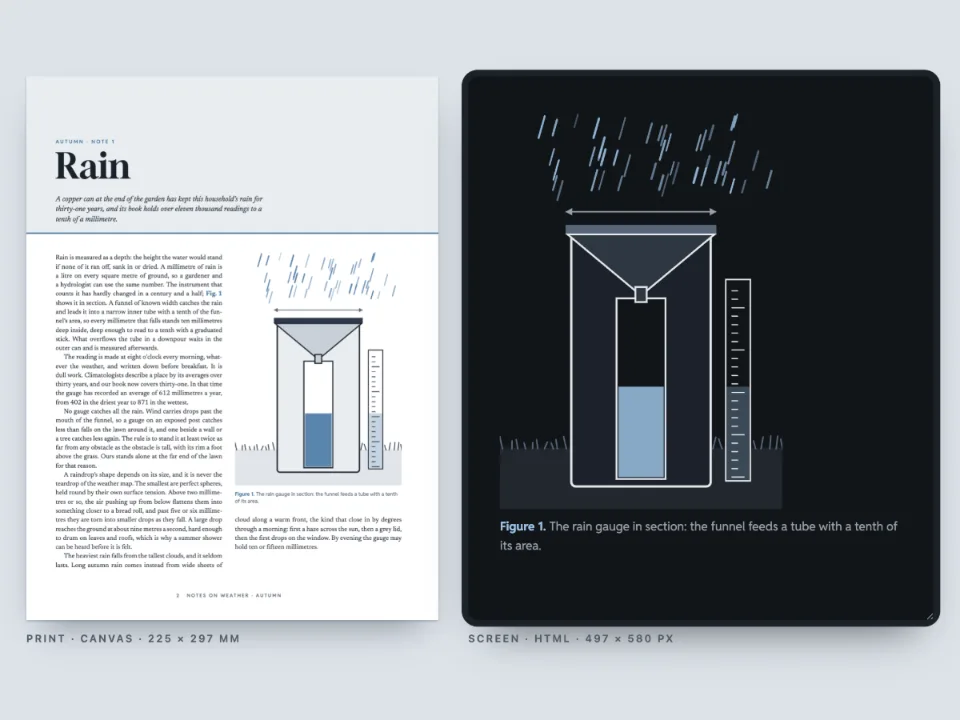
振り子の短い動画が2本入った物理のワークシートです。紙ではどちらの動画も読み取り用のコードの付いた静止画になり、画面と電子書籍ではページの上で再生されます。
できあがり
『Bench Physics』の実験シート4.2です。16歳から18歳の生徒向けのA4判のワークブックで、テーマは振り子の周期です。赤錆色の帯に題名と、名前、グループ、日付の欄が載ります。1ページ目の地には、同じ振り子を10°と80°から放した2本の動画が左右に並びます。紙ではどちらの動画も最初のフレームで、再生マークとMP4を開くQRコードが付きます。ページの横にある画面版でも、サンプルが書き出すEPUBでも、同じ2つのリソースが読者の環境のプレーヤーで再生されます。2ページ目には方法、記入用の表、コードで計算した正確な周期、解答欄の付いた4つの問いが入ります。
このレシピが答える質問
- HTML版とEPUBでは本の動画をどう再生しますか?ダウンロードボタンを隠すには?
- 印刷した本に動画を入れ、読者がページから開けるようにするには?
手短な答え
const clip = (id, file, poster, caption, altText) => ({
  id, typeId: 'video', kind: 'video', createdAt: 0, updatedAt: 0, caption: t(caption),
  note: t({ en: '8.00 s, 25 frames per second · Postext Cookbook, CC BY 4.0',
    es: '8,00 s, 25 fotogramas por segundo · Postext Cookbook, CC BY 4.0' }),
  altText: t(altText), placement: { position: 'bottom', span: 'column' },
  video: { source: 'file', fileId: file, format: 'mp4', width: 640, height: 360, duration: 8,
    url: asset(file), // the production address: printed as the QR code, linked from the PDF
    poster: { fileId: poster, format: 'jpeg', width: 640, height: 360 }, // the first frame
  },
});
const videoStyle = {
  playMark: { shape: 'rounded', position: 'top-left', size: mm(7), inset: mm(3),
    background: col('ink'), color: col('paper') },
  qr: { position: 'bottom-right', size: mm(19), inset: mm(2.5), // 111 characters: 45 modules
    color: col('ink'), background: col('paper'), radius: mm(1) },
  // The HTML5 player of a file honours every option. download: false writes
  // controlslist="nodownload": it hides the button, and the file stays at its address.
  player: { download: false, loop: true, muted: true, preload: 'auto',
    pictureInPicture: false, remotePlayback: false },
};
const clips = [
  clip('small', 'pendulum-small.mp4', 'pendulum-small-poster.jpg',
    { en: 'Released from rest at 10°.', es: 'Soltado desde el reposo a 10°.' },
    { en: 'A rust bob on a dark string hangs a few degrees off the vertical, under a short bar.',
      es: 'Una lenteja roja cuelga de un hilo oscuro a pocos grados de la vertical.' }),
  clip('large', 'pendulum-large.mp4', 'pendulum-large-poster.jpg',
    { en: 'Released from rest at 80°.', es: 'Soltado desde el reposo a 80°.' },
    { en: 'The same pendulum pulled out almost level with its pivot, a pale arc below it.',
      es: 'El mismo péndulo, casi a la altura de su eje, sobre un arco pálido.' }),
];
材料
- 機能
- 動画のポスター:再生マークとQRコードリソースとしての動画EPUBの書き出しHTMLの読書版画面用の簡素なデザインデータから作る表表スタイル囲み入れ子の囲み明示的な縦のアキデザインした章扉見出しの属性ページデザインのテキスト・罫・ボックス柱とノンブルページの役割ごとの柱独自のリソースの種類セマンティックカラーパレットPDFに埋め込むフォント
- 種類
- Source Serif 4, Red Hat Display, Red Hat Mono (SIL OFL 1.1)
- 素材
pendulum-large-poster.jpgpendulum-large.mp4pendulum-small-poster.jpgpendulum-small.mp4- Video 1: a pendulum 1 m long released from 10°, 8 s at 25 frames per second, rendered from an RK4 solution of the pendulum equation (1 ms steps) with Python and encoded with ffmpeg (Postext Cookbook, CC BY 4.0)
- Video 2: the same pendulum released from 80°, rendered and encoded the same way (Postext Cookbook, CC BY 4.0)
- The first frame of Video 1, its printed poster (Postext Cookbook, CC BY 4.0)
- The first frame of Video 2, its printed poster (Postext Cookbook, CC BY 4.0)
作り方
#1 · 動画ごとに公開先のアドレスとファイルを与える
コードは前の手短な答えにあります。自前の動画には2つのアドレスがあります。video.urlは公開された本が動画を見つける場所で、QRコードはこれを刷り、PDFはポスター画像をこれにリンクします。ここでは動画のjsDelivrのアドレスで、スマートフォンで今すぐ開けるものです。video.fileIdはファイルそのものを指し、ファイルはビットマップと同じく本体とは別に保存されます。ファイルを同梱できる出力や、別の場所から再生できる出力がこれを使います(文書形式 › 動画を参照)。videoStyle.playerのプレーヤーオプションはすべての動画に適用されます。ループし、ミュートで始まり、全体を読み込み(27 KBと61 KB)、ダウンロード、ピクチャー・イン・ピクチャー、キャストは提供しないので、動画はシートの上にとどまります。
#2 · 同じソースから画面版をレイアウトする
const [PANE_W, PANE_H] = [400, 640]; // px
const screen = {
  page: { width: px(PANE_W), height: px(PANE_H), dpi: 122, // so the 9.4 pt text is 16 px
    margins: { top: px(28), bottom: px(28), left: px(22), right: px(22), mirror: false } },
  layout: { layoutType: 'single' }, bodyText: { textAlign: 'left' }, // ragged in a narrow pane
  headings: { levels: [{ level: 1, span: 'column', breakBefore: { enabled: false },
    fontSize: px(28), lineHeight: px(32), fontWeight: 800, marginBottom: px(16),
    advancedDesign: { enabled: false } }] }, // the title alone: the band and fields are print's
  header: { elements: [] }, footer: { elements: [] } };
画面版は設定のhtmlViewer.overridesにあり、canvasとPDFはこれを無視します。122 dpiでは、ポイントで指定したサイズはどれも96 dpiのときよりおよそ4分の1大きくなるので、9.4 ptの本文はペインで16 pxになり、キャプション、囲み、表もそれに合わせて大きくなります。冒頭は題名を残し、紙のための帯と記入欄は外します。
#3 · ペインで動画を再生する
// A shadow root keeps the page's styles out, so the pane shows the lines as they were measured.
const pane = desk.querySelector('#screen').attachShadow({ mode: 'open' });
pane.innerHTML = renderToHtml(buildDocument({ markdown, resources },
  applyHtmlViewerOverrides(config())), { mode: 'single', padding: 0, background: '#ffffff',
  resourceImageUrl: imageUrl, // the posters, until a clip plays
  resourceVideoUrl: (fileId) => asset(fileId) }); // the file each <video> plays: the asset here
const top = (el) => el.getBoundingClientRect().top; // open the pane on the first player
pane.host.scrollTop = top(pane.querySelector('video')) - top(pane.host) - 48;
renderToHtmlは各動画リソースをHTML5の<video>として組み、プレーヤーオプションを属性にします。controls、muted、loop、playsinline、preload="auto"、disablepictureinpicture、disableremoteplayback、controlslist="nodownload"です。最後のものはボタンを隠すだけです。アドレスを知っていれば誰でもファイルを保存できるので、保護ではなく体裁を整えるものと考えてください。resourceVideoUrlは、resourceImageUrlがポスター画像に対してするのと同じように、fileIdごとに再生可能なアドレスをバックエンドに渡します。ここでは公開済みのアセットです。アップロードしたファイルを別の場所に置くサイトなら、自分のURLか、バイト列のblob URLを返します。これがないとプレーヤーはvideo.urlを使い、どちらもなければペインはポスター画像を表示します。
#4 · 動画を固定レイアウトのEPUBに同梱する
const media = new Map(await Promise.all(clips.map(async ({ video }) =>
  [video.fileId, { bytes: await bytesOf(asset(video.fileId)), mediaType: 'video/mp4' }])));
const fonts = await Promise.all([ // every face as bytes (gotcha: epub-embeds-given-fonts)
  ...Object.entries(FONTS).flatMap(([family, specs]) => specs.map(faceOf).map(([w, s]) =>
    ({ family, weight: w, style: s, url: file(family, 'latin', [w, s]) }))),
  ...greek.map((face) => ({ ...face, unicodeRange: GREEK })), // after latin: tried first
].map(async ({ url, ...face }) => ({ ...face, format: 'woff2', bytes: await bytesOf(url) })));
const epub = await renderToEpub([doc], { layout: 'fixed', fonts,
  metadata: { title: doc.metadata.title, creators: ['Postext Cookbook'], language: LANG,
    rights: 'CC BY 4.0', modified: new Date('2026-10-05T00:00:00Z') }, // the same bytes each run
  // The clips as video/mp4 and the posters as pictures; the book packs both under media/.
  resourceBytes: (fileId) => media.get(fileId)
    ?? { bytes: imageBytes(fileId), mediaType: 'image/jpeg' },
});
このシートは、左右に並んだ2本の動画と書き込むための空欄を軸に組んであるので、固定レイアウトでその形を保ちます。どのページも印刷と同じで、ポスター画像のあった場所にプレーヤーが入ります。リフロー型のEPUBでも動画は再生されますが、テキストの幅で上下に並びます。resourceBytesは動画ごとにvideo/mp4を、ポスター画像ごとにJPEGを返し、ライターはそれらをmedia/とimages/の下に収めます。EPUBはスキーマにある属性(controls、autoplay、muted、loop、playsinline、preload)だけを残すので、ダウンロードボタンなどはリーディングシステムに任されます。ファイルはEPUBCheckをエラーも警告もなく通ります。
#5 · canvas、PDF、EPUBでθとπを組む
// Fontsource cuts each face by script, and the PDF keeps its latin file (gotcha: latin-subset).
const GREEK = 'U+0370-03FF'; // Greek and Coptic
const file = (family, subset, [weight, style]) => 'https://cdn.jsdelivr.net/npm/@fontsource/'
  + `${fontsourceId(family)}@5/files/${fontsourceId(family)}-${subset}-${weight}-${style}.woff2`;
const faceOf = (spec) => [parseInt(spec, 10), spec.endsWith('i') ? 'italic' : 'normal'];
const bytesOf = async (url) => new Uint8Array(await (await fetch(url)).arrayBuffer());
const greek = FONTS[TEXT].map(faceOf).map(([weight, style]) => ({ family: TEXT, weight, style,
  url: file(TEXT, 'greek', [weight, style]) }));
const loadGreek = () => Promise.all(greek.map(async ({ weight, style, url }) => document.fonts.add(
  await new FontFace(TEXT, `url(${url})`, { weight: `${weight}`, style, unicodeRange: GREEK })
    .load())));
// The PDF takes both files of a text face; it asks for every weight, and Source Serif 4 ships
// 200 to 900 (gotcha: pdf-provider-all-styles). A character comes from the first file with it.
const pdfFont = async (family, weight, style) => {
  const latin = await fontsourceProvider(family, weight, style);
  return family !== TEXT ? latin : [latin, await decompressWoff2(await bytesOf(file(TEXT,
    'greek', [Math.max(weight, 200), style])))];
};
キットは各書体のFontsourceのlatinファイルを読み込みますが、これにはギリシャ文字がありません。サンプルはSource Serif 4のgreekファイルを、ギリシャ文字のブロックに限った書体として追加します。PDFには本文の各書体について両方のファイルを渡し(文字はそれを含む最初のファイルから取られます)、EPUBにはラテン文字のファイルの後にギリシャ文字のファイルを、それぞれのunicodeRangeを付けて渡します。キャプチャーではθとπがlatinサブセットの外にあるという警告がまだ出ますが、PDFにはこの2文字が入っています。
#6 · 表をコードで計算する
// The arithmetic-geometric mean gives the elliptic integral K of the exact period in a few steps.
const T0 = 2 * Math.PI * Math.sqrt(1 / 9.81); // s: L = 1 m, g = 9.81 m/s²
const agm = (a, b) => (Math.abs(a - b) < 1e-15 ? a : agm((a + b) / 2, Math.sqrt(a * b)));
const period = (degrees) => T0 / agm(1, Math.cos((degrees * Math.PI) / 360));
const num = (x, digits) => x.toFixed(digits).replace('.', t({ en: '.', es: ',' }));
const cell = (content, align = 'right') => ({ content, align, verticalAlign: 'middle' });
const table = (id, caption, head, rows, columnWidths) => ({ id, typeId: 'table', kind: 'table',
  createdAt: 0, updatedAt: 0, caption: t(caption), placement: { position: 'here' },
  table: { model: { headerRowCount: 1, columnWidths, rows: [head.map((h, i) =>
    ({ ...cell(h, i ? 'right' : 'left'), isHeader: true })), ...rows] } } });
const periods = table('periods', { en: 'Exact periods of a pendulum 1.00 m long.',
  es: 'Periodos exactos de un péndulo de 1,00 m.' },
['Amplitude|Amplitud', 'T (s)', 'T/T~0~', 'Longer by|Aumento'].map((h) =>
  t({ en: h.split('|')[0], es: h.split('|').at(-1) })),
[5, 10, 20, 30, 45, 60, 80, 90].map((d) => [cell(`${d}°`, 'left'), cell(num(period(d), 3)),
  cell(num(period(d) / T0, 3)), cell(`${num((period(d) / T0 - 1) * 100, 2)} %`)]),
[1.2, 1, 1, 1.1]);
const blank = cell(' \n '); // two empty lines: room to write
const data = table('data', { en: 'Your measurements.', es: 'Tus medidas.' },
  t({ en: ['Clip', 'Swings in 8 s', 'T (s)'], es: ['Vídeo', 'Oscilaciones en 8 s', 'T (s)'] }),
  [10, 80].map((d, i) => [cell(`${t({ en: 'Video', es: 'Vídeo' })} ${i + 1} · ${d}°`, 'left'),
    blank, blank]), [1.2, 1.5, 0.8]);
正確な周期には第1種完全楕円積分Kが必要で、算術幾何平均を使えば数ステップで求まります。式はT = T~0~ / AGM(1, cos ½θ~0~)です。表は小数点以下3桁で、スペイン語版では小数点にコンマを使います。10°と80°の行は動画に一致し、2.010 sと2.282 sで、T~0~ = 2.006 sよりそれぞれ0.2%と13.8%長くなります。8秒の間に振れる回数は、1本目の動画では4往復にわずかに足りず、2本目では3往復半です。
レシピの全体
// ═══ Postext Cookbook · Nº 132 · A lab sheet whose clips play on screen and in the EPUB ════ // https://postext.dev/en/cookbook/pendulum-lab-video-players // Code: MIT · Text: original (CC BY 4.0) · Clips: rendered in code (CC BY 4.0) // Fonts: Source Serif 4, Red Hat Display, Red Hat Mono (SIL OFL 1.1) · Needs postext ≥ 1.16.1 import { buildDocument, renderPageToCanvas, renderToHtml, applyHtmlViewerOverrides, clearMeasurementCache, registerResourceImage, defaultResourceTypes, resourceVideoLink, } from 'https://esm.sh/postext'; import { renderToPdf, decompressWoff2 } from 'https://esm.sh/postext-pdf'; import { renderToEpub, readEpub } from 'https://esm.sh/postext-epub'; const LANG = 'en'; // @lang: the language of the sample document ('en' | 'es') const RECIPE = 'pendulum-lab-video-players'; // ─── 1 · Design ───────────────────────────────────────────────────────────── const palette = { // the clips' own colours: a cream ground, the rust bob, warm black ink ink: '#22201b', // text, the play mark, the QR modules, table heads rust: '#a8432b', // the accent: the band, labels, list numbers (the bob's red, darker) cream: '#f6f1e4', rule: '#cbc2ae', // box fills, a shade deeper than the clips; hairlines muted: '#68625a', paper: '#ffffff' }; // muted: running heads, notes, prompts const col = (id) => ({ hex: palette[id], model: 'hex', paletteId: id }); const colorPalette = Object.entries({ ...palette, 'main-color': palette.rust }) // defaults: rust .map(([id, hex]) => ({ id, name: id, value: { hex, model: 'hex' } })); const [TEXT, DISPLAY, MONO] = ['Source Serif 4', 'Red Hat Display', 'Red Hat Mono']; const [TOP, INNER, OUTER, BAND, LEAD] = [22, 20, 17, 84, 13.2]; // mm, A4; LEAD in pt const px = (value) => ({ value, unit: 'px' }); // the screen edition's sizes const at = (to, edge, x, y, size) => ({ anchor: { to, edge }, offset: { x, y }, size }); const label = (size, color = 'rust') => ({ fontFamily: MONO, fontSize: pt(size), fontWeight: 600, letterSpacing: pt(size * 0.16), textTransform: 'uppercase', color: col(color) }); // #region answer: two clips of the book's own: a poster and a QR code, or a player const clip = (id, file, poster, caption, altText) => ({ id, typeId: 'video', kind: 'video', createdAt: 0, updatedAt: 0, caption: t(caption), note: t({ en: '8.00 s, 25 frames per second · Postext Cookbook, CC BY 4.0', es: '8,00 s, 25 fotogramas por segundo · Postext Cookbook, CC BY 4.0' }), altText: t(altText), placement: { position: 'bottom', span: 'column' }, video: { source: 'file', fileId: file, format: 'mp4', width: 640, height: 360, duration: 8, url: asset(file), // the production address: printed as the QR code, linked from the PDF poster: { fileId: poster, format: 'jpeg', width: 640, height: 360 }, // the first frame }, }); const videoStyle = { playMark: { shape: 'rounded', position: 'top-left', size: mm(7), inset: mm(3), background: col('ink'), color: col('paper') }, qr: { position: 'bottom-right', size: mm(19), inset: mm(2.5), // 111 characters: 45 modules color: col('ink'), background: col('paper'), radius: mm(1) }, // The HTML5 player of a file honours every option. download: false writes // controlslist="nodownload": it hides the button, and the file stays at its address. player: { download: false, loop: true, muted: true, preload: 'auto', pictureInPicture: false, remotePlayback: false }, }; const clips = [ clip('small', 'pendulum-small.mp4', 'pendulum-small-poster.jpg', { en: 'Released from rest at 10°.', es: 'Soltado desde el reposo a 10°.' }, { en: 'A rust bob on a dark string hangs a few degrees off the vertical, under a short bar.', es: 'Una lenteja roja cuelga de un hilo oscuro a pocos grados de la vertical.' }), clip('large', 'pendulum-large.mp4', 'pendulum-large-poster.jpg', { en: 'Released from rest at 80°.', es: 'Soltado desde el reposo a 80°.' }, { en: 'The same pendulum pulled out almost level with its pivot, a pale arc below it.', es: 'El mismo péndulo, casi a la altura de su eje, sobre un arco pálido.' }), ]; // #endregion // #region periods: Table 2 is worked out here, not typed: T = T0 / AGM(1, cos ½θ0) // The arithmetic-geometric mean gives the elliptic integral K of the exact period in a few steps. const T0 = 2 * Math.PI * Math.sqrt(1 / 9.81); // s: L = 1 m, g = 9.81 m/s² const agm = (a, b) => (Math.abs(a - b) < 1e-15 ? a : agm((a + b) / 2, Math.sqrt(a * b))); const period = (degrees) => T0 / agm(1, Math.cos((degrees * Math.PI) / 360)); const num = (x, digits) => x.toFixed(digits).replace('.', t({ en: '.', es: ',' })); const cell = (content, align = 'right') => ({ content, align, verticalAlign: 'middle' }); const table = (id, caption, head, rows, columnWidths) => ({ id, typeId: 'table', kind: 'table', createdAt: 0, updatedAt: 0, caption: t(caption), placement: { position: 'here' }, table: { model: { headerRowCount: 1, columnWidths, rows: [head.map((h, i) => ({ ...cell(h, i ? 'right' : 'left'), isHeader: true })), ...rows] } } }); const periods = table('periods', { en: 'Exact periods of a pendulum 1.00 m long.', es: 'Periodos exactos de un péndulo de 1,00 m.' }, ['Amplitude|Amplitud', 'T (s)', 'T/T~0~', 'Longer by|Aumento'].map((h) => t({ en: h.split('|')[0], es: h.split('|').at(-1) })), [5, 10, 20, 30, 45, 60, 80, 90].map((d) => [cell(`${d}°`, 'left'), cell(num(period(d), 3)), cell(num(period(d) / T0, 3)), cell(`${num((period(d) / T0 - 1) * 100, 2)} %`)]), [1.2, 1, 1, 1.1]); const blank = cell(' \n '); // two empty lines: room to write const data = table('data', { en: 'Your measurements.', es: 'Tus medidas.' }, t({ en: ['Clip', 'Swings in 8 s', 'T (s)'], es: ['Vídeo', 'Oscilaciones en 8 s', 'T (s)'] }), [10, 80].map((d, i) => [cell(`${t({ en: 'Video', es: 'Vídeo' })} ${i + 1} · ${d}°`, 'left'), blank, blank]), [1.2, 1.5, 0.8]); // #endregion // #region opener: a rust band with the sheet's number, its title and the fields to fill in const words = (id, content, family, size, placement, extra) => ({ kind: 'text', id, content, fontFamily: family, fontSize: pt(size), color: col('paper'), align: 'left', overflow: 'wrap', placement, ...extra }); // titles wrap (gotcha: overflow-ellipsis-default) const names = t({ en: ['Name', 'Group', 'Date'], es: ['Nombre', 'Grupo', 'Fecha'] }); const fields = [[0, 86], [90, 30], [124, 49]].flatMap(([x, width], i) => [ // mm, from the margin words(`label-${i}`, names[i], MONO, 7, at('page', 'top-left', mm(INNER + x), mm(BAND - 16)), label(7, 'paper')), { kind: 'box', id: `field-${i}`, style: { backgroundColor: col('paper'), borderRadius: mm(1) }, placement: at('page', 'top-left', mm(INNER + x), mm(BAND - 12.5), { width: mm(width), height: mm(6.5) }) }]); const opener = { enabled: true, minHeight: mm(BAND - TOP + 6), slot: { elements: [ { kind: 'box', id: 'band', style: { backgroundColor: col('rust') }, placement: at('bleed', 'top-left', mm(0), mm(0), { width: 'fill', height: mm(BAND) }) }, words('kicker', '{attr.kicker}', MONO, 8.5, at('page', 'top-left', mm(INNER), mm(14)), label(8.5, 'paper')), words('title', '{titleText}', DISPLAY, 46, at('#kicker', 'below', mm(0), mm(2.5), { width: mm(150) }), { fontWeight: 800, lineHeight: 0.98 }), words('lead', '{attr.lead}', TEXT, 10, at('#title', 'below', mm(0), mm(3.5), { width: mm(158) }), { lineHeight: 1.4 }), ...fields] } }; // a label over a white field for each, to fill in by hand // #endregion const head = (id, content, edge, x, extra) => ({ kind: 'text', id, content, parity: 'even', pages: 'body', ...label(7, 'muted'), fontWeight: 500, placement: at('page', edge, mm(x), mm(12)), ...extra }); const header = { elements: [ head('folio', '{pageNumber}', 'top-left', OUTER, { color: col('rust'), fontWeight: 700 }), head('title', '{title} · {attr.kicker}', 'top-left', OUTER + 7)] }; const footer = { elements: [head('drop-folio', '{title} · {pageNumber}', 'bottom-right', 0, { parity: 'all', pages: 'opener', placement: at('page', 'bottom-right', mm(-OUTER), mm(-11)) })] }; const box = (id, extra) => ({ id, background: col('cream'), borderRadius: mm(1.5), padding: { top: mm(3), right: mm(3.5), bottom: mm(3), left: mm(3.5) }, titleStyle: { ...label(7.5), gap: mm(1.2) }, body: { fontSize: pt(9.2), lineHeight: pt(LEAD), textAlign: 'left', firstLineIndent: pt(0) }, ...extra }); const config = () => ({ // a factory: the engine caches configs by identity locale: t({ en: 'en-us', es: 'es' }), // exact codes (gotcha: hyphenation-locales) // Figure, Table, Video in the sheet's language, counted 1, 2… (gotcha: resource-types-locale) resourceTypes: defaultResourceTypes(LANG).map((type) => ({ ...type, numberingTemplate: '{n}', resetOn: 'never', shortLabel: t({ en: type.name, es: type.name.toLowerCase() }) })), colorPalette, videoStyle, page: { sizePreset: 'custom', width: mm(210), height: mm(297), dpi: 150, margins: { top: mm(TOP), bottom: mm(22), left: mm(INNER), right: mm(OUTER), mirror: true } }, layout: { layoutType: 'double', gutterWidth: mm(7) }, // columns of 83 mm bodyText: { fontFamily: TEXT, fontSize: pt(9.4), lineHeight: pt(LEAD), color: col('ink'), boldColor: col('ink'), italicColor: col('ink'), referenceColor: col('rust'), textAlign: 'justify', firstLineIndent: mm(4), indentAfterHeading: false, hyphenation: { enabled: true }, optimalLineBreaking: true, avoidWidows: true, avoidOrphans: true, avoidRunts: true }, headings: { fontFamily: DISPLAY, color: col('ink'), fontWeight: 700, levels: [ // Restated: any headings object drops the H1 break (gotcha: headings-drop-h1-break). { level: 1, span: 'page', breakBefore: { enabled: true, parity: 'odd' }, marginTop: pt(0), marginBottom: pt(0), advancedDesign: opener }, { level: 2, fontSize: pt(12.5), lineHeight: pt(LEAD), marginTop: pt(LEAD), marginBottom: pt(LEAD / 2) }, ] }, orderedLists: { numberFormat: 'arabic', fontFamily: MONO, fontWeight: 700, color: col('rust'), marginTop: pt(0), marginBottom: pt(0) }, calloutStyles: [ box('aim', { stripe: { enabled: true, side: 'top', width: pt(2.5), color: col('rust') } }), box('method'), box('sheet'), { id: 'answer', background: col('paper'), borderRadius: mm(1), marginTop: mm(1.2), marginBottom: mm(2.5), border: { enabled: true, color: col('rule'), width: pt(0.6) }, padding: { top: mm(1), right: mm(2.5), bottom: mm(1), left: mm(2.5) }, body: { ...label(6.5, 'muted'), fontWeight: 500, lineHeight: pt(LEAD) } }, ], tableStyle: { rules: 'horizontal', borderColor: col('rule'), borderWidth: pt(0.5), headerBackground: col('ink'), headerColor: col('paper'), headerFontFamily: MONO, headerFontSize: pt(7.5), bodyFontFamily: MONO, bodyFontSize: pt(8.5), bodyColor: col('ink'), cellPadding: mm(1.4) }, captionStyle: { fontFamily: TEXT, fontSize: pt(8), color: col('ink'), labelBold: true, labelColor: col('rust'), gap: mm(2), note: { fontSize: pt(7), color: col('muted') } }, paragraphStyles: [ { id: 'formula', fontSize: pt(11), textAlign: 'center', firstLineIndent: pt(0), marginTop: pt(LEAD / 2), marginBottom: pt(LEAD / 2) }, { id: 'colophon', fontFamily: MONO, fontSize: pt(6.5), lineHeight: pt(9.5), color: col('muted'), textAlign: 'left', firstLineIndent: pt(0), marginTop: pt(LEAD) }, ], header, footer, htmlViewer: { overrides: screen }, // canvas and PDF ignore the overrides }); // #region screen: the screen edition: one column at the pane's width, the clips as players const [PANE_W, PANE_H] = [400, 640]; // px const screen = { page: { width: px(PANE_W), height: px(PANE_H), dpi: 122, // so the 9.4 pt text is 16 px margins: { top: px(28), bottom: px(28), left: px(22), right: px(22), mirror: false } }, layout: { layoutType: 'single' }, bodyText: { textAlign: 'left' }, // ragged in a narrow pane headings: { levels: [{ level: 1, span: 'column', breakBefore: { enabled: false }, fontSize: px(28), lineHeight: px(32), fontWeight: 800, marginBottom: px(16), advancedDesign: { enabled: false } }] }, // the title alone: the band and fields are print's header: { elements: [] }, footer: { elements: [] } }; // #endregion // ─── 2 · Content ──────────────────────────────────────────────────────────── const markdown = String.raw`---Markdownの見本 · 86行 · content.en.md
title: "Bench Physics" subtitle: "A lab workbook for ages 16 to 18" --- # The period of a pendulum {kicker="Unit 4 · Oscillations · Lab sheet 4.2" lead="Two pendulums of the same length, released from 10° and from 80°. Time both on video and find out whether the period depends on the size of the swing."} :::callout{type="aim" title="Aim"} To measure the period of a pendulum 1.00 m long from two video clips, and to find out how far the small-angle formula can be trusted. **You need** the two clips, a phone or a screen to play them, and a calculator. ::: ## The two clips :ref{id="small"} and :ref{id="large"} were rendered from a numerical solution of the pendulum’s equation of motion, θ″ = −(*g*/*L*) sin θ, worked out in steps of one millisecond for a pendulum 1.00 m long. Each clip lasts 8.00 s at 25 frames per second, so one frame is 0.04 s. There is no air resistance in the model, so the swings never die away. The still printed for each clip is its first frame, and the code in its corner opens the clip itself. Scan it with a phone, or play the clips in the screen edition of this workbook. Both clips loop, start with the sound off and have a speed menu: slow them to half speed when you count. ## Background A simple pendulum is a small heavy bob on a light string that does not stretch. Pulled aside and let go, it swings to and fro through its lowest point. The **period**, *T*, is the time it takes to go out and come back to where it started. Galileo noticed that a pendulum keeps the same period as its swings die away, and clockmakers relied on that for three hundred years. For small swings the period depends only on the length *L* and on the gravitational field strength *g*: :::paragraphs{style="formula"} *T*~0~ = 2π (*L*/*g*)^1/2^ ::: With *L* = 1.00 m and *g* = 9.81 m s^−2^, the formula gives *T*~0~ = 2.006 s. Its derivation replaces sin θ by θ in radians, which is within 1 % of the truth only up to about 14°. Past that, the pull back towards the middle grows more slowly than the angle, the bob lingers near the turning points and every swing takes a little longer. With the amplitude θ~0~, the angle the bob is released from, and *K*, the complete elliptic integral of the first kind, the exact period is :::paragraphs{style="formula"} *T* = 4 (*L*/*g*)^1/2^ *K*(sin ½θ~0~) ::: ## Method :::callout{type="method"} 1. Play the first clip from the start. The bob is let go from rest in the first frame. 2. Count the complete swings, out and back to the release point, until the clip ends at 8.00 s. Estimate the last one to a quarter of a swing. 3. Divide 8.00 s by the number of swings to find the period. 4. Repeat for the second clip and fill in the table below. ::: ## Results ::resource{id="data"} The values in :ref{id="periods"} come from the exact formula, worked out to three decimals. Compare your periods with the rows for 10° and 80°. ::resource{id="periods"} ## Questions :::callout{type="sheet"} 1. Which clip has the longer period, and by what percentage? :::callout{type="answer"} Answer :::space{lines=3} ::: 2. The bob in the second clip travels a much longer arc. Why does its period not grow in the same proportion? :::callout{type="answer"} Answer :::space{lines=4} ::: 3. The first correction to the small-angle formula gives *T* = *T*~0~ (1 + θ~0~^2^/16), with θ~0~ in radians. Work it out at 80° and compare it with the table. Is one term enough? :::callout{type="answer"} Answer :::space{lines=4} ::: 4. A long-case clock swings 4° either side of the vertical. Would its maker need the exact formula? :::callout{type="answer"} Answer :::space{lines=3} ::: ::: :::paragraphs{style="colophon"} Bench Physics, lab sheet 4.2 · Set in Source Serif 4, Red Hat Display and Red Hat Mono (SIL Open Font License) · Text and clips: Postext Cookbook, CC BY 4.0. :::`; // content.<lang>.md, inlined by the Cookbook const resources = [...clips, data, periods]; // ─── 3 · Fonts ────────────────────────────────────────────────────────────── const FONTS = { // every face the pages use, loaded before the build (gotcha: fonts-first) 'Source Serif 4': ['400', '400i', '700', '700i'], 'Red Hat Display': ['700', '800'], 'Red Hat Mono': ['400', '500', '600', '700'] }; // #region greek: θ and π come from the text face's greek file, which the kit does not load // Fontsource cuts each face by script, and the PDF keeps its latin file (gotcha: latin-subset). const GREEK = 'U+0370-03FF'; // Greek and Coptic const file = (family, subset, [weight, style]) => 'https://cdn.jsdelivr.net/npm/@fontsource/' + `${fontsourceId(family)}@5/files/${fontsourceId(family)}-${subset}-${weight}-${style}.woff2`; const faceOf = (spec) => [parseInt(spec, 10), spec.endsWith('i') ? 'italic' : 'normal']; const bytesOf = async (url) => new Uint8Array(await (await fetch(url)).arrayBuffer()); const greek = FONTS[TEXT].map(faceOf).map(([weight, style]) => ({ family: TEXT, weight, style, url: file(TEXT, 'greek', [weight, style]) })); const loadGreek = () => Promise.all(greek.map(async ({ weight, style, url }) => document.fonts.add( await new FontFace(TEXT, `url(${url})`, { weight: `${weight}`, style, unicodeRange: GREEK }) .load()))); // The PDF takes both files of a text face; it asks for every weight, and Source Serif 4 ships // 200 to 900 (gotcha: pdf-provider-all-styles). A character comes from the first file with it. const pdfFont = async (family, weight, style) => { const latin = await fontsourceProvider(family, weight, style); return family !== TEXT ? latin : [latin, await decompressWoff2(await bytesOf(file(TEXT, 'greek', [Math.max(weight, 200), style])))]; }; // #endregion // ─── 4 · Build & show ─────────────────────────────────────────────────────── await Promise.all([loadFonts(FONTS, markdown), loadGreek(), ...clips.map(({ video }) => loadImage(video.poster.fileId, asset(video.poster.fileId)))]); const doc = await buildWithFonts(() => buildDocument({ markdown, resources }, config()), markdown); showPages(doc, { title: t({ en: 'The period of a pendulum', es: 'El periodo de un péndulo' }) }); offerPdf(() => renderToPdf(doc, { fontProvider: pdfFont, resourceBytes: imageBytes }), `${RECIPE}.pdf`); // #region epub: a fixed-layout EPUB that carries both MP4 files and plays them on the page const media = new Map(await Promise.all(clips.map(async ({ video }) => [video.fileId, { bytes: await bytesOf(asset(video.fileId)), mediaType: 'video/mp4' }]))); const fonts = await Promise.all([ // every face as bytes (gotcha: epub-embeds-given-fonts) ...Object.entries(FONTS).flatMap(([family, specs]) => specs.map(faceOf).map(([w, s]) => ({ family, weight: w, style: s, url: file(family, 'latin', [w, s]) }))), ...greek.map((face) => ({ ...face, unicodeRange: GREEK })), // after latin: tried first ].map(async ({ url, ...face }) => ({ ...face, format: 'woff2', bytes: await bytesOf(url) }))); const epub = await renderToEpub([doc], { layout: 'fixed', fonts, metadata: { title: doc.metadata.title, creators: ['Postext Cookbook'], language: LANG, rights: 'CC BY 4.0', modified: new Date('2026-10-05T00:00:00Z') }, // the same bytes each run // The clips as video/mp4 and the posters as pictures; the book packs both under media/. resourceBytes: (fileId) => media.get(fileId) ?? { bytes: imageBytes(fileId), mediaType: 'image/jpeg' }, }); // #endregion const [read, kb] = [readEpub(epub), (bytes) => `${Math.round(bytes.length / 1024)} KB`]; const list = (lines) => `<ul>${lines.map((line) => `<li>${line}</li>`).join('')}</ul>`; const desk = Object.assign(document.createElement('section'), { id: 'editions', innerHTML: ` <style>#editions{display:flex;flex-wrap:wrap;gap:28px;justify-content:center;align-items:start; padding:28px 16px 0;color:#d9d5cc}#editions figure{margin:0}#editions figcaption{margin-top:16px; color:#8b8f97}#screen{width:${PANE_W}px;height:${PANE_H}px;overflow:auto;border-radius:12px; box-shadow:0 0 0 8px #1d1f24}#editions article{width:min(380px,92vw);padding:4px 18px; border-radius:8px;background:#15181d;overflow-wrap:anywhere}#editions a{color:#d8a21a}</style> <figure><div id="screen" role="region" tabindex="0"></div><figcaption>${t({ en: 'Screen' + ' edition', es: 'Edición de pantalla' })} · HTML · ${PANE_W} × ${PANE_H} px</figcaption> </figure><article><h3>EPUB 3 · ${read.layout}</h3> <p>${read.spine.length} pages · ${kb(epub)}. The book carries:</p>${list([...read.manifest .values()].filter((item) => item.mediaType === 'video/mp4').map(({ path }) => `${path.slice(read.root.length)} · ${kb(read.files.get(path))}`))} <p>The QR codes and the PDF links open:</p>${list(clips.map(resourceVideoLink))} <a download="${RECIPE}.epub" href="${URL.createObjectURL(new Blob([epub], { type: 'application/epub+zip' }))}">Download ${RECIPE}.epub</a></article>` }); document.getElementById('pages').before(desk); // #region pane: the screen edition as HTML, each clip in the browser's own player // A shadow root keeps the page's styles out, so the pane shows the lines as they were measured. const pane = desk.querySelector('#screen').attachShadow({ mode: 'open' }); pane.innerHTML = renderToHtml(buildDocument({ markdown, resources }, applyHtmlViewerOverrides(config())), { mode: 'single', padding: 0, background: '#ffffff', resourceImageUrl: imageUrl, // the posters, until a clip plays resourceVideoUrl: (fileId) => asset(fileId) }); // the file each <video> plays: the asset here const top = (el) => el.getBoundingClientRect().top; // open the pane on the first player pane.host.scrollTop = top(pane.querySelector('video')) - top(pane.host) - 48; // #endregionキット · core, fonts, viewer, pdf, images:全レシピ共通 · 310行
// ─── Kit ── helpers shared by every Cookbook recipe · postext.dev/cookbook ───── // ─── Kit · core v1 ── the same in every recipe · postext.dev/cookbook ───────── function mm(value) { return { value, unit: 'mm' }; } function pt(value) { return { value, unit: 'pt' }; } function em(value) { return { value, unit: 'em' }; } /** The sample language's string: t({ en: 'Figure', es: 'Figura' }). */ function t(strings) { return strings[LANG] ?? Object.values(strings)[0]; } /** A file in this recipe's assets folder, served from the Postext repo by jsDelivr. */ function asset(file) { return `https://cdn.jsdelivr.net/gh/drnachio/postext@main/cookbook/${RECIPE}/assets/${file}`; } // ─── Kit · fonts v1 ── the same in every recipe · postext.dev/cookbook ──────── // Postext measures text with the faces the browser has loaded, and caches the // widths, so every face must be ready before the first build. Faces come from // Fontsource: the same static files the PDF embeds, so screen and PDF agree. /** faces = { 'Family Name': ['400', '400i', '700'] }. `text` is the sample: * letters beyond Latin-1 (č, ł, ő…) also load the latin-ext files. With * `optional`, a face Fontsource does not ship is skipped instead of failing. * Resolves to the number of faces added. */ async function loadFonts(faces, text = '', { optional = false } = {}) { kitStatus('Loading fonts…'); const ranges = { latin: 'U+0000-00FF,U+0131,U+0152-0153,U+02BB-02BC,U+02C6,U+02DA,U+02DC,U+0304,U+0308,U+0329,' + 'U+2000-206F,U+20AC,U+2122,U+2191,U+2193,U+2212,U+2215,U+FEFF,U+FFFD', 'latin-ext': 'U+0100-02BA,U+02BD-02C5,U+02C7-02CC,U+02CE-02D7,U+02DD-02FF,U+0304,U+0308,U+0329,' + 'U+1D00-1DBF,U+1E00-1E9F,U+1EF2-1EFF,U+2020,U+20A0-20AB,U+20AD-20C0,U+2113,U+2C60-2C7F,U+A720-A7FF', }; const subsets = /[Ā-˿Ḁ-ỿ]/.test(text) ? ['latin', 'latin-ext'] : ['latin']; const jobs = []; let added = 0; for (const [family, specs] of Object.entries(faces)) { const id = fontsourceId(family); const meta = optional ? await fontsourceMeta(family) : null; for (const spec of new Set(specs)) { const weight = parseInt(spec, 10); const style = spec.endsWith('i') ? 'italic' : 'normal'; if (hasFace(family, weight, style)) continue; if (optional && !(meta?.weights.includes(weight) && meta.styles.includes(style))) continue; for (const subset of subsets) { const url = `https://cdn.jsdelivr.net/npm/@fontsource/${id}@5/files/${id}-${subset}-${weight}-${style}.woff2`; const face = new FontFace(family, `url(${url}) format('woff2')`, { weight: String(weight), style, unicodeRange: ranges[subset] }); jobs.push(face.load().then((ready) => { document.fonts.add(ready); added++; }, () => { if (subset === 'latin' && !optional) throw new Error(`Fontsource has no ${family} ${weight} ${style}`); })); } } } await Promise.all(jobs).catch((error) => { kitFail(error); throw error; }); return added; } /** Runs `build` (a buildDocument or buildBundle call) and checks the faces * the pages use. A regular face missing from FONTS is loaded with a warning; * bold and italic variants are loaded when the family ships them. Then the * measurement caches are cleared and the build runs again. */ async function buildWithFonts(build, text = '') { const tried = new Set(); for (let round = 0; round < 3; round++) { kitStatus('Laying out…'); await new Promise(requestAnimationFrame); // let the status paint first const result = await Promise.resolve().then(build).catch((error) => { kitFail(error); throw error; }); const wanted = { base: {}, variants: {} }; for (const { font, base } of [result].flat().flatMap(fontStringsOf)) { const { family, weight, style } = parseFont(font); const key = `${family}|${weight}|${style}`; if (tried.has(key) || hasFace(family, weight, style)) continue; tried.add(key); (wanted[base ? 'base' : 'variants'][family] ??= []).push(`${weight}${style === 'italic' ? 'i' : ''}`); } if (Object.keys(wanted.base).length) { console.warn(`[cookbook] FONTS does not list ${JSON.stringify(wanted.base)}: loading them.`); } const added = await loadFonts(wanted.base, text) + await loadFonts(wanted.variants, text, { optional: true }); if (added === 0) return result; clearMeasurementCache(); } throw new Error('The fonts did not settle after three builds.'); } /** Every font string of the layout. `base` marks a block's own face; its * bold, italic and bold-italic variants are listed whether or not used. */ function fontStringsOf(doc) { const found = new Map(); const walk = (node) => { if (!node || typeof node !== 'object') return; if (Array.isArray(node)) { node.forEach(walk); return; } for (const [key, value] of Object.entries(node)) { if (typeof value === 'string' && /fontString$/i.test(key)) { found.set(value, found.get(value) || key === 'fontString'); } else if (value && typeof value === 'object') walk(value); } }; walk(doc.pages); walk(doc.blocks); return [...found].map(([font, base]) => ({ font, base })); } /** '700 37.5px Open Sans' / 'italic 400 13px "Source Serif 4"' → { family, weight, style }. * A string with no weight ('95.8px Young Serif', from a design text) is 400. */ function parseFont(font) { const m = /^(?:(italic|oblique)\s+)?(?:small-caps\s+)?(?:(\d+|bold|normal)\s+)?[\d.]+px\s+(.+)$/.exec(font.trim()); if (!m) throw new Error(`Unexpected font string: ${font}`); const weight = m[2] === 'bold' ? 700 : !m[2] || m[2] === 'normal' ? 400 : Number(m[2]); return { family: m[3].replace(/^["']|["']$/g, ''), weight, style: m[1] ? 'italic' : 'normal' }; } /** True when a loaded FontFace covers exactly this family, weight and style * (document.fonts.check() is also true for families nobody declared). */ function hasFace(family, weight, style) { for (const face of document.fonts) { if (face.status !== 'loaded' || face.style !== style) continue; if (face.family.replace(/^["']|["']$/g, '') !== family) continue; const [low, high = low] = face.weight.split(' ').map(Number); if (weight >= low && weight <= high) return true; } return false; } /** Fontsource's id for a family: 'Source Serif 4' → 'source-serif-4'. */ function fontsourceId(family) { return family.toLowerCase().replace(/\s+/g, '-'); } /** The weights and styles a family ships ({ weights: [400, 700], styles: ['normal', 'italic'] }), or null. */ function fontsourceMeta(family) { fontsourceMeta.cache ??= new Map(); const id = fontsourceId(family); if (!fontsourceMeta.cache.has(id)) { fontsourceMeta.cache.set(id, fetch(`https://api.fontsource.org/v1/fonts/${id}`) .then((res) => (res.ok ? res.json() : null), () => null)); } return fontsourceMeta.cache.get(id); } // ─── Kit · viewer v1 ── the same in every recipe · postext.dev/cookbook ─────── /** Shows the pages as facing spreads on a dark desk: the first page is a * recto on its own, then verso | recto pairs, as in a bound book. Pages * are painted when they scroll near the screen. */ function showPages(docs, { title, width = 460 } = {}) { const root = viewer(title); const pages = [docs].flat().flatMap((doc) => doc.pages.map((page) => ({ doc, page, n: (doc.pageIndexOffset ?? 0) + page.index }))); const spreads = []; let verso = null; for (const p of pages) { if (p.n % 2 === 1) { if (verso) spreads.push([verso, null]); verso = p; } else { spreads.push([verso, p]); verso = null; } } if (verso) spreads.push([verso, null]); const density = Math.min(window.devicePixelRatio || 1, 2); showPages.painter?.disconnect(); const painter = new IntersectionObserver((entries) => { for (const { isIntersecting, target } of entries) { if (!isIntersecting) continue; painter.unobserve(target); const { doc, page } = target.postext; renderPageToCanvas(page, doc, target, { scale: (width * density) / page.width }); } }, { rootMargin: '800px' }); showPages.painter = painter; root.replaceChildren(...spreads.map((pair) => { const spread = document.createElement('div'); spread.className = 'pt-spread'; for (const p of pair) { const figure = document.createElement('figure'); if (p) { const label = p.page.pageLabel || String(p.n + 1); const canvas = document.createElement('canvas'); canvas.postext = p; canvas.style.aspectRatio = `${p.page.width} / ${p.page.height}`; canvas.setAttribute('role', 'img'); canvas.setAttribute('aria-label', `Page ${label}`); const folio = document.createElement('figcaption'); folio.textContent = label; figure.append(canvas, folio); painter.observe(canvas); } else figure.className = 'pt-blank'; spread.append(figure); } return spread; })); kitStatus(`${pages.length} ${pages.length === 1 ? 'page' : 'pages'}`); document.documentElement.dataset.postext = 'ready'; return pages.length; } /** The desk, the bar and the error reporting, created once. */ function viewer(title) { if (!document.getElementById('pt-kit')) { document.head.insertAdjacentHTML('beforeend', `<style id="pt-kit"> :root { color-scheme: dark; } body { margin: 0; background: #0e1014; color: #b9bcc4; font: 13px/1.45 system-ui, sans-serif; } #pt-bar { position: sticky; top: 0; z-index: 1; display: flex; flex-wrap: wrap; align-items: center; gap: 6px 16px; padding: 10px 16px; background: rgb(14 16 20 / .92); backdrop-filter: blur(6px); border-bottom: 1px solid #23262d; } #pt-bar strong { color: #f4f1ea; font-weight: 600; } #pt-actions { display: flex; gap: 12px; margin-left: auto; } #pt-actions a, #pt-actions button { color: #d8a21a; font: inherit; background: none; border: 0; padding: 0; cursor: pointer; } #pages { display: grid; justify-items: center; gap: 48px; padding: 32px 16px 72px; } .pt-spread { display: flex; } .pt-spread figure { margin: 0; width: min(460px, 44vw); } .pt-spread canvas { display: block; width: 100%; background: #fff; box-shadow: 0 1px 2px rgb(0 0 0 / .5), 0 22px 44px -16px rgb(0 0 0 / .8); } .pt-spread figure:first-child canvas { box-shadow: inset -14px 0 14px -14px rgb(0 0 0 / .18), 0 1px 2px rgb(0 0 0 / .5), 0 22px 44px -16px rgb(0 0 0 / .8); } .pt-spread figcaption { margin-top: 10px; text-align: center; font: 600 10px/1 system-ui, sans-serif; letter-spacing: .18em; text-transform: uppercase; color: #6c7079; } .pt-blank { visibility: hidden; } @media (max-width: 760px) { .pt-spread { flex-direction: column; gap: 32px; } .pt-spread figure { width: min(460px, 92vw); } .pt-blank { display: none; } } </style>`); document.body.insertAdjacentHTML('afterbegin', '<header id="pt-bar"><strong id="pt-title"></strong><span id="pt-status" role="status"></span><span id="pt-actions"></span></header>'); document.getElementById('pt-title').textContent = document.title || 'Postext'; addEventListener('error', (event) => kitFail(event.error ?? event.message)); addEventListener('unhandledrejection', (event) => kitFail(event.reason)); } if (title) document.getElementById('pt-title').textContent = title; return document.getElementById('pages') ?? document.body.appendChild(Object.assign(document.createElement('main'), { id: 'pages' })); } function kitStatus(text) { viewer(); document.getElementById('pt-status').textContent = text; } function kitFail(error) { document.documentElement.dataset.postext = 'error'; kitStatus(`Error: ${error?.message ?? error}`); } // ─── Kit · pdf v1 ── the same in every recipe that exports a PDF ────────────── /** postext-pdf embeds TrueType bytes. Fetch the Fontsource file the screen * used, snapping to a weight the family ships and falling back to upright * when it has no italic: the PDF asks for every face a block could use. */ async function fontsourceProvider(family, weight, style) { const id = fontsourceId(family); const meta = await fontsourceMeta(family); const weights = meta?.weights?.length ? meta.weights : [400, 700]; const w = weights.reduce((a, b) => (Math.abs(b - weight) < Math.abs(a - weight) ? b : a)); const s = style === 'italic' && meta && !meta.styles.includes('italic') ? 'normal' : style; const res = await fetch(`https://cdn.jsdelivr.net/npm/@fontsource/${id}@5/files/${id}-latin-${w}-${s}.woff2`); if (!res.ok) throw new Error(`Fontsource has no ${family} ${w} ${s} (${res.status})`); return decompressWoff2(new Uint8Array(await res.arrayBuffer())); } /** A "Build the PDF" button in the bar. Once built: "Open the PDF" (a new * tab, since CodePen's preview frame cannot show PDFs) and a download link. */ function offerPdf(makePdf, filename) { viewer(); const button = Object.assign(document.createElement('button'), { type: 'button', textContent: 'Build the PDF' }); button.dataset.postextPdf = filename; button.addEventListener('click', async () => { button.disabled = true; button.textContent = 'Building the PDF…'; try { const bytes = await makePdf(); const url = URL.createObjectURL(new Blob([bytes], { type: 'application/pdf' })); const size = `${Math.max(1, Math.round(bytes.length / 1024))} KB`; button.replaceWith( Object.assign(document.createElement('a'), { href: url, target: '_blank', rel: 'noopener', textContent: 'Open the PDF ↗' }), Object.assign(document.createElement('a'), { href: url, download: filename, textContent: `Download ${filename} · ${size}` })); } catch (error) { button.disabled = false; button.textContent = 'Build the PDF'; kitFail(error); } }); document.getElementById('pt-actions').append(button); } // ─── Kit · images v1 ── recipes with pictures · postext.dev/cookbook ────────── /** Registers a photo or PNG for the canvas and keeps its bytes for the PDF. * fetch → ImageBitmap never taints the canvas (a plain cross-origin <img> would). */ async function loadImage(fileId, url) { const res = await fetch(url); if (!res.ok) throw new Error(`Image not found (${res.status}): ${url}`); const bytes = new Uint8Array(await res.arrayBuffer()); registerResourceImage(fileId, await createImageBitmap(new Blob([bytes]))); (loadImage.bytes ??= new Map()).set(fileId, bytes); } /** Registers SVG markup (drawn in code, or fetched) as a vector image. */ async function loadSvg(fileId, svg) { const img = new Image(); img.src = `data:image/svg+xml;charset=utf-8,${encodeURIComponent(svg)}`; await img.decode(); registerResourceImage(fileId, img); (loadImage.bytes ??= new Map()).set(fileId, new TextEncoder().encode(svg)); } /** renderToPdf({ resourceBytes: imageBytes }) */ function imageBytes(fileId) { return loadImage.bytes?.get(fileId); } /** renderToHtml({ resourceImageUrl: imageUrl }) */ function imageUrl(fileId) { const bytes = imageBytes(fileId); if (!bytes) return undefined; imageUrl.urls ??= new Map(); if (!imageUrl.urls.has(fileId)) { const type = /\.svg$/i.test(fileId) ? 'image/svg+xml' : /\.png$/i.test(fileId) ? 'image/png' : 'image/jpeg'; imageUrl.urls.set(fileId, URL.createObjectURL(new Blob([bytes], { type }))); } return imageUrl.urls.get(fileId); } // ─── /Kit ───────────────────────────────────────────────────────────────────────
組み立てたscript.jsはそのまま動きます。任意のページのモジュールスクリプトに貼り付けるか、レシピをCodePenで開いてください。 GitHub上のレシピのフォルダー ↗ (新しいタブで開きます)
アレンジ
#1本の動画だけを自動で始める
動画自身のplayerはvideoStyle.playerの上に重ねられます。ブラウザーの要件どおり、自動再生は常にミュートで始まります。
 ];
+clips[0].video.player = { autoplay: true }; // the 10° clip starts as the pane opens#印刷用のポスター画像を画面に表示する
html: 'poster'を指定すると、HTML版はプレーヤーの代わりに、再生マークとQRコードを載せ、公開先のアドレスにリンクしたポスター画像を組みます。
 const videoStyle = {
+ html: 'poster',#YouTubeやVimeoの動画を使う
source: 'youtube'と動画のアドレスを指定すると、youtube-nocookie.comからYouTubeのプレーヤーを埋め込みます(privacyは初期設定でオンです)。このプレーヤーが従うオプションは少なく、コントロール、全画面表示、自動再生、ミュート、ループだけです。Vimeoのプレーヤーはこれに速度メニューとピクチャー・イン・ピクチャーが加わります。どちらもダウンロードは提供しません。EPUBにはWebページのプレーヤーを埋め込めないので、そこでは動画にリンクしたポスター画像になります。オプションとその対応範囲は設定 › 動画スタイルにまとめてあります。
よくあるつまずき
つまずき
renderToEpubは渡されたフォントしか埋め込まない
ブラウザーが読み込んだフォントは、postext-epubが読めるファイルではありません。ページが使うすべてのフォントのバイト列をoptions.fontsで渡してください(ページが読み込んだのと同じFontsourceのwoff2ファイル)。省いたフォントはmissingFontとして報告され、リーディングシステムはそのテキストを独自の書体で組みます。固定レイアウトでは、ページを組んだときの行に収まらなくなります。ライセンスが許すフォントだけを埋め込んでください。 EPUBの書き出し →
つまずき
Fontsourceのlatinファイルにはラテン文字以外のグリフがない
PDFプロバイダーが埋め込むのはFontsourceのlatinファイルです。スペイン語や西欧語のテキストは収まりますが、→、≈、✓、★、ギリシャ文字、中欧語の文字は含まれず、PDFではそれらのグリフが欠けます。PDFのテキストはlatinの範囲に収めてください。 PDFに埋め込むフォント →
つまずき
PDFはすべてのファミリーのすべてのウェイトとスタイルを要求する
renderToPdfは、ブロックが使う可能性のあるすべてのファミリーについて、実際には印字されないものも含め、ボールド、イタリック、ボールドイタリックのフォントをフォントプロバイダーに求めます。1つでも拒否されると書き出しが止まります。プロバイダーは、そのファミリーが持つ最も近いウェイトを返し、イタリックがなければ立体にフォールバックする必要があります。 PDFに埋め込むフォント →
つまずき
headingsオブジェクトを渡すとH1の改ページが消える
既定ではH1は奇数ページへ改ページします(always-odd)。ところがheadingsオブジェクトを渡すと中身にかかわらずこの既定がリセットされ、章は改ページせずに続けて組まれ、span: 'page'も効かなくなります。どの設定でもheadings.levels[0].breakBefore: { enabled: true, parity }を書き直してください。 奇数ページから始まる章 →
つまずき
レイアウトの前にすべてのフォントを読み込む
レイアウトはブラウザーが読み込んだフォントで文字を計測し、その幅をキャッシュします。最初のビルドのあとに届いたフォントがあると改行位置が狂い、PDFも画面と一致しなくなります。すべてのウェイトとスタイルを先に読み込み、遅れて届いたときは再ビルドの前にclearMeasurementCache()を呼んでください。 レイアウト前のフォント読み込み →
つまずき
設定はオブジェクトの同一性でキャッシュされる。毎回新しいオブジェクトを作る
エンジンは解決済みの設定をオブジェクトの同一性でキャッシュします。そのため、設定をその場で書き換えて再ビルドすると前の結果が再利用されます。ビルドのたびに新しいオブジェクトを作ってください。レシピの設定がファクトリー関数config()になっているのはこのためです。 キャンバス上のページ →
つまずき
Figure/TableはdefaultResourceTypes(locale)でローカライズする
設定のlocaleが決めるのはハイフネーションで、キャプションではありません。resourceTypesがなければ、組み込みの種類は英語でFigureとTableと表示されます。スペイン語ならresourceTypes: defaultResourceTypes('es')を渡し、それ以外の言語ではresourceTypesに名前を自分で書いてください。 「図」と「表」を文書の言語で →
つまずき
ハイフネーションできるのは8つのロケールだけで、コードは完全一致
ハイフネーションが用意されているのはen-us、es、fr、de、it、pt、ca、nlで、コードは完全一致で照合されます。'es-ES'やほかの言語は、何の知らせもなくアメリカ英語にフォールバックします。 ハイフネーションと文書の言語 →
つまずき
デザインのテキストのoverflowの既定値は'ellipsis-end'
幅に収まらないデザインのテキスト要素は、既定では省略記号で終わります。複数行に折り返したいタイトルにはoverflow: 'wrap'を設定してください。 ページデザインのテキスト・罫・ボックス →
MP4はH.264です。Chrome、Edge、Safari、Firefoxはこれを再生でき、キャプチャーが使うChrome for Testingも再生できます。プロプライエタリなコーデックを含めずにコンパイルしたChromium(オープンソース版の初期設定)は再生できません。読者にとってそれが問題になるなら、動画をWebM(format: 'webm')でエンコードしてください。
クレジット
- 本文
- 書き下ろしの文章, CC BY 4.0
- 画像
- Video 1: a pendulum 1 m long released from 10°, 8 s at 25 frames per second, rendered from an RK4 solution of the pendulum equation (1 ms steps) with Python and encoded with ffmpeg · Postext Cookbook · CC BY 4.0
- Video 2: the same pendulum released from 80°, rendered and encoded the same way · Postext Cookbook · CC BY 4.0
- The first frame of Video 1, its printed poster · Postext Cookbook · CC BY 4.0
- The first frame of Video 2, its printed poster · Postext Cookbook · CC BY 4.0
- フォント
- Source Serif 4 (SIL OFL 1.1) · Red Hat Display (SIL OFL 1.1) · Red Hat Mono (SIL OFL 1.1)