Em poucas palavras
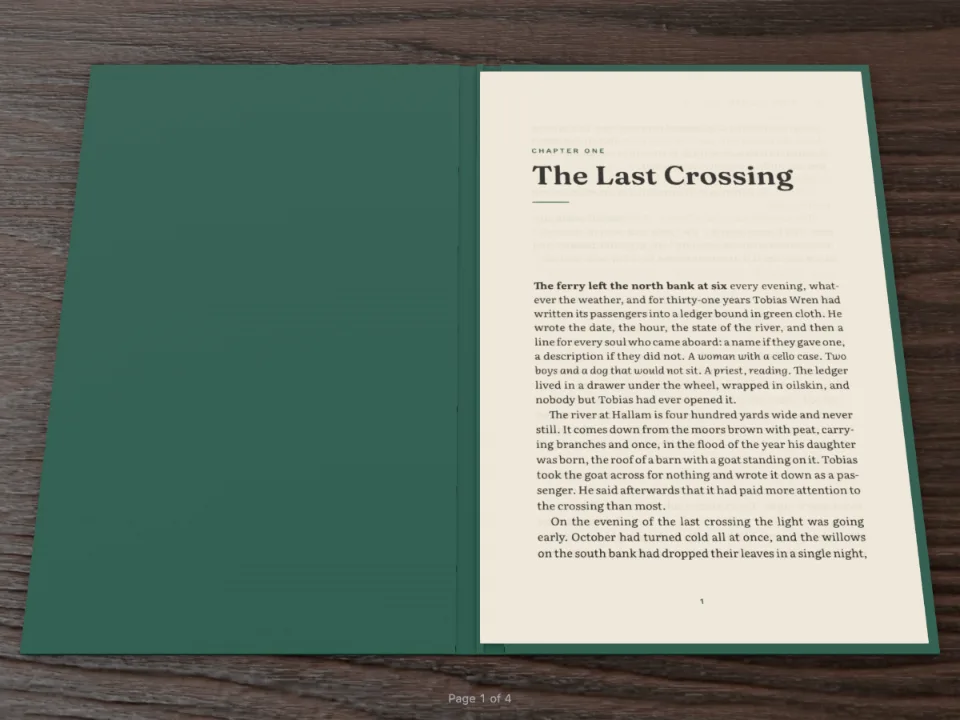
Um livrinho de capa dura com um conto de Poe, cuja capa estampada tem um furo oval. Pelo furo se vê o rosto do retrato impresso na folha de rosto embaixo.
O que você vai compor
O retrato oval, o conto de Edgar Allan Poe de 1842 no texto mais curto que ele publicou em 1845, como um livrinho de capa dura de dez páginas em 130 × 195 mm. A capa é um damasco antigo com uma janela oval cortada. Embaixo está a folha de rosto, o próprio retrato na moldura dourada à mourisca, e a janela fica de modo que a borda caia sobre o dourado: fechado, o livro mostra o rosto pintado emoldurado duas vezes, pelo ouro e pelo corte. O conto segue em papel creme com capitular, e a quarta capa repete o damasco com o texto num painel escuro. O PDF da gráfica leva o contorno da janela numa chapa própria.
Esta receita responde a
- Como corto uma janela na capa que emoldure a folha de rosto embaixo?
- Como entrego a quem faz a faca a linha de faca numa chapa própria do PDF?
A resposta curta
// The window is cut through the first leaf, so the closed book shows page 3 through it.
// Its size is measured on the title-page painting: a little wider than the frame's opening,
// so the cut edge falls on the gilt and the face sits in the middle of the hole.
const dieCuts = {
  shapes: [{ id: 'window', name: t({ en: 'Oval window', es: 'Ventana oval' }),
    shape: 'ellipse', x: mm(26), y: mm(15.7), width: mm(78), height: mm(102) }],
  pages: [{ pages: '1', die: 'window' }], // page 1, the front board
};
Ingredientes
- Funcionalidades
- Furos com faca especialLinha de faca no PDFVisualizador de livro em 3D (Folio)Estilos de títuloImagens nos designs de páginaTextos, fios e caixas nos designs de páginaMetadados do documentoEstilos de parágrafoCapitulares nas aberturasSangria e marcas de cortePDF em CMYK e em escala de cinzaExportação para PDFFiguras e tabelas como recursosPaleta de cores semânticaPáginas em um canvas
- Também usa
- Capitulares em parágrafos do textoPapel, encadernação, mesa e luz (Folio)Atributos de títuloAberturas desenhadasCor do papelCabeços por tipo de páginaCores por parteFontes incorporadas ao PDFGeometria por seçãoCabeços por seçãoCapítulos sem número
- Tipografia
- EB Garamond, Cormorant Garamond (SIL OFL 1.1)
- Materiais
damask.jpgportrait.jpg- Cover and back: a pomegranate damask (Generated With Diffusion Models, original)
- Title page: the oval portrait on a velvet wall (Generated With Diffusion Models, original)
Preparo
#1 · Uma janela em registro com a moldura
O código é a resposta curta acima. A janela é uma ellipse na página 1, posicionada a partir do canto superior esquerdo do refile. Um furo na página 1 dá para a página 3, então ele é medido na pintura da folha de rosto: aqui a abertura da moldura e a borda externa foram lidas em pixels na imagem e convertidas em milímetros, e a janela ficou a um terço da faixa dourada, para que um anel fino de ouro apareça dentro do corte.
#2 · Pinturas penduradas no refile
// Both paintings are placed in trim millimetres, the same frame the die is measured in. The
// portrait is set a little larger than the page so the frame is centred on it (and on the
// window); the cover type sits on a dark cartouche below the window.
const bleed = (x, y, width, height) => ({ kind: 'image', id: 'painting',
  resourceId: '{attr.picture}', fit: 'cover', placement: at('page', 'top-left', x, y,
    { width: mm(width), height: mm(height) }) });
const sheet = bleed(-BLEED, -BLEED, WIDTH + 2 * BLEED, HEIGHT + 2 * BLEED);
const portrait = bleed(-3.6, -BLEED, 140, 210); // its oval centred at x = WIDTH / 2
const box = (id, y, h) => ({ kind: 'box', id, placement: at('page', 'top-left', 17, y,
  { width: mm(WIDTH - 34), height: mm(h) }), style: { backgroundColor: col('plate'),
  borderColor: col('gold'), borderWidth: pt(0.75) } });
const type = (id, content, y, size, extra = {}) => ({ kind: 'text', id, content,
  fontFamily: DISPLAY, fontSize: pt(size), lineHeight: 1.1, color: col('gold'),
  align: 'center', placement: at('page', 'top-left', 17, y, { width: mm(WIDTH - 34) }),
  ...extra });
const caps = { fontWeight: 600, textTransform: 'uppercase', letterSpacing: pt(2.2) };
const full = (elements) => ({ enabled: true, minHeight: mm(HEIGHT - TOP),
  slot: { elements } });
const bare = { numbered: false, toc: false, header: { elements: [] },
  footer: { elements: [] } };
// A plate's section drops the foot margin, so its design reaches the foot of the page.
const flush = (top = TOP, side = 0) => ({ margins: { top: mm(top), bottom: mm(0),
  left: mm(INNER + side), right: mm(OUTER + side) } });
const dark = { palette: { paper: palette.velvet }, marginTop: pt(0), marginBottom: pt(0) };
const behind = (el) => ({ ...el, reserve: false }); // painted under the section's text
const headingStyles = [
  { id: 'cover', ...bare, ...dark, ...flush(), advancedDesign: full([sheet,
    box('plate', 130, 44), type('title', '{title}', 138, 27, { italic: true, fontWeight: 500 }),
    type('author', '{author}', 159, 9.5, caps)]) },
  { id: 'titlepage', ...bare, ...dark, ...flush(), breakBefore: { enabled: true, parity: 'odd' },
    advancedDesign: full([portrait, type('title', '{title}', 146, 30,
      { italic: true, fontWeight: 500 }), type('author', '{author}', 166, 10, caps)]) },
  { id: 'colophon', ...bare, hidden: true, ...flush(132), breakBefore: { parity: 'any' },
    bodyStyle: { fontSize: pt(9), lineHeight: pt(12.5), color: col('muted'), textAlign: 'left' } },
  { id: 'tale', numbered: false, toc: true, breakBefore: { enabled: true, parity: 'odd' },
    marginTop: mm(30), marginBottom: pt(28),
    dropCap: { lines: 3, fontFamily: DISPLAY, color: col('ink'), gap: mm(1.2) } },
  // The back: the damask again, and the copy set in gold on a cartouche.
  { id: 'back', ...bare, ...dark, ...flush(74, 10), breakBefore: { enabled: true,
    parity: 'even' }, advancedDesign: { enabled: true, slot: { elements: [behind(sheet),
      behind(box('plate', 62, 78))] } } },
];
A faca é medida em milímetros a partir do refile, e as pinturas também. O damasco passa do refile por toda a sangria; o retrato fica alguns milímetros mais largo, para que a moldura do quadro fique centrada na página e na janela. A capa e a folha de rosto tiram a margem do pé, e cada uma imprime título e autor a partir do frontmatter.
#3 · A linha de faca na sua chapa
  print: { standard: 'pdfx4', outputProfile: 'fogra51', convertImages: false,
    dieLine: { output: 'page', ink: 'Die', width: pt(0.5) } },
O PDF imprime a capa inteira e traça o contorno da janela numa separação Die em sobreimpressão que nunca é entintada: quem faz a faca lê a forma nela e a impressora a ignora. convertImages: false mantém as pinturas como JPEG sRGB, o que o PDF/X-4 permite, e o arquivo fica abaixo de um megabyte.
#4 · O livro fechado na mesa
  folio: {
    tilt: 34, yaw: 0,
    paper: { type: 'bookWove', shade: '#f6efe2' },
    binding: { type: 'hardcover', cover: 'pages', coverMaterial: 'paper' },
    surface: { type: 'walnut' },
    lighting: { environment: 'lamp', intensity: 1.15 },
  },
Com binding.cover: 'pages' a primeira página é a capa da frente, então o Folio mostra o livro fechado, com o rosto na janela e as paredes do corte pegando a luz da lâmpada. Vire a capa para ver a folha de rosto inteira.
#5 · A capa plana que deixa ver
const under = new Map();
const beneath = (i) => {
  if (!under.has(i) && doc.pages[i]) {
    const canvas = document.createElement('canvas');
    under.set(i, canvas);
    renderPageToCanvas(doc.pages[i], doc, canvas, { scale: 1, beneath });
  }
  return under.get(i);
};
No canvas, beneath entrega ao renderizador a página 3 para a janela da capa, e a capa plana também mostra o rosto. O verso da capa não tem nada embaixo, então o furo mostra o fundo.
A receita completa
// ═══ Postext Cookbook · Nº 194 · A window cover that frames the title page ═══════════════
// https://postext.dev/en/cookbook/die-cut-window-cover
// Code: MIT · Text: Poe (PD) · Translation: CC BY 4.0 · Paintings: diffusion models
// Fonts: EB Garamond, Cormorant Garamond (SIL OFL 1.1) · Needs postext ≥ 1.84.0
//
// Poe's tale of a portrait in an oval frame, as a small hardback whose damask cover has an
// oval window cut through it. Closed, the book shows the face of the portrait on the title
// page through the window; the window's edge falls on the gilt of the painted frame.
import {
  buildDocumentWithFonts, renderPageToCanvas, registerResourceImage,
} from 'https://esm.sh/postext';
import { renderToPdf, decompressWoff2 } from 'https://esm.sh/postext-pdf';
import { createFolioFromDocument } from 'https://esm.sh/postext-folio';

const LANG = 'en'; // @lang: the language of the sample document ('en' | 'es')
const RECIPE = 'die-cut-window-cover';

// ─── 1 · Design ─────────────────────────────────────────────────────────────
// #region palette: ink on cream inside; gold on a near-black for the cover and its plates
const palette = {
  ink: '#2b2320', // the text
  paper: '#f6efe2', // a cream book wove
  velvet: '#2a0d10', // the wall behind the portrait, and the endpapers
  plate: '#160c0b', // the cartouches on the damask
  gold: '#d9b36c', // the title type, the colour of the painted frame
  muted: '#6f6158', // the note on the text
};
const col = (id) => ({ hex: palette[id], model: 'hex', paletteId: id });
const colorPalette = [
  ...Object.entries(palette).map(([id, hex]) => ({ id, name: id, value: { hex, model: 'hex' } })),
  { id: 'main-color', name: 'gold (defaults)', value: { hex: palette.gold, model: 'hex' } },
];
// #endregion
const [WIDTH, HEIGHT, BLEED] = [130, 195, 3]; // mm: a small hardback, and its bleed
const [TOP, FOOT, INNER, OUTER] = [18, 24, 16, 19];
const [TEXT, DISPLAY] = ['EB Garamond', 'Cormorant Garamond'];
const at = (to, edge, x = 0, y = 0, size) => ({ anchor: { to, edge },
  offset: { x: mm(x), y: mm(y) }, ...(size && { size }) });

// #region answer: one oval die through the cover, in register with the frame beneath
// The window is cut through the first leaf, so the closed book shows page 3 through it.
// Its size is measured on the title-page painting: a little wider than the frame's opening,
// so the cut edge falls on the gilt and the face sits in the middle of the hole.
const dieCuts = {
  shapes: [{ id: 'window', name: t({ en: 'Oval window', es: 'Ventana oval' }),
    shape: 'ellipse', x: mm(26), y: mm(15.7), width: mm(78), height: mm(102) }],
  pages: [{ pages: '1', die: 'window' }], // page 1, the front board
};
O script.js montado funciona como está: cole-o como script de módulo em qualquer página ou abra a receita no CodePen. Pasta da receita no GitHub ↗ (abre em uma nova aba)
Variações
#Dê à chapa o nome que a mesa de corte espera
Mesas de corte digital procuram uma cor especial chamada CutContour, quase sempre magenta, e um traço finíssimo.
-    dieLine: { output: 'page', ink: 'Die', width: pt(0.5) } },
+    dieLine: { output: 'page', ink: 'CutContour', cmyk: { c: 0, m: 100, y: 0, k: 0 },
+ width: pt(0.25) } },#Uma janela redonda
Um círculo mostra só o rosto; a moldura fica escondida sob a capa até que ela seja virada.
-    shape: 'ellipse', x: mm(26), y: mm(15.7), width: mm(78), height: mm(102) }],
+ shape: 'circle', x: mm(32), y: mm(24), width: mm(66), height: mm(66) }],Créditos
- Receita
- Ignacio Ferro
- Texto
- The Oval Portrait, in the text of the Broadway Journal (1845), from Project Gutenberg eBook 2147, with Poe’s “rarely” for the eBook’s “merely” · Edgar Allan Poe · domínio público
- The Spanish translation, the note on the text and the back-cover copy · Postext Cookbook · CC BY 4.0
- Imagens
- Cover and back: a pomegranate damask · Generated With Diffusion Models · original
- Title page: the oval portrait on a velvet wall · Generated With Diffusion Models · original
- Fontes
- EB Garamond (SIL OFL 1.1) · Cormorant Garamond (SIL OFL 1.1)
- Código
- MIT, como o Postext
Editar este texto ↗ (abre em uma nova aba)Pasta da receita no GitHub ↗ (abre em uma nova aba)