Em poucas palavras
Um livro cartonado para os pequenos. Cada furo numa página mostra um pedacinho da figura seguinte, o texto faz adivinhar e, ao virar a página, aparece o que era de verdade.
O que você vai compor
Achou! Quem está no jardim?, um livro cartonado de catorze páginas num quadrado de 160 mm, com os quatro cantos arredondados. Cada pintura tem um furo, e o furo fica bem onde a pintura seguinte guarda a parte que engana o olho: o flanco listrado de um gato dormindo que podia ser um tigre, a lã de uma ovelha que podia ser uma nuvem, uma lanterna que podia ser a lua. A janela da capa é mais larga que o furo de trás, então o primeiro olhar chega duas páginas ao fundo. O texto da esquerda faz adivinhar; a página virada responde. O PDF da gráfica leva a linha de faca numa chapa própria.
Esta receita responde a
- Como corto furos nas páginas de um livro, cada um mostrando parte da imagem seguinte?
- Como entrego a quem faz a faca a linha de faca numa chapa própria do PDF?
A resposta curta
// Each painting is cut where the next one's telling part lies: the cat's striped flank, the
// sheep's wool, the lantern's glow. The cover's window is wider than the hedge's hole and
// holds it, so from the cover you see the hedge, and through the hedge the cat. A hole cuts
// both sides of its leaf, mirrored on the verso, and the words there run round it.
const circle = (id, name, cx, cy, d) => ({ id, name, shape: 'circle', x: mm(cx - d / 2),
  y: mm(cy - d / 2), width: mm(d), height: mm(d), wrap: { gap: mm(4) } });
const dieCuts = {
  shapes: [
    circle('window', t({ en: 'Cover window', es: 'Ventana de la cubierta' }), 112, 68, 60),
    circle('hedge', t({ en: 'Gap in the hedge', es: 'Hueco del seto' }), 112, 60, 36),
    { id: 'knot', name: t({ en: 'Knothole', es: 'Nudo de la valla' }), shape: 'ellipse',
      x: mm(102), y: mm(48), width: mm(32), height: mm(40), wrap: { gap: mm(4) } },
    circle('peephole', t({ en: 'Barn-door peephole', es: 'Mirilla del granero' }), 91, 29, 20),
  ],
  // By position in the book: page 1 is the cover, 3 the hedge, 7 the fence, 11 the door.
  pages: [{ pages: '1', die: 'window' }, { pages: '3', die: 'hedge' },
    { pages: '7', die: 'knot' }, { pages: '11', die: 'peephole' }],
  corners: { radius: mm(9), edges: 'all' }, // board books are rounded on all four corners
};
Ingredientes
- Funcionalidades
- Furos com faca especialCantos arredondados e livros recortadosLinha de faca no PDFFuros através de várias folhasVisualizador de livro em 3D (Folio)Estilos de títuloImagens nos designs de páginaAtributos de títuloEstilos de parágrafoSangria e marcas de cortePDF em CMYK e em escala de cinzaExportação para PDFFiguras e tabelas como recursosPaleta de cores semânticaPáginas em um canvas
- Também usa
- Papel, encadernação, mesa e luz (Folio)Aberturas desenhadasCor do papelCores por parteFontes incorporadas ao PDFGeometria por seçãoCapítulos sem número
- Tipografia
- Andika, Fredoka, Nunito (SIL OFL 1.1)
- Materiais
cat.jpgcover.jpgdoor.jpgfence.jpghedge.jpglantern.jpgsheep.jpg- Cover painting: a cottage garden, a hedge, hollyhocks and a robin (Generated With Diffusion Models, original)
- Page 3: the hedge (Generated With Diffusion Models, original)
- Page 5: the ginger cat asleep (Generated With Diffusion Models, original)
- Page 7: the wooden fence (Generated With Diffusion Models, original)
- Page 9: the sheep (Generated With Diffusion Models, original)
- Page 11: the barn door (Generated With Diffusion Models, original)
- Page 13: Grandpa and his lantern at dusk (Generated With Diffusion Models, original)
Preparo
#1 · Furos onde a figura seguinte se entrega
O código é a resposta curta acima. Cada forma é posicionada a partir do canto superior esquerdo do refile, e dieCuts.pages diz qual página ela corta, contando da primeira página do livro. Meça o furo na pintura que ele revela, não na página onde é cortado: a sebe, a cerca e a porta são texturas que aceitam um furo em qualquer lugar; o gato e a lanterna, não.
#2 · Pinturas em registro com os furos
// Each painting hangs from the trim and runs BLEED past it on every side, so the holes hit it
// in the same place on screen and in print. A picture's section drops the foot margin, so its
// design reaches the foot of the page; the words on the verso behind it, in the same section,
// start TOP down.
const SHEET = { width: mm(TRIM + 2 * BLEED), height: mm(TRIM + 2 * BLEED) }; // trim + bleed
const painting = { kind: 'image', id: 'painting', resourceId: '{attr.picture}', fit: 'cover',
  placement: at('page', 'top-left', -BLEED, -BLEED, SHEET) };
const full = (elements) => ({ enabled: true, minHeight: mm(TRIM - TOP), slot: { elements } });
const flush = { margins: { top: mm(TOP), bottom: mm(0), left: mm(INNER), right: mm(OUTER) } };
const title = { kind: 'text', id: 'title', content: '{titleText}', fontFamily: DISPLAY,
  fontWeight: 600, fontSize: pt(40), lineHeight: 1, color: col('accent'), align: 'left',
  placement: at('page', 'top-left', 62, 8, { width: mm(88) }) };
const headingStyles = [
  { id: 'cover', numbered: false, toc: false, ...flush, advancedDesign: full([painting, title]) },
  { id: 'picture', numbered: false, ...flush, breakBefore: { enabled: true, parity: 'odd' },
    advancedDesign: full([painting]) },
  // The back cover: the board printed dusk blue (the section's palette), the type in cream.
  { id: 'back', numbered: false, toc: false, breakBefore: { enabled: true, parity: 'even' },
    color: col('cream'), palette: { paper: palette.dusk } },
];
Os furos estão em milímetros a partir do refile, então cada pintura pende do refile e passa dele pela sangria nos quatro lados, na tela e na impressão. O estilo das pinturas tira só a margem do pé: o desenho chega ao pé da página, e o texto do verso de trás mantém seus 44 mm de margem superior, que o baixam para baixo do topo dos furos pequenos.
#3 · A linha de faca na sua chapa
  // The die line is stroked on a Separation plate of its own ('Die'), overprinting, that the
  // press never inks. PDF/X-4 on coated stock: the board is printed on coated paper.
  print: { standard: 'pdfx4', outputProfile: 'fogra51', convertImages: false,
    dieLine: { output: 'page', ink: 'Die', width: pt(0.5) } },
O PDF imprime cada página inteira e traça o contorno de cada furo, e de cada folha arredondada, numa separação Die em sobreimpressão que nunca é entintada. convertImages: false mantém as pinturas como JPEG RGB marcados como sRGB, o que o PDF/X-4 permite, e o arquivo continua pequeno.
#4 · O livro na mão
  folio: {
    tilt: 50, yaw: -32,
    paper: { type: 'board', shade: '#fbf5e8' },
    binding: { type: 'hardcover', cover: 'pages', coverMaterial: 'paper' },
    surface: { type: 'oak' },
    lighting: { environment: 'daylight', intensity: 1.05 },
  },
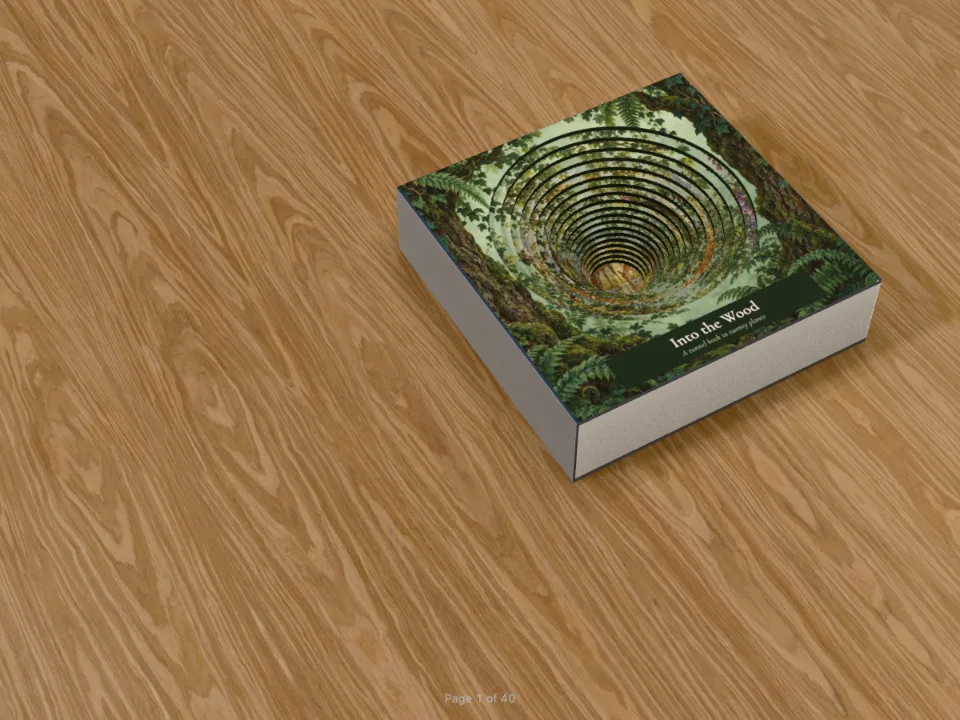
O Folio corta os furos em cada folha e mostra as páginas de baixo com as paredes do corte, e a janela em degraus se lê como profundidade. O cartão vira rígido, e os cantos arredondados são cortados em todas as folhas.
#5 · Páginas planas que deixam ver
// renderPageToCanvas cuts the holes; `beneath` hands it the pages under them, painted here
// at a lower scale (the composite stretches them to the page), each with its own holes.
const under = new Map();
const beneath = (i) => {
  if (!under.has(i) && doc.pages[i]) {
    const canvas = document.createElement('canvas');
    under.set(i, canvas);
    renderPageToCanvas(doc.pages[i], doc, canvas, { scale: 1, beneath });
  }
  return under.get(i);
};
No canvas, um furo mostra o que houver atrás do canvas se o renderizador não receber as páginas de baixo. beneath as devolve por índice, cada uma pintada com seus próprios furos: assim a capa deixa ver a sebe e, através da sebe, o gato.
A receita completa
// ═══ Postext Cookbook · Nº 193 · A peek-a-boo board book with holes in register ════════
// https://postext.dev/en/cookbook/peek-a-boo-board-book
// Code: MIT · Text: original (CC BY 4.0) · Paintings: generated with diffusion models
// Fonts: Andika, Fredoka, Nunito (SIL OFL 1.1) · Needs postext ≥ 1.84.0
//
// A fourteen-page board book for toddlers: on every other recto a hole is cut through the
// painting, and what shows through it is a scrap of the next picture. The words on the left
// make a guess from the scrap; the turned page shows what it really is. The leaves have
// rounded corners, the holes step down from the cover, and the PDF carries the die line.
import {
  buildDocumentWithFonts, renderPageToCanvas, registerResourceImage,
} from 'https://esm.sh/postext';
import { renderToPdf, decompressWoff2 } from 'https://esm.sh/postext-pdf';
import { createFolioFromDocument } from 'https://esm.sh/postext-folio';

const LANG = 'en'; // @lang: the language of the sample document ('en' | 'es')
const RECIPE = 'peek-a-boo-board-book';

// ─── 1 · Design ─────────────────────────────────────────────────────────────
// #region palette: a cream board, a robin red for the title and the guesses, a dusk blue
const palette = {
  ink: '#2a2420', // text: a warm near-black
  accent: '#b8432c', // the cover title and the guesses: the robin's breast
  paper: '#fbf5e8', // the board the words are printed on
  dusk: '#253a63', // the back cover, the blue of the last painting's sky
  cream: '#fff9ec', // type on the cover and the back
  muted: '#7a6f64', // the colophon
};
const col = (id) => ({ hex: palette[id], model: 'hex', paletteId: id });
const colorPalette = [
  ...Object.entries(palette).map(([id, hex]) => ({ id, name: id, value: { hex, model: 'hex' } })),
  { id: 'main-color', name: 'accent (defaults)', value: { hex: palette.accent, model: 'hex' } },
];
// #endregion
const [TRIM, BLEED] = [160, 3]; // mm: a square board book, and its bleed
const [TOP, FOOT, INNER, OUTER] = [44, 16, 18, 16]; // the words sit low, under the holes' tops
const [TEXT, DISPLAY, LABEL] = ['Andika', 'Fredoka', 'Nunito'];
const LEAD = 31; // pt: 24 pt type on a generous leading, for reading aloud
const at = (to, edge, x = 0, y = 0, size) => ({ anchor: { to, edge },
  offset: { x: mm(x), y: mm(y) }, ...(size && { size }) });

// #region answer: the dies, and the pages they cut
// Each painting is cut where the next one's telling part lies: the cat's striped flank, the
// sheep's wool, the lantern's glow. The cover's window is wider than the hedge's hole and
// holds it, so from the cover you see the hedge, and through the hedge the cat. A hole cuts
// both sides of its leaf, mirrored on the verso, and the words there run round it.
const circle = (id, name, cx, cy, d) => ({ id, name, shape: 'circle', x: mm(cx - d / 2),
  y: mm(cy - d / 2), width: mm(d), height: mm(d), wrap: { gap: mm(4) } });
O script.js montado funciona como está: cole-o como script de módulo em qualquer página ou abra a receita no CodePen. Pasta da receita no GitHub ↗ (abre em uma nova aba)
Variações
#Arredonde só os cantos do corte da frente
Um livro ilustrado arredonda os dois cantos longe da lombada e deixa a lombada em esquadro.
-  corners: { radius: mm(9), edges: 'all' }, // board books are rounded on all four corners
+ corners: { radius: mm(6), edges: 'fore' },#Recorte cada folha num formato
Um contorno em unidades de viewBox recorta cada folha, espelhado nos versos; prevalece sobre os cantos.
   corners: { radius: mm(9), edges: 'all' }, // board books are rounded on all four corners
+ outline: { d: 'M0 0.35 L0.5 0 L1 0.35 L1 1 L0 1 Z', viewBox: [1, 1] }, // a houseCréditos
- Receita
- Ignacio Ferro
- Texto
- The words of the board book · Postext Cookbook · CC BY 4.0
- Imagens
- Cover painting: a cottage garden, a hedge, hollyhocks and a robin · Generated With Diffusion Models · original
- Page 3: the hedge · Generated With Diffusion Models · original
- Page 5: the ginger cat asleep · Generated With Diffusion Models · original
- Page 7: the wooden fence · Generated With Diffusion Models · original
- Page 9: the sheep · Generated With Diffusion Models · original
- Page 11: the barn door · Generated With Diffusion Models · original
- Page 13: Grandpa and his lantern at dusk · Generated With Diffusion Models · original
- Fontes
- Andika (SIL OFL 1.1) · Fredoka (SIL OFL 1.1) · Nunito (SIL OFL 1.1)
- Código
- MIT, como o Postext
Editar este texto ↗ (abre em uma nova aba)Pasta da receita no GitHub ↗ (abre em uma nova aba)