Em poucas palavras
Duas páginas espelhadas de um livro de História feitas como uma só: uma faixa colorida atravessa o meio do livro e, embaixo, seis fichas com desenho dividem a largura, para que a história mais longa fique com a ficha mais larga.
O que você vai compor
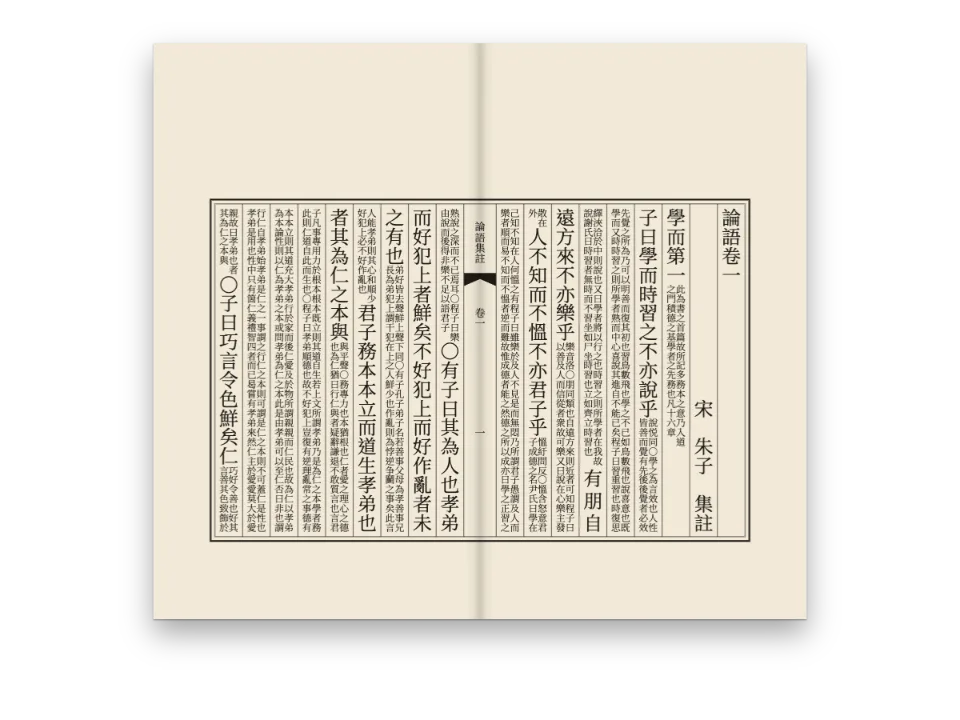
As páginas 48 e 49 de um livro de História do ensino fundamental: O caminho do papel, mil anos de ofício, da oficina de Cai Lun à mó de Keller. A página da esquerda abre com o título e dois parágrafos; a da direita, com um boxe que conta como se fazia uma folha à mão. Pelo meio corre a linha do tempo: uma faixa anil para a Ásia e uma terracota para a Europa, que começa na página da esquerda e atravessa a lombada. Embaixo, seis fichas com seu desenho, presas à faixa por um ponto e um traço. As fichas dividem a largura: a de 1844, com a história mais longa, toma largura das duas vizinhas (1 mm em espanhol, 7 mm em japonês), e o seu ponto se move com ela. Todas as palavras estão no Markdown, em espanhol, inglês e japonês; esta página mostra a edição em inglês.
Esta receita responde a
- Como diagramo uma linha do tempo em página dupla, com uma faixa que atravessa a lombada e fichas nas duas páginas?
- Como faço uma fileira de caixas dividir a largura, para que a do texto mais longo fique mais larga?
A resposta curta
const pageTemplates = [{
  id: 'timeline',
  spread: true, // two facing pages laid as one sheet; it opens on a verso
  gutter: mm(10), // the band round the spine that frames keep off
  grid: { columns: 2, rows: ROWS, columnGap: mm(2 * PAGE.inner), rowGap: mm(ROW_GAP) },
  frames: [
    { name: 'title', takes: 'h1' },
    { name: 'lead', flow: true, fit: { minScale: 0.8 } },
    { name: 'box', style: 'box', grid: { col: 2, row: 1, rows: 4 }, height: 'fill',
      padding: { right: mm(66) }, fit: { minScale: 0.85 } },
    { name: 'box-picture', layer: 2, width: mm(56), placement: at('#box', 'top-right', -5, 10) },
    { name: 'band-1', style: 'band-asia', grid: { col: 1, row: 5 }, height: mm(BAND) },
    { name: 'band-2', style: 'band-europe', crossGutter: true, width: 'fill', height: mm(BAND),
      padding: { left: mm(2 * PAGE.inner + 4) }, // the colour crosses the fold, the words do not
      placement: at('#band-1', 'right-of') },
    ...cards.map(card),
    { name: 'colophon', style: 'colophon', optional: true, width: mm(170),
      placement: at('page', 'bottom-right', -PAGE.outer, -7) },
  ],
  groups: [
    { name: 'opening', kind: 'stack', grid: { col: 1, row: 1, rows: 4 }, gap: mm(4),
      frames: ['title', 'lead'] },
    // A card whose text runs past its drawn height takes width from its neighbours first;
    // only when they have none to give does the row grow taller.
    { name: 'asia', kind: 'row', gap: mm(5), frames: ['c1', 'c2', 'c3'] },
    { name: 'europe', kind: 'row', gap: mm(5), frames: ['c4', 'c5', 'c6'] },
  ],
  decoration: { elements: [ground(), ...cards.flatMap(marks)] },
}];
Ingredientes
- Funcionalidades
- Modelos em página duplaQuadros que crescem num grupoDecoração ancorada aos blocosPáginas compostasAbas numeradas nos boxesBoxesAncoragem de elementos de designCabeços e fóliosMargens espelhadasListas numeradasFontes chinesas, japonesas e coreanasPaleta de cores semânticaPáginas em um canvasExportação para PDF
- Também usa
- Figuras exatamente aquiFontes incorporadas ao PDFTipos de recurso personalizadosFiguras e tabelas como recursos
- Tipografia
- Literata, Archivo, Noto Serif JP, Noto Sans JP (SIL OFL 1.1)
- Materiais
forma-800.jpgv105-1000.jpgv1150-1000.jpgv1282-1000.jpgv1844-1000.jpgv610-1000.jpgv751-1000.jpg- A Han court official watches a craftsman lift a bamboo mould from a vat. (Generated With Diffusion Models, original)
- A monk shows two Japanese courtiers how to hold a papermaking mould. (Generated With Diffusion Models, original)
- Papermakers by a canal in Samarkand, sheets drying on a wall. (Generated With Diffusion Models, original)
- A paper workshop below the castle of Xàtiva. (Generated With Diffusion Models, original)
- A Fabriano mill with its water wheel; a sheet held up to the light. (Generated With Diffusion Models, original)
- A craftsman grinds a spruce log against a stone into wood pulp. (Generated With Diffusion Models, original)
- Two hands lift a papermaker's mould from a vat of pulp. (Generated With Diffusion Models, original)
Preparo
#1 · Uma folha para duas páginas
const pageTemplates = [{
  id: 'timeline',
  spread: true, // two facing pages laid as one sheet; it opens on a verso
  gutter: mm(10), // the band round the spine that frames keep off
  grid: { columns: 2, rows: ROWS, columnGap: mm(2 * PAGE.inner), rowGap: mm(ROW_GAP) },
  frames: [
    { name: 'title', takes: 'h1' },
    { name: 'lead', flow: true, fit: { minScale: 0.8 } },
    { name: 'box', style: 'box', grid: { col: 2, row: 1, rows: 4 }, height: 'fill',
      padding: { right: mm(66) }, fit: { minScale: 0.85 } },
    { name: 'box-picture', layer: 2, width: mm(56), placement: at('#box', 'top-right', -5, 10) },
    { name: 'band-1', style: 'band-asia', grid: { col: 1, row: 5 }, height: mm(BAND) },
    { name: 'band-2', style: 'band-europe', crossGutter: true, width: 'fill', height: mm(BAND),
      padding: { left: mm(2 * PAGE.inner + 4) }, // the colour crosses the fold, the words do not
      placement: at('#band-1', 'right-of') },
    ...cards.map(card),
    { name: 'colophon', style: 'colophon', optional: true, width: mm(170),
      placement: at('page', 'bottom-right', -PAGE.outer, -7) },
  ],
  groups: [
    { name: 'opening', kind: 'stack', grid: { col: 1, row: 1, rows: 4 }, gap: mm(4),
      frames: ['title', 'lead'] },
    // A card whose text runs past its drawn height takes width from its neighbours first;
    // only when they have none to give does the row grow taller.
    { name: 'asia', kind: 'row', gap: mm(5), frames: ['c1', 'c2', 'c3'] },
    { name: 'europe', kind: 'row', gap: mm(5), frames: ['c4', 'c5', 'c6'] },
  ],
  decoration: { elements: [ground(), ...cards.flatMap(marks)] },
}];
spread: true transforma o modelo numa só folha da largura das duas páginas, e o bloco da página diz o mesmo com spread. Uma página dupla começa numa página par, então a composição recebe continuation: { pageIndexOffset: 1, pageNumbering: { startAt: 48 } }: a página 1 deste trecho é a 48 do livro, uma página da esquerda, e nenhuma página em branco vem antes. A grade tem uma coluna por página, separadas pelo dobro da margem interna, de modo que só a faixa chega perto da dobra. A segunda faixa usa crossGutter e 36 mm de recuo à esquerda: a cor sai do fim da primeira e atravessa a lombada, e as palavras começam na página da direita, onde a diagramação as lê.
#2 · Fichas que dividem a largura
const cards = ['c1', 'c2', 'c3', 'c4', 'c5', 'c6'];
const card = (name, i) => ({ name, style: i < 3 ? 'card-asia' : 'card-europe',
  width: mm((HALF - 10) / 3), minWidth: mm(40), minHeight: mm(CARD),
  shrink: 1, // a card gives width to a neighbour whose text runs past the row
  ...(i % 3 === 0 && { placement: at('container', 'top-left', i ? HALF + 2 * PAGE.inner : 0,
    CARD_TOP) }) }); // where each row starts
Cada fileira de três fichas é um grupo row, e cada ficha tem um minHeight, a altura em que está desenhada, e acima disso uma altura auto. Quando o texto de uma ficha passa da altura da fileira, ela toma das vizinhas com shrink os milímetros inteiros de que precisa, e cada vizinha mantém a largura em que o seu próprio texto ainda cabe. Só quando elas não têm mais o que dar a fileira cresce para baixo. Na edição em espanhol, a ficha de 1844 toma 1 mm da de 1282; na em japonês toma 7 mm, 3 da de 1150 e 4 da de 1282; com todos os textos 30 % mais longos, o teste da bancada, a espanhola toma 15 mm, e o boxe e o texto de abertura reduzem a letra a 92,5 % e 85 %.
#3 · Pontos que acompanham as fichas
function marks(name, i) {
  const ink = col(i < 3 ? 'asia' : 'europe');
  return [
    { kind: 'rule', id: `${name}-tick`, direction: 'vertical', thickness: pt(1), color: ink,
      placement: { ...at(`#${name}`, 'top', 0, -DROP), size: { height: mm(DROP) } } },
    { kind: 'box', id: `${name}-dot`,
      placement: { ...at(`#${name}`, 'top', 0, -DROP + 0.6), size: { width: mm(4.4),
        height: mm(4.4) } },
      style: { backgroundColor: col('paper'), borderColor: ink, borderWidth: pt(1.6),
        borderRadius: mm(2.2) } },
  ];
}
Os pontos e os traços são a decoração (decoration) do modelo, ancorados em #c1 … #c6 pela borda de cima (top) e levantados a distância que os separa da faixa. A decoração é posta depois dos blocos: quando uma ficha se move ou se alarga, o seu ponto continua sobre o centro dela. O fundo creme também é decoração, uma caixa ancorada ao pé da sangria cuja altura sobe até o pé de #band-1 (size: { height: { to: '#band-1', edge: 'bottom' } }): ela acompanha a faixa.
#4 · Desenhos no tamanho de impressão
const ART = {
  v105: t({ es: 'Un funcionario de la corte Han mira cómo un artesano saca de la tina un molde '
      + 'de bambú lleno de pasta, junto a corteza, trapos y redes viejas.',
    en: 'A Han court official watches a craftsman lift a bamboo mould full of pulp from a vat, '
      + 'beside bark, rags and old nets.',
    ja: '漢の役人が見守るなか、職人が竹のすき枠を漉き舟から引き上げる。そばに樹皮、ぼろ布、古い網。' }),
  v610: t({ es: 'Un monje enseña a dos cortesanos japoneses a sostener el molde sobre una tina, '
      + 'con ramas de kozo en una estera.',
    en: 'A monk shows two Japanese courtiers how to hold the mould over a tub, with kozo '
      + 'branches on a mat.',
    ja: '僧が二人の宮廷人に、桶の上ですき枠を持つ手つきを見せる。むしろの上に楮の枝。' }),
  v751: t({ es: 'Papeleros de Samarcanda junto a un canal; las hojas se secan al sol contra un '
      + 'muro de adobe.',
    en: 'Samarkand papermakers by a canal; the sheets dry in the sun against a mud-brick wall.',
    ja: '水路のそばで働くサマルカンドの紙すき職人。日干しれんがの壁に紙が張られて乾いている。' }),
  v1150: t({ es: 'Un taller de Xàtiva bajo el castillo: un operario golpea trapos en una pila '
      + 'de piedra y las hojas cuelgan de cuerdas.',
    en: 'A workshop in Xàtiva below the castle: a worker pounds rags in a stone trough and the '
      + 'sheets hang on ropes.',
    ja: '城の下のシャティバの工房。職人が石の槽でぼろ布をたたき、紙が綱につるされている。' }),
  v1282: t({ es: 'Un molino de Fabriano con su rueda hidráulica y sus mazos; un papelero mira '
      + 'una filigrana al trasluz.',
    en: 'A Fabriano mill with its water wheel and hammers; a papermaker holds a watermark up '
      + 'to the light.',
    ja: '水車と木づちのあるファブリアーノの製紙場。職人が紙を光にかざして透かしを見ている。' }),
  v1844: t({ es: 'Un artesano aprieta un tronco de abeto contra una muela que gira; debajo se '
      + 'amontonan las fibras.',
    en: 'A craftsman presses a spruce log against a turning grindstone; the fibres pile up '
      + 'below.',
    ja: '職人がトウヒの丸太を回る砥石に押し当て、その下に木の繊維が積もっていく。' }),
  forma: t({ es: 'Dos manos sacan de la tina el molde con una capa fina de fibras.',
    en: 'Two hands lift the mould from the vat with a thin layer of fibres on it.',
    ja: '両手ですき枠を引き上げる。網の上に繊維の薄い層ができている。' }),
};
const SIZE = { forma: [800, 800, 363] }; // pixels and ppi: 56 mm wide; the cards' are 46 mm
const resources = await Promise.all(Object.entries(ART).map(async ([id, altText]) => {
  const px = SIZE[id] ?? [1000, 667, 550];
  const fileId = `${id}-${px[0]}.jpg`;
  await loadImage(fileId, asset(fileId));
  return { id, typeId: 'picture', kind: 'bitmap', caption: '', altText, createdAt: 0,
    updatedAt: 0,
    bitmap: { fileId, format: 'jpeg', width: px[0], height: px[1], resolution: px[2] } };
}));
As vinhetas têm 1.000 px a 550 ppi, 46 mm na página, e uma imagem nunca é ampliada: a ficha que se alarga mantém o desenho e deixa o espaço para o texto. Uma ficha mais estreita que 53 mm (o desenho mais 3,5 mm de margem de cada lado) reduz o desenho, como o teste da bancada mostra na edição em japonês: os desenhos de 1150 e 1282 a 85 %.
A receita completa
// ═══ Postext Cookbook · Nº 158 · An illustrated timeline across a double page ═══════ // https://postext.dev/en/cookbook/illustrated-timeline-spread // Code: MIT · Text: original (CC BY 4.0) · Pictures: generated with diffusion models // Fonts: Literata, Archivo, Noto Serif JP, Noto Sans JP (SIL OFL 1.1) · Needs postext ≥ 1.38.0 import { buildDocument, withLoadedFonts, renderPageToCanvas, registerResourceImage, } from 'https://esm.sh/postext'; import { renderToPdf, decompressWoff2 } from 'https://esm.sh/postext-pdf'; const LANG = 'en'; // @lang: the language of the sample document ('es' | 'en' | 'ja') const RECIPE = 'illustrated-timeline-spread'; // ─── 1 · Design ───────────────────────────────────────────────────────────── // #region palette: one ink, an accent for each half of the timeline, a pale ground const palette = { ink: '#22201d', // text asia: '#2f4f7a', // indigo: the Asian half of the timeline europe: '#a2412a', // terracotta: the European half ground: '#f1ebdf', // the cream under the cards rule: '#c9bfae', // hairlines and the card borders muted: '#6b6359', // running heads and the colophon paper: '#ffffff', }; const col = (id) => ({ hex: palette[id], model: 'hex', paletteId: id }); const colorPalette = [ ...Object.entries(palette).map(([id, hex]) => ({ id, name: id, value: { hex, model: 'hex' } })), { id: 'main-color', name: 'europe (defaults)', value: { hex: palette.europe, model: 'hex' } }, ]; // #endregion const JA = LANG === 'ja'; const SERIF = JA ? 'Noto Serif JP' : 'Literata'; const SANS = JA ? 'Noto Sans JP' : 'Archivo'; // A Western textbook page is 210 × 280 mm; a Japanese one is AB判, 210 × 257 mm. const PAGE = { w: 210, h: JA ? 257 : 280, top: 22, bottom: 20, inner: 16, outer: 15 }; const ROWS = 12; const ROW_GAP = 3; const ROW = (PAGE.h - PAGE.top - PAGE.bottom - (ROWS - 1) * ROW_GAP) / ROWS; // one grid row, mm const HALF = PAGE.w - PAGE.inner - PAGE.outer; // the width of one page's half of the sheet const BAND = 9; // the timeline band, in grid row 5 const DROP = ROW - BAND + ROW_GAP; // from the band's foot to the cards' heads const CARD_TOP = 5 * (ROW + ROW_GAP); // grid row 6 // The drawn height of a card; 16 mm of the area stay free for a longer text. const CARD = PAGE.h - PAGE.top - PAGE.bottom - CARD_TOP - 16; const at = (to, edge, x = 0, y = 0) => ({ anchor: { to, edge }, offset: { x: mm(x), y: mm(y) } }); // #region cards: six cards at least one height tall that trade width with their neighbours const cards = ['c1', 'c2', 'c3', 'c4', 'c5', 'c6']; const card = (name, i) => ({ name, style: i < 3 ? 'card-asia' : 'card-europe', width: mm((HALF - 10) / 3), minWidth: mm(40), minHeight: mm(CARD), shrink: 1, // a card gives width to a neighbour whose text runs past the row ...(i % 3 === 0 && { placement: at('container', 'top-left', i ? HALF + 2 * PAGE.inner : 0, CARD_TOP) }) }); // where each row starts // #endregion // #region answer: one sheet for two pages, a band across the spine, two rows of cards const pageTemplates = [{ id: 'timeline', spread: true, // two facing pages laid as one sheet; it opens on a verso gutter: mm(10), // the band round the spine that frames keep off grid: { columns: 2, rows: ROWS, columnGap: mm(2 * PAGE.inner), rowGap: mm(ROW_GAP) }, frames: [ { name: 'title', takes: 'h1' }, { name: 'lead', flow: true, fit: { minScale: 0.8 } }, { name: 'box', style: 'box', grid: { col: 2, row: 1, rows: 4 }, height: 'fill', padding: { right: mm(66) }, fit: { minScale: 0.85 } }, { name: 'box-picture', layer: 2, width: mm(56), placement: at('#box', 'top-right', -5, 10) }, { name: 'band-1', style: 'band-asia', grid: { col: 1, row: 5 }, height: mm(BAND) }, { name: 'band-2', style: 'band-europe', crossGutter: true, width: 'fill', height: mm(BAND), padding: { left: mm(2 * PAGE.inner + 4) }, // the colour crosses the fold, the words do not placement: at('#band-1', 'right-of') }, ...cards.map(card), { name: 'colophon', style: 'colophon', optional: true, width: mm(170), placement: at('page', 'bottom-right', -PAGE.outer, -7) }, ], groups: [ { name: 'opening', kind: 'stack', grid: { col: 1, row: 1, rows: 4 }, gap: mm(4), frames: ['title', 'lead'] }, // A card whose text runs past its drawn height takes width from its neighbours first; // only when they have none to give does the row grow taller. { name: 'asia', kind: 'row', gap: mm(5), frames: ['c1', 'c2', 'c3'] }, { name: 'europe', kind: 'row', gap: mm(5), frames: ['c4', 'c5', 'c6'] }, ], decoration: { elements: [ground(), ...cards.flatMap(marks)] }, }]; // #endregion // #region marks: a dot under the band and a tick down to each card, anchored to the card function marks(name, i) { const ink = col(i < 3 ? 'asia' : 'europe'); return [ { kind: 'rule', id: `${name}-tick`, direction: 'vertical', thickness: pt(1), color: ink, placement: { ...at(`#${name}`, 'top', 0, -DROP), size: { height: mm(DROP) } } }, { kind: 'box', id: `${name}-dot`, placement: { ...at(`#${name}`, 'top', 0, -DROP + 0.6), size: { width: mm(4.4), height: mm(4.4) } }, style: { backgroundColor: col('paper'), borderColor: ink, borderWidth: pt(1.6), borderRadius: mm(2.2) } }, ]; } // #endregion // The cream ground under the cards: from the foot of the band down to the bleed. function ground() { return { kind: 'box', id: 'ground', decorative: true, placement: { ...at('bleed', 'bottom-left'), size: { width: 'fill', height: { to: '#band-1', edge: 'bottom' } } }, style: { backgroundColor: col('ground') } }; } const tab = (ink) => ({ position: 'top-left', background: col(ink), color: col('paper'), fontFamily: SANS, fontSize: pt(10), fontWeight: 700, height: mm(6), paddingX: mm(2.6), offset: mm(3.5), inset: mm(0), rule: { enabled: false } }); const cardStyle = (id, ink) => ({ id, backgroundEnabled: true, background: col('paper'), border: { enabled: true, color: col('rule'), width: pt(0.5) }, borderRadius: mm(1.5), stripe: { enabled: true, side: 'top', width: pt(2.5), color: col(ink) }, padding: { top: mm(8), right: mm(3.5), bottom: mm(3.5), left: mm(3.5) }, label: tab(ink), body: { fontFamily: SERIF, fontSize: pt(JA ? 8.6 : 9.4), lineHeight: pt(JA ? 15 : 12.8), color: col('ink'), boldColor: col(ink), italicColor: col('ink'), textAlign: JA ? 'justify' : 'left', hyphenation: !JA, firstLineIndent: pt(0), boldFontWeight: 700 } }); const bandStyle = (id, ink) => ({ id, backgroundEnabled: true, background: col(ink), border: { enabled: false }, padding: { top: mm(1.6), right: mm(4), bottom: mm(1), left: mm(4) }, body: { fontFamily: SANS, fontSize: pt(9.5), lineHeight: pt(12), fontWeight: 700, color: col('paper'), firstLineIndent: pt(0) } }); const head = (id, content, parity, edge, x) => ({ kind: 'text', id, content, parity, fontFamily: SANS, fontSize: pt(8), fontWeight: 600, letterSpacing: pt(JA ? 0 : 0.8), color: col('muted'), placement: at('page', edge, x, 11) }); const folio = (id, parity, edge, x) => ({ kind: 'text', id, content: '{pageNumber}', parity, fontFamily: SANS, fontSize: pt(9), fontWeight: 700, color: col('ink'), placement: at('page', edge, x, -10) }); const config = { locale: t({ es: 'es', en: 'en-gb', ja: 'ja' }), resourceTypes: [{ id: 'picture', name: t({ es: 'Ilustración', en: 'Illustration', ja: 'イラスト' }), shortLabel: '', numberingTemplate: '', resetOn: 'never', counterFormat: 'decimal', captionPrefix: '', defaultPlacement: { position: 'here' } }], colorPalette, page: { sizePreset: 'custom', width: mm(PAGE.w), height: mm(PAGE.h), dpi: 150, margins: { top: mm(PAGE.top), bottom: mm(PAGE.bottom), left: mm(PAGE.inner), right: mm(PAGE.outer), mirror: true }, }, layout: { layoutType: 'single' }, bodyText: { fontFamily: SERIF, fontSize: pt(JA ? 10.5 : 12.4), lineHeight: pt(JA ? 18.5 : 17), paragraphSpacing: !JA, color: col('ink'), boldColor: col('ink'), italicColor: col('ink'), referenceColor: col('ink'), textAlign: JA ? 'justify' : 'left', firstLineIndent: JA ? em(1) : pt(0), // Japanese paragraphs open with a one-character indent hyphenation: { enabled: !JA }, }, headings: { fontFamily: SANS, color: col('ink'), fontWeight: 800, levels: [{ level: 1, fontSize: pt(JA ? 44 : 58), lineHeight: pt(JA ? 54 : 60), color: col('asia'), marginTop: pt(0), marginBottom: pt(0), breakBefore: { enabled: false } }], }, orderedLists: { numberFormat: 'arabic', color: col('europe'), fontWeight: 700 }, calloutStyles: [ { id: 'box', backgroundEnabled: true, background: col('paper'), border: { enabled: true, color: col('rule'), width: pt(0.5) }, borderRadius: mm(1.5), padding: { top: mm(9), right: mm(5), bottom: mm(4), left: mm(5) }, label: tab('europe'), body: { fontFamily: SERIF, fontSize: pt(JA ? 9.5 : 10.4), lineHeight: pt(JA ? 16.5 : 14.2), color: col('ink'), boldColor: col('ink'), italicColor: col('ink'), textAlign: 'left', firstLineIndent: pt(0), paragraphSpacing: true }, lists: { color: col('europe'), gap: mm(1.5), itemSpacing: mm(1.2) } }, cardStyle('card-asia', 'asia'), cardStyle('card-europe', 'europe'), bandStyle('band-asia', 'asia'), bandStyle('band-europe', 'europe'), { id: 'colophon', backgroundEnabled: false, border: { enabled: false }, padding: { top: mm(0), right: mm(0), bottom: mm(0), left: mm(0) }, body: { fontFamily: SANS, fontSize: pt(6.5), lineHeight: pt(8), color: col('muted'), firstLineIndent: pt(0) } }, ], header: { elements: [ head('subject', '{attr.subject}', 'even', 'top-left', PAGE.outer), head('unit', '{attr.unit}', 'odd', 'top-right', -PAGE.outer), ] }, footer: { elements: [ folio('verso-folio', 'even', 'bottom-left', PAGE.outer), folio('recto-folio', 'odd', 'bottom-right', -PAGE.outer), ] }, pageTemplates, }; // The spread opens on a verso: page 1 of this excerpt is book page 48. const continuation = { pageIndexOffset: 1, pageNumbering: { startAt: 48 } }; // ─── 2 · Content ──────────────────────────────────────────────────────────── const markdown = String.raw`::::page{template="timeline" spread subject="History · Year 8" unit="Unit 5 · Trade routes"}Amostra em Markdown · 65 linhas · content.en.md
# The paper road For centuries, making paper was a craft kept in Chinese workshops. It took more than a thousand years to travel from there to the mills of Europe. Every people who learnt it changed the recipe to suit what they had to hand: mulberry bark in China, kozo in Japan, flax and rags in Samarkand and al-Andalus, and wood in the nineteenth century. :::frame{slot="box" label="How a sheet was made"} 1. The fibres are chopped and left to soak until they break down into a pulp. 2. The mould, a fine screen on a wooden frame, is dipped into the vat and lifted out full of pulp. 3. The mould is shaken: the water drains away and the fibres lock together in an even layer. 4. The sheet is pressed between felts and hung up to dry. The wires of the mould leave their print in the sheet: they are the fine lines you see when you hold paper up to the light. ::: ::resource{id="forma" slot="box-picture"} :::frame{slot="band-1"} In Asia, from the 2nd to the 8th century ::: :::frame{slot="band-2"} Around the Mediterranean and in Europe, from the 12th to the 19th century ::: :::frame{slot="c1" label="105"} ::resource{id="v105"} **China.** Cai Lun, an official at the Han court, presents the emperor with paper made from mulberry bark, scraps of hemp, rags and old fishing nets. It costs less than silk and weighs far less than strips of bamboo. Archaeologists have found Chinese paper two centuries older, but Cai Lun's is the one copied across the empire. ::: :::frame{slot="c2" label="610"} ::resource{id="v610"} **Japan.** According to the chronicle *Nihon shoki*, the monk Damjing, from the Korean kingdom of Goguryeo, teaches the court how to make paper and ink. Japanese papermakers turn the bark of the kozo shrub into *washi*, thin and very strong. The Shōsōin in Nara still keeps household registers written on paper in 702. ::: :::frame{slot="c3" label="751"} ::resource{id="v751"} **Samarkand.** A tradition says that after the Battle of Talas, Chinese prisoners taught the craft in this Silk Road city. Samarkand's papermakers use flax and cotton rags. By about 800, Baghdad has workshops of its own, and paper replaces parchment in the caliph's archives. ::: :::frame{slot="c4" label="1150"} ::resource{id="v1150"} **Xàtiva.** The geographer al-Idrisi writes that this town of al-Andalus makes a paper with no equal anywhere in the world, sold to East and West. When James I takes the town in 1244, the workshops carry on. ::: :::frame{slot="c5" label="1282"} ::resource{id="v1282"} **Fabriano.** The mills of this Italian town use the river to drive hammers that beat rags to pulp. They size their sheets with gelatine, which stops the ink from spreading, and mark them with a watermark, a design that only shows against the light. By the 14th century, Italian paper is sold across half of Europe. ::: :::frame{slot="c6" label="1844"} ::resource{id="v1844"} **Saxony.** After printing come the newspapers, and there are no longer rags enough for so much paper. In 1798, Louis-Nicolas Robert had built a machine in France that made one continuous sheet, with no mould. In 1844 the weaver Friedrich Gottlob Keller presses spruce logs against a grindstone and gets wood pulp. From then on paper is cheap and plentiful, and a daily paper costs no more than a loaf of bread. ::: :::frame{slot="colophon"} Set in Literata and Archivo (SIL OFL) · Original text (CC BY 4.0) · Illustrations generated with diffusion models ::: ::::`; // content.<lang>.md, inlined by the Cookbook // #region art: seven pictures at the size they print, with what each shows const ART = { v105: t({ es: 'Un funcionario de la corte Han mira cómo un artesano saca de la tina un molde ' + 'de bambú lleno de pasta, junto a corteza, trapos y redes viejas.', en: 'A Han court official watches a craftsman lift a bamboo mould full of pulp from a vat, ' + 'beside bark, rags and old nets.', ja: '漢の役人が見守るなか、職人が竹のすき枠を漉き舟から引き上げる。そばに樹皮、ぼろ布、古い網。' }), v610: t({ es: 'Un monje enseña a dos cortesanos japoneses a sostener el molde sobre una tina, ' + 'con ramas de kozo en una estera.', en: 'A monk shows two Japanese courtiers how to hold the mould over a tub, with kozo ' + 'branches on a mat.', ja: '僧が二人の宮廷人に、桶の上ですき枠を持つ手つきを見せる。むしろの上に楮の枝。' }), v751: t({ es: 'Papeleros de Samarcanda junto a un canal; las hojas se secan al sol contra un ' + 'muro de adobe.', en: 'Samarkand papermakers by a canal; the sheets dry in the sun against a mud-brick wall.', ja: '水路のそばで働くサマルカンドの紙すき職人。日干しれんがの壁に紙が張られて乾いている。' }), v1150: t({ es: 'Un taller de Xàtiva bajo el castillo: un operario golpea trapos en una pila ' + 'de piedra y las hojas cuelgan de cuerdas.', en: 'A workshop in Xàtiva below the castle: a worker pounds rags in a stone trough and the ' + 'sheets hang on ropes.', ja: '城の下のシャティバの工房。職人が石の槽でぼろ布をたたき、紙が綱につるされている。' }), v1282: t({ es: 'Un molino de Fabriano con su rueda hidráulica y sus mazos; un papelero mira ' + 'una filigrana al trasluz.', en: 'A Fabriano mill with its water wheel and hammers; a papermaker holds a watermark up ' + 'to the light.', ja: '水車と木づちのあるファブリアーノの製紙場。職人が紙を光にかざして透かしを見ている。' }), v1844: t({ es: 'Un artesano aprieta un tronco de abeto contra una muela que gira; debajo se ' + 'amontonan las fibras.', en: 'A craftsman presses a spruce log against a turning grindstone; the fibres pile up ' + 'below.', ja: '職人がトウヒの丸太を回る砥石に押し当て、その下に木の繊維が積もっていく。' }), forma: t({ es: 'Dos manos sacan de la tina el molde con una capa fina de fibras.', en: 'Two hands lift the mould from the vat with a thin layer of fibres on it.', ja: '両手ですき枠を引き上げる。網の上に繊維の薄い層ができている。' }), }; const SIZE = { forma: [800, 800, 363] }; // pixels and ppi: 56 mm wide; the cards' are 46 mm const resources = await Promise.all(Object.entries(ART).map(async ([id, altText]) => { const px = SIZE[id] ?? [1000, 667, 550]; const fileId = `${id}-${px[0]}.jpg`; await loadImage(fileId, asset(fileId)); return { id, typeId: 'picture', kind: 'bitmap', caption: '', altText, createdAt: 0, updatedAt: 0, bitmap: { fileId, format: 'jpeg', width: px[0], height: px[1], resolution: px[2] } }; })); // #endregion // ─── 3 · Fonts ────────────────────────────────────────────────────────────── const FONTS = { Literata: ['400', '400i', '700'], Archivo: ['400', '600', '700', '800'], // es, en 'Noto Serif JP': ['400', '700'], 'Noto Sans JP': ['400', '600', '700', '800'], // ja }; // ─── 4 · Build & show ─────────────────────────────────────────────────────── await loadFonts(FONTS, markdown); // the latin files of every face await loadCjkFonts({ [SERIF]: FONTS[SERIF], [SANS]: FONTS[SANS] }, markdown); // ja only const doc = await withLoadedFonts( () => buildDocument({ markdown, resources, continuation }, config), { ...kitFonts(FONTS), text: markdown }); showPages(doc, { title: t({ es: 'Una cronología ilustrada a doble página', en: 'An illustrated timeline across a double page', ja: '見開きの絵入り年表' }) }); offerPdf(() => renderToPdf(doc, { fontProvider: cjkPdfProvider, resourceBytes: imageBytes }), `${RECIPE}.pdf`);Kit · core, fonts, viewer, pdf, images, cjk: igual em todas as receitas · 504 linhas
// ─── Kit ── helpers shared by every Cookbook recipe · postext.dev/cookbook ───── // ─── Kit · core v1 ── the same in every recipe · postext.dev/cookbook function mm(value) { return { value, unit: 'mm' }; } function pt(value) { return { value, unit: 'pt' }; } function em(value) { return { value, unit: 'em' }; } /** The sample language's string: t({ en: 'Figure', es: 'Figura' }). */ function t(strings) { return strings[LANG] ?? Object.values(strings)[0]; } /** A file in this recipe's assets folder, served from the Postext repo by jsDelivr. */ function asset(file) { return `https://cdn.jsdelivr.net/gh/drnachio/postext@main/cookbook/${RECIPE}/assets/${file}`; } // ─── Kit · fonts v3 ── the same in every recipe · postext.dev/cookbook // Postext loads the faces a config asks for before layout (prepareFonts, // buildDocumentWithFonts) and asks the kit for the files: Fontsource's, the // files the PDF embeds too. /** The options of buildDocumentWithFonts / prepareFonts / withLoadedFonts: * the Fontsource resolver, and the faces of FONTS loaded with the ones the * config names. FONTS = { 'Family Name': ['400', '400i', '700'] }. */ function kitFonts(FONTS = {}) { const faces = Object.entries(FONTS).flatMap(([family, specs]) => specs.map((spec) => ({ family, weight: parseInt(spec, 10), style: spec.endsWith('i') ? 'italic' : 'normal' }))); return { resolve: fontsourceResolver, faces }; } /** A face's Fontsource files, in a fixed order: latin, then latin-ext and greek * when `text` needs them and the family ships them (kitSubsetsFor), each with * its unicode-range. Null for a weight or slant Fontsource does not ship. */ async function fontsourceResolver(family, weight, style, { text = '' } = {}) { const id = fontsourceId(family); const meta = await fontsourceMeta(family); if (meta && !(meta.weights.includes(weight) && meta.styles.includes(style))) return null; kitStatus('Loading fonts…'); const at = await fontsourceAt(id); return ['latin', ...kitSubsetsFor(text, meta)].map((subset) => ({ source: `${at}files/${id}-${subset}-${weight}-${style}.woff2`, unicodeRange: kitRanges()[subset], })); } /** The unicode-range of each Fontsource file the kit loads (a function: the * kit is inlined after the pen's code, which runs before a const would be set). */ function kitRanges() { return { latin: 'U+0000-00FF,U+0131,U+0152-0153,U+02BB-02BC,U+02C6,U+02DA,U+02DC,U+0304,U+0308,U+0329,' + 'U+2000-206F,U+20AC,U+2122,U+2191,U+2193,U+2212,U+2215,U+FEFF,U+FFFD', 'latin-ext': 'U+0100-02BA,U+02BD-02C5,U+02C7-02CC,U+02CE-02D7,U+02DD-02FF,U+0304,U+0308,U+0329,' + 'U+1D00-1DBF,U+1E00-1E9F,U+1EF2-1EFF,U+2020,U+20A0-20AB,U+20AD-20C0,U+2113,U+2C60-2C7F,U+A720-A7FF', greek: 'U+0370-03FF', }; } /** For the cjk, arabic and comics blocks, which add their own files: the * faces of `faces` = { 'Family Name': ['400', '400i', '700'] }. `text` is the sample: * č ł † α χ also load latin-ext and greek files (kitSubsetsFor). With * `optional`, a face Fontsource does not ship is skipped instead of failing. * The files are added once all have loaded, in the order asked (latin, then * latin-ext, then greek), whatever order they arrive in: the last one added * wins a character two files hold. Resolves to the number of faces added. */ async function loadFonts(faces, text = '', { optional = false } = {}) { kitStatus('Loading fonts…'); const ranges = kitRanges(); const jobs = []; for (const [family, specs] of Object.entries(faces)) { const id = fontsourceId(family); const todo = [...new Set(specs)].map((spec) => [parseInt(spec, 10), spec.endsWith('i') ? 'italic' : 'normal']) .filter(([weight, style]) => !hasFace(family, weight, style)); // before any await const at = fontsourceAt(id); const meta = optional || /[^\0-ÿ]/u.test(text) ? await fontsourceMeta(family) : null; const subsets = ['latin', ...kitSubsetsFor(text, meta)]; for (const [weight, style] of todo) { if (optional && !(meta?.weights.includes(weight) && meta.styles.includes(style))) continue; for (const subset of subsets) { const url = `${await at}files/${id}-${subset}-${weight}-${style}.woff2`; const face = new FontFace(family, `url(${url}) format('woff2')`, { weight: String(weight), style, unicodeRange: ranges[subset] }); jobs.push(face.load().catch(() => { if (subset === 'latin' && !optional) throw new Error(`Fontsource has no ${family} ${weight} ${style}`); })); } } } const ready = await Promise.all(jobs).catch((error) => { kitFail(error); throw error; }); return ready.filter((face) => face && document.fonts.add(face)).length; } /** A loaded FontFace covers this family, weight and style (fonts.check() would * also say yes for families nobody declared). */ function hasFace(family, weight, style) { for (const face of document.fonts) { if (face.status !== 'loaded' || face.style !== style) continue; if (face.family.replace(/^["']|["']$/g, '') !== family) continue; const [low, high = low] = face.weight.split(' ').map(Number); if (weight >= low && weight <= high) return true; } return false; } /** The files beyond latin `text` needs that `meta`'s family ships. */ function kitSubsetsFor(text, meta) { return [[/[Ā-˿ᴀ-ᶿḀ-ỿ†ℓⱠ-Ɀ꜠-ꟿ]/u, 'latin-ext'], [/[Ͱ-Ͽ]/u, 'greek']] .filter(([re, x]) => re.test(text) && meta?.subsets?.includes(x)).map(([, x]) => x); } /** Fontsource's id for a family: 'Source Serif 4' → 'source-serif-4'. */ function fontsourceId(family) { return family.toLowerCase().replace(/\s+/g, '-'); } /** A package's folder at the one version @5 names now (#766). */ function fontsourceAt(id, u = `https://cdn.jsdelivr.net/npm/@fontsource/${id}@`) { return (fontsourceAt.c ??= {})[id] ??= fetch(u + '5/package.json').then((r) => r.json()) .then((p) => p.version || 5, () => 5).then((v) => `${u}${v}/`); } /** The family's Fontsource metadata (weights, styles, subsets), or null. */ function fontsourceMeta(family) { fontsourceMeta.cache ??= new Map(); const id = fontsourceId(family); if (!fontsourceMeta.cache.has(id)) { fontsourceMeta.cache.set(id, fetch(`https://api.fontsource.org/v1/fonts/${id}`) .then((res) => (res.ok ? res.json() : null), () => null)); } return fontsourceMeta.cache.get(id); } // ─── Kit · viewer v2 ── the same in every recipe · postext.dev/cookbook /** The pages as spreads on a dark desk, page 1 alone, then verso | recto, * each painted when it scrolls near. Other options go to renderPageToCanvas. */ function showPages(docs, { title, width = 460, ...render } = {}) { const root = viewer(title); const pages = [docs].flat().flatMap((doc) => doc.pages.map((page) => ({ doc, page, n: (doc.pageIndexOffset ?? 0) + page.index }))); const spreads = []; let verso = null; for (const p of pages) { if (p.n % 2 === 1) { if (verso) spreads.push([verso, null]); verso = p; } else { spreads.push([verso, p]); verso = null; } } if (verso) spreads.push([verso, null]); const density = Math.min(window.devicePixelRatio || 1, 2); showPages.painter?.disconnect(); const painter = new IntersectionObserver((entries) => { for (const { isIntersecting, target } of entries) { if (!isIntersecting) continue; painter.unobserve(target); const { doc, page } = target.postext; renderPageToCanvas(page, doc, target, { ...render, scale: (width * density) / page.width }); } }, { rootMargin: '800px' }); showPages.painter = painter; root.replaceChildren(...spreads.map((pair) => { const spread = document.createElement('div'); spread.className = 'pt-spread'; for (const p of pair) { const figure = document.createElement('figure'); if (p) { const label = p.page.pageLabel || String(p.n + 1); const canvas = document.createElement('canvas'); canvas.postext = p; canvas.style.aspectRatio = `${p.page.width} / ${p.page.height}`; canvas.setAttribute('role', 'img'); canvas.setAttribute('aria-label', `Page ${label}`); const folio = document.createElement('figcaption'); folio.textContent = label; figure.append(canvas, folio); painter.observe(canvas); } else figure.className = 'pt-blank'; spread.append(figure); } return spread; })); kitStatus(`${pages.length} ${pages.length === 1 ? 'page' : 'pages'}`); document.documentElement.dataset.postext = 'ready'; return pages.length; } /** The desk, the bar and the error reporting, created once. */ function viewer(title) { if (!document.getElementById('pt-kit')) { document.head.insertAdjacentHTML('beforeend', `<style id="pt-kit"> :root { color-scheme: dark; } body { margin: 0; background: #0e1014; color: #b9bcc4; font: 13px/1.45 system-ui, sans-serif; } #pt-bar { position: sticky; top: 0; z-index: 1; display: flex; flex-wrap: wrap; align-items: center; gap: 6px 16px; padding: 10px 16px; background: rgb(14 16 20 / .92); backdrop-filter: blur(6px); border-bottom: 1px solid #23262d; } #pt-bar strong { color: #f4f1ea; font-weight: 600; } #pt-actions { display: flex; gap: 12px; margin-left: auto; } #pt-actions a, #pt-actions button { color: #d8a21a; font: inherit; background: none; border: 0; padding: 0; cursor: pointer; } #pages { display: grid; justify-items: center; gap: 48px; padding: 32px 16px 72px; } .pt-spread { display: flex; } .pt-spread figure { margin: 0; width: min(460px, 44vw); } .pt-spread canvas { display: block; width: 100%; background: #fff; box-shadow: 0 1px 2px rgb(0 0 0 / .5), 0 22px 44px -16px rgb(0 0 0 / .8); } .pt-spread figure:first-child canvas { box-shadow: inset -14px 0 14px -14px rgb(0 0 0 / .18), 0 1px 2px rgb(0 0 0 / .5), 0 22px 44px -16px rgb(0 0 0 / .8); } .pt-spread figcaption { margin-top: 10px; text-align: center; font: 600 10px/1 system-ui, sans-serif; letter-spacing: .18em; text-transform: uppercase; color: #6c7079; } .pt-blank { visibility: hidden; } @media (max-width: 760px) { .pt-spread { flex-direction: column; gap: 32px; } .pt-spread figure { width: min(460px, 92vw); } .pt-blank { display: none; } } </style>`); document.body.insertAdjacentHTML('afterbegin', '<header id="pt-bar"><strong id="pt-title"></strong><span id="pt-status" role="status"></span><span id="pt-actions"></span></header>'); document.getElementById('pt-title').textContent = document.title || 'Postext'; addEventListener('error', (event) => kitFail(event.error ?? event.message)); addEventListener('unhandledrejection', (event) => kitFail(event.reason)); } if (title) document.getElementById('pt-title').textContent = title; return document.getElementById('pages') ?? document.body.appendChild(Object.assign(document.createElement('main'), { id: 'pages' })); } function kitStatus(text) { viewer(); document.getElementById('pt-status').textContent = text; } function kitFail(error) { document.documentElement.dataset.postext = 'error'; kitStatus(`Error: ${error?.message ?? error}`); } // ─── Kit · pdf v3 ── the same in every recipe that exports a PDF /** The Fontsource files the screen used, as TrueType, with their range and * place: the nearest weight the family ships, upright with no italic; * latin, then what its letters need (kitSubsetsFor). */ async function fontsourceProvider(family, weight, style, request) { const id = fontsourceId(family); const meta = await fontsourceMeta(family); const weights = meta?.weights?.length ? meta.weights : [400, 700]; const w = weights.reduce((a, b) => (Math.abs(b - weight) < Math.abs(a - weight) ? b : a)); const s = style === 'italic' && meta && !meta.styles.includes('italic') ? 'normal' : style; const text = String.fromCodePoint(...(request?.codePoints ?? [])); const files = await Promise.all(['latin', ...kitSubsetsFor(text, meta)].map(async (subset, order) => { const res = await fetch(`${await fontsourceAt(id)}files/${id}-${subset}-${w}-${s}.woff2`); if (!res.ok) throw new Error(`Fontsource has no ${family} ${w} ${s} ${subset}`); return Object.assign(await decompressWoff2(new Uint8Array(await res.arrayBuffer())), { unicodeRange: kitRanges()[subset], order }); })); return files.length === 1 ? files[0] : files; } /** A "Build the PDF" button; then "Open the PDF" (a new tab: CodePen's frame * shows no PDFs) and a download link. */ function offerPdf(makePdf, filename) { viewer(); const button = Object.assign(document.createElement('button'), { type: 'button', textContent: 'Build the PDF' }); button.dataset.postextPdf = filename; button.addEventListener('click', async () => { button.disabled = true; button.textContent = 'Building the PDF…'; try { const bytes = await makePdf(); const url = URL.createObjectURL(new Blob([bytes], { type: 'application/pdf' })); const size = `${Math.max(1, Math.round(bytes.length / 1024))} KB`; button.replaceWith( Object.assign(document.createElement('a'), { href: url, target: '_blank', rel: 'noopener', textContent: 'Open the PDF ↗' }), Object.assign(document.createElement('a'), { href: url, download: filename, textContent: `Download ${filename} · ${size}` })); } catch (error) { button.disabled = false; button.textContent = 'Build the PDF'; kitFail(error); } }); document.getElementById('pt-actions').append(button); } // ─── Kit · images v3 ── recipes with pictures · postext.dev/cookbook /** Registers a photo or PNG for the canvas and keeps its bytes for the PDF. * fetch → ImageBitmap never taints the canvas (a plain cross-origin <img> would). */ async function loadImage(fileId, url) { const res = await fetch(url); if (!res.ok) throw new Error(`Image not found (${res.status}): ${url}`); const bytes = new Uint8Array(await res.arrayBuffer()); registerResourceImage(fileId, await createImageBitmap(new Blob([bytes]))); (loadImage.bytes ??= new Map()).set(fileId, bytes); } /** Registers SVG markup as a vector image, its fonts inside (inlineSvgFonts, ≥ 1.25). * `options` go to registerResourceImage: { singleInk: true } tints it on the canvas. */ async function loadSvg(fileId, svg, options) { if (typeof inlineSvgFonts === 'function') svg = await inlineSvgFonts(svg, svgFaces); const img = new Image(); img.src = `data:image/svg+xml;charset=utf-8,${encodeURIComponent(svg)}`; await img.decode(); registerResourceImage(fileId, img, options); (loadImage.bytes ??= new Map()).set(fileId, new TextEncoder().encode(svg)); } /** A face's Fontsource files: nearest weight; latin + what the SVG sets. */ async function svgFaces(family, weight, style, { codePoints = [] } = {}) { const [id, m] = [fontsourceId(family), await fontsourceMeta(family)]; const w = m?.weights.reduce((a, b) => (Math.abs(b - weight) < Math.abs(a - weight) ? b : a)) ?? weight; const s = m?.styles.includes(style) === false ? 'normal' : style; return Promise.all(['latin', ...kitSubsetsFor(String.fromCodePoint(...codePoints), m)].map(async (x) => new Uint8Array( await (await fetch(`${await fontsourceAt(id)}files/${id}-${x}-${w}-${s}.woff2`)).arrayBuffer()))); } /** renderToPdf({ resourceBytes: imageBytes }) */ function imageBytes(fileId) { return loadImage.bytes?.get(fileId); } /** renderToHtml({ resourceImageUrl: imageUrl }) */ function imageUrl(fileId) { const bytes = imageBytes(fileId); if (!bytes) return undefined; imageUrl.urls ??= new Map(); if (!imageUrl.urls.has(fileId)) { const type = /\.svg$/i.test(fileId) ? 'image/svg+xml' : /\.png$/i.test(fileId) ? 'image/png' : 'image/jpeg'; imageUrl.urls.set(fileId, URL.createObjectURL(new Blob([bytes], { type }))); } return imageUrl.urls.get(fileId); } // ─── Kit · cjk v2 ── Chinese, Japanese and Korean books · postext.dev/cookbook // Fontsource ships a CJK family as about a hundred files per weight, each // declared in its stylesheet with the unicode-range it covers. The screen // loads the files the sample touches; the PDF gets the same files for the // characters its pages set in each face, and embeds each as a subset. // A book bound on the right (vertical text) is shown with its spreads // mirrored: page 1 alone on the left of the spine, then [3 | 2]. /** The files of a Fontsource face, read from its stylesheet: { url, range, * ranges }, the last declared first (the order the browser tries them in). */ function cjkSlices(family, weight, style) { cjkSlices.cache ??= new Map(); const id = fontsourceId(family); const css = `${id}/${weight}${style === 'italic' ? '-italic' : ''}.css`; if (!cjkSlices.cache.has(css)) { let at; cjkSlices.cache.set(css, fontsourceAt(id).then((a) => fetch(at = a + css.slice(id.length + 1))) .then((res) => { if (!res.ok) throw new Error(`Fontsource has no ${family} ${weight} ${style} (${res.status})`); return res.text(); }) .then((text) => [...text.matchAll(/@font-face\s*{([^}]*)}/g)].map(([, rule]) => { const range = /unicode-range:\s*([^;]+);/.exec(rule)?.[1].trim() ?? 'U+0-10FFFF'; const ranges = range.split(',').map((part) => { const [lo, hi = lo] = part.trim().slice(2).split('-'); return [parseInt(lo, 16), parseInt(hi, 16)]; }); return { url: new URL(/url\(([^)]+?\.woff2)\)/.exec(rule)[1], at).href, range, ranges }; }).reverse())); } return cjkSlices.cache.get(css); } /** The file of `slices` the screen sets code point `cp` in, if any: the * last one loadCjkFonts adds whose range holds it. A numbered file that * repeats a letter of latin is added after latin, and wins it. */ function cjkSliceFor(slices, cp) { const holds = (slice) => slice.ranges.some(([lo, hi]) => cp >= lo && cp <= hi); return slices.reduce((last, slice) => (holds(slice) ? slice : last), undefined); } /** Whether Fontsource serves `family` as a Chinese, Japanese or Korean * family (its subsets name the script). Fails when the API does not * answer: a CJK face taken for a Latin one would paint in a system face. */ async function isCjkFamily(family) { const meta = await fontsourceMeta(family); if (!meta) throw new Error(`api.fontsource.org did not describe ${family}: reload to try again`); return !!meta.subsets?.some((subset) => /^(chinese|japanese|korean)/.test(subset)); } /** faces = { 'Noto Serif TC': ['400', '700'] }, as for loadFonts: the * whole FONTS object may be passed, its other families are left to * loadFonts. Adds one FontFace per file of each CJK face with its * unicodeRange, then loads the files `text` touches. `text` is what the * faces set: the sample for the text face; a book in several voices calls * it once per voice (loadCjkFonts({ 'LXGW WenKai TC': ['400'] }, quotes)), * so the heading and quotation faces fetch and check only their own * characters. Fails when a character of `text` is in no file of a face. * List every weight the pages use: a weight left to the engine's later round * gets the latin file only. With { vertical: true } it also loads each * family's vertical forms (brackets, quotes, pause marks) for the canvas, * which needs loadVerticalAlternates imported from postext. Resolves to * the number of files loaded. */ async function loadCjkFonts(faces, text, { vertical = false } = {}) { kitStatus('Loading fonts…'); let loaded = 0; try { if (vertical && typeof loadVerticalAlternates !== 'function') { throw new Error('loadCjkFonts(…, { vertical: true }) needs loadVerticalAlternates imported from postext'); } for (const [family, specs] of Object.entries(faces)) { if (!(await isCjkFamily(family))) continue; const twin = []; for (const spec of new Set(specs)) { const weight = parseInt(spec, 10); const style = spec.endsWith('i') ? 'italic' : 'normal'; const slices = await cjkSlices(family, weight, style); const missing = [...new Set(text)].filter((ch) => /\S/.test(ch) && !cjkSliceFor(slices, ch.codePointAt(0))); if (missing.length) { throw new Error(`${family} ${spec} has no file for ${missing.slice(0, 12).join(' ')}: ` + `give each face the text it sets (loadCjkFonts({ '${family}': ['${spec}'] }, text))`); } for (const slice of slices) { document.fonts.add(new FontFace(family, `url(${slice.url}) format('woff2')`, { weight: String(weight), style, unicodeRange: slice.range })); twin.push({ source: slice.url, weight: String(weight), style, unicodeRange: slice.range }); } const font = `${style === 'italic' ? 'italic ' : ''}${weight} 16px "${family}"`; loaded += (await document.fonts.load(font, text)).length; if (!document.fonts.check(font, text)) throw new Error(`${family} ${spec} did not load for the sample`); } // The same files under a twin name with the `vert` feature on: the // canvas paints the punctuation of vertical lines with it. if (vertical && twin.length) await loadVerticalAlternates(family, twin); } } catch (error) { kitFail(error); throw error; } return loaded; } /** The PDF font provider for recipes with CJK faces: a family whose * Fontsource subsets are Chinese, Japanese or Korean gets the files the * screen set its pages' characters in (`request.codePoints`), each marked * with its unicode-range and its place in the order loadCjkFonts added * them: postext-pdf sets a character two files hold in the one added * last, as the browser does. Any other family gets the latin file * fontsourceProvider fetches (the "pdf" block) and, when the face sets * letters only latin-ext has, that file too. */ async function cjkPdfProvider(family, weight, style, request) { if (!(await isCjkFamily(family))) return cjkLatinPdfFiles(family, weight, style, request); const meta = await fontsourceMeta(family); const weights = meta.weights?.length ? meta.weights : [400, 700]; const w = weights.reduce((a, b) => (Math.abs(b - weight) < Math.abs(a - weight) ? b : a)); const s = style === 'italic' && !meta.styles.includes('italic') ? 'normal' : style; const slices = await cjkSlices(family, w, s); const picked = new Set(); for (const cp of request?.codePoints ?? []) { const slice = cjkSliceFor(slices, cp); if (slice) picked.add(slice); } if (!picked.size) picked.add(slices[0]); return Promise.all(slices.map(async (slice, order) => { if (!picked.has(slice)) return null; const res = await fetch(slice.url); if (!res.ok) throw new Error(`Fontsource file ${slice.url} (${res.status})`); const bytes = await decompressWoff2(new Uint8Array(await res.arrayBuffer())); return Object.assign(bytes, { unicodeRange: slice.range, order }); })).then((files) => files.filter(Boolean)); } /** A Latin family set next to the CJK faces: its latin file, then its * latin-ext file when the face sets letters only latin-ext has (ō ū in * Hepburn rōmaji, ǎ in pinyin), the file loadFonts adds on screen for * them, each marked with its unicode-range and its place in that order: * the PDF sets a character in the file the browser took it from. A face * Fontsource ships without latin-ext, or whose file does not come, gets * latin alone, and the PDF names the letters it lacks. */ async function cjkLatinPdfFiles(family, weight, style, request) { const meta = await fontsourceMeta(family); const beyond = [...(request?.codePoints ?? [])].some(cjkLatinExtOnly); if (!beyond || !meta?.subsets?.includes('latin-ext')) return fontsourceProvider(family, weight, style); const weights = meta.weights?.length ? meta.weights : [400, 700]; const w = weights.reduce((a, b) => (Math.abs(b - weight) < Math.abs(a - weight) ? b : a)); const s = style === 'italic' && !meta.styles.includes('italic') ? 'normal' : style; const id = fontsourceId(family); const url = `${await fontsourceAt(id)}files/${id}-latin-ext-${w}-${s}.woff2`; const [latin, ext] = await Promise.all([fontsourceProvider(family, weight, style), fetch(url) .then(async (res) => (res.ok ? decompressWoff2(new Uint8Array(await res.arrayBuffer())) : null), () => null)]); const ranges = kitRanges(); return ext ? [Object.assign(latin, { unicodeRange: ranges.latin, order: 0 }), Object.assign(ext, { unicodeRange: ranges['latin-ext'], order: 1 })] : latin; } /** Whether code point `cp` is in Fontsource's latin-ext file and not in * its latin file: Latin Extended-A and -B, IPA, the spacing modifiers and * Latin Extended Additional (loadFonts's test for latin-ext), less the * few latin holds too (ı Œ œ ʻ ʼ ˆ ˚ ˜). */ function cjkLatinExtOnly(cp) { if (!((cp >= 0x100 && cp <= 0x2ff) || (cp >= 0x1e00 && cp <= 0x1eff))) return false; return ![0x131, 0x152, 0x153, 0x2bb, 0x2bc, 0x2c6, 0x2da, 0x2dc].includes(cp); } /** showPages for a book bound on either edge. A right-bound book (the * document says so: doc.binding is 'right' for page.binding 'right' and * for vertical text) lies on the desk as it opens: page 1 alone on the * left of the spine, then [3 | 2], the spine shade on each page's inner * edge. `binding` ('left' | 'right') overrides the document's. */ function showBook(docs, { binding, ...options } = {}) { const count = showPages(docs, options); const right = (binding ?? [docs].flat()[0]?.binding) === 'right'; if (!document.getElementById('pt-kit-cjk')) { // The pages keep direction ltr: a canvas draws text in the direction its // element inherits, and under rtl each run would end where the engine // starts it, its brackets mirrored. document.head.insertAdjacentHTML('beforeend', `<style id="pt-kit-cjk"> .pt-spread[dir="rtl"] canvas { direction: ltr; } .pt-spread[dir="rtl"] figure:first-child canvas { box-shadow: inset 14px 0 14px -14px rgb(0 0 0 / .18), 0 1px 2px rgb(0 0 0 / .5), 0 22px 44px -16px rgb(0 0 0 / .8); } </style>`); } // Each pair stays [verso, recto] in the page; right to left, the verso // sits on the right. Phones stack the pages in reading order either way. for (const spread of document.querySelectorAll('#pages > .pt-spread')) spread.dir = right ? 'rtl' : 'ltr'; document.getElementById('pages').dataset.binding = right ? 'right' : 'left'; return count; } // ─── /Kit ───────────────────────────────────────────────────────────────────────
O script.js montado funciona como está: cole-o como script de módulo em qualquer página ou abra a receita no CodePen. Pasta da receita no GitHub ↗ (abre em uma nova aba)
Variações
#Manter as fichas com a mesma largura
Com shrink: 0, nenhuma ficha cede largura: a fileira cresce para baixo, as três fichas juntas, e o seu pé desce na página.
-  shrink: 1, // a card gives width to a neighbour whose text runs past the row
+ shrink: 0,Erros comuns
- Uma ficha com
heightfixa não entra na divisão da largura, porque nunca passa da fileira: dê às fichas umminHeight, como aqui, e deixe a altura emauto. - Um tamanho que vai até a borda de outra caixa conta a partir do ponto de ancoragem do próprio elemento: o fundo está ancorado ao pé da sangria e cresce para cima até
#band-1. Uma borda atrás da âncora dá altura 0.
Créditos
- Receita
- Ignacio Ferro
- Texto
- The paper road, a double-page timeline written for this recipe in Spanish, English and Japanese · Postext Cookbook · CC BY 4.0
- Imagens
- A Han court official watches a craftsman lift a bamboo mould from a vat. · Generated With Diffusion Models · original
- A monk shows two Japanese courtiers how to hold a papermaking mould. · Generated With Diffusion Models · original
- Papermakers by a canal in Samarkand, sheets drying on a wall. · Generated With Diffusion Models · original
- A paper workshop below the castle of Xàtiva. · Generated With Diffusion Models · original
- A Fabriano mill with its water wheel; a sheet held up to the light. · Generated With Diffusion Models · original
- A craftsman grinds a spruce log against a stone into wood pulp. · Generated With Diffusion Models · original
- Two hands lift a papermaker's mould from a vat of pulp. · Generated With Diffusion Models · original
- Fontes
- Literata (SIL OFL 1.1) · Archivo (SIL OFL 1.1) · Noto Serif JP (SIL OFL 1.1) · Noto Sans JP (SIL OFL 1.1)
- Código
- MIT, como o Postext
Editar este texto ↗ (abre em uma nova aba)Pasta da receita no GitHub ↗ (abre em uma nova aba)