Em poucas palavras
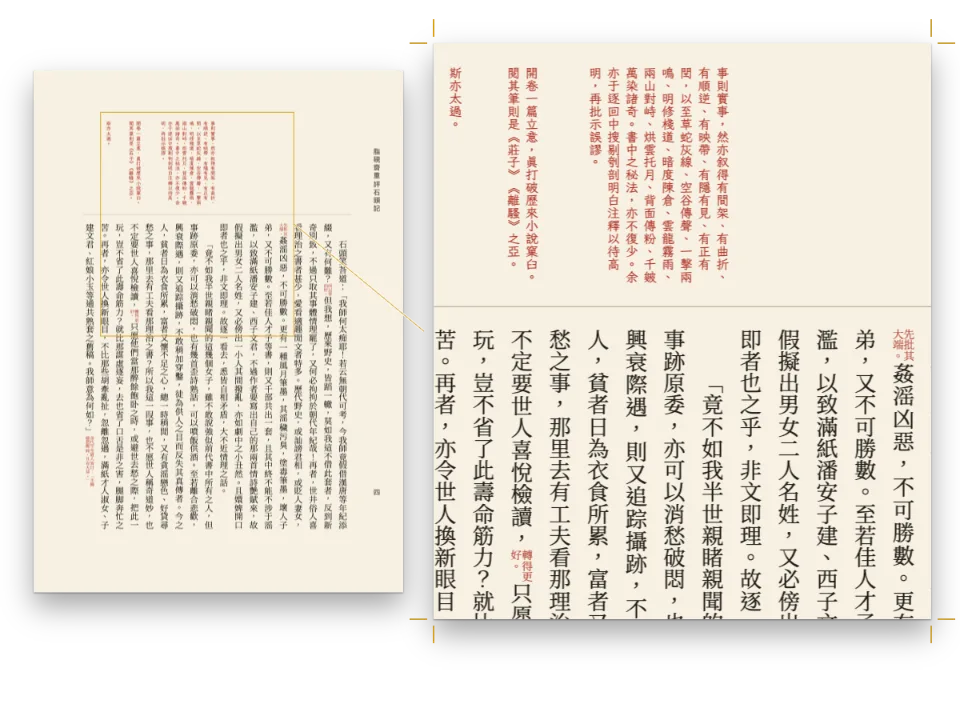
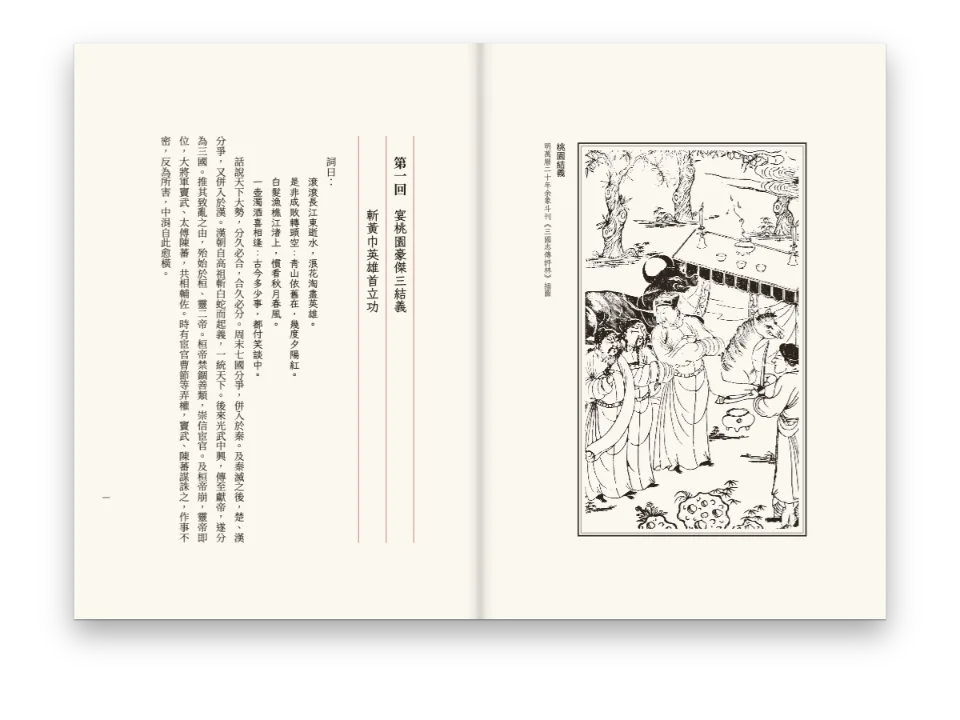
Um clássico chinês composto como os antigos livros impressos com matrizes de madeira. Cada página tem uma borda dupla e linhas finas entre as colunas, e as notas vão em letra miúda dentro das linhas.
O que você vai compor
Três folhas do comentário de Zhu Xi aos Analectos (論語集註), o começo do livro 學而, compostas como uma matriz de madeira as imprimia, depois de uma folha de rosto. Cada página é meia folha, de 121 × 213 mm, e cada página dupla é uma folha inteira, lida a partir da direita: em cada metade, nove colunas de 17 caracteres em Noto Serif TC de 20 pt, uma moldura dupla, um fio fino entre cada duas colunas e, na dobra, a faixa central (版心) com o título, um rabo de peixe preto, o juan e o número da folha. As notas de Zhu Xi se dobram em duas fileiras de caracteres de 10 pt dentro da coluna, depois das palavras que explicam. A margem superior é o dobro da inferior.
Esta receita responde a
- Como diagramo uma folha xilográfica, com moldura dupla, um fio entre as colunas e a faixa central?
- Como defino a mancha em caracteres, tantos por linha e tantas linhas por página?
- Como componho um livro chinês na vertical, encadernado à direita?
A resposta curta
// A block printed both halves of a leaf (葉) at once, the centre strip between them. Each
// page here is a half-leaf. Page 1, the title, is a recto: in a book bound on the right it
// stands alone left of the spine, and every spread after it is one leaf, read from the
// right. The grid sets the block's 9 columns of 17 characters; the text has no
// punctuation, so every column ends on its 17th character.
const page = {
  sizePreset: 'custom', width: pt(W), height: pt(H), dpi: 150,
  backgroundColor: col('paper'),
  // left is the inner margin, the half of the centre strip on this side of the fold
  margins: { top: pt(TOP), bottom: pt(BOTTOM), left: pt(HALF), right: pt(OUTER), mirror: true },
};
const layout = { layoutType: 'single', writingMode: 'vertical-rl' }; // bound on the right
const cjk = { grid: { enabled: true, charsPerLine: CHARS, linesPerPage: LINES } };
// Postext numbers pages, not leaves. Each leaf opens with a hidden level-1 heading, which
// prints nothing and starts a right-hand page; the centre strip prints their count.
const leaf = {
  level: 1, hidden: true, numberingTemplate: '{1:一}', // 一, 二, 三
  breakBefore: { enabled: true, parity: 'even' }, // gotcha: headings-drop-h1-break
};
Ingredientes
- Funcionalidades
- Textos, fios e caixas nos designs de páginaGrade de caracteresTexto verticalWarichu: notas em duas linhas dentro da linhaLivros encadernados pela direitaEstilos de títuloCabeços por seçãoCapítulos sem númeroAncoragem de elementos de designImagens nos designs de páginaTítulos numeradosAtributos de títuloNumeração chinesaFontes chinesas, japonesas e coreanasEstilos de parágrafoMargens espelhadasFormato da páginaCor do papelPaleta de cores semânticaExportação para PDF
- Tipografia
- Noto Serif TC, LXGW WenKai TC (SIL OFL 1.1)
- Materiais
- Nenhum: todas as imagens são desenhadas em código
Preparo
#1 · Meia folha por página, uma folha por página dupla
O código é a resposta curta acima. Uma matriz imprimia a folha (葉) inteira de uma vez, com as duas metades de cada lado da faixa central; o impressor dobrava o papel na faixa, com o lado impresso para fora, e costurava as bordas abertas, de modo que a faixa virava o corte da frente do livro. Estas páginas ficam como a folha saía da matriz. Cada página é meia folha. Num livro encadernado pela direita, a página 1 fica sozinha à esquerda da lombada e cada página dupla seguinte junta uma página par à direita com a ímpar que vem depois, então, com a folha de rosto na página 1, cada página dupla contém uma folha. A grade de caracteres define o 行款 da matriz, nove colunas de 17 caracteres, e as margens que ela deixa são exatas: a interna mede metade da faixa.
O Postext numera páginas, não folhas. Cada folha abre com um título de nível 1 oculto: ele não imprime nada nem ocupa espaço, mas o seu breakBefore com parity: 'even' abre uma página direita, e o seu número, 一, 二, 三 por numberingTemplate: '{1:一}', é o {chapterNumber} da faixa.
#2 · Cortar o texto onde cada folha termina
O copista que passava um texto a limpo para o entalhador o ajustava à matriz, folha por folha. O Markdown faz o mesmo: o título de uma folha vai onde termina a nona coluna da metade esquerda da folha anterior, mesmo no meio de uma frase ou de uma nota. Uma nota cortada ali é fechada e aberta de novo, e como cada coluna dobra o seu próprio trecho de nota em duas fileiras, as fileiras saem como eram:
子曰巧言令色鮮矣仁:warichu[巧好令善也好其言善其色致飾於]

# 學而

:warichu[外務以悦人則人欲肆而本心之德亡矣…]
A matriz não tem pontuação, então nenhuma regra de quebra de linha move um caractere, e toda coluna termina no 17º: as quebras de folha são contadas uma vez e não saem do lugar. As notas de Zhu Xi são trechos :warichu[…] com metade do corpo, o padrão, 34 caracteres pequenos por fileira, com um ○ entre a leitura e a glosa, como na matriz.
#3 · Desenhar a matriz com os números da grade
// Header elements are placed on the sheet, pt from the page's top left corner. Both halves
// read right to left: a right-hand page (even) from the outer frame to the fold, a
// left-hand page (odd) from the fold to the outer frame.
const at = (x, y) => ({ anchor: { to: 'page', edge: 'top-left' }, offset: { x: pt(x), y: pt(y) } });
// A column of characters stands in the middle of its pitch, so the rules between columns
// fall on whole pitches. The k-th, counted from the right edge of the type area:
const line = (parity, k) =>
  (parity === 'even' ? HALF + LINES * PITCH : W - HALF) - k * PITCH;
const [Y0, Y1] = [TOP - GAP, TOP + CHARS * BODY + GAP]; // the inner frame's top and foot
// A rule is drawn from its x, a box's border inside the box: each is set so that the line
// is centred where it belongs.
const rule = (id, x, parity) => ({ kind: 'rule', id, parity, direction: 'vertical',
  thickness: pt(0.6), color: col('rule'),
  placement: { ...at(x - 0.3, Y0), size: { height: pt(Y1 - Y0) } } });
const frame = (id, [x0, x1], parity) => [[RULES, 1.8], [0, 0.6]].map(([out, t], i) => ({
  kind: 'box', id: `${id}-${i}`, parity, style: { borderColor: col('rule'), borderWidth: pt(t) },
  placement: { ...at(x0 - out - t / 2, Y0 - out - t / 2),
    size: { width: pt(x1 - x0 + 2 * out + t), height: pt(Y1 - Y0 + 2 * out + t) } } }));
// The middle of the strip, where its text stands: the fold, halfway between its two rules.
// Both pages draw the text whole, and each shows its half.
const mid = (parity) => (parity === 'even' ? 0 : W);
const strip = (id, content, parity, y) => ({ kind: 'text', id: `${id}-${parity}`, parity,
  content, writingMode: 'vertical-rl', fontFamily: SONG, fontSize: pt(11), color: col('ink'),
  align: 'left', overflow: 'clip',
  placement: { ...at(mid(parity) - HALF, TOP + y),
    size: { width: pt(2 * HALF), height: pt(CHARS * BODY - y) } } });
// The fish tail (魚尾): a black band with a notch, from one side of the strip to the other.
const FISH = `<svg xmlns="http://www.w3.org/2000/svg" viewBox="0 0 32 18">
  <path d="M0 0H32V13L16 6L0 13Z" fill="${palette.rule}"/></svg>`;
const resources = [{ id: 'fish', typeId: 'figure', kind: 'svg', createdAt: 0, updatedAt: 0,
  svg: { fileId: 'fish.svg', width: 32, height: 18 } }];
const fish = (parity) => ({ kind: 'image', id: `fish-${parity}`, parity, resourceId: 'fish',
  decorative: true, placement: { ...at(mid(parity) - HALF + 0.3, TOP + 3.4 * BODY),
    size: { width: pt(2 * HALF - 0.6), height: 'auto' } } });
const furniture = (parity) => [
  // The frame runs 40 pt past the fold, where the other half of the leaf takes it on.
  ...frame(`frame-${parity}`, parity === 'even' ? [-40, line(parity, 0)]
    : [line(parity, LINES), W + 40], parity),
  // Nine rules: eight between the columns (界行) and the side of the strip.
  ...Array.from({ length: LINES }, (_, i) =>
    rule(`rule-${i}-${parity}`, line(parity, parity === 'even' ? i + 1 : i), parity)),
  strip('book', '{title}', parity, 0.7 * BODY), // 書名, above the fish tail
  fish(parity),
  strip('juan', '卷一', parity, 5.2 * BODY), // 卷次, under it
  strip('leaf', '{chapterNumber}', parity, 11.5 * BODY), // 葉碼, the leaf's number
];
O cabeço é disposto sobre a folha de papel, então a moldura, os fios e a faixa são posicionados em pontos a partir do canto da página com os mesmos números que definem a grade: um elemento de fio a cada 29 pt na largura da mancha, uma caixa a 4,5 pt do texto para a linha fina e outra 4,5 pt mais para fora para a grossa. Cada coluna de caracteres fica no meio do seu passo, então os fios caem a meio caminho entre as colunas. O texto da faixa desce a página em elementos de texto vertical, e o rabo de peixe é um SVG num elemento de imagem, os dois centralizados entre os dois fios da faixa, sobre a dobra: cada página mostra 17 pt da faixa. Cada página desenha inteiros o texto da faixa e o rabo de peixe e mostra a parte do seu lado, e lado a lado as partes se encontram. As molduras passam da dobra pelo mesmo motivo.
#4 · Dar à folha de rosto um estilo próprio
// A heading style of its own: hidden and unnumbered, so the leaves still count from 一, and
// its header replaces the leaves' furniture on its page. Its attributes hold the byline,
// this edition's note in red and the colophon, the one line that changes with the language.
const CELLS = [0, 2, LINES - 2, LINES]; // the byline, title and note, in pitches from the right
const cell = (i) => [CELLS[i], CELLS[i + 1]];
const column = (id, content, [k0, k1], style) => ({ kind: 'text', id, content,
  writingMode: 'vertical-rl', color: col('ink'), overflow: 'clip', verticalAlign: 'middle',
  placement: { ...at(line('odd', k1), TOP),
    size: { width: pt((k1 - k0) * PITCH), height: pt(CHARS * BODY) } }, ...style });
const titlePage = {
  id: 'title', numbered: false, hidden: true, breakBefore: { enabled: true, parity: 'any' },
  footer: { elements: [] },
  header: { elements: [
    ...frame('title-frame', [line('odd', LINES), line('odd', 0)]),
    rule('title-rule-1', line('odd', CELLS[1])), rule('title-rule-2', line('odd', CELLS[2])),
    column('byline', '{attr.byline}', cell(0), { fontFamily: SONG, fontSize: pt(14),
      align: 'left' }),
    column('book', '{title}', cell(1), { fontFamily: KAI, fontSize: pt(60),
      letterSpacing: pt(20), align: 'center' }),
    column('note', '{attr.note}', cell(2), { fontFamily: KAI, fontSize: pt(11),
      lineHeight: pt(0.6 * PITCH), color: col('vermilion'), align: 'right' }), // 3 in 2 pitches
    { kind: 'text', id: 'colophon', content: '{attr.colophon}', fontFamily: SONG,
      fontSize: pt(6.5), lineHeight: 1.4, color: col('muted'), align: 'left', overflow: 'wrap',
      placement: { ...at(line('odd', LINES) - RULES - 0.9, Y1 + RULES + 16),
        size: { width: pt(LINES * PITCH) } } },
  ] },
};
A folha de rosto (內封) é um título de nível 1 com um estilo de título oculto e sem número, então as folhas continuam contando a partir de 一. Um estilo governa as páginas da sua seção, e o header dele substitui ali o do documento: a folha de rosto ganha uma moldura fechada dividida em três colunas em vez dos elementos da meia folha. A autoria, a nota desta edição em Kai vermelho e o colofão vêm dos atributos do título; o colofão é a única linha que muda com a língua da edição. \n num atributo começa uma coluna nova.
#5 · Carregar cada fonte com os caracteres que ela compõe
// Song sets the leaves, the strip and its leaf numbers; Kai only the title page's title
// and note (gotcha: cjk-fonts-slices). No punctuation: no vertical forms to load.
const note = markdown.match(/note="([^"]*)"/)?.[1].replaceAll('\\n', '') ?? '';
await loadFonts(FONTS, markdown); // their Latin files: the colophon
await loadCjkFonts({ [SONG]: FONTS[SONG] }, `${markdown}論語集註卷一二三四五六七八九十`);
await loadCjkFonts({ [KAI]: FONTS[KAI] }, `論語集註${note}`);
O Fontsource serve cada fonte chinesa em cerca de cem arquivos por peso. A Song compõe as folhas, a faixa e os números de folha, então a chamada dela recebe a amostra e esses caracteres; a Kai compõe só o título e a nota. A matriz não tem pontuação, então nenhuma das duas precisa das formas verticais de loadCjkFonts(…, { vertical: true }).
#6 · Uma tinta sobre um papel quente
const palette = {
  ink: '#1f1b17', // the text, as the block printed it
  rule: '#1f1b17', // the frame, the column rules and the fish tail: the same block, same ink
  vermilion: '#a3301f', // 朱: this edition's note, on the title page; 5.9 : 1 on the paper
  muted: '#6d6358', // the colophon
  paper: '#f2ead8',
};
const col = (id) => ({ hex: palette[id], model: 'hex', paletteId: id });
const colorPalette = [
  ...Object.entries(palette).map(([id, hex]) => ({ id, name: id, value: { hex, model: 'hex' } })),
  { id: 'main-color', name: 'defaults', value: { hex: palette.ink, model: 'hex' } },
];
O texto e as linhas da matriz são impressos no mesmo preto quente, com contraste de 14 : 1 sobre o papel. Mesmo assim são duas entradas da paleta, ink e rule, para que os fios possam mudar de cor sem mexer no texto. O vermelho fica reservado para o que esta edição acrescenta.
A receita completa
// ═══ Postext Cookbook · Nº 085 · A woodblock leaf: double frame, rules and centre strip ═══ // https://postext.dev/en/cookbook/woodblock-leaf // Code: MIT · Text: 論語集註 卷一, 四庫全書 copy, zh.wikisource (CC BY-SA 4.0) · Pictures: none // Fonts: Noto Serif TC, LXGW WenKai TC (SIL OFL 1.1) · Needs postext ≥ 1.9.0 // A title page and three leaves of Zhu Xi's commentary on the Analects, set as a woodblock // printed them: each spread is one leaf, its two halves either side of the centre strip // (版心), the text in a double frame with a rule between every two columns, the commentary // folded into two small rows inside the column. import { buildDocument, renderPageToCanvas, clearMeasurementCache, registerResourceImage, } from 'https://esm.sh/postext'; import { renderToPdf, decompressWoff2 } from 'https://esm.sh/postext-pdf'; const LANG = 'en'; // @lang: the language of the colophon; the leaves are Chinese in both const RECIPE = 'woodblock-leaf'; // ─── 1 · Design ───────────────────────────────────────────────────────────── // #region palette: one ink on a warm paper, and a red for the editor's note const palette = { ink: '#1f1b17', // the text, as the block printed it rule: '#1f1b17', // the frame, the column rules and the fish tail: the same block, same ink vermilion: '#a3301f', // 朱: this edition's note, on the title page; 5.9 : 1 on the paper muted: '#6d6358', // the colophon paper: '#f2ead8', }; const col = (id) => ({ hex: palette[id], model: 'hex', paletteId: id }); const colorPalette = [ ...Object.entries(palette).map(([id, hex]) => ({ id, name: id, value: { hex, model: 'hex' } })), { id: 'main-color', name: 'defaults', value: { hex: palette.ink, model: 'hex' } }, ]; // #endregion const [SONG, KAI] = ['Noto Serif TC', 'LXGW WenKai TC']; // 宋: the block's face; 楷: the title // The leaf in points: 半葉九行,行十七字, a 20 pt character on a column pitch of 29 pt. const [BODY, PITCH, CHARS, LINES] = [20, 29, 17, 9]; const HALF = 17; // half the centre strip, from the fold to the column rule beside it const GAP = 4.5; // the text to the inner frame line, as a character to a column rule const RULES = 4.5; // the thin inner frame line to the heavy outer one (文武線) const [HEAD, FOOT, SIDE] = [164, 82, 60]; // paper outside the frame: 天頭 twice 地腳 const TOP = HEAD + RULES + GAP; // the page's margins const BOTTOM = FOOT + RULES + GAP; const OUTER = SIDE + RULES; const W = HALF + LINES * PITCH + OUTER; // a half-leaf, 121 × 213 mm const H = TOP + CHARS * BODY + BOTTOM; // #region answer: a half-leaf to a page, so that every spread is one whole leaf // A block printed both halves of a leaf (葉) at once, the centre strip between them. Each // page here is a half-leaf. Page 1, the title, is a recto: in a book bound on the right it // stands alone left of the spine, and every spread after it is one leaf, read from the // right. The grid sets the block's 9 columns of 17 characters; the text has no // punctuation, so every column ends on its 17th character. const page = { sizePreset: 'custom', width: pt(W), height: pt(H), dpi: 150, backgroundColor: col('paper'), // left is the inner margin, the half of the centre strip on this side of the fold margins: { top: pt(TOP), bottom: pt(BOTTOM), left: pt(HALF), right: pt(OUTER), mirror: true }, }; const layout = { layoutType: 'single', writingMode: 'vertical-rl' }; // bound on the right const cjk = { grid: { enabled: true, charsPerLine: CHARS, linesPerPage: LINES } }; // Postext numbers pages, not leaves. Each leaf opens with a hidden level-1 heading, which // prints nothing and starts a right-hand page; the centre strip prints their count. const leaf = { level: 1, hidden: true, numberingTemplate: '{1:一}', // 一, 二, 三 breakBefore: { enabled: true, parity: 'even' }, // gotcha: headings-drop-h1-break }; // #endregion // #region frame: the double frame, a rule between every two columns, the centre strip // Header elements are placed on the sheet, pt from the page's top left corner. Both halves // read right to left: a right-hand page (even) from the outer frame to the fold, a // left-hand page (odd) from the fold to the outer frame. const at = (x, y) => ({ anchor: { to: 'page', edge: 'top-left' }, offset: { x: pt(x), y: pt(y) } }); // A column of characters stands in the middle of its pitch, so the rules between columns // fall on whole pitches. The k-th, counted from the right edge of the type area: const line = (parity, k) => (parity === 'even' ? HALF + LINES * PITCH : W - HALF) - k * PITCH; const [Y0, Y1] = [TOP - GAP, TOP + CHARS * BODY + GAP]; // the inner frame's top and foot // A rule is drawn from its x, a box's border inside the box: each is set so that the line // is centred where it belongs. const rule = (id, x, parity) => ({ kind: 'rule', id, parity, direction: 'vertical', thickness: pt(0.6), color: col('rule'), placement: { ...at(x - 0.3, Y0), size: { height: pt(Y1 - Y0) } } }); const frame = (id, [x0, x1], parity) => [[RULES, 1.8], [0, 0.6]].map(([out, t], i) => ({ kind: 'box', id: `${id}-${i}`, parity, style: { borderColor: col('rule'), borderWidth: pt(t) }, placement: { ...at(x0 - out - t / 2, Y0 - out - t / 2), size: { width: pt(x1 - x0 + 2 * out + t), height: pt(Y1 - Y0 + 2 * out + t) } } })); // The middle of the strip, where its text stands: the fold, halfway between its two rules. // Both pages draw the text whole, and each shows its half. const mid = (parity) => (parity === 'even' ? 0 : W); const strip = (id, content, parity, y) => ({ kind: 'text', id: `${id}-${parity}`, parity, content, writingMode: 'vertical-rl', fontFamily: SONG, fontSize: pt(11), color: col('ink'), align: 'left', overflow: 'clip', placement: { ...at(mid(parity) - HALF, TOP + y), size: { width: pt(2 * HALF), height: pt(CHARS * BODY - y) } } }); // The fish tail (魚尾): a black band with a notch, from one side of the strip to the other. const FISH = `<svg xmlns="http://www.w3.org/2000/svg" viewBox="0 0 32 18"> <path d="M0 0H32V13L16 6L0 13Z" fill="${palette.rule}"/></svg>`; const resources = [{ id: 'fish', typeId: 'figure', kind: 'svg', createdAt: 0, updatedAt: 0, svg: { fileId: 'fish.svg', width: 32, height: 18 } }]; const fish = (parity) => ({ kind: 'image', id: `fish-${parity}`, parity, resourceId: 'fish', decorative: true, placement: { ...at(mid(parity) - HALF + 0.3, TOP + 3.4 * BODY), size: { width: pt(2 * HALF - 0.6), height: 'auto' } } }); const furniture = (parity) => [ // The frame runs 40 pt past the fold, where the other half of the leaf takes it on. ...frame(`frame-${parity}`, parity === 'even' ? [-40, line(parity, 0)] : [line(parity, LINES), W + 40], parity), // Nine rules: eight between the columns (界行) and the side of the strip. ...Array.from({ length: LINES }, (_, i) => rule(`rule-${i}-${parity}`, line(parity, parity === 'even' ? i + 1 : i), parity)), strip('book', '{title}', parity, 0.7 * BODY), // 書名, above the fish tail fish(parity), strip('juan', '卷一', parity, 5.2 * BODY), // 卷次, under it strip('leaf', '{chapterNumber}', parity, 11.5 * BODY), // 葉碼, the leaf's number ]; // #endregion // #region title: the title page (內封), a half-leaf in a closed frame, three columns // A heading style of its own: hidden and unnumbered, so the leaves still count from 一, and // its header replaces the leaves' furniture on its page. Its attributes hold the byline, // this edition's note in red and the colophon, the one line that changes with the language. const CELLS = [0, 2, LINES - 2, LINES]; // the byline, title and note, in pitches from the right const cell = (i) => [CELLS[i], CELLS[i + 1]]; const column = (id, content, [k0, k1], style) => ({ kind: 'text', id, content, writingMode: 'vertical-rl', color: col('ink'), overflow: 'clip', verticalAlign: 'middle', placement: { ...at(line('odd', k1), TOP), size: { width: pt((k1 - k0) * PITCH), height: pt(CHARS * BODY) } }, ...style }); const titlePage = { id: 'title', numbered: false, hidden: true, breakBefore: { enabled: true, parity: 'any' }, footer: { elements: [] }, header: { elements: [ ...frame('title-frame', [line('odd', LINES), line('odd', 0)]), rule('title-rule-1', line('odd', CELLS[1])), rule('title-rule-2', line('odd', CELLS[2])), column('byline', '{attr.byline}', cell(0), { fontFamily: SONG, fontSize: pt(14), align: 'left' }), column('book', '{title}', cell(1), { fontFamily: KAI, fontSize: pt(60), letterSpacing: pt(20), align: 'center' }), column('note', '{attr.note}', cell(2), { fontFamily: KAI, fontSize: pt(11), lineHeight: pt(0.6 * PITCH), color: col('vermilion'), align: 'right' }), // 3 in 2 pitches { kind: 'text', id: 'colophon', content: '{attr.colophon}', fontFamily: SONG, fontSize: pt(6.5), lineHeight: 1.4, color: col('muted'), align: 'left', overflow: 'wrap', placement: { ...at(line('odd', LINES) - RULES - 0.9, Y1 + RULES + 16), size: { width: pt(LINES * PITCH) } } }, ] }, }; // #endregion const config = () => ({ // a factory: the engine caches resolved configs per object locale: 'zh-Hant', // written out, never LANG (gotcha: cjk-locale-tag) colorPalette, page, layout, cjk, header: { elements: [...furniture('even'), ...furniture('odd')] }, footer: { elements: [] }, bodyText: { fontFamily: SONG, fontSize: pt(BODY), lineHeight: pt(PITCH), color: col('ink'), boldColor: col('ink'), italicColor: col('ink'), referenceColor: col('ink'), textAlign: 'justify', firstLineIndent: pt(0), indentAfterHeading: false, // 頂格 }, headings: { fontFamily: SONG, fontWeight: 400, color: col('ink'), levels: [leaf] }, headingStyles: [titlePage], // The byline's seven characters (宋 朱子 集註) end at the foot of the column. paragraphStyles: [{ id: 'byline', indent: em(CHARS - 7), firstLineIndent: pt(0), textAlign: 'left' }], }); // ─── 2 · Content ──────────────────────────────────────────────────────────── const markdown = String.raw`---Amostra em Markdown · 25 linhas · content.en.md
title: "論語集註" author: "朱熹" --- # 論語集註 {style="title" byline="宋 朱子 集註" note="據四庫全書本錄文\n仿刻本版式重排\n半葉九行行十七字" colophon="Set in Noto Serif TC and LXGW WenKai TC (SIL OFL) · Text: 論語集註, 四庫全書 copy, Wikisource transcription (CC BY-SA 4.0)"} # 學而 論語卷一 :::paragraphs{style="byline"} 宋 朱子 集註 ::: 學而第一:warichu[此為書之首篇故所記多務本之意乃入道之門積德之基學者之先務也凡十六章] 子曰學而時習之不亦說乎:warichu[說悦同○學之為言效也人性皆善而覺有先後後覺者必效先覺之所為乃可以明善而復其初也習鳥數飛也學之不已如鳥數飛也說喜意也既學而又時時習之則所學者熟而中心喜說其進自不能已矣程子曰習重習也時復思繹浹洽於中則說也又曰學者將以行之也時習之則所學者在我故說謝氏曰時習者無時而不習坐如尸坐時習也立如齊立時習也]有朋自遠方來不亦樂乎:warichu[樂音洛○朋同類也自遠方來則近者可知程子曰以善及人而信從者衆故可樂又曰說在心樂主發散在外]人不知而不慍不亦君子乎:warichu[慍紆問反○慍含怒意君子成德之名尹氏曰學在己知不知在人何慍之有程子曰雖樂於及人不見是而無悶乃所謂君子愚謂及人而樂者順而易不知而不慍者逆而難故惟成德者能之然德之所以成亦曰學之正習之熟說之深而不已焉耳○程子曰樂由說而後得非樂不足以語君子]○有子曰其為人也孝弟而好犯上者鮮矣不好犯上而好作亂者未之有也:warichu[弟好皆去聲鮮上聲下同○有子孔子弟子名若善事父母為孝善事兄長為弟犯上謂干犯在上之人鮮少也作亂則為悖逆争鬭之事矣此言人能孝弟則其心和順少好犯上必不好作亂也]君子務本本立而道生孝弟也者其為仁之本與:warichu[與平聲○務專力也本猶根也仁者愛之理心之德也為仁猶曰行仁與者疑辭謙退不敢質言也言君子凡事專用力於根本根本既立則其道自生若上文所謂孝弟乃是為仁之本學者務此則仁道自此而生也○程子曰孝弟順德也故不好犯上豈復有逆理亂常之事德有本本立則其道充大孝弟行於家而後仁愛及於物所謂親親而仁民也故為仁以孝弟為本論性則以仁為孝弟之本或問孝弟為仁之本此是由孝弟可以至仁否曰非也謂行仁自孝弟始孝弟是仁之一事謂之行仁之本則可謂是仁之本則不可蓋仁是性也孝弟是用也性中只有箇仁義禮智四者而已曷嘗有孝弟來然仁主於愛愛莫大於愛親故曰孝弟也者其為仁之本與]○子曰巧言令色鮮矣仁:warichu[巧好令善也好其言善其色致飾於] # 學而 :warichu[外務以悦人則人欲肆而本心之德亡矣聖人詞不迫切專言鮮則絕無可知學者所當深戒也○程子曰知巧言令色之非仁則知仁矣]○曾子曰吾日三省吾身為人謀而不忠乎與朋友交而不信乎傳不習乎:warichu[省悉井反為去聲傳平聲○曾子孔子弟子名參字子輿盡己之謂忠以實之謂信傳謂受之於師習謂熟之於己曾子以此三者日省其身有則改之無則加勉其自治誠切如此可謂得為學之本矣而三者之序則又以忠信為傳習之本也○尹氏曰曾子守約故動必求諸身謝氏曰諸子之學皆出於聖人其後愈遠而愈失其真獨曾子之學專用心於內故傳之無弊觀於子思孟子可見矣惜乎其嘉言善行不盡傳於世也其幸存而未泯者學者其可不盡心乎]○子曰道千乘之國敬事而信節用而愛人使民以時:warichu[道乘皆去聲○道治也千乘諸侯之國其地可出兵車千乘者也敬者主一無適之謂敬事而信者敬其事而信於民也時謂農隙之時言治國之要在此五者亦務本之意也○程子曰此言至淺然當時諸侯果能此亦足以治其國矣聖人言雖至近上下皆通此三言者若推其極堯舜之治亦不過此若常人之言近則淺近而已矣楊氏曰上不敬則下慢不信則下疑下慢而疑事不立矣敬事而信以身先之也易曰節以制度不傷財不害民蓋侈用則傷財傷財必至於害民故愛民必先於節用然使之不以其時則力本者不獲自盡雖有愛人之心而人不被其澤矣然此特論其所存而已未及為政也茍無是心則雖有政不行焉胡氏曰凡此數者又皆以敬為主愚謂五者反復相因各有次第讀者宜細推之]○子曰弟子入則孝出則弟謹而信汎愛衆而親仁行有餘力則以學文:warichu[弟子之弟上聲則弟之弟去聲○謹者行之有常也信者言之有實也汎廣也衆謂衆人親近也仁謂仁者餘力猶言暇日以用也文謂詩書六藝之文○程子曰為弟子之職力有餘則學文不脩其職而先文非為己之學也尹氏曰德行本也文藝末也窮其本末知所先後可以入德矣洪氏曰未有餘力而學文則文滅其質有餘力而不學文則質勝而野愚謂力行而不學文則無以考聖賢之成法識事理之當然而所行或出於私意非但失之於野而已]○子夏曰賢賢易色事父母能竭其力事君能致其身與朋友交言而有信雖曰未學吾必謂之學矣:warichu[子夏孔子弟子姓卜名商賢人之賢而易其好色之心好善有誠也致猶委也委致其身謂不有其身也四者皆人倫之大者而行之必盡其誠學求如是而已故子夏言有能如] # 學而 :warichu[是之人茍非生質之美必其務學之至雖或以為未嘗為學我必謂之已學也○游氏曰三代之學皆所以明人倫也能是四者則於人倫厚矣學之為道何以加此子夏以文學名而其言如此則古人之所謂學者可知矣故學而一篇大抵皆在於務本吳氏曰子夏之言其意善矣然詞氣之閒抑揚太過其流之弊將或至於廢學必若上章夫子之言然後為無弊也]○子曰君子不重則不威學則不固:warichu[重厚重威威嚴固堅固也輕乎外者必不能堅乎內故不厚重則無威嚴而所學亦不堅固也]主忠信:warichu[人不忠信則事皆無實為惡則易為善則難故學者必以是為主焉程子曰人道惟在忠信不誠則無物且出入無時莫知其鄉者人心也若無忠信豈復有物乎]無友不如己者:warichu[無毋通禁止辭也友所以輔仁不如己則無益而有損]過則勿憚改:warichu[勿亦禁止之辭憚畏難也自治不勇則惡日長故有過則當速改不可畏難而苟安也程子曰學問之道無他也知其不善則速改以從善而已○程子曰君子自脩之道當如是也游氏曰君子之道以威重為質而學以成之學之道必以忠信為主而以勝己者輔之然或吝於改過則終無以入德而賢者亦未必樂告以善道故以過勿憚改終焉]○曾子曰慎終追遠民德歸厚矣:warichu[慎終者喪盡其禮追遠者祭盡其誠民德歸厚謂下民化之其德亦歸於厚蓋終者人之所易忽也而能謹之遠者人之所易忘也而能追之厚之道也故以此自為則己之德厚下民化之則其德亦歸於厚也]○子禽問於子貢曰夫子至於是邦也必聞其政求之與抑與之與:warichu[之與之與平聲下同○子禽姓陳名亢子貢姓端木名賜皆孔子弟子或曰亢子貢弟子未知孰是抑反語辭]子貢曰夫子溫良恭儉讓以得之夫子之求之也其諸異乎人之求之與:warichu[溫和厚也良易直也恭莊敬也儉節制也讓謙遜也五者夫子之盛德光輝接於人者也其諸語辭也人他人也言夫子未嘗求之但其德容如是故時君敬信自以其政就而問之耳非若他人必求之而後得也聖人過化存神之妙未易窺測然即此而觀則其德盛禮恭而不願乎外亦可見矣學者所當潛心而勉學也○謝氏曰學者觀於聖人威儀之閒亦可以進德矣若子貢亦可謂善觀聖人矣亦可謂善言德行矣今去聖人千五百年以此五者想見其形容尚能使人興起而况於親炙之者乎張敬夫曰夫子至是邦必聞其政而未有能委國而授之以政者蓋見聖人之儀刑而樂告之者秉彞好德之良心也而私欲害之是以終不能用耳]`; // content.<lang>.md: the same leaves, another colophon // ─── 3 · Fonts ────────────────────────────────────────────────────────────── const FONTS = { 'Noto Serif TC': ['400'], // 宋: the text, the notes, the centre strip, the colophon 'LXGW WenKai TC': ['400'], // 楷: the title page's title and this edition's note }; // ─── 4 · Build & show ─────────────────────────────────────────────────────── // #region voices: each face loads the files of the characters it sets // Song sets the leaves, the strip and its leaf numbers; Kai only the title page's title // and note (gotcha: cjk-fonts-slices). No punctuation: no vertical forms to load. const note = markdown.match(/note="([^"]*)"/)?.[1].replaceAll('\\n', '') ?? ''; await loadFonts(FONTS, markdown); // their Latin files: the colophon await loadCjkFonts({ [SONG]: FONTS[SONG] }, `${markdown}論語集註卷一二三四五六七八九十`); await loadCjkFonts({ [KAI]: FONTS[KAI] }, `論語集註${note}`); // #endregion await loadSvg('fish.svg', FISH); const doc = await buildWithFonts( () => buildDocument({ markdown, resources }, config()), markdown); showBook(doc, { title: t({ en: 'A woodblock leaf: double frame, rules and centre strip', es: 'Una hoja xilográfica: marco doble, filetes y franja central' }) }); offerPdf(() => renderToPdf(doc, { fontProvider: cjkPdfProvider, resourceBytes: imageBytes }), `${RECIPE}.pdf`);Kit · core, fonts, viewer, pdf, images, cjk: igual em todas as receitas · 494 linhas
// ─── Kit ── helpers shared by every Cookbook recipe · postext.dev/cookbook ───── // ─── Kit · core v1 ── the same in every recipe · postext.dev/cookbook function mm(value) { return { value, unit: 'mm' }; } function pt(value) { return { value, unit: 'pt' }; } function em(value) { return { value, unit: 'em' }; } /** The sample language's string: t({ en: 'Figure', es: 'Figura' }). */ function t(strings) { return strings[LANG] ?? Object.values(strings)[0]; } /** A file in this recipe's assets folder, served from the Postext repo by jsDelivr. */ function asset(file) { return `https://cdn.jsdelivr.net/gh/drnachio/postext@main/cookbook/${RECIPE}/assets/${file}`; } // ─── Kit · fonts v2 ── the same in every recipe · postext.dev/cookbook // Postext measures with the loaded faces and caches the widths: load every face // before the first build, from Fontsource, the files the PDF embeds too. /** faces = { 'Family Name': ['400', '400i', '700'] }. `text` is the sample: * č ł † α χ also load latin-ext and greek files (kitSubsetsFor). With * `optional`, a face Fontsource does not ship is skipped instead of failing. * Resolves to the number of faces added. */ async function loadFonts(faces, text = '', { optional = false } = {}) { kitStatus('Loading fonts…'); const ranges = { latin: 'U+0000-00FF,U+0131,U+0152-0153,U+02BB-02BC,U+02C6,U+02DA,U+02DC,U+0304,U+0308,U+0329,' + 'U+2000-206F,U+20AC,U+2122,U+2191,U+2193,U+2212,U+2215,U+FEFF,U+FFFD', 'latin-ext': 'U+0100-02BA,U+02BD-02C5,U+02C7-02CC,U+02CE-02D7,U+02DD-02FF,U+0304,U+0308,U+0329,' + 'U+1D00-1DBF,U+1E00-1E9F,U+1EF2-1EFF,U+2020,U+20A0-20AB,U+20AD-20C0,U+2113,U+2C60-2C7F,U+A720-A7FF', greek: 'U+0370-03FF', }; const jobs = []; let added = 0; for (const [family, specs] of Object.entries(faces)) { const id = fontsourceId(family); const todo = [...new Set(specs)].map((spec) => [parseInt(spec, 10), spec.endsWith('i') ? 'italic' : 'normal']) .filter(([weight, style]) => !hasFace(family, weight, style)); // before any await const meta = optional || /[^\0-ÿ]/u.test(text) ? await fontsourceMeta(family) : null; const subsets = ['latin', ...kitSubsetsFor(text, meta)]; for (const [weight, style] of todo) { if (optional && !(meta?.weights.includes(weight) && meta.styles.includes(style))) continue; for (const subset of subsets) { const url = `https://cdn.jsdelivr.net/npm/@fontsource/${id}@5/files/${id}-${subset}-${weight}-${style}.woff2`; const face = new FontFace(family, `url(${url}) format('woff2')`, { weight: String(weight), style, unicodeRange: ranges[subset] }); jobs.push(face.load().then((ready) => { document.fonts.add(ready); added++; }, () => { if (subset === 'latin' && !optional) throw new Error(`Fontsource has no ${family} ${weight} ${style}`); })); } } } await Promise.all(jobs).catch((error) => { kitFail(error); throw error; }); return added; } /** Runs `build` and loads any face the pages use that FONTS missed (a regular * one with a warning), then clears the measurement cache and builds again. */ async function buildWithFonts(build, text = '') { const tried = new Set(); for (let round = 0; round < 3; round++) { kitStatus('Laying out…'); await new Promise(requestAnimationFrame); // let the status paint first const result = await Promise.resolve().then(build).catch((error) => { kitFail(error); throw error; }); const wanted = { base: {}, variants: {} }; for (const { font, base } of [result].flat().flatMap(fontStringsOf)) { const { family, weight, style } = parseFont(font); const key = `${family}|${weight}|${style}`; if (tried.has(key) || hasFace(family, weight, style)) continue; tried.add(key); (wanted[base ? 'base' : 'variants'][family] ??= []).push(`${weight}${style === 'italic' ? 'i' : ''}`); } if (Object.keys(wanted.base).length) { console.warn(`[cookbook] FONTS does not list ${JSON.stringify(wanted.base)}: loading them.`); } const added = await loadFonts(wanted.base, text) + await loadFonts(wanted.variants, text, { optional: true }); if (added === 0) return result; clearMeasurementCache(); } throw new Error('The fonts did not settle after three builds.'); } /** Every font string of the layout; `base` marks a block's own face. */ function fontStringsOf(doc) { const found = new Map(); const walk = (node) => { if (!node || typeof node !== 'object') return; if (Array.isArray(node)) { node.forEach(walk); return; } for (const [key, value] of Object.entries(node)) { if (typeof value === 'string' && /fontString$/i.test(key)) { found.set(value, found.get(value) || key === 'fontString'); } else if (value && typeof value === 'object') walk(value); } }; walk(doc.pages); walk(doc.blocks); return [...found].map(([font, base]) => ({ font, base })); } /** '700 37.5px Open Sans' / 'italic 400 13px "Source Serif 4"' → { family, weight, style }. * A string with no weight ('95.8px Young Serif', from a design text) is 400. */ function parseFont(font) { const m = /^(?:(italic|oblique)\s+)?(?:small-caps\s+)?(?:(\d+|bold|normal)\s+)?[\d.]+px\s+(.+)$/.exec(font.trim()); if (!m) throw new Error(`Unexpected font string: ${font}`); const weight = m[2] === 'bold' ? 700 : !m[2] || m[2] === 'normal' ? 400 : Number(m[2]); return { family: m[3].replace(/^["']|["']$/g, ''), weight, style: m[1] ? 'italic' : 'normal' }; } /** A loaded FontFace covers this family, weight and style (fonts.check() would * also say yes for families nobody declared). */ function hasFace(family, weight, style) { for (const face of document.fonts) { if (face.status !== 'loaded' || face.style !== style) continue; if (face.family.replace(/^["']|["']$/g, '') !== family) continue; const [low, high = low] = face.weight.split(' ').map(Number); if (weight >= low && weight <= high) return true; } return false; } /** The files beyond latin `text` needs that `meta`'s family ships. */ function kitSubsetsFor(text, meta) { return [[/[Ā-˿ᴀ-ᶿḀ-ỿ†ℓⱠ-Ɀ꜠-ꟿ]/u, 'latin-ext'], [/[Ͱ-Ͽ]/u, 'greek']] .filter(([re, x]) => re.test(text) && meta?.subsets?.includes(x)).map(([, x]) => x); } /** Fontsource's id for a family: 'Source Serif 4' → 'source-serif-4'. */ function fontsourceId(family) { return family.toLowerCase().replace(/\s+/g, '-'); } /** The family's Fontsource metadata (weights, styles, subsets), or null. */ function fontsourceMeta(family) { fontsourceMeta.cache ??= new Map(); const id = fontsourceId(family); if (!fontsourceMeta.cache.has(id)) { fontsourceMeta.cache.set(id, fetch(`https://api.fontsource.org/v1/fonts/${id}`) .then((res) => (res.ok ? res.json() : null), () => null)); } return fontsourceMeta.cache.get(id); } // ─── Kit · viewer v1 ── the same in every recipe · postext.dev/cookbook /** The pages as spreads on a dark desk, page 1 alone, then verso | recto, * each painted when it scrolls near. */ function showPages(docs, { title, width = 460 } = {}) { const root = viewer(title); const pages = [docs].flat().flatMap((doc) => doc.pages.map((page) => ({ doc, page, n: (doc.pageIndexOffset ?? 0) + page.index }))); const spreads = []; let verso = null; for (const p of pages) { if (p.n % 2 === 1) { if (verso) spreads.push([verso, null]); verso = p; } else { spreads.push([verso, p]); verso = null; } } if (verso) spreads.push([verso, null]); const density = Math.min(window.devicePixelRatio || 1, 2); showPages.painter?.disconnect(); const painter = new IntersectionObserver((entries) => { for (const { isIntersecting, target } of entries) { if (!isIntersecting) continue; painter.unobserve(target); const { doc, page } = target.postext; renderPageToCanvas(page, doc, target, { scale: (width * density) / page.width }); } }, { rootMargin: '800px' }); showPages.painter = painter; root.replaceChildren(...spreads.map((pair) => { const spread = document.createElement('div'); spread.className = 'pt-spread'; for (const p of pair) { const figure = document.createElement('figure'); if (p) { const label = p.page.pageLabel || String(p.n + 1); const canvas = document.createElement('canvas'); canvas.postext = p; canvas.style.aspectRatio = `${p.page.width} / ${p.page.height}`; canvas.setAttribute('role', 'img'); canvas.setAttribute('aria-label', `Page ${label}`); const folio = document.createElement('figcaption'); folio.textContent = label; figure.append(canvas, folio); painter.observe(canvas); } else figure.className = 'pt-blank'; spread.append(figure); } return spread; })); kitStatus(`${pages.length} ${pages.length === 1 ? 'page' : 'pages'}`); document.documentElement.dataset.postext = 'ready'; return pages.length; } /** The desk, the bar and the error reporting, created once. */ function viewer(title) { if (!document.getElementById('pt-kit')) { document.head.insertAdjacentHTML('beforeend', `<style id="pt-kit"> :root { color-scheme: dark; } body { margin: 0; background: #0e1014; color: #b9bcc4; font: 13px/1.45 system-ui, sans-serif; } #pt-bar { position: sticky; top: 0; z-index: 1; display: flex; flex-wrap: wrap; align-items: center; gap: 6px 16px; padding: 10px 16px; background: rgb(14 16 20 / .92); backdrop-filter: blur(6px); border-bottom: 1px solid #23262d; } #pt-bar strong { color: #f4f1ea; font-weight: 600; } #pt-actions { display: flex; gap: 12px; margin-left: auto; } #pt-actions a, #pt-actions button { color: #d8a21a; font: inherit; background: none; border: 0; padding: 0; cursor: pointer; } #pages { display: grid; justify-items: center; gap: 48px; padding: 32px 16px 72px; } .pt-spread { display: flex; } .pt-spread figure { margin: 0; width: min(460px, 44vw); } .pt-spread canvas { display: block; width: 100%; background: #fff; box-shadow: 0 1px 2px rgb(0 0 0 / .5), 0 22px 44px -16px rgb(0 0 0 / .8); } .pt-spread figure:first-child canvas { box-shadow: inset -14px 0 14px -14px rgb(0 0 0 / .18), 0 1px 2px rgb(0 0 0 / .5), 0 22px 44px -16px rgb(0 0 0 / .8); } .pt-spread figcaption { margin-top: 10px; text-align: center; font: 600 10px/1 system-ui, sans-serif; letter-spacing: .18em; text-transform: uppercase; color: #6c7079; } .pt-blank { visibility: hidden; } @media (max-width: 760px) { .pt-spread { flex-direction: column; gap: 32px; } .pt-spread figure { width: min(460px, 92vw); } .pt-blank { display: none; } } </style>`); document.body.insertAdjacentHTML('afterbegin', '<header id="pt-bar"><strong id="pt-title"></strong><span id="pt-status" role="status"></span><span id="pt-actions"></span></header>'); document.getElementById('pt-title').textContent = document.title || 'Postext'; addEventListener('error', (event) => kitFail(event.error ?? event.message)); addEventListener('unhandledrejection', (event) => kitFail(event.reason)); } if (title) document.getElementById('pt-title').textContent = title; return document.getElementById('pages') ?? document.body.appendChild(Object.assign(document.createElement('main'), { id: 'pages' })); } function kitStatus(text) { viewer(); document.getElementById('pt-status').textContent = text; } function kitFail(error) { document.documentElement.dataset.postext = 'error'; kitStatus(`Error: ${error?.message ?? error}`); } // ─── Kit · pdf v2 ── the same in every recipe that exports a PDF /** The Fontsource files the screen used, as TrueType: the nearest weight the * family ships, upright if it has no italic; latin, then what the face's * letters need (kitSubsetsFor). */ async function fontsourceProvider(family, weight, style, request) { const id = fontsourceId(family); const meta = await fontsourceMeta(family); const weights = meta?.weights?.length ? meta.weights : [400, 700]; const w = weights.reduce((a, b) => (Math.abs(b - weight) < Math.abs(a - weight) ? b : a)); const s = style === 'italic' && meta && !meta.styles.includes('italic') ? 'normal' : style; const text = String.fromCodePoint(...(request?.codePoints ?? [])); const more = kitSubsetsFor(text, meta); const files = await Promise.all(['latin', ...more].map(async (subset) => { const res = await fetch(`https://cdn.jsdelivr.net/npm/@fontsource/${id}@5/files/${id}-${subset}-${w}-${s}.woff2`); if (!res.ok) throw new Error(`Fontsource has no ${family} ${w} ${s} ${subset}`); return decompressWoff2(new Uint8Array(await res.arrayBuffer())); })); return files.length === 1 ? files[0] : files; } /** A "Build the PDF" button; then "Open the PDF" (a new tab: CodePen's frame * shows no PDFs) and a download link. */ function offerPdf(makePdf, filename) { viewer(); const button = Object.assign(document.createElement('button'), { type: 'button', textContent: 'Build the PDF' }); button.dataset.postextPdf = filename; button.addEventListener('click', async () => { button.disabled = true; button.textContent = 'Building the PDF…'; try { const bytes = await makePdf(); const url = URL.createObjectURL(new Blob([bytes], { type: 'application/pdf' })); const size = `${Math.max(1, Math.round(bytes.length / 1024))} KB`; button.replaceWith( Object.assign(document.createElement('a'), { href: url, target: '_blank', rel: 'noopener', textContent: 'Open the PDF ↗' }), Object.assign(document.createElement('a'), { href: url, download: filename, textContent: `Download ${filename} · ${size}` })); } catch (error) { button.disabled = false; button.textContent = 'Build the PDF'; kitFail(error); } }); document.getElementById('pt-actions').append(button); } // ─── Kit · images v1 ── recipes with pictures · postext.dev/cookbook /** Registers a photo or PNG for the canvas and keeps its bytes for the PDF. * fetch → ImageBitmap never taints the canvas (a plain cross-origin <img> would). */ async function loadImage(fileId, url) { const res = await fetch(url); if (!res.ok) throw new Error(`Image not found (${res.status}): ${url}`); const bytes = new Uint8Array(await res.arrayBuffer()); registerResourceImage(fileId, await createImageBitmap(new Blob([bytes]))); (loadImage.bytes ??= new Map()).set(fileId, bytes); } /** Registers SVG markup (drawn in code, or fetched) as a vector image. */ async function loadSvg(fileId, svg) { const img = new Image(); img.src = `data:image/svg+xml;charset=utf-8,${encodeURIComponent(svg)}`; await img.decode(); registerResourceImage(fileId, img); (loadImage.bytes ??= new Map()).set(fileId, new TextEncoder().encode(svg)); } /** renderToPdf({ resourceBytes: imageBytes }) */ function imageBytes(fileId) { return loadImage.bytes?.get(fileId); } /** renderToHtml({ resourceImageUrl: imageUrl }) */ function imageUrl(fileId) { const bytes = imageBytes(fileId); if (!bytes) return undefined; imageUrl.urls ??= new Map(); if (!imageUrl.urls.has(fileId)) { const type = /\.svg$/i.test(fileId) ? 'image/svg+xml' : /\.png$/i.test(fileId) ? 'image/png' : 'image/jpeg'; imageUrl.urls.set(fileId, URL.createObjectURL(new Blob([bytes], { type }))); } return imageUrl.urls.get(fileId); } // ─── Kit · cjk v1 ── Chinese, Japanese and Korean books · postext.dev/cookbook // Fontsource ships a CJK family as about a hundred files per weight, each // declared in its stylesheet with the unicode-range it covers. The screen // loads the files the sample touches; the PDF gets the same files for the // characters its pages set in each face, and embeds each as a subset. // A book bound on the right (vertical text) is shown with its spreads // mirrored: page 1 alone on the left of the spine, then [3 | 2]. /** The files of a Fontsource face, read from its stylesheet: { url, range, * ranges }, the last declared first (the order the browser tries them in). */ function cjkSlices(family, weight, style) { cjkSlices.cache ??= new Map(); const id = fontsourceId(family); const css = `https://cdn.jsdelivr.net/npm/@fontsource/${id}@5/${weight}${style === 'italic' ? '-italic' : ''}.css`; if (!cjkSlices.cache.has(css)) { cjkSlices.cache.set(css, fetch(css) .then((res) => { if (!res.ok) throw new Error(`Fontsource has no ${family} ${weight} ${style} (${res.status})`); return res.text(); }) .then((text) => [...text.matchAll(/@font-face\s*{([^}]*)}/g)].map(([, rule]) => { const range = /unicode-range:\s*([^;]+);/.exec(rule)?.[1].trim() ?? 'U+0-10FFFF'; const ranges = range.split(',').map((part) => { const [lo, hi = lo] = part.trim().slice(2).split('-'); return [parseInt(lo, 16), parseInt(hi, 16)]; }); return { url: new URL(/url\(([^)]+?\.woff2)\)/.exec(rule)[1], css).href, range, ranges }; }).reverse())); } return cjkSlices.cache.get(css); } /** The file of `slices` that holds code point `cp`, if any. */ function cjkSliceFor(slices, cp) { return slices.find((slice) => slice.ranges.some(([lo, hi]) => cp >= lo && cp <= hi)); } /** Whether Fontsource serves `family` as a Chinese, Japanese or Korean * family (its subsets name the script). Fails when the API does not * answer: a CJK face taken for a Latin one would paint in a system face. */ async function isCjkFamily(family) { const meta = await fontsourceMeta(family); if (!meta) throw new Error(`api.fontsource.org did not describe ${family}: reload to try again`); return !!meta.subsets?.some((subset) => /^(chinese|japanese|korean)/.test(subset)); } /** faces = { 'Noto Serif TC': ['400', '700'] }, as for loadFonts: the * whole FONTS object may be passed, its other families are left to * loadFonts. Adds one FontFace per file of each CJK face with its * unicodeRange, then loads the files `text` touches. `text` is what the * faces set: the sample for the text face; a book in several voices calls * it once per voice (loadCjkFonts({ 'LXGW WenKai TC': ['400'] }, quotes)), * so the heading and quotation faces fetch and check only their own * characters. Fails when a character of `text` is in no file of a face. * List every weight the pages use: a weight left to buildWithFonts gets * the latin file only. With { vertical: true } it also loads each * family's vertical forms (brackets, quotes, pause marks) for the canvas, * which needs loadVerticalAlternates imported from postext. Resolves to * the number of files loaded. */ async function loadCjkFonts(faces, text, { vertical = false } = {}) { kitStatus('Loading fonts…'); let loaded = 0; try { if (vertical && typeof loadVerticalAlternates !== 'function') { throw new Error('loadCjkFonts(…, { vertical: true }) needs loadVerticalAlternates imported from postext'); } for (const [family, specs] of Object.entries(faces)) { if (!(await isCjkFamily(family))) continue; const twin = []; for (const spec of new Set(specs)) { const weight = parseInt(spec, 10); const style = spec.endsWith('i') ? 'italic' : 'normal'; const slices = await cjkSlices(family, weight, style); const missing = [...new Set(text)].filter((ch) => /\S/.test(ch) && !cjkSliceFor(slices, ch.codePointAt(0))); if (missing.length) { throw new Error(`${family} ${spec} has no file for ${missing.slice(0, 12).join(' ')}: ` + `give each face the text it sets (loadCjkFonts({ '${family}': ['${spec}'] }, text))`); } for (const slice of slices) { document.fonts.add(new FontFace(family, `url(${slice.url}) format('woff2')`, { weight: String(weight), style, unicodeRange: slice.range })); twin.push({ source: slice.url, weight: String(weight), style, unicodeRange: slice.range }); } const font = `${style === 'italic' ? 'italic ' : ''}${weight} 16px "${family}"`; loaded += (await document.fonts.load(font, text)).length; if (!document.fonts.check(font, text)) throw new Error(`${family} ${spec} did not load for the sample`); } // The same files under a twin name with the `vert` feature on: the // canvas paints the punctuation of vertical lines with it. if (vertical && twin.length) await loadVerticalAlternates(family, twin); } } catch (error) { kitFail(error); throw error; } return loaded; } /** The PDF font provider for recipes with CJK faces: a family whose * Fontsource subsets are Chinese, Japanese or Korean gets the files that * hold the characters its pages set (`request.codePoints`); any other * family gets the latin file fontsourceProvider fetches (the "pdf" block) * and, when the face sets letters only latin-ext has, that file too. */ async function cjkPdfProvider(family, weight, style, request) { if (!(await isCjkFamily(family))) return cjkLatinPdfFiles(family, weight, style, request); const meta = await fontsourceMeta(family); const weights = meta.weights?.length ? meta.weights : [400, 700]; const w = weights.reduce((a, b) => (Math.abs(b - weight) < Math.abs(a - weight) ? b : a)); const s = style === 'italic' && !meta.styles.includes('italic') ? 'normal' : style; const slices = await cjkSlices(family, w, s); const picked = new Set(); for (const cp of request?.codePoints ?? []) { const slice = cjkSliceFor(slices, cp); if (slice) picked.add(slice); } if (!picked.size) picked.add(slices[0]); return Promise.all(slices.filter((slice) => picked.has(slice)).map(async (slice) => { const res = await fetch(slice.url); if (!res.ok) throw new Error(`Fontsource file ${slice.url} (${res.status})`); return decompressWoff2(new Uint8Array(await res.arrayBuffer())); })); } /** A Latin family set next to the CJK faces: its latin file, then its * latin-ext file when the face sets letters only latin-ext has (ō ū in * Hepburn rōmaji, ǎ in pinyin), the file loadFonts adds on screen for * them. Latin comes first: postext-pdf draws a character from the first * file that has it, as the browser takes a character both files hold from * latin. A face Fontsource ships without latin-ext, or whose file does * not come, gets latin alone, and the PDF names the letters it lacks. */ async function cjkLatinPdfFiles(family, weight, style, request) { const meta = await fontsourceMeta(family); const beyond = [...(request?.codePoints ?? [])].some(cjkLatinExtOnly); if (!beyond || !meta?.subsets?.includes('latin-ext')) return fontsourceProvider(family, weight, style); const weights = meta.weights?.length ? meta.weights : [400, 700]; const w = weights.reduce((a, b) => (Math.abs(b - weight) < Math.abs(a - weight) ? b : a)); const s = style === 'italic' && !meta.styles.includes('italic') ? 'normal' : style; const id = fontsourceId(family); const url = `https://cdn.jsdelivr.net/npm/@fontsource/${id}@5/files/${id}-latin-ext-${w}-${s}.woff2`; const [latin, ext] = await Promise.all([fontsourceProvider(family, weight, style), fetch(url) .then(async (res) => (res.ok ? decompressWoff2(new Uint8Array(await res.arrayBuffer())) : null), () => null)]); return ext ? [latin, ext] : latin; } /** Whether code point `cp` is in Fontsource's latin-ext file and not in * its latin file: Latin Extended-A and -B, IPA, the spacing modifiers and * Latin Extended Additional (loadFonts's test for latin-ext), less the * few latin holds too (ı Œ œ ʻ ʼ ˆ ˚ ˜). */ function cjkLatinExtOnly(cp) { if (!((cp >= 0x100 && cp <= 0x2ff) || (cp >= 0x1e00 && cp <= 0x1eff))) return false; return ![0x131, 0x152, 0x153, 0x2bb, 0x2bc, 0x2c6, 0x2da, 0x2dc].includes(cp); } /** showPages for a book bound on either edge. A right-bound book (the * document says so: doc.binding is 'right' for page.binding 'right' and * for vertical text) lies on the desk as it opens: page 1 alone on the * left of the spine, then [3 | 2], the spine shade on each page's inner * edge. `binding` ('left' | 'right') overrides the document's. */ function showBook(docs, { binding, ...options } = {}) { const count = showPages(docs, options); const right = (binding ?? [docs].flat()[0]?.binding) === 'right'; if (!document.getElementById('pt-kit-cjk')) { // The pages keep direction ltr: a canvas draws text in the direction its // element inherits, and under rtl each run would end where the engine // starts it, its brackets mirrored. document.head.insertAdjacentHTML('beforeend', `<style id="pt-kit-cjk"> .pt-spread[dir="rtl"] canvas { direction: ltr; } .pt-spread[dir="rtl"] figure:first-child canvas { box-shadow: inset 14px 0 14px -14px rgb(0 0 0 / .18), 0 1px 2px rgb(0 0 0 / .5), 0 22px 44px -16px rgb(0 0 0 / .8); } </style>`); } // Each pair stays [verso, recto] in the page; right to left, the verso // sits on the right. Phones stack the pages in reading order either way. for (const spread of document.querySelectorAll('#pages > .pt-spread')) spread.dir = right ? 'rtl' : 'ltr'; document.getElementById('pages').dataset.binding = right ? 'right' : 'left'; return count; } // ─── /Kit ───────────────────────────────────────────────────────────────────────
O script.js montado funciona como está: cole-o como script de módulo em qualquer página ou abra a receita no CodePen. Pasta da receita no GitHub ↗ (abre em uma nova aba)
Variações
#Pautar as colunas em vermelho
As cópias feitas para o 四庫全書 foram escritas em papel pautado em vermelho (朱絲欄). Mude a cor dos fios; o rabo de peixe acompanha.
-  rule: '#1f1b17', // the frame, the column rules and the fish tail: the same block, same ink
+ rule: '#b3412e', // 朱絲欄: red rules under black text#Entalhar outra matriz
As matrizes tinham muitas contagens, e 半葉十行,行二十字 é uma das mais comuns. As molduras, a faixa, as três casas da folha de rosto e o recuo da autoria saem todos destes números, então se ajustam sozinhos; as quebras de folha no Markdown precisam ser contadas de novo.
-const [BODY, PITCH, CHARS, LINES] = [20, 29, 17, 9];
+const [BODY, PITCH, CHARS, LINES] = [17, 24.5, 20, 10];#Comparar com uma página europeia sobre uma grade
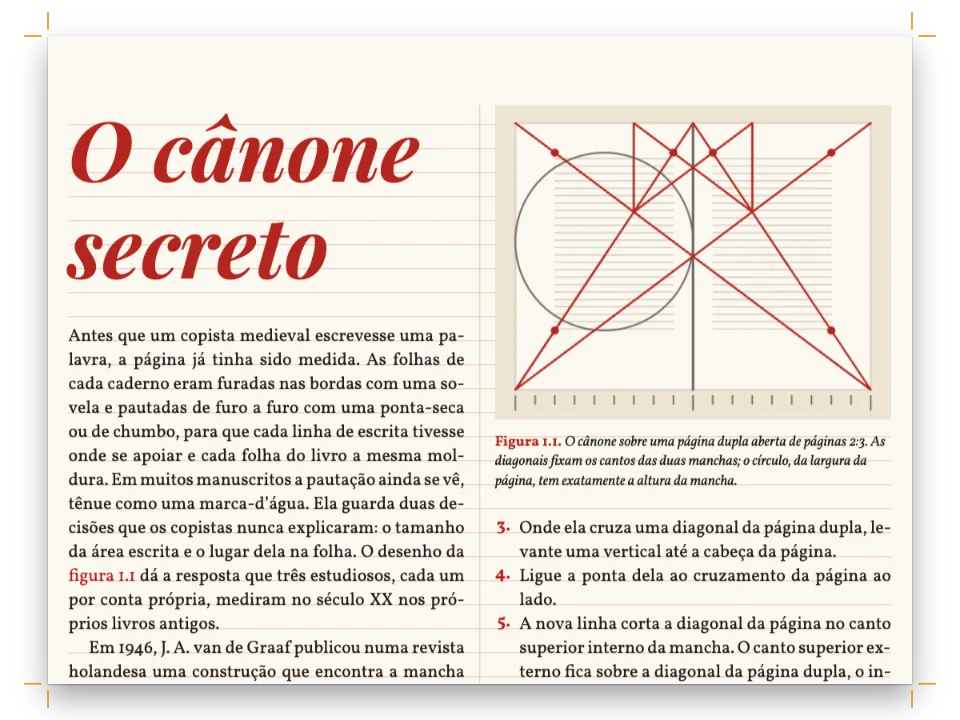
Uma página de livro sobre a grade de linhas de base constrói a mancha a partir de uma contagem de linhas, como esta folha constrói a sua com colunas e caracteres; o diploma desenha a sua borda no cabeço de um estilo de título, como a folha de rosto aqui.
Erros comuns
Erro comum
Marque o documento como zh-Hans ou zh-Hant, não com LANG
As edições de uma receita são en e es, mas uma amostra chinesa é chinesa nas duas: `locale: LANG` a marcaria como inglês ou espanhol, hifenizaria as suas palavras latinas, chamaria as suas figuras de Figure ou Figura e daria ao PDF o idioma errado. Escreva você mesmo a marcação: 'zh-Hans' (convenções da China continental: quebra de linha GB, pontuação Kaiming) ou 'zh-Hant' (Taiwan: pontuação de largura inteira centralizada); 'zh-HK' para Hong Kong. Um 'zh' sozinho é lido como chinês simplificado continental. Uma amostra japonesa leva 'ja' (armadilha ja-locale-tag). Quebra de linha em chinês →
Erro comum
Fontes chinesas são carregadas em fatias, pelo bloco cjk
O Fontsource serve uma família chinesa, japonesa ou coreana em cerca de cem arquivos por peso, cada um com um intervalo de caracteres. loadFonts baixa só o arquivo latin, então na tela os caracteres chineses vêm de uma fonte do sistema e são medidos errado, e o fontsourceProvider entrega ao PDF esse arquivo latin, que os imprime como caixas vazias. Inclua o bloco cjk do kit, chame loadCjkFonts(FONTS, markdown) depois de loadFonts (uma vez por voz, com o texto que ela compõe, quando o livro usa várias fontes CJK) e passe a renderToPdf fontProvider: cjkPdfProvider: os dois pegam os arquivos que contêm os caracteres do texto. Fontes chinesas, japonesas e coreanas →
Erro comum
Um livro encadernado pela direita mostra as páginas duplas com showBook
Em um livro encadernado pela direita (texto árabe, hebraico ou persa, chinês vertical, ou page.binding 'right') a página 1 continua sendo a ímpar, mas fica à esquerda da lombada, e os pares se leem [3 | 2]. showPages dispõe todos os livros como se fossem encadernados pela esquerda; showBook, do bloco book (o bloco cjk traz a mesma função), lê doc.binding e espelha os pares. capture.hero continua nomeando uma página dupla em ordem de leitura, [par, ímpar]: [2, 3]. Livros encadernados pela direita →
Erro comum
Transcrições em chinês tradicional trazem caracteres simplificados soltos
Textos copiados do Wikisource ou de outra edição na web de um livro em chinês tradicional às vezes trazem uma forma simplificada (颙 no lugar de 顒 no capítulo 1 de 三國演義), e uma fonte TC como a Noto Serif TC pode não tê-la. loadCjkFonts interrompe a receita e informa o caractere na mensagem; na página, ele sairia em uma fonte substituta. Restaure a forma tradicional na amostra e registre isso nos créditos. Fontes chinesas, japonesas e coreanas →
Erro comum
Qualquer objeto headings desativa a quebra de página do H1
Por padrão, um H1 salta para uma página ímpar (always-odd), mas passar qualquer objeto headings redefine esse padrão, então os capítulos ficam emendados e span: 'page' não faz nada. Declare de novo headings.levels[0].breakBefore: { enabled: true, parity } em toda configuração. Capítulos que abrem em página ímpar →
- As quebras de folha moram no Markdown. Se você mudar o texto, o corpo ou o 行款, uma folha que transborda empurra o título seguinte uma página adiante, e as páginas duplas deixam de coincidir com as folhas; uma que fica curta deixa colunas em branco antes da dobra. Confira a última coluna de cada página esquerda.
- A transcrição do 四庫全書 digita 巳 tanto por 已 quanto por 己; esta amostra decide cada caso pela frase. A página ainda pede revisão contra os fac-símiles, e isso aparece: o comentário de 張敬夫 traz 必開其政 onde os Analectos, que ele repete, trazem 必聞其政, e dois caracteres vêm como imagens do glifo. A amostra compõe 聞, 傳 e 邦. Confira um trecho com uma segunda edição antes de compô-lo.
- A mesma transcrição traz formas para as quais a Noto Serif TC não tem glifo (廹 徳 絶 逺 専 内). Cinco delas caem dentro da faixa de um arquivo do Fontsource, então
loadCjkFontsas deixa passar, e aí o canvas as desenha com uma fonte do sistema e o postext-pdf imprime uma caixa vazia e avisa. 廹 não cai na faixa de nenhum arquivo, eloadCjkFontspara com um erro. A amostra compõe 迫 德 絕 遠 專 內.
Créditos
- Receita
- Ignacio Ferro
- Texto
- 論語集註 (Collected Commentaries on the Analects), juan 1, the book 學而 from its opening to the end of its tenth section, in the copy made for the 四庫全書 (Siku quanshu, 1773–1782); Wikisource transcription, revision 523110. 巳 is read as 已 or 己 by its sentence; 開 in 張敬夫's 必開其政 is corrected to 聞, as in the words of the Analects he repeats and in Wikisource's other edition (論語集注卷一, revision 2598582); the two characters the transcription gives as glyph images are set as 傳 (以忠信為傳習之本) and 邦 (夫子至於是邦也); and six variant forms Noto Serif TC does not draw (廹 徳 絶 逺 専 内) are set in their standard forms · Zhu Xi (1130–1200); transcription by Wikisource editors · CC BY-SA 4.0
- The title page, the division into leaves and the note on this edition (據四庫全書本錄文…) · Ignacio Ferro · CC BY 4.0
- Fontes
- Noto Serif TC (SIL OFL 1.1) · LXGW WenKai TC (SIL OFL 1.1)
- Código
- MIT, como o Postext
Editar este texto ↗ (abre em uma nova aba)Pasta da receita no GitHub ↗ (abre em uma nova aba)