Em poucas palavras
Duas páginas de um jornal chinês de 1912, impresso em colunas lidas de cima para baixo. A página é dividida em faixas empilhadas, com uma linha entre elas, como faziam os jornais da época.
O que você vai compor
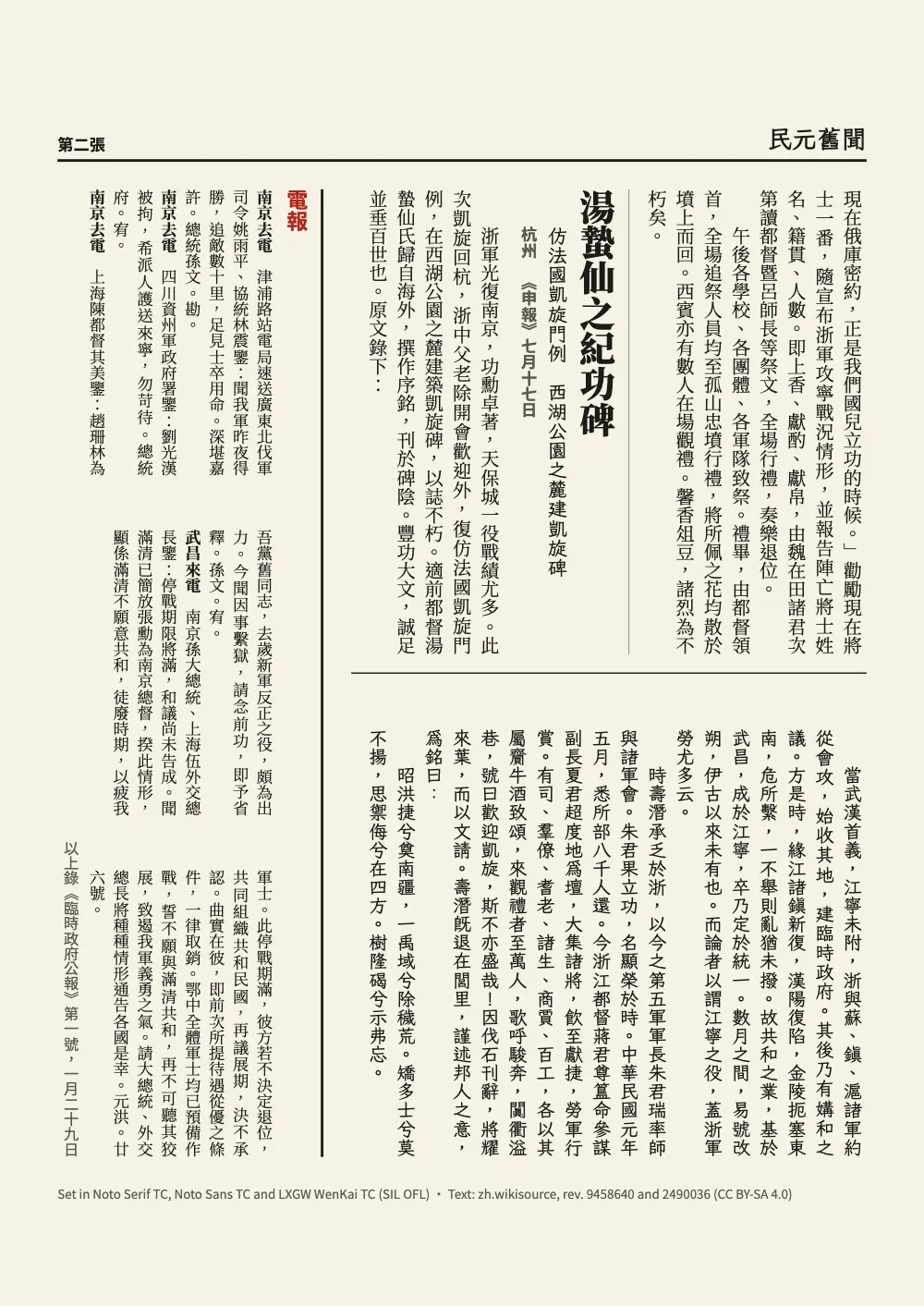
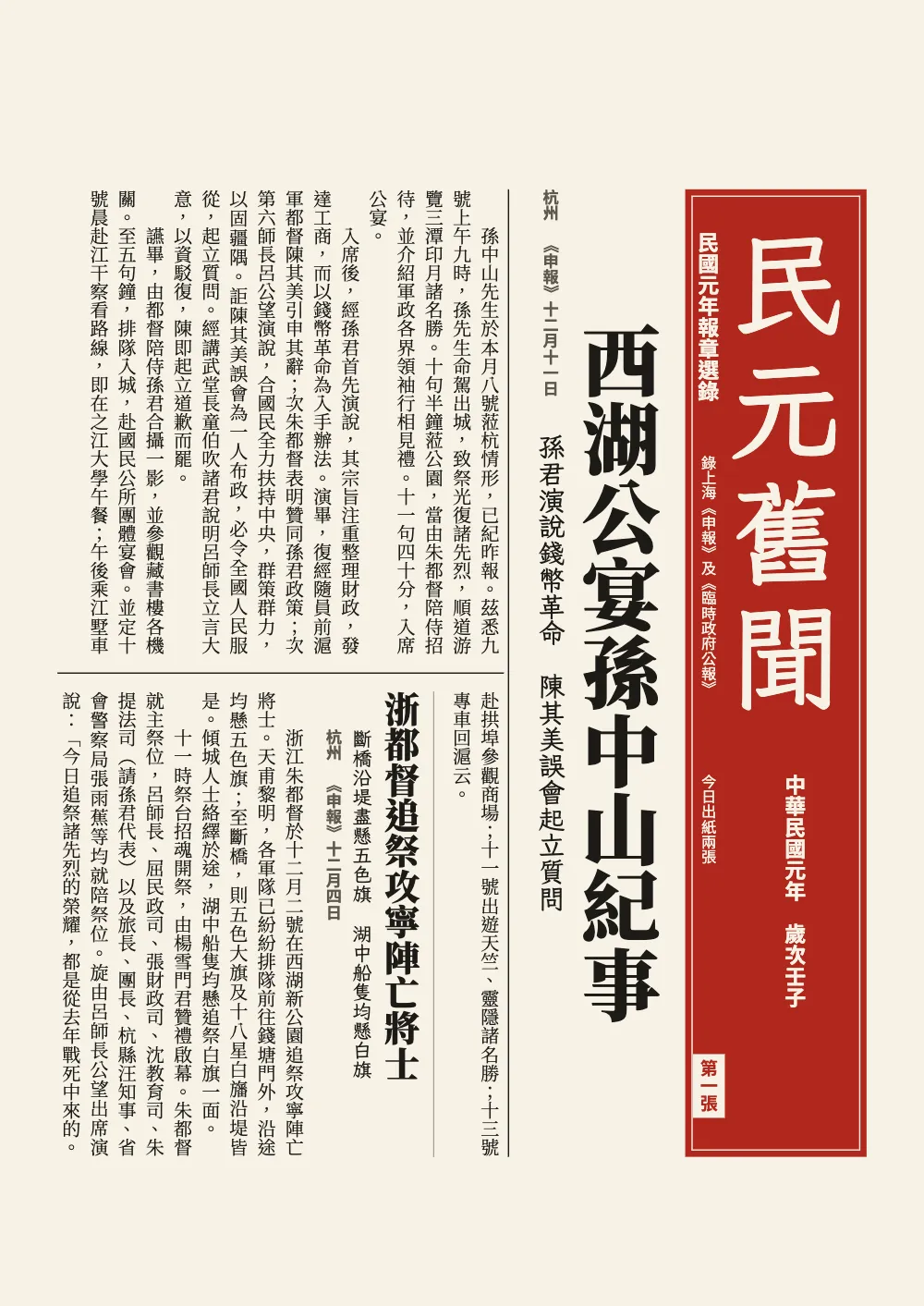
Duas folhas de um jornal chinês como era em 1912, o primeiro ano da República, quando os jornais ainda se liam de cima para baixo. Os textos vêm do Shenbao de Xangai: o banquete para Sun Yat-sen no Lago do Oeste, onde Chen Qimei se levantou para protestar contra um discurso e se levantou de novo para pedir desculpas; as exéquias pelos soldados de Zhejiang mortos na tomada de Nanquim; o monumento à vitória que Hangzhou ergueu para receber o exército de volta. Quatro telegramas do primeiro número do boletim do Governo Provisório enchem um boxe. O texto corre em dois andares (欄) de 25 caracteres com um fio entre eles, e os telegramas em três. Um cabeçalho vermelhão e a manchete, na altura inteira da página, abrem a primeira folha. A primeira página de jornal compõe a mesma página na horizontal.
Esta receita responde a
- Como componho uma página de jornal chinês na vertical, em faixas separadas por fios?
- Como coloco o título do capítulo na largura da página enquanto o texto segue em duas colunas abaixo?
- O Postext consegue compor três ou mais colunas de texto, ou fazer o texto contornar uma imagem?
- Como defino a mancha em caracteres, tantos por linha e tantas linhas por página?
A resposta curta
// On a vertical page two columns are two tiers (欄), stacked and filled from the upper right:
// the gutter is the gap between them, the column rule a rule across the page.
const layout = {
  layoutType: 'double', writingMode: 'vertical-rl', // binding 'auto' becomes 'right'
  gutterWidth: pt(2 * BODY),
  columnRule: { enabled: true, color: col('ink'), lineWidth: pt(0.75) },
};
// The grid counts characters down a tier and lines across the page: 25 × 29.
const cjk = { grid: { enabled: true, charsPerLine: CHARS, linesPerPage: 29 } };
// The body has two tiers at most. The telegrams take three inside a page-span box floated to
// the foot of the flow, the left of the sheet (gotcha: callout-columns), with the fences
//   :::callout{type="wires" span="page" placement="bottom" title="電報"} and :::columns{count=3}
const wires = { id: 'wires', backgroundEnabled: false,
  stripe: { enabled: true, side: 'top', width: pt(1.5), color: col('ink') }, // on its right
  padding: { top: pt(6), right: pt(0), bottom: pt(0), left: pt(0) },
  columnGap: pt((HEIGHT - 3 * 18 * 9) / 2), // three tiers of 18 characters of 9 pt
  titleStyle: { fontFamily: HEI, fontSize: pt(12), fontWeight: 700, color: col('accent') },
  body: { fontFamily: SONG, fontSize: pt(9), lineHeight: pt(13.5), textAlign: 'justify',
    firstLineIndent: pt(0), boldFontWeight: 700 } };
Ingredientes
- Funcionalidades
- Uma ou duas colunasFio entre colunasAberturas desenhadasTexto verticalLivros encadernados pela direitaGrade de caracteresColunas dentro de um boxeBoxes na largura da páginaBoxes flutuantesEstilos de títuloAtributos de títuloTextos, fios e caixas nos designs de páginaCabeços e fóliosCabeços por tipo de páginaEstilos de parágrafoFontes chinesas, japonesas e coreanasLargura da pontuação chinesaPaleta de cores semânticaExportação para PDFFontes incorporadas ao PDF
- Também usa
- BoxesQuebra de linha em chinêsFaixa de capítulo em largura totalCor do papelElementos pré-textuais em romanos
- Tipografia
- Noto Serif TC, Noto Sans TC, LXGW WenKai TC (SIL OFL 1.1)
- Materiais
- Nenhum: todas as imagens são desenhadas em código
Preparo
#1 · Transformar duas colunas em dois andares
O código é a resposta curta acima. Com writingMode: 'vertical-rl', a página é uma página horizontal girada um quarto de volta, então layoutType: 'double' empilha dois andares, lendo-se primeiro o de cima, e o fio entre colunas vira um fio que atravessa a página entre eles (escrita vertical). A grade de caracteres dá a cada andar 25 caracteres no corpo 五號 (10,5 pt), o máximo de uma coluna de jornal, e à página 29 linhas; arredonda a medianiz para dois quadratins e aumenta as margens para deixar os andares no meio delas (grade de caracteres).
O texto corrido aceita no máximo dois andares. Os telegramas ganham três dentro de um boxe: span="page" dá a ele a altura da mancha, placement="bottom" o leva ao pé do fluxo, que numa página vertical é a borda esquerda, e :::columns{count=3} o divide em andares. columnGap é o que três andares de 18 caracteres de 9 pt deixam dos 546 pt da mancha, de modo que cada andar contenha só caracteres inteiros.
#2 · Pôr o cabeçalho e a manchete num só desenho
// A page-span heading always opens a page (gotcha: page-span-heading-new-page), so the lead
// story's H1 carries the masthead in its own design, above its headline.
const MAST = 6.5 * LEAD; // the masthead's block, across the page
const block = (id, inset, style) => ({ kind: 'box', id, style,
  placement: at(inset, inset, { size: { width: pt(HEIGHT - 2 * inset),
    height: pt(MAST - 2 * inset) } }) });
const BAND = 13 * LEAD; // the whole design: masthead, headline, deck
const front = { enabled: true, minHeight: pt(BAND), slot: { elements: [
    block('field', 0, { backgroundColor: col('accent') }), // the name reversed out of it
    block('frame', 3.5, { borderColor: col('paper'), borderWidth: pt(0.75) }),
    text('name', '{title}', KAI, 700, 64, 'paper', { lineHeight: 1, letterSpacing: pt(6),
      placement: at(22, 13) }),
    text('kicker', '{subtitle}', HEI, 700, 12, 'paper', { placement: at(24, 82) }),
    text('sources', '錄{author}', HEI, 400, 8.5, 'paper', { placement: at(150, 84) }),
    text('issue', '{attr.issue}', HEI, 700, 12, 'paper', { placement: at(330, 33) }), // the year
    text('edition', '{attr.edition}', HEI, 400, 8.5, 'paper', { placement: at(330, 84) }),
    text('sheet', '第{pageNumber}張', HEI, 700, 10, 'accent', { placement: at(HEIGHT - 58, 80),
      box: { backgroundColor: col('paper'), padding: { top: pt(3), right: pt(3),
        bottom: pt(3), left: pt(3) } } }),
    // The headline down both tiers, centred; the dateline heads the deck's line.
    text('head', '{titleText}', SONG, 900, 44, 'ink', { align: 'center', lineHeight: 1.1,
      placement: at(0, MAST + 12, fill) }),
    text('deck', '{attr.deck}', KAI, 400, 15, 'ink', { align: 'center',
      placement: below('head', 6, fill) }),
    text('dateline', '{attr.dateline}', HEI, 700, 9, 'muted', { placement: below('head', 10) }),
    { kind: 'rule', id: 'foot', direction: 'horizontal', thickness: pt(0.75),
      color: col('ink'), placement: at(0, BAND - 3, fill) },
] } };
A manchete da matéria principal precisava atravessar os dois andares sob o cabeçalho. Um título com span: 'page' é composto como abertura na cabeça de uma página, então um segundo título desses, depois do cabeçalho, teria começado uma página nova. Por isso o H1 da página é a matéria principal, e o seu estilo de título desenha o cabeçalho acima da manchete: um bloco vermelhão de 6,5 linhas com o nome do jornal vazado e, sob ele, a linha da edição, com o ano da República e o do ciclo e 今日出紙兩張, “hoje, duas folhas”; depois, a manchete em Noto Serif TC 900 a 44 pt. No fluxo, a largura do desenho é a altura da mancha no papel, então size: { width: 'fill' } com align: 'center' centraliza a manchete na altura dos dois andares. O desenho mede 13 linhas, um número inteiro de linhas da grade, e o texto que vem depois começa numa linha da grade.
#3 · Abrir cada matéria com um desenho de título
const storyHead = { enabled: true, minHeight: pt(4 * LEAD), slot: { elements: [ // 4 lines
  { kind: 'rule', id: 'rule', direction: 'horizontal', thickness: pt(0.5), color: col('rule'),
    placement: at(0, 0, fill) },
  text('head', '{titleText}', SONG, 900, 20, 'ink', { placement: at(0, 6) }),
  text('deck', '{attr.deck}', KAI, 400, 11, 'ink', { // two characters down the tier
    placement: below('head', 4, { offset: { x: pt(2 * BODY), y: pt(4) } }) }),
  text('dateline', '{attr.dateline}', HEI, 700, 9, 'muted', { placement: below('deck', 4) }),
] } };
Um desenho de título na coluna fica dentro do seu andar. O fio dele é direction: 'horizontal' no fluxo, então no papel desce ao longo do andar, um fio fino entre duas matérias. O título começa na cabeça do andar, a linha fina dois caracteres mais abaixo, e a procedência informa o lugar, o jornal e o dia em que a reportagem saiu. minHeight mantém cada abertura com quatro linhas, e assim o texto sob cada uma começa na grade.
#4 · Dar um cabeço à segunda folha e assiná-la no pé
// The header's frame is the margin above the tiers; the footer's, the margin below them.
const above = (y, extra = {}) => ({ anchor: { to: 'container', edge: 'top-left' },
  offset: { x: pt(0), y: mm(HEAD - y) }, ...extra });
const header = { elements: [
  text('title', '{title}', KAI, 700, 14, 'ink', { align: 'right', placement: above(13, fill) }),
  text('sheet', '第{pageNumber}張', HEI, 700, 9, 'ink', { placement: above(10.8) }),
  { kind: 'rule', id: 'rule', thickness: pt(1.5), color: col('ink'), placement: above(6, fill) },
].map((element) => ({ ...element, pages: 'body' })) }; // page 1 has the masthead instead
const footer = { elements: [text('colophon', '{attr.colophon}', HEI, 400, 7, 'muted', {
  pages: 'body', placement: at(0, 17, fill) })] }; // 6 mm under the tiers
Numa página vertical, os cabeços continuam horizontais, como descreve o clreq. O quadro do cabeço é a margem acima dos andares; a grade aumenta essa margem, e HEAD repete a conta da grade para que o fio fique 6 mm acima do primeiro caractere. pages: 'body' deixa a página 1 para o cabeçalho. O colofão é um atributo do H1, então a edição em inglês e a em espanhol imprimem cada uma a sua linha sob as mesmas páginas em chinês.
#5 · Carregar cada voz com o texto que ela compõe
const pick = (pattern) => (markdown.match(pattern) ?? []).join('');
const attrs = (...keys) => pick(new RegExp(`[{ ](?:${keys.join('|')})="[^"]*"`, 'g'));
const voices = [ // family, weights, the text it sets, and whether it runs down a column
  [SONG, ['400'], markdown, true], // the text
  [SONG, ['700', '900'], pick(/^#+ [^{\n]*|\*\*[^*]+\*\*/gm), false], // heads, labels
  [HEI, ['400', '700'], pick(/^(?:subtitle|author): .*$|style="source"\}[^:]*/gm) // masthead,
    + attrs('dateline', 'issue', 'edition', 'title', 'colophon') + '錄第一二張', true], // datelines
  [KAI, ['400'], attrs('deck') + pick(/style="inscription"\}[^:]*/g), true], // decks, the stele
  [KAI, ['700'], pick(/^title: .*$/m), false], // the paper's name
];
O Fontsource serve cada peso destas famílias em cerca de cem arquivos, e loadCjkFonts baixa os que um texto usa. A Noto Serif TC 400 recebe a amostra inteira; os pesos 700 e 900 recebem só as manchetes e os rótulos dos telegramas; a Noto Sans TC, as linhas do cabeçalho, as procedências e o colofão; a LXGW WenKai TC, as linhas finas, a inscrição e o nome do jornal. Uma família que recebe menos texto do que compõe faz a captura falhar (C12), e o erro nomeia os caracteres que ela teve de pegar de outra família.
A receita completa
// ═══ Postext Cookbook · Nº 084 · A vertical newspaper page in tiers ═══════════════ // https://postext.dev/en/cookbook/vertical-newspaper-tiers // Code: MIT · Text: Shenbao, 1912 (PD); gazette, stele report: zh.wikisource (CC BY-SA 4.0) // Fonts: Noto Serif TC, Noto Sans TC, LXGW WenKai TC (SIL OFL 1.1) · Needs postext ≥ 1.9.0 import { buildDocument, renderPageToCanvas, clearMeasurementCache, loadVerticalAlternates, } from 'https://esm.sh/postext'; import { renderToPdf, decompressWoff2 } from 'https://esm.sh/postext-pdf'; const LANG = 'en'; // @lang: the language of the colophon; the news is Chinese in both editions const RECIPE = 'vertical-newspaper-tiers'; // ─── 1 · Design ───────────────────────────────────────────────────────────── // #region palette: newsprint, ink and the vermilion of the masthead const palette = { ink: '#1c1a17', // text, the rules between tiers accent: '#b0281c', // the one accent: the masthead block, the telegrams' flag rule: '#8f887c', // the hairline before each story muted: '#5e574e', // datelines, sources, the colophon paper: '#f7f2e6', // newsprint, and the masthead's type reversed out of the vermilion }; const col = (id) => ({ hex: palette[id], model: 'hex', paletteId: id }); const colorPalette = [ ...Object.entries(palette).map(([id, hex]) => ({ id, name: id, value: { hex, model: 'hex' } })), { id: 'main-color', name: 'ink (defaults)', value: { hex: palette.ink, model: 'hex' } }, ]; // #endregion const [SONG, HEI, KAI] = ['Noto Serif TC', 'Noto Sans TC', 'LXGW WenKai TC']; // 宋, 黑, 楷 const BODY = 10.5; // pt: 五號, the body size of the papers of 1912 const LEAD = 15.75; // pt: the line pitch across the page, 1.5 em const CHARS = 25; // characters down a tier: a newspaper column, 17 to 25 const HEIGHT = 2 * CHARS * BODY + 2 * BODY; // pt: two tiers and a gutter of two ems const TRIM = { w: 184, h: 260 }; // mm, 16開 const MARGIN = { top: 30, bottom: 22, side: 11 }; // mm, minimums: the grid centres the tiers // The grid grows the margins evenly, so the tiers start HEAD mm below the top edge. const HEAD = MARGIN.top + (TRIM.h - MARGIN.top - MARGIN.bottom - (HEIGHT * 25.4) / 72) / 2; // #region answer: two tiers down the page with a rule between them, three inside a box // On a vertical page two columns are two tiers (欄), stacked and filled from the upper right: // the gutter is the gap between them, the column rule a rule across the page. const layout = { layoutType: 'double', writingMode: 'vertical-rl', // binding 'auto' becomes 'right' gutterWidth: pt(2 * BODY), columnRule: { enabled: true, color: col('ink'), lineWidth: pt(0.75) }, }; // The grid counts characters down a tier and lines across the page: 25 × 29. const cjk = { grid: { enabled: true, charsPerLine: CHARS, linesPerPage: 29 } }; // The body has two tiers at most. The telegrams take three inside a page-span box floated to // the foot of the flow, the left of the sheet (gotcha: callout-columns), with the fences // :::callout{type="wires" span="page" placement="bottom" title="電報"} and :::columns{count=3} const wires = { id: 'wires', backgroundEnabled: false, stripe: { enabled: true, side: 'top', width: pt(1.5), color: col('ink') }, // on its right padding: { top: pt(6), right: pt(0), bottom: pt(0), left: pt(0) }, columnGap: pt((HEIGHT - 3 * 18 * 9) / 2), // three tiers of 18 characters of 9 pt titleStyle: { fontFamily: HEI, fontSize: pt(12), fontWeight: 700, color: col('accent') }, body: { fontFamily: SONG, fontSize: pt(9), lineHeight: pt(13.5), textAlign: 'justify', firstLineIndent: pt(0), boldFontWeight: 700 } }; // #endregion // In the flow of a vertical page x runs down the sheet and y leftward from its right edge. const at = (x, y, extra = {}) => ({ anchor: { to: 'container', edge: 'top-left' }, offset: { x: pt(x), y: pt(y) }, ...extra }); const text = (id, content, family, weight, size, colour, extra = {}) => ({ kind: 'text', id, content, fontFamily: family, fontWeight: weight, fontSize: pt(size), lineHeight: 1.2, color: col(colour), align: 'left', overflow: 'wrap', ...extra }); const below = (id, y, extra = {}) => ({ anchor: { to: `#${id}`, edge: 'below' }, offset: { y: pt(y) }, ...extra }); // y more points across the page, leftward const fill = { size: { width: 'fill' } }; // #region front: the masthead and the lead headline, one design down the right of page 1 // A page-span heading always opens a page (gotcha: page-span-heading-new-page), so the lead // story's H1 carries the masthead in its own design, above its headline. const MAST = 6.5 * LEAD; // the masthead's block, across the page const block = (id, inset, style) => ({ kind: 'box', id, style, placement: at(inset, inset, { size: { width: pt(HEIGHT - 2 * inset), height: pt(MAST - 2 * inset) } }) }); const BAND = 13 * LEAD; // the whole design: masthead, headline, deck const front = { enabled: true, minHeight: pt(BAND), slot: { elements: [ block('field', 0, { backgroundColor: col('accent') }), // the name reversed out of it block('frame', 3.5, { borderColor: col('paper'), borderWidth: pt(0.75) }), text('name', '{title}', KAI, 700, 64, 'paper', { lineHeight: 1, letterSpacing: pt(6), placement: at(22, 13) }), text('kicker', '{subtitle}', HEI, 700, 12, 'paper', { placement: at(24, 82) }), text('sources', '錄{author}', HEI, 400, 8.5, 'paper', { placement: at(150, 84) }), text('issue', '{attr.issue}', HEI, 700, 12, 'paper', { placement: at(330, 33) }), // the year text('edition', '{attr.edition}', HEI, 400, 8.5, 'paper', { placement: at(330, 84) }), text('sheet', '第{pageNumber}張', HEI, 700, 10, 'accent', { placement: at(HEIGHT - 58, 80), box: { backgroundColor: col('paper'), padding: { top: pt(3), right: pt(3), bottom: pt(3), left: pt(3) } } }), // The headline down both tiers, centred; the dateline heads the deck's line. text('head', '{titleText}', SONG, 900, 44, 'ink', { align: 'center', lineHeight: 1.1, placement: at(0, MAST + 12, fill) }), text('deck', '{attr.deck}', KAI, 400, 15, 'ink', { align: 'center', placement: below('head', 6, fill) }), text('dateline', '{attr.dateline}', HEI, 700, 9, 'muted', { placement: below('head', 10) }), { kind: 'rule', id: 'foot', direction: 'horizontal', thickness: pt(0.75), color: col('ink'), placement: at(0, BAND - 3, fill) }, ] } }; // #endregion // #region heads: each story opens with a hairline, the headline, a deck and a dateline const storyHead = { enabled: true, minHeight: pt(4 * LEAD), slot: { elements: [ // 4 lines { kind: 'rule', id: 'rule', direction: 'horizontal', thickness: pt(0.5), color: col('rule'), placement: at(0, 0, fill) }, text('head', '{titleText}', SONG, 900, 20, 'ink', { placement: at(0, 6) }), text('deck', '{attr.deck}', KAI, 400, 11, 'ink', { // two characters down the tier placement: below('head', 4, { offset: { x: pt(2 * BODY), y: pt(4) } }) }), text('dateline', '{attr.dateline}', HEI, 700, 9, 'muted', { placement: below('deck', 4) }), ] } }; // #endregion // #region pagehead: the second sheet's head and the colophon, horizontal on the sheet // The header's frame is the margin above the tiers; the footer's, the margin below them. const above = (y, extra = {}) => ({ anchor: { to: 'container', edge: 'top-left' }, offset: { x: pt(0), y: mm(HEAD - y) }, ...extra }); const header = { elements: [ text('title', '{title}', KAI, 700, 14, 'ink', { align: 'right', placement: above(13, fill) }), text('sheet', '第{pageNumber}張', HEI, 700, 9, 'ink', { placement: above(10.8) }), { kind: 'rule', id: 'rule', thickness: pt(1.5), color: col('ink'), placement: above(6, fill) }, ].map((element) => ({ ...element, pages: 'body' })) }; // page 1 has the masthead instead const footer = { elements: [text('colophon', '{attr.colophon}', HEI, 400, 7, 'muted', { pages: 'body', placement: at(0, 17, fill) })] }; // 6 mm under the tiers // #endregion const config = () => ({ // a factory: the engine caches resolved configs per object locale: 'zh-Hant', // Taiwan conventions: centred punctuation (gotcha: cjk-locale-tag) colorPalette, page: { sizePreset: 'custom', width: mm(TRIM.w), height: mm(TRIM.h), dpi: 150, backgroundColor: col('paper'), margins: { top: mm(MARGIN.top), bottom: mm(MARGIN.bottom), left: mm(MARGIN.side), right: mm(MARGIN.side), mirror: true }, pageNumbering: { format: 'trad-chinese-informal' }, // 第一張, 第二張 }, layout, cjk, bodyText: { fontFamily: SONG, fontSize: pt(BODY), lineHeight: pt(LEAD), color: col('ink'), boldColor: col('ink'), italicColor: col('ink'), referenceColor: col('ink'), textAlign: 'justify', firstLineIndent: em(2), indentAfterHeading: true, }, headings: { fontFamily: SONG, fontWeight: 900, color: col('ink'), levels: [ // Restated: any headings object drops the H1 break (gotcha: headings-drop-h1-break). { level: 1, span: 'page', breakBefore: { enabled: true, parity: 'any' }, marginBottom: pt(0) }, { level: 2, fontSize: pt(20), lineHeight: pt(2 * LEAD), marginTop: pt(LEAD / 2), marginBottom: pt(0), advancedDesign: storyHead }, ], }, headingStyles: [{ id: 'front', advancedDesign: front }], calloutStyles: [wires], paragraphStyles: [ { id: 'source', fontFamily: HEI, fontSize: pt(8.5), color: col('muted'), textAlign: 'right', firstLineIndent: pt(0) }, // the telegrams' source, at the foot of its line { id: 'inscription', fontFamily: KAI, indent: em(2), firstLineIndent: em(2) }, // 低二格 ], header, footer, }); // ─── 2 · Content ──────────────────────────────────────────────────────────── const markdown = String.raw`---Amostra em Markdown · 48 linhas · content.en.md
title: "民元舊聞" subtitle: "民國元年報章選錄" author: "上海《申報》及《臨時政府公報》" --- # 西湖公宴孫中山紀事 {style="front" deck="孫君演說錢幣革命 陳其美誤會起立質問" dateline="杭州 《申報》十二月十一日" issue="中華民國元年 歲次壬子" edition="今日出紙兩張" colophon="Set in Noto Serif TC, Noto Sans TC and LXGW WenKai TC (SIL OFL) · Text: zh.wikisource, rev. 9458640 and 2490036 (CC BY-SA 4.0)"} 孫中山先生於本月八號蒞杭情形,已紀昨報。茲悉九號上午九時,孫先生命駕出城,致祭光復諸先烈,順道游覽三潭印月諸名勝。十句半鐘蒞公園,當由朱都督陪侍招待,並介紹軍政各界領袖行相見禮。十一句四十分,入席公宴。 入席後,經孫君首先演說,其宗旨注重整理財政,發達工商,而以錢幣革命為入手辦法。演畢,復經隨員前滬軍都督陳其美引申其辭;次朱都督表明贊同孫君政策;次第六師長呂公望演說,合國民全力扶持中央,群策群力,以固疆隅。詎陳其美誤會為一人布政,必令全國人民服從,起立質問。經講武堂長童伯吹諸君說明呂師長立言大意,以資駁復,陳即起立道歉而罷。 讌畢,由都督陪侍孫君合攝一影,並參觀藏書樓各機關。至五句鐘,排隊入城,赴國民公所團體宴會。並定十號晨赴江干察看路線,即在之江大學午餐;午後乘江墅車赴拱埠參觀商場;十一號出遊天竺、靈隱諸名勝;十三號專車回滬云。 ## 浙都督追祭攻寧陣亡將士 {deck="斷橋沿堤盡懸五色旗 湖中船隻均懸白旗" dateline="杭州 《申報》十二月四日"} 浙江朱都督於十二月二號在西湖新公園追祭攻寧陣亡將士。天甫黎明,各軍隊已紛紛排隊前往錢塘門外,沿途均懸五色旗;至斷橋,則五色大旗及十八星白旛沿堤皆是。傾城人士絡繹於途,湖中船隻均懸追祭白旗一面。 十一時祭台招魂開祭,由楊雪門君贊禮啟幕。朱都督就主祭位,呂師長、屈民政司、張財政司、沈教育司、朱提法司(請孫君代表)以及旅長、團長、杭縣汪知事、省會警察局張雨蕉等均就陪祭位。旋由呂師長公望出席演說:「今日追祭諸先烈的榮耀,都是從去年戰死中來的。現在俄庫密約,正是我們國兒立功的時候。」勸勵現在將士一番,隨宣布浙軍攻寧戰況情形,並報告陣亡將士姓名、籍貫、人數。即上香、獻酌、獻帛,由魏在田諸君次第讀都督暨呂師長等祭文,全場行禮,奏樂退位。 午後各學校、各團體、各軍隊致祭。禮畢,由都督領首,全場追祭人員均至孤山忠墳行禮,將所佩之花均散於墳上而回。西賓亦有數人在場觀禮。馨香俎豆,諸烈為不朽矣。 :::callout{type="wires" span="page" placement="bottom" title="電報"} :::columns{count=3} **南京去電** 津浦路站電局速送廣東北伐軍司令姚雨平、協統林震鑒:聞我軍昨夜得勝,追敵數十里,足見士卒用命。深堪嘉許。總統孫文。勘。 **南京去電** 四川資州軍政府署鑒:劉光漢被拘,希派人護送來寧,勿苛待。總統府。宥。 **南京去電** 上海陳都督其美鑒:趙珊林為吾黨舊同志,去歲新軍反正之役,頗為出力。今聞因事繫獄,請念前功,即予省釋。孫文。宥。 **武昌來電** 南京孫大總統、上海伍外交總長鑒:停戰期限將滿,和議尚未告成。聞滿清已簡放張勳為南京總督,揆此情形,顯係滿清不願意共和,徒廢時期,以疲我軍士。此停戰期滿,彼方若不決定退位,共同組織共和民國,再議展期,決不承認。曲實在彼,即前次所提待遇從優之條件,一律取銷。鄂中全體軍士均已預備作戰,誓不願與滿清共和,再不可聽其狡展,致遏我軍義勇之氣。請大總統、外交總長將種種情形通告各國是幸。元洪。廿六號。 ::: :::paragraphs{style="source"} 以上錄《臨時政府公報》第一號,一月二十九日 ::: ::: ## 湯蟄仙之紀功碑 {deck="仿法國凱旋門例 西湖公園之麓建凱旋碑" dateline="杭州 《申報》七月十七日"} 浙軍光復南京,功勳卓著,天保城一役戰績尤多。此次凱旋回杭,浙中父老除開會歡迎外,復仿法國凱旋門例,在西湖公園之麓建築凱旋碑,以誌不朽。適前都督湯蟄仙氏歸自海外,撰作序銘,刊於碑陰。豐功大文,誠足並垂百世也。原文錄下: :::paragraphs{style="inscription"} 當武漢首義,江寧未附,浙與蘇、鎮、滬諸軍約從會攻,始收其地,建臨時政府。其後乃有媾和之議。方是時,緣江諸鎮新復,漢陽復陷,金陵扼塞東南,危所繫,一不舉則亂猶未撥。故共和之業,基於武昌,成於江寧,卒乃定於統一。數月之間,易號改朔,伊古以來未有也。而論者以謂江寧之役,蓋浙軍勞尤多云。 時壽潛承乏於浙,以今之第五軍軍長朱君瑞率師與諸軍會。朱君果立功,名顯榮於時。中華民國元年五月,悉所部八千人還。今浙江都督蔣君尊簋命參謀副長夏君超度地為壇,大集諸將,飲至獻捷,勞軍行賞。有司、羣僚、耆老、諸生、商賈、百工,各以其屬齎牛酒致頌,來觀禮者至萬人,歌呼駿奔,闐衢溢巷,號曰歡迎凱旋,斯不亦盛哉!因伐石刊辭,將耀來葉,而以文請。壽潛既退在閭里,謹述邦人之意,為銘曰: 昭洪捷兮奠南疆,一禹域兮除穢荒。矯多士兮莫不揚,思禦侮兮在四方。樹隆碣兮示弗忘。 :::`; // content.<lang>.md: the same Chinese text in both // ─── 3 · Fonts ────────────────────────────────────────────────────────────── // Every face the pages paint; the Chinese ones by files (gotcha: cjk-fonts-slices). const FONTS = { 'Noto Serif TC': ['400', '700', '900'], 'Noto Sans TC': ['400', '700'], 'LXGW WenKai TC': ['400', '700'] }; // #region voices: each face loads the files of the text it sets const pick = (pattern) => (markdown.match(pattern) ?? []).join(''); const attrs = (...keys) => pick(new RegExp(`[{ ](?:${keys.join('|')})="[^"]*"`, 'g')); const voices = [ // family, weights, the text it sets, and whether it runs down a column [SONG, ['400'], markdown, true], // the text [SONG, ['700', '900'], pick(/^#+ [^{\n]*|\*\*[^*]+\*\*/gm), false], // heads, labels [HEI, ['400', '700'], pick(/^(?:subtitle|author): .*$|style="source"\}[^:]*/gm) // masthead, + attrs('dateline', 'issue', 'edition', 'title', 'colophon') + '錄第一二張', true], // datelines [KAI, ['400'], attrs('deck') + pick(/style="inscription"\}[^:]*/g), true], // decks, the stele [KAI, ['700'], pick(/^title: .*$/m), false], // the paper's name ]; // #endregion // ─── 4 · Build & show ─────────────────────────────────────────────────────── await loadFonts(FONTS, markdown); for (const [family, weights, text, vertical] of voices) { await loadCjkFonts({ [family]: weights }, text, { vertical }); } const doc = await buildWithFonts(() => buildDocument({ markdown }, config()), markdown); showBook(doc, { title: t({ en: 'A vertical newspaper page in tiers', es: 'Una página de periódico vertical, en pisos' }) }); offerPdf(() => renderToPdf(doc, { fontProvider: cjkPdfProvider }), `${RECIPE}.pdf`);Kit · core, fonts, viewer, pdf, cjk: igual em todas as receitas · 459 linhas
// ─── Kit ── helpers shared by every Cookbook recipe · postext.dev/cookbook ───── // ─── Kit · core v1 ── the same in every recipe · postext.dev/cookbook function mm(value) { return { value, unit: 'mm' }; } function pt(value) { return { value, unit: 'pt' }; } function em(value) { return { value, unit: 'em' }; } /** The sample language's string: t({ en: 'Figure', es: 'Figura' }). */ function t(strings) { return strings[LANG] ?? Object.values(strings)[0]; } /** A file in this recipe's assets folder, served from the Postext repo by jsDelivr. */ function asset(file) { return `https://cdn.jsdelivr.net/gh/drnachio/postext@main/cookbook/${RECIPE}/assets/${file}`; } // ─── Kit · fonts v2 ── the same in every recipe · postext.dev/cookbook // Postext measures with the loaded faces and caches the widths: load every face // before the first build, from Fontsource, the files the PDF embeds too. /** faces = { 'Family Name': ['400', '400i', '700'] }. `text` is the sample: * č ł † α χ also load latin-ext and greek files (kitSubsetsFor). With * `optional`, a face Fontsource does not ship is skipped instead of failing. * Resolves to the number of faces added. */ async function loadFonts(faces, text = '', { optional = false } = {}) { kitStatus('Loading fonts…'); const ranges = { latin: 'U+0000-00FF,U+0131,U+0152-0153,U+02BB-02BC,U+02C6,U+02DA,U+02DC,U+0304,U+0308,U+0329,' + 'U+2000-206F,U+20AC,U+2122,U+2191,U+2193,U+2212,U+2215,U+FEFF,U+FFFD', 'latin-ext': 'U+0100-02BA,U+02BD-02C5,U+02C7-02CC,U+02CE-02D7,U+02DD-02FF,U+0304,U+0308,U+0329,' + 'U+1D00-1DBF,U+1E00-1E9F,U+1EF2-1EFF,U+2020,U+20A0-20AB,U+20AD-20C0,U+2113,U+2C60-2C7F,U+A720-A7FF', greek: 'U+0370-03FF', }; const jobs = []; let added = 0; for (const [family, specs] of Object.entries(faces)) { const id = fontsourceId(family); const todo = [...new Set(specs)].map((spec) => [parseInt(spec, 10), spec.endsWith('i') ? 'italic' : 'normal']) .filter(([weight, style]) => !hasFace(family, weight, style)); // before any await const meta = optional || /[^\0-ÿ]/u.test(text) ? await fontsourceMeta(family) : null; const subsets = ['latin', ...kitSubsetsFor(text, meta)]; for (const [weight, style] of todo) { if (optional && !(meta?.weights.includes(weight) && meta.styles.includes(style))) continue; for (const subset of subsets) { const url = `https://cdn.jsdelivr.net/npm/@fontsource/${id}@5/files/${id}-${subset}-${weight}-${style}.woff2`; const face = new FontFace(family, `url(${url}) format('woff2')`, { weight: String(weight), style, unicodeRange: ranges[subset] }); jobs.push(face.load().then((ready) => { document.fonts.add(ready); added++; }, () => { if (subset === 'latin' && !optional) throw new Error(`Fontsource has no ${family} ${weight} ${style}`); })); } } } await Promise.all(jobs).catch((error) => { kitFail(error); throw error; }); return added; } /** Runs `build` and loads any face the pages use that FONTS missed (a regular * one with a warning), then clears the measurement cache and builds again. */ async function buildWithFonts(build, text = '') { const tried = new Set(); for (let round = 0; round < 3; round++) { kitStatus('Laying out…'); await new Promise(requestAnimationFrame); // let the status paint first const result = await Promise.resolve().then(build).catch((error) => { kitFail(error); throw error; }); const wanted = { base: {}, variants: {} }; for (const { font, base } of [result].flat().flatMap(fontStringsOf)) { const { family, weight, style } = parseFont(font); const key = `${family}|${weight}|${style}`; if (tried.has(key) || hasFace(family, weight, style)) continue; tried.add(key); (wanted[base ? 'base' : 'variants'][family] ??= []).push(`${weight}${style === 'italic' ? 'i' : ''}`); } if (Object.keys(wanted.base).length) { console.warn(`[cookbook] FONTS does not list ${JSON.stringify(wanted.base)}: loading them.`); } const added = await loadFonts(wanted.base, text) + await loadFonts(wanted.variants, text, { optional: true }); if (added === 0) return result; clearMeasurementCache(); } throw new Error('The fonts did not settle after three builds.'); } /** Every font string of the layout; `base` marks a block's own face. */ function fontStringsOf(doc) { const found = new Map(); const walk = (node) => { if (!node || typeof node !== 'object') return; if (Array.isArray(node)) { node.forEach(walk); return; } for (const [key, value] of Object.entries(node)) { if (typeof value === 'string' && /fontString$/i.test(key)) { found.set(value, found.get(value) || key === 'fontString'); } else if (value && typeof value === 'object') walk(value); } }; walk(doc.pages); walk(doc.blocks); return [...found].map(([font, base]) => ({ font, base })); } /** '700 37.5px Open Sans' / 'italic 400 13px "Source Serif 4"' → { family, weight, style }. * A string with no weight ('95.8px Young Serif', from a design text) is 400. */ function parseFont(font) { const m = /^(?:(italic|oblique)\s+)?(?:small-caps\s+)?(?:(\d+|bold|normal)\s+)?[\d.]+px\s+(.+)$/.exec(font.trim()); if (!m) throw new Error(`Unexpected font string: ${font}`); const weight = m[2] === 'bold' ? 700 : !m[2] || m[2] === 'normal' ? 400 : Number(m[2]); return { family: m[3].replace(/^["']|["']$/g, ''), weight, style: m[1] ? 'italic' : 'normal' }; } /** A loaded FontFace covers this family, weight and style (fonts.check() would * also say yes for families nobody declared). */ function hasFace(family, weight, style) { for (const face of document.fonts) { if (face.status !== 'loaded' || face.style !== style) continue; if (face.family.replace(/^["']|["']$/g, '') !== family) continue; const [low, high = low] = face.weight.split(' ').map(Number); if (weight >= low && weight <= high) return true; } return false; } /** The files beyond latin `text` needs that `meta`'s family ships. */ function kitSubsetsFor(text, meta) { return [[/[Ā-˿ᴀ-ᶿḀ-ỿ†ℓⱠ-Ɀ꜠-ꟿ]/u, 'latin-ext'], [/[Ͱ-Ͽ]/u, 'greek']] .filter(([re, x]) => re.test(text) && meta?.subsets?.includes(x)).map(([, x]) => x); } /** Fontsource's id for a family: 'Source Serif 4' → 'source-serif-4'. */ function fontsourceId(family) { return family.toLowerCase().replace(/\s+/g, '-'); } /** The family's Fontsource metadata (weights, styles, subsets), or null. */ function fontsourceMeta(family) { fontsourceMeta.cache ??= new Map(); const id = fontsourceId(family); if (!fontsourceMeta.cache.has(id)) { fontsourceMeta.cache.set(id, fetch(`https://api.fontsource.org/v1/fonts/${id}`) .then((res) => (res.ok ? res.json() : null), () => null)); } return fontsourceMeta.cache.get(id); } // ─── Kit · viewer v1 ── the same in every recipe · postext.dev/cookbook /** The pages as spreads on a dark desk, page 1 alone, then verso | recto, * each painted when it scrolls near. */ function showPages(docs, { title, width = 460 } = {}) { const root = viewer(title); const pages = [docs].flat().flatMap((doc) => doc.pages.map((page) => ({ doc, page, n: (doc.pageIndexOffset ?? 0) + page.index }))); const spreads = []; let verso = null; for (const p of pages) { if (p.n % 2 === 1) { if (verso) spreads.push([verso, null]); verso = p; } else { spreads.push([verso, p]); verso = null; } } if (verso) spreads.push([verso, null]); const density = Math.min(window.devicePixelRatio || 1, 2); showPages.painter?.disconnect(); const painter = new IntersectionObserver((entries) => { for (const { isIntersecting, target } of entries) { if (!isIntersecting) continue; painter.unobserve(target); const { doc, page } = target.postext; renderPageToCanvas(page, doc, target, { scale: (width * density) / page.width }); } }, { rootMargin: '800px' }); showPages.painter = painter; root.replaceChildren(...spreads.map((pair) => { const spread = document.createElement('div'); spread.className = 'pt-spread'; for (const p of pair) { const figure = document.createElement('figure'); if (p) { const label = p.page.pageLabel || String(p.n + 1); const canvas = document.createElement('canvas'); canvas.postext = p; canvas.style.aspectRatio = `${p.page.width} / ${p.page.height}`; canvas.setAttribute('role', 'img'); canvas.setAttribute('aria-label', `Page ${label}`); const folio = document.createElement('figcaption'); folio.textContent = label; figure.append(canvas, folio); painter.observe(canvas); } else figure.className = 'pt-blank'; spread.append(figure); } return spread; })); kitStatus(`${pages.length} ${pages.length === 1 ? 'page' : 'pages'}`); document.documentElement.dataset.postext = 'ready'; return pages.length; } /** The desk, the bar and the error reporting, created once. */ function viewer(title) { if (!document.getElementById('pt-kit')) { document.head.insertAdjacentHTML('beforeend', `<style id="pt-kit"> :root { color-scheme: dark; } body { margin: 0; background: #0e1014; color: #b9bcc4; font: 13px/1.45 system-ui, sans-serif; } #pt-bar { position: sticky; top: 0; z-index: 1; display: flex; flex-wrap: wrap; align-items: center; gap: 6px 16px; padding: 10px 16px; background: rgb(14 16 20 / .92); backdrop-filter: blur(6px); border-bottom: 1px solid #23262d; } #pt-bar strong { color: #f4f1ea; font-weight: 600; } #pt-actions { display: flex; gap: 12px; margin-left: auto; } #pt-actions a, #pt-actions button { color: #d8a21a; font: inherit; background: none; border: 0; padding: 0; cursor: pointer; } #pages { display: grid; justify-items: center; gap: 48px; padding: 32px 16px 72px; } .pt-spread { display: flex; } .pt-spread figure { margin: 0; width: min(460px, 44vw); } .pt-spread canvas { display: block; width: 100%; background: #fff; box-shadow: 0 1px 2px rgb(0 0 0 / .5), 0 22px 44px -16px rgb(0 0 0 / .8); } .pt-spread figure:first-child canvas { box-shadow: inset -14px 0 14px -14px rgb(0 0 0 / .18), 0 1px 2px rgb(0 0 0 / .5), 0 22px 44px -16px rgb(0 0 0 / .8); } .pt-spread figcaption { margin-top: 10px; text-align: center; font: 600 10px/1 system-ui, sans-serif; letter-spacing: .18em; text-transform: uppercase; color: #6c7079; } .pt-blank { visibility: hidden; } @media (max-width: 760px) { .pt-spread { flex-direction: column; gap: 32px; } .pt-spread figure { width: min(460px, 92vw); } .pt-blank { display: none; } } </style>`); document.body.insertAdjacentHTML('afterbegin', '<header id="pt-bar"><strong id="pt-title"></strong><span id="pt-status" role="status"></span><span id="pt-actions"></span></header>'); document.getElementById('pt-title').textContent = document.title || 'Postext'; addEventListener('error', (event) => kitFail(event.error ?? event.message)); addEventListener('unhandledrejection', (event) => kitFail(event.reason)); } if (title) document.getElementById('pt-title').textContent = title; return document.getElementById('pages') ?? document.body.appendChild(Object.assign(document.createElement('main'), { id: 'pages' })); } function kitStatus(text) { viewer(); document.getElementById('pt-status').textContent = text; } function kitFail(error) { document.documentElement.dataset.postext = 'error'; kitStatus(`Error: ${error?.message ?? error}`); } // ─── Kit · pdf v2 ── the same in every recipe that exports a PDF /** The Fontsource files the screen used, as TrueType: the nearest weight the * family ships, upright if it has no italic; latin, then what the face's * letters need (kitSubsetsFor). */ async function fontsourceProvider(family, weight, style, request) { const id = fontsourceId(family); const meta = await fontsourceMeta(family); const weights = meta?.weights?.length ? meta.weights : [400, 700]; const w = weights.reduce((a, b) => (Math.abs(b - weight) < Math.abs(a - weight) ? b : a)); const s = style === 'italic' && meta && !meta.styles.includes('italic') ? 'normal' : style; const text = String.fromCodePoint(...(request?.codePoints ?? [])); const more = kitSubsetsFor(text, meta); const files = await Promise.all(['latin', ...more].map(async (subset) => { const res = await fetch(`https://cdn.jsdelivr.net/npm/@fontsource/${id}@5/files/${id}-${subset}-${w}-${s}.woff2`); if (!res.ok) throw new Error(`Fontsource has no ${family} ${w} ${s} ${subset}`); return decompressWoff2(new Uint8Array(await res.arrayBuffer())); })); return files.length === 1 ? files[0] : files; } /** A "Build the PDF" button; then "Open the PDF" (a new tab: CodePen's frame * shows no PDFs) and a download link. */ function offerPdf(makePdf, filename) { viewer(); const button = Object.assign(document.createElement('button'), { type: 'button', textContent: 'Build the PDF' }); button.dataset.postextPdf = filename; button.addEventListener('click', async () => { button.disabled = true; button.textContent = 'Building the PDF…'; try { const bytes = await makePdf(); const url = URL.createObjectURL(new Blob([bytes], { type: 'application/pdf' })); const size = `${Math.max(1, Math.round(bytes.length / 1024))} KB`; button.replaceWith( Object.assign(document.createElement('a'), { href: url, target: '_blank', rel: 'noopener', textContent: 'Open the PDF ↗' }), Object.assign(document.createElement('a'), { href: url, download: filename, textContent: `Download ${filename} · ${size}` })); } catch (error) { button.disabled = false; button.textContent = 'Build the PDF'; kitFail(error); } }); document.getElementById('pt-actions').append(button); } // ─── Kit · cjk v1 ── Chinese, Japanese and Korean books · postext.dev/cookbook // Fontsource ships a CJK family as about a hundred files per weight, each // declared in its stylesheet with the unicode-range it covers. The screen // loads the files the sample touches; the PDF gets the same files for the // characters its pages set in each face, and embeds each as a subset. // A book bound on the right (vertical text) is shown with its spreads // mirrored: page 1 alone on the left of the spine, then [3 | 2]. /** The files of a Fontsource face, read from its stylesheet: { url, range, * ranges }, the last declared first (the order the browser tries them in). */ function cjkSlices(family, weight, style) { cjkSlices.cache ??= new Map(); const id = fontsourceId(family); const css = `https://cdn.jsdelivr.net/npm/@fontsource/${id}@5/${weight}${style === 'italic' ? '-italic' : ''}.css`; if (!cjkSlices.cache.has(css)) { cjkSlices.cache.set(css, fetch(css) .then((res) => { if (!res.ok) throw new Error(`Fontsource has no ${family} ${weight} ${style} (${res.status})`); return res.text(); }) .then((text) => [...text.matchAll(/@font-face\s*{([^}]*)}/g)].map(([, rule]) => { const range = /unicode-range:\s*([^;]+);/.exec(rule)?.[1].trim() ?? 'U+0-10FFFF'; const ranges = range.split(',').map((part) => { const [lo, hi = lo] = part.trim().slice(2).split('-'); return [parseInt(lo, 16), parseInt(hi, 16)]; }); return { url: new URL(/url\(([^)]+?\.woff2)\)/.exec(rule)[1], css).href, range, ranges }; }).reverse())); } return cjkSlices.cache.get(css); } /** The file of `slices` that holds code point `cp`, if any. */ function cjkSliceFor(slices, cp) { return slices.find((slice) => slice.ranges.some(([lo, hi]) => cp >= lo && cp <= hi)); } /** Whether Fontsource serves `family` as a Chinese, Japanese or Korean * family (its subsets name the script). Fails when the API does not * answer: a CJK face taken for a Latin one would paint in a system face. */ async function isCjkFamily(family) { const meta = await fontsourceMeta(family); if (!meta) throw new Error(`api.fontsource.org did not describe ${family}: reload to try again`); return !!meta.subsets?.some((subset) => /^(chinese|japanese|korean)/.test(subset)); } /** faces = { 'Noto Serif TC': ['400', '700'] }, as for loadFonts: the * whole FONTS object may be passed, its other families are left to * loadFonts. Adds one FontFace per file of each CJK face with its * unicodeRange, then loads the files `text` touches. `text` is what the * faces set: the sample for the text face; a book in several voices calls * it once per voice (loadCjkFonts({ 'LXGW WenKai TC': ['400'] }, quotes)), * so the heading and quotation faces fetch and check only their own * characters. Fails when a character of `text` is in no file of a face. * List every weight the pages use: a weight left to buildWithFonts gets * the latin file only. With { vertical: true } it also loads each * family's vertical forms (brackets, quotes, pause marks) for the canvas, * which needs loadVerticalAlternates imported from postext. Resolves to * the number of files loaded. */ async function loadCjkFonts(faces, text, { vertical = false } = {}) { kitStatus('Loading fonts…'); let loaded = 0; try { if (vertical && typeof loadVerticalAlternates !== 'function') { throw new Error('loadCjkFonts(…, { vertical: true }) needs loadVerticalAlternates imported from postext'); } for (const [family, specs] of Object.entries(faces)) { if (!(await isCjkFamily(family))) continue; const twin = []; for (const spec of new Set(specs)) { const weight = parseInt(spec, 10); const style = spec.endsWith('i') ? 'italic' : 'normal'; const slices = await cjkSlices(family, weight, style); const missing = [...new Set(text)].filter((ch) => /\S/.test(ch) && !cjkSliceFor(slices, ch.codePointAt(0))); if (missing.length) { throw new Error(`${family} ${spec} has no file for ${missing.slice(0, 12).join(' ')}: ` + `give each face the text it sets (loadCjkFonts({ '${family}': ['${spec}'] }, text))`); } for (const slice of slices) { document.fonts.add(new FontFace(family, `url(${slice.url}) format('woff2')`, { weight: String(weight), style, unicodeRange: slice.range })); twin.push({ source: slice.url, weight: String(weight), style, unicodeRange: slice.range }); } const font = `${style === 'italic' ? 'italic ' : ''}${weight} 16px "${family}"`; loaded += (await document.fonts.load(font, text)).length; if (!document.fonts.check(font, text)) throw new Error(`${family} ${spec} did not load for the sample`); } // The same files under a twin name with the `vert` feature on: the // canvas paints the punctuation of vertical lines with it. if (vertical && twin.length) await loadVerticalAlternates(family, twin); } } catch (error) { kitFail(error); throw error; } return loaded; } /** The PDF font provider for recipes with CJK faces: a family whose * Fontsource subsets are Chinese, Japanese or Korean gets the files that * hold the characters its pages set (`request.codePoints`); any other * family gets the latin file fontsourceProvider fetches (the "pdf" block) * and, when the face sets letters only latin-ext has, that file too. */ async function cjkPdfProvider(family, weight, style, request) { if (!(await isCjkFamily(family))) return cjkLatinPdfFiles(family, weight, style, request); const meta = await fontsourceMeta(family); const weights = meta.weights?.length ? meta.weights : [400, 700]; const w = weights.reduce((a, b) => (Math.abs(b - weight) < Math.abs(a - weight) ? b : a)); const s = style === 'italic' && !meta.styles.includes('italic') ? 'normal' : style; const slices = await cjkSlices(family, w, s); const picked = new Set(); for (const cp of request?.codePoints ?? []) { const slice = cjkSliceFor(slices, cp); if (slice) picked.add(slice); } if (!picked.size) picked.add(slices[0]); return Promise.all(slices.filter((slice) => picked.has(slice)).map(async (slice) => { const res = await fetch(slice.url); if (!res.ok) throw new Error(`Fontsource file ${slice.url} (${res.status})`); return decompressWoff2(new Uint8Array(await res.arrayBuffer())); })); } /** A Latin family set next to the CJK faces: its latin file, then its * latin-ext file when the face sets letters only latin-ext has (ō ū in * Hepburn rōmaji, ǎ in pinyin), the file loadFonts adds on screen for * them. Latin comes first: postext-pdf draws a character from the first * file that has it, as the browser takes a character both files hold from * latin. A face Fontsource ships without latin-ext, or whose file does * not come, gets latin alone, and the PDF names the letters it lacks. */ async function cjkLatinPdfFiles(family, weight, style, request) { const meta = await fontsourceMeta(family); const beyond = [...(request?.codePoints ?? [])].some(cjkLatinExtOnly); if (!beyond || !meta?.subsets?.includes('latin-ext')) return fontsourceProvider(family, weight, style); const weights = meta.weights?.length ? meta.weights : [400, 700]; const w = weights.reduce((a, b) => (Math.abs(b - weight) < Math.abs(a - weight) ? b : a)); const s = style === 'italic' && !meta.styles.includes('italic') ? 'normal' : style; const id = fontsourceId(family); const url = `https://cdn.jsdelivr.net/npm/@fontsource/${id}@5/files/${id}-latin-ext-${w}-${s}.woff2`; const [latin, ext] = await Promise.all([fontsourceProvider(family, weight, style), fetch(url) .then(async (res) => (res.ok ? decompressWoff2(new Uint8Array(await res.arrayBuffer())) : null), () => null)]); return ext ? [latin, ext] : latin; } /** Whether code point `cp` is in Fontsource's latin-ext file and not in * its latin file: Latin Extended-A and -B, IPA, the spacing modifiers and * Latin Extended Additional (loadFonts's test for latin-ext), less the * few latin holds too (ı Œ œ ʻ ʼ ˆ ˚ ˜). */ function cjkLatinExtOnly(cp) { if (!((cp >= 0x100 && cp <= 0x2ff) || (cp >= 0x1e00 && cp <= 0x1eff))) return false; return ![0x131, 0x152, 0x153, 0x2bb, 0x2bc, 0x2c6, 0x2da, 0x2dc].includes(cp); } /** showPages for a book bound on either edge. A right-bound book (the * document says so: doc.binding is 'right' for page.binding 'right' and * for vertical text) lies on the desk as it opens: page 1 alone on the * left of the spine, then [3 | 2], the spine shade on each page's inner * edge. `binding` ('left' | 'right') overrides the document's. */ function showBook(docs, { binding, ...options } = {}) { const count = showPages(docs, options); const right = (binding ?? [docs].flat()[0]?.binding) === 'right'; if (!document.getElementById('pt-kit-cjk')) { // The pages keep direction ltr: a canvas draws text in the direction its // element inherits, and under rtl each run would end where the engine // starts it, its brackets mirrored. document.head.insertAdjacentHTML('beforeend', `<style id="pt-kit-cjk"> .pt-spread[dir="rtl"] canvas { direction: ltr; } .pt-spread[dir="rtl"] figure:first-child canvas { box-shadow: inset 14px 0 14px -14px rgb(0 0 0 / .18), 0 1px 2px rgb(0 0 0 / .5), 0 22px 44px -16px rgb(0 0 0 / .8); } </style>`); } // Each pair stays [verso, recto] in the page; right to left, the verso // sits on the right. Phones stack the pages in reading order either way. for (const spread of document.querySelectorAll('#pages > .pt-spread')) spread.dir = right ? 'rtl' : 'ltr'; document.getElementById('pages').dataset.binding = right ? 'right' : 'left'; return count; } // ─── /Kit ───────────────────────────────────────────────────────────────────────
O script.js montado funciona como está: cole-o como script de módulo em qualquer página ou abra a receita no CodePen. Pasta da receita no GitHub ↗ (abre em uma nova aba)
Variações
#Dar quatro andares aos telegramas
Quatro andares de 14 caracteres cabem na mesma altura, e o boxe estreita até as linhas de que precisa.
-  columnGap: pt((HEIGHT - 3 * 18 * 9) / 2), // three tiers of 18 characters of 9 pt
+  columnGap: pt((HEIGHT - 4 * 14 * 9) / 3), // four tiers of 14 characters of 9 pt
No Markdown, :::columns{count=4}.
#Compor as matérias num único andar
Um andar de 52 caracteres ocupa toda a altura da mancha, 193 mm de papel em cada linha. Cada abertura de matéria passa a tomar quatro linhas da página inteira, e as duas folhas viram três.
-  layoutType: 'double', writingMode: 'vertical-rl', // binding 'auto' becomes 'right'
+  layoutType: 'single', writingMode: 'vertical-rl', // binding 'auto' becomes 'right'
Com charsPerLine: 2 * CHARS + 2 na grade.
Erros comuns
Erro comum
Um título na largura da página sempre abre uma página nova
Um título cujo nível ou estilo define span: 'page' é composto como abertura no alto de uma página, tenha ou não breakBefore. Colocado depois de outro texto, ou de outra abertura na mesma página, ele passa para a página seguinte e deixa vazio o resto da atual. Uma manchete que atravessa as duas colunas (ou os dois andares de uma página vertical) sob o cabeçalho do jornal vai no design da própria abertura, ao lado do cabeçalho, ou dentro de um boxe :::callout{span="page"} como título sem span, que é como newspaper-front-page compõe as suas manchetes. Aberturas desenhadas →
Erro comum
:::columns só funciona dentro de um boxe e nunca se divide
:::columns é ignorado fora de um boxe, e um boxe que se divide nunca corta dentro de um grupo de colunas. O atributo breaks conta blocos filhos, e um boxe aninhado conta como um. Colunas dentro de um boxe →
Erro comum
Fontes chinesas são carregadas em fatias, pelo bloco cjk
O Fontsource serve uma família chinesa, japonesa ou coreana em cerca de cem arquivos por peso, cada um com um intervalo de caracteres. loadFonts baixa só o arquivo latin, então na tela os caracteres chineses vêm de uma fonte do sistema e são medidos errado, e o fontsourceProvider entrega ao PDF esse arquivo latin, que os imprime como caixas vazias. Inclua o bloco cjk do kit, chame loadCjkFonts(FONTS, markdown) depois de loadFonts (uma vez por voz, com o texto que ela compõe, quando o livro usa várias fontes CJK) e passe a renderToPdf fontProvider: cjkPdfProvider: os dois pegam os arquivos que contêm os caracteres do texto. Fontes chinesas, japonesas e coreanas →
Erro comum
Marque o documento como zh-Hans ou zh-Hant, não com LANG
As edições de uma receita são en e es, mas uma amostra chinesa é chinesa nas duas: `locale: LANG` a marcaria como inglês ou espanhol, hifenizaria as suas palavras latinas, chamaria as suas figuras de Figure ou Figura e daria ao PDF o idioma errado. Escreva você mesmo a marcação: 'zh-Hans' (convenções da China continental: quebra de linha GB, pontuação Kaiming) ou 'zh-Hant' (Taiwan: pontuação de largura inteira centralizada); 'zh-HK' para Hong Kong. Um 'zh' sozinho é lido como chinês simplificado continental. Uma amostra japonesa leva 'ja' (armadilha ja-locale-tag). Quebra de linha em chinês →
Erro comum
Um livro encadernado pela direita mostra as páginas duplas com showBook
Em um livro encadernado pela direita (texto árabe, hebraico ou persa, chinês vertical, ou page.binding 'right') a página 1 continua sendo a ímpar, mas fica à esquerda da lombada, e os pares se leem [3 | 2]. showPages dispõe todos os livros como se fossem encadernados pela esquerda; showBook, do bloco book (o bloco cjk traz a mesma função), lê doc.binding e espelha os pares. capture.hero continua nomeando uma página dupla em ordem de leitura, [par, ímpar]: [2, 3]. Livros encadernados pela direita →
Erro comum
Qualquer objeto headings desativa a quebra de página do H1
Por padrão, um H1 salta para uma página ímpar (always-odd), mas passar qualquer objeto headings redefine esse padrão, então os capítulos ficam emendados e span: 'page' não faz nada. Declare de novo headings.levels[0].breakBefore: { enabled: true, parity } em toda configuração. Capítulos que abrem em página ímpar →
Erro comum
A configuração fica em cache pela identidade: crie um objeto novo
O motor guarda em cache as configurações resolvidas pela identidade do objeto, então alterar uma configuração no próprio objeto e compor de novo reaproveita o resultado antigo. Crie um objeto novo a cada composição; por isso a configuração de uma receita é uma função, config(). Páginas em um canvas →
- A Noto Serif TC do Fontsource declara 爲, a forma que o Shenbao imprimia, na faixa de um dos seus arquivos, mas esse arquivo não tem o glifo: o canvas o desenhou com uma fonte do sistema e o PDF ficou sem ele (C25). As reportagens usam 為.
- As transcrições do Wikisource trazem erros que a página corrige: 己紀 por 已紀 e, duas vezes, 倍侍 por 陪侍 na reportagem do banquete; na das exéquias, 勸勵一番現在將土, com 土 por 士 e o complemento depois de 一番, composto aqui como 勸勵現在將士一番, “exortou os oficiais e soldados presentes”. A página também usa a forma padrão de quatro variantes: 寧 por 寗, 總 por 縂 (três vezes) e 決 por 决 (duas) nos telegramas, e 刊 por 刋 na inscrição.
- A LXGW WenKai TC, como o Fontsource a serve, desenha 為 como 爲, então a inscrição, em Kai, mostra a forma antiga que falta ao texto em Song.
- Os três andares do boxe são terços da mancha e não se alinham com os dois andares do texto. Um jornal compõe essas seções na sua própria grade; o fio na borda direita do boxe separa as duas grades.
Créditos
- Receita
- Ignacio Ferro
- Texto
- Shenbao (Shanghai), 11 December 1912: the banquet for Sun Yat-sen at West Lake, Hangzhou · Shenbao; transcription by Wikisource editors · domínio público
- Shenbao (Shanghai), 4 December 1912: the memorial for the Zhejiang soldiers killed at Nanjing · Shenbao; transcription by Wikisource editors · domínio público
- Shenbao (Shanghai), 17 July 1912: the victory monument at West Lake, with Tang Shouqian's inscription · Shenbao, Tang Shouqian; transcription and punctuation by Wikisource editors, revised for this recipe · CC BY-SA 4.0
- Four telegrams from Linshi zhengfu gongbao (Provisional Government Gazette) no. 1, 29 January 1912 · Provisional Government, Nanjing; transcription and punctuation by Wikisource editors · CC BY-SA 4.0
- Punctuation of the first two reports, the masthead, decks and datelines · Postext Cookbook · CC BY 4.0
- Fontes
- Noto Serif TC (SIL OFL 1.1) · Noto Sans TC (SIL OFL 1.1) · LXGW WenKai TC (SIL OFL 1.1)
- Código
- MIT, como o Postext
Editar este texto ↗ (abre em uma nova aba)Pasta da receita no GitHub ↗ (abre em uma nova aba)