简单来说
一张两页的科学和数学练习单,讲水的循环,做了十次。题目都一样;题号、方框、书写线和除法竖式,都照各国课本的样子印。
成品一览
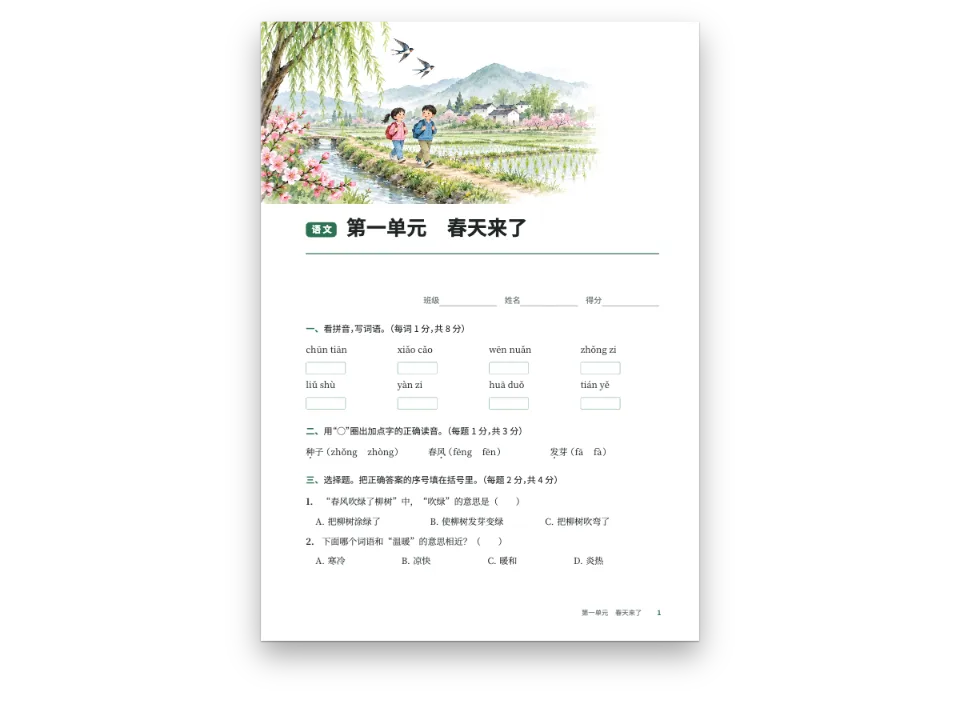
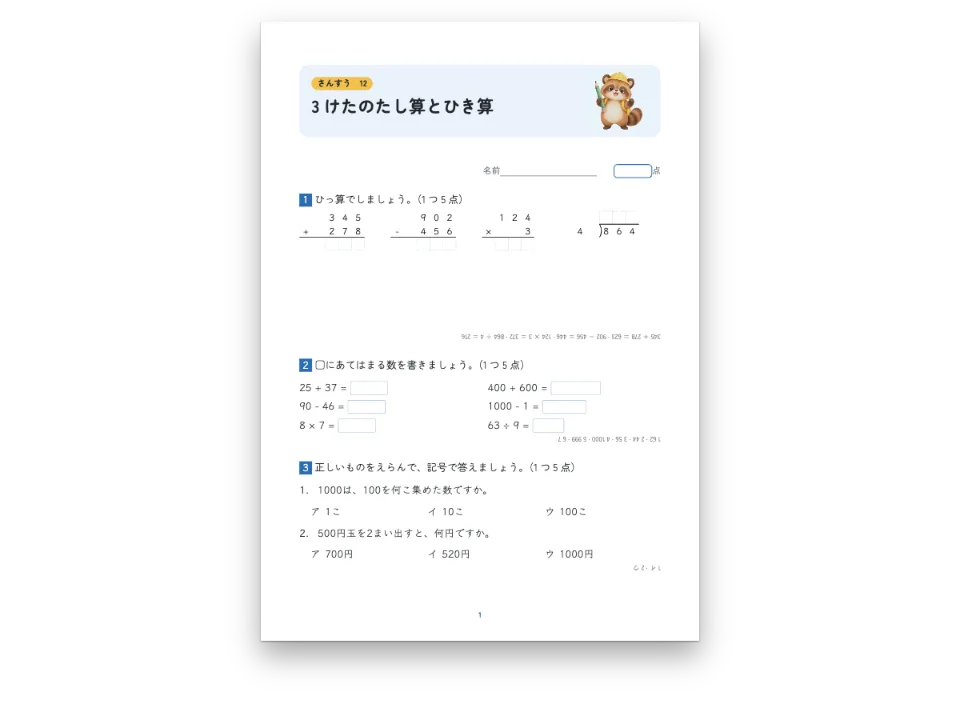
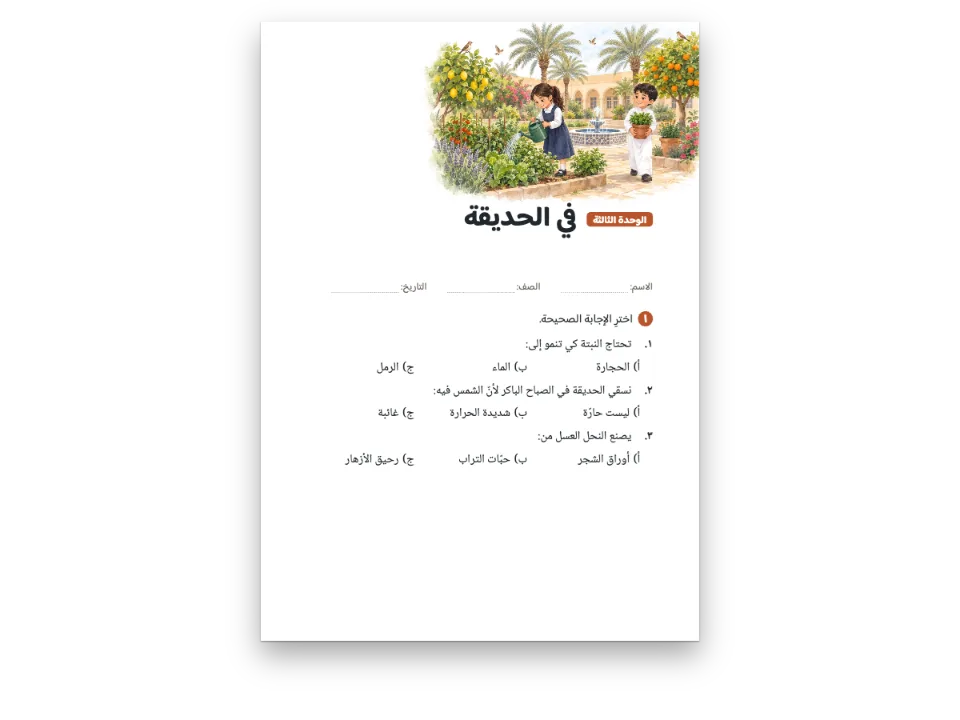
四年级科学与数学课程的第 7 张练习单《水的旅行》,排成十个版本。各语言的题目都一样:选一个答案,判断对错,用词语库里的词填空,把词语和意思连起来,圈出一个词,把水箱里的水平均分,说说为什么要节约用水。每个版本都照本国学校的样子印。西班牙文版和加泰罗尼亚文版把题号放在圆圈里,判断题标 V 或 F,除法把除数放在被除数右边的 L 形里。法文版用方块题号、cases à cocher 方框和点线空格,作答处是 Seyès 格纸。德文版写 R 和 F,填空题叫 Lückentext,864 : 4 = 写成一行,乘号用点。巴西版要在括号里写 V 或 F。英文版在 ⟌ 下面做除法。中文版的大题用一、二、编号,每个题干后面有( ),A. B. C. 排成一行,判断题打 √ 或 ×,最后一题是田字格里的“看拼音,写词语”。日文版用ア イ ウ和○ ×,阿拉伯文版从右往左排,用 أ ب ج 和 صح 或 خطأ。
这道食谱解答
- 怎样把同一张练习纸按各国教科书的习题版式来排?
- 怎样按各国学校的写法排长除法竖式?
- 怎样排中文选择题:题干后的( )括号和一行排开的 A. B. C. D. 选项?
简短回答
// The Markdown of every edition has the same seven exercises. What changes is this table:
// how the number prints, how options are labelled and answered, how true/false reads, where
// a blank is written, the paper of the open answer and the layout of long division.
const disc = { shape: 'disc' };
const square = { shape: 'square' };
const bare = { shape: 'none', suffix: '.' };
const TRADITIONS = {
  es: { number: disc, options: { marker: 'none' }, trueFalse: { look: 'boxes' },
    blank: { look: 'line' }, area: { kind: 'lines' }, arithmetic: { division: 'potence' } },
  fr: { number: square, options: { marker: 'box' }, trueFalse: { look: 'boxes' },
    blank: { look: 'dots' }, area: { kind: 'seyes', spacing: mm(8) },
    arithmetic: { division: 'potence' } },
  de: { number: square, options: { marker: 'box' }, trueFalse: { look: 'boxes' },
    blank: { look: 'line' }, area: { kind: 'lines' }, arithmetic: { division: 'inline' } },
  it: { number: { shape: 'rounded' }, options: { marker: 'box' }, trueFalse: { look: 'boxes' },
    blank: { look: 'dots' }, area: { kind: 'lines' }, arithmetic: { division: 'potence' } },
  pt: { number: bare, options: { marker: 'none' }, trueFalse: { look: 'bracket' },
    blank: { look: 'line' }, area: { kind: 'lines' }, arithmetic: { division: 'potence' } },
  en: { number: bare, options: { marker: 'none' }, trueFalse: { look: 'boxes' },
    blank: { look: 'line' }, area: { kind: 'lines' }, arithmetic: { division: 'bracket' } },
  // 一、二、 sections; ( ) after the stem and A. B. C. in a row; √ × in a bracket; 田字格.
  zh: { number: { shape: 'none', format: 'simp-chinese-informal', suffix: '、' },
    options: { labels: 'alpha-upper', suffix: '.', layout: 'row', bracket: true },
    trueFalse: { look: 'bracket' }, blank: { look: 'line' },
    area: { kind: 'tianzige', spacing: mm(13), lines: 1 }, arithmetic: { division: 'bracket' } },
  // ア イ ウ in a row with ( ), ○ × in a bracket, the number in a square.
  ja: { number: square, options: { labels: 'katakana', suffix: '', layout: 'row', bracket: true },
    trueFalse: { look: 'bracket' }, blank: { look: 'line' }, area: { kind: 'lines' },
    arithmetic: { division: 'bracket' } },
  ar: { number: disc, options: { marker: 'none', prefix: '(', suffix: ')' },
    trueFalse: { look: 'boxes' },
    blank: { look: 'dots' }, area: { kind: 'lines' }, arithmetic: { division: 'bracket' } },
};
TRADITIONS.ca = TRADITIONS.es; // Catalan schools set exercises as Spanish ones do
用料
- 类型
- Nunito, Baloo 2, Noto Serif SC, Noto Sans SC, Klee One, Noto Sans JP, Noto Naskh Arabic, Baloo Bhaijaan 2(SIL OFL 1.1)
- 素材
- 无:所有图片都用代码绘制
做法
#1 · 把每种传统写进一张表
// The Markdown of every edition has the same seven exercises. What changes is this table:
// how the number prints, how options are labelled and answered, how true/false reads, where
// a blank is written, the paper of the open answer and the layout of long division.
const disc = { shape: 'disc' };
const square = { shape: 'square' };
const bare = { shape: 'none', suffix: '.' };
const TRADITIONS = {
  es: { number: disc, options: { marker: 'none' }, trueFalse: { look: 'boxes' },
    blank: { look: 'line' }, area: { kind: 'lines' }, arithmetic: { division: 'potence' } },
  fr: { number: square, options: { marker: 'box' }, trueFalse: { look: 'boxes' },
    blank: { look: 'dots' }, area: { kind: 'seyes', spacing: mm(8) },
    arithmetic: { division: 'potence' } },
  de: { number: square, options: { marker: 'box' }, trueFalse: { look: 'boxes' },
    blank: { look: 'line' }, area: { kind: 'lines' }, arithmetic: { division: 'inline' } },
  it: { number: { shape: 'rounded' }, options: { marker: 'box' }, trueFalse: { look: 'boxes' },
    blank: { look: 'dots' }, area: { kind: 'lines' }, arithmetic: { division: 'potence' } },
  pt: { number: bare, options: { marker: 'none' }, trueFalse: { look: 'bracket' },
    blank: { look: 'line' }, area: { kind: 'lines' }, arithmetic: { division: 'potence' } },
  en: { number: bare, options: { marker: 'none' }, trueFalse: { look: 'boxes' },
    blank: { look: 'line' }, area: { kind: 'lines' }, arithmetic: { division: 'bracket' } },
  // 一、二、 sections; ( ) after the stem and A. B. C. in a row; √ × in a bracket; 田字格.
  zh: { number: { shape: 'none', format: 'simp-chinese-informal', suffix: '、' },
    options: { labels: 'alpha-upper', suffix: '.', layout: 'row', bracket: true },
    trueFalse: { look: 'bracket' }, blank: { look: 'line' },
    area: { kind: 'tianzige', spacing: mm(13), lines: 1 }, arithmetic: { division: 'bracket' } },
  // ア イ ウ in a row with ( ), ○ × in a bracket, the number in a square.
  ja: { number: square, options: { labels: 'katakana', suffix: '', layout: 'row', bracket: true },
    trueFalse: { look: 'bracket' }, blank: { look: 'line' }, area: { kind: 'lines' },
    arithmetic: { division: 'bracket' } },
  ar: { number: disc, options: { marker: 'none', prefix: '(', suffix: ')' },
    trueFalse: { look: 'boxes' },
    blank: { look: 'dots' }, area: { kind: 'lines' }, arithmetic: { division: 'bracket' } },
};
TRADITIONS.ca = TRADITIONS.es; // Catalan schools set exercises as Spanish ones do
所有版本的 Markdown 都一样:七个 :::exercise 块,答案就写在文字里(- [x]、[[水蒸气]]、- 蒸发 -> 水变成水蒸气、- 864 ÷ 4)。各国课本不同的地方在于形式,所以形式只放在这张表里:题号的形状和数字写法,选项的字母,学生是勾方框还是圈字母,判断题的样子,空格的样子,书写区,还有除法竖式的排法。加泰罗尼亚文版原样沿用西班牙文版那一行。
#2 · 把传统铺在本社样式上
const T = TRADITIONS[LANG];
const ficha = {
  id: 'ficha', ...T,
  number: { background: col('accent'), color: T.number.shape === 'none' ? col('accent')
    : col('paper'), fontFamily: LABEL, fontWeight: 700, ...T.number },
  // Chinese and Japanese sheets set the instructions in the gothic (黑体, ゴシック).
  instruction: { bold: true, color: col('ink'), ...(LANG === 'zh' || LANG === 'ja'
    ? { fontFamily: LABEL } : {}) },
  blank: { color: col('ink'), weight: pt(0.7), ...T.blank },
  match: { look: 'dots', gap: em(5), color: col('accent') },
  bank: { order: 'alpha' },
  area: { color: col('rule'), spacing: mm(9), weight: pt(0.6), ...T.area },
  grid: { cell: mm(8.5), fontFamily: TEXT, rule: col('rule'), color: col('ink') },
  marginTop: mm(7), marginBottom: mm(1), itemSpacing: em(0.4),
};
练习样式只有一个,叫 ficha,它带着十张练习单共有的东西(题号的蓝色、灰色的线、练习之间的空白),各版本的那一行再铺在它上面。表里没写的,由语言决定:T F、V F、R F、√ ×、○ × 和 صح خطأ 都是引擎自带的词,a) b) c)、A. B. C.、ア イ ウ 和 أ ب ج 也是,所以哪个版本都不用自己写。
#3 · 给每种文字配字体
const FACES = {
  zh: { text: 'Noto Serif SC', label: 'Noto Sans SC' },
  ja: { text: 'Klee One', label: 'Noto Sans JP' },
  ar: { text: 'Noto Naskh Arabic', label: 'Baloo Bhaijaan 2' },
}[LANG] ?? { text: 'Nunito', label: 'Baloo 2' };
const [TEXT, LABEL] = [FACES.text, FACES.label];
拉丁字母的各版共用 Nunito 和 Baloo 2。中文版正文用宋体,题目要求用黑体;日文版正文用教科书体 Klee One,题目要求用一款黑体(ゴシック);阿拉伯文版用 Noto Naskh Arabic。Klee One 最粗的字重是 600,所以日文版把粗体设成 600(boldFontWeight):如果用 700,浏览器会自己画出加粗效果,页面捕获就会失败。
#4 · 在练习单顶部留出写姓名的横线
const at = (to, edge, x = 0, y = 0, size) => ({ anchor: { to, edge },
  offset: { x: mm(x), y: mm(y) }, ...(size && { size }) });
const field = (id, attr, x, width) => [
  { kind: 'text', id, content: `{attr.${attr}}`, fontFamily: LABEL, fontSize: pt(10),
    fontWeight: 700, color: col('muted'), align: 'left', placement: at('container', 'top-left',
      x, 28) },
  { kind: 'rule', id: `${id}-line`, direction: 'horizontal', thickness: pt(0.75),
    color: col('rule'), placement: at('container', 'top-left', x + 16, 33, { width: mm(width) }) },
];
const head = { enabled: true, minHeight: mm(38), slot: { elements: [
  { kind: 'box', id: 'band', style: { backgroundColor: col('accent'), borderRadius: mm(3) },
    placement: at('container', 'top-left', 0, 0, { width: 'fill', height: mm(21) }) },
  { kind: 'text', id: 'kicker', content: '{title} · {subtitle}', fontFamily: LABEL,
    fontSize: pt(8.5), fontWeight: 700, color: col('tint'), align: 'left',
    placement: at('container', 'top-left', 6, 3.5) },
  { kind: 'text', id: 'title', content: '{titleText}', fontFamily: LABEL, fontSize: pt(22),
    fontWeight: 700, color: col('paper'), align: 'left', lineHeight: 1.1,
    placement: at('container', 'top-left', 6, 9.5) },
  ...field('name', 'nombre', 0, 96), ...field('date', 'fecha', 120, 40),
] } };
一级标题画出色带、取自 frontmatter 的课程名和标题,还有两个带横线的栏目,栏目里的字取自标题的属性(nombre="姓名" fecha="日期")。所以德文版写着 Datum,日文版写着“名前”,代码里却没有一个字符串。
完整食谱
// ═══ Postext Cookbook · Nº 169 · One worksheet in ten school traditions ═════════
// https://postext.dev/en/cookbook/school-traditions-worksheet
// Code: MIT · Text: original (CC BY 4.0) · Pictures: none
// Fonts: Nunito, Baloo 2, Klee One, Noto Naskh Arabic and others (SIL OFL) · Needs postext ≥ 1.59.0
import {
  buildDocument, withLoadedFonts, renderPageToCanvas,
} from 'https://esm.sh/postext';
import { renderToPdf, decompressWoff2 } from 'https://esm.sh/postext-pdf';

const LANG = 'zh'; // @lang: the language of the worksheet (en es ca fr de it pt zh ja ar)
const RECIPE = 'school-traditions-worksheet';

// ─── 1 · Design ─────────────────────────────────────────────────────────────
// #region palette: a blue-black ink, one blue accent, a pale tint, grey rules
const palette = {
  ink: '#1d2633', accent: '#2a5d9f', tint: '#e8f0fa', rule: '#a9b6c6', muted: '#5d6878',
  paper: '#ffffff',
};
const col = (id) => ({ hex: palette[id], model: 'hex', paletteId: id });
const colorPalette = [
  ...Object.entries(palette).map(([id, hex]) => ({ id, name: id, value: { hex, model: 'hex' } })),
  { id: 'main-color', name: 'accent (defaults)', value: { hex: palette.accent, model: 'hex' } },
];
// #endregion

// #region faces: Latin editions share two faces; Chinese, Japanese and Arabic their own
const FACES = {
  zh: { text: 'Noto Serif SC', label: 'Noto Sans SC' },
  ja: { text: 'Klee One', label: 'Noto Sans JP' },
  ar: { text: 'Noto Naskh Arabic', label: 'Baloo Bhaijaan 2' },
}[LANG] ?? { text: 'Nunito', label: 'Baloo 2' };
const [TEXT, LABEL] = [FACES.text, FACES.label];
// #endregion

// #region answer: the form of the exercises, as each country's school books set them
// The Markdown of every edition has the same seven exercises. What changes is this table:
// how the number prints, how options are labelled and answered, how true/false reads, where
// a blank is written, the paper of the open answer and the layout of long division.
const disc = { shape: 'disc' };
const square = { shape: 'square' };
const bare = { shape: 'none', suffix: '.' };
const TRADITIONS = {
  es: { number: disc, options: { marker: 'none' }, trueFalse: { look: 'boxes' },
    blank: { look: 'line' }, area: { kind: 'lines' }, arithmetic: { division: 'potence' } },
  fr: { number: square, options: { marker: 'box' }, trueFalse: { look: 'boxes' },
    blank: { look: 'dots' }, area: { kind: 'seyes', spacing: mm(8) },
    arithmetic: { division: 'potence' } },
  de: { number: square, options: { marker: 'box' }, trueFalse: { look: 'boxes' },
组合好的script.js可以直接运行:把它粘贴到任何页面的模块脚本中,或在CodePen上打开这道食谱。 GitHub上的食谱文件夹 ↗ (在新标签页中打开)
变化
常见问题
- 字体如果没有 700 的字重,题干编号的粗体就是合成出来的。给这种正文字体设一个
boldFontWeight,用它实际带有的字重。 - 日文题目要求里的○和中文题目要求里的√只有 CJK 字体里才有:把它们放在 CJK 正文的句子里,不要放进拉丁字母的标签。
致谢
- 文本
- 原创文字, CC BY 4.0
- 字体
- Nunito (SIL OFL 1.1) · Baloo 2 (SIL OFL 1.1) · Noto Serif SC (SIL OFL 1.1) · Noto Sans SC (SIL OFL 1.1) · Klee One (SIL OFL 1.1) · Noto Sans JP (SIL OFL 1.1) · Noto Naskh Arabic (SIL OFL 1.1) · Baloo Bhaijaan 2 (SIL OFL 1.1)