En poques paraules
Les pàgines de març d'un almanac d'hort, amb un calendari del mes i taules de colors. Ensenya a crear taules a partir de dades i a girar de costat una taula massa ampla per a la pàgina.
Què compondràs
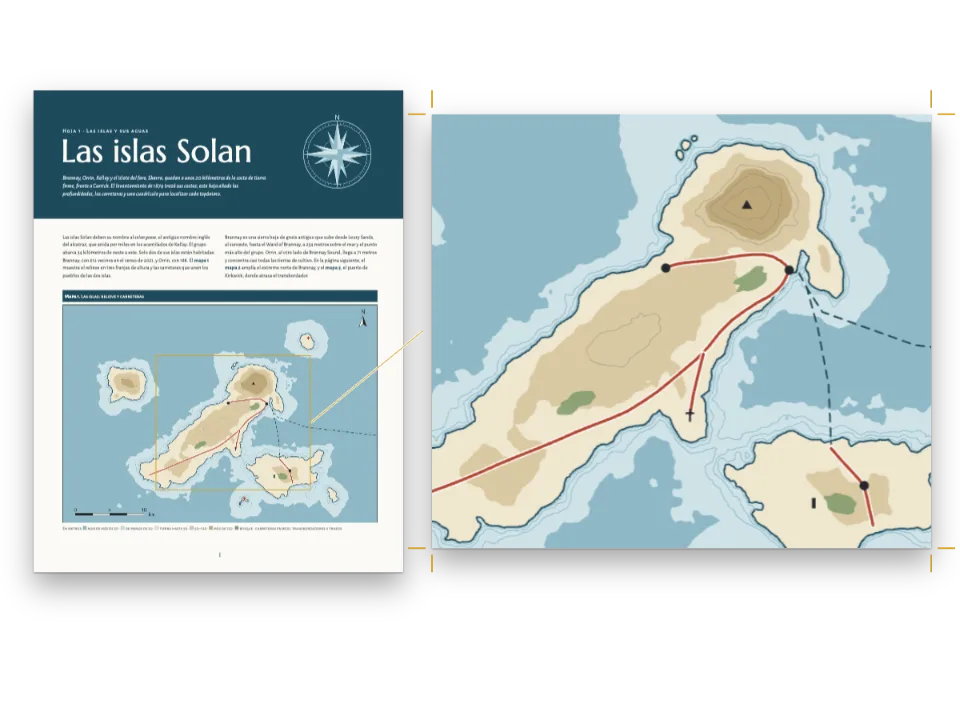
Les pàgines de març d'un almanac d'hort en italià. La pàgina 27 s'obre amb una aquarel·la de planters en terra fosca sota un cel pàl·lid, «Marzo» a 84 pt i una dita pagesa. Sota dues columnes de text va el calendari del mes, que el pen calcula amb les dates: els diumenges en vermell sobre una columna crema, el diumenge i el dilluns de Pasqua sobre rosa i les fases de la lluna al costat dels seus dies. La pàgina 28 reuneix les feines del mes en un requadre de dues columnes i acoloreix de verd, rosa o crema una matriu de deu per deu de cultius associats, amb el dibuix de cada cultiu a la diagonal. El gràfic de sembres, 38 cultius per quinzenes, no hi cap d'amplada i va girat a les pàgines 29 i 30, amb la capçalera repetida a la segona.
Aquesta recepta respon a
- Com componc una taula ampla apaïsada en una pàgina pròpia?
- Com faig una taula amb files de capçalera, cel·les combinades, amplades de columna i alineació per cel·la?
- Com dono estils diferents a diverses taules (emplenaments, files alternes, marcs arrodonits) en un mateix document?
- Com poso imatges o icones dins de les cel·les d'una taula?
- Com afegeixo mostres de color com a llegenda en el text, els peus o les notes de taula?
La resposta curta
// The chart's `placement` (#region resources): a quarter turn makes it a page-span float on
// pages of its own, flush to the spine; rows past the page's width go on under a repeated head.
const chartPlacement = { rotate: 'ccw' }; // a float, never 'here' (gotcha: here-table-no-split)
const MONTHS = ['gen', 'feb', 'mar', 'apr', 'mag', 'giu', 'lug', 'ago', 'set', 'ott', 'nov', 'dic'];
const SEASONS = [['INVERNO', 2], ['PRIMAVERA', 3], ['ESTATE', 3], ['AUTUNNO', 3], ['INVERNO', 1]];
const STATES = { S: 'ochre', C: 'green', T: 'brown' }; // seedbed, sown outdoors, planted out
const fortnight = (key) => MONTHS.indexOf(key.slice(0, 3)) * 2 + Number(key[3]); // 'mar2' → 6
function sowingChart(data) { // 'Pomodoro: S feb2–mar2, T apr2–mag2'; a bare line is a family
  const row = (first, isHeader = false) => [first, ...Array(24).fill('')]
    .map((content) => ({ content, isHeader }));
  let m = { headerRowCount: 2, columnWidths: [30, ...Array(24).fill(8.5)], // mm, as weights
    rows: [row('', true), row('', true)] };
  for (const line of data.trim().split('\n')) {
    const [name, plan] = line.split(': ');
    const r = m.rows.push(row(plan ? name : chip(name.toUpperCase(), 'famiglia'))) - 1;
    if (!plan) { m = mergeCells(m, span(r, 0, r, 24)); continue; } // a family heads its crops
    for (let f = 1; f <= 24; f++) { // every other month tinted, so a column reads down the page
      if ((f - 1) % 4 < 2) m = setCellBackground(m, at(r, f), col('cream'));
    }
    for (const step of plan.split(', ')) { // 'S feb2–mar2': one state over a run of fortnights
      const [state, range] = step.split(' ');
      const [from, to = from] = range.split('–').map(fortnight);
      for (let f = from; f <= to; f++) m = setCellBackground(m, at(r, f), col(STATES[state]));
    }
  }
  // Merged heads: 'Coltura' down both rows, each season over its months, each month over its
  // two fortnights. mergeCells marks the covered cells hiddenBy (gotcha: merged-cells-hiddenby).
  const merge = (r0, c0, r1, c1, content) => { // the head's text goes in its first cell
    m = mergeCells(setCellContent(m, at(r0, c0), content), span(r0, c0, r1, c1));
  };
  merge(0, 0, 1, 0, 'Coltura');
  let c = 1;
  for (const [name, n] of SEASONS) { merge(0, c, 0, c + 2 * n - 1, name); c += 2 * n; }
  MONTHS.forEach((month, i) => merge(1, 2 * i + 1, 1, 2 * i + 2, month.toUpperCase()));
  for (const r of [0, 1]) for (let f = 1; f <= 24; f++) m = setAlignment(m, at(r, f), 'center');
  return setCellBackground(m, at(1, fortnight('mar1')), col('red')); // this month's head
}
Ingredients
- Funcions
- Taules i figures apaïsadesTaules a partir de dadesEmplenaments de cel·laTaules que passen de pàginaEstils de taula amb nomEstil de taulesImatges a les cel·lesMostres de colorChips en líniaColumnes dins d'un requadreObertures dissenyadesBanda de capítol d'amplada completaAtributs de títolPaleta de color semànticaMarges simètricsLínies de font i crèditFigura i Taula en la teva llenguaPartició de mots i llengua del documentFigures i taules com a recursosPàgines en un canvas
- També fa servir
- RequadresRequadres niatsColor del paperCapçaleres segons el tipus de pàginaEstils de paràgrafTipus de recurs propisPreliminars en romans
- Tipografia
- Piazzolla, Gilda Display, Commissioner (SIL OFL 1.1)
- Recursos
campo-1680.jpg- The opener’s field of seedlings in March, a watercolour (Generated With Diffusion Models, original)
- The moon’s quarters and the ten crops, drawn in code in the page’s palette (Ignacio Ferro, CC BY 4.0)
Elaboració
#1 · Gira el gràfic i deixa que continuï
El codi és la resposta curta de més amunt. Amb rotate: 'ccw', la taula passa a ser un flotant a l'amplada de la pàgina, en pàgines pròpies (Col·locació), amb la capçalera cap a la vora esquerra, i s'enganxa al llom tant a la pàgina senar com a la parella. Girada, la taula es compon a l'alçada de la caixa de text i n'ocupa 227 dels 237 mm: les 47 línies senceres de 14 pt que caben a la retícula, menys una per a la separació del flotant. Les seves files s'apilen a l'amplada dels 176 mm de la caixa; quan ja no hi caben, la taula es talla entre dues files i continua a la pàgina següent, sota les seves dues files de capçalera i el seu peu, que acaba en (segue) (Taules més altes que la pàgina). Només un flotant pot girar o partir-se: amb position: 'here' el gir s'ignora i la taula no es parteix mai. La capçalera porta tres classes de cel·les combinades: Coltura ocupa les seves dues files, cada estació abasta els seus mesos i cada mes, les seves dues quinzenes.
#2 · Un calendari calculat amb dates
const [YEAR, MONTH, DAY] = [2027, 3, 24 * 60 * 60 * 1000]; // DAY in ms
const epochDay = (m, d) => Date.UTC(YEAR, m - 1, d) / DAY; // 1 January 1970 was a Thursday
const weekday = (d) => (epochDay(MONTH, d) + 3) % 7; // 0 is Monday: Italian weeks start there
function easter(y) { // the Gregorian computus (Meeus): [month, day]
  const a = y % 19, b = Math.floor(y / 100), c = y % 100, d = Math.floor(b / 4);
  const g = Math.floor((8 * b + 13) / 25), h = (19 * a + b - d - g + 15) % 30;
  const i = Math.floor(c / 4), k = c % 4, l = (32 + 2 * (b % 4) + 2 * i - h - k) % 7;
  const n = h + l - 7 * Math.floor((a + 11 * h + 22 * l) / 451) + 114;
  return [Math.floor(n / 31), (n % 31) + 1];
}
// The moon's age: mean synodic months since the new moon of 6 January 2000 at 18.14 UT.
const [SYNODIC, NEW_MOON] = [29.530588853, Date.UTC(2000, 0, 6, 18, 14) / DAY];
const quarter = (day) => Math.floor((((day - NEW_MOON) % SYNODIC) / SYNODIC) * 4); // 0–3
const PHASES = ['luna-nuova', 'primo-quarto', 'luna-piena', 'ultimo-quarto'];
const JOINER = '\u2060'; // a word joiner: the second line of a day without a note
const DAYS = ['LUNEDÌ', 'MARTEDÌ', 'MERCOLEDÌ', 'GIOVEDÌ', 'VENERDÌ', 'SABATO', 'DOMENICA'];
function calendarTable() { // the grid, and the quarters it draws, listed for the caption
  const e = epochDay(...easter(YEAR)) - epochDay(MONTH, 0); // Easter as a day of MONTH: 28 in 2027
  const feasts = { [e - 7]: 'Le Palme', [e]: 'Pasqua', [e + 1]: 'Pasquetta' };
  const notes = { 19: 'S. Giuseppe', 20: 'Equinozio' }; // March 2027's, typed by hand
  const first = weekday(1), days = epochDay(MONTH + 1, 1) - epochDay(MONTH, 1), moons = [];
  const week = (names, isHeader) => names.flatMap((content) => [content, '']) // a day: moon, date
    .map((content) => ({ content, isHeader }));
  let m = { headerRowCount: 1, columnWidths: Array(7).fill([7, 18]).flat(), rows: [week(DAYS, true),
    ...Array.from({ length: Math.ceil((first + days) / 7) }, () => week(Array(7).fill('')))] };
  for (let d = 1; d <= days; d++) {
    const r = 1 + Math.floor((first + d - 1) / 7), c = 2 * weekday(d), sunday = c === 12;
    // Sundays and feasts print in red. Every day has a second line, so all weeks are as tall.
    const note = feasts[d] ? chip(feasts[d], 'festa') : notes[d] ? chip(notes[d], 'nota') : JOINER;
    m = setCellContent(m, at(r, c + 1), `${sunday || feasts[d] ? chip(d, 'rosso') : d}\n${note}`);
    const fill = d === e || d === e + 1 ? 'blush' : sunday ? 'cream' : null;
    if (fill) for (const k of [c, c + 1]) m = setCellBackground(m, at(r, k), col(fill));
    const midnight = epochDay(MONTH, d) - 1 / 24, q = quarter(midnight + 1); // 00.00 CET
    if (q === quarter(midnight)) continue;
    m = setCellImage(m, at(r, c), { resourceId: PHASES[q] }); // a quarter begins today
    moons.push(`${PHASES[q].replace('-', ' ')} ${[1, 8, 11].includes(d) ? 'l’' : 'il '}${d}`);
  }
  for (let i = 0; i < 7; i++) m = mergeCells(m, span(0, 2 * i, 0, 2 * i + 1)); // one head a day
  return { model: setCellBackground(m, at(0, 12), col('red')), moons: moons.join(', ') };
}
Amb Date.UTC, cada data es converteix en un número de dia, i d'aquest número surt el dia de la setmana; la quadrícula comença el dilluns 1 de març i ocupa cinc setmanes. La Pasqua surt del còmput eclesiàstic, i les fases de la lluna, del mes sinòdic mitjà. Amb aquest càlcul, una fase pot caure un dia abans o després, com adverteix el peu. El mateix bucle que dibuixa cada lluna escriu la seva data al peu. La imatge d'una cel·la sempre va damunt del seu text; per això cada dia ocupa dues columnes, la de la lluna i la de la data: una lluna a la cel·la de la data baixaria la xifra només en quatre dies. Els diumenges i les festes surten en vermell amb un estil de xip que només canvia el color, i les notes són xips a la meitat del cos. Un dia sense nota porta com a segona línia un unidor de paraules (U+2060), i així les cinc setmanes tenen la mateixa alçada.
#3 · Acoloreix la matriu a partir de símbols enganxats
const FILLS = { '+': 'leaf', '−': 'blush', '': 'cream' }; // good, bad, no known effect
function companionTable(tsv) {
  let m = { ...parseTSV(tsv), headerRowCount: 1, columnWidths: [26, ...Array(10).fill(15)] };
  for (let r = 1; r < m.rows.length; r++) {
    m = setAlignment(m, at(r, 0), 'left', 'middle');
    for (let c = 1; c < m.rows[r].length; c++) {
      const symbol = m.rows[r][c].content; // + and − stay printed, for greyscale copies
      m = setCellContent(m, at(r, c), symbol && symbol !== '=' ? chip(symbol, 'segno') : '');
      m = symbol === '=' // the diagonal pairs a crop with itself: its picture instead
        ? setCellImage(m, at(r, c), { resourceId: `veg-${r}`, width: 0.62 })
        : setCellBackground(m, at(r, c), col(FILLS[symbol]));
      m = setAlignment(m, at(r, c), 'center', 'middle');
    }
  }
  for (let c = 1; c <= 10; c++) m = setAlignment(m, at(0, c), 'center');
  return m;
}
Les parelles s'escriuen com a TSV, un símbol per cel·la. A postext 1.4.1, parseTSV crea cel·les normals i deixa headerRowCount sense fixar, així que s'afegeix a mà headerRowCount: 1 perquè la fila amb els noms dels cultius sigui la capçalera. Els pesos de columnWidths reparteixen en mil·límetres els 176 mm de la mesura: 26 per als noms i 15 per a cada cultiu. Cada símbol correspon a una entrada de la paleta, que setCellBackground posa de fons a la cel·la; el + i el − s'imprimeixen també, en un xip a 1,4 em, perquè la matriu es llegeixi en una còpia en escala de grisos. La diagonal aparella cada cultiu amb si mateix, i allà setCellImage posa el seu dibuix, al 62 % de l'amplada interior de la cel·la.
#4 · Posa la llegenda amb mostres de color
const resourceTypes = [ // 1.4.1 has English and Spanish ones (gotcha: resource-types-locale)
  { id: 'table', name: 'Tabella', shortLabel: 'Tab.', captionPrefix: 'Tabella',
    captionStyle: { position: 'above' } },
  { id: 'calendar', name: 'Calendario', shortLabel: 'Cal.', captionPrefix: '' }, // no label
].map((t) => ({ numberingTemplate: '{n}', resetOn: 'never', counterFormat: 'decimal', ...t }));
const table = (id, typeId, caption, model, styleId, extra) => ({ id, typeId, kind: 'table',
  caption, table: { model, styleId }, createdAt: 0, updatedAt: 0, ...extra });
const foot = { position: 'bottom', span: 'page' }; // across both columns, at the page's foot
const calendar = calendarTable(); // its key names the quarters the grid draws
const resources = [...pictures, // never cited: the opener and the cells draw them by id
  table('calendario', 'calendar', ':swatch{color="cream"} domeniche · :swatch{color="blush"} '
    + `Pasqua e Pasquetta · ${calendar.moons}, sul mese sinodico medio: un giorno prima o dopo `
    + 'è possibile. Per tradizione in crescente si semina ciò che fruttifica sopra terra, in '
    + 'calante le radici.', calendar.model, 'calendario', { placement: foot }),
  table('consociazioni', 'table', 'Consociazioni tra dieci ortaggi', companionTable(companions),
    'matrice', { placement: foot, note: ':swatch{color="leaf"} + favorevole · '
      + ':swatch{color="blush"} − da evitare · :swatch{color="cream"} nessun effetto noto. '
      + 'Indicazioni della tradizione orticola.' }),
  // Each part of a split table repeats its caption, so the key goes there; the note ends the last.
  table('semine', 'table', 'Semine al Nord e al Centro, in pianura e collina: '
    + ':swatch{color="ochre"} in semenzaio protetto · :swatch{color="green"} in piena terra · '
    + ':swatch{color="brown"} trapianto o messa a dimora', sowingChart(sowing), 'semine', {
    placement: chartPlacement, note: 'Al Sud e lungo le coste le date si anticipano di '
      + 'due-quattro settimane; in montagna si ritardano.' }),
];
:swatch{color="leaf"} compon un quadrat de tres quarts del cos, emplenat amb una entrada de la paleta i perfilat en el color del text; aquestes pàgines el fan servir al text corrent, en dos peus i en una nota. La llegenda del gràfic va al seu peu, perquè cada part d'una taula partida repeteix el peu, mentre que la nota només surt sota l'última. El calendari és un tipus de recurs propi amb el prefix del peu buit, i el seu peu comença per la llegenda i no per una etiqueta Tabella. position: 'bottom' amb span: 'page' col·loca el calendari i la matriu a l'amplada de les dues columnes, al peu de la seva pàgina. La pàgina 28 és l'última amb text. En una pàgina així, la 1.4.1 puja el flotant a l'amplada de la pàgina fins a una línia per sota del text; per això la matriu acaba 10 mm per sobre del marge inferior.
#5 · Un estil de la casa i una variant per taula
const tableStyle = { rules: 'horizontal', borderColor: col('rule'), borderWidth: pt(0.5),
  headerBackground: col('ink'), headerColor: col('paper'), headerFontFamily: LABEL,
  headerFontSize: pt(7), bodyFontSize: pt(8.5), cellPadding: mm(1.2),
  // 1.4.1 has continuation strings in English and Spanish only (gotcha: resource-types-locale).
  continuedSuffix: '(segue)', continuesMarker: 'Continua alla pagina seguente' };
const tableStyles = [
  { id: 'calendario', bodyFontFamily: DISPLAY, bodyFontSize: pt(15), cellPadding: mm(1.4) },
  { id: 'matrice', rules: 'grid', borderColor: col('paper'), borderWidth: pt(2), // tiles
    headerBackgroundEnabled: false, headerColor: col('ink'), headerFontSize: pt(6.8) },
  { id: 'semine', rules: 'grid', borderColor: col('paper'), borderWidth: pt(1),
    bodyFontSize: pt(7.8), headerFontSize: pt(6.6), cellPadding: mm(1.1) },
];
tableStyle fixa l'estil de la casa: capçalera amb fons de tinta i rètols en Commissioner del color del paper, filets fins entre files i els textos de continuació en italià, que la 1.4.1 només porta en anglès i en espanyol. Cada estil amb nom indica només el que canvia la seva taula. El calendari compon els dies en Gilda Display a 15 pt; la matriu treu l'emplenament de la capçalera, i la matriu i el gràfic tracen una retícula de filets del color del paper, de 2 pt i 1 pt, que talla els seus emplenaments en caselles.
#6 · El mes s'obre amb una aquarel·la
const ART_H = 92, AIR = 5, BEARING = 1.5; // mm: painting, air under it, side bearing of the 84 pt M
const pin = (to, edge, x, y, size) => ({ anchor: { to, edge }, offset: { x: mm(x), y: mm(y) },
  ...(size && { size }) }); // to: 'page', or '#id' of an element listed before
const text = (id, content, family, size, color, placement, extra) => ({ kind: 'text', id,
  content, fontFamily: family, fontSize: pt(size), color: col(color), placement,
  align: placement.anchor.edge.endsWith('right') ? 'right' : 'left',
  overflow: 'wrap', ...extra }); // not '…' at the edge (gotcha: overflow-ellipsis-default)
const caps = (s) => ({ fontWeight: 600, textTransform: 'uppercase', letterSpacing: pt(s / 5) });
// The painting reserves nothing (gotcha: opener-image-no-reserve), so the text starts on the
// first grid line at least AIR under it.
const OPENER_H = pt(LEAD * Math.ceil((ART_H + AIR - PAGE.top) / (LEAD * 25.4 / 72)));
const opener = { enabled: true, minHeight: OPENER_H, slot: { elements: [
  { kind: 'image', id: 'art', resourceId: 'campo',
    placement: pin('page', 'top-left', 0, 0, { width: mm(PAGE.w), height: mm(ART_H) }) },
  text('kicker', '{attr.kicker}', LABEL, 8.5, 'red', pin('page', 'top-left', PAGE.inner, 12),
    caps(8.5)), // page 1 is a recto: its inner margin is on the left
  text('title', '{titleText}', DISPLAY, 84, 'ink', pin('#kicker', 'below', -BEARING, 1),
    { lineHeight: 1 }), // a multiple, never pt() (gotcha: design-lineheight-multiple)
  text('proverb', '{attr.proverb}', TEXT, 12.5, 'ink',
    pin('#title', 'below', BEARING, 1, { width: mm(140) }), { italic: true, lineHeight: 1.3 }),
  text('source', '{attr.source}', LABEL, 7, 'ink', pin('#proverb', 'below', 0, 1.6), caps(7)),
] } };
El títol de primer nivell es dibuixa amb una ranura d'elements. L'aquarel·la és un element d'imatge al cap de la pàgina, i l'avanttítol, la dita i la seva font surten dels atributs del títol. A la 1.4.1 un element d'imatge no reserva alçada, i minHeight ho compensa: 92 mm d'aquarel·la més 5 mm d'aire, menys els 22 mm del marge superior, donen 75 mm, que s'arrodoneixen cap amunt a 16 línies de 14 pt (79 mm). La primera línia de text queda a 101 mm de la vora superior de la pàgina, 9 mm per sota de la terra. El títol es desplaça 1,5 mm a l'esquerra, el que mesura el blanc lateral de la M de Gilda Display a 84 pt, i així el remat de la M s'alinea amb l'avanttítol; la dita es desplaça el mateix cap a la dreta.
La recepta completa
// ═══ Postext Cookbook · Nº 035 · Garden almanac: calendar grid and landscape chart ═════ // https://postext.dev/en/cookbook/garden-almanac // Code: MIT · Text: original, Italian (CC BY 4.0) · Field: diffusion models · Icons: CC BY 4.0 // Fonts: Piazzolla, Gilda Display, Commissioner (SIL OFL 1.1) · Needs postext ≥ 1.4.1 import { buildDocument, renderPageToCanvas, clearMeasurementCache, registerResourceImage, parseTSV, mergeCells, setCellContent, setCellBackground, setCellImage, setAlignment, } from 'https://esm.sh/postext'; const LANG = 'es'; // @lang: the language of the sample document ('en' | 'es') const RECIPE = 'garden-almanac'; // ─── 1 · Design ───────────────────────────────────────────────────────────── const palette = { ink: '#262a22', paper: '#fbf8ef', // a green-black on unbleached paper red: '#a2372a', // Sundays and feasts, as almanacs print them; kickers and labels green: '#5b8a32', ochre: '#d39a2e', brown: '#7a5230', // sown outdoors, in a seedbed, planted leaf: '#bfdaa2', blush: '#f3cdbd', cream: '#e9ddc1', // good pairs, bad pairs, neutral pairs sky: '#cfe2e6', rule: '#cfc6b2', muted: '#6b6e63' }; // sky and work box; hairlines; notes // 1.4.1 design slots read the hex, not the id: col() writes both (gotcha: palette-skips-designs) const col = (id) => ({ hex: palette[id], model: 'hex', paletteId: id }); const colorPalette = Object.entries({ ...palette, 'main-color': palette.red }) // the defaults' id .map(([id, hex]) => ({ id, name: id, value: { hex, model: 'hex' } })); const [TEXT, DISPLAY, LABEL] = ['Piazzolla', 'Gilda Display', 'Commissioner']; const PAGE = { w: 210, h: 280, top: 22, bottom: 21, inner: 18, outer: 16 }; // mm, mirrored const LEAD = 14; // pt: the body's leading and baseline grid const at = (row, column) => ({ row, col: column }); const span = (r0, c0, r1, c1) => ({ start: at(r0, c0), end: at(r1, c1) }); const chip = (text, style) => `:chip[${text}]{style="${style}"}`; // #region answer: a crops × fortnights chart, turned to landscape on pages of its own // The chart's `placement` (#region resources): a quarter turn makes it a page-span float on // pages of its own, flush to the spine; rows past the page's width go on under a repeated head. const chartPlacement = { rotate: 'ccw' }; // a float, never 'here' (gotcha: here-table-no-split) const MONTHS = ['gen', 'feb', 'mar', 'apr', 'mag', 'giu', 'lug', 'ago', 'set', 'ott', 'nov', 'dic']; const SEASONS = [['INVERNO', 2], ['PRIMAVERA', 3], ['ESTATE', 3], ['AUTUNNO', 3], ['INVERNO', 1]]; const STATES = { S: 'ochre', C: 'green', T: 'brown' }; // seedbed, sown outdoors, planted out const fortnight = (key) => MONTHS.indexOf(key.slice(0, 3)) * 2 + Number(key[3]); // 'mar2' → 6 function sowingChart(data) { // 'Pomodoro: S feb2–mar2, T apr2–mag2'; a bare line is a family const row = (first, isHeader = false) => [first, ...Array(24).fill('')] .map((content) => ({ content, isHeader })); let m = { headerRowCount: 2, columnWidths: [30, ...Array(24).fill(8.5)], // mm, as weights rows: [row('', true), row('', true)] }; for (const line of data.trim().split('\n')) { const [name, plan] = line.split(': '); const r = m.rows.push(row(plan ? name : chip(name.toUpperCase(), 'famiglia'))) - 1; if (!plan) { m = mergeCells(m, span(r, 0, r, 24)); continue; } // a family heads its crops for (let f = 1; f <= 24; f++) { // every other month tinted, so a column reads down the page if ((f - 1) % 4 < 2) m = setCellBackground(m, at(r, f), col('cream')); } for (const step of plan.split(', ')) { // 'S feb2–mar2': one state over a run of fortnights const [state, range] = step.split(' '); const [from, to = from] = range.split('–').map(fortnight); for (let f = from; f <= to; f++) m = setCellBackground(m, at(r, f), col(STATES[state])); } } // Merged heads: 'Coltura' down both rows, each season over its months, each month over its // two fortnights. mergeCells marks the covered cells hiddenBy (gotcha: merged-cells-hiddenby). const merge = (r0, c0, r1, c1, content) => { // the head's text goes in its first cell m = mergeCells(setCellContent(m, at(r0, c0), content), span(r0, c0, r1, c1)); }; merge(0, 0, 1, 0, 'Coltura'); let c = 1; for (const [name, n] of SEASONS) { merge(0, c, 0, c + 2 * n - 1, name); c += 2 * n; } MONTHS.forEach((month, i) => merge(1, 2 * i + 1, 1, 2 * i + 2, month.toUpperCase())); for (const r of [0, 1]) for (let f = 1; f <= 24; f++) m = setAlignment(m, at(r, f), 'center'); return setCellBackground(m, at(1, fortnight('mar1')), col('red')); // this month's head } // #endregion // #region calendar: the month grid from real dates: weekdays, Easter, the moon's quarters const [YEAR, MONTH, DAY] = [2027, 3, 24 * 60 * 60 * 1000]; // DAY in ms const epochDay = (m, d) => Date.UTC(YEAR, m - 1, d) / DAY; // 1 January 1970 was a Thursday const weekday = (d) => (epochDay(MONTH, d) + 3) % 7; // 0 is Monday: Italian weeks start there function easter(y) { // the Gregorian computus (Meeus): [month, day] const a = y % 19, b = Math.floor(y / 100), c = y % 100, d = Math.floor(b / 4); const g = Math.floor((8 * b + 13) / 25), h = (19 * a + b - d - g + 15) % 30; const i = Math.floor(c / 4), k = c % 4, l = (32 + 2 * (b % 4) + 2 * i - h - k) % 7; const n = h + l - 7 * Math.floor((a + 11 * h + 22 * l) / 451) + 114; return [Math.floor(n / 31), (n % 31) + 1]; } // The moon's age: mean synodic months since the new moon of 6 January 2000 at 18.14 UT. const [SYNODIC, NEW_MOON] = [29.530588853, Date.UTC(2000, 0, 6, 18, 14) / DAY]; const quarter = (day) => Math.floor((((day - NEW_MOON) % SYNODIC) / SYNODIC) * 4); // 0–3 const PHASES = ['luna-nuova', 'primo-quarto', 'luna-piena', 'ultimo-quarto']; const JOINER = '\u2060'; // a word joiner: the second line of a day without a note const DAYS = ['LUNEDÌ', 'MARTEDÌ', 'MERCOLEDÌ', 'GIOVEDÌ', 'VENERDÌ', 'SABATO', 'DOMENICA']; function calendarTable() { // the grid, and the quarters it draws, listed for the caption const e = epochDay(...easter(YEAR)) - epochDay(MONTH, 0); // Easter as a day of MONTH: 28 in 2027 const feasts = { [e - 7]: 'Le Palme', [e]: 'Pasqua', [e + 1]: 'Pasquetta' }; const notes = { 19: 'S. Giuseppe', 20: 'Equinozio' }; // March 2027's, typed by hand const first = weekday(1), days = epochDay(MONTH + 1, 1) - epochDay(MONTH, 1), moons = []; const week = (names, isHeader) => names.flatMap((content) => [content, '']) // a day: moon, date .map((content) => ({ content, isHeader })); let m = { headerRowCount: 1, columnWidths: Array(7).fill([7, 18]).flat(), rows: [week(DAYS, true), ...Array.from({ length: Math.ceil((first + days) / 7) }, () => week(Array(7).fill('')))] }; for (let d = 1; d <= days; d++) { const r = 1 + Math.floor((first + d - 1) / 7), c = 2 * weekday(d), sunday = c === 12; // Sundays and feasts print in red. Every day has a second line, so all weeks are as tall. const note = feasts[d] ? chip(feasts[d], 'festa') : notes[d] ? chip(notes[d], 'nota') : JOINER; m = setCellContent(m, at(r, c + 1), `${sunday || feasts[d] ? chip(d, 'rosso') : d}\n${note}`); const fill = d === e || d === e + 1 ? 'blush' : sunday ? 'cream' : null; if (fill) for (const k of [c, c + 1]) m = setCellBackground(m, at(r, k), col(fill)); const midnight = epochDay(MONTH, d) - 1 / 24, q = quarter(midnight + 1); // 00.00 CET if (q === quarter(midnight)) continue; m = setCellImage(m, at(r, c), { resourceId: PHASES[q] }); // a quarter begins today moons.push(`${PHASES[q].replace('-', ' ')} ${[1, 8, 11].includes(d) ? 'l’' : 'il '}${d}`); } for (let i = 0; i < 7; i++) m = mergeCells(m, span(0, 2 * i, 0, 2 * i + 1)); // one head a day return { model: setCellBackground(m, at(0, 12), col('red')), moons: moons.join(', ') }; } // #endregion // #region matrix: companion pairs pasted as TSV; each symbol becomes a palette fill const FILLS = { '+': 'leaf', '−': 'blush', '': 'cream' }; // good, bad, no known effect function companionTable(tsv) { let m = { ...parseTSV(tsv), headerRowCount: 1, columnWidths: [26, ...Array(10).fill(15)] }; for (let r = 1; r < m.rows.length; r++) { m = setAlignment(m, at(r, 0), 'left', 'middle'); for (let c = 1; c < m.rows[r].length; c++) { const symbol = m.rows[r][c].content; // + and − stay printed, for greyscale copies m = setCellContent(m, at(r, c), symbol && symbol !== '=' ? chip(symbol, 'segno') : ''); m = symbol === '=' // the diagonal pairs a crop with itself: its picture instead ? setCellImage(m, at(r, c), { resourceId: `veg-${r}`, width: 0.62 }) : setCellBackground(m, at(r, c), col(FILLS[symbol])); m = setAlignment(m, at(r, c), 'center', 'middle'); } } for (let c = 1; c <= 10; c++) m = setAlignment(m, at(0, c), 'center'); return m; } // #endregion // #region styles: one house table style and a named variant for each of the three tables const tableStyle = { rules: 'horizontal', borderColor: col('rule'), borderWidth: pt(0.5), headerBackground: col('ink'), headerColor: col('paper'), headerFontFamily: LABEL, headerFontSize: pt(7), bodyFontSize: pt(8.5), cellPadding: mm(1.2), // 1.4.1 has continuation strings in English and Spanish only (gotcha: resource-types-locale). continuedSuffix: '(segue)', continuesMarker: 'Continua alla pagina seguente' }; const tableStyles = [ { id: 'calendario', bodyFontFamily: DISPLAY, bodyFontSize: pt(15), cellPadding: mm(1.4) }, { id: 'matrice', rules: 'grid', borderColor: col('paper'), borderWidth: pt(2), // tiles headerBackgroundEnabled: false, headerColor: col('ink'), headerFontSize: pt(6.8) }, { id: 'semine', rules: 'grid', borderColor: col('paper'), borderWidth: pt(1), bodyFontSize: pt(7.8), headerFontSize: pt(6.6), cellPadding: mm(1.1) }, ]; // #endregion // #region opener: the month on a painting, with its proverb from the heading's attributes const ART_H = 92, AIR = 5, BEARING = 1.5; // mm: painting, air under it, side bearing of the 84 pt M const pin = (to, edge, x, y, size) => ({ anchor: { to, edge }, offset: { x: mm(x), y: mm(y) }, ...(size && { size }) }); // to: 'page', or '#id' of an element listed before const text = (id, content, family, size, color, placement, extra) => ({ kind: 'text', id, content, fontFamily: family, fontSize: pt(size), color: col(color), placement, align: placement.anchor.edge.endsWith('right') ? 'right' : 'left', overflow: 'wrap', ...extra }); // not '…' at the edge (gotcha: overflow-ellipsis-default) const caps = (s) => ({ fontWeight: 600, textTransform: 'uppercase', letterSpacing: pt(s / 5) }); // The painting reserves nothing (gotcha: opener-image-no-reserve), so the text starts on the // first grid line at least AIR under it. const OPENER_H = pt(LEAD * Math.ceil((ART_H + AIR - PAGE.top) / (LEAD * 25.4 / 72))); const opener = { enabled: true, minHeight: OPENER_H, slot: { elements: [ { kind: 'image', id: 'art', resourceId: 'campo', placement: pin('page', 'top-left', 0, 0, { width: mm(PAGE.w), height: mm(ART_H) }) }, text('kicker', '{attr.kicker}', LABEL, 8.5, 'red', pin('page', 'top-left', PAGE.inner, 12), caps(8.5)), // page 1 is a recto: its inner margin is on the left text('title', '{titleText}', DISPLAY, 84, 'ink', pin('#kicker', 'below', -BEARING, 1), { lineHeight: 1 }), // a multiple, never pt() (gotcha: design-lineheight-multiple) text('proverb', '{attr.proverb}', TEXT, 12.5, 'ink', pin('#title', 'below', BEARING, 1, { width: mm(140) }), { italic: true, lineHeight: 1.3 }), text('source', '{attr.source}', LABEL, 7, 'ink', pin('#proverb', 'below', 0, 1.6), caps(7)), ] } }; // #endregion const head = (id, content, parity, x, extra) => text(id, content, LABEL, 7.5, 'muted', pin('page', x > 0 ? 'top-left' : 'top-right', x, 12), { ...caps(7.5), parity, pages: 'body', ...extra }); // body pages only: the opener has its drawing, and a folio at the foot const folio = { fontFamily: DISPLAY, fontSize: pt(11), fontWeight: 400, letterSpacing: pt(0), color: col('red') }; const header = { elements: [head('verso-folio', '{pageNumber}', 'even', PAGE.outer, folio), head('verso-title', '{title}', 'even', PAGE.outer + 10), head('recto-title', '{chapterTitle}', 'odd', -(PAGE.outer + 10)), head('recto-folio', '{pageNumber}', 'odd', -PAGE.outer, folio)] }; const footer = { elements: [text('drop-folio', '{pageNumber}', DISPLAY, 11, 'red', pin('page', 'bottom', 0, -12), { pages: 'opener', align: 'center' })] }; // the opener's folio const bare = (id, extra) => ({ id, backgroundEnabled: false, borderWidth: pt(0), paddingX: pt(0), ...extra }); // a chip that is only a change of face, size or colour const note = (color) => ({ fontFamily: TEXT, fontSize: em(0.5), italic: true, color: col(color) }); const config = () => ({ // a factory: configs are cached by identity (gotcha: config-cache-identity) locale: 'it', resourceTypes, colorPalette, tableStyle, tableStyles, header, footer, page: { width: mm(PAGE.w), height: mm(PAGE.h), dpi: 150, backgroundColor: col('paper'), pageNumbering: { startAt: 27 }, margins: { top: mm(PAGE.top), bottom: mm(PAGE.bottom), left: mm(PAGE.inner), right: mm(PAGE.outer), mirror: true } }, // March opens on p. 27 layout: { layoutType: 'double', gutterWidth: mm(7) }, bodyText: { fontFamily: TEXT, fontSize: pt(9.8), lineHeight: pt(LEAD), color: col('ink'), boldFontWeight: 600, boldColor: col('ink'), italicColor: col('ink'), referenceColor: col('ink'), referenceBold: false, firstLineIndent: mm(4), indentAfterHeading: false, minWordSpacing: 0.8, maxWordSpacing: 1.6 }, // from 0.6 and 2 headings: { fontFamily: DISPLAY, fontWeight: 400, color: col('ink'), levels: [ // Restated: any headings object drops the H1 break (gotcha: headings-drop-h1-break). { level: 1, span: 'page', breakBefore: { enabled: true, parity: 'odd' }, advancedDesign: opener, marginBottom: pt(0) }, { level: 2, fontSize: pt(17), lineHeight: pt(2 * LEAD), marginTop: pt(LEAD), marginBottom: pt(0) }, ] }, chipStyles: [bare('rosso', { color: col('red') }), bare('nota', note('muted')), bare('festa', note('red')), bare('segno', { fontFamily: LABEL, fontSize: em(1.4), bold: true }), bare('famiglia', { fontFamily: LABEL, fontSize: em(0.85), bold: true, color: col('red') })], calloutStyles: [ { id: 'lavori', title: 'Lavori del mese', span: 'page', background: col('sky'), padding: { top: mm(3.5), right: mm(5), bottom: mm(4), left: mm(5) }, columnGap: mm(7), titleStyle: { fontFamily: LABEL, fontSize: pt(8), ...caps(8), color: col('red') }, body: { fontSize: pt(9.2), lineHeight: pt(13) } }, { id: 'colonna', backgroundEnabled: false, padding: { top: mm(0), right: mm(0), // no frame bottom: mm(0), left: mm(0) }, lists: { gap: mm(2.2), itemSpacing: pt(2) }, titleStyle: { fontFamily: TEXT, fontSize: pt(9.2), italic: true, fontWeight: 400, color: col('ink') } }, ], unorderedLists: { bulletChar: '–', color: col('red'), fontWeight: 400 }, captionStyle: { fontSize: pt(8.5), labelColor: col('red'), gap: mm(2), note: { fontSize: pt(7.5), color: col('muted') } }, paragraphStyles: [{ id: 'colophon', fontSize: pt(7.5), lineHeight: pt(10), textAlign: 'left', color: col('muted'), firstLineIndent: pt(0), marginTop: pt(LEAD) }], }); // ─── 2 · Content ──────────────────────────────────────────────────────────── const markdown = String.raw`---Mostra en Markdown · 36 línies · content.es.md
title: "Almanacco dell’orto 2027" author: "Redazione dell’Almanacco" --- # Marzo {kicker="Almanacco dell’orto · 2027" proverb="Marzo asciutto, aprile bagnato, beato il villan che ha seminato." source="Proverbio contadino"} A marzo l’orto riparte. Il :ref{id="calendario" text="calendario"} in fondo alla pagina segna l’equinozio, sabato 20 alle 21.25, e la domenica di Pasqua, il 28, che quest’anno coincide con il ritorno dell’ora legale. A Bologna il giorno dura 11 ore e 9 minuti il primo del mese e 12 ore e 42 minuti il 31, un’ora e mezza abbondante in più. Il terreno però resta freddo. Si lavora solo quando una zolla stretta nel pugno si sbriciola invece di impastarsi, e all’aperto si semina soltanto ciò che nasce anche sotto i dieci gradi, come piselli, spinaci, carote, rucola e ravanelli. Pomodori, peperoni e melanzane restano al riparo, perché per germinare vogliono tra i venti e i venticinque gradi. Nelle notti serene la brina è possibile fino all’inizio di aprile: un telo di tessuto non tessuto steso la sera sulle file appena nate le protegge, e si toglie al mattino quando il sole comincia a scaldare. :::callout{type="lavori"} :::columns{count=2} :::callout{type="colonna" title="In semenzaio"} - Semina pomodori, peperoni e melanzane al caldo, in alveoli vicino alla luce. - Da metà mese semina zucchine, cetrioli e meloni, due semi per vasetto. - Semina sedano e basilico; il sedano impiega due o tre settimane a nascere. ::: :::callout{type="colonna" title="In piena terra"} - Semina a file piselli, spinaci, ravanelli e carote; la rucola anche a spaglio. - Metti a dimora patate, bulbilli di cipolla e scalogno quando la terra si sbriciola. - Pacciama l’aglio piantato in autunno e togli le erbe prima che fioriscano. ::: ::: ::: ## Consociazioni Consociare vuol dire far crescere vicine piante che si giovano a vicenda. La :ref{id="consociazioni" style="full" case="lower"} riassume le coppie più citate negli orti di famiglia: in verde :swatch{color="leaf"} le favorevoli, in rosa :swatch{color="blush"} quelle da evitare, in crema :swatch{color="cream"} quelle senza effetti noti. La cipolla tiene lontana la mosca della carota, e la carota quella della cipolla; il basilico accanto al pomodoro è un’abitudine antica. Patata e pomodoro invece temono la stessa peronospora, e l’aglio frena fagioli e cavoli. Sono consigli nati dall’esperienza più che da prove sperimentali, e conviene verificarli nel proprio orto, un’aiuola alla volta. Le semine di tutto l’anno sono nella :ref{id="semine" style="full" case="lower"}, alle pagine seguenti: una riga per coltura e due caselle per ogni mese, una per quindicina. :::paragraphs{style="colophon"} Almanacco dell’orto 2027 · Piazzolla, Gilda Display e Commissioner (SIL OFL) · Testo e icone originali, CC BY 4.0 · Acquerello generato. :::`; // the month's text, in Italian const sowing = String.raw`SolanaceeMostra en Markdown · 46 línies · content.semine.en.md
Pomodoro: S feb2–mar2, T apr2–mag2 Peperone: S feb1–mar1, T mag1–mag2 Melanzana: S feb1–mar1, T mag1–mag2 Patata: T mar1–apr1 Cucurbitacee Zucchina: S mar2–apr1, T apr2–mag1, C mag2–giu2 Cetriolo: S mar2–apr1, T mag1–mag2, C giu1–giu2 Zucca: C apr2–mag2 Melone: S mar2–apr1, T mag1–mag2 Anguria: S apr1, T mag1–mag2 Leguminose Fagiolo: C apr2–lug1 Fagiolino: C apr2–lug2 Pisello: C feb1–mar2, C ott2–nov1 Fava: C feb1–mar1, C ott2–nov2 Crucifere Cavolo cappuccio: S mar1–apr1, T apr2–mag2, S giu1–giu2, T lug1–lug2 Cavolfiore: S mag2–giu2, T lug1–lug2 Broccolo: S mag2–giu2, T lug1–ago1 Cavolo nero: S giu1–lug1, T lug2–ago2 Rucola: C mar1–mag1, C ago2–set2 Ravanello: C feb2–mag2, C ago2–ott1 Rapa: C ago1–set1 Liliacee Aglio: T feb1–mar1, T ott2–dic1 Cipolla: S gen2–feb2, T mar2–apr2, C ago2–set1 Porro: S feb2–apr1, T mag2–lug1 Scalogno: T feb1–mar2 Ombrellifere Carota: C feb2–lug1 Prezzemolo: C feb2–giu1 Sedano: S feb2–mar2, T mag1–giu1 Finocchio: C giu2–lug2 Composite Lattuga: S gen2–feb2, T mar1–apr1, C apr2–ago2 Radicchio: C giu2–lug2 Indivia: S giu1–lug1, T lug2–ago2 Carciofo: T mar2–apr2 Chenopodiacee Spinacio: C feb2–apr1, C ago2–ott1 Bietola: C mar2–giu2 Barbabietola: C mar2–giu1 Labiate Basilico: S mar1–apr1, T mag1–giu1 Rosmarino: T mar2–apr2 Salvia: T mar2–apr2`; // one line per crop, grouped by family const companions = String.raw` Pomodoro Basilico Carota Cipolla Aglio Lattuga Fagiolo Zucchina Cavolo PatataMostra en Markdown · 10 línies · content.consociazioni.en.md
Pomodoro = + + + + + − − Basilico + = Carota + = + + + + Cipolla + + = + − Aglio + + = + − − Lattuga + + + + = + + Fagiolo + − − + = + + + Zucchina + = − Cavolo − − + + = + Patata − + − + =`; // TSV: + good, − bad, blank neutral // #region art: four moon phases and ten crops, drawn in the page's colours const svg = (w, h, body) => `<svg xmlns="http://www.w3.org/2000/svg" width="${w * 10}" ` + `height="${h * 10}" viewBox="0 0 ${w} ${h}">${body}</svg>`; const ART = { carrot: '#df7a2e', garlic: '#f4ecdc', cabbage: '#7fa38c', potato: '#c9a066', dark: '#3f6b22' }; // The moon cell is 4.2 mm wide inside its padding, so a viewBox unit is 0.42 mm: the disc drops // 5.2 units (2.2 mm) to sit level with the day's figures in the next cell. const MOON_DROP = 5.2; function moon(phase) { // lit side in paper, the rest in ink: the northern hemisphere's view const [y, top, foot] = [5, 0.8, 9.2].map((v) => v + MOON_DROP); const disc = (fill, extra = '') => `<circle cx="5" cy="${y}" r="4.2" fill="${fill}"${extra}/>`; const half = (sweep) => `<path d="M5 ${top}A4.2 4.2 0 0 ${sweep} 5 ${foot}Z" ` + `fill="${palette.paper}"/>`; const lit = { 'luna-nuova': '', 'primo-quarto': half(1), 'luna-piena': disc(palette.paper), 'ultimo-quarto': half(0) }[phase]; return svg(10, 10 + MOON_DROP, disc(palette.ink) + lit + disc('none', ` stroke="${palette.ink}" stroke-width="0.6"`)); } const P = palette; const VEG = { // 20 × 20 drawings, in the order of the matrix's rows pomodoro: `<circle cx="10" cy="11.5" r="7" fill="${P.red}"/><path d="M10 4.4l1.2 2.4 ` + '2.6-.8-1.6 2 2 1.6-2.6.2-.2 2.4-1.4-2-1.4 2-.2-2.4-2.6-.2 2-1.6-1.6-2 2.6.8Z" ' + `fill="${P.green}"/>`, basilico: `<path d="M10 19V6" stroke="${P.green}" stroke-width="1"/><ellipse cx="6.5" cy="12" ` + `rx="4.2" ry="2.4" transform="rotate(-30 6.5 12)" fill="${P.green}"/><ellipse cx="13.5" ` + `cy="10" rx="4.2" ry="2.4" transform="rotate(30 13.5 10)" fill="${P.green}"/>` + `<ellipse cx="10" cy="4.5" rx="2" ry="3.4" fill="${ART.dark}"/>`, carota: `<path d="M6 6.5h8L10.6 19a.6.6 0 0 1-1.2 0Z" fill="${ART.carrot}"/><path d="M10 ` + `6.5 7 1.5M10 6.5V1M10 6.5l3-5" stroke="${P.green}" stroke-width="1.1" ` + 'stroke-linecap="round"/>', cipolla: '<path d="M10 3c1 3.5 6.5 5.5 6.5 10.2C16.5 17 13.4 18.6 10 18.6S3.5 17 3.5 13.2C3.5 ' + `8.5 9 6.5 10 3Z" fill="${P.ochre}"/><path d="M10 5.5c-2 3-3 6-2.4 12.6M10 5.5c2 3 3 6 ` + `2.4 12.6" fill="none" stroke="${P.brown}" stroke-width="0.5"/>`, aglio: '<path d="M10 3.5c.8 3 6.2 5 6.2 9.5 0 3.8-3 5.5-6.2 5.5S3.8 16.8 3.8 13c0-4.5 5.4-6.5 ' + `6.2-9.5Z" fill="${ART.garlic}" stroke="${P.brown}" stroke-width="0.5"/><path d="M10 ` + '7v11.4M7 9.4c-1 3-1 6 0 8.6M13 9.4c1 3 1 6 0 8.6" fill="none" ' + `stroke="${P.rule}" stroke-width="0.5"/>`, lattuga: `<circle cx="10" cy="11" r="7.4" fill="${P.green}"/><circle cx="7.2" cy="9.5" ` + `r="3.6" fill="${P.leaf}"/><circle cx="12.8" cy="9.5" r="3.6" fill="${P.leaf}"/>` + `<circle cx="10" cy="12.6" r="3.8" fill="${P.leaf}"/><circle cx="10" cy="11" r="1.6" ` + `fill="${P.green}"/>`, fagiolo: '<path d="M3 5c4 1 6 4 8 8s4 5 6.5 5.5c-2 1.5-6 .8-8.8-2.6C6 12.8 4.4 9 3 5Z" ' + `fill="${P.green}"/>` + [[7.4, 10], [10.4, 13.6], [13.6, 16.2]].map(([x, y]) => `<circle cx="${x}" cy="${y}" r="1.2" fill="${P.leaf}"/>`).join(''), zucchina: '<rect x="2" y="8" width="16.5" height="5.4" rx="2.7" transform="rotate(-28 10 10.7)" ' + `fill="${ART.dark}"/><path d="M4.4 14.6 15.6 8.6" stroke="${P.leaf}" stroke-width="0.6"/>` + `<path d="M17.4 5.2l1.8-1.2" stroke="${P.brown}" stroke-width="1.4" stroke-linecap="round"/>`, cavolo: `<circle cx="10" cy="11" r="7.6" fill="${ART.cabbage}"/><path d="M10 18.4V5.2M10 9 ` + '6 6.4M10 12 5 9.6M10 9l4-2.6M10 12l5-2.4M10 15l-4.4-2M10 15l4.4-2" fill="none" ' + `stroke="${P.leaf}" stroke-width="0.7"/>`, patata: `<path d="M4 9c1-4 7-5 11-3s3.6 8.4-.4 10.6S2.8 14 4 9Z" fill="${ART.potato}"/>` + [[8, 9], [12.6, 11.4], [9.2, 14]].map(([x, y]) => `<circle cx="${x}" cy="${y}" r=".6" fill="${P.brown}"/>`).join(''), }; // Each drawing is an SVG resource, registered for the canvas under its fileId. const drawings = [...PHASES.map((p) => [p, moon(p), [10, 10 + MOON_DROP], p.replace('-', ' ')]), ...Object.entries(VEG).map(([name, body], i) => [`veg-${i + 1}`, svg(20, 20, body), [20, 20], name])]; const pictures = drawings.map(([id, , [w, h], altText]) => ({ id, typeId: 'figure', kind: 'svg', altText, createdAt: 0, updatedAt: 0, svg: { fileId: `${id}.svg`, width: w * 10, height: h * 10 } })); // the size sets the aspect ratio: the cell or the design sets the width for (const [id, markup] of drawings) await loadSvg(`${id}.svg`, markup); // The opener's field is a watercolour, a JPEG in assets/ cut to 210 × ART_H mm, at its pixels. pictures.push({ id: 'campo', typeId: 'figure', kind: 'bitmap', createdAt: 0, updatedAt: 0, altText: 'Piantine appena nate in file sulla terra', bitmap: { fileId: 'campo-1680.jpg', format: 'jpeg', width: 1680, height: 736 } }); await loadImage('campo-1680.jpg', asset('campo-1680.jpg')); // #endregion // #region resources: the three tables, keyed by colour swatches in captions and notes const resourceTypes = [ // 1.4.1 has English and Spanish ones (gotcha: resource-types-locale) { id: 'table', name: 'Tabella', shortLabel: 'Tab.', captionPrefix: 'Tabella', captionStyle: { position: 'above' } }, { id: 'calendar', name: 'Calendario', shortLabel: 'Cal.', captionPrefix: '' }, // no label ].map((t) => ({ numberingTemplate: '{n}', resetOn: 'never', counterFormat: 'decimal', ...t })); const table = (id, typeId, caption, model, styleId, extra) => ({ id, typeId, kind: 'table', caption, table: { model, styleId }, createdAt: 0, updatedAt: 0, ...extra }); const foot = { position: 'bottom', span: 'page' }; // across both columns, at the page's foot const calendar = calendarTable(); // its key names the quarters the grid draws const resources = [...pictures, // never cited: the opener and the cells draw them by id table('calendario', 'calendar', ':swatch{color="cream"} domeniche · :swatch{color="blush"} ' + `Pasqua e Pasquetta · ${calendar.moons}, sul mese sinodico medio: un giorno prima o dopo ` + 'è possibile. Per tradizione in crescente si semina ciò che fruttifica sopra terra, in ' + 'calante le radici.', calendar.model, 'calendario', { placement: foot }), table('consociazioni', 'table', 'Consociazioni tra dieci ortaggi', companionTable(companions), 'matrice', { placement: foot, note: ':swatch{color="leaf"} + favorevole · ' + ':swatch{color="blush"} − da evitare · :swatch{color="cream"} nessun effetto noto. ' + 'Indicazioni della tradizione orticola.' }), // Each part of a split table repeats its caption, so the key goes there; the note ends the last. table('semine', 'table', 'Semine al Nord e al Centro, in pianura e collina: ' + ':swatch{color="ochre"} in semenzaio protetto · :swatch{color="green"} in piena terra · ' + ':swatch{color="brown"} trapianto o messa a dimora', sowingChart(sowing), 'semine', { placement: chartPlacement, note: 'Al Sud e lungo le coste le date si anticipano di ' + 'due-quattro settimane; in montagna si ritardano.' }), ]; // #endregion // ─── 3 · Fonts ────────────────────────────────────────────────────────────── const FONTS = { // every face the layout uses, loaded before the build (gotcha: fonts-first) Piazzolla: ['400', '400i', '600'], // text, notes and proverb; 600 for caption labels 'Gilda Display': ['400'], Commissioner: ['600'] }; // display and days; labels and table heads // ─── 4 · Build & show ─────────────────────────────────────────────────────── const allText = [markdown, sowing, companions].join('\n'); await loadFonts(FONTS, allText); const doc = await buildWithFonts(() => buildDocument({ markdown, resources }, config()), allText); showPages(doc, { title: 'Almanacco dell’orto 2027 · Marzo' });Kit · core, fonts, viewer, images: igual a totes les receptes · 270 línies
// ─── Kit ── helpers shared by every Cookbook recipe · postext.dev/cookbook ───── // ─── Kit · core v1 ── the same in every recipe · postext.dev/cookbook ───────── function mm(value) { return { value, unit: 'mm' }; } function pt(value) { return { value, unit: 'pt' }; } function em(value) { return { value, unit: 'em' }; } /** The sample language's string: t({ en: 'Figure', es: 'Figura' }). */ function t(strings) { return strings[LANG] ?? Object.values(strings)[0]; } /** A file in this recipe's assets folder, served from the Postext repo by jsDelivr. */ function asset(file) { return `https://cdn.jsdelivr.net/gh/drnachio/postext@main/cookbook/${RECIPE}/assets/${file}`; } // ─── Kit · fonts v1 ── the same in every recipe · postext.dev/cookbook ──────── // Postext measures text with the faces the browser has loaded, and caches the // widths, so every face must be ready before the first build. Faces come from // Fontsource: the same static files the PDF embeds, so screen and PDF agree. /** faces = { 'Family Name': ['400', '400i', '700'] }. `text` is the sample: * letters beyond Latin-1 (č, ł, ő…) also load the latin-ext files. With * `optional`, a face Fontsource does not ship is skipped instead of failing. * Resolves to the number of faces added. */ async function loadFonts(faces, text = '', { optional = false } = {}) { kitStatus('Loading fonts…'); const ranges = { latin: 'U+0000-00FF,U+0131,U+0152-0153,U+02BB-02BC,U+02C6,U+02DA,U+02DC,U+0304,U+0308,U+0329,' + 'U+2000-206F,U+20AC,U+2122,U+2191,U+2193,U+2212,U+2215,U+FEFF,U+FFFD', 'latin-ext': 'U+0100-02BA,U+02BD-02C5,U+02C7-02CC,U+02CE-02D7,U+02DD-02FF,U+0304,U+0308,U+0329,' + 'U+1D00-1DBF,U+1E00-1E9F,U+1EF2-1EFF,U+2020,U+20A0-20AB,U+20AD-20C0,U+2113,U+2C60-2C7F,U+A720-A7FF', }; const subsets = /[Ā-˿Ḁ-ỿ]/.test(text) ? ['latin', 'latin-ext'] : ['latin']; const jobs = []; let added = 0; for (const [family, specs] of Object.entries(faces)) { const id = fontsourceId(family); const meta = optional ? await fontsourceMeta(family) : null; for (const spec of new Set(specs)) { const weight = parseInt(spec, 10); const style = spec.endsWith('i') ? 'italic' : 'normal'; if (hasFace(family, weight, style)) continue; if (optional && !(meta?.weights.includes(weight) && meta.styles.includes(style))) continue; for (const subset of subsets) { const url = `https://cdn.jsdelivr.net/npm/@fontsource/${id}@5/files/${id}-${subset}-${weight}-${style}.woff2`; const face = new FontFace(family, `url(${url}) format('woff2')`, { weight: String(weight), style, unicodeRange: ranges[subset] }); jobs.push(face.load().then((ready) => { document.fonts.add(ready); added++; }, () => { if (subset === 'latin' && !optional) throw new Error(`Fontsource has no ${family} ${weight} ${style}`); })); } } } await Promise.all(jobs).catch((error) => { kitFail(error); throw error; }); return added; } /** Runs `build` (a buildDocument or buildBundle call) and checks the faces * the pages use. A regular face missing from FONTS is loaded with a warning; * bold and italic variants are loaded when the family ships them. Then the * measurement caches are cleared and the build runs again. */ async function buildWithFonts(build, text = '') { const tried = new Set(); for (let round = 0; round < 3; round++) { kitStatus('Laying out…'); await new Promise(requestAnimationFrame); // let the status paint first const result = await Promise.resolve().then(build).catch((error) => { kitFail(error); throw error; }); const wanted = { base: {}, variants: {} }; for (const { font, base } of [result].flat().flatMap(fontStringsOf)) { const { family, weight, style } = parseFont(font); const key = `${family}|${weight}|${style}`; if (tried.has(key) || hasFace(family, weight, style)) continue; tried.add(key); (wanted[base ? 'base' : 'variants'][family] ??= []).push(`${weight}${style === 'italic' ? 'i' : ''}`); } if (Object.keys(wanted.base).length) { console.warn(`[cookbook] FONTS does not list ${JSON.stringify(wanted.base)}: loading them.`); } const added = await loadFonts(wanted.base, text) + await loadFonts(wanted.variants, text, { optional: true }); if (added === 0) return result; clearMeasurementCache(); } throw new Error('The fonts did not settle after three builds.'); } /** Every font string of the layout. `base` marks a block's own face; its * bold, italic and bold-italic variants are listed whether or not used. */ function fontStringsOf(doc) { const found = new Map(); const walk = (node) => { if (!node || typeof node !== 'object') return; if (Array.isArray(node)) { node.forEach(walk); return; } for (const [key, value] of Object.entries(node)) { if (typeof value === 'string' && /fontString$/i.test(key)) { found.set(value, found.get(value) || key === 'fontString'); } else if (value && typeof value === 'object') walk(value); } }; walk(doc.pages); walk(doc.blocks); return [...found].map(([font, base]) => ({ font, base })); } /** '700 37.5px Open Sans' / 'italic 400 13px "Source Serif 4"' → { family, weight, style }. * A string with no weight ('95.8px Young Serif', from a design text) is 400. */ function parseFont(font) { const m = /^(?:(italic|oblique)\s+)?(?:small-caps\s+)?(?:(\d+|bold|normal)\s+)?[\d.]+px\s+(.+)$/.exec(font.trim()); if (!m) throw new Error(`Unexpected font string: ${font}`); const weight = m[2] === 'bold' ? 700 : !m[2] || m[2] === 'normal' ? 400 : Number(m[2]); return { family: m[3].replace(/^["']|["']$/g, ''), weight, style: m[1] ? 'italic' : 'normal' }; } /** True when a loaded FontFace covers exactly this family, weight and style * (document.fonts.check() is also true for families nobody declared). */ function hasFace(family, weight, style) { for (const face of document.fonts) { if (face.status !== 'loaded' || face.style !== style) continue; if (face.family.replace(/^["']|["']$/g, '') !== family) continue; const [low, high = low] = face.weight.split(' ').map(Number); if (weight >= low && weight <= high) return true; } return false; } /** Fontsource's id for a family: 'Source Serif 4' → 'source-serif-4'. */ function fontsourceId(family) { return family.toLowerCase().replace(/\s+/g, '-'); } /** The weights and styles a family ships ({ weights: [400, 700], styles: ['normal', 'italic'] }), or null. */ function fontsourceMeta(family) { fontsourceMeta.cache ??= new Map(); const id = fontsourceId(family); if (!fontsourceMeta.cache.has(id)) { fontsourceMeta.cache.set(id, fetch(`https://api.fontsource.org/v1/fonts/${id}`) .then((res) => (res.ok ? res.json() : null), () => null)); } return fontsourceMeta.cache.get(id); } // ─── Kit · viewer v1 ── the same in every recipe · postext.dev/cookbook ─────── /** Shows the pages as facing spreads on a dark desk: the first page is a * recto on its own, then verso | recto pairs, as in a bound book. Pages * are painted when they scroll near the screen. */ function showPages(docs, { title, width = 460 } = {}) { const root = viewer(title); const pages = [docs].flat().flatMap((doc) => doc.pages.map((page) => ({ doc, page, n: (doc.pageIndexOffset ?? 0) + page.index }))); const spreads = []; let verso = null; for (const p of pages) { if (p.n % 2 === 1) { if (verso) spreads.push([verso, null]); verso = p; } else { spreads.push([verso, p]); verso = null; } } if (verso) spreads.push([verso, null]); const density = Math.min(window.devicePixelRatio || 1, 2); showPages.painter?.disconnect(); const painter = new IntersectionObserver((entries) => { for (const { isIntersecting, target } of entries) { if (!isIntersecting) continue; painter.unobserve(target); const { doc, page } = target.postext; renderPageToCanvas(page, doc, target, { scale: (width * density) / page.width }); } }, { rootMargin: '800px' }); showPages.painter = painter; root.replaceChildren(...spreads.map((pair) => { const spread = document.createElement('div'); spread.className = 'pt-spread'; for (const p of pair) { const figure = document.createElement('figure'); if (p) { const label = p.page.pageLabel || String(p.n + 1); const canvas = document.createElement('canvas'); canvas.postext = p; canvas.style.aspectRatio = `${p.page.width} / ${p.page.height}`; canvas.setAttribute('role', 'img'); canvas.setAttribute('aria-label', `Page ${label}`); const folio = document.createElement('figcaption'); folio.textContent = label; figure.append(canvas, folio); painter.observe(canvas); } else figure.className = 'pt-blank'; spread.append(figure); } return spread; })); kitStatus(`${pages.length} ${pages.length === 1 ? 'page' : 'pages'}`); document.documentElement.dataset.postext = 'ready'; return pages.length; } /** The desk, the bar and the error reporting, created once. */ function viewer(title) { if (!document.getElementById('pt-kit')) { document.head.insertAdjacentHTML('beforeend', `<style id="pt-kit"> :root { color-scheme: dark; } body { margin: 0; background: #0e1014; color: #b9bcc4; font: 13px/1.45 system-ui, sans-serif; } #pt-bar { position: sticky; top: 0; z-index: 1; display: flex; flex-wrap: wrap; align-items: center; gap: 6px 16px; padding: 10px 16px; background: rgb(14 16 20 / .92); backdrop-filter: blur(6px); border-bottom: 1px solid #23262d; } #pt-bar strong { color: #f4f1ea; font-weight: 600; } #pt-actions { display: flex; gap: 12px; margin-left: auto; } #pt-actions a, #pt-actions button { color: #d8a21a; font: inherit; background: none; border: 0; padding: 0; cursor: pointer; } #pages { display: grid; justify-items: center; gap: 48px; padding: 32px 16px 72px; } .pt-spread { display: flex; } .pt-spread figure { margin: 0; width: min(460px, 44vw); } .pt-spread canvas { display: block; width: 100%; background: #fff; box-shadow: 0 1px 2px rgb(0 0 0 / .5), 0 22px 44px -16px rgb(0 0 0 / .8); } .pt-spread figure:first-child canvas { box-shadow: inset -14px 0 14px -14px rgb(0 0 0 / .18), 0 1px 2px rgb(0 0 0 / .5), 0 22px 44px -16px rgb(0 0 0 / .8); } .pt-spread figcaption { margin-top: 10px; text-align: center; font: 600 10px/1 system-ui, sans-serif; letter-spacing: .18em; text-transform: uppercase; color: #6c7079; } .pt-blank { visibility: hidden; } @media (max-width: 760px) { .pt-spread { flex-direction: column; gap: 32px; } .pt-spread figure { width: min(460px, 92vw); } .pt-blank { display: none; } } </style>`); document.body.insertAdjacentHTML('afterbegin', '<header id="pt-bar"><strong id="pt-title"></strong><span id="pt-status" role="status"></span><span id="pt-actions"></span></header>'); document.getElementById('pt-title').textContent = document.title || 'Postext'; addEventListener('error', (event) => kitFail(event.error ?? event.message)); addEventListener('unhandledrejection', (event) => kitFail(event.reason)); } if (title) document.getElementById('pt-title').textContent = title; return document.getElementById('pages') ?? document.body.appendChild(Object.assign(document.createElement('main'), { id: 'pages' })); } function kitStatus(text) { viewer(); document.getElementById('pt-status').textContent = text; } function kitFail(error) { document.documentElement.dataset.postext = 'error'; kitStatus(`Error: ${error?.message ?? error}`); } // ─── Kit · images v1 ── recipes with pictures · postext.dev/cookbook ────────── /** Registers a photo or PNG for the canvas and keeps its bytes for the PDF. * fetch → ImageBitmap never taints the canvas (a plain cross-origin <img> would). */ async function loadImage(fileId, url) { const res = await fetch(url); if (!res.ok) throw new Error(`Image not found (${res.status}): ${url}`); const bytes = new Uint8Array(await res.arrayBuffer()); registerResourceImage(fileId, await createImageBitmap(new Blob([bytes]))); (loadImage.bytes ??= new Map()).set(fileId, bytes); } /** Registers SVG markup (drawn in code, or fetched) as a vector image. */ async function loadSvg(fileId, svg) { const img = new Image(); img.src = `data:image/svg+xml;charset=utf-8,${encodeURIComponent(svg)}`; await img.decode(); registerResourceImage(fileId, img); (loadImage.bytes ??= new Map()).set(fileId, new TextEncoder().encode(svg)); } /** renderToPdf({ resourceBytes: imageBytes }) */ function imageBytes(fileId) { return loadImage.bytes?.get(fileId); } /** renderToHtml({ resourceImageUrl: imageUrl }) */ function imageUrl(fileId) { const bytes = imageBytes(fileId); if (!bytes) return undefined; imageUrl.urls ??= new Map(); if (!imageUrl.urls.has(fileId)) { const type = /\.svg$/i.test(fileId) ? 'image/svg+xml' : /\.png$/i.test(fileId) ? 'image/png' : 'image/jpeg'; imageUrl.urls.set(fileId, URL.createObjectURL(new Blob([bytes], { type }))); } return imageUrl.urls.get(fileId); } // ─── /Kit ───────────────────────────────────────────────────────────────────────
L'script.js compost funciona tal com és: enganxa'l com a script de mòdul en qualsevol pàgina o obre la recepta a CodePen. Carpeta de la recepta a GitHub ↗ (s'obre en una pestanya nova)
Variants
#Gira el gràfic en el sentit de les agulles del rellotge
La capçalera mira llavors a la vora dreta de la pàgina, i el lector gira el llibre cap a l'altre costat.
-const chartPlacement = { rotate: 'ccw' }; // a float, never 'here' (gotcha: here-table-no-split)
+const chartPlacement = { rotate: 'cw' }; // a float, never 'here' (gotcha: here-table-no-split)Errors freqüents
Error freqüent
Una taula 'here' no es parteix mai
Només es parteixen entre columnes i pàgines les taules flotants; una taula col·locada 'here' es mou sencera. Deixa flotar les taules llargues o mantén curtes les taules en línia. Taules que passen de pàgina →
Error freqüent
Tradueix Figura i Taula amb defaultResourceTypes(locale)
El locale de la configuració fixa la partició de mots, no els peus: sense resourceTypes, els tipus de sèrie diuen Figure i Table en anglès. Passa resourceTypes: defaultResourceTypes('es') per al castellà; per a qualsevol altra llengua, escriu tu mateix els noms a resourceTypes. Figura i Taula en la teva llengua →
Error freqüent
Les imatges d'una obertura no compten per a l'alçada que reserva
A postext 1.4.1, un títol amb disseny avançat mesura l'alçada que reserva sense comptar-ne les imatges: els seus textos, filets i caixes compten, encara que estiguin ancorats a la pàgina, però una imatge, com un dibuix a sang al capdamunt de la pàgina, no reserva res, de manera que el text pot començar a sobre. Fixa amb minHeight on ha de començar el text. Obertures dissenyades →
Error freqüent
Qualsevol objecte headings desactiva el salt de pàgina de l'H1
Per defecte un H1 salta a una pàgina senar (always-odd), però qualsevol objecte headings anul·la aquest valor, de manera que els capítols van seguits i span: 'page' no fa res. Torna a declarar headings.levels[0].breakBefore: { enabled: true, parity } a cada configuració. Capítols que obren en pàgina senar →
Error freqüent
Una paleta canviada no arriba als elements de disseny ni al color de les remissions
postext 1.4.1 aplica colorPalette als estils de text (cos, títols, llistes, peus, taules, requadres), però no als elements de capçaleres, peus de pàgina, obertures i portadelles, ni a bodyText.referenceColor: conserven l'hex escrit al costat del seu paletteId. Si canvies la paleta, per a una edició de pantalla fosca o per recolorejar, reescriu cada color enllaçat a partir de colorPalette abans de compondre. Paleta de color semàntica →
Error freqüent
El lineHeight d'un text de disseny és un múltiple, mai una mesura
En una ranura de disseny, el lineHeight d'un element de text multiplica el seu cos (lineHeight: 1.05). A postext 1.4.1 una mesura com pt(15) no dona error: l'alçada de l'obertura surt NaN, l'espai que reserva, minHeight inclòs, es perd sense avís i el text se superposa al títol. Textos, filets i caixes als dissenys de pàgina →
Error freqüent
El desbordament del text de disseny és 'ellipsis-end' per defecte
Un element de text de disseny que no cap en la seva amplada acaba en punts suspensius per defecte. Posa overflow: 'wrap' als títols que hagin de passar a més línies. Textos, filets i caixes als dissenys de pàgina →
Error freqüent
Una configuració es desa a la memòria cau per identitat: crea un objecte nou
El motor desa a la memòria cau les configuracions resoltes segons la identitat de l'objecte, de manera que modificar el mateix objecte i tornar a compondre reutilitza el resultat anterior. Crea un objecte nou a cada composició: per això la configuració d'una recepta és una funció, config(). Pàgines en un canvas →
Error freqüent
Carrega totes les fonts abans de compondre
La composició mesura el text amb les fonts que el navegador ha carregat i en desa les amplades, així que una font que arriba després de la primera composició deixa talls de línia erronis i un PDF que ja no coincideix amb la pantalla. Carrega abans tots els pesos i estils, i crida clearMeasurementCache() abans de recompondre si alguna arriba tard. Fonts abans de compondre →
- La imatge d'una cel·la de taula es dibuixa sempre damunt del text de la cel·la i amb la mateixa alineació. Per posar una icona al costat d'una xifra, dona a la icona una columna pròpia, com fa el calendari amb la lluna.
- La nota d'una taula partida només apareix sota l'última part; una llegenda que necessitin totes les parts va al peu.
Crèdits
- Recepta
- Ignacio Ferro
- Text
- The Italian text of the March pages, with the table captions, the notes and the colophon, written for this recipe · Ignacio Ferro · CC BY 4.0
- The proverb “Marzo asciutto, aprile bagnato, beato il villan che ha seminato”, a traditional Italian saying · Proverbio contadino · domini públic
- Imatges
- The opener’s field of seedlings in March, a watercolour · Generated With Diffusion Models · original
- The moon’s quarters and the ten crops, drawn in code in the page’s palette · Ignacio Ferro · CC BY 4.0
- Fonts
- Piazzolla (SIL OFL 1.1) · Gilda Display (SIL OFL 1.1) · Commissioner (SIL OFL 1.1)
- Codi
- MIT, com Postext
Editar aquest text ↗ (s'obre en una pestanya nova)Carpeta de la recepta a GitHub ↗ (s'obre en una pestanya nova)