En poques paraules
Un llibret de poemes xinesos de la dinastia Tang amb una traducció anglesa antiga a la pàgina del davant. Cada filera de versos xinesos queda a l'altura dels versos anglesos que la tradueixen.
Què compondràs
Un petit llibre bilingüe de poemes Tang, compost com les edicions bilingües dels clàssics: el xinès a la pàgina senar, sobre un full tenyit com paper vell, i els versos rimats d'Herbert A. Giles, de 1901, a la parella del davant. Quatre poemes de Li Bai, Du Fu i Wang Wei ocupen un plec cadascun, amb títol en cada llengua i el nom del poeta. El xinès va en LXGW WenKai, una Kai dibuixada a partir del pinzell, a dos versos per renglera, de manera que cada renglera queda a l'altura dels dos versos anglesos que la tradueixen. Al peu de la pàgina xinesa van les notes, en la llengua del lector. Traducció encarada, estrofa a estrofa posa un poema espanyol al costat de la seva versió anglesa en una sola pàgina; aquí cada llengua té la seva pàgina.
Aquesta recepta respon a
- Com componc un poema i la seva traducció en pàgines enfrontades, amb l'original sempre a la senar?
- Com componc poesia: un vers per línia, espai entre estrofes, sagnat francès als versos que no hi caben i sense partició de mots?
- Com faig notes a peu de pàgina?
- Com forço un salt de pàgina o de columna, i faig que cada capítol comenci en pàgina senar?
La resposta curta
const SINK = 6; // lines of LEAD under both titles, so the two poems start on the same line
const at = (y) => ({ anchor: { to: 'container', edge: 'top' }, offset: { y: mm(y) } });
// A title whose foot is 23 mm down at any size, and the poet's line under it at 24 mm.
const titled = (size, title, poet, under = []) => ({
  enabled: true, minHeight: pt(SINK * LEAD),
  slot: { elements: [...under,
    { kind: 'text', id: 'title', content: '{titleText}', fontSize: pt(size), lineHeight: 1.2,
      align: 'center', overflow: 'wrap', color: col('ink'),
      placement: at(23 - (size * 1.2 * 25.4) / 72), ...title },
    { kind: 'text', id: 'poet', align: 'center', overflow: 'wrap', color: col('seal'),
      placement: at(24), ...poet },
  ] },
});
// Each style breaks to its own side of the spread (gotcha: style-inherits-break).
const english = { id: 'en', breakBefore: { enabled: true, parity: 'even' }, // a verso
  advancedDesign: titled(19, { fontFamily: ROMAN, italic: true },
    { content: '{attr.kicker}', fontFamily: LABEL, fontSize: pt(7.5), fontWeight: 600,
      letterSpacing: pt(1.5), textTransform: 'uppercase' }) };
// The original on a tinted leaf: span 'page' lets the tint reach past the text column.
const chinese = { id: 'zh', span: 'page', breakBefore: { enabled: true, parity: 'odd' },
  advancedDesign: titled(28, { fontFamily: SERIF, fontWeight: 700, letterSpacing: pt(7) },
    { content: '{attr.poet}', fontFamily: HEI, fontSize: pt(9), letterSpacing: pt(1.5) },
    [{ kind: 'box', id: 'leaf', reserve: false, style: { backgroundColor: col('leaf') },
      placement: { anchor: { to: 'page', edge: 'top-left' },
        size: { width: 'fill', height: 'fill' } } }]) };
Ingredients
- Funcions
- Capítols que obren en pàgina senarEstils de títolNotes a peu de pàginaEstils de paràgrafRetícula de caràctersFonts xineses, japoneses i coreanesTall de línies en xinèsObertures dissenyadesAtributs de títolTextos, filets i caixes als dissenys de pàginaCobertes, portades i colofonsCapçaleres i folisCapçaleres per seccióCapçaleres segons el tipus de pàginaMarges simètricsColor del paperPaleta de color semànticaEspai vertical explícitExportació a PDFFonts incrustades al PDF
- Tipografia
- Noto Serif TC, LXGW WenKai TC, Noto Sans TC, Source Serif 4, Source Sans 3 (SIL OFL 1.1)
- Recursos
- Cap: totes les imatges es dibuixen en codi
Elaboració
#1 · Un estil de títol per a cada costat del plec
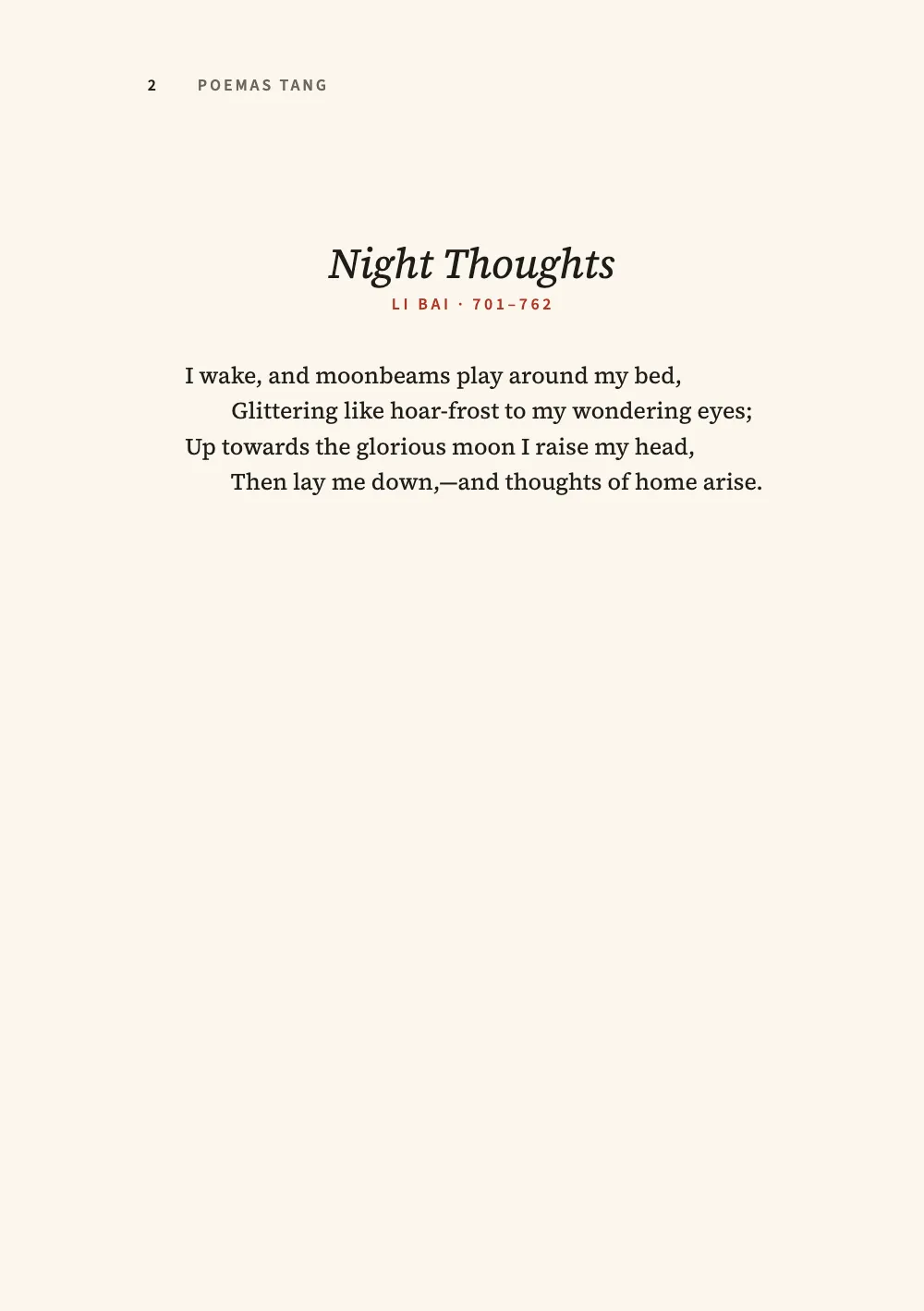
El codi és a la resposta curta, més amunt. Cada poema són dos títols de nivell 1: # Night Thoughts {style="en" …} amb els versos de Giles i després # 靜夜思 {style="zh" …} amb el poema. L'estil en salta a la pàgina parella següent; el zh, a la senar següent, la que queda al davant. Mentre cada poema càpiga a la seva pàgina no hi entra cap pàgina en blanc; una versió anglesa que passés de pàgina empenyeria el seu original a la senar següent, darrere d'una parella en blanc (Saltar abans). Els dos dissenys reserven sis línies de la retícula, així que l'anglès i el xinès comencen a la mateixa línia. L'estil xinès porta span: 'page' perquè el seu primer element, una caixa de la mida de la pàgina, és el full tenyit, i un disseny que es queda a la columna es talla al peu de la columna (Span i disseny avançat).
#2 · Una renglera xinesa per cada dos versos anglesos
// Each indent centres the longest line of the poems that use it on the 103.7 mm measure:
// 97.8 mm in the moonlight poem, 91–93 mm in two quatrains, 66 mm in Wang Wei's.
const verses = [['verse-long', 3], ['verse', 6], ['verse-short', 19]].map(([id, indent]) => ({
  id, fontFamily: ROMAN, fontSize: pt(BODY), lineHeight: pt(LEAD), textAlign: 'left',
  firstLineIndent: pt(0), indent: mm(indent) }));
const shi = { id: 'shi', fontFamily: KAI, fontSize: pt(SHI), lineHeight: pt(2 * LEAD),
  textAlign: 'left', firstLineIndent: pt(0), // two lines of verse to a row: 2 × LEAD
  // Five characters and a full-width mark, twice: 12 ems, centred in the 28 of the grid.
  // A fixed left edge, and the note numbers after each row's 。: every character keeps its column.
  indent: pt((CHARS * BODY - 12 * SHI) / 2) };
// A paragraph drops its leading spaces (gap: hard-line-breaks): the two spaces Giles indents
// his rhyming lines by become two em spaces behind a word joiner, which nothing trims.
const indentVerse = (md) => md.replace(/^ {2}(?=\S)/gm, '\u2060\u2003\u2003');
Les rengleres xineses tenen el doble d'interlineat que els versos anglesos, 32 pt contra 16, i així una renglera de dos versos de cinc caràcters queda davant de l'apariat que Giles en treu. Al poema de la lluna de les pàgines 4 i 5 el mateix :::space{lines=1} va als dos textos, i les seves tres estrofes continuen a la mateixa altura en tot el plec. La renglera xinesa entra 51 pt, cosa que centra els seus dotze quadratins en els 28 de la retícula, i cada crida de nota va després del 。 de la seva renglera, fora dels dotze: dins de la renglera empenyeria sis dècimes de quadratí a la dreta tots els caràcters que la segueixen, que deixarien de caure sobre els de la renglera de sota. Els sagnats anglesos surten de mesurar el vers més llarg de cada poema. Giles sagna un vers de cada dos; el Markdown conserva els seus dos espais, i indentVerse els canvia per espais de quadratí després d'un unidor de paraules, perquè un paràgraf perd els espais amb què comença.
#3 · Notes a peu de la pàgina xinesa
const footnotes = { placement: 'column', numbering: 'page', // the page foot; ① again on each page
  numberFormat: 'circled-decimal', markerSize: em(0.6), fontSize: pt(8), lineHeight: pt(11),
  color: col('ink'), textAlign: 'left', spaceAbove: pt(LEAD), spaceBelowRule: pt(5),
  spaceBetween: pt(3), separator: { width: 0.12, lineWidth: pt(0.6), color: col('seal') } };
Les notes són notes a peu de pàgina, una per renglera: 疑是地上霜。[^bed] tanca la primera renglera del poema i [^bed]: … va després, amb les paraules que glossa en negreta, perquè la crida ja no és al seu costat. Es numeren com numera les notes un llibre xinès (页下注): números en cercle sobre la línia de base, comptats de nou des de ① a cada pàgina (numberFormat: 'circled-decimal', numbering: 'page'). Al vers la crida es compon a sis dècimes de la mida del poema, markerSize: em(0.6), a prop de la mida de les notes; al peu de la pàgina cada nota comença amb el seu ① a la mida del text de la nota (Notes a peu de pàgina). Les notes es componen amb la font del cos, i la d'aquest llibre és Noto Serif TC perquè una nota barreja caràcters i pinyin; les lletres llatines de Noto Serif TC són les de Source Serif, i per això les pàgines angleses van en Source Serif 4. Les notes s'escriuen en la llengua de l'edició: amb la capçalera de la pàgina parella i la nota sobre el text, són el que canvia a l'edició espanyola.
#4 · Capçaleres en la llengua de cada pàgina
const head = (id, content, parity, edge, x, style) => ({ kind: 'text', id, content, parity,
  pages: 'opener', // every poem page opens with its title; a blank page stays bare
  fontFamily: LABEL, fontSize: pt(7.5), fontWeight: 600, color: col('muted'),
  placement: { anchor: { to: 'page', edge }, offset: { x: mm(x), y: mm(12) } }, ...style });
const header = { elements: [
  head('verso-folio', '{pageNumber}', 'even', 'top-left', EDGE, { color: col('ink') }),
  head('verso-book', '{subtitle}', 'even', 'top-left', EDGE + 8,
    { letterSpacing: pt(1.2), textTransform: 'uppercase' }),
  head('recto-poet', '{attr.name}', 'odd', 'top-right', -(EDGE + 8),
    { fontFamily: HEI, fontWeight: 400, fontSize: pt(8), letterSpacing: pt(3) }),
  head('recto-folio', '{pageNumber}', 'odd', 'top-right', -EDGE, { color: col('ink') }),
] };
Totes les pàgines d'aquest llibre comencen amb un títol, així que totes són obertures, i les capçaleres porten pages: 'opener'. Una pàgina en blanc que afegís un salt quedaria neta, i la portada les treu amb una capçalera buida pròpia. La pàgina parella pren el títol del llibre del subtitle del frontmatter, que cada edició escriu en la seva llengua; la senar pren el nom del poeta de l'atribut name del títol xinès (Capçaleres i peus).
#5 · Una portada sobre una lluna
const onPage = (y, size) => ({ anchor: { to: 'page', edge: 'top' }, offset: { y: mm(y) },
  ...(size ? { size: { width: mm(size), height: mm(size) } } : {}) });
const [MOON_Y, MOON, HAN] = [36, 78, 60]; // mm: the moon's top and width; pt: the title
const UNDER = MOON_Y + MOON; // mm: the English lines start under the moon
const line = (id, content, y, style) => ({ kind: 'text', id, content, align: 'center',
  overflow: 'wrap', color: col('ink'), placement: onPage(y), ...style });
const titlePage = {
  id: 'title', span: 'page', runningChapter: false,
  header: { elements: [] }, footer: { elements: [] },
  advancedDesign: { enabled: true, slot: { elements: [
    { kind: 'box', id: 'moon', placement: onPage(MOON_Y, MOON),
      style: { backgroundColor: col('moon'), borderRadius: mm(MOON / 2) } },
    line('han', '{titleText}', MOON_Y + MOON / 2 - (HAN * 25.4) / 144, { fontFamily: SERIF,
      fontWeight: 900, fontSize: pt(HAN), letterSpacing: pt(HAN / 4), lineHeight: 1 }),
    line('en', '{attr.en}', UNDER + 10, { fontFamily: LABEL, fontSize: pt(10), fontWeight: 600,
      letterSpacing: pt(3), textTransform: 'uppercase', color: col('seal') }),
    line('poets', '{attr.poets}', UNDER + 19, { fontFamily: ROMAN, fontSize: pt(12) }),
    line('giles', '{attr.english}', UNDER + 26, { fontFamily: ROMAN, fontSize: pt(11),
      italic: true }),
    // A seal reading 明月, the bright moon of three of the four poems, set down its square.
    { kind: 'box', id: 'seal', placement: onPage(170, 13),
      style: { backgroundColor: col('seal'), borderRadius: mm(1) } },
    line('seal-text', '明月', 170, { placement: onPage(170, 13), writingMode: 'vertical-rl',
      fontFamily: KAI, fontSize: pt(14), lineHeight: 1, color: col('paper'),
      verticalAlign: 'middle' }),
  ] } },
};
La portada també és un estil de títol, amb runningChapter: false perquè no anomeni cap capítol. La lluna és una caixa de disseny el radi de cantonada de la qual mesura la meitat del costat, i 唐詩 es centra al damunt amb un càlcul: el centre de la lluna menys la meitat de l'alçada del títol. El segell compon 明月 amb writingMode: 'vertical-rl', un caràcter sobre l'altre, com es graven els segells.
#6 · Cada font xinesa carrega el que compon
const grab = (re) => (markdown.match(re) ?? []).join('');
const poems = grab(/:::paragraphs\{style="shi"\}[\s\S]*?\n:::/g) + '①②③④⑤⑥⑦⑧⑨⑩'; // and note numbers
await loadFonts(FONTS, markdown);
await Promise.all([
  loadCjkFonts({ [SERIF]: ['400'] }, markdown + poems), // the notes and their ①, the heading blocks
  loadCjkFonts({ [SERIF]: ['700'] }, grab(/^# \S+(?= \{style="zh")|\*\*[^*]+\*\*/gm)),
  loadCjkFonts({ [SERIF]: ['900'] }, grab(/^# \S+(?= \{style="title")/gm)),
  loadCjkFonts({ [KAI]: ['400'] }, `${poems}明月`),
  loadCjkFonts({ [HEI]: ['400'] }, grab(/(?<=(?:poet|name)=")[^"]*/g)),
]);
Fontsource parteix cada font xinesa en uns cent fitxers per rangs de caràcters, i loadCjkFonts baixa només els que necessita el seu text (Fonts xineses, japoneses i coreanes). La Kai rep els poemes i el segell; la Hei, els noms dels poetes; la Song en negreta, els quatre títols i les paraules glossades de les notes, i el seu pes més negre, els dos caràcters de la portada.
La recepta completa
// ═══ Postext Cookbook · Nº 083 · Tang poems facing their English verse ═══════════════ // https://postext.dev/en/cookbook/tang-poems-facing-english // Code: MIT · Text: Tang poems, zh.wikisource; H. A. Giles, 1901, Project Gutenberg (PD) // Fonts: Noto Serif TC, LXGW WenKai TC, Noto Sans TC, Source Serif 4 (OFL) · Needs postext ≥ 1.11.0 import { buildDocument, renderPageToCanvas, clearMeasurementCache } from 'https://esm.sh/postext'; import { renderToPdf, decompressWoff2 } from 'https://esm.sh/postext-pdf'; const LANG = 'es'; // @lang: the language of the sample document ('en' | 'es') const RECIPE = 'tang-poems-facing-english'; // ─── 1 · Design ───────────────────────────────────────────────────────────── // Ink and seal red on a cream paper, and a pale moon for the title page. const palette = { ink: '#1f1b18', // text: a warm near-black seal: '#ad3526', // the accent: vermilion seal paste, for the poets, the rules and the seal moon: '#eadcb4', // the title page's moon leaf: '#f2e8cf', // the recto's tint, under the Chinese muted: '#6d655c', // running heads and the colophon paper: '#faf6ed', // a cream paper }; const col = (id) => ({ hex: palette[id], model: 'hex', paletteId: id }); const colorPalette = [ ...Object.entries(palette).map(([id, hex]) => ({ id, name: id, value: { hex, model: 'hex' } })), { id: 'main-color', name: 'seal (defaults)', value: { hex: palette.seal, model: 'hex' } }, ]; const SERIF = 'Noto Serif TC'; // 明: the Chinese titles and the notes const KAI = 'LXGW WenKai TC'; // 楷: the poems const HEI = 'Noto Sans TC'; // 黑: the poet lines and the recto's running head const ROMAN = 'Source Serif 4'; // the English: the Latin that Noto Serif TC is built on const LABEL = 'Source Sans 3'; // English labels and folios const [BODY, LEAD, SHI] = [10.5, 16, 16]; // pt: 五号 on a 16 pt pitch; the poems' size const [CHARS, LINES] = [28, 30]; // the character grid: 28 ems by 30 lines const TRIM = { width: 148, height: 210 }; // mm: 25開, a Taiwan trade trim const [INNER, OUTER] = [18, 21]; // mm: minimum sides; the grid centres its measure between them const MEASURE = (CHARS * BODY * 25.4) / 72; // 103.7 mm: 28 ems of 五号 const EDGE = OUTER + (TRIM.width - INNER - OUTER - MEASURE) / 2; // 23.6 mm: the outer text edge // #region answer: the English opens the next verso, the Chinese the recto that faces it const SINK = 6; // lines of LEAD under both titles, so the two poems start on the same line const at = (y) => ({ anchor: { to: 'container', edge: 'top' }, offset: { y: mm(y) } }); // A title whose foot is 23 mm down at any size, and the poet's line under it at 24 mm. const titled = (size, title, poet, under = []) => ({ enabled: true, minHeight: pt(SINK * LEAD), slot: { elements: [...under, { kind: 'text', id: 'title', content: '{titleText}', fontSize: pt(size), lineHeight: 1.2, align: 'center', overflow: 'wrap', color: col('ink'), placement: at(23 - (size * 1.2 * 25.4) / 72), ...title }, { kind: 'text', id: 'poet', align: 'center', overflow: 'wrap', color: col('seal'), placement: at(24), ...poet }, ] }, }); // Each style breaks to its own side of the spread (gotcha: style-inherits-break). const english = { id: 'en', breakBefore: { enabled: true, parity: 'even' }, // a verso advancedDesign: titled(19, { fontFamily: ROMAN, italic: true }, { content: '{attr.kicker}', fontFamily: LABEL, fontSize: pt(7.5), fontWeight: 600, letterSpacing: pt(1.5), textTransform: 'uppercase' }) }; // The original on a tinted leaf: span 'page' lets the tint reach past the text column. const chinese = { id: 'zh', span: 'page', breakBefore: { enabled: true, parity: 'odd' }, advancedDesign: titled(28, { fontFamily: SERIF, fontWeight: 700, letterSpacing: pt(7) }, { content: '{attr.poet}', fontFamily: HEI, fontSize: pt(9), letterSpacing: pt(1.5) }, [{ kind: 'box', id: 'leaf', reserve: false, style: { backgroundColor: col('leaf') }, placement: { anchor: { to: 'page', edge: 'top-left' }, size: { width: 'fill', height: 'fill' } } }]) }; // #endregion // #region verse: a Chinese row faces two lines of English on the grid both pages share // Each indent centres the longest line of the poems that use it on the 103.7 mm measure: // 97.8 mm in the moonlight poem, 91–93 mm in two quatrains, 66 mm in Wang Wei's. const verses = [['verse-long', 3], ['verse', 6], ['verse-short', 19]].map(([id, indent]) => ({ id, fontFamily: ROMAN, fontSize: pt(BODY), lineHeight: pt(LEAD), textAlign: 'left', firstLineIndent: pt(0), indent: mm(indent) })); const shi = { id: 'shi', fontFamily: KAI, fontSize: pt(SHI), lineHeight: pt(2 * LEAD), textAlign: 'left', firstLineIndent: pt(0), // two lines of verse to a row: 2 × LEAD // Five characters and a full-width mark, twice: 12 ems, centred in the 28 of the grid. // A fixed left edge, and the note numbers after each row's 。: every character keeps its column. indent: pt((CHARS * BODY - 12 * SHI) / 2) }; // A paragraph drops its leading spaces (gap: hard-line-breaks): the two spaces Giles indents // his rhyming lines by become two em spaces behind a word joiner, which nothing trims. const indentVerse = (md) => md.replace(/^ {2}(?=\S)/gm, '\u2060\u2003\u2003'); // #endregion // #region notes: glosses at the foot of the recto, in the edition's language const footnotes = { placement: 'column', numbering: 'page', // the page foot; ① again on each page numberFormat: 'circled-decimal', markerSize: em(0.6), fontSize: pt(8), lineHeight: pt(11), color: col('ink'), textAlign: 'left', spaceAbove: pt(LEAD), spaceBelowRule: pt(5), spaceBetween: pt(3), separator: { width: 0.12, lineWidth: pt(0.6), color: col('seal') } }; // #endregion // #region title: 唐詩 on a pale moon, with a seal const onPage = (y, size) => ({ anchor: { to: 'page', edge: 'top' }, offset: { y: mm(y) }, ...(size ? { size: { width: mm(size), height: mm(size) } } : {}) }); const [MOON_Y, MOON, HAN] = [36, 78, 60]; // mm: the moon's top and width; pt: the title const UNDER = MOON_Y + MOON; // mm: the English lines start under the moon const line = (id, content, y, style) => ({ kind: 'text', id, content, align: 'center', overflow: 'wrap', color: col('ink'), placement: onPage(y), ...style }); const titlePage = { id: 'title', span: 'page', runningChapter: false, header: { elements: [] }, footer: { elements: [] }, advancedDesign: { enabled: true, slot: { elements: [ { kind: 'box', id: 'moon', placement: onPage(MOON_Y, MOON), style: { backgroundColor: col('moon'), borderRadius: mm(MOON / 2) } }, line('han', '{titleText}', MOON_Y + MOON / 2 - (HAN * 25.4) / 144, { fontFamily: SERIF, fontWeight: 900, fontSize: pt(HAN), letterSpacing: pt(HAN / 4), lineHeight: 1 }), line('en', '{attr.en}', UNDER + 10, { fontFamily: LABEL, fontSize: pt(10), fontWeight: 600, letterSpacing: pt(3), textTransform: 'uppercase', color: col('seal') }), line('poets', '{attr.poets}', UNDER + 19, { fontFamily: ROMAN, fontSize: pt(12) }), line('giles', '{attr.english}', UNDER + 26, { fontFamily: ROMAN, fontSize: pt(11), italic: true }), // A seal reading 明月, the bright moon of three of the four poems, set down its square. { kind: 'box', id: 'seal', placement: onPage(170, 13), style: { backgroundColor: col('seal'), borderRadius: mm(1) } }, line('seal-text', '明月', 170, { placement: onPage(170, 13), writingMode: 'vertical-rl', fontFamily: KAI, fontSize: pt(14), lineHeight: 1, color: col('paper'), verticalAlign: 'middle' }), ] } }, }; // #endregion // #region heads: the book in English over the verso, the poet in Chinese over the recto const head = (id, content, parity, edge, x, style) => ({ kind: 'text', id, content, parity, pages: 'opener', // every poem page opens with its title; a blank page stays bare fontFamily: LABEL, fontSize: pt(7.5), fontWeight: 600, color: col('muted'), placement: { anchor: { to: 'page', edge }, offset: { x: mm(x), y: mm(12) } }, ...style }); const header = { elements: [ head('verso-folio', '{pageNumber}', 'even', 'top-left', EDGE, { color: col('ink') }), head('verso-book', '{subtitle}', 'even', 'top-left', EDGE + 8, { letterSpacing: pt(1.2), textTransform: 'uppercase' }), head('recto-poet', '{attr.name}', 'odd', 'top-right', -(EDGE + 8), { fontFamily: HEI, fontWeight: 400, fontSize: pt(8), letterSpacing: pt(3) }), head('recto-folio', '{pageNumber}', 'odd', 'top-right', -EDGE, { color: col('ink') }), ] }; // #endregion const paragraphStyles = [shi, ...verses, // Justified like the body, and divided by the patterns of the edition's language (bodyText). { id: 'prose', fontFamily: ROMAN, fontSize: pt(10), lineHeight: pt(LEAD), firstLineIndent: mm(4) }, { id: 'colophon', fontFamily: LABEL, fontSize: pt(7), lineHeight: pt(10), color: col('muted'), italicColor: col('muted'), textAlign: 'left', firstLineIndent: pt(0), marginTop: pt(LEAD) }, ]; const config = () => ({ // a factory: the engine caches resolved configs per object locale: 'zh-Hant', // the Chinese sets the rules; written out, never LANG (gotcha: cjk-locale-tag) colorPalette, page: { width: mm(TRIM.width), height: mm(TRIM.height), dpi: 150, backgroundColor: col('paper'), // 23 + 17.5 mm leave 169.5 mm for 30 lines of 16 pt (169.3 mm): a head deeper than the foot. margins: { top: mm(23), bottom: mm(17.5), left: mm(INNER), right: mm(OUTER), mirror: true }, }, layout: { layoutType: 'single' }, cjk: { grid: { enabled: true, charsPerLine: CHARS, linesPerPage: LINES } }, bodyText: { fontFamily: SERIF, fontSize: pt(BODY), lineHeight: pt(LEAD), color: col('ink'), boldColor: col('ink'), italicColor: col('ink'), referenceColor: col('ink'), textAlign: 'justify', firstLineIndent: em(2), indentAfterHeading: false, hyphenation: { enabled: true, locale: LANG } }, // no Chinese patterns: the Latin's language // The designs paint the titles; weight 400 keeps the heading blocks in a loaded face. // Restated: any headings object drops the H1 break (gotcha: headings-drop-h1-break). headings: { fontFamily: SERIF, fontWeight: 400, levels: [{ level: 1, marginTop: pt(0), marginBottom: pt(0), breakBefore: { enabled: true, parity: 'any' } }] }, headingStyles: [titlePage, english, chinese], paragraphStyles, footnotes, header, footer: { elements: [] }, }); // ─── 2 · Content ──────────────────────────────────────────────────────────── const markdown = String.raw`---Mostra en Markdown · 153 línies · content.es.md
title: "唐詩" subtitle: "Poemas Tang" --- # 唐詩 {style="title" en="Poemas Tang" poets="Li Bai · Du Fu · Wang Wei" english="con la versión inglesa en verso de Herbert A. Giles"} # Night Thoughts {style="en" kicker="Li Bai · 701–762"} :::paragraphs{style="verse"} I wake, and moonbeams play around my bed, Glittering like hoar-frost to my wondering eyes; Up towards the glorious moon I raise my head, Then lay me down,—and thoughts of home arise. ::: # 靜夜思 {style="zh" poet="〔唐〕李白" name="李白"} :::paragraphs{style="shi"} 牀前明月光,疑是地上霜。[^bed] 舉頭望明月,低頭思故鄉。[^moon] ::: [^bed]: **牀** chuáng, hoy escrito 床: la cama. Algunos comentaristas leen aquí el brocal de un pozo, y otros un asiento plegable sacado al patio; Giles se queda con la cama. [^moon]: **明月** míngyuè, la luna clara. Las obras reunidas de Li Bai dicen 看月光 en el primer verso y aquí 山月, la luna sobre los montes; la edición de 1705 de toda la poesía Tang dice también 山月, pero conserva 明月光. Esta página sigue la antología de 1763, el texto que los niños chinos aprenden de memoria. **鄉** xiāng rima con 光 guāng y 霜 shuāng, al final de los dos primeros versos; Giles rima su cuarteta en versos alternos. # Drinking Alone under the Moon {style="en" kicker="Li Bai · 701–762"} :::paragraphs{style="verse-long"} An arbour of flowers and a kettle of wine: Alas! in the bowers no companion is mine. Then the moon sheds her rays on my goblet and me, And my shadow betrays we’re a party of three. :::space{lines=1} Though the moon cannot swallow her share of the grog, And my shadow must follow wherever I jog,— Yet their friendship I’ll borrow and gaily carouse, And laugh away sorrow while spring-time allows. :::space{lines=1} See the moon,—how she glances response to my song; See my shadow,—it dances so lightly along! While sober I feel you are both my good friends; When drunken I reel, our companionship ends. But we’ll soon have a greeting without a good-bye, At our next merry meeting away in the sky. ::: # 月下獨酌 {style="zh" poet="〔唐〕李白" name="李白"} :::paragraphs{style="shi"} 花間一壺酒,獨酌無相親。 舉杯邀明月,對影成三人。[^three] :::space{lines=1} 月既不解飲,影徒隨我身。 暫伴月將影,行樂須及春。[^jiang] :::space{lines=1} 我歌月徘徊,我舞影零亂。 醒時同交歡,醉後各分散。 永結無情遊,相期邈雲漢。[^wuqing] ::: [^three]: **三人** sān rén, tres personas: el poeta, la luna y su sombra. [^jiang]: **將** jiāng: aquí une 月 y 影, la luna y la sombra. [^wuqing]: **無情遊** wúqíng yóu: una amistad con compañeros que no sienten nada, la luna y la sombra; el poeta se ata a ella para siempre. **雲漢** yúnhàn: la Vía Láctea, donde los tres volverán a encontrarse, el «away in the sky» de Giles. La rima cambia en el noveno verso, donde empieza la tercera estrofa de Giles. # Stop-short {style="en" kicker="Du Fu · 712–770"} :::paragraphs{style="verse"} White gleam the gulls across the darkling tide, On the green hills the red flowers seem to burn; Alas! I see another spring has died…. When will it come—the day of my return? ::: # 絕句 {style="zh" poet="〔唐〕杜甫" name="杜甫"} :::paragraphs{style="shi"} 江碧鳥逾白,山青花欲燃。[^yu] 今春看又過,何日是歸年。[^guinian] ::: [^yu]: **逾** yú, todavía más: contra el verde del río, los pájaros parecen aún más blancos. **欲燃** yù rán, a punto de arder: el rojo de las flores. En Giles, «seem to burn». [^guinian]: **歸年** guī nián, el año del regreso. Du Fu escribió esta cuarteta, la segunda de una pareja, en la primavera de 764 en Chengdu, adonde lo había llevado la guerra del norte. # The Bamboo Lodge {style="en" kicker="Wang Wei · 701–761"} :::paragraphs{style="verse-short"} Beneath the bamboo grove, alone, I seize my lute and sit and croon; No ear to hear me, save mine own: No eye to see me—save the moon. ::: # 竹里館 {style="zh" poet="〔唐〕王維" name="王維"} :::paragraphs{style="shi"} 獨坐幽篁裏,彈琴復長嘯。[^huang] 深林人不知,明月來相照。 ::: [^huang]: **幽篁** yōuhuáng: un bambudal hondo y oscuro. **長嘯** cháng xiào: un silbido largo con los labios fruncidos, arte de ermitaños; el poeta de Giles canturrea («croon»). El Pabellón de los Bambúes era uno de los veinte lugares de la finca de Wang Wei en Wangchuan, al sudeste de la capital Tang, y el poeta dedicó a cada uno una cuarteta de 輞川集, la colección de Wangchuan. # Nota sobre el texto {style="en" kicker="Sobre esta edición"} :::paragraphs{style="prose"} Los poemas chinos siguen los *Trescientos poemas Tang*, la antología que Sun Zhu reunió en 1763 con el nombre de Hengtang Tuishi, salvo la cuarteta de Du Fu, que no figura en ella y se da como la imprime el *Quan Tang shi* de 1705. Los cuatro proceden de Wikisource, en caracteres tradicionales y con las formas antiguas que conservan allí algunos caracteres. Los versos ingleses son de Herbert A. Giles, tal como los publicó en *A History of Chinese Literature* (1901), donde los poemas no llevan título; los títulos ingleses son de esta edición. Giles escribía Li Po y Tu Fu donde hoy se escribe Li Bai y Du Fu, y llamaba *stop-short* al *jueju*, la cuarteta, de ahí el título inglés del poema de Du Fu. Se respetan sus rimas, sus sangrías y su puntuación; el poema de la luna, que su libro imprimió en hemistiquios, va aquí en versos enteros. Cada poema chino va a dos versos por renglón, de modo que cada renglón queda frente a los dos versos ingleses que lo traducen. El blanco entre las estrofas del poema de la luna es del editor y está en las dos páginas. ::: :::paragraphs{style="colophon"} Compuesto en Noto Serif TC, LXGW WenKai TC y Noto Sans TC para el chino, y en Source Serif 4 y Source Sans 3 para el inglés, todas con la licencia SIL Open Font License · Texto chino: Wikisource · Versos ingleses: H. A. Giles, *A History of Chinese Literature*, 1901, libro electrónico 43711 del Proyecto Gutenberg :::`; // content.<lang>.md, inlined by the Cookbook // ─── 3 · Fonts ────────────────────────────────────────────────────────────── const FONTS = { // every face the pages use, loaded before the build (gotcha: fonts-first) 'Noto Serif TC': ['400', '700', '900'], // SERIF: the notes; the titles; 唐詩 'LXGW WenKai TC': ['400'], // KAI: the poems and the seal 'Noto Sans TC': ['400'], // HEI: the poet lines, the recto's head 'Source Serif 4': ['400', '400i'], // ROMAN: the verse, the titles, the note on the text 'Source Sans 3': ['400', '400i', '600'], // LABEL: kickers, the verso's head, folios, colophon }; // ─── 4 · Build & show ─────────────────────────────────────────────────────── // #region voices: each Chinese face loads the files of the characters it sets const grab = (re) => (markdown.match(re) ?? []).join(''); const poems = grab(/:::paragraphs\{style="shi"\}[\s\S]*?\n:::/g) + '①②③④⑤⑥⑦⑧⑨⑩'; // and note numbers await loadFonts(FONTS, markdown); await Promise.all([ loadCjkFonts({ [SERIF]: ['400'] }, markdown + poems), // the notes and their ①, the heading blocks loadCjkFonts({ [SERIF]: ['700'] }, grab(/^# \S+(?= \{style="zh")|\*\*[^*]+\*\*/gm)), loadCjkFonts({ [SERIF]: ['900'] }, grab(/^# \S+(?= \{style="title")/gm)), loadCjkFonts({ [KAI]: ['400'] }, `${poems}明月`), loadCjkFonts({ [HEI]: ['400'] }, grab(/(?<=(?:poet|name)=")[^"]*/g)), ]); // #endregion const doc = await buildWithFonts( () => buildDocument({ markdown: indentVerse(markdown) }, config()), markdown); showPages(doc, { title: t({ en: 'Tang poems facing their English verse', es: 'Poemas Tang frente a su versión inglesa' }) }); offerPdf(() => renderToPdf(doc, { fontProvider: cjkPdfProvider }), `${RECIPE}.pdf`);Kit · core, fonts, viewer, pdf, cjk: igual a totes les receptes · 422 línies
// ─── Kit ── helpers shared by every Cookbook recipe · postext.dev/cookbook ───── // ─── Kit · core v1 ── the same in every recipe · postext.dev/cookbook ───────── function mm(value) { return { value, unit: 'mm' }; } function pt(value) { return { value, unit: 'pt' }; } function em(value) { return { value, unit: 'em' }; } /** The sample language's string: t({ en: 'Figure', es: 'Figura' }). */ function t(strings) { return strings[LANG] ?? Object.values(strings)[0]; } /** A file in this recipe's assets folder, served from the Postext repo by jsDelivr. */ function asset(file) { return `https://cdn.jsdelivr.net/gh/drnachio/postext@main/cookbook/${RECIPE}/assets/${file}`; } // ─── Kit · fonts v1 ── the same in every recipe · postext.dev/cookbook ──────── // Postext measures text with the faces the browser has loaded, and caches the // widths, so every face must be ready before the first build. Faces come from // Fontsource: the same static files the PDF embeds, so screen and PDF agree. /** faces = { 'Family Name': ['400', '400i', '700'] }. `text` is the sample: * letters beyond Latin-1 (č, ł, ő…) also load the latin-ext files. With * `optional`, a face Fontsource does not ship is skipped instead of failing. * Resolves to the number of faces added. */ async function loadFonts(faces, text = '', { optional = false } = {}) { kitStatus('Loading fonts…'); const ranges = { latin: 'U+0000-00FF,U+0131,U+0152-0153,U+02BB-02BC,U+02C6,U+02DA,U+02DC,U+0304,U+0308,U+0329,' + 'U+2000-206F,U+20AC,U+2122,U+2191,U+2193,U+2212,U+2215,U+FEFF,U+FFFD', 'latin-ext': 'U+0100-02BA,U+02BD-02C5,U+02C7-02CC,U+02CE-02D7,U+02DD-02FF,U+0304,U+0308,U+0329,' + 'U+1D00-1DBF,U+1E00-1E9F,U+1EF2-1EFF,U+2020,U+20A0-20AB,U+20AD-20C0,U+2113,U+2C60-2C7F,U+A720-A7FF', }; const subsets = /[Ā-˿Ḁ-ỿ]/.test(text) ? ['latin', 'latin-ext'] : ['latin']; const jobs = []; let added = 0; for (const [family, specs] of Object.entries(faces)) { const id = fontsourceId(family); const meta = optional ? await fontsourceMeta(family) : null; for (const spec of new Set(specs)) { const weight = parseInt(spec, 10); const style = spec.endsWith('i') ? 'italic' : 'normal'; if (hasFace(family, weight, style)) continue; if (optional && !(meta?.weights.includes(weight) && meta.styles.includes(style))) continue; for (const subset of subsets) { const url = `https://cdn.jsdelivr.net/npm/@fontsource/${id}@5/files/${id}-${subset}-${weight}-${style}.woff2`; const face = new FontFace(family, `url(${url}) format('woff2')`, { weight: String(weight), style, unicodeRange: ranges[subset] }); jobs.push(face.load().then((ready) => { document.fonts.add(ready); added++; }, () => { if (subset === 'latin' && !optional) throw new Error(`Fontsource has no ${family} ${weight} ${style}`); })); } } } await Promise.all(jobs).catch((error) => { kitFail(error); throw error; }); return added; } /** Runs `build` (a buildDocument or buildBundle call) and checks the faces * the pages use. A regular face missing from FONTS is loaded with a warning; * bold and italic variants are loaded when the family ships them. Then the * measurement caches are cleared and the build runs again. */ async function buildWithFonts(build, text = '') { const tried = new Set(); for (let round = 0; round < 3; round++) { kitStatus('Laying out…'); await new Promise(requestAnimationFrame); // let the status paint first const result = await Promise.resolve().then(build).catch((error) => { kitFail(error); throw error; }); const wanted = { base: {}, variants: {} }; for (const { font, base } of [result].flat().flatMap(fontStringsOf)) { const { family, weight, style } = parseFont(font); const key = `${family}|${weight}|${style}`; if (tried.has(key) || hasFace(family, weight, style)) continue; tried.add(key); (wanted[base ? 'base' : 'variants'][family] ??= []).push(`${weight}${style === 'italic' ? 'i' : ''}`); } if (Object.keys(wanted.base).length) { console.warn(`[cookbook] FONTS does not list ${JSON.stringify(wanted.base)}: loading them.`); } const added = await loadFonts(wanted.base, text) + await loadFonts(wanted.variants, text, { optional: true }); if (added === 0) return result; clearMeasurementCache(); } throw new Error('The fonts did not settle after three builds.'); } /** Every font string of the layout. `base` marks a block's own face; its * bold, italic and bold-italic variants are listed whether or not used. */ function fontStringsOf(doc) { const found = new Map(); const walk = (node) => { if (!node || typeof node !== 'object') return; if (Array.isArray(node)) { node.forEach(walk); return; } for (const [key, value] of Object.entries(node)) { if (typeof value === 'string' && /fontString$/i.test(key)) { found.set(value, found.get(value) || key === 'fontString'); } else if (value && typeof value === 'object') walk(value); } }; walk(doc.pages); walk(doc.blocks); return [...found].map(([font, base]) => ({ font, base })); } /** '700 37.5px Open Sans' / 'italic 400 13px "Source Serif 4"' → { family, weight, style }. * A string with no weight ('95.8px Young Serif', from a design text) is 400. */ function parseFont(font) { const m = /^(?:(italic|oblique)\s+)?(?:small-caps\s+)?(?:(\d+|bold|normal)\s+)?[\d.]+px\s+(.+)$/.exec(font.trim()); if (!m) throw new Error(`Unexpected font string: ${font}`); const weight = m[2] === 'bold' ? 700 : !m[2] || m[2] === 'normal' ? 400 : Number(m[2]); return { family: m[3].replace(/^["']|["']$/g, ''), weight, style: m[1] ? 'italic' : 'normal' }; } /** True when a loaded FontFace covers exactly this family, weight and style * (document.fonts.check() is also true for families nobody declared). */ function hasFace(family, weight, style) { for (const face of document.fonts) { if (face.status !== 'loaded' || face.style !== style) continue; if (face.family.replace(/^["']|["']$/g, '') !== family) continue; const [low, high = low] = face.weight.split(' ').map(Number); if (weight >= low && weight <= high) return true; } return false; } /** Fontsource's id for a family: 'Source Serif 4' → 'source-serif-4'. */ function fontsourceId(family) { return family.toLowerCase().replace(/\s+/g, '-'); } /** The weights and styles a family ships ({ weights: [400, 700], styles: ['normal', 'italic'] }), or null. */ function fontsourceMeta(family) { fontsourceMeta.cache ??= new Map(); const id = fontsourceId(family); if (!fontsourceMeta.cache.has(id)) { fontsourceMeta.cache.set(id, fetch(`https://api.fontsource.org/v1/fonts/${id}`) .then((res) => (res.ok ? res.json() : null), () => null)); } return fontsourceMeta.cache.get(id); } // ─── Kit · viewer v1 ── the same in every recipe · postext.dev/cookbook ─────── /** Shows the pages as facing spreads on a dark desk: the first page is a * recto on its own, then verso | recto pairs, as in a bound book. Pages * are painted when they scroll near the screen. */ function showPages(docs, { title, width = 460 } = {}) { const root = viewer(title); const pages = [docs].flat().flatMap((doc) => doc.pages.map((page) => ({ doc, page, n: (doc.pageIndexOffset ?? 0) + page.index }))); const spreads = []; let verso = null; for (const p of pages) { if (p.n % 2 === 1) { if (verso) spreads.push([verso, null]); verso = p; } else { spreads.push([verso, p]); verso = null; } } if (verso) spreads.push([verso, null]); const density = Math.min(window.devicePixelRatio || 1, 2); showPages.painter?.disconnect(); const painter = new IntersectionObserver((entries) => { for (const { isIntersecting, target } of entries) { if (!isIntersecting) continue; painter.unobserve(target); const { doc, page } = target.postext; renderPageToCanvas(page, doc, target, { scale: (width * density) / page.width }); } }, { rootMargin: '800px' }); showPages.painter = painter; root.replaceChildren(...spreads.map((pair) => { const spread = document.createElement('div'); spread.className = 'pt-spread'; for (const p of pair) { const figure = document.createElement('figure'); if (p) { const label = p.page.pageLabel || String(p.n + 1); const canvas = document.createElement('canvas'); canvas.postext = p; canvas.style.aspectRatio = `${p.page.width} / ${p.page.height}`; canvas.setAttribute('role', 'img'); canvas.setAttribute('aria-label', `Page ${label}`); const folio = document.createElement('figcaption'); folio.textContent = label; figure.append(canvas, folio); painter.observe(canvas); } else figure.className = 'pt-blank'; spread.append(figure); } return spread; })); kitStatus(`${pages.length} ${pages.length === 1 ? 'page' : 'pages'}`); document.documentElement.dataset.postext = 'ready'; return pages.length; } /** The desk, the bar and the error reporting, created once. */ function viewer(title) { if (!document.getElementById('pt-kit')) { document.head.insertAdjacentHTML('beforeend', `<style id="pt-kit"> :root { color-scheme: dark; } body { margin: 0; background: #0e1014; color: #b9bcc4; font: 13px/1.45 system-ui, sans-serif; } #pt-bar { position: sticky; top: 0; z-index: 1; display: flex; flex-wrap: wrap; align-items: center; gap: 6px 16px; padding: 10px 16px; background: rgb(14 16 20 / .92); backdrop-filter: blur(6px); border-bottom: 1px solid #23262d; } #pt-bar strong { color: #f4f1ea; font-weight: 600; } #pt-actions { display: flex; gap: 12px; margin-left: auto; } #pt-actions a, #pt-actions button { color: #d8a21a; font: inherit; background: none; border: 0; padding: 0; cursor: pointer; } #pages { display: grid; justify-items: center; gap: 48px; padding: 32px 16px 72px; } .pt-spread { display: flex; } .pt-spread figure { margin: 0; width: min(460px, 44vw); } .pt-spread canvas { display: block; width: 100%; background: #fff; box-shadow: 0 1px 2px rgb(0 0 0 / .5), 0 22px 44px -16px rgb(0 0 0 / .8); } .pt-spread figure:first-child canvas { box-shadow: inset -14px 0 14px -14px rgb(0 0 0 / .18), 0 1px 2px rgb(0 0 0 / .5), 0 22px 44px -16px rgb(0 0 0 / .8); } .pt-spread figcaption { margin-top: 10px; text-align: center; font: 600 10px/1 system-ui, sans-serif; letter-spacing: .18em; text-transform: uppercase; color: #6c7079; } .pt-blank { visibility: hidden; } @media (max-width: 760px) { .pt-spread { flex-direction: column; gap: 32px; } .pt-spread figure { width: min(460px, 92vw); } .pt-blank { display: none; } } </style>`); document.body.insertAdjacentHTML('afterbegin', '<header id="pt-bar"><strong id="pt-title"></strong><span id="pt-status" role="status"></span><span id="pt-actions"></span></header>'); document.getElementById('pt-title').textContent = document.title || 'Postext'; addEventListener('error', (event) => kitFail(event.error ?? event.message)); addEventListener('unhandledrejection', (event) => kitFail(event.reason)); } if (title) document.getElementById('pt-title').textContent = title; return document.getElementById('pages') ?? document.body.appendChild(Object.assign(document.createElement('main'), { id: 'pages' })); } function kitStatus(text) { viewer(); document.getElementById('pt-status').textContent = text; } function kitFail(error) { document.documentElement.dataset.postext = 'error'; kitStatus(`Error: ${error?.message ?? error}`); } // ─── Kit · pdf v1 ── the same in every recipe that exports a PDF ────────────── /** postext-pdf embeds TrueType bytes. Fetch the Fontsource file the screen * used, snapping to a weight the family ships and falling back to upright * when it has no italic: the PDF asks for every face a block could use. */ async function fontsourceProvider(family, weight, style) { const id = fontsourceId(family); const meta = await fontsourceMeta(family); const weights = meta?.weights?.length ? meta.weights : [400, 700]; const w = weights.reduce((a, b) => (Math.abs(b - weight) < Math.abs(a - weight) ? b : a)); const s = style === 'italic' && meta && !meta.styles.includes('italic') ? 'normal' : style; const res = await fetch(`https://cdn.jsdelivr.net/npm/@fontsource/${id}@5/files/${id}-latin-${w}-${s}.woff2`); if (!res.ok) throw new Error(`Fontsource has no ${family} ${w} ${s} (${res.status})`); return decompressWoff2(new Uint8Array(await res.arrayBuffer())); } /** A "Build the PDF" button in the bar. Once built: "Open the PDF" (a new * tab, since CodePen's preview frame cannot show PDFs) and a download link. */ function offerPdf(makePdf, filename) { viewer(); const button = Object.assign(document.createElement('button'), { type: 'button', textContent: 'Build the PDF' }); button.dataset.postextPdf = filename; button.addEventListener('click', async () => { button.disabled = true; button.textContent = 'Building the PDF…'; try { const bytes = await makePdf(); const url = URL.createObjectURL(new Blob([bytes], { type: 'application/pdf' })); const size = `${Math.max(1, Math.round(bytes.length / 1024))} KB`; button.replaceWith( Object.assign(document.createElement('a'), { href: url, target: '_blank', rel: 'noopener', textContent: 'Open the PDF ↗' }), Object.assign(document.createElement('a'), { href: url, download: filename, textContent: `Download ${filename} · ${size}` })); } catch (error) { button.disabled = false; button.textContent = 'Build the PDF'; kitFail(error); } }); document.getElementById('pt-actions').append(button); } // ─── Kit · cjk v1 ── Chinese, Japanese and Korean books · postext.dev/cookbook ─ // Fontsource ships a CJK family as about a hundred files per weight, each // declared in its stylesheet with the unicode-range it covers. The screen // loads the files the sample touches; the PDF gets the same files for the // characters its pages set in each face, and embeds each as a subset. // A book bound on the right (vertical text) is shown with its spreads // mirrored: page 1 alone on the left of the spine, then [3 | 2]. /** The files of a Fontsource face, read from its stylesheet: { url, range, * ranges }, the last declared first (the order the browser tries them in). */ function cjkSlices(family, weight, style) { cjkSlices.cache ??= new Map(); const id = fontsourceId(family); const css = `https://cdn.jsdelivr.net/npm/@fontsource/${id}@5/${weight}${style === 'italic' ? '-italic' : ''}.css`; if (!cjkSlices.cache.has(css)) { cjkSlices.cache.set(css, fetch(css) .then((res) => { if (!res.ok) throw new Error(`Fontsource has no ${family} ${weight} ${style} (${res.status})`); return res.text(); }) .then((text) => [...text.matchAll(/@font-face\s*{([^}]*)}/g)].map(([, rule]) => { const range = /unicode-range:\s*([^;]+);/.exec(rule)?.[1].trim() ?? 'U+0-10FFFF'; const ranges = range.split(',').map((part) => { const [lo, hi = lo] = part.trim().slice(2).split('-'); return [parseInt(lo, 16), parseInt(hi, 16)]; }); return { url: new URL(/url\(([^)]+?\.woff2)\)/.exec(rule)[1], css).href, range, ranges }; }).reverse())); } return cjkSlices.cache.get(css); } /** The file of `slices` that holds code point `cp`, if any. */ function cjkSliceFor(slices, cp) { return slices.find((slice) => slice.ranges.some(([lo, hi]) => cp >= lo && cp <= hi)); } /** Whether Fontsource serves `family` as a Chinese, Japanese or Korean * family (its subsets name the script). Fails when the API does not * answer: a CJK face taken for a Latin one would paint in a system face. */ async function isCjkFamily(family) { const meta = await fontsourceMeta(family); if (!meta) throw new Error(`api.fontsource.org did not describe ${family}: reload to try again`); return !!meta.subsets?.some((subset) => /^(chinese|japanese|korean)/.test(subset)); } /** faces = { 'Noto Serif TC': ['400', '700'] }, as for loadFonts: the * whole FONTS object may be passed, its other families are left to * loadFonts. Adds one FontFace per file of each CJK face with its * unicodeRange, then loads the files `text` touches. `text` is what the * faces set: the sample for the text face; a book in several voices calls * it once per voice (loadCjkFonts({ 'LXGW WenKai TC': ['400'] }, quotes)), * so the heading and quotation faces fetch and check only their own * characters. Fails when a character of `text` is in no file of a face. * List every weight the pages use: a weight left to buildWithFonts gets * the latin file only. With { vertical: true } it also loads each * family's vertical forms (brackets, quotes, pause marks) for the canvas, * which needs loadVerticalAlternates imported from postext. Resolves to * the number of files loaded. */ async function loadCjkFonts(faces, text, { vertical = false } = {}) { kitStatus('Loading fonts…'); let loaded = 0; try { if (vertical && typeof loadVerticalAlternates !== 'function') { throw new Error('loadCjkFonts(…, { vertical: true }) needs loadVerticalAlternates imported from postext'); } for (const [family, specs] of Object.entries(faces)) { if (!(await isCjkFamily(family))) continue; const twin = []; for (const spec of new Set(specs)) { const weight = parseInt(spec, 10); const style = spec.endsWith('i') ? 'italic' : 'normal'; const slices = await cjkSlices(family, weight, style); const missing = [...new Set(text)].filter((ch) => /\S/.test(ch) && !cjkSliceFor(slices, ch.codePointAt(0))); if (missing.length) { throw new Error(`${family} ${spec} has no file for ${missing.slice(0, 12).join(' ')}: ` + `give each face the text it sets (loadCjkFonts({ '${family}': ['${spec}'] }, text))`); } for (const slice of slices) { document.fonts.add(new FontFace(family, `url(${slice.url}) format('woff2')`, { weight: String(weight), style, unicodeRange: slice.range })); twin.push({ source: slice.url, weight: String(weight), style, unicodeRange: slice.range }); } const font = `${style === 'italic' ? 'italic ' : ''}${weight} 16px "${family}"`; loaded += (await document.fonts.load(font, text)).length; if (!document.fonts.check(font, text)) throw new Error(`${family} ${spec} did not load for the sample`); } // The same files under a twin name with the `vert` feature on: the // canvas paints the punctuation of vertical lines with it. if (vertical && twin.length) await loadVerticalAlternates(family, twin); } } catch (error) { kitFail(error); throw error; } return loaded; } /** The PDF font provider for recipes with CJK faces: a family whose * Fontsource subsets are Chinese, Japanese or Korean gets the files that * hold the characters its pages set (`request.codePoints`); any other * family goes to fontsourceProvider (the "pdf" block). */ async function cjkPdfProvider(family, weight, style, request) { if (!(await isCjkFamily(family))) return fontsourceProvider(family, weight, style); const meta = await fontsourceMeta(family); const weights = meta.weights?.length ? meta.weights : [400, 700]; const w = weights.reduce((a, b) => (Math.abs(b - weight) < Math.abs(a - weight) ? b : a)); const s = style === 'italic' && !meta.styles.includes('italic') ? 'normal' : style; const slices = await cjkSlices(family, w, s); const picked = new Set(); for (const cp of request?.codePoints ?? []) { const slice = cjkSliceFor(slices, cp); if (slice) picked.add(slice); } if (!picked.size) picked.add(slices[0]); return Promise.all(slices.filter((slice) => picked.has(slice)).map(async (slice) => { const res = await fetch(slice.url); if (!res.ok) throw new Error(`Fontsource file ${slice.url} (${res.status})`); return decompressWoff2(new Uint8Array(await res.arrayBuffer())); })); } /** showPages for a book bound on either edge. A right-bound book (the * document says so: doc.binding is 'right' for page.binding 'right' and * for vertical text) lies on the desk as it opens: page 1 alone on the * left of the spine, then [3 | 2], the spine shade on each page's inner * edge. `binding` ('left' | 'right') overrides the document's. */ function showBook(docs, { binding, ...options } = {}) { const count = showPages(docs, options); const right = (binding ?? [docs].flat()[0]?.binding) === 'right'; if (!document.getElementById('pt-kit-cjk')) { // The pages keep direction ltr: a canvas draws text in the direction its // element inherits, and under rtl each run would end where the engine // starts it, its brackets mirrored. document.head.insertAdjacentHTML('beforeend', `<style id="pt-kit-cjk"> .pt-spread[dir="rtl"] canvas { direction: ltr; } .pt-spread[dir="rtl"] figure:first-child canvas { box-shadow: inset 14px 0 14px -14px rgb(0 0 0 / .18), 0 1px 2px rgb(0 0 0 / .5), 0 22px 44px -16px rgb(0 0 0 / .8); } </style>`); } // Each pair stays [verso, recto] in the page; right to left, the verso // sits on the right. Phones stack the pages in reading order either way. for (const spread of document.querySelectorAll('#pages > .pt-spread')) spread.dir = right ? 'rtl' : 'ltr'; document.getElementById('pages').dataset.binding = right ? 'right' : 'left'; return count; } // ─── /Kit ───────────────────────────────────────────────────────────────────────
L'script.js compost funciona tal com és: enganxa'l com a script de mòdul en qualsevol pàgina o obre la recepta a CodePen. Carpeta de la recepta a GitHub ↗ (s'obre en una pestanya nova)
Variants
#Posa l'original a la pàgina parella
Les edicions Loeb i molts llibres bilingües de xinès i anglès posen l'original a l'esquerra: intercanvia les paritats dels dos estils de títol i de les dues capçaleres que anomenen el llibre i el poeta, i escriu al Markdown cada títol i poema xinesos abans que la seva versió anglesa.
-const english = { id: 'en', breakBefore: { enabled: true, parity: 'even' }, // a verso
+const english = { id: 'en', breakBefore: { enabled: true, parity: 'odd' }, // a recto
-const chinese = { id: 'zh', span: 'page', breakBefore: { enabled: true, parity: 'odd' },
+const chinese = { id: 'zh', span: 'page', breakBefore: { enabled: true, parity: 'even' },
-  head('verso-book', '{subtitle}', 'even', 'top-left', EDGE + 8,
+  head('verso-book', '{subtitle}', 'odd', 'top-right', -(EDGE + 8),
-  head('recto-poet', '{attr.name}', 'odd', 'top-right', -(EDGE + 8),
+ head('recto-poet', '{attr.name}', 'even', 'top-left', EDGE + 8,#Posa les notes just a sota del poema
Les antologies xineses anotades (注釋本) imprimeixen les notes després de cada poema. Les notes de final de capítol ho fan aquí, perquè cada poema és un capítol.
-const footnotes = { placement: 'column', numbering: 'page', // the page foot; ① again on each page
+const footnotes = { placement: 'chapterEnd', chapterEndAlign: 'text',Errors freqüents
Error freqüent
Un estil de títol hereta el salt de pàgina del seu nivell
Una entrada de headingStyles pren del seu nivell de títol tot allò que no fixa, també breakBefore. Un índex o un colofó amb estil sobre un H1 després d'un :::pagebreak hereta la paritat 'odd' i cau darrere d'una pàgina en blanc. Dona a aquest estil breakBefore: { enabled: false }. Estils de títol →
Error freqüent
La pàgina 1 és senar: planifica amb números físics
La pàgina 1 queda a la dreta i la 2 és la primera pàgina parella, així que planifica els plecs amb números de pàgina físics: una obertura en pàgina parella queda davant de la senar que la segueix. Salts de pàgina i de columna →
Error freqüent
Les fonts xineses es carreguen per fragments, amb el bloc cjk
Fontsource serveix una família xinesa, japonesa o coreana en un centenar de fitxers per pes, cadascun amb un interval de caràcters. loadFonts només baixa el fitxer latin, així que a la pantalla els caràcters xinesos surten d'una font del sistema i es mesuren malament, i fontsourceProvider lliura al PDF aquest fitxer latin, que els imprimeix com a caixes buides. Afegeix el bloc cjk del kit, crida loadCjkFonts(FONTS, markdown) després de loadFonts (una vegada per veu, amb el text que compon, si el llibre fa servir diverses fonts xineses) i passa a renderToPdf fontProvider: cjkPdfProvider: tots dos agafen els fitxers que contenen els caràcters del text. Fonts xineses, japoneses i coreanes →
Error freqüent
Etiqueta el document zh-Hans o zh-Hant, no amb LANG
Les edicions d'una recepta són en i es, però una mostra xinesa és xinesa en totes dues: `locale: LANG` l'etiquetaria com a anglès o castellà, separaria les seves paraules llatines, anomenaria Figure o Figura les seves figures i donaria al PDF una llengua equivocada. Escriu tu l'etiqueta: 'zh-Hans' (convencions de la Xina continental: tall GB, puntuació Kaiming) o 'zh-Hant' (Taiwan: puntuació d'amplada completa centrada); 'zh-HK' per a Hong Kong. Un 'zh' tot sol es llegeix com a xinès simplificat continental. Tall de línies en xinès →
Error freqüent
Una font xinesa compon cometes i apòstrofs d'amplada completa, també en text llatí
Noto Serif TC i les altres fonts de xinès tradicional dibuixen ‘ ’ “ ” amb un quadratí d'amplada, com les fa servir el text xinès, i aquest és el signe que rep una paraula llatina composta amb la font: Li Bai’s surt amb un buit ample després de l'apòstrof i una cita anglesa obre i tanca amb un quadratí en blanc. Una font xinesa tampoc no té cursiva, i la inclinació simulada a la pantalla surt recta al PDF. El text que barreja xinès i una llengua llatina en una sola font (les notes a peu de pàgina, que fan servir la font del cos, o les glosses amb pinyin) es llegeix millor sense apòstrofs, cometes angleses ni cursives; « » i els signes de Latin-1 conserven la seva amplada. Quan el text llatí va a part, dona-li una font llatina amb un estil de paràgraf. Fonts xineses, japoneses i coreanes →
Error freqüent
Qualsevol objecte headings desactiva el salt de pàgina de l'H1
Per defecte un H1 salta a una pàgina senar (always-odd), però qualsevol objecte headings anul·la aquest valor, de manera que els capítols van seguits i span: 'page' no fa res. Torna a declarar headings.levels[0].breakBefore: { enabled: true, parity } a cada configuració. Capítols que obren en pàgina senar →
Error freqüent
Carrega totes les fonts abans de compondre
La composició mesura el text amb les fonts que el navegador ha carregat i en desa les amplades, així que una font que arriba després de la primera composició deixa talls de línia erronis i un PDF que ja no coincideix amb la pantalla. Carrega abans tots els pesos i estils, i crida clearMeasurementCache() abans de recompondre si alguna arriba tard. Fonts abans de compondre →
Crèdits
- Recepta
- Ignacio Ferro
- Text
- Three Tang poems in traditional characters, Li Bai’s 靜夜思 and 月下獨酌 and Wang Wei’s 竹里館, as Three Hundred Tang Poems (1763) gives them · Li Bai, Wang Wei · domini públic
- Du Fu’s 絕句, the second of his 絕句二首, as the Complete Tang Poems (1705, juan 228) prints it · Du Fu · domini públic
- The English verse translations, from A History of Chinese Literature (1901), Project Gutenberg eBook 43711 · Herbert A. Giles · domini públic
- The notes, the English titles, the note on the text and the colophon · Postext Cookbook · original
- Fonts
- Noto Serif TC (SIL OFL 1.1) · LXGW WenKai TC (SIL OFL 1.1) · Noto Sans TC (SIL OFL 1.1) · Source Serif 4 (SIL OFL 1.1) · Source Sans 3 (SIL OFL 1.1)
- Codi
- MIT, com Postext
Editar aquest text ↗ (s'obre en una pestanya nova)Carpeta de la recepta a GitHub ↗ (s'obre en una pestanya nova)