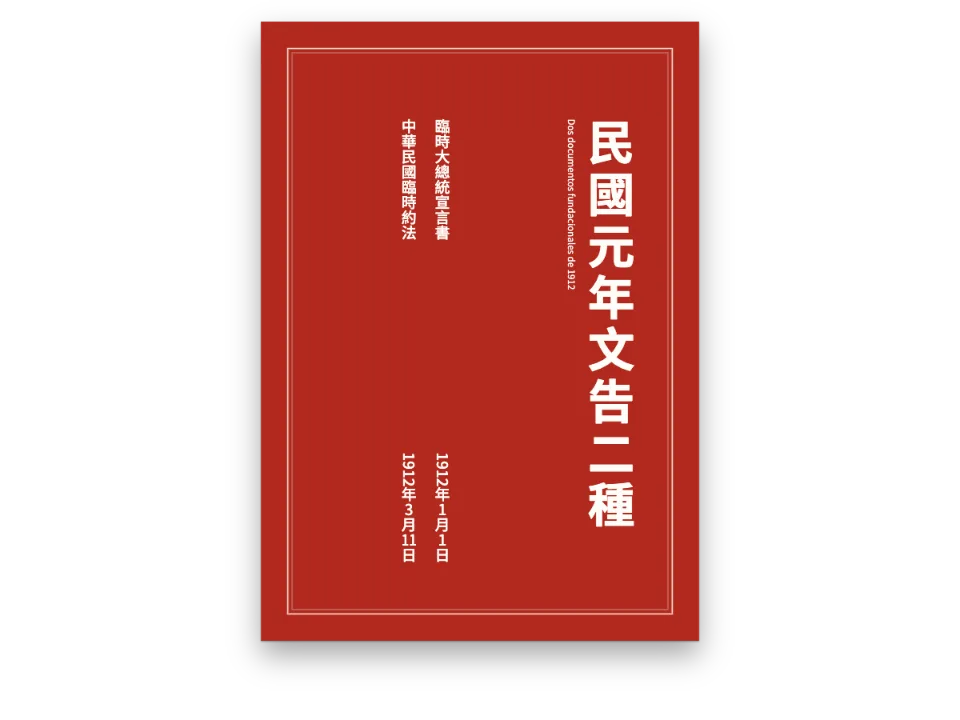
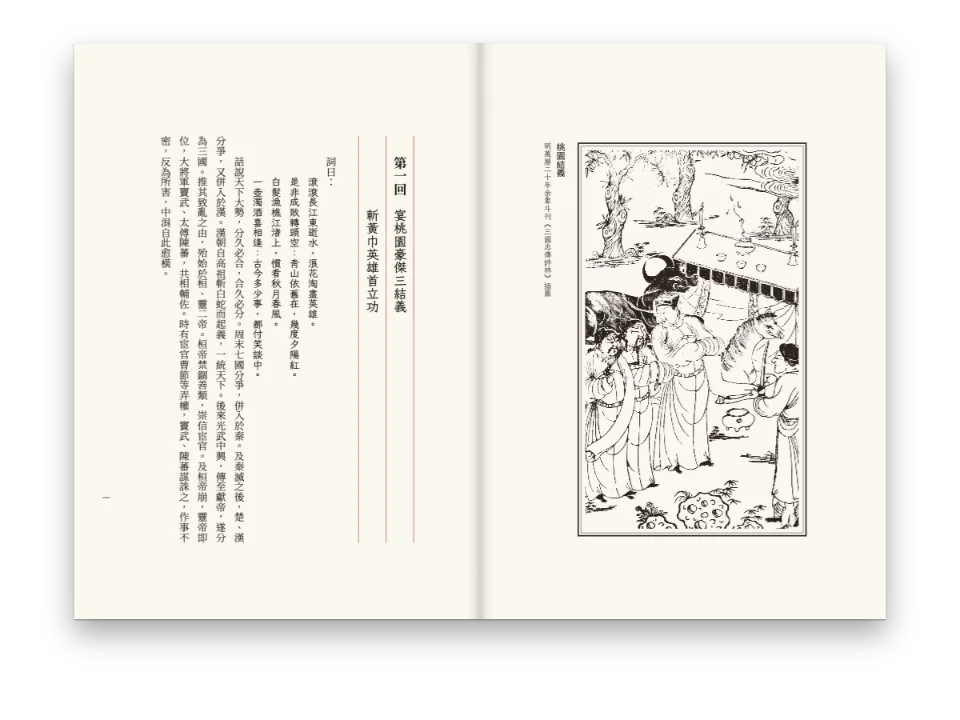
Lo que vas a componer
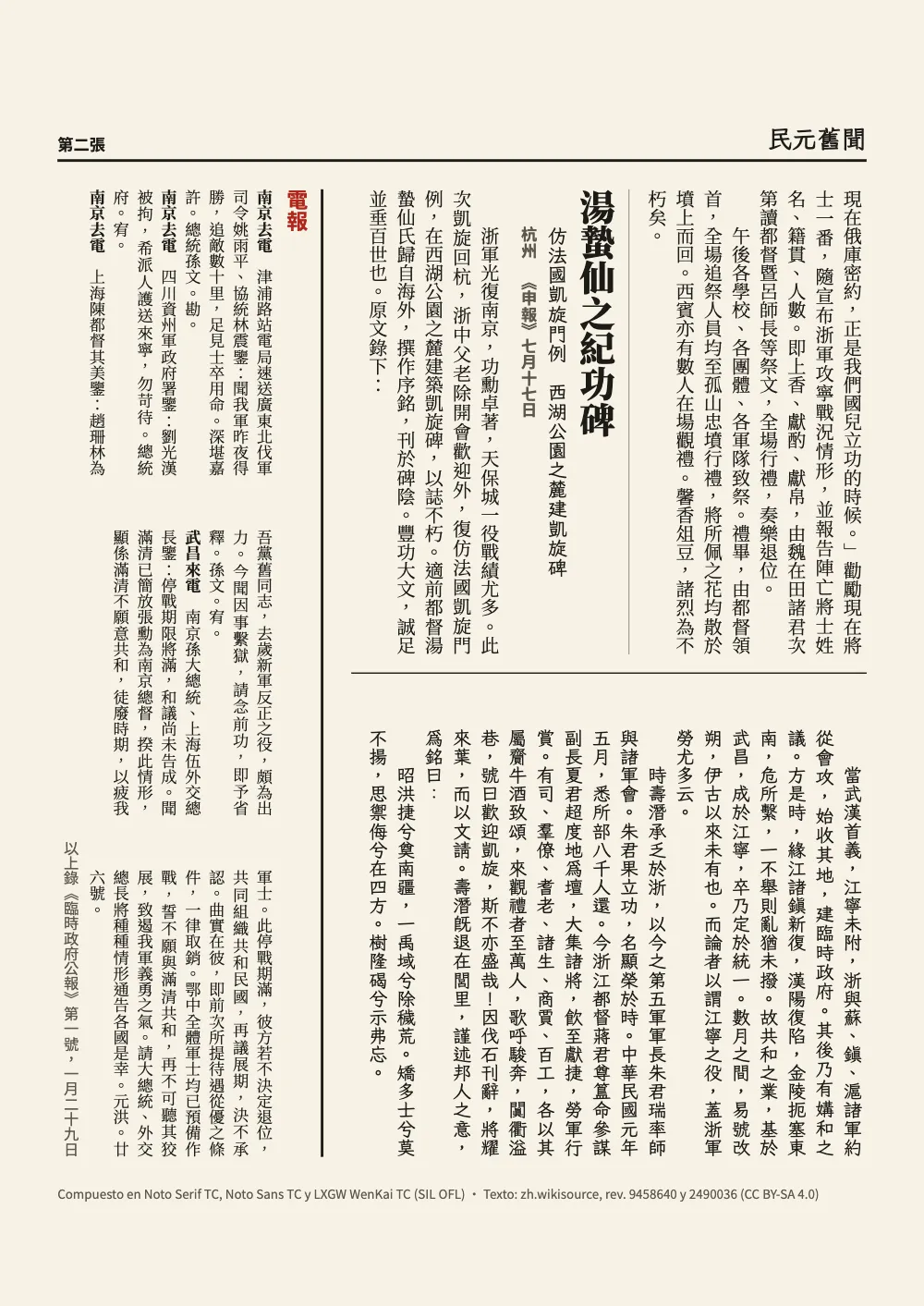
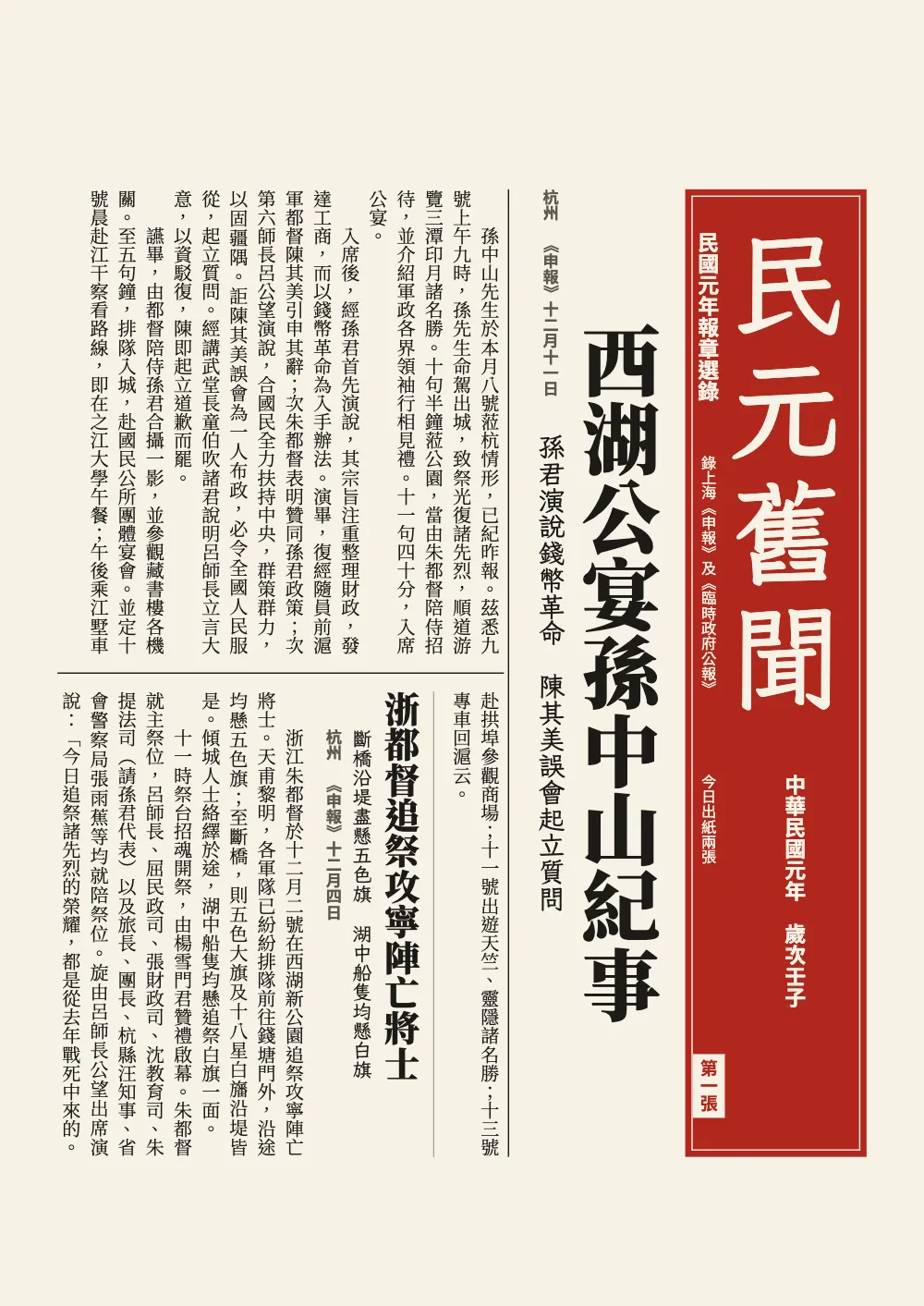
Dos hojas de un periódico chino tal como se componía en 1912, el primer año de la República, cuando la prensa aún se leía de arriba abajo. Los textos son del Shenbao de Shanghái: el banquete a Sun Yat-sen en el Lago del Oeste, donde Chen Qimei se levantó a protestar por un discurso y volvió a levantarse para disculparse; las honras a los soldados de Zhejiang muertos en la toma de Nankín; el monumento con que Hangzhou recibió al ejército a su vuelta. Cuatro telegramas del primer número del boletín del Gobierno Provisional llenan un recuadro. El texto va en dos pisos (欄) de 25 caracteres con un filete entre ellos, y los telegramas en tres. Una mancheta bermellón y el titular principal, a lo alto de toda la página, abren la primera hoja. Portada de periódico compone la misma página en horizontal.
Esta receta responde a
- ¿Cómo compongo una página de periódico chino en vertical, en pisos separados por filetes?
- ¿Cómo pongo el título de capítulo a todo el ancho mientras el texto sigue a dos columnas debajo?
- ¿Puede Postext componer tres o más columnas de texto, o hacer que el texto rodee una imagen?
- ¿Cómo defino la mancha en caracteres, tantos por línea y tantas líneas por página?
La respuesta corta
// On a vertical page two columns are two tiers (欄), stacked and filled from the upper right:
// the gutter is the gap between them, the column rule a rule across the page.
const layout = {
  layoutType: 'double', writingMode: 'vertical-rl', // binding 'auto' becomes 'right'
  gutterWidth: pt(2 * BODY),
  columnRule: { enabled: true, color: col('ink'), lineWidth: pt(0.75) },
};
// The grid counts characters down a tier and lines across the page: 25 × 29.
const cjk = { grid: { enabled: true, charsPerLine: CHARS, linesPerPage: 29 } };
// The body has two tiers at most. The telegrams take three inside a page-span box floated to
// the foot of the flow, the left of the sheet (gotcha: callout-columns), with the fences
//   :::callout{type="wires" span="page" placement="bottom" title="電報"} and :::columns{count=3}
const wires = { id: 'wires', backgroundEnabled: false,
  stripe: { enabled: true, side: 'top', width: pt(1.5), color: col('ink') }, // on its right
  padding: { top: pt(6), right: pt(0), bottom: pt(0), left: pt(0) },
  columnGap: pt((HEIGHT - 3 * 18 * 9) / 2), // three tiers of 18 characters of 9 pt
  titleStyle: { fontFamily: HEI, fontSize: pt(12), fontWeight: 700, color: col('accent') },
  body: { fontFamily: SONG, fontSize: pt(9), lineHeight: pt(13.5), textAlign: 'justify',
    firstLineIndent: pt(0), boldFontWeight: 700 } };
Ingredientes
- Funciones
- Una o dos columnasFilete de columnaAperturas diseñadasTexto verticalLibros encuadernados por la derechaRetícula de caracteresColumnas dentro de un recuadroRecuadros a todo el anchoRecuadros flotantesEstilos de títuloAtributos de títuloTextos, filetes y cajas en los diseños de páginaCabeceras y foliosCabeceras según el tipo de páginaEstilos de párrafoFuentes chinas, japonesas y coreanasAnchura de la puntuación chinaPaleta de color semánticaExportación a PDFFuentes incrustadas en el PDF
- También usa
- RecuadrosCorte de líneas en chinoBanda de capítulo a todo el anchoColor del papelPreliminares en romanos
- Tipografía
- Noto Serif TC, Noto Sans TC, LXGW WenKai TC (SIL OFL 1.1)
- Recursos
- Ninguno: todas las imágenes se dibujan en código
Elaboración
#1 · Convierte dos columnas en dos pisos
El código es la respuesta corta de arriba. Con writingMode: 'vertical-rl' la página es una página horizontal girada un cuarto de vuelta, así que layoutType: 'double' apila dos pisos, y se lee primero el de arriba; el filete de columna pasa a ser un filete que cruza la página entre ambos (escritura vertical). La retícula de caracteres da a cada piso 25 caracteres de cuerpo 五號 (10,5 pt), el máximo de una columna de periódico, y a la página 29 líneas; redondea el medianil a dos cuadratines y agranda los márgenes para dejar los pisos en medio (retícula de caracteres).
El texto admite dos pisos como mucho. Los telegramas van en tres dentro de un recuadro: span="page" le da la altura de la mancha, placement="bottom" lo lleva al pie del flujo, que en una página vertical es el borde izquierdo, y :::columns{count=3} lo corta en pisos. columnGap es lo que dejan tres pisos de 18 caracteres de 9 pt en los 546 pt de la mancha, de modo que cada piso contiene caracteres enteros.
#2 · Pon la mancheta y el titular en un solo diseño
// A page-span heading always opens a page (gotcha: page-span-heading-new-page), so the lead
// story's H1 carries the masthead in its own design, above its headline.
const MAST = 6.5 * LEAD; // the masthead's block, across the page
const block = (id, inset, style) => ({ kind: 'box', id, style,
  placement: at(inset, inset, { size: { width: pt(HEIGHT - 2 * inset),
    height: pt(MAST - 2 * inset) } }) });
const BAND = 13 * LEAD; // the whole design: masthead, headline, deck
const front = { enabled: true, minHeight: pt(BAND), slot: { elements: [
    block('field', 0, { backgroundColor: col('accent') }), // the name reversed out of it
    block('frame', 3.5, { borderColor: col('paper'), borderWidth: pt(0.75) }),
    text('name', '{title}', KAI, 700, 64, 'paper', { lineHeight: 1, letterSpacing: pt(6),
      placement: at(22, 13) }),
    text('kicker', '{subtitle}', HEI, 700, 12, 'paper', { placement: at(24, 82) }),
    text('sources', '錄{author}', HEI, 400, 8.5, 'paper', { placement: at(150, 84) }),
    text('issue', '{attr.issue}', HEI, 700, 12, 'paper', { placement: at(330, 33) }), // the year
    text('edition', '{attr.edition}', HEI, 400, 8.5, 'paper', { placement: at(330, 84) }),
    text('sheet', '第{pageNumber}張', HEI, 700, 10, 'accent', { placement: at(HEIGHT - 58, 80),
      box: { backgroundColor: col('paper'), padding: { top: pt(3), right: pt(3),
        bottom: pt(3), left: pt(3) } } }),
    // The headline down both tiers, centred; the dateline heads the deck's line.
    text('head', '{titleText}', SONG, 900, 44, 'ink', { align: 'center', lineHeight: 1.1,
      placement: at(0, MAST + 12, fill) }),
    text('deck', '{attr.deck}', KAI, 400, 15, 'ink', { align: 'center',
      placement: below('head', 6, fill) }),
    text('dateline', '{attr.dateline}', HEI, 700, 9, 'muted', { placement: below('head', 10) }),
    { kind: 'rule', id: 'foot', direction: 'horizontal', thickness: pt(0.75),
      color: col('ink'), placement: at(0, BAND - 3, fill) },
] } };
El titular de la noticia principal tenía que cruzar los dos pisos bajo la mancheta. Un título con span: 'page' se compone como apertura en la cabeza de una página, así que un segundo título así, detrás de la mancheta, habría empezado una página nueva. Por eso el H1 de la página es la noticia principal, y su estilo de título dibuja la mancheta encima del titular: un bloque bermellón de 6,5 líneas con el nombre del periódico calado y, bajo él, la línea del número: el año de la República y el del ciclo, y 今日出紙兩張, «hoy, dos hojas»; después, el titular en Noto Serif TC 900 a 44 pt. En el flujo, la anchura del diseño es la altura de la mancha sobre el papel, así que size: { width: 'fill' } con align: 'center' centra el titular a lo alto de los dos pisos. El diseño mide 13 líneas, un número entero de líneas de la rejilla, y el texto que lo sigue empieza en una línea de la rejilla.
#3 · Abre cada noticia con un diseño de título
const storyHead = { enabled: true, minHeight: pt(4 * LEAD), slot: { elements: [ // 4 lines
  { kind: 'rule', id: 'rule', direction: 'horizontal', thickness: pt(0.5), color: col('rule'),
    placement: at(0, 0, fill) },
  text('head', '{titleText}', SONG, 900, 20, 'ink', { placement: at(0, 6) }),
  text('deck', '{attr.deck}', KAI, 400, 11, 'ink', { // two characters down the tier
    placement: below('head', 4, { offset: { x: pt(2 * BODY), y: pt(4) } }) }),
  text('dateline', '{attr.dateline}', HEI, 700, 9, 'muted', { placement: below('deck', 4) }),
] } };
Un diseño de título en columna vive dentro de su piso. Su filete es direction: 'horizontal' en el flujo, así que sobre el papel baja a lo largo del piso y separa dos noticias. El titular empieza en la cabeza del piso, el sumario dos caracteres más abajo, y la data da el lugar, el periódico y el día en que salió la crónica. minHeight mantiene cada cabeza en cuatro líneas, y el texto de cada noticia empieza en la rejilla.
#4 · Pon cabecera a la segunda hoja y fírmala al pie
// The header's frame is the margin above the tiers; the footer's, the margin below them.
const above = (y, extra = {}) => ({ anchor: { to: 'container', edge: 'top-left' },
  offset: { x: pt(0), y: mm(HEAD - y) }, ...extra });
const header = { elements: [
  text('title', '{title}', KAI, 700, 14, 'ink', { align: 'right', placement: above(13, fill) }),
  text('sheet', '第{pageNumber}張', HEI, 700, 9, 'ink', { placement: above(10.8) }),
  { kind: 'rule', id: 'rule', thickness: pt(1.5), color: col('ink'), placement: above(6, fill) },
].map((element) => ({ ...element, pages: 'body' })) }; // page 1 has the masthead instead
const footer = { elements: [text('colophon', '{attr.colophon}', HEI, 400, 7, 'muted', {
  pages: 'body', placement: at(0, 17, fill) })] }; // 6 mm under the tiers
En una página vertical, las cabeceras siguen en horizontal, como describe clreq. El marco de la cabecera es el margen que queda encima de los pisos; la retícula lo agranda, y HEAD repite su cuenta para que el filete quede 6 mm por encima del primer carácter. pages: 'body' deja la página 1 a la mancheta. El colofón es un atributo del H1, así que la edición inglesa y la española imprimen cada una su línea bajo las mismas páginas en chino.
#5 · Carga cada voz con el texto que compone
const pick = (pattern) => (markdown.match(pattern) ?? []).join('');
const attrs = (...keys) => pick(new RegExp(`[{ ](?:${keys.join('|')})="[^"]*"`, 'g'));
const voices = [ // family, weights, the text it sets, and whether it runs down a column
  [SONG, ['400'], markdown, true], // the text
  [SONG, ['700', '900'], pick(/^#+ [^{\n]*|\*\*[^*]+\*\*/gm), false], // heads, labels
  [HEI, ['400', '700'], pick(/^(?:subtitle|author): .*$|style="source"\}[^:]*/gm) // masthead,
    + attrs('dateline', 'issue', 'edition', 'title', 'colophon') + '錄第一二張', true], // datelines
  [KAI, ['400'], attrs('deck') + pick(/style="inscription"\}[^:]*/g), true], // decks, the stele
  [KAI, ['700'], pick(/^title: .*$/m), false], // the paper's name
];
Fontsource sirve cada peso de estas familias en un centenar de archivos, y loadCjkFonts descarga los que toca un texto. Noto Serif TC 400 recibe la muestra entera; sus pesos 700 y 900, solo los titulares y las etiquetas de los telegramas; Noto Sans TC, las líneas de la mancheta, las datas y el colofón; LXGW WenKai TC, los sumarios, la inscripción y el nombre del periódico. Si una familia recibe menos texto del que compone, la captura falla (C12) y nombra los caracteres que tuvo que tomar de otra.
La receta completa
// ═══ Postext Cookbook · Nº 084 · A vertical newspaper page in tiers ═══════════════ // https://postext.dev/en/cookbook/vertical-newspaper-tiers // Code: MIT · Text: Shenbao, 1912 (PD); gazette, stele report: zh.wikisource (CC BY-SA 4.0) // Fonts: Noto Serif TC, Noto Sans TC, LXGW WenKai TC (SIL OFL 1.1) · Needs postext ≥ 1.9.0 import { buildDocument, renderPageToCanvas, clearMeasurementCache, loadVerticalAlternates, } from 'https://esm.sh/postext'; import { renderToPdf, decompressWoff2 } from 'https://esm.sh/postext-pdf'; const LANG = 'es'; // @lang: the language of the colophon; the news is Chinese in both editions const RECIPE = 'vertical-newspaper-tiers'; // ─── 1 · Design ───────────────────────────────────────────────────────────── // #region palette: newsprint, ink and the vermilion of the masthead const palette = { ink: '#1c1a17', // text, the rules between tiers accent: '#b0281c', // the one accent: the masthead block, the telegrams' flag rule: '#8f887c', // the hairline before each story muted: '#5e574e', // datelines, sources, the colophon paper: '#f7f2e6', // newsprint, and the masthead's type reversed out of the vermilion }; const col = (id) => ({ hex: palette[id], model: 'hex', paletteId: id }); const colorPalette = [ ...Object.entries(palette).map(([id, hex]) => ({ id, name: id, value: { hex, model: 'hex' } })), { id: 'main-color', name: 'ink (defaults)', value: { hex: palette.ink, model: 'hex' } }, ]; // #endregion const [SONG, HEI, KAI] = ['Noto Serif TC', 'Noto Sans TC', 'LXGW WenKai TC']; // 宋, 黑, 楷 const BODY = 10.5; // pt: 五號, the body size of the papers of 1912 const LEAD = 15.75; // pt: the line pitch across the page, 1.5 em const CHARS = 25; // characters down a tier: a newspaper column, 17 to 25 const HEIGHT = 2 * CHARS * BODY + 2 * BODY; // pt: two tiers and a gutter of two ems const TRIM = { w: 184, h: 260 }; // mm, 16開 const MARGIN = { top: 30, bottom: 22, side: 11 }; // mm, minimums: the grid centres the tiers // The grid grows the margins evenly, so the tiers start HEAD mm below the top edge. const HEAD = MARGIN.top + (TRIM.h - MARGIN.top - MARGIN.bottom - (HEIGHT * 25.4) / 72) / 2; // #region answer: two tiers down the page with a rule between them, three inside a box // On a vertical page two columns are two tiers (欄), stacked and filled from the upper right: // the gutter is the gap between them, the column rule a rule across the page. const layout = { layoutType: 'double', writingMode: 'vertical-rl', // binding 'auto' becomes 'right' gutterWidth: pt(2 * BODY), columnRule: { enabled: true, color: col('ink'), lineWidth: pt(0.75) }, }; // The grid counts characters down a tier and lines across the page: 25 × 29. const cjk = { grid: { enabled: true, charsPerLine: CHARS, linesPerPage: 29 } }; // The body has two tiers at most. The telegrams take three inside a page-span box floated to // the foot of the flow, the left of the sheet (gotcha: callout-columns), with the fences // :::callout{type="wires" span="page" placement="bottom" title="電報"} and :::columns{count=3} const wires = { id: 'wires', backgroundEnabled: false, stripe: { enabled: true, side: 'top', width: pt(1.5), color: col('ink') }, // on its right padding: { top: pt(6), right: pt(0), bottom: pt(0), left: pt(0) }, columnGap: pt((HEIGHT - 3 * 18 * 9) / 2), // three tiers of 18 characters of 9 pt titleStyle: { fontFamily: HEI, fontSize: pt(12), fontWeight: 700, color: col('accent') }, body: { fontFamily: SONG, fontSize: pt(9), lineHeight: pt(13.5), textAlign: 'justify', firstLineIndent: pt(0), boldFontWeight: 700 } }; // #endregion // In the flow of a vertical page x runs down the sheet and y leftward from its right edge. const at = (x, y, extra = {}) => ({ anchor: { to: 'container', edge: 'top-left' }, offset: { x: pt(x), y: pt(y) }, ...extra }); const text = (id, content, family, weight, size, colour, extra = {}) => ({ kind: 'text', id, content, fontFamily: family, fontWeight: weight, fontSize: pt(size), lineHeight: 1.2, color: col(colour), align: 'left', overflow: 'wrap', ...extra }); const below = (id, y, extra = {}) => ({ anchor: { to: `#${id}`, edge: 'below' }, offset: { y: pt(y) }, ...extra }); // y more points across the page, leftward const fill = { size: { width: 'fill' } }; // #region front: the masthead and the lead headline, one design down the right of page 1 // A page-span heading always opens a page (gotcha: page-span-heading-new-page), so the lead // story's H1 carries the masthead in its own design, above its headline. const MAST = 6.5 * LEAD; // the masthead's block, across the page const block = (id, inset, style) => ({ kind: 'box', id, style, placement: at(inset, inset, { size: { width: pt(HEIGHT - 2 * inset), height: pt(MAST - 2 * inset) } }) }); const BAND = 13 * LEAD; // the whole design: masthead, headline, deck const front = { enabled: true, minHeight: pt(BAND), slot: { elements: [ block('field', 0, { backgroundColor: col('accent') }), // the name reversed out of it block('frame', 3.5, { borderColor: col('paper'), borderWidth: pt(0.75) }), text('name', '{title}', KAI, 700, 64, 'paper', { lineHeight: 1, letterSpacing: pt(6), placement: at(22, 13) }), text('kicker', '{subtitle}', HEI, 700, 12, 'paper', { placement: at(24, 82) }), text('sources', '錄{author}', HEI, 400, 8.5, 'paper', { placement: at(150, 84) }), text('issue', '{attr.issue}', HEI, 700, 12, 'paper', { placement: at(330, 33) }), // the year text('edition', '{attr.edition}', HEI, 400, 8.5, 'paper', { placement: at(330, 84) }), text('sheet', '第{pageNumber}張', HEI, 700, 10, 'accent', { placement: at(HEIGHT - 58, 80), box: { backgroundColor: col('paper'), padding: { top: pt(3), right: pt(3), bottom: pt(3), left: pt(3) } } }), // The headline down both tiers, centred; the dateline heads the deck's line. text('head', '{titleText}', SONG, 900, 44, 'ink', { align: 'center', lineHeight: 1.1, placement: at(0, MAST + 12, fill) }), text('deck', '{attr.deck}', KAI, 400, 15, 'ink', { align: 'center', placement: below('head', 6, fill) }), text('dateline', '{attr.dateline}', HEI, 700, 9, 'muted', { placement: below('head', 10) }), { kind: 'rule', id: 'foot', direction: 'horizontal', thickness: pt(0.75), color: col('ink'), placement: at(0, BAND - 3, fill) }, ] } }; // #endregion // #region heads: each story opens with a hairline, the headline, a deck and a dateline const storyHead = { enabled: true, minHeight: pt(4 * LEAD), slot: { elements: [ // 4 lines { kind: 'rule', id: 'rule', direction: 'horizontal', thickness: pt(0.5), color: col('rule'), placement: at(0, 0, fill) }, text('head', '{titleText}', SONG, 900, 20, 'ink', { placement: at(0, 6) }), text('deck', '{attr.deck}', KAI, 400, 11, 'ink', { // two characters down the tier placement: below('head', 4, { offset: { x: pt(2 * BODY), y: pt(4) } }) }), text('dateline', '{attr.dateline}', HEI, 700, 9, 'muted', { placement: below('deck', 4) }), ] } }; // #endregion // #region pagehead: the second sheet's head and the colophon, horizontal on the sheet // The header's frame is the margin above the tiers; the footer's, the margin below them. const above = (y, extra = {}) => ({ anchor: { to: 'container', edge: 'top-left' }, offset: { x: pt(0), y: mm(HEAD - y) }, ...extra }); const header = { elements: [ text('title', '{title}', KAI, 700, 14, 'ink', { align: 'right', placement: above(13, fill) }), text('sheet', '第{pageNumber}張', HEI, 700, 9, 'ink', { placement: above(10.8) }), { kind: 'rule', id: 'rule', thickness: pt(1.5), color: col('ink'), placement: above(6, fill) }, ].map((element) => ({ ...element, pages: 'body' })) }; // page 1 has the masthead instead const footer = { elements: [text('colophon', '{attr.colophon}', HEI, 400, 7, 'muted', { pages: 'body', placement: at(0, 17, fill) })] }; // 6 mm under the tiers // #endregion const config = () => ({ // a factory: the engine caches resolved configs per object locale: 'zh-Hant', // Taiwan conventions: centred punctuation (gotcha: cjk-locale-tag) colorPalette, page: { sizePreset: 'custom', width: mm(TRIM.w), height: mm(TRIM.h), dpi: 150, backgroundColor: col('paper'), margins: { top: mm(MARGIN.top), bottom: mm(MARGIN.bottom), left: mm(MARGIN.side), right: mm(MARGIN.side), mirror: true }, pageNumbering: { format: 'trad-chinese-informal' }, // 第一張, 第二張 }, layout, cjk, bodyText: { fontFamily: SONG, fontSize: pt(BODY), lineHeight: pt(LEAD), color: col('ink'), boldColor: col('ink'), italicColor: col('ink'), referenceColor: col('ink'), textAlign: 'justify', firstLineIndent: em(2), indentAfterHeading: true, }, headings: { fontFamily: SONG, fontWeight: 900, color: col('ink'), levels: [ // Restated: any headings object drops the H1 break (gotcha: headings-drop-h1-break). { level: 1, span: 'page', breakBefore: { enabled: true, parity: 'any' }, marginBottom: pt(0) }, { level: 2, fontSize: pt(20), lineHeight: pt(2 * LEAD), marginTop: pt(LEAD / 2), marginBottom: pt(0), advancedDesign: storyHead }, ], }, headingStyles: [{ id: 'front', advancedDesign: front }], calloutStyles: [wires], paragraphStyles: [ { id: 'source', fontFamily: HEI, fontSize: pt(8.5), color: col('muted'), textAlign: 'right', firstLineIndent: pt(0) }, // the telegrams' source, at the foot of its line { id: 'inscription', fontFamily: KAI, indent: em(2), firstLineIndent: em(2) }, // 低二格 ], header, footer, }); // ─── 2 · Content ──────────────────────────────────────────────────────────── const markdown = String.raw`---Muestra en Markdown · 48 líneas · content.es.md
title: "民元舊聞" subtitle: "民國元年報章選錄" author: "上海《申報》及《臨時政府公報》" --- # 西湖公宴孫中山紀事 {style="front" deck="孫君演說錢幣革命 陳其美誤會起立質問" dateline="杭州 《申報》十二月十一日" issue="中華民國元年 歲次壬子" edition="今日出紙兩張" colophon="Compuesto en Noto Serif TC, Noto Sans TC y LXGW WenKai TC (SIL OFL) · Texto: zh.wikisource, rev. 9458640 y 2490036 (CC BY-SA 4.0)"} 孫中山先生於本月八號蒞杭情形,已紀昨報。茲悉九號上午九時,孫先生命駕出城,致祭光復諸先烈,順道游覽三潭印月諸名勝。十句半鐘蒞公園,當由朱都督陪侍招待,並介紹軍政各界領袖行相見禮。十一句四十分,入席公宴。 入席後,經孫君首先演說,其宗旨注重整理財政,發達工商,而以錢幣革命為入手辦法。演畢,復經隨員前滬軍都督陳其美引申其辭;次朱都督表明贊同孫君政策;次第六師長呂公望演說,合國民全力扶持中央,群策群力,以固疆隅。詎陳其美誤會為一人布政,必令全國人民服從,起立質問。經講武堂長童伯吹諸君說明呂師長立言大意,以資駁復,陳即起立道歉而罷。 讌畢,由都督陪侍孫君合攝一影,並參觀藏書樓各機關。至五句鐘,排隊入城,赴國民公所團體宴會。並定十號晨赴江干察看路線,即在之江大學午餐;午後乘江墅車赴拱埠參觀商場;十一號出遊天竺、靈隱諸名勝;十三號專車回滬云。 ## 浙都督追祭攻寧陣亡將士 {deck="斷橋沿堤盡懸五色旗 湖中船隻均懸白旗" dateline="杭州 《申報》十二月四日"} 浙江朱都督於十二月二號在西湖新公園追祭攻寧陣亡將士。天甫黎明,各軍隊已紛紛排隊前往錢塘門外,沿途均懸五色旗;至斷橋,則五色大旗及十八星白旛沿堤皆是。傾城人士絡繹於途,湖中船隻均懸追祭白旗一面。 十一時祭台招魂開祭,由楊雪門君贊禮啟幕。朱都督就主祭位,呂師長、屈民政司、張財政司、沈教育司、朱提法司(請孫君代表)以及旅長、團長、杭縣汪知事、省會警察局張雨蕉等均就陪祭位。旋由呂師長公望出席演說:「今日追祭諸先烈的榮耀,都是從去年戰死中來的。現在俄庫密約,正是我們國兒立功的時候。」勸勵現在將士一番,隨宣布浙軍攻寧戰況情形,並報告陣亡將士姓名、籍貫、人數。即上香、獻酌、獻帛,由魏在田諸君次第讀都督暨呂師長等祭文,全場行禮,奏樂退位。 午後各學校、各團體、各軍隊致祭。禮畢,由都督領首,全場追祭人員均至孤山忠墳行禮,將所佩之花均散於墳上而回。西賓亦有數人在場觀禮。馨香俎豆,諸烈為不朽矣。 :::callout{type="wires" span="page" placement="bottom" title="電報"} :::columns{count=3} **南京去電** 津浦路站電局速送廣東北伐軍司令姚雨平、協統林震鑒:聞我軍昨夜得勝,追敵數十里,足見士卒用命。深堪嘉許。總統孫文。勘。 **南京去電** 四川資州軍政府署鑒:劉光漢被拘,希派人護送來寧,勿苛待。總統府。宥。 **南京去電** 上海陳都督其美鑒:趙珊林為吾黨舊同志,去歲新軍反正之役,頗為出力。今聞因事繫獄,請念前功,即予省釋。孫文。宥。 **武昌來電** 南京孫大總統、上海伍外交總長鑒:停戰期限將滿,和議尚未告成。聞滿清已簡放張勳為南京總督,揆此情形,顯係滿清不願意共和,徒廢時期,以疲我軍士。此停戰期滿,彼方若不決定退位,共同組織共和民國,再議展期,決不承認。曲實在彼,即前次所提待遇從優之條件,一律取銷。鄂中全體軍士均已預備作戰,誓不願與滿清共和,再不可聽其狡展,致遏我軍義勇之氣。請大總統、外交總長將種種情形通告各國是幸。元洪。廿六號。 ::: :::paragraphs{style="source"} 以上錄《臨時政府公報》第一號,一月二十九日 ::: ::: ## 湯蟄仙之紀功碑 {deck="仿法國凱旋門例 西湖公園之麓建凱旋碑" dateline="杭州 《申報》七月十七日"} 浙軍光復南京,功勳卓著,天保城一役戰績尤多。此次凱旋回杭,浙中父老除開會歡迎外,復仿法國凱旋門例,在西湖公園之麓建築凱旋碑,以誌不朽。適前都督湯蟄仙氏歸自海外,撰作序銘,刊於碑陰。豐功大文,誠足並垂百世也。原文錄下: :::paragraphs{style="inscription"} 當武漢首義,江寧未附,浙與蘇、鎮、滬諸軍約從會攻,始收其地,建臨時政府。其後乃有媾和之議。方是時,緣江諸鎮新復,漢陽復陷,金陵扼塞東南,危所繫,一不舉則亂猶未撥。故共和之業,基於武昌,成於江寧,卒乃定於統一。數月之間,易號改朔,伊古以來未有也。而論者以謂江寧之役,蓋浙軍勞尤多云。 時壽潛承乏於浙,以今之第五軍軍長朱君瑞率師與諸軍會。朱君果立功,名顯榮於時。中華民國元年五月,悉所部八千人還。今浙江都督蔣君尊簋命參謀副長夏君超度地為壇,大集諸將,飲至獻捷,勞軍行賞。有司、羣僚、耆老、諸生、商賈、百工,各以其屬齎牛酒致頌,來觀禮者至萬人,歌呼駿奔,闐衢溢巷,號曰歡迎凱旋,斯不亦盛哉!因伐石刊辭,將耀來葉,而以文請。壽潛既退在閭里,謹述邦人之意,為銘曰: 昭洪捷兮奠南疆,一禹域兮除穢荒。矯多士兮莫不揚,思禦侮兮在四方。樹隆碣兮示弗忘。 :::`; // content.<lang>.md: the same Chinese text in both // ─── 3 · Fonts ────────────────────────────────────────────────────────────── // Every face the pages paint; the Chinese ones by files (gotcha: cjk-fonts-slices). const FONTS = { 'Noto Serif TC': ['400', '700', '900'], 'Noto Sans TC': ['400', '700'], 'LXGW WenKai TC': ['400', '700'] }; // #region voices: each face loads the files of the text it sets const pick = (pattern) => (markdown.match(pattern) ?? []).join(''); const attrs = (...keys) => pick(new RegExp(`[{ ](?:${keys.join('|')})="[^"]*"`, 'g')); const voices = [ // family, weights, the text it sets, and whether it runs down a column [SONG, ['400'], markdown, true], // the text [SONG, ['700', '900'], pick(/^#+ [^{\n]*|\*\*[^*]+\*\*/gm), false], // heads, labels [HEI, ['400', '700'], pick(/^(?:subtitle|author): .*$|style="source"\}[^:]*/gm) // masthead, + attrs('dateline', 'issue', 'edition', 'title', 'colophon') + '錄第一二張', true], // datelines [KAI, ['400'], attrs('deck') + pick(/style="inscription"\}[^:]*/g), true], // decks, the stele [KAI, ['700'], pick(/^title: .*$/m), false], // the paper's name ]; // #endregion // ─── 4 · Build & show ─────────────────────────────────────────────────────── await loadFonts(FONTS, markdown); for (const [family, weights, text, vertical] of voices) { await loadCjkFonts({ [family]: weights }, text, { vertical }); } const doc = await buildWithFonts(() => buildDocument({ markdown }, config()), markdown); showBook(doc, { title: t({ en: 'A vertical newspaper page in tiers', es: 'Una página de periódico vertical, en pisos' }) }); offerPdf(() => renderToPdf(doc, { fontProvider: cjkPdfProvider }), `${RECIPE}.pdf`);Kit · core, fonts, viewer, pdf, cjk: igual en todas las recetas · 422 líneas
// ─── Kit ── helpers shared by every Cookbook recipe · postext.dev/cookbook ───── // ─── Kit · core v1 ── the same in every recipe · postext.dev/cookbook ───────── function mm(value) { return { value, unit: 'mm' }; } function pt(value) { return { value, unit: 'pt' }; } function em(value) { return { value, unit: 'em' }; } /** The sample language's string: t({ en: 'Figure', es: 'Figura' }). */ function t(strings) { return strings[LANG] ?? Object.values(strings)[0]; } /** A file in this recipe's assets folder, served from the Postext repo by jsDelivr. */ function asset(file) { return `https://cdn.jsdelivr.net/gh/drnachio/postext@main/cookbook/${RECIPE}/assets/${file}`; } // ─── Kit · fonts v1 ── the same in every recipe · postext.dev/cookbook ──────── // Postext measures text with the faces the browser has loaded, and caches the // widths, so every face must be ready before the first build. Faces come from // Fontsource: the same static files the PDF embeds, so screen and PDF agree. /** faces = { 'Family Name': ['400', '400i', '700'] }. `text` is the sample: * letters beyond Latin-1 (č, ł, ő…) also load the latin-ext files. With * `optional`, a face Fontsource does not ship is skipped instead of failing. * Resolves to the number of faces added. */ async function loadFonts(faces, text = '', { optional = false } = {}) { kitStatus('Loading fonts…'); const ranges = { latin: 'U+0000-00FF,U+0131,U+0152-0153,U+02BB-02BC,U+02C6,U+02DA,U+02DC,U+0304,U+0308,U+0329,' + 'U+2000-206F,U+20AC,U+2122,U+2191,U+2193,U+2212,U+2215,U+FEFF,U+FFFD', 'latin-ext': 'U+0100-02BA,U+02BD-02C5,U+02C7-02CC,U+02CE-02D7,U+02DD-02FF,U+0304,U+0308,U+0329,' + 'U+1D00-1DBF,U+1E00-1E9F,U+1EF2-1EFF,U+2020,U+20A0-20AB,U+20AD-20C0,U+2113,U+2C60-2C7F,U+A720-A7FF', }; const subsets = /[Ā-˿Ḁ-ỿ]/.test(text) ? ['latin', 'latin-ext'] : ['latin']; const jobs = []; let added = 0; for (const [family, specs] of Object.entries(faces)) { const id = fontsourceId(family); const meta = optional ? await fontsourceMeta(family) : null; for (const spec of new Set(specs)) { const weight = parseInt(spec, 10); const style = spec.endsWith('i') ? 'italic' : 'normal'; if (hasFace(family, weight, style)) continue; if (optional && !(meta?.weights.includes(weight) && meta.styles.includes(style))) continue; for (const subset of subsets) { const url = `https://cdn.jsdelivr.net/npm/@fontsource/${id}@5/files/${id}-${subset}-${weight}-${style}.woff2`; const face = new FontFace(family, `url(${url}) format('woff2')`, { weight: String(weight), style, unicodeRange: ranges[subset] }); jobs.push(face.load().then((ready) => { document.fonts.add(ready); added++; }, () => { if (subset === 'latin' && !optional) throw new Error(`Fontsource has no ${family} ${weight} ${style}`); })); } } } await Promise.all(jobs).catch((error) => { kitFail(error); throw error; }); return added; } /** Runs `build` (a buildDocument or buildBundle call) and checks the faces * the pages use. A regular face missing from FONTS is loaded with a warning; * bold and italic variants are loaded when the family ships them. Then the * measurement caches are cleared and the build runs again. */ async function buildWithFonts(build, text = '') { const tried = new Set(); for (let round = 0; round < 3; round++) { kitStatus('Laying out…'); await new Promise(requestAnimationFrame); // let the status paint first const result = await Promise.resolve().then(build).catch((error) => { kitFail(error); throw error; }); const wanted = { base: {}, variants: {} }; for (const { font, base } of [result].flat().flatMap(fontStringsOf)) { const { family, weight, style } = parseFont(font); const key = `${family}|${weight}|${style}`; if (tried.has(key) || hasFace(family, weight, style)) continue; tried.add(key); (wanted[base ? 'base' : 'variants'][family] ??= []).push(`${weight}${style === 'italic' ? 'i' : ''}`); } if (Object.keys(wanted.base).length) { console.warn(`[cookbook] FONTS does not list ${JSON.stringify(wanted.base)}: loading them.`); } const added = await loadFonts(wanted.base, text) + await loadFonts(wanted.variants, text, { optional: true }); if (added === 0) return result; clearMeasurementCache(); } throw new Error('The fonts did not settle after three builds.'); } /** Every font string of the layout. `base` marks a block's own face; its * bold, italic and bold-italic variants are listed whether or not used. */ function fontStringsOf(doc) { const found = new Map(); const walk = (node) => { if (!node || typeof node !== 'object') return; if (Array.isArray(node)) { node.forEach(walk); return; } for (const [key, value] of Object.entries(node)) { if (typeof value === 'string' && /fontString$/i.test(key)) { found.set(value, found.get(value) || key === 'fontString'); } else if (value && typeof value === 'object') walk(value); } }; walk(doc.pages); walk(doc.blocks); return [...found].map(([font, base]) => ({ font, base })); } /** '700 37.5px Open Sans' / 'italic 400 13px "Source Serif 4"' → { family, weight, style }. * A string with no weight ('95.8px Young Serif', from a design text) is 400. */ function parseFont(font) { const m = /^(?:(italic|oblique)\s+)?(?:small-caps\s+)?(?:(\d+|bold|normal)\s+)?[\d.]+px\s+(.+)$/.exec(font.trim()); if (!m) throw new Error(`Unexpected font string: ${font}`); const weight = m[2] === 'bold' ? 700 : !m[2] || m[2] === 'normal' ? 400 : Number(m[2]); return { family: m[3].replace(/^["']|["']$/g, ''), weight, style: m[1] ? 'italic' : 'normal' }; } /** True when a loaded FontFace covers exactly this family, weight and style * (document.fonts.check() is also true for families nobody declared). */ function hasFace(family, weight, style) { for (const face of document.fonts) { if (face.status !== 'loaded' || face.style !== style) continue; if (face.family.replace(/^["']|["']$/g, '') !== family) continue; const [low, high = low] = face.weight.split(' ').map(Number); if (weight >= low && weight <= high) return true; } return false; } /** Fontsource's id for a family: 'Source Serif 4' → 'source-serif-4'. */ function fontsourceId(family) { return family.toLowerCase().replace(/\s+/g, '-'); } /** The weights and styles a family ships ({ weights: [400, 700], styles: ['normal', 'italic'] }), or null. */ function fontsourceMeta(family) { fontsourceMeta.cache ??= new Map(); const id = fontsourceId(family); if (!fontsourceMeta.cache.has(id)) { fontsourceMeta.cache.set(id, fetch(`https://api.fontsource.org/v1/fonts/${id}`) .then((res) => (res.ok ? res.json() : null), () => null)); } return fontsourceMeta.cache.get(id); } // ─── Kit · viewer v1 ── the same in every recipe · postext.dev/cookbook ─────── /** Shows the pages as facing spreads on a dark desk: the first page is a * recto on its own, then verso | recto pairs, as in a bound book. Pages * are painted when they scroll near the screen. */ function showPages(docs, { title, width = 460 } = {}) { const root = viewer(title); const pages = [docs].flat().flatMap((doc) => doc.pages.map((page) => ({ doc, page, n: (doc.pageIndexOffset ?? 0) + page.index }))); const spreads = []; let verso = null; for (const p of pages) { if (p.n % 2 === 1) { if (verso) spreads.push([verso, null]); verso = p; } else { spreads.push([verso, p]); verso = null; } } if (verso) spreads.push([verso, null]); const density = Math.min(window.devicePixelRatio || 1, 2); showPages.painter?.disconnect(); const painter = new IntersectionObserver((entries) => { for (const { isIntersecting, target } of entries) { if (!isIntersecting) continue; painter.unobserve(target); const { doc, page } = target.postext; renderPageToCanvas(page, doc, target, { scale: (width * density) / page.width }); } }, { rootMargin: '800px' }); showPages.painter = painter; root.replaceChildren(...spreads.map((pair) => { const spread = document.createElement('div'); spread.className = 'pt-spread'; for (const p of pair) { const figure = document.createElement('figure'); if (p) { const label = p.page.pageLabel || String(p.n + 1); const canvas = document.createElement('canvas'); canvas.postext = p; canvas.style.aspectRatio = `${p.page.width} / ${p.page.height}`; canvas.setAttribute('role', 'img'); canvas.setAttribute('aria-label', `Page ${label}`); const folio = document.createElement('figcaption'); folio.textContent = label; figure.append(canvas, folio); painter.observe(canvas); } else figure.className = 'pt-blank'; spread.append(figure); } return spread; })); kitStatus(`${pages.length} ${pages.length === 1 ? 'page' : 'pages'}`); document.documentElement.dataset.postext = 'ready'; return pages.length; } /** The desk, the bar and the error reporting, created once. */ function viewer(title) { if (!document.getElementById('pt-kit')) { document.head.insertAdjacentHTML('beforeend', `<style id="pt-kit"> :root { color-scheme: dark; } body { margin: 0; background: #0e1014; color: #b9bcc4; font: 13px/1.45 system-ui, sans-serif; } #pt-bar { position: sticky; top: 0; z-index: 1; display: flex; flex-wrap: wrap; align-items: center; gap: 6px 16px; padding: 10px 16px; background: rgb(14 16 20 / .92); backdrop-filter: blur(6px); border-bottom: 1px solid #23262d; } #pt-bar strong { color: #f4f1ea; font-weight: 600; } #pt-actions { display: flex; gap: 12px; margin-left: auto; } #pt-actions a, #pt-actions button { color: #d8a21a; font: inherit; background: none; border: 0; padding: 0; cursor: pointer; } #pages { display: grid; justify-items: center; gap: 48px; padding: 32px 16px 72px; } .pt-spread { display: flex; } .pt-spread figure { margin: 0; width: min(460px, 44vw); } .pt-spread canvas { display: block; width: 100%; background: #fff; box-shadow: 0 1px 2px rgb(0 0 0 / .5), 0 22px 44px -16px rgb(0 0 0 / .8); } .pt-spread figure:first-child canvas { box-shadow: inset -14px 0 14px -14px rgb(0 0 0 / .18), 0 1px 2px rgb(0 0 0 / .5), 0 22px 44px -16px rgb(0 0 0 / .8); } .pt-spread figcaption { margin-top: 10px; text-align: center; font: 600 10px/1 system-ui, sans-serif; letter-spacing: .18em; text-transform: uppercase; color: #6c7079; } .pt-blank { visibility: hidden; } @media (max-width: 760px) { .pt-spread { flex-direction: column; gap: 32px; } .pt-spread figure { width: min(460px, 92vw); } .pt-blank { display: none; } } </style>`); document.body.insertAdjacentHTML('afterbegin', '<header id="pt-bar"><strong id="pt-title"></strong><span id="pt-status" role="status"></span><span id="pt-actions"></span></header>'); document.getElementById('pt-title').textContent = document.title || 'Postext'; addEventListener('error', (event) => kitFail(event.error ?? event.message)); addEventListener('unhandledrejection', (event) => kitFail(event.reason)); } if (title) document.getElementById('pt-title').textContent = title; return document.getElementById('pages') ?? document.body.appendChild(Object.assign(document.createElement('main'), { id: 'pages' })); } function kitStatus(text) { viewer(); document.getElementById('pt-status').textContent = text; } function kitFail(error) { document.documentElement.dataset.postext = 'error'; kitStatus(`Error: ${error?.message ?? error}`); } // ─── Kit · pdf v1 ── the same in every recipe that exports a PDF ────────────── /** postext-pdf embeds TrueType bytes. Fetch the Fontsource file the screen * used, snapping to a weight the family ships and falling back to upright * when it has no italic: the PDF asks for every face a block could use. */ async function fontsourceProvider(family, weight, style) { const id = fontsourceId(family); const meta = await fontsourceMeta(family); const weights = meta?.weights?.length ? meta.weights : [400, 700]; const w = weights.reduce((a, b) => (Math.abs(b - weight) < Math.abs(a - weight) ? b : a)); const s = style === 'italic' && meta && !meta.styles.includes('italic') ? 'normal' : style; const res = await fetch(`https://cdn.jsdelivr.net/npm/@fontsource/${id}@5/files/${id}-latin-${w}-${s}.woff2`); if (!res.ok) throw new Error(`Fontsource has no ${family} ${w} ${s} (${res.status})`); return decompressWoff2(new Uint8Array(await res.arrayBuffer())); } /** A "Build the PDF" button in the bar. Once built: "Open the PDF" (a new * tab, since CodePen's preview frame cannot show PDFs) and a download link. */ function offerPdf(makePdf, filename) { viewer(); const button = Object.assign(document.createElement('button'), { type: 'button', textContent: 'Build the PDF' }); button.dataset.postextPdf = filename; button.addEventListener('click', async () => { button.disabled = true; button.textContent = 'Building the PDF…'; try { const bytes = await makePdf(); const url = URL.createObjectURL(new Blob([bytes], { type: 'application/pdf' })); const size = `${Math.max(1, Math.round(bytes.length / 1024))} KB`; button.replaceWith( Object.assign(document.createElement('a'), { href: url, target: '_blank', rel: 'noopener', textContent: 'Open the PDF ↗' }), Object.assign(document.createElement('a'), { href: url, download: filename, textContent: `Download ${filename} · ${size}` })); } catch (error) { button.disabled = false; button.textContent = 'Build the PDF'; kitFail(error); } }); document.getElementById('pt-actions').append(button); } // ─── Kit · cjk v1 ── Chinese, Japanese and Korean books · postext.dev/cookbook ─ // Fontsource ships a CJK family as about a hundred files per weight, each // declared in its stylesheet with the unicode-range it covers. The screen // loads the files the sample touches; the PDF gets the same files for the // characters its pages set in each face, and embeds each as a subset. // A book bound on the right (vertical text) is shown with its spreads // mirrored: page 1 alone on the left of the spine, then [3 | 2]. /** The files of a Fontsource face, read from its stylesheet: { url, range, * ranges }, the last declared first (the order the browser tries them in). */ function cjkSlices(family, weight, style) { cjkSlices.cache ??= new Map(); const id = fontsourceId(family); const css = `https://cdn.jsdelivr.net/npm/@fontsource/${id}@5/${weight}${style === 'italic' ? '-italic' : ''}.css`; if (!cjkSlices.cache.has(css)) { cjkSlices.cache.set(css, fetch(css) .then((res) => { if (!res.ok) throw new Error(`Fontsource has no ${family} ${weight} ${style} (${res.status})`); return res.text(); }) .then((text) => [...text.matchAll(/@font-face\s*{([^}]*)}/g)].map(([, rule]) => { const range = /unicode-range:\s*([^;]+);/.exec(rule)?.[1].trim() ?? 'U+0-10FFFF'; const ranges = range.split(',').map((part) => { const [lo, hi = lo] = part.trim().slice(2).split('-'); return [parseInt(lo, 16), parseInt(hi, 16)]; }); return { url: new URL(/url\(([^)]+?\.woff2)\)/.exec(rule)[1], css).href, range, ranges }; }).reverse())); } return cjkSlices.cache.get(css); } /** The file of `slices` that holds code point `cp`, if any. */ function cjkSliceFor(slices, cp) { return slices.find((slice) => slice.ranges.some(([lo, hi]) => cp >= lo && cp <= hi)); } /** Whether Fontsource serves `family` as a Chinese, Japanese or Korean * family (its subsets name the script). Fails when the API does not * answer: a CJK face taken for a Latin one would paint in a system face. */ async function isCjkFamily(family) { const meta = await fontsourceMeta(family); if (!meta) throw new Error(`api.fontsource.org did not describe ${family}: reload to try again`); return !!meta.subsets?.some((subset) => /^(chinese|japanese|korean)/.test(subset)); } /** faces = { 'Noto Serif TC': ['400', '700'] }, as for loadFonts: the * whole FONTS object may be passed, its other families are left to * loadFonts. Adds one FontFace per file of each CJK face with its * unicodeRange, then loads the files `text` touches. `text` is what the * faces set: the sample for the text face; a book in several voices calls * it once per voice (loadCjkFonts({ 'LXGW WenKai TC': ['400'] }, quotes)), * so the heading and quotation faces fetch and check only their own * characters. Fails when a character of `text` is in no file of a face. * List every weight the pages use: a weight left to buildWithFonts gets * the latin file only. With { vertical: true } it also loads each * family's vertical forms (brackets, quotes, pause marks) for the canvas, * which needs loadVerticalAlternates imported from postext. Resolves to * the number of files loaded. */ async function loadCjkFonts(faces, text, { vertical = false } = {}) { kitStatus('Loading fonts…'); let loaded = 0; try { if (vertical && typeof loadVerticalAlternates !== 'function') { throw new Error('loadCjkFonts(…, { vertical: true }) needs loadVerticalAlternates imported from postext'); } for (const [family, specs] of Object.entries(faces)) { if (!(await isCjkFamily(family))) continue; const twin = []; for (const spec of new Set(specs)) { const weight = parseInt(spec, 10); const style = spec.endsWith('i') ? 'italic' : 'normal'; const slices = await cjkSlices(family, weight, style); const missing = [...new Set(text)].filter((ch) => /\S/.test(ch) && !cjkSliceFor(slices, ch.codePointAt(0))); if (missing.length) { throw new Error(`${family} ${spec} has no file for ${missing.slice(0, 12).join(' ')}: ` + `give each face the text it sets (loadCjkFonts({ '${family}': ['${spec}'] }, text))`); } for (const slice of slices) { document.fonts.add(new FontFace(family, `url(${slice.url}) format('woff2')`, { weight: String(weight), style, unicodeRange: slice.range })); twin.push({ source: slice.url, weight: String(weight), style, unicodeRange: slice.range }); } const font = `${style === 'italic' ? 'italic ' : ''}${weight} 16px "${family}"`; loaded += (await document.fonts.load(font, text)).length; if (!document.fonts.check(font, text)) throw new Error(`${family} ${spec} did not load for the sample`); } // The same files under a twin name with the `vert` feature on: the // canvas paints the punctuation of vertical lines with it. if (vertical && twin.length) await loadVerticalAlternates(family, twin); } } catch (error) { kitFail(error); throw error; } return loaded; } /** The PDF font provider for recipes with CJK faces: a family whose * Fontsource subsets are Chinese, Japanese or Korean gets the files that * hold the characters its pages set (`request.codePoints`); any other * family goes to fontsourceProvider (the "pdf" block). */ async function cjkPdfProvider(family, weight, style, request) { if (!(await isCjkFamily(family))) return fontsourceProvider(family, weight, style); const meta = await fontsourceMeta(family); const weights = meta.weights?.length ? meta.weights : [400, 700]; const w = weights.reduce((a, b) => (Math.abs(b - weight) < Math.abs(a - weight) ? b : a)); const s = style === 'italic' && !meta.styles.includes('italic') ? 'normal' : style; const slices = await cjkSlices(family, w, s); const picked = new Set(); for (const cp of request?.codePoints ?? []) { const slice = cjkSliceFor(slices, cp); if (slice) picked.add(slice); } if (!picked.size) picked.add(slices[0]); return Promise.all(slices.filter((slice) => picked.has(slice)).map(async (slice) => { const res = await fetch(slice.url); if (!res.ok) throw new Error(`Fontsource file ${slice.url} (${res.status})`); return decompressWoff2(new Uint8Array(await res.arrayBuffer())); })); } /** showPages for a book bound on either edge. A right-bound book (the * document says so: doc.binding is 'right' for page.binding 'right' and * for vertical text) lies on the desk as it opens: page 1 alone on the * left of the spine, then [3 | 2], the spine shade on each page's inner * edge. `binding` ('left' | 'right') overrides the document's. */ function showBook(docs, { binding, ...options } = {}) { const count = showPages(docs, options); const right = (binding ?? [docs].flat()[0]?.binding) === 'right'; if (!document.getElementById('pt-kit-cjk')) { // The pages keep direction ltr: a canvas draws text in the direction its // element inherits, and under rtl each run would end where the engine // starts it, its brackets mirrored. document.head.insertAdjacentHTML('beforeend', `<style id="pt-kit-cjk"> .pt-spread[dir="rtl"] canvas { direction: ltr; } .pt-spread[dir="rtl"] figure:first-child canvas { box-shadow: inset 14px 0 14px -14px rgb(0 0 0 / .18), 0 1px 2px rgb(0 0 0 / .5), 0 22px 44px -16px rgb(0 0 0 / .8); } </style>`); } // Each pair stays [verso, recto] in the page; right to left, the verso // sits on the right. Phones stack the pages in reading order either way. for (const spread of document.querySelectorAll('#pages > .pt-spread')) spread.dir = right ? 'rtl' : 'ltr'; document.getElementById('pages').dataset.binding = right ? 'right' : 'left'; return count; } // ─── /Kit ───────────────────────────────────────────────────────────────────────
El script.js compuesto funciona tal cual: pégalo como script de módulo en cualquier página o abre la receta en CodePen. Carpeta de la receta en GitHub ↗
Variantes
#Da cuatro pisos a los telegramas
Cuatro pisos de 14 caracteres caben en la misma altura, y el recuadro se estrecha hasta las líneas que ocupan.
-  columnGap: pt((HEIGHT - 3 * 18 * 9) / 2), // three tiers of 18 characters of 9 pt
+  columnGap: pt((HEIGHT - 4 * 14 * 9) / 3), // four tiers of 14 characters of 9 pt
En el Markdown, :::columns{count=4}.
#Compón las noticias en un solo piso
Un piso de 52 caracteres ocupa toda la altura de la mancha: 193 mm de papel por cada línea. Cada cabeza de noticia ocupa ahora cuatro líneas de la página entera, y las dos hojas pasan a ser tres.
-  layoutType: 'double', writingMode: 'vertical-rl', // binding 'auto' becomes 'right'
+  layoutType: 'single', writingMode: 'vertical-rl', // binding 'auto' becomes 'right'
Con charsPerLine: 2 * CHARS + 2 en la retícula.
Errores frecuentes
Error frecuente
Un título a todo el ancho siempre abre una página nueva
Un título cuyo nivel o estilo fija span: 'page' se compone como apertura en la cabeza de una página, tenga o no breakBefore. Colocado después de otro texto, o de otra apertura en la misma página, pasa a la página siguiente y deja vacío el resto de la actual. Un titular que cruza las dos columnas (o los dos pisos de una página vertical) bajo la cabecera del periódico va en el diseño de la propia apertura, junto a la cabecera, o dentro de un recuadro :::callout{span="page"} como título sin span, que es como newspaper-front-page compone sus titulares. Aperturas diseñadas →
Error frecuente
:::columns solo funciona dentro de un recuadro y no se parte
:::columns se ignora fuera de un recuadro, y un recuadro que se parte nunca corta dentro de un grupo de columnas. El atributo breaks cuenta bloques hijos, y un recuadro anidado cuenta como uno. Columnas dentro de un recuadro →
Error frecuente
Las fuentes chinas se cargan por fragmentos, con el bloque cjk
Fontsource sirve una familia china, japonesa o coreana en un centenar de archivos por peso, cada uno con un intervalo de caracteres. loadFonts solo descarga el archivo latin, así que en pantalla los caracteres chinos salen de una fuente del sistema y se miden mal, y fontsourceProvider entrega al PDF ese archivo latin, que los imprime como cajas vacías. Añade el bloque cjk del kit, llama a loadCjkFonts(FONTS, markdown) después de loadFonts (una vez por voz, con el texto que compone, si el libro usa varias fuentes chinas) y pasa a renderToPdf fontProvider: cjkPdfProvider: ambos toman los archivos que contienen los caracteres del texto. Fuentes chinas, japonesas y coreanas →
Error frecuente
Etiqueta el documento zh-Hans o zh-Hant, no con LANG
Las ediciones de una receta son en y es, pero una muestra china es china en las dos: `locale: LANG` la etiquetaría como inglés o español, separaría sus palabras latinas, llamaría Figure o Figura a sus figuras y daría al PDF un idioma equivocado. Escribe tú la etiqueta: 'zh-Hans' (convenciones de la China continental: corte GB, puntuación Kaiming) o 'zh-Hant' (Taiwán: puntuación de ancho completo centrada); 'zh-HK' para Hong Kong. Un 'zh' a secas se lee como chino simplificado continental. Corte de líneas en chino →
Error frecuente
Un libro encuadernado por la derecha muestra sus pliegos con showBook
En un libro encuadernado por la derecha (chino vertical, o page.binding 'right') la página 1 sigue siendo impar, pero queda a la izquierda del lomo, y los pliegos se leen [3 | 2]. showPages compone todos los libros como si se encuadernaran por la izquierda; showBook, del bloque cjk, lee doc.binding y refleja los pliegos. capture.hero sigue nombrando un pliego en orden de lectura, [par, impar]: [2, 3]. Libros encuadernados por la derecha →
Error frecuente
Cualquier objeto headings desactiva el salto de página del H1
Por defecto un H1 salta a una página impar (always-odd), pero cualquier objeto headings anula ese valor, así que los capítulos van seguidos y span: 'page' no hace nada. Vuelve a declarar headings.levels[0].breakBefore: { enabled: true, parity } en cada configuración. Capítulos que abren en página impar →
Error frecuente
Una configuración se cachea por identidad: crea un objeto nuevo
El motor guarda en caché las configuraciones resueltas según la identidad del objeto, así que modificar el mismo objeto y volver a componer reutiliza el resultado anterior. Crea un objeto nuevo en cada composición: por eso la configuración de una receta es una función, config(). Páginas en un canvas →
- La Noto Serif TC de Fontsource declara 爲, la forma que imprimía el Shenbao, en el rango de uno de sus archivos, pero ese archivo no tiene el glifo: el lienzo lo dibujó con una fuente del sistema y el PDF se quedó sin él (C25). Las crónicas llevan 為.
- Las transcripciones de Wikisource traen erratas que la página corrige: 己紀 por 已紀 y, dos veces, 倍侍 por 陪侍 en la crónica del banquete; en la de las honras, 勸勵一番現在將土, con 土 por 士 y el complemento detrás de 一番, que aquí se compone 勸勵現在將士一番, «arengó a los oficiales y soldados presentes». La página usa además la forma normal de cuatro variantes: 寧 por 寗, 總 por 縂 (tres veces) y 決 por 决 (dos) en los telegramas, y 刊 por 刋 en la inscripción.
- LXGW WenKai TC, tal como la sirve Fontsource, dibuja 為 como 爲, así que la inscripción, en Kai, muestra la forma antigua que al texto en Song le falta.
- Los tres pisos del recuadro son tercios de la mancha y no coinciden con los dos pisos del texto. Un periódico compone esas secciones con su propia retícula; el filete del borde derecho del recuadro separa las dos.
Créditos
- Receta
- Ignacio Ferro
- Texto
- Shenbao (Shanghái), 11 de diciembre de 1912: el banquete a Sun Yat-sen en el Lago del Oeste, Hangzhou · Shenbao; transcription by Wikisource editors · dominio público
- Shenbao (Shanghái), 4 de diciembre de 1912: las honras a los soldados de Zhejiang caídos en Nankín · Shenbao; transcription by Wikisource editors · dominio público
- Shenbao (Shanghái), 17 de julio de 1912: el monumento a la victoria del Lago del Oeste, con la inscripción de Tang Shouqian · Shenbao, Tang Shouqian; transcription and punctuation by Wikisource editors, revised for this recipe · CC BY-SA 4.0
- Cuatro telegramas del Linshi zhengfu gongbao (Boletín del Gobierno Provisional), n.º 1, 29 de enero de 1912 · Provisional Government, Nanjing; transcription and punctuation by Wikisource editors · CC BY-SA 4.0
- La puntuación de las dos primeras noticias, la cabecera, los sumarios y las datas · Postext Cookbook · CC BY 4.0
- Fuentes
- Noto Serif TC (SIL OFL 1.1) · Noto Sans TC (SIL OFL 1.1) · LXGW WenKai TC (SIL OFL 1.1)
- Código
- MIT, como Postext