かんたんな説明
文字組みを扱う小さな雑誌を、文章の両端をそろえた狭い段で組んだ例です。語と語の間を均一に保つ方法を、不ぞろいな行を黄色で示した版と並べて見せます。
できあがり
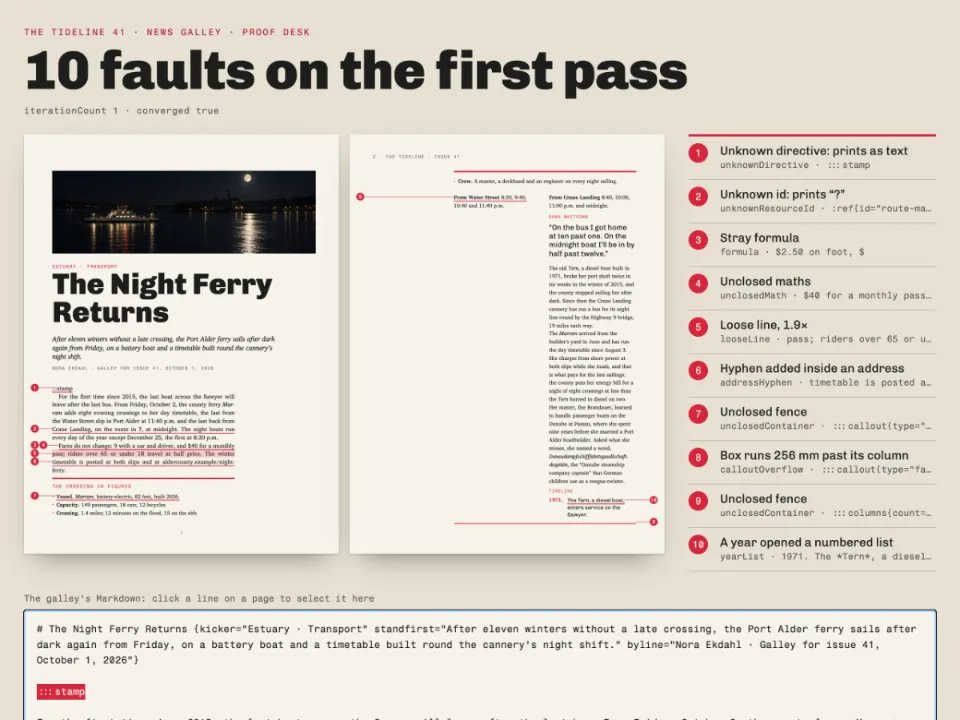
文字組みの研究所が出す専門誌『Galley』の第12号です。A5判に1行約40字の2段組みで組み、両端そろえの行が余りを吸収するための語間は5つか6つしかありません。章扉はグラファイト色の帯にKnuth–Plassのモデルを描きます。語の箱が1列に並び、グルーの黄色いばねが伸びて行長を埋める図です。論考は狭い段がなぜゆるくなるかを説明し、各規則を支える設定を段落の間に等幅書体で印刷します。3ページ目の地では、比較テストが1つの段落を左そろえ、ハイフンなしの両端そろえ、ハイフンありの両端そろえで組みます。CodePenのサンプルは同じ号をファーストフィットの改行で、ウィドウとオーファンの保護を切って組んだ版も作り、このレシピのカードと同じように、2つの2ページ目をページの上に並べて見せます。ゆるい行は蛍光イエローで塗り、孤立した行とラントには余白に札を付けます。
このレシピが答える質問
- スペイン語・フランス語・ドイツ語のテキストで、きれいな両端そろえとハイフネーションを得るには?
- ウィドウ、オーファン、最終行の一語(ラント)を避け、見出しを本文と離さないようにするには?
- ある行だけが不ぞろいに組まれたり、伸びすぎたりするのはなぜですか(URL、長い複合語、セル内の長い単語)?
- 文書のどこに問題があるか(警告、はみ出し、収束しないレイアウト)を調べるには?
手短な答え
// Knuth–Plass breaking, hyphenation and the widow, orphan and runt penalties are all on by
// default. A narrow column also needs a tighter fence round the glue, in multiples of a
// normal word space (defaults 0.6 and 2): lines past the upper fence cost more than any
// hyphen, so the breaker hyphenates or re-breaks the paragraph before it stretches that far.
const FENCES = { minWordSpacing: 0.8, maxWordSpacing: 1.6 };
const bodyText = { // config().bodyText
  fontFamily: TEXT, fontSize: pt(BODY), lineHeight: pt(LEAD), color: col('ink'),
  boldColor: col('ink'), italicColor: col('ink'), referenceColor: col('ink'),
  firstLineIndent: mm(4), indentAfterHeading: false, // justified and hyphenated by default
  ...FENCES,
};
// Hyphenation follows the document's locale, by exact code (gotcha: hyphenation-locales):
const locale = t({ en: 'en-us', es: 'es' }); // config().locale; 'es-ES' would be English
// The control: first-fit breaking, which sets each line once and moves on, with the widow and
// orphan guards off (runts are priced inside Knuth–Plass only). Same text, fonts and measure;
// a fresh object on every call, like config() itself, because the engine caches resolved
// configs by identity (gotcha: config-cache-identity).
const GREEDY = { optimalLineBreaking: false, avoidWidows: false, avoidOrphans: false };
const control = () => ({ ...config(), bodyText: { ...bodyText, ...GREEDY } });
材料
- 機能
- 最適な改行(Knuth–Plass)ウィドウ、オーファン、ラント警告と診断ハイフネーションと文書の言語字下げ、行そろえ、段落間隔囲みの中の段組み入れ子の囲み囲みデザインした章扉ページデザインの画像見出しの属性段落スタイルキャンバス上のページリソースとしての図と表セマンティックカラーパレット柱とノンブルページの役割ごとの柱
- 併用する機能
- 段抜きの章見出し帯
- 種類
- Petrona, Bricolage Grotesque, Source Code Pro (SIL OFL 1.1)
- 素材
- なし:図はすべてコードで描画
作り方
#1 · 語間の柵を狭め、保護は残す
この手順のコードは上の手短な答えにあります。Knuth–Plass、ハイフネーション、ウィドウ・オーファン・ラントのペナルティー、次の段落と離さない見出しは初期設定で有効なので、公開版は語間の上下限を通常の語間の0.8倍と1.6倍に狭めるだけです(初期値は0.6と2)。上限を超える行はどのハイフンやラントよりも高くつくので、改行処理はまずほかの改行位置を試します。2つの上下限を消すと、この論考では1.6を超える行が2行できます。ハイフネーションはlocaleのコードに完全一致で従います。'es'、'fr'、'de'はそれぞれのTeXパターンを使いますが、'es-ES'は警告なしにアメリカ英語としてハイフネーションされます。
#2 · レイアウトツリーからゆるい行に印を付ける
// debug.looseLineHighlight is Sandbox-only (gotcha: sandbox-only-warnings), so the pen reads the
// VDT: justified lines carry justifiedSpaceRatio; a paragraph cut by a column is two blocks.
function marks(doc, page) {
  const body = doc.pages.flatMap((p) => p.columns.flatMap((c) => c.blocks)).filter((b) =>
    b.type === 'paragraph' && b.containerId === undefined && b.textAlign === 'justify');
  const out = [];
  for (const column of page.columns) {
    for (const b of column.blocks.filter((x) => body.includes(x))) {
      const parts = body.filter((o) => o.contentIndex === b.contentIndex);
      b.lines.forEach((line) => {
        const at = { x: b.bbox.x, y: line.bbox.y, w: b.bbox.width, h: line.bbox.height, column };
        if (line.justifiedSpaceRatio > FENCES.maxWordSpacing || line.ragged) {
          out.push({ ...at, kind: 'loose' }); // ragged: past 3×, so the engine set it ragged
        }
        if (b.lines.length === 1 && parts.length > 1) { // Postext's names (see the essay):
          out.push({ ...at, kind: b === parts[0] ? 'widow' : 'orphan' }); // foot : head
        } else if (line.isLastLine && !/\s/.test(line.text.trim())) {
          out.push({ ...at, kind: 'runt' }); // one word alone on a paragraph's last line
        }
      });
    }
  }
  return out;
}
const TAGS = t({ en: { widow: 'widow', orphan: 'orphan', runt: 'runt' },
  es: { widow: 'viuda', orphan: 'huérfana', runt: 'corta' } });
function paintMarks(canvas, list, scale) {
  const ctx = canvas.getContext('2d');
  ctx.setTransform(scale, 0, 0, scale, 0, 0); // page px from here on
  for (const m of list) { // loose lines: a wash; lone lines and runts: a tag in the margin
    const loose = m.kind === 'loose';
    ctx.globalCompositeOperation = loose ? 'multiply' : 'source-over'; // the ink shows through
    ctx.fillStyle = loose ? palette.marker : palette.graphite;
    if (loose) { ctx.fillRect(m.x - 2, m.y + 1, m.w + 4, m.h - 1); continue; }
    ctx.font = `600 ${m.h * 0.48}px "${MONO}"`;
    const w = ctx.measureText(TAGS[m.kind]).width + m.h * 0.5;
    const x = m.column.index === 0 ? m.x - w - m.h * 0.35 : m.x + m.w + m.h * 0.35;
    ctx.fillRect(x, m.y + m.h * 0.12, w, m.h * 0.8);
    ctx.fillStyle = palette.marker;
    ctx.fillText(TAGS[m.kind], x + m.h * 0.25, m.y + m.h * 0.7);
  }
  ctx.setTransform(1, 0, 0, 1, 0, 0);
}
debug.looseLineHighlightに従うのはSandboxだけで、doc.warningsがゆるい行を挙げることはないので、marks()が自分でVDTを読みます。両端そろえの行はすべてjustifiedSpaceRatioを持ちます。2つの段に分かれた段落は断片ごとに1ブロックとして返ってきます。3倍を超える行には比率がありません。エンジンがその行を左そろえで組み、代わりにline.raggedの印を付けるからです。1行40字では上下限だけですべての行を1.6未満に保つことはできません。論考の原稿を調整している間、どの文を書き換えればよいかを印が示しました。
#3 · 対照版を公開版のページと並べる
function compare(pairs) {
  document.head.insertAdjacentHTML('beforeend', `<style>
    #compare { background: ${palette.graphite}; color: ${palette.haze}; padding: 36px 24px 44px;
      font: 500 12px/1.4 "${MONO}", monospace; } #compare > * { max-width: 860px; margin: 0 auto; }
    #compare h2 { font: 800 clamp(30px, 6vw, 72px)/0.95 "${DISPLAY}", sans-serif; color: #fff;
      margin: 6px auto 26px; letter-spacing: -0.01em; } #compare figure { margin: 0; }
    #compare .kicker { color: ${palette.marker}; letter-spacing: .16em; text-transform: uppercase; }
    #compare .pair { display: grid; grid-template-columns: 1fr 1fr; gap: 28px; }
    #compare canvas { width: 100%; display: block; }
    #compare figcaption { margin-bottom: 12px; text-transform: uppercase; letter-spacing: .12em; }
    #compare figcaption b { display: block; margin-bottom: 6px; color: #fff; letter-spacing: 0;
      font: 800 clamp(18px, 2.4vw, 26px)/1 "${DISPLAY}"; text-transform: none; }
    @media (max-width: 640px) { #compare .pair { grid-template-columns: 1fr; } }</style>`);
  const section = Object.assign(document.createElement('section'), { id: 'compare' });
  section.innerHTML = `<p class="kicker">${t({ en: 'Same text · same design · page 2',
    es: 'El mismo texto · el mismo diseño · página 2' })}</p><h2>${t({
    en: 'Two line breakers', es: 'Dos formas de cortar' })}</h2><div class="pair"></div>`;
  for (const [name, doc] of pairs) {
    const page = doc.pages[1];
    const list = marks(doc, page); // one walk per edition: the counts and the paint share it
    const n = (...kinds) => list.filter((m) => kinds.includes(m.kind)).length;
    const counts = `${t({ en: 'loose', es: 'flojas' })} ${n('loose')} · `
      + `${t({ en: 'lone', es: 'solas' })} ${n('widow', 'orphan')} · `
      + `${t({ en: 'runts', es: 'cortas' })} ${n('runt')}`;
    const figure = document.createElement('figure');
    figure.innerHTML = `<figcaption><b>${name}</b><span>${counts}</span></figcaption>`;
    const canvas = figure.appendChild(document.createElement('canvas'));
    canvas.setAttribute('role', 'img');
    canvas.setAttribute('aria-label', `${name}, ${t({ en: 'page', es: 'página' })} 2: ${counts}`);
    renderPageToCanvas(page, doc, canvas, { scale: 1000 / page.width });
    paintMarks(canvas, list, 1000 / page.width);
    section.querySelector('.pair').append(figure);
  }
  document.getElementById('pages').before(section); // #pages: the desk showPages() builds
}
2つの版は同じデザインを共有するので、2つの2ページ目の違いはすべて改行処理とその保護から来ます。英語版では、貪欲法の対照版は両端そろえの110行のうち47行が1.6を、30行が2を超え、うち3行は3倍を超えてエンジンが左そろえで組みます。一方、Knuth–Plass版は105行すべてを0.80から1.60の間に収めます。2ページ目では、対照版は段落の最終行を1行だけ段の頭へ送ってもいます。これはavoidOrphans: falseが許すものです。さらに別の段落はラントで終わります。
#4 · 設定ごとに専用の箱を与える
// A box sets all its :::columns in one body style, so each setting is a nested box; breaks="3"
// counts a nested box as one block (gotcha: callout-columns). The bench floats to a page foot.
const [SLIP_GAP, FRAME] = [3, 4]; // mm: between slips; the bench's frame round them
const slip = (id, body) => ({ id, background: col('paper'), marginBottom: mm(SLIP_GAP),
  padding: { top: mm(2.2), right: mm(2.6), bottom: mm(2.4), left: mm(2.6) },
  titleStyle: { fontFamily: MONO, fontSize: pt(6.6), fontWeight: 600, color: col('muted'),
    gap: mm(1.6) }, // code keeps its case: textAlign, not TEXTALIGN
  body: { fontSize: pt(8.6), lineHeight: pt(11.6), firstLineIndent: pt(0), ...body } });
const calloutStyles = [
  { id: 'bench', span: 'page', placement: 'bottom', background: col('graphite'),
    columnGap: mm(FRAME), // the foot needs a FRAME too: the last slip's marginBottom is dropped
    padding: { top: mm(3.4), right: mm(FRAME), bottom: mm(FRAME), left: mm(FRAME) },
    titleStyle: { ...caps(7.5, 600), color: col('marker'), gap: mm(2.4) },
    body: { fontSize: pt(8.6), lineHeight: pt(11.6), color: col('paper'), textAlign: 'left',
      firstLineIndent: pt(0) } },
  slip('ragged', { textAlign: 'left' }), // never hyphenated (gotcha: ragged-no-hyphenation)
  slip('unhyphenated', { hyphenation: false }), // justified, like the body text
  slip('justified', {}), // justified and hyphenated: the body text's own settings
  { id: 'settings', backgroundEnabled: false, marginTop: pt(3), marginBottom: pt(3), // config
    stripe: { enabled: true, side: 'left', width: pt(2), color: col('graphite') },
    padding: { top: pt(1), right: pt(0), bottom: pt(1), left: mm(3) },
    body: { fontFamily: MONO, fontSize: pt(7), lineHeight: pt(9.5), color: col('graphite'),
      firstLineIndent: pt(0) } },
];
囲みは:::columnsグループのすべての段を1つの本文スタイルで組むので、各試し刷りはそれぞれbodyを持つ入れ子の囲みにし、breaks="3"で左そろえとハイフンなしの試し刷りを1段目に積みます。左そろえのテキストはハイフネーションされないので、左そろえの試し刷りにhyphenation: falseは要りません。比較テストはplacement: 'bottom'で3ページ目の地にフロートします。最後の試し刷りのmarginBottomは囲みの終わりで捨てられるので、下パディングで4 mmの枠を繰り返しています。
#5 · モデルを章扉に描き込む
const BAND = 104; // mm from the trim's top edge to the band's foot
const DIAGRAM = { y: 64, w: MEASURE + 8, h: 34 }; // mm: its top on the page, width, height
const LABEL = 7; // pt: the diagram's labels, tracked less than caps() so the legend fits
const text = (id, content, family, size, color, x, y, extra) => ({ kind: 'text', id, content,
  fontFamily: family, fontSize: pt(size), color: col(color), align: 'left', overflow: 'wrap',
  placement: { anchor: { to: 'page', edge: 'top-left' }, offset: { x: mm(x), y: mm(y) },
    size: { width: mm(MEASURE) } }, ...extra });
const opener = () => ({ // a function: the diagram's constants are defined further down
  enabled: true,
  slot: { elements: [
    // The band box reserves the opener's height, and the H1's default marginBottom adds a line
    // of white: the body starts on the second grid line under the band. The diagram could not
    // reserve it, as images never count (gotcha: opener-image-no-reserve).
    { kind: 'box', id: 'band', style: { backgroundColor: col('graphite') },
      placement: { anchor: { to: 'bleed', edge: 'top-left' },
        size: { width: 'fill', height: mm(BAND) } } },
    text('kicker', '{attr.kicker}', MONO, 7.5, 'marker', INNER, TOP, caps(7.5, 600)),
    text('title', '{titleText}', DISPLAY, 29, 'paper', INNER, TOP + 5, // one line in both
      { fontWeight: 800, lineHeight: 1.02 }), // a multiple (gotcha: design-lineheight-multiple)
    text('standfirst', '{attr.standfirst}', TEXT, 10.5, 'haze', INNER, TOP + 19,
      { italic: true, lineHeight: 1.3 }),
    { kind: 'image', id: 'diagram', resourceId: 'diagram', placement: { anchor: { to: 'page',
      edge: 'top-left' }, offset: { x: mm(INNER), y: mm(DIAGRAM.y) },
    size: { width: mm(DIAGRAM.w), height: mm(DIAGRAM.h) } } },
    // An SVG image cannot use web fonts (gotcha: svg-no-webfonts): its labels are design text.
    ...diagramLabels().map(([id, words, x, y]) => text(id, words, MONO, LABEL, 'haze',
      INNER + x, DIAGRAM.y + y, { ...caps(LABEL), letterSpacing: pt(0.5) })),
  ] },
});
図はH1のデザインの画像要素です。図として置けばページ幅のtopフロートになり、1ページ目で参照されたtopフロートは2ページ目の頭に入ってしまいます。帯は箱で、箱は章扉が確保する高さに数えられますが画像は数えられないので、本文はminHeightなしで帯の下から始まります。H1の初期設定のmarginBottomがあるため、さらに1行下からです。ラベルは図の座標の上に置いたデザインのテキストです。画像として描くSVGはページのWebフォントを使えないからです。
レシピの全体
// ═══ Postext Cookbook · Nº 014 · Justification lab ════════════════════════════════ // https://postext.dev/en/cookbook/justification-lab // Code: MIT · Text: original (CC BY 4.0) · Diagram: generated in code (CC BY 4.0) // Fonts: Petrona, Bricolage Grotesque, Source Code Pro (SIL OFL 1.1) · Needs postext ≥ 1.4.1 // A type journal's essay set twice from one design, Knuth–Plass and greedy: the two page 2s // side by side with their loose lines marked from the layout tree, then the published pages. import { buildDocument, renderPageToCanvas, clearMeasurementCache, registerResourceImage, parseMarkdownWithIssues, } from 'https://esm.sh/postext'; const LANG = 'en'; // @lang: the language of the sample document ('en' | 'es') const RECIPE = 'justification-lab'; // ─── 1 · Design ───────────────────────────────────────────────────────────── // Graphite, paper, one highlighter yellow; col() writes hex too (gotcha: palette-skips-designs). const palette = { ink: '#1f2124', // text: a graphite near-black graphite: '#2e3136', // the accent: the opener band, the bench box, folios marker: '#ffe14d', // highlighter yellow: glue and loose lines, never type on white haze: '#c3c7cc', // type on graphite: the standfirst, the diagram's labels muted: '#66686c', // running heads, settings lines, the colophon paper: '#ffffff', }; const col = (id) => ({ hex: palette[id], model: 'hex', paletteId: id }); const colorPalette = [ ...Object.entries(palette).map(([id, hex]) => ({ id, name: id, value: { hex, model: 'hex' } })), { id: 'main-color', name: 'defaults', value: { hex: palette.graphite, model: 'hex' } }, // no blue ]; const [TEXT, DISPLAY, MONO] = ['Petrona', 'Bricolage Grotesque', 'Source Code Pro']; const [BODY, LEAD] = [9.5, 13]; // pt: body size and leading, the grid both columns share // mm: an A5 trim, mirrored margins and a narrow gutter: two columns of about 40 characters const [TRIM_W, TRIM_H, TOP, BOTTOM, INNER, OUTER, GUTTER] = [148, 210, 20, 20, 16, 13, 5]; const MEASURE = TRIM_W - INNER - OUTER; // mm: 119, the text width the opener aligns to const caps = (size, weight = 500) => ({ fontFamily: MONO, fontSize: pt(size), fontWeight: weight, letterSpacing: pt(size * 0.16), textTransform: 'uppercase' }); // tracked mono labels // #region answer: one design, two line breakers: Knuth–Plass inside fences, greedy without // Knuth–Plass breaking, hyphenation and the widow, orphan and runt penalties are all on by // default. A narrow column also needs a tighter fence round the glue, in multiples of a // normal word space (defaults 0.6 and 2): lines past the upper fence cost more than any // hyphen, so the breaker hyphenates or re-breaks the paragraph before it stretches that far. const FENCES = { minWordSpacing: 0.8, maxWordSpacing: 1.6 }; const bodyText = { // config().bodyText fontFamily: TEXT, fontSize: pt(BODY), lineHeight: pt(LEAD), color: col('ink'), boldColor: col('ink'), italicColor: col('ink'), referenceColor: col('ink'), firstLineIndent: mm(4), indentAfterHeading: false, // justified and hyphenated by default ...FENCES, }; // Hyphenation follows the document's locale, by exact code (gotcha: hyphenation-locales): const locale = t({ en: 'en-us', es: 'es' }); // config().locale; 'es-ES' would be English // The control: first-fit breaking, which sets each line once and moves on, with the widow and // orphan guards off (runts are priced inside Knuth–Plass only). Same text, fonts and measure; // a fresh object on every call, like config() itself, because the engine caches resolved // configs by identity (gotcha: config-cache-identity). const GREEDY = { optimalLineBreaking: false, avoidWidows: false, avoidOrphans: false }; const control = () => ({ ...config(), bodyText: { ...bodyText, ...GREEDY } }); // #endregion // #region opener: the title on a graphite band, with the diagram drawn in as an image element const BAND = 104; // mm from the trim's top edge to the band's foot const DIAGRAM = { y: 64, w: MEASURE + 8, h: 34 }; // mm: its top on the page, width, height const LABEL = 7; // pt: the diagram's labels, tracked less than caps() so the legend fits const text = (id, content, family, size, color, x, y, extra) => ({ kind: 'text', id, content, fontFamily: family, fontSize: pt(size), color: col(color), align: 'left', overflow: 'wrap', placement: { anchor: { to: 'page', edge: 'top-left' }, offset: { x: mm(x), y: mm(y) }, size: { width: mm(MEASURE) } }, ...extra }); const opener = () => ({ // a function: the diagram's constants are defined further down enabled: true, slot: { elements: [ // The band box reserves the opener's height, and the H1's default marginBottom adds a line // of white: the body starts on the second grid line under the band. The diagram could not // reserve it, as images never count (gotcha: opener-image-no-reserve). { kind: 'box', id: 'band', style: { backgroundColor: col('graphite') }, placement: { anchor: { to: 'bleed', edge: 'top-left' }, size: { width: 'fill', height: mm(BAND) } } }, text('kicker', '{attr.kicker}', MONO, 7.5, 'marker', INNER, TOP, caps(7.5, 600)), text('title', '{titleText}', DISPLAY, 29, 'paper', INNER, TOP + 5, // one line in both { fontWeight: 800, lineHeight: 1.02 }), // a multiple (gotcha: design-lineheight-multiple) text('standfirst', '{attr.standfirst}', TEXT, 10.5, 'haze', INNER, TOP + 19, { italic: true, lineHeight: 1.3 }), { kind: 'image', id: 'diagram', resourceId: 'diagram', placement: { anchor: { to: 'page', edge: 'top-left' }, offset: { x: mm(INNER), y: mm(DIAGRAM.y) }, size: { width: mm(DIAGRAM.w), height: mm(DIAGRAM.h) } } }, // An SVG image cannot use web fonts (gotcha: svg-no-webfonts): its labels are design text. ...diagramLabels().map(([id, words, x, y]) => text(id, words, MONO, LABEL, 'haze', INNER + x, DIAGRAM.y + y, { ...caps(LABEL), letterSpacing: pt(0.5) })), ] }, }); // #endregion const HEAD_Y = 11; // mm from the top (bottom) edge: running heads in the margin, folios outside const head = (id, content, parity, edge, x, extra) => ({ ...text(id, content, MONO, 7.5, 'muted', 0, 0, caps(7.5)), parity, pages: 'body', align: edge.split('-')[1], // left | right placement: { anchor: { to: 'page', edge }, offset: { x: mm(x), y: mm(edge.startsWith('top') ? HEAD_Y : -HEAD_Y) } }, ...extra }); const folio = { fontFamily: DISPLAY, fontWeight: 800, fontSize: pt(8), letterSpacing: pt(0), color: col('graphite') }; const header = { elements: [ head('v-folio', '{pageNumber}', 'even', 'top-left', OUTER, folio), head('v-title', '{title} · {subtitle}', 'even', 'top-left', OUTER + 8), head('r-title', '{chapterTitle}', 'odd', 'top-right', -(OUTER + 8)), head('r-folio', '{pageNumber}', 'odd', 'top-right', -OUTER, folio), ] }; const footer = { elements: [head('drop-folio', '{pageNumber}', 'all', 'bottom-right', -OUTER, { ...folio, pages: 'opener' })] }; // the opener's folio drops to its foot // #region bench: three slips in a 2 × 2 grid, each a nested box with a body style of its own // A box sets all its :::columns in one body style, so each setting is a nested box; breaks="3" // counts a nested box as one block (gotcha: callout-columns). The bench floats to a page foot. const [SLIP_GAP, FRAME] = [3, 4]; // mm: between slips; the bench's frame round them const slip = (id, body) => ({ id, background: col('paper'), marginBottom: mm(SLIP_GAP), padding: { top: mm(2.2), right: mm(2.6), bottom: mm(2.4), left: mm(2.6) }, titleStyle: { fontFamily: MONO, fontSize: pt(6.6), fontWeight: 600, color: col('muted'), gap: mm(1.6) }, // code keeps its case: textAlign, not TEXTALIGN body: { fontSize: pt(8.6), lineHeight: pt(11.6), firstLineIndent: pt(0), ...body } }); const calloutStyles = [ { id: 'bench', span: 'page', placement: 'bottom', background: col('graphite'), columnGap: mm(FRAME), // the foot needs a FRAME too: the last slip's marginBottom is dropped padding: { top: mm(3.4), right: mm(FRAME), bottom: mm(FRAME), left: mm(FRAME) }, titleStyle: { ...caps(7.5, 600), color: col('marker'), gap: mm(2.4) }, body: { fontSize: pt(8.6), lineHeight: pt(11.6), color: col('paper'), textAlign: 'left', firstLineIndent: pt(0) } }, slip('ragged', { textAlign: 'left' }), // never hyphenated (gotcha: ragged-no-hyphenation) slip('unhyphenated', { hyphenation: false }), // justified, like the body text slip('justified', {}), // justified and hyphenated: the body text's own settings { id: 'settings', backgroundEnabled: false, marginTop: pt(3), marginBottom: pt(3), // config stripe: { enabled: true, side: 'left', width: pt(2), color: col('graphite') }, padding: { top: pt(1), right: pt(0), bottom: pt(1), left: mm(3) }, body: { fontFamily: MONO, fontSize: pt(7), lineHeight: pt(9.5), color: col('graphite'), firstLineIndent: pt(0) } }, ]; // #endregion const config = () => ({ // a factory: the engine caches resolved configs per object locale, colorPalette, page: { width: mm(TRIM_W), height: mm(TRIM_H), dpi: 150, margins: { top: mm(TOP), bottom: mm(BOTTOM), left: mm(INNER), right: mm(OUTER), mirror: true } }, layout: { layoutType: 'double', gutterWidth: mm(GUTTER) }, bodyText, headings: { fontFamily: DISPLAY, fontWeight: 800, color: col('ink'), levels: [ // restated: a headings object drops the H1 break (gotcha: headings-drop-h1-break) { level: 1, span: 'page', breakBefore: { enabled: true, parity: 'odd' }, advancedDesign: opener() }, { level: 2, fontSize: pt(11.5), lineHeight: pt(LEAD), marginTop: pt(LEAD), marginBottom: pt(0) }, ] }, paragraphStyles: [ { id: 'colophon', fontFamily: MONO, fontSize: pt(6.6), lineHeight: pt(9), color: col('muted'), textAlign: 'left', firstLineIndent: pt(0), marginTop: pt(LEAD) }, ], calloutStyles, header, footer, }); // ─── 2 · Content ──────────────────────────────────────────────────────────── const markdown = String.raw`---Markdownの見本 · 86行 · content.en.md
title: "Galley" subtitle: "Notes from the type bench · No. 12" author: "Galley" --- # The river problem {kicker="Galley · No. 12 · Justification" standfirst="Justify a narrow column and its word spaces are the first thing to open up. How a line breaker that weighs the whole paragraph keeps the grey even, and the eight settings that govern it."} Hold a newspaper page at arm’s length and half close your eyes. In a good column the text turns into an even grey. In a bad one, pale channels wander down through it, from a gap in one line to the gap below it. Printers call them rivers. They form when the spaces open up on several lines at once and happen to fall in line, and nothing opens spaces faster than a narrow measure. A column of forty characters has five or six word spaces to a line. Carry one long word on to the next line and those few spaces must share its whole width between them: each may have to grow to twice its width, or more. In a column twice as wide, twice as many spaces take up the same width, and each grows half as much. ## Boxes, glue and penalties In 1981, Donald E. Knuth and Michael F. Plass described a paragraph the way TeX still sees it. Words are boxes, fixed in width. The spaces between them are glue, with a natural width and a limit to how far it may stretch or shrink. Penalties mark the places where a line may end, each with a price: ending on a hyphen costs something, ending between two words costs nothing. The drawing at the head of this article shows one line in those terms, as measured and as set, with its glue stretched until the line fills the measure and the word that ran past it broken at a hyphen. The breaker then prices every line by how far its glue had to move, cubing the figure so one very loose line costs more than a string of slightly loose ones, and then adds the penalties. Of all the ways to break the paragraph, it keeps the one whose total is lowest, looking back as far as the first line to find it. ## Greedy and total fit The older method, first fit, survives on the web. It fills each line with as many words as will fit before moving on, and a line once set stays set, so one more short word taken now can leave the next line with a gap that no later break can close. The whole-paragraph method sets one line a little looser when that spares the next one a gap. Across a whole column the trade leaves fewer loose lines than first fit, and so fewer gaps that can line up into rivers. ## Fences for the glue Two numbers fence the glue in: a space may shrink to 80 per cent of its natural width and grow to 160 per cent. Much tighter, and the breaker runs out of ways to fill a line; any looser, and the eye sees the gaps. Past the upper fence, every extra stretch costs more than any hyphen or short last line, so the breaker looks for another way to fill the line first. :::callout{type="settings"} minWordSpacing: 0.8 maxWordSpacing: 1.6 ::: :::callout{type="bench" title="Bench test · one paragraph, three settings"} :::columns{count=2 breaks="3"} :::callout{type="ragged" title="ragged · textAlign: 'left'"} Unhyphenated justification in a narrow measure hands every shortfall to the few word spaces on the line. With hyphenation the line breaker can end a line inside a word too, and the slack is shared out in amounts too small to notice. ::: :::callout{type="unhyphenated" title="justified · hyphenation: false"} Unhyphenated justification in a narrow measure hands every shortfall to the few word spaces on the line. With hyphenation the line breaker can end a line inside a word too, and the slack is shared out in amounts too small to notice. ::: :::callout{type="justified" title="justified · hyphenation: true"} Unhyphenated justification in a narrow measure hands every shortfall to the few word spaces on the line. With hyphenation the line breaker can end a line inside a word too, and the slack is shared out in amounts too small to notice. ::: The same words set three ways, in a measure a little narrower than these columns. Ragged text breaks only between words, whatever the hyphenation setting. Justified without hyphens, a few spaces take up all the slack. With hyphens, the spaces stay even at the cost of a few broken words. ::: ::: ## Hyphens Hyphens hand the breaker more places to end a line, and in a narrow measure they are not optional. Postext hyphenates with the TeX patterns of the document’s language, which it takes from an exact code: *en-us* for this issue and *es* for its Spanish edition. A code it lacks, such as *es-ES*, falls back to American English without notice. The patterns serve justified text only; ragged lines break only between words, so a narrow ragged column gets a deep rag. ## Widows, orphans and runts A paragraph that breaks across columns leaves a line behind or carries one over. A lone first line at the foot of a column and a lone last line at the head of the next are the pair the style manuals forbid, though printers have never agreed which of the two is the widow. Postext settles it by position: avoidWidows applies at the foot of the column, avoidOrphans at its head. :::callout{type="settings"} widowPenalty: 1000 orphanPenalty: 1000 slackWeight: 10 ::: Each rule is a price in the breaker’s sums, weighed against the white space that obeying it would leave: a lone line costs its penalty, and the empty lines a split would leave at the foot of a column cost ten times the square of their number. The breaker takes the cheaper way. A runt is a last line too short to stand alone: one word, or the tail of one, under a full paragraph. Postext prices it inside the line breaker, so a set of breaks that brings a second word down wins whenever the fences allow. When no other set of breaks stays inside the fences, it sets the paragraph one line shorter, tightening the spaces first and then, if it has to, the letters, by no more than ten thousandths of an em. :::callout{type="settings"} runtMinCharacters: 20 runtPenalty: 1000 maxRuntTracking: 10 ::: ## What the eye forgives A long word can still leave one line of a narrow column a shade looser than its neighbours, and a paragraph that must end somewhere will now and then end on a short line. The breaker can move the extra space from one line to another but cannot remove it. Near a long word it adds a trace to each of five lines rather than leave the whole amount in a single gap, where it would show as a hole in the grey of the column. A line that still gapes is left to the editor, who can usually close it by changing one word in the sentence. :::paragraphs{style="colophon"} Galley is set in Petrona, Bricolage Grotesque and Source Code Pro (SIL Open Font License). Text and diagram: original, CC BY 4.0. :::`; // content.<lang>.md, inlined by the Cookbook // #region art: boxes, glue and penalties: one line as measured and as set, and its resource const resources = [{ id: 'diagram', typeId: 'figure', kind: 'svg', createdAt: 0, updatedAt: 0, svg: { fileId: 'diagram.svg', width: DIAGRAM.w * 10, height: DIAGRAM.h * 10 }, // 10 px a mm altText: t({ en: 'A line of word boxes whose last word overruns the measure; then the same ' + 'line hyphenated, its springs stretched until it fills the measure exactly.', es: 'Una línea de cajas cuya última palabra rebasa la medida; después, la misma línea ' + 'partida, con los muelles estirados hasta llenar la medida justa.' }) }]; // Word boxes in mm; the long last word may break at a hyphenation penalty after its first part. const WORDS = [[14], [8], [17], [6.5], [13.5], [10], [16.7, 16]]; const [ROW_H, GLUE, HYPHEN, ROWS] = [4.4, 3.6, 2, [7, 20.5]]; // mm; ROWS: the rows' tops const SET = WORDS.reduce((sum, w) => sum + w[0], HYPHEN); // the set line: boxes to the hyphen const STRETCH = (MEASURE - SET) / (WORDS.length - 1) / GLUE; // what fills the measure: ×1.45 const R = (v) => Math.round(v * 100) / 100; function spring(x, y, w) { // a zigzag of eight turns: glue, stretched or at rest const pts = Array.from({ length: 9 }, (_, i) => `${R(x + (i * w) / 8)} ${R(y + (i % 2 ? -1 : 1) * 0.9)}`); return `<path d="M${R(x)} ${R(y)}L${pts.join('L')}L${R(x + w)} ${R(y)}" fill="none" ` + `stroke="${palette.marker}" stroke-width="0.45" stroke-linejoin="round"/>`; } function row(y, glue, broken) { // one line of boxes; `broken`: set up to the penalty let [x, out] = [0, '']; const box = (w, h = ROW_H) => { out += `<rect x="${R(x)}" y="${R(y + (ROW_H - h) / 2)}" ` + `width="${R(w)}" height="${h}" rx="0.5" fill="${palette.paper}"/>`; x += w; }; WORDS.forEach((word, i) => { if (i) { out += spring(x, y + ROW_H / 2, glue); x += glue; } box(word[0]); if (word.length === 1) return; // The penalty: a flagged break inside the word, marked by a yellow wedge. Taken, it sets // a hyphen (a short bar); passed over, the rest of the word runs on past the measure. out += `<path d="M${R(x - 1.1)} ${y - 2.6}h2.2l-1.1 1.9z" fill="${palette.marker}"/>`; if (broken) box(HYPHEN, 1); else box(word[1]); }); return out; } function diagram() { const measure = `<path d="M${MEASURE - 0.2} 3V${ROWS[1] + ROW_H + 2}" ` // stops over the legend + `stroke="${palette.haze}" stroke-width="0.4" stroke-dasharray="0.8 0.8"/>`; return `<svg xmlns="http://www.w3.org/2000/svg" width="${DIAGRAM.w * 10}" ` + `height="${DIAGRAM.h * 10}" viewBox="0 0 ${DIAGRAM.w} ${DIAGRAM.h}">` + `${row(ROWS[0], GLUE, false)}${row(ROWS[1], GLUE * STRETCH, true)}${measure}</svg>`; } function diagramLabels() { // [id, text, x, y] in mm from the diagram's top-left corner const k = STRETCH.toFixed(2).replace('.', t({ en: '.', es: ',' })); return [ ['l-natural', t({ en: 'As measured: the word overruns', es: 'Medida natural: la palabra no cabe' }), 0, ROWS[0] - 5.5], ['l-set', t({ en: `As set: hyphenated, each space ×${k}`, es: `Compuesta: partida, cada espacio ×${k}` }), 0, ROWS[1] - 5.5], ['l-legend', t({ en: 'Box: a word · glue: a space · penalty: a break · dashes: the measure', es: 'Caja: palabra · cola: espacio · penalización: corte · trazos: la medida' }), 0, ROWS[1] + ROW_H + 3.5], ]; } // #endregion // #region marks: the highlighter: loose lines, lone lines and runts read from the layout tree // debug.looseLineHighlight is Sandbox-only (gotcha: sandbox-only-warnings), so the pen reads the // VDT: justified lines carry justifiedSpaceRatio; a paragraph cut by a column is two blocks. function marks(doc, page) { const body = doc.pages.flatMap((p) => p.columns.flatMap((c) => c.blocks)).filter((b) => b.type === 'paragraph' && b.containerId === undefined && b.textAlign === 'justify'); const out = []; for (const column of page.columns) { for (const b of column.blocks.filter((x) => body.includes(x))) { const parts = body.filter((o) => o.contentIndex === b.contentIndex); b.lines.forEach((line) => { const at = { x: b.bbox.x, y: line.bbox.y, w: b.bbox.width, h: line.bbox.height, column }; if (line.justifiedSpaceRatio > FENCES.maxWordSpacing || line.ragged) { out.push({ ...at, kind: 'loose' }); // ragged: past 3×, so the engine set it ragged } if (b.lines.length === 1 && parts.length > 1) { // Postext's names (see the essay): out.push({ ...at, kind: b === parts[0] ? 'widow' : 'orphan' }); // foot : head } else if (line.isLastLine && !/\s/.test(line.text.trim())) { out.push({ ...at, kind: 'runt' }); // one word alone on a paragraph's last line } }); } } return out; } const TAGS = t({ en: { widow: 'widow', orphan: 'orphan', runt: 'runt' }, es: { widow: 'viuda', orphan: 'huérfana', runt: 'corta' } }); function paintMarks(canvas, list, scale) { const ctx = canvas.getContext('2d'); ctx.setTransform(scale, 0, 0, scale, 0, 0); // page px from here on for (const m of list) { // loose lines: a wash; lone lines and runts: a tag in the margin const loose = m.kind === 'loose'; ctx.globalCompositeOperation = loose ? 'multiply' : 'source-over'; // the ink shows through ctx.fillStyle = loose ? palette.marker : palette.graphite; if (loose) { ctx.fillRect(m.x - 2, m.y + 1, m.w + 4, m.h - 1); continue; } ctx.font = `600 ${m.h * 0.48}px "${MONO}"`; const w = ctx.measureText(TAGS[m.kind]).width + m.h * 0.5; const x = m.column.index === 0 ? m.x - w - m.h * 0.35 : m.x + m.w + m.h * 0.35; ctx.fillRect(x, m.y + m.h * 0.12, w, m.h * 0.8); ctx.fillStyle = palette.marker; ctx.fillText(TAGS[m.kind], x + m.h * 0.25, m.y + m.h * 0.7); } ctx.setTransform(1, 0, 0, 1, 0, 0); } // #endregion // #region compare: the control beside the published page, each with its count of marks function compare(pairs) { document.head.insertAdjacentHTML('beforeend', `<style> #compare { background: ${palette.graphite}; color: ${palette.haze}; padding: 36px 24px 44px; font: 500 12px/1.4 "${MONO}", monospace; } #compare > * { max-width: 860px; margin: 0 auto; } #compare h2 { font: 800 clamp(30px, 6vw, 72px)/0.95 "${DISPLAY}", sans-serif; color: #fff; margin: 6px auto 26px; letter-spacing: -0.01em; } #compare figure { margin: 0; } #compare .kicker { color: ${palette.marker}; letter-spacing: .16em; text-transform: uppercase; } #compare .pair { display: grid; grid-template-columns: 1fr 1fr; gap: 28px; } #compare canvas { width: 100%; display: block; } #compare figcaption { margin-bottom: 12px; text-transform: uppercase; letter-spacing: .12em; } #compare figcaption b { display: block; margin-bottom: 6px; color: #fff; letter-spacing: 0; font: 800 clamp(18px, 2.4vw, 26px)/1 "${DISPLAY}"; text-transform: none; } @media (max-width: 640px) { #compare .pair { grid-template-columns: 1fr; } }</style>`); const section = Object.assign(document.createElement('section'), { id: 'compare' }); section.innerHTML = `<p class="kicker">${t({ en: 'Same text · same design · page 2', es: 'El mismo texto · el mismo diseño · página 2' })}</p><h2>${t({ en: 'Two line breakers', es: 'Dos formas de cortar' })}</h2><div class="pair"></div>`; for (const [name, doc] of pairs) { const page = doc.pages[1]; const list = marks(doc, page); // one walk per edition: the counts and the paint share it const n = (...kinds) => list.filter((m) => kinds.includes(m.kind)).length; const counts = `${t({ en: 'loose', es: 'flojas' })} ${n('loose')} · ` + `${t({ en: 'lone', es: 'solas' })} ${n('widow', 'orphan')} · ` + `${t({ en: 'runts', es: 'cortas' })} ${n('runt')}`; const figure = document.createElement('figure'); figure.innerHTML = `<figcaption><b>${name}</b><span>${counts}</span></figcaption>`; const canvas = figure.appendChild(document.createElement('canvas')); canvas.setAttribute('role', 'img'); canvas.setAttribute('aria-label', `${name}, ${t({ en: 'page', es: 'página' })} 2: ${counts}`); renderPageToCanvas(page, doc, canvas, { scale: 1000 / page.width }); paintMarks(canvas, list, 1000 / page.width); section.querySelector('.pair').append(figure); } document.getElementById('pages').before(section); // #pages: the desk showPages() builds } // #endregion // ─── 3 · Fonts ────────────────────────────────────────────────────────────── // Every face the pages and the comparison paint, loaded before the build (gotcha: fonts-first). const FONTS = { Petrona: ['400', '400i', '700', '700i'], 'Bricolage Grotesque': ['800'], 'Source Code Pro': ['400', '500', '600'] }; // ─── 4 · Build & show ─────────────────────────────────────────────────────── await loadFonts(FONTS, markdown); await loadSvg('diagram.svg', diagram()); const build = (cfg) => buildWithFonts(() => buildDocument({ markdown, resources }, cfg()), markdown); const greedy = await build(control); // first: the control, for the comparison only const doc = await build(config); // last: the published pages showPages(doc, { title: t({ en: 'Justification lab', es: 'Laboratorio de justificación' }) }); compare([[t({ en: 'Greedy, no guards', es: 'Voraz, sin protecciones' }), greedy], ['Knuth–Plass', doc]]); // The engine's own report: parse issues (a ::: left open) and layout warnings, never loose lines. const { issues } = parseMarkdownWithIssues(markdown); kitStatus(t({ en: `${doc.pages.length} pages · parse issues ${issues.length} · layout warnings `, es: `${doc.pages.length} páginas · problemas de análisis ${issues.length} · avisos ` }) + (doc.warnings?.length ?? 0));キット · core, fonts, viewer, images:全レシピ共通 · 270行
// ─── Kit ── helpers shared by every Cookbook recipe · postext.dev/cookbook ───── // ─── Kit · core v1 ── the same in every recipe · postext.dev/cookbook ───────── function mm(value) { return { value, unit: 'mm' }; } function pt(value) { return { value, unit: 'pt' }; } function em(value) { return { value, unit: 'em' }; } /** The sample language's string: t({ en: 'Figure', es: 'Figura' }). */ function t(strings) { return strings[LANG] ?? Object.values(strings)[0]; } /** A file in this recipe's assets folder, served from the Postext repo by jsDelivr. */ function asset(file) { return `https://cdn.jsdelivr.net/gh/drnachio/postext@main/cookbook/${RECIPE}/assets/${file}`; } // ─── Kit · fonts v1 ── the same in every recipe · postext.dev/cookbook ──────── // Postext measures text with the faces the browser has loaded, and caches the // widths, so every face must be ready before the first build. Faces come from // Fontsource: the same static files the PDF embeds, so screen and PDF agree. /** faces = { 'Family Name': ['400', '400i', '700'] }. `text` is the sample: * letters beyond Latin-1 (č, ł, ő…) also load the latin-ext files. With * `optional`, a face Fontsource does not ship is skipped instead of failing. * Resolves to the number of faces added. */ async function loadFonts(faces, text = '', { optional = false } = {}) { kitStatus('Loading fonts…'); const ranges = { latin: 'U+0000-00FF,U+0131,U+0152-0153,U+02BB-02BC,U+02C6,U+02DA,U+02DC,U+0304,U+0308,U+0329,' + 'U+2000-206F,U+20AC,U+2122,U+2191,U+2193,U+2212,U+2215,U+FEFF,U+FFFD', 'latin-ext': 'U+0100-02BA,U+02BD-02C5,U+02C7-02CC,U+02CE-02D7,U+02DD-02FF,U+0304,U+0308,U+0329,' + 'U+1D00-1DBF,U+1E00-1E9F,U+1EF2-1EFF,U+2020,U+20A0-20AB,U+20AD-20C0,U+2113,U+2C60-2C7F,U+A720-A7FF', }; const subsets = /[Ā-˿Ḁ-ỿ]/.test(text) ? ['latin', 'latin-ext'] : ['latin']; const jobs = []; let added = 0; for (const [family, specs] of Object.entries(faces)) { const id = fontsourceId(family); const meta = optional ? await fontsourceMeta(family) : null; for (const spec of new Set(specs)) { const weight = parseInt(spec, 10); const style = spec.endsWith('i') ? 'italic' : 'normal'; if (hasFace(family, weight, style)) continue; if (optional && !(meta?.weights.includes(weight) && meta.styles.includes(style))) continue; for (const subset of subsets) { const url = `https://cdn.jsdelivr.net/npm/@fontsource/${id}@5/files/${id}-${subset}-${weight}-${style}.woff2`; const face = new FontFace(family, `url(${url}) format('woff2')`, { weight: String(weight), style, unicodeRange: ranges[subset] }); jobs.push(face.load().then((ready) => { document.fonts.add(ready); added++; }, () => { if (subset === 'latin' && !optional) throw new Error(`Fontsource has no ${family} ${weight} ${style}`); })); } } } await Promise.all(jobs).catch((error) => { kitFail(error); throw error; }); return added; } /** Runs `build` (a buildDocument or buildBundle call) and checks the faces * the pages use. A regular face missing from FONTS is loaded with a warning; * bold and italic variants are loaded when the family ships them. Then the * measurement caches are cleared and the build runs again. */ async function buildWithFonts(build, text = '') { const tried = new Set(); for (let round = 0; round < 3; round++) { kitStatus('Laying out…'); await new Promise(requestAnimationFrame); // let the status paint first const result = await Promise.resolve().then(build).catch((error) => { kitFail(error); throw error; }); const wanted = { base: {}, variants: {} }; for (const { font, base } of [result].flat().flatMap(fontStringsOf)) { const { family, weight, style } = parseFont(font); const key = `${family}|${weight}|${style}`; if (tried.has(key) || hasFace(family, weight, style)) continue; tried.add(key); (wanted[base ? 'base' : 'variants'][family] ??= []).push(`${weight}${style === 'italic' ? 'i' : ''}`); } if (Object.keys(wanted.base).length) { console.warn(`[cookbook] FONTS does not list ${JSON.stringify(wanted.base)}: loading them.`); } const added = await loadFonts(wanted.base, text) + await loadFonts(wanted.variants, text, { optional: true }); if (added === 0) return result; clearMeasurementCache(); } throw new Error('The fonts did not settle after three builds.'); } /** Every font string of the layout. `base` marks a block's own face; its * bold, italic and bold-italic variants are listed whether or not used. */ function fontStringsOf(doc) { const found = new Map(); const walk = (node) => { if (!node || typeof node !== 'object') return; if (Array.isArray(node)) { node.forEach(walk); return; } for (const [key, value] of Object.entries(node)) { if (typeof value === 'string' && /fontString$/i.test(key)) { found.set(value, found.get(value) || key === 'fontString'); } else if (value && typeof value === 'object') walk(value); } }; walk(doc.pages); walk(doc.blocks); return [...found].map(([font, base]) => ({ font, base })); } /** '700 37.5px Open Sans' / 'italic 400 13px "Source Serif 4"' → { family, weight, style }. * A string with no weight ('95.8px Young Serif', from a design text) is 400. */ function parseFont(font) { const m = /^(?:(italic|oblique)\s+)?(?:small-caps\s+)?(?:(\d+|bold|normal)\s+)?[\d.]+px\s+(.+)$/.exec(font.trim()); if (!m) throw new Error(`Unexpected font string: ${font}`); const weight = m[2] === 'bold' ? 700 : !m[2] || m[2] === 'normal' ? 400 : Number(m[2]); return { family: m[3].replace(/^["']|["']$/g, ''), weight, style: m[1] ? 'italic' : 'normal' }; } /** True when a loaded FontFace covers exactly this family, weight and style * (document.fonts.check() is also true for families nobody declared). */ function hasFace(family, weight, style) { for (const face of document.fonts) { if (face.status !== 'loaded' || face.style !== style) continue; if (face.family.replace(/^["']|["']$/g, '') !== family) continue; const [low, high = low] = face.weight.split(' ').map(Number); if (weight >= low && weight <= high) return true; } return false; } /** Fontsource's id for a family: 'Source Serif 4' → 'source-serif-4'. */ function fontsourceId(family) { return family.toLowerCase().replace(/\s+/g, '-'); } /** The weights and styles a family ships ({ weights: [400, 700], styles: ['normal', 'italic'] }), or null. */ function fontsourceMeta(family) { fontsourceMeta.cache ??= new Map(); const id = fontsourceId(family); if (!fontsourceMeta.cache.has(id)) { fontsourceMeta.cache.set(id, fetch(`https://api.fontsource.org/v1/fonts/${id}`) .then((res) => (res.ok ? res.json() : null), () => null)); } return fontsourceMeta.cache.get(id); } // ─── Kit · viewer v1 ── the same in every recipe · postext.dev/cookbook ─────── /** Shows the pages as facing spreads on a dark desk: the first page is a * recto on its own, then verso | recto pairs, as in a bound book. Pages * are painted when they scroll near the screen. */ function showPages(docs, { title, width = 460 } = {}) { const root = viewer(title); const pages = [docs].flat().flatMap((doc) => doc.pages.map((page) => ({ doc, page, n: (doc.pageIndexOffset ?? 0) + page.index }))); const spreads = []; let verso = null; for (const p of pages) { if (p.n % 2 === 1) { if (verso) spreads.push([verso, null]); verso = p; } else { spreads.push([verso, p]); verso = null; } } if (verso) spreads.push([verso, null]); const density = Math.min(window.devicePixelRatio || 1, 2); showPages.painter?.disconnect(); const painter = new IntersectionObserver((entries) => { for (const { isIntersecting, target } of entries) { if (!isIntersecting) continue; painter.unobserve(target); const { doc, page } = target.postext; renderPageToCanvas(page, doc, target, { scale: (width * density) / page.width }); } }, { rootMargin: '800px' }); showPages.painter = painter; root.replaceChildren(...spreads.map((pair) => { const spread = document.createElement('div'); spread.className = 'pt-spread'; for (const p of pair) { const figure = document.createElement('figure'); if (p) { const label = p.page.pageLabel || String(p.n + 1); const canvas = document.createElement('canvas'); canvas.postext = p; canvas.style.aspectRatio = `${p.page.width} / ${p.page.height}`; canvas.setAttribute('role', 'img'); canvas.setAttribute('aria-label', `Page ${label}`); const folio = document.createElement('figcaption'); folio.textContent = label; figure.append(canvas, folio); painter.observe(canvas); } else figure.className = 'pt-blank'; spread.append(figure); } return spread; })); kitStatus(`${pages.length} ${pages.length === 1 ? 'page' : 'pages'}`); document.documentElement.dataset.postext = 'ready'; return pages.length; } /** The desk, the bar and the error reporting, created once. */ function viewer(title) { if (!document.getElementById('pt-kit')) { document.head.insertAdjacentHTML('beforeend', `<style id="pt-kit"> :root { color-scheme: dark; } body { margin: 0; background: #0e1014; color: #b9bcc4; font: 13px/1.45 system-ui, sans-serif; } #pt-bar { position: sticky; top: 0; z-index: 1; display: flex; flex-wrap: wrap; align-items: center; gap: 6px 16px; padding: 10px 16px; background: rgb(14 16 20 / .92); backdrop-filter: blur(6px); border-bottom: 1px solid #23262d; } #pt-bar strong { color: #f4f1ea; font-weight: 600; } #pt-actions { display: flex; gap: 12px; margin-left: auto; } #pt-actions a, #pt-actions button { color: #d8a21a; font: inherit; background: none; border: 0; padding: 0; cursor: pointer; } #pages { display: grid; justify-items: center; gap: 48px; padding: 32px 16px 72px; } .pt-spread { display: flex; } .pt-spread figure { margin: 0; width: min(460px, 44vw); } .pt-spread canvas { display: block; width: 100%; background: #fff; box-shadow: 0 1px 2px rgb(0 0 0 / .5), 0 22px 44px -16px rgb(0 0 0 / .8); } .pt-spread figure:first-child canvas { box-shadow: inset -14px 0 14px -14px rgb(0 0 0 / .18), 0 1px 2px rgb(0 0 0 / .5), 0 22px 44px -16px rgb(0 0 0 / .8); } .pt-spread figcaption { margin-top: 10px; text-align: center; font: 600 10px/1 system-ui, sans-serif; letter-spacing: .18em; text-transform: uppercase; color: #6c7079; } .pt-blank { visibility: hidden; } @media (max-width: 760px) { .pt-spread { flex-direction: column; gap: 32px; } .pt-spread figure { width: min(460px, 92vw); } .pt-blank { display: none; } } </style>`); document.body.insertAdjacentHTML('afterbegin', '<header id="pt-bar"><strong id="pt-title"></strong><span id="pt-status" role="status"></span><span id="pt-actions"></span></header>'); document.getElementById('pt-title').textContent = document.title || 'Postext'; addEventListener('error', (event) => kitFail(event.error ?? event.message)); addEventListener('unhandledrejection', (event) => kitFail(event.reason)); } if (title) document.getElementById('pt-title').textContent = title; return document.getElementById('pages') ?? document.body.appendChild(Object.assign(document.createElement('main'), { id: 'pages' })); } function kitStatus(text) { viewer(); document.getElementById('pt-status').textContent = text; } function kitFail(error) { document.documentElement.dataset.postext = 'error'; kitStatus(`Error: ${error?.message ?? error}`); } // ─── Kit · images v1 ── recipes with pictures · postext.dev/cookbook ────────── /** Registers a photo or PNG for the canvas and keeps its bytes for the PDF. * fetch → ImageBitmap never taints the canvas (a plain cross-origin <img> would). */ async function loadImage(fileId, url) { const res = await fetch(url); if (!res.ok) throw new Error(`Image not found (${res.status}): ${url}`); const bytes = new Uint8Array(await res.arrayBuffer()); registerResourceImage(fileId, await createImageBitmap(new Blob([bytes]))); (loadImage.bytes ??= new Map()).set(fileId, bytes); } /** Registers SVG markup (drawn in code, or fetched) as a vector image. */ async function loadSvg(fileId, svg) { const img = new Image(); img.src = `data:image/svg+xml;charset=utf-8,${encodeURIComponent(svg)}`; await img.decode(); registerResourceImage(fileId, img); (loadImage.bytes ??= new Map()).set(fileId, new TextEncoder().encode(svg)); } /** renderToPdf({ resourceBytes: imageBytes }) */ function imageBytes(fileId) { return loadImage.bytes?.get(fileId); } /** renderToHtml({ resourceImageUrl: imageUrl }) */ function imageUrl(fileId) { const bytes = imageBytes(fileId); if (!bytes) return undefined; imageUrl.urls ??= new Map(); if (!imageUrl.urls.has(fileId)) { const type = /\.svg$/i.test(fileId) ? 'image/svg+xml' : /\.png$/i.test(fileId) ? 'image/png' : 'image/jpeg'; imageUrl.urls.set(fileId, URL.createObjectURL(new Blob([bytes], { type }))); } return imageUrl.urls.get(fileId); } // ─── /Kit ───────────────────────────────────────────────────────────────────────
組み立てたscript.jsはそのまま動きます。任意のページのモジュールスクリプトに貼り付けるか、レシピをCodePenで開いてください。 GitHub上のレシピのフォルダー ↗ (新しいタブで開きます)
アレンジ
#ドイツ語のテキストをハイフネーションする
パターンはコードの完全一致で引かれるので、ドイツ語のテキストには'de'が必要です。
-const locale = t({ en: 'en-us', es: 'es' }); // config().locale; 'es-ES' would be English
+const locale = 'de'; // German patterns; 'de-DE' would hyphenate as English#最もゆるい行にだけ印を付ける
しきい値を1.6から2に上げると、蛍光ペンは語間が2倍を超えた行にだけ印を付けます。
-        if (line.justifiedSpaceRatio > FENCES.maxWordSpacing || line.ragged) {
+ if (line.justifiedSpaceRatio > 2 || line.ragged) {よくあるつまずき
つまずき
avoidWidowsは段の末尾を、avoidOrphansは段の頭を守る
Postextは2種類の孤立行に独自の名前を付けています。avoidWidows(widowMinLines、widowPenalty)は段落の1行目が段の末尾に1行だけ残るのを防ぎ、avoidOrphans(orphanMinLines、orphanPenalty)は段落の最終行が次の段の頭に1行だけ残るのを防ぎます。多くの組版の手引きはこの2つの名前を逆に使っているので、設定は効く位置で選んでください。どちらも既定で有効で、ペナルティとして働きます。レイアウトは、それぞれを、従った場合に生じる空行と比べて判断します。 ウィドウ、オーファン、ラント →
つまずき
行末不ぞろいのテキストはハイフネーションされない
ハイフネーションが効くのは両端そろえのテキストだけです。左そろえのテキストは語と語の間で改行するため、幅の狭い左そろえの段では行末の凹凸が大きくなります。その箇所を両端そろえにするか、行長を広げてください。 ハイフネーションと文書の言語 →
つまずき
ハイフネーションできるのは8つのロケールだけで、コードは完全一致
ハイフネーションが用意されているのはen-us、es、fr、de、it、pt、ca、nlで、コードは完全一致で照合されます。'es-ES'やほかの言語は、何の知らせもなくアメリカ英語にフォールバックします。 ハイフネーションと文書の言語 →
つまずき
警告の多くはSandboxにしかない
不明なid、スタイル、ディレクティブ、欠けたフォント、ゆるい行を検査するのはSandboxで、エンジンではありません。CodePenのサンプルで得られるのはdoc.warningsとparseMarkdownWithIssuesだけです。不明なスタイルは何の知らせもなくフォールバックし、不明なディレクティブはテキストとして印字されるので、idを確認してください。 警告と診断 →
つまずき
設定はオブジェクトの同一性でキャッシュされる。毎回新しいオブジェクトを作る
エンジンは解決済みの設定をオブジェクトの同一性でキャッシュします。そのため、設定をその場で書き換えて再ビルドすると前の結果が再利用されます。ビルドのたびに新しいオブジェクトを作ってください。レシピの設定がファクトリー関数config()になっているのはこのためです。 キャンバス上のページ →
つまずき
:::columnsは囲みの中でしか効かず、分割されない
:::columnsは囲みの外では無視されます。また、囲みが分割されても、columnsグループの内部で切れることはありません。breaks属性は子ブロックを数え、入れ子の囲みは1つと数えます。 囲みの中の段組み →
つまずき
章扉の画像は確保する高さに数えられない
postext 1.4.1では、詳細デザインの見出しは、確保する高さを画像抜きで計測します。テキスト、罫、箱はページに固定していても数えられますが、ページの頭に裁ち落としで置いた写真のような画像は何も確保しないため、本文がその上から始まることがあります。minHeightを本文が始まるべき位置に設定してください。 デザインした章扉 →
つまずき
'top'のフロートは参照したページには入らない
フロートが自分の参照より上に置かれることはありません。そのため、Nページで参照したページ幅の'top'フロートはN+1ページの頭に置かれます。もっと前で参照するか、参照したページの下端に入れる位置'auto'または'bottom'を使ってください。 図の配置 →
つまずき
SVGの<img>内のテキストはWebフォントを使えない
SVGは画像として描かれ、画像はページのWebフォントにアクセスできないため、ラベルはシステムの書体にフォールバックします。テキストをアウトライン化するか、SVGに@font-faceのサブセットを埋め込むか、ラベルをキャプションに移してください。 リソースとしての図と表 →
つまずき
デザインのテキストのlineHeightは倍率で、寸法ではない
デザインのスロットでは、テキスト要素のlineHeightはフォントサイズに掛ける倍率です(lineHeight: 1.05)。postext 1.4.1ではpt(15)のような寸法を指定しても拒否されず、章扉の高さがNaNと計測されて、minHeightを含め確保する高さが警告なしに失われ、本文がタイトルに重なって組まれます。 ページデザインのテキスト・罫・ボックス →
つまずき
パレットを差し替えても、デザイン要素と参照色は変わらない
postext 1.4.1はcolorPaletteをテキストのスタイル(本文、見出し、リスト、キャプション、表、囲み)には反映しますが、ヘッダー、フッター、章扉、部扉の要素と、bodyText.referenceColorには反映しません。これらはpaletteIdの横に書いた16進の色のままです。画面用のダーク版や色替えのためにパレットを差し替えるときは、ビルドの前に、リンクしたすべての色をcolorPaletteから書き直してください。 セマンティックカラーパレット →
つまずき
headingsオブジェクトを渡すとH1の改ページが消える
既定ではH1は奇数ページへ改ページします(always-odd)。ところがheadingsオブジェクトを渡すと中身にかかわらずこの既定がリセットされ、章は改ページせずに続けて組まれ、span: 'page'も効かなくなります。どの設定でもheadings.levels[0].breakBefore: { enabled: true, parity }を書き直してください。 奇数ページから始まる章 →
つまずき
レイアウトの前にすべてのフォントを読み込む
レイアウトはブラウザーが読み込んだフォントで文字を計測し、その幅をキャッシュします。最初のビルドのあとに届いたフォントがあると改行位置が狂い、PDFも画面と一致しなくなります。すべてのウェイトとスタイルを先に読み込み、遅れて届いたときは再ビルドの前にclearMeasurementCache()を呼んでください。 レイアウト前のフォント読み込み →
Sandboxの検査 · looseLine
ゆるい行
原因. 両端そろえの行で、語間がしきい値を超えて広がっています。原因はたいてい長い単語、URL、または狭い行長です。
対処. 正しい言語でハイフネーションを有効にする、行長を広げる、文を書き換える、またはその箇所を左そろえ(行末不ぞろい)で組んでください。 ドキュメント →
- 段の終わりに残った囲みは、段末をそろえるときに段の地へ落ち、属する段落から離れます。「Fences for the glue」の下の設定の囲みで必要だったように、原稿を調整して段を埋めてください。
- postext 1.4.1では、囲みの中の行はどれほど伸びても左そろえになりません。ハイフンなしの試し刷りには通常の語間の3倍を超える行が残ります(1行は6倍)。本文ならこれらの行は左そろえで組まれます。
クレジット
- 本文
- The essay “The river problem” and its Spanish version “El problema de los ríos”, the bench test and the diagram, written and drawn for this recipe · Postext Cookbook · CC BY 4.0
- フォント
- Petrona (SIL OFL 1.1) · Bricolage Grotesque (SIL OFL 1.1) · Source Code Pro (SIL OFL 1.1)