かんたんな説明
1912年の中国の新聞の2ページです。文字は上から下へ読む行で組まれ、昔の新聞と同じく、ページを上下に積んだ帯に分けて、そのあいだに線を引きます。
できあがり
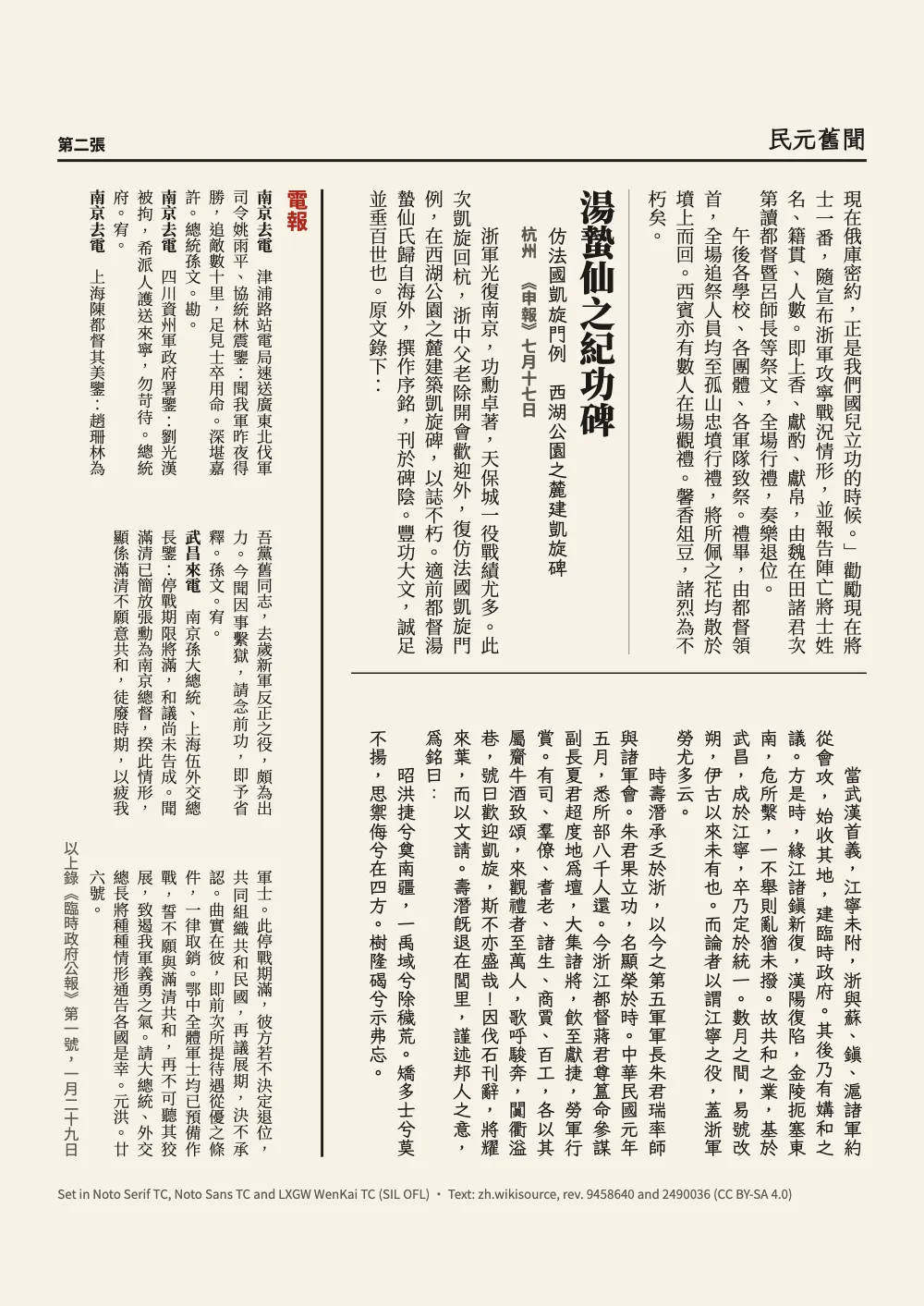
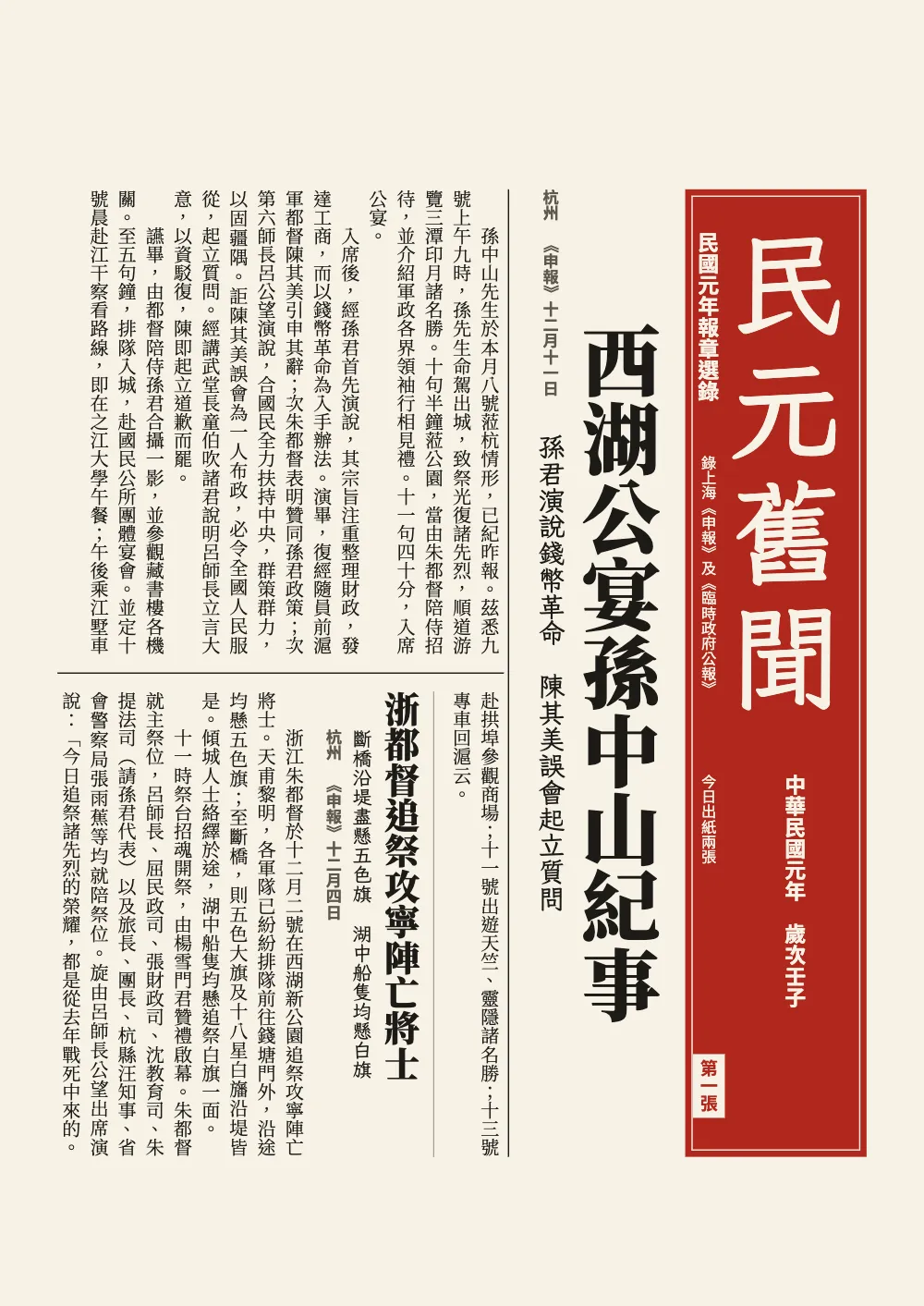
中華民国元年にあたる1912年、新聞がまだ縦に組まれていたころの中国の新聞2面です。本文は上海の『申報』から取りました。西湖の宴席に招かれた孫文(孫中山)、その席で演説に異を唱えて立ち上がり、もう一度立ち上がって詫びた陳其美。南京攻略で戦死した浙江の兵士の追悼。杭州が帰還した軍のために建てた凱旋記念碑。臨時政府の公報の創刊号から取った電報4通が囲みを埋めます。本文は25字の2段(欄)で、段のあいだに罫を引き、電報は3段に組みます。第1面は朱色の題字と、ページの高さいっぱいに縦に組んだトップ記事の見出しで始まります。同じページを横組みで作る例が新聞の第1面です。
このレシピが答える質問
- 中国語の新聞のページを、罫線で区切った段で縦組みにするには?
- 章タイトルをページ幅いっぱいに置き、その下で本文を2段組みにするには?
- Postextは3段以上の段組みや、画像の周りへの回り込みに対応していますか?
- 版面を字数で設定し、1行の字数と1ページの行数を決めるには?
手短な答え
// On a vertical page two columns are two tiers (欄), stacked and filled from the upper right:
// the gutter is the gap between them, the column rule a rule across the page.
const layout = {
  layoutType: 'double', writingMode: 'vertical-rl', // binding 'auto' becomes 'right'
  gutterWidth: pt(2 * BODY),
  columnRule: { enabled: true, color: col('ink'), lineWidth: pt(0.75) },
};
// The grid counts characters down a tier and lines across the page: 25 × 29.
const cjk = { grid: { enabled: true, charsPerLine: CHARS, linesPerPage: 29 } };
// The body has two tiers at most. The telegrams take three inside a page-span box floated to
// the foot of the flow, the left of the sheet (gotcha: callout-columns), with the fences
//   :::callout{type="wires" span="page" placement="bottom" title="電報"} and :::columns{count=3}
const wires = { id: 'wires', backgroundEnabled: false,
  stripe: { enabled: true, side: 'top', width: pt(1.5), color: col('ink') }, // on its right
  padding: { top: pt(6), right: pt(0), bottom: pt(0), left: pt(0) },
  columnGap: pt((HEIGHT - 3 * 18 * 9) / 2), // three tiers of 18 characters of 9 pt
  titleStyle: { fontFamily: HEI, fontSize: pt(12), fontWeight: 700, color: col('accent') },
  body: { fontFamily: SONG, fontSize: pt(9), lineHeight: pt(13.5), textAlign: 'justify',
    firstLineIndent: pt(0), boldFontWeight: 700 } };
材料
- 機能
- 1段組みと2段組み段間罫デザインした章扉縦組み右綴じの本文字グリッド囲みの中の段組み段抜きの囲みフロートする囲み見出しスタイル見出しの属性ページデザインのテキスト・罫・ボックス柱とノンブルページの役割ごとの柱段落スタイル中国語・日本語・韓国語のフォント中国語の約物の幅セマンティックカラーパレットPDFの書き出しPDFに埋め込むフォント
- 種類
- Noto Serif TC, Noto Sans TC, LXGW WenKai TC (SIL OFL 1.1)
- 素材
- なし:図はすべてコードで描画
作り方
#1 · 2段組みを上下の2段に変える
コードは上の手短な答えにあります。writingMode: 'vertical-rl'では、ページは横組みのページを90°回したものになります。そのためlayoutType: 'double'は2つの段を上下に積み(先に読むのは上の段)、段間の罫はページを横切る罫として段のあいだに入ります(縦組み)。字詰めのグリッドは各段を五號(10.5 pt)の25字、新聞の段としては長めの字詰めにし、ページを29行にします。段間は2字分に丸め、段が余白の中央に来るように余白を広げます(文字グリッド)。
本文の段は2段までです。電報は囲みの中で3段にします。span="page"で囲みを版面と同じ高さにし、placement="bottom"で流れの末尾、つまり縦組みのページでは左端へフロートとして配置し、:::columns{count=3}で段に分けます。columnGapは、版面の546 ptから9 ptの18字の段3つ分を引いた残りなので、どの段にも字がちょうど整数個入ります。
#2 · 題字とトップ見出しを1つのデザインに入れる
// A page-span heading always opens a page (gotcha: page-span-heading-new-page), so the lead
// story's H1 carries the masthead in its own design, above its headline.
const MAST = 6.5 * LEAD; // the masthead's block, across the page
const block = (id, inset, style) => ({ kind: 'box', id, style,
  placement: at(inset, inset, { size: { width: pt(HEIGHT - 2 * inset),
    height: pt(MAST - 2 * inset) } }) });
const BAND = 13 * LEAD; // the whole design: masthead, headline, deck
const front = { enabled: true, minHeight: pt(BAND), slot: { elements: [
    block('field', 0, { backgroundColor: col('accent') }), // the name reversed out of it
    block('frame', 3.5, { borderColor: col('paper'), borderWidth: pt(0.75) }),
    text('name', '{title}', KAI, 700, 64, 'paper', { lineHeight: 1, letterSpacing: pt(6),
      placement: at(22, 13) }),
    text('kicker', '{subtitle}', HEI, 700, 12, 'paper', { placement: at(24, 82) }),
    text('sources', '錄{author}', HEI, 400, 8.5, 'paper', { placement: at(150, 84) }),
    text('issue', '{attr.issue}', HEI, 700, 12, 'paper', { placement: at(330, 33) }), // the year
    text('edition', '{attr.edition}', HEI, 400, 8.5, 'paper', { placement: at(330, 84) }),
    text('sheet', '第{pageNumber}張', HEI, 700, 10, 'accent', { placement: at(HEIGHT - 58, 80),
      box: { backgroundColor: col('paper'), padding: { top: pt(3), right: pt(3),
        bottom: pt(3), left: pt(3) } } }),
    // The headline down both tiers, centred; the dateline heads the deck's line.
    text('head', '{titleText}', SONG, 900, 44, 'ink', { align: 'center', lineHeight: 1.1,
      placement: at(0, MAST + 12, fill) }),
    text('deck', '{attr.deck}', KAI, 400, 15, 'ink', { align: 'center',
      placement: below('head', 6, fill) }),
    text('dateline', '{attr.dateline}', HEI, 700, 9, 'muted', { placement: below('head', 10) }),
    { kind: 'rule', id: 'foot', direction: 'horizontal', thickness: pt(0.75),
      color: col('ink'), placement: at(0, BAND - 3, fill) },
] } };
トップ記事の見出しは、題字の下で両方の段を横切る必要がありました。span: 'page'の見出しはページの頭に置く章扉としてレイアウトされるので、題字の後にもう1つ置くと、そこから新しいページが始まってしまいます。そこでページのH1をトップ記事にし、その見出しスタイルで見出しの上に題字を描きます。題字は6.5行分の深さの朱色のブロックで、紙名を白抜きにし、その下に号数の行を置きます。号数の行には民国の年と干支の年、そして「本日は2枚発行」を意味する今日出紙兩張が入ります。その後に見出しが44 ptのNoto Serif TC 900で続きます。流れの中ではデザインの幅が紙面上の版面の高さになるので、size: { width: 'fill' }とalign: 'center'で見出しは両方の段にまたがって中央にそろいます。デザインの深さは13行で、グリッド線の整数倍なので、その後の本文はグリッドの行から始まります。
#3 · 各記事を見出しデザインで始める
const storyHead = { enabled: true, minHeight: pt(4 * LEAD), slot: { elements: [ // 4 lines
  { kind: 'rule', id: 'rule', direction: 'horizontal', thickness: pt(0.5), color: col('rule'),
    placement: at(0, 0, fill) },
  text('head', '{titleText}', SONG, 900, 20, 'ink', { placement: at(0, 6) }),
  text('deck', '{attr.deck}', KAI, 400, 11, 'ink', { // two characters down the tier
    placement: below('head', 4, { offset: { x: pt(2 * BODY), y: pt(4) } }) }),
  text('dateline', '{attr.dateline}', HEI, 700, 9, 'muted', { placement: below('deck', 4) }),
] } };
段の中に置く見出しデザインは、その段の中に収まります。罫は流れの中でdirection: 'horizontal'なので、紙面では段を縦に走り、2つの記事のあいだの細罫になります。見出しは段の頭から、脇見出しは2字下げて始まり、日付行には発信地、紙名、記事が載った日が入ります。minHeightで各見出しの深さを4行に保つので、どの見出しの下でも本文はグリッドから始まります。
#4 · 第2面に柱を付け、地に奥付を入れる
// The header's frame is the margin above the tiers; the footer's, the margin below them.
const above = (y, extra = {}) => ({ anchor: { to: 'container', edge: 'top-left' },
  offset: { x: pt(0), y: mm(HEAD - y) }, ...extra });
const header = { elements: [
  text('title', '{title}', KAI, 700, 14, 'ink', { align: 'right', placement: above(13, fill) }),
  text('sheet', '第{pageNumber}張', HEI, 700, 9, 'ink', { placement: above(10.8) }),
  { kind: 'rule', id: 'rule', thickness: pt(1.5), color: col('ink'), placement: above(6, fill) },
].map((element) => ({ ...element, pages: 'body' })) }; // page 1 has the masthead instead
const footer = { elements: [text('colophon', '{attr.colophon}', HEI, 400, 7, 'muted', {
  pages: 'body', placement: at(0, 17, fill) })] }; // 6 mm under the tiers
clreqにあるとおり、縦組みのページでも柱は横組みのままです。ヘッダーの枠は段の上の余白です。グリッドがこの余白を広げるので、HEADはグリッドと同じ合計をくり返し計算し、罫が最初の文字の6 mm上に来るようにします。pages: 'body'により、1ページは題字に任せます。奥付はH1の属性なので、英語版とスペイン語版は同じ中国語のページの下に、それぞれ自分の行を印刷します。
#5 · 書体ごとに、その書体で組むテキストを読み込む
const pick = (pattern) => (markdown.match(pattern) ?? []).join('');
const attrs = (...keys) => pick(new RegExp(`[{ ](?:${keys.join('|')})="[^"]*"`, 'g'));
const voices = [ // family, weights, the text it sets, and whether it runs down a column
  [SONG, ['400'], markdown, true], // the text
  [SONG, ['700', '900'], pick(/^#+ [^{\n]*|\*\*[^*]+\*\*/gm), false], // heads, labels
  [HEI, ['400', '700'], pick(/^(?:subtitle|author): .*$|style="source"\}[^:]*/gm) // masthead,
    + attrs('dateline', 'issue', 'edition', 'title', 'colophon') + '錄第一二張', true], // datelines
  [KAI, ['400'], attrs('deck') + pick(/style="inscription"\}[^:]*/g), true], // decks, the stele
  [KAI, ['700'], pick(/^title: .*$/m), false], // the paper's name
];
Fontsourceはこれらの書体の各ウェイトをおよそ100個のファイルに分けて配信しており、loadCjkFontsはテキストが使うファイルだけを取得します。Noto Serif TC 400にはサンプル全体を渡します。その700と900には見出しと電報のラベルだけ、Noto Sans TCには題字の行、日付行、奥付、LXGW WenKai TCには脇見出し、碑文、紙名を渡します。渡したテキストが足りない書体があるとキャプチャーは失敗し(C12)、別の書体から借りた文字を挙げます。
レシピの全体
// ═══ Postext Cookbook · Nº 084 · A vertical newspaper page in tiers ═══════════════ // https://postext.dev/en/cookbook/vertical-newspaper-tiers // Code: MIT · Text: Shenbao, 1912 (PD); gazette, stele report: zh.wikisource (CC BY-SA 4.0) // Fonts: Noto Serif TC, Noto Sans TC, LXGW WenKai TC (SIL OFL 1.1) · Needs postext ≥ 1.9.0 import { buildDocument, renderPageToCanvas, clearMeasurementCache, loadVerticalAlternates, } from 'https://esm.sh/postext'; import { renderToPdf, decompressWoff2 } from 'https://esm.sh/postext-pdf'; const LANG = 'en'; // @lang: the language of the colophon; the news is Chinese in both editions const RECIPE = 'vertical-newspaper-tiers'; // ─── 1 · Design ───────────────────────────────────────────────────────────── // #region palette: newsprint, ink and the vermilion of the masthead const palette = { ink: '#1c1a17', // text, the rules between tiers accent: '#b0281c', // the one accent: the masthead block, the telegrams' flag rule: '#8f887c', // the hairline before each story muted: '#5e574e', // datelines, sources, the colophon paper: '#f7f2e6', // newsprint, and the masthead's type reversed out of the vermilion }; const col = (id) => ({ hex: palette[id], model: 'hex', paletteId: id }); const colorPalette = [ ...Object.entries(palette).map(([id, hex]) => ({ id, name: id, value: { hex, model: 'hex' } })), { id: 'main-color', name: 'ink (defaults)', value: { hex: palette.ink, model: 'hex' } }, ]; // #endregion const [SONG, HEI, KAI] = ['Noto Serif TC', 'Noto Sans TC', 'LXGW WenKai TC']; // 宋, 黑, 楷 const BODY = 10.5; // pt: 五號, the body size of the papers of 1912 const LEAD = 15.75; // pt: the line pitch across the page, 1.5 em const CHARS = 25; // characters down a tier: a newspaper column, 17 to 25 const HEIGHT = 2 * CHARS * BODY + 2 * BODY; // pt: two tiers and a gutter of two ems const TRIM = { w: 184, h: 260 }; // mm, 16開 const MARGIN = { top: 30, bottom: 22, side: 11 }; // mm, minimums: the grid centres the tiers // The grid grows the margins evenly, so the tiers start HEAD mm below the top edge. const HEAD = MARGIN.top + (TRIM.h - MARGIN.top - MARGIN.bottom - (HEIGHT * 25.4) / 72) / 2; // #region answer: two tiers down the page with a rule between them, three inside a box // On a vertical page two columns are two tiers (欄), stacked and filled from the upper right: // the gutter is the gap between them, the column rule a rule across the page. const layout = { layoutType: 'double', writingMode: 'vertical-rl', // binding 'auto' becomes 'right' gutterWidth: pt(2 * BODY), columnRule: { enabled: true, color: col('ink'), lineWidth: pt(0.75) }, }; // The grid counts characters down a tier and lines across the page: 25 × 29. const cjk = { grid: { enabled: true, charsPerLine: CHARS, linesPerPage: 29 } }; // The body has two tiers at most. The telegrams take three inside a page-span box floated to // the foot of the flow, the left of the sheet (gotcha: callout-columns), with the fences // :::callout{type="wires" span="page" placement="bottom" title="電報"} and :::columns{count=3} const wires = { id: 'wires', backgroundEnabled: false, stripe: { enabled: true, side: 'top', width: pt(1.5), color: col('ink') }, // on its right padding: { top: pt(6), right: pt(0), bottom: pt(0), left: pt(0) }, columnGap: pt((HEIGHT - 3 * 18 * 9) / 2), // three tiers of 18 characters of 9 pt titleStyle: { fontFamily: HEI, fontSize: pt(12), fontWeight: 700, color: col('accent') }, body: { fontFamily: SONG, fontSize: pt(9), lineHeight: pt(13.5), textAlign: 'justify', firstLineIndent: pt(0), boldFontWeight: 700 } }; // #endregion // In the flow of a vertical page x runs down the sheet and y leftward from its right edge. const at = (x, y, extra = {}) => ({ anchor: { to: 'container', edge: 'top-left' }, offset: { x: pt(x), y: pt(y) }, ...extra }); const text = (id, content, family, weight, size, colour, extra = {}) => ({ kind: 'text', id, content, fontFamily: family, fontWeight: weight, fontSize: pt(size), lineHeight: 1.2, color: col(colour), align: 'left', overflow: 'wrap', ...extra }); const below = (id, y, extra = {}) => ({ anchor: { to: `#${id}`, edge: 'below' }, offset: { y: pt(y) }, ...extra }); // y more points across the page, leftward const fill = { size: { width: 'fill' } }; // #region front: the masthead and the lead headline, one design down the right of page 1 // A page-span heading always opens a page (gotcha: page-span-heading-new-page), so the lead // story's H1 carries the masthead in its own design, above its headline. const MAST = 6.5 * LEAD; // the masthead's block, across the page const block = (id, inset, style) => ({ kind: 'box', id, style, placement: at(inset, inset, { size: { width: pt(HEIGHT - 2 * inset), height: pt(MAST - 2 * inset) } }) }); const BAND = 13 * LEAD; // the whole design: masthead, headline, deck const front = { enabled: true, minHeight: pt(BAND), slot: { elements: [ block('field', 0, { backgroundColor: col('accent') }), // the name reversed out of it block('frame', 3.5, { borderColor: col('paper'), borderWidth: pt(0.75) }), text('name', '{title}', KAI, 700, 64, 'paper', { lineHeight: 1, letterSpacing: pt(6), placement: at(22, 13) }), text('kicker', '{subtitle}', HEI, 700, 12, 'paper', { placement: at(24, 82) }), text('sources', '錄{author}', HEI, 400, 8.5, 'paper', { placement: at(150, 84) }), text('issue', '{attr.issue}', HEI, 700, 12, 'paper', { placement: at(330, 33) }), // the year text('edition', '{attr.edition}', HEI, 400, 8.5, 'paper', { placement: at(330, 84) }), text('sheet', '第{pageNumber}張', HEI, 700, 10, 'accent', { placement: at(HEIGHT - 58, 80), box: { backgroundColor: col('paper'), padding: { top: pt(3), right: pt(3), bottom: pt(3), left: pt(3) } } }), // The headline down both tiers, centred; the dateline heads the deck's line. text('head', '{titleText}', SONG, 900, 44, 'ink', { align: 'center', lineHeight: 1.1, placement: at(0, MAST + 12, fill) }), text('deck', '{attr.deck}', KAI, 400, 15, 'ink', { align: 'center', placement: below('head', 6, fill) }), text('dateline', '{attr.dateline}', HEI, 700, 9, 'muted', { placement: below('head', 10) }), { kind: 'rule', id: 'foot', direction: 'horizontal', thickness: pt(0.75), color: col('ink'), placement: at(0, BAND - 3, fill) }, ] } }; // #endregion // #region heads: each story opens with a hairline, the headline, a deck and a dateline const storyHead = { enabled: true, minHeight: pt(4 * LEAD), slot: { elements: [ // 4 lines { kind: 'rule', id: 'rule', direction: 'horizontal', thickness: pt(0.5), color: col('rule'), placement: at(0, 0, fill) }, text('head', '{titleText}', SONG, 900, 20, 'ink', { placement: at(0, 6) }), text('deck', '{attr.deck}', KAI, 400, 11, 'ink', { // two characters down the tier placement: below('head', 4, { offset: { x: pt(2 * BODY), y: pt(4) } }) }), text('dateline', '{attr.dateline}', HEI, 700, 9, 'muted', { placement: below('deck', 4) }), ] } }; // #endregion // #region pagehead: the second sheet's head and the colophon, horizontal on the sheet // The header's frame is the margin above the tiers; the footer's, the margin below them. const above = (y, extra = {}) => ({ anchor: { to: 'container', edge: 'top-left' }, offset: { x: pt(0), y: mm(HEAD - y) }, ...extra }); const header = { elements: [ text('title', '{title}', KAI, 700, 14, 'ink', { align: 'right', placement: above(13, fill) }), text('sheet', '第{pageNumber}張', HEI, 700, 9, 'ink', { placement: above(10.8) }), { kind: 'rule', id: 'rule', thickness: pt(1.5), color: col('ink'), placement: above(6, fill) }, ].map((element) => ({ ...element, pages: 'body' })) }; // page 1 has the masthead instead const footer = { elements: [text('colophon', '{attr.colophon}', HEI, 400, 7, 'muted', { pages: 'body', placement: at(0, 17, fill) })] }; // 6 mm under the tiers // #endregion const config = () => ({ // a factory: the engine caches resolved configs per object locale: 'zh-Hant', // Taiwan conventions: centred punctuation (gotcha: cjk-locale-tag) colorPalette, page: { sizePreset: 'custom', width: mm(TRIM.w), height: mm(TRIM.h), dpi: 150, backgroundColor: col('paper'), margins: { top: mm(MARGIN.top), bottom: mm(MARGIN.bottom), left: mm(MARGIN.side), right: mm(MARGIN.side), mirror: true }, pageNumbering: { format: 'trad-chinese-informal' }, // 第一張, 第二張 }, layout, cjk, bodyText: { fontFamily: SONG, fontSize: pt(BODY), lineHeight: pt(LEAD), color: col('ink'), boldColor: col('ink'), italicColor: col('ink'), referenceColor: col('ink'), textAlign: 'justify', firstLineIndent: em(2), indentAfterHeading: true, }, headings: { fontFamily: SONG, fontWeight: 900, color: col('ink'), levels: [ // Restated: any headings object drops the H1 break (gotcha: headings-drop-h1-break). { level: 1, span: 'page', breakBefore: { enabled: true, parity: 'any' }, marginBottom: pt(0) }, { level: 2, fontSize: pt(20), lineHeight: pt(2 * LEAD), marginTop: pt(LEAD / 2), marginBottom: pt(0), advancedDesign: storyHead }, ], }, headingStyles: [{ id: 'front', advancedDesign: front }], calloutStyles: [wires], paragraphStyles: [ { id: 'source', fontFamily: HEI, fontSize: pt(8.5), color: col('muted'), textAlign: 'right', firstLineIndent: pt(0) }, // the telegrams' source, at the foot of its line { id: 'inscription', fontFamily: KAI, indent: em(2), firstLineIndent: em(2) }, // 低二格 ], header, footer, }); // ─── 2 · Content ──────────────────────────────────────────────────────────── const markdown = String.raw`---Markdownの見本 · 48行 · content.en.md
title: "民元舊聞" subtitle: "民國元年報章選錄" author: "上海《申報》及《臨時政府公報》" --- # 西湖公宴孫中山紀事 {style="front" deck="孫君演說錢幣革命 陳其美誤會起立質問" dateline="杭州 《申報》十二月十一日" issue="中華民國元年 歲次壬子" edition="今日出紙兩張" colophon="Set in Noto Serif TC, Noto Sans TC and LXGW WenKai TC (SIL OFL) · Text: zh.wikisource, rev. 9458640 and 2490036 (CC BY-SA 4.0)"} 孫中山先生於本月八號蒞杭情形,已紀昨報。茲悉九號上午九時,孫先生命駕出城,致祭光復諸先烈,順道游覽三潭印月諸名勝。十句半鐘蒞公園,當由朱都督陪侍招待,並介紹軍政各界領袖行相見禮。十一句四十分,入席公宴。 入席後,經孫君首先演說,其宗旨注重整理財政,發達工商,而以錢幣革命為入手辦法。演畢,復經隨員前滬軍都督陳其美引申其辭;次朱都督表明贊同孫君政策;次第六師長呂公望演說,合國民全力扶持中央,群策群力,以固疆隅。詎陳其美誤會為一人布政,必令全國人民服從,起立質問。經講武堂長童伯吹諸君說明呂師長立言大意,以資駁復,陳即起立道歉而罷。 讌畢,由都督陪侍孫君合攝一影,並參觀藏書樓各機關。至五句鐘,排隊入城,赴國民公所團體宴會。並定十號晨赴江干察看路線,即在之江大學午餐;午後乘江墅車赴拱埠參觀商場;十一號出遊天竺、靈隱諸名勝;十三號專車回滬云。 ## 浙都督追祭攻寧陣亡將士 {deck="斷橋沿堤盡懸五色旗 湖中船隻均懸白旗" dateline="杭州 《申報》十二月四日"} 浙江朱都督於十二月二號在西湖新公園追祭攻寧陣亡將士。天甫黎明,各軍隊已紛紛排隊前往錢塘門外,沿途均懸五色旗;至斷橋,則五色大旗及十八星白旛沿堤皆是。傾城人士絡繹於途,湖中船隻均懸追祭白旗一面。 十一時祭台招魂開祭,由楊雪門君贊禮啟幕。朱都督就主祭位,呂師長、屈民政司、張財政司、沈教育司、朱提法司(請孫君代表)以及旅長、團長、杭縣汪知事、省會警察局張雨蕉等均就陪祭位。旋由呂師長公望出席演說:「今日追祭諸先烈的榮耀,都是從去年戰死中來的。現在俄庫密約,正是我們國兒立功的時候。」勸勵現在將士一番,隨宣布浙軍攻寧戰況情形,並報告陣亡將士姓名、籍貫、人數。即上香、獻酌、獻帛,由魏在田諸君次第讀都督暨呂師長等祭文,全場行禮,奏樂退位。 午後各學校、各團體、各軍隊致祭。禮畢,由都督領首,全場追祭人員均至孤山忠墳行禮,將所佩之花均散於墳上而回。西賓亦有數人在場觀禮。馨香俎豆,諸烈為不朽矣。 :::callout{type="wires" span="page" placement="bottom" title="電報"} :::columns{count=3} **南京去電** 津浦路站電局速送廣東北伐軍司令姚雨平、協統林震鑒:聞我軍昨夜得勝,追敵數十里,足見士卒用命。深堪嘉許。總統孫文。勘。 **南京去電** 四川資州軍政府署鑒:劉光漢被拘,希派人護送來寧,勿苛待。總統府。宥。 **南京去電** 上海陳都督其美鑒:趙珊林為吾黨舊同志,去歲新軍反正之役,頗為出力。今聞因事繫獄,請念前功,即予省釋。孫文。宥。 **武昌來電** 南京孫大總統、上海伍外交總長鑒:停戰期限將滿,和議尚未告成。聞滿清已簡放張勳為南京總督,揆此情形,顯係滿清不願意共和,徒廢時期,以疲我軍士。此停戰期滿,彼方若不決定退位,共同組織共和民國,再議展期,決不承認。曲實在彼,即前次所提待遇從優之條件,一律取銷。鄂中全體軍士均已預備作戰,誓不願與滿清共和,再不可聽其狡展,致遏我軍義勇之氣。請大總統、外交總長將種種情形通告各國是幸。元洪。廿六號。 ::: :::paragraphs{style="source"} 以上錄《臨時政府公報》第一號,一月二十九日 ::: ::: ## 湯蟄仙之紀功碑 {deck="仿法國凱旋門例 西湖公園之麓建凱旋碑" dateline="杭州 《申報》七月十七日"} 浙軍光復南京,功勳卓著,天保城一役戰績尤多。此次凱旋回杭,浙中父老除開會歡迎外,復仿法國凱旋門例,在西湖公園之麓建築凱旋碑,以誌不朽。適前都督湯蟄仙氏歸自海外,撰作序銘,刊於碑陰。豐功大文,誠足並垂百世也。原文錄下: :::paragraphs{style="inscription"} 當武漢首義,江寧未附,浙與蘇、鎮、滬諸軍約從會攻,始收其地,建臨時政府。其後乃有媾和之議。方是時,緣江諸鎮新復,漢陽復陷,金陵扼塞東南,危所繫,一不舉則亂猶未撥。故共和之業,基於武昌,成於江寧,卒乃定於統一。數月之間,易號改朔,伊古以來未有也。而論者以謂江寧之役,蓋浙軍勞尤多云。 時壽潛承乏於浙,以今之第五軍軍長朱君瑞率師與諸軍會。朱君果立功,名顯榮於時。中華民國元年五月,悉所部八千人還。今浙江都督蔣君尊簋命參謀副長夏君超度地為壇,大集諸將,飲至獻捷,勞軍行賞。有司、羣僚、耆老、諸生、商賈、百工,各以其屬齎牛酒致頌,來觀禮者至萬人,歌呼駿奔,闐衢溢巷,號曰歡迎凱旋,斯不亦盛哉!因伐石刊辭,將耀來葉,而以文請。壽潛既退在閭里,謹述邦人之意,為銘曰: 昭洪捷兮奠南疆,一禹域兮除穢荒。矯多士兮莫不揚,思禦侮兮在四方。樹隆碣兮示弗忘。 :::`; // content.<lang>.md: the same Chinese text in both // ─── 3 · Fonts ────────────────────────────────────────────────────────────── // Every face the pages paint; the Chinese ones by files (gotcha: cjk-fonts-slices). const FONTS = { 'Noto Serif TC': ['400', '700', '900'], 'Noto Sans TC': ['400', '700'], 'LXGW WenKai TC': ['400', '700'] }; // #region voices: each face loads the files of the text it sets const pick = (pattern) => (markdown.match(pattern) ?? []).join(''); const attrs = (...keys) => pick(new RegExp(`[{ ](?:${keys.join('|')})="[^"]*"`, 'g')); const voices = [ // family, weights, the text it sets, and whether it runs down a column [SONG, ['400'], markdown, true], // the text [SONG, ['700', '900'], pick(/^#+ [^{\n]*|\*\*[^*]+\*\*/gm), false], // heads, labels [HEI, ['400', '700'], pick(/^(?:subtitle|author): .*$|style="source"\}[^:]*/gm) // masthead, + attrs('dateline', 'issue', 'edition', 'title', 'colophon') + '錄第一二張', true], // datelines [KAI, ['400'], attrs('deck') + pick(/style="inscription"\}[^:]*/g), true], // decks, the stele [KAI, ['700'], pick(/^title: .*$/m), false], // the paper's name ]; // #endregion // ─── 4 · Build & show ─────────────────────────────────────────────────────── await loadFonts(FONTS, markdown); for (const [family, weights, text, vertical] of voices) { await loadCjkFonts({ [family]: weights }, text, { vertical }); } const doc = await buildWithFonts(() => buildDocument({ markdown }, config()), markdown); showBook(doc, { title: t({ en: 'A vertical newspaper page in tiers', es: 'Una página de periódico vertical, en pisos' }) }); offerPdf(() => renderToPdf(doc, { fontProvider: cjkPdfProvider }), `${RECIPE}.pdf`);キット · core, fonts, viewer, pdf, cjk:全レシピ共通 · 453行
// ─── Kit ── helpers shared by every Cookbook recipe · postext.dev/cookbook ───── // ─── Kit · core v1 ── the same in every recipe · postext.dev/cookbook ───────── function mm(value) { return { value, unit: 'mm' }; } function pt(value) { return { value, unit: 'pt' }; } function em(value) { return { value, unit: 'em' }; } /** The sample language's string: t({ en: 'Figure', es: 'Figura' }). */ function t(strings) { return strings[LANG] ?? Object.values(strings)[0]; } /** A file in this recipe's assets folder, served from the Postext repo by jsDelivr. */ function asset(file) { return `https://cdn.jsdelivr.net/gh/drnachio/postext@main/cookbook/${RECIPE}/assets/${file}`; } // ─── Kit · fonts v1 ── the same in every recipe · postext.dev/cookbook ──────── // Postext measures text with the faces the browser has loaded, and caches the // widths, so every face must be ready before the first build. Faces come from // Fontsource: the same static files the PDF embeds, so screen and PDF agree. /** faces = { 'Family Name': ['400', '400i', '700'] }. `text` is the sample: * letters beyond Latin-1 (č, ł, ő…) also load the latin-ext files. With * `optional`, a face Fontsource does not ship is skipped instead of failing. * Resolves to the number of faces added. */ async function loadFonts(faces, text = '', { optional = false } = {}) { kitStatus('Loading fonts…'); const ranges = { latin: 'U+0000-00FF,U+0131,U+0152-0153,U+02BB-02BC,U+02C6,U+02DA,U+02DC,U+0304,U+0308,U+0329,' + 'U+2000-206F,U+20AC,U+2122,U+2191,U+2193,U+2212,U+2215,U+FEFF,U+FFFD', 'latin-ext': 'U+0100-02BA,U+02BD-02C5,U+02C7-02CC,U+02CE-02D7,U+02DD-02FF,U+0304,U+0308,U+0329,' + 'U+1D00-1DBF,U+1E00-1E9F,U+1EF2-1EFF,U+2020,U+20A0-20AB,U+20AD-20C0,U+2113,U+2C60-2C7F,U+A720-A7FF', }; const subsets = /[Ā-˿Ḁ-ỿ]/.test(text) ? ['latin', 'latin-ext'] : ['latin']; const jobs = []; let added = 0; for (const [family, specs] of Object.entries(faces)) { const id = fontsourceId(family); const meta = optional ? await fontsourceMeta(family) : null; for (const spec of new Set(specs)) { const weight = parseInt(spec, 10); const style = spec.endsWith('i') ? 'italic' : 'normal'; if (hasFace(family, weight, style)) continue; if (optional && !(meta?.weights.includes(weight) && meta.styles.includes(style))) continue; for (const subset of subsets) { const url = `https://cdn.jsdelivr.net/npm/@fontsource/${id}@5/files/${id}-${subset}-${weight}-${style}.woff2`; const face = new FontFace(family, `url(${url}) format('woff2')`, { weight: String(weight), style, unicodeRange: ranges[subset] }); jobs.push(face.load().then((ready) => { document.fonts.add(ready); added++; }, () => { if (subset === 'latin' && !optional) throw new Error(`Fontsource has no ${family} ${weight} ${style}`); })); } } } await Promise.all(jobs).catch((error) => { kitFail(error); throw error; }); return added; } /** Runs `build` (a buildDocument or buildBundle call) and checks the faces * the pages use. A regular face missing from FONTS is loaded with a warning; * bold and italic variants are loaded when the family ships them. Then the * measurement caches are cleared and the build runs again. */ async function buildWithFonts(build, text = '') { const tried = new Set(); for (let round = 0; round < 3; round++) { kitStatus('Laying out…'); await new Promise(requestAnimationFrame); // let the status paint first const result = await Promise.resolve().then(build).catch((error) => { kitFail(error); throw error; }); const wanted = { base: {}, variants: {} }; for (const { font, base } of [result].flat().flatMap(fontStringsOf)) { const { family, weight, style } = parseFont(font); const key = `${family}|${weight}|${style}`; if (tried.has(key) || hasFace(family, weight, style)) continue; tried.add(key); (wanted[base ? 'base' : 'variants'][family] ??= []).push(`${weight}${style === 'italic' ? 'i' : ''}`); } if (Object.keys(wanted.base).length) { console.warn(`[cookbook] FONTS does not list ${JSON.stringify(wanted.base)}: loading them.`); } const added = await loadFonts(wanted.base, text) + await loadFonts(wanted.variants, text, { optional: true }); if (added === 0) return result; clearMeasurementCache(); } throw new Error('The fonts did not settle after three builds.'); } /** Every font string of the layout. `base` marks a block's own face; its * bold, italic and bold-italic variants are listed whether or not used. */ function fontStringsOf(doc) { const found = new Map(); const walk = (node) => { if (!node || typeof node !== 'object') return; if (Array.isArray(node)) { node.forEach(walk); return; } for (const [key, value] of Object.entries(node)) { if (typeof value === 'string' && /fontString$/i.test(key)) { found.set(value, found.get(value) || key === 'fontString'); } else if (value && typeof value === 'object') walk(value); } }; walk(doc.pages); walk(doc.blocks); return [...found].map(([font, base]) => ({ font, base })); } /** '700 37.5px Open Sans' / 'italic 400 13px "Source Serif 4"' → { family, weight, style }. * A string with no weight ('95.8px Young Serif', from a design text) is 400. */ function parseFont(font) { const m = /^(?:(italic|oblique)\s+)?(?:small-caps\s+)?(?:(\d+|bold|normal)\s+)?[\d.]+px\s+(.+)$/.exec(font.trim()); if (!m) throw new Error(`Unexpected font string: ${font}`); const weight = m[2] === 'bold' ? 700 : !m[2] || m[2] === 'normal' ? 400 : Number(m[2]); return { family: m[3].replace(/^["']|["']$/g, ''), weight, style: m[1] ? 'italic' : 'normal' }; } /** True when a loaded FontFace covers exactly this family, weight and style * (document.fonts.check() is also true for families nobody declared). */ function hasFace(family, weight, style) { for (const face of document.fonts) { if (face.status !== 'loaded' || face.style !== style) continue; if (face.family.replace(/^["']|["']$/g, '') !== family) continue; const [low, high = low] = face.weight.split(' ').map(Number); if (weight >= low && weight <= high) return true; } return false; } /** Fontsource's id for a family: 'Source Serif 4' → 'source-serif-4'. */ function fontsourceId(family) { return family.toLowerCase().replace(/\s+/g, '-'); } /** The weights and styles a family ships ({ weights: [400, 700], styles: ['normal', 'italic'] }), or null. */ function fontsourceMeta(family) { fontsourceMeta.cache ??= new Map(); const id = fontsourceId(family); if (!fontsourceMeta.cache.has(id)) { fontsourceMeta.cache.set(id, fetch(`https://api.fontsource.org/v1/fonts/${id}`) .then((res) => (res.ok ? res.json() : null), () => null)); } return fontsourceMeta.cache.get(id); } // ─── Kit · viewer v1 ── the same in every recipe · postext.dev/cookbook ─────── /** Shows the pages as facing spreads on a dark desk: the first page is a * recto on its own, then verso | recto pairs, as in a bound book. Pages * are painted when they scroll near the screen. */ function showPages(docs, { title, width = 460 } = {}) { const root = viewer(title); const pages = [docs].flat().flatMap((doc) => doc.pages.map((page) => ({ doc, page, n: (doc.pageIndexOffset ?? 0) + page.index }))); const spreads = []; let verso = null; for (const p of pages) { if (p.n % 2 === 1) { if (verso) spreads.push([verso, null]); verso = p; } else { spreads.push([verso, p]); verso = null; } } if (verso) spreads.push([verso, null]); const density = Math.min(window.devicePixelRatio || 1, 2); showPages.painter?.disconnect(); const painter = new IntersectionObserver((entries) => { for (const { isIntersecting, target } of entries) { if (!isIntersecting) continue; painter.unobserve(target); const { doc, page } = target.postext; renderPageToCanvas(page, doc, target, { scale: (width * density) / page.width }); } }, { rootMargin: '800px' }); showPages.painter = painter; root.replaceChildren(...spreads.map((pair) => { const spread = document.createElement('div'); spread.className = 'pt-spread'; for (const p of pair) { const figure = document.createElement('figure'); if (p) { const label = p.page.pageLabel || String(p.n + 1); const canvas = document.createElement('canvas'); canvas.postext = p; canvas.style.aspectRatio = `${p.page.width} / ${p.page.height}`; canvas.setAttribute('role', 'img'); canvas.setAttribute('aria-label', `Page ${label}`); const folio = document.createElement('figcaption'); folio.textContent = label; figure.append(canvas, folio); painter.observe(canvas); } else figure.className = 'pt-blank'; spread.append(figure); } return spread; })); kitStatus(`${pages.length} ${pages.length === 1 ? 'page' : 'pages'}`); document.documentElement.dataset.postext = 'ready'; return pages.length; } /** The desk, the bar and the error reporting, created once. */ function viewer(title) { if (!document.getElementById('pt-kit')) { document.head.insertAdjacentHTML('beforeend', `<style id="pt-kit"> :root { color-scheme: dark; } body { margin: 0; background: #0e1014; color: #b9bcc4; font: 13px/1.45 system-ui, sans-serif; } #pt-bar { position: sticky; top: 0; z-index: 1; display: flex; flex-wrap: wrap; align-items: center; gap: 6px 16px; padding: 10px 16px; background: rgb(14 16 20 / .92); backdrop-filter: blur(6px); border-bottom: 1px solid #23262d; } #pt-bar strong { color: #f4f1ea; font-weight: 600; } #pt-actions { display: flex; gap: 12px; margin-left: auto; } #pt-actions a, #pt-actions button { color: #d8a21a; font: inherit; background: none; border: 0; padding: 0; cursor: pointer; } #pages { display: grid; justify-items: center; gap: 48px; padding: 32px 16px 72px; } .pt-spread { display: flex; } .pt-spread figure { margin: 0; width: min(460px, 44vw); } .pt-spread canvas { display: block; width: 100%; background: #fff; box-shadow: 0 1px 2px rgb(0 0 0 / .5), 0 22px 44px -16px rgb(0 0 0 / .8); } .pt-spread figure:first-child canvas { box-shadow: inset -14px 0 14px -14px rgb(0 0 0 / .18), 0 1px 2px rgb(0 0 0 / .5), 0 22px 44px -16px rgb(0 0 0 / .8); } .pt-spread figcaption { margin-top: 10px; text-align: center; font: 600 10px/1 system-ui, sans-serif; letter-spacing: .18em; text-transform: uppercase; color: #6c7079; } .pt-blank { visibility: hidden; } @media (max-width: 760px) { .pt-spread { flex-direction: column; gap: 32px; } .pt-spread figure { width: min(460px, 92vw); } .pt-blank { display: none; } } </style>`); document.body.insertAdjacentHTML('afterbegin', '<header id="pt-bar"><strong id="pt-title"></strong><span id="pt-status" role="status"></span><span id="pt-actions"></span></header>'); document.getElementById('pt-title').textContent = document.title || 'Postext'; addEventListener('error', (event) => kitFail(event.error ?? event.message)); addEventListener('unhandledrejection', (event) => kitFail(event.reason)); } if (title) document.getElementById('pt-title').textContent = title; return document.getElementById('pages') ?? document.body.appendChild(Object.assign(document.createElement('main'), { id: 'pages' })); } function kitStatus(text) { viewer(); document.getElementById('pt-status').textContent = text; } function kitFail(error) { document.documentElement.dataset.postext = 'error'; kitStatus(`Error: ${error?.message ?? error}`); } // ─── Kit · pdf v1 ── the same in every recipe that exports a PDF ────────────── /** postext-pdf embeds TrueType bytes. Fetch the Fontsource file the screen * used, snapping to a weight the family ships and falling back to upright * when it has no italic: the PDF asks for every face a block could use. */ async function fontsourceProvider(family, weight, style) { const id = fontsourceId(family); const meta = await fontsourceMeta(family); const weights = meta?.weights?.length ? meta.weights : [400, 700]; const w = weights.reduce((a, b) => (Math.abs(b - weight) < Math.abs(a - weight) ? b : a)); const s = style === 'italic' && meta && !meta.styles.includes('italic') ? 'normal' : style; const res = await fetch(`https://cdn.jsdelivr.net/npm/@fontsource/${id}@5/files/${id}-latin-${w}-${s}.woff2`); if (!res.ok) throw new Error(`Fontsource has no ${family} ${w} ${s} (${res.status})`); return decompressWoff2(new Uint8Array(await res.arrayBuffer())); } /** A "Build the PDF" button in the bar. Once built: "Open the PDF" (a new * tab, since CodePen's preview frame cannot show PDFs) and a download link. */ function offerPdf(makePdf, filename) { viewer(); const button = Object.assign(document.createElement('button'), { type: 'button', textContent: 'Build the PDF' }); button.dataset.postextPdf = filename; button.addEventListener('click', async () => { button.disabled = true; button.textContent = 'Building the PDF…'; try { const bytes = await makePdf(); const url = URL.createObjectURL(new Blob([bytes], { type: 'application/pdf' })); const size = `${Math.max(1, Math.round(bytes.length / 1024))} KB`; button.replaceWith( Object.assign(document.createElement('a'), { href: url, target: '_blank', rel: 'noopener', textContent: 'Open the PDF ↗' }), Object.assign(document.createElement('a'), { href: url, download: filename, textContent: `Download ${filename} · ${size}` })); } catch (error) { button.disabled = false; button.textContent = 'Build the PDF'; kitFail(error); } }); document.getElementById('pt-actions').append(button); } // ─── Kit · cjk v1 ── Chinese, Japanese and Korean books · postext.dev/cookbook ─ // Fontsource ships a CJK family as about a hundred files per weight, each // declared in its stylesheet with the unicode-range it covers. The screen // loads the files the sample touches; the PDF gets the same files for the // characters its pages set in each face, and embeds each as a subset. // A book bound on the right (vertical text) is shown with its spreads // mirrored: page 1 alone on the left of the spine, then [3 | 2]. /** The files of a Fontsource face, read from its stylesheet: { url, range, * ranges }, the last declared first (the order the browser tries them in). */ function cjkSlices(family, weight, style) { cjkSlices.cache ??= new Map(); const id = fontsourceId(family); const css = `https://cdn.jsdelivr.net/npm/@fontsource/${id}@5/${weight}${style === 'italic' ? '-italic' : ''}.css`; if (!cjkSlices.cache.has(css)) { cjkSlices.cache.set(css, fetch(css) .then((res) => { if (!res.ok) throw new Error(`Fontsource has no ${family} ${weight} ${style} (${res.status})`); return res.text(); }) .then((text) => [...text.matchAll(/@font-face\s*{([^}]*)}/g)].map(([, rule]) => { const range = /unicode-range:\s*([^;]+);/.exec(rule)?.[1].trim() ?? 'U+0-10FFFF'; const ranges = range.split(',').map((part) => { const [lo, hi = lo] = part.trim().slice(2).split('-'); return [parseInt(lo, 16), parseInt(hi, 16)]; }); return { url: new URL(/url\(([^)]+?\.woff2)\)/.exec(rule)[1], css).href, range, ranges }; }).reverse())); } return cjkSlices.cache.get(css); } /** The file of `slices` that holds code point `cp`, if any. */ function cjkSliceFor(slices, cp) { return slices.find((slice) => slice.ranges.some(([lo, hi]) => cp >= lo && cp <= hi)); } /** Whether Fontsource serves `family` as a Chinese, Japanese or Korean * family (its subsets name the script). Fails when the API does not * answer: a CJK face taken for a Latin one would paint in a system face. */ async function isCjkFamily(family) { const meta = await fontsourceMeta(family); if (!meta) throw new Error(`api.fontsource.org did not describe ${family}: reload to try again`); return !!meta.subsets?.some((subset) => /^(chinese|japanese|korean)/.test(subset)); } /** faces = { 'Noto Serif TC': ['400', '700'] }, as for loadFonts: the * whole FONTS object may be passed, its other families are left to * loadFonts. Adds one FontFace per file of each CJK face with its * unicodeRange, then loads the files `text` touches. `text` is what the * faces set: the sample for the text face; a book in several voices calls * it once per voice (loadCjkFonts({ 'LXGW WenKai TC': ['400'] }, quotes)), * so the heading and quotation faces fetch and check only their own * characters. Fails when a character of `text` is in no file of a face. * List every weight the pages use: a weight left to buildWithFonts gets * the latin file only. With { vertical: true } it also loads each * family's vertical forms (brackets, quotes, pause marks) for the canvas, * which needs loadVerticalAlternates imported from postext. Resolves to * the number of files loaded. */ async function loadCjkFonts(faces, text, { vertical = false } = {}) { kitStatus('Loading fonts…'); let loaded = 0; try { if (vertical && typeof loadVerticalAlternates !== 'function') { throw new Error('loadCjkFonts(…, { vertical: true }) needs loadVerticalAlternates imported from postext'); } for (const [family, specs] of Object.entries(faces)) { if (!(await isCjkFamily(family))) continue; const twin = []; for (const spec of new Set(specs)) { const weight = parseInt(spec, 10); const style = spec.endsWith('i') ? 'italic' : 'normal'; const slices = await cjkSlices(family, weight, style); const missing = [...new Set(text)].filter((ch) => /\S/.test(ch) && !cjkSliceFor(slices, ch.codePointAt(0))); if (missing.length) { throw new Error(`${family} ${spec} has no file for ${missing.slice(0, 12).join(' ')}: ` + `give each face the text it sets (loadCjkFonts({ '${family}': ['${spec}'] }, text))`); } for (const slice of slices) { document.fonts.add(new FontFace(family, `url(${slice.url}) format('woff2')`, { weight: String(weight), style, unicodeRange: slice.range })); twin.push({ source: slice.url, weight: String(weight), style, unicodeRange: slice.range }); } const font = `${style === 'italic' ? 'italic ' : ''}${weight} 16px "${family}"`; loaded += (await document.fonts.load(font, text)).length; if (!document.fonts.check(font, text)) throw new Error(`${family} ${spec} did not load for the sample`); } // The same files under a twin name with the `vert` feature on: the // canvas paints the punctuation of vertical lines with it. if (vertical && twin.length) await loadVerticalAlternates(family, twin); } } catch (error) { kitFail(error); throw error; } return loaded; } /** The PDF font provider for recipes with CJK faces: a family whose * Fontsource subsets are Chinese, Japanese or Korean gets the files that * hold the characters its pages set (`request.codePoints`); any other * family gets the latin file fontsourceProvider fetches (the "pdf" block) * and, when the face sets letters only latin-ext has, that file too. */ async function cjkPdfProvider(family, weight, style, request) { if (!(await isCjkFamily(family))) return cjkLatinPdfFiles(family, weight, style, request); const meta = await fontsourceMeta(family); const weights = meta.weights?.length ? meta.weights : [400, 700]; const w = weights.reduce((a, b) => (Math.abs(b - weight) < Math.abs(a - weight) ? b : a)); const s = style === 'italic' && !meta.styles.includes('italic') ? 'normal' : style; const slices = await cjkSlices(family, w, s); const picked = new Set(); for (const cp of request?.codePoints ?? []) { const slice = cjkSliceFor(slices, cp); if (slice) picked.add(slice); } if (!picked.size) picked.add(slices[0]); return Promise.all(slices.filter((slice) => picked.has(slice)).map(async (slice) => { const res = await fetch(slice.url); if (!res.ok) throw new Error(`Fontsource file ${slice.url} (${res.status})`); return decompressWoff2(new Uint8Array(await res.arrayBuffer())); })); } /** A Latin family set next to the CJK faces: its latin file, then its * latin-ext file when the face sets letters only latin-ext has (ō ū in * Hepburn rōmaji, ǎ in pinyin), the file loadFonts adds on screen for * them. Latin comes first: postext-pdf draws a character from the first * file that has it, as the browser takes a character both files hold from * latin. A face Fontsource ships without latin-ext, or whose file does * not come, gets latin alone, and the PDF names the letters it lacks. */ async function cjkLatinPdfFiles(family, weight, style, request) { const meta = await fontsourceMeta(family); const beyond = [...(request?.codePoints ?? [])].some(cjkLatinExtOnly); if (!beyond || !meta?.subsets?.includes('latin-ext')) return fontsourceProvider(family, weight, style); const weights = meta.weights?.length ? meta.weights : [400, 700]; const w = weights.reduce((a, b) => (Math.abs(b - weight) < Math.abs(a - weight) ? b : a)); const s = style === 'italic' && !meta.styles.includes('italic') ? 'normal' : style; const id = fontsourceId(family); const url = `https://cdn.jsdelivr.net/npm/@fontsource/${id}@5/files/${id}-latin-ext-${w}-${s}.woff2`; const [latin, ext] = await Promise.all([fontsourceProvider(family, weight, style), fetch(url) .then(async (res) => (res.ok ? decompressWoff2(new Uint8Array(await res.arrayBuffer())) : null), () => null)]); return ext ? [latin, ext] : latin; } /** Whether code point `cp` is in Fontsource's latin-ext file and not in * its latin file: Latin Extended-A and -B, IPA, the spacing modifiers and * Latin Extended Additional (loadFonts's test for latin-ext), less the * few latin holds too (ı Œ œ ʻ ʼ ˆ ˚ ˜). */ function cjkLatinExtOnly(cp) { if (!((cp >= 0x100 && cp <= 0x2ff) || (cp >= 0x1e00 && cp <= 0x1eff))) return false; return ![0x131, 0x152, 0x153, 0x2bb, 0x2bc, 0x2c6, 0x2da, 0x2dc].includes(cp); } /** showPages for a book bound on either edge. A right-bound book (the * document says so: doc.binding is 'right' for page.binding 'right' and * for vertical text) lies on the desk as it opens: page 1 alone on the * left of the spine, then [3 | 2], the spine shade on each page's inner * edge. `binding` ('left' | 'right') overrides the document's. */ function showBook(docs, { binding, ...options } = {}) { const count = showPages(docs, options); const right = (binding ?? [docs].flat()[0]?.binding) === 'right'; if (!document.getElementById('pt-kit-cjk')) { // The pages keep direction ltr: a canvas draws text in the direction its // element inherits, and under rtl each run would end where the engine // starts it, its brackets mirrored. document.head.insertAdjacentHTML('beforeend', `<style id="pt-kit-cjk"> .pt-spread[dir="rtl"] canvas { direction: ltr; } .pt-spread[dir="rtl"] figure:first-child canvas { box-shadow: inset 14px 0 14px -14px rgb(0 0 0 / .18), 0 1px 2px rgb(0 0 0 / .5), 0 22px 44px -16px rgb(0 0 0 / .8); } </style>`); } // Each pair stays [verso, recto] in the page; right to left, the verso // sits on the right. Phones stack the pages in reading order either way. for (const spread of document.querySelectorAll('#pages > .pt-spread')) spread.dir = right ? 'rtl' : 'ltr'; document.getElementById('pages').dataset.binding = right ? 'right' : 'left'; return count; } // ─── /Kit ───────────────────────────────────────────────────────────────────────
組み立てたscript.jsはそのまま動きます。任意のページのモジュールスクリプトに貼り付けるか、レシピをCodePenで開いてください。 GitHub上のレシピのフォルダー ↗ (新しいタブで開きます)
アレンジ
#電報を4段にする
同じ高さに14字の段が4つ収まり、囲みは必要な行数まで狭くなります。
-  columnGap: pt((HEIGHT - 3 * 18 * 9) / 2), // three tiers of 18 characters of 9 pt
+ columnGap: pt((HEIGHT - 4 * 14 * 9) / 3), // four tiers of 14 characters of 9 ptMarkdownでは:::columns{count=4}にします。
#記事を1段で組む
52字の1段が版面の高さいっぱいに走り、紙面ではどの行も193 mmの長さになります。記事の見出しはそれぞれページ全体の4行を占め、2面は3面になります。
-  layoutType: 'double', writingMode: 'vertical-rl', // binding 'auto' becomes 'right'
+ layoutType: 'single', writingMode: 'vertical-rl', // binding 'auto' becomes 'right'グリッドではcharsPerLine: 2 * CHARS + 2にします。
よくあるつまずき
つまずき
ページ幅の見出しは必ず新しいページを始める
階層やスタイルでspan: 'page'を設定した見出しは、breakBeforeの有無にかかわらず、ページの頭の章扉として組まれます。ほかのテキストのあとや、同じページの別の章扉のあとに置くと、次のページに移り、現在のページの残りは空になります。題字の下で両段(縦組みのページなら上下両段)にまたがる大見出しは、題字と並べて章扉自身のデザインに入れるか、spanを指定しない見出しとして:::callout{span="page"}の囲みに入れてください。newspaper-front-pageの大見出しはこの方法で組んでいます。 デザインした章扉 →
つまずき
:::columnsは囲みの中でしか効かず、分割されない
:::columnsは囲みの外では無視されます。また、囲みが分割されても、columnsグループの内部で切れることはありません。breaks属性は子ブロックを数え、入れ子の囲みは1つと数えます。 囲みの中の段組み →
つまずき
中国語の書体はcjkブロックを通じてスライス単位で読み込む
Fontsourceは中国語、日本語、韓国語のファミリーを、ウェイトごとに約100個のファイルとして配信し、各ファイルが文字の範囲を受け持ちます。loadFontsが取得するのはlatinファイルだけなので、画面では漢字がシステムの書体で出て計測が狂い、fontsourceProviderはPDFにそのlatinファイルを渡すため、漢字が空の四角で印字されます。キットのcjkブロックを挙げ、loadFontsのあとにloadCjkFonts(FONTS, markdown)を呼び(本で複数のCJK書体を使うときは、それぞれの書体で組むテキストを渡して書体ごとに1回)、renderToPdfにfontProvider: cjkPdfProviderを渡してください。どちらもテキストの文字を含むファイルを取得します。 中国語・日本語・韓国語のフォント →
つまずき
文書のタグはLANGではなくzh-Hansかzh-Hantにする
レシピの版はenとesですが、中国語のサンプルはどちらの版でも中国語です。`locale: LANG`では英語やスペイン語とタグ付けされ、ラテン文字の語がハイフネーションされ、図にFigureやFiguraの表示名が付き、PDFの言語も誤ります。タグは自分で書いてください。'zh-Hans'(中国本土の慣習:GBの改行規則、開明式の約物)または'zh-Hant'(台湾:全角で中央に置く約物)、香港なら'zh-HK'です。単なる'zh'は簡体字、本土として読まれます。日本語のサンプルには'ja'を使います(つまずき「ja-locale-tag」)。 中国語の改行 →
つまずき
右綴じの本の見開きはshowBookで表示する
右綴じの本(アラビア語、ヘブライ語、ペルシア語のテキスト、縦組みの中国語、またはpage.binding 'right')でも1ページは奇数ページですが、背の左側に来て、見開きは[3 | 2]と並びます。showPagesはどの本も左綴じとして並べます。bookブロックのshowBook(cjkブロックにも同じ関数があります)はdoc.bindingを読み、見開きを左右反転します。capture.heroでは、見開きは引き続き読む順の[偶数ページ, 奇数ページ]、つまり[2, 3]と指定します。 右綴じの本 →
つまずき
headingsオブジェクトを渡すとH1の改ページが消える
既定ではH1は奇数ページへ改ページします(always-odd)。ところがheadingsオブジェクトを渡すと中身にかかわらずこの既定がリセットされ、章は改ページせずに続けて組まれ、span: 'page'も効かなくなります。どの設定でもheadings.levels[0].breakBefore: { enabled: true, parity }を書き直してください。 奇数ページから始まる章 →
つまずき
設定はオブジェクトの同一性でキャッシュされる。毎回新しいオブジェクトを作る
エンジンは解決済みの設定をオブジェクトの同一性でキャッシュします。そのため、設定をその場で書き換えて再ビルドすると前の結果が再利用されます。ビルドのたびに新しいオブジェクトを作ってください。レシピの設定がファクトリー関数config()になっているのはこのためです。 キャンバス上のページ →
- FontsourceのNoto Serif TCは、『申報』が印刷した字形である爲を、あるファイルの範囲に含むと宣言していますが、そのファイルにはこの字のグリフがありません。Canvasはシステムの書体で描き、PDFにはこの字が入りませんでした(C25)。記事では為を使っています。
- Wikisourceの翻刻には、このページで直した誤りがあります。宴席の記事では已紀が己紀に、陪侍が2か所とも倍侍になっています。追悼の記事の勸勵一番現在將土は、士が土になり、目的語が一番の後に来ているので、ここでは勸勵現在將士一番(「居合わせた将兵を励ました」)と組みます。異体字4つも標準の字形にしています。寗を寧に、電報では縂を總に(3か所)、决を決に(2か所)、碑文では刋を刊にしました。
- Fontsourceが配信するLXGW WenKai TCは為を爲の形で描きます。そのため楷書体の碑文には、宋体のテキストにない古い字形が現れます。
- 囲みの3段は版面を3等分したもので、本文の2段とはそろいません。新聞ではこうした欄を独自のグリッドで組みます。囲みの右辺の罫が2つのグリッドを分けています。
クレジット
- 本文
- Shenbao (Shanghai), 11 December 1912: the banquet for Sun Yat-sen at West Lake, Hangzhou · Shenbao; transcription by Wikisource editors · パブリックドメイン
- Shenbao (Shanghai), 4 December 1912: the memorial for the Zhejiang soldiers killed at Nanjing · Shenbao; transcription by Wikisource editors · パブリックドメイン
- Shenbao (Shanghai), 17 July 1912: the victory monument at West Lake, with Tang Shouqian's inscription · Shenbao, Tang Shouqian; transcription and punctuation by Wikisource editors, revised for this recipe · CC BY-SA 4.0
- Four telegrams from Linshi zhengfu gongbao (Provisional Government Gazette) no. 1, 29 January 1912 · Provisional Government, Nanjing; transcription and punctuation by Wikisource editors · CC BY-SA 4.0
- Punctuation of the first two reports, the masthead, decks and datelines · Postext Cookbook · CC BY 4.0
- フォント
- Noto Serif TC (SIL OFL 1.1) · Noto Sans TC (SIL OFL 1.1) · LXGW WenKai TC (SIL OFL 1.1)