かんたんな説明
アラビア語の古い物語を、文字の上下に付く小さな母音記号をすべて入れて印刷した例です。行の間隔を広く取り、ある行の記号が下の行にぶつからないようにします。
できあがり
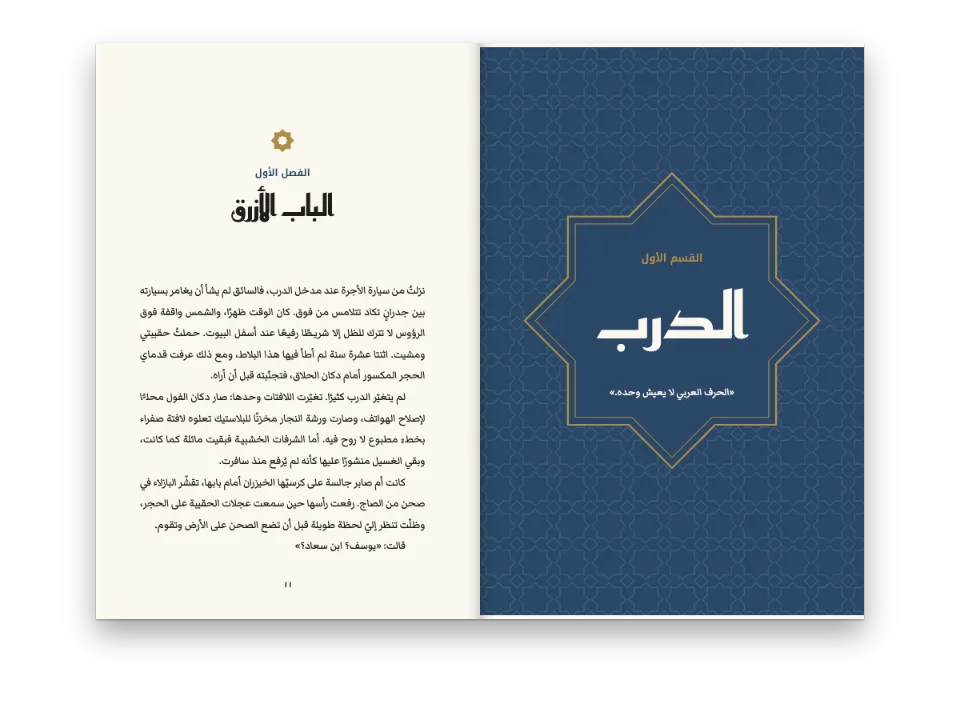
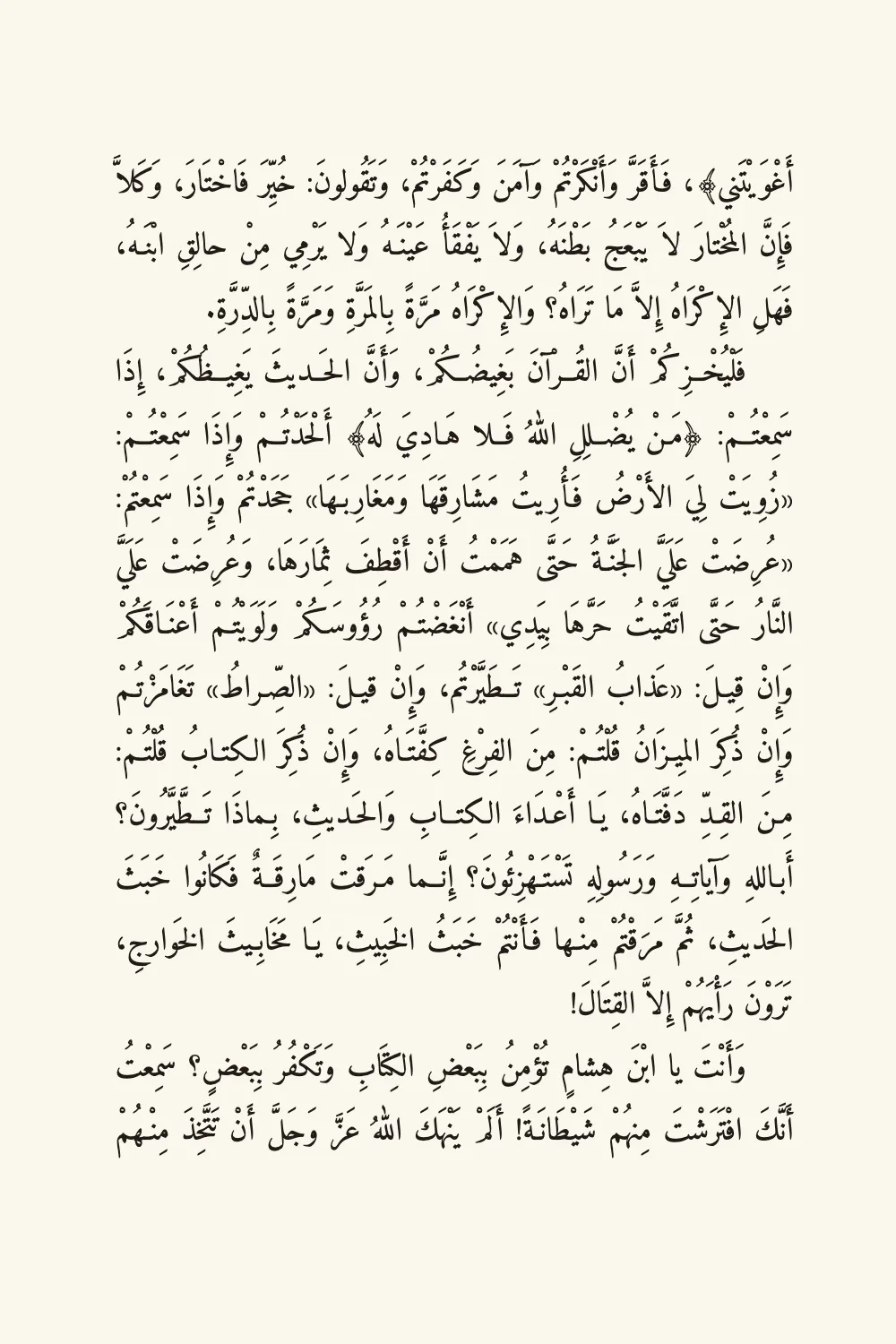
すべての文字に母音を付けたアラビア語の古典の本、4ページです。収めるのはal-Hamadhānīの『精神病院のマカーマ』で、バスラの精神病院にいる狂人が神学者を言い負かし、最後に詩で自分の名を明かします。母音記号をすべて付けたテキストでは、文字の上にファトハとシャッダが重なり、下にカスラが付きます。これらの記号は行と行のあいだの空間に入ります。そこでページはAmiriの14 ptを、その2倍の28 ptの行送りで組み、ほかには何もしません。行送りそのものがデザインです。本文はカシーダで両端をそろえ、書き出しは右側に1.5 emの字下げを取り、3か所のクルアーンの引用は、印刷されたムスハフ(クルアーンの刊本)と同じ装飾括弧﴿ ﴾に入れます。版によって変わるのは、ラテン文字の題の行と本文についての注だけです。
このレシピが答える質問
- 完全に母音符号を付けたアラビア語には、どれくらいの行送りが必要ですか?
手短な答え
// Every letter of this maqāma carries its vowel: fatḥa and shadda over the letters, kasra
// and kasratān under them, often two marks on one letter. The marks sit in the leading,
// which never grows for them, so the leading is chosen for the most vocalised line of the
// book. Unvocalised prose sets well at 1.6 × the size; fully vocalised text needs
// 1.9–2.1 ×: here 14 pt on 28 pt, 2 ×, so a kasra hanging under one line clears a shadda
// standing on the line below. Any closer and the build reports the paragraph
// (arabicMarksExceedLeading) with the leading it would need.
const SIZE = 14; // pt
const LEAD = 2 * SIZE; // pt: 28
const bodyText = {
  fontFamily: NASKH, fontSize: pt(SIZE), lineHeight: pt(LEAD), color: col('ink'),
  boldColor: col('ink'), italicColor: col('ink'), referenceColor: col('ink'),
  // Justified with kashidas, the default in an Arabic book, written out to say so:
  // a line widens at its joins as well as at its spaces.
  textAlign: 'justify', kashida: 'auto', kashidaPatterns: 'naskh',
  firstLineIndent: em(1.5), indentAfterHeading: false, // on the start side, the right
  optimalLineBreaking: true, avoidWidows: true, avoidOrphans: true,
};
材料
- 機能
- アラビア語のフォント本文の書体右から左のテキスト文書の言語としてのアラビア語字下げ、行そろえ、段落間隔カシーダによる両端そろえアラビア語の詩(2つの半句からなるバイト)右綴じの本逆方向の段落見出しの階層仕上がりサイズ見開きの余白用紙の色セマンティックカラーパレットキャンバス上のページ
- 併用する機能
- 生成される番号の数字見出しの属性段落スタイル
- 種類
- Amiri, Aref Ruqaa (SIL OFL 1.1)
- 素材
- なし:図はすべてコードで描画
作り方
#1 · 文字サイズの2倍の行送り
コードは上の手短な答えにあります。行送りは記号のために広がることはありません。ある行の下のカスラと次の行の上のシャッダは同じすきまを分け合うので、すきまは本の中で最も母音記号の多い行に合わせて決めます(母音記号)。このテキストでは、行送りを文字サイズの1.6倍にすると記号がぶつかる段落が6つ残り、1.9倍でもまだ1つ残ります。2倍ではぶつかる段落はありません。これはビルドが知らせてくれます。2つの行がぶつかると、その段落についてarabicMarksExceedLeadingを報告し、必要な行送りを示します(アラビア文字のテキスト)。
#2 · 小さなページに広い行長
// 166 mm of text block hold seventeen lines on the 28 pt pitch (9.88 mm). The measure is
// 106 mm, about twelve words of vocalised Naskh.
const page = {
  sizePreset: 'custom', width: mm(140), height: mm(210), dpi: 150,
  backgroundColor: col('paper'),
  // mirror: left is the inner margin, at the spine (the right edge of an odd page here)
  margins: { top: mm(22), bottom: mm(22), left: mm(18), right: mm(16), mirror: true },
};
14 × 21 cmのページに左右16 mmと18 mmの余白を取ると、行長は106 mmになります。母音記号付きの語がおよそ12語入り、28 ptの行送りで17行になります。記号のせいで行は灰色がかって見えるので、ページは簡素にとどめます。柱はなく、紙はクリーム色、赤は題1つだけです。mirror: trueは広いほうの余白を背の側に置きます。右綴じの本では、それは奇数ページの右端です(ページの順序と右綴じ)。
#3 · グリッドを崩さない題
// The headings carry no design: the title's line box, three lines of the grid deep, lowers
// it on the page (a top margin is dropped at the head of a page), and the levels under it
// keep to the 28 pt pitch, so the text starts on a line of the grid.
const headings = {
  fontFamily: NASKH, color: col('ink'), textAlign: 'center',
  levels: [
    // Restated: any headings object drops the H1 break (gotcha: headings-drop-h1-break).
    { level: 1, fontFamily: RUQAA, fontWeight: 700, fontSize: pt(32), lineHeight: pt(LEAD * 3),
      color: col('rubric'), marginTop: pt(0), marginBottom: pt(0),
      breakBefore: { enabled: true, parity: 'odd' } },
    { level: 2, fontWeight: 700, fontSize: pt(15), lineHeight: pt(LEAD), color: col('ink'),
      marginTop: pt(0), marginBottom: pt(0) },
    { level: 3, fontWeight: 400, fontSize: pt(10), lineHeight: pt(LEAD), color: col('muted'),
      marginTop: pt(0), marginBottom: pt(LEAD) },
  ],
};
見出しにデザインはありません。ルクア体の題はグリッド3行分の深さの行ボックスに収まり、著者名とラテン文字の行はそれぞれ28 ptの1行を取るので、本文の1行目はグリッドの上に来ます。ラテン文字の行は{dir=ltr}で、右から左の本の中にある左から右の見出しです(文書、ブロック、インラインの方向)。
レシピの全体
// ═══ Postext Cookbook · Nº 111 · Fully vocalised classical prose with Qur'anic brackets ═══ // https://postext.dev/en/cookbook/vocalised-classical-prose // Code: MIT · Text: al-Hamadhānī, Maqāmāt, ar.wikisource (PD) · Pictures: none // Fonts: Amiri, Aref Ruqaa (SIL OFL 1.1) · Needs postext ≥ 1.15.0 import { buildDocument, renderPageToCanvas, clearMeasurementCache } from 'https://esm.sh/postext'; const LANG = 'en'; // @lang: the language of the sample document ('en' | 'es') const RECIPE = 'vocalised-classical-prose'; // ─── 1 · Design ───────────────────────────────────────────────────────────── // Black text and a red title on a cream page, as the Beirut and Cairo editions of the // Maqāmāt print them. const palette = { ink: '#211b17', // text: a warm near-black rubric: '#94291d', // the accent: the title muted: '#6b6156', // the author's name, the Latin title line, the note on the text paper: '#fbf7ee', // a cream paper }; const col = (id) => ({ hex: palette[id], model: 'hex', paletteId: id }); const colorPalette = [ ...Object.entries(palette).map(([id, hex]) => ({ id, name: id, value: { hex, model: 'hex' } })), { id: 'main-color', name: 'rubric (defaults)', value: { hex: palette.rubric, model: 'hex' } }, ]; const NASKH = 'Amiri'; // the text: a Bulaq Naskh, with its own Latin for the note const RUQAA = 'Aref Ruqaa'; // display: the title // #region answer: a leading of 2 × the size for text with every vowel written // Every letter of this maqāma carries its vowel: fatḥa and shadda over the letters, kasra // and kasratān under them, often two marks on one letter. The marks sit in the leading, // which never grows for them, so the leading is chosen for the most vocalised line of the // book. Unvocalised prose sets well at 1.6 × the size; fully vocalised text needs // 1.9–2.1 ×: here 14 pt on 28 pt, 2 ×, so a kasra hanging under one line clears a shadda // standing on the line below. Any closer and the build reports the paragraph // (arabicMarksExceedLeading) with the leading it would need. const SIZE = 14; // pt const LEAD = 2 * SIZE; // pt: 28 const bodyText = { fontFamily: NASKH, fontSize: pt(SIZE), lineHeight: pt(LEAD), color: col('ink'), boldColor: col('ink'), italicColor: col('ink'), referenceColor: col('ink'), // Justified with kashidas, the default in an Arabic book, written out to say so: // a line widens at its joins as well as at its spaces. textAlign: 'justify', kashida: 'auto', kashidaPatterns: 'naskh', firstLineIndent: em(1.5), indentAfterHeading: false, // on the start side, the right optimalLineBreaking: true, avoidWidows: true, avoidOrphans: true, }; // #endregion // #region page: a 14 × 21 cm book page, seventeen lines of 28 pt // 166 mm of text block hold seventeen lines on the 28 pt pitch (9.88 mm). The measure is // 106 mm, about twelve words of vocalised Naskh. const page = { sizePreset: 'custom', width: mm(140), height: mm(210), dpi: 150, backgroundColor: col('paper'), // mirror: left is the inner margin, at the spine (the right edge of an odd page here) margins: { top: mm(22), bottom: mm(22), left: mm(18), right: mm(16), mirror: true }, }; // #endregion // #region titles: the maqāma's title in Ruqʿa, its author and a Latin line under it // The headings carry no design: the title's line box, three lines of the grid deep, lowers // it on the page (a top margin is dropped at the head of a page), and the levels under it // keep to the 28 pt pitch, so the text starts on a line of the grid. const headings = { fontFamily: NASKH, color: col('ink'), textAlign: 'center', levels: [ // Restated: any headings object drops the H1 break (gotcha: headings-drop-h1-break). { level: 1, fontFamily: RUQAA, fontWeight: 700, fontSize: pt(32), lineHeight: pt(LEAD * 3), color: col('rubric'), marginTop: pt(0), marginBottom: pt(0), breakBefore: { enabled: true, parity: 'odd' } }, { level: 2, fontWeight: 700, fontSize: pt(15), lineHeight: pt(LEAD), color: col('ink'), marginTop: pt(0), marginBottom: pt(0) }, { level: 3, fontWeight: 400, fontSize: pt(10), lineHeight: pt(LEAD), color: col('muted'), marginTop: pt(0), marginBottom: pt(LEAD) }, ], }; // #endregion const config = () => ({ // a factory: the engine caches resolved configs per object locale: 'ar', // right to left, bound on the right, digits ٠–٩ (gotcha: arabic-locale-tag) colorPalette, page, layout: { layoutType: 'single' }, // the default is two columns bodyText, headings, header: { elements: [] }, // a single maqāma: no running heads footer: { elements: [] }, }); // ─── 2 · Content ──────────────────────────────────────────────────────────── const markdown = String.raw`---Markdownの見本 · 29行 · content.en.md
title: "مقامات بديع الزمان الهمذاني" --- # المقامة المارستانية ## بديع الزمان الهمذاني ### Al-Maqāma al-Māristāniyya · The Maqāma of the Madhouse {dir=ltr} حَدَّثَنا عِيسَى بْنُ هِشَامٍ قَالَ: دَخَلْتُ مَارسْتانَ البَصْرَةِ وَمَعِي أَبُو داوُدَ المُتَكَلِّمُ، فَنَظَرْتُ إِلَى مَجْنُونٍ تَأْخُذُنِي عَيْنُهُ وَتَدَعُنِي فَقالَ: إِنْ تَصْدُقِ الطَّيْرُ فَأَنْتُمْ غُرَباءُ، فَقُلْنَا: كَذلِكَ، فَقَالَ: مَنِ القَوْمُ للهِ أَبُوهُمْ؟ فَقُلْتُ: أَنَا عِيسَى ابْنُ هِشامٍ وَهَذَا أَبُو دَاوُدَ المُتَكَلِّمُ فَقالَ: العَسْكَرِيُّ؟ قُلْتُ: نَعَمْ، فَقَالَ: شَاهَتِ الوُجُوهُ وَأَهْلُهَا إِنَّ الخَيْرَةَ للهِ لا لِعَبْدِهِ، وَالأُمُورَ بِيَدِ اللهِ لا بِيَدِهِ وَأَنْتُمْ يا مَجُوسَ هذِهِ الأُمَّةِ تَعِيشُونَ جَبْراً، وَتَمُوتُونَ صَبْراً وَتُسَاقُونَ إِلى المَقْدُورِ قَهْراً، وَ﴿لَوْ كُنْتُمْ في بُيُوتِكُمْ لَبَرَزَ الَّذينَ كُتِبَ عَلَيْهِمُ القَتْلُ إِلى مَضَاجِعِهِمْ﴾، أَفَلا تُنْصِفُونَ، إِنْ كَانَ الأَمْرُ كَمَا تَصِفُونَ؟ وَتَقُولونَ: خالِقُ الظُلْمِ ظَالِمٌ! أَفَلا تَقُولُونَ: خَالِقُ الهُلْكِ هَالِكٌ؟ أَتَعْلَمُونَ يَقِينَاً، أَنَّكُمْ أَخْبَثُ مِنْ إِبْليسَ دِيناً؟ قَالَ: ﴿رَبِّ بِمَا أَغْوَيْتَني﴾، فَأَقَرَّ وَأَنْكَرْتُمْ وَآمَنَ وَكَفَرْتُمْ، وَتَقُولونَ: خُيِّرَ فَاخْتَارَ، وَكَلاَّ فَإِنَّ المُخْتارَ لاَ يَبْعَجُ بَطْنَهُ، وَلاَ يَفْقَأُ عَيْنَهُ وَلا يَرْمِي مِنْ حالِقِ ابْنَهُ، فَهَلِ الإِكْرَاهُ إِلاَّ مَا تَرَاهُ؟ وَالإِكْرَاهُ مَرَّةً بِالمَرَّةِ وَمَرَّةً بِالدِّرَّةِ. فَلْيُخْزِكُمْ أَنَّ القُرْآنَ بَغِيضُكُمْ، وَأَنَّ الحَديثَ يَغِيظُكُمْ، إِذَا سَمِعْتُمْ: ﴿مَنْ يُضْلِلِ اللهُ فَلا هَادِيَ لَهُ﴾ أَلْحَدْتُمْ وَإِذَا سَمِعْتُمْ: «زُوِيَتْ لِيَ الأَرْضُ فَأُرِيتُ مَشَارِقَهَا وَمَغَارِبَهَا» جَحَدْتُمْ وَإِذَا سَمِعْتُمْ: «عُرِضَتْ عَلَيَّ الجَنَّةُ حَتَّى هَمَمْتُ أَنْ أَقْطِفَ ثِمَارَهَا، وَعُرِضَتْ عَلَيَّ النَّارُ حَتَّى اتَّقَيْتُ حَرَّهَا بِيَدِي» أَنْغَضْتُمْ رُؤُوسَكُمْ وَلَوَيْتُمْ أَعْنَاقَكُمْ وَإِنْ قِيلَ: «عَذابُ القَبْرِ» تَطَيَّرْتُم، وَإِنْ قيلَ: «الصِّراطُ» تَغَامَزْتُمْ وَإِنْ ذُكِرَ المِيزَانُ قُلْتُمْ: مِنَ الفِرْغِ كِفَّتَاهُ، وَإِنْ ذُكِرَ الكِتابُ قُلْتُمْ: مِنَ القِدِّ دَفَّتَاهُ، يَا أَعْدَاءَ الكِتابِ وَالحَديثِ، بِماذَا تَطَّيَّرُونَ؟ أَباللهِ وَآياتِهِ وَرَسُولِهِ تَسْتَهْزِئُونَ؟ إِنَّما مَرَقتْ مَارِقَةٌ فَكَانُوا خَبَثَ الحَديثِ، ثُمَّ مَرَقْتُمْ مِنْها فَأَنْتُمْ خَبَثُ الخَبِيثِ، يَا مَخَابِيثَ الخَوارجِ، تَرَوْنَ رَأْيَهُمْ إِلاَّ القِتَالَ! وَأَنْتَ يا ابْنَ هِشامٍ تُؤْمِنُ بِبَعْضِ الكِتَابِ وَتَكْفُرُ بِبَعْضٍ؟ سَمِعْتُ أَنَّكَ افْتَرَشْتَ مِنهُمْ شَيْطَانَةً! أَلَمْ يَنْهَكَ اللهُ عَزَّ وَجَلَّ أَنْ تَتَّخِذَ مِنْهُمْ بِطَانَةً؟ وَيْلَكَ هَلاَّ تَخَيَّرْتَ لِنُطْفَتِكَ، وَنَظَرْتَ لِعَقِبِكَ؟ ثُمَّ قَالَ: اللَّهُمَّ أَبْدِلْنِي بِهؤُلاءِ خَيْراً مِنْهُمْ، وَأَشْهِدْنِي مَلائِكَتَكَ. قَالَ عِيسَى بْنُ هِشَامٍ: فَبَقِيتُ وَبَقِي أَبُو دَاوُدَ لا نُحِيرُ جَوَاباً، وَرَجَعْنَا عَنْهُ بِشَرٍّ وإِنِّي لأَعْرِفُ فِي أَبي دَاوُدَ انْكِسَاراً، حَتَّى إِذَا أَرَدْنَا الافْتِراقَ قَالَ: يا عِيسَى هَذا وَأَبِيكَ الحَدِيثُ، فَمَا الَّذي أَرَادَ بِالشَّيْطَانَةِ؟ قُلْتُ: لاَ واللهِ مَا أَدْرِي، غَيْرَ أَنِّي هَمَمْتُ أَنْ أَخْطُبَ إِلَى أَحَدِهِمْ وَلَمْ أُحَدِّثْ بِما هَمَمْتُ بِهِ أَحَداً، وَاللهِ لا أَفْعَلُ ذَلِكَ أَبَداً، فَقَالَ: مَا هَذا وَاللهِ إِلاَّ شَيْطَانٌ فِي أَشْطَانٍ، فَرَجَعْنَا إِلَيْهِ، وَوَقَفْنَا عَلَيْهِ، فَابْتَدَرَ بِالْمَقَالِ، وَبَدَأَنَا بِالسُّؤَالِ، فَقالَ: لَعَلَّكُمَا آثَرْتُمَا، أَنْ تَعْرِفَا مِنْ أَمْرِي ما أَنْكَرْتُمَا، فَقُلْنَا: كُنْتَ مِنْ قَبْلُ مُطَّلِعَاً على أُمُورِنَا، وَلَمْ تَعْدُ الآنَ مَا في صُدُورِنَا، فَفَسِّرْ لَنَا أَمْرَكَ، وَاكْشِفْ لَنَا سِرَّكَ، فَقالَ: :::verse أَنَا يَنْبُوعُ العَجَائِبْ || فِي احْتِيَالِي ذُو مَرَاتِبْ أَنَا فِي الحَقِّ سَنَامٌ || أَنَا في البَاطِلِ غَارِبْ أَنَا إِسكَنْدَرُ دَارِي || فِي بِلادِ اللهِ سَارِبْ أَغْتَدِي فِي الدَّيْرِ قِسِّيساً || وَفي المَسْجِدِ رَاهِبْ ::: :::paragraphs{dir=ltr} **A note on the text.** Badīʿ al-Zamān al-Hamadhānī (968–1008) wrote the first maqāmāt, tales in rhymed prose in which the narrator ʿĪsā ibn Hishām meets the rogue Abū al-Fatḥ al-Iskandarī in one disguise after another. Here a madman in the asylum of Basra routs a theologian who holds that men choose their own acts. The text is that of ar.wikisource, every letter vocalised; twenty typing slips are corrected and the paragraphs are ours. The three Qurʾān quotations (3:154, 15:39, 7:186) stand between ornate brackets, the Prophet’s sayings between « ». Set in Amiri and Aref Ruqaa (SIL OFL) · Text: al-Hamadhānī, public domain, from ar.wikisource :::`; // content.<lang>.md, inlined by the Cookbook // ─── 3 · Fonts ────────────────────────────────────────────────────────────── const FONTS = { // every face the pages use, loaded before the build (gotcha: fonts-first) Amiri: ['400', '700'], // NASKH: the maqāma, the author, the note and its Latin 'Aref Ruqaa': ['700'], // RUQAA: the title }; // ─── 4 · Build & show ─────────────────────────────────────────────────────── await loadFonts(FONTS, markdown); // The arabic file of each face, which loadFonts leaves out (gotcha: arabic-fonts-subset). await loadArabicFonts(FONTS, markdown); const doc = await buildWithFonts(() => buildDocument({ markdown }, config()), markdown); showBook(doc, { title: t({ en: 'Fully vocalised classical prose', es: 'Prosa clásica con todas sus vocales' }) });キット · core, fonts, viewer, arabic, book:全レシピ共通 · 371行
// ─── Kit ── helpers shared by every Cookbook recipe · postext.dev/cookbook ───── // ─── Kit · core v1 ── the same in every recipe · postext.dev/cookbook ───────── function mm(value) { return { value, unit: 'mm' }; } function pt(value) { return { value, unit: 'pt' }; } function em(value) { return { value, unit: 'em' }; } /** The sample language's string: t({ en: 'Figure', es: 'Figura' }). */ function t(strings) { return strings[LANG] ?? Object.values(strings)[0]; } /** A file in this recipe's assets folder, served from the Postext repo by jsDelivr. */ function asset(file) { return `https://cdn.jsdelivr.net/gh/drnachio/postext@main/cookbook/${RECIPE}/assets/${file}`; } // ─── Kit · fonts v1 ── the same in every recipe · postext.dev/cookbook ──────── // Postext measures text with the faces the browser has loaded, and caches the // widths, so every face must be ready before the first build. Faces come from // Fontsource: the same static files the PDF embeds, so screen and PDF agree. /** faces = { 'Family Name': ['400', '400i', '700'] }. `text` is the sample: * letters beyond Latin-1 (č, ł, ő…) also load the latin-ext files. With * `optional`, a face Fontsource does not ship is skipped instead of failing. * Resolves to the number of faces added. */ async function loadFonts(faces, text = '', { optional = false } = {}) { kitStatus('Loading fonts…'); const ranges = { latin: 'U+0000-00FF,U+0131,U+0152-0153,U+02BB-02BC,U+02C6,U+02DA,U+02DC,U+0304,U+0308,U+0329,' + 'U+2000-206F,U+20AC,U+2122,U+2191,U+2193,U+2212,U+2215,U+FEFF,U+FFFD', 'latin-ext': 'U+0100-02BA,U+02BD-02C5,U+02C7-02CC,U+02CE-02D7,U+02DD-02FF,U+0304,U+0308,U+0329,' + 'U+1D00-1DBF,U+1E00-1E9F,U+1EF2-1EFF,U+2020,U+20A0-20AB,U+20AD-20C0,U+2113,U+2C60-2C7F,U+A720-A7FF', }; const subsets = /[Ā-˿Ḁ-ỿ]/.test(text) ? ['latin', 'latin-ext'] : ['latin']; const jobs = []; let added = 0; for (const [family, specs] of Object.entries(faces)) { const id = fontsourceId(family); const meta = optional ? await fontsourceMeta(family) : null; for (const spec of new Set(specs)) { const weight = parseInt(spec, 10); const style = spec.endsWith('i') ? 'italic' : 'normal'; if (hasFace(family, weight, style)) continue; if (optional && !(meta?.weights.includes(weight) && meta.styles.includes(style))) continue; for (const subset of subsets) { const url = `https://cdn.jsdelivr.net/npm/@fontsource/${id}@5/files/${id}-${subset}-${weight}-${style}.woff2`; const face = new FontFace(family, `url(${url}) format('woff2')`, { weight: String(weight), style, unicodeRange: ranges[subset] }); jobs.push(face.load().then((ready) => { document.fonts.add(ready); added++; }, () => { if (subset === 'latin' && !optional) throw new Error(`Fontsource has no ${family} ${weight} ${style}`); })); } } } await Promise.all(jobs).catch((error) => { kitFail(error); throw error; }); return added; } /** Runs `build` (a buildDocument or buildBundle call) and checks the faces * the pages use. A regular face missing from FONTS is loaded with a warning; * bold and italic variants are loaded when the family ships them. Then the * measurement caches are cleared and the build runs again. */ async function buildWithFonts(build, text = '') { const tried = new Set(); for (let round = 0; round < 3; round++) { kitStatus('Laying out…'); await new Promise(requestAnimationFrame); // let the status paint first const result = await Promise.resolve().then(build).catch((error) => { kitFail(error); throw error; }); const wanted = { base: {}, variants: {} }; for (const { font, base } of [result].flat().flatMap(fontStringsOf)) { const { family, weight, style } = parseFont(font); const key = `${family}|${weight}|${style}`; if (tried.has(key) || hasFace(family, weight, style)) continue; tried.add(key); (wanted[base ? 'base' : 'variants'][family] ??= []).push(`${weight}${style === 'italic' ? 'i' : ''}`); } if (Object.keys(wanted.base).length) { console.warn(`[cookbook] FONTS does not list ${JSON.stringify(wanted.base)}: loading them.`); } const added = await loadFonts(wanted.base, text) + await loadFonts(wanted.variants, text, { optional: true }); if (added === 0) return result; clearMeasurementCache(); } throw new Error('The fonts did not settle after three builds.'); } /** Every font string of the layout. `base` marks a block's own face; its * bold, italic and bold-italic variants are listed whether or not used. */ function fontStringsOf(doc) { const found = new Map(); const walk = (node) => { if (!node || typeof node !== 'object') return; if (Array.isArray(node)) { node.forEach(walk); return; } for (const [key, value] of Object.entries(node)) { if (typeof value === 'string' && /fontString$/i.test(key)) { found.set(value, found.get(value) || key === 'fontString'); } else if (value && typeof value === 'object') walk(value); } }; walk(doc.pages); walk(doc.blocks); return [...found].map(([font, base]) => ({ font, base })); } /** '700 37.5px Open Sans' / 'italic 400 13px "Source Serif 4"' → { family, weight, style }. * A string with no weight ('95.8px Young Serif', from a design text) is 400. */ function parseFont(font) { const m = /^(?:(italic|oblique)\s+)?(?:small-caps\s+)?(?:(\d+|bold|normal)\s+)?[\d.]+px\s+(.+)$/.exec(font.trim()); if (!m) throw new Error(`Unexpected font string: ${font}`); const weight = m[2] === 'bold' ? 700 : !m[2] || m[2] === 'normal' ? 400 : Number(m[2]); return { family: m[3].replace(/^["']|["']$/g, ''), weight, style: m[1] ? 'italic' : 'normal' }; } /** True when a loaded FontFace covers exactly this family, weight and style * (document.fonts.check() is also true for families nobody declared). */ function hasFace(family, weight, style) { for (const face of document.fonts) { if (face.status !== 'loaded' || face.style !== style) continue; if (face.family.replace(/^["']|["']$/g, '') !== family) continue; const [low, high = low] = face.weight.split(' ').map(Number); if (weight >= low && weight <= high) return true; } return false; } /** Fontsource's id for a family: 'Source Serif 4' → 'source-serif-4'. */ function fontsourceId(family) { return family.toLowerCase().replace(/\s+/g, '-'); } /** The weights and styles a family ships ({ weights: [400, 700], styles: ['normal', 'italic'] }), or null. */ function fontsourceMeta(family) { fontsourceMeta.cache ??= new Map(); const id = fontsourceId(family); if (!fontsourceMeta.cache.has(id)) { fontsourceMeta.cache.set(id, fetch(`https://api.fontsource.org/v1/fonts/${id}`) .then((res) => (res.ok ? res.json() : null), () => null)); } return fontsourceMeta.cache.get(id); } // ─── Kit · viewer v1 ── the same in every recipe · postext.dev/cookbook ─────── /** Shows the pages as facing spreads on a dark desk: the first page is a * recto on its own, then verso | recto pairs, as in a bound book. Pages * are painted when they scroll near the screen. */ function showPages(docs, { title, width = 460 } = {}) { const root = viewer(title); const pages = [docs].flat().flatMap((doc) => doc.pages.map((page) => ({ doc, page, n: (doc.pageIndexOffset ?? 0) + page.index }))); const spreads = []; let verso = null; for (const p of pages) { if (p.n % 2 === 1) { if (verso) spreads.push([verso, null]); verso = p; } else { spreads.push([verso, p]); verso = null; } } if (verso) spreads.push([verso, null]); const density = Math.min(window.devicePixelRatio || 1, 2); showPages.painter?.disconnect(); const painter = new IntersectionObserver((entries) => { for (const { isIntersecting, target } of entries) { if (!isIntersecting) continue; painter.unobserve(target); const { doc, page } = target.postext; renderPageToCanvas(page, doc, target, { scale: (width * density) / page.width }); } }, { rootMargin: '800px' }); showPages.painter = painter; root.replaceChildren(...spreads.map((pair) => { const spread = document.createElement('div'); spread.className = 'pt-spread'; for (const p of pair) { const figure = document.createElement('figure'); if (p) { const label = p.page.pageLabel || String(p.n + 1); const canvas = document.createElement('canvas'); canvas.postext = p; canvas.style.aspectRatio = `${p.page.width} / ${p.page.height}`; canvas.setAttribute('role', 'img'); canvas.setAttribute('aria-label', `Page ${label}`); const folio = document.createElement('figcaption'); folio.textContent = label; figure.append(canvas, folio); painter.observe(canvas); } else figure.className = 'pt-blank'; spread.append(figure); } return spread; })); kitStatus(`${pages.length} ${pages.length === 1 ? 'page' : 'pages'}`); document.documentElement.dataset.postext = 'ready'; return pages.length; } /** The desk, the bar and the error reporting, created once. */ function viewer(title) { if (!document.getElementById('pt-kit')) { document.head.insertAdjacentHTML('beforeend', `<style id="pt-kit"> :root { color-scheme: dark; } body { margin: 0; background: #0e1014; color: #b9bcc4; font: 13px/1.45 system-ui, sans-serif; } #pt-bar { position: sticky; top: 0; z-index: 1; display: flex; flex-wrap: wrap; align-items: center; gap: 6px 16px; padding: 10px 16px; background: rgb(14 16 20 / .92); backdrop-filter: blur(6px); border-bottom: 1px solid #23262d; } #pt-bar strong { color: #f4f1ea; font-weight: 600; } #pt-actions { display: flex; gap: 12px; margin-left: auto; } #pt-actions a, #pt-actions button { color: #d8a21a; font: inherit; background: none; border: 0; padding: 0; cursor: pointer; } #pages { display: grid; justify-items: center; gap: 48px; padding: 32px 16px 72px; } .pt-spread { display: flex; } .pt-spread figure { margin: 0; width: min(460px, 44vw); } .pt-spread canvas { display: block; width: 100%; background: #fff; box-shadow: 0 1px 2px rgb(0 0 0 / .5), 0 22px 44px -16px rgb(0 0 0 / .8); } .pt-spread figure:first-child canvas { box-shadow: inset -14px 0 14px -14px rgb(0 0 0 / .18), 0 1px 2px rgb(0 0 0 / .5), 0 22px 44px -16px rgb(0 0 0 / .8); } .pt-spread figcaption { margin-top: 10px; text-align: center; font: 600 10px/1 system-ui, sans-serif; letter-spacing: .18em; text-transform: uppercase; color: #6c7079; } .pt-blank { visibility: hidden; } @media (max-width: 760px) { .pt-spread { flex-direction: column; gap: 32px; } .pt-spread figure { width: min(460px, 92vw); } .pt-blank { display: none; } } </style>`); document.body.insertAdjacentHTML('afterbegin', '<header id="pt-bar"><strong id="pt-title"></strong><span id="pt-status" role="status"></span><span id="pt-actions"></span></header>'); document.getElementById('pt-title').textContent = document.title || 'Postext'; addEventListener('error', (event) => kitFail(event.error ?? event.message)); addEventListener('unhandledrejection', (event) => kitFail(event.reason)); } if (title) document.getElementById('pt-title').textContent = title; return document.getElementById('pages') ?? document.body.appendChild(Object.assign(document.createElement('main'), { id: 'pages' })); } function kitStatus(text) { viewer(); document.getElementById('pt-status').textContent = text; } function kitFail(error) { document.documentElement.dataset.postext = 'error'; kitStatus(`Error: ${error?.message ?? error}`); } // ─── Kit · arabic v1 ── Arabic-script faces · postext.dev/cookbook ─────────── // Fontsource ships an Arabic family as one file per subset and weight: the // `arabic` file holds the letters, the harakat, the Arabic-Indic digits, the // Arabic punctuation and the presentation forms; `latin` and `latin-ext` // hold the rest. loadFonts loads the latin files; this block adds the arabic // file of every Arabic family, for the canvas and for the PDF, which shapes // the letters with HarfBuzz from the same bytes. /** The code points of Fontsource's `arabic` subset, as its stylesheets * declare them (the same unicode-range the browser picks the file by). A * function, not a const: the kit is inlined after the recipe's top-level * awaits, and a const read before its line throws, where a function * declaration is hoisted. */ function arabicRange() { return 'U+0600-06FF,U+0750-077F,U+0870-088E,U+0890-0891,U+0897-08E1,U+08E3-08FF,' + 'U+200C-200E,U+2010-2011,U+204F,U+2E41,U+FB50-FDFF,U+FE70-FE74,U+FE76-FEFC,U+102E0-102FB,' + 'U+10E60-10E7E,U+10EC2-10EC4,U+10EFC-10EFF,U+1EE00-1EEFF'; } /** Whether code point `cp` is in the arabic file. */ function inArabicRange(cp) { inArabicRange.ranges ??= arabicRange().split(',').map((part) => { const [lo, hi = lo] = part.slice(2).split('-'); return [parseInt(lo, 16), parseInt(hi, 16)]; }); return inArabicRange.ranges.some(([lo, hi]) => cp >= lo && cp <= hi); } /** Whether Fontsource serves `family` with an `arabic` subset. Fails when * the API does not answer: an Arabic face taken for a Latin one would set * its letters in a system face. */ async function isArabicFamily(family) { const meta = await fontsourceMeta(family); if (!meta) throw new Error(`api.fontsource.org did not describe ${family}: reload to try again`); return !!meta.subsets?.includes('arabic'); } /** The arabic file of a face. */ function arabicFileUrl(family, weight, style) { const id = fontsourceId(family); return `https://cdn.jsdelivr.net/npm/@fontsource/${id}@5/files/${id}-arabic-${weight}-${style}.woff2`; } /** faces = { Amiri: ['400', '700'] }, as for loadFonts, after it: the whole * FONTS object may be passed, its families without an arabic subset are * left alone. Adds the arabic file of every listed weight of each Arabic * family (the latin files come from loadFonts) and loads it. `text` is * the sample: fails when it holds an Arabic-script character the arabic * file does not cover. List every weight the pages set in Arabic: a weight * left to buildWithFonts gets the latin file only, and its Arabic letters * fall back to a system face. Resolves to the number of files loaded. */ async function loadArabicFonts(faces, text = '') { kitStatus('Loading fonts…'); let loaded = 0; try { const outside = [...new Set(text)].filter((ch) => /\p{Script=Arabic}/u.test(ch) && !inArabicRange(ch.codePointAt(0))); if (outside.length) throw new Error(`Fontsource's arabic files have no ${outside.slice(0, 12).join(' ')}`); for (const [family, specs] of Object.entries(faces)) { if (!(await isArabicFamily(family))) continue; for (const spec of new Set(specs)) { const weight = parseInt(spec, 10); const style = spec.endsWith('i') ? 'italic' : 'normal'; const face = new FontFace(family, `url(${arabicFileUrl(family, weight, style)}) format('woff2')`, { weight: String(weight), style, unicodeRange: arabicRange() }); document.fonts.add(await face.load().catch(() => { throw new Error(`Fontsource has no arabic file for ${family} ${weight} ${style}`); })); loaded++; } } } catch (error) { kitFail(error); throw error; } return loaded; } /** The PDF font provider for recipes with Arabic faces: a family with an * arabic subset gets its arabic file when its pages set Arabic letters * (`request.codePoints`), then its latin file, and its latin-ext file for * the letters beyond latin (transliteration: ā ḥ ʿ). The arabic file comes * first: it also holds the space and the brackets, so a line of Arabic is * shaped as one run and not cut at every space. Any other family goes to * fontsourceProvider (the "pdf" block). */ async function arabicPdfProvider(family, weight, style, request) { if (!(await isArabicFamily(family))) return fontsourceProvider(family, weight, style); const meta = await fontsourceMeta(family); const weights = meta.weights?.length ? meta.weights : [400, 700]; const w = weights.reduce((a, b) => (Math.abs(b - weight) < Math.abs(a - weight) ? b : a)); const s = style === 'italic' && !meta.styles.includes('italic') ? 'normal' : style; const wanted = [...(request?.codePoints ?? [])]; const id = fontsourceId(family); const urls = []; if (!wanted.length || wanted.some(inArabicRange)) urls.push(arabicFileUrl(family, w, s)); urls.push(`https://cdn.jsdelivr.net/npm/@fontsource/${id}@5/files/${id}-latin-${w}-${s}.woff2`); if (meta.subsets.includes('latin-ext') && wanted.some((cp) => /[Ā-˿Ḁ-ỿ]/u.test(String.fromCodePoint(cp)))) { urls.push(`https://cdn.jsdelivr.net/npm/@fontsource/${id}@5/files/${id}-latin-ext-${w}-${s}.woff2`); } return Promise.all(urls.map(async (url) => { const res = await fetch(url); if (!res.ok) throw new Error(`Fontsource file ${url} (${res.status})`); return decompressWoff2(new Uint8Array(await res.arrayBuffer())); })); } // ─── Kit · book v1 ── books bound on either edge · postext.dev/cookbook ────── // A book bound on the right (Arabic, Hebrew or Persian text, vertical // Chinese, or page.binding 'right') opens from what a Latin reader calls // the back: page 1 lies alone on the left of the spine, then [3 | 2]. /** showPages for a book bound on either edge. A right-bound book (the * document says so: doc.binding is 'right' for page.binding 'right', for * text that runs right to left and for vertical text, when the binding is * left to 'auto') lies on the desk as it opens: page 1 alone on the left * of the spine, then [3 | 2], the spine shade on each page's inner edge. * `binding` ('left' | 'right') overrides the document's. */ function showBook(docs, { binding, ...options } = {}) { const count = showPages(docs, options); const right = (binding ?? [docs].flat()[0]?.binding) === 'right'; if (!document.getElementById('pt-kit-book')) { // The pages keep direction ltr, as in a left-bound book: a canvas takes // the direction its element inherits, and under the spread's rtl a run // painted for an ltr canvas would end where the engine starts it. document.head.insertAdjacentHTML('beforeend', `<style id="pt-kit-book"> .pt-spread[dir="rtl"] canvas { direction: ltr; } .pt-spread[dir="rtl"] figure:first-child canvas { box-shadow: inset 14px 0 14px -14px rgb(0 0 0 / .18), 0 1px 2px rgb(0 0 0 / .5), 0 22px 44px -16px rgb(0 0 0 / .8); } </style>`); } // Each pair stays [verso, recto] in the page; right to left, the verso // sits on the right. Phones stack the pages in reading order either way. for (const spread of document.querySelectorAll('#pages > .pt-spread')) spread.dir = right ? 'rtl' : 'ltr'; document.getElementById('pages').dataset.binding = right ? 'right' : 'left'; return count; } // ─── /Kit ───────────────────────────────────────────────────────────────────────
組み立てたscript.jsはそのまま動きます。任意のページのモジュールスクリプトに貼り付けるか、レシピをCodePenで開いてください。 GitHub上のレシピのフォルダー ↗ (新しいタブで開きます)
アレンジ
#読本用に母音記号を外す
tashkil: 'strip'は短母音とシャッダをレイアウトから外すので、同じテキストを文字サイズの1.6倍の行送りで組めます。'strip-vowels'はシャッダを残します。
-  textAlign: 'justify', kashida: 'auto', kashidaPatterns: 'naskh',
+ textAlign: 'justify', kashida: 'auto', kashidaPatterns: 'naskh', tashkil: 'strip',#警告を見る
行送りを文字サイズの1.6倍にすると、ビルドはarabicMarksExceedLeadingの付いた段落を6つ報告し、それぞれに必要な行送りを示します。このテキストでは最大1.89 emです。
-const LEAD = 2 * SIZE; // pt: 28
+const LEAD = 1.6 * SIZE; // pt: 22.4よくあるつまずき
つまずき
アラビア語の本のタグはLANGではなく'ar'にする
レシピの版はenとesですが、アラビア語のサンプルはどちらの版でもアラビア語です。`locale: LANG`では左から右に組まれ、左綴じになり、ページ番号は1 2 3となり、図のキャプションにはFigureやFiguraが付きます。タグは自分で書いてください。'ar'(アラビア・インド数字、マシュリク地域の慣習)、'ar-EG'や'ar-SA'のような地域付きのタグ、ヨーロッパ式数字を使うマグレブ版なら'ar-MA'、'ar-DZ'、'ar-TN'です。アラビア語を引用するだけのラテン文字のページは、自分のロケールのままにします。 右から左のテキスト →
つまずき
アラビア語の書体にはarabicブロックを通じてarabicファイルが必要
FontsourceはAmiri、Noto Naskh Arabic、Scheherazade Newをサブセットごとに1ファイルとして配信し、アラビア文字はarabicファイルに入っています。loadFontsが取得するのはlatin(とlatin-ext)だけなので、画面ではアラビア文字がシステムの書体で出て計測が狂い、fontsourceProviderはPDFにそのlatinファイルを渡すため、空の四角が印字されます。キットのarabicブロックを挙げ、loadFontsのあとにloadArabicFonts(FONTS, markdown)を呼び(ページでアラビア文字に使うすべてのウェイトをFONTSに挙げておきます)、renderToPdfにfontProvider: arabicPdfProviderを渡してください。 アラビア語のフォント →
つまずき
headingsオブジェクトを渡すとH1の改ページが消える
既定ではH1は奇数ページへ改ページします(always-odd)。ところがheadingsオブジェクトを渡すと中身にかかわらずこの既定がリセットされ、章は改ページせずに続けて組まれ、span: 'page'も効かなくなります。どの設定でもheadings.levels[0].breakBefore: { enabled: true, parity }を書き直してください。 奇数ページから始まる章 →
つまずき
レイアウトの前にすべてのフォントを読み込む
レイアウトはブラウザーが読み込んだフォントで文字を計測し、その幅をキャッシュします。最初のビルドのあとに届いたフォントがあると改行位置が狂い、PDFも画面と一致しなくなります。すべてのウェイトとスタイルを先に読み込み、遅れて届いたときは再ビルドの前にclearMeasurementCache()を呼んでください。 レイアウト前のフォント読み込み →
レイアウト警告 · arabicMarksExceedLeading
母音記号が次の行に接触
原因. 母音符号付きのアラビア語の段落では、母音記号(ファトハ、カスラ、シャッダ、タンウィーン…)が行間に置かれ、行間は記号のために広がりません。ある行の単語の上の記号が、上の行の単語の下に垂れる文字や記号に届くと、2つの行が接してしまいます。
対処. `bodyText.lineHeight`を大きくする(部分的に母音符号を付けたテキストは1.7〜1.85em、完全に母音符号を付けた韻文は1.9〜2.1em)、行送りの大きい段落スタイルをその段落に与える、または母音符号なしの版にするなら`bodyText.tashkil: 'strip-vowels'`を設定してください。 ドキュメント →
クレジット
- 本文
- Al-Maqāma al-Māristāniyya, fully vocalised, as ar.wikisource gives it (revision 601165), with twenty typing slips corrected, its paragraphs divided and its Qurʾān quotations set between ﴿ ﴾ · Badīʿ al-Zamān al-Hamadhānī · パブリックドメイン
- The note on the text, the Latin title line and the colophon · Postext Cookbook · オリジナル
- フォント
- Amiri (SIL OFL 1.1) · Aref Ruqaa (SIL OFL 1.1)