成品一览
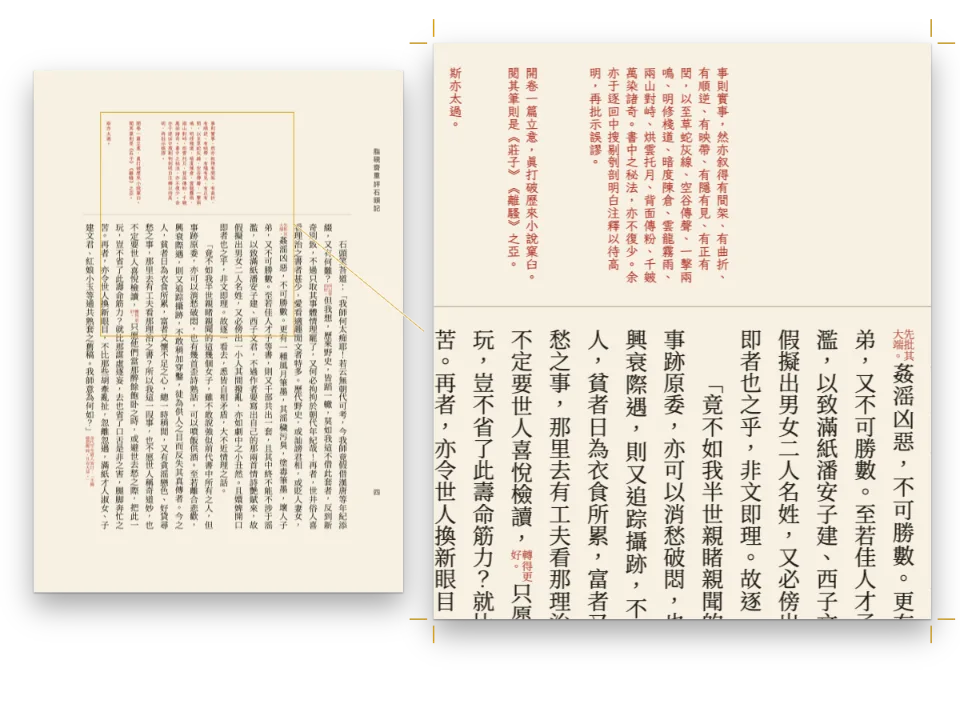
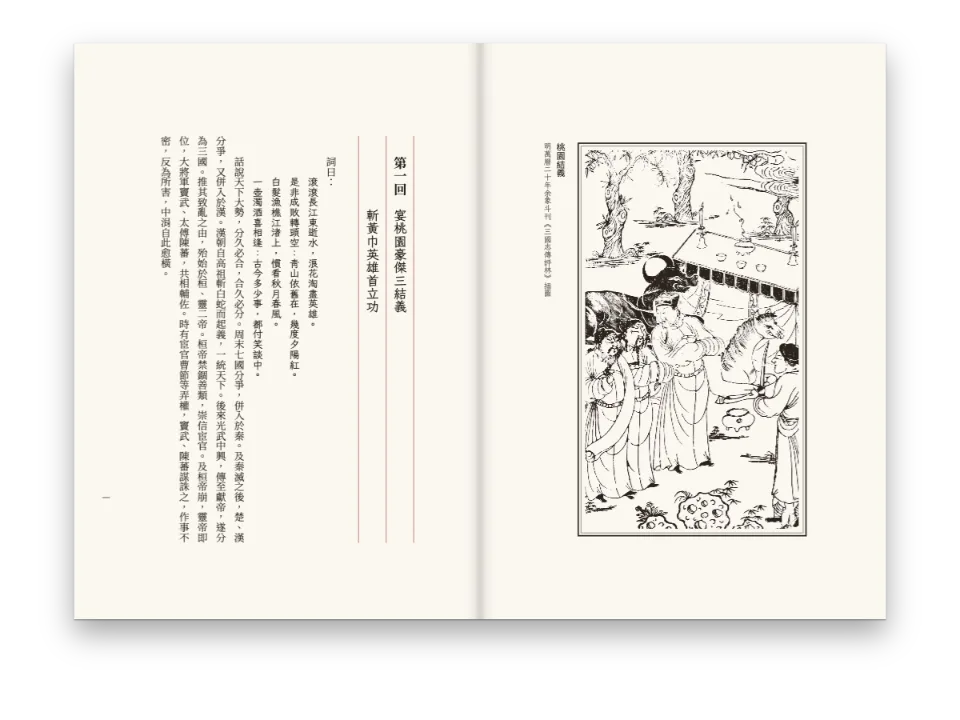
在一张内封之后,照刻本的样子排出朱熹《论语集注》(論語集註)开头《学而》篇的三叶。每页是半叶,121 × 213 mm,每个跨页是完整的一叶,从右往左读:每半叶九行,每行17字,用20 pt的Noto Serif TC,四周双边,每两行之间一条细线;折缝处是版心,上有书名、黑鱼尾、卷次和叶码。朱熹的注文用10 pt的小字折成双行,排在所注文字之后的行内。天头是地脚的两倍。
这道食谱解答
- 怎样排雕版书叶:双线边框、行间界线和中间的版心?
- 怎样按字数设定版心,每行多少字、每页多少行?
- 怎样把中文书排成竖排、右侧装订?
简短回答
// A block printed both halves of a leaf (葉) at once, the centre strip between them. Each
// page here is a half-leaf. Page 1, the title, is a recto: in a book bound on the right it
// stands alone left of the spine, and every spread after it is one leaf, read from the
// right. The grid sets the block's 9 columns of 17 characters; the text has no
// punctuation, so every column ends on its 17th character.
const page = {
  sizePreset: 'custom', width: pt(W), height: pt(H), dpi: 150,
  backgroundColor: col('paper'),
  // left is the inner margin, the half of the centre strip on this side of the fold
  margins: { top: pt(TOP), bottom: pt(BOTTOM), left: pt(HALF), right: pt(OUTER), mirror: true },
};
const layout = { layoutType: 'single', writingMode: 'vertical-rl' }; // bound on the right
const cjk = { grid: { enabled: true, charsPerLine: CHARS, linesPerPage: LINES } };
// Postext numbers pages, not leaves. Each leaf opens with a hidden level-1 heading, which
// prints nothing and starts a right-hand page; the centre strip prints their count.
const leaf = {
  level: 1, hidden: true, numberingTemplate: '{1:一}', // 一, 二, 三
  breakBefore: { enabled: true, parity: 'even' }, // gotcha: headings-drop-h1-break
};
用料
- 类型
- Noto Serif TC, LXGW WenKai TC(SIL OFL 1.1)
- 素材
- 无:所有图片都用代码绘制
做法
#1 · 一页半叶,一个跨页一叶
代码见上文的简短回答。一块书版一次印出一整叶(葉),两个半叶分在版心两侧;印工沿版心把纸对折,印面朝外,再把开口的一边缝起来,于是版心成了书的书口。这里的页面保持书叶刚从书版上印下来时的样子,每页是半叶。在右侧装订的书中,第1页单独位于书脊左侧,此后每个跨页都由右边的偶数页和它后面的奇数页组成,所以内封放在第1页,每个跨页就正好是一叶。字格网格设定书版的行款,九行,每行17字,它留下的页边距是精确的:内侧页边距正好是版心的一半。
Postext给页面编号,不给书叶编号。每叶都以一个隐藏的一级标题开头:它什么都不印,也不占位置,但它带parity: 'even'的breakBefore会从一个右页开始,它的编号(由numberingTemplate: '{1:一}'得到一、二、三)就是版心所用的{chapterNumber}。
#2 · 在每叶结束处断开正文
为刻工写样的抄手按书版一叶一叶地安排文字,Markdown也这样做:一叶的标题放在上一叶左半叶第九行结束的地方,即使那里在一句话或一段注文中间。在那里被截断的注文先关闭,再重新打开;由于每行都把自己那部分注文折成两行,双行小注排出来和原来一样:
子曰巧言令色鮮矣仁:warichu[巧好令善也好其言善其色致飾於]

# 學而

:warichu[外務以悦人則人欲肆而本心之德亡矣…]书版没有标点,所以没有哪条避头尾规则会挪动字,每行都在第17字结束:叶的断点只需数一次,之后不会变。朱熹的注文是:warichu[…],使用默认的一半字号,每行34个小字,读音和释义之间像刻本一样用○隔开。
#3 · 用网格的数值画出书版
// Header elements are placed on the sheet, pt from the page's top left corner. Both halves
// read right to left: a right-hand page (even) from the outer frame to the fold, a
// left-hand page (odd) from the fold to the outer frame.
const at = (x, y) => ({ anchor: { to: 'page', edge: 'top-left' }, offset: { x: pt(x), y: pt(y) } });
// A column of characters stands in the middle of its pitch, so the rules between columns
// fall on whole pitches. The k-th, counted from the right edge of the type area:
const line = (parity, k) =>
  (parity === 'even' ? HALF + LINES * PITCH : W - HALF) - k * PITCH;
const [Y0, Y1] = [TOP - GAP, TOP + CHARS * BODY + GAP]; // the inner frame's top and foot
// A rule is drawn from its x, a box's border inside the box: each is set so that the line
// is centred where it belongs.
const rule = (id, x, parity) => ({ kind: 'rule', id, parity, direction: 'vertical',
  thickness: pt(0.6), color: col('rule'),
  placement: { ...at(x - 0.3, Y0), size: { height: pt(Y1 - Y0) } } });
const frame = (id, [x0, x1], parity) => [[RULES, 1.8], [0, 0.6]].map(([out, t], i) => ({
  kind: 'box', id: `${id}-${i}`, parity, style: { borderColor: col('rule'), borderWidth: pt(t) },
  placement: { ...at(x0 - out - t / 2, Y0 - out - t / 2),
    size: { width: pt(x1 - x0 + 2 * out + t), height: pt(Y1 - Y0 + 2 * out + t) } } }));
// The middle of the strip, where its text stands: the fold, halfway between its two rules.
// Both pages draw the text whole, and each shows its half.
const mid = (parity) => (parity === 'even' ? 0 : W);
const strip = (id, content, parity, y) => ({ kind: 'text', id: `${id}-${parity}`, parity,
  content, writingMode: 'vertical-rl', fontFamily: SONG, fontSize: pt(11), color: col('ink'),
  align: 'left', overflow: 'clip',
  placement: { ...at(mid(parity) - HALF, TOP + y),
    size: { width: pt(2 * HALF), height: pt(CHARS * BODY - y) } } });
// The fish tail (魚尾): a black band with a notch, from one side of the strip to the other.
const FISH = `<svg xmlns="http://www.w3.org/2000/svg" viewBox="0 0 32 18">
  <path d="M0 0H32V13L16 6L0 13Z" fill="${palette.rule}"/></svg>`;
const resources = [{ id: 'fish', typeId: 'figure', kind: 'svg', createdAt: 0, updatedAt: 0,
  svg: { fileId: 'fish.svg', width: 32, height: 18 } }];
const fish = (parity) => ({ kind: 'image', id: `fish-${parity}`, parity, resourceId: 'fish',
  decorative: true, placement: { ...at(mid(parity) - HALF + 0.3, TOP + 3.4 * BODY),
    size: { width: pt(2 * HALF - 0.6), height: 'auto' } } });
const furniture = (parity) => [
  // The frame runs 40 pt past the fold, where the other half of the leaf takes it on.
  ...frame(`frame-${parity}`, parity === 'even' ? [-40, line(parity, 0)]
    : [line(parity, LINES), W + 40], parity),
  // Nine rules: eight between the columns (界行) and the side of the strip.
  ...Array.from({ length: LINES }, (_, i) =>
    rule(`rule-${i}-${parity}`, line(parity, parity === 'even' ? i + 1 : i), parity)),
  strip('book', '{title}', parity, 0.7 * BODY), // 書名, above the fish tail
  fish(parity),
  strip('juan', '卷一', parity, 5.2 * BODY), // 卷次, under it
  strip('leaf', '{chapterNumber}', parity, 11.5 * BODY), // 葉碼, the leaf's number
];
页眉排在整张纸上,所以框、界行和版心都用设定网格的那些数值,从页面一角以点为单位定位:在文字区域内每隔29 pt放一个线条元素,在正文外4.5 pt处放一个方框作细线,再往外4.5 pt放另一个作粗线。每行字都居于自己行宽的正中,所以界行正好落在相邻两行的中间。版心的文字由竖排文本元素自上而下排出,鱼尾是一个SVG图片元素,两者都居中于版心的两条线之间,也就是折缝上:每页显示版心的17 pt。每页都把版心文字和鱼尾完整地画出来,只显示自己这一侧的部分,两页并排时两部分就对上了。框线越过折缝也是同样的道理。
#4 · 给内封一个自己的样式
// A heading style of its own: hidden and unnumbered, so the leaves still count from 一, and
// its header replaces the leaves' furniture on its page. Its attributes hold the byline,
// this edition's note in red and the colophon, the one line that changes with the language.
const CELLS = [0, 2, LINES - 2, LINES]; // the byline, title and note, in pitches from the right
const cell = (i) => [CELLS[i], CELLS[i + 1]];
const column = (id, content, [k0, k1], style) => ({ kind: 'text', id, content,
  writingMode: 'vertical-rl', color: col('ink'), overflow: 'clip', verticalAlign: 'middle',
  placement: { ...at(line('odd', k1), TOP),
    size: { width: pt((k1 - k0) * PITCH), height: pt(CHARS * BODY) } }, ...style });
const titlePage = {
  id: 'title', numbered: false, hidden: true, breakBefore: { enabled: true, parity: 'any' },
  footer: { elements: [] },
  header: { elements: [
    ...frame('title-frame', [line('odd', LINES), line('odd', 0)]),
    rule('title-rule-1', line('odd', CELLS[1])), rule('title-rule-2', line('odd', CELLS[2])),
    column('byline', '{attr.byline}', cell(0), { fontFamily: SONG, fontSize: pt(14),
      align: 'left' }),
    column('book', '{title}', cell(1), { fontFamily: KAI, fontSize: pt(60),
      letterSpacing: pt(20), align: 'center' }),
    column('note', '{attr.note}', cell(2), { fontFamily: KAI, fontSize: pt(11),
      lineHeight: pt(0.6 * PITCH), color: col('vermilion'), align: 'right' }), // 3 in 2 pitches
    { kind: 'text', id: 'colophon', content: '{attr.colophon}', fontFamily: SONG,
      fontSize: pt(6.5), lineHeight: 1.4, color: col('muted'), align: 'left', overflow: 'wrap',
      placement: { ...at(line('odd', LINES) - RULES - 0.9, Y1 + RULES + 16),
        size: { width: pt(LINES * PITCH) } } },
  ] },
};
内封(內封)是一个一级标题,使用一个隐藏且不编号的标题样式,所以书叶仍从一开始计数。样式管辖其所在章节的页面,它的header在那里取代文档的页眉:内封得到一个封闭的、分成三栏的框,而不是半叶的那些版面元素。署名、本版的红色楷体说明和版权说明来自标题的属性;版权说明是唯一一行随版本语言而变的文字。属性中的\n另起一栏。
#5 · 每种字体只加载它要排的字
// Song sets the leaves, the strip and its leaf numbers; Kai only the title page's title
// and note (gotcha: cjk-fonts-slices). No punctuation: no vertical forms to load.
const note = markdown.match(/note="([^"]*)"/)?.[1].replaceAll('\\n', '') ?? '';
await loadFonts(FONTS, markdown); // their Latin files: the colophon
await loadCjkFonts({ [SONG]: FONTS[SONG] }, `${markdown}論語集註卷一二三四五六七八九十`);
await loadCjkFonts({ [KAI]: FONTS[KAI] }, `論語集註${note}`);
Fontsource把每种中文字体的每个字重拆成大约一百个文件。宋体排书叶、版心和叶码,所以它的调用传入样本文本和这些字;楷体只排书名和说明。书版没有标点,所以两种字体都不需要loadCjkFonts(…, { vertical: true })提供的竖排字形。
#6 · 暖色纸上只用一种墨
const palette = {
  ink: '#1f1b17', // the text, as the block printed it
  rule: '#1f1b17', // the frame, the column rules and the fish tail: the same block, same ink
  vermilion: '#a3301f', // 朱: this edition's note, on the title page; 5.9 : 1 on the paper
  muted: '#6d6358', // the colophon
  paper: '#f2ead8',
};
const col = (id) => ({ hex: palette[id], model: 'hex', paletteId: id });
const colorPalette = [
  ...Object.entries(palette).map(([id, hex]) => ({ id, name: id, value: { hex, model: 'hex' } })),
  { id: 'main-color', name: 'defaults', value: { hex: palette.ink, model: 'hex' } },
];
正文和书版的线条用同一种暖黑色印刷,与纸色的对比度为14 : 1。它们仍是调色板中的两项,ink和rule,这样可以只改线条的颜色而不动正文。红色留给本版添加的内容。
完整食谱
// ═══ Postext Cookbook · Nº 085 · A woodblock leaf: double frame, rules and centre strip ═══ // https://postext.dev/en/cookbook/woodblock-leaf // Code: MIT · Text: 論語集註 卷一, 四庫全書 copy, zh.wikisource (CC BY-SA 4.0) · Pictures: none // Fonts: Noto Serif TC, LXGW WenKai TC (SIL OFL 1.1) · Needs postext ≥ 1.9.0 // A title page and three leaves of Zhu Xi's commentary on the Analects, set as a woodblock // printed them: each spread is one leaf, its two halves either side of the centre strip // (版心), the text in a double frame with a rule between every two columns, the commentary // folded into two small rows inside the column. import { buildDocument, renderPageToCanvas, clearMeasurementCache, registerResourceImage, } from 'https://esm.sh/postext'; import { renderToPdf, decompressWoff2 } from 'https://esm.sh/postext-pdf'; const LANG = 'en'; // @lang: the language of the colophon; the leaves are Chinese in both const RECIPE = 'woodblock-leaf'; // ─── 1 · Design ───────────────────────────────────────────────────────────── // #region palette: one ink on a warm paper, and a red for the editor's note const palette = { ink: '#1f1b17', // the text, as the block printed it rule: '#1f1b17', // the frame, the column rules and the fish tail: the same block, same ink vermilion: '#a3301f', // 朱: this edition's note, on the title page; 5.9 : 1 on the paper muted: '#6d6358', // the colophon paper: '#f2ead8', }; const col = (id) => ({ hex: palette[id], model: 'hex', paletteId: id }); const colorPalette = [ ...Object.entries(palette).map(([id, hex]) => ({ id, name: id, value: { hex, model: 'hex' } })), { id: 'main-color', name: 'defaults', value: { hex: palette.ink, model: 'hex' } }, ]; // #endregion const [SONG, KAI] = ['Noto Serif TC', 'LXGW WenKai TC']; // 宋: the block's face; 楷: the title // The leaf in points: 半葉九行,行十七字, a 20 pt character on a column pitch of 29 pt. const [BODY, PITCH, CHARS, LINES] = [20, 29, 17, 9]; const HALF = 17; // half the centre strip, from the fold to the column rule beside it const GAP = 4.5; // the text to the inner frame line, as a character to a column rule const RULES = 4.5; // the thin inner frame line to the heavy outer one (文武線) const [HEAD, FOOT, SIDE] = [164, 82, 60]; // paper outside the frame: 天頭 twice 地腳 const TOP = HEAD + RULES + GAP; // the page's margins const BOTTOM = FOOT + RULES + GAP; const OUTER = SIDE + RULES; const W = HALF + LINES * PITCH + OUTER; // a half-leaf, 121 × 213 mm const H = TOP + CHARS * BODY + BOTTOM; // #region answer: a half-leaf to a page, so that every spread is one whole leaf // A block printed both halves of a leaf (葉) at once, the centre strip between them. Each // page here is a half-leaf. Page 1, the title, is a recto: in a book bound on the right it // stands alone left of the spine, and every spread after it is one leaf, read from the // right. The grid sets the block's 9 columns of 17 characters; the text has no // punctuation, so every column ends on its 17th character. const page = { sizePreset: 'custom', width: pt(W), height: pt(H), dpi: 150, backgroundColor: col('paper'), // left is the inner margin, the half of the centre strip on this side of the fold margins: { top: pt(TOP), bottom: pt(BOTTOM), left: pt(HALF), right: pt(OUTER), mirror: true }, }; const layout = { layoutType: 'single', writingMode: 'vertical-rl' }; // bound on the right const cjk = { grid: { enabled: true, charsPerLine: CHARS, linesPerPage: LINES } }; // Postext numbers pages, not leaves. Each leaf opens with a hidden level-1 heading, which // prints nothing and starts a right-hand page; the centre strip prints their count. const leaf = { level: 1, hidden: true, numberingTemplate: '{1:一}', // 一, 二, 三 breakBefore: { enabled: true, parity: 'even' }, // gotcha: headings-drop-h1-break }; // #endregion // #region frame: the double frame, a rule between every two columns, the centre strip // Header elements are placed on the sheet, pt from the page's top left corner. Both halves // read right to left: a right-hand page (even) from the outer frame to the fold, a // left-hand page (odd) from the fold to the outer frame. const at = (x, y) => ({ anchor: { to: 'page', edge: 'top-left' }, offset: { x: pt(x), y: pt(y) } }); // A column of characters stands in the middle of its pitch, so the rules between columns // fall on whole pitches. The k-th, counted from the right edge of the type area: const line = (parity, k) => (parity === 'even' ? HALF + LINES * PITCH : W - HALF) - k * PITCH; const [Y0, Y1] = [TOP - GAP, TOP + CHARS * BODY + GAP]; // the inner frame's top and foot // A rule is drawn from its x, a box's border inside the box: each is set so that the line // is centred where it belongs. const rule = (id, x, parity) => ({ kind: 'rule', id, parity, direction: 'vertical', thickness: pt(0.6), color: col('rule'), placement: { ...at(x - 0.3, Y0), size: { height: pt(Y1 - Y0) } } }); const frame = (id, [x0, x1], parity) => [[RULES, 1.8], [0, 0.6]].map(([out, t], i) => ({ kind: 'box', id: `${id}-${i}`, parity, style: { borderColor: col('rule'), borderWidth: pt(t) }, placement: { ...at(x0 - out - t / 2, Y0 - out - t / 2), size: { width: pt(x1 - x0 + 2 * out + t), height: pt(Y1 - Y0 + 2 * out + t) } } })); // The middle of the strip, where its text stands: the fold, halfway between its two rules. // Both pages draw the text whole, and each shows its half. const mid = (parity) => (parity === 'even' ? 0 : W); const strip = (id, content, parity, y) => ({ kind: 'text', id: `${id}-${parity}`, parity, content, writingMode: 'vertical-rl', fontFamily: SONG, fontSize: pt(11), color: col('ink'), align: 'left', overflow: 'clip', placement: { ...at(mid(parity) - HALF, TOP + y), size: { width: pt(2 * HALF), height: pt(CHARS * BODY - y) } } }); // The fish tail (魚尾): a black band with a notch, from one side of the strip to the other. const FISH = `<svg xmlns="http://www.w3.org/2000/svg" viewBox="0 0 32 18"> <path d="M0 0H32V13L16 6L0 13Z" fill="${palette.rule}"/></svg>`; const resources = [{ id: 'fish', typeId: 'figure', kind: 'svg', createdAt: 0, updatedAt: 0, svg: { fileId: 'fish.svg', width: 32, height: 18 } }]; const fish = (parity) => ({ kind: 'image', id: `fish-${parity}`, parity, resourceId: 'fish', decorative: true, placement: { ...at(mid(parity) - HALF + 0.3, TOP + 3.4 * BODY), size: { width: pt(2 * HALF - 0.6), height: 'auto' } } }); const furniture = (parity) => [ // The frame runs 40 pt past the fold, where the other half of the leaf takes it on. ...frame(`frame-${parity}`, parity === 'even' ? [-40, line(parity, 0)] : [line(parity, LINES), W + 40], parity), // Nine rules: eight between the columns (界行) and the side of the strip. ...Array.from({ length: LINES }, (_, i) => rule(`rule-${i}-${parity}`, line(parity, parity === 'even' ? i + 1 : i), parity)), strip('book', '{title}', parity, 0.7 * BODY), // 書名, above the fish tail fish(parity), strip('juan', '卷一', parity, 5.2 * BODY), // 卷次, under it strip('leaf', '{chapterNumber}', parity, 11.5 * BODY), // 葉碼, the leaf's number ]; // #endregion // #region title: the title page (內封), a half-leaf in a closed frame, three columns // A heading style of its own: hidden and unnumbered, so the leaves still count from 一, and // its header replaces the leaves' furniture on its page. Its attributes hold the byline, // this edition's note in red and the colophon, the one line that changes with the language. const CELLS = [0, 2, LINES - 2, LINES]; // the byline, title and note, in pitches from the right const cell = (i) => [CELLS[i], CELLS[i + 1]]; const column = (id, content, [k0, k1], style) => ({ kind: 'text', id, content, writingMode: 'vertical-rl', color: col('ink'), overflow: 'clip', verticalAlign: 'middle', placement: { ...at(line('odd', k1), TOP), size: { width: pt((k1 - k0) * PITCH), height: pt(CHARS * BODY) } }, ...style }); const titlePage = { id: 'title', numbered: false, hidden: true, breakBefore: { enabled: true, parity: 'any' }, footer: { elements: [] }, header: { elements: [ ...frame('title-frame', [line('odd', LINES), line('odd', 0)]), rule('title-rule-1', line('odd', CELLS[1])), rule('title-rule-2', line('odd', CELLS[2])), column('byline', '{attr.byline}', cell(0), { fontFamily: SONG, fontSize: pt(14), align: 'left' }), column('book', '{title}', cell(1), { fontFamily: KAI, fontSize: pt(60), letterSpacing: pt(20), align: 'center' }), column('note', '{attr.note}', cell(2), { fontFamily: KAI, fontSize: pt(11), lineHeight: pt(0.6 * PITCH), color: col('vermilion'), align: 'right' }), // 3 in 2 pitches { kind: 'text', id: 'colophon', content: '{attr.colophon}', fontFamily: SONG, fontSize: pt(6.5), lineHeight: 1.4, color: col('muted'), align: 'left', overflow: 'wrap', placement: { ...at(line('odd', LINES) - RULES - 0.9, Y1 + RULES + 16), size: { width: pt(LINES * PITCH) } } }, ] }, }; // #endregion const config = () => ({ // a factory: the engine caches resolved configs per object locale: 'zh-Hant', // written out, never LANG (gotcha: cjk-locale-tag) colorPalette, page, layout, cjk, header: { elements: [...furniture('even'), ...furniture('odd')] }, footer: { elements: [] }, bodyText: { fontFamily: SONG, fontSize: pt(BODY), lineHeight: pt(PITCH), color: col('ink'), boldColor: col('ink'), italicColor: col('ink'), referenceColor: col('ink'), textAlign: 'justify', firstLineIndent: pt(0), indentAfterHeading: false, // 頂格 }, headings: { fontFamily: SONG, fontWeight: 400, color: col('ink'), levels: [leaf] }, headingStyles: [titlePage], // The byline's seven characters (宋 朱子 集註) end at the foot of the column. paragraphStyles: [{ id: 'byline', indent: em(CHARS - 7), firstLineIndent: pt(0), textAlign: 'left' }], }); // ─── 2 · Content ──────────────────────────────────────────────────────────── const markdown = String.raw`---Markdown样例 · 25行 · content.en.md
title: "論語集註" author: "朱熹" --- # 論語集註 {style="title" byline="宋 朱子 集註" note="據四庫全書本錄文\n仿刻本版式重排\n半葉九行行十七字" colophon="Set in Noto Serif TC and LXGW WenKai TC (SIL OFL) · Text: 論語集註, 四庫全書 copy, Wikisource transcription (CC BY-SA 4.0)"} # 學而 論語卷一 :::paragraphs{style="byline"} 宋 朱子 集註 ::: 學而第一:warichu[此為書之首篇故所記多務本之意乃入道之門積德之基學者之先務也凡十六章] 子曰學而時習之不亦說乎:warichu[說悦同○學之為言效也人性皆善而覺有先後後覺者必效先覺之所為乃可以明善而復其初也習鳥數飛也學之不已如鳥數飛也說喜意也既學而又時時習之則所學者熟而中心喜說其進自不能已矣程子曰習重習也時復思繹浹洽於中則說也又曰學者將以行之也時習之則所學者在我故說謝氏曰時習者無時而不習坐如尸坐時習也立如齊立時習也]有朋自遠方來不亦樂乎:warichu[樂音洛○朋同類也自遠方來則近者可知程子曰以善及人而信從者衆故可樂又曰說在心樂主發散在外]人不知而不慍不亦君子乎:warichu[慍紆問反○慍含怒意君子成德之名尹氏曰學在己知不知在人何慍之有程子曰雖樂於及人不見是而無悶乃所謂君子愚謂及人而樂者順而易不知而不慍者逆而難故惟成德者能之然德之所以成亦曰學之正習之熟說之深而不已焉耳○程子曰樂由說而後得非樂不足以語君子]○有子曰其為人也孝弟而好犯上者鮮矣不好犯上而好作亂者未之有也:warichu[弟好皆去聲鮮上聲下同○有子孔子弟子名若善事父母為孝善事兄長為弟犯上謂干犯在上之人鮮少也作亂則為悖逆争鬭之事矣此言人能孝弟則其心和順少好犯上必不好作亂也]君子務本本立而道生孝弟也者其為仁之本與:warichu[與平聲○務專力也本猶根也仁者愛之理心之德也為仁猶曰行仁與者疑辭謙退不敢質言也言君子凡事專用力於根本根本既立則其道自生若上文所謂孝弟乃是為仁之本學者務此則仁道自此而生也○程子曰孝弟順德也故不好犯上豈復有逆理亂常之事德有本本立則其道充大孝弟行於家而後仁愛及於物所謂親親而仁民也故為仁以孝弟為本論性則以仁為孝弟之本或問孝弟為仁之本此是由孝弟可以至仁否曰非也謂行仁自孝弟始孝弟是仁之一事謂之行仁之本則可謂是仁之本則不可蓋仁是性也孝弟是用也性中只有箇仁義禮智四者而已曷嘗有孝弟來然仁主於愛愛莫大於愛親故曰孝弟也者其為仁之本與]○子曰巧言令色鮮矣仁:warichu[巧好令善也好其言善其色致飾於] # 學而 :warichu[外務以悦人則人欲肆而本心之德亡矣聖人詞不迫切專言鮮則絕無可知學者所當深戒也○程子曰知巧言令色之非仁則知仁矣]○曾子曰吾日三省吾身為人謀而不忠乎與朋友交而不信乎傳不習乎:warichu[省悉井反為去聲傳平聲○曾子孔子弟子名參字子輿盡己之謂忠以實之謂信傳謂受之於師習謂熟之於己曾子以此三者日省其身有則改之無則加勉其自治誠切如此可謂得為學之本矣而三者之序則又以忠信為傳習之本也○尹氏曰曾子守約故動必求諸身謝氏曰諸子之學皆出於聖人其後愈遠而愈失其真獨曾子之學專用心於內故傳之無弊觀於子思孟子可見矣惜乎其嘉言善行不盡傳於世也其幸存而未泯者學者其可不盡心乎]○子曰道千乘之國敬事而信節用而愛人使民以時:warichu[道乘皆去聲○道治也千乘諸侯之國其地可出兵車千乘者也敬者主一無適之謂敬事而信者敬其事而信於民也時謂農隙之時言治國之要在此五者亦務本之意也○程子曰此言至淺然當時諸侯果能此亦足以治其國矣聖人言雖至近上下皆通此三言者若推其極堯舜之治亦不過此若常人之言近則淺近而已矣楊氏曰上不敬則下慢不信則下疑下慢而疑事不立矣敬事而信以身先之也易曰節以制度不傷財不害民蓋侈用則傷財傷財必至於害民故愛民必先於節用然使之不以其時則力本者不獲自盡雖有愛人之心而人不被其澤矣然此特論其所存而已未及為政也茍無是心則雖有政不行焉胡氏曰凡此數者又皆以敬為主愚謂五者反復相因各有次第讀者宜細推之]○子曰弟子入則孝出則弟謹而信汎愛衆而親仁行有餘力則以學文:warichu[弟子之弟上聲則弟之弟去聲○謹者行之有常也信者言之有實也汎廣也衆謂衆人親近也仁謂仁者餘力猶言暇日以用也文謂詩書六藝之文○程子曰為弟子之職力有餘則學文不脩其職而先文非為己之學也尹氏曰德行本也文藝末也窮其本末知所先後可以入德矣洪氏曰未有餘力而學文則文滅其質有餘力而不學文則質勝而野愚謂力行而不學文則無以考聖賢之成法識事理之當然而所行或出於私意非但失之於野而已]○子夏曰賢賢易色事父母能竭其力事君能致其身與朋友交言而有信雖曰未學吾必謂之學矣:warichu[子夏孔子弟子姓卜名商賢人之賢而易其好色之心好善有誠也致猶委也委致其身謂不有其身也四者皆人倫之大者而行之必盡其誠學求如是而已故子夏言有能如] # 學而 :warichu[是之人茍非生質之美必其務學之至雖或以為未嘗為學我必謂之已學也○游氏曰三代之學皆所以明人倫也能是四者則於人倫厚矣學之為道何以加此子夏以文學名而其言如此則古人之所謂學者可知矣故學而一篇大抵皆在於務本吳氏曰子夏之言其意善矣然詞氣之閒抑揚太過其流之弊將或至於廢學必若上章夫子之言然後為無弊也]○子曰君子不重則不威學則不固:warichu[重厚重威威嚴固堅固也輕乎外者必不能堅乎內故不厚重則無威嚴而所學亦不堅固也]主忠信:warichu[人不忠信則事皆無實為惡則易為善則難故學者必以是為主焉程子曰人道惟在忠信不誠則無物且出入無時莫知其鄉者人心也若無忠信豈復有物乎]無友不如己者:warichu[無毋通禁止辭也友所以輔仁不如己則無益而有損]過則勿憚改:warichu[勿亦禁止之辭憚畏難也自治不勇則惡日長故有過則當速改不可畏難而苟安也程子曰學問之道無他也知其不善則速改以從善而已○程子曰君子自脩之道當如是也游氏曰君子之道以威重為質而學以成之學之道必以忠信為主而以勝己者輔之然或吝於改過則終無以入德而賢者亦未必樂告以善道故以過勿憚改終焉]○曾子曰慎終追遠民德歸厚矣:warichu[慎終者喪盡其禮追遠者祭盡其誠民德歸厚謂下民化之其德亦歸於厚蓋終者人之所易忽也而能謹之遠者人之所易忘也而能追之厚之道也故以此自為則己之德厚下民化之則其德亦歸於厚也]○子禽問於子貢曰夫子至於是邦也必聞其政求之與抑與之與:warichu[之與之與平聲下同○子禽姓陳名亢子貢姓端木名賜皆孔子弟子或曰亢子貢弟子未知孰是抑反語辭]子貢曰夫子溫良恭儉讓以得之夫子之求之也其諸異乎人之求之與:warichu[溫和厚也良易直也恭莊敬也儉節制也讓謙遜也五者夫子之盛德光輝接於人者也其諸語辭也人他人也言夫子未嘗求之但其德容如是故時君敬信自以其政就而問之耳非若他人必求之而後得也聖人過化存神之妙未易窺測然即此而觀則其德盛禮恭而不願乎外亦可見矣學者所當潛心而勉學也○謝氏曰學者觀於聖人威儀之閒亦可以進德矣若子貢亦可謂善觀聖人矣亦可謂善言德行矣今去聖人千五百年以此五者想見其形容尚能使人興起而况於親炙之者乎張敬夫曰夫子至是邦必聞其政而未有能委國而授之以政者蓋見聖人之儀刑而樂告之者秉彞好德之良心也而私欲害之是以終不能用耳]`; // content.<lang>.md: the same leaves, another colophon // ─── 3 · Fonts ────────────────────────────────────────────────────────────── const FONTS = { 'Noto Serif TC': ['400'], // 宋: the text, the notes, the centre strip, the colophon 'LXGW WenKai TC': ['400'], // 楷: the title page's title and this edition's note }; // ─── 4 · Build & show ─────────────────────────────────────────────────────── // #region voices: each face loads the files of the characters it sets // Song sets the leaves, the strip and its leaf numbers; Kai only the title page's title // and note (gotcha: cjk-fonts-slices). No punctuation: no vertical forms to load. const note = markdown.match(/note="([^"]*)"/)?.[1].replaceAll('\\n', '') ?? ''; await loadFonts(FONTS, markdown); // their Latin files: the colophon await loadCjkFonts({ [SONG]: FONTS[SONG] }, `${markdown}論語集註卷一二三四五六七八九十`); await loadCjkFonts({ [KAI]: FONTS[KAI] }, `論語集註${note}`); // #endregion await loadSvg('fish.svg', FISH); const doc = await buildWithFonts( () => buildDocument({ markdown, resources }, config()), markdown); showBook(doc, { title: t({ en: 'A woodblock leaf: double frame, rules and centre strip', es: 'Una hoja xilográfica: marco doble, filetes y franja central' }) }); offerPdf(() => renderToPdf(doc, { fontProvider: cjkPdfProvider, resourceBytes: imageBytes }), `${RECIPE}.pdf`);工具包 · core, fonts, viewer, pdf, images, cjk:每道食谱都相同 · 457行
// ─── Kit ── helpers shared by every Cookbook recipe · postext.dev/cookbook ───── // ─── Kit · core v1 ── the same in every recipe · postext.dev/cookbook ───────── function mm(value) { return { value, unit: 'mm' }; } function pt(value) { return { value, unit: 'pt' }; } function em(value) { return { value, unit: 'em' }; } /** The sample language's string: t({ en: 'Figure', es: 'Figura' }). */ function t(strings) { return strings[LANG] ?? Object.values(strings)[0]; } /** A file in this recipe's assets folder, served from the Postext repo by jsDelivr. */ function asset(file) { return `https://cdn.jsdelivr.net/gh/drnachio/postext@main/cookbook/${RECIPE}/assets/${file}`; } // ─── Kit · fonts v1 ── the same in every recipe · postext.dev/cookbook ──────── // Postext measures text with the faces the browser has loaded, and caches the // widths, so every face must be ready before the first build. Faces come from // Fontsource: the same static files the PDF embeds, so screen and PDF agree. /** faces = { 'Family Name': ['400', '400i', '700'] }. `text` is the sample: * letters beyond Latin-1 (č, ł, ő…) also load the latin-ext files. With * `optional`, a face Fontsource does not ship is skipped instead of failing. * Resolves to the number of faces added. */ async function loadFonts(faces, text = '', { optional = false } = {}) { kitStatus('Loading fonts…'); const ranges = { latin: 'U+0000-00FF,U+0131,U+0152-0153,U+02BB-02BC,U+02C6,U+02DA,U+02DC,U+0304,U+0308,U+0329,' + 'U+2000-206F,U+20AC,U+2122,U+2191,U+2193,U+2212,U+2215,U+FEFF,U+FFFD', 'latin-ext': 'U+0100-02BA,U+02BD-02C5,U+02C7-02CC,U+02CE-02D7,U+02DD-02FF,U+0304,U+0308,U+0329,' + 'U+1D00-1DBF,U+1E00-1E9F,U+1EF2-1EFF,U+2020,U+20A0-20AB,U+20AD-20C0,U+2113,U+2C60-2C7F,U+A720-A7FF', }; const subsets = /[Ā-˿Ḁ-ỿ]/.test(text) ? ['latin', 'latin-ext'] : ['latin']; const jobs = []; let added = 0; for (const [family, specs] of Object.entries(faces)) { const id = fontsourceId(family); const meta = optional ? await fontsourceMeta(family) : null; for (const spec of new Set(specs)) { const weight = parseInt(spec, 10); const style = spec.endsWith('i') ? 'italic' : 'normal'; if (hasFace(family, weight, style)) continue; if (optional && !(meta?.weights.includes(weight) && meta.styles.includes(style))) continue; for (const subset of subsets) { const url = `https://cdn.jsdelivr.net/npm/@fontsource/${id}@5/files/${id}-${subset}-${weight}-${style}.woff2`; const face = new FontFace(family, `url(${url}) format('woff2')`, { weight: String(weight), style, unicodeRange: ranges[subset] }); jobs.push(face.load().then((ready) => { document.fonts.add(ready); added++; }, () => { if (subset === 'latin' && !optional) throw new Error(`Fontsource has no ${family} ${weight} ${style}`); })); } } } await Promise.all(jobs).catch((error) => { kitFail(error); throw error; }); return added; } /** Runs `build` (a buildDocument or buildBundle call) and checks the faces * the pages use. A regular face missing from FONTS is loaded with a warning; * bold and italic variants are loaded when the family ships them. Then the * measurement caches are cleared and the build runs again. */ async function buildWithFonts(build, text = '') { const tried = new Set(); for (let round = 0; round < 3; round++) { kitStatus('Laying out…'); await new Promise(requestAnimationFrame); // let the status paint first const result = await Promise.resolve().then(build).catch((error) => { kitFail(error); throw error; }); const wanted = { base: {}, variants: {} }; for (const { font, base } of [result].flat().flatMap(fontStringsOf)) { const { family, weight, style } = parseFont(font); const key = `${family}|${weight}|${style}`; if (tried.has(key) || hasFace(family, weight, style)) continue; tried.add(key); (wanted[base ? 'base' : 'variants'][family] ??= []).push(`${weight}${style === 'italic' ? 'i' : ''}`); } if (Object.keys(wanted.base).length) { console.warn(`[cookbook] FONTS does not list ${JSON.stringify(wanted.base)}: loading them.`); } const added = await loadFonts(wanted.base, text) + await loadFonts(wanted.variants, text, { optional: true }); if (added === 0) return result; clearMeasurementCache(); } throw new Error('The fonts did not settle after three builds.'); } /** Every font string of the layout. `base` marks a block's own face; its * bold, italic and bold-italic variants are listed whether or not used. */ function fontStringsOf(doc) { const found = new Map(); const walk = (node) => { if (!node || typeof node !== 'object') return; if (Array.isArray(node)) { node.forEach(walk); return; } for (const [key, value] of Object.entries(node)) { if (typeof value === 'string' && /fontString$/i.test(key)) { found.set(value, found.get(value) || key === 'fontString'); } else if (value && typeof value === 'object') walk(value); } }; walk(doc.pages); walk(doc.blocks); return [...found].map(([font, base]) => ({ font, base })); } /** '700 37.5px Open Sans' / 'italic 400 13px "Source Serif 4"' → { family, weight, style }. * A string with no weight ('95.8px Young Serif', from a design text) is 400. */ function parseFont(font) { const m = /^(?:(italic|oblique)\s+)?(?:small-caps\s+)?(?:(\d+|bold|normal)\s+)?[\d.]+px\s+(.+)$/.exec(font.trim()); if (!m) throw new Error(`Unexpected font string: ${font}`); const weight = m[2] === 'bold' ? 700 : !m[2] || m[2] === 'normal' ? 400 : Number(m[2]); return { family: m[3].replace(/^["']|["']$/g, ''), weight, style: m[1] ? 'italic' : 'normal' }; } /** True when a loaded FontFace covers exactly this family, weight and style * (document.fonts.check() is also true for families nobody declared). */ function hasFace(family, weight, style) { for (const face of document.fonts) { if (face.status !== 'loaded' || face.style !== style) continue; if (face.family.replace(/^["']|["']$/g, '') !== family) continue; const [low, high = low] = face.weight.split(' ').map(Number); if (weight >= low && weight <= high) return true; } return false; } /** Fontsource's id for a family: 'Source Serif 4' → 'source-serif-4'. */ function fontsourceId(family) { return family.toLowerCase().replace(/\s+/g, '-'); } /** The weights and styles a family ships ({ weights: [400, 700], styles: ['normal', 'italic'] }), or null. */ function fontsourceMeta(family) { fontsourceMeta.cache ??= new Map(); const id = fontsourceId(family); if (!fontsourceMeta.cache.has(id)) { fontsourceMeta.cache.set(id, fetch(`https://api.fontsource.org/v1/fonts/${id}`) .then((res) => (res.ok ? res.json() : null), () => null)); } return fontsourceMeta.cache.get(id); } // ─── Kit · viewer v1 ── the same in every recipe · postext.dev/cookbook ─────── /** Shows the pages as facing spreads on a dark desk: the first page is a * recto on its own, then verso | recto pairs, as in a bound book. Pages * are painted when they scroll near the screen. */ function showPages(docs, { title, width = 460 } = {}) { const root = viewer(title); const pages = [docs].flat().flatMap((doc) => doc.pages.map((page) => ({ doc, page, n: (doc.pageIndexOffset ?? 0) + page.index }))); const spreads = []; let verso = null; for (const p of pages) { if (p.n % 2 === 1) { if (verso) spreads.push([verso, null]); verso = p; } else { spreads.push([verso, p]); verso = null; } } if (verso) spreads.push([verso, null]); const density = Math.min(window.devicePixelRatio || 1, 2); showPages.painter?.disconnect(); const painter = new IntersectionObserver((entries) => { for (const { isIntersecting, target } of entries) { if (!isIntersecting) continue; painter.unobserve(target); const { doc, page } = target.postext; renderPageToCanvas(page, doc, target, { scale: (width * density) / page.width }); } }, { rootMargin: '800px' }); showPages.painter = painter; root.replaceChildren(...spreads.map((pair) => { const spread = document.createElement('div'); spread.className = 'pt-spread'; for (const p of pair) { const figure = document.createElement('figure'); if (p) { const label = p.page.pageLabel || String(p.n + 1); const canvas = document.createElement('canvas'); canvas.postext = p; canvas.style.aspectRatio = `${p.page.width} / ${p.page.height}`; canvas.setAttribute('role', 'img'); canvas.setAttribute('aria-label', `Page ${label}`); const folio = document.createElement('figcaption'); folio.textContent = label; figure.append(canvas, folio); painter.observe(canvas); } else figure.className = 'pt-blank'; spread.append(figure); } return spread; })); kitStatus(`${pages.length} ${pages.length === 1 ? 'page' : 'pages'}`); document.documentElement.dataset.postext = 'ready'; return pages.length; } /** The desk, the bar and the error reporting, created once. */ function viewer(title) { if (!document.getElementById('pt-kit')) { document.head.insertAdjacentHTML('beforeend', `<style id="pt-kit"> :root { color-scheme: dark; } body { margin: 0; background: #0e1014; color: #b9bcc4; font: 13px/1.45 system-ui, sans-serif; } #pt-bar { position: sticky; top: 0; z-index: 1; display: flex; flex-wrap: wrap; align-items: center; gap: 6px 16px; padding: 10px 16px; background: rgb(14 16 20 / .92); backdrop-filter: blur(6px); border-bottom: 1px solid #23262d; } #pt-bar strong { color: #f4f1ea; font-weight: 600; } #pt-actions { display: flex; gap: 12px; margin-left: auto; } #pt-actions a, #pt-actions button { color: #d8a21a; font: inherit; background: none; border: 0; padding: 0; cursor: pointer; } #pages { display: grid; justify-items: center; gap: 48px; padding: 32px 16px 72px; } .pt-spread { display: flex; } .pt-spread figure { margin: 0; width: min(460px, 44vw); } .pt-spread canvas { display: block; width: 100%; background: #fff; box-shadow: 0 1px 2px rgb(0 0 0 / .5), 0 22px 44px -16px rgb(0 0 0 / .8); } .pt-spread figure:first-child canvas { box-shadow: inset -14px 0 14px -14px rgb(0 0 0 / .18), 0 1px 2px rgb(0 0 0 / .5), 0 22px 44px -16px rgb(0 0 0 / .8); } .pt-spread figcaption { margin-top: 10px; text-align: center; font: 600 10px/1 system-ui, sans-serif; letter-spacing: .18em; text-transform: uppercase; color: #6c7079; } .pt-blank { visibility: hidden; } @media (max-width: 760px) { .pt-spread { flex-direction: column; gap: 32px; } .pt-spread figure { width: min(460px, 92vw); } .pt-blank { display: none; } } </style>`); document.body.insertAdjacentHTML('afterbegin', '<header id="pt-bar"><strong id="pt-title"></strong><span id="pt-status" role="status"></span><span id="pt-actions"></span></header>'); document.getElementById('pt-title').textContent = document.title || 'Postext'; addEventListener('error', (event) => kitFail(event.error ?? event.message)); addEventListener('unhandledrejection', (event) => kitFail(event.reason)); } if (title) document.getElementById('pt-title').textContent = title; return document.getElementById('pages') ?? document.body.appendChild(Object.assign(document.createElement('main'), { id: 'pages' })); } function kitStatus(text) { viewer(); document.getElementById('pt-status').textContent = text; } function kitFail(error) { document.documentElement.dataset.postext = 'error'; kitStatus(`Error: ${error?.message ?? error}`); } // ─── Kit · pdf v1 ── the same in every recipe that exports a PDF ────────────── /** postext-pdf embeds TrueType bytes. Fetch the Fontsource file the screen * used, snapping to a weight the family ships and falling back to upright * when it has no italic: the PDF asks for every face a block could use. */ async function fontsourceProvider(family, weight, style) { const id = fontsourceId(family); const meta = await fontsourceMeta(family); const weights = meta?.weights?.length ? meta.weights : [400, 700]; const w = weights.reduce((a, b) => (Math.abs(b - weight) < Math.abs(a - weight) ? b : a)); const s = style === 'italic' && meta && !meta.styles.includes('italic') ? 'normal' : style; const res = await fetch(`https://cdn.jsdelivr.net/npm/@fontsource/${id}@5/files/${id}-latin-${w}-${s}.woff2`); if (!res.ok) throw new Error(`Fontsource has no ${family} ${w} ${s} (${res.status})`); return decompressWoff2(new Uint8Array(await res.arrayBuffer())); } /** A "Build the PDF" button in the bar. Once built: "Open the PDF" (a new * tab, since CodePen's preview frame cannot show PDFs) and a download link. */ function offerPdf(makePdf, filename) { viewer(); const button = Object.assign(document.createElement('button'), { type: 'button', textContent: 'Build the PDF' }); button.dataset.postextPdf = filename; button.addEventListener('click', async () => { button.disabled = true; button.textContent = 'Building the PDF…'; try { const bytes = await makePdf(); const url = URL.createObjectURL(new Blob([bytes], { type: 'application/pdf' })); const size = `${Math.max(1, Math.round(bytes.length / 1024))} KB`; button.replaceWith( Object.assign(document.createElement('a'), { href: url, target: '_blank', rel: 'noopener', textContent: 'Open the PDF ↗' }), Object.assign(document.createElement('a'), { href: url, download: filename, textContent: `Download ${filename} · ${size}` })); } catch (error) { button.disabled = false; button.textContent = 'Build the PDF'; kitFail(error); } }); document.getElementById('pt-actions').append(button); } // ─── Kit · images v1 ── recipes with pictures · postext.dev/cookbook ────────── /** Registers a photo or PNG for the canvas and keeps its bytes for the PDF. * fetch → ImageBitmap never taints the canvas (a plain cross-origin <img> would). */ async function loadImage(fileId, url) { const res = await fetch(url); if (!res.ok) throw new Error(`Image not found (${res.status}): ${url}`); const bytes = new Uint8Array(await res.arrayBuffer()); registerResourceImage(fileId, await createImageBitmap(new Blob([bytes]))); (loadImage.bytes ??= new Map()).set(fileId, bytes); } /** Registers SVG markup (drawn in code, or fetched) as a vector image. */ async function loadSvg(fileId, svg) { const img = new Image(); img.src = `data:image/svg+xml;charset=utf-8,${encodeURIComponent(svg)}`; await img.decode(); registerResourceImage(fileId, img); (loadImage.bytes ??= new Map()).set(fileId, new TextEncoder().encode(svg)); } /** renderToPdf({ resourceBytes: imageBytes }) */ function imageBytes(fileId) { return loadImage.bytes?.get(fileId); } /** renderToHtml({ resourceImageUrl: imageUrl }) */ function imageUrl(fileId) { const bytes = imageBytes(fileId); if (!bytes) return undefined; imageUrl.urls ??= new Map(); if (!imageUrl.urls.has(fileId)) { const type = /\.svg$/i.test(fileId) ? 'image/svg+xml' : /\.png$/i.test(fileId) ? 'image/png' : 'image/jpeg'; imageUrl.urls.set(fileId, URL.createObjectURL(new Blob([bytes], { type }))); } return imageUrl.urls.get(fileId); } // ─── Kit · cjk v1 ── Chinese, Japanese and Korean books · postext.dev/cookbook ─ // Fontsource ships a CJK family as about a hundred files per weight, each // declared in its stylesheet with the unicode-range it covers. The screen // loads the files the sample touches; the PDF gets the same files for the // characters its pages set in each face, and embeds each as a subset. // A book bound on the right (vertical text) is shown with its spreads // mirrored: page 1 alone on the left of the spine, then [3 | 2]. /** The files of a Fontsource face, read from its stylesheet: { url, range, * ranges }, the last declared first (the order the browser tries them in). */ function cjkSlices(family, weight, style) { cjkSlices.cache ??= new Map(); const id = fontsourceId(family); const css = `https://cdn.jsdelivr.net/npm/@fontsource/${id}@5/${weight}${style === 'italic' ? '-italic' : ''}.css`; if (!cjkSlices.cache.has(css)) { cjkSlices.cache.set(css, fetch(css) .then((res) => { if (!res.ok) throw new Error(`Fontsource has no ${family} ${weight} ${style} (${res.status})`); return res.text(); }) .then((text) => [...text.matchAll(/@font-face\s*{([^}]*)}/g)].map(([, rule]) => { const range = /unicode-range:\s*([^;]+);/.exec(rule)?.[1].trim() ?? 'U+0-10FFFF'; const ranges = range.split(',').map((part) => { const [lo, hi = lo] = part.trim().slice(2).split('-'); return [parseInt(lo, 16), parseInt(hi, 16)]; }); return { url: new URL(/url\(([^)]+?\.woff2)\)/.exec(rule)[1], css).href, range, ranges }; }).reverse())); } return cjkSlices.cache.get(css); } /** The file of `slices` that holds code point `cp`, if any. */ function cjkSliceFor(slices, cp) { return slices.find((slice) => slice.ranges.some(([lo, hi]) => cp >= lo && cp <= hi)); } /** Whether Fontsource serves `family` as a Chinese, Japanese or Korean * family (its subsets name the script). Fails when the API does not * answer: a CJK face taken for a Latin one would paint in a system face. */ async function isCjkFamily(family) { const meta = await fontsourceMeta(family); if (!meta) throw new Error(`api.fontsource.org did not describe ${family}: reload to try again`); return !!meta.subsets?.some((subset) => /^(chinese|japanese|korean)/.test(subset)); } /** faces = { 'Noto Serif TC': ['400', '700'] }, as for loadFonts: the * whole FONTS object may be passed, its other families are left to * loadFonts. Adds one FontFace per file of each CJK face with its * unicodeRange, then loads the files `text` touches. `text` is what the * faces set: the sample for the text face; a book in several voices calls * it once per voice (loadCjkFonts({ 'LXGW WenKai TC': ['400'] }, quotes)), * so the heading and quotation faces fetch and check only their own * characters. Fails when a character of `text` is in no file of a face. * List every weight the pages use: a weight left to buildWithFonts gets * the latin file only. With { vertical: true } it also loads each * family's vertical forms (brackets, quotes, pause marks) for the canvas, * which needs loadVerticalAlternates imported from postext. Resolves to * the number of files loaded. */ async function loadCjkFonts(faces, text, { vertical = false } = {}) { kitStatus('Loading fonts…'); let loaded = 0; try { if (vertical && typeof loadVerticalAlternates !== 'function') { throw new Error('loadCjkFonts(…, { vertical: true }) needs loadVerticalAlternates imported from postext'); } for (const [family, specs] of Object.entries(faces)) { if (!(await isCjkFamily(family))) continue; const twin = []; for (const spec of new Set(specs)) { const weight = parseInt(spec, 10); const style = spec.endsWith('i') ? 'italic' : 'normal'; const slices = await cjkSlices(family, weight, style); const missing = [...new Set(text)].filter((ch) => /\S/.test(ch) && !cjkSliceFor(slices, ch.codePointAt(0))); if (missing.length) { throw new Error(`${family} ${spec} has no file for ${missing.slice(0, 12).join(' ')}: ` + `give each face the text it sets (loadCjkFonts({ '${family}': ['${spec}'] }, text))`); } for (const slice of slices) { document.fonts.add(new FontFace(family, `url(${slice.url}) format('woff2')`, { weight: String(weight), style, unicodeRange: slice.range })); twin.push({ source: slice.url, weight: String(weight), style, unicodeRange: slice.range }); } const font = `${style === 'italic' ? 'italic ' : ''}${weight} 16px "${family}"`; loaded += (await document.fonts.load(font, text)).length; if (!document.fonts.check(font, text)) throw new Error(`${family} ${spec} did not load for the sample`); } // The same files under a twin name with the `vert` feature on: the // canvas paints the punctuation of vertical lines with it. if (vertical && twin.length) await loadVerticalAlternates(family, twin); } } catch (error) { kitFail(error); throw error; } return loaded; } /** The PDF font provider for recipes with CJK faces: a family whose * Fontsource subsets are Chinese, Japanese or Korean gets the files that * hold the characters its pages set (`request.codePoints`); any other * family goes to fontsourceProvider (the "pdf" block). */ async function cjkPdfProvider(family, weight, style, request) { if (!(await isCjkFamily(family))) return fontsourceProvider(family, weight, style); const meta = await fontsourceMeta(family); const weights = meta.weights?.length ? meta.weights : [400, 700]; const w = weights.reduce((a, b) => (Math.abs(b - weight) < Math.abs(a - weight) ? b : a)); const s = style === 'italic' && !meta.styles.includes('italic') ? 'normal' : style; const slices = await cjkSlices(family, w, s); const picked = new Set(); for (const cp of request?.codePoints ?? []) { const slice = cjkSliceFor(slices, cp); if (slice) picked.add(slice); } if (!picked.size) picked.add(slices[0]); return Promise.all(slices.filter((slice) => picked.has(slice)).map(async (slice) => { const res = await fetch(slice.url); if (!res.ok) throw new Error(`Fontsource file ${slice.url} (${res.status})`); return decompressWoff2(new Uint8Array(await res.arrayBuffer())); })); } /** showPages for a book bound on either edge. A right-bound book (the * document says so: doc.binding is 'right' for page.binding 'right' and * for vertical text) lies on the desk as it opens: page 1 alone on the * left of the spine, then [3 | 2], the spine shade on each page's inner * edge. `binding` ('left' | 'right') overrides the document's. */ function showBook(docs, { binding, ...options } = {}) { const count = showPages(docs, options); const right = (binding ?? [docs].flat()[0]?.binding) === 'right'; if (!document.getElementById('pt-kit-cjk')) { // The pages keep direction ltr: a canvas draws text in the direction its // element inherits, and under rtl each run would end where the engine // starts it, its brackets mirrored. document.head.insertAdjacentHTML('beforeend', `<style id="pt-kit-cjk"> .pt-spread[dir="rtl"] canvas { direction: ltr; } .pt-spread[dir="rtl"] figure:first-child canvas { box-shadow: inset 14px 0 14px -14px rgb(0 0 0 / .18), 0 1px 2px rgb(0 0 0 / .5), 0 22px 44px -16px rgb(0 0 0 / .8); } </style>`); } // Each pair stays [verso, recto] in the page; right to left, the verso // sits on the right. Phones stack the pages in reading order either way. for (const spread of document.querySelectorAll('#pages > .pt-spread')) spread.dir = right ? 'rtl' : 'ltr'; document.getElementById('pages').dataset.binding = right ? 'right' : 'left'; return count; } // ─── /Kit ───────────────────────────────────────────────────────────────────────
组合好的script.js可以直接运行:把它粘贴到任何页面的模块脚本中,或在CodePen上打开这道食谱。 GitHub上的食谱文件夹 ↗
变化
#用红色画界行
为《四库全书》缮写的本子用的是画好红格的纸(朱丝栏)。改一下线条颜色即可,鱼尾会跟着变。
-  rule: '#1f1b17', // 框、界行和鱼尾:同一块书版,同一种墨
+ rule: '#b3412e', // 朱丝栏:黑字红格#换一种行款
书版的行款有很多种,半葉十行,行二十字是最常见的一种。框、版心、内封的三栏和署名的缩进都由这些数值算出,所以会跟着变;Markdown中的叶断点则要重新数。
-const [BODY, PITCH, CHARS, LINES] = [20, 29, 17, 9];
+const [BODY, PITCH, CHARS, LINES] = [17, 24.5, 20, 10];#与欧洲的网格页面对照
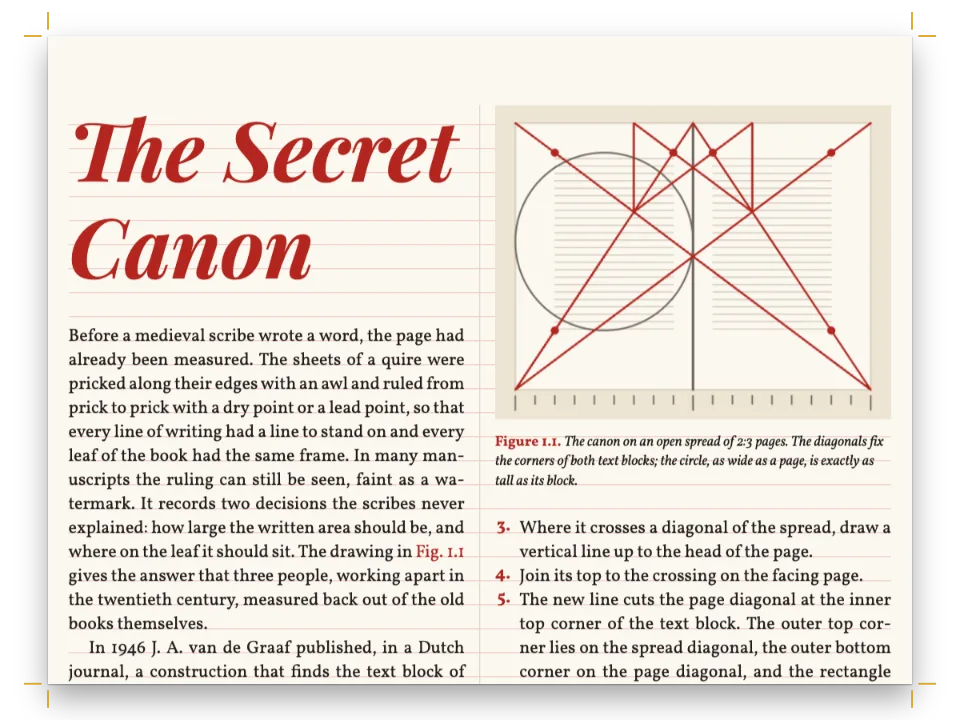
排在基线网格上的书页用行数构建文字区域,就像这张书叶用行和字构建自己的文字区域;证书在标题样式的页眉里画边框,和这里的内封做法相同。
常见问题
易错点
用zh-Hans或zh-Hant标记文档,不要用LANG
食谱的版本是en和es,但中文示例在两个版本里都是中文:`locale: LANG`会把它标记为英文或西班牙文,给其中的拉丁文词断词,把图标注为Figure或Figura,并给PDF标上错误的语言。自己写出标记:'zh-Hans'(大陆规范:GB断行规则、开明式标点)或'zh-Hant'(台湾:全角居中标点);香港用'zh-HK'。单写'zh'按简体、大陆规范处理。 中文断行 →
易错点
中文字体通过cjk块分片加载
Fontsource把一个中文、日文或韩文字体家族按每个字重约一百个文件提供,每个文件覆盖一段字符范围。loadFonts只获取latin文件,所以屏幕上的汉字来自系统字体,测量不准;fontsourceProvider交给PDF的也是这个latin文件,汉字印出来是空框。列出kit中的cjk块,在loadFonts之后调用loadCjkFonts(FONTS, markdown)(书中用到几种CJK字体时,每种字体调用一次,并传入它所排的文字),并给renderToPdf传fontProvider: cjkPdfProvider:两者都会取用包含文中字符的那些文件。 中日韩字体 →
易错点
右装订的书用showBook显示跨页
在右装订的书中(竖排中文,或page.binding 'right'),第1页仍是奇数页(recto),但它位于书脊左侧,跨页读作[3 | 2]。showPages把所有书都按左装订排列;cjk块中的showBook读取doc.binding,把跨页左右镜像。capture.hero仍按阅读顺序[偶数页, 奇数页]指定跨页:[2, 3]。 右翻书 →
易错点
繁体录入本夹杂零星简体字
从维基文库或其他网络版本复制的繁体书文字,有时夹着简体字形(《三國演義》第一回中以颙代顒),而Noto Serif TC这类TC字体可能没有这个字。loadCjkFonts会中止pen,并在消息中给出这个字符;在页面上,它会用后备字体印出。在示例中恢复繁体字形,并在出处说明中注明。 中日韩字体 →
易错点
传入任何headings对象都会关掉H1换页
默认情况下,H1换页到右页(always-odd),但只要传入headings对象,这个默认值就会被重置,于是各章接排,span: 'page'也不起作用。在每份配置中重新写明headings.levels[0].breakBefore: { enabled: true, parity }。 从右页开始的章 →
- 叶断点写在Markdown里。改动正文、字号或行款后,一叶排不下时会把下一个标题推到下一页,跨页就和书叶对不上了;一叶排不满时,折缝前会留下空行。要检查每个左页的最后一行。
- 《四库全书》的录文把已和己都录成巳;这个样本根据句意逐个判断。页面仍需对照书影校对,这一点看得出来:张敬夫的话录作必開其政,而他所引的《论语》原文是必聞其政,另有两个字是字形的图片。样本排作聞、傳和邦。排一段文字之前,先用另一个版本核对。
- 同一份录文中有Noto Serif TC没有字形的字(廹 徳 絶 逺 専 内)。其中五个落在某个Fontsource文件的范围内,所以
loadCjkFonts会放行,结果Canvas用系统字体画出它们,postext-pdf则印出空框并发出警告。廹不在任何文件的范围内,loadCjkFonts会报错停止。样本排作迫 德 絕 遠 專 內。
致谢
- 文本
- 論語集註 (Collected Commentaries on the Analects), juan 1, the book 學而 from its opening to the end of its tenth section, in the copy made for the 四庫全書 (Siku quanshu, 1773–1782); Wikisource transcription, revision 523110. 巳 is read as 已 or 己 by its sentence; 開 in 張敬夫's 必開其政 is corrected to 聞, as in the words of the Analects he repeats and in Wikisource's other edition (論語集注卷一, revision 2598582); the two characters the transcription gives as glyph images are set as 傳 (以忠信為傳習之本) and 邦 (夫子至於是邦也); and six variant forms Noto Serif TC does not draw (廹 徳 絶 逺 専 内) are set in their standard forms · Zhu Xi (1130–1200); transcription by Wikisource editors · CC BY-SA 4.0
- The title page, the division into leaves and the note on this edition (據四庫全書本錄文…) · Ignacio Ferro · CC BY 4.0
- 字体
- Noto Serif TC (SIL OFL 1.1) · LXGW WenKai TC (SIL OFL 1.1)