En pocas palabras
Un boletín de vecinos japonés impreso en líneas de arriba abajo. Muestra las distintas maneras de escribir los números en japonés y cómo las fechas se leen bien en vertical.
Lo que vas a componer
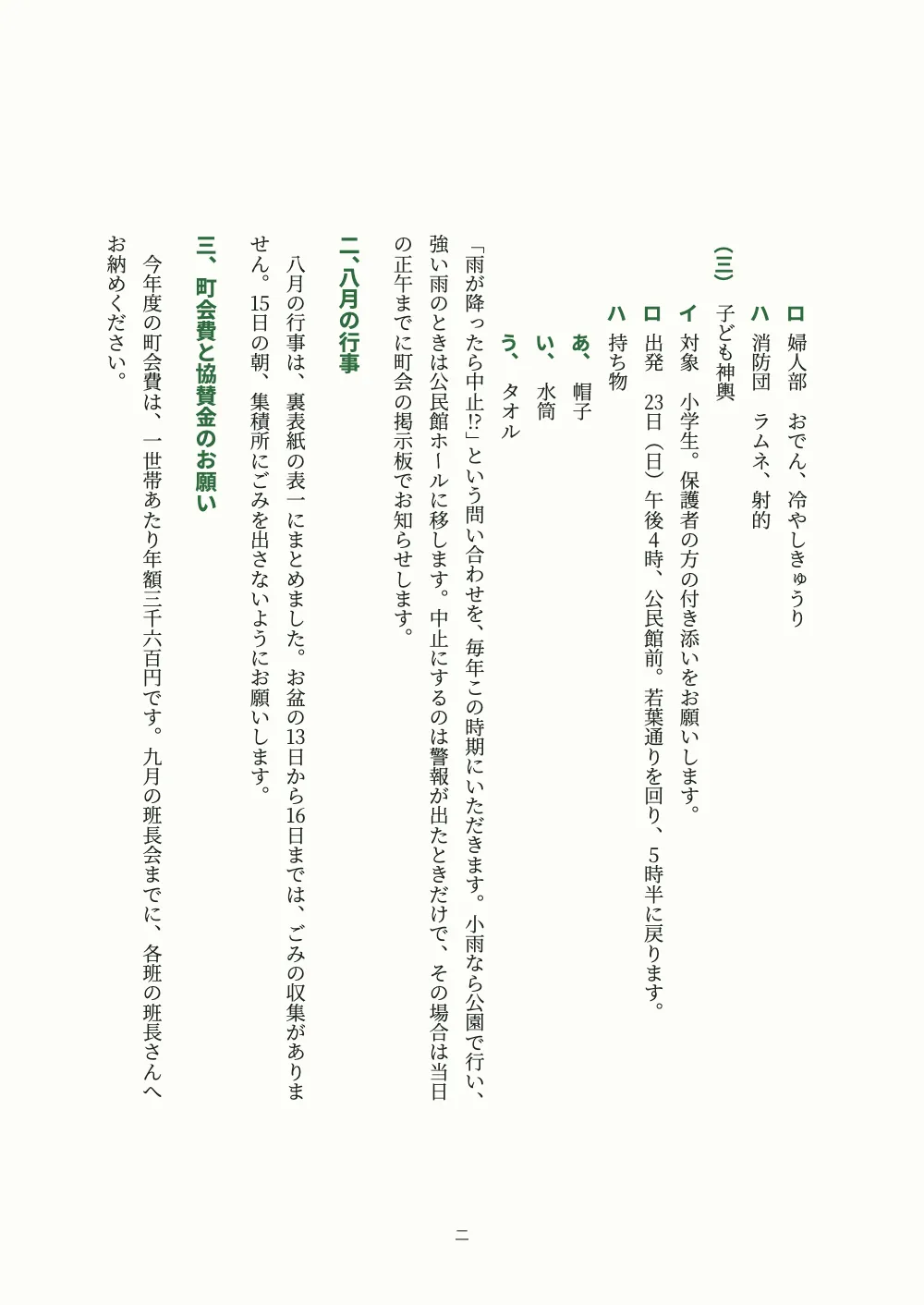
Cuatro páginas verticales de un boletín de vecinos, 東若葉台だより, número 第百二十号, en una página B5 encuadernada por la derecha: el aviso de la fiesta de verano, el calendario de agosto, las cuotas con un recibo de donativo y una breve historia de la asociación. La asociación es inventada; sus números están escritos como los escribe un editor japonés. El número del boletín, el 第三十二回 de la fiesta y los 二千四百人 que vinieron se cuentan con 十 百 千; los años van cifra a cifra, 二〇二六年 y 一九六〇年; el importe del recibo va en daiji (大字), 壱萬弐阡, que no se puede alterar con un trazo; las horas y las fechas van en cifras arábigas, y el 22 se pone en pie en una casilla. Las listas bajan 一、 → (一) → イ → あ, y el calendario ocupa la contraportada.
Esta receta responde a
- ¿Cómo numero los capítulos 第一章 con numerales kanji, o los elementos de una lista あ い う e イ ロ ハ?
- ¿Por qué mi texto japonés sale con reglas chinas: etiquetas 图, kana pequeño al principio de línea, kanji con formas chinas?
La respuesta corta
// formatNumeral is the counter the engine numbers pages, lists and headings with.
const ISSUE = 120;
const kan = (n) => formatNumeral(n, 'japanese-informal'); // 120 → 百二十: counted
const pos = (n) => formatNumeral(n, 'cjk-decimal'); // 2026 → 二〇二六: digit by digit
const daiji = (n) => formatNumeral(n, 'japanese-formal'); // 12000 → 壱萬弐阡: on money
// {{daiji:12000}} in the text: the amount of a receipt in the hard-to-alter daiji.
const withDaiji = (md) => md.replace(/\{\{daiji:(\d+)\}\}/g, (_, n) => daiji(Number(n)));
const cjk = {
  grid: { enabled: true, charsPerLine: CHARS, linesPerPage: LINES },
  uprightDigits: 2, // 8月22日: one or two Arabic digits stand in one cell (the default)
};
// Sections 一、二、三、, items (一)(二), then イ ロ ハ and あ い う beneath them.
const sectionLevel = { level: 2, numberingTemplate: '{2:一}、', numberSeparator: '',
  fontFamily: GOTHIC, fontWeight: 700, fontSize: pt(12), color: col('leaf'), lineSpan: 2 }; // 二行取り
const level = (n, numberFormat, prefix, separator) => ({ level: n, numberFormat, prefix,
  separator }); // each level starts where the text of the one above starts
const orderedLists = {
  fontFamily: GOTHIC, color: col('leaf'), fontWeight: 700, gap: em(0.5),
  marginTop: pt(0), marginBottom: pt(0), itemSpacing: pt(0),
  levels: [level(1, 'japanese-informal', '(', ')'), level(2, 'katakana-iroha', '', ''),
    level(3, 'hiragana', '', '、')],
};
Ingredientes
- Funciones
- Numerales japoneses y contadores en kanaNúmeros en pie en texto verticalListas numeradasTexto verticalLibros encuadernados por la derechaRetícula de caracteresKana, kanji y rōmajiFuentes chinas, japonesas y coreanasEspaciado de la puntuación japonesa (yakumono)Títulos que ocupan líneas del texto (gyōdori)Títulos numeradosAperturas diseñadasEstilos de títuloEstilos de párrafoRecuadrosEstilos de tabla con nombreTipos de recurso propiosColor del papelPaleta de color semánticaExportación a PDF
- También usa
- Bibliografías y glosariosCorte de líneas en chinoAtributos de títuloFiguras justo aquíCabeceras según el tipo de páginaFuentes incrustadas en el PDFPreliminares en romanosCapítulos sin número
- Tipografía
- Noto Serif JP, Noto Sans JP, Zen Maru Gothic (SIL OFL 1.1)
- Recursos
- Ninguno: todas las imágenes se dibujan en código
Elaboración
#1 · Elige la grafía según dónde va el número
El código está en la respuesta corta. formatNumeral es el contador con que el motor numera páginas, listas y títulos, y la receta lo llama para los números que compone ella misma: japanese-informal cuenta (120 → 百二十, sin 一 delante de 十 百 千), cjk-decimal escribe cifra a cifra (2026 → 二〇二六) y japanese-formal da el daiji de un importe (12000 → 壱萬弐阡). Un {{daiji:12000}} en el texto se convierte en el importe del recibo, así que la cifra se escribe una sola vez, en dígitos. Los mismos estilos nombran los contadores: las secciones son {2:一}、, y orderedLists.levels fija (一), después katakana-iroha (イ ロ ハ) y después hiragana con 、 (あ、い、う). cjk.uprightDigits: 2 pone en pie 8月22日 y 23日 sin marcas, y el !? de 「雨が降ったら中止!?」 comparte una casilla, un valor por defecto del japonés (números en texto vertical).
#2 · Pon la cabecera en una banda por el borde derecho
const BAND = 46; // mm from the right trim edge
const at = (x, y, extra = {}) => ({ anchor: { to: 'page', edge: 'top-left' },
  offset: { x: mm(x), y: mm(y) }, ...extra }); // x down the sheet, y leftward from its right
const onBand = { color: col('paper'), overflow: 'wrap', align: 'left' };
const masthead = {
  id: 'masthead', numbered: false, toc: false, runningChapter: false,
  breakBefore: { enabled: true, parity: 'any' },
  advancedDesign: { enabled: true, minHeight: mm(BAND - 15), slot: { elements: [
    { kind: 'box', id: 'band', style: { backgroundColor: col('leaf') },
      placement: { anchor: { to: 'bleed', edge: 'top-left' }, size: { height: mm(BAND) } } },
    { kind: 'text', id: 'title', content: '{titleText}', ...onBand, fontFamily: ROUND,
      fontWeight: 700, fontSize: pt(36), lineHeight: 1.1, letterSpacing: pt(3),
      placement: at(HEAD, 9) },
    { kind: 'text', id: 'issue', content: `第${kan(ISSUE)}号`, ...onBand, fontFamily: GOTHIC,
      fontWeight: 700, fontSize: pt(12), letterSpacing: pt(2), placement: at(HEAD, 26) },
    { kind: 'text', id: 'date', content: `${pos(2026)}年(令和${kan(8)}年)${kan(8)}月${kan(1)}日発行`,
      ...onBand, fontFamily: GOTHIC, fontSize: pt(10), align: 'right',
      placement: at(HEAD, 26, { size: { width: mm(LINE) } }) },
    { kind: 'text', id: 'publisher', content: '{author}', ...onBand, fontFamily: GOTHIC,
      fontSize: pt(10), align: 'right', placement: at(HEAD, 33, { size: { width: mm(LINE) } }) },
    { kind: 'text', id: 'latin', content: '{attr.latin}', ...onBand, fontFamily: GOTHIC,
      fontSize: pt(7.5), placement: at(HEAD, 40) },
  ] } },
};
En una página vertical, lo alto del flujo es el borde derecho de la hoja, así que un diseño de título anclado arriba del sangrado es una banda por ese borde, y su size.height es su anchura en la hoja. El número y la fecha son texto de diseño construido con kan() y pos(), y la fecha termina al pie de la caja de texto con align: 'right'.
#3 · Dale al calendario su propia página
const DAYS = { 2: '訓練', 9: '清掃', 13: 'お盆', 18: '練習会', 19: '練習会',
  22: '夏祭り', 23: '夏祭り', 30: '役員会' };
const day = (d) => (d ? { content: `**${d}**\n${DAYS[d] ?? '\u00a0'}`, align: 'center',
  ...(DAYS[d] ? { background: col(d === 22 || d === 23 ? 'blush' : 'tint') } : {}) }
  : { content: '' });
const weeks = []; // 1 August 2026 is a Saturday
for (let d = -5; d <= 31; d += 7) weeks.push([0, 1, 2, 3, 4, 5, 6].map((k) => day(d + k > 0
  && d + k <= 31 ? d + k : 0)));
const calendar = { id: 'calendar', typeId: 'table', kind: 'table', createdAt: 0, updatedAt: 0,
  // An upright table takes every line of the vertical page it stands on (gap:
  // vertical-tables): the calendar is the back page, cited at the end of the text.
  placement: { position: 'top', span: 'page' },
  caption: '八月の行事。13日から16日まではごみの収集がありません。',
  table: { model: { headerRowCount: 1, rows: [[...'日月火水木金土'].map((c) => ({ content: c,
    isHeader: true, align: 'center' })), ...weeks] } } };
const resourceTypes = [{ id: 'table', name: '表', shortLabel: '表', captionPrefix: '表',
  numberingTemplate: '{n}', counterFormat: '一', resetOn: 'never' }]; // 表一, 表二…
Una tabla queda en pie en una página vertical y se lee en horizontal, como imprimen las tablas los libros japoneses; ocupa todas las líneas de la página en que está. El calendario se cita después del último párrafo como flotante a página completa, así que pasa a la contraportada y el texto anterior llena sus páginas. resourceTypes lo numera con el token 一 (表一), y un documento ja compone por sí solo la etiqueta 表一 : rótulo y número juntos y un espacio ideográfico detrás.
#4 · Carga cada voz con el texto que compone
const heads = (markdown.match(/^#+ .*$/gm) ?? []).join('');
const gothicText = `${heads}${markdown}第号年月日発行令和${kan(ISSUE)}${pos(2026)}${
  calendar.caption}日月火水木金土${Object.values(DAYS).join('')}領収証(記入例)表一`;
Noto Serif JP compone el texto; Noto Sans JP, los títulos, las listas, el calendario y la etiqueta del recibo, y Zen Maru Gothic solo el título. Cada una carga los archivos de Fontsource de sus propios caracteres, más los números que compone la receta.
La receta completa
// ═══ Postext Cookbook · Nº 129 · Kanji numerals, counters and dates in vertical text ═══ // https://postext.dev/en/cookbook/kanji-numerals-and-dates // Code: MIT · Text: written for the recipe (CC BY 4.0) // Fonts: Noto Serif JP, Noto Sans JP, Zen Maru Gothic (SIL OFL 1.1) · Needs postext ≥ 1.16.1 // A neighbourhood newsletter set vertically: every way Japanese writes a number. import { buildDocument, renderPageToCanvas, clearMeasurementCache, loadVerticalAlternates, formatNumeral, } from 'https://esm.sh/postext'; import { renderToPdf, decompressWoff2 } from 'https://esm.sh/postext-pdf'; const LANG = 'es'; // @lang: the language of the frame; the newsletter is Japanese in both const RECIPE = 'kanji-numerals-and-dates'; // ─── 1 · Design ───────────────────────────────────────────────────────────── // #region palette: ink, the green of young leaves, its tint, a festival red and its blush const palette = { ink: '#1f2420', // the text leaf: '#2f6b3f', // masthead band, section numbers (6.4:1 on the paper) tint: '#e4efdf', // the calendar's marked days, the receipt red: '#b4362b', // the receipt's amount blush: '#f4d4cc', // the festival days in the calendar muted: '#5f665f', // folios, the colophon paper: '#fdfdf9', }; const col = (id) => ({ hex: palette[id], model: 'hex', paletteId: id }); const colorPalette = [ ...Object.entries(palette).map(([id, hex]) => ({ id, name: id, value: { hex, model: 'hex' } })), { id: 'main-color', name: 'leaf (defaults)', value: { hex: palette.leaf, model: 'hex' } }, ]; // #endregion const MINCHO = 'Noto Serif JP'; // the text const GOTHIC = 'Noto Sans JP'; // section heads, labels, the calendar const ROUND = 'Zen Maru Gothic'; // the masthead's title const [BODY, LEAD] = [11, 20]; // pt: large print for every age on the street const [CHARS, LINES] = [44, 20]; const PT = 25.4 / 72; // mm in a point const TRIM = { w: 182, h: 257 }; // mm, B5 const LINE = CHARS * BODY * PT; // mm: 170.7, the length of a line const HEAD = 30 + (TRIM.h - 30 - 24 - LINE) / 2; // mm: the head of the type area // #region answer: one number, four spellings, chosen by where it stands // formatNumeral is the counter the engine numbers pages, lists and headings with. const ISSUE = 120; const kan = (n) => formatNumeral(n, 'japanese-informal'); // 120 → 百二十: counted const pos = (n) => formatNumeral(n, 'cjk-decimal'); // 2026 → 二〇二六: digit by digit const daiji = (n) => formatNumeral(n, 'japanese-formal'); // 12000 → 壱萬弐阡: on money // {{daiji:12000}} in the text: the amount of a receipt in the hard-to-alter daiji. const withDaiji = (md) => md.replace(/\{\{daiji:(\d+)\}\}/g, (_, n) => daiji(Number(n))); const cjk = { grid: { enabled: true, charsPerLine: CHARS, linesPerPage: LINES }, uprightDigits: 2, // 8月22日: one or two Arabic digits stand in one cell (the default) }; // Sections 一、二、三、, items (一)(二), then イ ロ ハ and あ い う beneath them. const sectionLevel = { level: 2, numberingTemplate: '{2:一}、', numberSeparator: '', fontFamily: GOTHIC, fontWeight: 700, fontSize: pt(12), color: col('leaf'), lineSpan: 2 }; // 二行取り const level = (n, numberFormat, prefix, separator) => ({ level: n, numberFormat, prefix, separator }); // each level starts where the text of the one above starts const orderedLists = { fontFamily: GOTHIC, color: col('leaf'), fontWeight: 700, gap: em(0.5), marginTop: pt(0), marginBottom: pt(0), itemSpacing: pt(0), levels: [level(1, 'japanese-informal', '(', ')'), level(2, 'katakana-iroha', '', ''), level(3, 'hiragana', '', '、')], }; // #endregion // #region masthead: a green band down the right edge, the issue and the date in kanji const BAND = 46; // mm from the right trim edge const at = (x, y, extra = {}) => ({ anchor: { to: 'page', edge: 'top-left' }, offset: { x: mm(x), y: mm(y) }, ...extra }); // x down the sheet, y leftward from its right const onBand = { color: col('paper'), overflow: 'wrap', align: 'left' }; const masthead = { id: 'masthead', numbered: false, toc: false, runningChapter: false, breakBefore: { enabled: true, parity: 'any' }, advancedDesign: { enabled: true, minHeight: mm(BAND - 15), slot: { elements: [ { kind: 'box', id: 'band', style: { backgroundColor: col('leaf') }, placement: { anchor: { to: 'bleed', edge: 'top-left' }, size: { height: mm(BAND) } } }, { kind: 'text', id: 'title', content: '{titleText}', ...onBand, fontFamily: ROUND, fontWeight: 700, fontSize: pt(36), lineHeight: 1.1, letterSpacing: pt(3), placement: at(HEAD, 9) }, { kind: 'text', id: 'issue', content: `第${kan(ISSUE)}号`, ...onBand, fontFamily: GOTHIC, fontWeight: 700, fontSize: pt(12), letterSpacing: pt(2), placement: at(HEAD, 26) }, { kind: 'text', id: 'date', content: `${pos(2026)}年(令和${kan(8)}年)${kan(8)}月${kan(1)}日発行`, ...onBand, fontFamily: GOTHIC, fontSize: pt(10), align: 'right', placement: at(HEAD, 26, { size: { width: mm(LINE) } }) }, { kind: 'text', id: 'publisher', content: '{author}', ...onBand, fontFamily: GOTHIC, fontSize: pt(10), align: 'right', placement: at(HEAD, 33, { size: { width: mm(LINE) } }) }, { kind: 'text', id: 'latin', content: '{attr.latin}', ...onBand, fontFamily: GOTHIC, fontSize: pt(7.5), placement: at(HEAD, 40) }, ] } }, }; // #endregion // #region calendar: August 2026 as a table, the festival and the duties marked const DAYS = { 2: '訓練', 9: '清掃', 13: 'お盆', 18: '練習会', 19: '練習会', 22: '夏祭り', 23: '夏祭り', 30: '役員会' }; const day = (d) => (d ? { content: `**${d}**\n${DAYS[d] ?? '\u00a0'}`, align: 'center', ...(DAYS[d] ? { background: col(d === 22 || d === 23 ? 'blush' : 'tint') } : {}) } : { content: '' }); const weeks = []; // 1 August 2026 is a Saturday for (let d = -5; d <= 31; d += 7) weeks.push([0, 1, 2, 3, 4, 5, 6].map((k) => day(d + k > 0 && d + k <= 31 ? d + k : 0))); const calendar = { id: 'calendar', typeId: 'table', kind: 'table', createdAt: 0, updatedAt: 0, // An upright table takes every line of the vertical page it stands on (gap: // vertical-tables): the calendar is the back page, cited at the end of the text. placement: { position: 'top', span: 'page' }, caption: '八月の行事。13日から16日まではごみの収集がありません。', table: { model: { headerRowCount: 1, rows: [[...'日月火水木金土'].map((c) => ({ content: c, isHeader: true, align: 'center' })), ...weeks] } } }; const resourceTypes = [{ id: 'table', name: '表', shortLabel: '表', captionPrefix: '表', numberingTemplate: '{n}', counterFormat: '一', resetOn: 'never' }]; // 表一, 表二… // #endregion const config = () => ({ // a factory: the engine caches resolved configs per object locale: 'ja', // written out, never LANG (gotcha: ja-locale-tag) colorPalette, resourceTypes, page: { sizePreset: 'custom', width: mm(TRIM.w), height: mm(TRIM.h), dpi: 150, backgroundColor: col('paper'), margins: { top: mm(30), bottom: mm(24), left: mm(16), right: mm(18), mirror: true }, pageNumbering: { format: 'japanese-informal' }, }, layout: { layoutType: 'single', writingMode: 'vertical-rl' }, cjk, bodyText: { fontFamily: MINCHO, fontSize: pt(BODY), lineHeight: pt(LEAD), color: col('ink'), boldColor: col('ink'), italicColor: col('ink'), referenceColor: col('ink'), textAlign: 'justify', firstLineIndent: em(1), indentAfterHeading: true, }, headings: { fontFamily: GOTHIC, color: col('ink'), levels: [{ level: 1, breakBefore: { enabled: true, parity: 'any' } }, sectionLevel] }, headingStyles: [masthead], orderedLists, paragraphStyles: [ { id: 'item', firstLineIndent: em(0), indent: em(1), hangingIndent: em(3) }, { id: 'chronicle', firstLineIndent: em(0), hangingIndent: em(14) }, { id: 'colophon', fontFamily: GOTHIC, fontSize: pt(7), color: col('muted'), textAlign: 'left', firstLineIndent: em(0), marginTop: pt(LEAD) }, ], calloutStyles: [{ id: 'receipt', title: '領収証(記入例)', background: col('tint'), padding: { top: mm(4), right: mm(4), bottom: mm(4), left: mm(4) }, marginTop: pt(LEAD / 2), marginBottom: pt(0), // the next heading's 行取り gives it room titleStyle: { fontFamily: GOTHIC, fontSize: pt(12), fontWeight: 700, color: col('leaf') }, body: { fontFamily: MINCHO, color: col('ink'), boldColor: col('red'), textAlign: 'left', firstLineIndent: em(0) } }], tableStyle: { rules: 'horizontal', borderColor: col('leaf'), borderWidth: pt(0.5), headerBackground: col('leaf'), headerColor: col('paper'), headerFontFamily: GOTHIC, headerFontSize: pt(12), bodyFontFamily: GOTHIC, bodyFontSize: pt(11), bodyColor: col('ink'), cellPadding: mm(3.2) }, // 表一 八月の行事: label and number solid, then U+3000 (the ja default) captionStyle: { fontFamily: GOTHIC, fontSize: pt(10), color: col('ink'), labelColor: col('leaf') }, header: { elements: [{ kind: 'text', id: 'folio', content: '{pageNumber}', pages: 'body', fontFamily: GOTHIC, fontSize: pt(8), color: col('muted'), align: 'center', placement: { anchor: { to: 'page', edge: 'bottom' }, offset: { y: mm(-12) } } }] }, footer: { elements: [] }, }); // ─── 2 · Content ──────────────────────────────────────────────────────────── const markdown = withDaiji(String.raw`---Muestra en Markdown · 74 líneas · content.es.md
title: "東若葉台だより" author: "東若葉台二丁目町会 広報部" --- # 東若葉台だより {style="masthead" latin="Noticias de Higashi-Wakabadai, boletín de una asociación de vecinos (ficción)"} 暑い日が続いています。今号は夏祭りの案内を中心に、八月の行事、町会費と協賛金のお願い、それに町会の歩みをお届けします。 ## 夏祭りのお知らせ 今年の夏祭りは第三十二回になります。平成七年に公民館の駐車場で始まった小さな盆踊りが、昨年は二日間で延べ二千四百人が訪れる行事になりました。今年も子ども会、婦人部、消防団の皆さんが準備を進めています。 :::paragraphs{style="item"} 日時 8月22日(土)・23日(日) 午後4時から9時まで 会場 若葉台第二公園(雨の場合は公民館ホール) ::: 1. 盆踊り 1. 練習会 8月18日(火)・19日(水)の午後7時から、公民館ホールで行います。浴衣でなくてもかまいません。 2. 本番 両日とも午後6時半から。太鼓は今年も若葉台中学校の和太鼓部が務めます。 2. 屋台 1. 子ども会 焼きそば、かき氷 2. 婦人部 おでん、冷やしきゅうり 3. 消防団 ラムネ、射的 3. 子ども神輿 1. 対象 小学生。保護者の方の付き添いをお願いします。 2. 出発 23日(日)午後4時、公民館前。若葉通りを回り、5時半に戻ります。 3. 持ち物 1. 帽子 2. 水筒 3. タオル 「雨が降ったら中止!?」という問い合わせを、毎年この時期にいただきます。小雨なら公園で行い、強い雨のときは公民館ホールに移します。中止にするのは警報が出たときだけで、その場合は当日の正午までに町会の掲示板でお知らせします。 ## 八月の行事 八月の行事は、裏表紙の表一にまとめました。お盆の13日から16日までは、ごみの収集がありません。15日の朝、集積所にごみを出さないようにお願いします。 ## 町会費と協賛金のお願い 今年度の町会費は、一世帯あたり年額三千六百円です。九月の班長会までに、各班の班長さんへお納めください。 夏祭りには、毎年たくさんの商店と個人の方から協賛金をいただいています。協賛金には領収証をお渡しします。金額は、書き換えを防ぐために大字(だいじ)で書きます。 :::callout{type="receipt"} 若葉台商店会 様 金 **{{daiji:12000}}** 円也 但し 第三十二回夏祭り協賛金として 二〇二六年八月一日 東若葉台二丁目町会 会計 中村 節子 ::: ## 町会の歩み :::paragraphs{style="chronicle"} 一九六〇年(昭和三十五年) 町会ができる。このときの世帯数は八十四。 一九七二年(昭和四十七年) 公民館が完成する。 一九九五年(平成七年) 第一回の夏祭りを公民館の駐車場で開く。 二〇一一年(平成二十三年) 若葉台第二公園に防災倉庫を置く。 二〇二六年(令和八年) 世帯数は三百十二になった。 ::: :::paragraphs{style="colophon"} Compuesto en Noto Serif JP, Noto Sans JP y Zen Maru Gothic (SIL OFL) · La asociación, sus vecinos y sus actos son una ficción escrita para esta receta, CC BY 4.0 ::: ::resource{id="calendar"}`); // content.<lang>.md, amounts filled in // ─── 3 · Fonts ────────────────────────────────────────────────────────────── const FONTS = { 'Noto Serif JP': ['400', '700'], 'Noto Sans JP': ['400', '700'], 'Zen Maru Gothic': ['700'] }; // #region voices: each face loads the files of the characters it sets const heads = (markdown.match(/^#+ .*$/gm) ?? []).join(''); const gothicText = `${heads}${markdown}第号年月日発行令和${kan(ISSUE)}${pos(2026)}${ calendar.caption}日月火水木金土${Object.values(DAYS).join('')}領収証(記入例)表一`; // #endregion // ─── 4 · Build & show ─────────────────────────────────────────────────────── await loadFonts(FONTS, markdown); await loadCjkFonts({ [MINCHO]: FONTS[MINCHO] }, markdown, { vertical: true }); await loadCjkFonts({ [GOTHIC]: FONTS[GOTHIC] }, gothicText, { vertical: true }); await loadCjkFonts({ [ROUND]: FONTS[ROUND] }, heads, { vertical: true }); const doc = await buildWithFonts( () => buildDocument({ markdown, resources: [calendar] }, config()), markdown); showBook(doc, { title: t({ en: 'A newsletter in kanji numerals', es: 'Un boletín con numerales kanji' }) }); offerPdf(() => renderToPdf(doc, { fontProvider: cjkPdfProvider }), `${RECIPE}.pdf`);Kit · core, fonts, viewer, pdf, cjk: igual en todas las recetas · 453 líneas
// ─── Kit ── helpers shared by every Cookbook recipe · postext.dev/cookbook ───── // ─── Kit · core v1 ── the same in every recipe · postext.dev/cookbook ───────── function mm(value) { return { value, unit: 'mm' }; } function pt(value) { return { value, unit: 'pt' }; } function em(value) { return { value, unit: 'em' }; } /** The sample language's string: t({ en: 'Figure', es: 'Figura' }). */ function t(strings) { return strings[LANG] ?? Object.values(strings)[0]; } /** A file in this recipe's assets folder, served from the Postext repo by jsDelivr. */ function asset(file) { return `https://cdn.jsdelivr.net/gh/drnachio/postext@main/cookbook/${RECIPE}/assets/${file}`; } // ─── Kit · fonts v1 ── the same in every recipe · postext.dev/cookbook ──────── // Postext measures text with the faces the browser has loaded, and caches the // widths, so every face must be ready before the first build. Faces come from // Fontsource: the same static files the PDF embeds, so screen and PDF agree. /** faces = { 'Family Name': ['400', '400i', '700'] }. `text` is the sample: * letters beyond Latin-1 (č, ł, ő…) also load the latin-ext files. With * `optional`, a face Fontsource does not ship is skipped instead of failing. * Resolves to the number of faces added. */ async function loadFonts(faces, text = '', { optional = false } = {}) { kitStatus('Loading fonts…'); const ranges = { latin: 'U+0000-00FF,U+0131,U+0152-0153,U+02BB-02BC,U+02C6,U+02DA,U+02DC,U+0304,U+0308,U+0329,' + 'U+2000-206F,U+20AC,U+2122,U+2191,U+2193,U+2212,U+2215,U+FEFF,U+FFFD', 'latin-ext': 'U+0100-02BA,U+02BD-02C5,U+02C7-02CC,U+02CE-02D7,U+02DD-02FF,U+0304,U+0308,U+0329,' + 'U+1D00-1DBF,U+1E00-1E9F,U+1EF2-1EFF,U+2020,U+20A0-20AB,U+20AD-20C0,U+2113,U+2C60-2C7F,U+A720-A7FF', }; const subsets = /[Ā-˿Ḁ-ỿ]/.test(text) ? ['latin', 'latin-ext'] : ['latin']; const jobs = []; let added = 0; for (const [family, specs] of Object.entries(faces)) { const id = fontsourceId(family); const meta = optional ? await fontsourceMeta(family) : null; for (const spec of new Set(specs)) { const weight = parseInt(spec, 10); const style = spec.endsWith('i') ? 'italic' : 'normal'; if (hasFace(family, weight, style)) continue; if (optional && !(meta?.weights.includes(weight) && meta.styles.includes(style))) continue; for (const subset of subsets) { const url = `https://cdn.jsdelivr.net/npm/@fontsource/${id}@5/files/${id}-${subset}-${weight}-${style}.woff2`; const face = new FontFace(family, `url(${url}) format('woff2')`, { weight: String(weight), style, unicodeRange: ranges[subset] }); jobs.push(face.load().then((ready) => { document.fonts.add(ready); added++; }, () => { if (subset === 'latin' && !optional) throw new Error(`Fontsource has no ${family} ${weight} ${style}`); })); } } } await Promise.all(jobs).catch((error) => { kitFail(error); throw error; }); return added; } /** Runs `build` (a buildDocument or buildBundle call) and checks the faces * the pages use. A regular face missing from FONTS is loaded with a warning; * bold and italic variants are loaded when the family ships them. Then the * measurement caches are cleared and the build runs again. */ async function buildWithFonts(build, text = '') { const tried = new Set(); for (let round = 0; round < 3; round++) { kitStatus('Laying out…'); await new Promise(requestAnimationFrame); // let the status paint first const result = await Promise.resolve().then(build).catch((error) => { kitFail(error); throw error; }); const wanted = { base: {}, variants: {} }; for (const { font, base } of [result].flat().flatMap(fontStringsOf)) { const { family, weight, style } = parseFont(font); const key = `${family}|${weight}|${style}`; if (tried.has(key) || hasFace(family, weight, style)) continue; tried.add(key); (wanted[base ? 'base' : 'variants'][family] ??= []).push(`${weight}${style === 'italic' ? 'i' : ''}`); } if (Object.keys(wanted.base).length) { console.warn(`[cookbook] FONTS does not list ${JSON.stringify(wanted.base)}: loading them.`); } const added = await loadFonts(wanted.base, text) + await loadFonts(wanted.variants, text, { optional: true }); if (added === 0) return result; clearMeasurementCache(); } throw new Error('The fonts did not settle after three builds.'); } /** Every font string of the layout. `base` marks a block's own face; its * bold, italic and bold-italic variants are listed whether or not used. */ function fontStringsOf(doc) { const found = new Map(); const walk = (node) => { if (!node || typeof node !== 'object') return; if (Array.isArray(node)) { node.forEach(walk); return; } for (const [key, value] of Object.entries(node)) { if (typeof value === 'string' && /fontString$/i.test(key)) { found.set(value, found.get(value) || key === 'fontString'); } else if (value && typeof value === 'object') walk(value); } }; walk(doc.pages); walk(doc.blocks); return [...found].map(([font, base]) => ({ font, base })); } /** '700 37.5px Open Sans' / 'italic 400 13px "Source Serif 4"' → { family, weight, style }. * A string with no weight ('95.8px Young Serif', from a design text) is 400. */ function parseFont(font) { const m = /^(?:(italic|oblique)\s+)?(?:small-caps\s+)?(?:(\d+|bold|normal)\s+)?[\d.]+px\s+(.+)$/.exec(font.trim()); if (!m) throw new Error(`Unexpected font string: ${font}`); const weight = m[2] === 'bold' ? 700 : !m[2] || m[2] === 'normal' ? 400 : Number(m[2]); return { family: m[3].replace(/^["']|["']$/g, ''), weight, style: m[1] ? 'italic' : 'normal' }; } /** True when a loaded FontFace covers exactly this family, weight and style * (document.fonts.check() is also true for families nobody declared). */ function hasFace(family, weight, style) { for (const face of document.fonts) { if (face.status !== 'loaded' || face.style !== style) continue; if (face.family.replace(/^["']|["']$/g, '') !== family) continue; const [low, high = low] = face.weight.split(' ').map(Number); if (weight >= low && weight <= high) return true; } return false; } /** Fontsource's id for a family: 'Source Serif 4' → 'source-serif-4'. */ function fontsourceId(family) { return family.toLowerCase().replace(/\s+/g, '-'); } /** The weights and styles a family ships ({ weights: [400, 700], styles: ['normal', 'italic'] }), or null. */ function fontsourceMeta(family) { fontsourceMeta.cache ??= new Map(); const id = fontsourceId(family); if (!fontsourceMeta.cache.has(id)) { fontsourceMeta.cache.set(id, fetch(`https://api.fontsource.org/v1/fonts/${id}`) .then((res) => (res.ok ? res.json() : null), () => null)); } return fontsourceMeta.cache.get(id); } // ─── Kit · viewer v1 ── the same in every recipe · postext.dev/cookbook ─────── /** Shows the pages as facing spreads on a dark desk: the first page is a * recto on its own, then verso | recto pairs, as in a bound book. Pages * are painted when they scroll near the screen. */ function showPages(docs, { title, width = 460 } = {}) { const root = viewer(title); const pages = [docs].flat().flatMap((doc) => doc.pages.map((page) => ({ doc, page, n: (doc.pageIndexOffset ?? 0) + page.index }))); const spreads = []; let verso = null; for (const p of pages) { if (p.n % 2 === 1) { if (verso) spreads.push([verso, null]); verso = p; } else { spreads.push([verso, p]); verso = null; } } if (verso) spreads.push([verso, null]); const density = Math.min(window.devicePixelRatio || 1, 2); showPages.painter?.disconnect(); const painter = new IntersectionObserver((entries) => { for (const { isIntersecting, target } of entries) { if (!isIntersecting) continue; painter.unobserve(target); const { doc, page } = target.postext; renderPageToCanvas(page, doc, target, { scale: (width * density) / page.width }); } }, { rootMargin: '800px' }); showPages.painter = painter; root.replaceChildren(...spreads.map((pair) => { const spread = document.createElement('div'); spread.className = 'pt-spread'; for (const p of pair) { const figure = document.createElement('figure'); if (p) { const label = p.page.pageLabel || String(p.n + 1); const canvas = document.createElement('canvas'); canvas.postext = p; canvas.style.aspectRatio = `${p.page.width} / ${p.page.height}`; canvas.setAttribute('role', 'img'); canvas.setAttribute('aria-label', `Page ${label}`); const folio = document.createElement('figcaption'); folio.textContent = label; figure.append(canvas, folio); painter.observe(canvas); } else figure.className = 'pt-blank'; spread.append(figure); } return spread; })); kitStatus(`${pages.length} ${pages.length === 1 ? 'page' : 'pages'}`); document.documentElement.dataset.postext = 'ready'; return pages.length; } /** The desk, the bar and the error reporting, created once. */ function viewer(title) { if (!document.getElementById('pt-kit')) { document.head.insertAdjacentHTML('beforeend', `<style id="pt-kit"> :root { color-scheme: dark; } body { margin: 0; background: #0e1014; color: #b9bcc4; font: 13px/1.45 system-ui, sans-serif; } #pt-bar { position: sticky; top: 0; z-index: 1; display: flex; flex-wrap: wrap; align-items: center; gap: 6px 16px; padding: 10px 16px; background: rgb(14 16 20 / .92); backdrop-filter: blur(6px); border-bottom: 1px solid #23262d; } #pt-bar strong { color: #f4f1ea; font-weight: 600; } #pt-actions { display: flex; gap: 12px; margin-left: auto; } #pt-actions a, #pt-actions button { color: #d8a21a; font: inherit; background: none; border: 0; padding: 0; cursor: pointer; } #pages { display: grid; justify-items: center; gap: 48px; padding: 32px 16px 72px; } .pt-spread { display: flex; } .pt-spread figure { margin: 0; width: min(460px, 44vw); } .pt-spread canvas { display: block; width: 100%; background: #fff; box-shadow: 0 1px 2px rgb(0 0 0 / .5), 0 22px 44px -16px rgb(0 0 0 / .8); } .pt-spread figure:first-child canvas { box-shadow: inset -14px 0 14px -14px rgb(0 0 0 / .18), 0 1px 2px rgb(0 0 0 / .5), 0 22px 44px -16px rgb(0 0 0 / .8); } .pt-spread figcaption { margin-top: 10px; text-align: center; font: 600 10px/1 system-ui, sans-serif; letter-spacing: .18em; text-transform: uppercase; color: #6c7079; } .pt-blank { visibility: hidden; } @media (max-width: 760px) { .pt-spread { flex-direction: column; gap: 32px; } .pt-spread figure { width: min(460px, 92vw); } .pt-blank { display: none; } } </style>`); document.body.insertAdjacentHTML('afterbegin', '<header id="pt-bar"><strong id="pt-title"></strong><span id="pt-status" role="status"></span><span id="pt-actions"></span></header>'); document.getElementById('pt-title').textContent = document.title || 'Postext'; addEventListener('error', (event) => kitFail(event.error ?? event.message)); addEventListener('unhandledrejection', (event) => kitFail(event.reason)); } if (title) document.getElementById('pt-title').textContent = title; return document.getElementById('pages') ?? document.body.appendChild(Object.assign(document.createElement('main'), { id: 'pages' })); } function kitStatus(text) { viewer(); document.getElementById('pt-status').textContent = text; } function kitFail(error) { document.documentElement.dataset.postext = 'error'; kitStatus(`Error: ${error?.message ?? error}`); } // ─── Kit · pdf v1 ── the same in every recipe that exports a PDF ────────────── /** postext-pdf embeds TrueType bytes. Fetch the Fontsource file the screen * used, snapping to a weight the family ships and falling back to upright * when it has no italic: the PDF asks for every face a block could use. */ async function fontsourceProvider(family, weight, style) { const id = fontsourceId(family); const meta = await fontsourceMeta(family); const weights = meta?.weights?.length ? meta.weights : [400, 700]; const w = weights.reduce((a, b) => (Math.abs(b - weight) < Math.abs(a - weight) ? b : a)); const s = style === 'italic' && meta && !meta.styles.includes('italic') ? 'normal' : style; const res = await fetch(`https://cdn.jsdelivr.net/npm/@fontsource/${id}@5/files/${id}-latin-${w}-${s}.woff2`); if (!res.ok) throw new Error(`Fontsource has no ${family} ${w} ${s} (${res.status})`); return decompressWoff2(new Uint8Array(await res.arrayBuffer())); } /** A "Build the PDF" button in the bar. Once built: "Open the PDF" (a new * tab, since CodePen's preview frame cannot show PDFs) and a download link. */ function offerPdf(makePdf, filename) { viewer(); const button = Object.assign(document.createElement('button'), { type: 'button', textContent: 'Build the PDF' }); button.dataset.postextPdf = filename; button.addEventListener('click', async () => { button.disabled = true; button.textContent = 'Building the PDF…'; try { const bytes = await makePdf(); const url = URL.createObjectURL(new Blob([bytes], { type: 'application/pdf' })); const size = `${Math.max(1, Math.round(bytes.length / 1024))} KB`; button.replaceWith( Object.assign(document.createElement('a'), { href: url, target: '_blank', rel: 'noopener', textContent: 'Open the PDF ↗' }), Object.assign(document.createElement('a'), { href: url, download: filename, textContent: `Download ${filename} · ${size}` })); } catch (error) { button.disabled = false; button.textContent = 'Build the PDF'; kitFail(error); } }); document.getElementById('pt-actions').append(button); } // ─── Kit · cjk v1 ── Chinese, Japanese and Korean books · postext.dev/cookbook ─ // Fontsource ships a CJK family as about a hundred files per weight, each // declared in its stylesheet with the unicode-range it covers. The screen // loads the files the sample touches; the PDF gets the same files for the // characters its pages set in each face, and embeds each as a subset. // A book bound on the right (vertical text) is shown with its spreads // mirrored: page 1 alone on the left of the spine, then [3 | 2]. /** The files of a Fontsource face, read from its stylesheet: { url, range, * ranges }, the last declared first (the order the browser tries them in). */ function cjkSlices(family, weight, style) { cjkSlices.cache ??= new Map(); const id = fontsourceId(family); const css = `https://cdn.jsdelivr.net/npm/@fontsource/${id}@5/${weight}${style === 'italic' ? '-italic' : ''}.css`; if (!cjkSlices.cache.has(css)) { cjkSlices.cache.set(css, fetch(css) .then((res) => { if (!res.ok) throw new Error(`Fontsource has no ${family} ${weight} ${style} (${res.status})`); return res.text(); }) .then((text) => [...text.matchAll(/@font-face\s*{([^}]*)}/g)].map(([, rule]) => { const range = /unicode-range:\s*([^;]+);/.exec(rule)?.[1].trim() ?? 'U+0-10FFFF'; const ranges = range.split(',').map((part) => { const [lo, hi = lo] = part.trim().slice(2).split('-'); return [parseInt(lo, 16), parseInt(hi, 16)]; }); return { url: new URL(/url\(([^)]+?\.woff2)\)/.exec(rule)[1], css).href, range, ranges }; }).reverse())); } return cjkSlices.cache.get(css); } /** The file of `slices` that holds code point `cp`, if any. */ function cjkSliceFor(slices, cp) { return slices.find((slice) => slice.ranges.some(([lo, hi]) => cp >= lo && cp <= hi)); } /** Whether Fontsource serves `family` as a Chinese, Japanese or Korean * family (its subsets name the script). Fails when the API does not * answer: a CJK face taken for a Latin one would paint in a system face. */ async function isCjkFamily(family) { const meta = await fontsourceMeta(family); if (!meta) throw new Error(`api.fontsource.org did not describe ${family}: reload to try again`); return !!meta.subsets?.some((subset) => /^(chinese|japanese|korean)/.test(subset)); } /** faces = { 'Noto Serif TC': ['400', '700'] }, as for loadFonts: the * whole FONTS object may be passed, its other families are left to * loadFonts. Adds one FontFace per file of each CJK face with its * unicodeRange, then loads the files `text` touches. `text` is what the * faces set: the sample for the text face; a book in several voices calls * it once per voice (loadCjkFonts({ 'LXGW WenKai TC': ['400'] }, quotes)), * so the heading and quotation faces fetch and check only their own * characters. Fails when a character of `text` is in no file of a face. * List every weight the pages use: a weight left to buildWithFonts gets * the latin file only. With { vertical: true } it also loads each * family's vertical forms (brackets, quotes, pause marks) for the canvas, * which needs loadVerticalAlternates imported from postext. Resolves to * the number of files loaded. */ async function loadCjkFonts(faces, text, { vertical = false } = {}) { kitStatus('Loading fonts…'); let loaded = 0; try { if (vertical && typeof loadVerticalAlternates !== 'function') { throw new Error('loadCjkFonts(…, { vertical: true }) needs loadVerticalAlternates imported from postext'); } for (const [family, specs] of Object.entries(faces)) { if (!(await isCjkFamily(family))) continue; const twin = []; for (const spec of new Set(specs)) { const weight = parseInt(spec, 10); const style = spec.endsWith('i') ? 'italic' : 'normal'; const slices = await cjkSlices(family, weight, style); const missing = [...new Set(text)].filter((ch) => /\S/.test(ch) && !cjkSliceFor(slices, ch.codePointAt(0))); if (missing.length) { throw new Error(`${family} ${spec} has no file for ${missing.slice(0, 12).join(' ')}: ` + `give each face the text it sets (loadCjkFonts({ '${family}': ['${spec}'] }, text))`); } for (const slice of slices) { document.fonts.add(new FontFace(family, `url(${slice.url}) format('woff2')`, { weight: String(weight), style, unicodeRange: slice.range })); twin.push({ source: slice.url, weight: String(weight), style, unicodeRange: slice.range }); } const font = `${style === 'italic' ? 'italic ' : ''}${weight} 16px "${family}"`; loaded += (await document.fonts.load(font, text)).length; if (!document.fonts.check(font, text)) throw new Error(`${family} ${spec} did not load for the sample`); } // The same files under a twin name with the `vert` feature on: the // canvas paints the punctuation of vertical lines with it. if (vertical && twin.length) await loadVerticalAlternates(family, twin); } } catch (error) { kitFail(error); throw error; } return loaded; } /** The PDF font provider for recipes with CJK faces: a family whose * Fontsource subsets are Chinese, Japanese or Korean gets the files that * hold the characters its pages set (`request.codePoints`); any other * family gets the latin file fontsourceProvider fetches (the "pdf" block) * and, when the face sets letters only latin-ext has, that file too. */ async function cjkPdfProvider(family, weight, style, request) { if (!(await isCjkFamily(family))) return cjkLatinPdfFiles(family, weight, style, request); const meta = await fontsourceMeta(family); const weights = meta.weights?.length ? meta.weights : [400, 700]; const w = weights.reduce((a, b) => (Math.abs(b - weight) < Math.abs(a - weight) ? b : a)); const s = style === 'italic' && !meta.styles.includes('italic') ? 'normal' : style; const slices = await cjkSlices(family, w, s); const picked = new Set(); for (const cp of request?.codePoints ?? []) { const slice = cjkSliceFor(slices, cp); if (slice) picked.add(slice); } if (!picked.size) picked.add(slices[0]); return Promise.all(slices.filter((slice) => picked.has(slice)).map(async (slice) => { const res = await fetch(slice.url); if (!res.ok) throw new Error(`Fontsource file ${slice.url} (${res.status})`); return decompressWoff2(new Uint8Array(await res.arrayBuffer())); })); } /** A Latin family set next to the CJK faces: its latin file, then its * latin-ext file when the face sets letters only latin-ext has (ō ū in * Hepburn rōmaji, ǎ in pinyin), the file loadFonts adds on screen for * them. Latin comes first: postext-pdf draws a character from the first * file that has it, as the browser takes a character both files hold from * latin. A face Fontsource ships without latin-ext, or whose file does * not come, gets latin alone, and the PDF names the letters it lacks. */ async function cjkLatinPdfFiles(family, weight, style, request) { const meta = await fontsourceMeta(family); const beyond = [...(request?.codePoints ?? [])].some(cjkLatinExtOnly); if (!beyond || !meta?.subsets?.includes('latin-ext')) return fontsourceProvider(family, weight, style); const weights = meta.weights?.length ? meta.weights : [400, 700]; const w = weights.reduce((a, b) => (Math.abs(b - weight) < Math.abs(a - weight) ? b : a)); const s = style === 'italic' && !meta.styles.includes('italic') ? 'normal' : style; const id = fontsourceId(family); const url = `https://cdn.jsdelivr.net/npm/@fontsource/${id}@5/files/${id}-latin-ext-${w}-${s}.woff2`; const [latin, ext] = await Promise.all([fontsourceProvider(family, weight, style), fetch(url) .then(async (res) => (res.ok ? decompressWoff2(new Uint8Array(await res.arrayBuffer())) : null), () => null)]); return ext ? [latin, ext] : latin; } /** Whether code point `cp` is in Fontsource's latin-ext file and not in * its latin file: Latin Extended-A and -B, IPA, the spacing modifiers and * Latin Extended Additional (loadFonts's test for latin-ext), less the * few latin holds too (ı Œ œ ʻ ʼ ˆ ˚ ˜). */ function cjkLatinExtOnly(cp) { if (!((cp >= 0x100 && cp <= 0x2ff) || (cp >= 0x1e00 && cp <= 0x1eff))) return false; return ![0x131, 0x152, 0x153, 0x2bb, 0x2bc, 0x2c6, 0x2da, 0x2dc].includes(cp); } /** showPages for a book bound on either edge. A right-bound book (the * document says so: doc.binding is 'right' for page.binding 'right' and * for vertical text) lies on the desk as it opens: page 1 alone on the * left of the spine, then [3 | 2], the spine shade on each page's inner * edge. `binding` ('left' | 'right') overrides the document's. */ function showBook(docs, { binding, ...options } = {}) { const count = showPages(docs, options); const right = (binding ?? [docs].flat()[0]?.binding) === 'right'; if (!document.getElementById('pt-kit-cjk')) { // The pages keep direction ltr: a canvas draws text in the direction its // element inherits, and under rtl each run would end where the engine // starts it, its brackets mirrored. document.head.insertAdjacentHTML('beforeend', `<style id="pt-kit-cjk"> .pt-spread[dir="rtl"] canvas { direction: ltr; } .pt-spread[dir="rtl"] figure:first-child canvas { box-shadow: inset 14px 0 14px -14px rgb(0 0 0 / .18), 0 1px 2px rgb(0 0 0 / .5), 0 22px 44px -16px rgb(0 0 0 / .8); } </style>`); } // Each pair stays [verso, recto] in the page; right to left, the verso // sits on the right. Phones stack the pages in reading order either way. for (const spread of document.querySelectorAll('#pages > .pt-spread')) spread.dir = right ? 'rtl' : 'ltr'; document.getElementById('pages').dataset.binding = right ? 'right' : 'left'; return count; } // ─── /Kit ───────────────────────────────────────────────────────────────────────
El script.js compuesto funciona tal cual: pégalo como script de módulo en cualquier página o abre la receta en CodePen. Carpeta de la receta en GitHub ↗ (se abre en una nueva pestaña)
Variantes
#Escribe todos los años contados
Hay quien prefiere 二千二十六年 a 二〇二六年 en el texto corrido; cambia el estilo de pos.
-const pos = (n) => formatNumeral(n, 'cjk-decimal'); // 2026 → 二〇二六: digit by digit
+const pos = (n) => formatNumeral(n, 'japanese-informal'); // 2026 → 二千二十六#Pon en pie tres cifras
Con 3, un 100 o un 365 del texto también ocupan una casilla.
-  uprightDigits: 2, // 8月22日: one or two Arabic digits stand in one cell (the default)
+ uprightDigits: 3,Errores frecuentes
Error frecuente
Etiqueta un texto japonés 'ja', nunca zh-Hans ni LANG
Las ediciones de una receta son en y es, pero una muestra japonesa es japonesa en las dos: `locale: LANG` la etiquetaría como inglés o español, y una etiqueta china la compondría con las reglas chinas (puntuación Kaiming, kana pequeño libre de empezar línea, 图 en lugar de 図, formas chinas de los caracteres en el PDF). Escribe 'ja': elige la región de Japón (corte y puntuación de la JLReq, puntos de sésamo, reparto de los furigana, etiquetas 図 y 表) y desactiva la separación silábica. El lint falla un texto con kana bajo una etiqueta zh o ko. Corte de líneas japonés (kinsoku) →
Error frecuente
Compón el japonés con una fuente japonesa
Noto Serif SC y TC tienen kana, pero dibujan los kanji con formas chinas (直, 骨 y 角 cambian) y el kana con un diseño chino. Compón el texto en Noto Serif JP o Shippori Mincho B1 y los títulos en Noto Sans JP, cargadas con loadCjkFonts. Los archivos japoneses de Fontsource no tienen hentaigana ni otros kana históricos (U+1B000–1B16F): loadCjkFonts falla con ellos y el PDF imprime cajas, así que escribe el kana moderno o lleva en los recursos de la receta una fuente que los tenga. Shippori Mincho tampoco tiene las vocales con macrón ō y ū: compón el rōmaji con una fuente latina. Kana, kanji y rōmaji →
Error frecuente
Las fuentes chinas se cargan por fragmentos, con el bloque cjk
Fontsource sirve una familia china, japonesa o coreana en un centenar de archivos por peso, cada uno con un intervalo de caracteres. loadFonts solo descarga el archivo latin, así que en pantalla los caracteres chinos salen de una fuente del sistema y se miden mal, y fontsourceProvider entrega al PDF ese archivo latin, que los imprime como cajas vacías. Añade el bloque cjk del kit, llama a loadCjkFonts(FONTS, markdown) después de loadFonts (una vez por voz, con el texto que compone, si el libro usa varias fuentes chinas) y pasa a renderToPdf fontProvider: cjkPdfProvider: ambos toman los archivos que contienen los caracteres del texto. Fuentes chinas, japonesas y coreanas →
Error frecuente
Cualquier objeto headings desactiva el salto de página del H1
Por defecto un H1 salta a una página impar (always-odd), pero cualquier objeto headings anula ese valor, así que los capítulos van seguidos y span: 'page' no hace nada. Vuelve a declarar headings.levels[0].breakBefore: { enabled: true, parity } en cada configuración. Capítulos que abren en página impar →
Error frecuente
Una configuración se cachea por identidad: crea un objeto nuevo
El motor guarda en caché las configuraciones resueltas según la identidad del objeto, así que modificar el mismo objeto y volver a componer reutiliza el resultado anterior. Crea un objeto nuevo en cada composición: por eso la configuración de una receta es una función, config(). Páginas en un canvas →
Error frecuente
Carga todas las fuentes antes de componer
La composición mide el texto con las fuentes que el navegador ha cargado y guarda los anchos, así que una fuente que llega después de la primera composición deja cortes de línea erróneos y un PDF que ya no coincide con la pantalla. Carga antes todos los pesos y estilos, y llama a clearMeasurementCache() antes de recomponer si alguna llega tarde. Fuentes antes de componer →
- El calendario ocupa una página porque una tabla en pie toma todas las líneas de una página vertical (laguna: tablas compuestas en texto vertical). Si una tabla debe compartir página con el texto, necesita una página horizontal o un dibujo SVG colocado por un diseño de título.
- En chino el mismo contador escribe 一百二十 y 一千零一; en japonés, 百二十 y 千一. Escribe
locale: 'ja', o el token 一 elegirá el estilo chino. El libro chino Fechas y siglas en pie en texto vertical compone sus fechas con el mismouprightDigits.
Créditos
- Receta
- Ignacio Ferro
- Texto
- El boletín de una asociación de vecinos imaginaria, escrito en japonés para esta receta · Postext Cookbook · CC BY 4.0
- Fuentes
- Noto Serif JP (SIL OFL 1.1) · Noto Sans JP (SIL OFL 1.1) · Zen Maru Gothic (SIL OFL 1.1)
- Código
- MIT, como Postext
Editar este texto ↗ (se abre en una nueva pestaña)Carpeta de la receta en GitHub ↗ (se abre en una nueva pestaña)