En pocas palabras
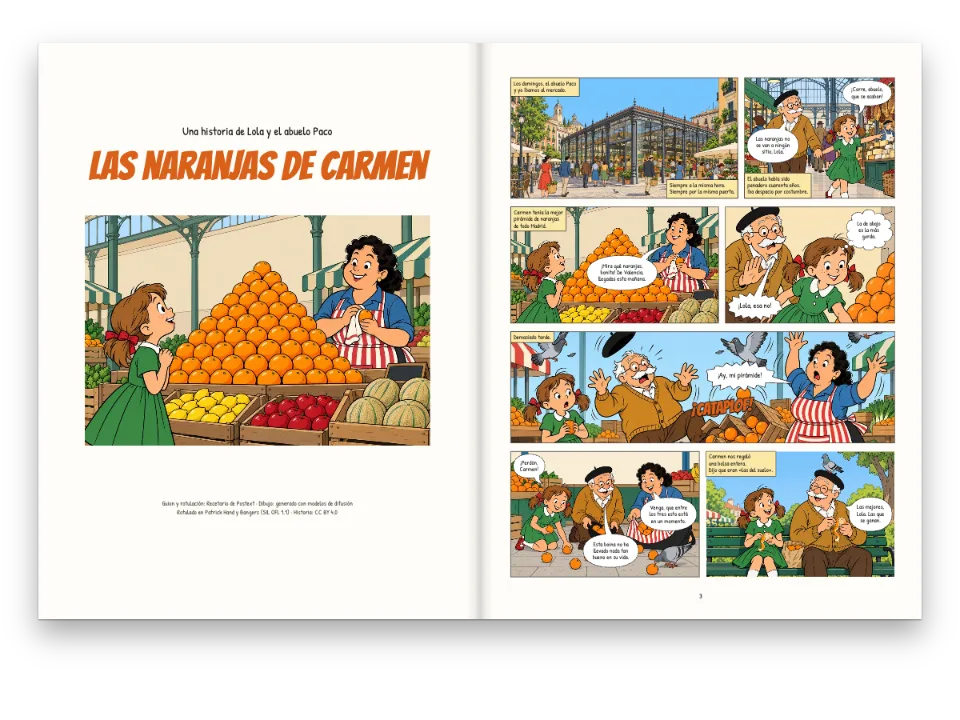
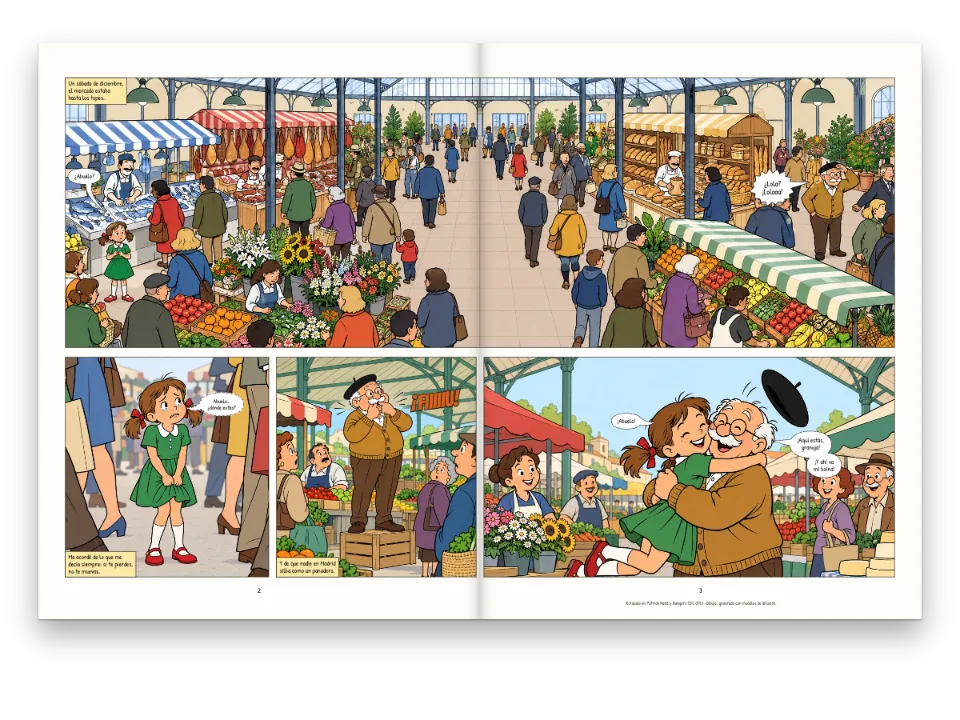
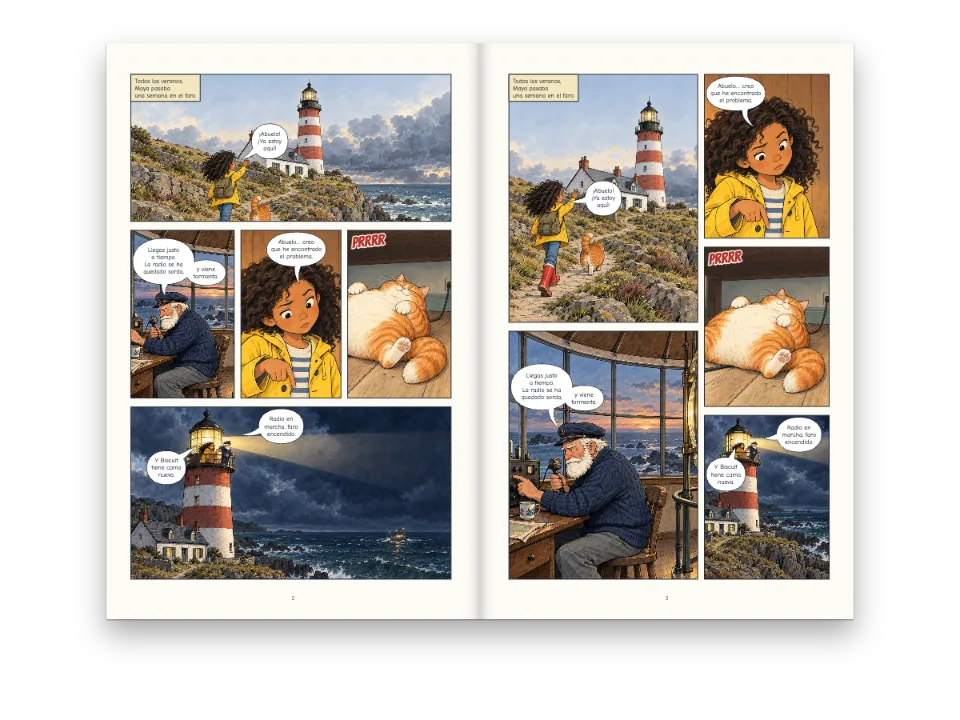
Dos páginas de la sección de cómics de un periódico: un cómic grande en color en la portada y, dentro, una entrevista con la dibujante a cuatro columnas y la tira diaria de cuatro viñetas abajo.
Lo que vas a componer
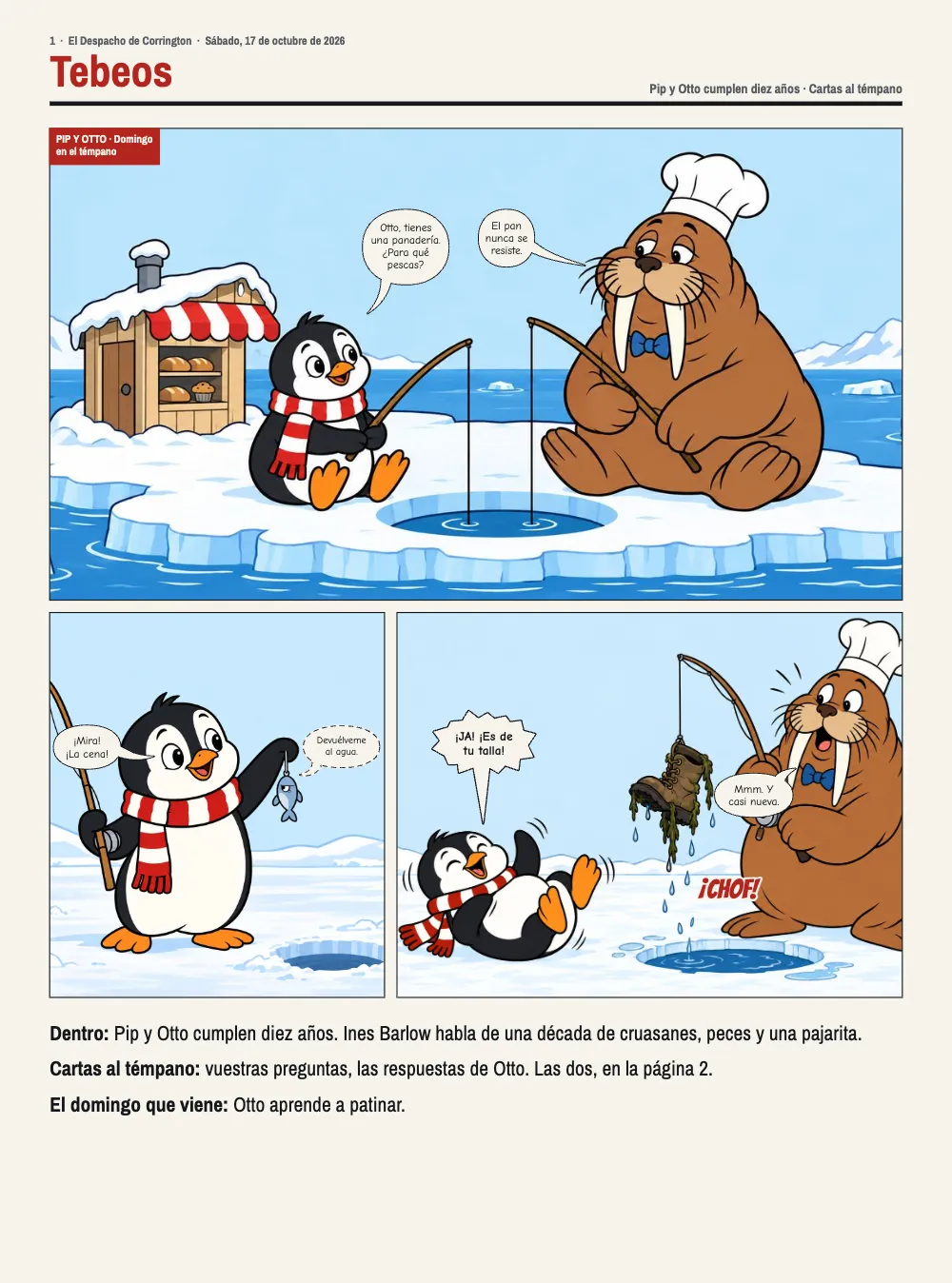
El suplemento de tebeos de un periódico de fin de semana, El Despacho de Corrington, plegado a 230 × 310 mm. La portada lleva la media página dominical de Pip y Otto, un pingüino y una morsa que tienen una panadería sobre un témpano, con el sumario debajo. Dentro, una entrevista con la dibujante ocupa cuatro columnas, con cartas de lectores y un anuncio, y la tira diaria de la semana, cuatro viñetas cuadradas, corre al pie de la página. Las dos historietas son bloques :::strip del texto del periódico, y el suplemento sale en seis idiomas.
Esta receta responde a
- ¿Cómo pongo una tira cómica en una página de periódico?
La respuesta corta
// In the Markdown each strip is a fenced block, where the paper wants it:
//   :::strip{split="55 / * [40 | *]" height=210mm}   the Sunday half page, on the cover
//   :::strip{split="* | * | * | *" span=page placement=bottom}   the daily: four square panels
// On the one-column cover the Sunday strip is set in the text, 210 mm deep. Inside, the daily
// floats to the foot of the page, as wide as its four columns, and the columns of the article
// end level above it. A strip never splits; one that does not fit moves to the next page.
// The panels, gutters and balloons come from the comics settings, as on a comic page.
const comics = {
  gutter: { horizontal: mm(3), vertical: mm(3) },
  panel: { borderWidth: pt(0.75), borderColor: col('ink'), background: col('paper') },
  lettering: { fontFamily: LETTERING, fontSize: pt(7.5), color: col('ink'), inset: mm(1) },
  balloonStyles: [
    { id: 'speech', fill: col('paper'), stroke: col('ink') },
    { id: 'whisper', fill: col('paper'), stroke: col('ink') },
    { id: 'shout', fill: col('paper'), stroke: col('ink') },
    { id: 'caption', fill: col('accent'), stroke: col('accent'), color: col('paper'),
      fontFamily: LABEL, bold: true },
    { id: 'sfx', fontFamily: SFX, color: col('accent'), haloColor: col('paper') },
  ],
};
const layout = { layoutType: 'multiple', columnCount: 4, gutterWidth: mm(GUTTER),
  columnRule: { enabled: true, color: col('rule'), lineWidth: pt(0.4) } };
Ingredientes
- Funciones
- Tiras cómicas en el textoTres o más columnasFilete de columnaBordes y calles de las viñetasPersonajes y anclasPáginas de cómicRotulación de cómicRotular en otros idiomasEstilos de bocadilloAperturas diseñadasCabeceras y foliosRecuadrosEstilos de párrafoPaleta de color semánticaExportación a PDFGeometría por secciónColocación de figuras
- También usa
- Recuadros que se parten o noImagen y recorte de la viñetaAtributos de títuloEstilos de títuloBanda de capítulo a todo el anchoColor del papelFuentes incrustadas en el PDFFiguras y tablas como recursosOnomatopeyas
- Tipografía
- Newsreader, Archivo Narrow, Comic Neue, Bangers, Noto Serif SC, Noto Sans SC, ZCOOL KuaiLe, ZCOOL QingKe HuangYou, Noto Serif JP, Noto Sans JP, Zen Antique, Dela Gothic One, Noto Naskh Arabic, Noto Kufi Arabic, Playpen Sans Arabic, Lalezar (SIL OFL 1.1)
- Recursos
po1.jpgpo2.jpgpo3.jpgpo4.jpgpo5.jpgpo6.jpgpo7.jpg- Viñeta de la tira: Pip entra en la panadería (Generated With Diffusion Models, original)
- Viñeta de la tira: Otto y el cruasán grande (Generated With Diffusion Models, original)
- Viñeta de la tira: Pip y el cruasán en el mostrador (Generated With Diffusion Models, original)
- Viñeta de la tira: Otto se come el cruasán (Generated With Diffusion Models, original)
- Viñeta de la tira: pescando en el témpano (Generated With Diffusion Models, original)
- Viñeta de la tira: Pip y su pez (Generated With Diffusion Models, original)
- Viñeta de la tira: Otto pesca una bota (Generated With Diffusion Models, original)
Elaboración
#1 · Escribe la tira donde la quiere el periódico
El código es la respuesta corta de arriba. Un :::strip tiene el cuerpo de una página de cómic (su split, sus líneas ::panel y su guion), pero es un bloque del texto (tiras). En la portada, a una columna, la tira dominical se compone donde está escrita, con 210 mm de alto, y el sumario va detrás. Su división, 55 / * [40 | *], da a la escena ancha de la pesca una tira propia y deja abajo una fila para los dos chistes. Una tira nunca se parte: si no cabe, pasa entera a la página siguiente.
#2 · Flota la tira diaria sobre las columnas
La página interior abre con un H1 cuyo estilo de título pasa la sección a cuatro columnas. La tira diaria va justo después, con span=page placement=bottom: flota al pie de la página con el ancho de las cuatro columnas, y las columnas del artículo terminan igualadas encima. Sin height ni aspect, una tira toma la forma que hace cuadradas sus viñetas, aquí cuatro a uno. Con placement=top abriría la página siguiente, porque un flotante nunca sube por encima del punto donde se escribe.
#3 · Ajusta cada imagen a su viñeta
// From the art manifest; fractions of each picture, the same in every language.
const face = (x, y, width, height) => ({ x, y, width, height });
const ART = {
  po1: { width: 1024, height: 1024, safeArea: face(0.11, 0.22, 0.71, 0.45),
    anchors: [{ id: 'pip', x: 0.27, y: 0.58, face: face(0.11, 0.44, 0.22, 0.2) },
      { id: 'otto', x: 0.67, y: 0.37, face: face(0.56, 0.23, 0.24, 0.22) }] },
  po2: { width: 1024, height: 1024, safeArea: face(0.07, 0.14, 0.79, 0.56),
    anchors: [{ id: 'pip', x: 0.23, y: 0.62, face: face(0.07, 0.5, 0.22, 0.18) },
      { id: 'otto', x: 0.75, y: 0.31, face: face(0.52, 0.14, 0.33, 0.22) }],
    avoid: [face(0.28, 0.17, 0.38, 0.39)] },
  po3: { width: 1024, height: 1024, safeArea: face(0.03, 0.18, 0.72, 0.56),
    anchors: [{ id: 'pip', x: 0.275, y: 0.36, face: face(0.1, 0.19, 0.25, 0.21) }],
    avoid: [face(0.34, 0.41, 0.64, 0.41)] },
  po4: { width: 1024, height: 1024, safeArea: face(0.07, 0.19, 0.84, 0.53),
    anchors: [{ id: 'pip', x: 0.23, y: 0.61, face: face(0.07, 0.48, 0.22, 0.18) },
      { id: 'otto', x: 0.69, y: 0.36, face: face(0.53, 0.19, 0.39, 0.23) }],
    avoid: [face(0.31, 0.63, 0.05, 0.08), face(0.39, 0.32, 0.29, 0.18)] },
  po5: { width: 1400, height: 600, safeArea: face(0.16, 0.17, 0.6, 0.66),
    anchors: [{ id: 'pip', x: 0.345, y: 0.53, face: face(0.29, 0.4, 0.09, 0.18) },
      { id: 'otto', x: 0.625, y: 0.33, face: face(0.58, 0.17, 0.12, 0.23) }] },
  po6: { width: 1152, height: 1152, safeArea: face(0.3, 0.21, 0.43, 0.35),
    anchors: [{ id: 'pip', x: 0.46, y: 0.39, face: face(0.35, 0.25, 0.2, 0.18) },
      { id: 'fish', x: 0.66, y: 0.46, face: face(0.64, 0.41, 0.07, 0.12) }] },
  po7: { width: 1400, height: 933, safeArea: face(0.07, 0.15, 0.81, 0.65),
    anchors: [{ id: 'pip', x: 0.195, y: 0.64, face: face(0.1, 0.56, 0.15, 0.14) },
      { id: 'otto', x: 0.795, y: 0.35, face: face(0.7, 0.18, 0.18, 0.22) },
      { id: 'sfx', x: 0.62, y: 0.7 }],
    avoid: [face(0.44, 0.3, 0.15, 0.32)] },
};
const ALT = {
  po1: t({ en: 'Pip the penguin waddles into Otto the walrus’s tiny bakery, waving.',
    es: 'Pip, el pingüino, entra saludando en la pequeña panadería de Otto, la morsa.',
    ca: 'En Pip, el pingüí, entra saludant a la petita fleca de l’Otto, la morsa.',
    zh: '企鹅皮普摇摇摆摆走进海象奥托的小面包店,挥着手。',
    ar: 'البطريق بيب يدخل مخبز الفظّ أوتو الصغير وهو يلوّح.',
    ja: 'ペンギンのピップが手を振りながら、セイウチのオットーの小さなパン屋に入ってくる。',
    pt: 'O pinguim Pip entra acenando na padariazinha da morsa Otto.' }),
  po2: t({ en: 'Otto proudly holds up a croissant as big as Pip.',
    es: 'Otto enseña orgulloso un cruasán tan grande como Pip.',
    ca: 'L’Otto ensenya orgullós un croissant tan gran com en Pip.',
    zh: '奥托得意地举起一个和皮普一样大的羊角面包。',
    ar: 'أوتو يرفع بفخر كرواسونًا بحجم بيب.',
    ja: 'オットーが、ピップと同じくらい大きなクロワッサンを得意げに持ち上げる。',
    pt: 'Otto ergue, todo orgulhoso, um croissant do tamanho do Pip.' }),
  po3: t({ en: 'Pip stands on the counter next to the giant croissant, scratching his head.',
    es: 'Pip, de pie en el mostrador junto al cruasán gigante, se rasca la cabeza.',
    ca: 'En Pip, dret al taulell al costat del croissant gegant, es grata el cap.',
    zh: '皮普站在柜台上,挨着巨大的羊角面包挠头。',
    ar: 'بيب واقف على المنضدة بجانب الكرواسون العملاق يحكّ رأسه.',
    ja: 'ピップがカウンターの巨大なクロワッサンの横に立ち、頭をかいている。',
    pt: 'Pip, de pé no balcão ao lado do croissant gigante, coça a cabeça.' }),
  po4: t({ en: 'Otto munches the big half of the croissant; Pip holds a tiny end piece.',
    es: 'Otto se come la mitad grande del cruasán; Pip sostiene una punta diminuta.',
    ca: 'L’Otto es menja la meitat gran del croissant; en Pip aguanta una punta minúscula.',
    zh: '奥托大口吃着大半个羊角面包;皮普手里拿着一小截面包尖。',
    ar: 'أوتو يلتهم النصف الكبير من الكرواسون، وبيب يمسك طرفًا صغيرًا.',
    ja: 'オットーがクロワッサンの大きいほうをほおばり、ピップは小さな端っこを持っている。',
    pt: 'Otto devora a metade grande do croissant; Pip segura uma pontinha.' }),
  po5: t({ en: 'Pip and Otto fish through a hole in an ice floe beside a tiny bakery hut.',
    es: 'Pip y Otto pescan por un agujero en un témpano, junto a una caseta de panadería.',
    ca: 'En Pip i l’Otto pesquen per un forat en un glaç, al costat d’una caseta de fleca.',
    zh: '皮普和奥托在浮冰的冰洞里钓鱼,旁边是一间小面包屋。',
    ar: 'بيب وأوتو يصطادان من ثقب في جليد طافٍ بجانب كوخ مخبز صغير.',
    ja: '流氷の穴でピップとオットーが釣りをしている。そばに小さなパン屋の小屋。',
    pt: 'Pip e Otto pescam num buraco do bloco de gelo, ao lado de uma padariazinha.' }),
  po6: t({ en: 'Pip proudly holds up a tiny, unimpressed fish.',
    es: 'Pip levanta orgulloso un pez diminuto y nada impresionado.',
    ca: 'En Pip aixeca orgullós un peix minúscul i gens impressionat.',
    zh: '皮普得意地举起一条小小的、一脸不屑的鱼。',
    ar: 'بيب يرفع بفخر سمكة صغيرة لا يبدو عليها أي إعجاب.',
    ja: 'ピップが、少しもうれしそうでない小さな魚を得意げに持ち上げる。',
    pt: 'Pip ergue, todo orgulhoso, um peixinho nada impressionado.' }),
  po7: t({ en: 'Otto reels in a soggy boot; Pip has fallen on his back laughing.',
    es: 'Otto saca del agua una bota empapada; Pip se ha caído de espaldas de la risa.',
    ca: 'L’Otto treu de l’aigua una bota xopa; en Pip ha caigut d’esquena de riure.',
    zh: '奥托钓上来一只湿透的靴子;皮普笑得仰面摔倒。',
    ar: 'أوتو يسحب حذاءً مبتلًا، وبيب سقط على ظهره من الضحك.',
    ja: 'オットーがずぶぬれの長靴を釣り上げ、ピップは笑いころげてあおむけに倒れている。',
    pt: 'Otto puxa uma bota encharcada; Pip caiu de costas de tanto rir.' }),
};
Las imágenes se dibujaron cuadradas o apaisadas, y las celdas de la división dominical no lo son: el chiste de la bota cae en una celda de 112 × 88 mm. Cada zona segura se recorta a lo que necesita el chiste, Pip, Otto y la bota, para que el encuadre nunca deje bandas (viñetas e imágenes).
#4 · Imprime la misma página en seis periódicos
const [TEXT, LABEL, LETTERING, SFX] = t({
  en: ['Newsreader', 'Archivo Narrow', 'Comic Neue', 'Bangers'],
  es: ['Newsreader', 'Archivo Narrow', 'Comic Neue', 'Bangers'],
  ca: ['Newsreader', 'Archivo Narrow', 'Comic Neue', 'Bangers'],
  pt: ['Newsreader', 'Archivo Narrow', 'Comic Neue', 'Bangers'],
  zh: ['Noto Serif SC', 'Noto Sans SC', 'ZCOOL KuaiLe', 'ZCOOL QingKe HuangYou'],
  ja: ['Noto Serif JP', 'Noto Sans JP', 'Zen Antique', 'Dela Gothic One'],
  ar: ['Noto Naskh Arabic', 'Noto Kufi Arabic', 'Playpen Sans Arabic', 'Lalezar'],
});
const CJK = LANG === 'zh' || LANG === 'ja';
// Design text aligns to physical sides: an Arabic page starts on the right.
const [START, END] = LANG === 'ar' ? ['right', 'left'] : ['left', 'right'];
Cada edición compone el periódico con letras para su escritura y rotula las tiras con sus propias letras de cómic. Los bocadillos japoneses van en vertical. Las ediciones japonesa y árabe leen las tiras de derecha a izquierda, así que las viñetas de cada fila cambian de sitio; la árabe, compuesta de derecha a izquierda, invierte además las columnas de la página. Las imágenes y la división no cambian; solo cambia content.<lang>.md (sentido de lectura).
La receta completa
// ═══ Postext Cookbook · Nº 146 · A daily strip and a Sunday half page in the newspaper ═══ // https://postext.dev/en/cookbook/newspaper-daily-strip // Code: MIT · Text: original (CC BY 4.0) · Pictures: generated with diffusion models // Fonts: Newsreader, Archivo Narrow, Comic Neue, Bangers and 12 more (OFL) · Needs postext ≥ 1.21.0 // // Two pages of a newspaper's pull-out comics section: a four-panel daily strip across the head // of a four-column page, and a Sunday half page with its own panel grid. Both are :::strip blocks // in the text: the columns flow around them as they flow around a page-wide figure. import { buildDocument, renderPageToCanvas, clearMeasurementCache, registerResourceImage, } from 'https://esm.sh/postext'; import { renderToPdf, decompressWoff2 } from 'https://esm.sh/postext-pdf'; const LANG = 'es'; // @lang: the sample's language: 'en' | 'es' | 'ca' | 'zh' | 'ar' | 'ja' | 'pt' const RECIPE = 'newspaper-daily-strip'; // ─── 1 · Design ───────────────────────────────────────────────────────────── // #region palette: newsprint, ink and the paper's red const palette = { ink: '#16181b', // text, rules, panel borders and the lettering paper: '#f6f3ec', // newsprint accent: '#b3261e', // section flags, kickers and the sound effects tint: '#e9e4d8', // the advert's box rule: '#8f9196', // the column rules muted: '#575b61', // bylines and the folio line }; const col = (id) => ({ hex: palette[id], model: 'hex', paletteId: id }); const colorPalette = [ ...Object.entries(palette).map(([id, hex]) => ({ id, name: id, value: { hex, model: 'hex' } })), { id: 'main-color', name: 'ink (defaults)', value: { hex: palette.ink, model: 'hex' } }, ]; // #endregion // #region editions: the newspaper's text, label and lettering faces in each script const [TEXT, LABEL, LETTERING, SFX] = t({ en: ['Newsreader', 'Archivo Narrow', 'Comic Neue', 'Bangers'], es: ['Newsreader', 'Archivo Narrow', 'Comic Neue', 'Bangers'], ca: ['Newsreader', 'Archivo Narrow', 'Comic Neue', 'Bangers'], pt: ['Newsreader', 'Archivo Narrow', 'Comic Neue', 'Bangers'], zh: ['Noto Serif SC', 'Noto Sans SC', 'ZCOOL KuaiLe', 'ZCOOL QingKe HuangYou'], ja: ['Noto Serif JP', 'Noto Sans JP', 'Zen Antique', 'Dela Gothic One'], ar: ['Noto Naskh Arabic', 'Noto Kufi Arabic', 'Playpen Sans Arabic', 'Lalezar'], }); const CJK = LANG === 'zh' || LANG === 'ja'; // Design text aligns to physical sides: an Arabic page starts on the right. const [START, END] = LANG === 'ar' ? ['right', 'left'] : ['left', 'right']; // #endregion const MARGIN = { top: 31, bottom: 14, side: 12 }; // mm: a newspaper's narrow, even margins const GUTTER = 4; // mm: four columns of 48.5 mm on the 206 mm text width const LEAD = CJK ? 15 : LANG === 'ar' ? 16 : 12.2; // pt: the baseline grid const at = (to, edge, x = 0, y = 0) => ({ anchor: { to, edge }, offset: { x: mm(x), y: mm(y) } }); const label = (size, look = {}) => ({ fontFamily: LABEL, fontSize: pt(size), fontWeight: 700, color: col('ink'), ...look }); // #region answer: a page-wide daily strip and a Sunday half page, set in the columns // In the Markdown each strip is a fenced block, where the paper wants it: // :::strip{split="55 / * [40 | *]" height=210mm} the Sunday half page, on the cover // :::strip{split="* | * | * | *" span=page placement=bottom} the daily: four square panels // On the one-column cover the Sunday strip is set in the text, 210 mm deep. Inside, the daily // floats to the foot of the page, as wide as its four columns, and the columns of the article // end level above it. A strip never splits; one that does not fit moves to the next page. // The panels, gutters and balloons come from the comics settings, as on a comic page. const comics = { gutter: { horizontal: mm(3), vertical: mm(3) }, panel: { borderWidth: pt(0.75), borderColor: col('ink'), background: col('paper') }, lettering: { fontFamily: LETTERING, fontSize: pt(7.5), color: col('ink'), inset: mm(1) }, balloonStyles: [ { id: 'speech', fill: col('paper'), stroke: col('ink') }, { id: 'whisper', fill: col('paper'), stroke: col('ink') }, { id: 'shout', fill: col('paper'), stroke: col('ink') }, { id: 'caption', fill: col('accent'), stroke: col('accent'), color: col('paper'), fontFamily: LABEL, bold: true }, { id: 'sfx', fontFamily: SFX, color: col('accent'), haloColor: col('paper') }, ], }; const layout = { layoutType: 'multiple', columnCount: 4, gutterWidth: mm(GUTTER), columnRule: { enabled: true, color: col('rule'), lineWidth: pt(0.4) } }; // #endregion // The section flag heads every page of the pull-out: its name over a 3 pt bar, the folio line // above it. It lives in the header, so the cover's strip starts right under it, and a float // written after an opener can still take that page's foot (gotcha: top-float-next-page). const WIDTH = 230 - 2 * MARGIN.side; // mm: the text width const SECTION = t({ en: 'Funnies', es: 'Tebeos', ca: 'Còmics', zh: '漫画版', ar: 'صفحة الكوميكس', ja: '漫画面', pt: 'Quadrinhos' }); const across = (y) => ({ ...at('page', 'top-left', MARGIN.side, y), size: { width: mm(WIDTH) } }); const header = { elements: [ { kind: 'text', id: 'folio', content: '{pageNumber} · {title} · {publishDate}', ...label(8, { color: col('muted') }), align: START, placement: across(8) }, { kind: 'text', id: 'flag', content: SECTION, ...label(30, { color: col('accent') }), lineHeight: 1, align: START, placement: across(12.5) }, { kind: 'text', id: 'tag', content: '{subtitle}', ...label(9, { color: col('muted') }), align: END, placement: across(19.5) }, { kind: 'rule', id: 'bar', thickness: pt(3), color: col('ink'), placement: across(24.5) }, ] }; const config = () => ({ // a factory: the engine caches resolved configs per object locale: t({ en: 'en-gb', es: 'es', ca: 'ca', ja: 'ja', zh: 'zh-Hans', ar: 'ar', pt: 'pt-BR' }), colorPalette, comics, layout: { layoutType: 'single' }, // the cover; the inside page is a section in four columns // The pull-out is a tabloid sheet folded once more: 230 × 310 mm. page: { sizePreset: 'custom', width: mm(230), height: mm(310), dpi: 150, backgroundColor: col('paper'), margins: { top: mm(MARGIN.top), bottom: mm(MARGIN.bottom), left: mm(MARGIN.side), right: mm(MARGIN.side) } }, bodyText: { fontFamily: TEXT, fontSize: pt(CJK ? 8.5 : 9), lineHeight: pt(LEAD), color: col('ink'), boldColor: col('ink'), italicColor: col('ink'), referenceColor: col('ink'), textAlign: 'justify', firstLineIndent: CJK ? em(1) : mm(3), indentAfterHeading: false, hyphenation: { enabled: true }, optimalLineBreaking: true, avoidWidows: true, avoidOrphans: true, avoidRunts: true }, headings: { fontFamily: TEXT, fontWeight: 700, color: col('ink'), levels: [ // Restated: any headings object drops the H1 break (gotcha: headings-drop-h1-break). { level: 1, span: 'page', fontSize: pt(28), lineHeight: pt(32), marginTop: pt(0), marginBottom: pt(LEAD * 0.5), breakBefore: { enabled: true, parity: 'any' } }, { level: 2, fontFamily: LABEL, fontSize: pt(12), lineHeight: pt(LEAD), marginTop: pt(LEAD), marginBottom: pt(0) }, { level: 3, fontFamily: LABEL, fontSize: pt(9.5), lineHeight: pt(LEAD), marginTop: pt(LEAD), marginBottom: pt(0) }, ] }, // An H1 opens the inside page, and its style turns that page into four columns. headingStyles: [{ id: 'inside', layout }], paragraphStyles: [ { id: 'contents', fontFamily: LABEL, fontSize: pt(14), lineHeight: pt(LEAD * 1.5), textAlign: 'left', firstLineIndent: pt(0), spaceBetween: pt(LEAD * 0.5) }, { id: 'byline', ...label(8.5, { color: col('muted') }), textAlign: 'left', firstLineIndent: pt(0), marginBottom: pt(LEAD * 0.5) }, { id: 'flush', firstLineIndent: pt(0), textAlign: 'left' }, // letters, ragged { id: 'imprint', ...label(7, { color: col('muted'), fontWeight: 400 }), textAlign: 'left', firstLineIndent: pt(0), marginTop: pt(LEAD) }, ], calloutStyles: [{ id: 'ad', background: col('tint'), keepTogether: true, stripe: { enabled: true, side: 'top', width: pt(2.5), color: col('accent') }, padding: { top: mm(3), right: mm(4), bottom: mm(4), left: mm(4) }, titleStyle: { ...label(7.5, { color: col('muted') }), gap: mm(2) }, // "Advertisement" body: { fontFamily: LABEL, fontSize: pt(11), lineHeight: pt(LEAD * 1.2), textAlign: 'left', firstLineIndent: pt(0), paragraphSpacing: true } }], header, footer: { elements: [] }, }); // ─── 2 · Content ──────────────────────────────────────────────────────────── const markdown = String.raw`---Muestra en Markdown · 105 líneas · content.es.md
title: "El Despacho de Corrington" subtitle: "Pip y Otto cumplen diez años · Cartas al témpano" publishDate: "Sábado, 17 de octubre de 2026" --- :::strip{split="55 / * [40 | *]" height=210mm} ::panel{art=po5} caption{at=top-start}: PIP Y OTTO · Domingo en el témpano pip: Otto, tienes una panadería. ¿Para qué pescas? otto: El pan nunca se resiste. ::panel{art=po6} pip: ¡Mira! ¡La cena! fish{whisper}: Devuélveme al agua. ::panel{art=po7} sfx{at="62% 72%"}: ¡CHOF! pip{shout}: ¡JA! ¡Es de tu talla! otto: Mmm. Y casi nueva. ::: :::paragraphs{style="contents"} **Dentro:** Pip y Otto cumplen diez años. Ines Barlow habla de una década de cruasanes, peces y una pajarita. **Cartas al témpano:** vuestras preguntas, las respuestas de Otto. Las dos, en la página 2. **El domingo que viene:** Otto aprende a patinar. ::: # Diez inviernos en el témpano {style="inside"} :::strip{split="* | * | * | *" span=page placement=bottom} ::panel{art=po1} pip: ¡Buenos días, Otto! Un cruasán, por favor. otto: ¡Marchando! ::panel{art=po2} otto: ¡Recién salido del horno! ::panel{art=po3} pip: ¿No tienes uno más pequeño? ::panel{art=po4} sfx: ÑAM otto: Toma. Más pequeño. ::: :::paragraphs{style="byline"} Por Ruth Okafor · Cultura ::: Ines Barlow dibuja un pingüino y una morsa cada mañana de lunes a viernes en la mesa de la cocina de su casa de Saltmarsh Lane, y lleva diez años haciéndolo. *Pip y Otto* salió por primera vez en el Despacho el 17 de octubre de 2016, encajada debajo del crucigrama. Hoy se publica en once periódicos y en seis idiomas, y sigue cabiendo en cuatro viñetas cuadradas. «La regla es que el chiste tiene que caer en la cuarta viñeta, ni una antes», dice Barlow. «Si Otto es gracioso en la segunda, he tirado la tira». Pip es pequeño, educado y siempre tiene hambre. Otto lleva una panadería sobre un témpano, va a trabajar con pajarita y jamás ha dado una respuesta directa. Los lectores escriben a los dos, aunque la mayoría de las cartas van para Otto. Barlow creció encima de la panadería de sus padres en Harrow Road, y de ahí salen los cruasanes. El pingüino llegó después, de una postal que su abuela le mandó desde Ciudad del Cabo. «Dibujé a Pip en el reverso de un talonario de pedidos cuando tenía nueve años. Ya llevaba la bufanda. Otto me costó veinte años más». Mandó las seis primeras tiras al Despacho en el verano de 2016, con una carta de presentación de una sola línea. El responsable de cómics de entonces, Martin Fry, las publicó a prueba durante un mes. La prueba no ha terminado. Fry, ya jubilado, sigue recibiendo la tira por correo un día antes. «Me avisa cuando un chiste flojea», dice Barlow. «Casi siempre tiene razón». El trabajo empieza el lunes con cinco bocetos a lápiz en hojas A4, cuatro recuadros por hoja. El miércoles ya están entintados y coloreados. Los dibujos llegan al periódico sin una sola palabra; el texto va aparte, en un guion breve: quién habla, en qué viñeta y qué dice. Cada onomatopeya tiene su propia línea. La costumbre empezó con la edición francesa, en 2019. «Rotular una tira dos veces a mano era una semana de trabajo», cuenta. «Ahora cada periódico compone el texto en su idioma y los bocadillos se dibujan alrededor». Los periódicos españoles reciben «¡Recién salido del horno!»; la edición japonesa compone los bocadillos en columnas verticales y, como la árabe, lee las viñetas de derecha a izquierda. Los dibujos no cambian nunca. La tira del domingo es la excepción a la regla de las cuatro viñetas. Ocupa media página, en color, y Barlow la trata como un cuento corto: tres viñetas, un chiste más lento y casi siempre un pez. La de esta semana está en la portada. ¿Qué les espera ahora? «Otto va a aprender a patinar», dice Barlow. «No le va a gustar». ## Pip y Otto en cifras :::paragraphs{style="flush"} **2516** tiras diarias desde octubre de 2016. **520** medias páginas de domingo. **11** periódicos, **6** idiomas. **1** pajarita. ::: ## Cartas al témpano :::paragraphs{style="flush"} **Querido Otto:** mi hijo quiere saber para qué necesita una morsa una pajarita. —*Grace, Abbotsford* ::: **Responde Otto:** Un panadero que no se arregla para trabajar hace un pan sin gracia. :::paragraphs{style="flush"} **Querido Pip:** ¿te has terminado alguna vez un cruasán entero? —*Tomasz, 8 años, Riverside* ::: **Responde Pip:** Una vez. Tardé dos días y Otto me lo cobró dos veces. :::paragraphs{style="flush"} **Querido Otto:** ¿la panadería del témpano existe de verdad? Me gustaría visitarla. —*Sra. D. Keane, Harrow* ::: **Responde Otto:** Se va moviendo. Tráigase un abrigo. :::paragraphs{style="flush"} **Querida Ines Barlow:** ¿Pip crecerá algún día? —*Sam, Brook Lane* ::: **Responde Ines Barlow:** Crece un poco cada invierno. Él no se da cuenta. :::paragraphs{style="flush"} Escribid a Pip y Otto al Despacho, 12 Bridge Street, Corrington, o por correo electrónico. Las cartas pueden aparecer resumidas. ::: :::callout{type="ad" title="Publicidad"} **Diez inviernos en el témpano.** Todas las tiras dominicales de Pip y Otto de los diez primeros años, en un solo libro. 240 páginas en color, 18 £ en la tienda del Despacho y en buenas librerías. ::: :::paragraphs{style="imprint"} Compuesto en Newsreader y Archivo Narrow; rotulado en Comic Neue y Bangers (SIL OFL). Imágenes generadas con modelos de difusión. :::`; // content.<lang>.md, inlined by the Cookbook // #region art: the seven pictures: safe area, speakers' anchors and avoid zones // From the art manifest; fractions of each picture, the same in every language. const face = (x, y, width, height) => ({ x, y, width, height }); const ART = { po1: { width: 1024, height: 1024, safeArea: face(0.11, 0.22, 0.71, 0.45), anchors: [{ id: 'pip', x: 0.27, y: 0.58, face: face(0.11, 0.44, 0.22, 0.2) }, { id: 'otto', x: 0.67, y: 0.37, face: face(0.56, 0.23, 0.24, 0.22) }] }, po2: { width: 1024, height: 1024, safeArea: face(0.07, 0.14, 0.79, 0.56), anchors: [{ id: 'pip', x: 0.23, y: 0.62, face: face(0.07, 0.5, 0.22, 0.18) }, { id: 'otto', x: 0.75, y: 0.31, face: face(0.52, 0.14, 0.33, 0.22) }], avoid: [face(0.28, 0.17, 0.38, 0.39)] }, po3: { width: 1024, height: 1024, safeArea: face(0.03, 0.18, 0.72, 0.56), anchors: [{ id: 'pip', x: 0.275, y: 0.36, face: face(0.1, 0.19, 0.25, 0.21) }], avoid: [face(0.34, 0.41, 0.64, 0.41)] }, po4: { width: 1024, height: 1024, safeArea: face(0.07, 0.19, 0.84, 0.53), anchors: [{ id: 'pip', x: 0.23, y: 0.61, face: face(0.07, 0.48, 0.22, 0.18) }, { id: 'otto', x: 0.69, y: 0.36, face: face(0.53, 0.19, 0.39, 0.23) }], avoid: [face(0.31, 0.63, 0.05, 0.08), face(0.39, 0.32, 0.29, 0.18)] }, po5: { width: 1400, height: 600, safeArea: face(0.16, 0.17, 0.6, 0.66), anchors: [{ id: 'pip', x: 0.345, y: 0.53, face: face(0.29, 0.4, 0.09, 0.18) }, { id: 'otto', x: 0.625, y: 0.33, face: face(0.58, 0.17, 0.12, 0.23) }] }, po6: { width: 1152, height: 1152, safeArea: face(0.3, 0.21, 0.43, 0.35), anchors: [{ id: 'pip', x: 0.46, y: 0.39, face: face(0.35, 0.25, 0.2, 0.18) }, { id: 'fish', x: 0.66, y: 0.46, face: face(0.64, 0.41, 0.07, 0.12) }] }, po7: { width: 1400, height: 933, safeArea: face(0.07, 0.15, 0.81, 0.65), anchors: [{ id: 'pip', x: 0.195, y: 0.64, face: face(0.1, 0.56, 0.15, 0.14) }, { id: 'otto', x: 0.795, y: 0.35, face: face(0.7, 0.18, 0.18, 0.22) }, { id: 'sfx', x: 0.62, y: 0.7 }], avoid: [face(0.44, 0.3, 0.15, 0.32)] }, }; const ALT = { po1: t({ en: 'Pip the penguin waddles into Otto the walrus’s tiny bakery, waving.', es: 'Pip, el pingüino, entra saludando en la pequeña panadería de Otto, la morsa.', ca: 'En Pip, el pingüí, entra saludant a la petita fleca de l’Otto, la morsa.', zh: '企鹅皮普摇摇摆摆走进海象奥托的小面包店,挥着手。', ar: 'البطريق بيب يدخل مخبز الفظّ أوتو الصغير وهو يلوّح.', ja: 'ペンギンのピップが手を振りながら、セイウチのオットーの小さなパン屋に入ってくる。', pt: 'O pinguim Pip entra acenando na padariazinha da morsa Otto.' }), po2: t({ en: 'Otto proudly holds up a croissant as big as Pip.', es: 'Otto enseña orgulloso un cruasán tan grande como Pip.', ca: 'L’Otto ensenya orgullós un croissant tan gran com en Pip.', zh: '奥托得意地举起一个和皮普一样大的羊角面包。', ar: 'أوتو يرفع بفخر كرواسونًا بحجم بيب.', ja: 'オットーが、ピップと同じくらい大きなクロワッサンを得意げに持ち上げる。', pt: 'Otto ergue, todo orgulhoso, um croissant do tamanho do Pip.' }), po3: t({ en: 'Pip stands on the counter next to the giant croissant, scratching his head.', es: 'Pip, de pie en el mostrador junto al cruasán gigante, se rasca la cabeza.', ca: 'En Pip, dret al taulell al costat del croissant gegant, es grata el cap.', zh: '皮普站在柜台上,挨着巨大的羊角面包挠头。', ar: 'بيب واقف على المنضدة بجانب الكرواسون العملاق يحكّ رأسه.', ja: 'ピップがカウンターの巨大なクロワッサンの横に立ち、頭をかいている。', pt: 'Pip, de pé no balcão ao lado do croissant gigante, coça a cabeça.' }), po4: t({ en: 'Otto munches the big half of the croissant; Pip holds a tiny end piece.', es: 'Otto se come la mitad grande del cruasán; Pip sostiene una punta diminuta.', ca: 'L’Otto es menja la meitat gran del croissant; en Pip aguanta una punta minúscula.', zh: '奥托大口吃着大半个羊角面包;皮普手里拿着一小截面包尖。', ar: 'أوتو يلتهم النصف الكبير من الكرواسون، وبيب يمسك طرفًا صغيرًا.', ja: 'オットーがクロワッサンの大きいほうをほおばり、ピップは小さな端っこを持っている。', pt: 'Otto devora a metade grande do croissant; Pip segura uma pontinha.' }), po5: t({ en: 'Pip and Otto fish through a hole in an ice floe beside a tiny bakery hut.', es: 'Pip y Otto pescan por un agujero en un témpano, junto a una caseta de panadería.', ca: 'En Pip i l’Otto pesquen per un forat en un glaç, al costat d’una caseta de fleca.', zh: '皮普和奥托在浮冰的冰洞里钓鱼,旁边是一间小面包屋。', ar: 'بيب وأوتو يصطادان من ثقب في جليد طافٍ بجانب كوخ مخبز صغير.', ja: '流氷の穴でピップとオットーが釣りをしている。そばに小さなパン屋の小屋。', pt: 'Pip e Otto pescam num buraco do bloco de gelo, ao lado de uma padariazinha.' }), po6: t({ en: 'Pip proudly holds up a tiny, unimpressed fish.', es: 'Pip levanta orgulloso un pez diminuto y nada impresionado.', ca: 'En Pip aixeca orgullós un peix minúscul i gens impressionat.', zh: '皮普得意地举起一条小小的、一脸不屑的鱼。', ar: 'بيب يرفع بفخر سمكة صغيرة لا يبدو عليها أي إعجاب.', ja: 'ピップが、少しもうれしそうでない小さな魚を得意げに持ち上げる。', pt: 'Pip ergue, todo orgulhoso, um peixinho nada impressionado.' }), po7: t({ en: 'Otto reels in a soggy boot; Pip has fallen on his back laughing.', es: 'Otto saca del agua una bota empapada; Pip se ha caído de espaldas de la risa.', ca: 'L’Otto treu de l’aigua una bota xopa; en Pip ha caigut d’esquena de riure.', zh: '奥托钓上来一只湿透的靴子;皮普笑得仰面摔倒。', ar: 'أوتو يسحب حذاءً مبتلًا، وبيب سقط على ظهره من الضحك.', ja: 'オットーがずぶぬれの長靴を釣り上げ、ピップは笑いころげてあおむけに倒れている。', pt: 'Otto puxa uma bota encharcada; Pip caiu de costas de tanto rir.' }), }; // #endregion // ─── 3 · Fonts ────────────────────────────────────────────────────────────── // Every face of the six editions; each edition loads the latin files of all of them and the // Chinese, Japanese or Arabic files of its own (gotcha: fonts-first). const FONTS = { Newsreader: ['400', '400i', '700'], 'Archivo Narrow': ['400', '700'], 'Comic Neue': ['400', '400i', '700', '700i'], Bangers: ['400'], 'Noto Serif SC': ['400', '700'], 'Noto Sans SC': ['400', '700'], 'ZCOOL KuaiLe': ['400'], 'ZCOOL QingKe HuangYou': ['400'], 'Noto Serif JP': ['400', '700'], 'Noto Sans JP': ['400', '700'], 'Zen Antique': ['400'], 'Dela Gothic One': ['400'], 'Noto Naskh Arabic': ['400', '700'], 'Noto Kufi Arabic': ['400', '700'], 'Playpen Sans Arabic': ['400', '700'], Lalezar: ['400'], }; // ─── 4 · Build & show ─────────────────────────────────────────────────────── const faces = Object.fromEntries([TEXT, LABEL, LETTERING, SFX].map((f) => [f, FONTS[f]])); await loadFonts(FONTS, markdown); await loadCjkFonts(faces, markdown); await loadArabicFonts(faces, markdown); await loadComicFonts({ [LETTERING]: FONTS[LETTERING], [SFX]: FONTS[SFX] }, markdown); const panel = (id, url) => comicPanel(id, url, { ...ART[id], alt: ALT[id] }); const resources = await Promise.all([ panel('po1', asset('po1.jpg')), panel('po2', asset('po2.jpg')), panel('po3', asset('po3.jpg')), panel('po4', asset('po4.jpg')), panel('po5', asset('po5.jpg')), panel('po6', asset('po6.jpg')), panel('po7', asset('po7.jpg')), ]); const doc = await buildWithFonts(() => buildDocument({ markdown, resources }, config()), markdown); showBook(doc, { title: t({ en: 'A daily strip and a Sunday half page in the newspaper', es: 'Una tira diaria y media página dominical en el periódico', pt: 'Uma tirinha diária e meia página de domingo no jornal' }) }); offerPdf(() => renderToPdf(doc, { fontProvider: comicPdfProvider, resourceBytes: imageBytes }), `${RECIPE}.pdf`);Kit · core, fonts, viewer, pdf, images, cjk, arabic, comics: igual en todas las recetas · 722 líneas
// ─── Kit ── helpers shared by every Cookbook recipe · postext.dev/cookbook ───── // ─── Kit · core v1 ── the same in every recipe · postext.dev/cookbook function mm(value) { return { value, unit: 'mm' }; } function pt(value) { return { value, unit: 'pt' }; } function em(value) { return { value, unit: 'em' }; } /** The sample language's string: t({ en: 'Figure', es: 'Figura' }). */ function t(strings) { return strings[LANG] ?? Object.values(strings)[0]; } /** A file in this recipe's assets folder, served from the Postext repo by jsDelivr. */ function asset(file) { return `https://cdn.jsdelivr.net/gh/drnachio/postext@main/cookbook/${RECIPE}/assets/${file}`; } // ─── Kit · fonts v2 ── the same in every recipe · postext.dev/cookbook // Postext measures with the loaded faces and caches the widths: load every face // before the first build, from Fontsource, the files the PDF embeds too. /** faces = { 'Family Name': ['400', '400i', '700'] }. `text` is the sample: * č ł † α χ also load latin-ext and greek files (kitSubsetsFor). With * `optional`, a face Fontsource does not ship is skipped instead of failing. * Resolves to the number of faces added. */ async function loadFonts(faces, text = '', { optional = false } = {}) { kitStatus('Loading fonts…'); const ranges = { latin: 'U+0000-00FF,U+0131,U+0152-0153,U+02BB-02BC,U+02C6,U+02DA,U+02DC,U+0304,U+0308,U+0329,' + 'U+2000-206F,U+20AC,U+2122,U+2191,U+2193,U+2212,U+2215,U+FEFF,U+FFFD', 'latin-ext': 'U+0100-02BA,U+02BD-02C5,U+02C7-02CC,U+02CE-02D7,U+02DD-02FF,U+0304,U+0308,U+0329,' + 'U+1D00-1DBF,U+1E00-1E9F,U+1EF2-1EFF,U+2020,U+20A0-20AB,U+20AD-20C0,U+2113,U+2C60-2C7F,U+A720-A7FF', greek: 'U+0370-03FF', }; const jobs = []; let added = 0; for (const [family, specs] of Object.entries(faces)) { const id = fontsourceId(family); const todo = [...new Set(specs)].map((spec) => [parseInt(spec, 10), spec.endsWith('i') ? 'italic' : 'normal']) .filter(([weight, style]) => !hasFace(family, weight, style)); // before any await const meta = optional || /[^\0-ÿ]/u.test(text) ? await fontsourceMeta(family) : null; const subsets = ['latin', ...kitSubsetsFor(text, meta)]; for (const [weight, style] of todo) { if (optional && !(meta?.weights.includes(weight) && meta.styles.includes(style))) continue; for (const subset of subsets) { const url = `https://cdn.jsdelivr.net/npm/@fontsource/${id}@5/files/${id}-${subset}-${weight}-${style}.woff2`; const face = new FontFace(family, `url(${url}) format('woff2')`, { weight: String(weight), style, unicodeRange: ranges[subset] }); jobs.push(face.load().then((ready) => { document.fonts.add(ready); added++; }, () => { if (subset === 'latin' && !optional) throw new Error(`Fontsource has no ${family} ${weight} ${style}`); })); } } } await Promise.all(jobs).catch((error) => { kitFail(error); throw error; }); return added; } /** Runs `build` and loads any face the pages use that FONTS missed (a regular * one with a warning), then clears the measurement cache and builds again. */ async function buildWithFonts(build, text = '') { const tried = new Set(); for (let round = 0; round < 3; round++) { kitStatus('Laying out…'); await new Promise(requestAnimationFrame); // let the status paint first const result = await Promise.resolve().then(build).catch((error) => { kitFail(error); throw error; }); const wanted = { base: {}, variants: {} }; for (const { font, base } of [result].flat().flatMap(fontStringsOf)) { const { family, weight, style } = parseFont(font); const key = `${family}|${weight}|${style}`; if (tried.has(key) || hasFace(family, weight, style)) continue; tried.add(key); (wanted[base ? 'base' : 'variants'][family] ??= []).push(`${weight}${style === 'italic' ? 'i' : ''}`); } if (Object.keys(wanted.base).length) { console.warn(`[cookbook] FONTS does not list ${JSON.stringify(wanted.base)}: loading them.`); } const added = await loadFonts(wanted.base, text) + await loadFonts(wanted.variants, text, { optional: true }); if (added === 0) return result; clearMeasurementCache(); } throw new Error('The fonts did not settle after three builds.'); } /** Every font string of the layout; `base` marks a block's own face. */ function fontStringsOf(doc) { const found = new Map(); const walk = (node) => { if (!node || typeof node !== 'object') return; if (Array.isArray(node)) { node.forEach(walk); return; } for (const [key, value] of Object.entries(node)) { if (typeof value === 'string' && /fontString$/i.test(key)) { found.set(value, found.get(value) || key === 'fontString'); } else if (value && typeof value === 'object') walk(value); } }; walk(doc.pages); walk(doc.blocks); return [...found].map(([font, base]) => ({ font, base })); } /** '700 37.5px Open Sans' / 'italic 400 13px "Source Serif 4"' → { family, weight, style }. * A string with no weight ('95.8px Young Serif', from a design text) is 400. */ function parseFont(font) { const m = /^(?:(italic|oblique)\s+)?(?:small-caps\s+)?(?:(\d+|bold|normal)\s+)?[\d.]+px\s+(.+)$/.exec(font.trim()); if (!m) throw new Error(`Unexpected font string: ${font}`); const weight = m[2] === 'bold' ? 700 : !m[2] || m[2] === 'normal' ? 400 : Number(m[2]); return { family: m[3].replace(/^["']|["']$/g, ''), weight, style: m[1] ? 'italic' : 'normal' }; } /** A loaded FontFace covers this family, weight and style (fonts.check() would * also say yes for families nobody declared). */ function hasFace(family, weight, style) { for (const face of document.fonts) { if (face.status !== 'loaded' || face.style !== style) continue; if (face.family.replace(/^["']|["']$/g, '') !== family) continue; const [low, high = low] = face.weight.split(' ').map(Number); if (weight >= low && weight <= high) return true; } return false; } /** The files beyond latin `text` needs that `meta`'s family ships. */ function kitSubsetsFor(text, meta) { return [[/[Ā-˿ᴀ-ᶿḀ-ỿ†ℓⱠ-Ɀ꜠-ꟿ]/u, 'latin-ext'], [/[Ͱ-Ͽ]/u, 'greek']] .filter(([re, x]) => re.test(text) && meta?.subsets?.includes(x)).map(([, x]) => x); } /** Fontsource's id for a family: 'Source Serif 4' → 'source-serif-4'. */ function fontsourceId(family) { return family.toLowerCase().replace(/\s+/g, '-'); } /** The family's Fontsource metadata (weights, styles, subsets), or null. */ function fontsourceMeta(family) { fontsourceMeta.cache ??= new Map(); const id = fontsourceId(family); if (!fontsourceMeta.cache.has(id)) { fontsourceMeta.cache.set(id, fetch(`https://api.fontsource.org/v1/fonts/${id}`) .then((res) => (res.ok ? res.json() : null), () => null)); } return fontsourceMeta.cache.get(id); } // ─── Kit · viewer v1 ── the same in every recipe · postext.dev/cookbook /** The pages as spreads on a dark desk, page 1 alone, then verso | recto, * each painted when it scrolls near. */ function showPages(docs, { title, width = 460 } = {}) { const root = viewer(title); const pages = [docs].flat().flatMap((doc) => doc.pages.map((page) => ({ doc, page, n: (doc.pageIndexOffset ?? 0) + page.index }))); const spreads = []; let verso = null; for (const p of pages) { if (p.n % 2 === 1) { if (verso) spreads.push([verso, null]); verso = p; } else { spreads.push([verso, p]); verso = null; } } if (verso) spreads.push([verso, null]); const density = Math.min(window.devicePixelRatio || 1, 2); showPages.painter?.disconnect(); const painter = new IntersectionObserver((entries) => { for (const { isIntersecting, target } of entries) { if (!isIntersecting) continue; painter.unobserve(target); const { doc, page } = target.postext; renderPageToCanvas(page, doc, target, { scale: (width * density) / page.width }); } }, { rootMargin: '800px' }); showPages.painter = painter; root.replaceChildren(...spreads.map((pair) => { const spread = document.createElement('div'); spread.className = 'pt-spread'; for (const p of pair) { const figure = document.createElement('figure'); if (p) { const label = p.page.pageLabel || String(p.n + 1); const canvas = document.createElement('canvas'); canvas.postext = p; canvas.style.aspectRatio = `${p.page.width} / ${p.page.height}`; canvas.setAttribute('role', 'img'); canvas.setAttribute('aria-label', `Page ${label}`); const folio = document.createElement('figcaption'); folio.textContent = label; figure.append(canvas, folio); painter.observe(canvas); } else figure.className = 'pt-blank'; spread.append(figure); } return spread; })); kitStatus(`${pages.length} ${pages.length === 1 ? 'page' : 'pages'}`); document.documentElement.dataset.postext = 'ready'; return pages.length; } /** The desk, the bar and the error reporting, created once. */ function viewer(title) { if (!document.getElementById('pt-kit')) { document.head.insertAdjacentHTML('beforeend', `<style id="pt-kit"> :root { color-scheme: dark; } body { margin: 0; background: #0e1014; color: #b9bcc4; font: 13px/1.45 system-ui, sans-serif; } #pt-bar { position: sticky; top: 0; z-index: 1; display: flex; flex-wrap: wrap; align-items: center; gap: 6px 16px; padding: 10px 16px; background: rgb(14 16 20 / .92); backdrop-filter: blur(6px); border-bottom: 1px solid #23262d; } #pt-bar strong { color: #f4f1ea; font-weight: 600; } #pt-actions { display: flex; gap: 12px; margin-left: auto; } #pt-actions a, #pt-actions button { color: #d8a21a; font: inherit; background: none; border: 0; padding: 0; cursor: pointer; } #pages { display: grid; justify-items: center; gap: 48px; padding: 32px 16px 72px; } .pt-spread { display: flex; } .pt-spread figure { margin: 0; width: min(460px, 44vw); } .pt-spread canvas { display: block; width: 100%; background: #fff; box-shadow: 0 1px 2px rgb(0 0 0 / .5), 0 22px 44px -16px rgb(0 0 0 / .8); } .pt-spread figure:first-child canvas { box-shadow: inset -14px 0 14px -14px rgb(0 0 0 / .18), 0 1px 2px rgb(0 0 0 / .5), 0 22px 44px -16px rgb(0 0 0 / .8); } .pt-spread figcaption { margin-top: 10px; text-align: center; font: 600 10px/1 system-ui, sans-serif; letter-spacing: .18em; text-transform: uppercase; color: #6c7079; } .pt-blank { visibility: hidden; } @media (max-width: 760px) { .pt-spread { flex-direction: column; gap: 32px; } .pt-spread figure { width: min(460px, 92vw); } .pt-blank { display: none; } } </style>`); document.body.insertAdjacentHTML('afterbegin', '<header id="pt-bar"><strong id="pt-title"></strong><span id="pt-status" role="status"></span><span id="pt-actions"></span></header>'); document.getElementById('pt-title').textContent = document.title || 'Postext'; addEventListener('error', (event) => kitFail(event.error ?? event.message)); addEventListener('unhandledrejection', (event) => kitFail(event.reason)); } if (title) document.getElementById('pt-title').textContent = title; return document.getElementById('pages') ?? document.body.appendChild(Object.assign(document.createElement('main'), { id: 'pages' })); } function kitStatus(text) { viewer(); document.getElementById('pt-status').textContent = text; } function kitFail(error) { document.documentElement.dataset.postext = 'error'; kitStatus(`Error: ${error?.message ?? error}`); } // ─── Kit · pdf v2 ── the same in every recipe that exports a PDF /** The Fontsource files the screen used, as TrueType: the nearest weight the * family ships, upright if it has no italic; latin, then what the face's * letters need (kitSubsetsFor). */ async function fontsourceProvider(family, weight, style, request) { const id = fontsourceId(family); const meta = await fontsourceMeta(family); const weights = meta?.weights?.length ? meta.weights : [400, 700]; const w = weights.reduce((a, b) => (Math.abs(b - weight) < Math.abs(a - weight) ? b : a)); const s = style === 'italic' && meta && !meta.styles.includes('italic') ? 'normal' : style; const text = String.fromCodePoint(...(request?.codePoints ?? [])); const more = kitSubsetsFor(text, meta); const files = await Promise.all(['latin', ...more].map(async (subset) => { const res = await fetch(`https://cdn.jsdelivr.net/npm/@fontsource/${id}@5/files/${id}-${subset}-${w}-${s}.woff2`); if (!res.ok) throw new Error(`Fontsource has no ${family} ${w} ${s} ${subset}`); return decompressWoff2(new Uint8Array(await res.arrayBuffer())); })); return files.length === 1 ? files[0] : files; } /** A "Build the PDF" button; then "Open the PDF" (a new tab: CodePen's frame * shows no PDFs) and a download link. */ function offerPdf(makePdf, filename) { viewer(); const button = Object.assign(document.createElement('button'), { type: 'button', textContent: 'Build the PDF' }); button.dataset.postextPdf = filename; button.addEventListener('click', async () => { button.disabled = true; button.textContent = 'Building the PDF…'; try { const bytes = await makePdf(); const url = URL.createObjectURL(new Blob([bytes], { type: 'application/pdf' })); const size = `${Math.max(1, Math.round(bytes.length / 1024))} KB`; button.replaceWith( Object.assign(document.createElement('a'), { href: url, target: '_blank', rel: 'noopener', textContent: 'Open the PDF ↗' }), Object.assign(document.createElement('a'), { href: url, download: filename, textContent: `Download ${filename} · ${size}` })); } catch (error) { button.disabled = false; button.textContent = 'Build the PDF'; kitFail(error); } }); document.getElementById('pt-actions').append(button); } // ─── Kit · images v1 ── recipes with pictures · postext.dev/cookbook /** Registers a photo or PNG for the canvas and keeps its bytes for the PDF. * fetch → ImageBitmap never taints the canvas (a plain cross-origin <img> would). */ async function loadImage(fileId, url) { const res = await fetch(url); if (!res.ok) throw new Error(`Image not found (${res.status}): ${url}`); const bytes = new Uint8Array(await res.arrayBuffer()); registerResourceImage(fileId, await createImageBitmap(new Blob([bytes]))); (loadImage.bytes ??= new Map()).set(fileId, bytes); } /** Registers SVG markup (drawn in code, or fetched) as a vector image. */ async function loadSvg(fileId, svg) { const img = new Image(); img.src = `data:image/svg+xml;charset=utf-8,${encodeURIComponent(svg)}`; await img.decode(); registerResourceImage(fileId, img); (loadImage.bytes ??= new Map()).set(fileId, new TextEncoder().encode(svg)); } /** renderToPdf({ resourceBytes: imageBytes }) */ function imageBytes(fileId) { return loadImage.bytes?.get(fileId); } /** renderToHtml({ resourceImageUrl: imageUrl }) */ function imageUrl(fileId) { const bytes = imageBytes(fileId); if (!bytes) return undefined; imageUrl.urls ??= new Map(); if (!imageUrl.urls.has(fileId)) { const type = /\.svg$/i.test(fileId) ? 'image/svg+xml' : /\.png$/i.test(fileId) ? 'image/png' : 'image/jpeg'; imageUrl.urls.set(fileId, URL.createObjectURL(new Blob([bytes], { type }))); } return imageUrl.urls.get(fileId); } // ─── Kit · cjk v1 ── Chinese, Japanese and Korean books · postext.dev/cookbook // Fontsource ships a CJK family as about a hundred files per weight, each // declared in its stylesheet with the unicode-range it covers. The screen // loads the files the sample touches; the PDF gets the same files for the // characters its pages set in each face, and embeds each as a subset. // A book bound on the right (vertical text) is shown with its spreads // mirrored: page 1 alone on the left of the spine, then [3 | 2]. /** The files of a Fontsource face, read from its stylesheet: { url, range, * ranges }, the last declared first (the order the browser tries them in). */ function cjkSlices(family, weight, style) { cjkSlices.cache ??= new Map(); const id = fontsourceId(family); const css = `https://cdn.jsdelivr.net/npm/@fontsource/${id}@5/${weight}${style === 'italic' ? '-italic' : ''}.css`; if (!cjkSlices.cache.has(css)) { cjkSlices.cache.set(css, fetch(css) .then((res) => { if (!res.ok) throw new Error(`Fontsource has no ${family} ${weight} ${style} (${res.status})`); return res.text(); }) .then((text) => [...text.matchAll(/@font-face\s*{([^}]*)}/g)].map(([, rule]) => { const range = /unicode-range:\s*([^;]+);/.exec(rule)?.[1].trim() ?? 'U+0-10FFFF'; const ranges = range.split(',').map((part) => { const [lo, hi = lo] = part.trim().slice(2).split('-'); return [parseInt(lo, 16), parseInt(hi, 16)]; }); return { url: new URL(/url\(([^)]+?\.woff2)\)/.exec(rule)[1], css).href, range, ranges }; }).reverse())); } return cjkSlices.cache.get(css); } /** The file of `slices` that holds code point `cp`, if any. */ function cjkSliceFor(slices, cp) { return slices.find((slice) => slice.ranges.some(([lo, hi]) => cp >= lo && cp <= hi)); } /** Whether Fontsource serves `family` as a Chinese, Japanese or Korean * family (its subsets name the script). Fails when the API does not * answer: a CJK face taken for a Latin one would paint in a system face. */ async function isCjkFamily(family) { const meta = await fontsourceMeta(family); if (!meta) throw new Error(`api.fontsource.org did not describe ${family}: reload to try again`); return !!meta.subsets?.some((subset) => /^(chinese|japanese|korean)/.test(subset)); } /** faces = { 'Noto Serif TC': ['400', '700'] }, as for loadFonts: the * whole FONTS object may be passed, its other families are left to * loadFonts. Adds one FontFace per file of each CJK face with its * unicodeRange, then loads the files `text` touches. `text` is what the * faces set: the sample for the text face; a book in several voices calls * it once per voice (loadCjkFonts({ 'LXGW WenKai TC': ['400'] }, quotes)), * so the heading and quotation faces fetch and check only their own * characters. Fails when a character of `text` is in no file of a face. * List every weight the pages use: a weight left to buildWithFonts gets * the latin file only. With { vertical: true } it also loads each * family's vertical forms (brackets, quotes, pause marks) for the canvas, * which needs loadVerticalAlternates imported from postext. Resolves to * the number of files loaded. */ async function loadCjkFonts(faces, text, { vertical = false } = {}) { kitStatus('Loading fonts…'); let loaded = 0; try { if (vertical && typeof loadVerticalAlternates !== 'function') { throw new Error('loadCjkFonts(…, { vertical: true }) needs loadVerticalAlternates imported from postext'); } for (const [family, specs] of Object.entries(faces)) { if (!(await isCjkFamily(family))) continue; const twin = []; for (const spec of new Set(specs)) { const weight = parseInt(spec, 10); const style = spec.endsWith('i') ? 'italic' : 'normal'; const slices = await cjkSlices(family, weight, style); const missing = [...new Set(text)].filter((ch) => /\S/.test(ch) && !cjkSliceFor(slices, ch.codePointAt(0))); if (missing.length) { throw new Error(`${family} ${spec} has no file for ${missing.slice(0, 12).join(' ')}: ` + `give each face the text it sets (loadCjkFonts({ '${family}': ['${spec}'] }, text))`); } for (const slice of slices) { document.fonts.add(new FontFace(family, `url(${slice.url}) format('woff2')`, { weight: String(weight), style, unicodeRange: slice.range })); twin.push({ source: slice.url, weight: String(weight), style, unicodeRange: slice.range }); } const font = `${style === 'italic' ? 'italic ' : ''}${weight} 16px "${family}"`; loaded += (await document.fonts.load(font, text)).length; if (!document.fonts.check(font, text)) throw new Error(`${family} ${spec} did not load for the sample`); } // The same files under a twin name with the `vert` feature on: the // canvas paints the punctuation of vertical lines with it. if (vertical && twin.length) await loadVerticalAlternates(family, twin); } } catch (error) { kitFail(error); throw error; } return loaded; } /** The PDF font provider for recipes with CJK faces: a family whose * Fontsource subsets are Chinese, Japanese or Korean gets the files that * hold the characters its pages set (`request.codePoints`); any other * family gets the latin file fontsourceProvider fetches (the "pdf" block) * and, when the face sets letters only latin-ext has, that file too. */ async function cjkPdfProvider(family, weight, style, request) { if (!(await isCjkFamily(family))) return cjkLatinPdfFiles(family, weight, style, request); const meta = await fontsourceMeta(family); const weights = meta.weights?.length ? meta.weights : [400, 700]; const w = weights.reduce((a, b) => (Math.abs(b - weight) < Math.abs(a - weight) ? b : a)); const s = style === 'italic' && !meta.styles.includes('italic') ? 'normal' : style; const slices = await cjkSlices(family, w, s); const picked = new Set(); for (const cp of request?.codePoints ?? []) { const slice = cjkSliceFor(slices, cp); if (slice) picked.add(slice); } if (!picked.size) picked.add(slices[0]); return Promise.all(slices.filter((slice) => picked.has(slice)).map(async (slice) => { const res = await fetch(slice.url); if (!res.ok) throw new Error(`Fontsource file ${slice.url} (${res.status})`); return decompressWoff2(new Uint8Array(await res.arrayBuffer())); })); } /** A Latin family set next to the CJK faces: its latin file, then its * latin-ext file when the face sets letters only latin-ext has (ō ū in * Hepburn rōmaji, ǎ in pinyin), the file loadFonts adds on screen for * them. Latin comes first: postext-pdf draws a character from the first * file that has it, as the browser takes a character both files hold from * latin. A face Fontsource ships without latin-ext, or whose file does * not come, gets latin alone, and the PDF names the letters it lacks. */ async function cjkLatinPdfFiles(family, weight, style, request) { const meta = await fontsourceMeta(family); const beyond = [...(request?.codePoints ?? [])].some(cjkLatinExtOnly); if (!beyond || !meta?.subsets?.includes('latin-ext')) return fontsourceProvider(family, weight, style); const weights = meta.weights?.length ? meta.weights : [400, 700]; const w = weights.reduce((a, b) => (Math.abs(b - weight) < Math.abs(a - weight) ? b : a)); const s = style === 'italic' && !meta.styles.includes('italic') ? 'normal' : style; const id = fontsourceId(family); const url = `https://cdn.jsdelivr.net/npm/@fontsource/${id}@5/files/${id}-latin-ext-${w}-${s}.woff2`; const [latin, ext] = await Promise.all([fontsourceProvider(family, weight, style), fetch(url) .then(async (res) => (res.ok ? decompressWoff2(new Uint8Array(await res.arrayBuffer())) : null), () => null)]); return ext ? [latin, ext] : latin; } /** Whether code point `cp` is in Fontsource's latin-ext file and not in * its latin file: Latin Extended-A and -B, IPA, the spacing modifiers and * Latin Extended Additional (loadFonts's test for latin-ext), less the * few latin holds too (ı Œ œ ʻ ʼ ˆ ˚ ˜). */ function cjkLatinExtOnly(cp) { if (!((cp >= 0x100 && cp <= 0x2ff) || (cp >= 0x1e00 && cp <= 0x1eff))) return false; return ![0x131, 0x152, 0x153, 0x2bb, 0x2bc, 0x2c6, 0x2da, 0x2dc].includes(cp); } /** showPages for a book bound on either edge. A right-bound book (the * document says so: doc.binding is 'right' for page.binding 'right' and * for vertical text) lies on the desk as it opens: page 1 alone on the * left of the spine, then [3 | 2], the spine shade on each page's inner * edge. `binding` ('left' | 'right') overrides the document's. */ function showBook(docs, { binding, ...options } = {}) { const count = showPages(docs, options); const right = (binding ?? [docs].flat()[0]?.binding) === 'right'; if (!document.getElementById('pt-kit-cjk')) { // The pages keep direction ltr: a canvas draws text in the direction its // element inherits, and under rtl each run would end where the engine // starts it, its brackets mirrored. document.head.insertAdjacentHTML('beforeend', `<style id="pt-kit-cjk"> .pt-spread[dir="rtl"] canvas { direction: ltr; } .pt-spread[dir="rtl"] figure:first-child canvas { box-shadow: inset 14px 0 14px -14px rgb(0 0 0 / .18), 0 1px 2px rgb(0 0 0 / .5), 0 22px 44px -16px rgb(0 0 0 / .8); } </style>`); } // Each pair stays [verso, recto] in the page; right to left, the verso // sits on the right. Phones stack the pages in reading order either way. for (const spread of document.querySelectorAll('#pages > .pt-spread')) spread.dir = right ? 'rtl' : 'ltr'; document.getElementById('pages').dataset.binding = right ? 'right' : 'left'; return count; } // ─── Kit · arabic v1 ── Arabic-script faces · postext.dev/cookbook // Fontsource ships an Arabic family as one file per subset and weight: the // `arabic` file holds the letters, the harakat, the Arabic-Indic digits, the // Arabic punctuation and the presentation forms; `latin` and `latin-ext` // hold the rest. loadFonts loads the latin files; this block adds the arabic // file of every Arabic family, for the canvas and for the PDF, which shapes // the letters with HarfBuzz from the same bytes. /** The code points of Fontsource's `arabic` subset, as its stylesheets * declare them (the same unicode-range the browser picks the file by). A * function, not a const: the kit is inlined after the recipe's top-level * awaits, and a const read before its line throws, where a function * declaration is hoisted. */ function arabicRange() { return 'U+0600-06FF,U+0750-077F,U+0870-088E,U+0890-0891,U+0897-08E1,U+08E3-08FF,' + 'U+200C-200E,U+2010-2011,U+204F,U+2E41,U+FB50-FDFF,U+FE70-FE74,U+FE76-FEFC,U+102E0-102FB,' + 'U+10E60-10E7E,U+10EC2-10EC4,U+10EFC-10EFF,U+1EE00-1EEFF'; } /** Whether code point `cp` is in the arabic file. */ function inArabicRange(cp) { inArabicRange.ranges ??= arabicRange().split(',').map((part) => { const [lo, hi = lo] = part.slice(2).split('-'); return [parseInt(lo, 16), parseInt(hi, 16)]; }); return inArabicRange.ranges.some(([lo, hi]) => cp >= lo && cp <= hi); } /** Whether Fontsource serves `family` with an `arabic` subset. Fails when * the API does not answer: an Arabic face taken for a Latin one would set * its letters in a system face. */ async function isArabicFamily(family) { const meta = await fontsourceMeta(family); if (!meta) throw new Error(`api.fontsource.org did not describe ${family}: reload to try again`); return !!meta.subsets?.includes('arabic'); } /** The arabic file of a face. */ function arabicFileUrl(family, weight, style) { const id = fontsourceId(family); return `https://cdn.jsdelivr.net/npm/@fontsource/${id}@5/files/${id}-arabic-${weight}-${style}.woff2`; } /** faces = { Amiri: ['400', '700'] }, as for loadFonts, after it: the whole * FONTS object may be passed, its families without an arabic subset are * left alone. Adds the arabic file of every listed weight of each Arabic * family (the latin files come from loadFonts) and loads it. `text` is * the sample: fails when it holds an Arabic-script character the arabic * file does not cover. List every weight the pages set in Arabic: a weight * left to buildWithFonts gets the latin file only, and its Arabic letters * fall back to a system face. Resolves to the number of files loaded. */ async function loadArabicFonts(faces, text = '') { kitStatus('Loading fonts…'); let loaded = 0; try { const outside = [...new Set(text)].filter((ch) => /\p{Script=Arabic}/u.test(ch) && !inArabicRange(ch.codePointAt(0))); if (outside.length) throw new Error(`Fontsource's arabic files have no ${outside.slice(0, 12).join(' ')}`); for (const [family, specs] of Object.entries(faces)) { if (!(await isArabicFamily(family))) continue; for (const spec of new Set(specs)) { const weight = parseInt(spec, 10); const style = spec.endsWith('i') ? 'italic' : 'normal'; const face = new FontFace(family, `url(${arabicFileUrl(family, weight, style)}) format('woff2')`, { weight: String(weight), style, unicodeRange: arabicRange() }); document.fonts.add(await face.load().catch(() => { throw new Error(`Fontsource has no arabic file for ${family} ${weight} ${style}`); })); loaded++; } } } catch (error) { kitFail(error); throw error; } return loaded; } /** The PDF font provider for recipes with Arabic faces: a family with an * arabic subset gets its arabic file when its pages set Arabic letters * (`request.codePoints`), then its latin file, and its latin-ext file for * the letters beyond latin (transliteration: ā ḥ ʿ). The arabic file comes * first: it also holds the space and the brackets, so a line of Arabic is * shaped as one run and not cut at every space. Any other family goes to * fontsourceProvider (the "pdf" block). */ async function arabicPdfProvider(family, weight, style, request) { if (!(await isArabicFamily(family))) return fontsourceProvider(family, weight, style, request); const meta = await fontsourceMeta(family); const weights = meta.weights?.length ? meta.weights : [400, 700]; const w = weights.reduce((a, b) => (Math.abs(b - weight) < Math.abs(a - weight) ? b : a)); const s = style === 'italic' && !meta.styles.includes('italic') ? 'normal' : style; const wanted = [...(request?.codePoints ?? [])]; const id = fontsourceId(family); const urls = []; if (!wanted.length || wanted.some(inArabicRange)) urls.push(arabicFileUrl(family, w, s)); urls.push(`https://cdn.jsdelivr.net/npm/@fontsource/${id}@5/files/${id}-latin-${w}-${s}.woff2`); if (meta.subsets.includes('latin-ext') && wanted.some((cp) => /[Ā-˿Ḁ-ỿ]/u.test(String.fromCodePoint(cp)))) { urls.push(`https://cdn.jsdelivr.net/npm/@fontsource/${id}@5/files/${id}-latin-ext-${w}-${s}.woff2`); } return Promise.all(urls.map(async (url) => { const res = await fetch(url); if (!res.ok) throw new Error(`Fontsource file ${url} (${res.status})`); return decompressWoff2(new Uint8Array(await res.arrayBuffer())); })); } // ─── Kit · comics v1 ── comic pages · postext.dev/cookbook // The engine letters a comic in a face per language (defaultComicFont: // Comic Neue, Zen Antique for Japanese, Noto Sans SC, LXGW WenKai TC, // Playpen Sans Arabic; defaultComicSfxFont: Bangers, Dela Gothic One, // ZCOOL KuaiLe, Lalezar) and asks for the bold of a shout or a sound effect // and the italic of an inner voice. Most of these faces ship one weight and // no italic: this block declares the file Fontsource does ship for those // variants, so the canvas measures and paints the letters the PDF embeds // (the providers snap to the shipped file) and not a bold or a slant the // browser makes up. It also turns the art manifest into panel resources. /** faces = { 'Comic Neue': ['400', '700'], Bangers: ['400'] }, as for * loadFonts, after it (and after loadCjkFonts or loadArabicFonts for the * faces of those scripts); the whole FONTS object may be passed. List in * FONTS only what Fontsource ships (Bangers: ['400']): loadFonts fails on * the rest. For each family, the regular, bold, italic and bold italic it * lacks are declared with its nearest file (the regular for the bold, the * upright for the italic) and loaded for `text`. A CJK face needs the cjk * block; an Arabic face setting Arabic, the arabic block. Resolves to the * number of variants added. */ async function loadComicFonts(faces, text = '') { kitStatus('Loading fonts…'); let added = 0; try { for (const family of Object.keys(faces)) { const meta = await fontsourceMeta(family); if (!meta) throw new Error(`api.fontsource.org did not describe ${family}: reload to try again`); const weights = meta.weights?.length ? meta.weights : [400, 700]; const styles = meta.styles?.length ? meta.styles : ['normal']; for (const [weight, style] of [[400, 'normal'], [700, 'normal'], [400, 'italic'], [700, 'italic']]) { if ((weights.includes(weight) && styles.includes(style)) || hasFace(family, weight, style)) continue; const w = weights.reduce((a, b) => (Math.abs(b - weight) < Math.abs(a - weight) ? b : a)); const s = style === 'italic' && styles.includes('italic') ? 'italic' : 'normal'; for (const { url, range } of await comicFaceFiles(family, w, s, meta, text)) { document.fonts.add(new FontFace(family, `url(${url}) format('woff2')`, { weight: String(weight), style, unicodeRange: range })); } await document.fonts.load(`${style === 'italic' ? 'italic ' : ''}${weight} 16px "${family}"`, text || 'A'); added++; } } } catch (error) { kitFail(error); throw error; } return added; } /** The files of a shipped face ({ url, range }): a CJK face's slices (the * cjk block reads them from its stylesheet), else latin, the latin-ext * and greek files `text` needs, and the arabic file when `text` holds * Arabic. */ async function comicFaceFiles(family, weight, style, meta, text) { if (meta.subsets?.some((subset) => /^(chinese|japanese|korean)/.test(subset))) { if (typeof cjkSlices !== 'function') throw new Error(`${family} is a CJK face: list the cjk kit block`); return (await cjkSlices(family, weight, style)).map(({ url, range }) => ({ url, range })); } const id = fontsourceId(family); const file = (subset) => `https://cdn.jsdelivr.net/npm/@fontsource/${id}@5/files/${id}-${subset}-${weight}-${style}.woff2`; const files = ['latin', ...kitSubsetsFor(text, meta)].map((subset) => ({ url: file(subset), range: comicRange(subset) })); if (meta.subsets?.includes('arabic') && /\p{Script=Arabic}/u.test(text)) { if (typeof arabicRange !== 'function') throw new Error(`${family} sets Arabic: list the arabic kit block`); files.unshift({ url: file('arabic'), range: arabicRange() }); } return files; } /** The unicode-range loadFonts gives a Fontsource file. A function, not a * const: the kit is inlined after the recipe's top-level awaits. */ function comicRange(subset) { return { latin: 'U+0000-00FF,U+0131,U+0152-0153,U+02BB-02BC,U+02C6,U+02DA,U+02DC,U+0304,U+0308,U+0329,' + 'U+2000-206F,U+20AC,U+2122,U+2191,U+2193,U+2212,U+2215,U+FEFF,U+FFFD', 'latin-ext': 'U+0100-02BA,U+02BD-02C5,U+02C7-02CC,U+02CE-02D7,U+02DD-02FF,U+0304,U+0308,U+0329,' + 'U+1D00-1DBF,U+1E00-1E9F,U+1EF2-1EFF,U+2020,U+20A0-20AB,U+20AD-20C0,U+2113,U+2C60-2C7F,U+A720-A7FF', greek: 'U+0370-03FF', }[subset]; } /** The PDF font provider of a comic in any script: a CJK face goes to * cjkPdfProvider, an Arabic face to arabicPdfProvider, any other to * fontsourceProvider (the "pdf" block). Each embeds the shipped weight * and style nearest to the one asked for, the file loadComicFonts * declared for the canvas. */ async function comicPdfProvider(family, weight, style, request) { const subsets = (await fontsourceMeta(family))?.subsets ?? []; if (subsets.some((subset) => /^(chinese|japanese|korean)/.test(subset))) { if (typeof cjkPdfProvider !== 'function') throw new Error(`${family} is a CJK face: list the cjk kit block`); return cjkPdfProvider(family, weight, style, request); } if (subsets.includes('arabic') && typeof arabicPdfProvider === 'function') { return arabicPdfProvider(family, weight, style, request); } return fontsourceProvider(family, weight, style, request); } /** A panel picture as a resource for art= (and pop=): loads `url` * (write asset('lh-arrive.jpg') in the call, so the lint checks the file) * and declares it with `meta`, its entry in the art manifest: * { width, height, alt, safeArea, anchors, avoid }. The safe area is what * every crop keeps, the anchors the speakers' mouths, heads and faces, * the avoid zones what no balloon covers; all in fractions of the picture, * the same in every language. Without width and height, the picture's own * size. Needs the images block. Resolves to the resource. */ async function comicPanel(id, url, meta = {}) { const fileId = decodeURIComponent(url.split('/').pop()); await loadImage(fileId, url); let { width, height } = meta; if (!width || !height) { const bitmap = await createImageBitmap(new Blob([imageBytes(fileId)])); ({ width, height } = bitmap); bitmap.close(); } return { id, typeId: meta.typeId ?? 'figure', kind: 'bitmap', createdAt: 0, updatedAt: 0, bitmap: { fileId, format: /\.png$/i.test(fileId) ? 'png' : 'jpeg', width, height }, ...(meta.alt && { altText: meta.alt }), ...(meta.safeArea && { safeArea: meta.safeArea }), ...(meta.anchors?.length && { anchors: meta.anchors }), ...(meta.avoid?.length && { avoid: meta.avoid }), }; } // ─── /Kit ───────────────────────────────────────────────────────────────────────
El script.js compuesto funciona tal cual: pégalo como script de módulo en cualquier página o abre la receta en CodePen. Carpeta de la receta en GitHub ↗ (se abre en una nueva pestaña)
Variantes
#Fija el alto de la tira diaria
-:::strip{split="* | * | * | *" span=page placement=bottom}
+:::strip{split="* | * | * | *" span=page placement=bottom height=45mm}#Pon una tira de una columna en el texto
Sin span=page, una tira tiene el ancho de su columna y se compone donde está escrita, como una figura en línea.
-:::strip{split="* | * | * | *" span=page placement=bottom}
+:::strip{split="* / * / * / *" aspect=0.25}Errores frecuentes
Error frecuente
Cualquier objeto headings desactiva el salto de página del H1
Por defecto un H1 salta a una página impar (always-odd), pero cualquier objeto headings anula ese valor, así que los capítulos van seguidos y span: 'page' no hace nada. Vuelve a declarar headings.levels[0].breakBefore: { enabled: true, parity } en cada configuración. Capítulos que abren en página impar →
Error frecuente
Carga todas las fuentes antes de componer
La composición mide el texto con las fuentes que el navegador ha cargado y guarda los anchos, así que una fuente que llega después de la primera composición deja cortes de línea erróneos y un PDF que ya no coincide con la pantalla. Carga antes todos los pesos y estilos, y llama a clearMeasurementCache() antes de recomponer si alguna llega tarde. Fuentes antes de componer →
Error frecuente
Un flotante 'top' nunca cae en la página que lo cita
Un flotante nunca va por encima de su propia referencia, así que un flotante 'top' a todo el ancho citado en la página N abre la página N+1. Cítalo antes, o usa la posición 'auto' o 'bottom', que pueden ocupar el pie de la página que lo cita. Colocación de figuras →
- La cabecera de la sección la dibuja la cabecera de página, no un H1 con apertura, así que encima de la tira de la portada solo queda la línea del folio.
- Una zona segura más ancha que la forma de su celda deja la imagen con bandas del fondo de la viñeta, y la composición avisa con
comicPanelLetterbox.
Créditos
- Receta
- Ignacio Ferro
- Texto
- Texto original, CC BY 4.0
- Imágenes
- Viñeta de la tira: Pip entra en la panadería · Generated With Diffusion Models · original
- Viñeta de la tira: Otto y el cruasán grande · Generated With Diffusion Models · original
- Viñeta de la tira: Pip y el cruasán en el mostrador · Generated With Diffusion Models · original
- Viñeta de la tira: Otto se come el cruasán · Generated With Diffusion Models · original
- Viñeta de la tira: pescando en el témpano · Generated With Diffusion Models · original
- Viñeta de la tira: Pip y su pez · Generated With Diffusion Models · original
- Viñeta de la tira: Otto pesca una bota · Generated With Diffusion Models · original
- Fuentes
- Newsreader (SIL OFL 1.1) · Archivo Narrow (SIL OFL 1.1) · Comic Neue (SIL OFL 1.1) · Bangers (SIL OFL 1.1) · Noto Serif SC (SIL OFL 1.1) · Noto Sans SC (SIL OFL 1.1) · ZCOOL KuaiLe (SIL OFL 1.1) · ZCOOL QingKe HuangYou (SIL OFL 1.1) · Noto Serif JP (SIL OFL 1.1) · Noto Sans JP (SIL OFL 1.1) · Zen Antique (SIL OFL 1.1) · Dela Gothic One (SIL OFL 1.1) · Noto Naskh Arabic (SIL OFL 1.1) · Noto Kufi Arabic (SIL OFL 1.1) · Playpen Sans Arabic (SIL OFL 1.1) · Lalezar (SIL OFL 1.1)
- Código
- MIT, como Postext
Editar este texto ↗ (se abre en una nueva pestaña)Carpeta de la receta en GitHub ↗ (se abre en una nueva pestaña)