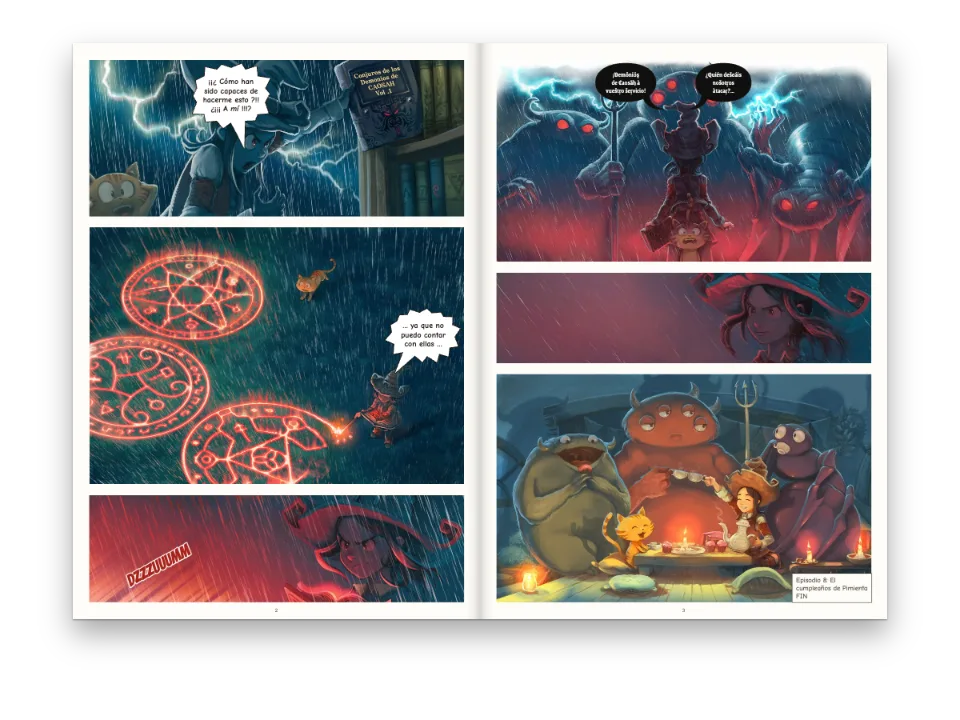
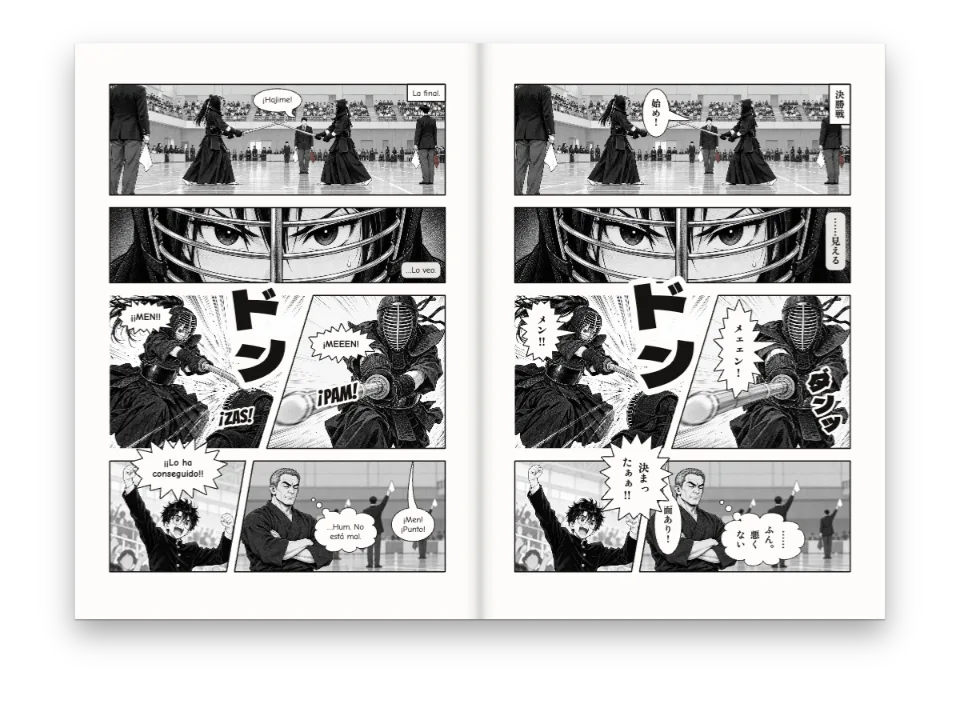
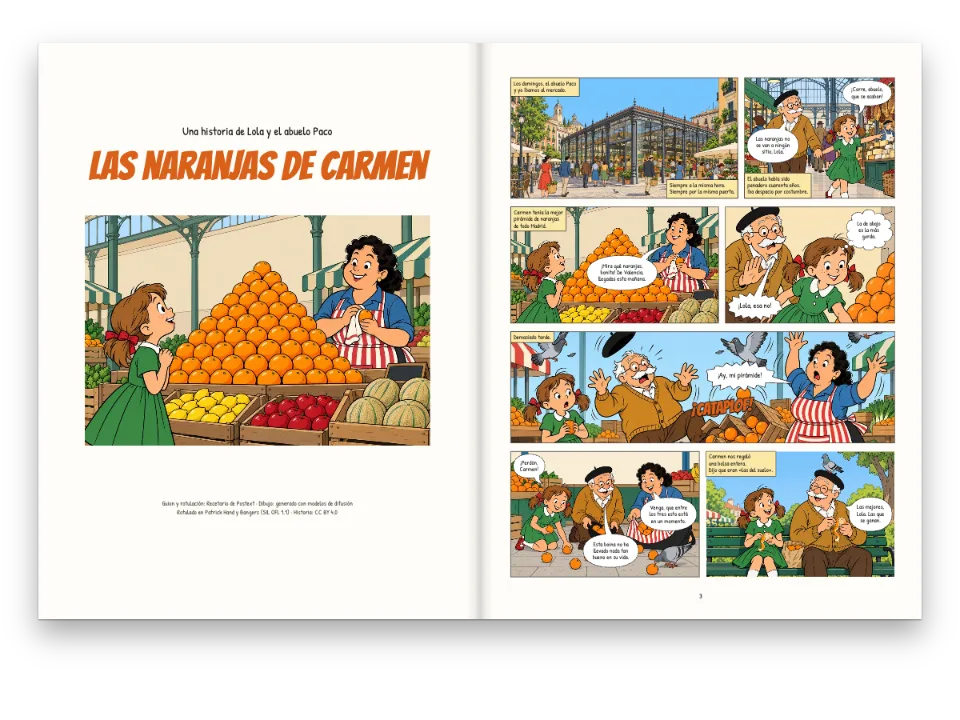
En pocas palabras
Una página de cómic sobre un rescate en plena tormenta que usa todos los tipos de bocadillo, con la hoja de estilo del rotulista que enseña cómo se escribe cada uno en el guion.
Lo que vas a componer
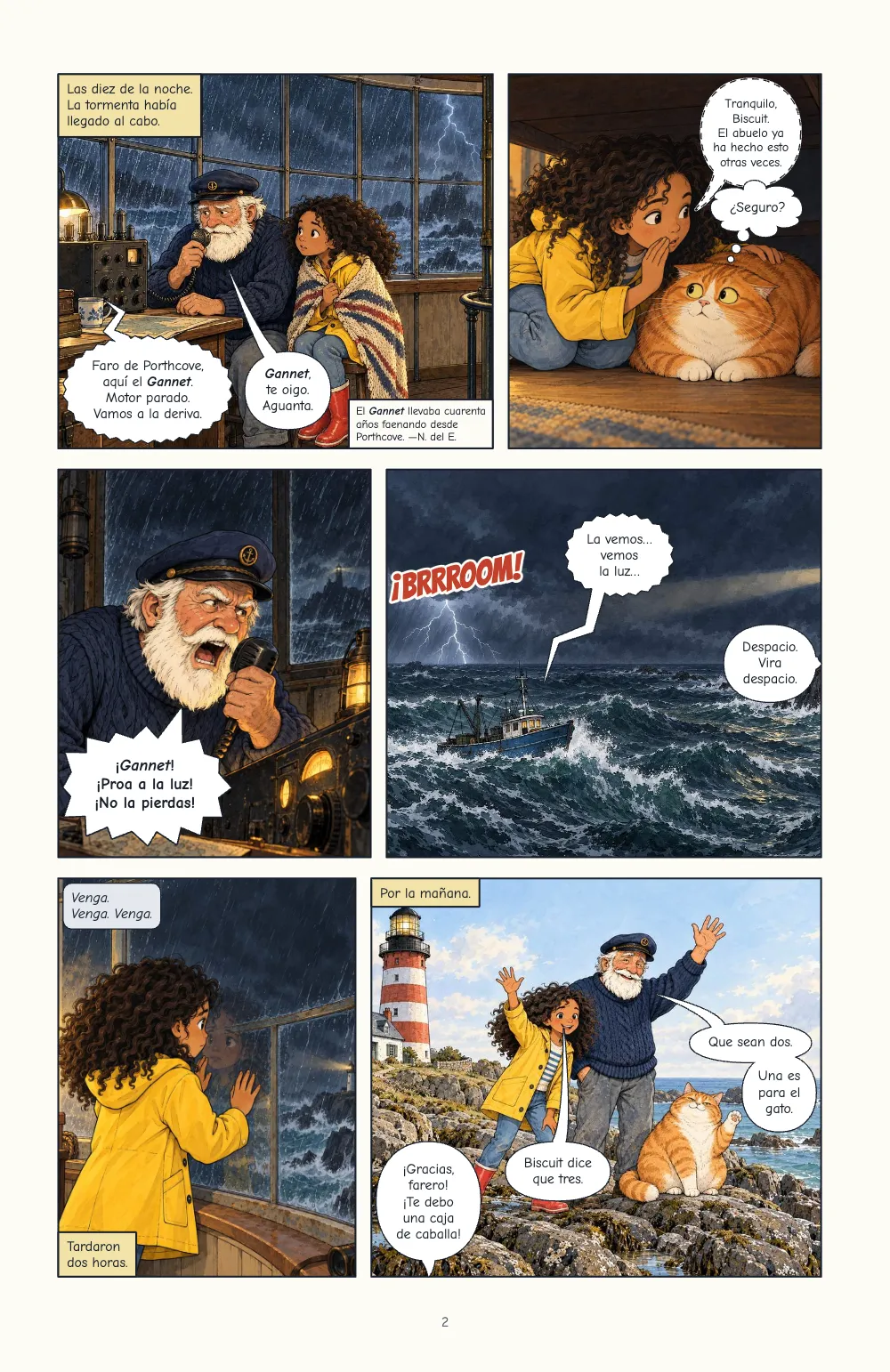
La página 7 de La luz de Porthcove, un cómic sobre una noche de tormenta en un faro, con la hoja de estilo del rotulista delante. Un pesquero se queda sin motor, el farero lo guía por radio, Maya espera con el gato y por la mañana el patrón les da las gracias. La página usa todos los bocadillos que dibuja Postext: diálogo, diálogo unido, pensamiento, susurro, grito, radio, cartelas de narración, voz interior, nota del editor, onomatopeya, una voz fuera de campo y un bocadillo fijado. El formato es el de un cómic americano, 168 × 259 mm, y la página sale en seis idiomas.
Esta receta responde a
- ¿Cómo muestro bocadillos de pensamiento, susurro, grito y radio?
- ¿Cómo hago que el rabillo del bocadillo apunte al personaje que habla?
- ¿Cómo rotulo onomatopeyas sobre la imagen?
- ¿Cómo escribo los bocadillos en Markdown?
La respuesta corta
// A script line is `speaker{kind}: text`. The kinds are balloon styles: the engine ships
// speech, thought, whisper, shout, radio, caption, inner, note and sfx, and a style of the
// same id here changes only what it names. `caption`, `note` and `sfx` are reserved speakers.
const balloonStyles = [
  { id: 'speech', stroke: col('ink') }, // an oval, a curved tail to the mouth
  { id: 'thought', stroke: col('ink') }, // a cloud, bubbles to the head
  { id: 'whisper', stroke: col('ink') }, // a dashed outline, 0.9 × the type
  { id: 'shout', stroke: col('ink'), burstPoints: 16 }, // a burst, bold, 1.15 × the type
  { id: 'radio', stroke: col('ink') }, // a zig-zag outline and tail: a voice through a set
  { id: 'caption', fill: col('caption'), stroke: col('ink') }, // narration, butted to a corner
  { id: 'inner', fill: col('inner'), stroke: col('ink') }, // no tail, italic where it can be
  { id: 'note', fill: col('paper'), stroke: col('ink') }, // the editor's note, 0.8 × the type
  { id: 'sfx', fontFamily: SFX, color: col('accent'), haloColor: col('paper') }, // no balloon
];
const comics = {
  gutter: { horizontal: mm(4), vertical: mm(3) },
  panel: { borderWidth: pt(1), borderColor: col('ink'), background: col('paper') },
  lettering: { fontFamily: LETTERING, fontSize: pt(7.5), color: col('ink'), inset: mm(1) },
  balloonStyles,
  // A speaker's own style: every `skipper:` line comes through the radio unless it says not.
  cast: [{ id: 'skipper', balloonStyle: 'radio', name: t({ en: 'The skipper', es: 'El patrón',
    ca: 'El patró', zh: '船长', ar: 'الربّان', ja: '船長', pt: 'O capitão' }) }],
  runningHeads: true, // a comic page has no running head unless asked: here, its folio
};
Ingredientes
- Funciones
- Estilos de bocadilloOnomatopeyasPersonajes y anclasDivisión en viñetasImagen y recorte de la viñetaPáginas de cómicRotulación de cómicRotular en otros idiomasPaleta de color semánticaPáginas en un canvasExportación a PDF
- También usa
- Chips en líneaBordes y calles de las viñetasColor del papelEstilos de párrafoFuentes incrustadas en el PDFFiguras y tablas como recursos
- Tipografía
- Comic Neue, Bangers, Zen Antique, Dela Gothic One, ZCOOL KuaiLe, ZCOOL QingKe HuangYou, Playpen Sans Arabic, Lalezar (SIL OFL 1.1)
- Recursos
bk-morning.jpgbk-sea.jpgbk-shout.jpgbk-storm.jpgbk-whisper.jpgbk-window.jpg- Viñeta: la tormenta en la sala de la linterna (Generated With Diffusion Models, original)
- Viñeta: Maya y el gato bajo la mesa (Generated With Diffusion Models, original)
- Viñeta: el farero gritando al micrófono (Generated With Diffusion Models, original)
- Viñeta: el pesquero en la tormenta (Generated With Diffusion Models, original)
- Viñeta: Maya en la ventana (Generated With Diffusion Models, original)
- Viñeta: la mañana siguiente en las rocas (Generated With Diffusion Models, original)
Elaboración
#1 · Nombra el tipo en la línea del guion
El código es la respuesta corta de arriba. Una línea del guion es personaje{tipo}: texto, y el tipo es el identificador de un estilo de bocadillo. Los nueve estilos de serie cubren los tipos habituales: un óvalo con rabillo curvo para el diálogo, una nube con burbujas para el pensamiento, un contorno discontinuo para el susurro, un estallido con rabillo en cuña para el grito y un contorno quebrado con rabillo en zigzag para una voz por radio (estilos de bocadillo). Un estilo de la configuración con el mismo identificador cambia solo lo que nombra: aquí el color del trazo, el amarillo de las cartelas y las 16 puntas del estallido. caption, note y sfx son personajes reservados: cartelas encajadas en una esquina, la nota del editor a 0,8 veces el cuerpo y letras de cartel sin bocadillo.
#2 · Apunta cada rabillo a quien habla
// From the art manifest; fractions of each picture, the same in every language. `skipper` in
// the storm picture is the radio set, the voice's source; in the sea picture, his boat.
const ART = {
  'bk-storm': { width: 1100, height: 733, safeArea: { x: 0.05, y: 0.26, width: 0.52, height: 0.36 },
    anchors: [{ id: 'tomas', x: 0.3, y: 0.44, head: { x: 0.32, y: 0.33 },
      face: { x: 0.26, y: 0.29, width: 0.13, height: 0.21 } },
    { id: 'maya', x: 0.475, y: 0.47, head: { x: 0.48, y: 0.38 },
      face: { x: 0.43, y: 0.35, width: 0.09, height: 0.16 } },
    { id: 'skipper', x: 0.08, y: 0.52 }],
    avoid: [{ x: 0, y: 0.38, width: 0.18, height: 0.28 }],
    alt: t({ en: 'Storm at night in the lamp room: the keeper speaks into the radio microphone '
      + 'while Maya, wrapped in a blanket, listens.',
      es: 'Noche de tormenta en la sala de la linterna: el farero habla por el micrófono de la '
        + 'radio y Maya, envuelta en una manta, escucha.',
      ca: 'Nit de tempesta a la sala de la llanterna: el faroner parla pel micròfon de la ràdio i '
        + 'la Maya, embolicada amb una manta, escolta.',
      zh: '暴风雨之夜的灯室里,守塔人对着收音机的话筒说话,裹着毯子的玛雅在一旁听着。',
      ar: 'ليلة عاصفة في غرفة الفانوس: الحارس يتكلم في ميكروفون المذياع، ومايا الملتفّة ببطانية '
        + 'تصغي.',
      ja: '嵐の夜の灯室。灯台守が無線のマイクに話しかけ、毛布にくるまったマヤが耳をすます。',
      pt: 'Noite de tempestade na sala da lanterna: o faroleiro fala ao microfone do rádio e '
        + 'Maya, enrolada num cobertor, escuta.' }) },
  'bk-whisper': { width: 1152, height: 1152,
    safeArea: { x: 0.36, y: 0.26, width: 0.44, height: 0.48 },
    anchors: [{ id: 'maya', x: 0.53, y: 0.47, head: { x: 0.52, y: 0.33 },
      face: { x: 0.41, y: 0.3, width: 0.19, height: 0.22 } },
    { id: 'biscuit', x: 0.625, y: 0.635, head: { x: 0.66, y: 0.57 },
      face: { x: 0.55, y: 0.5, width: 0.25, height: 0.22 } }],
    avoid: [],
    alt: t({ en: 'Under the desk, Maya whispers behind her hand to the frightened orange cat.',
      es: 'Bajo la mesa, Maya le susurra tapándose la boca al gato naranja asustado.',
      ca: 'Sota la taula, la Maya xiuxiueja tapant-se la boca al gat taronja espantat.',
      zh: '桌子底下,玛雅用手挡着嘴,对受惊的橘猫说悄悄话。',
      ar: 'تحت المكتب تهمس مايا من وراء يدها للقط البرتقالي الخائف.',
      ja: '机の下で、マヤが手で口をかくして、おびえたオレンジ色の猫にささやく。',
      pt: 'Debaixo da mesa, Maya cobre a boca com a mão e sussurra para o gato laranja '
        + 'assustado.' }) },
  'bk-shout': { width: 880, height: 1100, safeArea: { x: 0.22, y: 0.26, width: 0.46, height: 0.42 },
    anchors: [{ id: 'tomas', x: 0.48, y: 0.47, head: { x: 0.42, y: 0.33 },
      face: { x: 0.25, y: 0.28, width: 0.37, height: 0.32 } }],
    avoid: [{ x: 0.53, y: 0.43, width: 0.17, height: 0.27 }],
    alt: t({ en: 'Close-up of the keeper shouting into the microphone, lit from below by the '
      + 'radio dials.',
      es: 'Primer plano del farero gritando al micrófono, iluminado desde abajo por los diales de '
        + 'la radio.',
      ca: 'Primer pla del faroner cridant al micròfon, il·luminat des de baix pels dials de la '
        + 'ràdio.',
      zh: '守塔人对着话筒大喊的特写,收音机的刻度盘从下方照亮他的脸。',
      ar: 'لقطة قريبة للحارس يصرخ في الميكروفون، وأضواء لوحة المذياع تنيره من أسفل.',
      ja: 'マイクに向かって叫ぶ灯台守のアップ。無線機の目盛りの光が下から顔を照らす。',
      pt: 'Close do faroleiro gritando ao microfone, iluminado de baixo pelos mostradores do '
        + 'rádio.' }) },
  'bk-sea': { width: 1200, height: 800, safeArea: { x: 0.1, y: 0.19, width: 0.37, height: 0.57 },
    anchors: [{ id: 'skipper', x: 0.28, y: 0.63 }, { id: 'sfx', x: 0.16, y: 0.36 }],
    avoid: [{ x: 0.13, y: 0.52, width: 0.24, height: 0.23 },
      { x: 0.85, y: 0.19, width: 0.08, height: 0.26 }],
    alt: t({ en: 'A small blue trawler heaves on storm waves at night; lightning on the left, the '
      + 'lighthouse beam on the right.',
      es: 'Un pesquero azul cabecea entre las olas de la tormenta; un rayo a la izquierda, el haz '
        + 'del faro a la derecha.',
      ca: 'Un pesquer blau capcineja entre les onades de la tempesta; un llamp a l’esquerra, el '
        + 'feix del far a la dreta.',
      zh: '夜里,一艘蓝色小渔船在暴风雨的浪头上颠簸;左边是闪电,右边是灯塔的光束。',
      ar: 'قارب صيد أزرق صغير يتقاذفه موج العاصفة ليلًا؛ برق على اليسار وشعاع المنارة على اليمين.',
      ja: '夜の嵐の波にもまれる青い小さな漁船。左に稲妻、右に灯台の光。',
      pt: 'Um pequeno barco pesqueiro azul jogado pelas ondas da tempestade à noite; um raio à '
        + 'esquerda, o facho do farol à direita.' }) },
  'bk-window': { width: 1000, height: 1000,
    safeArea: { x: 0.36, y: 0.27, width: 0.28, height: 0.33 },
    anchors: [{ id: 'maya', x: 0.49, y: 0.41, head: { x: 0.42, y: 0.3 },
      face: { x: 0.41, y: 0.33, width: 0.1, height: 0.13 } }],
    avoid: [{ x: 0.5, y: 0.33, width: 0.1, height: 0.17 },
      { x: 0.83, y: 0.45, width: 0.06, height: 0.08 }],
    alt: t({ en: 'Maya presses her hands and nose to the rainy window, staring out at the storm.',
      es: 'Maya pega las manos y la nariz al cristal mojado y mira la tormenta.',
      ca: 'La Maya enganxa les mans i el nas al vidre mullat i mira la tempesta.',
      zh: '玛雅把双手和鼻子贴在满是雨水的窗户上,望着外面的暴风雨。',
      ar: 'تلصق مايا يديها وأنفها بالزجاج المبلل وتحدّق في العاصفة.',
      ja: 'マヤが雨の窓に両手と鼻を押しつけ、嵐を見つめる。',
      pt: 'Maya cola as mãos e o nariz no vidro molhado e olha a tempestade.' }) },
  'bk-morning': { width: 1000, height: 667,
    safeArea: { x: 0.33, y: 0.06, width: 0.42, height: 0.59 },
    anchors: [{ id: 'tomas', x: 0.565, y: 0.25, head: { x: 0.56, y: 0.15 },
      face: { x: 0.51, y: 0.13, width: 0.1, height: 0.17 } },
    { id: 'maya', x: 0.465, y: 0.29, head: { x: 0.45, y: 0.24 },
      face: { x: 0.41, y: 0.19, width: 0.09, height: 0.14 } },
    { id: 'biscuit', x: 0.685, y: 0.58, head: { x: 0.69, y: 0.55 },
      face: { x: 0.64, y: 0.51, width: 0.09, height: 0.11 } }],
    avoid: [{ x: 0.66, y: 0.08, width: 0.08, height: 0.12 },
      { x: 0.34, y: 0.14, width: 0.06, height: 0.08 }],
    alt: t({ en: 'Next morning on the sunny rocks, Maya, the keeper and the cat wave; the '
      + 'lighthouse stands behind them.',
      es: 'A la mañana siguiente, en las rocas al sol, Maya, el farero y el gato saludan; detrás '
        + 'está el faro.',
      ca: 'L’endemà al matí, a les roques al sol, la Maya, el faroner i el gat saluden; darrere '
        + 'hi ha el far.',
      zh: '第二天早上,阳光照着礁石,玛雅、守塔人和猫在挥手;灯塔立在他们身后。',
      ar: 'في الصباح التالي على الصخور المشمسة يلوّح مايا والحارس والقط، والمنارة خلفهم.',
      ja: '翌朝、日の当たる岩の上でマヤと灯台守と猫が手を振る。後ろに灯台が立つ。',
      pt: 'Na manhã seguinte, nas pedras ao sol, Maya, o faroleiro e o gato acenam; atrás deles '
        + 'está o farol.' }) },
};
Cada imagen lleva anclas en fracciones de la imagen: la boca a la que apunta el rabillo de un diálogo, la cabeza a la que apunta un pensamiento y la cara que ningún bocadillo puede tapar (personajes y anclas). Al patrón no se le ve nunca: su ancla en la imagen de la tormenta es la radio y, en la del mar, su barco. Cuando quien habla no está en la viñeta, tail=end (o start, top, bottom) lleva el rabillo a ese borde, y at="44% 22%" fija el centro de un bocadillo en un punto de la imagen, que se mantiene con cualquier recorte. Dos líneas seguidas de un mismo personaje se funden en un contorno con un solo rabillo.
#3 · Dale a un personaje su propia voz
El reparto de la respuesta corta da a cada línea skipper: el estilo de radio, así que el guion no repite {radio}. Una línea puede decir otra cosa: en la viñeta de la mañana el patrón grita desde su barco, skipper{speech tail=bottom}:, con un bocadillo normal cuyo rabillo sale por el pie de la viñeta.
#4 · Rotula cada edición con sus letras
// The engine's default lettering and sound-effect faces, but for Chinese two ZCOOL faces drawn
// for cartoons. content.<lang>.md holds the words under the same speaker ids.
const [LETTERING, SFX] = t({
  en: ['Comic Neue', 'Bangers'], es: ['Comic Neue', 'Bangers'], ca: ['Comic Neue', 'Bangers'],
  ja: ['Zen Antique', 'Dela Gothic One'], zh: ['ZCOOL KuaiLe', 'ZCOOL QingKe HuangYou'],
  ar: ['Playpen Sans Arabic', 'Lalezar'], pt: ['Comic Neue', 'Bangers'],
});
La misma página sale en seis idiomas: content.<lang>.md solo lleva las palabras. Los bocadillos japoneses van en vertical con Zen Antique y sus onomatopeyas con Dela Gothic One; los árabes, con Playpen Sans Arabic y Lalezar para el trueno. La cursiva y la negrita se aplican donde la letra las tiene: la voz interior va en cursiva en inglés y en redonda en japonés (rotulación).
La receta completa
// ═══ Postext Cookbook · Nº 145 · Every kind of balloon on a lighthouse page ═════════ // https://postext.dev/en/cookbook/balloon-kinds // Code: MIT · Text: original (CC BY 4.0) · Pictures: generated with diffusion models // Fonts: Comic Neue, Bangers and the faces of five editions (OFL) · Needs postext ≥ 1.21.0 // // One comic page that uses every kind of balloon the engine draws, with a letterer's style // sheet in front of it. Each line of the script names its speaker and, when it is not plain // speech, its kind; the shape, the tail and the type follow from the balloon style. import { buildDocument, renderPageToCanvas, clearMeasurementCache, registerResourceImage, loadVerticalAlternates, } from 'https://esm.sh/postext'; import { renderToPdf, decompressWoff2 } from 'https://esm.sh/postext-pdf'; const LANG = 'es'; // @lang: the sample's language: 'en' | 'es' | 'ca' | 'zh' | 'ar' | 'ja' | 'pt' const RECIPE = 'balloon-kinds'; // ─── 1 · Design ───────────────────────────────────────────────────────────── // #region palette: a storm at night, and the yellow of the captions const palette = { ink: '#18202b', // panel borders, lettering and text: a blue-black accent: '#c2412d', // sound effects and the style sheet's labels caption: '#f3e3a8', // narration boxes inner: '#e4e8ee', // the inner voice: a cold grey-blue muted: '#5c6672', // folios and the imprint paper: '#fdfbf6', }; const col = (id) => ({ hex: palette[id], model: 'hex', paletteId: id }); const colorPalette = [ ...Object.entries(palette).map(([id, hex]) => ({ id, name: id, value: { hex, model: 'hex' } })), { id: 'main-color', name: 'accent (defaults)', value: { hex: palette.accent, model: 'hex' } }, ]; // #endregion // #region editions: six editions, each lettered in faces for its script // The engine's default lettering and sound-effect faces, but for Chinese two ZCOOL faces drawn // for cartoons. content.<lang>.md holds the words under the same speaker ids. const [LETTERING, SFX] = t({ en: ['Comic Neue', 'Bangers'], es: ['Comic Neue', 'Bangers'], ca: ['Comic Neue', 'Bangers'], ja: ['Zen Antique', 'Dela Gothic One'], zh: ['ZCOOL KuaiLe', 'ZCOOL QingKe HuangYou'], ar: ['Playpen Sans Arabic', 'Lalezar'], pt: ['Comic Neue', 'Bangers'], }); // #endregion // #region answer: one balloon style per kind, and a cast that gives the skipper his radio // A script line is `speaker{kind}: text`. The kinds are balloon styles: the engine ships // speech, thought, whisper, shout, radio, caption, inner, note and sfx, and a style of the // same id here changes only what it names. `caption`, `note` and `sfx` are reserved speakers. const balloonStyles = [ { id: 'speech', stroke: col('ink') }, // an oval, a curved tail to the mouth { id: 'thought', stroke: col('ink') }, // a cloud, bubbles to the head { id: 'whisper', stroke: col('ink') }, // a dashed outline, 0.9 × the type { id: 'shout', stroke: col('ink'), burstPoints: 16 }, // a burst, bold, 1.15 × the type { id: 'radio', stroke: col('ink') }, // a zig-zag outline and tail: a voice through a set { id: 'caption', fill: col('caption'), stroke: col('ink') }, // narration, butted to a corner { id: 'inner', fill: col('inner'), stroke: col('ink') }, // no tail, italic where it can be { id: 'note', fill: col('paper'), stroke: col('ink') }, // the editor's note, 0.8 × the type { id: 'sfx', fontFamily: SFX, color: col('accent'), haloColor: col('paper') }, // no balloon ]; const comics = { gutter: { horizontal: mm(4), vertical: mm(3) }, panel: { borderWidth: pt(1), borderColor: col('ink'), background: col('paper') }, lettering: { fontFamily: LETTERING, fontSize: pt(7.5), color: col('ink'), inset: mm(1) }, balloonStyles, // A speaker's own style: every `skipper:` line comes through the radio unless it says not. cast: [{ id: 'skipper', balloonStyle: 'radio', name: t({ en: 'The skipper', es: 'El patrón', ca: 'El patró', zh: '船长', ar: 'الربّان', ja: '船長', pt: 'O capitão' }) }], runningHeads: true, // a comic page has no running head unless asked: here, its folio }; // #endregion const LABEL = { fontFamily: LETTERING, fontSize: pt(7.5), color: col('muted') }; const footer = { elements: [{ kind: 'text', id: 'folio', content: '{pageNumber}', ...LABEL, align: 'center', placement: { anchor: { to: 'page', edge: 'bottom' }, offset: { x: mm(0), y: mm(-8) } } }] }; const config = () => ({ // a factory: the engine caches resolved configs per object locale: t({ en: 'en-us', es: 'es', ca: 'ca', ja: 'ja', zh: 'zh-Hans', ar: 'ar', pt: 'pt-BR' }), colorPalette, comics, // The trim of an American comic book, 6⅝ × 10³⁄₁₆ in; the type area is the panel frame. page: { sizePreset: 'custom', width: mm(168), height: mm(259), dpi: 150, backgroundColor: col('paper'), margins: { top: mm(14), bottom: mm(18), left: mm(13), right: mm(11), mirror: true } }, layout: { layoutType: 'single' }, // The style sheet is set in the lettering face of the edition. bodyText: { fontFamily: LETTERING, fontSize: pt(9.5), lineHeight: pt(13.5), color: col('ink'), boldColor: col('ink'), italicColor: col('ink'), referenceColor: col('ink'), textAlign: 'left', firstLineIndent: pt(0), paragraphSpacing: true, hyphenation: { enabled: false } }, headings: { fontFamily: SFX, color: col('accent'), fontWeight: 400, levels: [ // Restated: any headings object drops the H1 break (gotcha: headings-drop-h1-break). { level: 1, fontSize: pt(34), lineHeight: pt(38), breakBefore: { enabled: true, parity: 'any' }, marginTop: mm(18), marginBottom: pt(13.5) }, { level: 2, fontFamily: LETTERING, fontSize: pt(9.5), fontWeight: 700, color: col('accent'), marginTop: pt(13.5), marginBottom: pt(0) }, ] }, unorderedLists: { bulletChar: '–', color: col('accent'), fontWeight: 400, marginTop: pt(0), marginBottom: pt(0) }, // The script's markup on the style sheet: a chip in the caption yellow. chipStyles: [{ id: 'code', background: col('caption'), color: col('ink'), borderWidth: pt(0), borderRadius: pt(1.5), fontFamily: LETTERING, fontSize: em(0.9), paddingX: em(0.3), paddingY: em(0.1) }], paragraphStyles: [{ id: 'imprint', fontSize: pt(7.5), lineHeight: pt(10), color: col('muted'), marginTop: pt(27) }], header: { elements: [] }, footer, }); // ─── 2 · Content ──────────────────────────────────────────────────────────── const markdown = String.raw`# Hoja de estilo de rotulaciónMuestra en Markdown · 47 líneas · content.es.md
## La luz de Porthcove · número 3 · página 7 Cada línea del guion es un bocadillo: quién habla, el tipo entre llaves si no es un diálogo normal, dos puntos y el texto. Las formas de esta lista son las de la página 2. - **Diálogo.** :chip[tomas: Que sean dos.]{style="code"} Un óvalo; el rabillo se queda a un paso de la boca de quien habla. - **Unidos.** Dos líneas :chip[tomas:]{style="code"} seguidas se funden en un solo contorno, con un solo rabillo. - **Pensamiento.** :chip[biscuit{thought}:]{style="code"} Una nube, con burbujas que suben hacia la cabeza. - **Susurro.** :chip[maya{whisper}:]{style="code"} Contorno discontinuo y letra más pequeña. - **Grito.** :chip[tomas{shout}:]{style="code"} Un estallido, en negrita y un punto más grande. - **Radio.** El patrón habla por el aparato: el reparto da a cada línea :chip[skipper:]{style="code"} un contorno quebrado y un rabillo en zigzag. - **Cartela.** :chip[caption:]{style="code"} Narración en una caja amarilla, encajada en una esquina. - **Voz interior.** :chip[maya{inner}:]{style="code"} Lo que no dice en voz alta: sin rabillo, caja gris, cursiva. - **Nota del editor.** :chip[note:]{style="code"} Pequeña, en la esquina inferior de la viñeta. - **Onomatopeya.** :chip[sfx{at="16% 28%" rotate=-10}:]{style="code"} Sin bocadillo: letras de cartel en rojo con contorno blanco, colocadas y giradas a mano. - **Fuera de campo.** :chip[tomas{tail=end}:]{style="code"} Quien habla está fuera de la imagen; el rabillo llega al borde de la viñeta. - **Fijado.** :chip[skipper{at="44% 22%"}:]{style="code"} El bocadillo se centra en ese punto de la imagen, sea cual sea el recorte. :::paragraphs{style="imprint"} Guion y rotulación para el Recetario de Postext. Imágenes generadas con modelos de difusión. Rotulado en Comic Neue y Bangers (SIL OFL). ::: :::page{split="32 [58 | *] / 34 [42 | *] / * [40 | *]"} ::panel{art=bk-storm} caption: Las diez de la noche. La tormenta había llegado al cabo. skipper: Faro de Porthcove, aquí el *Gannet*. Motor parado. Vamos a la deriva. tomas: *Gannet*, te oigo. Aguanta. note{at=bottom-end}: El *Gannet* llevaba cuarenta años faenando desde Porthcove. —N. del E. ::panel{art=bk-whisper} maya{whisper}: Tranquilo, Biscuit. El abuelo ya ha hecho esto otras veces. biscuit{thought}: ¿Seguro? ::panel{art=bk-shout} tomas{shout}: ¡*Gannet*! ¡Proa a la luz! ¡No la pierdas! ::panel{art=bk-sea} sfx{at="16% 28%" rotate=-10}: ¡BRRROOM! skipper{at="44% 22%"}: La vemos… vemos la luz… tomas{tail=end}: Despacio. Vira despacio. ::panel{art=bk-window} maya{inner}: Venga. Venga. Venga. caption{at=bottom-start}: Tardaron dos horas. ::panel{art=bk-morning} caption{at=top-start}: Por la mañana. skipper{speech tail=bottom}: ¡Gracias, farero! ¡Te debo una caja de caballa! tomas: Que sean dos. tomas: Una es para el gato. maya: Biscuit dice que tres. :::`; // content.<lang>.md, inlined by the Cookbook // #region art: the six pictures: safe area, speakers' anchors and avoid zones // From the art manifest; fractions of each picture, the same in every language. `skipper` in // the storm picture is the radio set, the voice's source; in the sea picture, his boat. const ART = { 'bk-storm': { width: 1100, height: 733, safeArea: { x: 0.05, y: 0.26, width: 0.52, height: 0.36 }, anchors: [{ id: 'tomas', x: 0.3, y: 0.44, head: { x: 0.32, y: 0.33 }, face: { x: 0.26, y: 0.29, width: 0.13, height: 0.21 } }, { id: 'maya', x: 0.475, y: 0.47, head: { x: 0.48, y: 0.38 }, face: { x: 0.43, y: 0.35, width: 0.09, height: 0.16 } }, { id: 'skipper', x: 0.08, y: 0.52 }], avoid: [{ x: 0, y: 0.38, width: 0.18, height: 0.28 }], alt: t({ en: 'Storm at night in the lamp room: the keeper speaks into the radio microphone ' + 'while Maya, wrapped in a blanket, listens.', es: 'Noche de tormenta en la sala de la linterna: el farero habla por el micrófono de la ' + 'radio y Maya, envuelta en una manta, escucha.', ca: 'Nit de tempesta a la sala de la llanterna: el faroner parla pel micròfon de la ràdio i ' + 'la Maya, embolicada amb una manta, escolta.', zh: '暴风雨之夜的灯室里,守塔人对着收音机的话筒说话,裹着毯子的玛雅在一旁听着。', ar: 'ليلة عاصفة في غرفة الفانوس: الحارس يتكلم في ميكروفون المذياع، ومايا الملتفّة ببطانية ' + 'تصغي.', ja: '嵐の夜の灯室。灯台守が無線のマイクに話しかけ、毛布にくるまったマヤが耳をすます。', pt: 'Noite de tempestade na sala da lanterna: o faroleiro fala ao microfone do rádio e ' + 'Maya, enrolada num cobertor, escuta.' }) }, 'bk-whisper': { width: 1152, height: 1152, safeArea: { x: 0.36, y: 0.26, width: 0.44, height: 0.48 }, anchors: [{ id: 'maya', x: 0.53, y: 0.47, head: { x: 0.52, y: 0.33 }, face: { x: 0.41, y: 0.3, width: 0.19, height: 0.22 } }, { id: 'biscuit', x: 0.625, y: 0.635, head: { x: 0.66, y: 0.57 }, face: { x: 0.55, y: 0.5, width: 0.25, height: 0.22 } }], avoid: [], alt: t({ en: 'Under the desk, Maya whispers behind her hand to the frightened orange cat.', es: 'Bajo la mesa, Maya le susurra tapándose la boca al gato naranja asustado.', ca: 'Sota la taula, la Maya xiuxiueja tapant-se la boca al gat taronja espantat.', zh: '桌子底下,玛雅用手挡着嘴,对受惊的橘猫说悄悄话。', ar: 'تحت المكتب تهمس مايا من وراء يدها للقط البرتقالي الخائف.', ja: '机の下で、マヤが手で口をかくして、おびえたオレンジ色の猫にささやく。', pt: 'Debaixo da mesa, Maya cobre a boca com a mão e sussurra para o gato laranja ' + 'assustado.' }) }, 'bk-shout': { width: 880, height: 1100, safeArea: { x: 0.22, y: 0.26, width: 0.46, height: 0.42 }, anchors: [{ id: 'tomas', x: 0.48, y: 0.47, head: { x: 0.42, y: 0.33 }, face: { x: 0.25, y: 0.28, width: 0.37, height: 0.32 } }], avoid: [{ x: 0.53, y: 0.43, width: 0.17, height: 0.27 }], alt: t({ en: 'Close-up of the keeper shouting into the microphone, lit from below by the ' + 'radio dials.', es: 'Primer plano del farero gritando al micrófono, iluminado desde abajo por los diales de ' + 'la radio.', ca: 'Primer pla del faroner cridant al micròfon, il·luminat des de baix pels dials de la ' + 'ràdio.', zh: '守塔人对着话筒大喊的特写,收音机的刻度盘从下方照亮他的脸。', ar: 'لقطة قريبة للحارس يصرخ في الميكروفون، وأضواء لوحة المذياع تنيره من أسفل.', ja: 'マイクに向かって叫ぶ灯台守のアップ。無線機の目盛りの光が下から顔を照らす。', pt: 'Close do faroleiro gritando ao microfone, iluminado de baixo pelos mostradores do ' + 'rádio.' }) }, 'bk-sea': { width: 1200, height: 800, safeArea: { x: 0.1, y: 0.19, width: 0.37, height: 0.57 }, anchors: [{ id: 'skipper', x: 0.28, y: 0.63 }, { id: 'sfx', x: 0.16, y: 0.36 }], avoid: [{ x: 0.13, y: 0.52, width: 0.24, height: 0.23 }, { x: 0.85, y: 0.19, width: 0.08, height: 0.26 }], alt: t({ en: 'A small blue trawler heaves on storm waves at night; lightning on the left, the ' + 'lighthouse beam on the right.', es: 'Un pesquero azul cabecea entre las olas de la tormenta; un rayo a la izquierda, el haz ' + 'del faro a la derecha.', ca: 'Un pesquer blau capcineja entre les onades de la tempesta; un llamp a l’esquerra, el ' + 'feix del far a la dreta.', zh: '夜里,一艘蓝色小渔船在暴风雨的浪头上颠簸;左边是闪电,右边是灯塔的光束。', ar: 'قارب صيد أزرق صغير يتقاذفه موج العاصفة ليلًا؛ برق على اليسار وشعاع المنارة على اليمين.', ja: '夜の嵐の波にもまれる青い小さな漁船。左に稲妻、右に灯台の光。', pt: 'Um pequeno barco pesqueiro azul jogado pelas ondas da tempestade à noite; um raio à ' + 'esquerda, o facho do farol à direita.' }) }, 'bk-window': { width: 1000, height: 1000, safeArea: { x: 0.36, y: 0.27, width: 0.28, height: 0.33 }, anchors: [{ id: 'maya', x: 0.49, y: 0.41, head: { x: 0.42, y: 0.3 }, face: { x: 0.41, y: 0.33, width: 0.1, height: 0.13 } }], avoid: [{ x: 0.5, y: 0.33, width: 0.1, height: 0.17 }, { x: 0.83, y: 0.45, width: 0.06, height: 0.08 }], alt: t({ en: 'Maya presses her hands and nose to the rainy window, staring out at the storm.', es: 'Maya pega las manos y la nariz al cristal mojado y mira la tormenta.', ca: 'La Maya enganxa les mans i el nas al vidre mullat i mira la tempesta.', zh: '玛雅把双手和鼻子贴在满是雨水的窗户上,望着外面的暴风雨。', ar: 'تلصق مايا يديها وأنفها بالزجاج المبلل وتحدّق في العاصفة.', ja: 'マヤが雨の窓に両手と鼻を押しつけ、嵐を見つめる。', pt: 'Maya cola as mãos e o nariz no vidro molhado e olha a tempestade.' }) }, 'bk-morning': { width: 1000, height: 667, safeArea: { x: 0.33, y: 0.06, width: 0.42, height: 0.59 }, anchors: [{ id: 'tomas', x: 0.565, y: 0.25, head: { x: 0.56, y: 0.15 }, face: { x: 0.51, y: 0.13, width: 0.1, height: 0.17 } }, { id: 'maya', x: 0.465, y: 0.29, head: { x: 0.45, y: 0.24 }, face: { x: 0.41, y: 0.19, width: 0.09, height: 0.14 } }, { id: 'biscuit', x: 0.685, y: 0.58, head: { x: 0.69, y: 0.55 }, face: { x: 0.64, y: 0.51, width: 0.09, height: 0.11 } }], avoid: [{ x: 0.66, y: 0.08, width: 0.08, height: 0.12 }, { x: 0.34, y: 0.14, width: 0.06, height: 0.08 }], alt: t({ en: 'Next morning on the sunny rocks, Maya, the keeper and the cat wave; the ' + 'lighthouse stands behind them.', es: 'A la mañana siguiente, en las rocas al sol, Maya, el farero y el gato saludan; detrás ' + 'está el faro.', ca: 'L’endemà al matí, a les roques al sol, la Maya, el faroner i el gat saluden; darrere ' + 'hi ha el far.', zh: '第二天早上,阳光照着礁石,玛雅、守塔人和猫在挥手;灯塔立在他们身后。', ar: 'في الصباح التالي على الصخور المشمسة يلوّح مايا والحارس والقط، والمنارة خلفهم.', ja: '翌朝、日の当たる岩の上でマヤと灯台守と猫が手を振る。後ろに灯台が立つ。', pt: 'Na manhã seguinte, nas pedras ao sol, Maya, o faroleiro e o gato acenam; atrás deles ' + 'está o farol.' }) }, }; // #endregion // ─── 3 · Fonts ────────────────────────────────────────────────────────────── // Every face of the six editions; each edition loads the latin files of all of them and the // Japanese, Chinese or Arabic files of its own two (gotcha: fonts-first). const FONTS = { 'Comic Neue': ['400', '400i', '700', '700i'], Bangers: ['400'], 'Zen Antique': ['400'], 'Dela Gothic One': ['400'], 'ZCOOL KuaiLe': ['400'], 'ZCOOL QingKe HuangYou': ['400'], 'Playpen Sans Arabic': ['400', '700'], Lalezar: ['400'], }; // ─── 4 · Build & show ─────────────────────────────────────────────────────── const faces = { [LETTERING]: FONTS[LETTERING], [SFX]: FONTS[SFX] }; await loadFonts(FONTS, markdown); await loadCjkFonts(faces, markdown, { vertical: LANG === 'ja' }); // ja balloons are vertical await loadArabicFonts(faces, markdown); await loadComicFonts(faces, markdown); // the bold and italic the faces do not ship const resources = await Promise.all([ comicPanel('bk-storm', asset('bk-storm.jpg'), ART['bk-storm']), comicPanel('bk-whisper', asset('bk-whisper.jpg'), ART['bk-whisper']), comicPanel('bk-shout', asset('bk-shout.jpg'), ART['bk-shout']), comicPanel('bk-sea', asset('bk-sea.jpg'), ART['bk-sea']), comicPanel('bk-window', asset('bk-window.jpg'), ART['bk-window']), comicPanel('bk-morning', asset('bk-morning.jpg'), ART['bk-morning']), ]); const doc = await buildWithFonts(() => buildDocument({ markdown, resources }, config()), markdown); showBook(doc, { title: t({ en: 'Every kind of balloon on a lighthouse page', es: 'Todos los bocadillos en una página del faro', pt: 'Todos os tipos de balão numa página do farol' }) }); offerPdf(() => renderToPdf(doc, { fontProvider: comicPdfProvider, resourceBytes: imageBytes }), `${RECIPE}.pdf`);Kit · core, fonts, viewer, pdf, images, cjk, arabic, comics: igual en todas las recetas · 722 líneas
// ─── Kit ── helpers shared by every Cookbook recipe · postext.dev/cookbook ───── // ─── Kit · core v1 ── the same in every recipe · postext.dev/cookbook function mm(value) { return { value, unit: 'mm' }; } function pt(value) { return { value, unit: 'pt' }; } function em(value) { return { value, unit: 'em' }; } /** The sample language's string: t({ en: 'Figure', es: 'Figura' }). */ function t(strings) { return strings[LANG] ?? Object.values(strings)[0]; } /** A file in this recipe's assets folder, served from the Postext repo by jsDelivr. */ function asset(file) { return `https://cdn.jsdelivr.net/gh/drnachio/postext@main/cookbook/${RECIPE}/assets/${file}`; } // ─── Kit · fonts v2 ── the same in every recipe · postext.dev/cookbook // Postext measures with the loaded faces and caches the widths: load every face // before the first build, from Fontsource, the files the PDF embeds too. /** faces = { 'Family Name': ['400', '400i', '700'] }. `text` is the sample: * č ł † α χ also load latin-ext and greek files (kitSubsetsFor). With * `optional`, a face Fontsource does not ship is skipped instead of failing. * Resolves to the number of faces added. */ async function loadFonts(faces, text = '', { optional = false } = {}) { kitStatus('Loading fonts…'); const ranges = { latin: 'U+0000-00FF,U+0131,U+0152-0153,U+02BB-02BC,U+02C6,U+02DA,U+02DC,U+0304,U+0308,U+0329,' + 'U+2000-206F,U+20AC,U+2122,U+2191,U+2193,U+2212,U+2215,U+FEFF,U+FFFD', 'latin-ext': 'U+0100-02BA,U+02BD-02C5,U+02C7-02CC,U+02CE-02D7,U+02DD-02FF,U+0304,U+0308,U+0329,' + 'U+1D00-1DBF,U+1E00-1E9F,U+1EF2-1EFF,U+2020,U+20A0-20AB,U+20AD-20C0,U+2113,U+2C60-2C7F,U+A720-A7FF', greek: 'U+0370-03FF', }; const jobs = []; let added = 0; for (const [family, specs] of Object.entries(faces)) { const id = fontsourceId(family); const todo = [...new Set(specs)].map((spec) => [parseInt(spec, 10), spec.endsWith('i') ? 'italic' : 'normal']) .filter(([weight, style]) => !hasFace(family, weight, style)); // before any await const meta = optional || /[^\0-ÿ]/u.test(text) ? await fontsourceMeta(family) : null; const subsets = ['latin', ...kitSubsetsFor(text, meta)]; for (const [weight, style] of todo) { if (optional && !(meta?.weights.includes(weight) && meta.styles.includes(style))) continue; for (const subset of subsets) { const url = `https://cdn.jsdelivr.net/npm/@fontsource/${id}@5/files/${id}-${subset}-${weight}-${style}.woff2`; const face = new FontFace(family, `url(${url}) format('woff2')`, { weight: String(weight), style, unicodeRange: ranges[subset] }); jobs.push(face.load().then((ready) => { document.fonts.add(ready); added++; }, () => { if (subset === 'latin' && !optional) throw new Error(`Fontsource has no ${family} ${weight} ${style}`); })); } } } await Promise.all(jobs).catch((error) => { kitFail(error); throw error; }); return added; } /** Runs `build` and loads any face the pages use that FONTS missed (a regular * one with a warning), then clears the measurement cache and builds again. */ async function buildWithFonts(build, text = '') { const tried = new Set(); for (let round = 0; round < 3; round++) { kitStatus('Laying out…'); await new Promise(requestAnimationFrame); // let the status paint first const result = await Promise.resolve().then(build).catch((error) => { kitFail(error); throw error; }); const wanted = { base: {}, variants: {} }; for (const { font, base } of [result].flat().flatMap(fontStringsOf)) { const { family, weight, style } = parseFont(font); const key = `${family}|${weight}|${style}`; if (tried.has(key) || hasFace(family, weight, style)) continue; tried.add(key); (wanted[base ? 'base' : 'variants'][family] ??= []).push(`${weight}${style === 'italic' ? 'i' : ''}`); } if (Object.keys(wanted.base).length) { console.warn(`[cookbook] FONTS does not list ${JSON.stringify(wanted.base)}: loading them.`); } const added = await loadFonts(wanted.base, text) + await loadFonts(wanted.variants, text, { optional: true }); if (added === 0) return result; clearMeasurementCache(); } throw new Error('The fonts did not settle after three builds.'); } /** Every font string of the layout; `base` marks a block's own face. */ function fontStringsOf(doc) { const found = new Map(); const walk = (node) => { if (!node || typeof node !== 'object') return; if (Array.isArray(node)) { node.forEach(walk); return; } for (const [key, value] of Object.entries(node)) { if (typeof value === 'string' && /fontString$/i.test(key)) { found.set(value, found.get(value) || key === 'fontString'); } else if (value && typeof value === 'object') walk(value); } }; walk(doc.pages); walk(doc.blocks); return [...found].map(([font, base]) => ({ font, base })); } /** '700 37.5px Open Sans' / 'italic 400 13px "Source Serif 4"' → { family, weight, style }. * A string with no weight ('95.8px Young Serif', from a design text) is 400. */ function parseFont(font) { const m = /^(?:(italic|oblique)\s+)?(?:small-caps\s+)?(?:(\d+|bold|normal)\s+)?[\d.]+px\s+(.+)$/.exec(font.trim()); if (!m) throw new Error(`Unexpected font string: ${font}`); const weight = m[2] === 'bold' ? 700 : !m[2] || m[2] === 'normal' ? 400 : Number(m[2]); return { family: m[3].replace(/^["']|["']$/g, ''), weight, style: m[1] ? 'italic' : 'normal' }; } /** A loaded FontFace covers this family, weight and style (fonts.check() would * also say yes for families nobody declared). */ function hasFace(family, weight, style) { for (const face of document.fonts) { if (face.status !== 'loaded' || face.style !== style) continue; if (face.family.replace(/^["']|["']$/g, '') !== family) continue; const [low, high = low] = face.weight.split(' ').map(Number); if (weight >= low && weight <= high) return true; } return false; } /** The files beyond latin `text` needs that `meta`'s family ships. */ function kitSubsetsFor(text, meta) { return [[/[Ā-˿ᴀ-ᶿḀ-ỿ†ℓⱠ-Ɀ꜠-ꟿ]/u, 'latin-ext'], [/[Ͱ-Ͽ]/u, 'greek']] .filter(([re, x]) => re.test(text) && meta?.subsets?.includes(x)).map(([, x]) => x); } /** Fontsource's id for a family: 'Source Serif 4' → 'source-serif-4'. */ function fontsourceId(family) { return family.toLowerCase().replace(/\s+/g, '-'); } /** The family's Fontsource metadata (weights, styles, subsets), or null. */ function fontsourceMeta(family) { fontsourceMeta.cache ??= new Map(); const id = fontsourceId(family); if (!fontsourceMeta.cache.has(id)) { fontsourceMeta.cache.set(id, fetch(`https://api.fontsource.org/v1/fonts/${id}`) .then((res) => (res.ok ? res.json() : null), () => null)); } return fontsourceMeta.cache.get(id); } // ─── Kit · viewer v1 ── the same in every recipe · postext.dev/cookbook /** The pages as spreads on a dark desk, page 1 alone, then verso | recto, * each painted when it scrolls near. */ function showPages(docs, { title, width = 460 } = {}) { const root = viewer(title); const pages = [docs].flat().flatMap((doc) => doc.pages.map((page) => ({ doc, page, n: (doc.pageIndexOffset ?? 0) + page.index }))); const spreads = []; let verso = null; for (const p of pages) { if (p.n % 2 === 1) { if (verso) spreads.push([verso, null]); verso = p; } else { spreads.push([verso, p]); verso = null; } } if (verso) spreads.push([verso, null]); const density = Math.min(window.devicePixelRatio || 1, 2); showPages.painter?.disconnect(); const painter = new IntersectionObserver((entries) => { for (const { isIntersecting, target } of entries) { if (!isIntersecting) continue; painter.unobserve(target); const { doc, page } = target.postext; renderPageToCanvas(page, doc, target, { scale: (width * density) / page.width }); } }, { rootMargin: '800px' }); showPages.painter = painter; root.replaceChildren(...spreads.map((pair) => { const spread = document.createElement('div'); spread.className = 'pt-spread'; for (const p of pair) { const figure = document.createElement('figure'); if (p) { const label = p.page.pageLabel || String(p.n + 1); const canvas = document.createElement('canvas'); canvas.postext = p; canvas.style.aspectRatio = `${p.page.width} / ${p.page.height}`; canvas.setAttribute('role', 'img'); canvas.setAttribute('aria-label', `Page ${label}`); const folio = document.createElement('figcaption'); folio.textContent = label; figure.append(canvas, folio); painter.observe(canvas); } else figure.className = 'pt-blank'; spread.append(figure); } return spread; })); kitStatus(`${pages.length} ${pages.length === 1 ? 'page' : 'pages'}`); document.documentElement.dataset.postext = 'ready'; return pages.length; } /** The desk, the bar and the error reporting, created once. */ function viewer(title) { if (!document.getElementById('pt-kit')) { document.head.insertAdjacentHTML('beforeend', `<style id="pt-kit"> :root { color-scheme: dark; } body { margin: 0; background: #0e1014; color: #b9bcc4; font: 13px/1.45 system-ui, sans-serif; } #pt-bar { position: sticky; top: 0; z-index: 1; display: flex; flex-wrap: wrap; align-items: center; gap: 6px 16px; padding: 10px 16px; background: rgb(14 16 20 / .92); backdrop-filter: blur(6px); border-bottom: 1px solid #23262d; } #pt-bar strong { color: #f4f1ea; font-weight: 600; } #pt-actions { display: flex; gap: 12px; margin-left: auto; } #pt-actions a, #pt-actions button { color: #d8a21a; font: inherit; background: none; border: 0; padding: 0; cursor: pointer; } #pages { display: grid; justify-items: center; gap: 48px; padding: 32px 16px 72px; } .pt-spread { display: flex; } .pt-spread figure { margin: 0; width: min(460px, 44vw); } .pt-spread canvas { display: block; width: 100%; background: #fff; box-shadow: 0 1px 2px rgb(0 0 0 / .5), 0 22px 44px -16px rgb(0 0 0 / .8); } .pt-spread figure:first-child canvas { box-shadow: inset -14px 0 14px -14px rgb(0 0 0 / .18), 0 1px 2px rgb(0 0 0 / .5), 0 22px 44px -16px rgb(0 0 0 / .8); } .pt-spread figcaption { margin-top: 10px; text-align: center; font: 600 10px/1 system-ui, sans-serif; letter-spacing: .18em; text-transform: uppercase; color: #6c7079; } .pt-blank { visibility: hidden; } @media (max-width: 760px) { .pt-spread { flex-direction: column; gap: 32px; } .pt-spread figure { width: min(460px, 92vw); } .pt-blank { display: none; } } </style>`); document.body.insertAdjacentHTML('afterbegin', '<header id="pt-bar"><strong id="pt-title"></strong><span id="pt-status" role="status"></span><span id="pt-actions"></span></header>'); document.getElementById('pt-title').textContent = document.title || 'Postext'; addEventListener('error', (event) => kitFail(event.error ?? event.message)); addEventListener('unhandledrejection', (event) => kitFail(event.reason)); } if (title) document.getElementById('pt-title').textContent = title; return document.getElementById('pages') ?? document.body.appendChild(Object.assign(document.createElement('main'), { id: 'pages' })); } function kitStatus(text) { viewer(); document.getElementById('pt-status').textContent = text; } function kitFail(error) { document.documentElement.dataset.postext = 'error'; kitStatus(`Error: ${error?.message ?? error}`); } // ─── Kit · pdf v2 ── the same in every recipe that exports a PDF /** The Fontsource files the screen used, as TrueType: the nearest weight the * family ships, upright if it has no italic; latin, then what the face's * letters need (kitSubsetsFor). */ async function fontsourceProvider(family, weight, style, request) { const id = fontsourceId(family); const meta = await fontsourceMeta(family); const weights = meta?.weights?.length ? meta.weights : [400, 700]; const w = weights.reduce((a, b) => (Math.abs(b - weight) < Math.abs(a - weight) ? b : a)); const s = style === 'italic' && meta && !meta.styles.includes('italic') ? 'normal' : style; const text = String.fromCodePoint(...(request?.codePoints ?? [])); const more = kitSubsetsFor(text, meta); const files = await Promise.all(['latin', ...more].map(async (subset) => { const res = await fetch(`https://cdn.jsdelivr.net/npm/@fontsource/${id}@5/files/${id}-${subset}-${w}-${s}.woff2`); if (!res.ok) throw new Error(`Fontsource has no ${family} ${w} ${s} ${subset}`); return decompressWoff2(new Uint8Array(await res.arrayBuffer())); })); return files.length === 1 ? files[0] : files; } /** A "Build the PDF" button; then "Open the PDF" (a new tab: CodePen's frame * shows no PDFs) and a download link. */ function offerPdf(makePdf, filename) { viewer(); const button = Object.assign(document.createElement('button'), { type: 'button', textContent: 'Build the PDF' }); button.dataset.postextPdf = filename; button.addEventListener('click', async () => { button.disabled = true; button.textContent = 'Building the PDF…'; try { const bytes = await makePdf(); const url = URL.createObjectURL(new Blob([bytes], { type: 'application/pdf' })); const size = `${Math.max(1, Math.round(bytes.length / 1024))} KB`; button.replaceWith( Object.assign(document.createElement('a'), { href: url, target: '_blank', rel: 'noopener', textContent: 'Open the PDF ↗' }), Object.assign(document.createElement('a'), { href: url, download: filename, textContent: `Download ${filename} · ${size}` })); } catch (error) { button.disabled = false; button.textContent = 'Build the PDF'; kitFail(error); } }); document.getElementById('pt-actions').append(button); } // ─── Kit · images v1 ── recipes with pictures · postext.dev/cookbook /** Registers a photo or PNG for the canvas and keeps its bytes for the PDF. * fetch → ImageBitmap never taints the canvas (a plain cross-origin <img> would). */ async function loadImage(fileId, url) { const res = await fetch(url); if (!res.ok) throw new Error(`Image not found (${res.status}): ${url}`); const bytes = new Uint8Array(await res.arrayBuffer()); registerResourceImage(fileId, await createImageBitmap(new Blob([bytes]))); (loadImage.bytes ??= new Map()).set(fileId, bytes); } /** Registers SVG markup (drawn in code, or fetched) as a vector image. */ async function loadSvg(fileId, svg) { const img = new Image(); img.src = `data:image/svg+xml;charset=utf-8,${encodeURIComponent(svg)}`; await img.decode(); registerResourceImage(fileId, img); (loadImage.bytes ??= new Map()).set(fileId, new TextEncoder().encode(svg)); } /** renderToPdf({ resourceBytes: imageBytes }) */ function imageBytes(fileId) { return loadImage.bytes?.get(fileId); } /** renderToHtml({ resourceImageUrl: imageUrl }) */ function imageUrl(fileId) { const bytes = imageBytes(fileId); if (!bytes) return undefined; imageUrl.urls ??= new Map(); if (!imageUrl.urls.has(fileId)) { const type = /\.svg$/i.test(fileId) ? 'image/svg+xml' : /\.png$/i.test(fileId) ? 'image/png' : 'image/jpeg'; imageUrl.urls.set(fileId, URL.createObjectURL(new Blob([bytes], { type }))); } return imageUrl.urls.get(fileId); } // ─── Kit · cjk v1 ── Chinese, Japanese and Korean books · postext.dev/cookbook // Fontsource ships a CJK family as about a hundred files per weight, each // declared in its stylesheet with the unicode-range it covers. The screen // loads the files the sample touches; the PDF gets the same files for the // characters its pages set in each face, and embeds each as a subset. // A book bound on the right (vertical text) is shown with its spreads // mirrored: page 1 alone on the left of the spine, then [3 | 2]. /** The files of a Fontsource face, read from its stylesheet: { url, range, * ranges }, the last declared first (the order the browser tries them in). */ function cjkSlices(family, weight, style) { cjkSlices.cache ??= new Map(); const id = fontsourceId(family); const css = `https://cdn.jsdelivr.net/npm/@fontsource/${id}@5/${weight}${style === 'italic' ? '-italic' : ''}.css`; if (!cjkSlices.cache.has(css)) { cjkSlices.cache.set(css, fetch(css) .then((res) => { if (!res.ok) throw new Error(`Fontsource has no ${family} ${weight} ${style} (${res.status})`); return res.text(); }) .then((text) => [...text.matchAll(/@font-face\s*{([^}]*)}/g)].map(([, rule]) => { const range = /unicode-range:\s*([^;]+);/.exec(rule)?.[1].trim() ?? 'U+0-10FFFF'; const ranges = range.split(',').map((part) => { const [lo, hi = lo] = part.trim().slice(2).split('-'); return [parseInt(lo, 16), parseInt(hi, 16)]; }); return { url: new URL(/url\(([^)]+?\.woff2)\)/.exec(rule)[1], css).href, range, ranges }; }).reverse())); } return cjkSlices.cache.get(css); } /** The file of `slices` that holds code point `cp`, if any. */ function cjkSliceFor(slices, cp) { return slices.find((slice) => slice.ranges.some(([lo, hi]) => cp >= lo && cp <= hi)); } /** Whether Fontsource serves `family` as a Chinese, Japanese or Korean * family (its subsets name the script). Fails when the API does not * answer: a CJK face taken for a Latin one would paint in a system face. */ async function isCjkFamily(family) { const meta = await fontsourceMeta(family); if (!meta) throw new Error(`api.fontsource.org did not describe ${family}: reload to try again`); return !!meta.subsets?.some((subset) => /^(chinese|japanese|korean)/.test(subset)); } /** faces = { 'Noto Serif TC': ['400', '700'] }, as for loadFonts: the * whole FONTS object may be passed, its other families are left to * loadFonts. Adds one FontFace per file of each CJK face with its * unicodeRange, then loads the files `text` touches. `text` is what the * faces set: the sample for the text face; a book in several voices calls * it once per voice (loadCjkFonts({ 'LXGW WenKai TC': ['400'] }, quotes)), * so the heading and quotation faces fetch and check only their own * characters. Fails when a character of `text` is in no file of a face. * List every weight the pages use: a weight left to buildWithFonts gets * the latin file only. With { vertical: true } it also loads each * family's vertical forms (brackets, quotes, pause marks) for the canvas, * which needs loadVerticalAlternates imported from postext. Resolves to * the number of files loaded. */ async function loadCjkFonts(faces, text, { vertical = false } = {}) { kitStatus('Loading fonts…'); let loaded = 0; try { if (vertical && typeof loadVerticalAlternates !== 'function') { throw new Error('loadCjkFonts(…, { vertical: true }) needs loadVerticalAlternates imported from postext'); } for (const [family, specs] of Object.entries(faces)) { if (!(await isCjkFamily(family))) continue; const twin = []; for (const spec of new Set(specs)) { const weight = parseInt(spec, 10); const style = spec.endsWith('i') ? 'italic' : 'normal'; const slices = await cjkSlices(family, weight, style); const missing = [...new Set(text)].filter((ch) => /\S/.test(ch) && !cjkSliceFor(slices, ch.codePointAt(0))); if (missing.length) { throw new Error(`${family} ${spec} has no file for ${missing.slice(0, 12).join(' ')}: ` + `give each face the text it sets (loadCjkFonts({ '${family}': ['${spec}'] }, text))`); } for (const slice of slices) { document.fonts.add(new FontFace(family, `url(${slice.url}) format('woff2')`, { weight: String(weight), style, unicodeRange: slice.range })); twin.push({ source: slice.url, weight: String(weight), style, unicodeRange: slice.range }); } const font = `${style === 'italic' ? 'italic ' : ''}${weight} 16px "${family}"`; loaded += (await document.fonts.load(font, text)).length; if (!document.fonts.check(font, text)) throw new Error(`${family} ${spec} did not load for the sample`); } // The same files under a twin name with the `vert` feature on: the // canvas paints the punctuation of vertical lines with it. if (vertical && twin.length) await loadVerticalAlternates(family, twin); } } catch (error) { kitFail(error); throw error; } return loaded; } /** The PDF font provider for recipes with CJK faces: a family whose * Fontsource subsets are Chinese, Japanese or Korean gets the files that * hold the characters its pages set (`request.codePoints`); any other * family gets the latin file fontsourceProvider fetches (the "pdf" block) * and, when the face sets letters only latin-ext has, that file too. */ async function cjkPdfProvider(family, weight, style, request) { if (!(await isCjkFamily(family))) return cjkLatinPdfFiles(family, weight, style, request); const meta = await fontsourceMeta(family); const weights = meta.weights?.length ? meta.weights : [400, 700]; const w = weights.reduce((a, b) => (Math.abs(b - weight) < Math.abs(a - weight) ? b : a)); const s = style === 'italic' && !meta.styles.includes('italic') ? 'normal' : style; const slices = await cjkSlices(family, w, s); const picked = new Set(); for (const cp of request?.codePoints ?? []) { const slice = cjkSliceFor(slices, cp); if (slice) picked.add(slice); } if (!picked.size) picked.add(slices[0]); return Promise.all(slices.filter((slice) => picked.has(slice)).map(async (slice) => { const res = await fetch(slice.url); if (!res.ok) throw new Error(`Fontsource file ${slice.url} (${res.status})`); return decompressWoff2(new Uint8Array(await res.arrayBuffer())); })); } /** A Latin family set next to the CJK faces: its latin file, then its * latin-ext file when the face sets letters only latin-ext has (ō ū in * Hepburn rōmaji, ǎ in pinyin), the file loadFonts adds on screen for * them. Latin comes first: postext-pdf draws a character from the first * file that has it, as the browser takes a character both files hold from * latin. A face Fontsource ships without latin-ext, or whose file does * not come, gets latin alone, and the PDF names the letters it lacks. */ async function cjkLatinPdfFiles(family, weight, style, request) { const meta = await fontsourceMeta(family); const beyond = [...(request?.codePoints ?? [])].some(cjkLatinExtOnly); if (!beyond || !meta?.subsets?.includes('latin-ext')) return fontsourceProvider(family, weight, style); const weights = meta.weights?.length ? meta.weights : [400, 700]; const w = weights.reduce((a, b) => (Math.abs(b - weight) < Math.abs(a - weight) ? b : a)); const s = style === 'italic' && !meta.styles.includes('italic') ? 'normal' : style; const id = fontsourceId(family); const url = `https://cdn.jsdelivr.net/npm/@fontsource/${id}@5/files/${id}-latin-ext-${w}-${s}.woff2`; const [latin, ext] = await Promise.all([fontsourceProvider(family, weight, style), fetch(url) .then(async (res) => (res.ok ? decompressWoff2(new Uint8Array(await res.arrayBuffer())) : null), () => null)]); return ext ? [latin, ext] : latin; } /** Whether code point `cp` is in Fontsource's latin-ext file and not in * its latin file: Latin Extended-A and -B, IPA, the spacing modifiers and * Latin Extended Additional (loadFonts's test for latin-ext), less the * few latin holds too (ı Œ œ ʻ ʼ ˆ ˚ ˜). */ function cjkLatinExtOnly(cp) { if (!((cp >= 0x100 && cp <= 0x2ff) || (cp >= 0x1e00 && cp <= 0x1eff))) return false; return ![0x131, 0x152, 0x153, 0x2bb, 0x2bc, 0x2c6, 0x2da, 0x2dc].includes(cp); } /** showPages for a book bound on either edge. A right-bound book (the * document says so: doc.binding is 'right' for page.binding 'right' and * for vertical text) lies on the desk as it opens: page 1 alone on the * left of the spine, then [3 | 2], the spine shade on each page's inner * edge. `binding` ('left' | 'right') overrides the document's. */ function showBook(docs, { binding, ...options } = {}) { const count = showPages(docs, options); const right = (binding ?? [docs].flat()[0]?.binding) === 'right'; if (!document.getElementById('pt-kit-cjk')) { // The pages keep direction ltr: a canvas draws text in the direction its // element inherits, and under rtl each run would end where the engine // starts it, its brackets mirrored. document.head.insertAdjacentHTML('beforeend', `<style id="pt-kit-cjk"> .pt-spread[dir="rtl"] canvas { direction: ltr; } .pt-spread[dir="rtl"] figure:first-child canvas { box-shadow: inset 14px 0 14px -14px rgb(0 0 0 / .18), 0 1px 2px rgb(0 0 0 / .5), 0 22px 44px -16px rgb(0 0 0 / .8); } </style>`); } // Each pair stays [verso, recto] in the page; right to left, the verso // sits on the right. Phones stack the pages in reading order either way. for (const spread of document.querySelectorAll('#pages > .pt-spread')) spread.dir = right ? 'rtl' : 'ltr'; document.getElementById('pages').dataset.binding = right ? 'right' : 'left'; return count; } // ─── Kit · arabic v1 ── Arabic-script faces · postext.dev/cookbook // Fontsource ships an Arabic family as one file per subset and weight: the // `arabic` file holds the letters, the harakat, the Arabic-Indic digits, the // Arabic punctuation and the presentation forms; `latin` and `latin-ext` // hold the rest. loadFonts loads the latin files; this block adds the arabic // file of every Arabic family, for the canvas and for the PDF, which shapes // the letters with HarfBuzz from the same bytes. /** The code points of Fontsource's `arabic` subset, as its stylesheets * declare them (the same unicode-range the browser picks the file by). A * function, not a const: the kit is inlined after the recipe's top-level * awaits, and a const read before its line throws, where a function * declaration is hoisted. */ function arabicRange() { return 'U+0600-06FF,U+0750-077F,U+0870-088E,U+0890-0891,U+0897-08E1,U+08E3-08FF,' + 'U+200C-200E,U+2010-2011,U+204F,U+2E41,U+FB50-FDFF,U+FE70-FE74,U+FE76-FEFC,U+102E0-102FB,' + 'U+10E60-10E7E,U+10EC2-10EC4,U+10EFC-10EFF,U+1EE00-1EEFF'; } /** Whether code point `cp` is in the arabic file. */ function inArabicRange(cp) { inArabicRange.ranges ??= arabicRange().split(',').map((part) => { const [lo, hi = lo] = part.slice(2).split('-'); return [parseInt(lo, 16), parseInt(hi, 16)]; }); return inArabicRange.ranges.some(([lo, hi]) => cp >= lo && cp <= hi); } /** Whether Fontsource serves `family` with an `arabic` subset. Fails when * the API does not answer: an Arabic face taken for a Latin one would set * its letters in a system face. */ async function isArabicFamily(family) { const meta = await fontsourceMeta(family); if (!meta) throw new Error(`api.fontsource.org did not describe ${family}: reload to try again`); return !!meta.subsets?.includes('arabic'); } /** The arabic file of a face. */ function arabicFileUrl(family, weight, style) { const id = fontsourceId(family); return `https://cdn.jsdelivr.net/npm/@fontsource/${id}@5/files/${id}-arabic-${weight}-${style}.woff2`; } /** faces = { Amiri: ['400', '700'] }, as for loadFonts, after it: the whole * FONTS object may be passed, its families without an arabic subset are * left alone. Adds the arabic file of every listed weight of each Arabic * family (the latin files come from loadFonts) and loads it. `text` is * the sample: fails when it holds an Arabic-script character the arabic * file does not cover. List every weight the pages set in Arabic: a weight * left to buildWithFonts gets the latin file only, and its Arabic letters * fall back to a system face. Resolves to the number of files loaded. */ async function loadArabicFonts(faces, text = '') { kitStatus('Loading fonts…'); let loaded = 0; try { const outside = [...new Set(text)].filter((ch) => /\p{Script=Arabic}/u.test(ch) && !inArabicRange(ch.codePointAt(0))); if (outside.length) throw new Error(`Fontsource's arabic files have no ${outside.slice(0, 12).join(' ')}`); for (const [family, specs] of Object.entries(faces)) { if (!(await isArabicFamily(family))) continue; for (const spec of new Set(specs)) { const weight = parseInt(spec, 10); const style = spec.endsWith('i') ? 'italic' : 'normal'; const face = new FontFace(family, `url(${arabicFileUrl(family, weight, style)}) format('woff2')`, { weight: String(weight), style, unicodeRange: arabicRange() }); document.fonts.add(await face.load().catch(() => { throw new Error(`Fontsource has no arabic file for ${family} ${weight} ${style}`); })); loaded++; } } } catch (error) { kitFail(error); throw error; } return loaded; } /** The PDF font provider for recipes with Arabic faces: a family with an * arabic subset gets its arabic file when its pages set Arabic letters * (`request.codePoints`), then its latin file, and its latin-ext file for * the letters beyond latin (transliteration: ā ḥ ʿ). The arabic file comes * first: it also holds the space and the brackets, so a line of Arabic is * shaped as one run and not cut at every space. Any other family goes to * fontsourceProvider (the "pdf" block). */ async function arabicPdfProvider(family, weight, style, request) { if (!(await isArabicFamily(family))) return fontsourceProvider(family, weight, style, request); const meta = await fontsourceMeta(family); const weights = meta.weights?.length ? meta.weights : [400, 700]; const w = weights.reduce((a, b) => (Math.abs(b - weight) < Math.abs(a - weight) ? b : a)); const s = style === 'italic' && !meta.styles.includes('italic') ? 'normal' : style; const wanted = [...(request?.codePoints ?? [])]; const id = fontsourceId(family); const urls = []; if (!wanted.length || wanted.some(inArabicRange)) urls.push(arabicFileUrl(family, w, s)); urls.push(`https://cdn.jsdelivr.net/npm/@fontsource/${id}@5/files/${id}-latin-${w}-${s}.woff2`); if (meta.subsets.includes('latin-ext') && wanted.some((cp) => /[Ā-˿Ḁ-ỿ]/u.test(String.fromCodePoint(cp)))) { urls.push(`https://cdn.jsdelivr.net/npm/@fontsource/${id}@5/files/${id}-latin-ext-${w}-${s}.woff2`); } return Promise.all(urls.map(async (url) => { const res = await fetch(url); if (!res.ok) throw new Error(`Fontsource file ${url} (${res.status})`); return decompressWoff2(new Uint8Array(await res.arrayBuffer())); })); } // ─── Kit · comics v1 ── comic pages · postext.dev/cookbook // The engine letters a comic in a face per language (defaultComicFont: // Comic Neue, Zen Antique for Japanese, Noto Sans SC, LXGW WenKai TC, // Playpen Sans Arabic; defaultComicSfxFont: Bangers, Dela Gothic One, // ZCOOL KuaiLe, Lalezar) and asks for the bold of a shout or a sound effect // and the italic of an inner voice. Most of these faces ship one weight and // no italic: this block declares the file Fontsource does ship for those // variants, so the canvas measures and paints the letters the PDF embeds // (the providers snap to the shipped file) and not a bold or a slant the // browser makes up. It also turns the art manifest into panel resources. /** faces = { 'Comic Neue': ['400', '700'], Bangers: ['400'] }, as for * loadFonts, after it (and after loadCjkFonts or loadArabicFonts for the * faces of those scripts); the whole FONTS object may be passed. List in * FONTS only what Fontsource ships (Bangers: ['400']): loadFonts fails on * the rest. For each family, the regular, bold, italic and bold italic it * lacks are declared with its nearest file (the regular for the bold, the * upright for the italic) and loaded for `text`. A CJK face needs the cjk * block; an Arabic face setting Arabic, the arabic block. Resolves to the * number of variants added. */ async function loadComicFonts(faces, text = '') { kitStatus('Loading fonts…'); let added = 0; try { for (const family of Object.keys(faces)) { const meta = await fontsourceMeta(family); if (!meta) throw new Error(`api.fontsource.org did not describe ${family}: reload to try again`); const weights = meta.weights?.length ? meta.weights : [400, 700]; const styles = meta.styles?.length ? meta.styles : ['normal']; for (const [weight, style] of [[400, 'normal'], [700, 'normal'], [400, 'italic'], [700, 'italic']]) { if ((weights.includes(weight) && styles.includes(style)) || hasFace(family, weight, style)) continue; const w = weights.reduce((a, b) => (Math.abs(b - weight) < Math.abs(a - weight) ? b : a)); const s = style === 'italic' && styles.includes('italic') ? 'italic' : 'normal'; for (const { url, range } of await comicFaceFiles(family, w, s, meta, text)) { document.fonts.add(new FontFace(family, `url(${url}) format('woff2')`, { weight: String(weight), style, unicodeRange: range })); } await document.fonts.load(`${style === 'italic' ? 'italic ' : ''}${weight} 16px "${family}"`, text || 'A'); added++; } } } catch (error) { kitFail(error); throw error; } return added; } /** The files of a shipped face ({ url, range }): a CJK face's slices (the * cjk block reads them from its stylesheet), else latin, the latin-ext * and greek files `text` needs, and the arabic file when `text` holds * Arabic. */ async function comicFaceFiles(family, weight, style, meta, text) { if (meta.subsets?.some((subset) => /^(chinese|japanese|korean)/.test(subset))) { if (typeof cjkSlices !== 'function') throw new Error(`${family} is a CJK face: list the cjk kit block`); return (await cjkSlices(family, weight, style)).map(({ url, range }) => ({ url, range })); } const id = fontsourceId(family); const file = (subset) => `https://cdn.jsdelivr.net/npm/@fontsource/${id}@5/files/${id}-${subset}-${weight}-${style}.woff2`; const files = ['latin', ...kitSubsetsFor(text, meta)].map((subset) => ({ url: file(subset), range: comicRange(subset) })); if (meta.subsets?.includes('arabic') && /\p{Script=Arabic}/u.test(text)) { if (typeof arabicRange !== 'function') throw new Error(`${family} sets Arabic: list the arabic kit block`); files.unshift({ url: file('arabic'), range: arabicRange() }); } return files; } /** The unicode-range loadFonts gives a Fontsource file. A function, not a * const: the kit is inlined after the recipe's top-level awaits. */ function comicRange(subset) { return { latin: 'U+0000-00FF,U+0131,U+0152-0153,U+02BB-02BC,U+02C6,U+02DA,U+02DC,U+0304,U+0308,U+0329,' + 'U+2000-206F,U+20AC,U+2122,U+2191,U+2193,U+2212,U+2215,U+FEFF,U+FFFD', 'latin-ext': 'U+0100-02BA,U+02BD-02C5,U+02C7-02CC,U+02CE-02D7,U+02DD-02FF,U+0304,U+0308,U+0329,' + 'U+1D00-1DBF,U+1E00-1E9F,U+1EF2-1EFF,U+2020,U+20A0-20AB,U+20AD-20C0,U+2113,U+2C60-2C7F,U+A720-A7FF', greek: 'U+0370-03FF', }[subset]; } /** The PDF font provider of a comic in any script: a CJK face goes to * cjkPdfProvider, an Arabic face to arabicPdfProvider, any other to * fontsourceProvider (the "pdf" block). Each embeds the shipped weight * and style nearest to the one asked for, the file loadComicFonts * declared for the canvas. */ async function comicPdfProvider(family, weight, style, request) { const subsets = (await fontsourceMeta(family))?.subsets ?? []; if (subsets.some((subset) => /^(chinese|japanese|korean)/.test(subset))) { if (typeof cjkPdfProvider !== 'function') throw new Error(`${family} is a CJK face: list the cjk kit block`); return cjkPdfProvider(family, weight, style, request); } if (subsets.includes('arabic') && typeof arabicPdfProvider === 'function') { return arabicPdfProvider(family, weight, style, request); } return fontsourceProvider(family, weight, style, request); } /** A panel picture as a resource for art= (and pop=): loads `url` * (write asset('lh-arrive.jpg') in the call, so the lint checks the file) * and declares it with `meta`, its entry in the art manifest: * { width, height, alt, safeArea, anchors, avoid }. The safe area is what * every crop keeps, the anchors the speakers' mouths, heads and faces, * the avoid zones what no balloon covers; all in fractions of the picture, * the same in every language. Without width and height, the picture's own * size. Needs the images block. Resolves to the resource. */ async function comicPanel(id, url, meta = {}) { const fileId = decodeURIComponent(url.split('/').pop()); await loadImage(fileId, url); let { width, height } = meta; if (!width || !height) { const bitmap = await createImageBitmap(new Blob([imageBytes(fileId)])); ({ width, height } = bitmap); bitmap.close(); } return { id, typeId: meta.typeId ?? 'figure', kind: 'bitmap', createdAt: 0, updatedAt: 0, bitmap: { fileId, format: /\.png$/i.test(fileId) ? 'png' : 'jpeg', width, height }, ...(meta.alt && { altText: meta.alt }), ...(meta.safeArea && { safeArea: meta.safeArea }), ...(meta.anchors?.length && { anchors: meta.anchors }), ...(meta.avoid?.length && { avoid: meta.avoid }), }; } // ─── /Kit ───────────────────────────────────────────────────────────────────────
El script.js compuesto funciona tal cual: pégalo como script de módulo en cualquier página o abre la receta en CodePen. Carpeta de la receta en GitHub ↗ (se abre en una nueva pestaña)
Variantes
#Usa un bocadillo ondulado para una voz débil
Cualquier otro identificador es un estilo nuevo, que parte del bocadillo de diálogo.
 const balloonStyles = [
+  { id: 'weak', shape: 'wavy', stroke: col('ink'), fontScale: 0.9 }, // maya{weak}: …
{ id: 'speech', stroke: col('ink') },#Une dos líneas con un cuello
-  lettering: { fontFamily: LETTERING, fontSize: pt(7.5), color: col('ink'), inset: mm(1) },
+  lettering: { fontFamily: LETTERING, fontSize: pt(7.5), color: col('ink'), inset: mm(1),
+ joinSameSpeaker: 'connector' },Errores frecuentes
Error frecuente
Cualquier objeto headings desactiva el salto de página del H1
Por defecto un H1 salta a una página impar (always-odd), pero cualquier objeto headings anula ese valor, así que los capítulos van seguidos y span: 'page' no hace nada. Vuelve a declarar headings.levels[0].breakBefore: { enabled: true, parity } en cada configuración. Capítulos que abren en página impar →
Error frecuente
Carga todas las fuentes antes de componer
La composición mide el texto con las fuentes que el navegador ha cargado y guarda los anchos, así que una fuente que llega después de la primera composición deja cortes de línea erróneos y un PDF que ya no coincide con la pantalla. Carga antes todos los pesos y estilos, y llama a clearMeasurementCache() antes de recomponer si alguna llega tarde. Fuentes antes de componer →
- Un punto fijado es un punto del dibujo y se mantiene con cualquier recorte. Una onomatopeya fijada tan cerca del borde que saldría de la viñeta (¡BRRROOM! en
at="16% 28%") se mete de nuevo dentro, así que puede quedar algo apartada del punto escrito. - Una voz fuera de la viñeta se rotula junto al borde al que apunta su rabillo: el agradecimiento del patrón,
tail=bottom, va al pie de la viñeta de la mañana aunque sea su primera línea. Apunta el rabillo al borde de arriba cuando una línea así tenga que leerse primero.
Créditos
- Receta
- Ignacio Ferro
- Texto
- Texto original, CC BY 4.0
- Imágenes
- Viñeta: la tormenta en la sala de la linterna · Generated With Diffusion Models · original
- Viñeta: Maya y el gato bajo la mesa · Generated With Diffusion Models · original
- Viñeta: el farero gritando al micrófono · Generated With Diffusion Models · original
- Viñeta: el pesquero en la tormenta · Generated With Diffusion Models · original
- Viñeta: Maya en la ventana · Generated With Diffusion Models · original
- Viñeta: la mañana siguiente en las rocas · Generated With Diffusion Models · original
- Fuentes
- Comic Neue (SIL OFL 1.1) · Bangers (SIL OFL 1.1) · Zen Antique (SIL OFL 1.1) · Dela Gothic One (SIL OFL 1.1) · ZCOOL KuaiLe (SIL OFL 1.1) · ZCOOL QingKe HuangYou (SIL OFL 1.1) · Playpen Sans Arabic (SIL OFL 1.1) · Lalezar (SIL OFL 1.1)
- Código
- MIT, como Postext
Editar este texto ↗ (se abre en una nueva pestaña)Carpeta de la receta en GitHub ↗ (se abre en una nueva pestaña)