En pocas palabras
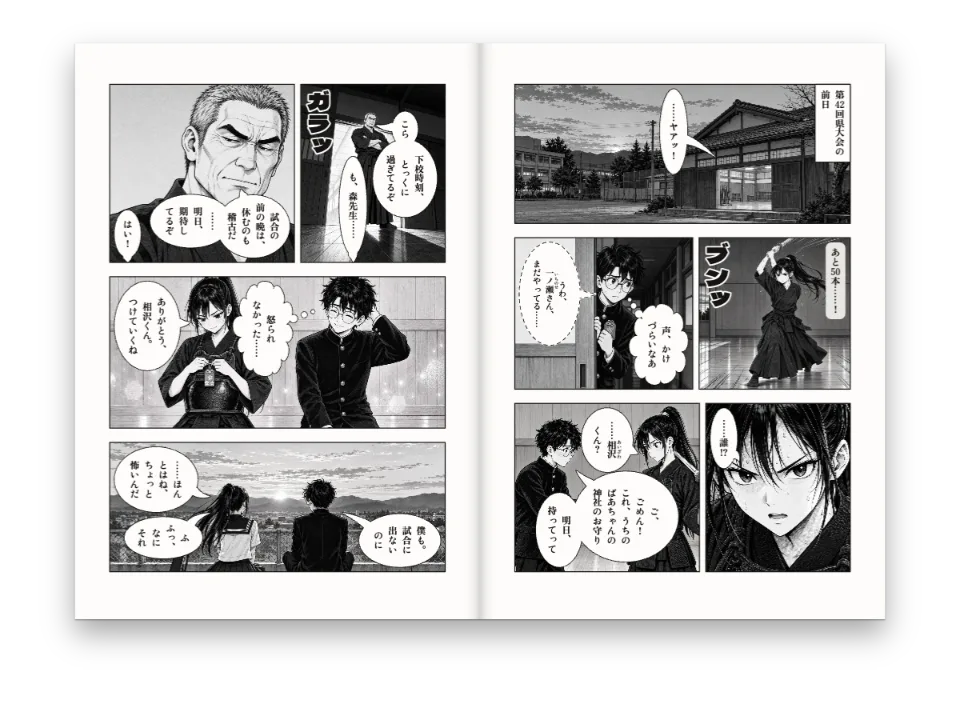
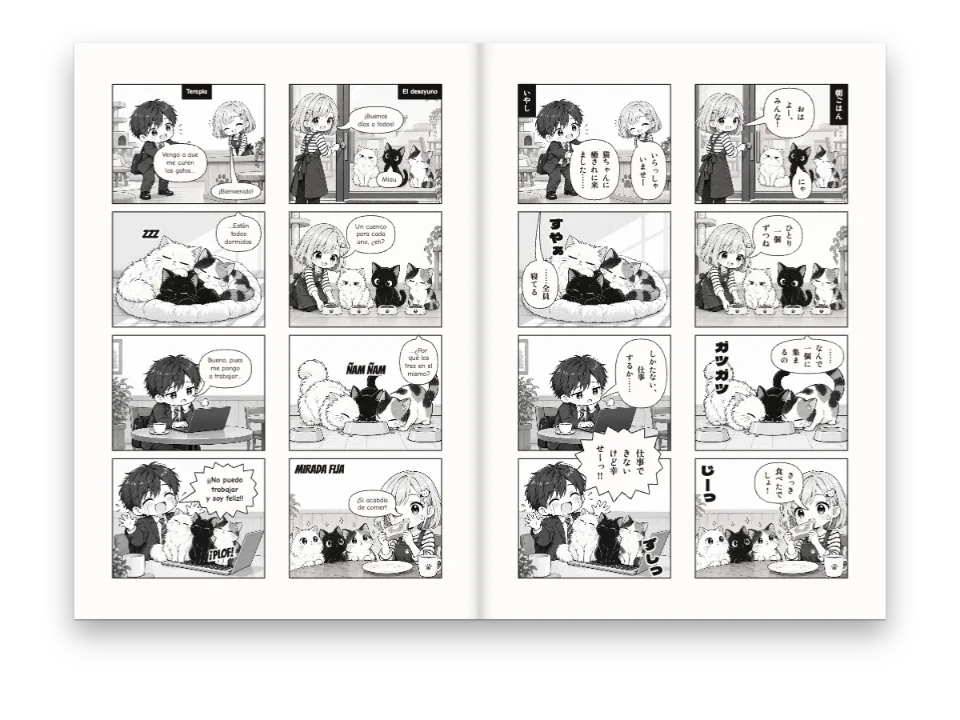
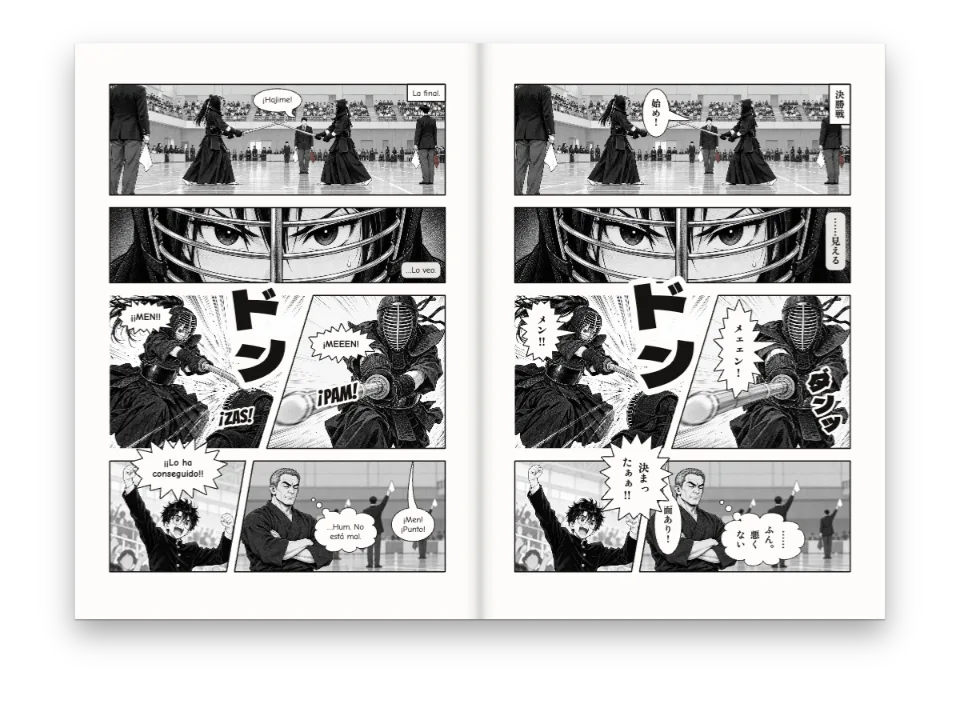
La misma página de cómic en inglés, español, francés, japonés, chino y árabe: solo cambian las palabras, y Postext redibuja cada bocadillo alrededor de ellas.
Lo que vas a componer
Una página de cómic, La radio del faro: Maya llega al faro de su abuelo cuando entra una tormenta, la radio no funciona y el culpable es Biscuit, dormido encima del cable. La división y los cinco dibujos a la acuarela son fijos; de una edición a otra solo cambia un guion de nueve líneas. Cada edición de esta receta compone su propio idioma y, al lado, la página en francés: inglés y francés, español y francés, y así con el japonés, el chino y el árabe. El motor redibuja cada bocadillo alrededor de las palabras que lleva. El japonés se rotula en columnas verticales con Zen Antique. Las páginas japonesa y árabe se leen desde la derecha, así que las tres viñetas de la tira central cambian de sitio.
Esta receta responde a
- ¿Cómo rotulo un cómic en otro idioma?
- ¿Cómo rotulo japonés en vertical dentro de los bocadillos?
La respuesta corta
const LOCALE = t({ en: 'en-gb', es: 'es', ja: 'ja', zh: 'zh-Hans', ar: 'ar' });
const comics = {
  // No fontFamily: each language is lettered in its own comic face (defaultComicFont):
  // Comic Neue, Zen Antique for Japanese, Noto Sans SC, Playpen Sans Arabic. The size is
  // one for the whole book: a longer translation grows its balloons, never shrinks its text.
  lettering: { fontSize: pt(8.5), lineHeight: 1.12, color: col('ink') },
  // writingMode 'auto' (the default): Japanese is lettered in vertical columns.
  // readingDirection 'auto': a Japanese or Arabic page reads from the right, so the
  // tier of three panels is laid out right to left from the same split. The art keeps
  // its drawn direction (mirrorArt: false).
  panel: { borderWidth: pt(1), borderColor: col('ink') },
  gutter: { horizontal: mm(4), vertical: mm(3) },
  balloonStyles: [
    { id: 'caption', fill: col('caption'), stroke: col('ink'), strokeWidth: pt(0.6) },
    { id: 'sfx', color: col('red'), halo: pt(1.4), haloColor: col('paper'), rotate: -8 },
  ],
  readingDirection: 'auto', // the default, written out: it is what an edition flips
  cast: [{ id: 'maya', name: 'Maya' }, { id: 'tomas', name: 'Tomás' }],
  runningHeads: true, // the footer prints on the comic page
};
Ingredientes
- Funciones
- Rotular en otros idiomasSentido de lectura y orden del mangaRotulación de cómicPersonajes y anclasDivisión en viñetasImagen y recorte de la viñetaPáginas de cómicEstilos de bocadilloOnomatopeyasFuentes chinas, japonesas y coreanasFuentes árabesTexto de derecha a izquierdaTexto verticalPaleta de color semánticaPáginas en un canvasExportación a PDF
- También usa
- Bordes y calles de las viñetasCabeceras según el tipo de páginaFuentes incrustadas en el PDFFiguras y tablas como recursos
- Tipografía
- Comic Neue, Bangers, Zen Antique, Dela Gothic One, Noto Sans SC, ZCOOL KuaiLe, Playpen Sans Arabic, Lalezar (SIL OFL 1.1)
- Recursos
lh-arrive.jpglh-beam.jpglh-biscuit.jpglh-maya.jpglh-radio.jpg- Una niña con chubasquero amarillo sube por un camino de la costa hacia un faro rojo y blanco, con un gato naranja gordo delante; se acercan nubes de tormenta sobre el mar. (Generated With Diffusion Models, original)
- El viejo farero, de barba blanca, jersey azul marino y gorra, golpea una radio de válvulas en la sala de la linterna, micrófono en mano; la gran lente brilla a su lado. (Generated With Diffusion Models, original)
- Primer plano de Maya, ceñuda, señalando el suelo. (Generated With Diffusion Models, original)
- Bajo la mesa, el gato naranja duerme panza arriba sobre el cable negro de la radio y lo aplasta. (Generated With Diffusion Models, original)
- De noche, el haz del faro barre un mar oscuro; Maya y su abuelo están en la galería de la linterna y, a lo lejos, un pesquero enciende sus luces. (Generated With Diffusion Models, original)
Elaboración
#1 · Una config para todos los idiomas
El código está en la respuesta corta. En la config nada nombra un idioma salvo locale. Sin fontFamily, la rotulación toma la letra de cómic del idioma del documento (defaultComicFont): Comic Neue, Zen Antique, Noto Sans SC o Playpen Sans Arabic, y la onomatopeya la letra de rótulo que le corresponde. writingMode: 'auto' pone los bocadillos japoneses en columnas verticales; readingDirection: 'auto' hace que las páginas japonesa y árabe se lean desde la derecha, como sus idiomas, de modo que el mismo split="30 / 35 [* | * | *] / *" coloca la viñeta de la radio a la derecha y la del gato a la izquierda. Los ids de los personajes (maya, tomas) son los mismos en todos los guiones, y a ellos responden los anclajes de los dibujos.
El cuerpo es uno para todo el libro. El guion inglés tiene 216 letras, el español 220, el francés 224 y el chino 74 caracteres; los guiones más largos tienen bocadillos más grandes, nunca letra más pequeña.
#2 · El francés va en todas las ediciones
const build = (md, cfg) =>
  buildWithFonts(() => buildDocument({ markdown: md, resources }, cfg), md);
const docs = [await build(markdown, config())];
// French is not a site language, so every edition carries its page: the same config
// with another locale, as a new object (the engine caches resolved configs by identity).
docs.push(await build(french, { ...config(), locale: 'fr', footer: footerFor('fr', 'fr') }));
El sitio no tiene páginas en francés, así que cada edición construye dos documentos: su propia página y luego la francesa, desde content.fr.en.md, con la misma config y locale 'fr'. La config se copia en un objeto nuevo, porque el motor guarda las configs resueltas por identidad. El guion francés lleva el espacio fino de no separación antes de ! y ?, como manda la tipografía francesa.
#3 · Los dibujos no cambian
const box = ([x, y, width, height]) => ({ x, y, width, height });
const who = (id, x, y, head, face) => ({ id, x, y,
  ...(head && { head: { x: head[0], y: head[1] } }), ...(face && { face: box(face) }) });
const ART = {
  'lh-arrive': { width: 1100, height: 733, safeArea: box([.22, .08, .4, .64]),
    alt: t({ en: 'A girl in a yellow raincoat walks up a coastal path towards a red-and-white '
        + 'lighthouse, a fat orange cat trotting ahead; storm clouds gather over the sea.',
      es: 'Una niña con chubasquero amarillo sube por un camino de costa hacia un faro '
        + 'rojo y blanco, con un gato naranja gordo trotando delante; sobre el mar se '
        + 'acumulan nubes de tormenta.',
      zh: '一个穿黄色雨衣的女孩沿着海边小路走向红白相间的灯塔,一只胖橘猫小跑在前面;海上聚起了暴风雨的乌云。',
      ar: 'فتاة بمعطف مطر أصفر تصعد دربًا ساحليًا نحو منارة حمراء وبيضاء، وأمامها قط '
        + 'برتقالي سمين يهرول، والغيوم تتجمّع فوق البحر.',
      ja: '黄色いレインコートの女の子が、赤と白の灯台へ続く海辺の小道をのぼっていく。前を太ったオレンジ色の猫が小走りし、海の上には嵐の雲が集まっている。' }),
    anchors: [
      who('maya', .29, .52, [.27, .47], [.22, .42, .12, .16]),
      who('biscuit', .4, .68, [.4, .66], [.37, .64, .07, .08]),
    ],
    avoid: [box([.51, .09, .1, .43])],
  },
  'lh-radio': { width: 1000, height: 1000, safeArea: box([.11, .36, .36, .31]),
    alt: t({ en: 'The old keeper, white-bearded in a navy sweater and cap, taps a valve radio '
        + 'in the lamp room, microphone in hand; the great lens glows beside him.',
      es: 'El viejo farero, de barba blanca, jersey azul marino y gorra, golpea una radio '
        + 'de válvulas en la sala de la lámpara con el micrófono en la mano; a su lado '
        + 'brilla la gran lente.',
      zh: '白胡子的老守塔人穿着藏青色毛衣、戴着帽子,在灯室里手握话筒敲着一台电子管收音机;巨大的透镜在他身旁发光。',
      ar: 'حارس المنارة العجوز بلحيته البيضاء وكنزته الكحلية وقبعته ينقر على مذياع قديم '
        + 'في غرفة الفانوس والميكروفون في يده، والعدسة الكبيرة تتوهّج بجانبه.',
      ja: '白いひげの老灯台守が、紺のセーターに帽子姿で、灯室でマイクを握って真空管ラジオをたたいている。そばで大きなレンズが光っている。' }),
    anchors: [
      who('tomas', .345, .52, [.38, .44], [.29, .4, .16, .18]),
    ],
    avoid: [box([0, .44, .22, .26])],
  },
  'lh-maya': { width: 1100, height: 1100, safeArea: box([.25, .27, .41, .68]),
    alt: t({ en: 'Close-up of Maya frowning at the floor and pointing down.',
      es: 'Primer plano de Maya, que frunce el ceño mirando al suelo y señala hacia abajo.',
      zh: '玛雅的特写:她皱着眉头看着地板,手指向下指。',
      ar: 'لقطة قريبة لمايا وهي تعقد حاجبيها ناظرةً إلى الأرض وتشير إلى أسفل.',
      ja: 'マヤのアップ。眉をひそめて床を見つめ、下を指さしている。' }),
    anchors: [
      who('maya', .54, .565, [.5, .3], [.4, .33, .24, .29]),
    ],
    avoid: [box([.27, .73, .25, .22])],
  },
  'lh-biscuit': { width: 1000, height: 1000, safeArea: box([.58, .25, .42, .33]),
    alt: t({ en: 'Under the desk, the fat orange cat sleeps on his back on top of the black '
        + 'radio cable, squashing it flat.',
      es: 'Bajo la mesa, el gato naranja gordo duerme panza arriba encima del cable negro '
        + 'de la radio y lo aplasta.',
      zh: '桌子底下,胖橘猫四脚朝天地睡在收音机的黑色电线上,把电线压得扁扁的。',
      ar: 'تحت المكتب ينام القط البرتقالي السمين على ظهره فوق سلك المذياع الأسود ويسحقه.',
      ja: '机の下で、太ったオレンジ色の猫がラジオの黒いコードの上にあおむけで眠り、コードをぺしゃんこにしている。' }),
    anchors: [
      who('biscuit', .72, .355, [.73, .32], [.64, .27, .2, .18]),
    ],
    avoid: [box([.93, .28, .07, .24]), box([0, .72, .4, .1])],
  },
  'lh-beam': { width: 1200, height: 800, safeArea: box([.15, .01, .25, .3]),
    alt: t({ en: 'Night: the lighthouse beam sweeps over a dark sea; Maya and her grandfather '
        + 'stand on the lantern gallery, and far out a fishing boat shows its lights.',
      es: 'De noche, el haz del faro barre un mar oscuro; Maya y su abuelo están en la '
        + 'galería de la linterna y a lo lejos se ven las luces de un pesquero.',
      zh: '夜里,灯塔的光束扫过漆黑的海面;玛雅和外公站在灯室外的回廊上,远处一艘渔船亮着灯。',
      ar: 'ليلًا يمسح شعاع المنارة بحرًا مظلمًا، ومايا وجدّها واقفان على شرفة الفانوس، '
        + 'وفي البعيد قارب صيد بأضوائه.',
      ja: '夜。灯台の光の帯が暗い海をなでる。マヤと祖父は灯室の回廊に立ち、沖には漁船の明かりが見える。' }),
    anchors: [
      who('maya', .235, .15, null, [.21, .11, .05, .07]),
      who('tomas', .3, .145, null, [.28, .11, .04, .06]),
    ],
    avoid: [box([.79, .55, .08, .09])],
  },

};
Las zonas seguras son más estrechas que las celdas de esta división: la tira central tiene tres viñetas de unos 46 mm de ancho por 80 mm de alto, así que cada dibujo cuadrado muestra una columna de cerca del 58 % de su anchura, y su zona segura, la cara del personaje y aquello de lo que habla, ocupa del 36 al 42 %. Los dibujos no se reflejan para el japonés ni para el árabe (mirrorArt sigue en false): Maya sigue subiendo el camino desde la izquierda, y solo el orden de las viñetas sigue a la lectura.
La receta completa
// ═══ Postext Cookbook · Nº 153 · One page lettered in six languages ═══════════════════ // https://postext.dev/en/cookbook/one-page-six-languages // Code: MIT · Story: written for the recipe (CC BY 4.0) · Pictures: generated with diffusion models // Fonts: Comic Neue, Bangers, the comic faces of each script (OFL) · Needs postext ≥ 1.21.0 // One comic page, its split and its five pictures fixed, lettered from a script per // language: each edition sets its own page, and the French one beside it. import { buildDocument, renderPageToCanvas, clearMeasurementCache, registerResourceImage, defaultComicFont, defaultComicSfxFont, } from 'https://esm.sh/postext'; import { renderToPdf, decompressWoff2 } from 'https://esm.sh/postext-pdf'; const LANG = 'es'; // @lang: the edition: 'en' | 'es' | 'ja' | 'zh' | 'ar' (French rides along) const RECIPE = 'one-page-six-languages'; // ─── 1 · Design ───────────────────────────────────────────────────────────── // #region palette: ink and paper, the lighthouse red for the sound effect const palette = { ink: '#1b1d22', // borders, lettering red: '#c23a2b', // the purr (4.9:1 on paper) caption: '#f3ead2', // narration boxes, the colour of old charts muted: '#5d6068', // the footer paper: '#ffffff', }; const col = (id) => ({ hex: palette[id], model: 'hex', paletteId: id }); const colorPalette = [ ...Object.entries(palette).map(([id, hex]) => ({ id, name: id, value: { hex, model: 'hex' } })), { id: 'main-color', name: 'red (defaults)', value: { hex: palette.red, model: 'hex' } }, ]; // #endregion // #region answer: one config for every language; the locale picks face, direction and columns const LOCALE = t({ en: 'en-gb', es: 'es', ja: 'ja', zh: 'zh-Hans', ar: 'ar' }); const comics = { // No fontFamily: each language is lettered in its own comic face (defaultComicFont): // Comic Neue, Zen Antique for Japanese, Noto Sans SC, Playpen Sans Arabic. The size is // one for the whole book: a longer translation grows its balloons, never shrinks its text. lettering: { fontSize: pt(8.5), lineHeight: 1.12, color: col('ink') }, // writingMode 'auto' (the default): Japanese is lettered in vertical columns. // readingDirection 'auto': a Japanese or Arabic page reads from the right, so the // tier of three panels is laid out right to left from the same split. The art keeps // its drawn direction (mirrorArt: false). panel: { borderWidth: pt(1), borderColor: col('ink') }, gutter: { horizontal: mm(4), vertical: mm(3) }, balloonStyles: [ { id: 'caption', fill: col('caption'), stroke: col('ink'), strokeWidth: pt(0.6) }, { id: 'sfx', color: col('red'), halo: pt(1.4), haloColor: col('paper'), rotate: -8 }, ], readingDirection: 'auto', // the default, written out: it is what an edition flips cast: [{ id: 'maya', name: 'Maya' }, { id: 'tomas', name: 'Tomás' }], runningHeads: true, // the footer prints on the comic page }; // #endregion const NAMES = { en: 'English', es: 'Español', ja: '日本語', zh: '中文', ar: 'العربية', fr: 'Français' }; const footerFor = (lang, locale) => ({ elements: [{ kind: 'text', id: 'edition', content: `${NAMES[lang]} · ${defaultComicFont(locale)}`, fontFamily: defaultComicFont(locale), fontSize: pt(8), color: col('muted'), align: 'center', pages: 'comic', placement: { anchor: { to: 'page', edge: 'bottom' }, offset: { y: mm(-8) } } }] }); const config = () => ({ // a factory: the engine caches resolved configs per object locale: LOCALE, colorPalette, page: { sizePreset: 'custom', width: mm(170), height: mm(260), dpi: 150, // a comic book margins: { top: mm(14), bottom: mm(18), left: mm(12), right: mm(12), mirror: true }, }, layout: { layoutType: 'single' }, bodyText: { fontFamily: defaultComicFont(LOCALE), fontSize: pt(10), lineHeight: pt(14), color: col('ink'), boldColor: col('ink'), italicColor: col('ink'), referenceColor: col('ink') }, headings: { color: col('ink'), levels: [{ level: 1, breakBefore: { enabled: true, parity: 'any' } }] }, // the H1 break comics, header: { elements: [] }, footer: footerFor(LANG, LOCALE), }); // ─── 2 · Content ──────────────────────────────────────────────────────────── const markdown = String.raw`:::page{split="30 / 35 [* | * | *] / *"}Muestra en Markdown · 13 líneas · content.es.md
::panel{art=lh-arrive} caption: Maya pasaba todos los veranos en el faro. maya: ¡Abuelo! ¡Ya estoy aquí! ::panel{art=lh-radio} tomas: Llegas a tiempo. La radio no funciona y viene tormenta. ::panel{art=lh-maya} maya: Abuelo… creo que ya sé qué le pasa. ::panel{art=lh-biscuit} sfx: rrrrrr ::panel{art=lh-beam} tomas: Radio en marcha, faro encendido. maya: Y Biscuit tiene cama nueva. :::`; // content.<lang>.md: the page in the edition's language const french = String.raw`:::page{split="30 / 35 [* | * | *] / *"}Muestra en Markdown · 13 líneas · content.fr.en.md
::panel{art=lh-arrive} caption: Maya passait tous ses étés au phare. maya: Papi ! Je suis là ! ::panel{art=lh-radio} tomas: Tu tombes bien. La radio est morte, et une tempête arrive. ::panel{art=lh-maya} maya: Papi… je crois que j’ai trouvé la panne. ::panel{art=lh-biscuit} sfx: rrrrrr ::panel{art=lh-beam} tomas: La radio marche, le phare est allumé. maya: Et Biscuit a un nouveau lit. :::`; // content.fr.en.md: the French page, in every edition // ─── 3 · Fonts ────────────────────────────────────────────────────────────── const FONTS = { 'Comic Neue': ['400', '700', '400i', '700i'], Bangers: ['400'], // Latin 'Zen Antique': ['400'], 'Dela Gothic One': ['400'], // Japanese 'Noto Sans SC': ['400', '700'], 'ZCOOL KuaiLe': ['400'], // Chinese 'Playpen Sans Arabic': ['400', '700'], Lalezar: ['400'], // Arabic }; // #region art: the panel manifest: safe areas, speakers' mouths, heads and faces, in fractions const box = ([x, y, width, height]) => ({ x, y, width, height }); const who = (id, x, y, head, face) => ({ id, x, y, ...(head && { head: { x: head[0], y: head[1] } }), ...(face && { face: box(face) }) }); const ART = { 'lh-arrive': { width: 1100, height: 733, safeArea: box([.22, .08, .4, .64]), alt: t({ en: 'A girl in a yellow raincoat walks up a coastal path towards a red-and-white ' + 'lighthouse, a fat orange cat trotting ahead; storm clouds gather over the sea.', es: 'Una niña con chubasquero amarillo sube por un camino de costa hacia un faro ' + 'rojo y blanco, con un gato naranja gordo trotando delante; sobre el mar se ' + 'acumulan nubes de tormenta.', zh: '一个穿黄色雨衣的女孩沿着海边小路走向红白相间的灯塔,一只胖橘猫小跑在前面;海上聚起了暴风雨的乌云。', ar: 'فتاة بمعطف مطر أصفر تصعد دربًا ساحليًا نحو منارة حمراء وبيضاء، وأمامها قط ' + 'برتقالي سمين يهرول، والغيوم تتجمّع فوق البحر.', ja: '黄色いレインコートの女の子が、赤と白の灯台へ続く海辺の小道をのぼっていく。前を太ったオレンジ色の猫が小走りし、海の上には嵐の雲が集まっている。' }), anchors: [ who('maya', .29, .52, [.27, .47], [.22, .42, .12, .16]), who('biscuit', .4, .68, [.4, .66], [.37, .64, .07, .08]), ], avoid: [box([.51, .09, .1, .43])], }, 'lh-radio': { width: 1000, height: 1000, safeArea: box([.11, .36, .36, .31]), alt: t({ en: 'The old keeper, white-bearded in a navy sweater and cap, taps a valve radio ' + 'in the lamp room, microphone in hand; the great lens glows beside him.', es: 'El viejo farero, de barba blanca, jersey azul marino y gorra, golpea una radio ' + 'de válvulas en la sala de la lámpara con el micrófono en la mano; a su lado ' + 'brilla la gran lente.', zh: '白胡子的老守塔人穿着藏青色毛衣、戴着帽子,在灯室里手握话筒敲着一台电子管收音机;巨大的透镜在他身旁发光。', ar: 'حارس المنارة العجوز بلحيته البيضاء وكنزته الكحلية وقبعته ينقر على مذياع قديم ' + 'في غرفة الفانوس والميكروفون في يده، والعدسة الكبيرة تتوهّج بجانبه.', ja: '白いひげの老灯台守が、紺のセーターに帽子姿で、灯室でマイクを握って真空管ラジオをたたいている。そばで大きなレンズが光っている。' }), anchors: [ who('tomas', .345, .52, [.38, .44], [.29, .4, .16, .18]), ], avoid: [box([0, .44, .22, .26])], }, 'lh-maya': { width: 1100, height: 1100, safeArea: box([.25, .27, .41, .68]), alt: t({ en: 'Close-up of Maya frowning at the floor and pointing down.', es: 'Primer plano de Maya, que frunce el ceño mirando al suelo y señala hacia abajo.', zh: '玛雅的特写:她皱着眉头看着地板,手指向下指。', ar: 'لقطة قريبة لمايا وهي تعقد حاجبيها ناظرةً إلى الأرض وتشير إلى أسفل.', ja: 'マヤのアップ。眉をひそめて床を見つめ、下を指さしている。' }), anchors: [ who('maya', .54, .565, [.5, .3], [.4, .33, .24, .29]), ], avoid: [box([.27, .73, .25, .22])], }, 'lh-biscuit': { width: 1000, height: 1000, safeArea: box([.58, .25, .42, .33]), alt: t({ en: 'Under the desk, the fat orange cat sleeps on his back on top of the black ' + 'radio cable, squashing it flat.', es: 'Bajo la mesa, el gato naranja gordo duerme panza arriba encima del cable negro ' + 'de la radio y lo aplasta.', zh: '桌子底下,胖橘猫四脚朝天地睡在收音机的黑色电线上,把电线压得扁扁的。', ar: 'تحت المكتب ينام القط البرتقالي السمين على ظهره فوق سلك المذياع الأسود ويسحقه.', ja: '机の下で、太ったオレンジ色の猫がラジオの黒いコードの上にあおむけで眠り、コードをぺしゃんこにしている。' }), anchors: [ who('biscuit', .72, .355, [.73, .32], [.64, .27, .2, .18]), ], avoid: [box([.93, .28, .07, .24]), box([0, .72, .4, .1])], }, 'lh-beam': { width: 1200, height: 800, safeArea: box([.15, .01, .25, .3]), alt: t({ en: 'Night: the lighthouse beam sweeps over a dark sea; Maya and her grandfather ' + 'stand on the lantern gallery, and far out a fishing boat shows its lights.', es: 'De noche, el haz del faro barre un mar oscuro; Maya y su abuelo están en la ' + 'galería de la linterna y a lo lejos se ven las luces de un pesquero.', zh: '夜里,灯塔的光束扫过漆黑的海面;玛雅和外公站在灯室外的回廊上,远处一艘渔船亮着灯。', ar: 'ليلًا يمسح شعاع المنارة بحرًا مظلمًا، ومايا وجدّها واقفان على شرفة الفانوس، ' + 'وفي البعيد قارب صيد بأضوائه.', ja: '夜。灯台の光の帯が暗い海をなでる。マヤと祖父は灯室の回廊に立ち、沖には漁船の明かりが見える。' }), anchors: [ who('maya', .235, .15, null, [.21, .11, .05, .07]), who('tomas', .3, .145, null, [.28, .11, .04, .06]), ], avoid: [box([.79, .55, .08, .09])], }, }; // #endregion // ─── 4 · Build & show ─────────────────────────────────────────────────────── const text = markdown + french + Object.values(NAMES).join(' '); const faces = Object.fromEntries([LOCALE, 'fr'].flatMap((l) => [defaultComicFont(l), defaultComicSfxFont(l)]).map((family) => [family, FONTS[family]])); await loadFonts(FONTS, text); // the Latin files of every face await loadCjkFonts(faces, markdown + NAMES[LANG]); await loadArabicFonts(faces, markdown + NAMES[LANG]); await loadComicFonts(faces, text); const resources = await Promise.all([ comicPanel('lh-arrive', asset('lh-arrive.jpg'), ART['lh-arrive']), comicPanel('lh-radio', asset('lh-radio.jpg'), ART['lh-radio']), comicPanel('lh-maya', asset('lh-maya.jpg'), ART['lh-maya']), comicPanel('lh-biscuit', asset('lh-biscuit.jpg'), ART['lh-biscuit']), comicPanel('lh-beam', asset('lh-beam.jpg'), ART['lh-beam']), ]); // #region editions: the edition's page, then the French one from the same config and art const build = (md, cfg) => buildWithFonts(() => buildDocument({ markdown: md, resources }, cfg), md); const docs = [await build(markdown, config())]; // French is not a site language, so every edition carries its page: the same config // with another locale, as a new object (the engine caches resolved configs by identity). docs.push(await build(french, { ...config(), locale: 'fr', footer: footerFor('fr', 'fr') })); // #endregion showBook(docs, { title: t({ en: 'One page in six languages', es: 'Una página en seis idiomas', ja: '六つの言語で写植した一ページ', zh: '用六种语言嵌字的一页漫画', ar: 'صفحة واحدة بست لغات' }) }); offerPdf(() => renderToPdf(docs[0], { fontProvider: comicPdfProvider, resourceBytes: imageBytes }), `${RECIPE}-${LANG}.pdf`);Kit · core, fonts, viewer, pdf, images, cjk, arabic, comics: igual en todas las recetas · 722 líneas
// ─── Kit ── helpers shared by every Cookbook recipe · postext.dev/cookbook ───── // ─── Kit · core v1 ── the same in every recipe · postext.dev/cookbook function mm(value) { return { value, unit: 'mm' }; } function pt(value) { return { value, unit: 'pt' }; } function em(value) { return { value, unit: 'em' }; } /** The sample language's string: t({ en: 'Figure', es: 'Figura' }). */ function t(strings) { return strings[LANG] ?? Object.values(strings)[0]; } /** A file in this recipe's assets folder, served from the Postext repo by jsDelivr. */ function asset(file) { return `https://cdn.jsdelivr.net/gh/drnachio/postext@main/cookbook/${RECIPE}/assets/${file}`; } // ─── Kit · fonts v2 ── the same in every recipe · postext.dev/cookbook // Postext measures with the loaded faces and caches the widths: load every face // before the first build, from Fontsource, the files the PDF embeds too. /** faces = { 'Family Name': ['400', '400i', '700'] }. `text` is the sample: * č ł † α χ also load latin-ext and greek files (kitSubsetsFor). With * `optional`, a face Fontsource does not ship is skipped instead of failing. * Resolves to the number of faces added. */ async function loadFonts(faces, text = '', { optional = false } = {}) { kitStatus('Loading fonts…'); const ranges = { latin: 'U+0000-00FF,U+0131,U+0152-0153,U+02BB-02BC,U+02C6,U+02DA,U+02DC,U+0304,U+0308,U+0329,' + 'U+2000-206F,U+20AC,U+2122,U+2191,U+2193,U+2212,U+2215,U+FEFF,U+FFFD', 'latin-ext': 'U+0100-02BA,U+02BD-02C5,U+02C7-02CC,U+02CE-02D7,U+02DD-02FF,U+0304,U+0308,U+0329,' + 'U+1D00-1DBF,U+1E00-1E9F,U+1EF2-1EFF,U+2020,U+20A0-20AB,U+20AD-20C0,U+2113,U+2C60-2C7F,U+A720-A7FF', greek: 'U+0370-03FF', }; const jobs = []; let added = 0; for (const [family, specs] of Object.entries(faces)) { const id = fontsourceId(family); const todo = [...new Set(specs)].map((spec) => [parseInt(spec, 10), spec.endsWith('i') ? 'italic' : 'normal']) .filter(([weight, style]) => !hasFace(family, weight, style)); // before any await const meta = optional || /[^\0-ÿ]/u.test(text) ? await fontsourceMeta(family) : null; const subsets = ['latin', ...kitSubsetsFor(text, meta)]; for (const [weight, style] of todo) { if (optional && !(meta?.weights.includes(weight) && meta.styles.includes(style))) continue; for (const subset of subsets) { const url = `https://cdn.jsdelivr.net/npm/@fontsource/${id}@5/files/${id}-${subset}-${weight}-${style}.woff2`; const face = new FontFace(family, `url(${url}) format('woff2')`, { weight: String(weight), style, unicodeRange: ranges[subset] }); jobs.push(face.load().then((ready) => { document.fonts.add(ready); added++; }, () => { if (subset === 'latin' && !optional) throw new Error(`Fontsource has no ${family} ${weight} ${style}`); })); } } } await Promise.all(jobs).catch((error) => { kitFail(error); throw error; }); return added; } /** Runs `build` and loads any face the pages use that FONTS missed (a regular * one with a warning), then clears the measurement cache and builds again. */ async function buildWithFonts(build, text = '') { const tried = new Set(); for (let round = 0; round < 3; round++) { kitStatus('Laying out…'); await new Promise(requestAnimationFrame); // let the status paint first const result = await Promise.resolve().then(build).catch((error) => { kitFail(error); throw error; }); const wanted = { base: {}, variants: {} }; for (const { font, base } of [result].flat().flatMap(fontStringsOf)) { const { family, weight, style } = parseFont(font); const key = `${family}|${weight}|${style}`; if (tried.has(key) || hasFace(family, weight, style)) continue; tried.add(key); (wanted[base ? 'base' : 'variants'][family] ??= []).push(`${weight}${style === 'italic' ? 'i' : ''}`); } if (Object.keys(wanted.base).length) { console.warn(`[cookbook] FONTS does not list ${JSON.stringify(wanted.base)}: loading them.`); } const added = await loadFonts(wanted.base, text) + await loadFonts(wanted.variants, text, { optional: true }); if (added === 0) return result; clearMeasurementCache(); } throw new Error('The fonts did not settle after three builds.'); } /** Every font string of the layout; `base` marks a block's own face. */ function fontStringsOf(doc) { const found = new Map(); const walk = (node) => { if (!node || typeof node !== 'object') return; if (Array.isArray(node)) { node.forEach(walk); return; } for (const [key, value] of Object.entries(node)) { if (typeof value === 'string' && /fontString$/i.test(key)) { found.set(value, found.get(value) || key === 'fontString'); } else if (value && typeof value === 'object') walk(value); } }; walk(doc.pages); walk(doc.blocks); return [...found].map(([font, base]) => ({ font, base })); } /** '700 37.5px Open Sans' / 'italic 400 13px "Source Serif 4"' → { family, weight, style }. * A string with no weight ('95.8px Young Serif', from a design text) is 400. */ function parseFont(font) { const m = /^(?:(italic|oblique)\s+)?(?:small-caps\s+)?(?:(\d+|bold|normal)\s+)?[\d.]+px\s+(.+)$/.exec(font.trim()); if (!m) throw new Error(`Unexpected font string: ${font}`); const weight = m[2] === 'bold' ? 700 : !m[2] || m[2] === 'normal' ? 400 : Number(m[2]); return { family: m[3].replace(/^["']|["']$/g, ''), weight, style: m[1] ? 'italic' : 'normal' }; } /** A loaded FontFace covers this family, weight and style (fonts.check() would * also say yes for families nobody declared). */ function hasFace(family, weight, style) { for (const face of document.fonts) { if (face.status !== 'loaded' || face.style !== style) continue; if (face.family.replace(/^["']|["']$/g, '') !== family) continue; const [low, high = low] = face.weight.split(' ').map(Number); if (weight >= low && weight <= high) return true; } return false; } /** The files beyond latin `text` needs that `meta`'s family ships. */ function kitSubsetsFor(text, meta) { return [[/[Ā-˿ᴀ-ᶿḀ-ỿ†ℓⱠ-Ɀ꜠-ꟿ]/u, 'latin-ext'], [/[Ͱ-Ͽ]/u, 'greek']] .filter(([re, x]) => re.test(text) && meta?.subsets?.includes(x)).map(([, x]) => x); } /** Fontsource's id for a family: 'Source Serif 4' → 'source-serif-4'. */ function fontsourceId(family) { return family.toLowerCase().replace(/\s+/g, '-'); } /** The family's Fontsource metadata (weights, styles, subsets), or null. */ function fontsourceMeta(family) { fontsourceMeta.cache ??= new Map(); const id = fontsourceId(family); if (!fontsourceMeta.cache.has(id)) { fontsourceMeta.cache.set(id, fetch(`https://api.fontsource.org/v1/fonts/${id}`) .then((res) => (res.ok ? res.json() : null), () => null)); } return fontsourceMeta.cache.get(id); } // ─── Kit · viewer v1 ── the same in every recipe · postext.dev/cookbook /** The pages as spreads on a dark desk, page 1 alone, then verso | recto, * each painted when it scrolls near. */ function showPages(docs, { title, width = 460 } = {}) { const root = viewer(title); const pages = [docs].flat().flatMap((doc) => doc.pages.map((page) => ({ doc, page, n: (doc.pageIndexOffset ?? 0) + page.index }))); const spreads = []; let verso = null; for (const p of pages) { if (p.n % 2 === 1) { if (verso) spreads.push([verso, null]); verso = p; } else { spreads.push([verso, p]); verso = null; } } if (verso) spreads.push([verso, null]); const density = Math.min(window.devicePixelRatio || 1, 2); showPages.painter?.disconnect(); const painter = new IntersectionObserver((entries) => { for (const { isIntersecting, target } of entries) { if (!isIntersecting) continue; painter.unobserve(target); const { doc, page } = target.postext; renderPageToCanvas(page, doc, target, { scale: (width * density) / page.width }); } }, { rootMargin: '800px' }); showPages.painter = painter; root.replaceChildren(...spreads.map((pair) => { const spread = document.createElement('div'); spread.className = 'pt-spread'; for (const p of pair) { const figure = document.createElement('figure'); if (p) { const label = p.page.pageLabel || String(p.n + 1); const canvas = document.createElement('canvas'); canvas.postext = p; canvas.style.aspectRatio = `${p.page.width} / ${p.page.height}`; canvas.setAttribute('role', 'img'); canvas.setAttribute('aria-label', `Page ${label}`); const folio = document.createElement('figcaption'); folio.textContent = label; figure.append(canvas, folio); painter.observe(canvas); } else figure.className = 'pt-blank'; spread.append(figure); } return spread; })); kitStatus(`${pages.length} ${pages.length === 1 ? 'page' : 'pages'}`); document.documentElement.dataset.postext = 'ready'; return pages.length; } /** The desk, the bar and the error reporting, created once. */ function viewer(title) { if (!document.getElementById('pt-kit')) { document.head.insertAdjacentHTML('beforeend', `<style id="pt-kit"> :root { color-scheme: dark; } body { margin: 0; background: #0e1014; color: #b9bcc4; font: 13px/1.45 system-ui, sans-serif; } #pt-bar { position: sticky; top: 0; z-index: 1; display: flex; flex-wrap: wrap; align-items: center; gap: 6px 16px; padding: 10px 16px; background: rgb(14 16 20 / .92); backdrop-filter: blur(6px); border-bottom: 1px solid #23262d; } #pt-bar strong { color: #f4f1ea; font-weight: 600; } #pt-actions { display: flex; gap: 12px; margin-left: auto; } #pt-actions a, #pt-actions button { color: #d8a21a; font: inherit; background: none; border: 0; padding: 0; cursor: pointer; } #pages { display: grid; justify-items: center; gap: 48px; padding: 32px 16px 72px; } .pt-spread { display: flex; } .pt-spread figure { margin: 0; width: min(460px, 44vw); } .pt-spread canvas { display: block; width: 100%; background: #fff; box-shadow: 0 1px 2px rgb(0 0 0 / .5), 0 22px 44px -16px rgb(0 0 0 / .8); } .pt-spread figure:first-child canvas { box-shadow: inset -14px 0 14px -14px rgb(0 0 0 / .18), 0 1px 2px rgb(0 0 0 / .5), 0 22px 44px -16px rgb(0 0 0 / .8); } .pt-spread figcaption { margin-top: 10px; text-align: center; font: 600 10px/1 system-ui, sans-serif; letter-spacing: .18em; text-transform: uppercase; color: #6c7079; } .pt-blank { visibility: hidden; } @media (max-width: 760px) { .pt-spread { flex-direction: column; gap: 32px; } .pt-spread figure { width: min(460px, 92vw); } .pt-blank { display: none; } } </style>`); document.body.insertAdjacentHTML('afterbegin', '<header id="pt-bar"><strong id="pt-title"></strong><span id="pt-status" role="status"></span><span id="pt-actions"></span></header>'); document.getElementById('pt-title').textContent = document.title || 'Postext'; addEventListener('error', (event) => kitFail(event.error ?? event.message)); addEventListener('unhandledrejection', (event) => kitFail(event.reason)); } if (title) document.getElementById('pt-title').textContent = title; return document.getElementById('pages') ?? document.body.appendChild(Object.assign(document.createElement('main'), { id: 'pages' })); } function kitStatus(text) { viewer(); document.getElementById('pt-status').textContent = text; } function kitFail(error) { document.documentElement.dataset.postext = 'error'; kitStatus(`Error: ${error?.message ?? error}`); } // ─── Kit · pdf v2 ── the same in every recipe that exports a PDF /** The Fontsource files the screen used, as TrueType: the nearest weight the * family ships, upright if it has no italic; latin, then what the face's * letters need (kitSubsetsFor). */ async function fontsourceProvider(family, weight, style, request) { const id = fontsourceId(family); const meta = await fontsourceMeta(family); const weights = meta?.weights?.length ? meta.weights : [400, 700]; const w = weights.reduce((a, b) => (Math.abs(b - weight) < Math.abs(a - weight) ? b : a)); const s = style === 'italic' && meta && !meta.styles.includes('italic') ? 'normal' : style; const text = String.fromCodePoint(...(request?.codePoints ?? [])); const more = kitSubsetsFor(text, meta); const files = await Promise.all(['latin', ...more].map(async (subset) => { const res = await fetch(`https://cdn.jsdelivr.net/npm/@fontsource/${id}@5/files/${id}-${subset}-${w}-${s}.woff2`); if (!res.ok) throw new Error(`Fontsource has no ${family} ${w} ${s} ${subset}`); return decompressWoff2(new Uint8Array(await res.arrayBuffer())); })); return files.length === 1 ? files[0] : files; } /** A "Build the PDF" button; then "Open the PDF" (a new tab: CodePen's frame * shows no PDFs) and a download link. */ function offerPdf(makePdf, filename) { viewer(); const button = Object.assign(document.createElement('button'), { type: 'button', textContent: 'Build the PDF' }); button.dataset.postextPdf = filename; button.addEventListener('click', async () => { button.disabled = true; button.textContent = 'Building the PDF…'; try { const bytes = await makePdf(); const url = URL.createObjectURL(new Blob([bytes], { type: 'application/pdf' })); const size = `${Math.max(1, Math.round(bytes.length / 1024))} KB`; button.replaceWith( Object.assign(document.createElement('a'), { href: url, target: '_blank', rel: 'noopener', textContent: 'Open the PDF ↗' }), Object.assign(document.createElement('a'), { href: url, download: filename, textContent: `Download ${filename} · ${size}` })); } catch (error) { button.disabled = false; button.textContent = 'Build the PDF'; kitFail(error); } }); document.getElementById('pt-actions').append(button); } // ─── Kit · images v1 ── recipes with pictures · postext.dev/cookbook /** Registers a photo or PNG for the canvas and keeps its bytes for the PDF. * fetch → ImageBitmap never taints the canvas (a plain cross-origin <img> would). */ async function loadImage(fileId, url) { const res = await fetch(url); if (!res.ok) throw new Error(`Image not found (${res.status}): ${url}`); const bytes = new Uint8Array(await res.arrayBuffer()); registerResourceImage(fileId, await createImageBitmap(new Blob([bytes]))); (loadImage.bytes ??= new Map()).set(fileId, bytes); } /** Registers SVG markup (drawn in code, or fetched) as a vector image. */ async function loadSvg(fileId, svg) { const img = new Image(); img.src = `data:image/svg+xml;charset=utf-8,${encodeURIComponent(svg)}`; await img.decode(); registerResourceImage(fileId, img); (loadImage.bytes ??= new Map()).set(fileId, new TextEncoder().encode(svg)); } /** renderToPdf({ resourceBytes: imageBytes }) */ function imageBytes(fileId) { return loadImage.bytes?.get(fileId); } /** renderToHtml({ resourceImageUrl: imageUrl }) */ function imageUrl(fileId) { const bytes = imageBytes(fileId); if (!bytes) return undefined; imageUrl.urls ??= new Map(); if (!imageUrl.urls.has(fileId)) { const type = /\.svg$/i.test(fileId) ? 'image/svg+xml' : /\.png$/i.test(fileId) ? 'image/png' : 'image/jpeg'; imageUrl.urls.set(fileId, URL.createObjectURL(new Blob([bytes], { type }))); } return imageUrl.urls.get(fileId); } // ─── Kit · cjk v1 ── Chinese, Japanese and Korean books · postext.dev/cookbook // Fontsource ships a CJK family as about a hundred files per weight, each // declared in its stylesheet with the unicode-range it covers. The screen // loads the files the sample touches; the PDF gets the same files for the // characters its pages set in each face, and embeds each as a subset. // A book bound on the right (vertical text) is shown with its spreads // mirrored: page 1 alone on the left of the spine, then [3 | 2]. /** The files of a Fontsource face, read from its stylesheet: { url, range, * ranges }, the last declared first (the order the browser tries them in). */ function cjkSlices(family, weight, style) { cjkSlices.cache ??= new Map(); const id = fontsourceId(family); const css = `https://cdn.jsdelivr.net/npm/@fontsource/${id}@5/${weight}${style === 'italic' ? '-italic' : ''}.css`; if (!cjkSlices.cache.has(css)) { cjkSlices.cache.set(css, fetch(css) .then((res) => { if (!res.ok) throw new Error(`Fontsource has no ${family} ${weight} ${style} (${res.status})`); return res.text(); }) .then((text) => [...text.matchAll(/@font-face\s*{([^}]*)}/g)].map(([, rule]) => { const range = /unicode-range:\s*([^;]+);/.exec(rule)?.[1].trim() ?? 'U+0-10FFFF'; const ranges = range.split(',').map((part) => { const [lo, hi = lo] = part.trim().slice(2).split('-'); return [parseInt(lo, 16), parseInt(hi, 16)]; }); return { url: new URL(/url\(([^)]+?\.woff2)\)/.exec(rule)[1], css).href, range, ranges }; }).reverse())); } return cjkSlices.cache.get(css); } /** The file of `slices` that holds code point `cp`, if any. */ function cjkSliceFor(slices, cp) { return slices.find((slice) => slice.ranges.some(([lo, hi]) => cp >= lo && cp <= hi)); } /** Whether Fontsource serves `family` as a Chinese, Japanese or Korean * family (its subsets name the script). Fails when the API does not * answer: a CJK face taken for a Latin one would paint in a system face. */ async function isCjkFamily(family) { const meta = await fontsourceMeta(family); if (!meta) throw new Error(`api.fontsource.org did not describe ${family}: reload to try again`); return !!meta.subsets?.some((subset) => /^(chinese|japanese|korean)/.test(subset)); } /** faces = { 'Noto Serif TC': ['400', '700'] }, as for loadFonts: the * whole FONTS object may be passed, its other families are left to * loadFonts. Adds one FontFace per file of each CJK face with its * unicodeRange, then loads the files `text` touches. `text` is what the * faces set: the sample for the text face; a book in several voices calls * it once per voice (loadCjkFonts({ 'LXGW WenKai TC': ['400'] }, quotes)), * so the heading and quotation faces fetch and check only their own * characters. Fails when a character of `text` is in no file of a face. * List every weight the pages use: a weight left to buildWithFonts gets * the latin file only. With { vertical: true } it also loads each * family's vertical forms (brackets, quotes, pause marks) for the canvas, * which needs loadVerticalAlternates imported from postext. Resolves to * the number of files loaded. */ async function loadCjkFonts(faces, text, { vertical = false } = {}) { kitStatus('Loading fonts…'); let loaded = 0; try { if (vertical && typeof loadVerticalAlternates !== 'function') { throw new Error('loadCjkFonts(…, { vertical: true }) needs loadVerticalAlternates imported from postext'); } for (const [family, specs] of Object.entries(faces)) { if (!(await isCjkFamily(family))) continue; const twin = []; for (const spec of new Set(specs)) { const weight = parseInt(spec, 10); const style = spec.endsWith('i') ? 'italic' : 'normal'; const slices = await cjkSlices(family, weight, style); const missing = [...new Set(text)].filter((ch) => /\S/.test(ch) && !cjkSliceFor(slices, ch.codePointAt(0))); if (missing.length) { throw new Error(`${family} ${spec} has no file for ${missing.slice(0, 12).join(' ')}: ` + `give each face the text it sets (loadCjkFonts({ '${family}': ['${spec}'] }, text))`); } for (const slice of slices) { document.fonts.add(new FontFace(family, `url(${slice.url}) format('woff2')`, { weight: String(weight), style, unicodeRange: slice.range })); twin.push({ source: slice.url, weight: String(weight), style, unicodeRange: slice.range }); } const font = `${style === 'italic' ? 'italic ' : ''}${weight} 16px "${family}"`; loaded += (await document.fonts.load(font, text)).length; if (!document.fonts.check(font, text)) throw new Error(`${family} ${spec} did not load for the sample`); } // The same files under a twin name with the `vert` feature on: the // canvas paints the punctuation of vertical lines with it. if (vertical && twin.length) await loadVerticalAlternates(family, twin); } } catch (error) { kitFail(error); throw error; } return loaded; } /** The PDF font provider for recipes with CJK faces: a family whose * Fontsource subsets are Chinese, Japanese or Korean gets the files that * hold the characters its pages set (`request.codePoints`); any other * family gets the latin file fontsourceProvider fetches (the "pdf" block) * and, when the face sets letters only latin-ext has, that file too. */ async function cjkPdfProvider(family, weight, style, request) { if (!(await isCjkFamily(family))) return cjkLatinPdfFiles(family, weight, style, request); const meta = await fontsourceMeta(family); const weights = meta.weights?.length ? meta.weights : [400, 700]; const w = weights.reduce((a, b) => (Math.abs(b - weight) < Math.abs(a - weight) ? b : a)); const s = style === 'italic' && !meta.styles.includes('italic') ? 'normal' : style; const slices = await cjkSlices(family, w, s); const picked = new Set(); for (const cp of request?.codePoints ?? []) { const slice = cjkSliceFor(slices, cp); if (slice) picked.add(slice); } if (!picked.size) picked.add(slices[0]); return Promise.all(slices.filter((slice) => picked.has(slice)).map(async (slice) => { const res = await fetch(slice.url); if (!res.ok) throw new Error(`Fontsource file ${slice.url} (${res.status})`); return decompressWoff2(new Uint8Array(await res.arrayBuffer())); })); } /** A Latin family set next to the CJK faces: its latin file, then its * latin-ext file when the face sets letters only latin-ext has (ō ū in * Hepburn rōmaji, ǎ in pinyin), the file loadFonts adds on screen for * them. Latin comes first: postext-pdf draws a character from the first * file that has it, as the browser takes a character both files hold from * latin. A face Fontsource ships without latin-ext, or whose file does * not come, gets latin alone, and the PDF names the letters it lacks. */ async function cjkLatinPdfFiles(family, weight, style, request) { const meta = await fontsourceMeta(family); const beyond = [...(request?.codePoints ?? [])].some(cjkLatinExtOnly); if (!beyond || !meta?.subsets?.includes('latin-ext')) return fontsourceProvider(family, weight, style); const weights = meta.weights?.length ? meta.weights : [400, 700]; const w = weights.reduce((a, b) => (Math.abs(b - weight) < Math.abs(a - weight) ? b : a)); const s = style === 'italic' && !meta.styles.includes('italic') ? 'normal' : style; const id = fontsourceId(family); const url = `https://cdn.jsdelivr.net/npm/@fontsource/${id}@5/files/${id}-latin-ext-${w}-${s}.woff2`; const [latin, ext] = await Promise.all([fontsourceProvider(family, weight, style), fetch(url) .then(async (res) => (res.ok ? decompressWoff2(new Uint8Array(await res.arrayBuffer())) : null), () => null)]); return ext ? [latin, ext] : latin; } /** Whether code point `cp` is in Fontsource's latin-ext file and not in * its latin file: Latin Extended-A and -B, IPA, the spacing modifiers and * Latin Extended Additional (loadFonts's test for latin-ext), less the * few latin holds too (ı Œ œ ʻ ʼ ˆ ˚ ˜). */ function cjkLatinExtOnly(cp) { if (!((cp >= 0x100 && cp <= 0x2ff) || (cp >= 0x1e00 && cp <= 0x1eff))) return false; return ![0x131, 0x152, 0x153, 0x2bb, 0x2bc, 0x2c6, 0x2da, 0x2dc].includes(cp); } /** showPages for a book bound on either edge. A right-bound book (the * document says so: doc.binding is 'right' for page.binding 'right' and * for vertical text) lies on the desk as it opens: page 1 alone on the * left of the spine, then [3 | 2], the spine shade on each page's inner * edge. `binding` ('left' | 'right') overrides the document's. */ function showBook(docs, { binding, ...options } = {}) { const count = showPages(docs, options); const right = (binding ?? [docs].flat()[0]?.binding) === 'right'; if (!document.getElementById('pt-kit-cjk')) { // The pages keep direction ltr: a canvas draws text in the direction its // element inherits, and under rtl each run would end where the engine // starts it, its brackets mirrored. document.head.insertAdjacentHTML('beforeend', `<style id="pt-kit-cjk"> .pt-spread[dir="rtl"] canvas { direction: ltr; } .pt-spread[dir="rtl"] figure:first-child canvas { box-shadow: inset 14px 0 14px -14px rgb(0 0 0 / .18), 0 1px 2px rgb(0 0 0 / .5), 0 22px 44px -16px rgb(0 0 0 / .8); } </style>`); } // Each pair stays [verso, recto] in the page; right to left, the verso // sits on the right. Phones stack the pages in reading order either way. for (const spread of document.querySelectorAll('#pages > .pt-spread')) spread.dir = right ? 'rtl' : 'ltr'; document.getElementById('pages').dataset.binding = right ? 'right' : 'left'; return count; } // ─── Kit · arabic v1 ── Arabic-script faces · postext.dev/cookbook // Fontsource ships an Arabic family as one file per subset and weight: the // `arabic` file holds the letters, the harakat, the Arabic-Indic digits, the // Arabic punctuation and the presentation forms; `latin` and `latin-ext` // hold the rest. loadFonts loads the latin files; this block adds the arabic // file of every Arabic family, for the canvas and for the PDF, which shapes // the letters with HarfBuzz from the same bytes. /** The code points of Fontsource's `arabic` subset, as its stylesheets * declare them (the same unicode-range the browser picks the file by). A * function, not a const: the kit is inlined after the recipe's top-level * awaits, and a const read before its line throws, where a function * declaration is hoisted. */ function arabicRange() { return 'U+0600-06FF,U+0750-077F,U+0870-088E,U+0890-0891,U+0897-08E1,U+08E3-08FF,' + 'U+200C-200E,U+2010-2011,U+204F,U+2E41,U+FB50-FDFF,U+FE70-FE74,U+FE76-FEFC,U+102E0-102FB,' + 'U+10E60-10E7E,U+10EC2-10EC4,U+10EFC-10EFF,U+1EE00-1EEFF'; } /** Whether code point `cp` is in the arabic file. */ function inArabicRange(cp) { inArabicRange.ranges ??= arabicRange().split(',').map((part) => { const [lo, hi = lo] = part.slice(2).split('-'); return [parseInt(lo, 16), parseInt(hi, 16)]; }); return inArabicRange.ranges.some(([lo, hi]) => cp >= lo && cp <= hi); } /** Whether Fontsource serves `family` with an `arabic` subset. Fails when * the API does not answer: an Arabic face taken for a Latin one would set * its letters in a system face. */ async function isArabicFamily(family) { const meta = await fontsourceMeta(family); if (!meta) throw new Error(`api.fontsource.org did not describe ${family}: reload to try again`); return !!meta.subsets?.includes('arabic'); } /** The arabic file of a face. */ function arabicFileUrl(family, weight, style) { const id = fontsourceId(family); return `https://cdn.jsdelivr.net/npm/@fontsource/${id}@5/files/${id}-arabic-${weight}-${style}.woff2`; } /** faces = { Amiri: ['400', '700'] }, as for loadFonts, after it: the whole * FONTS object may be passed, its families without an arabic subset are * left alone. Adds the arabic file of every listed weight of each Arabic * family (the latin files come from loadFonts) and loads it. `text` is * the sample: fails when it holds an Arabic-script character the arabic * file does not cover. List every weight the pages set in Arabic: a weight * left to buildWithFonts gets the latin file only, and its Arabic letters * fall back to a system face. Resolves to the number of files loaded. */ async function loadArabicFonts(faces, text = '') { kitStatus('Loading fonts…'); let loaded = 0; try { const outside = [...new Set(text)].filter((ch) => /\p{Script=Arabic}/u.test(ch) && !inArabicRange(ch.codePointAt(0))); if (outside.length) throw new Error(`Fontsource's arabic files have no ${outside.slice(0, 12).join(' ')}`); for (const [family, specs] of Object.entries(faces)) { if (!(await isArabicFamily(family))) continue; for (const spec of new Set(specs)) { const weight = parseInt(spec, 10); const style = spec.endsWith('i') ? 'italic' : 'normal'; const face = new FontFace(family, `url(${arabicFileUrl(family, weight, style)}) format('woff2')`, { weight: String(weight), style, unicodeRange: arabicRange() }); document.fonts.add(await face.load().catch(() => { throw new Error(`Fontsource has no arabic file for ${family} ${weight} ${style}`); })); loaded++; } } } catch (error) { kitFail(error); throw error; } return loaded; } /** The PDF font provider for recipes with Arabic faces: a family with an * arabic subset gets its arabic file when its pages set Arabic letters * (`request.codePoints`), then its latin file, and its latin-ext file for * the letters beyond latin (transliteration: ā ḥ ʿ). The arabic file comes * first: it also holds the space and the brackets, so a line of Arabic is * shaped as one run and not cut at every space. Any other family goes to * fontsourceProvider (the "pdf" block). */ async function arabicPdfProvider(family, weight, style, request) { if (!(await isArabicFamily(family))) return fontsourceProvider(family, weight, style, request); const meta = await fontsourceMeta(family); const weights = meta.weights?.length ? meta.weights : [400, 700]; const w = weights.reduce((a, b) => (Math.abs(b - weight) < Math.abs(a - weight) ? b : a)); const s = style === 'italic' && !meta.styles.includes('italic') ? 'normal' : style; const wanted = [...(request?.codePoints ?? [])]; const id = fontsourceId(family); const urls = []; if (!wanted.length || wanted.some(inArabicRange)) urls.push(arabicFileUrl(family, w, s)); urls.push(`https://cdn.jsdelivr.net/npm/@fontsource/${id}@5/files/${id}-latin-${w}-${s}.woff2`); if (meta.subsets.includes('latin-ext') && wanted.some((cp) => /[Ā-˿Ḁ-ỿ]/u.test(String.fromCodePoint(cp)))) { urls.push(`https://cdn.jsdelivr.net/npm/@fontsource/${id}@5/files/${id}-latin-ext-${w}-${s}.woff2`); } return Promise.all(urls.map(async (url) => { const res = await fetch(url); if (!res.ok) throw new Error(`Fontsource file ${url} (${res.status})`); return decompressWoff2(new Uint8Array(await res.arrayBuffer())); })); } // ─── Kit · comics v1 ── comic pages · postext.dev/cookbook // The engine letters a comic in a face per language (defaultComicFont: // Comic Neue, Zen Antique for Japanese, Noto Sans SC, LXGW WenKai TC, // Playpen Sans Arabic; defaultComicSfxFont: Bangers, Dela Gothic One, // ZCOOL KuaiLe, Lalezar) and asks for the bold of a shout or a sound effect // and the italic of an inner voice. Most of these faces ship one weight and // no italic: this block declares the file Fontsource does ship for those // variants, so the canvas measures and paints the letters the PDF embeds // (the providers snap to the shipped file) and not a bold or a slant the // browser makes up. It also turns the art manifest into panel resources. /** faces = { 'Comic Neue': ['400', '700'], Bangers: ['400'] }, as for * loadFonts, after it (and after loadCjkFonts or loadArabicFonts for the * faces of those scripts); the whole FONTS object may be passed. List in * FONTS only what Fontsource ships (Bangers: ['400']): loadFonts fails on * the rest. For each family, the regular, bold, italic and bold italic it * lacks are declared with its nearest file (the regular for the bold, the * upright for the italic) and loaded for `text`. A CJK face needs the cjk * block; an Arabic face setting Arabic, the arabic block. Resolves to the * number of variants added. */ async function loadComicFonts(faces, text = '') { kitStatus('Loading fonts…'); let added = 0; try { for (const family of Object.keys(faces)) { const meta = await fontsourceMeta(family); if (!meta) throw new Error(`api.fontsource.org did not describe ${family}: reload to try again`); const weights = meta.weights?.length ? meta.weights : [400, 700]; const styles = meta.styles?.length ? meta.styles : ['normal']; for (const [weight, style] of [[400, 'normal'], [700, 'normal'], [400, 'italic'], [700, 'italic']]) { if ((weights.includes(weight) && styles.includes(style)) || hasFace(family, weight, style)) continue; const w = weights.reduce((a, b) => (Math.abs(b - weight) < Math.abs(a - weight) ? b : a)); const s = style === 'italic' && styles.includes('italic') ? 'italic' : 'normal'; for (const { url, range } of await comicFaceFiles(family, w, s, meta, text)) { document.fonts.add(new FontFace(family, `url(${url}) format('woff2')`, { weight: String(weight), style, unicodeRange: range })); } await document.fonts.load(`${style === 'italic' ? 'italic ' : ''}${weight} 16px "${family}"`, text || 'A'); added++; } } } catch (error) { kitFail(error); throw error; } return added; } /** The files of a shipped face ({ url, range }): a CJK face's slices (the * cjk block reads them from its stylesheet), else latin, the latin-ext * and greek files `text` needs, and the arabic file when `text` holds * Arabic. */ async function comicFaceFiles(family, weight, style, meta, text) { if (meta.subsets?.some((subset) => /^(chinese|japanese|korean)/.test(subset))) { if (typeof cjkSlices !== 'function') throw new Error(`${family} is a CJK face: list the cjk kit block`); return (await cjkSlices(family, weight, style)).map(({ url, range }) => ({ url, range })); } const id = fontsourceId(family); const file = (subset) => `https://cdn.jsdelivr.net/npm/@fontsource/${id}@5/files/${id}-${subset}-${weight}-${style}.woff2`; const files = ['latin', ...kitSubsetsFor(text, meta)].map((subset) => ({ url: file(subset), range: comicRange(subset) })); if (meta.subsets?.includes('arabic') && /\p{Script=Arabic}/u.test(text)) { if (typeof arabicRange !== 'function') throw new Error(`${family} sets Arabic: list the arabic kit block`); files.unshift({ url: file('arabic'), range: arabicRange() }); } return files; } /** The unicode-range loadFonts gives a Fontsource file. A function, not a * const: the kit is inlined after the recipe's top-level awaits. */ function comicRange(subset) { return { latin: 'U+0000-00FF,U+0131,U+0152-0153,U+02BB-02BC,U+02C6,U+02DA,U+02DC,U+0304,U+0308,U+0329,' + 'U+2000-206F,U+20AC,U+2122,U+2191,U+2193,U+2212,U+2215,U+FEFF,U+FFFD', 'latin-ext': 'U+0100-02BA,U+02BD-02C5,U+02C7-02CC,U+02CE-02D7,U+02DD-02FF,U+0304,U+0308,U+0329,' + 'U+1D00-1DBF,U+1E00-1E9F,U+1EF2-1EFF,U+2020,U+20A0-20AB,U+20AD-20C0,U+2113,U+2C60-2C7F,U+A720-A7FF', greek: 'U+0370-03FF', }[subset]; } /** The PDF font provider of a comic in any script: a CJK face goes to * cjkPdfProvider, an Arabic face to arabicPdfProvider, any other to * fontsourceProvider (the "pdf" block). Each embeds the shipped weight * and style nearest to the one asked for, the file loadComicFonts * declared for the canvas. */ async function comicPdfProvider(family, weight, style, request) { const subsets = (await fontsourceMeta(family))?.subsets ?? []; if (subsets.some((subset) => /^(chinese|japanese|korean)/.test(subset))) { if (typeof cjkPdfProvider !== 'function') throw new Error(`${family} is a CJK face: list the cjk kit block`); return cjkPdfProvider(family, weight, style, request); } if (subsets.includes('arabic') && typeof arabicPdfProvider === 'function') { return arabicPdfProvider(family, weight, style, request); } return fontsourceProvider(family, weight, style, request); } /** A panel picture as a resource for art= (and pop=): loads `url` * (write asset('lh-arrive.jpg') in the call, so the lint checks the file) * and declares it with `meta`, its entry in the art manifest: * { width, height, alt, safeArea, anchors, avoid }. The safe area is what * every crop keeps, the anchors the speakers' mouths, heads and faces, * the avoid zones what no balloon covers; all in fractions of the picture, * the same in every language. Without width and height, the picture's own * size. Needs the images block. Resolves to the resource. */ async function comicPanel(id, url, meta = {}) { const fileId = decodeURIComponent(url.split('/').pop()); await loadImage(fileId, url); let { width, height } = meta; if (!width || !height) { const bitmap = await createImageBitmap(new Blob([imageBytes(fileId)])); ({ width, height } = bitmap); bitmap.close(); } return { id, typeId: meta.typeId ?? 'figure', kind: 'bitmap', createdAt: 0, updatedAt: 0, bitmap: { fileId, format: /\.png$/i.test(fileId) ? 'png' : 'jpeg', width, height }, ...(meta.alt && { altText: meta.alt }), ...(meta.safeArea && { safeArea: meta.safeArea }), ...(meta.anchors?.length && { anchors: meta.anchors }), ...(meta.avoid?.length && { avoid: meta.avoid }), }; } // ─── /Kit ───────────────────────────────────────────────────────────────────────
El script.js compuesto funciona tal cual: pégalo como script de módulo en cualquier página o abre la receta en CodePen. Carpeta de la receta en GitHub ↗ (se abre en una nueva pestaña)
Variantes
#Refleja los dibujos en las ediciones de derecha a izquierda
mirrorArt: true da la vuelta a cada dibujo cuando la página se lee en sentido contrario al del dibujo. Deja sin reflejar una viñeta con letras o un reloj con ::panel{mirror=false}.
   readingDirection: 'auto', // the default, written out: it is what an edition flips
+ mirrorArt: true,Errores frecuentes
Error frecuente
Carga todas las fuentes antes de componer
La composición mide el texto con las fuentes que el navegador ha cargado y guarda los anchos, así que una fuente que llega después de la primera composición deja cortes de línea erróneos y un PDF que ya no coincide con la pantalla. Carga antes todos los pesos y estilos, y llama a clearMeasurementCache() antes de recomponer si alguna llega tarde. Fuentes antes de componer →
Error frecuente
Una configuración se cachea por identidad: crea un objeto nuevo
El motor guarda en caché las configuraciones resueltas según la identidad del objeto, así que modificar el mismo objeto y volver a componer reutiliza el resultado anterior. Crea un objeto nuevo en cada composición: por eso la configuración de una receta es una función, config(). Páginas en un canvas →
- Una línea del guion nombra al personaje por su id, no por su nombre: escribe
maya:en todos los idiomas. El nombre que anuncia un lector de pantalla escast[].name. - La página francesa comparte los dibujos de la edición, así que el texto alternativo de sus viñetas está en el idioma de la edición; escribe
::panel{alt="…"}encontent.fr.en.mdsi lo quieres en francés.
Créditos
- Receta
- Ignacio Ferro
- Texto
- La radio del faro, una historieta de una página escrita para esta receta en inglés, español, francés, japonés, chino y árabe · Postext Cookbook · CC BY 4.0
- Imágenes
- Una niña con chubasquero amarillo sube por un camino de la costa hacia un faro rojo y blanco, con un gato naranja gordo delante; se acercan nubes de tormenta sobre el mar. · Generated With Diffusion Models · original
- El viejo farero, de barba blanca, jersey azul marino y gorra, golpea una radio de válvulas en la sala de la linterna, micrófono en mano; la gran lente brilla a su lado. · Generated With Diffusion Models · original
- Primer plano de Maya, ceñuda, señalando el suelo. · Generated With Diffusion Models · original
- Bajo la mesa, el gato naranja duerme panza arriba sobre el cable negro de la radio y lo aplasta. · Generated With Diffusion Models · original
- De noche, el haz del faro barre un mar oscuro; Maya y su abuelo están en la galería de la linterna y, a lo lejos, un pesquero enciende sus luces. · Generated With Diffusion Models · original
- Fuentes
- Comic Neue (SIL OFL 1.1) · Bangers (SIL OFL 1.1) · Zen Antique (SIL OFL 1.1) · Dela Gothic One (SIL OFL 1.1) · Noto Sans SC (SIL OFL 1.1) · ZCOOL KuaiLe (SIL OFL 1.1) · Playpen Sans Arabic (SIL OFL 1.1) · Lalezar (SIL OFL 1.1)
- Código
- MIT, como Postext
Editar este texto ↗ (se abre en una nueva pestaña)Carpeta de la receta en GitHub ↗ (se abre en una nueva pestaña)