かんたんな説明
日本の詩歌の小さな本です。芭蕉の紀行文では俳句をそれぞれ独立した行に置き、啄木の短い歌は3行ずつ、ページをめくる位置で分かれないように組みます。
できあがり
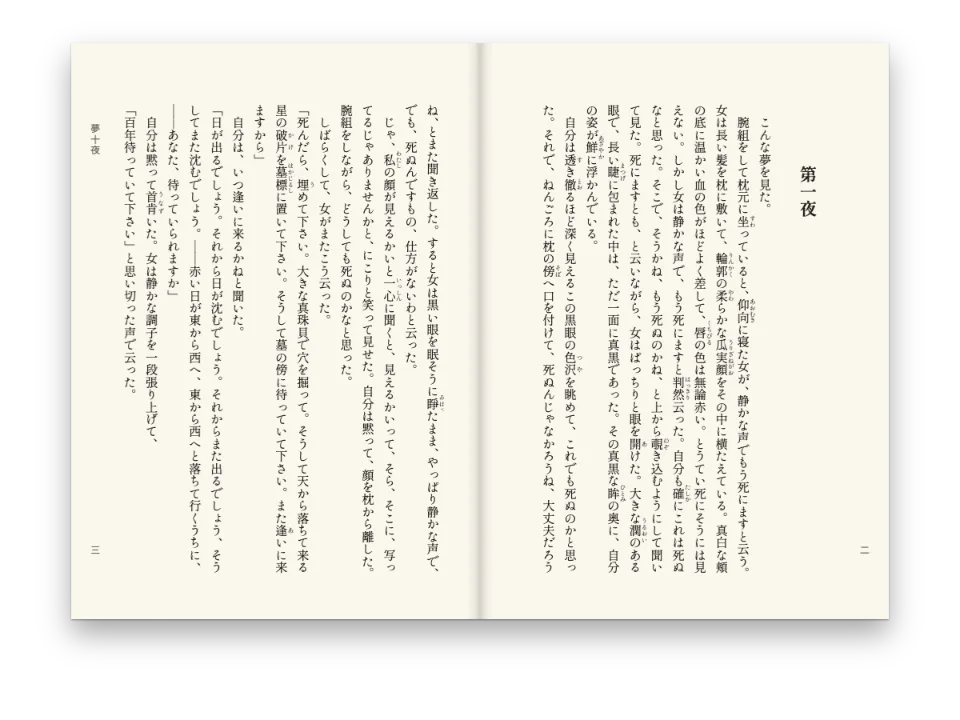
127 × 188 mmの四六判、右綴じの小さな詩歌集を8ページ作ります。第1部は芭蕉の『おくのほそ道』から7つの段を選び、紀行文と俳句を収めます。第2部は石川啄木の『一握の砂』から短歌12首を、啄木が書いたとおりの3行で収めます。散文は上から下へ1行36字、Shippori Minchoの10 ptで、1.9 emのゆったりした行送りで組みます。俳句は3字下げ、短歌は2字下げの独立した行に置き、曾良の句には行の地寄りに曾良と署名を入れます。短歌はページをまたいで分かれることがなく、歌群のあいだは柿色の*で区切ります。欧文の詩集はNo. 015、縦組み中国語の唐詩はNo. 083にあります。
このレシピが答える質問
- 詩を組むには(1行に1詩行、連の間のアキ、折り返した行のぶら下げインデント、ハイフネーションなし)?
- 画面とPDFで、漢字を日本の字形で表示して日本語を組めるフォントは?
手短な答え
// Each line of verse is a paragraph of its own, so a style sets where it starts. A haiku
// stands three characters down from the head of the line; Takuboku's tanka keep his three
// lines, two down; 曾良 signs his haiku raised five characters from the foot (地から五字上げ).
const paragraphStyles = [
  { id: 'haiku', indent: em(3), firstLineIndent: em(0), marginTop: pt(0), marginBottom: pt(0) },
  { id: 'tanka', indent: em(2), firstLineIndent: em(0), marginTop: pt(0), marginBottom: pt(0) },
  { id: 'by', textAlign: 'end', endIndent: em(5), firstLineIndent: em(0) },
  // The ornament between groups of poems, in the middle of its line.
  { id: 'ornament', textAlign: 'center', firstLineIndent: em(0), color: col('persimmon') },
];
//   :::paragraphs{style="haiku"}       :::paragraphs{style="by"}
//   夏草や兵どもが夢の跡                   曾良
//   :::                                :::
材料
- 機能
- 段落スタイル行取りの見出し縦組み右綴じの本字下げ、行そろえ、段落間隔ふりがな:漢字に付ける仮名の読み日本語の改行(禁則処理)漢数字と仮名の番号仮名、漢字、ローマ字文字グリッド中国語・日本語・韓国語のフォント青空文庫の取り込み見出しスタイルデザインした章扉ページデザインのテキスト・罫・ボックス柱とノンブルページの役割ごとの柱見開きの余白セマンティックカラーパレットPDFの書き出し
- 種類
- Shippori Mincho, Noto Sans JP (SIL OFL 1.1)
- 素材
- なし:図はすべてコードで描画
作り方
#1 · 詩の1行は1つの段落で、その書き出し位置はスタイルが決める
コードは上の手短な答えにあります。Postextには強制改行がないので、詩の各行は:::paragraphsの囲いの中の独立した段落になり、字下げは囲いのスタイルが決めます。indent: em(3)は俳句を行頭から3字下げて置きます(青空文庫のテキストは2字下げですが、3字下げると句のまわりに余裕が生まれます)。firstLineIndent: em(0)は、本文の1字下げがそこに加わらないようにします。俳句の17字前後は36字の行にいつでも収まるので、折り返すことはありません。署名は独立した段落です。textAlign: 'end'で行の地に付け(地付き)、endIndent: em(5)でそこから5字上げます(地から五字上げ)。このテキストの底本と同じ組み方です(段落スタイル)。
#2 · 短歌を1ページに収める
// Postext has no hard line break and never keeps one paragraph with the next, so each tanka
// sits in a box with nothing drawn round it: a box moves on whole (keepTogether, its
// default), and a tanka is never cut at the foot of a page. One blank line follows each.
//   :::callout{type="tanka"}  :::paragraphs{style="tanka"} … three lines …  :::  :::
const calloutStyles = [{ id: 'tanka', backgroundEnabled: false, keepTogether: true,
  padding: { top: pt(0), right: pt(0), bottom: pt(0), left: pt(0) },
  marginTop: pt(0), marginBottom: pt(LEAD),
  body: { fontFamily: MINCHO, fontSize: pt(BODY), lineHeight: pt(LEAD), color: col('ink'),
    firstLineIndent: em(0) } }];
短歌の3行は3つの段落です。エンジンは1つの段落の行どうしはまとめておきますが、段落と次の段落をまとめることはしません。囲みは中身を分割しないので、各短歌を何も描かないスタイルの:::calloutに入れます。背景もパディングもなく、あとに1行分のマージンを置くだけで、これが歌と歌のあいだの空き行になります。5ページでは3首目が部の題と最初の2首の下に収まらないので、最初の1行だけを残すことはせず、6ページの先頭にまるごと移ります(囲みスタイル)。
#3 · 地名を同じ幅に字取りする
// The place names over the prose take two lines (2行取り), four characters down, and a
// two-character name is spaced out to three (字取り: 平泉 → 平 泉), so they all end level.
const place = {
  level: 2, fontFamily: MINCHO, fontWeight: 700, fontSize: pt(11),
  lineSpan: 2, indent: em(4), jidori: 3,
};
芭蕉の旅の段の名は、本文2行分の高さを持つ第2階層の見出し(2行取り)です。そのため後に続く紀行文と俳句も行のグリッドからずれません。jidori: 3は短い名前を自身の文字3字分の幅に広げます(字取り)。平泉は平 泉と1字分空けて印刷され、どの名前も立石寺や最上川と同じ高さで終わります。すでに3字の名前はそのままです(レベルごとの上書き)。
#4 · 各部を新しいページで始める
// A design on a vertical page is laid out in the flow frame: x runs down the column from
// the head of the type area, y across the page leftwards from its right edge.
const at = (down, across) => ({ anchor: { to: 'container', edge: 'top-left' },
  offset: { x: pt(down), y: pt(across) } });
const TITLE = 18; // pt
const part = {
  level: 1, breakBefore: { enabled: true, parity: 'any' }, // gotcha: headings-drop-h1-break
  advancedDesign: { enabled: true, minHeight: lines(5), slot: { elements: [
    { kind: 'text', id: 'title', content: '{titleText}', fontFamily: MINCHO, fontWeight: 700,
      fontSize: pt(TITLE), lineHeight: 1, letterSpacing: pt(4), color: col('ink'),
      placement: at(3 * BODY, 1.5 * LEAD - TITLE / 2) },
    { kind: 'text', id: 'abridged', content: '(抄)', fontFamily: MINCHO, fontSize: pt(9),
      color: col('ink'), placement: { anchor: { to: '#title', edge: 'right-of' },
        offset: { x: pt(6), y: pt((TITLE - 9) / 2) } } },
    { kind: 'rule', id: 'rule', direction: 'horizontal', thickness: pt(0.6),
      color: col('persimmon'), placement: { ...at(3 * BODY, 2.5 * LEAD),
        size: { width: pt(4 * TITLE) } } },
    { kind: 'text', id: 'poet', content: '{attr.author}', fontFamily: MINCHO, fontSize: pt(11),
      letterSpacing: pt(3), color: col('ink'),
      placement: at(CHARS * BODY - 4 * 11 - 3 * 3 - 2 * BODY, 3.5 * LEAD - 11 / 2) },
  ] } },
};
各部は第1階層の見出しで、そのデザインが題、anchor.to: '#title'で題のすぐ後に置く小さな(抄)(「抜粋」の意)、題の横の短い柿色の罫、そして行の地寄りに置く作者名を描きます。デザインは5行分を確保し、本文はそのあと同じグリッドの上で始まります。
#5 · 古い記号を持つ書体を選ぶ
const title = markdown.match(/^title: "(.*)"$/m)[1];
const heads = markdown.match(/^#+ [^{\n]*/gm).join('');
await loadFonts(FONTS, markdown); // the Latin files: the colophon
await loadCjkFonts({ [MINCHO]: ['400'] }, markdown, { vertical: true });
await loadCjkFonts({ [MINCHO]: ['700'] }, heads);
await loadCjkFonts({ [GOTHIC]: ['400'] },
  `${title}${heads}${markdown.match(/colophon="([^"]*)"/)[1]}一二三四五六七八九十`, { vertical: true });
芭蕉の散文は繰り返しの語を古い踊り字〻で書き(日〻、人〻)、さらに古いテキストでは長いくの字点〳〵も使います。Zen Old Minchoにはどちらもないので、Canvasはシステムの書体から借りて描き、PDFは空の四角を描いてしまいます。Shippori Mincho、Noto Serif JP、Shippori Mincho B1はどちらも備えているので、詩歌はShippori Minchoで組みます(中国語・日本語・韓国語のフォント)。青空文庫のテキストには旧仮名遣いについての編者の注記とら{え|(へ)}ても残っており、芭蕉の書いた仮名の横に読みとして期待される仮名を印刷します。
レシピの全体
// ═══ Postext Cookbook · Nº 119 · Haiku and tanka set vertically ═══════════════════ // https://postext.dev/en/cookbook/haiku-and-tanka // Code: MIT · Text: 芭蕉『おくのほそ道』, 啄木『一握の砂』, Aozora Bunko (PD) · Pictures: none // Fonts: Shippori Mincho, Noto Sans JP (SIL OFL 1.1) · Needs postext ≥ 1.16.1 import { buildDocument, renderPageToCanvas, clearMeasurementCache, loadVerticalAlternates, } from 'https://esm.sh/postext'; import { renderToPdf, decompressWoff2 } from 'https://esm.sh/postext-pdf'; const LANG = 'en'; // @lang: the language of the colophon; the poems are Japanese in both const RECIPE = 'haiku-and-tanka'; // ─── 1 · Design ───────────────────────────────────────────────────────────── // #region palette: ink, one persimmon, a soft poetry stock const palette = { ink: '#22201d', // the poems persimmon: '#b5512c', // 柿: the part titles' rule and the ornaments muted: '#6a645c', // the hashira, the folios, the colophon paper: '#fbf8f1', }; const col = (id) => ({ hex: palette[id], model: 'hex', paletteId: id }); const colorPalette = [ ...Object.entries(palette).map(([id, hex]) => ({ id, name: id, value: { hex, model: 'hex' } })), { id: 'main-color', name: 'defaults', value: { hex: palette.persimmon, model: 'hex' } }, ]; // #endregion // Shippori Mincho: it has the 〻 of 日〻 and 人〻, which Zen Old Mincho lacks. const [MINCHO, GOTHIC] = ['Shippori Mincho', 'Noto Sans JP']; const [BODY, LEAD, CHARS, LINES] = [10, 19, 36, 14]; // pt, pt: 36字 × 14行, a 1.9 em pitch const lines = (n) => pt(n * LEAD); // #region answer: a haiku on one line three characters down, a tanka in three, 地付き names // Each line of verse is a paragraph of its own, so a style sets where it starts. A haiku // stands three characters down from the head of the line; Takuboku's tanka keep his three // lines, two down; 曾良 signs his haiku raised five characters from the foot (地から五字上げ). const paragraphStyles = [ { id: 'haiku', indent: em(3), firstLineIndent: em(0), marginTop: pt(0), marginBottom: pt(0) }, { id: 'tanka', indent: em(2), firstLineIndent: em(0), marginTop: pt(0), marginBottom: pt(0) }, { id: 'by', textAlign: 'end', endIndent: em(5), firstLineIndent: em(0) }, // The ornament between groups of poems, in the middle of its line. { id: 'ornament', textAlign: 'center', firstLineIndent: em(0), color: col('persimmon') }, ]; // :::paragraphs{style="haiku"} :::paragraphs{style="by"} // 夏草や兵どもが夢の跡 曾良 // ::: ::: // #endregion // #region tanka: a box with nothing drawn round it keeps each tanka on one page // Postext has no hard line break and never keeps one paragraph with the next, so each tanka // sits in a box with nothing drawn round it: a box moves on whole (keepTogether, its // default), and a tanka is never cut at the foot of a page. One blank line follows each. // :::callout{type="tanka"} :::paragraphs{style="tanka"} … three lines … ::: ::: const calloutStyles = [{ id: 'tanka', backgroundEnabled: false, keepTogether: true, padding: { top: pt(0), right: pt(0), bottom: pt(0), left: pt(0) }, marginTop: pt(0), marginBottom: pt(LEAD), body: { fontFamily: MINCHO, fontSize: pt(BODY), lineHeight: pt(LEAD), color: col('ink'), firstLineIndent: em(0) } }]; // #endregion // #region places: the place names take two lines, spaced to three characters // The place names over the prose take two lines (2行取り), four characters down, and a // two-character name is spaced out to three (字取り: 平泉 → 平 泉), so they all end level. const place = { level: 2, fontFamily: MINCHO, fontWeight: 700, fontSize: pt(11), lineSpan: 2, indent: em(4), jidori: 3, }; // #endregion // #region part: each part opens a page with its title, (抄) and the poet at the foot // A design on a vertical page is laid out in the flow frame: x runs down the column from // the head of the type area, y across the page leftwards from its right edge. const at = (down, across) => ({ anchor: { to: 'container', edge: 'top-left' }, offset: { x: pt(down), y: pt(across) } }); const TITLE = 18; // pt const part = { level: 1, breakBefore: { enabled: true, parity: 'any' }, // gotcha: headings-drop-h1-break advancedDesign: { enabled: true, minHeight: lines(5), slot: { elements: [ { kind: 'text', id: 'title', content: '{titleText}', fontFamily: MINCHO, fontWeight: 700, fontSize: pt(TITLE), lineHeight: 1, letterSpacing: pt(4), color: col('ink'), placement: at(3 * BODY, 1.5 * LEAD - TITLE / 2) }, { kind: 'text', id: 'abridged', content: '(抄)', fontFamily: MINCHO, fontSize: pt(9), color: col('ink'), placement: { anchor: { to: '#title', edge: 'right-of' }, offset: { x: pt(6), y: pt((TITLE - 9) / 2) } } }, { kind: 'rule', id: 'rule', direction: 'horizontal', thickness: pt(0.6), color: col('persimmon'), placement: { ...at(3 * BODY, 2.5 * LEAD), size: { width: pt(4 * TITLE) } } }, { kind: 'text', id: 'poet', content: '{attr.author}', fontFamily: MINCHO, fontSize: pt(11), letterSpacing: pt(3), color: col('ink'), placement: at(CHARS * BODY - 4 * 11 - 3 * 3 - 2 * BODY, 3.5 * LEAD - 11 / 2) }, ] } }, }; // #endregion // #region furniture: the book's title down the fore-edge, the folio below it const foreEdge = (id, content, parity, edge, y, extra = {}) => ({ kind: 'text', id, content, parity, pages: 'body', writingMode: 'vertical-rl', fontFamily: GOTHIC, fontSize: pt(7), letterSpacing: pt(1), color: col('muted'), overflow: 'clip', placement: { anchor: { to: 'outer', edge }, offset: { y: em(y) } }, ...extra, }); const header = { elements: [ foreEdge('book', '{title}', 'even', 'top', 3), foreEdge('part', '{chapterTitle}', 'odd', 'top', 3), foreEdge('folio', '{pageNumber}', 'all', 'bottom', -3, { pages: 'all' }), ] }; const none = { elements: [] }; // The first part's opening page carries the colophon across the foot. const first = { id: 'first', footer: { elements: [{ kind: 'text', id: 'colophon', content: '{attr.colophon}', pages: 'opener', fontFamily: GOTHIC, fontSize: pt(5.5), lineHeight: 1.45, color: col('muted'), overflow: 'wrap', align: 'center', placement: { anchor: { to: 'page', edge: 'bottom' }, offset: { y: mm(-7) }, size: { width: mm(100) } } }] } }; // #endregion const config = () => ({ // a factory: the engine caches resolved configs per object locale: 'ja', // written out, never LANG (gotcha: ja-locale-tag) colorPalette, page: { sizePreset: 'custom', width: mm(127), height: mm(188), dpi: 150, // 四六判 backgroundColor: col('paper'), margins: { top: mm(32), bottom: mm(24), left: mm(15), right: mm(17), mirror: true }, pageNumbering: { format: 'japanese-informal' }, }, layout: { layoutType: 'single', writingMode: 'vertical-rl' }, cjk: { grid: { enabled: true, charsPerLine: CHARS, linesPerPage: LINES } }, bodyText: { fontFamily: MINCHO, fontSize: pt(BODY), lineHeight: pt(LEAD), color: col('ink'), boldColor: col('ink'), italicColor: col('ink'), referenceColor: col('ink'), textAlign: 'justify', firstLineIndent: em(1), indentAfterHeading: true, }, headings: { fontFamily: MINCHO, color: col('ink'), levels: [part, place] }, headingStyles: [first], paragraphStyles, calloutStyles, header, footer: none, }); // ─── 2 · Content ──────────────────────────────────────────────────────────── const markdown = String.raw`---Markdownの見本 · 183行 · content.en.md
title: "芭蕉と啄木" subtitle: "俳句と短歌" --- # おくのほそ道 {style="first" author="松尾芭蕉" colophon="Matsuo Bashō, おくのほそ道 (The Narrow Road to the Deep North, 1702), selections, after Sugiura Shōichirō’s 1957 edition; Ishikawa Takuboku, 一握の砂 (A Handful of Sand, 1910), twelve tanka. Text: Aozora Bunko 61619 and 816, public domain. Set in Shippori Mincho and Noto Sans JP (SIL OFL)."} ## 冒頭 {月日|つきひ}は{百代|はくだい}の{過客|くわかく}にして、{行|ゆき}かふ{年|とし}も{又|また}{旅人|たびびと}{也|なり}。{舟|ふね}の{上|うへ}に生涯をうかべ馬の口とら{え|(へ)}て{老|おい}をむかふる{物|もの}は、{日〻|ひび}{旅|たび}にして{旅|たび}を{栖|すみか}とす。古人も多く旅に死せるあり。予もいづれの年よりか、{片雲|へんうん}の風にさそはれて、漂泊の思ひやまず海濱にさすらへ、{去年|こぞ}の秋{江上|かうじやう}の{破屋|はをく}に{蜘|くも}の古巣をはらひて、やゝ年も{暮|くれ}春{立|たて}る霞の空に白川の關こえんと、そゞろ{神|がみ}の物につきて心をくるはせ、{道祖神|だうそじん}のまねきにあひて{取|とる}もの手につかず、もゝ{引|ひき}の{破|やぶれ}をつゞり{笠|かさ}の{緒|を}{付|つけ}か{え|(へ)}て、三里に灸す{ゆ|(う)}るより松嶋の月{先|まづ}心にかゝりて、{住|すめ}る{方|かた}は人に讓り{杉風|さんぷう}が{別墅|べつしよ}に移るに、 :::paragraphs{style="haiku"} 草の戸も{住替|すみかは}る{代|よ}ぞひなの家 ::: {面八句|おもてはちく}を{庵|いほり}の柱に{懸置|かけおく}。 ## 旅立 :::paragraphs{style="haiku"} {行|ゆく}春や鳥{啼|なき}{魚|うを}の目は{泪|なみだ} ::: ## 平泉 三代の{榮耀|えいえう}{一睡|いつすゐ}の{中|うち}にして、{大門|だいもん}の跡は一里こなたに{有|あり}。{秀衡|ひでひら}が跡は田野に{成|なり}て、金鷄山のみ形を殘す。{先|まづ}{高舘|たかだち}にのぼれば、北上川南部より流るゝ{大河|たいが}也。衣川は和泉が{城|じやう}をめぐりて、高舘の下にて大河に{落入|おちいる}。{康衡|やすひら}等が旧跡は、衣が關を{隔|へだて}て南部口をさし堅め、{夷|えぞ}をふせぐとみえたり。{偖|さて}も義臣すぐつて{此城|このしろ}にこもり、功名一時の{叢|くさむら}となる。「國破れて山河あり、{城|じやう}春にして草青みたり」と笠{打敷|うちしき}て時のうつるまで泪を落し侍りぬ。 :::paragraphs{style="haiku"} {夏草|なつくさ}や{兵|つはもの}どもが夢の跡 {卯|う}の{花|はな}に{兼房|かねふさ}みゆる{白毛|しらが}かな ::: :::paragraphs{style="by"} 曾良 ::: ## 立石寺 山形領に{立石寺|りふしやくじ}と{云|いふ}山寺あり。{慈覺大師|じかくだいし}の開基にして、{殊|ことに}清閑の地也。一見すべきよし、人〻のすゝむるに{依|よつ}て、尾花澤よりとつて返し、{其|その}間七里ばかり也。日いまだ{暮|くれ}ず。{麓|ふもと}の坊に宿かり{置|おき}て、山上の堂にのぼる。岩に{巖|いはほ}を{重|かさね}て山とし、{松柏|しようはく}{年旧|としふり}、{土石|どせき}{老|おい}て苔{滑|なめらか}に、岩上の院〻{扉|とびら}を{閉|とぢ}て物の音きこえず。{岸|きし}をめぐり岩を{這|はひ}て{佛閣|ぶつかく}を拜し、{佳景|かけい}{寂莫|じやくまく}として心すみ{行|ゆく}のみおぼゆ。 :::paragraphs{style="haiku"} {閑|しづか}さや岩にしみ{入|いる}蝉の聲 ::: ## 最上川 :::paragraphs{style="haiku"} 五月雨をあつめて早し最上川 ::: ## 越後路 :::paragraphs{style="haiku"} 文月や六日も常の夜には似ず 荒海や佐渡によこたふ{天河|あまのがは} ::: ## 大垣 :::paragraphs{style="haiku"} 蛤のふたみにわかれ{行|ゆく}秋ぞ ::: # 一握の砂 {author="石川啄木"} :::callout{type="tanka"} :::paragraphs{style="tanka"} {東海|とうかい}の{小島|こじま}の{磯|いそ}の{白砂|しらすな}に われ{泣|な}きぬれて {蟹|かに}とたはむる ::: ::: :::callout{type="tanka"} :::paragraphs{style="tanka"} {頬|ほ}につたふ なみだのごはず {一握|いちあく}の砂を{示|しめ}しし人を忘れず ::: ::: :::callout{type="tanka"} :::paragraphs{style="tanka"} いのちなき砂のかなしさよ さらさらと {握|にぎ}れば指のあひだより落つ ::: ::: :::callout{type="tanka"} :::paragraphs{style="tanka"} たはむれに母を{背負|せお}ひて そのあまり{軽|かろ}きに泣きて 三歩あゆまず ::: ::: :::callout{type="tanka"} :::paragraphs{style="tanka"} はたらけど はたらけど{猶|なほ}わが{生活|くらし}楽にならざり ぢっと手を見る ::: ::: :::paragraphs{style="ornament"} * ::: :::callout{type="tanka"} :::paragraphs{style="tanka"} {不来方|こずかた}のお城の草に寝ころびて 空に吸はれし {十五|じふご}の心 ::: ::: :::callout{type="tanka"} :::paragraphs{style="tanka"} ふるさとの{訛|なまり}なつかし {停車場|ていしやば}の人ごみの中に そを{聴|き}きにゆく ::: ::: :::callout{type="tanka"} :::paragraphs{style="tanka"} 石をもて追はるるごとく ふるさとを{出|い}でしかなしみ 消ゆる時なし ::: ::: :::callout{type="tanka"} :::paragraphs{style="tanka"} やはらかに柳あをめる {北上|きたかみ}の{岸辺|きしべ}目に見ゆ 泣けとごとくに ::: ::: :::callout{type="tanka"} :::paragraphs{style="tanka"} ふるさとの山に向ひて 言ふことなし ふるさとの山はありがたきかな ::: ::: :::paragraphs{style="ornament"} * ::: :::callout{type="tanka"} :::paragraphs{style="tanka"} {函館|はこだて}の{青柳町|あをやぎちやう}こそかなしけれ 友の{恋歌|こひうた} 矢ぐるまの花 ::: :::`; // content.<lang>.md: the same Japanese text in both // ─── 3 · Fonts ────────────────────────────────────────────────────────────── const FONTS = { 'Shippori Mincho': ['400', '700'], // the poems and the prose; the titles 'Noto Sans JP': ['400'], // the hashira, the folios and the colophon }; // ─── 4 · Build & show ─────────────────────────────────────────────────────── // #region voices: each face loads the files that hold the characters it sets const title = markdown.match(/^title: "(.*)"$/m)[1]; const heads = markdown.match(/^#+ [^{\n]*/gm).join(''); await loadFonts(FONTS, markdown); // the Latin files: the colophon await loadCjkFonts({ [MINCHO]: ['400'] }, markdown, { vertical: true }); await loadCjkFonts({ [MINCHO]: ['700'] }, heads); await loadCjkFonts({ [GOTHIC]: ['400'] }, `${title}${heads}${markdown.match(/colophon="([^"]*)"/)[1]}一二三四五六七八九十`, { vertical: true }); // #endregion const doc = await buildWithFonts(() => buildDocument({ markdown }, config()), markdown); showBook(doc, { title: t({ en: 'Haiku and tanka set vertically', es: 'Haikus y tankas compuestos en vertical' }) }); offerPdf(() => renderToPdf(doc, { fontProvider: cjkPdfProvider }), `${RECIPE}.pdf`);キット · core, fonts, viewer, pdf, cjk:全レシピ共通 · 453行
// ─── Kit ── helpers shared by every Cookbook recipe · postext.dev/cookbook ───── // ─── Kit · core v1 ── the same in every recipe · postext.dev/cookbook ───────── function mm(value) { return { value, unit: 'mm' }; } function pt(value) { return { value, unit: 'pt' }; } function em(value) { return { value, unit: 'em' }; } /** The sample language's string: t({ en: 'Figure', es: 'Figura' }). */ function t(strings) { return strings[LANG] ?? Object.values(strings)[0]; } /** A file in this recipe's assets folder, served from the Postext repo by jsDelivr. */ function asset(file) { return `https://cdn.jsdelivr.net/gh/drnachio/postext@main/cookbook/${RECIPE}/assets/${file}`; } // ─── Kit · fonts v1 ── the same in every recipe · postext.dev/cookbook ──────── // Postext measures text with the faces the browser has loaded, and caches the // widths, so every face must be ready before the first build. Faces come from // Fontsource: the same static files the PDF embeds, so screen and PDF agree. /** faces = { 'Family Name': ['400', '400i', '700'] }. `text` is the sample: * letters beyond Latin-1 (č, ł, ő…) also load the latin-ext files. With * `optional`, a face Fontsource does not ship is skipped instead of failing. * Resolves to the number of faces added. */ async function loadFonts(faces, text = '', { optional = false } = {}) { kitStatus('Loading fonts…'); const ranges = { latin: 'U+0000-00FF,U+0131,U+0152-0153,U+02BB-02BC,U+02C6,U+02DA,U+02DC,U+0304,U+0308,U+0329,' + 'U+2000-206F,U+20AC,U+2122,U+2191,U+2193,U+2212,U+2215,U+FEFF,U+FFFD', 'latin-ext': 'U+0100-02BA,U+02BD-02C5,U+02C7-02CC,U+02CE-02D7,U+02DD-02FF,U+0304,U+0308,U+0329,' + 'U+1D00-1DBF,U+1E00-1E9F,U+1EF2-1EFF,U+2020,U+20A0-20AB,U+20AD-20C0,U+2113,U+2C60-2C7F,U+A720-A7FF', }; const subsets = /[Ā-˿Ḁ-ỿ]/.test(text) ? ['latin', 'latin-ext'] : ['latin']; const jobs = []; let added = 0; for (const [family, specs] of Object.entries(faces)) { const id = fontsourceId(family); const meta = optional ? await fontsourceMeta(family) : null; for (const spec of new Set(specs)) { const weight = parseInt(spec, 10); const style = spec.endsWith('i') ? 'italic' : 'normal'; if (hasFace(family, weight, style)) continue; if (optional && !(meta?.weights.includes(weight) && meta.styles.includes(style))) continue; for (const subset of subsets) { const url = `https://cdn.jsdelivr.net/npm/@fontsource/${id}@5/files/${id}-${subset}-${weight}-${style}.woff2`; const face = new FontFace(family, `url(${url}) format('woff2')`, { weight: String(weight), style, unicodeRange: ranges[subset] }); jobs.push(face.load().then((ready) => { document.fonts.add(ready); added++; }, () => { if (subset === 'latin' && !optional) throw new Error(`Fontsource has no ${family} ${weight} ${style}`); })); } } } await Promise.all(jobs).catch((error) => { kitFail(error); throw error; }); return added; } /** Runs `build` (a buildDocument or buildBundle call) and checks the faces * the pages use. A regular face missing from FONTS is loaded with a warning; * bold and italic variants are loaded when the family ships them. Then the * measurement caches are cleared and the build runs again. */ async function buildWithFonts(build, text = '') { const tried = new Set(); for (let round = 0; round < 3; round++) { kitStatus('Laying out…'); await new Promise(requestAnimationFrame); // let the status paint first const result = await Promise.resolve().then(build).catch((error) => { kitFail(error); throw error; }); const wanted = { base: {}, variants: {} }; for (const { font, base } of [result].flat().flatMap(fontStringsOf)) { const { family, weight, style } = parseFont(font); const key = `${family}|${weight}|${style}`; if (tried.has(key) || hasFace(family, weight, style)) continue; tried.add(key); (wanted[base ? 'base' : 'variants'][family] ??= []).push(`${weight}${style === 'italic' ? 'i' : ''}`); } if (Object.keys(wanted.base).length) { console.warn(`[cookbook] FONTS does not list ${JSON.stringify(wanted.base)}: loading them.`); } const added = await loadFonts(wanted.base, text) + await loadFonts(wanted.variants, text, { optional: true }); if (added === 0) return result; clearMeasurementCache(); } throw new Error('The fonts did not settle after three builds.'); } /** Every font string of the layout. `base` marks a block's own face; its * bold, italic and bold-italic variants are listed whether or not used. */ function fontStringsOf(doc) { const found = new Map(); const walk = (node) => { if (!node || typeof node !== 'object') return; if (Array.isArray(node)) { node.forEach(walk); return; } for (const [key, value] of Object.entries(node)) { if (typeof value === 'string' && /fontString$/i.test(key)) { found.set(value, found.get(value) || key === 'fontString'); } else if (value && typeof value === 'object') walk(value); } }; walk(doc.pages); walk(doc.blocks); return [...found].map(([font, base]) => ({ font, base })); } /** '700 37.5px Open Sans' / 'italic 400 13px "Source Serif 4"' → { family, weight, style }. * A string with no weight ('95.8px Young Serif', from a design text) is 400. */ function parseFont(font) { const m = /^(?:(italic|oblique)\s+)?(?:small-caps\s+)?(?:(\d+|bold|normal)\s+)?[\d.]+px\s+(.+)$/.exec(font.trim()); if (!m) throw new Error(`Unexpected font string: ${font}`); const weight = m[2] === 'bold' ? 700 : !m[2] || m[2] === 'normal' ? 400 : Number(m[2]); return { family: m[3].replace(/^["']|["']$/g, ''), weight, style: m[1] ? 'italic' : 'normal' }; } /** True when a loaded FontFace covers exactly this family, weight and style * (document.fonts.check() is also true for families nobody declared). */ function hasFace(family, weight, style) { for (const face of document.fonts) { if (face.status !== 'loaded' || face.style !== style) continue; if (face.family.replace(/^["']|["']$/g, '') !== family) continue; const [low, high = low] = face.weight.split(' ').map(Number); if (weight >= low && weight <= high) return true; } return false; } /** Fontsource's id for a family: 'Source Serif 4' → 'source-serif-4'. */ function fontsourceId(family) { return family.toLowerCase().replace(/\s+/g, '-'); } /** The weights and styles a family ships ({ weights: [400, 700], styles: ['normal', 'italic'] }), or null. */ function fontsourceMeta(family) { fontsourceMeta.cache ??= new Map(); const id = fontsourceId(family); if (!fontsourceMeta.cache.has(id)) { fontsourceMeta.cache.set(id, fetch(`https://api.fontsource.org/v1/fonts/${id}`) .then((res) => (res.ok ? res.json() : null), () => null)); } return fontsourceMeta.cache.get(id); } // ─── Kit · viewer v1 ── the same in every recipe · postext.dev/cookbook ─────── /** Shows the pages as facing spreads on a dark desk: the first page is a * recto on its own, then verso | recto pairs, as in a bound book. Pages * are painted when they scroll near the screen. */ function showPages(docs, { title, width = 460 } = {}) { const root = viewer(title); const pages = [docs].flat().flatMap((doc) => doc.pages.map((page) => ({ doc, page, n: (doc.pageIndexOffset ?? 0) + page.index }))); const spreads = []; let verso = null; for (const p of pages) { if (p.n % 2 === 1) { if (verso) spreads.push([verso, null]); verso = p; } else { spreads.push([verso, p]); verso = null; } } if (verso) spreads.push([verso, null]); const density = Math.min(window.devicePixelRatio || 1, 2); showPages.painter?.disconnect(); const painter = new IntersectionObserver((entries) => { for (const { isIntersecting, target } of entries) { if (!isIntersecting) continue; painter.unobserve(target); const { doc, page } = target.postext; renderPageToCanvas(page, doc, target, { scale: (width * density) / page.width }); } }, { rootMargin: '800px' }); showPages.painter = painter; root.replaceChildren(...spreads.map((pair) => { const spread = document.createElement('div'); spread.className = 'pt-spread'; for (const p of pair) { const figure = document.createElement('figure'); if (p) { const label = p.page.pageLabel || String(p.n + 1); const canvas = document.createElement('canvas'); canvas.postext = p; canvas.style.aspectRatio = `${p.page.width} / ${p.page.height}`; canvas.setAttribute('role', 'img'); canvas.setAttribute('aria-label', `Page ${label}`); const folio = document.createElement('figcaption'); folio.textContent = label; figure.append(canvas, folio); painter.observe(canvas); } else figure.className = 'pt-blank'; spread.append(figure); } return spread; })); kitStatus(`${pages.length} ${pages.length === 1 ? 'page' : 'pages'}`); document.documentElement.dataset.postext = 'ready'; return pages.length; } /** The desk, the bar and the error reporting, created once. */ function viewer(title) { if (!document.getElementById('pt-kit')) { document.head.insertAdjacentHTML('beforeend', `<style id="pt-kit"> :root { color-scheme: dark; } body { margin: 0; background: #0e1014; color: #b9bcc4; font: 13px/1.45 system-ui, sans-serif; } #pt-bar { position: sticky; top: 0; z-index: 1; display: flex; flex-wrap: wrap; align-items: center; gap: 6px 16px; padding: 10px 16px; background: rgb(14 16 20 / .92); backdrop-filter: blur(6px); border-bottom: 1px solid #23262d; } #pt-bar strong { color: #f4f1ea; font-weight: 600; } #pt-actions { display: flex; gap: 12px; margin-left: auto; } #pt-actions a, #pt-actions button { color: #d8a21a; font: inherit; background: none; border: 0; padding: 0; cursor: pointer; } #pages { display: grid; justify-items: center; gap: 48px; padding: 32px 16px 72px; } .pt-spread { display: flex; } .pt-spread figure { margin: 0; width: min(460px, 44vw); } .pt-spread canvas { display: block; width: 100%; background: #fff; box-shadow: 0 1px 2px rgb(0 0 0 / .5), 0 22px 44px -16px rgb(0 0 0 / .8); } .pt-spread figure:first-child canvas { box-shadow: inset -14px 0 14px -14px rgb(0 0 0 / .18), 0 1px 2px rgb(0 0 0 / .5), 0 22px 44px -16px rgb(0 0 0 / .8); } .pt-spread figcaption { margin-top: 10px; text-align: center; font: 600 10px/1 system-ui, sans-serif; letter-spacing: .18em; text-transform: uppercase; color: #6c7079; } .pt-blank { visibility: hidden; } @media (max-width: 760px) { .pt-spread { flex-direction: column; gap: 32px; } .pt-spread figure { width: min(460px, 92vw); } .pt-blank { display: none; } } </style>`); document.body.insertAdjacentHTML('afterbegin', '<header id="pt-bar"><strong id="pt-title"></strong><span id="pt-status" role="status"></span><span id="pt-actions"></span></header>'); document.getElementById('pt-title').textContent = document.title || 'Postext'; addEventListener('error', (event) => kitFail(event.error ?? event.message)); addEventListener('unhandledrejection', (event) => kitFail(event.reason)); } if (title) document.getElementById('pt-title').textContent = title; return document.getElementById('pages') ?? document.body.appendChild(Object.assign(document.createElement('main'), { id: 'pages' })); } function kitStatus(text) { viewer(); document.getElementById('pt-status').textContent = text; } function kitFail(error) { document.documentElement.dataset.postext = 'error'; kitStatus(`Error: ${error?.message ?? error}`); } // ─── Kit · pdf v1 ── the same in every recipe that exports a PDF ────────────── /** postext-pdf embeds TrueType bytes. Fetch the Fontsource file the screen * used, snapping to a weight the family ships and falling back to upright * when it has no italic: the PDF asks for every face a block could use. */ async function fontsourceProvider(family, weight, style) { const id = fontsourceId(family); const meta = await fontsourceMeta(family); const weights = meta?.weights?.length ? meta.weights : [400, 700]; const w = weights.reduce((a, b) => (Math.abs(b - weight) < Math.abs(a - weight) ? b : a)); const s = style === 'italic' && meta && !meta.styles.includes('italic') ? 'normal' : style; const res = await fetch(`https://cdn.jsdelivr.net/npm/@fontsource/${id}@5/files/${id}-latin-${w}-${s}.woff2`); if (!res.ok) throw new Error(`Fontsource has no ${family} ${w} ${s} (${res.status})`); return decompressWoff2(new Uint8Array(await res.arrayBuffer())); } /** A "Build the PDF" button in the bar. Once built: "Open the PDF" (a new * tab, since CodePen's preview frame cannot show PDFs) and a download link. */ function offerPdf(makePdf, filename) { viewer(); const button = Object.assign(document.createElement('button'), { type: 'button', textContent: 'Build the PDF' }); button.dataset.postextPdf = filename; button.addEventListener('click', async () => { button.disabled = true; button.textContent = 'Building the PDF…'; try { const bytes = await makePdf(); const url = URL.createObjectURL(new Blob([bytes], { type: 'application/pdf' })); const size = `${Math.max(1, Math.round(bytes.length / 1024))} KB`; button.replaceWith( Object.assign(document.createElement('a'), { href: url, target: '_blank', rel: 'noopener', textContent: 'Open the PDF ↗' }), Object.assign(document.createElement('a'), { href: url, download: filename, textContent: `Download ${filename} · ${size}` })); } catch (error) { button.disabled = false; button.textContent = 'Build the PDF'; kitFail(error); } }); document.getElementById('pt-actions').append(button); } // ─── Kit · cjk v1 ── Chinese, Japanese and Korean books · postext.dev/cookbook ─ // Fontsource ships a CJK family as about a hundred files per weight, each // declared in its stylesheet with the unicode-range it covers. The screen // loads the files the sample touches; the PDF gets the same files for the // characters its pages set in each face, and embeds each as a subset. // A book bound on the right (vertical text) is shown with its spreads // mirrored: page 1 alone on the left of the spine, then [3 | 2]. /** The files of a Fontsource face, read from its stylesheet: { url, range, * ranges }, the last declared first (the order the browser tries them in). */ function cjkSlices(family, weight, style) { cjkSlices.cache ??= new Map(); const id = fontsourceId(family); const css = `https://cdn.jsdelivr.net/npm/@fontsource/${id}@5/${weight}${style === 'italic' ? '-italic' : ''}.css`; if (!cjkSlices.cache.has(css)) { cjkSlices.cache.set(css, fetch(css) .then((res) => { if (!res.ok) throw new Error(`Fontsource has no ${family} ${weight} ${style} (${res.status})`); return res.text(); }) .then((text) => [...text.matchAll(/@font-face\s*{([^}]*)}/g)].map(([, rule]) => { const range = /unicode-range:\s*([^;]+);/.exec(rule)?.[1].trim() ?? 'U+0-10FFFF'; const ranges = range.split(',').map((part) => { const [lo, hi = lo] = part.trim().slice(2).split('-'); return [parseInt(lo, 16), parseInt(hi, 16)]; }); return { url: new URL(/url\(([^)]+?\.woff2)\)/.exec(rule)[1], css).href, range, ranges }; }).reverse())); } return cjkSlices.cache.get(css); } /** The file of `slices` that holds code point `cp`, if any. */ function cjkSliceFor(slices, cp) { return slices.find((slice) => slice.ranges.some(([lo, hi]) => cp >= lo && cp <= hi)); } /** Whether Fontsource serves `family` as a Chinese, Japanese or Korean * family (its subsets name the script). Fails when the API does not * answer: a CJK face taken for a Latin one would paint in a system face. */ async function isCjkFamily(family) { const meta = await fontsourceMeta(family); if (!meta) throw new Error(`api.fontsource.org did not describe ${family}: reload to try again`); return !!meta.subsets?.some((subset) => /^(chinese|japanese|korean)/.test(subset)); } /** faces = { 'Noto Serif TC': ['400', '700'] }, as for loadFonts: the * whole FONTS object may be passed, its other families are left to * loadFonts. Adds one FontFace per file of each CJK face with its * unicodeRange, then loads the files `text` touches. `text` is what the * faces set: the sample for the text face; a book in several voices calls * it once per voice (loadCjkFonts({ 'LXGW WenKai TC': ['400'] }, quotes)), * so the heading and quotation faces fetch and check only their own * characters. Fails when a character of `text` is in no file of a face. * List every weight the pages use: a weight left to buildWithFonts gets * the latin file only. With { vertical: true } it also loads each * family's vertical forms (brackets, quotes, pause marks) for the canvas, * which needs loadVerticalAlternates imported from postext. Resolves to * the number of files loaded. */ async function loadCjkFonts(faces, text, { vertical = false } = {}) { kitStatus('Loading fonts…'); let loaded = 0; try { if (vertical && typeof loadVerticalAlternates !== 'function') { throw new Error('loadCjkFonts(…, { vertical: true }) needs loadVerticalAlternates imported from postext'); } for (const [family, specs] of Object.entries(faces)) { if (!(await isCjkFamily(family))) continue; const twin = []; for (const spec of new Set(specs)) { const weight = parseInt(spec, 10); const style = spec.endsWith('i') ? 'italic' : 'normal'; const slices = await cjkSlices(family, weight, style); const missing = [...new Set(text)].filter((ch) => /\S/.test(ch) && !cjkSliceFor(slices, ch.codePointAt(0))); if (missing.length) { throw new Error(`${family} ${spec} has no file for ${missing.slice(0, 12).join(' ')}: ` + `give each face the text it sets (loadCjkFonts({ '${family}': ['${spec}'] }, text))`); } for (const slice of slices) { document.fonts.add(new FontFace(family, `url(${slice.url}) format('woff2')`, { weight: String(weight), style, unicodeRange: slice.range })); twin.push({ source: slice.url, weight: String(weight), style, unicodeRange: slice.range }); } const font = `${style === 'italic' ? 'italic ' : ''}${weight} 16px "${family}"`; loaded += (await document.fonts.load(font, text)).length; if (!document.fonts.check(font, text)) throw new Error(`${family} ${spec} did not load for the sample`); } // The same files under a twin name with the `vert` feature on: the // canvas paints the punctuation of vertical lines with it. if (vertical && twin.length) await loadVerticalAlternates(family, twin); } } catch (error) { kitFail(error); throw error; } return loaded; } /** The PDF font provider for recipes with CJK faces: a family whose * Fontsource subsets are Chinese, Japanese or Korean gets the files that * hold the characters its pages set (`request.codePoints`); any other * family gets the latin file fontsourceProvider fetches (the "pdf" block) * and, when the face sets letters only latin-ext has, that file too. */ async function cjkPdfProvider(family, weight, style, request) { if (!(await isCjkFamily(family))) return cjkLatinPdfFiles(family, weight, style, request); const meta = await fontsourceMeta(family); const weights = meta.weights?.length ? meta.weights : [400, 700]; const w = weights.reduce((a, b) => (Math.abs(b - weight) < Math.abs(a - weight) ? b : a)); const s = style === 'italic' && !meta.styles.includes('italic') ? 'normal' : style; const slices = await cjkSlices(family, w, s); const picked = new Set(); for (const cp of request?.codePoints ?? []) { const slice = cjkSliceFor(slices, cp); if (slice) picked.add(slice); } if (!picked.size) picked.add(slices[0]); return Promise.all(slices.filter((slice) => picked.has(slice)).map(async (slice) => { const res = await fetch(slice.url); if (!res.ok) throw new Error(`Fontsource file ${slice.url} (${res.status})`); return decompressWoff2(new Uint8Array(await res.arrayBuffer())); })); } /** A Latin family set next to the CJK faces: its latin file, then its * latin-ext file when the face sets letters only latin-ext has (ō ū in * Hepburn rōmaji, ǎ in pinyin), the file loadFonts adds on screen for * them. Latin comes first: postext-pdf draws a character from the first * file that has it, as the browser takes a character both files hold from * latin. A face Fontsource ships without latin-ext, or whose file does * not come, gets latin alone, and the PDF names the letters it lacks. */ async function cjkLatinPdfFiles(family, weight, style, request) { const meta = await fontsourceMeta(family); const beyond = [...(request?.codePoints ?? [])].some(cjkLatinExtOnly); if (!beyond || !meta?.subsets?.includes('latin-ext')) return fontsourceProvider(family, weight, style); const weights = meta.weights?.length ? meta.weights : [400, 700]; const w = weights.reduce((a, b) => (Math.abs(b - weight) < Math.abs(a - weight) ? b : a)); const s = style === 'italic' && !meta.styles.includes('italic') ? 'normal' : style; const id = fontsourceId(family); const url = `https://cdn.jsdelivr.net/npm/@fontsource/${id}@5/files/${id}-latin-ext-${w}-${s}.woff2`; const [latin, ext] = await Promise.all([fontsourceProvider(family, weight, style), fetch(url) .then(async (res) => (res.ok ? decompressWoff2(new Uint8Array(await res.arrayBuffer())) : null), () => null)]); return ext ? [latin, ext] : latin; } /** Whether code point `cp` is in Fontsource's latin-ext file and not in * its latin file: Latin Extended-A and -B, IPA, the spacing modifiers and * Latin Extended Additional (loadFonts's test for latin-ext), less the * few latin holds too (ı Œ œ ʻ ʼ ˆ ˚ ˜). */ function cjkLatinExtOnly(cp) { if (!((cp >= 0x100 && cp <= 0x2ff) || (cp >= 0x1e00 && cp <= 0x1eff))) return false; return ![0x131, 0x152, 0x153, 0x2bb, 0x2bc, 0x2c6, 0x2da, 0x2dc].includes(cp); } /** showPages for a book bound on either edge. A right-bound book (the * document says so: doc.binding is 'right' for page.binding 'right' and * for vertical text) lies on the desk as it opens: page 1 alone on the * left of the spine, then [3 | 2], the spine shade on each page's inner * edge. `binding` ('left' | 'right') overrides the document's. */ function showBook(docs, { binding, ...options } = {}) { const count = showPages(docs, options); const right = (binding ?? [docs].flat()[0]?.binding) === 'right'; if (!document.getElementById('pt-kit-cjk')) { // The pages keep direction ltr: a canvas draws text in the direction its // element inherits, and under rtl each run would end where the engine // starts it, its brackets mirrored. document.head.insertAdjacentHTML('beforeend', `<style id="pt-kit-cjk"> .pt-spread[dir="rtl"] canvas { direction: ltr; } .pt-spread[dir="rtl"] figure:first-child canvas { box-shadow: inset 14px 0 14px -14px rgb(0 0 0 / .18), 0 1px 2px rgb(0 0 0 / .5), 0 22px 44px -16px rgb(0 0 0 / .8); } </style>`); } // Each pair stays [verso, recto] in the page; right to left, the verso // sits on the right. Phones stack the pages in reading order either way. for (const spread of document.querySelectorAll('#pages > .pt-spread')) spread.dir = right ? 'rtl' : 'ltr'; document.getElementById('pages').dataset.binding = right ? 'right' : 'left'; return count; } // ─── /Kit ───────────────────────────────────────────────────────────────────────
組み立てたscript.jsはそのまま動きます。任意のページのモジュールスクリプトに貼り付けるか、レシピをCodePenで開いてください。 GitHub上のレシピのフォルダー ↗ (新しいタブで開きます)
アレンジ
#俳句の3つの句切れに空きを入れる
学校向けのアンソロジーでは、形を学ぶ読者のために5音、7音、5音のあいだに全角スペースを入れることがあります。このスペースはテキストの文字です。
-{夏草|なつくさ}や{兵|つはもの}どもが夢の跡
+{夏草|なつくさ}や {兵|つはもの}どもが 夢の跡#長い短歌の分割を許す
囲みのスタイルにkeepTogether: falseを指定すると、短歌がページの地近くで始まり、次のページへ続くことを許します。千首を収める詰まったアンソロジーならそう組むところです。
-const calloutStyles = [{ id: 'tanka', backgroundEnabled: false, keepTogether: true,
+const calloutStyles = [{ id: 'tanka', backgroundEnabled: false, keepTogether: false,よくあるつまずき
つまずき
日本語のテキストのタグは'ja'。zh-HansやLANGにしない
レシピの版はenとesですが、日本語のサンプルはどちらの版でも日本語です。`locale: LANG`では英語やスペイン語とタグ付けされ、中国語のタグでは中国語の規則で組まれます(開明式の約物、小書きの仮名が行頭に来てもよい、図の代わりに图、PDFでは中国の字形)。'ja'と書いてください。日本の地域(JLReqの改行と約物、ゴマの圏点、ルビの間隔、図と表の表示名)が選ばれ、ハイフネーションが切られます。リントは、zhやkoのタグで仮名を含むテキストをエラーにします。 日本語の改行(禁則処理) →
つまずき
headingsオブジェクトを渡すとH1の改ページが消える
既定ではH1は奇数ページへ改ページします(always-odd)。ところがheadingsオブジェクトを渡すと中身にかかわらずこの既定がリセットされ、章は改ページせずに続けて組まれ、span: 'page'も効かなくなります。どの設定でもheadings.levels[0].breakBefore: { enabled: true, parity }を書き直してください。 奇数ページから始まる章 →
つまずき
中国語の書体はcjkブロックを通じてスライス単位で読み込む
Fontsourceは中国語、日本語、韓国語のファミリーを、ウェイトごとに約100個のファイルとして配信し、各ファイルが文字の範囲を受け持ちます。loadFontsが取得するのはlatinファイルだけなので、画面では漢字がシステムの書体で出て計測が狂い、fontsourceProviderはPDFにそのlatinファイルを渡すため、漢字が空の四角で印字されます。キットのcjkブロックを挙げ、loadFontsのあとにloadCjkFonts(FONTS, markdown)を呼び(本で複数のCJK書体を使うときは、それぞれの書体で組むテキストを渡して書体ごとに1回)、renderToPdfにfontProvider: cjkPdfProviderを渡してください。どちらもテキストの文字を含むファイルを取得します。 中国語・日本語・韓国語のフォント →
つまずき
右綴じの本の見開きはshowBookで表示する
右綴じの本(アラビア語、ヘブライ語、ペルシア語のテキスト、縦組みの中国語、またはpage.binding 'right')でも1ページは奇数ページですが、背の左側に来て、見開きは[3 | 2]と並びます。showPagesはどの本も左綴じとして並べます。bookブロックのshowBook(cjkブロックにも同じ関数があります)はdoc.bindingを読み、見開きを左右反転します。capture.heroでは、見開きは引き続き読む順の[偶数ページ, 奇数ページ]、つまり[2, 3]と指定します。 右綴じの本 →
つまずき
フロントマターの値はすべて引用符で囲む
YAMLはtitle: 1984を数値として、日付をDateオブジェクトとして読みます。文字列でない値はプレースホルダーに空で出力され、PDFにもタイトルが付きません。値はすべて引用符で囲んでください(title: "1984")。 文書のメタデータ →
つまずき
Fontsourceの範囲は、ファイルにない文字を含むことがある
Fontsourceは各ファイルにunicode-rangeを与え、loadCjkFontsはサンプルを範囲で覆うファイルを読み込みますが、範囲はファイルの実際の中身より多くを主張することがあります。Zen Old MinchoのU+3028–303Fの断片には〻も長い繰り返し記号〳〴〵もなく、この書体にはマクロン付きの母音ō ū āもありません。Shippori Mincho B1のlatin-extファイルにはわずかな文字しかなく、ō、ū、āはどれも含まれません。サンプルの実行中は何も失敗しません。画面ではこれらの文字がシステムの書体で出てその書体で計測され、PDFにはフォントの.notdefの四角が印字されます。それを報告するのは、あとで行うC25の検査だけです。珍しい記号やローマ字の語は、書体を選ぶ前にフォントで確認し(Fontsourceのファイルに対してfontToolsを使う)、それを持つ書体で組んでください。Shippori Mincho B1とNoto Serif JPには〻と〳〴〵があり、Noto Serif JPとNoto Sans JPにはマクロン付きの母音があります。 中国語・日本語・韓国語のフォント →
クレジット
- 本文
- 松尾芭蕉『おくのほそ道』 (The Narrow Road to the Deep North, 1702), seven sections, the editor’s notes left out; Aozora Bunko card 61619, from 「芭蕉 おくのほそ道」 (Iwanami, 1975) after 杉浦正一郎’s Iwanami Bunko edition (1957), input 砂場清隆, proofreading 木下聡, converted with aozora.py · Matsuo Bashō; Sugiura Shōichirō (editor, 1911–1957); Aozora Bunko volunteers · パブリックドメイン
- 石川啄木『一握の砂』 (A Handful of Sand, 1910), twelve tanka; Aozora Bunko card 816, converted with aozora.py · Ishikawa Takuboku; Aozora Bunko volunteers · パブリックドメイン
- フォント
- Shippori Mincho (SIL OFL 1.1) · Noto Sans JP (SIL OFL 1.1)