かんたんな説明
日本の古典的な小説に、古い地名を説明する短い注を付けます。小さな番号は本文の横に置き、開いた2ページ分の説明は左ページの外側の端にまとめます。
できあがり
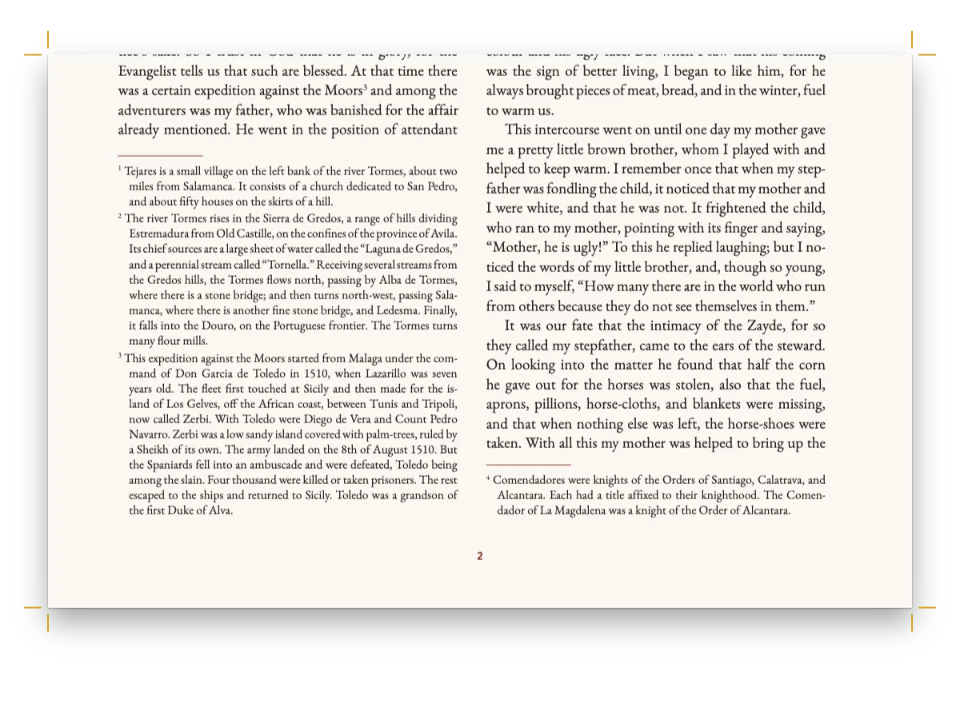
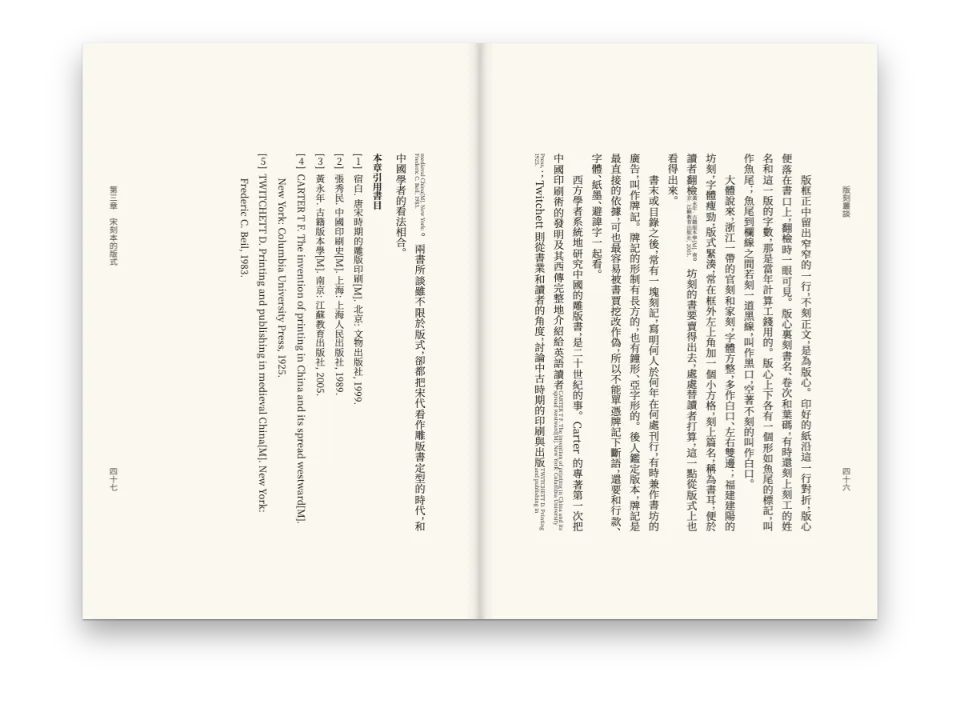
樋口一葉の『たけくらべ』(1895〜96年)の第1章を、四六判の版として4ページに組みます。作品が描く昔の吉原について、7つの注を付けます。注は傍注(ぼうちゅう)、つまり古典の文庫本で使われる傍らの注です。説明する語のあとの行の右に小さな(1)が立ち、見開きの両ページで引用された注は、左ページの小口側に、行長の3分の1の罫の下に、5分の1小さい文字で組まれます。読者はページをめくらずにどの注にもたどり着けます。本文は9.25 ptのShippori Minchoで1行42字、17行です。一葉の長い1つの段落と、ぎつちよんちよんに打たれたゴマの圏点をそのまま残しています。ヨーロッパの小説で段の下に注を置く例はNo. 071です。
このレシピが答える質問
- 日本語の本で、(1)の注を章末、ページの下、または見開きにわたって本文の横に置くには?
- 脚注を付けるには?
- 日本語のテキストを、イタリックではなくゴマ圏点や傍線で強調するには?
手短な答え
// placement 'spread' gathers the notes cited on the two pages of a spread at the end of the
// left-hand page's text, the fore-edge in a book bound on the right, under a rule a third of
// the line long, and numbers them per spread. The marker (1) stands small at the right of
// the line, its digits upright, and the note opens with its number and a full note-em.
const footnotes = {
  placement: 'spread', // 傍注; 'chapterEnd' sets 後注 after the chapter instead
  numbering: 'spread',
  markerPosition: 'right', markerTemplate: '({n})', // written out: 'ja' sets them so
  numberGap: 'em', hangingIndent: em(2), // turnovers clear the number
  fontSize: em(0.8), lineHeight: em(1.5),
  separator: { width: 1 / 3, lineWidth: pt(0.5), color: col('plum') },
};
// Ichiyō's sesame marks (傍点) over ぎつちよんちよん: the mark Japan uses, right of the line.
const cjk = {
  grid: { enabled: true, charsPerLine: CHARS, linesPerPage: LINES },
  emphasisMark: { style: 'sesame', position: 'over' },
};
材料
- 機能
- 日本の本の注脚注日本語の圏点(傍点)縦組み右綴じの本ふりがな:漢字に付ける仮名の読み縦組みの中の正立した数字漢数字と仮名の番号行取りの見出し文字グリッド日本語の改行(禁則処理)青空文庫の取り込み中国語・日本語・韓国語のフォント柱とノンブルページの役割ごとの柱見出しスタイルデザインした章扉見開きの余白セマンティックカラーパレットPDFの書き出し
- 種類
- Shippori Mincho, Noto Sans JP (SIL OFL 1.1)
- 素材
- なし:図はすべてコードで描画
作り方
#1 · 見開きの注を左ページの小口側にまとめる
コードは上の手短な答えにあります。footnotes.placement: 'spread'は、2ページと3ページで引用された注を3ページの本文の最後、つまり右綴じの本ではその小口側に組みます。numbering: 'spread'で、注の番号は見開きごとに(1)から始まります(脚注)。右ページで引用された注は左ページを待ちます。注のせいで左ページに本文が1行も残らなくなる場合は、残りの注は右ページの地に置かれます。JLReqが認めているとおりです。jaのタグを付けた文書では、縦組みの本の合印はすでに行の右に0.7 emの({n})として、数字を正立させて組まれます。明示的に書いた2行はそれを示すためのものです。numberGap: 'em'で番号のあとに注の文字の全角1字分をあけ、hangingIndent: em(2)で折り返し行をその先にそろえます。
#2 · 日本語の慣習どおりの位置に合印を書く
Markdownでは、注が説明する語のあとに見返り柳[^1]と書き、注は章の最後に[^1]: …の段落として書きます。合印は注が説明する語のあとに置きます。文末に来る合印は。の前に置き(…先生[^1]。)、エンジンは。や合印を行頭に置きません。7つの注はこのレシピのために書いたもので、見返り柳とお齒ぐろ溝が何だったか、大音寺前がどこにあったか、酉の市で何が売られていたかを、平易な現代の日本語で説明しています。
#3 · 底本のゴマの圏点を残す
cjk.emphasisMarkは、この本で*…*と:dots[…]が何を印字するかを決めます。縦組みの行の右に打つゴマ点です。jaの文書はすでにゴマ点を使います。明示的に書くと、機能一覧の圏点の項目が有効になります。青空文庫のテキストはぎつちよんちよんに傍点を付けており、aozora.pyはそれを:dots[ぎつちよんちよん]{style=sesame}と書きました。中国語の本では代わりに行の下に点を打ちます(圏点と傍線、ルビ、割注)。
#4 · 見開きで始める
// Page-anchored design on a vertical page: x runs down the page from its top edge, y across
// it leftwards from its right edge. The title stands on the page's axis, the author lower.
const PT = 25.4 / 72; // mm in a point
const page = (down, across) => ({ anchor: { to: 'page', edge: 'top-left' },
  offset: { x: mm(down), y: mm(across) } });
const TITLE = 26; // pt
// gotcha: headings-drop-h1-break
const story = { level: 1, breakBefore: { enabled: true, parity: 'any' },
  advancedDesign: { enabled: true, minHeight: lines(LINES), slot: { elements: [
    { kind: 'text', id: 'title', content: '{titleText}', fontFamily: MINCHO, fontWeight: 700,
      fontSize: pt(TITLE), lineHeight: 1, letterSpacing: pt(TITLE / 2), color: col('ink'),
      placement: page(42, 127 / 2 - (TITLE * PT) / 2) },
    { kind: 'rule', id: 'rule', direction: 'horizontal', thickness: pt(0.6), color: col('plum'),
      placement: { ...page(42, 127 / 2 + (TITLE * PT) / 2 + 5), size: { width: mm(24) } } },
    { kind: 'text', id: 'author', content: '{author}', fontFamily: MINCHO, fontSize: pt(12),
      letterSpacing: pt(4), color: col('ink'),
      placement: page(118, 127 / 2 + (TITLE * PT) / 2 + 3) },
  ] } } };
const section = { level: 2, fontFamily: MINCHO, fontWeight: 700, fontSize: pt(11),
  lineSpan: 3, indent: em(7) }; // 3行取り, seven characters down, as the Aozora text marks it
章の最初の文は、最初の3行のうちに4つの注を引用します。1ページの表題の下に組むと、本文には3行分の場所しか残りません。左ページに入るのはその見開きの注だけで、ほかのページの注は入りません。1ページに扉だけを単独で置くと、章は右ページの2ページへ移り、最初の見開きに本文とそのすべての注が収まります。扉は第1レベルの見出しで、そのデザインがページを埋めます。仕上がりに固定しているので、表題はページの中心線上に立ちます。
#5 · 柱とノンブルを小口側に縦に入れる
const foreEdge = (id, content, parity, edge, y, pages) => ({
  kind: 'text', id, content, parity, pages, writingMode: 'vertical-rl',
  fontFamily: GOTHIC, fontSize: pt(7), letterSpacing: pt(1), color: col('muted'),
  overflow: 'clip', placement: { anchor: { to: 'outer', edge }, offset: { y: em(y) } },
});
const header = { elements: [
  foreEdge('hashira', '{title}', 'odd', 'top', 2, 'body'),
  foreEdge('folio', '{pageNumber}', 'all', 'bottom', -2, 'body'),
] };
// The title page carries the colophon across the foot, in the edition's language.
const footer = { elements: [{ kind: 'text', id: 'colophon', content: '{attr.colophon}',
  pages: 'opener', fontFamily: GOTHIC, fontSize: pt(5.5), lineHeight: 1.45,
  color: col('muted'), overflow: 'wrap', align: 'center',
  placement: { anchor: { to: 'page', edge: 'bottom' }, offset: { y: mm(-6) },
    size: { width: mm(100) } } }] };
表題は左ページの小口側の余白に、注の外側に縦に入ります。漢数字のノンブルは、扉を除くすべてのページの下に入ります。
レシピの全体
// ═══ Postext Cookbook · Nº 121 · Notes beside a vertical Japanese text, across the spread ══ // https://postext.dev/en/cookbook/vertical-notes-and-sidenotes // Code: MIT · Text: 樋口一葉『たけくらべ』, Aozora Bunko 389 (PD); notes CC BY 4.0 · Pictures: none // Fonts: Shippori Mincho, Noto Sans JP (SIL OFL 1.1) · Needs postext ≥ 1.16.1 import { buildDocument, renderPageToCanvas, clearMeasurementCache, loadVerticalAlternates, } from 'https://esm.sh/postext'; import { renderToPdf, decompressWoff2 } from 'https://esm.sh/postext-pdf'; const LANG = 'en'; // @lang: the language of the colophon; the story is Japanese in both const RECIPE = 'vertical-notes-and-sidenotes'; // ─── 1 · Design ───────────────────────────────────────────────────────────── // #region palette: ink, a muted plum for the note numbers' rule, cream paper const palette = { ink: '#211d1b', // the text and the notes plum: '#6b3a55', // 紫: the rule over the notes, the engine's defaults muted: '#6b645d', // the hashira and the folios paper: '#fbf7ef', }; const col = (id) => ({ hex: palette[id], model: 'hex', paletteId: id }); const colorPalette = [ ...Object.entries(palette).map(([id, hex]) => ({ id, name: id, value: { hex, model: 'hex' } })), { id: 'main-color', name: 'defaults', value: { hex: palette.plum, model: 'hex' } }, ]; // #endregion const [MINCHO, GOTHIC] = ['Shippori Mincho', 'Noto Sans JP']; const [BODY, LEAD, CHARS, LINES] = [9.25, 16.25, 42, 17]; // pt, pt: 四六判 42字 × 17行 const lines = (n) => pt(n * LEAD); // #region answer: 傍注, the notes of both pages of a spread at the fore-edge of the left one // placement 'spread' gathers the notes cited on the two pages of a spread at the end of the // left-hand page's text, the fore-edge in a book bound on the right, under a rule a third of // the line long, and numbers them per spread. The marker (1) stands small at the right of // the line, its digits upright, and the note opens with its number and a full note-em. const footnotes = { placement: 'spread', // 傍注; 'chapterEnd' sets 後注 after the chapter instead numbering: 'spread', markerPosition: 'right', markerTemplate: '({n})', // written out: 'ja' sets them so numberGap: 'em', hangingIndent: em(2), // turnovers clear the number fontSize: em(0.8), lineHeight: em(1.5), separator: { width: 1 / 3, lineWidth: pt(0.5), color: col('plum') }, }; // Ichiyō's sesame marks (傍点) over ぎつちよんちよん: the mark Japan uses, right of the line. const cjk = { grid: { enabled: true, charsPerLine: CHARS, linesPerPage: LINES }, emphasisMark: { style: 'sesame', position: 'over' }, }; // #endregion // #region opener: a title page (扉) on its own, so the story opens on a spread // Page-anchored design on a vertical page: x runs down the page from its top edge, y across // it leftwards from its right edge. The title stands on the page's axis, the author lower. const PT = 25.4 / 72; // mm in a point const page = (down, across) => ({ anchor: { to: 'page', edge: 'top-left' }, offset: { x: mm(down), y: mm(across) } }); const TITLE = 26; // pt // gotcha: headings-drop-h1-break const story = { level: 1, breakBefore: { enabled: true, parity: 'any' }, advancedDesign: { enabled: true, minHeight: lines(LINES), slot: { elements: [ { kind: 'text', id: 'title', content: '{titleText}', fontFamily: MINCHO, fontWeight: 700, fontSize: pt(TITLE), lineHeight: 1, letterSpacing: pt(TITLE / 2), color: col('ink'), placement: page(42, 127 / 2 - (TITLE * PT) / 2) }, { kind: 'rule', id: 'rule', direction: 'horizontal', thickness: pt(0.6), color: col('plum'), placement: { ...page(42, 127 / 2 + (TITLE * PT) / 2 + 5), size: { width: mm(24) } } }, { kind: 'text', id: 'author', content: '{author}', fontFamily: MINCHO, fontSize: pt(12), letterSpacing: pt(4), color: col('ink'), placement: page(118, 127 / 2 + (TITLE * PT) / 2 + 3) }, ] } } }; const section = { level: 2, fontFamily: MINCHO, fontWeight: 700, fontSize: pt(11), lineSpan: 3, indent: em(7) }; // 3行取り, seven characters down, as the Aozora text marks it // #endregion // #region furniture: the hashira and kanji folios down the fore-edge const foreEdge = (id, content, parity, edge, y, pages) => ({ kind: 'text', id, content, parity, pages, writingMode: 'vertical-rl', fontFamily: GOTHIC, fontSize: pt(7), letterSpacing: pt(1), color: col('muted'), overflow: 'clip', placement: { anchor: { to: 'outer', edge }, offset: { y: em(y) } }, }); const header = { elements: [ foreEdge('hashira', '{title}', 'odd', 'top', 2, 'body'), foreEdge('folio', '{pageNumber}', 'all', 'bottom', -2, 'body'), ] }; // The title page carries the colophon across the foot, in the edition's language. const footer = { elements: [{ kind: 'text', id: 'colophon', content: '{attr.colophon}', pages: 'opener', fontFamily: GOTHIC, fontSize: pt(5.5), lineHeight: 1.45, color: col('muted'), overflow: 'wrap', align: 'center', placement: { anchor: { to: 'page', edge: 'bottom' }, offset: { y: mm(-6) }, size: { width: mm(100) } } }] }; // #endregion const config = () => ({ // a factory: the engine caches resolved configs per object locale: 'ja', // written out, never LANG (gotcha: ja-locale-tag) colorPalette, page: { sizePreset: 'custom', width: mm(127), height: mm(188), dpi: 150, // 四六判 backgroundColor: col('paper'), margins: { top: mm(27), bottom: mm(21), left: mm(13), right: mm(16), mirror: true }, pageNumbering: { format: 'japanese-informal' }, }, layout: { layoutType: 'single', writingMode: 'vertical-rl' }, cjk, footnotes, bodyText: { fontFamily: MINCHO, fontSize: pt(BODY), lineHeight: pt(LEAD), color: col('ink'), boldColor: col('ink'), italicColor: col('ink'), referenceColor: col('ink'), textAlign: 'justify', firstLineIndent: em(1), indentAfterHeading: true, }, headings: { fontFamily: MINCHO, color: col('ink'), levels: [story, section] }, header, footer, }); // ─── 2 · Content ──────────────────────────────────────────────────────────── const markdown = String.raw`---Markdownの見本 · 23行 · content.en.md
title: "たけくらべ" author: "樋口一葉" --- # たけくらべ {colophon="Higuchi Ichiyō, たけくらべ (Child’s Play, 1895–96), chapter one; the notes are this recipe’s. Text: Aozora Bunko 389, public domain. Set in Shippori Mincho and Noto Sans JP (SIL OFL)."} ## 一 廻れば大門の見返り柳[^1]いと長けれど、お齒ぐろ溝[^2]に{燈火|ともしび}うつる三階[^3]の騷ぎも手に取る如く、明けくれなしの車の{行來|ゆきゝ}にはかり知られぬ全盛をうらなひて、{大音寺前|だいおんじまへ}[^4]と名は佛くさけれど、さりとは陽氣の町と住みたる人の申き、{三嶋神社|みしまさま}の角をまがりてより是れぞと見ゆる{大厦|いへ}もなく、かたぶく軒端の十軒長屋二十軒長や、商ひはかつふつ利かぬ處とて半さしたる雨戸の外に、あやしき{形|なり}に紙を切りなして、胡粉ぬりくり彩色のある{田樂|でんがく}みるやう、裏にはりたる串のさまもをかし、一軒ならず二軒ならず、朝日に干して夕日に仕舞ふ手當こと〴〵しく、一家内これにかゝりて夫れは何ぞと問ふに、知らずや霜月{酉|とり}の日[^5]例の神社に欲深樣のかつぎ給ふ是れぞ熊手の下ごしらへといふ、正月門松とりすつるよりかゝりて、一年うち通しの夫れは誠の商賣人、片手わざにも夏より手足を色どりて、{新年着|はるぎ}の支度もこれをば當てぞかし、南無や大鳥大明神、買ふ人にさへ大福をあたへ給へば製造もとの我等萬倍の利益をと人ごとに言ふめれど、さりとは思ひのほかなるもの、此あたりに大長者のうわさも聞かざりき、住む人の多くは{廓者|くるわもの}にて良人は小格子[^6]の何とやら、下足札そろへてがらんがらんの音もいそがしや夕暮より羽織引かけて立出れば、うしろに切火打かくる女房の顏もこれが見納めか十人ぎりの側杖無理{情死|しんぢう}のしそこね、恨みはかゝる身のはて危ふく、すはと言はゞ命がけの勤めに{遊山|ゆさん}らしく見ゆるもをかし、娘は{大籬|おほまがき}の{下新造|したしんぞ}とやら、七軒の何屋が客廻しとやら、{提燈|かんばん}さげてちよこちよこ走りの修業、卒業して何にかなる、とかくは檜舞臺と見たつるもをかしからずや、垢ぬけのせし三十あまりの年増、小ざつぱりとせし唐棧ぞろひに紺足袋はきて、雪駄ちやら〳〵忙がしげに横抱きの小包はとはでもしるし、茶屋が棧橋とんと沙汰して、廻り遠や此處からあげまする、誂へ物の仕事やさんと此あたりには言ふぞかし、一體の風俗よそと變りて、{女子|おなご}の後帶きちんとせし人少なく、がらを好みて巾廣の卷帶、年増はまだよし、十五六の小癪なるが{酸漿|ほゝづき}ふくんで此{姿|なり}はと目をふさぐ人もあるべし、所がら是非もなや、昨日河岸店に何紫の源氏名耳に殘れど、けふは地廻りの吉と手馴れぬ燒鳥の夜店を出して、身代たゝき骨になれば再び古巣への{内儀|かみさま}姿、どこやら素人よりは見よげに覺えて、これに染まらぬ子供もなし、秋は九月{仁和賀|にわか}[^7]の頃の大路を見給へ、さりとは宜くも學びし{露八|ろはち}が物眞似、{榮喜|えいき}が{處|しよ}作、孟子の母やおどろかん上達の速やかさ、うまいと褒められて今宵も一廻りと生意氣は七つ八つよりつのりて、やがては肩に置手ぬぐひ、鼻歌のそゝり節、十五の少年がませかた恐ろし、學校の唱歌にも:dots[ぎつちよんちよん]{style=sesame}と拍子を取りて、運動會に木やり音頭もなしかねまじき風情、さらでも教育はむづかしきに教師の苦心さこそと思はるゝ{入谷|いりや}ぢかくに育英舍とて、私立なれども生徒の數は千人近く、狹き校舍に目白押の窮屈さも教師が人望いよ〳〵あらはれて、唯學校と一ト口にて此あたりには呑込みのつくほど成るがあり、通ふ子供の數々に或は火消鳶人足、おとつさんは{刎橋|はねばし}の番屋に居るよと習はずして知る其道のかしこさ、梯子のりのまねびにアレ忍びがへしを折りましたと訴へのつべこべ、三百といふ代言の子もあるべし、お前の父さんは馬だねへと言はれて、名のりや{愁|つ}らき子心にも顏あからめるしほらしさ、出入りの{貸座敷|いへ}の祕藏息子寮住居に華族さまを氣取りて、ふさ付き帽子面もちゆたかに洋服かる〴〵と花々敷を、坊ちやん坊ちやんとて此子の追從するもをかし、多くの中に{龍華|りうげ}寺の{信如|しんによ}とて、{千筋|ちすぢ}となづる黒髮も今いく{歳|とせ}のさかりにか、やがては墨染にかへぬべき袖の色、{發心|ほつしん}は腹からか、坊は親ゆづりの勉強ものあり、性來をとなしきを友達いぶせく思ひて、さま〴〵の惡戲をしかけ、猫の死骸を繩にくゝりてお役目なれば{引導|いんだう}をたのみますと投げつけし事も有りしが、それは昔、今は校内一の人とて假にも{侮|あなど}りての處業はなかりき、歳は十五、{並背|なみぜい}にていが栗の{頭髮|つむり}も思ひなしか俗とは變りて、{藤本信如|ふぢもとのぶゆき}と{訓|よみ}にてすませど、何處やら{釋|しやく}といひたげの素振なり。 [^1]: 吉原遊廓の入口、大門へ下る衣紋坂の上の日本堤に立っていた柳。帰りの客がここで名残を惜しんで振り返ったという。 [^2]: 遊廓のまわりをめぐる堀。遊女が逃げ出さないように掘られたもので、水が黒く濁っていたのでこう呼ばれた。 [^3]: 廓の中に建ち並ぶ三階建ての大きな妓楼。 [^4]: 吉原の裏手、下谷龍泉寺町のあたりの通称。大音寺の門前にあたる。 [^5]: 十一月の酉の日に鷲(おおとり)神社で開かれる酉の市。縁起物の熊手が売られる。 [^6]: 格の低い、小さな遊女屋。 [^7]: 吉原で秋に催された俄(にわか)。芸者や幇間が茶番や踊りを見せて廓の中を練り歩いた。`; // content.<lang>.md: the same Japanese text in both // ─── 3 · Fonts ────────────────────────────────────────────────────────────── const FONTS = { 'Shippori Mincho': ['400', '700'], // the text and the notes; the title and 一 'Noto Sans JP': ['400'], // the hashira, the folios and the colophon }; // ─── 4 · Build & show ─────────────────────────────────────────────────────── const title = markdown.match(/^title: "(.*)"$/m)[1]; const author = markdown.match(/^author: "(.*)"$/m)[1]; await loadFonts(FONTS, markdown); // the Latin files: the colophon // The notes' (1) and their upright digits come from the text face too. await loadCjkFonts({ [MINCHO]: ['400'] }, `${markdown}()0123456789`, { vertical: true }); await loadCjkFonts({ [MINCHO]: ['700'] }, `${title}${author}一`); await loadCjkFonts({ [GOTHIC]: ['400'] }, `${title}${markdown.match(/colophon="([^"]*)"/)[1]}一二三四五六七八九十`, { vertical: true }); const doc = await buildWithFonts(() => buildDocument({ markdown }, config()), markdown); showBook(doc, { title: t({ en: 'Notes beside a vertical Japanese text, across the spread', es: 'Notas junto a un texto japonés vertical, en la doble página' }) }); offerPdf(() => renderToPdf(doc, { fontProvider: cjkPdfProvider }), `${RECIPE}.pdf`);キット · core, fonts, viewer, pdf, cjk:全レシピ共通 · 453行
// ─── Kit ── helpers shared by every Cookbook recipe · postext.dev/cookbook ───── // ─── Kit · core v1 ── the same in every recipe · postext.dev/cookbook ───────── function mm(value) { return { value, unit: 'mm' }; } function pt(value) { return { value, unit: 'pt' }; } function em(value) { return { value, unit: 'em' }; } /** The sample language's string: t({ en: 'Figure', es: 'Figura' }). */ function t(strings) { return strings[LANG] ?? Object.values(strings)[0]; } /** A file in this recipe's assets folder, served from the Postext repo by jsDelivr. */ function asset(file) { return `https://cdn.jsdelivr.net/gh/drnachio/postext@main/cookbook/${RECIPE}/assets/${file}`; } // ─── Kit · fonts v1 ── the same in every recipe · postext.dev/cookbook ──────── // Postext measures text with the faces the browser has loaded, and caches the // widths, so every face must be ready before the first build. Faces come from // Fontsource: the same static files the PDF embeds, so screen and PDF agree. /** faces = { 'Family Name': ['400', '400i', '700'] }. `text` is the sample: * letters beyond Latin-1 (č, ł, ő…) also load the latin-ext files. With * `optional`, a face Fontsource does not ship is skipped instead of failing. * Resolves to the number of faces added. */ async function loadFonts(faces, text = '', { optional = false } = {}) { kitStatus('Loading fonts…'); const ranges = { latin: 'U+0000-00FF,U+0131,U+0152-0153,U+02BB-02BC,U+02C6,U+02DA,U+02DC,U+0304,U+0308,U+0329,' + 'U+2000-206F,U+20AC,U+2122,U+2191,U+2193,U+2212,U+2215,U+FEFF,U+FFFD', 'latin-ext': 'U+0100-02BA,U+02BD-02C5,U+02C7-02CC,U+02CE-02D7,U+02DD-02FF,U+0304,U+0308,U+0329,' + 'U+1D00-1DBF,U+1E00-1E9F,U+1EF2-1EFF,U+2020,U+20A0-20AB,U+20AD-20C0,U+2113,U+2C60-2C7F,U+A720-A7FF', }; const subsets = /[Ā-˿Ḁ-ỿ]/.test(text) ? ['latin', 'latin-ext'] : ['latin']; const jobs = []; let added = 0; for (const [family, specs] of Object.entries(faces)) { const id = fontsourceId(family); const meta = optional ? await fontsourceMeta(family) : null; for (const spec of new Set(specs)) { const weight = parseInt(spec, 10); const style = spec.endsWith('i') ? 'italic' : 'normal'; if (hasFace(family, weight, style)) continue; if (optional && !(meta?.weights.includes(weight) && meta.styles.includes(style))) continue; for (const subset of subsets) { const url = `https://cdn.jsdelivr.net/npm/@fontsource/${id}@5/files/${id}-${subset}-${weight}-${style}.woff2`; const face = new FontFace(family, `url(${url}) format('woff2')`, { weight: String(weight), style, unicodeRange: ranges[subset] }); jobs.push(face.load().then((ready) => { document.fonts.add(ready); added++; }, () => { if (subset === 'latin' && !optional) throw new Error(`Fontsource has no ${family} ${weight} ${style}`); })); } } } await Promise.all(jobs).catch((error) => { kitFail(error); throw error; }); return added; } /** Runs `build` (a buildDocument or buildBundle call) and checks the faces * the pages use. A regular face missing from FONTS is loaded with a warning; * bold and italic variants are loaded when the family ships them. Then the * measurement caches are cleared and the build runs again. */ async function buildWithFonts(build, text = '') { const tried = new Set(); for (let round = 0; round < 3; round++) { kitStatus('Laying out…'); await new Promise(requestAnimationFrame); // let the status paint first const result = await Promise.resolve().then(build).catch((error) => { kitFail(error); throw error; }); const wanted = { base: {}, variants: {} }; for (const { font, base } of [result].flat().flatMap(fontStringsOf)) { const { family, weight, style } = parseFont(font); const key = `${family}|${weight}|${style}`; if (tried.has(key) || hasFace(family, weight, style)) continue; tried.add(key); (wanted[base ? 'base' : 'variants'][family] ??= []).push(`${weight}${style === 'italic' ? 'i' : ''}`); } if (Object.keys(wanted.base).length) { console.warn(`[cookbook] FONTS does not list ${JSON.stringify(wanted.base)}: loading them.`); } const added = await loadFonts(wanted.base, text) + await loadFonts(wanted.variants, text, { optional: true }); if (added === 0) return result; clearMeasurementCache(); } throw new Error('The fonts did not settle after three builds.'); } /** Every font string of the layout. `base` marks a block's own face; its * bold, italic and bold-italic variants are listed whether or not used. */ function fontStringsOf(doc) { const found = new Map(); const walk = (node) => { if (!node || typeof node !== 'object') return; if (Array.isArray(node)) { node.forEach(walk); return; } for (const [key, value] of Object.entries(node)) { if (typeof value === 'string' && /fontString$/i.test(key)) { found.set(value, found.get(value) || key === 'fontString'); } else if (value && typeof value === 'object') walk(value); } }; walk(doc.pages); walk(doc.blocks); return [...found].map(([font, base]) => ({ font, base })); } /** '700 37.5px Open Sans' / 'italic 400 13px "Source Serif 4"' → { family, weight, style }. * A string with no weight ('95.8px Young Serif', from a design text) is 400. */ function parseFont(font) { const m = /^(?:(italic|oblique)\s+)?(?:small-caps\s+)?(?:(\d+|bold|normal)\s+)?[\d.]+px\s+(.+)$/.exec(font.trim()); if (!m) throw new Error(`Unexpected font string: ${font}`); const weight = m[2] === 'bold' ? 700 : !m[2] || m[2] === 'normal' ? 400 : Number(m[2]); return { family: m[3].replace(/^["']|["']$/g, ''), weight, style: m[1] ? 'italic' : 'normal' }; } /** True when a loaded FontFace covers exactly this family, weight and style * (document.fonts.check() is also true for families nobody declared). */ function hasFace(family, weight, style) { for (const face of document.fonts) { if (face.status !== 'loaded' || face.style !== style) continue; if (face.family.replace(/^["']|["']$/g, '') !== family) continue; const [low, high = low] = face.weight.split(' ').map(Number); if (weight >= low && weight <= high) return true; } return false; } /** Fontsource's id for a family: 'Source Serif 4' → 'source-serif-4'. */ function fontsourceId(family) { return family.toLowerCase().replace(/\s+/g, '-'); } /** The weights and styles a family ships ({ weights: [400, 700], styles: ['normal', 'italic'] }), or null. */ function fontsourceMeta(family) { fontsourceMeta.cache ??= new Map(); const id = fontsourceId(family); if (!fontsourceMeta.cache.has(id)) { fontsourceMeta.cache.set(id, fetch(`https://api.fontsource.org/v1/fonts/${id}`) .then((res) => (res.ok ? res.json() : null), () => null)); } return fontsourceMeta.cache.get(id); } // ─── Kit · viewer v1 ── the same in every recipe · postext.dev/cookbook ─────── /** Shows the pages as facing spreads on a dark desk: the first page is a * recto on its own, then verso | recto pairs, as in a bound book. Pages * are painted when they scroll near the screen. */ function showPages(docs, { title, width = 460 } = {}) { const root = viewer(title); const pages = [docs].flat().flatMap((doc) => doc.pages.map((page) => ({ doc, page, n: (doc.pageIndexOffset ?? 0) + page.index }))); const spreads = []; let verso = null; for (const p of pages) { if (p.n % 2 === 1) { if (verso) spreads.push([verso, null]); verso = p; } else { spreads.push([verso, p]); verso = null; } } if (verso) spreads.push([verso, null]); const density = Math.min(window.devicePixelRatio || 1, 2); showPages.painter?.disconnect(); const painter = new IntersectionObserver((entries) => { for (const { isIntersecting, target } of entries) { if (!isIntersecting) continue; painter.unobserve(target); const { doc, page } = target.postext; renderPageToCanvas(page, doc, target, { scale: (width * density) / page.width }); } }, { rootMargin: '800px' }); showPages.painter = painter; root.replaceChildren(...spreads.map((pair) => { const spread = document.createElement('div'); spread.className = 'pt-spread'; for (const p of pair) { const figure = document.createElement('figure'); if (p) { const label = p.page.pageLabel || String(p.n + 1); const canvas = document.createElement('canvas'); canvas.postext = p; canvas.style.aspectRatio = `${p.page.width} / ${p.page.height}`; canvas.setAttribute('role', 'img'); canvas.setAttribute('aria-label', `Page ${label}`); const folio = document.createElement('figcaption'); folio.textContent = label; figure.append(canvas, folio); painter.observe(canvas); } else figure.className = 'pt-blank'; spread.append(figure); } return spread; })); kitStatus(`${pages.length} ${pages.length === 1 ? 'page' : 'pages'}`); document.documentElement.dataset.postext = 'ready'; return pages.length; } /** The desk, the bar and the error reporting, created once. */ function viewer(title) { if (!document.getElementById('pt-kit')) { document.head.insertAdjacentHTML('beforeend', `<style id="pt-kit"> :root { color-scheme: dark; } body { margin: 0; background: #0e1014; color: #b9bcc4; font: 13px/1.45 system-ui, sans-serif; } #pt-bar { position: sticky; top: 0; z-index: 1; display: flex; flex-wrap: wrap; align-items: center; gap: 6px 16px; padding: 10px 16px; background: rgb(14 16 20 / .92); backdrop-filter: blur(6px); border-bottom: 1px solid #23262d; } #pt-bar strong { color: #f4f1ea; font-weight: 600; } #pt-actions { display: flex; gap: 12px; margin-left: auto; } #pt-actions a, #pt-actions button { color: #d8a21a; font: inherit; background: none; border: 0; padding: 0; cursor: pointer; } #pages { display: grid; justify-items: center; gap: 48px; padding: 32px 16px 72px; } .pt-spread { display: flex; } .pt-spread figure { margin: 0; width: min(460px, 44vw); } .pt-spread canvas { display: block; width: 100%; background: #fff; box-shadow: 0 1px 2px rgb(0 0 0 / .5), 0 22px 44px -16px rgb(0 0 0 / .8); } .pt-spread figure:first-child canvas { box-shadow: inset -14px 0 14px -14px rgb(0 0 0 / .18), 0 1px 2px rgb(0 0 0 / .5), 0 22px 44px -16px rgb(0 0 0 / .8); } .pt-spread figcaption { margin-top: 10px; text-align: center; font: 600 10px/1 system-ui, sans-serif; letter-spacing: .18em; text-transform: uppercase; color: #6c7079; } .pt-blank { visibility: hidden; } @media (max-width: 760px) { .pt-spread { flex-direction: column; gap: 32px; } .pt-spread figure { width: min(460px, 92vw); } .pt-blank { display: none; } } </style>`); document.body.insertAdjacentHTML('afterbegin', '<header id="pt-bar"><strong id="pt-title"></strong><span id="pt-status" role="status"></span><span id="pt-actions"></span></header>'); document.getElementById('pt-title').textContent = document.title || 'Postext'; addEventListener('error', (event) => kitFail(event.error ?? event.message)); addEventListener('unhandledrejection', (event) => kitFail(event.reason)); } if (title) document.getElementById('pt-title').textContent = title; return document.getElementById('pages') ?? document.body.appendChild(Object.assign(document.createElement('main'), { id: 'pages' })); } function kitStatus(text) { viewer(); document.getElementById('pt-status').textContent = text; } function kitFail(error) { document.documentElement.dataset.postext = 'error'; kitStatus(`Error: ${error?.message ?? error}`); } // ─── Kit · pdf v1 ── the same in every recipe that exports a PDF ────────────── /** postext-pdf embeds TrueType bytes. Fetch the Fontsource file the screen * used, snapping to a weight the family ships and falling back to upright * when it has no italic: the PDF asks for every face a block could use. */ async function fontsourceProvider(family, weight, style) { const id = fontsourceId(family); const meta = await fontsourceMeta(family); const weights = meta?.weights?.length ? meta.weights : [400, 700]; const w = weights.reduce((a, b) => (Math.abs(b - weight) < Math.abs(a - weight) ? b : a)); const s = style === 'italic' && meta && !meta.styles.includes('italic') ? 'normal' : style; const res = await fetch(`https://cdn.jsdelivr.net/npm/@fontsource/${id}@5/files/${id}-latin-${w}-${s}.woff2`); if (!res.ok) throw new Error(`Fontsource has no ${family} ${w} ${s} (${res.status})`); return decompressWoff2(new Uint8Array(await res.arrayBuffer())); } /** A "Build the PDF" button in the bar. Once built: "Open the PDF" (a new * tab, since CodePen's preview frame cannot show PDFs) and a download link. */ function offerPdf(makePdf, filename) { viewer(); const button = Object.assign(document.createElement('button'), { type: 'button', textContent: 'Build the PDF' }); button.dataset.postextPdf = filename; button.addEventListener('click', async () => { button.disabled = true; button.textContent = 'Building the PDF…'; try { const bytes = await makePdf(); const url = URL.createObjectURL(new Blob([bytes], { type: 'application/pdf' })); const size = `${Math.max(1, Math.round(bytes.length / 1024))} KB`; button.replaceWith( Object.assign(document.createElement('a'), { href: url, target: '_blank', rel: 'noopener', textContent: 'Open the PDF ↗' }), Object.assign(document.createElement('a'), { href: url, download: filename, textContent: `Download ${filename} · ${size}` })); } catch (error) { button.disabled = false; button.textContent = 'Build the PDF'; kitFail(error); } }); document.getElementById('pt-actions').append(button); } // ─── Kit · cjk v1 ── Chinese, Japanese and Korean books · postext.dev/cookbook ─ // Fontsource ships a CJK family as about a hundred files per weight, each // declared in its stylesheet with the unicode-range it covers. The screen // loads the files the sample touches; the PDF gets the same files for the // characters its pages set in each face, and embeds each as a subset. // A book bound on the right (vertical text) is shown with its spreads // mirrored: page 1 alone on the left of the spine, then [3 | 2]. /** The files of a Fontsource face, read from its stylesheet: { url, range, * ranges }, the last declared first (the order the browser tries them in). */ function cjkSlices(family, weight, style) { cjkSlices.cache ??= new Map(); const id = fontsourceId(family); const css = `https://cdn.jsdelivr.net/npm/@fontsource/${id}@5/${weight}${style === 'italic' ? '-italic' : ''}.css`; if (!cjkSlices.cache.has(css)) { cjkSlices.cache.set(css, fetch(css) .then((res) => { if (!res.ok) throw new Error(`Fontsource has no ${family} ${weight} ${style} (${res.status})`); return res.text(); }) .then((text) => [...text.matchAll(/@font-face\s*{([^}]*)}/g)].map(([, rule]) => { const range = /unicode-range:\s*([^;]+);/.exec(rule)?.[1].trim() ?? 'U+0-10FFFF'; const ranges = range.split(',').map((part) => { const [lo, hi = lo] = part.trim().slice(2).split('-'); return [parseInt(lo, 16), parseInt(hi, 16)]; }); return { url: new URL(/url\(([^)]+?\.woff2)\)/.exec(rule)[1], css).href, range, ranges }; }).reverse())); } return cjkSlices.cache.get(css); } /** The file of `slices` that holds code point `cp`, if any. */ function cjkSliceFor(slices, cp) { return slices.find((slice) => slice.ranges.some(([lo, hi]) => cp >= lo && cp <= hi)); } /** Whether Fontsource serves `family` as a Chinese, Japanese or Korean * family (its subsets name the script). Fails when the API does not * answer: a CJK face taken for a Latin one would paint in a system face. */ async function isCjkFamily(family) { const meta = await fontsourceMeta(family); if (!meta) throw new Error(`api.fontsource.org did not describe ${family}: reload to try again`); return !!meta.subsets?.some((subset) => /^(chinese|japanese|korean)/.test(subset)); } /** faces = { 'Noto Serif TC': ['400', '700'] }, as for loadFonts: the * whole FONTS object may be passed, its other families are left to * loadFonts. Adds one FontFace per file of each CJK face with its * unicodeRange, then loads the files `text` touches. `text` is what the * faces set: the sample for the text face; a book in several voices calls * it once per voice (loadCjkFonts({ 'LXGW WenKai TC': ['400'] }, quotes)), * so the heading and quotation faces fetch and check only their own * characters. Fails when a character of `text` is in no file of a face. * List every weight the pages use: a weight left to buildWithFonts gets * the latin file only. With { vertical: true } it also loads each * family's vertical forms (brackets, quotes, pause marks) for the canvas, * which needs loadVerticalAlternates imported from postext. Resolves to * the number of files loaded. */ async function loadCjkFonts(faces, text, { vertical = false } = {}) { kitStatus('Loading fonts…'); let loaded = 0; try { if (vertical && typeof loadVerticalAlternates !== 'function') { throw new Error('loadCjkFonts(…, { vertical: true }) needs loadVerticalAlternates imported from postext'); } for (const [family, specs] of Object.entries(faces)) { if (!(await isCjkFamily(family))) continue; const twin = []; for (const spec of new Set(specs)) { const weight = parseInt(spec, 10); const style = spec.endsWith('i') ? 'italic' : 'normal'; const slices = await cjkSlices(family, weight, style); const missing = [...new Set(text)].filter((ch) => /\S/.test(ch) && !cjkSliceFor(slices, ch.codePointAt(0))); if (missing.length) { throw new Error(`${family} ${spec} has no file for ${missing.slice(0, 12).join(' ')}: ` + `give each face the text it sets (loadCjkFonts({ '${family}': ['${spec}'] }, text))`); } for (const slice of slices) { document.fonts.add(new FontFace(family, `url(${slice.url}) format('woff2')`, { weight: String(weight), style, unicodeRange: slice.range })); twin.push({ source: slice.url, weight: String(weight), style, unicodeRange: slice.range }); } const font = `${style === 'italic' ? 'italic ' : ''}${weight} 16px "${family}"`; loaded += (await document.fonts.load(font, text)).length; if (!document.fonts.check(font, text)) throw new Error(`${family} ${spec} did not load for the sample`); } // The same files under a twin name with the `vert` feature on: the // canvas paints the punctuation of vertical lines with it. if (vertical && twin.length) await loadVerticalAlternates(family, twin); } } catch (error) { kitFail(error); throw error; } return loaded; } /** The PDF font provider for recipes with CJK faces: a family whose * Fontsource subsets are Chinese, Japanese or Korean gets the files that * hold the characters its pages set (`request.codePoints`); any other * family gets the latin file fontsourceProvider fetches (the "pdf" block) * and, when the face sets letters only latin-ext has, that file too. */ async function cjkPdfProvider(family, weight, style, request) { if (!(await isCjkFamily(family))) return cjkLatinPdfFiles(family, weight, style, request); const meta = await fontsourceMeta(family); const weights = meta.weights?.length ? meta.weights : [400, 700]; const w = weights.reduce((a, b) => (Math.abs(b - weight) < Math.abs(a - weight) ? b : a)); const s = style === 'italic' && !meta.styles.includes('italic') ? 'normal' : style; const slices = await cjkSlices(family, w, s); const picked = new Set(); for (const cp of request?.codePoints ?? []) { const slice = cjkSliceFor(slices, cp); if (slice) picked.add(slice); } if (!picked.size) picked.add(slices[0]); return Promise.all(slices.filter((slice) => picked.has(slice)).map(async (slice) => { const res = await fetch(slice.url); if (!res.ok) throw new Error(`Fontsource file ${slice.url} (${res.status})`); return decompressWoff2(new Uint8Array(await res.arrayBuffer())); })); } /** A Latin family set next to the CJK faces: its latin file, then its * latin-ext file when the face sets letters only latin-ext has (ō ū in * Hepburn rōmaji, ǎ in pinyin), the file loadFonts adds on screen for * them. Latin comes first: postext-pdf draws a character from the first * file that has it, as the browser takes a character both files hold from * latin. A face Fontsource ships without latin-ext, or whose file does * not come, gets latin alone, and the PDF names the letters it lacks. */ async function cjkLatinPdfFiles(family, weight, style, request) { const meta = await fontsourceMeta(family); const beyond = [...(request?.codePoints ?? [])].some(cjkLatinExtOnly); if (!beyond || !meta?.subsets?.includes('latin-ext')) return fontsourceProvider(family, weight, style); const weights = meta.weights?.length ? meta.weights : [400, 700]; const w = weights.reduce((a, b) => (Math.abs(b - weight) < Math.abs(a - weight) ? b : a)); const s = style === 'italic' && !meta.styles.includes('italic') ? 'normal' : style; const id = fontsourceId(family); const url = `https://cdn.jsdelivr.net/npm/@fontsource/${id}@5/files/${id}-latin-ext-${w}-${s}.woff2`; const [latin, ext] = await Promise.all([fontsourceProvider(family, weight, style), fetch(url) .then(async (res) => (res.ok ? decompressWoff2(new Uint8Array(await res.arrayBuffer())) : null), () => null)]); return ext ? [latin, ext] : latin; } /** Whether code point `cp` is in Fontsource's latin-ext file and not in * its latin file: Latin Extended-A and -B, IPA, the spacing modifiers and * Latin Extended Additional (loadFonts's test for latin-ext), less the * few latin holds too (ı Œ œ ʻ ʼ ˆ ˚ ˜). */ function cjkLatinExtOnly(cp) { if (!((cp >= 0x100 && cp <= 0x2ff) || (cp >= 0x1e00 && cp <= 0x1eff))) return false; return ![0x131, 0x152, 0x153, 0x2bb, 0x2bc, 0x2c6, 0x2da, 0x2dc].includes(cp); } /** showPages for a book bound on either edge. A right-bound book (the * document says so: doc.binding is 'right' for page.binding 'right' and * for vertical text) lies on the desk as it opens: page 1 alone on the * left of the spine, then [3 | 2], the spine shade on each page's inner * edge. `binding` ('left' | 'right') overrides the document's. */ function showBook(docs, { binding, ...options } = {}) { const count = showPages(docs, options); const right = (binding ?? [docs].flat()[0]?.binding) === 'right'; if (!document.getElementById('pt-kit-cjk')) { // The pages keep direction ltr: a canvas draws text in the direction its // element inherits, and under rtl each run would end where the engine // starts it, its brackets mirrored. document.head.insertAdjacentHTML('beforeend', `<style id="pt-kit-cjk"> .pt-spread[dir="rtl"] canvas { direction: ltr; } .pt-spread[dir="rtl"] figure:first-child canvas { box-shadow: inset 14px 0 14px -14px rgb(0 0 0 / .18), 0 1px 2px rgb(0 0 0 / .5), 0 22px 44px -16px rgb(0 0 0 / .8); } </style>`); } // Each pair stays [verso, recto] in the page; right to left, the verso // sits on the right. Phones stack the pages in reading order either way. for (const spread of document.querySelectorAll('#pages > .pt-spread')) spread.dir = right ? 'rtl' : 'ltr'; document.getElementById('pages').dataset.binding = right ? 'right' : 'left'; return count; } // ─── /Kit ───────────────────────────────────────────────────────────────────────
組み立てたscript.jsはそのまま動きます。任意のページのモジュールスクリプトに貼り付けるか、レシピをCodePenで開いてください。 GitHub上のレシピのフォルダー ↗ (新しいタブで開きます)
アレンジ
#注を章の最後にまとめる
placementを指定しないと、縦組みのjaの本は注を後注(こうちゅう)として組みます。章の本文のあとに、同じ罫の下に、章を通した番号で組まれます。ここでは注が4ページの左半分を埋めます。
-  placement: 'spread', // 傍注; 'chapterEnd' sets 後注 after the chapter instead
-  numbering: 'spread',
+  placement: 'chapterEnd', // 後注, the default for a vertical ja book
+ numbering: 'chapter',#合印を語の横に置く
markerPosition: 'side'にすると、行間のルビのように、行の横のあきに小さな合印を組みます。合印は行の中の場所をまったく取りません。
-  markerPosition: 'right', markerTemplate: '({n})', // written out: 'ja' sets them so
+ markerPosition: 'side', markerTemplate: '{n}',よくあるつまずき
つまずき
日本語のテキストのタグは'ja'。zh-HansやLANGにしない
レシピの版はenとesですが、日本語のサンプルはどちらの版でも日本語です。`locale: LANG`では英語やスペイン語とタグ付けされ、中国語のタグでは中国語の規則で組まれます(開明式の約物、小書きの仮名が行頭に来てもよい、図の代わりに图、PDFでは中国の字形)。'ja'と書いてください。日本の地域(JLReqの改行と約物、ゴマの圏点、ルビの間隔、図と表の表示名)が選ばれ、ハイフネーションが切られます。リントは、zhやkoのタグで仮名を含むテキストをエラーにします。 日本語の改行(禁則処理) →
つまずき
headingsオブジェクトを渡すとH1の改ページが消える
既定ではH1は奇数ページへ改ページします(always-odd)。ところがheadingsオブジェクトを渡すと中身にかかわらずこの既定がリセットされ、章は改ページせずに続けて組まれ、span: 'page'も効かなくなります。どの設定でもheadings.levels[0].breakBefore: { enabled: true, parity }を書き直してください。 奇数ページから始まる章 →
つまずき
中国語の書体はcjkブロックを通じてスライス単位で読み込む
Fontsourceは中国語、日本語、韓国語のファミリーを、ウェイトごとに約100個のファイルとして配信し、各ファイルが文字の範囲を受け持ちます。loadFontsが取得するのはlatinファイルだけなので、画面では漢字がシステムの書体で出て計測が狂い、fontsourceProviderはPDFにそのlatinファイルを渡すため、漢字が空の四角で印字されます。キットのcjkブロックを挙げ、loadFontsのあとにloadCjkFonts(FONTS, markdown)を呼び(本で複数のCJK書体を使うときは、それぞれの書体で組むテキストを渡して書体ごとに1回)、renderToPdfにfontProvider: cjkPdfProviderを渡してください。どちらもテキストの文字を含むファイルを取得します。 中国語・日本語・韓国語のフォント →
つまずき
右綴じの本の見開きはshowBookで表示する
右綴じの本(アラビア語、ヘブライ語、ペルシア語のテキスト、縦組みの中国語、またはpage.binding 'right')でも1ページは奇数ページですが、背の左側に来て、見開きは[3 | 2]と並びます。showPagesはどの本も左綴じとして並べます。bookブロックのshowBook(cjkブロックにも同じ関数があります)はdoc.bindingを読み、見開きを左右反転します。capture.heroでは、見開きは引き続き読む順の[偶数ページ, 奇数ページ]、つまり[2, 3]と指定します。 右綴じの本 →
クレジット
- 本文
- 樋口一葉「たけくらべ」 (Child’s Play, 1895–96), chapter one; Aozora Bunko card 389, from 「日本現代文學全集10 樋口一葉集」 (Kōdansha, 1962), input 青空文庫, proofreading 米田進 and 小林繁雄, converted with aozora.py; the seven notes were written for this recipe (CC BY 4.0) · Higuchi Ichiyō; Aozora Bunko volunteers · パブリックドメイン
- フォント
- Shippori Mincho (SIL OFL 1.1) · Noto Sans JP (SIL OFL 1.1)